
Ever since we tested the 49 after the 2009 Cannes Boat Show, we have been impressed by the dynamic qualities of this first “new generation” Outremer. The appearance in the Spring of 2013 of a longer version bears witness to the evolution of the yard. It’s not simply a question of cosmetic restyling, the technical aspects of this vessel dedicated to modern cruising have also progressed.
Infos pratiques
- Le chantier : Outremer 51
- La fiche technique
-
 Découvrez notre vidéo exclusive
- Financez votre Outremer 51
- Assuez votre Outremer 51
- Articles autour du Outremer 51
An acknowledged pedigree
With the 40’-43’, Gerard Danson’s Outremer yard has given shape to a truly visionary family catamaran. Simple, fun to helm, reliable, accessible and attractive. This true cruiser-racer catamaran has had great commercial success, and is still a star of the second-hand market today. What would become of an even more sporty version with a rotating mast? No one knows, as the boss wasn’t keen on such high-tech expensive accessories! Those who have dared to try these transformations (such as Yanneraud, a 43’ and Wally Walou, a 45’) have discovered untapped potential in their magic vessels, despite their simplicity and their chronic allergy to being overloaded.
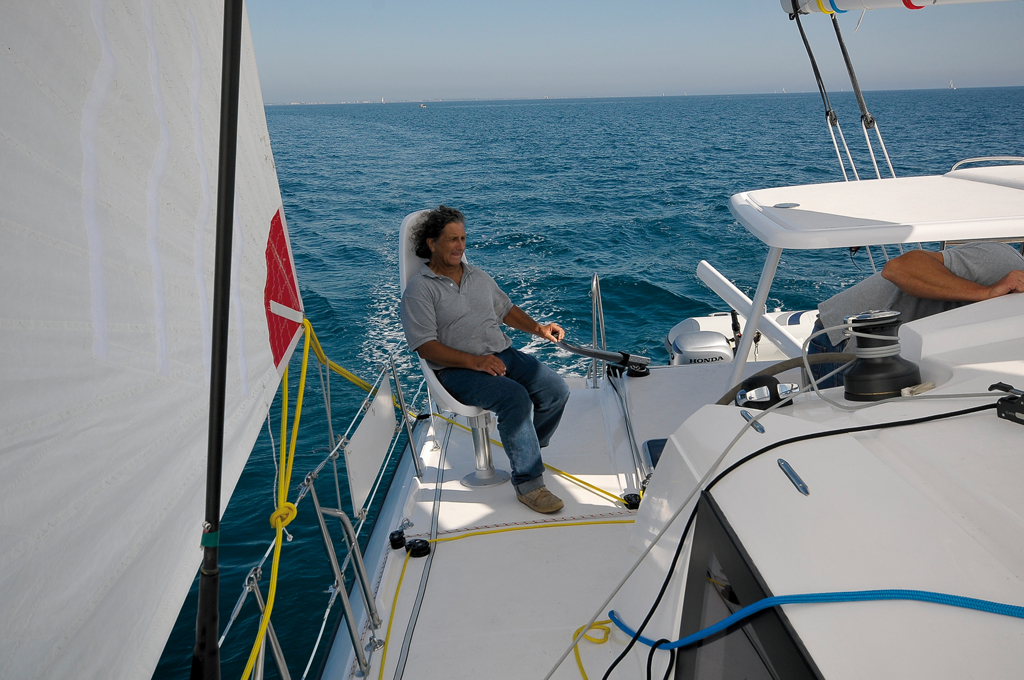
Like all models of the new generation, the 51 has wheel steering, but also has the option of having tillers.
Heritage with commercial focus
The revival of a high performance boat brand, like that of a prestigious automobile manufacturer, demands tact and vision. A generation of owners were left orphaned by the sudden disappearance of the founder in 2005, especially as the architect had not yet foreseen a follow-up of this creative and industrial adventure. After some uncertainty, Outremer found a new captain in the form of Xavier Desmaret, which meant that all that was missing was a designer! The choice of Christopher Barreau for the 49 and VPLP for the 5X have proved to be well-judged. As has the recruitment of Christophe Comar to the production team. It’s true that there has been a real leap forward in the range between these models and the previous generation. The prices have kept pace with the technical and marketing evolutions, but the DNA of the two families is still intact. The taste for making playful multihulls built for long distance cruising, and yet ready to occasionally race round the cans, has remained the same.
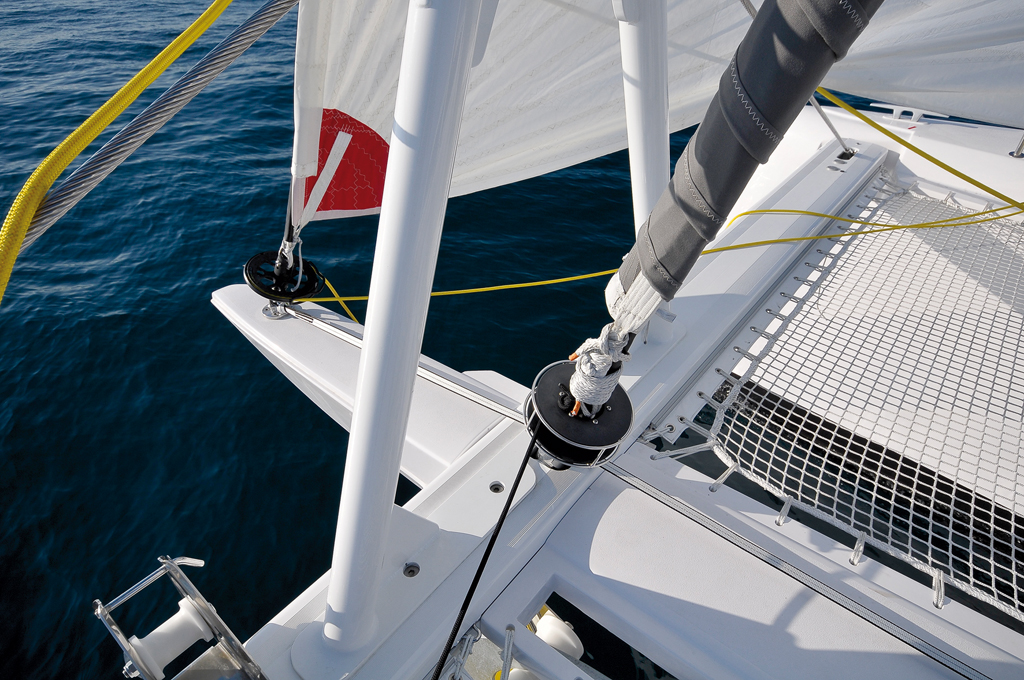
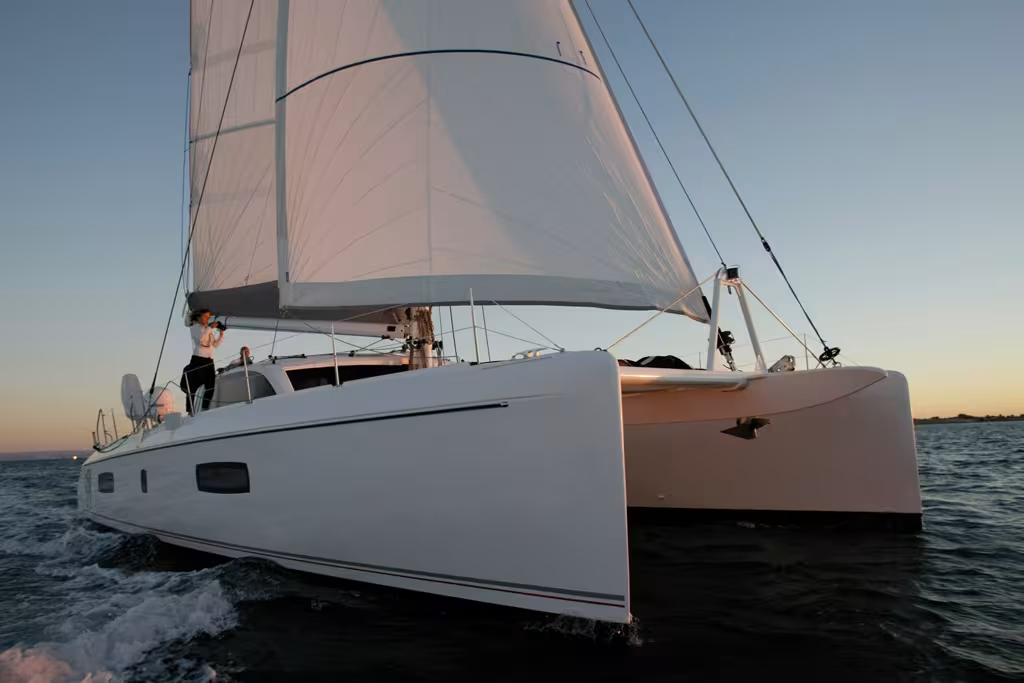
The new forward crossbeam is striking: essential for overall stiffness.
The designers of the 51: Christophe Barreau and Frederic Neuman
The buyers of blue water cruising catamarans have changed in 25 years. The generation who got carried away by the must-have that was the 55’ Light have gotten older, and these days no one’s looking for such angular and compartmentalized interiors! A few of Outremer’s current customers remember this era, but this isn’t what they have signed up for. They are waiting for their Outremers with civilized sporting qualities, and the capacity to cope with being loaded up for living aboard. Christophe Barreau is a sailing naval architect, with the polished profile of a young man which hides a love of off-piste maritime adventure, and a determination to design performance catamarans. Several generations of Catana owe part of their success to him, and the turbulent TS 50-52 propelled him into the small circle of the world’s fastest cruising multihull designers.
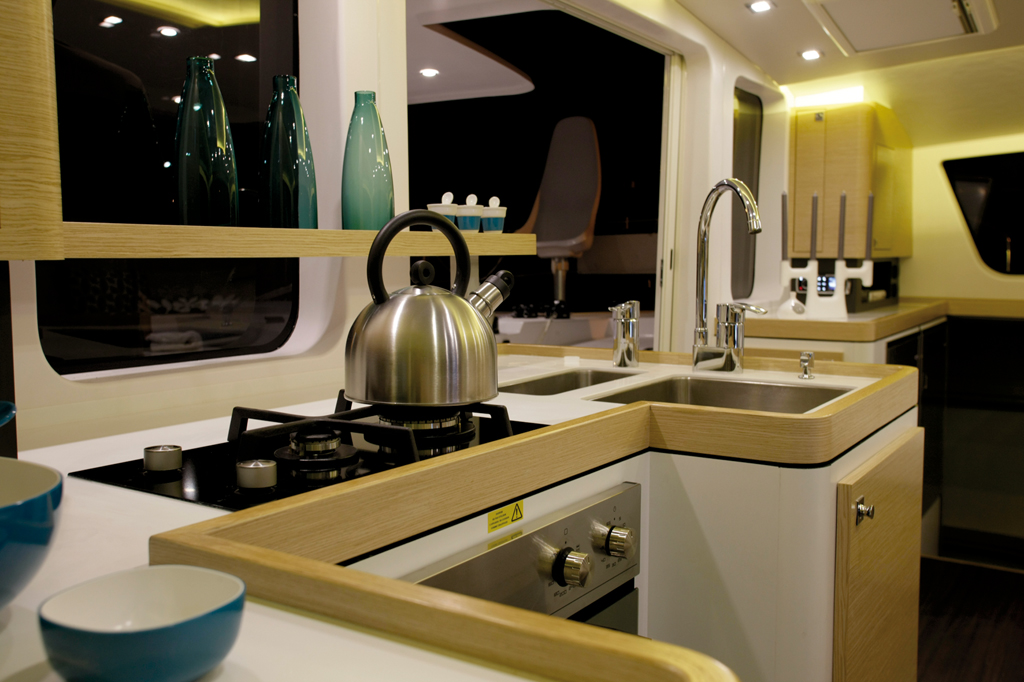
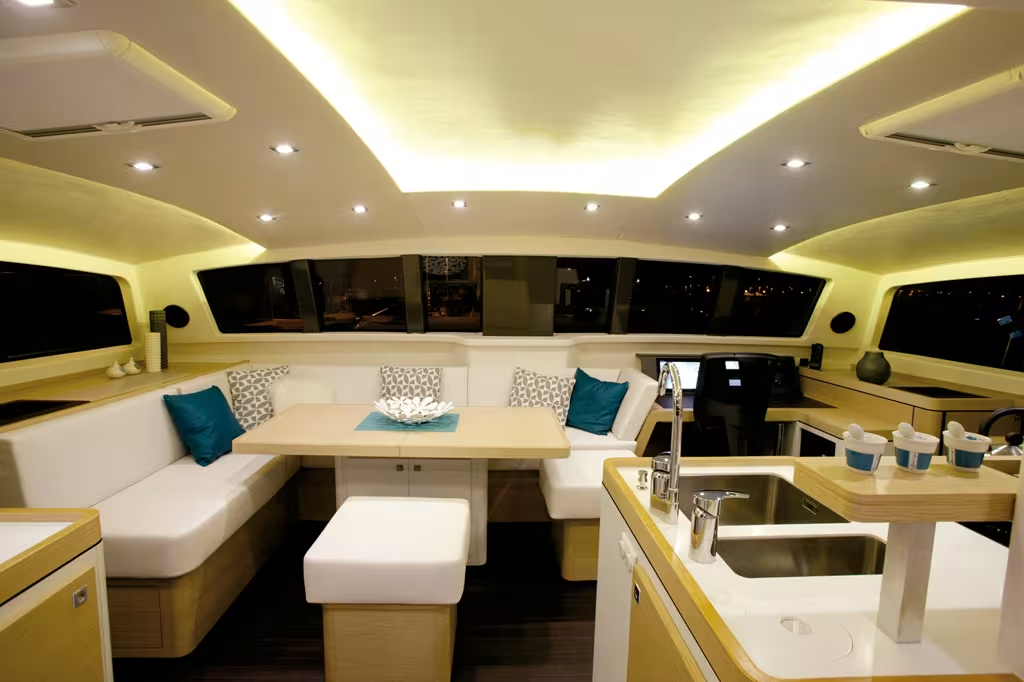
Functional galley for preparing a nice dinner, with a view of the best anchorages of the voyage
The 51: the spirit of the 49
The completion of a successful model passes through several successive stages: like an automobile, the grafting of innovative solutions onto proven bases leads progressively to the complete expression of potential. Don't forget the integrated Lancia Delta, Sierra Cosworth, Subaru wrx, Mitsubishi Lancer evolution or Omega Lotus, all classic examples of the efforts of design teams and sport workshops which made it possible for these widely known saloon cars to become racing legends. All things being equal, the position of Outremer with the 51 is close to this. The work on the chassis has shown the advantage of lengthening the boat and offering more sophisticated structural options. The approach to the sail plan has opened up the possibility of increased efficiency by popularizing the option of carbon masts (rotating or fixed) and square-top mainsails. All of this effort is aimed at appealing to lovers of catamarans. It is a typical 15 meter cruising catamaran, seaworthy and high performance, able to be crewed by a family.
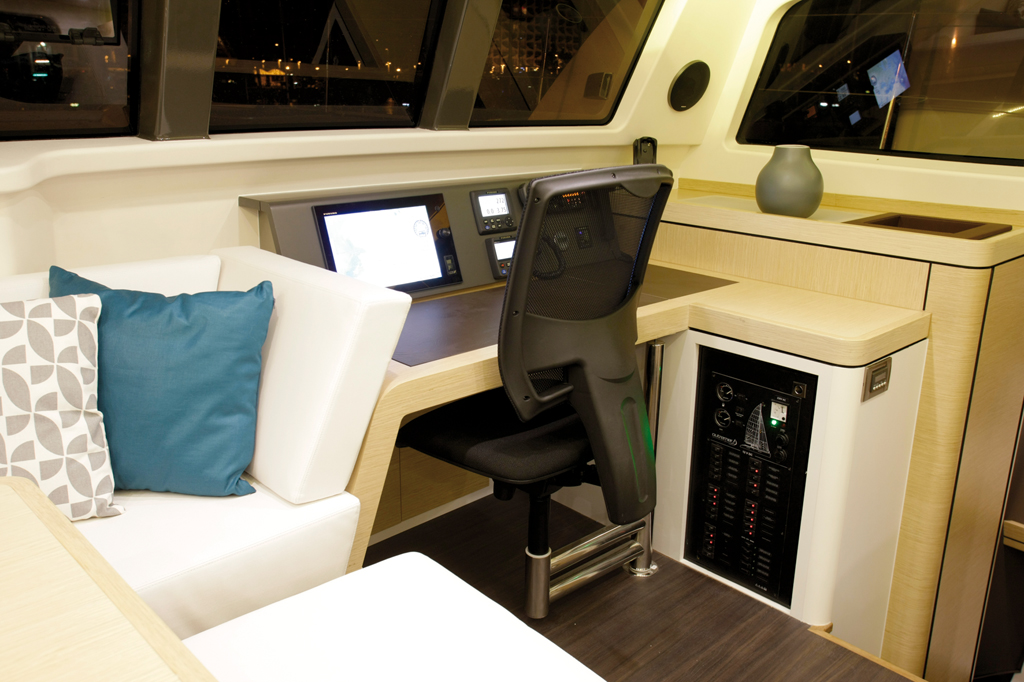
Forward-facing chart table for night watches in the warm with a good view over the sea
The technical advances
The 51, like its predecessor, is constructed out of poly-vinylester infusion, with the bottom of the hulls rightly constructed in one solid piece, so that the boat can take the ground. Thanks to the skegs protecting the saildrive legs and the rudder blades, the boat can be carefully beached. The yard can also build a foam/carbon sandwich structural bulkheads option, of which the stiffness and reduction in weight enhance the increase in power generated by the carbon mast and square top mainsail.
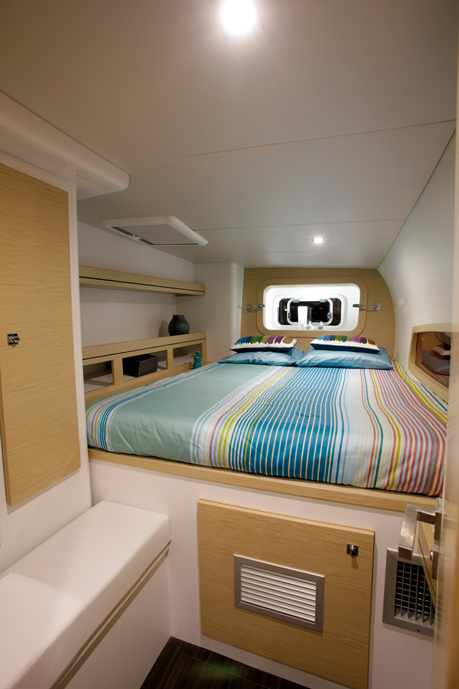
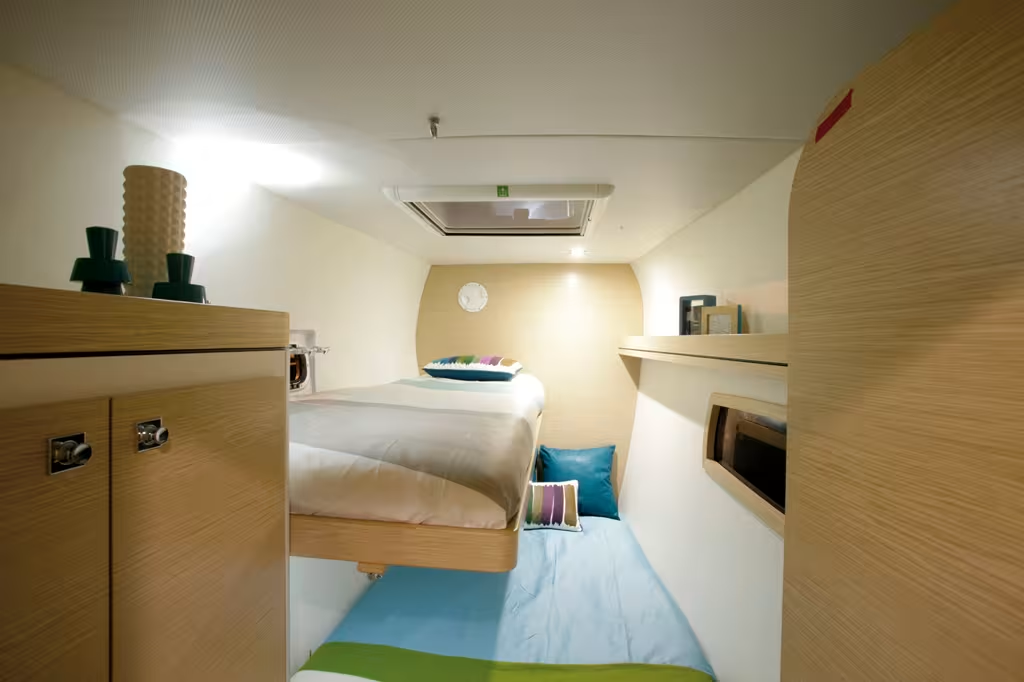
The cabins are light and airy. Great in the tropics, yet comfortable and cozy in poor weather.
Crazy Louise: an upgraded 51
Our test boat is a delightful owners’ version and the deck plan and structural options have benefitted from the input of Didier Ragot, the crewmember, fine-tuner and fixer for Olivier de Kersauson (French round the world record holder). The beautiful Lorima mast (without pre-bend) and the carbon boom make up some of the luxurious equipment which significantly improves the aerodynamics, and reduces pitching, with Kevlar being the obvious choice for the rigging. The design of the headsails is taken from longstanding racing world products. The all-or-nothing genoa on an anti-twist braided forestay provides greater reliability whilst reducing the considerable weight and drag of a metal furler. The staysail on its own detachable braided stay complements the genoa, and will be used as the sailplan for passage-making in fresher conditions (often with the first reef taken in). For light wind conditions, the maxi-gennaker is the ultimate weapon. But Didier Ragot’s suggestions don’t stop there: the traveler lines are led back to the helm; large Antal rollers have been added at the mast for the halyards; and oversize clutches have been installed. The overlapping genoa is preferred to the self-tacking solent jib, due to better performance, and tillers are obviously mandatory. Didier had wanted one last thing: to do away with the compression frame in favor of a carbon cross included in the forward beam. However, both the yard and the owner had preferred to stop there.
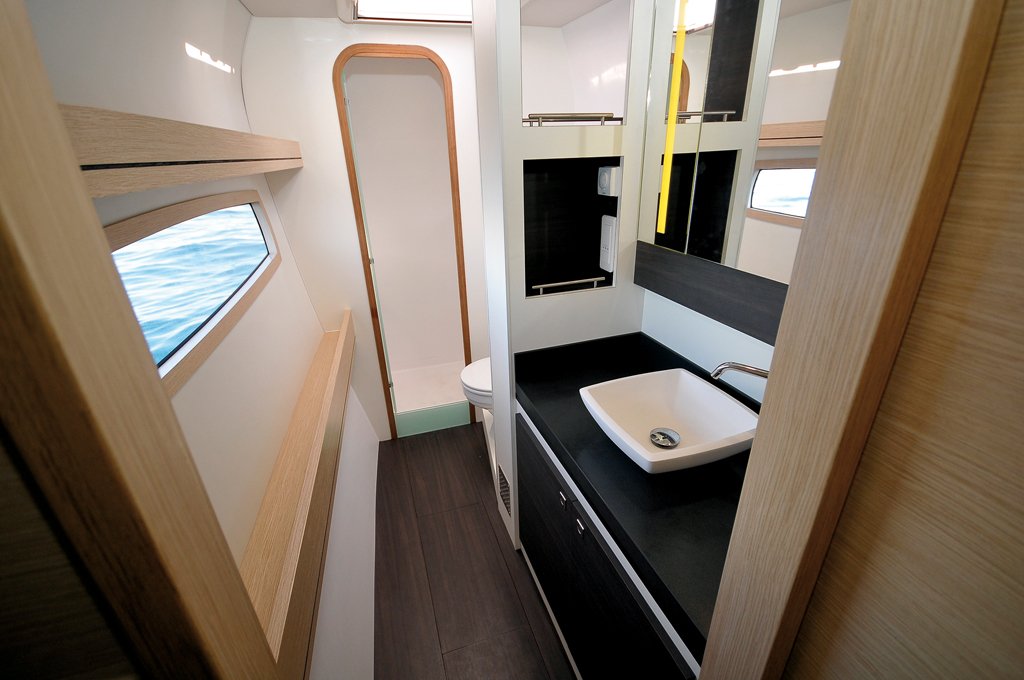
The owners heads compartment is one of the best in the market sector.
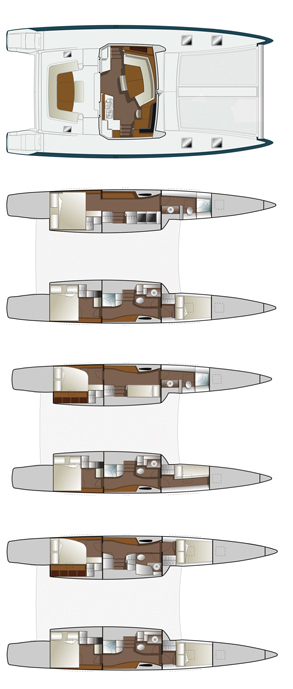
Interior modeling
Outremer has now found its style of interior design and joinery. Light is everywhere, thanks to two small round opening hatches opposite the two passages down into the hulls. The successful use of the right materials gives a neat and flattering look. The interior finish in light oak with a dark grain complements the dark floors, whose grain can still be seen. Considering the warmth the modern headlining gives, the fitting is exemplary. The difficulty of creating a “sport/comfort” brand has been overcome. The engine rooms are clear and straightforward, with good access for servicing. Certain ancillaries (filters, casings, etc) are screwed directly into the composite, but I would have preferred to have seen them fixed to glued-on panels. The system connecting the rudder linkage to the tillers or wheel is remotely operated (via cable with a push-pull handle) and the design of the complex mechanics for this is cunning, and remarkably well welded. This mechanism gives a much better feel and helm response than a hydraulic system, which this renders obsolete.
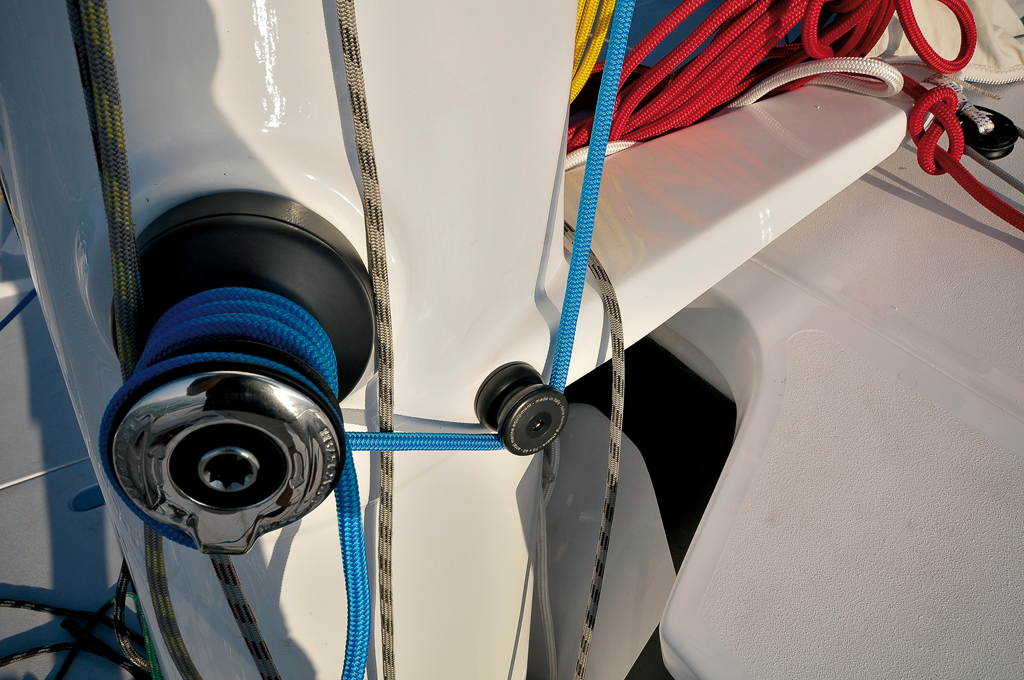
The deck layout has been enhanced by Didier Ragot, organizer for Olivier de Kersauson.
Sea trial: gliding along in comfort
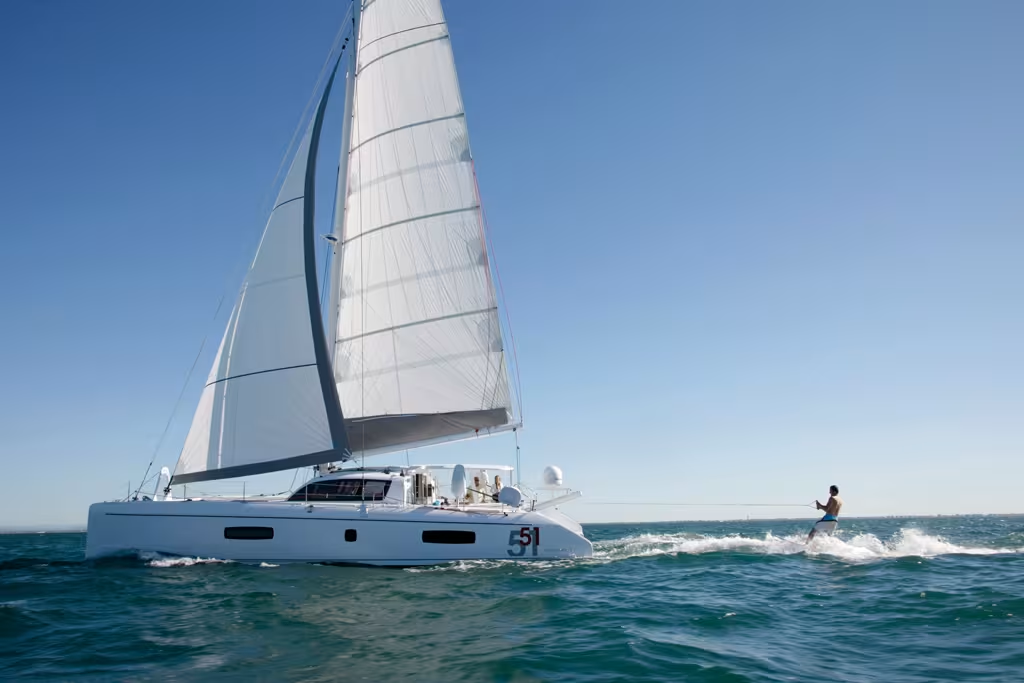
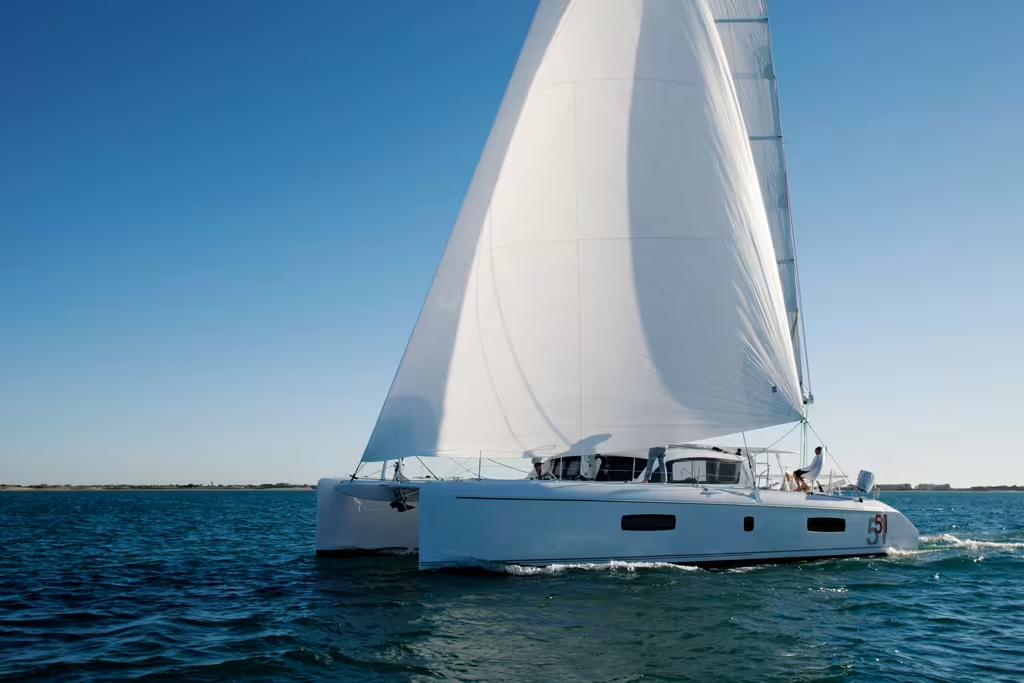
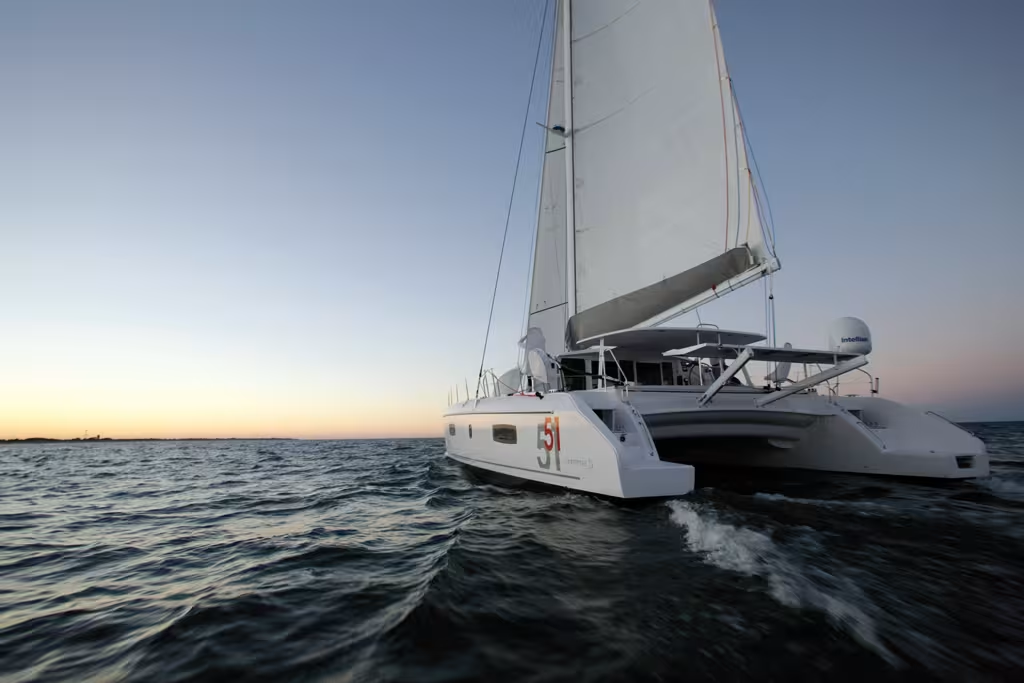
When we seatrialed the 49’ we tested the boat in a severe easterly gale between Cannes and Marseille: the behavior of the hulls in this very heavy and confused sea state showed great agility, testament to the large freeboard and bow volumes. On the 51 we found that this increase in height is invaluable when faced with conditions “at the limit”! As soon as you step aboard Crazy Louise, there is a more distinct feeling of ease than on the previous model. The lengthening of the sugar scoops by 60cm increases the dynamic flotation and smoothes out the wake, and the major changes to the rig give more power. Beating to windward under the maxi gennaker, there is a great feeling of stability. With the daggerboards down the apparent wind increases to the point that you have to bear away to contend with the increase in acceleration and avoid luffing up the (very) large headsail. The contact between the frame and the rig is direct and sensitive: the rotating mast adjustment isn’t just there for fun, it’s for efficiency. The increase in airflow brought about by aerodynamic improvements is noticeable, benefitted by the profile of the radial hydranet mainsail. From his seat, the attentive helmsman gets sensitive feedback from the tiller, and the surface of the water slips by at a good pace no matter what the wind strength (5 to 12 knots at the time of our two seatrials). Such a responsiveness reinforces the pleasure of trimming and justifies the traveler being led back to the cockpit. This sets an ergonomic standard, particularly when being used manually. There is a real sense of gliding across the water, and this is a large part of the pleasure felt at the helm of the new 51 (particularly one with a good rigging arrangement!) This lively catamaran really shows off the multi-function principle much vaunted by the yard. Crews who are wary of overloading can benefit from this dual aspect multihull which is as much at home daysailing as ocean passagemaking or peaceful family cruising. When night falls, furl the gennaker or the code 0, engage the wheel and the autopilot, take in a precautionary reef, and there you are aboard a comfortable ocean cruiser. The average day’s runs remain high, as shown by Crazy Louise’s quick 15 day passage from the Canary Islands to the West Indies, sailed by a couple with two children! It was the crew’s first offshore passage with this boat.
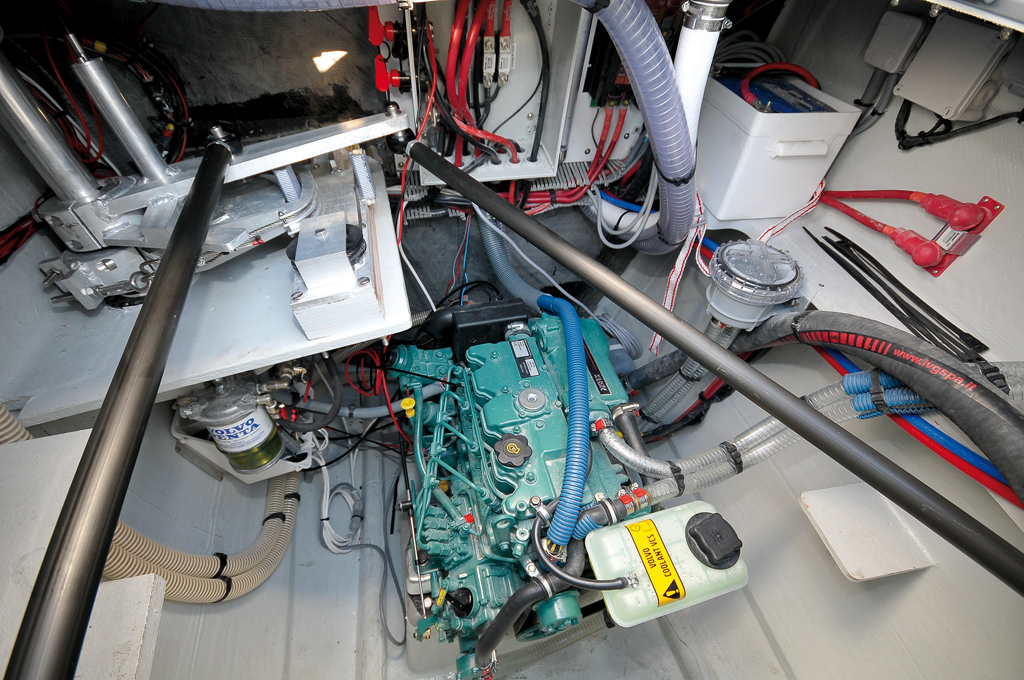
The engine rooms allow for good clear easy access for maintenance.
Conclusion
The Outremer 51 is an undeniable success, although for a version with this specification, the price will be higher. However, the result is plain to see. The balance between speed, comfort and ease of maintenance are the undoubted strong points of this model.
Technical description
- Designers: Christophe Barreau and Frédéric Neuman
- Interior design: Franck Darnet
- Builder: Outremer Yachting
- Length: 15.27 meters
- Beam: 7.45 meters
- Draft: 0.95 - 2.35 meters
- Light displacement: 10 tonnes
- Maximum displacement: 13.7 tonnes Sail areas.
- Mainsail: 85m²-91m² for the square top version
- Solent: 40m²
- Genoa: 62m²
- Gennaker: 110m²
- Spinnaker: 160m² for the tri-radial or 140m² for the asymmetric
- Mast height: 21.06 meters
- Air draft: 23.08 meters
- Motors: 2 x 40hp diesels with saildrive transmissions
- Fuel capacity: 2 x 170 liters
- Water: 2 x 190 liters
- Batteries: 4 x 10⁵ Ah service batteries and 2 x 70 Ah starter batteries
- Basic price: 609,000 Euros ex-tax
- Options (ex-tax): Carbon mast: €68,000 (fixed) or €72,000 (rotating) Kevlar capshrouds: €4,000 Halyards led back to the cockpit: €2,800 Genoa and hardware in place of the solent: €9,000 Gennaker and furling gear: €8,100 Code 0 and hardware: €10,000 Three bladed folding propellers: €3,000 Tillers: €13,200 Hydrocharger: €7,500 60 liters / hour watermaker: €10,240 Wind generator: €4,500
The owner’s view, by Laurent Jacolot
We wanted a reliable boat, ready for a long family trip in variable latitudes, and we chose the Outremer 51 owners’ version. At the start of the planning stage, our first instinct was to look for an aluminum centerboarder. We quickly realized that monohulls available for long distance cruising were far from our idea of the tropical way of life (we have lived in Polynesia for more than 13 years). After much searching, a multihull became the obvious choice due to their comfort and performance. We were looking for a performance production catamaran which we could customize, for safety, comfort and enjoyment. As it was a little difficult for us to oversee the construction of our boat from afar, our neighbor in Moorea (Polynesia), a man well-known in the maxi-multihull world, proposed that we take on his former organizer as project manager. Didier Ragot was also able to act as the liaison between us and the yard, bringing a unique complement to the process. The majority of cruising boats get going when there’s wind: ours fires up and accelerates in the slightest breeze - a real pleasure. We sail regularly between 10 and 14 knots, and higher speeds are not unusual. We saw 17-18 knots in flat water during a strong blow off Lanzarote in the Canary Islands. That said, Crazy Louise is a safe and balanced boat; helming is lovely, it doesn’t get carried away and easily accepts sail reduction for more peaceful sailing.
My reflections on the Outremer 51 catamaran Crazy Louise by Didier Ragot
Having been first mate to Olivier de Kersauson for 30 years, I started a small company as a project manager, and this is what led me to work on the Outremer 51. I was rather hesitant when I arrived at the yard , for people like me often instill fear (incorrectly of course!) Nevertheless I was very quickly seduced by the Outremer 51. I found her lines pleasing, though less so the deck layout, but that could be improved. During the build I found the yard to be staffed by likeable men who were responsible, courageous, ready to listen and very knowledgeable about offshore sailing! We had a few minor differences, but when the launch day came I was able to see the catamaran from all angles: she was perfect! I was pleasantly surprised as I’d had a doubt over the weight of the composite longitudinal beam, required for keeping the staysail stay tensioned. The final phase was the seatrials. Everything went smoothly with the motors after a little adjustment, and we hoisted the sails. In a light wind of 8-10 knots I watched the in-house test skipper at the helm. The pleasure on his face was a good sign, and I already knew that Crazy Louise was going to be fast for a cruising cat. I took the helm and noted a small bit of play to be corrected, with the rudder blades not being perfectly aligned, the genoa badly adjusted at the luff, and also we needed to look at the batten tension. With the leeward daggerboard down the boat was not however asking to open up, but I wanted to test it upwind and luffing. Once again I was pleasantly surprised with the result (around 35° off the apparent wind pushing it to the limit): that was promising! Next, downwind with the gennaker which I wanted long in the foot and very large. The boat accelerated with consistent power. Over the following days, the yard attended to the adjustments and finishings, and everything was put right. It’s a beautiful boat for family cruising, easy to single-hand or for a couple, safe and comfortable. During a month of trials with the owners, I sometimes sailed outside the recommendations of the yard, and structurally it held up well in these conditions, (not recommended behaviour of course!)…
The competitors
| Model | Builder | Sail area (nearest m²) | Light displacement | Price (ex-tax) in € |
| Freydis 49 | Soubise Yacht | 128 | 9 t | 460,000 |
| Catana 47 CR | Catana | 140 | 10.9 t | 610,000 |
| Dazcat 15 | Multimarine | n/a | 8.5 t | on request |
| Nautitech 482 | Nautitech | 116 | 11.2 t | 545,500 |
| M Cat 52 | Technologie | 123 | 10.8 t | 950,000 |
| TAG 50 | Tag Yachts | 155 | 11 t | on request |
Plusses
- Excellent liveaboard multihull
- Dynamic qualities
- Good cruiser-racer balance
Minuses
- Tillers a little too short
- No provision for Plexiglas rooflights
- For a finished version the costs can mount up
Caption
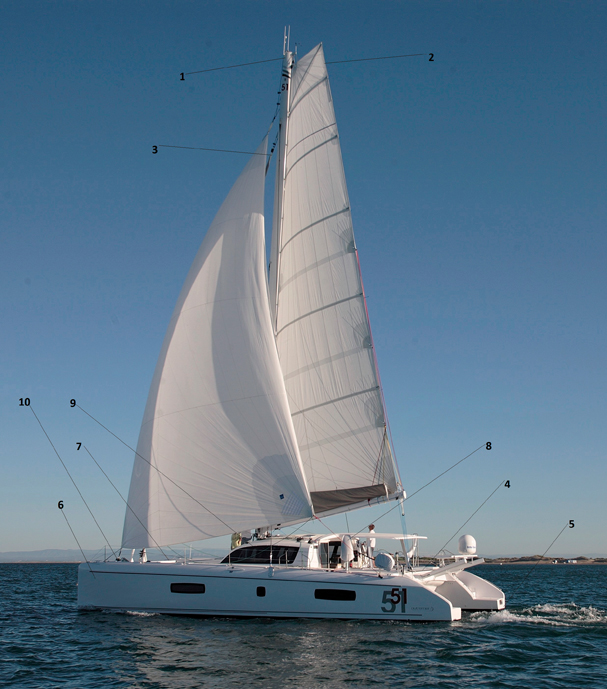
- A carbon mast (rotating or fixed) is THE solution for this high performance catamaran. Our test boat had the optional “chimney” mast without pre-bend. A must have!
- Of course the square-top mainsail is essential too!
- On our test boat, Crazy Louise, the staysail and genoa were fitted to braided stays, with a roller furler for the all-or-nothing genoa and a loose furler for the flying staysail.
- The Outremer 51 is fitted with a long mainsheet traveler, which was led back to the cockpit on our test boat. This should become standard.
- The lengthening of the sugar scoops, which are open on the inboard side to give easy access on board, and optimize the waterline length.
- High freeboards and generous volumes ensure safety in confused seas, giving the advantage for heading off long distance.
- The huge forward beam and compression pods are reassuring, as is the martingale stay A-frame. You could go one step further with an all carbon beam
- The helm seats make for unavoidably enjoyable helming.
- The coachroof volume strikes a good balance between internal space, light, external dimensions and centralizing weight.
- Crazy Louise’s gennaker is much larger than this one, the choice of a modern furlable asymmetric spinnaker (like a Code D) Is an appropriate alternative.
