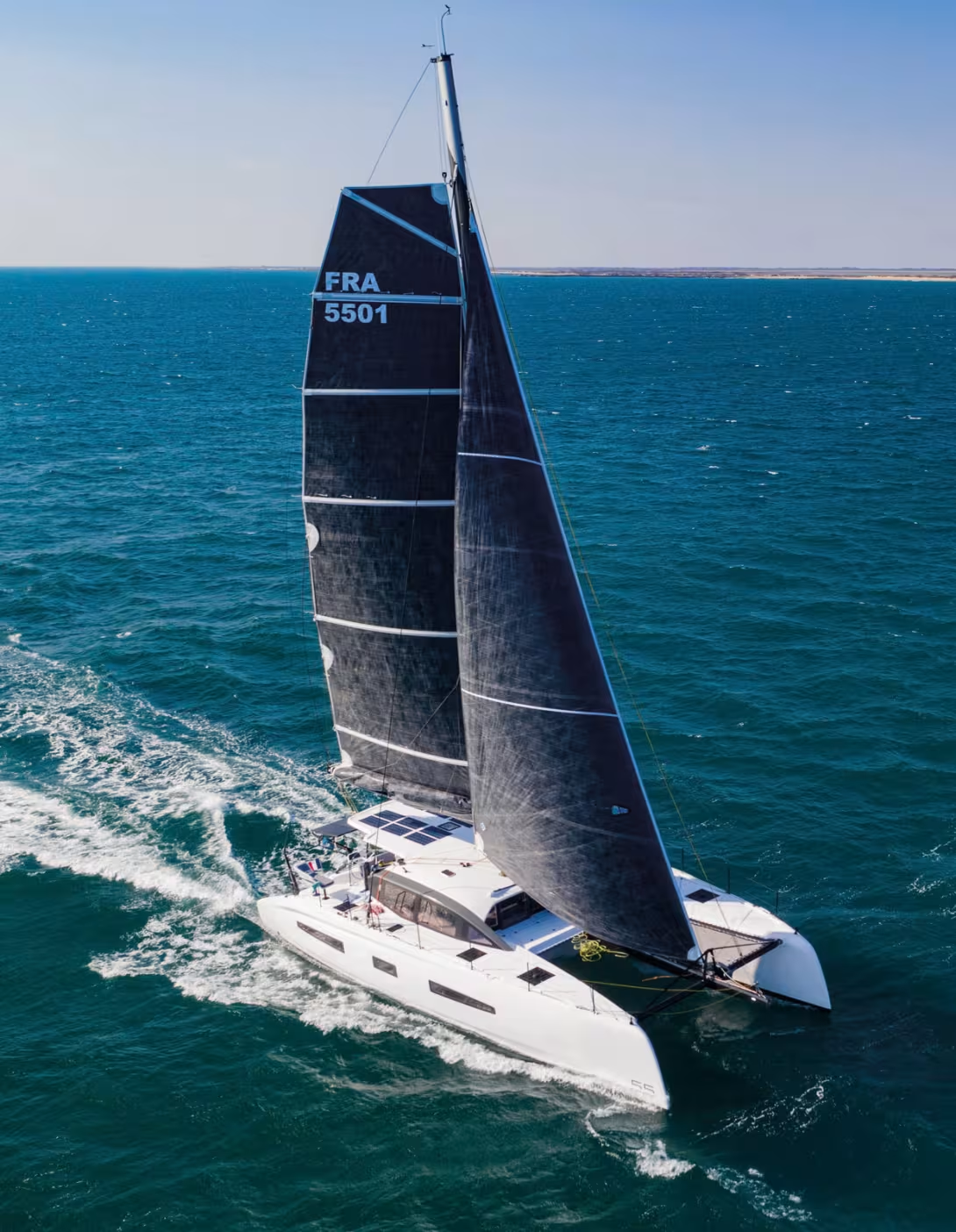
MULTIHULLS WORLD EXCLUSIVE - 55 is reminiscent of a mythical model in the history of Outremer, the brand created by Gérard Danson back in 1984. Picking up on this vintage is therefore a challenge - a bit like what’s happening with the new Lagoon... 55! The aim of this new Outremer 55 is to offer the same level of performance as her illustrious predecessor, while providing the volume and level of comfort to correspond with the expectations of anyone signing on for ocean cruising in the 21st century. Multihulls World was the first to get aboard to ensure that this 55 is indeed the worthy heir to the... 55.
Infos pratiques
- Le chantier : Outremer 55 (2021)
- La fiche technique
-
 Découvrez notre vidéo exclusive
- Financez votre Outremer 55
- Assuez votre Outremer 55
- Articles autour du Outremer 55
Test location: La Grande Motte, France
Conditions: sea state slight, wind 8 to 25 knots
Looking at the first digital images unveiled in January 2019, the new Outremer 55 looked like she was going to mark a significant evolution within the very consistent range (45, 51 and 59 feet) developed by the manufacturer since 2008. In the words of Xavier Desmarest, Outremer Yachting’s CEO, there is a fierce determination not to fall into the Saab syndrome. The iconic Swedish car brand disappeared because it failed to renew itself. Why didn’t they change course? Probably for fear of losing their historical customers. When Xavier talks about this new 55, he talks about “a changing world” and the “need to have a fresh eye to adapt to the times”. The approach is all the more commendable given that the team in charge of the project has called on a high-flying trio (VPLP, Le Quément, and Darnet Design) but this is a trio that has already worked regularly for the brand, notably on the 5X. Will the dream team be able to pull off this renewal? By wanting to offer more space and more comfort, wasn’t there a risk that the catamaran would become too heavy to still guarantee the incomparable pleasure of family cruising at double-digit average speeds?
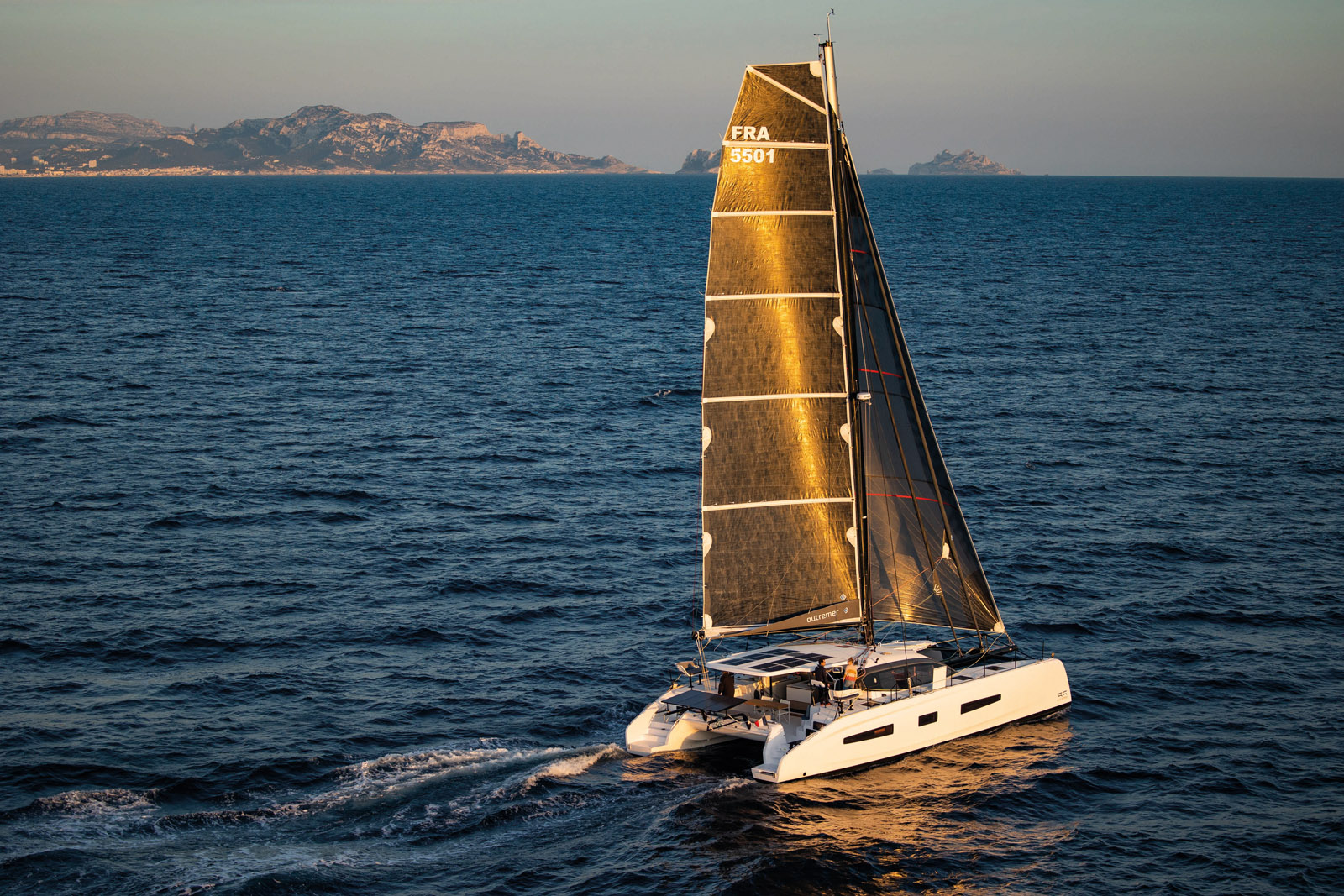
This first model has been optimized for performance with a rotating carbon mast, a carbon forward cross and membrane sails.
24 units ordered
To find out for sure, we joined for two days’ sailing aboard the #1 of this new series. Already 24 units are on order, but we were the first to set foot on board. The wide sugarscoops sit close to the pontoon (the pontoon that usually hosts the International Multihull Show at La Grande Motte), so stepping aboard is easy. At first sight, the overall lines look to conform with the impression given by the digital images - seductive. No doubt about it: each surface, line or corner radius has been studied in detail, challenged by many variations, judged intrinsically and by what it brings to the whole. It’s a complex equation, played out between a demand for ever greater interior volume, a displacement objective that must place the 55 exactly between the 51 and the 5X in terms of performance, and finally the search for obvious elegance. Of course, the multihull must remain manageable by a short-handed crew, typically a couple on a trip around the world, as this is the target audience.
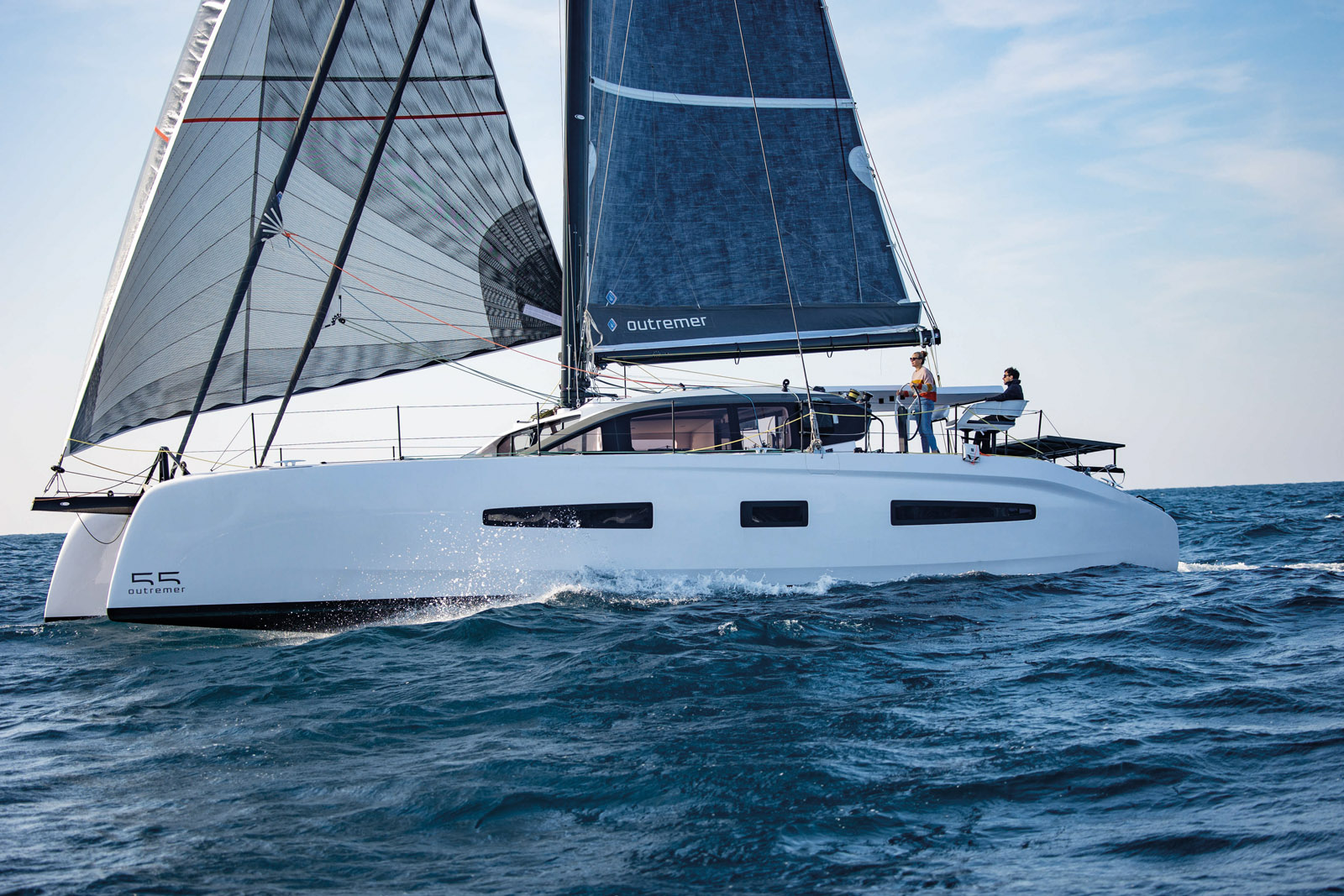
The Outremer 55 easily reaches wind speed under gennaker.
All the performance expected
Of course, we weren’t going to be crossing an ocean in the 36 hours we had. I was going to have to be satisfied with a one-way trip to the Frioul Islands and then on to Marseille, with weather conditions that were very varied. In spite of a crosswind and the 27’3” (8.30 m) beam of the 55, the twin 60HP Volvo motors made no hesitation getting us out from between the famous pile moorings so typical in this region. As soon as we were clear of the port, there was no doubt about the comfortable power transmitted to the saildrives: at less than 2,500 rpm, we were already making between 8.7 and 8.9 knots. By pushing the electronic throttles to the limit, a speed of 11 knots is reached. Of course, except for the 153 US gallons (580 liters) of water in the tanks (filled by mistake!), the catamaran is unladen. This flattering speed gives us the first positive clues about the narrowness of the hulls and the real weight. But we were promised performance under sail, so let’s hoist the 1,120-square foot (104 m²) mainsail from the port maneuvering station and find out. Despite the length of the double-purchase halyard (twice the height of the 62-foot/19 m mast), it doesn’t require much effort thanks to the assistance provided by the (optional) electric winch. Most of the choices made by the owners of this first unit are very performance oriented, despite the context of a second round the world trip with their family and the plan to go down to Patagonia this time: The boat has a rotating carbon mast, a carbon forward cross and membrane sails - with a furling genoa on furling staysail, rather than the standard self-tacking solent.
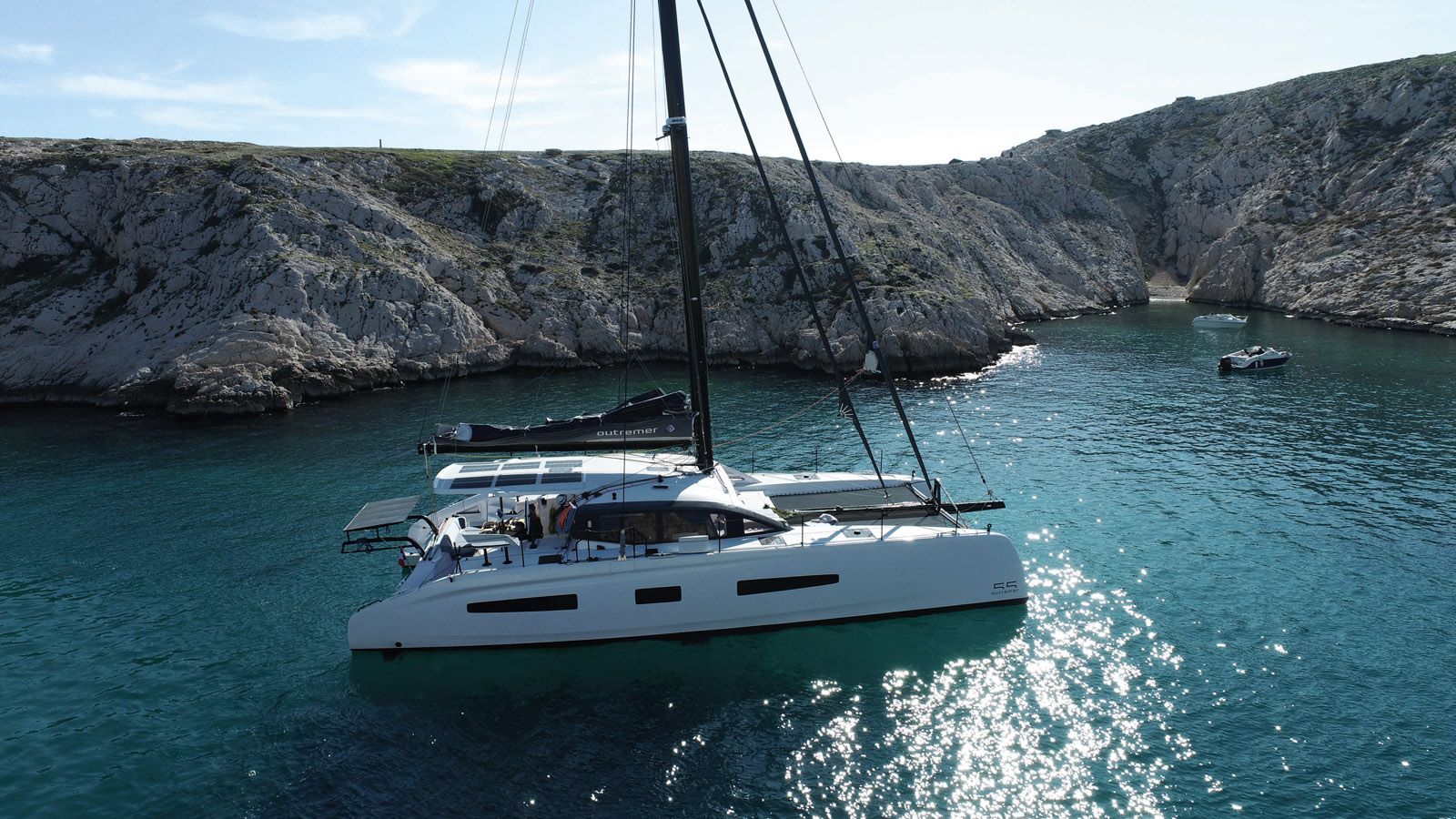
At anchor in the Iles du Frioul, off Marseille.
Twin off-center helm stations These choices have an impact on performance, on the budget (85,000 Euros before tax for the carbon cross, which makes a saving of 220 lbs / 100 Kg!) but also on the deck plan. Though everything is laid out for maneuvering easily on your own on the standard version, having two on board is preferable here. The mainsail halyard clutch is positioned on the rotating mast and not at the helm, and the genoa sheets come back to starboard, while the furling line is on the port side (where the single sheet of the self-tacking solent would normally be located.) As for the extreme stiffness of the membrane mainsail, it results in laborious flaking to stow it, even though it is easy to climb up onto the coachroof thanks to the three aluminum steps just forward of the mast - the latter is equipped with stainless steel handrail.
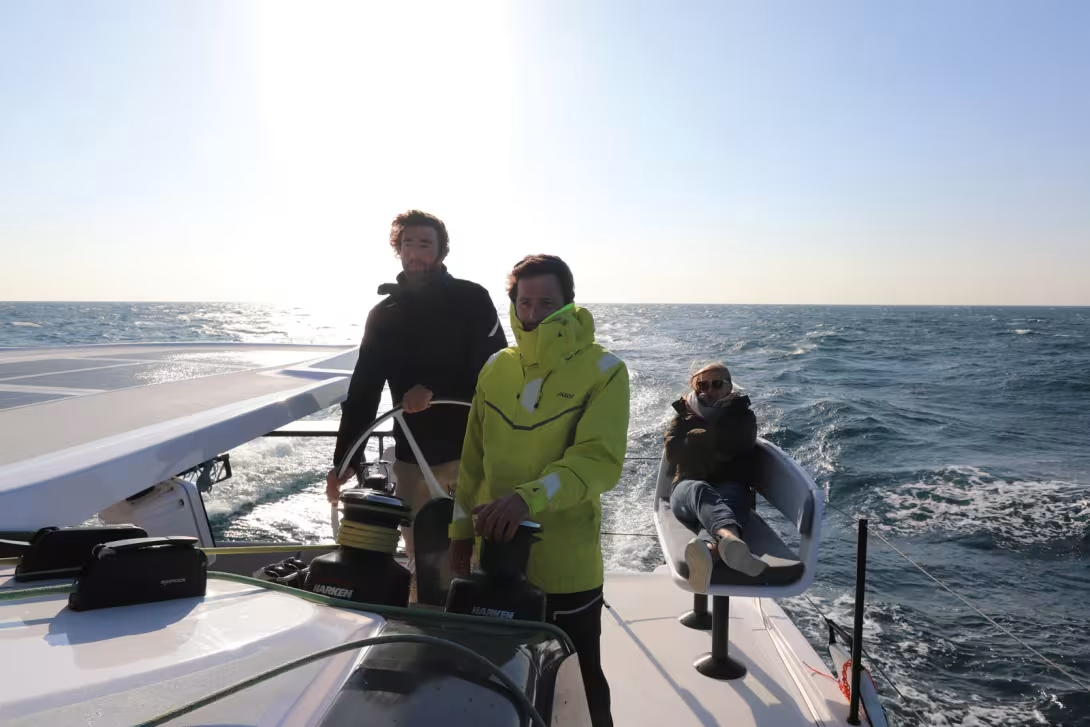
There’s nothing but praise due for the remarkable work undertaken by the design team - including of course the shipyard’s engineering department - on the twin off-center helm stations. Moving the steering wheels three feet (one meter) back from the coachroof allows them to be separated from the four Harken winches. The winches are positioned at the right height on a console that extends the coachroof’s trailing edge, creating perfect ergonomics. The helm remains within easy reach, as do the engine and autopilot controls, which are integrated into the molding of a comfortable and aesthetically-pleasing standing seat. As for the tilting helms, these can no longer be called an innovation given that they first appeared on monohulls (Dehler, Bénéteau, among others) and is now to be found on multihulls (Alibi, Balance...). But Outremer has used all the available amplitude to increase the options for helm positions. This way, you are perfectly well positioned, whatever the conditions or situation. In the cockpit, the helmsman can be well-protected in bad weather, or standing on the deck, he can keep his eyes riveted along the hull in racing mode, or on the bows during tricky docking maneuvers. The third option is to sit on the lovely double side bench seat - certainly a coveted spot. At this point, you may be wondering how good the view is from the lowered helm in the cockpit? Surprisingly good, thanks to the windows in the nacelle.
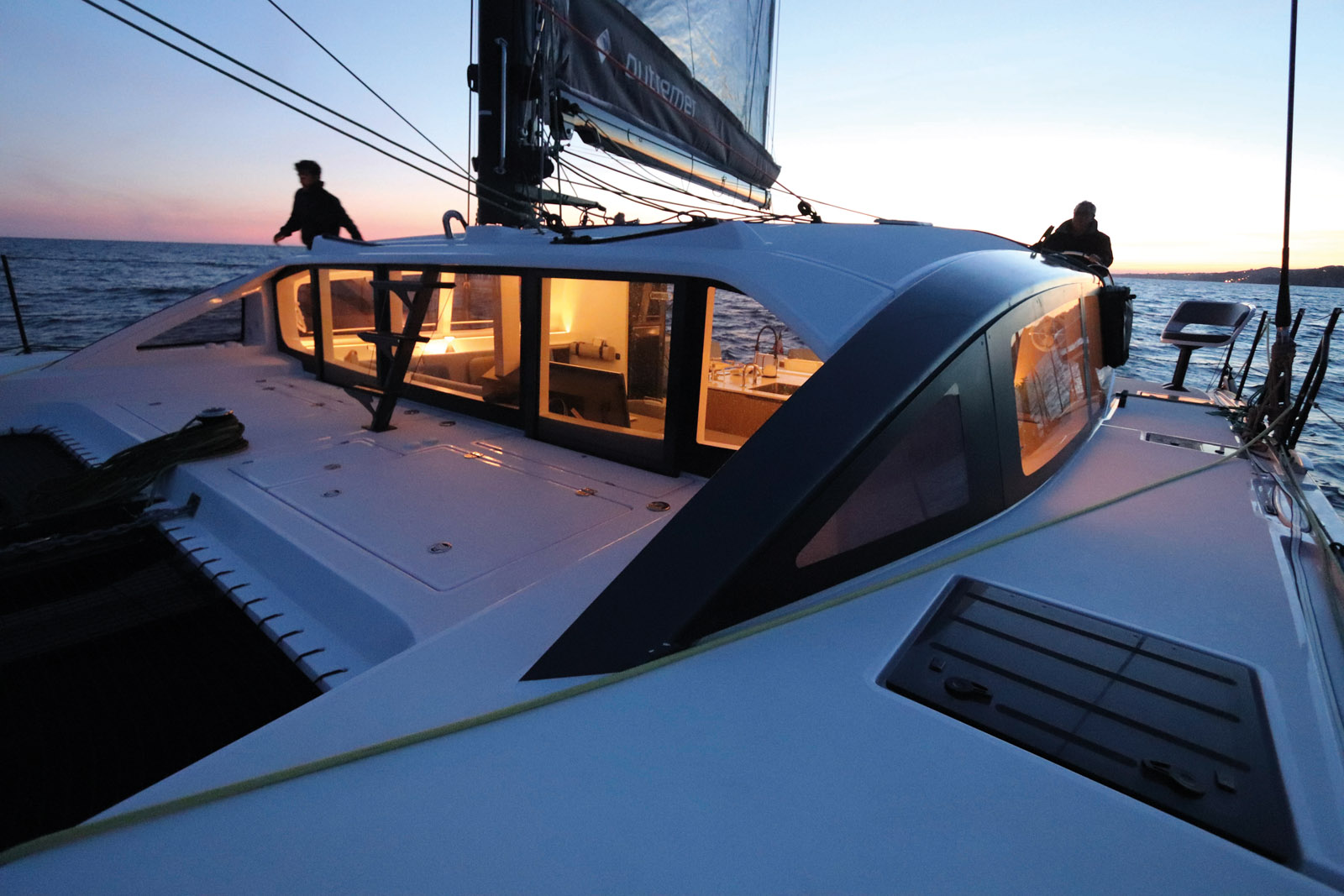
Moving about on deck is easy, as is the access onto the coachroof thanks to steps and handrails.
Technology borrowed from Gunboat
Indeed, for any Outremer connoisseur, the 55 distinguishes itself from the “historical” versions by breaking three taboos: direct access from both sugarscoops, an XXL-size bay window opening to 10 feet (3.10 m) wide, and a forward window (29 in/73 cm of clear glass) high enough for someone of 6’4” (1.93 m) to see the horizon without needing to stoop. For many years, these have been typical features on board catamarans designed for leisurely cruising, but they are rarer for a multihull concerned with saving weight and offering maximum rigidity. To achieve this goal, the Outremer 55 uses three carbon bulkheads as standard (aft beam, the back of the coachroof and the mast step bulkhead). As a result, not a single creaking sound was heard in our two days of sailing, and the fully equipped Outremer 55 weighs 14.2 tons lightship, or between 15 and 16 tons ready to set sail around the world. To ensure that the target weight was achieved, some technologies were borrowed from Gunboat, Outremer’s sister company within the Grand Large Yachting Group. The sandwich foams are perforated instead of grooved. And though the infusion process is a little more complex, the quantity of resin needed is drastically reduced. The 1,430 lbs (650 kilos) that have been saved have been “reinvested” in modern expressions of comfort such as volume, visibility and accessibility, all without compromising aesthetics or cutting back on that sacrosanct performance. In this area, making something beautiful and uncluttered is extremely complex. The work undertaken, visible in every detail as well as in the overall vision, is remarkable. We can only salute the contribution of Patrick le Quément in this matter
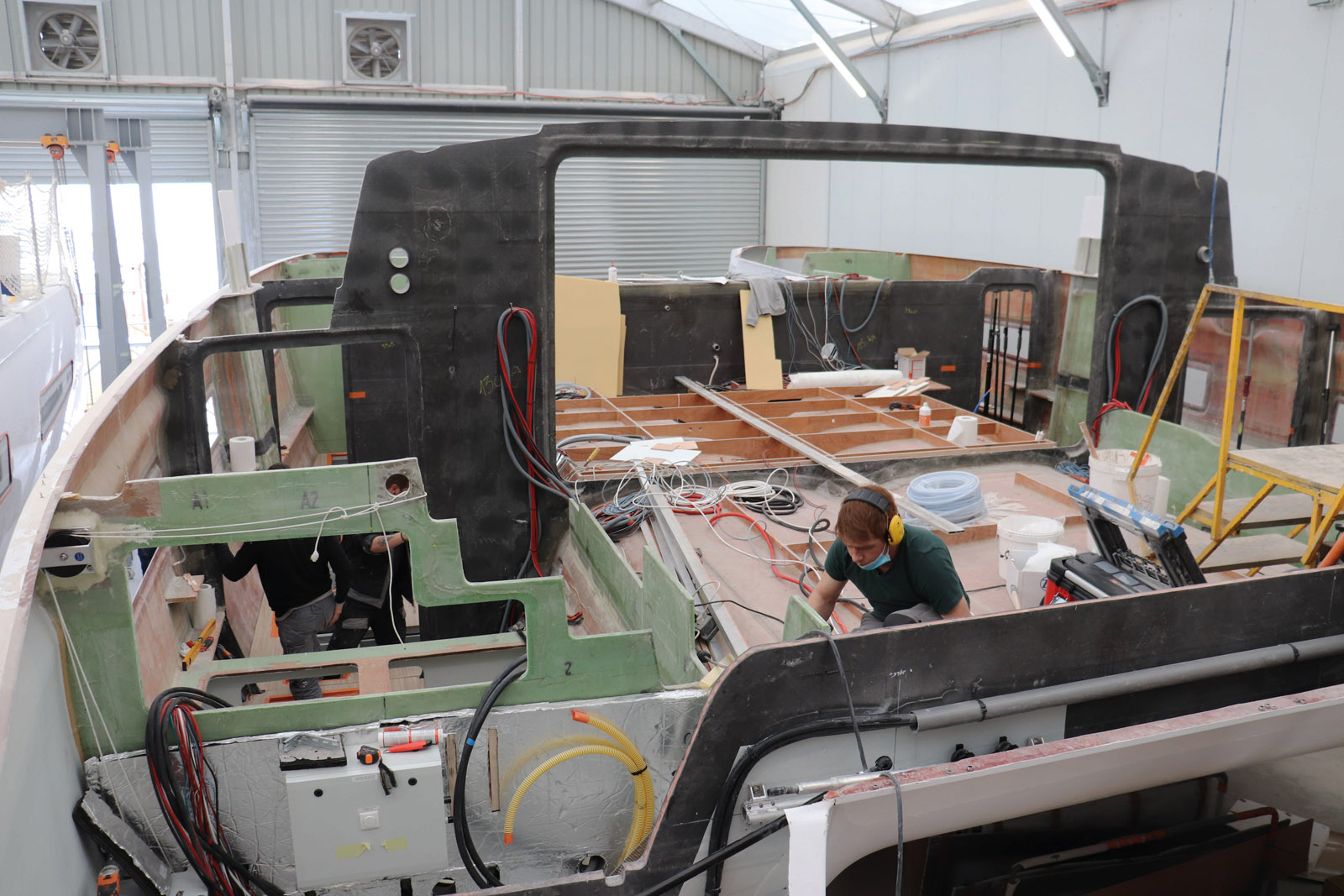
Three carbon bulkheads ensure excellent structure stiffness.
Topping out at 19 knots Though the breeze was moderate for the first few miles, it was forecast to increase during the day - locally, and we’re always wary of the acceleration zones off the mouth of the Rhone and the Gulf of Fos. So, we set out slightly under-canvassed, with the first reef in the main. The J2 was fully unfurled. In this configuration, on the furler, it can only be used in all-or-nothing mode, but the staysail was set. All maneuvers are performed from the cockpit. The mainsheet traveler has a dedicated winch on the aft beam, at the perfect height for efficient winching. It was a sunny afternoon, with flat seas and wind just aft of the beam (between 100 and 120 degrees) awaiting us. Indeed, the wind was progressively increasing (14, 18, 20, and then up to 25 knots) and the log simply continued to follow this upwards trend: 9.2, 10, 14.3 and even one peak at 19 knots! The catamaran glided along, without apparent effort, without any stress for the crew. At the helm, she was just as hot as she needs to be so that the sensations sent back by the steering wheels make her come alive. So pleasant that, honestly, we don’t really see the point of the tiller option. Of course, it’s a very nice piece of carbon, but its usage time is likely to be inversely proportional to its size. In less than seven hours, without pushing it, but with an average speed of 11.4 knots all the same, we were in Frioul, facing the city of Marseille. The port was deserted. The harbormaster’s office gave us authorization to tie up alongside the quay, just in front of... the sign forbidding this. Our arrival was a bit quick, due to an unexpected strong gust. A warning sign, but without cost - thanks to the effective inflatable fenders; the featherweight of the boat; the not insignificant windage; and especially partially or totally raised daggerboards to limit the draft. We noted that freeboard again when went ashore to stretch our legs: we prefer the cutaway access of the sugarscoops rather than by the gate in fiber guardwires, fixed on aluminum stanchions, close to the Kevlar shrouds... weight hunting, remember!
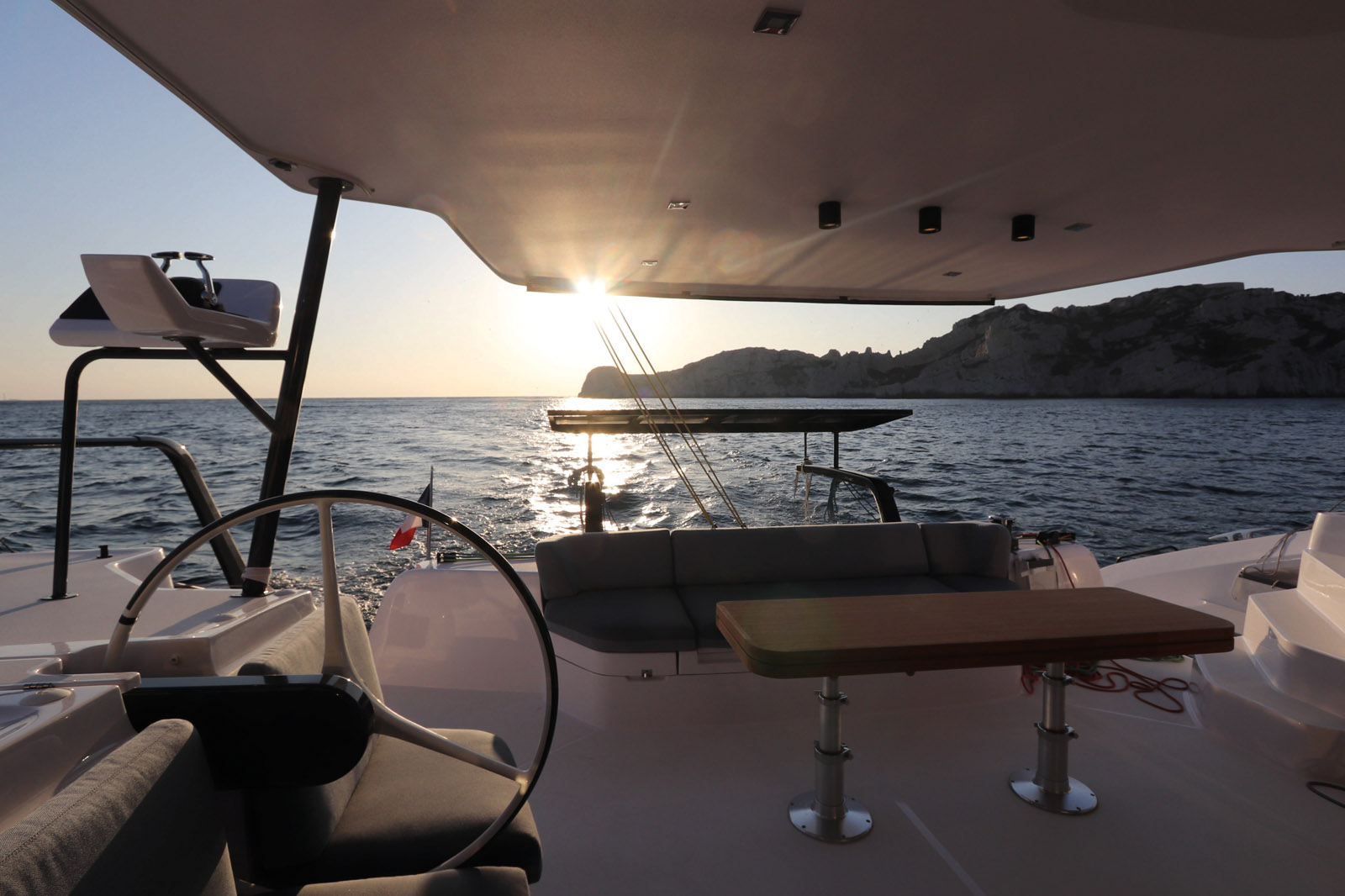
The helms offer multiple seating positions - and comfort. This cockpit is a real success!
Almost twenty linear feet of galley worktop!
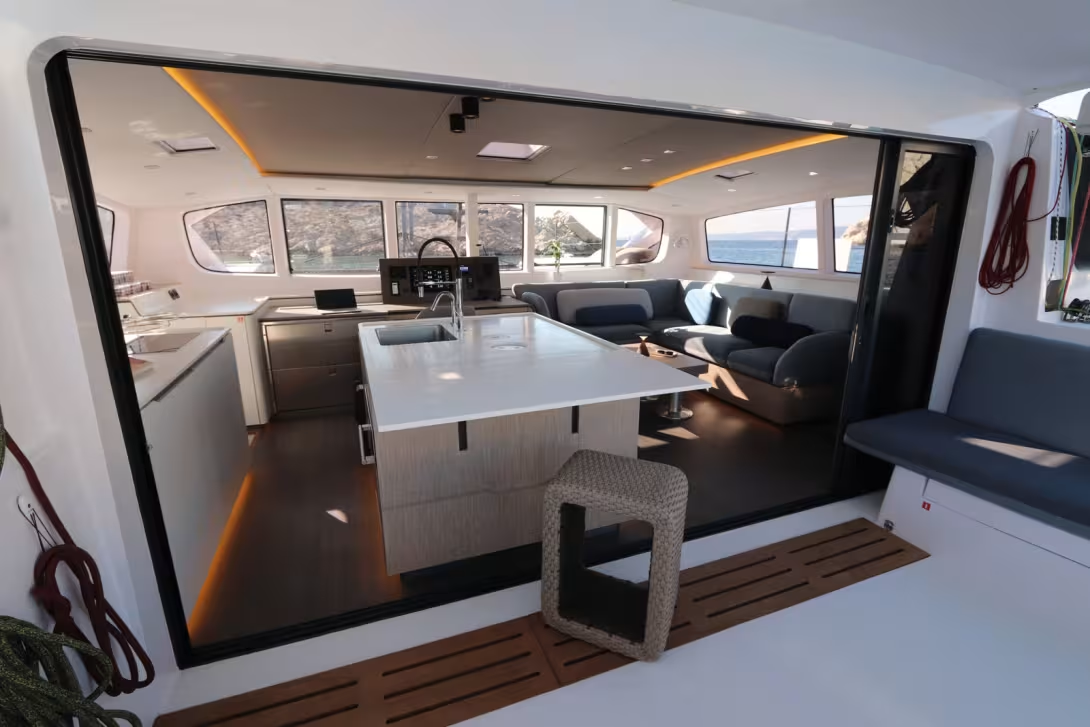
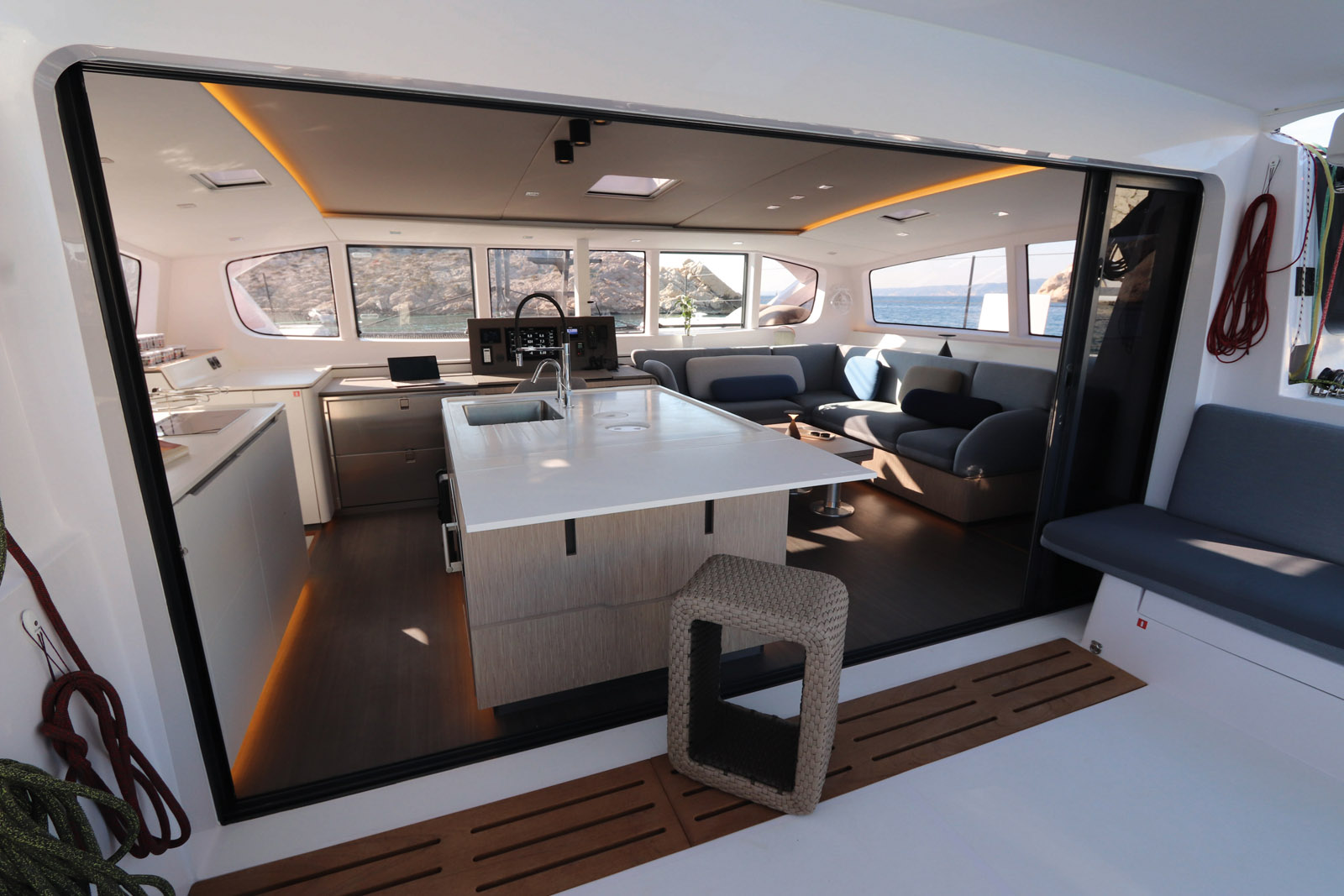
In this month of March, the night temperatures reminded us it was still winter. The bay window was promptly closed, and we set about preparing a meal in a galley with a totally redesigned ergonomics. Modernity isn’t necessarily always the best way forward, but in this case, there’s close to twenty linear feet (7 meters) of space and we four of us were able to work without getting in each other’s way. The old debate over “L-shaped or U-shaped galley?” is old news. Circulation, conviviality, practicality, what more could you want? These qualities won’t prevent even the most reluctant from shying away from the collective tasks. The central island, measuring 56 by 46” (143 x 117 cm) accommodates a sink, oven, potentially a freezer and in every case, storage space. On the port side, a 5-foot (154 cm) work surface houses more storage, the optional microwave and the cooktop. This is not a gas hob, but an induction one, as requested by the owner. A choice that is becoming more and more frequent and one which we will come back to soon. It translates here into 2,300 W of solar panels and three 5,500 W of lithium batterie. The doubledrawer refrigerator is located at the front, in keeping with the long (7’3” / 2.22 m) forwardfacing chart table. With its two large drawers, it should easily accommodate all the chilled supplies required for a long passage. You have to dig deep to find any defects in this huge nacelle that’s flush-decked from the sugarscoops to the mast foot. I only wonder about the relevance of the fragile tilting bar shelf. On the other hand, the idea of being able to roll out a mosquito net over the entire width of the bay window is excellent. Combined with the two huge lifting windows forward, maximum ventilation is guaranteed. But the team in charge of the interior design must have choked when they saw it covered up by a vulgar PVC tarp, in stark contrast to the extreme care taken over the design of the furniture. This didn’t not spoil our appetite, though, and we pulled up and folded out the table for dinner. Note in passing, all the worked forms, the softness, the bench seats and their accessory cushions.
Fine hulls, limited volume
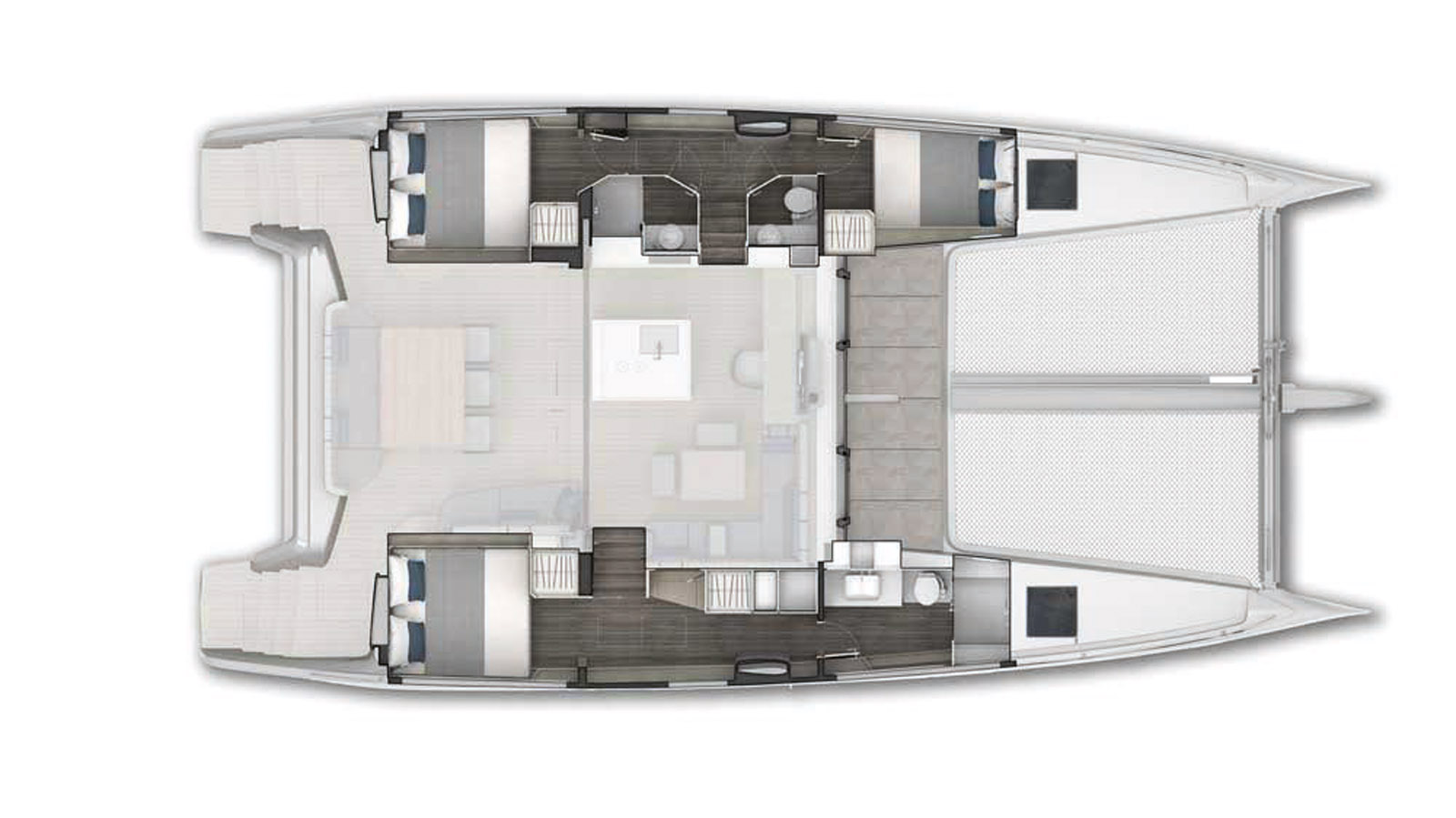
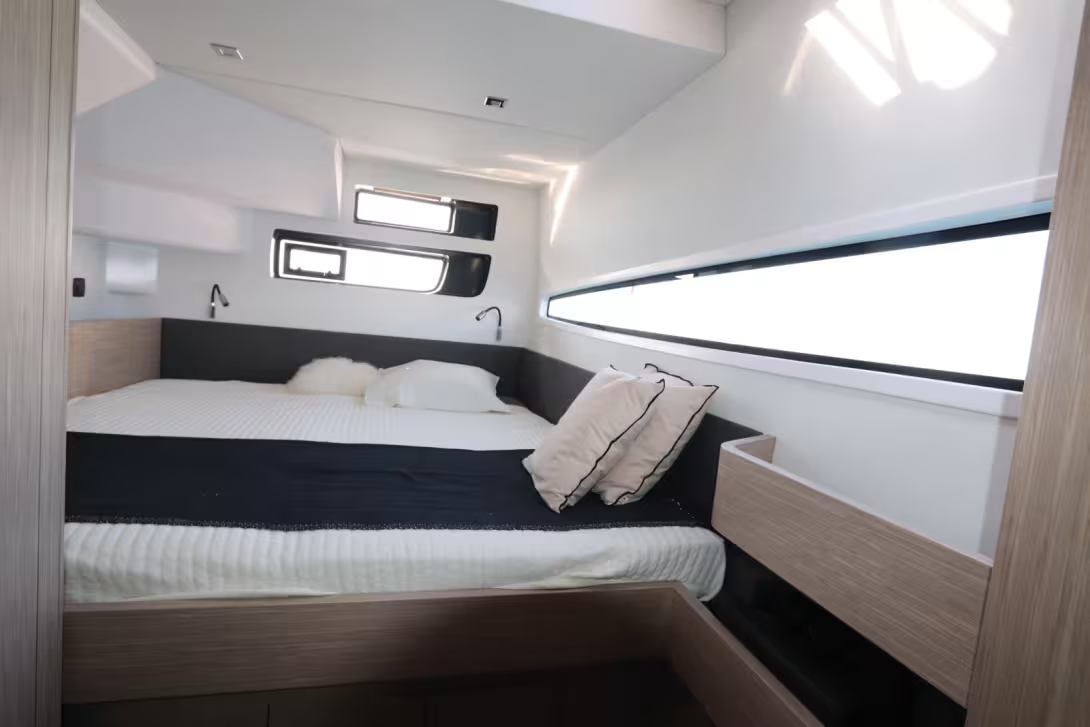
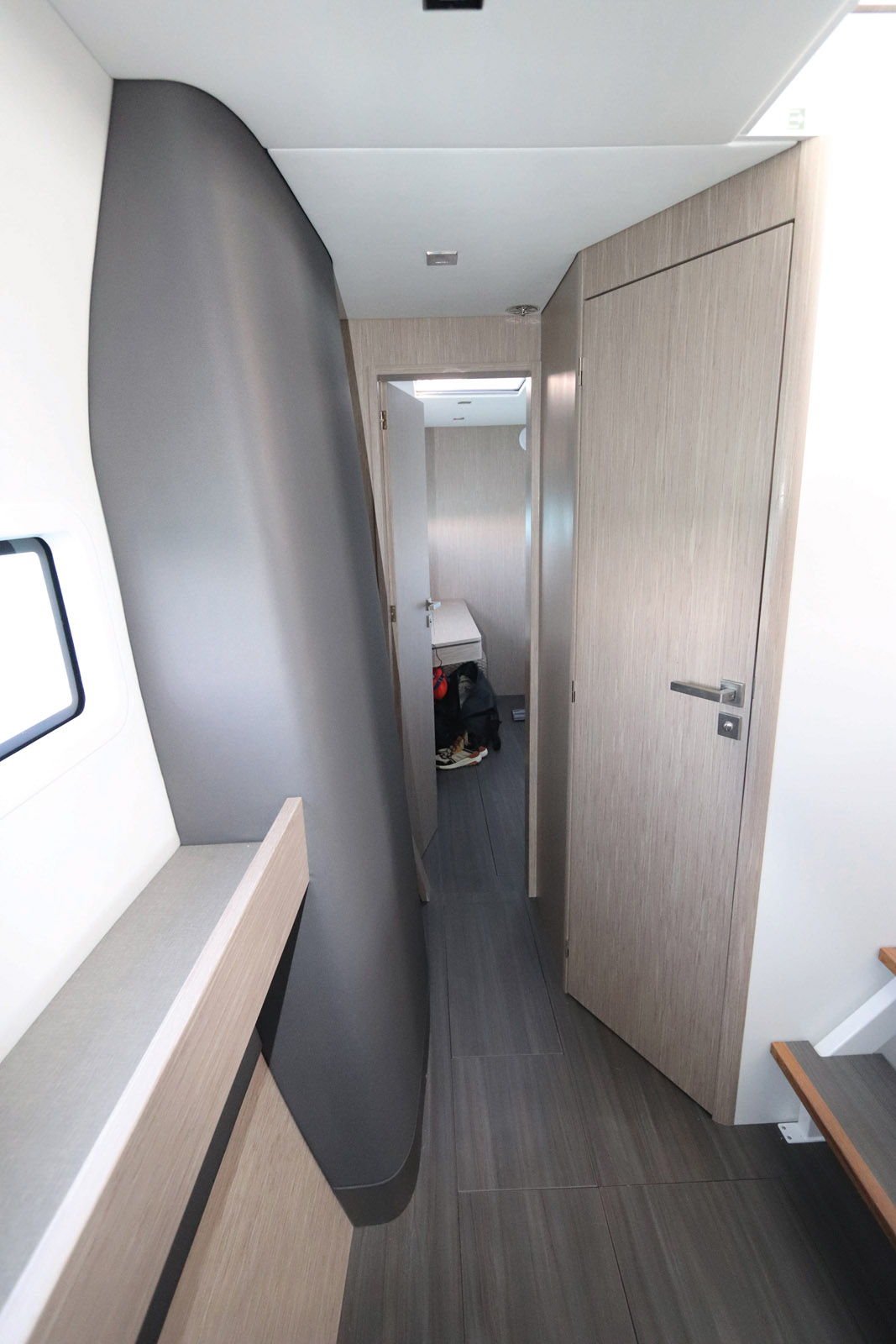
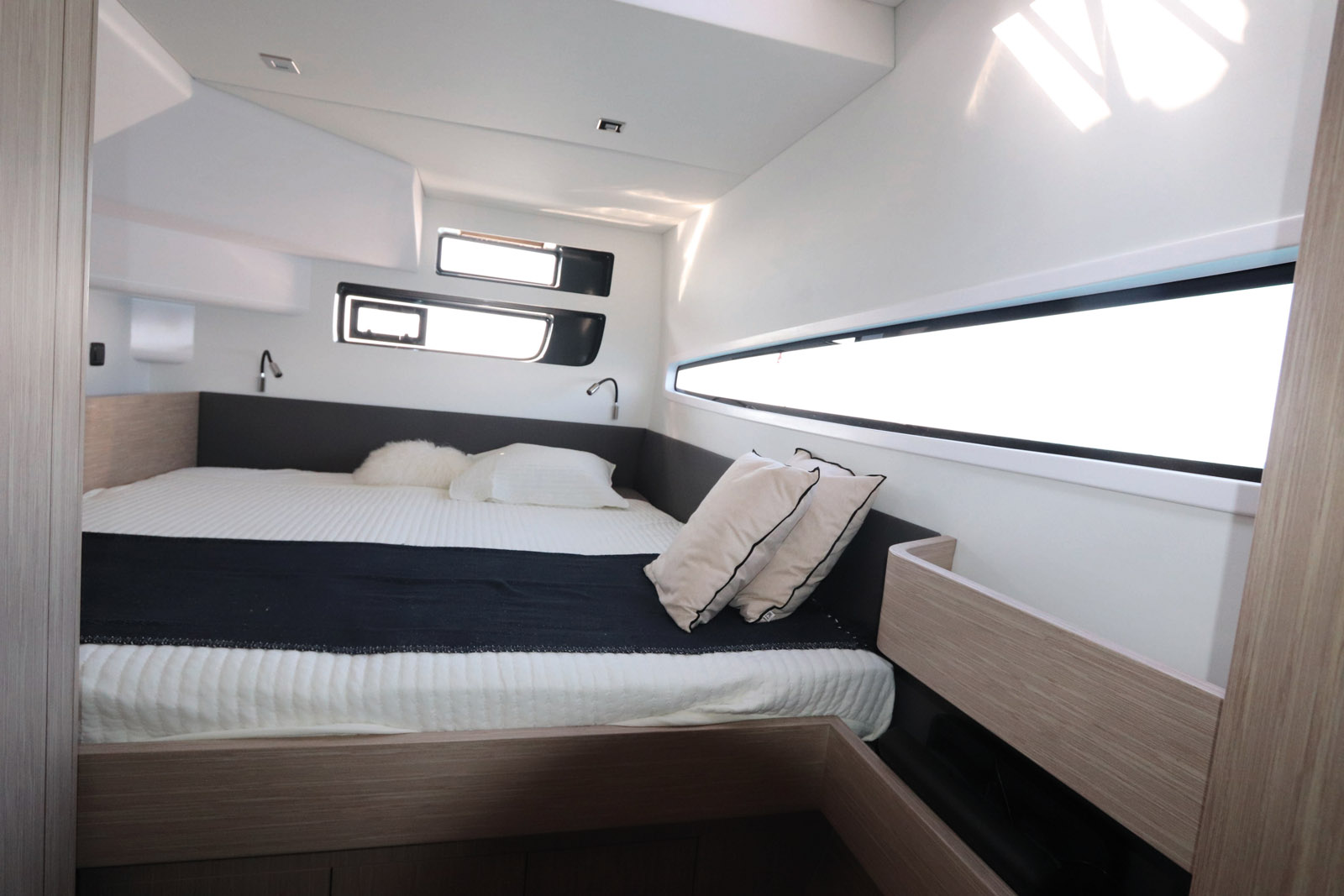
After this long day, we were all ready to get to our cabins. As for me, I was aft, on the port side. In this large, almost square bed (7’3” by 6’2” / 203 by 187 cm), I found the right angle to avoid the light from the quay entering through the long window that runs almost the whole length of the cabin. I only found the rigid shutter the next morning, wellstowed beneath the bunk! But by that stage I had no desire to prevent the sun from warming this cozy nest, nor to deprive myself of the sea view. It was time to take a shower. In this respect, the Outremer 55 plays with asymmetry. On the port side, two spaces frame the companionway. Both have a good-sized sink, but the forward one incorporates a toilet, while the aft one has a separate shower. To starboard, the companionway is further back, and a single central volume accommodates the three functions: sink, toilet and separate shower. The limited volume of these high-performance hulls has been used in an optimal way. Even with the daggerboard wells integrated with maximum discretion into the sides of the boat, don’t expect the habitability of multihulls with more generous dimensions in these areas dedicated to resting. This is the other side of the coin that lovers of pure speed must be ready to accept.
 |
 |
The daggerboard wells are perfectly integrated into the passageways.
The aft port cabin features a huge bed (7’3” x 6’2”) and a large hull window.
Lunch on the terrace
For our second and final day at sea, the wind was giving 15 knots maximum, so we got out the gennaker - just to see what the beast has in store. Verdict: with 14.8 knots flat out, exactly the speed of the true wind, the contract has been fulfilled! Upwind, in a wind dropping to 8 knots true, the catamaran’s speed was barely any less. She regularly exceeded 7 knots at 55 degrees off the wind, mainsail up this time of course. Sailing in the South of France early March, it is also possible to enjoy a lunch on the terrace - mea - ning in the cockpit - on the very large table. This could easily accommodate more than the seven of us we were on the day, with a few additional seats. At the end of the afternoon, we regret - fully left the shelter of our postcard cove for a few last runs, all at wind speed. And on the final stretch, a magical night-time entry into the old port between the Mucem museum and the basilica of the “Bonne Mère”.
 |
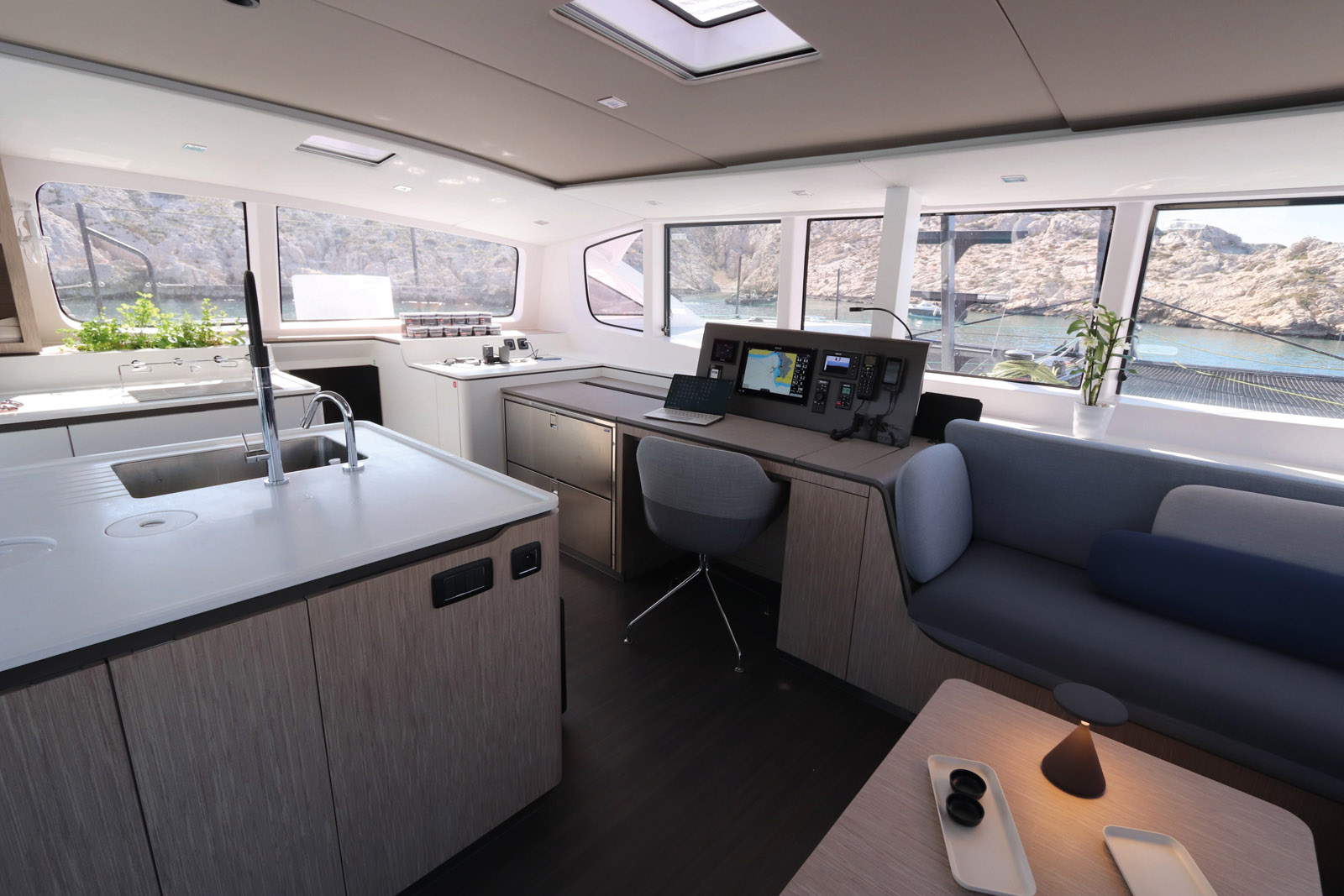 |
The builder opted for a huge bay window: the nacelle and its central island galley blend perfectly with the cockpit.
Conclusion
After spending two days testing the Outremer 55 in preview, the term “sweet-spot” was what came to mind - a term used in marketing to des - cribe an effective positioning. There is no universal multihull, let alone a perfect one. Each model is designed to fit a program, to meet the sailors that fit it. The Outremer 55 is exact - ly where she promised to be, stood a little apart from the crowd, faithful to her roots. She is the heir to a long line of high-performance, seaworthy cata - marans, whose modern expression does not mean forgoing comfort. The options chosen will work like photoenhancing software, accentuating here or there her qualities of a performer or great cruiser. In every respect, the Outremer 55 is a superb boat - she will even silence those who would claim that a multihull can’t be beautiful.
The pluses
+ Fast and easy to handle
+ Successful helm stations
+ Ergonomics of the galley
The minuses
- Higher price
- Fragile vinyl decor on the coachroof
TECHNICAL SPECIFICATIONS
Builder: Outremer Yachting
Architects: VPLP
Design consultant: Patrick Le Quément
Interior: Darnet Design
Hull length: 54’11” (16.73 m)
Waterline length: 54’11” (16.73 m)
Beam: 27’3” (8.30 m)
Draft: 4’5”/7’7” (1.36/ 2.30 m)
Air draft (not including VHF aerial): 80’9” (24.6 m)
Displacement: 30,645 / 40,785 lbs (13.9/18.5 t)
Mainsail: 1,120 sq ft (104 m²)
Genoa: 732 sq ft (68 m²)
Self-tacking solent (optional): 517 sq ft (48 m²)
Gennaker (optional): 1,507 sq ft (140 m²)
Spinnaker (optional): 2,368 sq ft (220 m²)
CE Certification: 8/26 persons
Engines: 2 x 60 HP Volvos
Prices excluding tax Outremer 55 Standard: € 1,215,000
Principal options
4-cabin Offshore version: € 16,890
90-liter (3.18 cu ft) cool storage: € 2,290
26 gph (100 l/h) Watermaker: €13,200
1,250 W Solar panels on bimini: € 16,540
800 W Solar panels on davits: € 6,700
Second set of engine controls: € 4,500
Fixed carbon mast and Kevlar shrouds: € 93,990
ST60 Electric winch: € 4,370
Cockpit table and upholstery: € 2,390
B&G Electronics: € 19,235
Self-polishing antifoul: € 4,680
Price of the model we tested: € 1,519,512