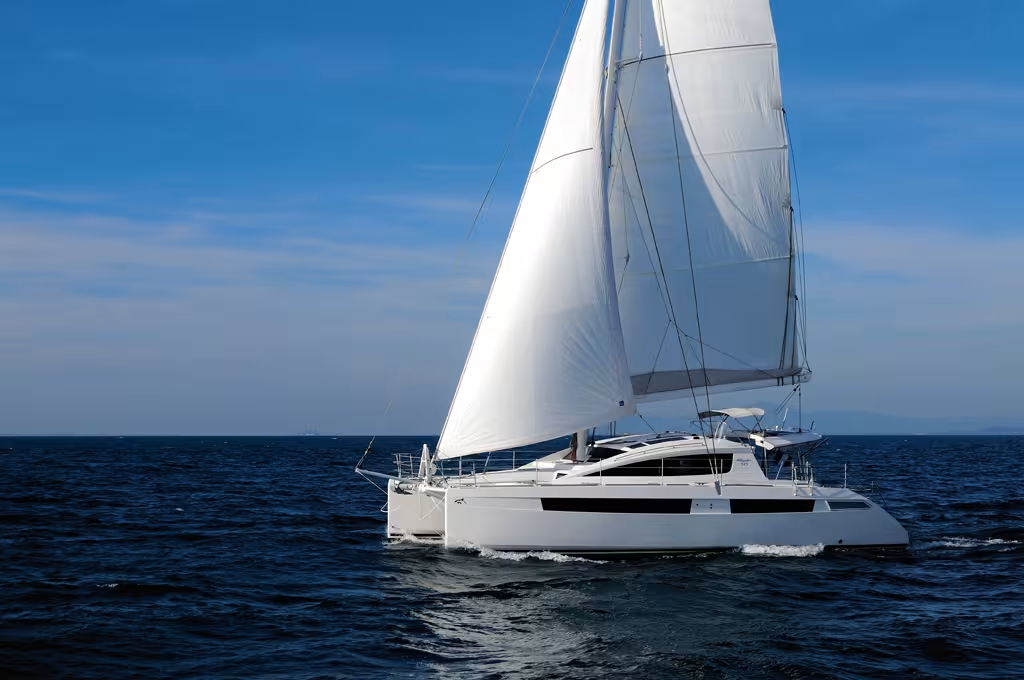
The Vendée-based builder’s production is oriented resolutely towards the coveted multi-yacht segment, yet the new 2009 model presented at the autumn boat shows is a 50-footer! It is very different from the 495, but appears almost ‘reasonable’, compared to its elder sisters, the 615, 745 and the superlative 1000.
Infos pratiques
- Le chantier : Privilege 515
- La fiche technique
- Découvrez notre vidéo exclusive
- Financez votre Privilege 515
- Assuez votre Privilege 515
- Articles autour du Privilege 515
Comfort generation
Since the 48’, the catamarans from Les Sables d’Olonne have always been synonymous with quality and pleasure in use; the unjustified deficit in their image, concerning performance, has been corrected little by little through concrete tests in real ocean-crossing situations. For Privilège fans, life aboard when cruising the oceans cannot be tested over a flying mile, and the crane’s balance is not an absolute criterion! After the 51’ and the 65’, the 580 pioneered the avant-garde interpretation of an 18-metre platform (an exception for the period, we were at the beginning of the 21st century!). This big boat’s improbable success confirmed the potential of a luxurious offer for defectors from motor yachting, whose limits were starting to become apparent! The message was carefully analysed by the competition (Sunreef, Bluebay...), which also had an eye on this exceptional market. Paradoxically, the design of these XXL multihulls proved to be tricky, confronted with the new demands of a clientele very different from the catamaran pioneers. The cuneiform approach to the Alliaura coachroofs was a creative answer to this set of problems; it conceals the ‘essential’ flybridge, without, however, succeeding in offering the reference ergonomic solution for this family of boats. Reinterpreting the concept of a top of the range 50-footer, but one which is really easy to use, Alliaura seems to have invested a lot of expertise and ambition in the 515.
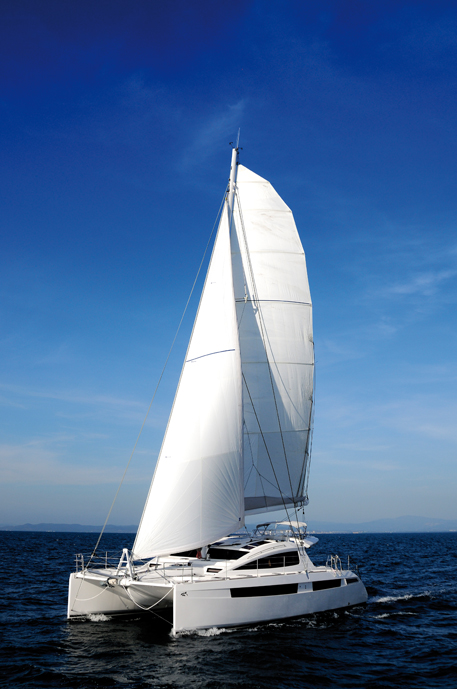
Very comfortable, powerful, sails well in light weather, easy to handle and homogenous; the 515 renews the approach to luxurious 50-footers.
An avant-garde silhouette
Innovating without overplaying the role, expressing the full potential of a 15-metre platform without caricaturing, is a high-risk challenge in a competitive market, where R & D departments and interior designers put spokes in each other’s wheels! Leaving aside the debatable flybridge, the 515’s project team has succeeded, with an aesthetically convincing result. The 515’s silhouette is resolutely different, and achieves its aim. To the eye, it offers a tight, contemporary design which enriches the new Alliaura signature. The hull sides have been the subject of special architectural attention. The ‘step’, overhanging the hull is well-integrated, the perspective lines created by clever use of Perspex surfaces combined with a studied coachroof profile reduce the impression of volume. The 515 has unquestionably got style. Its elegant design would be set off by more audacious decoration (colour, transfers, etc...). . The lifting davits form a pertinent solution, the steering position at mid-level merges into the overall lines. Only the mechanically-welded fittings on the forward crossbeam break up the fluidity of the lines, and call for a structural treatment of this element. From the exterior, the overall perception is positive; the 515 breaks free of the classic route taken by the 495. These catamarans express two successful, but very different approaches to (very) comfortable multihull cruising. The 515 is aimed at a more elitist clientele, looking for originality.
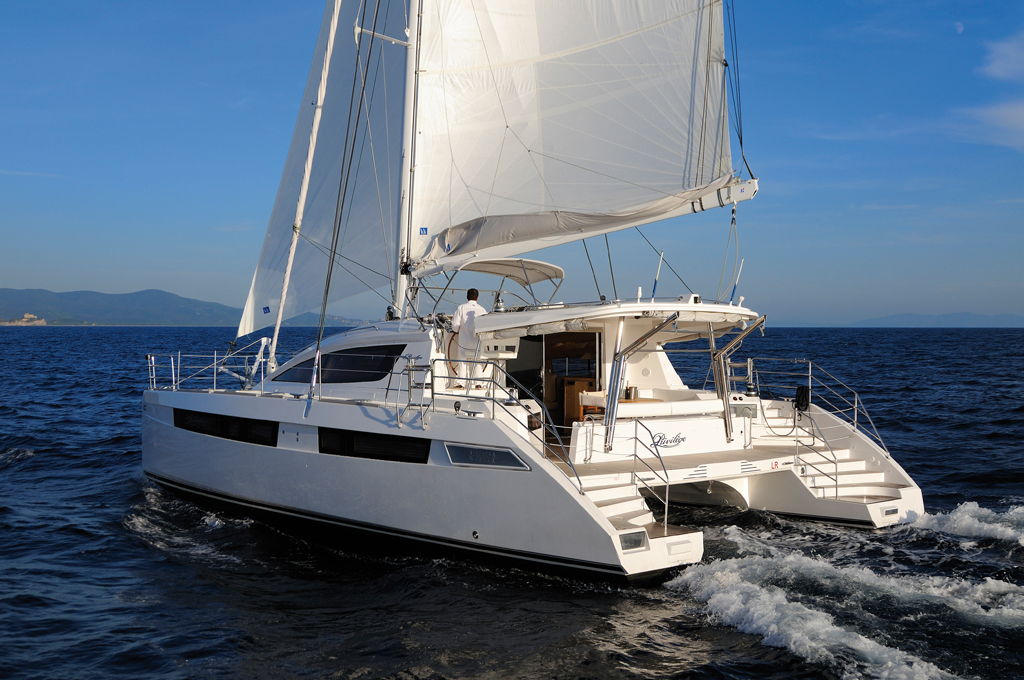
The Privilege 515: the quintessence of traditional joinery, effective ergonomics and an inspired design.
Accommodation: classic style for a contemporary design
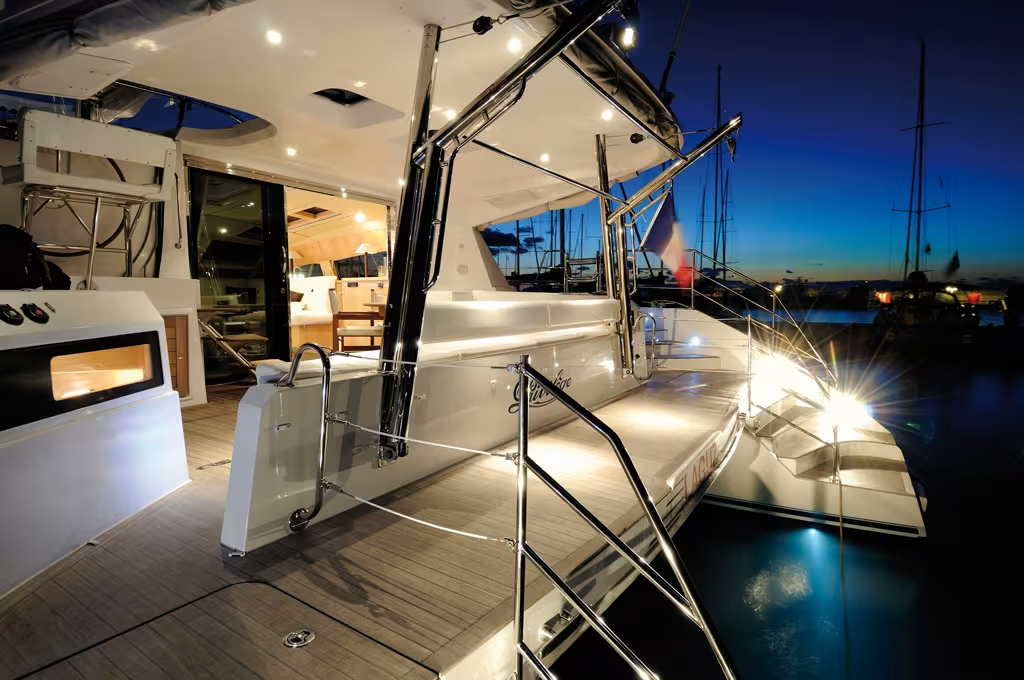
Alliaura’s joiners no longer have to prove their mastery of their art, and can therefore put this excellence to use in a less conventional, creative style. The choice of walnut in the example presented at the Grand Pavois illustrates the richness of the match sought between the materials (white headlining, deep shades of the wood coverings) and the shapes. The Dièdre office seems to have pushed back the limits of the usual areas; this is particularly obvious in the same-level cockpit-saloon, but can also be seen in the superb treatment of the galley. The overall atmosphere is airy and warm without being ostentatious; the panoramic ‘sun-roof’ is a really good idea; the electrical assistance with its complex kinematics is perhaps not indispensable. I would willingly exchange the chart table’s ‘pouffe’ for a technical relaxing seat suitable for use at sea. Lighting in the cabins and the gangways has taken a real step forward, with the long, horizontal portlights set into the hulls, which will however oblige the crew to be careful with the quality and number of fenders used to protect these elegant hulls from the agricultural stonework of the marinas. There is no point in emphasising the special charm of the owner’s cabin, which exerts an unreserved attraction on enthusiasts; skilfully reinterpreted on the 515, it is brighter and just as cosy.
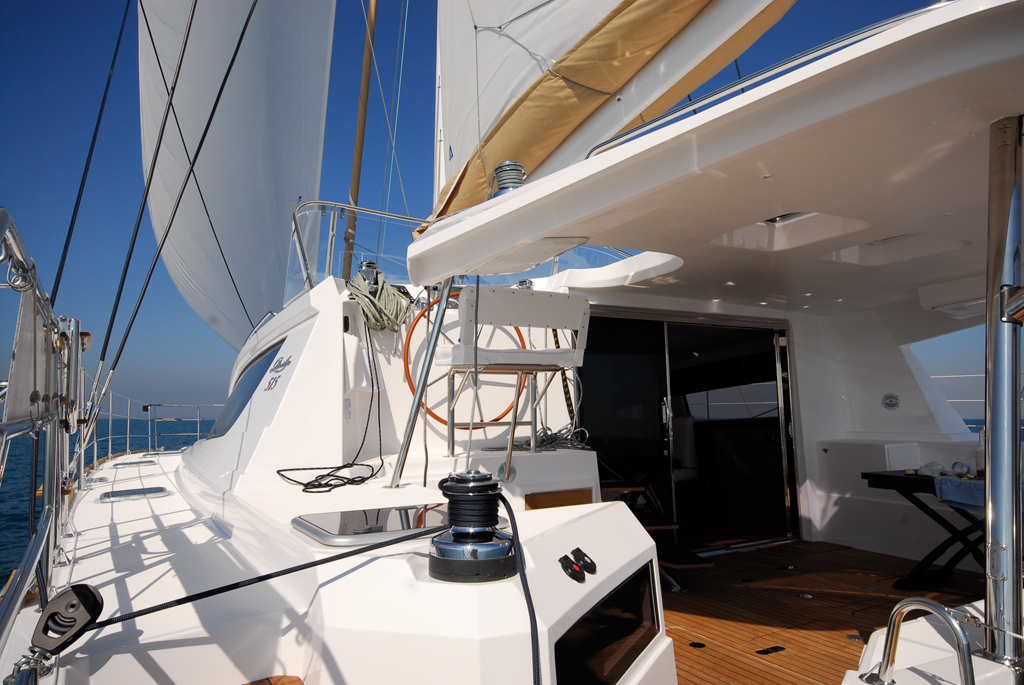
Fluid and coherent ergonomics, easy manoeuvring shorthanded; from this point of view, could the 515 be the most successful of the Privilèges?
A voyager’s engine choice
By meeting the needs of weight-centering, the engine installation gains in accessibility and visibility, without being a nuisance for the crew, thanks to effective sound insulation. The peripherals (watermaker, generator...) benefit from a welcome secondary location. Functional monitoring of the main organs is optimised; the experienced skipper will frequent this safe space, dedicated to rational maintenance, as often as possible. The 2 x 65 hp engines on our test version were perfectly comfortable.
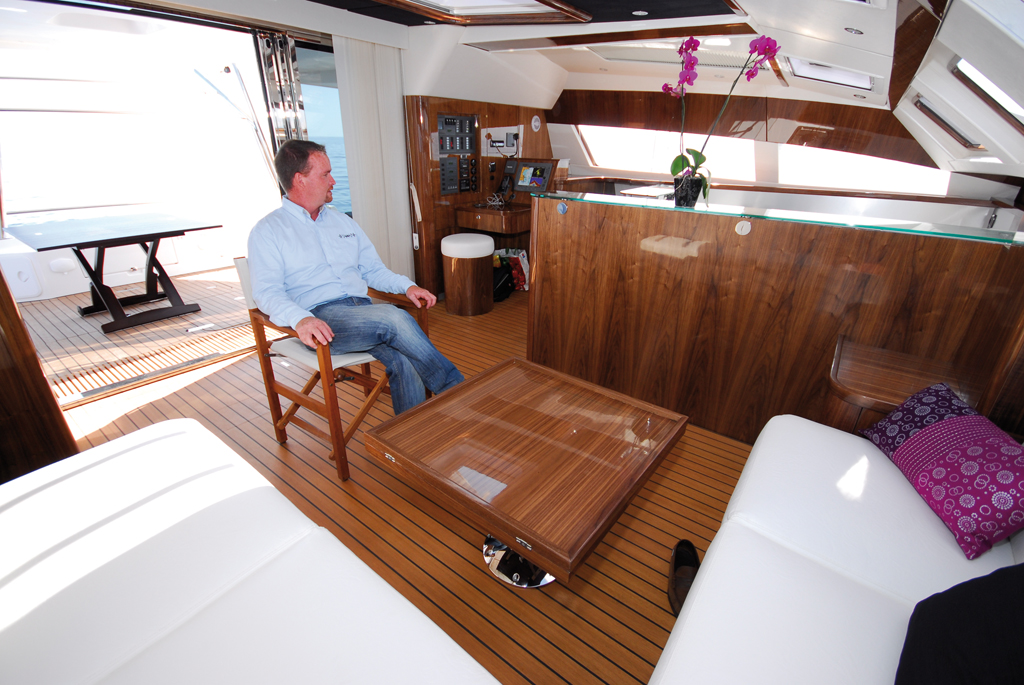
The superb shades of the walnut renew the Privilege style; the decorative balance of the materials and the colours confirms an authentic signature.
An effective, simple-to-use deck plan
An obvious sign of the company’s investment in this key compartment of life aboard: the ergonomics and readability of the manoeuvring position of the navstation, deserve a special mention. The overall reflection which governed this creation is fruitful, even if this apparent ease owes a lot to the electric assistance of the two powerful Andersen winches. Within the limits of our test, I was very enthusiastic about the ease with which this big boat can be handled, with its respectable sail areas. The care taken over compatibility of the diameter of the lines with their ‘super-strong’ jammers, and the general quality of the components show seriousness and allow us to pay homage to the considerable progress made in yacht fittings, without which this catamaran’s aim could not have been achieved.
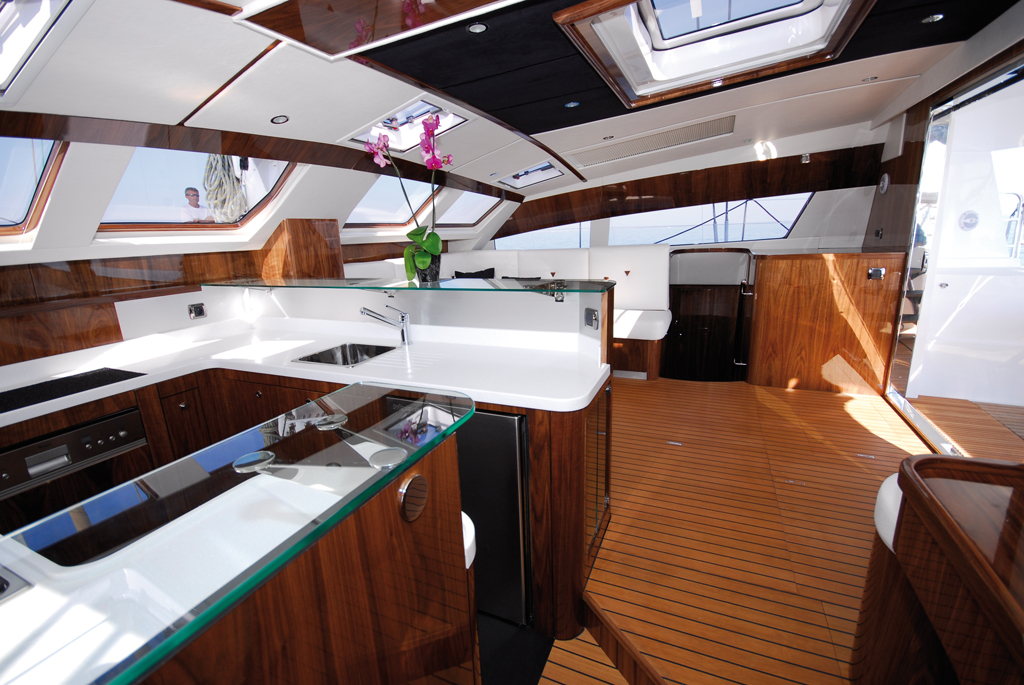
The accommodation is in a classic style for a contemporary design... A success!
Convincing behaviour
The architects seem to have dedicated a lot of grey matter to improving the performance of this new generation of ultra-comfortable catamarans. The reliability of the components (sails, rigging,) and the construction allow satisfactory power ratios. Under way, this Pullman is well balanced, the vertical bows are quite slim, and the forefoot passes through the chop in an agile manner. The flat aft sections give clean wakes; it would take very lively sea conditions to induce unpleasant pitching. The nacelle tunnel is suited to the programme. In this size, a bow thruster is not essential; its absence will only be noticed in exceptional circumstances (of which there are many in European marinas!). The visibility when manoeuvring is entirely satisfactory. The delivery trip from La Rochelle to Les Sables d’Olonne only allowed us to discover one aspect of the boat’s possibilities, but one of the most sensitive: sailing in light weather! The drive qualities of this generation of propulsion assemblies are amazing, and we left the La Rochelle channel at 8.5 knots in appreciable comfort. On a well-prepared 515, the manoeuvre takes place at the navstation, visual observation and anticipation mobilise the essential part of the crew’s technical resources. The 88m² mainsail was hoisted in less than two minutes, without calling on any manual assistance; I then unrolled the 94m² gennaker thanks to the pertinent combined arrangement of the roller line and the sheet winch control on the dashboard (alas, fully sheeted, it chafes on the aft stanchion). The other nice surprise comes from this big boat’s handling in these conditions: with laminar profiles, it is lively and relays noticeable accelerations with each increase in the breeze. The sails ‘fly’ perfectly, well-filled by 8 knots of north-easterly. Mastery of these areas by the best professionals has only happened in the last few years (for cruising), but the shape and the perfection of the volumes is amazing. The use of Hydranet as a good compromise solution has become highly commendable. The enthusiast can push back the limits of the ‘iron topsail’ and really play with a coherent sailing machine, which is not always the case! The aluminium Marechal mast follows the trend; the construction quality of this 21m tube is a reference in the segment. To confirm these favourable impressions, we tried a series of tacks close-hauled, whose result proved clearly positive; the directional effect of the rudders is real, the hulls pivot without hesitation and acceleration is quite swift for a platform of this size. We sailed quickly up the Pertuis Breton and overtook, under sail, the 12 – 14m production monohulls which were being delivered under engine at the end of the Grand Pavois with generous amounts of throttle!
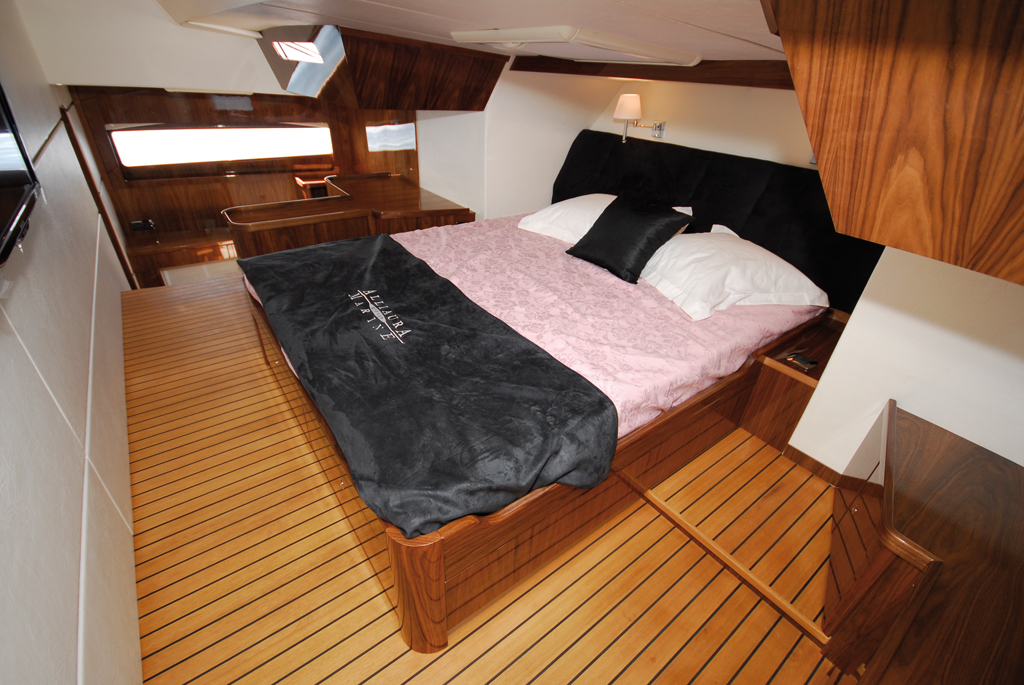
The trump card in the owner’s version: the forward suite!
CONCLUSION
I liked this boat. The elegant functional ergonomics, the visibility from the steering position, the readability of the deck plan, the quality of the build and the equipment convinced me. The overall placing of this catamaran in the international market is judicious: it offers the services of a small yacht, whilst remaining controllable by a shorthanded crew. The good ability it proved to have during our test will probably be confirmed in rough seas, as long as the half-load displacement is respected (the worst ton is always the last!). Without trying to be original and amaze the boat show, the 515 offers a sound and elegant interpretation for the wealthy enthusiast who wants to remain master of his boat and his programme, whilst pampering his guests.
Comfort : 4/5 Sport : 2/5
THE PLUSSES
• The boat’s style • Overall quality • Ergonomics and pleasantness in use
THE MINUSES
• Absence of mainsail barber for downwind sailing • Gennaker sheet chafes on stanchion • No jib boom options
THE COMPETITORS
Model Architect Builder Weight in t Sail area in m² Price in euros, inc. VAT Dean 498 P. Dean Dean 14 140 592,000 Phisa XV N .C Phisa 14.5 146 820,000 Catana 50 C. Barreau Catana 13.6 134 944,720
TECHNICAL SPECIFICATIONS
Architect: Marc Lombard Design: Diedre and Alliaura Builder: Alliaura Marine Length: 14.74m Waterline length: 14.63m Beam: 7.98m Draft: 1.57m Unladen displacement: 16t Mainsail area: 88m² Genoa area: 53m² Staysail area: 28m² Gennaker area: 94m² Mast height: 21.11m Diesel: 800L Water: 600L Engines: 2 x 55hp (2 x 65hp optional) Transmission: sail drive Keels/daggerboards: Keels Price: 1,005,000 inc. VAT