
Claude Thélier, skipper and owner of the trimaran ‘Région Guadeloupe’ (formerly Laurent Bourgnon’s Primagaz ) tested the Punch 1700 for Multihulls World, during the Tour de Guadeloupe.
Infos pratiques
- Le chantier : Punch 1700
- La fiche technique
- Découvrez notre vidéo exclusive
- Financez votre Punch 1700
- Assuez votre Punch 1700
- Articles autour du Punch 1700
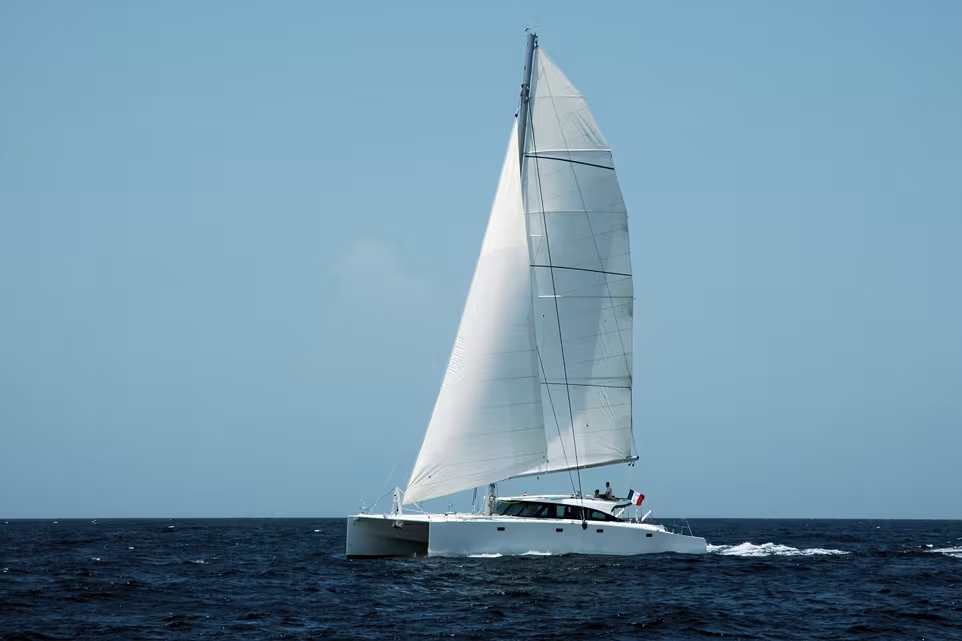
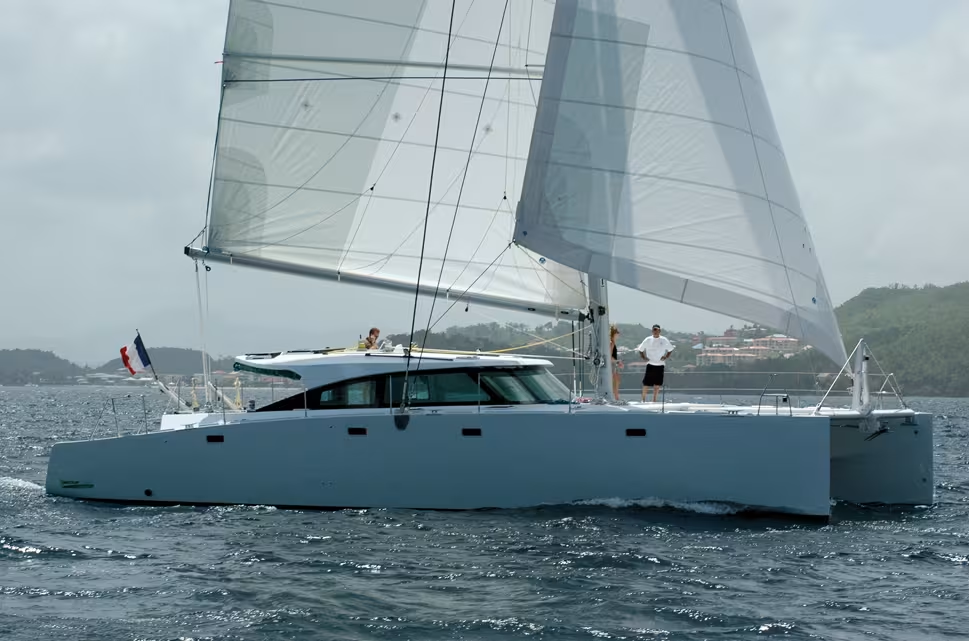
This catamaran is not the biggest in the range, despite a huge internal volume, and it can be differentiated from the other Punches by its more modern and very aesthetically-pleasing look, with a panoramic view under the coachroof. The rounded hulls are built in red cedar strip planking and epoxy. The owners, Sandrine and Fred Lachot, had very precise requirements: to carry out mixed sea/river cruises in Guyana, with large load-carrying capacity (passengers and equipment), as well as getting to the Caribbean quickly with 16 people aboard. After having questioned various builders and architects, the boat was designed by the La Rochelle-based architects’ office, Mortain & Mavrikios, and built by Multicap Caraibes, based in Martinique. To best meet the specifications, the choice of material turned to red cedar strip planking, glassfibre and epoxy (lamination system). After delivery in August 2008, the catamaran sailed to the Iles du Salut in Guyana - 800 miles close-hauled against a 2 to 3 knot south-easterly current, at an average of 8.5 knots over the ground. In January, the catamaran was chartered for the ‘Bouvet Rames Guyane’, a singlehanded rowing race with no outside assistance, between Senegal and Guyana, to take care of the daily media coverage of the event, as well as assisting the 22 competitors in case of danger. It therefore sailed from Kourou, passing via the south of the Azores to Saint Louis in Senegal, 4,000 miles, 3,000 of which were close-hauled in 20/30 knots of north-easterly, with a rough sea and 3 metres of swell. Result: an average speed of 8.9 knots over the ground! The return trip to Guyana, following the rowers, took place from March to the end of April, and totalled 7,000 miles on all points of sailing. The Punch 1700 has thus covered more than 12,000 miles in all conditions: an excellent breaking-in period!
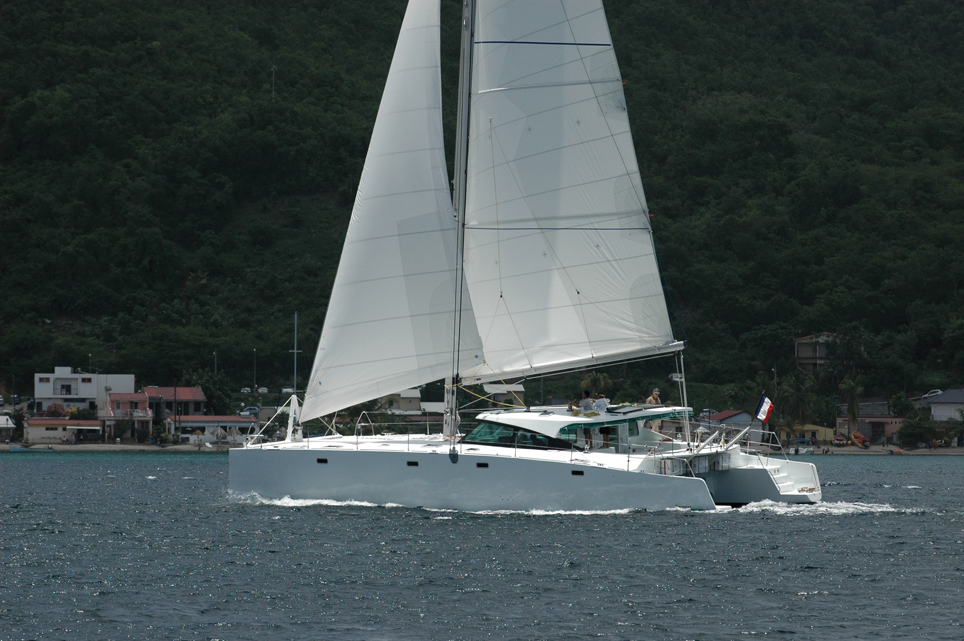
A fast cat, as its excellent result in the Tour de Guadeloupe demonstrates.
At the end of May, after having had his catamaran measured for the Multi2000 class, Fred Lachot entered the Tour de Guadeloupe, organised by the Triskell Cup from 20th to 24th May, and invited Claud Thélier aboard. What could be more interesting to test this new catamaran, which intrigued so many sailors on the quayside, than a race and a skipper who is a multihull specialist? But let’s allow Claude Thélier, who accepted the invitation for a stage or two, to tell us about it: “Wednesday 20th May, 8am, the crew, consisting of 10 people, including 5 young Guyanese, was impatient to do battle with the 50 boats entered, amongst which, in our multihull category, were to be found some very fast boats: a 42’ Lerouge design, a KL 28, a CDK 28, etc. The wind was varying between 15 and 22 knots, and I placed the catamaran as best I could on starboard tack, whilst Fred gave me the countdown: 10...5...1..go! I was surprised by the boat’s manoeuvrability under sail in the middle of the fleet. It responded perfectly and didn’t give the impression of being a big, 17m catamaran. I was immediately very comfortable aboard. We covered the course to Saint Louis (Marie Galante) in 4h28 and finished second on corrected time in the multihull category. Even though I am used to the performance of my trimaran, with speeds of 25 knots, I was very surprised by the Punch 1700, and decided to stay aboard for the next day’s stage, Marie Galante – Port Louis, on Grande Terre.
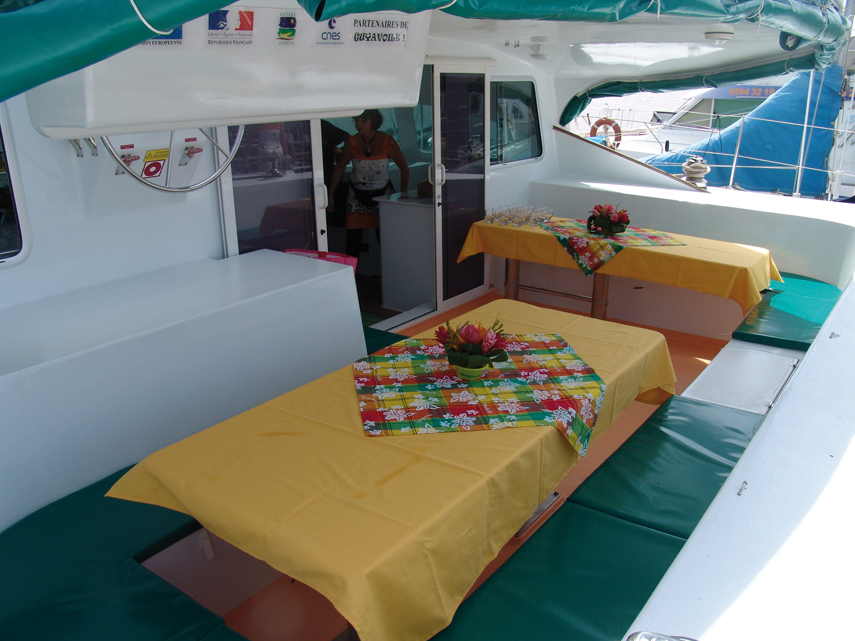
A convivial cockpit, perfect for welcoming all your friends.
On Thursday, despite the crew having got to bed late, everyone was at their positions, and to motivate everyone, I offered to stay on board on the Friday if we won this second leg, the longest of this 2009 TGV. The Punch 1700 is really surprising, I managed to get a start which surprised...even the crew! On the course, under main and genoa or gennaker, it was a treat. The boat sailed really fast and responded to the slightest gust. It is a real sailing boat which is a pleasure to race on all points of sailing. Its behaviour in rough seas is very pleasant. In two hours, we had caught up most of the monohulls, which had left 15 minutes before us. We finished first on corrected time, and as promised, I stayed aboard the next day! The evening we had a party, of course, but I asked the crew to go easy, as the following day we had to win the third leg. Friday, 7am, the crew was on good form, and had no intention of being beaten. We got a fantastic start again, right in the middle of the fleet. The wind was light, 5 to 10 knots, and we finished third despite everything. On Saturday, we motored from Deshais to Vieux Fort, where the start was given to go to Les Saintes. The 18 miles we covered under engine allowed me to note a speed of 10 knots at 2,500 rpm, thanks to 2 x 75hp Volvo S-drives and folding propellers, which, with 750 litres of fuel, give a range of 800 miles. Even under engine, the boat is fast, pleasant and really very manoeuvrable.
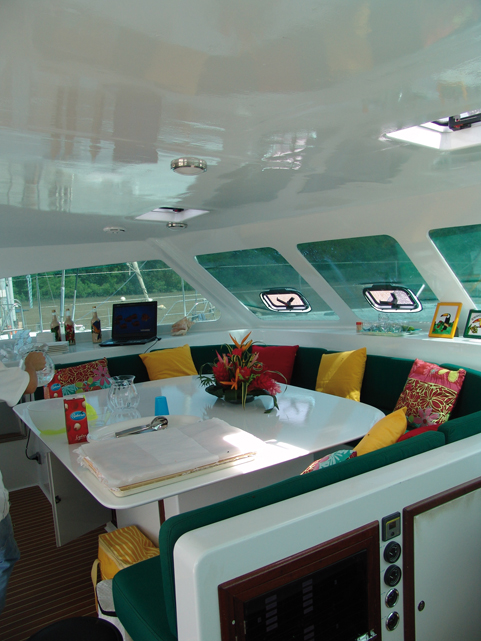
Volume, light, good ventilation. A cat which is pleasant to live aboard.
At 10am, we got a very good start, with a 15-knot easterly wind. Another stage with different points of sailing and rough seas. We were once again first on corrected time at the finish in Les Saintes. The crew members were delighted; they had embarked aboard a good catamaran! Sunday, final stage, Les Saintes - Pointe-à-Pitre and I stayed aboard just for the pleasure despite the extra work that these 5 hours of racing would give me on the Monday. It was worth it, as it was pure pleasure. 10am, the Punch 1700 allowed us to get an excellent start again, it was really surprising with this catamaran which never missed a tack, and accelerated immediately, without us easing the main, even if the genoa had not passed. We sailed well again on this stage and finished first on corrected time, and we were…… First overall! It was fantastic and in the evening the crew celebrated –for certain of them, this had been their first race! In conclusion, I was very pleasantly surprised with the Punch 1700, and it reconciled me with cruising cats, because my previous experiences on various boats had not convinced me at all.” He concludes the test by adding: “The 1700 sails well in rough seas, thanks to its 1.1m bridgedeck height, its sail plan, its slim bows and rounded hull, which make it fast on all points of sailing. We never sailed at less than 8 knots, with top speeds of 17 knots, in winds of from 5 to 28 knots. The Punch 1700 sails well close-hauled; we regularly sailed at 40° to the wind... The deck area is huge, manoeuvres are relatively easy for a catamaran of this size, and its raised steering position which brings together main and genoa sheets, gives great comfort and safety.
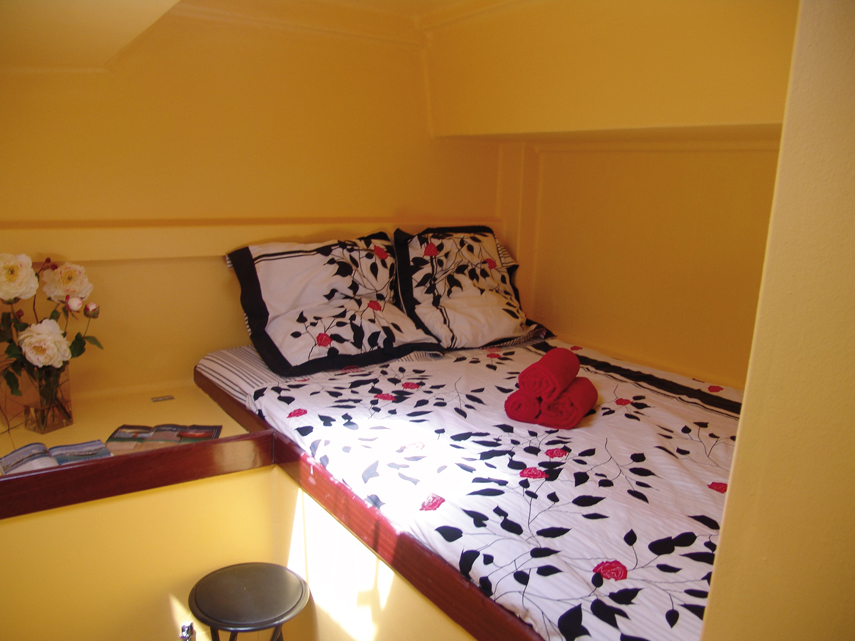
Simple and pleasant, the cabins will be easy to maintain.
Accommodation
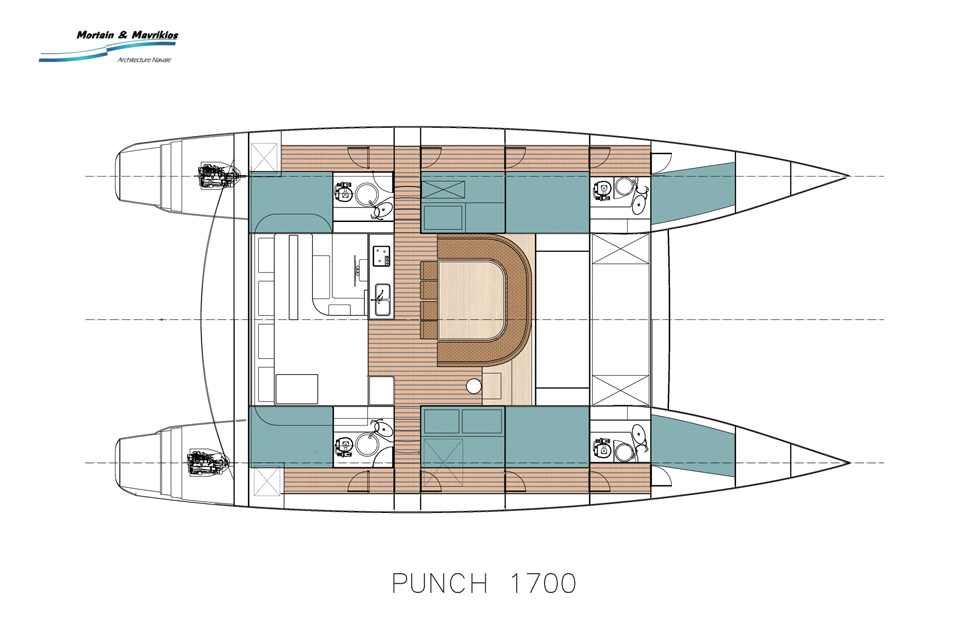
This is the part of the boat I spent least time on, however I was able to see that the shape of the hulls, thanks to the interior ‘step’, allowed three big double berths in three cabins in each hull, two bunks in two forward cabins and two heads in each hull. Thus the Punch 1700 can accommodate 16 people whilst cruising offshore. The saloon can accommodate the full crew around the table, and the skipper benefits from a nice navigation position, with a full-sized chart table. As for the hostess, the galley is imposing, with two refrigerators, a 120-litre freezer, and a stainless steel gas stove and oven worthy of a chef’s kitchen. All this is enhanced by a panoramic view and excellent ventilation. Sailing for 5 days aboard the PUNCH 1700 was such a pleasure that I will have difficulty finding weak points; I prefer to talk about improvements. -The 126m² North Sails main could be hoisted more easily with an electric winch. - It would be wise to change the main halyard for one in spectra. -You have to get used to the access to the steering position; it’s the owner’s choice, but it remains a great place when sailing. - Multicap Caraibes and the architects, Mortain & Mavrikios, offer ‘à la carte’ accommodation, according to the cruising programme. The interior finishing was carried out by the owners; the result is very successful and well-suited to the programme of cruises they are offering between Guyana and the West Indies.”
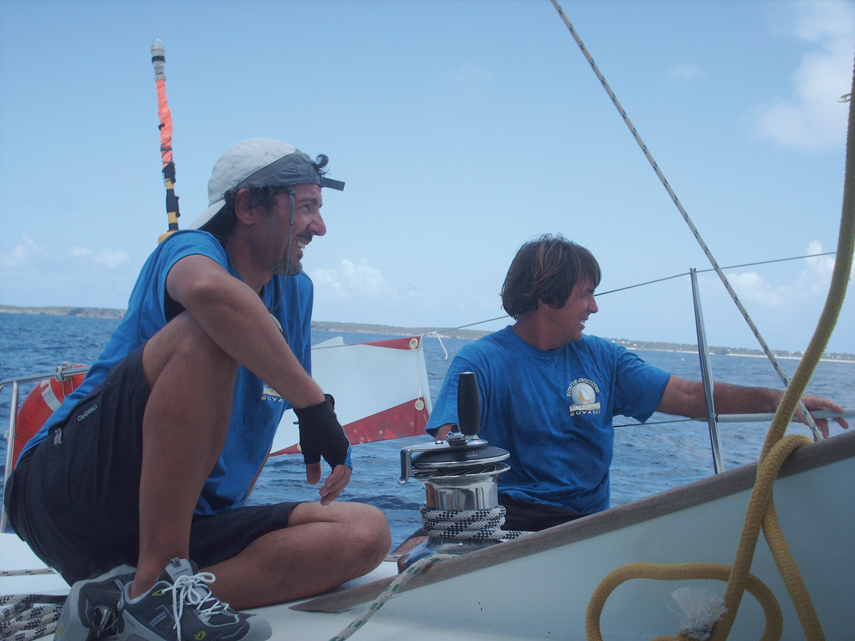
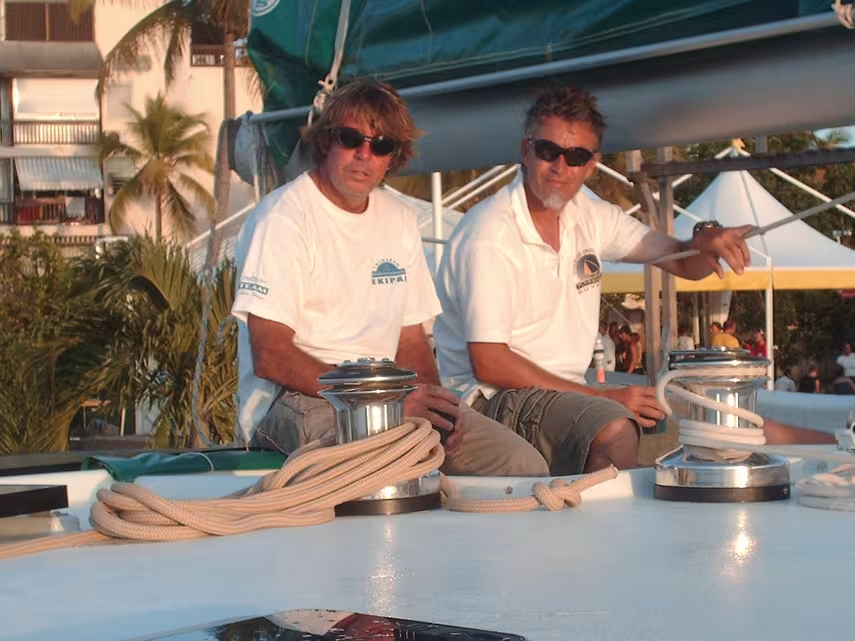
Racing, waiting for the skipper’s orders.
THE OWNER-SKIPPER’S OPINION OF THE RACE (Fred LACHOT)
“I wanted to test the Punch 1700 in an official regatta run by the FFV; the Tour de Guadeloupe’ was the perfect opportunity. 5 days’ racing, from 20th to 24th May, with 50 boats on the start line, including 10 multihulls. Amongst the latter were several ‘big names’: a 40’ racing trimaran, two 35’ racing cats, a 45’ cruiser-racer catamaran, etc... Weather conditions: 15 to 22 knots of ESE trade wind, calm to slight sea in the Caribbean, but rough in the channels and to windward. Large areas of calm and wind shadow in the lee of the island, with less than 6 knots of wind, sometimes changing direction by 180°. Perfect conditions for a test, with all points of sailing: apparent wind from 5 to 30 knots, use of all the sails, including the 160m² gennaker, from wind astern to a close reach. The result is spectacular; the boat sails well on all points of sailing. It has very low drag, which is important in light weather. In strong winds with a rough sea, the bridgedeck height allows it to pass incredibly well through the waves. Despite a displacement of 18 tonnes, the Punch 1700 reacts immediately in light airs, the slightest gust of an extra 3 knots gives noticeable acceleration. When we had 8 knots of true wind, we were at 6 knots over the surface, and with a gust of 12 knots, the Punch 1700 accelerated to 8 knots. The boat is really fast! With 5 tonnes aboard during the 2 Atlantic crossings, the regular average, all points of sailing taken together, was 9 knots, with top speeds of 18 knots a common occurrence. We are proud of our 1st place in the Tour de Guadeloupe, in the cruiser/racer/offshore catamaran category... The sails, from North Sails, gave us great satisfaction; the engines (2 x 75hp Volvo S-Drives, with folding propellers) are well suited. Our average speed was 8 knots under engine, at 2,500 rpm. The 750 litres of fuel gave us a 90-hour or 7 to 800 mile range. We have just covered 11,000 miles with the Punch 1700, 95% of them under sail. We chose keels rather than daggerboards and do not regret this choice at all. We pointed as close as the monohulls, sometimes at 40° to the wind, but we were sailing much faster. We can beach the boat on its keels to scrub off the hulls and carry out maintenance. Thanks to Claude Thélier for his help and precious advice; thanks to the architects Alain Mortain and Yannis Mavrikios for having taken up the challenge; and thanks to Multicap Caraibes for this extraordinary and particularly versatile multihull.
Technical specification
Builder: Multicap Caraïbes Overall length: 17 m Overall beam: 9 m Unladen waterline length: 15.35 m Air draft: 25.17 m Draft: 1.5 m Mainsail area: 110m² Genoa area: 76.5m² Reference displacement: 19.7 t Unladen displacement: 17.8 t Laden displacement: 21.2 t Engines: Volvo 2 x 75cv
THE COMPETITORS
Builder Model Length in m Price exc.VAT in euros Nautitech Catamarans Nautitech 54 16.30 650,000 Swiss Catamaran Swiss S2C 55 17 1,100,000 Mattia Mattia 56' 17.10 795,000 African Cats FastCat 555 17.70 1,395,000 Outremer Yachting Outremer 55' Light 16.30 460,000
