
For several months now we have been eagerly awaiting the arrival of the Rapier 550. Broadblue entrusted the design to Darren Newton (and Nick Bailey) who also undertook the build, at the Multimarine yard. This fact, combined with a very advanced specification, has all the makings of an exceptional project. We set off for Portsmouth (UK) for a two-day test, including the famous Round the Island Race (round the Isle of Wight), with more than 1,500 boats on the startline.
Infos pratiques
- Le chantier : Broadblue Rapier 550
- La fiche technique
-
 Découvrez notre vidéo exclusive
- Financez votre Rapier 550
- Assuez votre Rapier 550
- Articles autour du Rapier 550
Broadblue, re-emerging ambition!
England is part of a very close-knit club of countries pioneering the rediscovery of multihulls. Pat Patterson (Heavenly Twins), Tom Lack (Catalac), the Prout brothers (Snowgoose), James Wharram then Derek Kelsall and Nigel Irens have been the standard-bearers for this adventure, which has cleared the way for many architectural styles in both racing and cruising. By the late nineties this was starting to fizzle out a little, leading to a crisis: most of these “English cats” were running out of steam in the commercial world. Despite this, their replacements were there (Multimarine being one of the leading ones), but were probably overshadowed by the remarkable growth in French production. Mark Jarvis launched Broadblue in the mid-2000s, drawing on his background as a businessman, a sailor and a maritime professional. To begin with, the Broadblue 345 and 385 were built under license in China with technical assistance from Darren Newton, before production being moved to Poland. Next came the very successful and very capable Format 400, (a semi-open catamaran shown at the Multihull Boat Show and the La Rochelle Boat Show in 2009. See the test report in Multihulls World 118). To properly create the portfolio, they needed to re-group the different models under one brand, and also add a big cruising boat in the 50 foot range. And that’s where we are today.
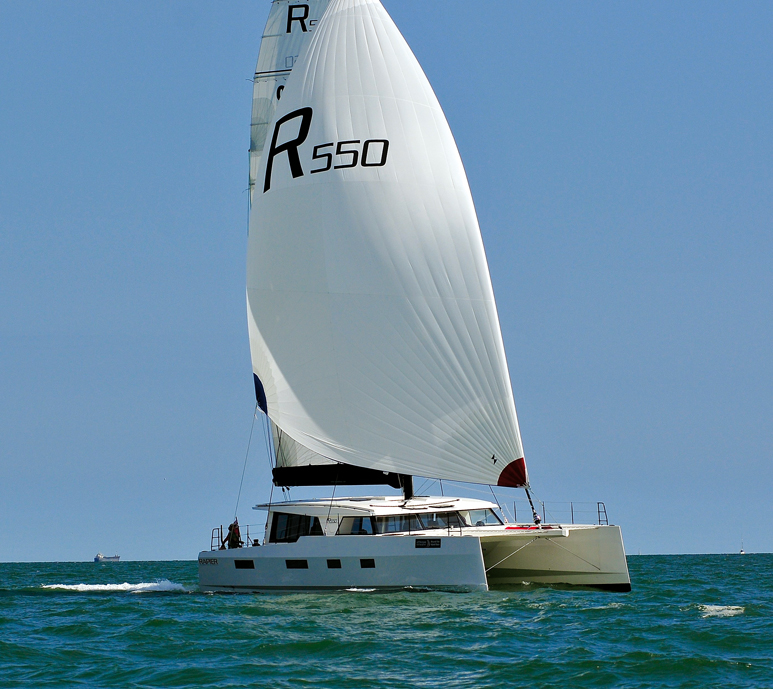
The R550, a fusion of power, quality and design
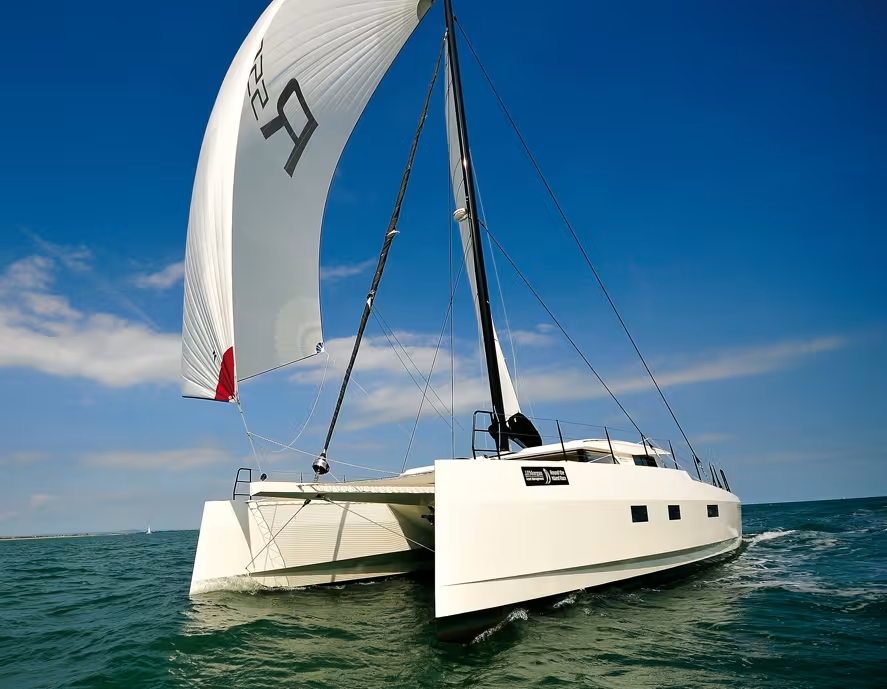
Rapier 550. An immediately obvious unique style
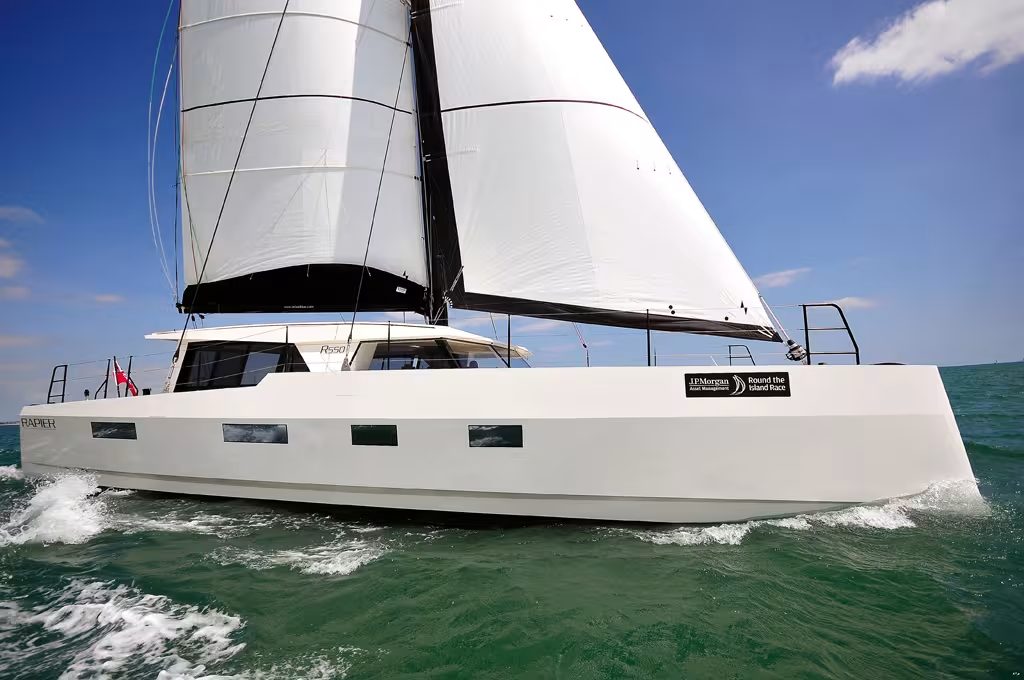
A rapier is an elaborately designed long, thin sword. A description which fits well with this catamaran whose sophisticated design hovers between asserting a bold image while retaining clean lines. The pen of Nick Bailey and Darren Newton flirts with an avant-garde style, but the accuracy of the proportions gives the boat an almost classic personality. The quality of the workmanship and the black and white dress code join together to give a beautiful and sensual result.
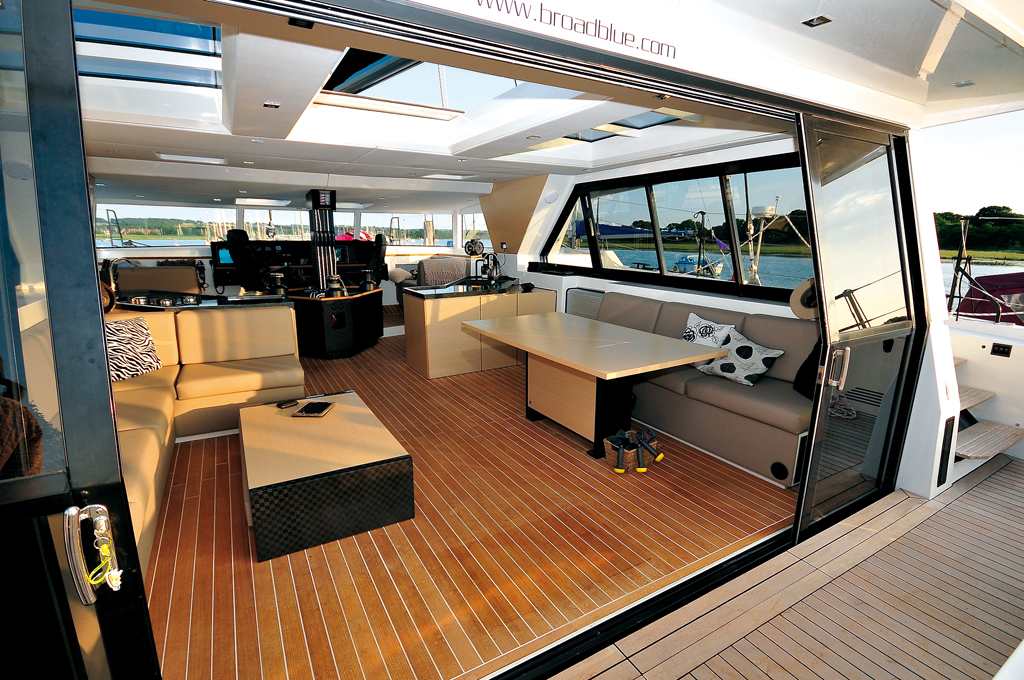
The R550 in “Targa” mode, moored in the River Medina at Cowes.
A sharp and innovative multihull
The R550 wants it all, and wants it right now! Even so, it is not borne of the dreams of Antigone, but of rational and exacting thought, used to creating designs for the testing areas of northern waters. Speed, comfort in every possible climate and maneuverability remain greatly opposing concepts. Broadblue’s approach raises the bar, is innovative in many areas and uses only reliable technical solutions! A challenge for which the bar is already raised high! We need to have a look.
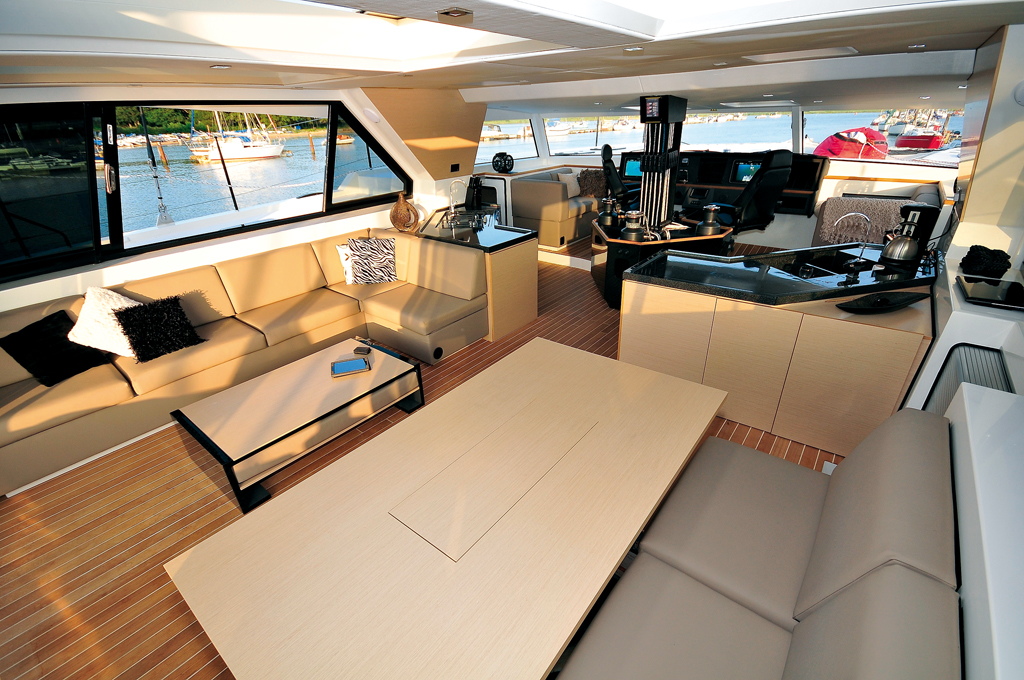
This boat revolutionizes the traditional interior catamaran layout, but far from being a question of styling, it makes the liveaboard quality exceptional.
The objective: to remain light, even for offshore cruising
Darren and Nick’s response is radical: to build a 55 foot catamaran whose operational weight doesn’t exceed 9.5 tonnes means carbon foam sandwich. The complete platform, except for the coachroof, is built by infused epoxy resin in one go. Superb! This large family catamaran sails at 12 tonnes in standard configuration (our test boat, fully loaded with food, water and fuel), with the maximum being 15 tonnes.
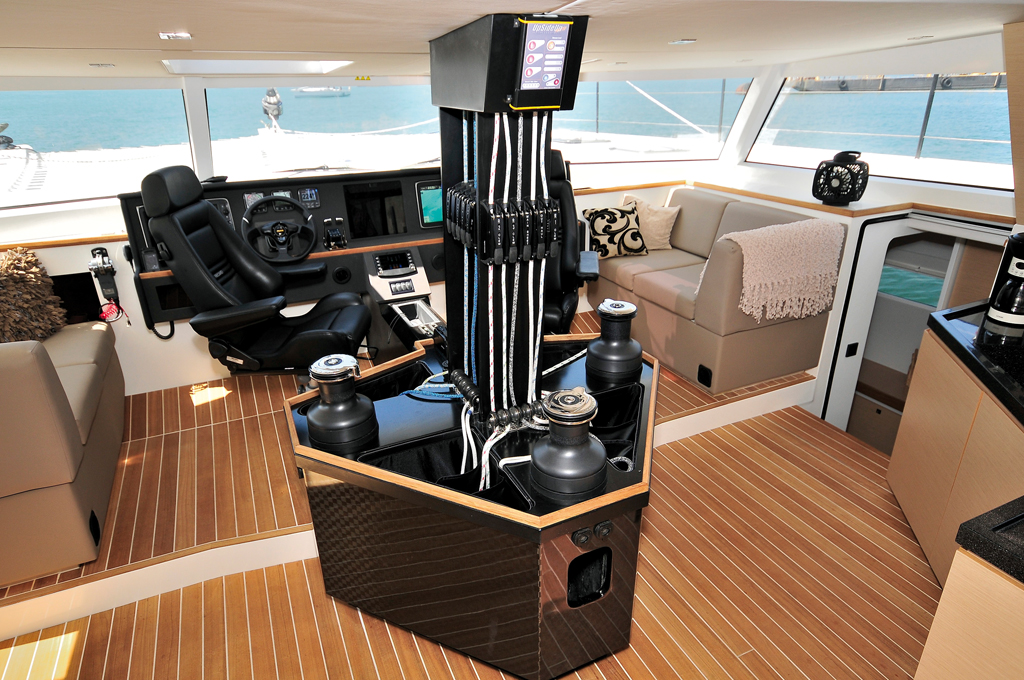
The helm station turns the traditional idea of a deck layout upside down. Adjustable Recaro seats, push-button console and auto-reversing winches allow you to sheet in and ease off to your heart’s content… all under the control of the programmable Up side Up system.
The Broadblue solution for sailing short-handed on a 55 footer
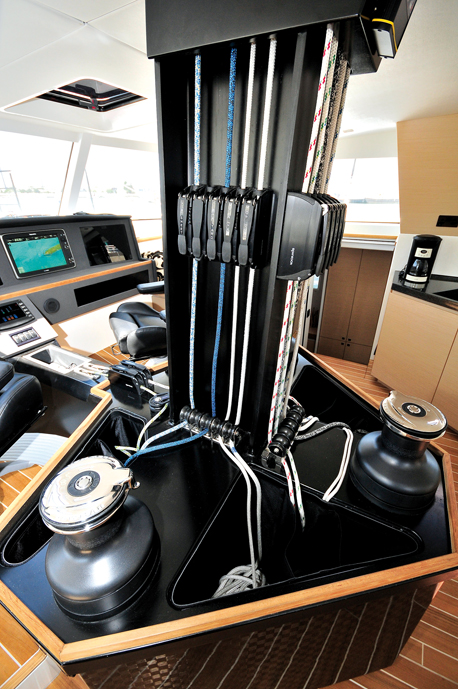
98m² of mainsail, 52m² of solent (event though it’s self-tacking), 167m² of spinnaker are not necessarily that easy to handle, given that the budget required for the R550 is not aimed at young fit racer-types! The racing experience of the guys from Millbrook is significant, and this has allowed them to incorporate a fair amount of new techniques; it also borrows ideas from a former original project which partially inspired the R550: the aptly named “Impossible Dream”! The “dream” was to design, develop and build a 60’ catamaran for Mike Browne, a paraplegic sailor. Geoff Holt, a tetraplegic sailor subsequently chartered the boat, and following a significant amount of preparation, completed an amazing single-handed Atlantic crossing! The reward for succeeding in this amazing challenge was the “Yachtsman of the Year” medal in 2010! Transposing part of this experience into the design of the 550, Darren Newton, Nick Bailey, Simon Baker and Miles Pinchin (Structural designer) designed the coachroof around a central carbon arch and an I-beam in charcoal black designed to withstand 45 tonnes of dynamic compression (25 tonnes static). Twenty “high-load” Spinlock clutches are fitted to this, which control all sail operations via three powerful, auto-reversing Lewmar electric winches! The console unit, built in strongly walled uni-directional carbon is a real work of art. It serves as an organizer, it holds the rope storage bins, and transfers the load to the bottom of the bridgedeck. In short, all sail-handling processes (yes, all: hoisting, lowering and adjustment!) are effected from this “winch station console”, sheeting in and easing out. The only lines visible on deck are the spi (or gennaker) sheets.
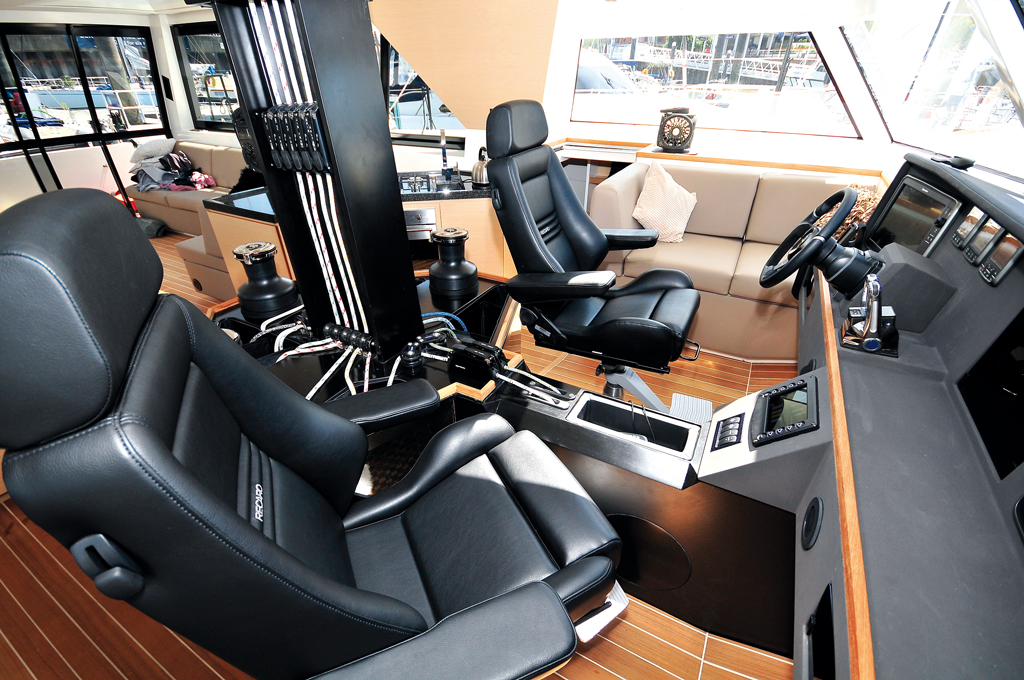
The design of the “passerelle” is a combination of a GT car’s dashboard, the helmsman controls all the sail and motor functions from this well insulated and ventilated cockpit.
A revolutionary helm station!
Not content with the drastic changes to the deck layout, the Multimarine duo (in fact a trio, with Simon Baker, a MOCRA champion) has completely turned the ergonomic aspects of a cruising catamaran upside-down! The helm station of the Broadblue R550 is in effect inside the salon, and is designed like an aircraft cockpit. Comfortably installed in “real” Recaro multi-position leather seats, the helmsman of this nautical speed machine is in complete control of all elements of navigation from his “dashboard” (instruments, engine controls, masthead camera, sport steering wheel, chartplotter) and the winch console (adjustment of the travelers, mainsheets and solent sheets)! A programmable “Up side Up” system (for releasing under load) connected to the three principal sheets is there for user safety.
A mastered technique
A level of automation such as this legitimately leads to some questions, and the response from the Millbrook team is that all the solutions used are reliable, readily available within the industry and have several safety nets in place. The explanation by Peter Middleton, in-house electrical specialist, is eloquent, particularly following two days of intensive use. Energy is produced by six large extra-flat solar panels, up-rated 125 Ah alternators on the diesel motors and a compact and discreet 6kVA Paguro generator. Power is stored in a large bank of four 230Ah 12 volt batteries. Distribution calls on high-tech engineering using five Empire bus modules spread about the boat which communicate by NMEA2000, with the Murphy system (a 7” screen which shows all the functions which are being supplied, in a simple and easy-to-use manner). Each module has sixteen channels available, and has electronically programmable fuses. This design dramatically reduces the cabling required. The units are interchangeable, and replacing them is a quick job if you have the part. This power system has been in intensive use since the boat was launched (3 months ago) and we haven’t even noticed the slightest deficiency during the three days spent on board.
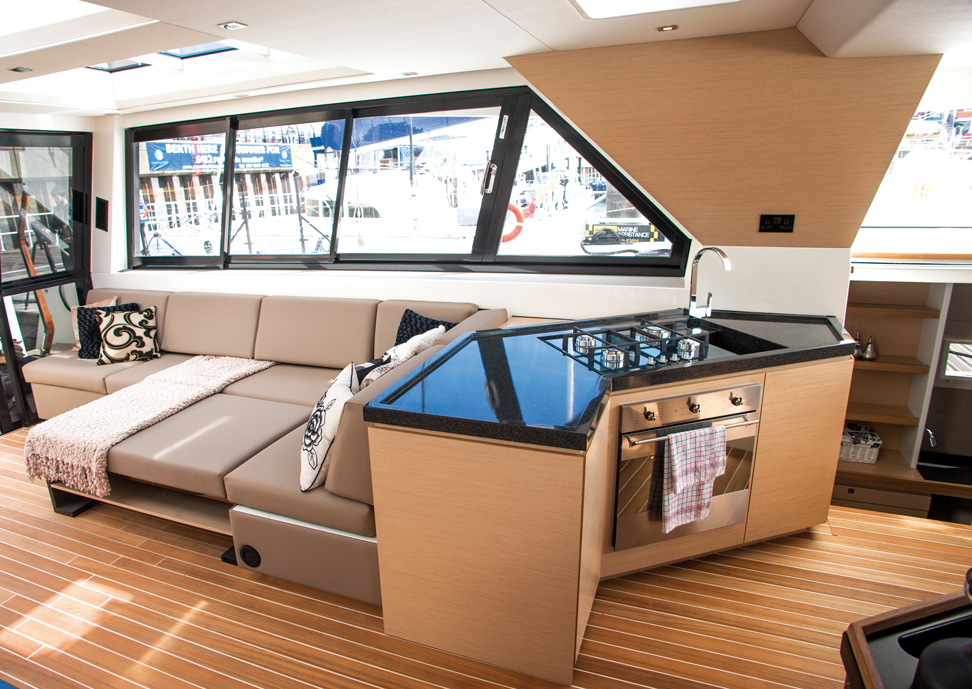
One of the two galley modules with the salon sofa transformed into a futon for use at the folding (carbon) table.
A convertible salon/galley for all climates
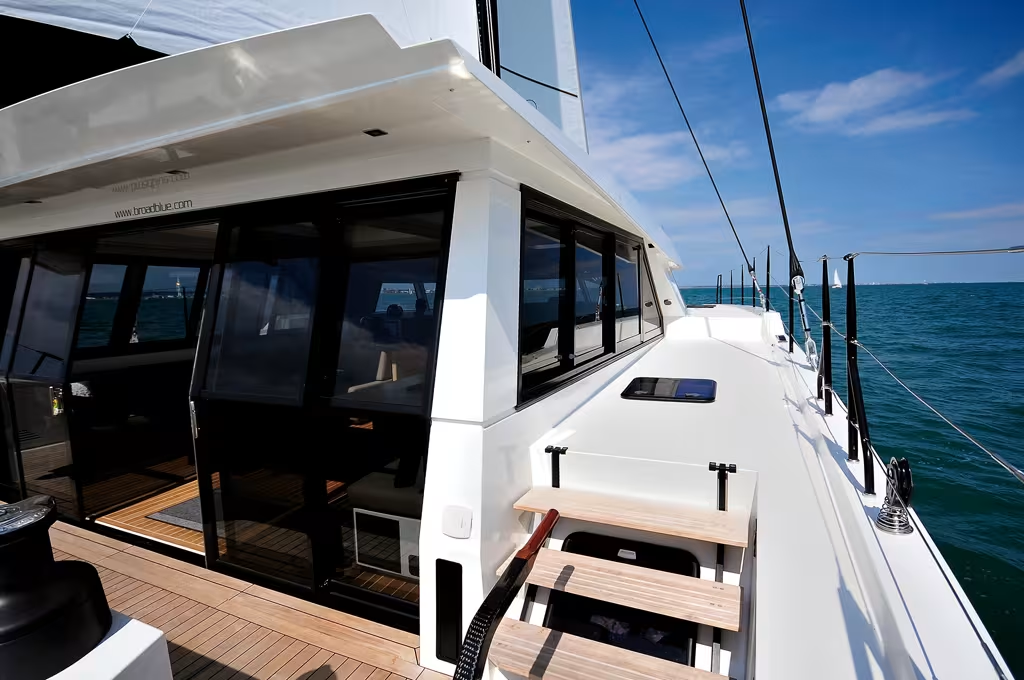
Tradition-defying right to the end, the R550 skillfully blends the sailing aspects with those of living on board, even as far as to amalgamate them. Next to the navstation are two sofas for the watch crew (so they are in permanent contact with the onboard nerve-center) or for the non-sailing guests to be able to accompany the skipper without being exposed to the outside elements. The galley is separated into two islands situated in the middle of the boat, between the salon, dining area and the navstation. The appliances are perfect (two fridges, a large Smeg oven, three-bowl sink); the neat hob is integrated into a recess to cope with any possible spillages. The work surfaces are magnificent, having the appearance of Corian (which would be too heavy), but are built in composite! The deck salon design is modular, the sliding side and rear windows open up wide, and part of the roof retracts electrically. Access to the aft end is totally clear. All the coachroof panels are made of a special toughened glass, capable of withstanding 300kg so as to not deform and to guarantee longevity)!
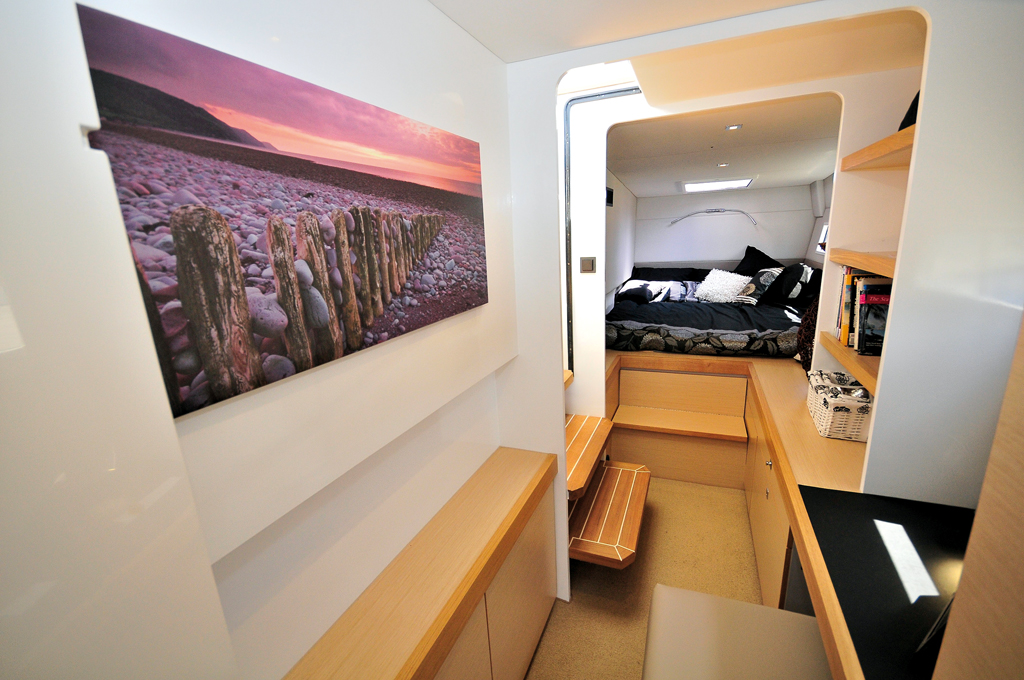
A high-tech carbon structure doesn’t prohibit an attractive interior design, here the owner’s suite to port.
An owner’s suite and just two double cabins
The overall insulation of the catamaran is absolutely remarkable, as is the quality of two-tone beige headlining, the furniture and the deck coverings (teak in the deck salon, fitted carpet in the cabins). The R550 offers an owner’s suite in one hull, and two double cabins in the other. The mattresses are recessed into the bunks, for ease of access for getting into bed. It’s things such as this and the clean sharp luxury which help create a very agreeable feng-shui atmosphere. Electric heads in the three bathrooms, passive and active ventilation throughout, high quality taps and plumbing fittings, hidden pumps and automatic shower drains… Everything seems to have been done to make life on board simple and comfortable. A crew cabin is even available forward to starboard.
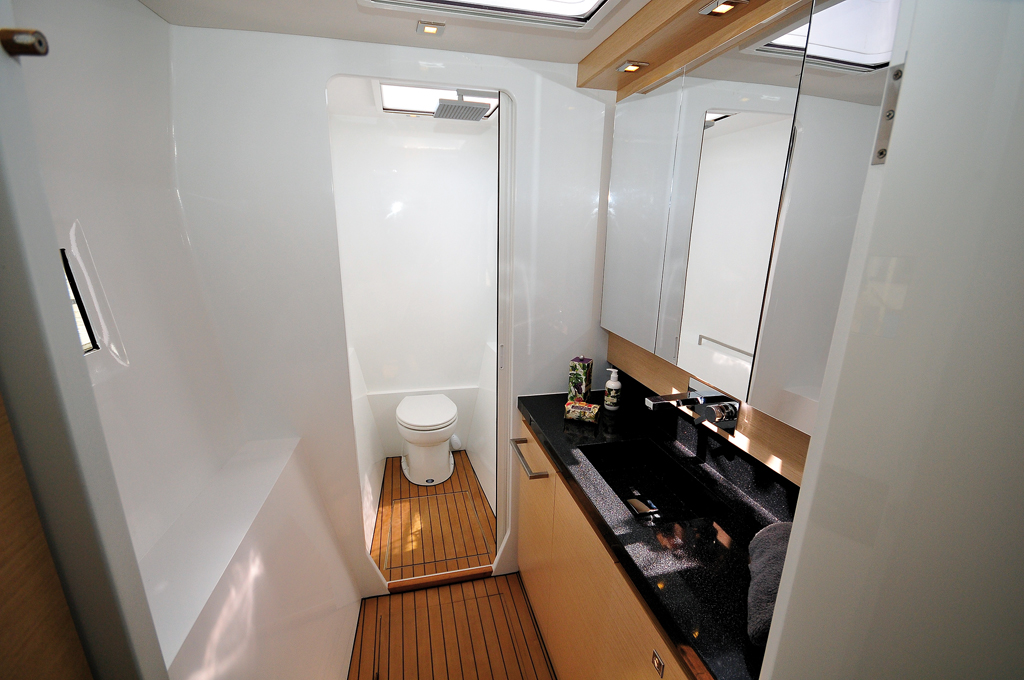
Heads compartment of the owner’s cabin.
100 miles on board the R550
Arriving on board the day before the famous race around the Isle of Wight, the day of Friday June 20th was given over to discovering the 550, the technology and the comfort of course, but also sailing, to try out the all-new 168m² asymmetric spi. The photo and video session allowed me to see the cat from the outside, and moving from all angles, to feel the machine in action, sometimes very close-up! We always have to begin like that! Going beyond a specification which seems a bit complicated, using the Rapier is logical. The excellent choice of equipment and the rigorousness of its installation help generate this perception. To set off under power, you have the choice of two helm stations, whether the main one inside (the helmsman remains in direct contact with the outside via the opening roof), or the mobile remote control for the motors, which can be carried up on to the top of the coachroof, or taken to the passerelle, aft. This way you can maneuver via the wire, yet maintain freedom to move about the deck. The logically set up 40hp Yanmars (prop shafts, not saildrives) are carefully insulated. Linked to three-bladed folding propellers, and protected by remarkable in-house anti-siphon devices, they are connected to galvanic protection by external earthing plates. A proper workshop is located in the port engine room. The mainsail is easily hoisted by means of the powerful electric Lewmar 60. When single-handing, a remote control allows you to prevent everything at the foot of the mast from turning to chaos (lazy bag, reefing lines, vang). Coming back to the interior, push-button sailing can begin, with unfurling the solent. Sports steering wheel in hand (connected via an electro-hydraulic servo motor). The helmsman can adjust his sails by means of four principal actions, the controls for which (rocker switches on this model, but will be a joystick on later models) are centered by your right hand on the central control console. The track for the self-tacking solent is very wide, reaching far enough that there is no need to short-sheet or set up a barberhauler. Handling the mainsail is equally as convenient, the fantastic Antal self-tailing winch being more efficient and quicker-reacting than any crewmember. Putting twist in the sail using the sheet is also controlled from the navstation. While the view of the hulls is good from the coachroof, a camera at the masthead refines this (really useful as well when maneuvering in port!) The well-thought out insulation and ventilation of the coachroof makes helming from inside both comfortable and efficient. In cooler weather, forced air heating and ventilation of the windshield prevents condensation from forming, and the wipers keep the screen clear. To familiarize myself with the nice set of Banks Spectra sails et the superb carbon mast by Future Fibers (a very refined design by Torbjörn Linderson , formerly of Marström, without spreaders, and with the lowers forwards to avoid the main getting inverted when reefed), I spent several hours trimming, with the help of the exterior controls aft. Tacks and gybes executed perfectly, with trimming effected with fingertip control in line with variations in the breeze, the user-friendliness is inviting. The direct leads of the lines, without going through multiple angles, combined with the exceptional quality of the deck fittings smoothes the maneuvers and considerably reduces the effort required. During our tour of the Isle of Wight (50 miles direct, without counting the tacks), we were going to have a lot of upwind work with a range of wind between 3 and 8 knots true, a few periods of light to moderate conditions, and a long downwind leg under spinnaker, then an eight mile reach under spi, before the last ten miles or so to the finish, into the wind. Such a course proved testing for most of the cruising boats (700 abandoned) in an area with many strong currents, coastal effects and shallows. This was perfect to demonstrate the agility of the R550 in these conditions and show just how well it maneuvered. Upwind performance was fairly formidable (we rarely gave more than 5° to the sharp monohulls, of which there were hundreds in this race) and it was hard to believe that this catamaran only has skeg keels set aft and no daggerboards! In the light to medium winds (5 to 9 knots true) boat speed matched wind speed, and when the wind picked up a little (10 - 14 knots), 10 knots on the GPS (measured with a Garmin Quatix watch) was reached and generally exceeded under spi. You really can feel these Newton-Bailey hulls slipping through the water, and with the good bridgedeck clearance, and the very smooth attachments to the elegant, stepped hull allow the boat to bowl along between 15 and 20 knots without being thrown around by the sea (performances already achieved, and in line with predicted speeds, to a maximum of 25 knots). There is very little pitching due to a lot of work being put into centering the weight. The absence of a transverse forward beam is an example of this rigorous approach. The hydraulic helm is fairly direct and efficient, though the feel is more intellectual than physical with the small wheel. I was disappointed that the tillers on this model were only emergency tillers. I can picture articulating wing-seats at the aft end of the hulls and tillers with extensions, linked by de-clutchable fiber lines to the main system. Multimarine and Broadblue are considering this for future models.
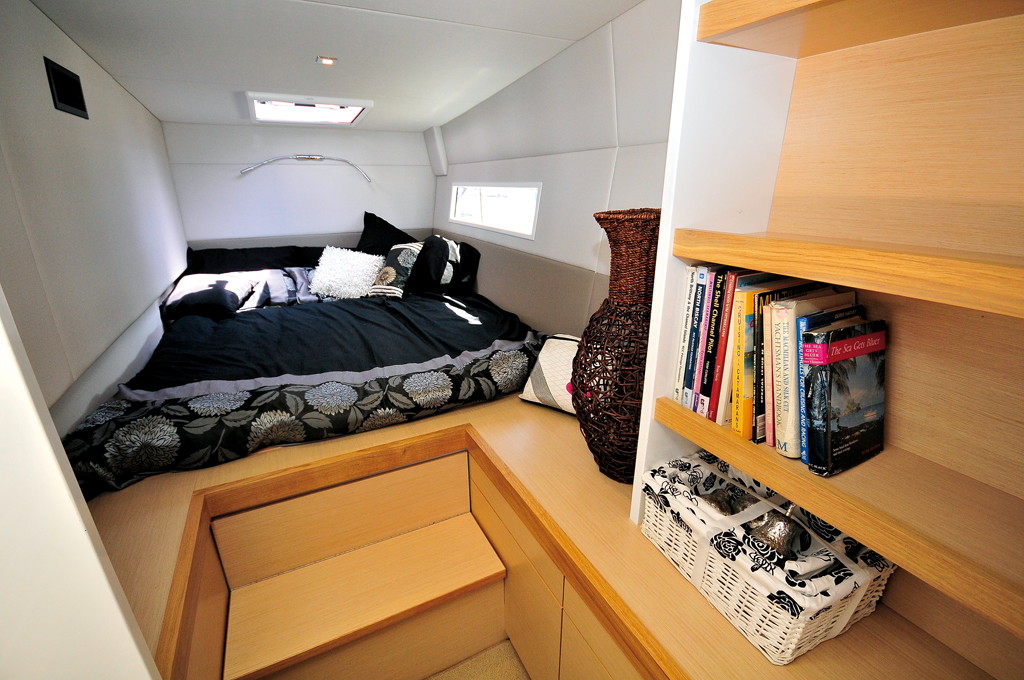
A hint of Feng-Shui, the recessed mattresses are more accessible, the two-tone headlinings in a leather style and light woodwork all combine to make a luxurious yet not ostentatious atmosphere which is pleasantly relaxing.
Conclusion:
These 100 miles in the Solent allowed me to discover an exceptional voyaging catamaran, in the company of its passionate designers. The ambitious specification puts the imagination to work. A cruising multihull which is so innovative could have become unnerving, but on the contrary, the R550 gives nothing but confidence. The required budget is above average, but the exacting nature of the build, the abundant equipment and the pertinent choices would hit the mark for the wealthy and enlightened enthusiast.
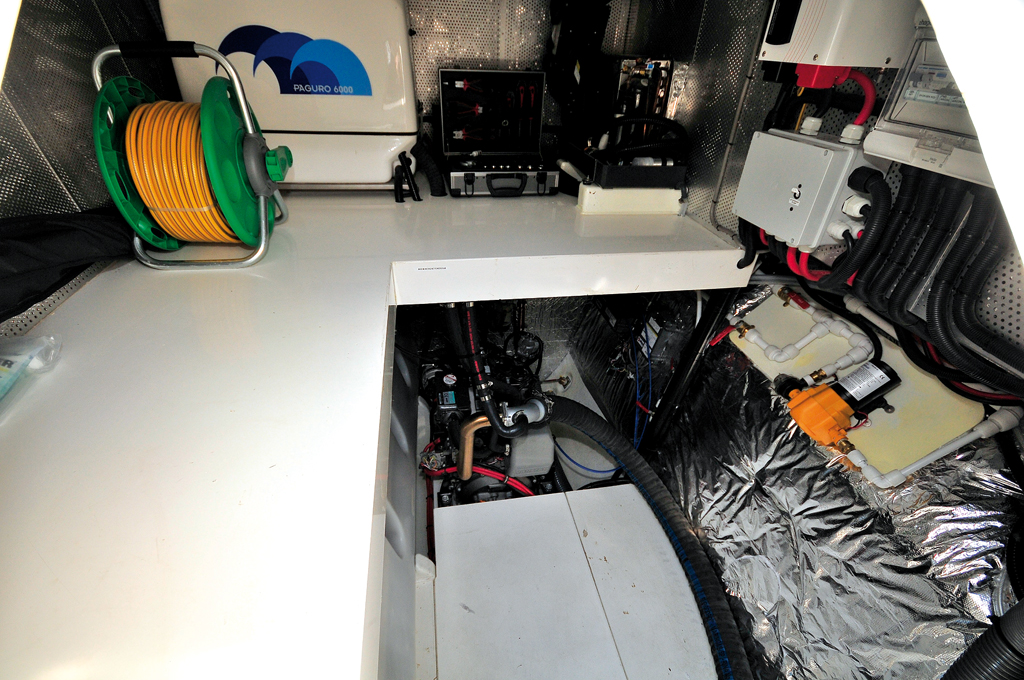
The engine room which is directly accessible from the deck is a great success, with neatly installed cabling and fittings, a carefully designed engine installation (custom-made exhaust gooseneck, enhanced insulation, propeller shafts…) and a proper workshop for the independent DIY-er.
Pluses:
- Exceptional build quality
- Numerous pertinent innovations
- Aesthetics and performance
Minuses:
- Chainplates for the lowers not in line
- No tiller independent of the hydraulic steering
- Handles for opening deck hatches not very practical
The competition:
Model Yard Upwind sail area in m2 Weight in tonnes Price in € (ex-tax) Gunboat 55 Gunboat 165 9 NC S2C55 Swiss Cat 155 16,5 1 350 000 Catana 53 Catana 174 14 1 119 000 MC2 53 MC2 Catamarans 145 7,5 1 380 000 Alibi 54 Alibi 155 9 950 000
Specifications:
- Architects: Darren Newton et Nick Bailey
- Developer: Mark Jarvis
- Builder: Multimarine
- Length: 16.72 meters
- Beam: 8.04 meters
- Draft: 1.32 meters
- Light displacement: 9.5 tonnes
- Operational displacement: 12 tonnes
- Maximum displacement: 15 tonnes
- Motors: 2x40hp Yanmar
- Transmission: Shaft driven
- Mainsail area: 98m2
- Solent: 52m2
- Reacher: 97m2
- Asymmetric spinnaker: 167m2
- Construction: Carbon foam sandwich / glass epoxy in a one-shot vacuum-bagged infusion Keel type: Skegs Fresh water capacity: 550 liters Fuel: 300 liters
- Options fitted on the boat we tested: Air conditioning, water-maker, carbon mast, fiber rigging, full electronics package
- Price of the boat tested: £1,580,000 GBP
Darren Newton
The R550 is designed as a blue water cruising boat driven by the owner rather than a skipper boat with a professional crew. The design brief required a high degree of performance combined with very comfortable accommodation for long distance passage making and living on board. The boat had to be very easy to sail single handed or fully crewed with full protection on board from the sun and weather. We used advanced composite materials and processes; including the latest resin infusion techniques where the hull is made in one shot. Our main design principle was to reduce the overall weight of the boat by design simplification. The overall displacement was set at 15 tonnes fully loaded so a target weight of 9.5 tonnes was set for the bare boat and 12 tonnes with all fluids as well as air-conditioning, generator and water maker etc. This leaves 3 tonnes for crew and provisions on a fully optioned boat. We needed a hull that would average high speeds. Averaging 10 to 12 knots means speeds of 16 knots would be needed peaking at 25 knots. Overall design was in part inspired by the latest technology available now in both racing and cruising boats. This includes the use of rewinding winches allowing you to set up both the main and jib sheets and control them from any position on the boat either using the fixed switching or remote. The main traveller uses an Antal line driver to complement this. The beauty of this system is in its simplicity and it can be used manually as well if you desire.
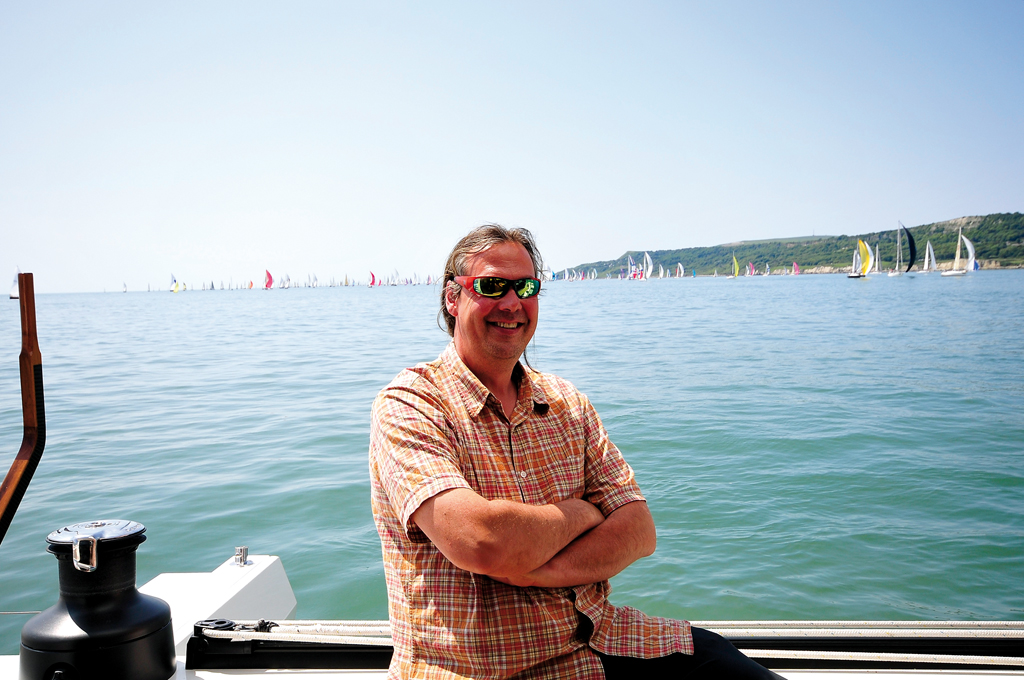
Mark Jarvis Design and production director
The Rapier series are intended to be fast and exciting to sail and so for the 550, we chose Darren Newton and Nick Bailey to lead the design team so that we could achieve both high performance and a great looking boat. The design brief for the Broadblue Rapier 550 was to produce a performance sailing catamaran at 55ft that can be used for longer distance family cruising which for most skippers means single handed sailing with other people aboard. The ergonomics of the helm console, winch station, internal layout and deck layout together with the use of reversing winches, motorised mainsheet traveller and remote engine controls are all incorporated to exactly meet this objective. We are very pleased with the great result!
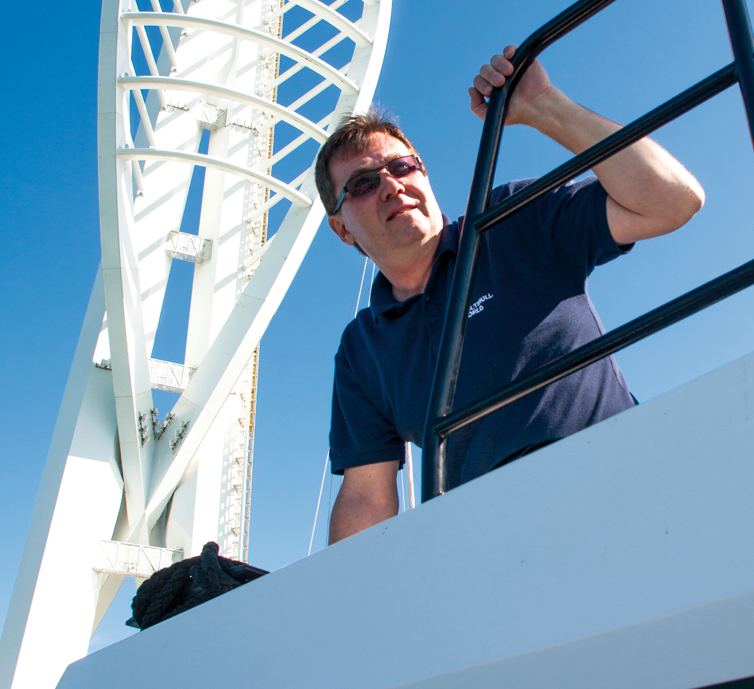
Caption
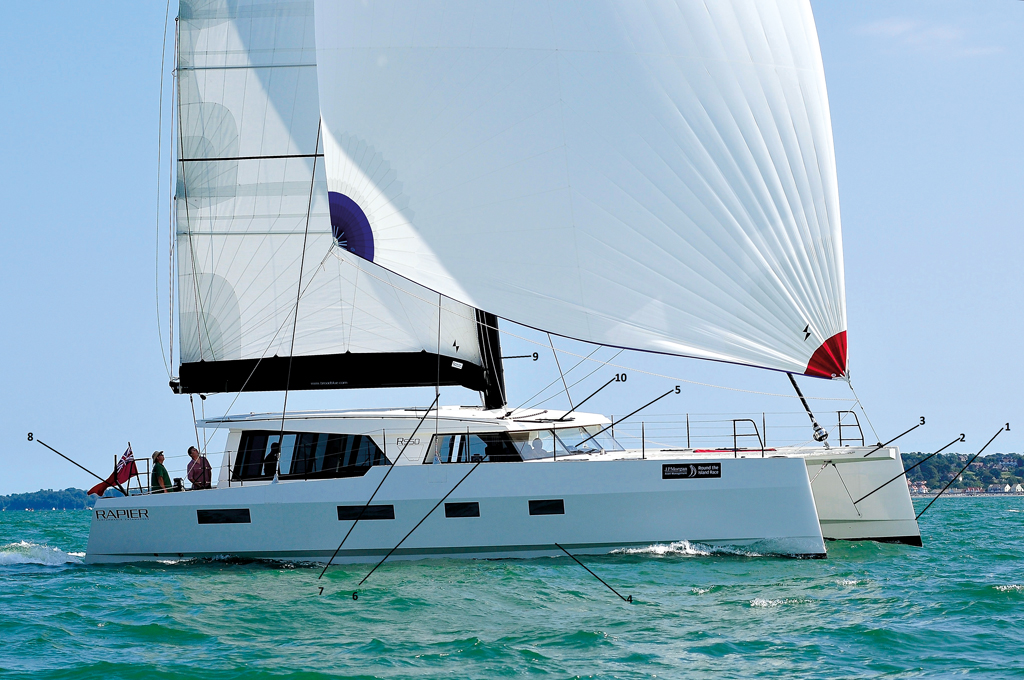
- : The inverted bows lead to great hydro-dynamic finesse for a cruising boat and really help combat pitching. 2 and 3.
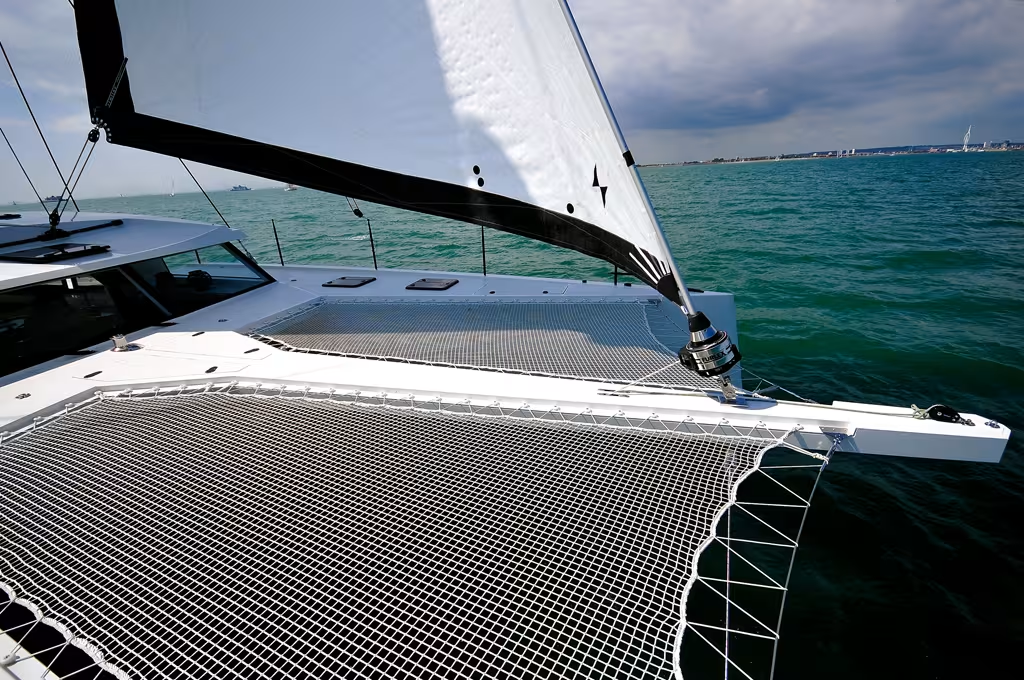
- : The bowsprit extends from the carbon pod, and a structural bridle in stainless rod replaces the forward beam and the martingale/A frame. I’ll wager that this starts a trend.
- : The bowsprit extends from the carbon pod, and a structural bridle in stainless rod replaces the forward beam and the martingale/A frame. I’ll wager that this starts a trend.4.
- : The pronounced step is elegant, and where it joins to the interior of the nacelle has been carefully designed from a hydro-dynamic point of view, to reduce slamming under the bridgedeck. 5.
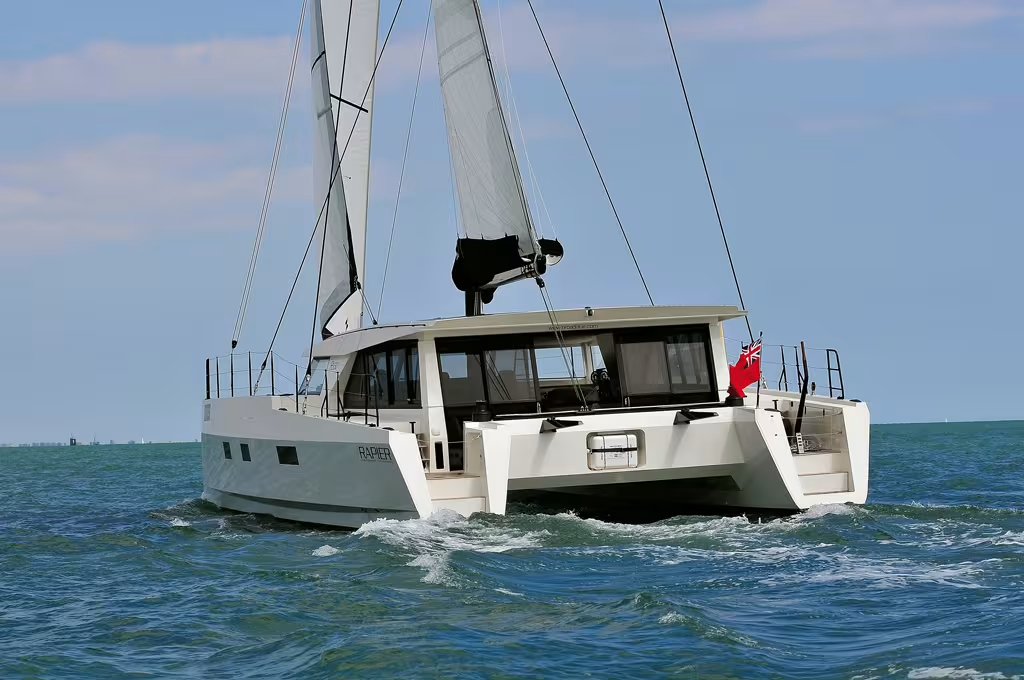
- : The windshield is made of toughened glass to prevent it from distorting as happens over time with plexiglass, while guaranteeing great light. Windshield wipers allow you to maintain good visibility in spite of any spray. 6.
- : The helm and maneuvering station is behind this windshield! A single-hander could sail this boat entirely from the one navstation. 7.
- : The fantastic fiber rigging is comprised of a pair of capshrouds and two lowers which are slightly forward-swept to avoid the mainsail inverting against them when reefed. 8.
- : The tillers are fitted directly to the rudder posts. They would need to be disconnected from the hydraulic steering to enjoy helming outside 9.
- : The Future Fibers large-section tube mast with no spreaders is aerodynamically very fluid, but it does not rotate. 10.
- : The large self-tacking solent has a very wide track, avoiding the need for a barberhauler. The traveler and the sheet are both adjustable from the navstation.
