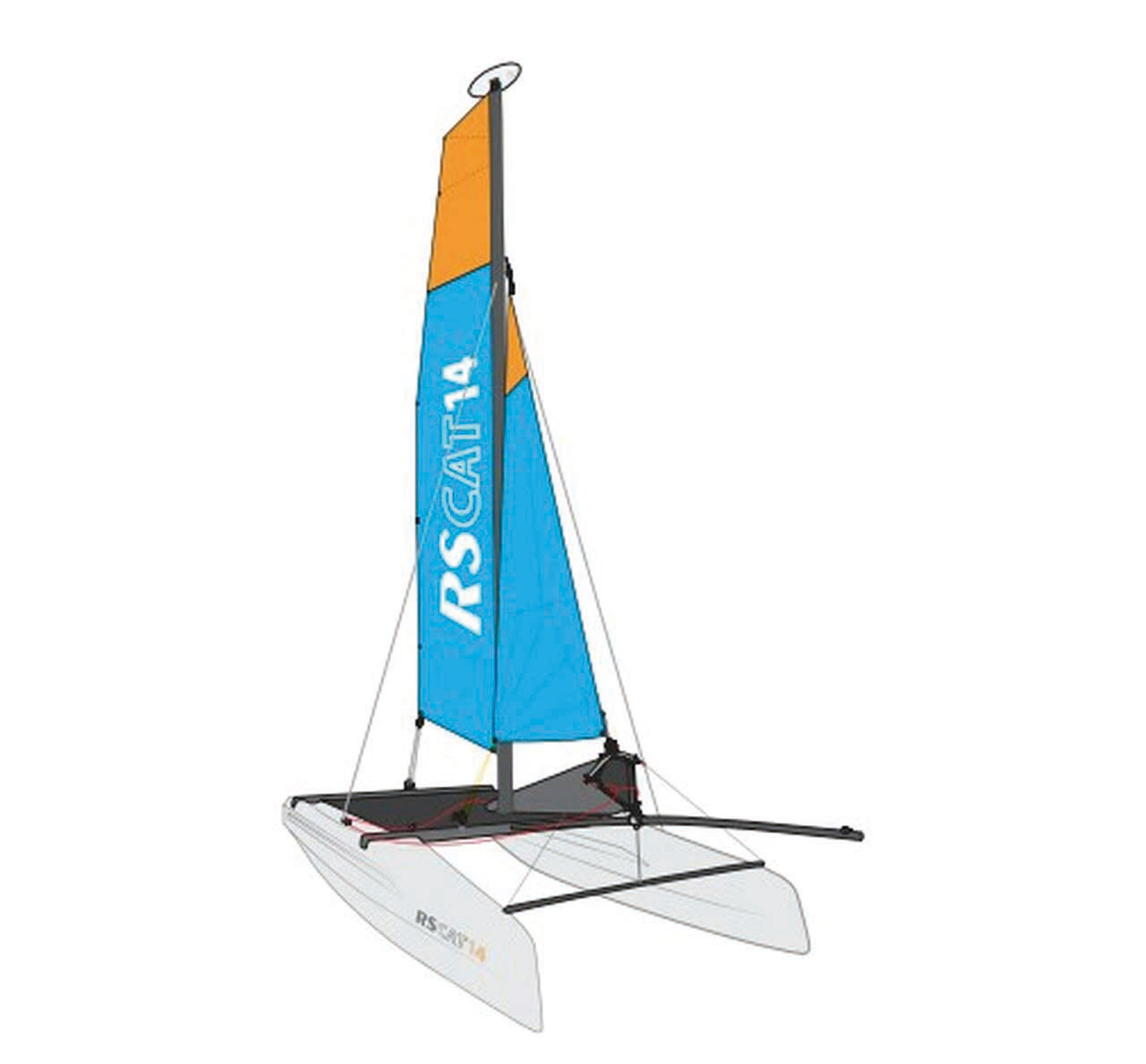
Known as a specialist in smaller sailing dinghies, British manufacturer RS Sailing has recently launched a range of light catamarans aimed at sailing school or family use. For the moment, there are two models. Nicolas Honor, the brand’s importer in France, gave us a demonstration of the smaller (and most recent) of the two, the RS Cat 14, in its XL version.
Infos pratiques
- Le chantier : RS CAT 14 XL
- La fiche technique
-
 Découvrez notre vidéo exclusive
- Financez votre RS Cat 14 XL
- Assuez votre RS Cat 14 XL
- Articles autour du RS Cat 14 XL
Test location: Saint-Pierre-Quiberon, France
Conditions: Westerly wind of 10 to 15 knots, sea state slight
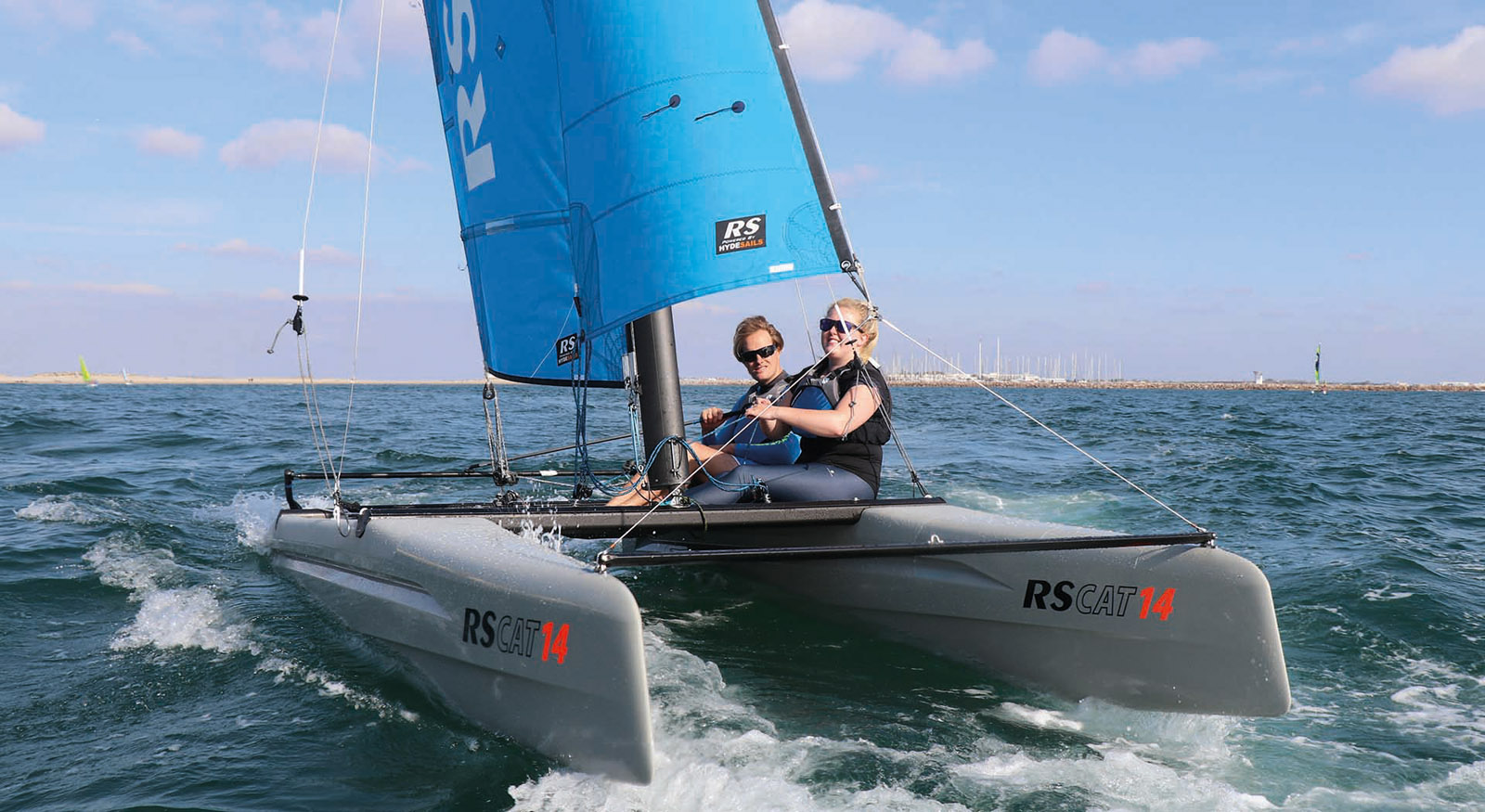
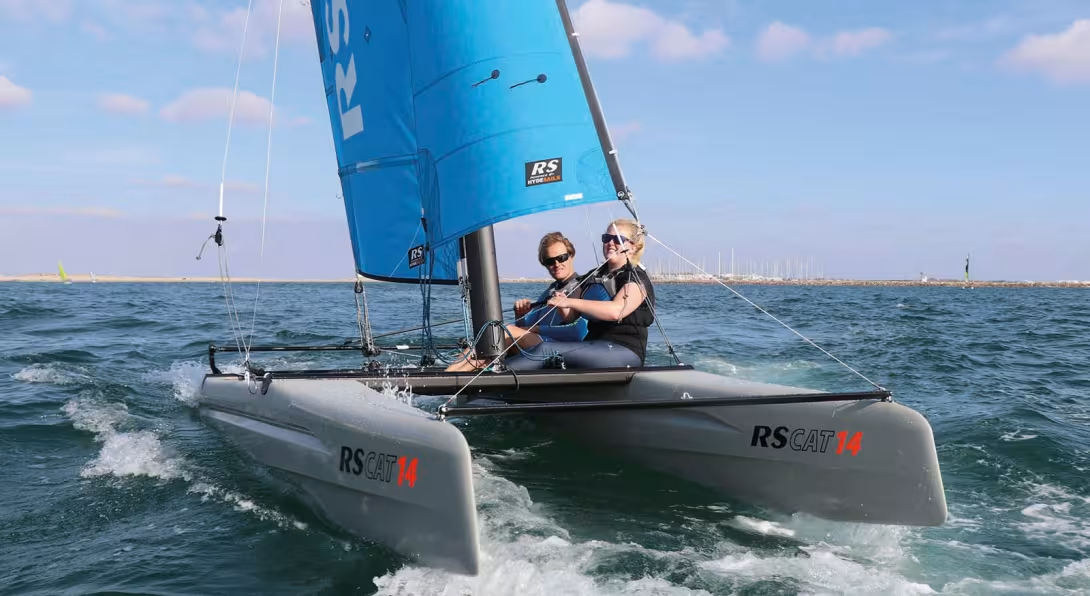
With the volume of its hulls, the RS Cat 14 can easily carry two crew members, or even three or four as the maximum weight is 790 lbs (360 kg).
Though RS Sailing’s catamaran range is currently limited to the RS Cat 16 and 14, these two models have clearly managed to establish themselves as one of the players in the sports multihull business; this manufacturer who traditionally specialized in sailing dinghies has simply applied the rules that have made their monohull models so successful – build quality, attractive design, competitive prices. In fact, RS Sailing has been able to convince many sailing clubs to build an RS Cat fleet. The 16 is perfectly suited for two adults, while the 14, and this is the one we’re taking a look at today, is more suited to children. However, the RS Cat 14 has significant volume, as it is able to support a crew totaling 790 lbs (360 kg). Compared that to the maximum load of 350 lbs (160 kg) for a Hobie Cat 14. While we’re on the subject of comparisons, we can note here the heritage of the Dart 16 as for the anti-leeway plan: the underside of the floats displays a progressive V-shaped slope, rising sharply to the transom.
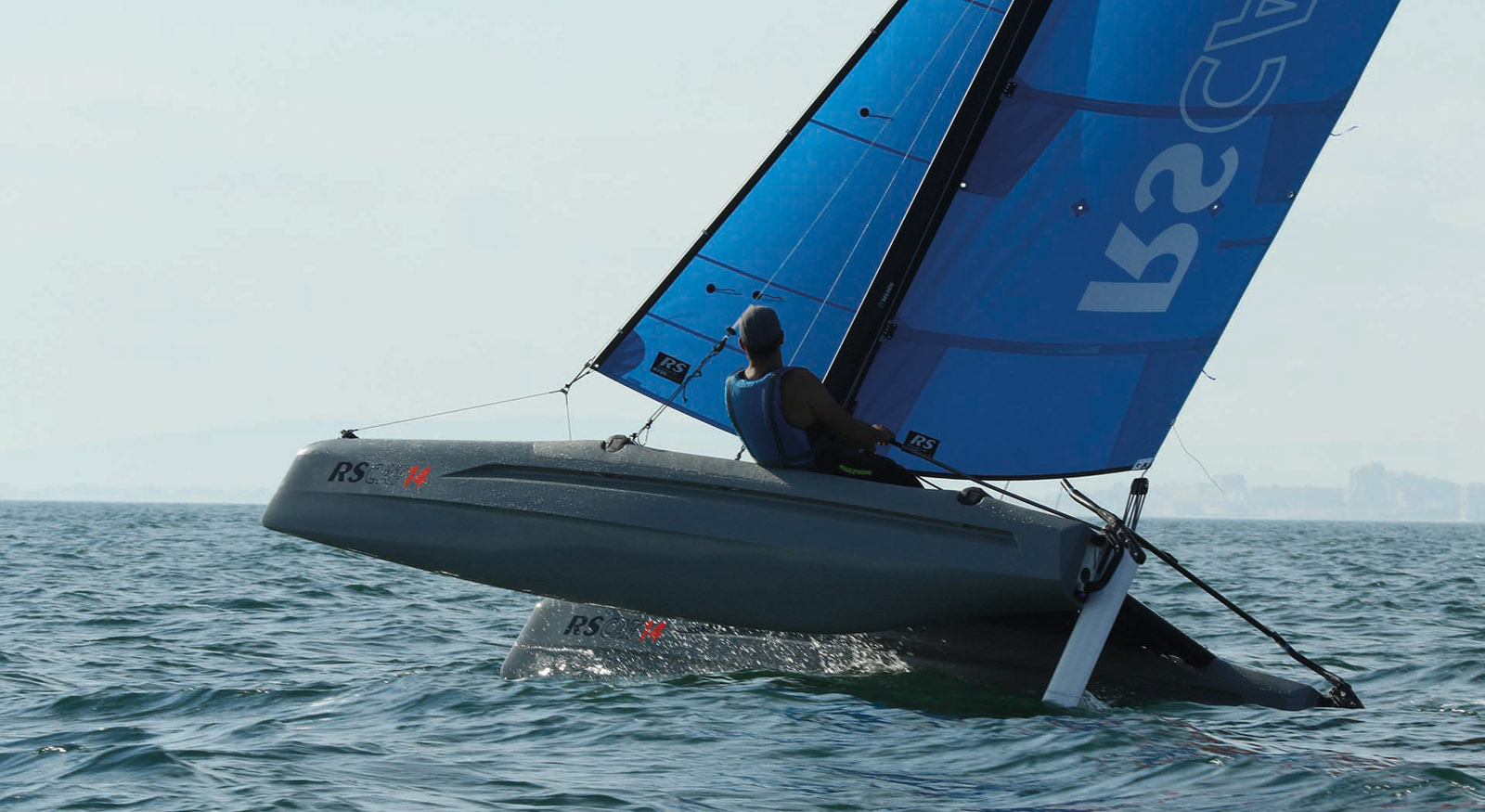
Single-handed sailors will start by rigging their RS as a cat-boat, then trying out the jib... and why not the spinnaker.
Clever and robust construction
The builder has opted for construction in rotomolded polyethylene; this material is perfectly suited to mass production and is known for its strength. However, care must be taken with the material and its implementation. Here, we aren’t dealing with a single layer with little UV protection, like the small tenders, but with a proper, three-layer sandwich construction - the central section being comparable to a foam. We were able to check out a few RS Cat 16s that have already completed five seasons at the Carnac Yacht Club, a few miles from France’s national sailing school, the Ecole Nationale de Voile: the hulls show no signs of being deformed and are only have any damage on the bows (inverted and very pinched, these see hard use in sailing school mode. The hulls are identical, meaning that a damaged hull can easily be replaced. The assembly is particularly clever with the beams secured by bolts set wide apart - a guarantee of rigidity - and these are notably on an external lip on the hull, hidden by an elegant step that, in addition, makes the hull even stiffer. Sturdy stainless-steel lugs allow these to be well tightened without the risk of deforming the polyethylene. There are no holes in the hull, no nuts that aren’t easily accessible, no hatches and no risk of water ingress. The same goes for the rudder shaft, which is directly accessible from the inside of the transom. The aluminum rudders -these raise automatically - are identical to those on the RS Cat 16. The trampoline is easily tensioned by lines and cleats at the stern - all of which provides additional rigidity and yet is easily removed.
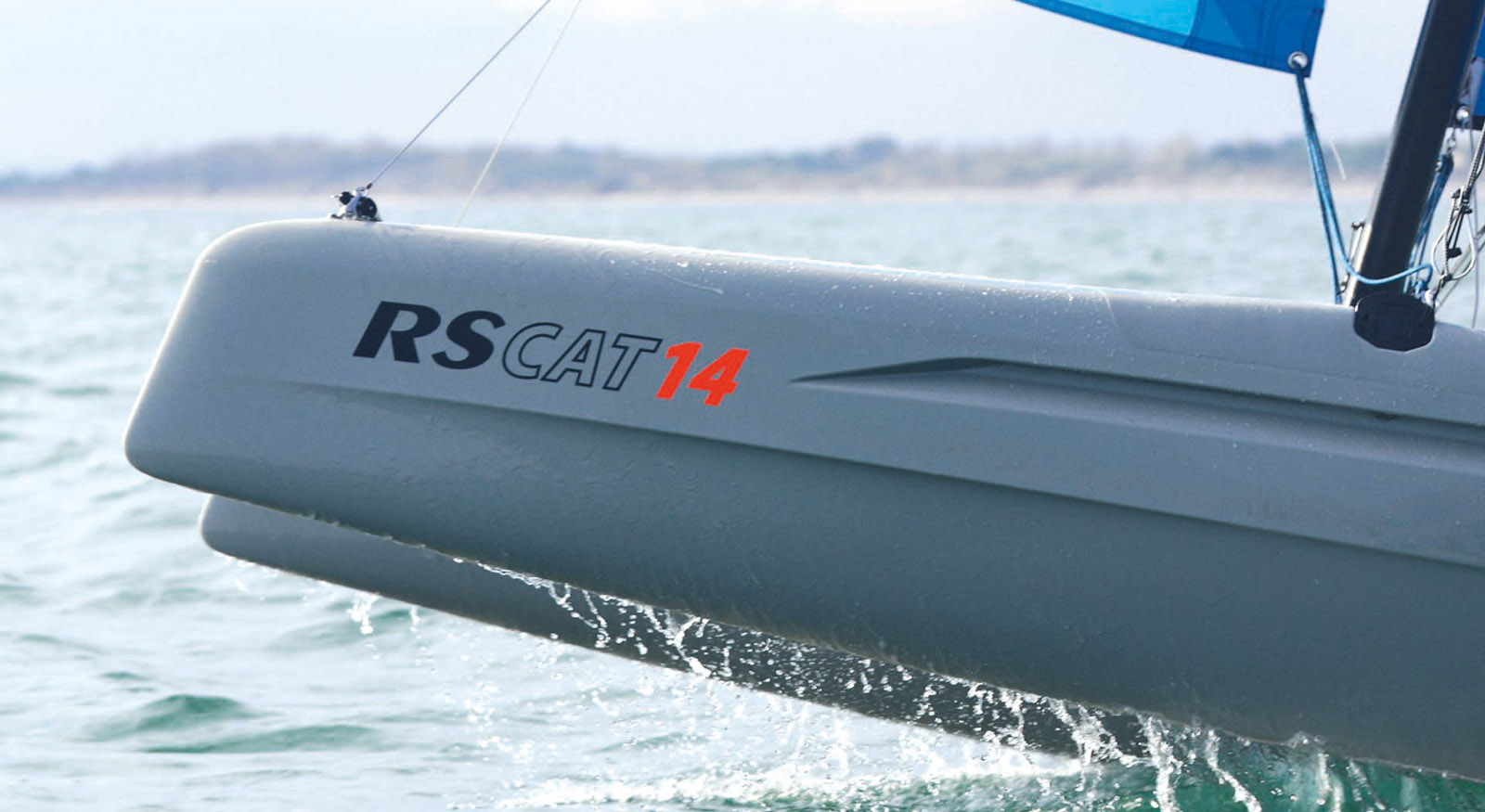
The three-layer rotomolded polyethylene is particularly resistant to impact, does not deform and is UV resistant. However, it doesn’t match the glossy finish of a gelcoat.
Easy to rig
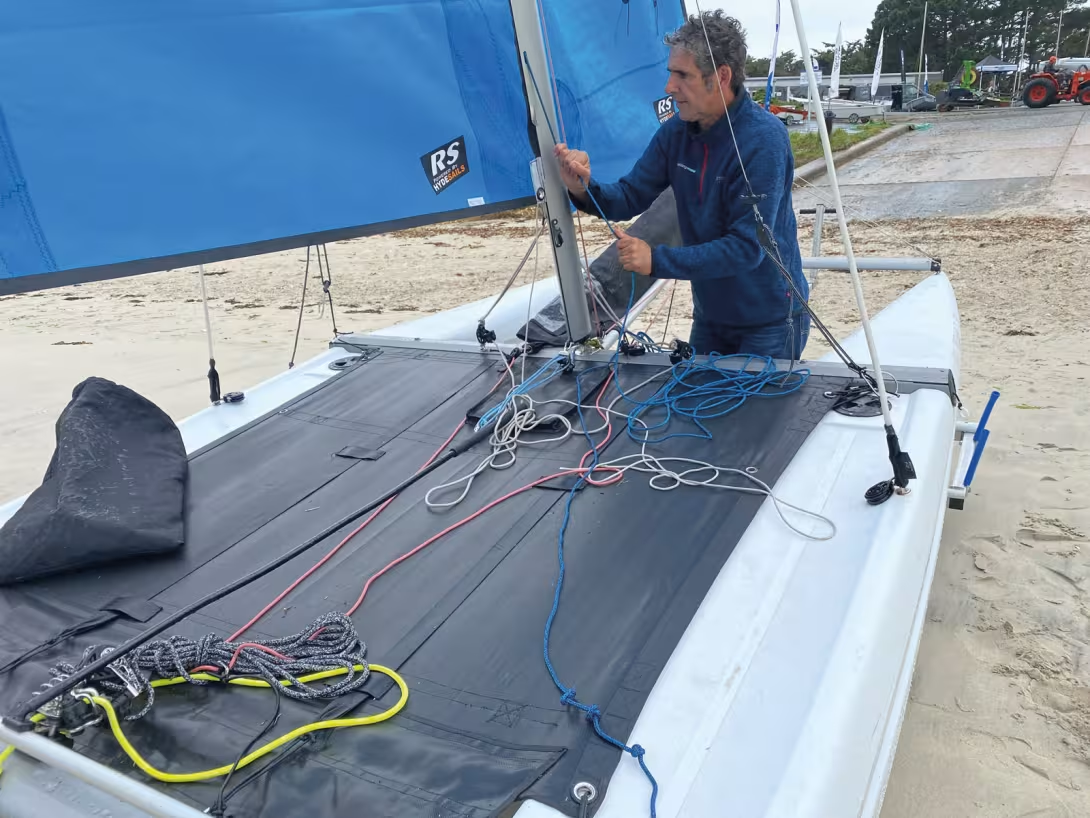
No boom, no hook... right from the get-go, you’re saving time rigging the boat. The RS Cat 14 is very intuitive when it comes to bending on the sails - even the spinnaker and its feeder are operational in just a few minutes. A powerful cunningham flattens the main very effectively to match the breeze. One reef is provided. The lines all stow in pockets integrated into the trampoline. The six-purchase sheet (identical to the RS Cat 16) is of course attached to an easy-to-adjust track. The battens can be adjusted thanks to fittings on the leech of the main. All the adjustments are right there, within easy reach and very quick to get the hang of, making a good compromise for both beginners and experienced sailors.
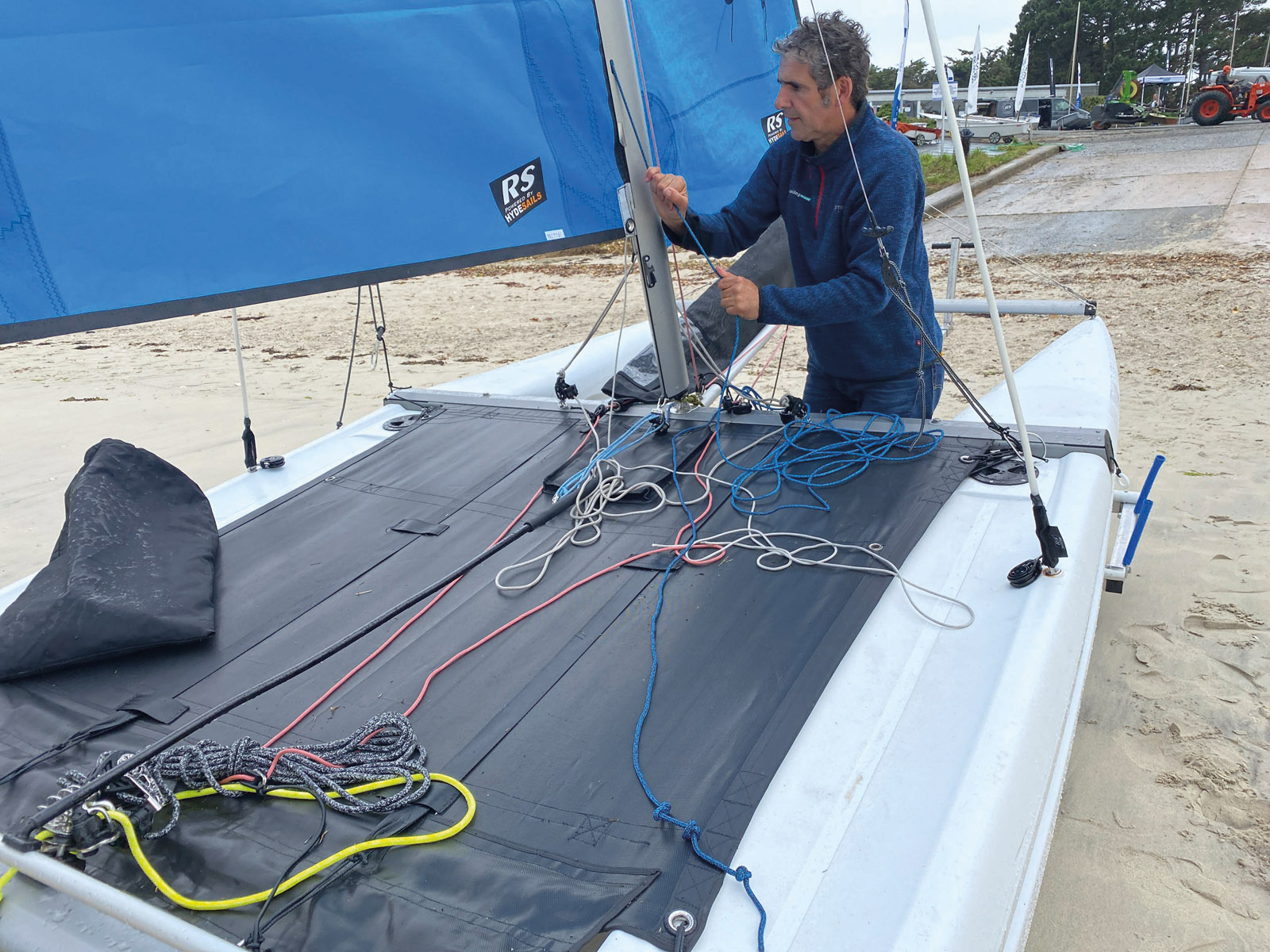
The RS Cat 14 is particularly easy and quick to rig.
Three versions for having fun on the water
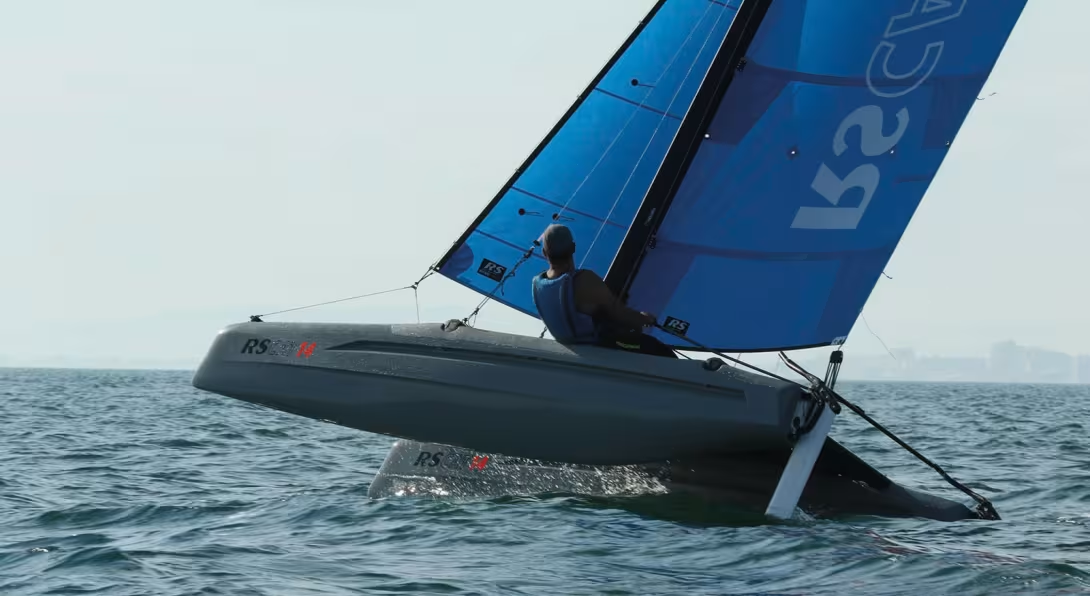
Out on the water, the rigidity of the platform that we already noticed on land translates into dynamic and pleasant behavior: every puff of breeze translates into an acceleration. If the wind picks up again, it’s time to hike out to windward - or even clip on the trapeze. The RS Cat 14 is offered in three versions. The Club has just a mainsail, making it suitable for solo sailors and beginners. The S version incorporates a jib and a trapeze. This is the ultimate club sailing catamaran. And the XL version, which was the one presented to us, features an asymmetric spinnaker and its chute. Evidently, this version is the one that guarantees the most adrenaline - 15 knots is very quickly exceeded. In this sportier configuration, the carbon tiller extension is recommended. The RS Cat 14 is definitely a highperformance machine for a sailing school boat. It tacks on the spot, picks up again immediately and sails a close course (about 45° off the true wind) for a catamaran without daggerboards. As standard, this little boat comes equipped with masthead buoyancy. Someone of 155-175 lbs (70-80 kg) can easily right this catamaran.
 |
 |
 |
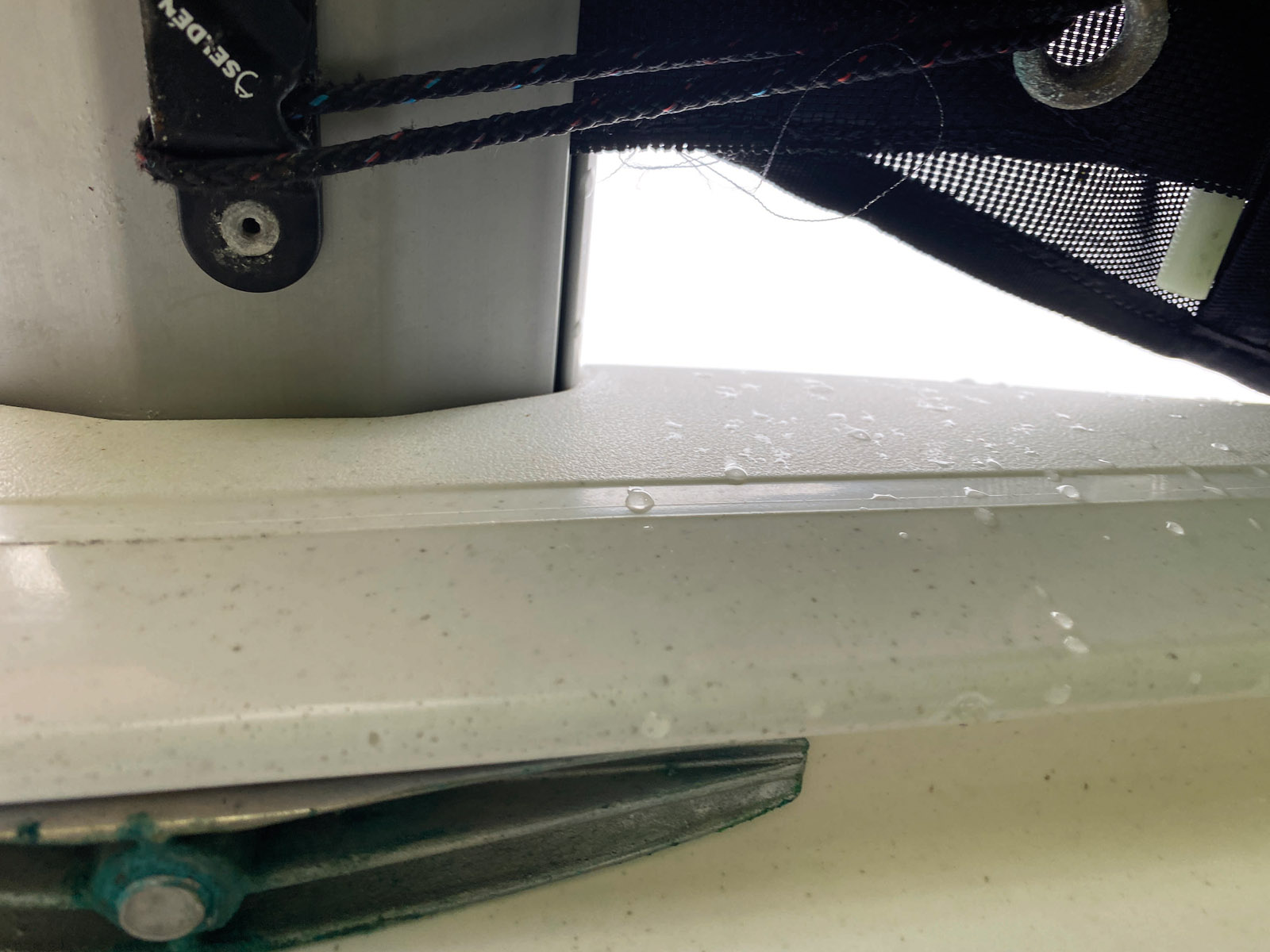
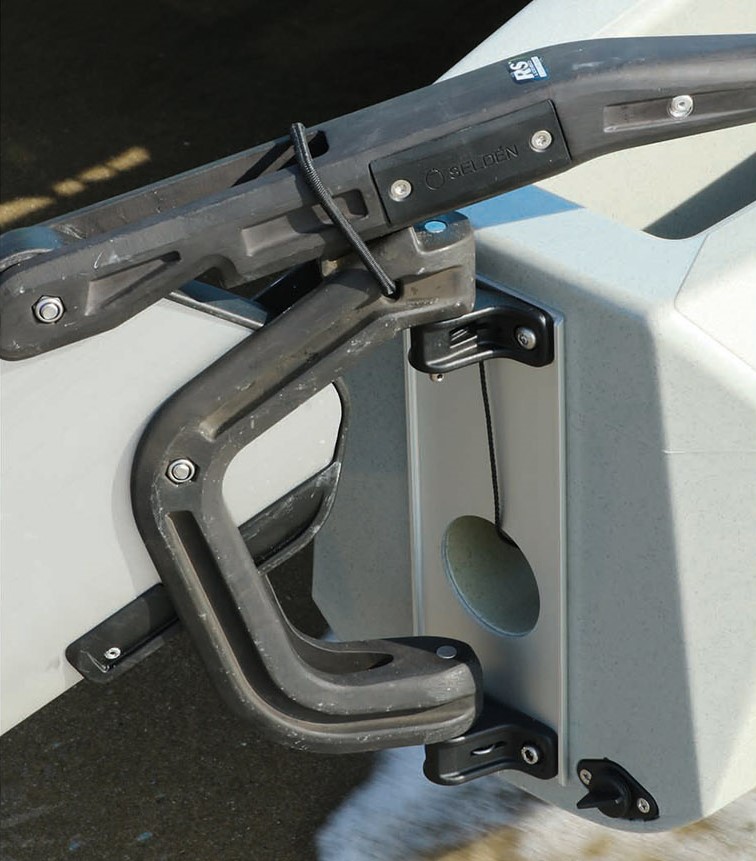
La boulonnerie de la structure coque/bras de liaison et celle des ferrures de safran restent accessibles sur les deux faces.
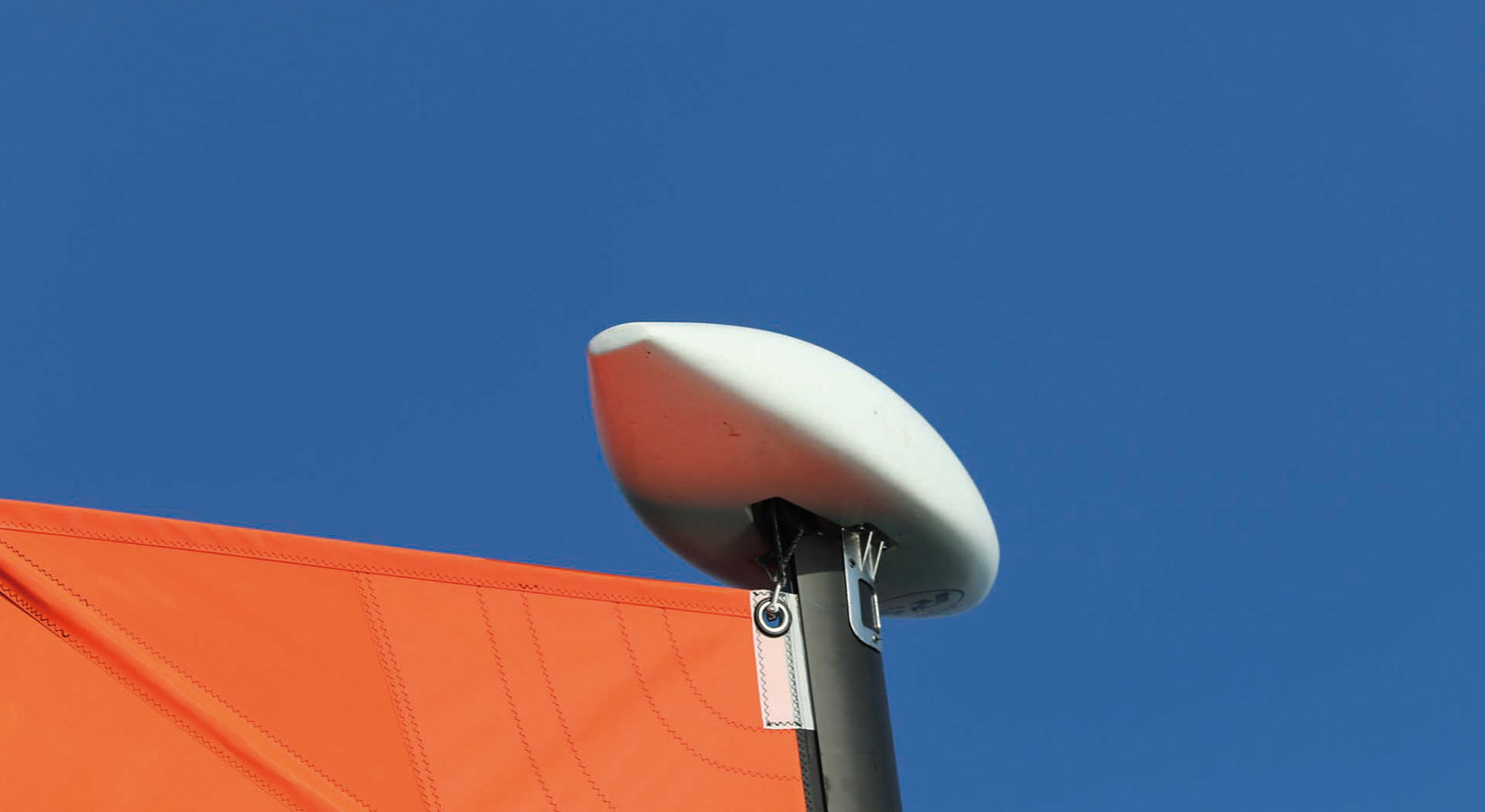
Un flotteur en tête de mât permet d’éviter le retournement complet en cas de dessalage.
Conclusion
Versatile, clever and offered at a competitive price, in just three years, the RS Cat 14 has managed to impose itself in the niche sector of training catamarans. The success of this model among sailing schools is an excellent indicator of this: the 14 is certainly one of the best twinhulled options on the market!
The Pluses
+ Versatility of use
+ Attractive price
+ Convincing performance
The Minuses
- Not very esthetically flattering material
- Forefeet exposed for harsh and intensive use
TECHNICAL SPECIFICATIONS
Manufacturer: RS Sailing
Architect: Jo Richards and RS Sailing
Material: 3-layer rotomolded polyethylene
Length: 14’ (4.25 m)
Beam: 7’ (2.14 m)
Weight: 176 lbs (80 kg)
Maximum crew weight: 790 lbs (360 kg)
Mainsail: 87 sq ft (8.1 m²)
Self-tacking jib: 23 sq ft (2.1 m²)
Asymmetrical spinnaker: 97 sq ft (9 m²)
Price ex-tax: from € 6,662 XXL
Pack: € 800 ex-tax