Fountaine Pajot is finishing the renewal of its range, initiated with the Lavezzi 40, with the arrival of the Salina 48; this boat marks a clear development in the company’s tradition.
Infos pratiques
- Le chantier : Salina 48
- La fiche technique
- Découvrez notre vidéo exclusive
- Financez votre Salina 48
- Assuez votre Salina 48
- Articles autour du Salina 48
Whilst its direct competitor was imposing its vision of the cruising catamaran, by elevating liveable volume to the status of a genuine architectural ideology, thus taking a few market shares, the Aigrefeuille-based company was obliged to react: the Bahia and Belize were certainly very seaworthy boats, but with however clearly less volume than a Lagoon (not to mention them by name) of the same size, but of a new generation. With the arrival of the Salina, Fountaine Pajot is back in the race for large volumes. “It took two years to perfect this boat,” Hélène de Fontainieu, communications manager for the La Rochelle company told us. So, is the Salina a successor to the Bahia? “They shouldn’t be compared,” Hélène continued, “moreover, the two boats coexisted for a year in the company’s catalogue.”
The design was entrusted to the Berret-Racoupeau office, which is used to Fountaine’s big boats, as they designed notably the Marquises 56 and more recently, the Eleuthera 60, not forgetting the Galathéa 65, the builder’s ‘flagship’, as they like to call it.
An innovative, fluid deck plan.
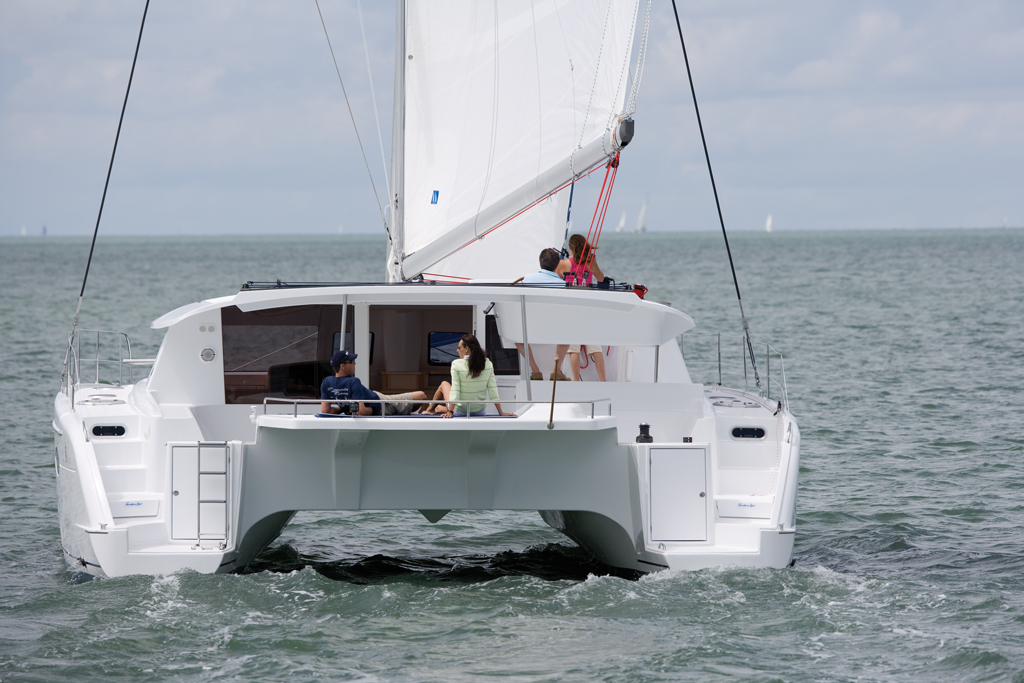
You have to get used to it: here everything is big and wide; the designers have broken the latest taboos, pushed over the latest barriers, to (finally) allow the forms come to the fore. Compared to the past, the Salina has several new features. Firstly, the platform dedicated to the sunbathing area, above the davits, where we are used to seeing the solar panels: this is in fact a completely clear area. Whether you like it or not, it increases the space of course, but associated with the rigid bimini, it makes the boat’s lines more cumbersome.
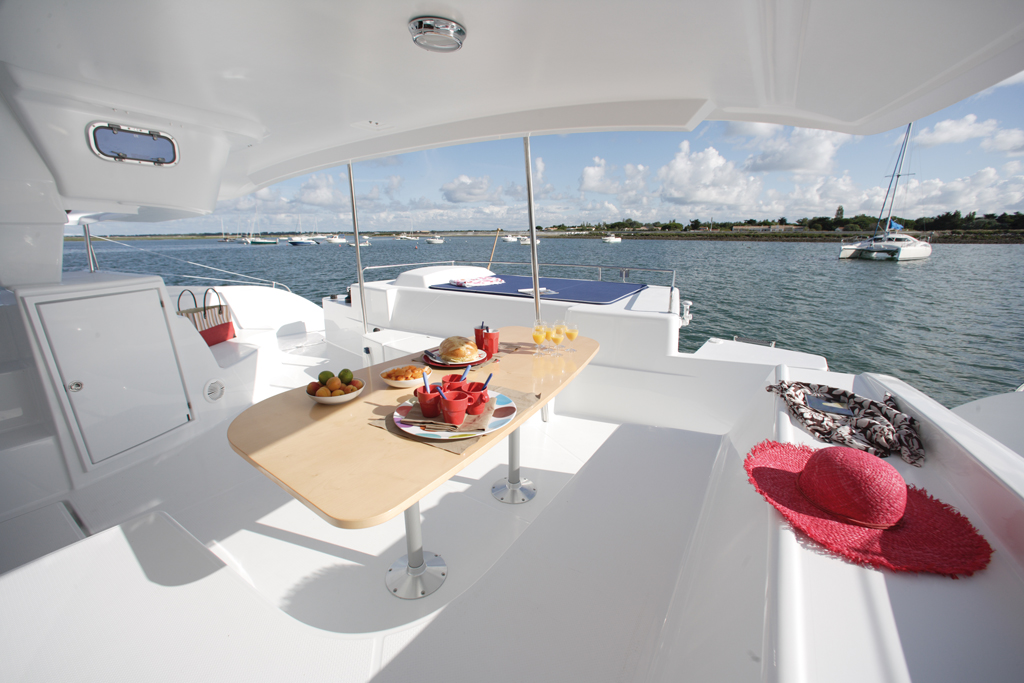
Note next the levels of the cockpit and the nacelle; access from one to the other is on the same level. The only disadvantage of this formula is that in bad weather, water from a nasty wave could, after breaking in the cockpit, enter the saloon via a badly-closed door. So a hatch has been fitted just before the sliding door, with scuppers to drain the rebellious water away. Just in the cockpit there is a plethora of areas where it is possible to be alone, to read, rest, eat, work (why not?) – all the activities which make up daily life at sea, if possible in blue waters with tropical temperatures...
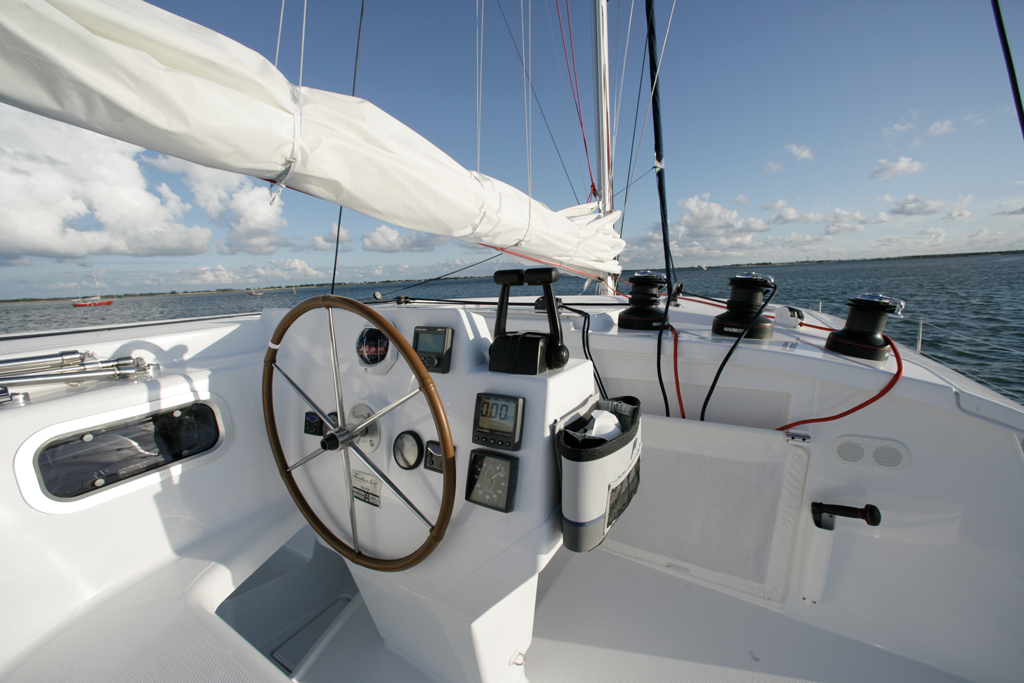
Finally the third point, and the one which marks almost a revolution – the raised steering position. Its originality resides in the fact that it can be accessed via two different areas: either from the cockpit, when sailing at night for example and needing to pass quickly from the steering position to the chart table, or from the mast foot, which can be reached easily, as it is at the same level as the deck. Movement around the boat is fluid and remarkable from all points of view. Behind the helm, the seat will take up to three people, who will feel protected, as they are not too high up; the area is closed on three sides, and the instruments, engine and automatic pilot controls, etc. are positioned either side of the steering wheel.
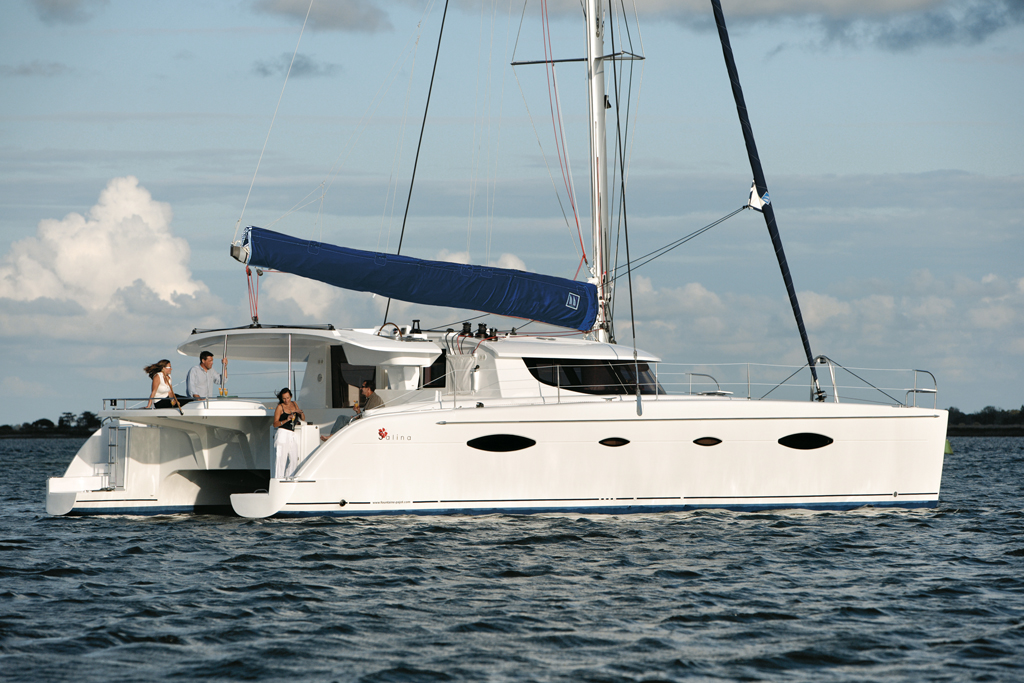
The boom is not too high, for which the builder is to be congratulated; in terms of weight centering, the lower it is the better, it must simply be remembered when gybing. A metre ahead of the helm there is the nerve centre of the boat, where the majority of the sail handling is carried out. There is a battery of three winches for this purpose; a large bag below catches the various lines and keeps them from trailing everywhere. The working height is just right, to take in the traveller, for example, aft of the rigid bimini; the forces on the track are taken underneath by two vertical stainless steel tubes. The distribution is coherent. The three reefing pennants return freely to the battery of winches. Once the tape is hooked on, the halyard tightened and the pennant hauled taut, it is necessary to return to the mast foot to close the pennant’s jammer under the boom, to free up the winch. Otherwise, three additional jammers must be fitted, just forward of the winches. The starboard winch is dedicated to the main halyard (2:1 of course); it is the only one to benefit from a Spinlock jamming cleat.
Borderline in light weather, better in strong breezes.
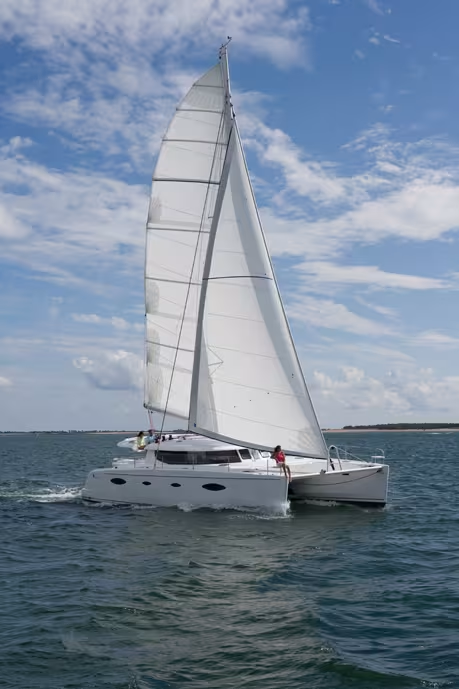
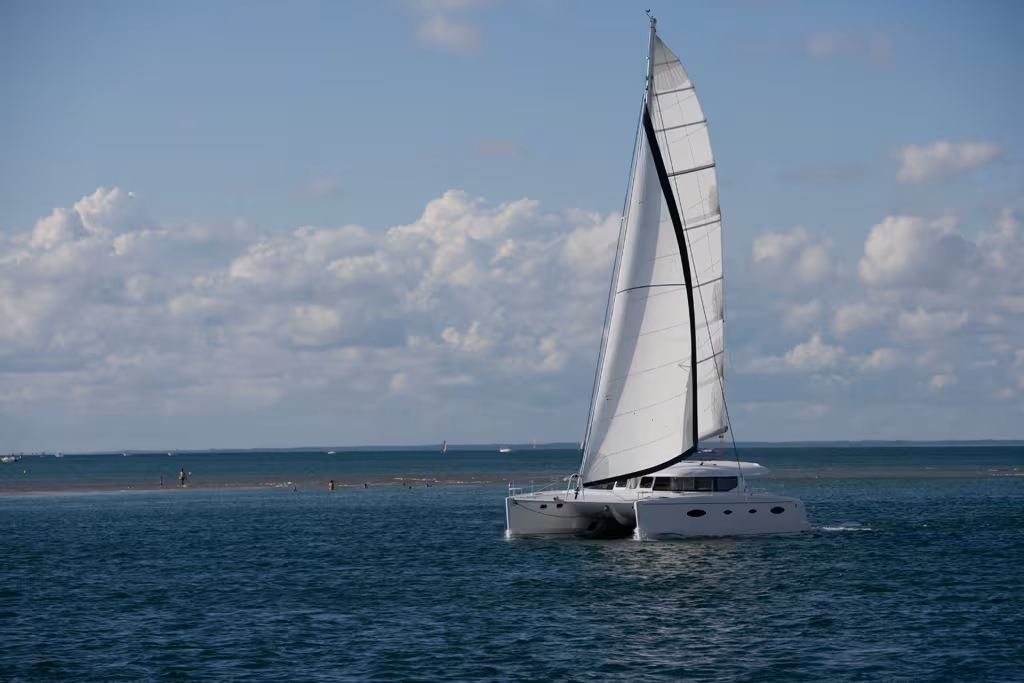
Volume is all well and good, but a sailing boat which sails well is even better. Culturally, Fountain Pajot of course has a sporting spirit; before directing the company and going into politics, Jean-François Fountaine competed in the Montreal Olympic Games, and was an ocean racer. As for Eric Brunnell, he won The Transat in 2004, aboard a 50’ multihull. Let’s take the time to observe the rig. It is doubly triangulated, held by a single pair of cap shrouds. The Z-Spar profile is slightly curved, for better penetration in the air, as well as a better sail profile, for honest performance. So, in the tradition of the other models already produced, the Salina is obliged to be a comfortable boat, of course, but one which offers a minimum level of performance. Fortunately, with 48’, there is a lot of waterline length and the boat should, when all is said and done, be able to maintain quite respectable averages. In strong winds it should be at its best (understand by this: downwind in a fresh trade wind).
On the other hand, the mass implies a large wetted surface area, and thus hydrodynamic drag, so the boat will certainly be in trouble in light winds, as was the case on our test day - the worst possible situation for a displacement boat. A Code 0 would certainly be a plus. However, it gets by quite well, the figures on the speedo were half the wind speed – with 11 knots of wind, it sailed at a little less than 6 knots, and with 9 knots, we were sailing at 4.5 knots. Of course we must explain that we were aboard the builder’s boat, it was its first outing, and this same catamaran, laden with everything full and equipped for blue water cruising, would certainly not have the same performance. The helm has a good feel, the transmission is direct, via vectran lines; the two rudders are linked together by an aluminium rod which runs inside the aft crossbeam. We would have liked to sail for longer, but we were allotted just two hours for this test - rather short for a 48-footer.
Let’s now take time to explore the Salina. The cruising catamaran clientele has developed and the boats have become leisure platforms. Through looking for maximum liveable volume, and still more comfortable living areas, a few points have perhaps been skimped. As on the other boats in the range, the stowage lockers are borderline for ocean cruising; there are just two of them in the cockpit, one under the seat and another under the steering position. There is a single locker forward of the mast, but it is huge – it houses the gas bottle, the windlass and the anchor locker, as well as two large water tanks, containing a total of 750 litres. The bulkhead protecting them can be dismantled and removed, to allow for their possible replacement. In terms of weight centering, their position is ideal. The forepeaks, equipped with a mattress if required (optional), open to the exterior via circular, 50cm diameter Goïot hatches, through which it is certainly not possible to pass a bag containing a gennaker, a spinnaker or even less a bicycle, even a folding one. Otherwise, the trampoline area is big enough for a siesta in the company of the dolphins.
Generous spaces for living, slightly less so for stowage.
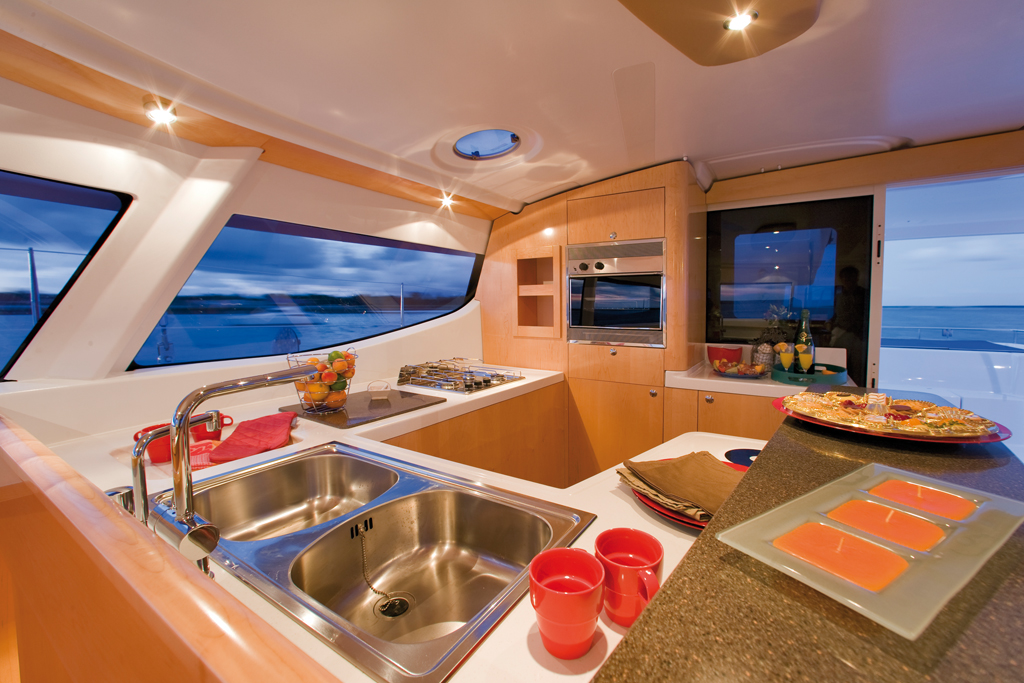
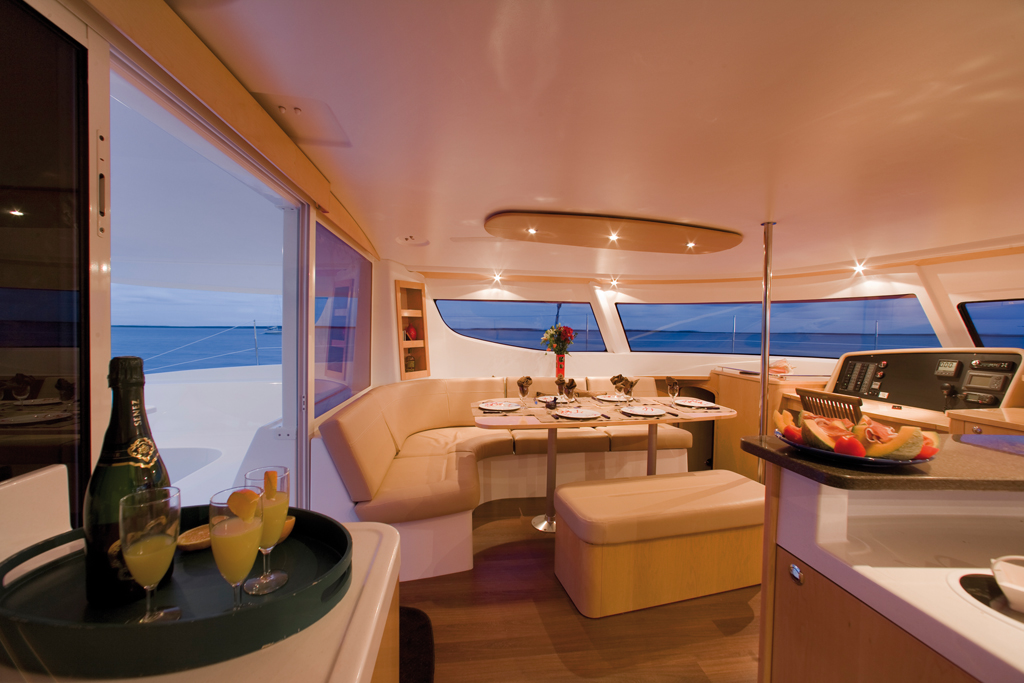
And inside? The living space is wonderful; the colour chosen for the woodwork is particularly warm and light is omnipresent. From the saloon, there is a panoramic view of the exterior; you dominate the situation. The galley is spacious, those who use it would perhaps appreciate a little more stowage high up, to be able to access the cutlery, glasses, plates, etc. without having to bend down. Otherwise, there is sufficient stowage space. We liked the two large sinks, with the associated drainer next to them. Aboard a catamaran, cold storage is (too) often taken care of by a cupboard. Although back at home the thermal losses are not too important, as the mains supply is there to make up for them, it is not the same on a boat, especially at anchor, where you have to produce your own electricity. A chest is the ideal solution, except that...stowage in it is vertical, and it is sometimes necessary to take everything out to get at the butter (salted, of course), which, just by chance, is right at the bottom. Fountaine Pajot’s research and development department (who are certainly sailors) have therefore devised a mixed fridge (called Piano©), which opens both at the front and the top, with removable stowage baskets. A great idea! In the same vein, the insulation has not been neglected.
The interior decoration is a success, particularly in the nacelle, where the headlinings, the white interior moulding, the woodwork and the stainless steel are blended tastefully. The chart table is of course not big enough to unfold an A0 format chart on it; in any case this has not been a problem for some time now, as electronic charts are used increasingly. Here too, we liked the view of the exterior.
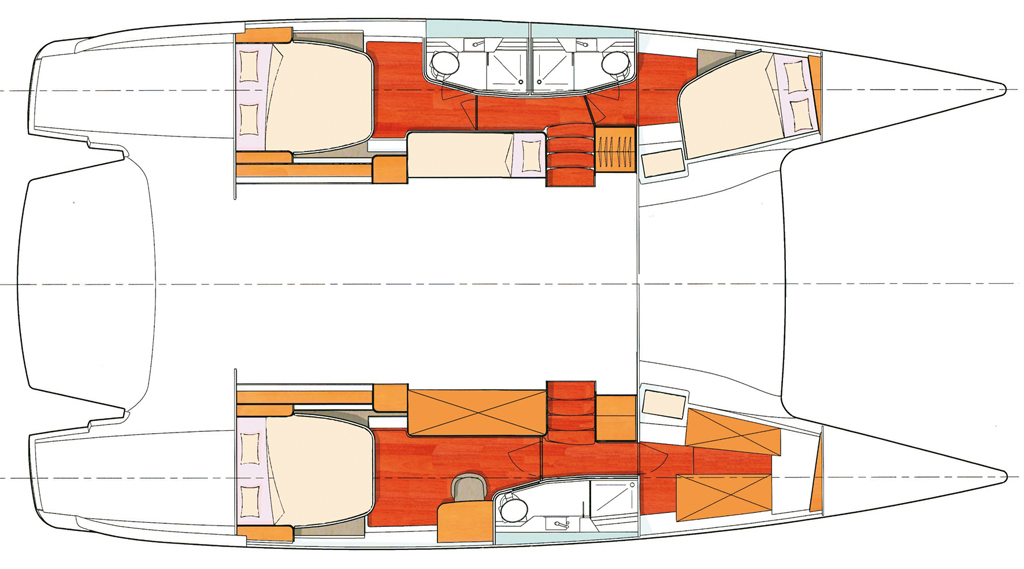
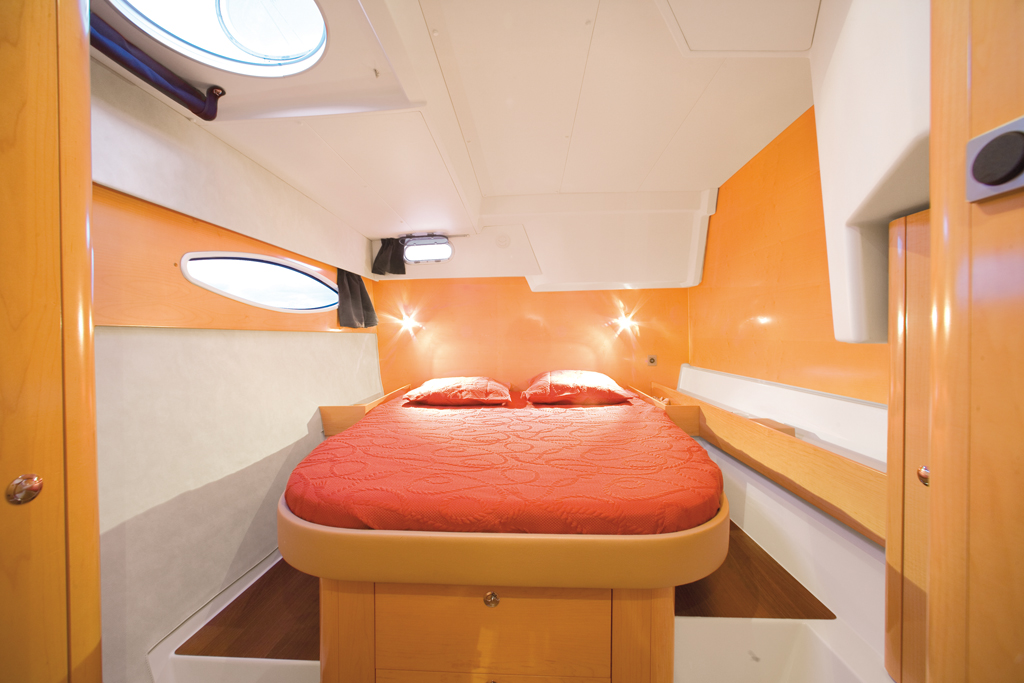
And in the hulls? The companionways are comfortable; the aft berths, (max. 155cm x 200cm), are accessed from the side, without having to crawl. There is sufficient bookshelf space and various lockers for stowing small objects. In the port heads, there is an amusing detail – the small loophole in the mirror above the wash basin looks onto an exterior porthole, so you can admire the scenery whilst putting on your make-up, shaving, or brushing your teeth. How to enjoy life! The forward cabin in this port hull is of course smaller, but with a berth whose maximum width is 140cm, nevertheless, with access from one side. An opening in the forward bulkhead allows access to the forepeak.
As this is the Maestro version, the starboard hull is the owner’s. The size of the locker doors is perhaps impressive, but they don’t live up to their promise, and open onto very little stowage space. Certain act as covers for the galley furniture just above. Fortunately, the two large drawers under the berths are there for personal affairs, and would be perfect for charter cruising use, but barely enough for ocean cruising. The cabin in the Maestro version is certainly much more spacious; the heads is offset forward and has a separate shower which closes with a glass door. In the ‘bathroom’, the starboard loophole in the mirror has disappeared, but we gain a lateral porthole under the shower. Note, in the gangway, the simple, small quarter berth which will allow an additional guest to sleep aboard, if necessary. In the forepeak of this hull, there is a workshop.
Fountaine Pajot has used all its experience and expertise on this boat, which appears to us to be successful, and meets the requirements of a demanding clientele, not always hardened sailors, looking for a nice leisure platform. The Salina represents a compromise between a minimum level of performance on the one hand, and the regular demand for increased comfort on the other. In this, it meets the specifications.
Square-headed sails; be careful not to confuse performance and marketing.
The company has just tested a square-headed mainsail on a Salina 48 which took part in the ‘Grande Traversée’, between La Rochelle and Quebec. Re-named the CST, for ‘Cruising Square Top’, their aim is to improve performance in light airs. The gain will probably be noticeable, on condition that the boat remains light. Note! With this kind of sail (optional) you must remember to reduce sail earlier. One thing is certain, aesthetically, they’re really something!
The plusses :
- Good ergonomics.
- An intelligent cold storage compartment.
- An enormous amount of space.
The minuses :
- Slightly bulky lines.
- In trouble in light airs.
- Stowage a bit limited for ocean cruising.
Technical specification :
- Length: 14.30 m
- Maximum beam: 7.70 m
- Draft: 1.10 m
- Unladen weight: 10,500 kg
- Sail area: 130 m²
- Genoa area: 54 m²
- Mainsail area: 76 m²
- Price: 536,765 euros inc. VAT (Quatuor version), 548,964 euros inc. VAT (Maestro version).