
From Eleuthera to the Bahamas, to Sanya in the extreme south of China, the search for a name for the successor to the Eleuthera 60’ led the Fountaine Pajot team to the other side of the world, to the seaside resort on the island province of Hainan, Sanya! A long voyage for a major change.
Infos pratiques
- Le chantier : Sanya 57
- La fiche technique
- Découvrez notre vidéo exclusive
- Financez votre Sanya 57’
- Assuez votre Sanya 57’
- Articles autour du Sanya 57’
The enviable marketing segment
The 56 – 59’ size seems to have become the centre of the target for fierce competition between the European builders. Sunreef plays its trump card of customisation with the 58’. Outremer has just joined this quite exclusive club with the 5X by showing ambitions for superlative performance. Catana of course takes up the challenge with the 59’ and its curved appendages, whilst Lagoon pursues its conquest of space with the 560. Nautitech is hiding in ambush at just under 55’ and is congratulating itself on the launch of the 542. Fountaine Pajot therefore had to lay a decisive card on the table in this coveted game.
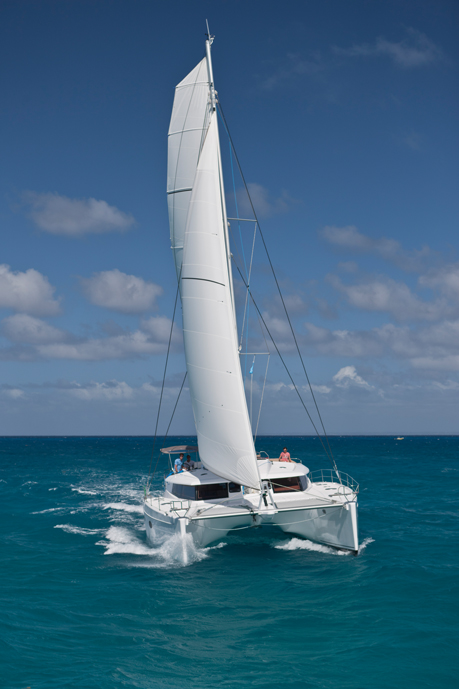
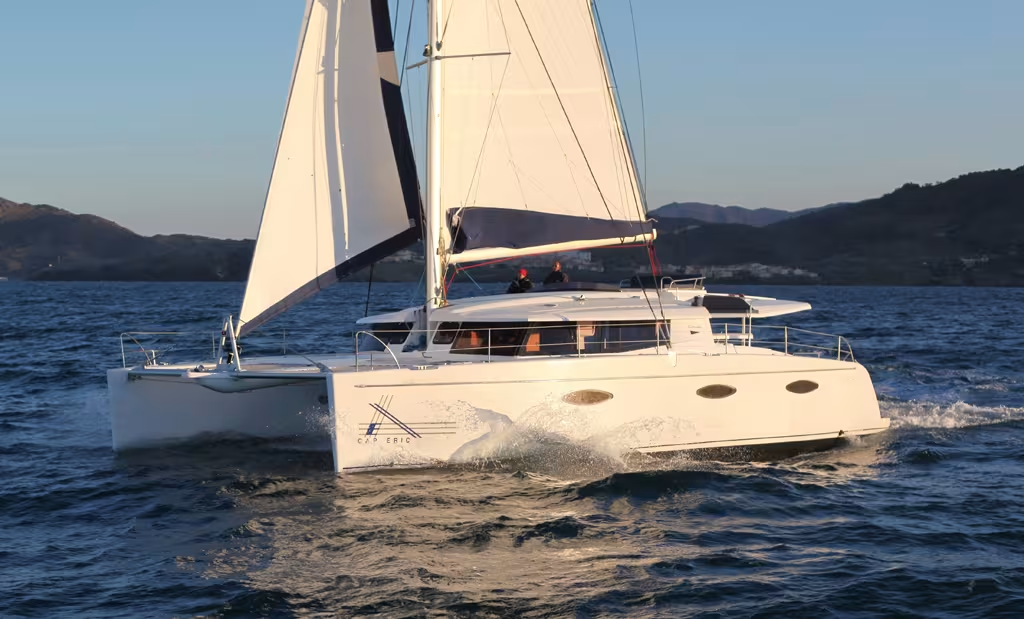
The Sanya on one of its favourite exercises: sailing fast in moderate conditions. (Photo: G. Martin-Raget)
Relevant positioning
Before tackling the totally exclusive semi-custom boat market the leaders (apart from Sunreef and Catana) seem to have abandoned to the specialised yards (Tournier Marine, with its 65’ and 70’ carbon boats, Alibi, Swiss Cats, Gunboat…), it has become essential for a builder of calibre to plant its flag in this 56’ – 59’ niche. Beyond traditional purchasers, new aficionados will be attracted, amongst the defectors from a collapsing fleet of yachts. To appeal to the enthusiasts and also reach these former Ulysses from the motor catamarans, the designers must offer a multihull which is true to its values, but also avoid the danger of conservatism. The philosophy must satisfy the wealthy philistine and his family influences, as well as the blue water cruiser... The charter clientele must not be neglected, but this mustn’t be seen! Have the fairies poured the magic potion of success into the recent formula from Aigrefeuille?
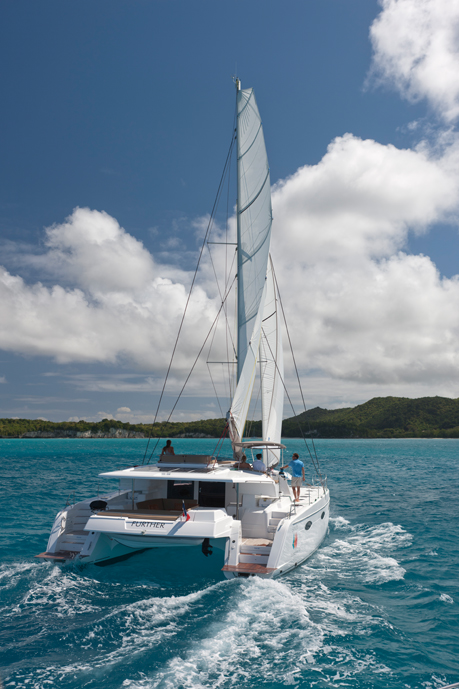
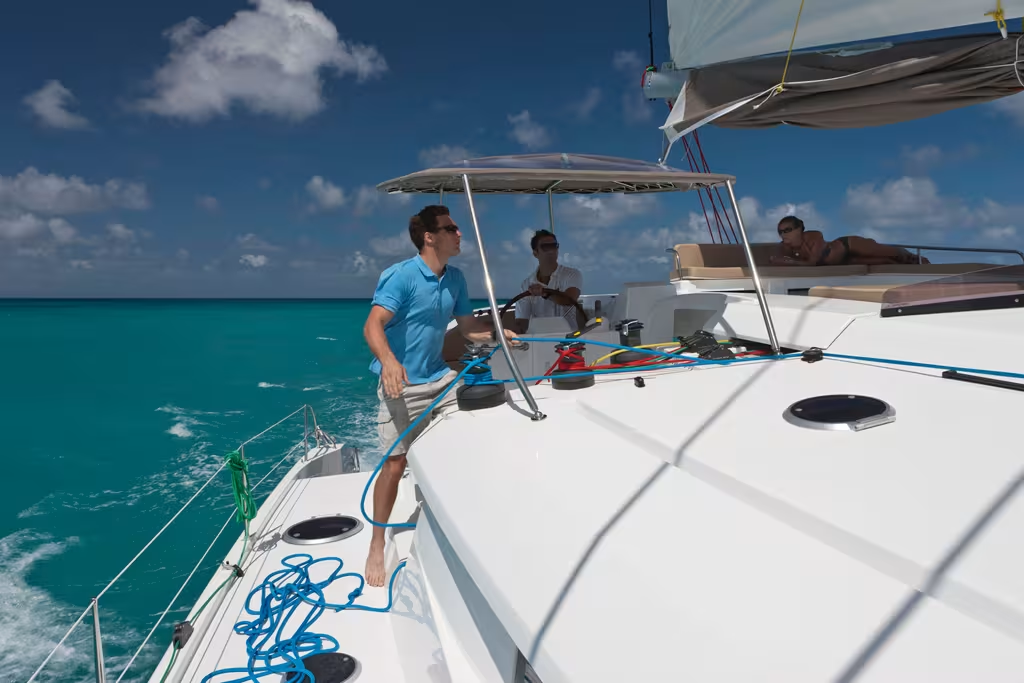
The raised steering position is comfortable and offers a nice space to ‘play’ with the winches. The deck plan is successful. (Photo: G. Martin-Raget)
Silhouette: in medio stat virtus* (*: virtue is far from the extremes)
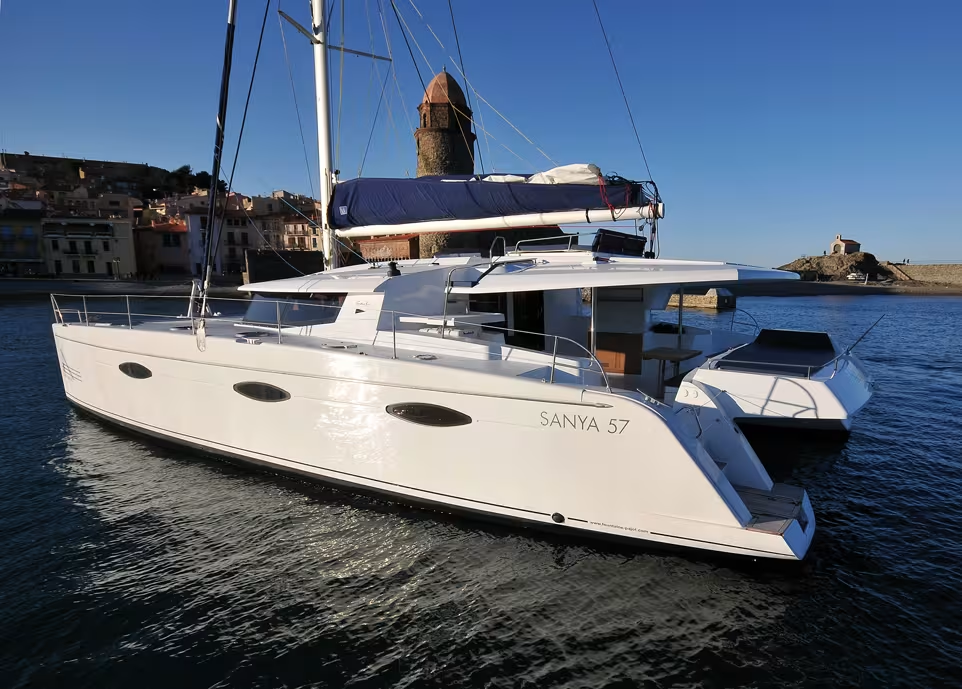
Olivier Racoupeau has appropriated the motto of Solon of Athens, by refining the balance of the Sanya’s design parameters, and ensuring that none of the recent comfort ploys ruins the effort of homogeneity. The 57’ retains an aesthetic family connection with the Eleuthera, but the overall ergonomics break with its large predecessor, and cleverly adopt contemporary solutions. Vertical bows, a ridge on the coachroof, and a re-styling of the ‘windows’ reinforce more determined lines. The ‘no complex’ sugar scoops assert a multi-use vocation. The clarity of the design of the lateral portlights and the reduction in their number have a positive impact on the perception of the hulls. The cast aluminium ‘ear flaps’ supporting the company logo have been advantageously replaced by a logo in silver mylar which makes a better impression. The integration of the ‘essential’ comfort areas (semi flybridge, navstation, sunbathing areas and seating, rigid bimini) is an achievement from a style point of view. The silhouette remains fluid, for this kind of generous multihull.
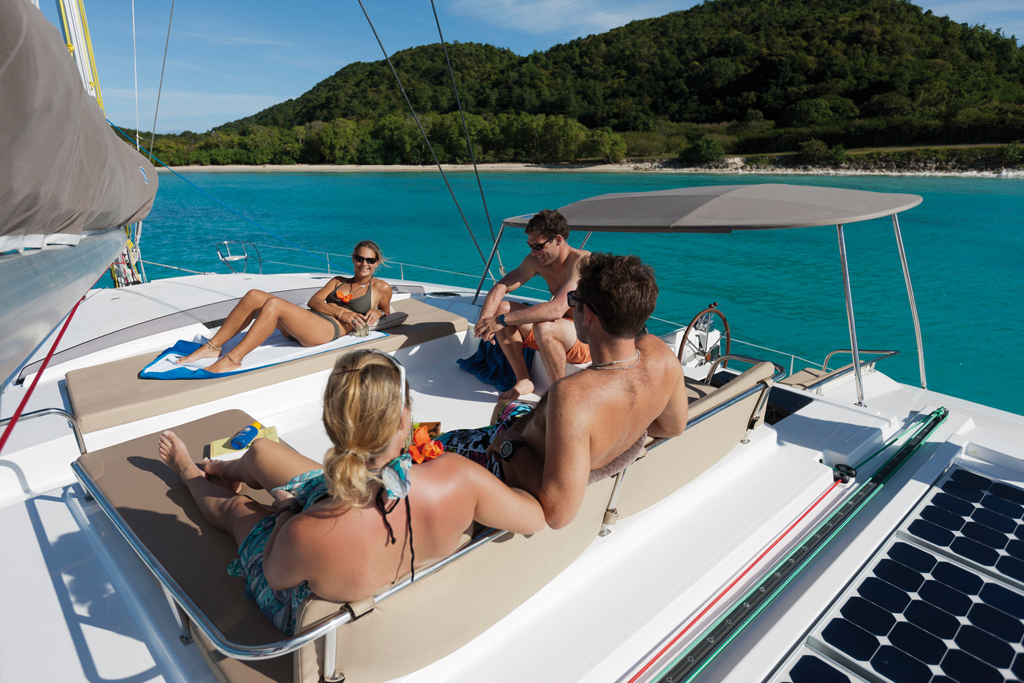
The lounge deck will always be the ‘must’ on a cruise in the sun. A particularly pleasant area. (Photo: G. Martin-Raget)
Architecture and construction
The concern for retaining volume in the ends to combat pitching, whilst making gentle, progressive sections pass through the water, shows hydrodynamic design work adapted to this kind of hull. The bridgedeck tunnel has been the subject of extensive and creative studies; it uses a significant development of the earlier approaches. A first longitudinal step, high enough and flared, allows the hoped-for hull volume to be moved to the interior sides of the hulls; it is supported on an intermediate gullwing rib on each side. In the median axis, a longitudinal bulb merges with the omegas which structure the bridgedeck. This complex theoretical approach aims to avoid slamming and stiffen the panels. To combat leeway, there are conventional fixed profiles; the propshaft exits are mechanically very strong, via two skegs/cutless bearing supports, and an intermediate bracket. The semi-elliptical, balanced rudders will be as efficient as is possible with the available aspect ratio. Construction of the platform is split into two operations: a first phase of contact impregnation of the exterior skin with vinylester resin (3 x 300g below the waterline, 2 x 300g above), before the application of the 80kg/m3 glass foam (apart from the monolithic hull bottoms) and the interior lamination by polyester infusion.
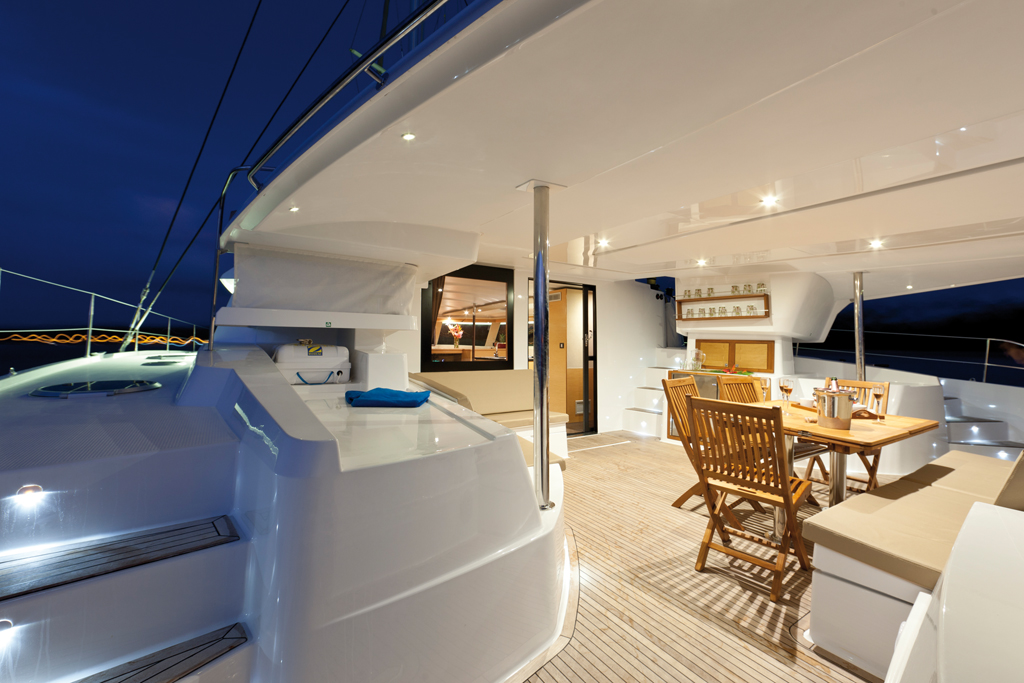
Well protected, close to the steering position – the exterior saloon is ingenious and pleasantly versatile. More than ever, it is an essential living area. (Photo: G. Martin-Raget)
Interior and exterior accommodation
The Berret-Racoupeau design office is responsible for the whole of the style and the follow-up of the installation of the Sanya’s furnishing. The organisation of the areas is resolutely modern, without being audacious; the set up is relevant. The design of the decorative elements remains sober, almost refined, and creates a bright atmosphere which plays on the contrasts between the light facing of the Alpi veneer and the floors or bathroom furniture in a very dark shade of ‘wenge’. The galley, with its central ‘island’ is functional and suited to use by a private owner. The open space philosophy and the reduction of the saloon table will orient the service towards the exterior, when on charter. The two chrome leather covered tubular handrails are judiciously positioned. The full panoramic view from the lounge is very pleasant. The choice of a fixed seat for the navstation is debatable; a real watchkeeper’s armchair would be more suitable, and more appropriate to the 57-footer’s status. The volumes available in the cabins are very attractive. Particular care has been taken with the ergonomic comfort of the bathrooms: large mirrors, basins, elegant and practical taps, spacious showers, and sophisticated and intuitive lighting. The numerous pigeonholes and shelves favour temporary appropriation by the guests, and personalised, or even up-gradeable decoration (according to the seasons, the owners or the crew’s taste). The quality of the materials and accessories (door handles, cushions, spotlights, switches) is good; certain minor marine hardware articles (hinges) could be developed. The woodwork is sturdy and flattering to the eye everywhere in the boat. The exterior saloon is ingenious and pleasantly versatile; it completely fulfils all the functions of this new and essential living room. Ideally close to the helm, but completely protected from the elements and the sun, this area will be a favourite. Movement on the same level is appreciable. Access to the deck saloon via a large, good quality single sliding door is a reference in the field. The lounge deck is a subtle version of a flybridge, at mid-height. The huge aft sunbathing area, and the port side seating (symmetrical with the steering position) complete the arrangements for welcoming guests in particularly successful and accessible convivial or private relaxation areas.
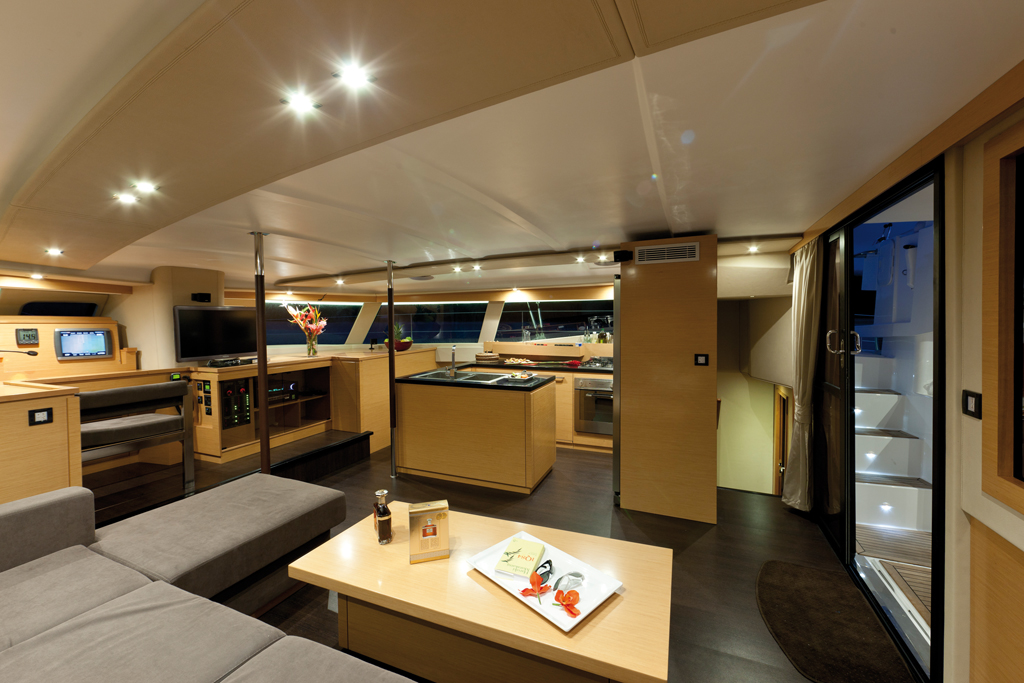
The interior is modern and sober, and offers a very relevant set-up. (Photo: G. Martin-Raget)
A fast and comfortable big catamaran
I want to say lots of good things about the engine installation; certain people will have reservations regarding the forward position of the blocks (transmission by propeller shafts), but apart from the benefit for the boat’s trim from this set up, the soundproofing is absolutely praiseworthy. The generator is imperceptible; on deck, the rev. counter is the only way to be sure that the engines are running. Daily maintenance is carried out in the independent compartments. Hatch struts would be desirable for the weekly visits via the aft cabins. The plumbing, a source of comical nautical adventures, is here clearly identifiable and referenced – bravo! The two polar weeks in February gave way to a window which was ideal for our test (25 – 28 knots of north-westerly). The D3 110hp Volvos (optional) and the folding three-bladed propellers gently eased the Sanya from its head to wind berth; the motor function, the torque and the power are immediately available. The company’s electric controls are brilliantly precise (protection will be necessary). The silence and absence of vibration deserve real praise! We left under full main (twisted-traveller open), long enough to unroll and trim our jib. The Sanya easily tolerated this brief overload. With one reef in the main and full genoa, it set off with conviction and bit into the big chop, at less than 40° to the (apparent) wind. The 57’ found an ideal compromise with the seas at 50/55° (force 6, rough sea); the speed varied between 8.5 and 9.5 knots, the movements remained supple. Pitching was remarkably limited and the impacts of the waves were absorbed. The catamaran did not stumble in the troughs and seemed to appreciate this lively sail. There will probably be a limit to its windward ability beyond these already-athletic conditions, but the Sanya passed the test with flying colours! The beam wind didn’t reward us with significant acceleration. It was after the gybe during a long, 15-mile downwind leg that the 57’ showed another facet of its talent. The balance of the helm downwind immediately became perceptible, assisted by the directional effect of the efficient rudders and a pleasant feel, despite the hydraulic transmission. Between 9 and 13 knots, the catamaran leaves a limousine’s wake – straight, with no parasitic rolling, or spray on the deck. This point of sailing proved to be one of the boat’s strong points: safety, directional stability and steady speed allowed it to tackle the crossed seas offshore without tiring the automatic pilot.
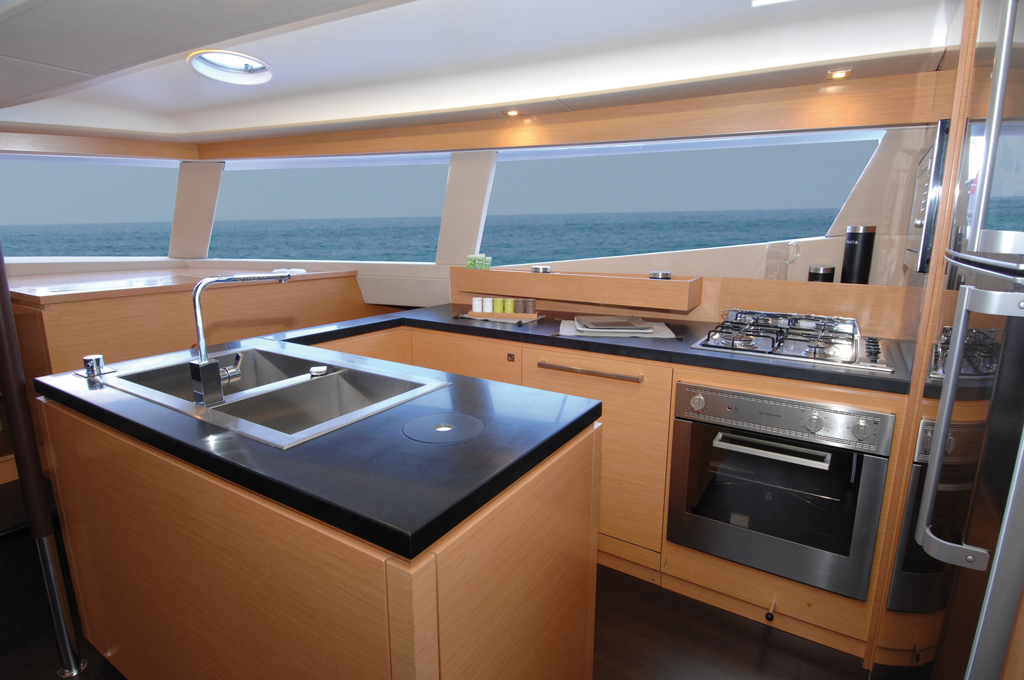
The galley and its central ‘island’ will delight the gourmet. Modern and functional! (Photo: G. Martin-Raget)
Conclusion
The dynamic qualities in rough seas are good. With a gennaker (essential), the Sanya will become more agile in light airs. The integrated deck plan works well; the reasonable sail area makes manoeuvring easy, without affecting performance. This big multihull really can be used by a family, with some previous experience.
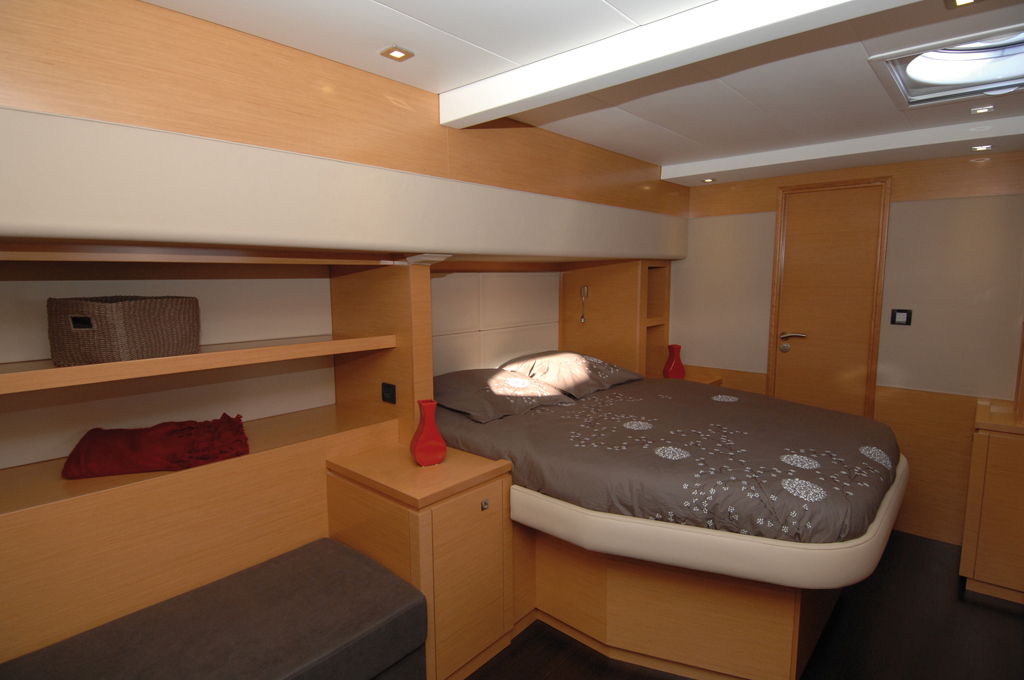
The volumes available in the cabins are impressive, especially in the owner’s cabin... (Photo: G. Martin-Raget).
The point of view of the architect, Olivier Racoupeau
We wanted to design an easy catamaran for a hedonistic public. Not over-canvassed, but relatively light, protected, and comfortable, both at sea and in harbour, the Sanya’s balanced character is the result of common reflection with Jean-François Fountaine. We paid particular attention to the rigidity of the platform; the computer finite element calculations were precious, to finish off an extensive structural study, the main beneficiaries of which will be the purchasers. Hulls which are full at the ends, gentle and well-distributed shapes, not too much rocker (curve of the hull), to limit pitching and ‘rearing up’ ; we put a lot of time and effort into this design, convinced that we had to look everywhere in order to remain harmonious.
Sailing and golf
Not just sailing, not uniquely golf - the themed cruise in which Sailing and Golf specialises in the Mediterranean, allows two fun passions to be associated, or one to be discovered from the other. Starting with the observation that diving, animal photography…or ethnology are essential complements to any successful nautical adventure, Capéric has perfected a circuit around Palma which in one week, allows you to discover the island from chosen anchorages, whilst taking advantage of the cool of the morning to play 3 dream rounds at the famous spots of Andraixt, Pula and Alcanada. A skipper and a hostess will be your partners for a personalised cruise aboard our test Sanya, as a couple, a family or with friends. www.caperic.com
TECHNICAL SPECIFICATION
Architect: Cabinet Racoupeau-Berret Builder: Fountaine Pajot Length: 17.26m Beam: 8.88m Draft: 1.40m Unladen weight: 18.8t Fully laden displacement: 24.7t Air draft: 22.25m Mainsail area: 98m² Jib area: 52m² Engines: 2 x 75hp/2 x 110hp as an option Transmission: propshafts Water: 1,000L Diesel: 1,100L Certification: category A 12 persons – B for 20 – D for 30 Versions: Maestro private owner (1 suite + 3 doubles +1 skipper) Guests (5 doubles+1 single) Charter (5 doubles + 1 skipper) Construction: foam-glass/polyester sandwich, infusion process Price, Maestro version: 868,000 euros exc. VAT ‘Grand Large’ Pack: 27,307 euros exc. VAT Solar panels: 11,000 euros exc. VAT Watermaker (90L/h/24V): 16,126 euros exc. VAT Lounge deck: 10,300 euros exc. VAT Folding propellers: 3,800 euros exc. VAT 7kW generator: 14,400 euros exc. VAT Gennaker option: 16,400 euros exc. VAT Electric mainsheet winch: 2,200 euros exc. VAT Epoxy primer and antifouling: 4,500 euros exc. VAT Delivery to La Rochelle: 5,500 euros exc. VAT
THE PLUSSES:
• Pleasant and easy to use • Technical coherence • Interior and exterior conviviality
THE MINUSES:
• A few finishing details • Access to the coachroof from the starboard side • Finishing of the davits and the dinghy lifting system.
THE COMPETITORS
Builder Windward sail area in m² Weight in t Basic price in euros, exc. VAT NAUTITECH 542 150 15 790,000 LAGOON 560 207 28 825,000 SUNREEF 58 181 26 850,000
