Wolfgang Koch is passionate about anything that sails on two or three hulls. For a long time, he was president of the German cruising catamaran association, but it was in Switzerland that he discovered the Ocean Youth Sailing project: the building of Vellamo, an Arrow 1360 catamaran, designed for amateur construction. Here he gives us his first impressions of the boat under sail.
Infos pratiques
- Le chantier : Arrow 1360
- La fiche technique
- Découvrez notre vidéo exclusive
- Financez votre Schionning Arrow 1360
- Assuez votre Schionning Arrow 1360
- Articles autour du Schionning Arrow 1360
Test location: Bottighofen, Lake Constance, Switzerland
Weather conditions: 5 to 10 knots of wind. Calm.
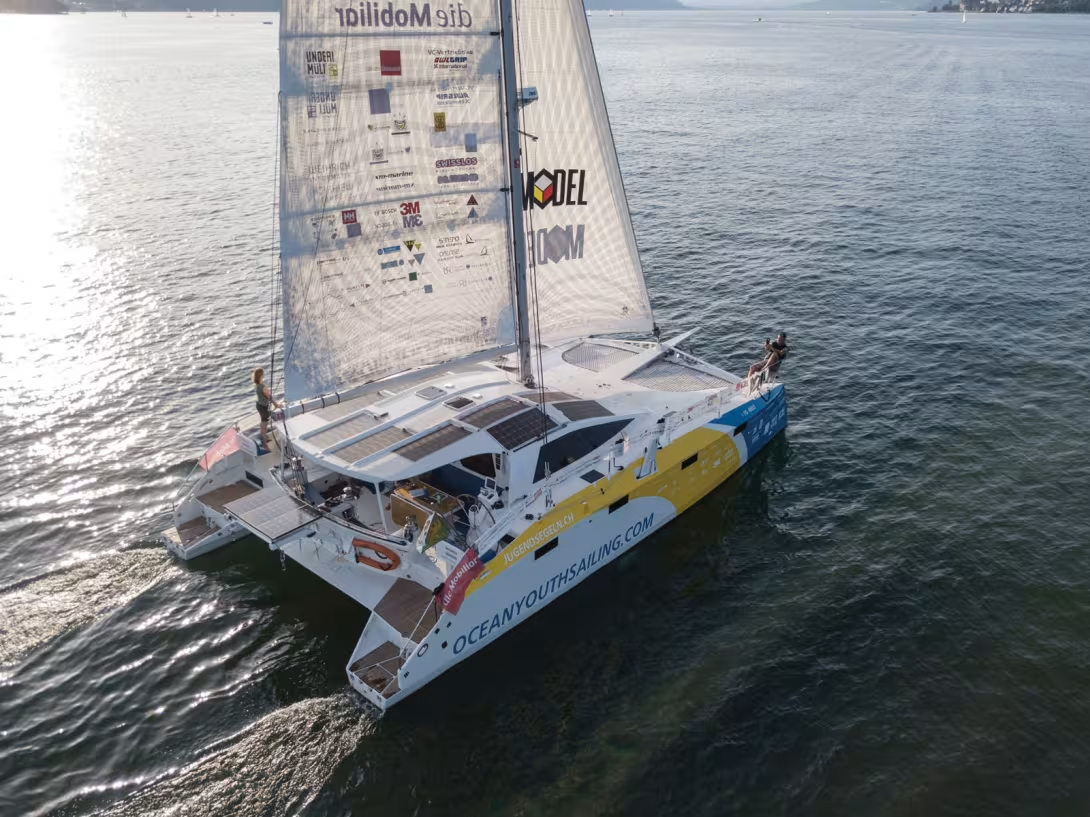
I got the chance to sail Vellamo alongside the men and women involved in building the boat. I’d been invited to come to Bottighofen, Switzerland, on lake Constance. The arrival of the catamaran in port, coming back in from another seatrial in the morning, was very unusual. Driven by the two electric motors, there was no smell of diesel, nor exhaust fumes to see as the boat glided alongside! The docking maneuver was very elegant and smooth, typical for a twin-engined catamaran, even though the man at the helm was not that experienced. Using both motors, Vellamo pivoted on the spot without any problems. The conditions were smooth with very little wind, but still, the small harbor is quite narrow…It was a beautiful and sunny day in late fall, with a crisp wind blowing. Temperatures were cool in the shade, but the bright sun warmed our backs. We had a little snack and after the morning guests departed, we left the dock and headed out of the harbor.
The first thing that struck me about this boat: The workmanship is really professional, and the finish is amazing. Construction was carried out using a kit of pre-cut wood/ foam sandwich panels. Only a few little details show that this is a self-build project, and not manufactured by a professional shipyard. General specifications like the layout and sail plan were supplied by Schionning Designs, and carefully developed with attention to detail. Just one example: to maintain control of electricity consumption in the cockpit and saloon, there are no power outlets in the cabins.
Excellent sensations under sail
The skipper of the day was giving instructions to the crew, several of whom knew little about sailing. This project was not only built by young people, but its aim is also to teach them sailing on a cruising catamaran. Today for some of them, it’s their first time. They all help work the lines and take their turn at the helm. For me, in the beginning, I was just watching their actions and the performance of the boat. The 755 sq ft (70 m²) fully-battened mainsail was hoisted quickly and then the foresail was unfurled. Sadly, the wind dropped and we were left with only a light breeze. Even so, Vellamo picked up speed easily, despite the fact that there were 14 people aboard. With winds of just force 1 to 2, we were already making 3 to 4 knots, heading towards the city of Constance. After a few miles we bear away a little, take in the genoa and hoist the blue gennaker, which is stowed in a sock. As soon as the sock is lifted, the gennaker opens with the wind and starts to fill. Though the wind was light, you could feel the boat speeding up right away. I then took a turn at the helm myself and started to play with the sails and the course. The boat responds well to the helm, but the feeling is not very direct due to the Dyneema lines that comprise the steering system. The wind was dropping again, so it was hard to keep the foresail filled, so after a while we dropped the gennaker and tried the code zero. After playing with this for a bit, we gybed again and headed back towards Constance.
Electric power
As we were getting closer inshore, we doused all sail and I tried out the engines. During hard acceleration, you can hear and feel the vibration of the propshafts. But this is all you hear, besides the passing water and the little wind. I think the shaft bearings could be improved. The owners also tested out different sizes of propellers, before the catamaran left Switzerland. At the time of our test, there were 2 different sized propellers fitted: on the port side, 16.5x10” 3-bladedprop with a left-hand rotation, and to starboard, 15x10” 3-blade, also left-handed. The smaller prop is better in recuperating energy and the bigger one gives better performance for speed. Using 5kW of power, one motor keeps the Arrow 1360 at a cruising speed of 5 to 6 knots. With these motors, the boat is easily capable of reaching 7 knots using both. The torque and power are impressive, as expected for electric engines. Also stopping from full speed is no problem, taking less than two boat lengths to come to a halt, though I was quite careful when shifting to astern. The usual small shock you experience when changing to reverse in the gearbox of a diesel engine simply doesn’t happen! Turning the boat with one motor forward and the other astern has the same normal effect as with regular diesel engines. Maneuvering and turning on the spot are no problem at all. A very good idea is that if the engine controls on one side are activated, the ones on the other side are blocked, making it impossible to activate the controls by accident. Of course, each helm station also has a display showing engine information, such as rpm and consumption in kilowatt/hours. During the build, the decision to go for these electric engines came up, called “Green Vision”. The association leading the project created another new goal and decided to emphasize sustainability and environmental protection. This resulted in extra cost of around € 70,000. The aim is: no diesel, no CO2, and no noise. They skipped the traditional diesel engines and installed two electric motors. These are Oceanvolt Twin Shaft Drive AXC 48 Volt, 10 kW. The boat has two 10kW Lithium-ion batteries inside the hulls. They are charged by solar panels of up to 2,300 W. Shaft generators driven by the propellers when going along under sail can also put back in up to 1,500 W at 10 knots of boatspeed. And if all else fails, there is still a 10 kW Fischer-Panda Diesel generator aboard, that is always able to run the motors.
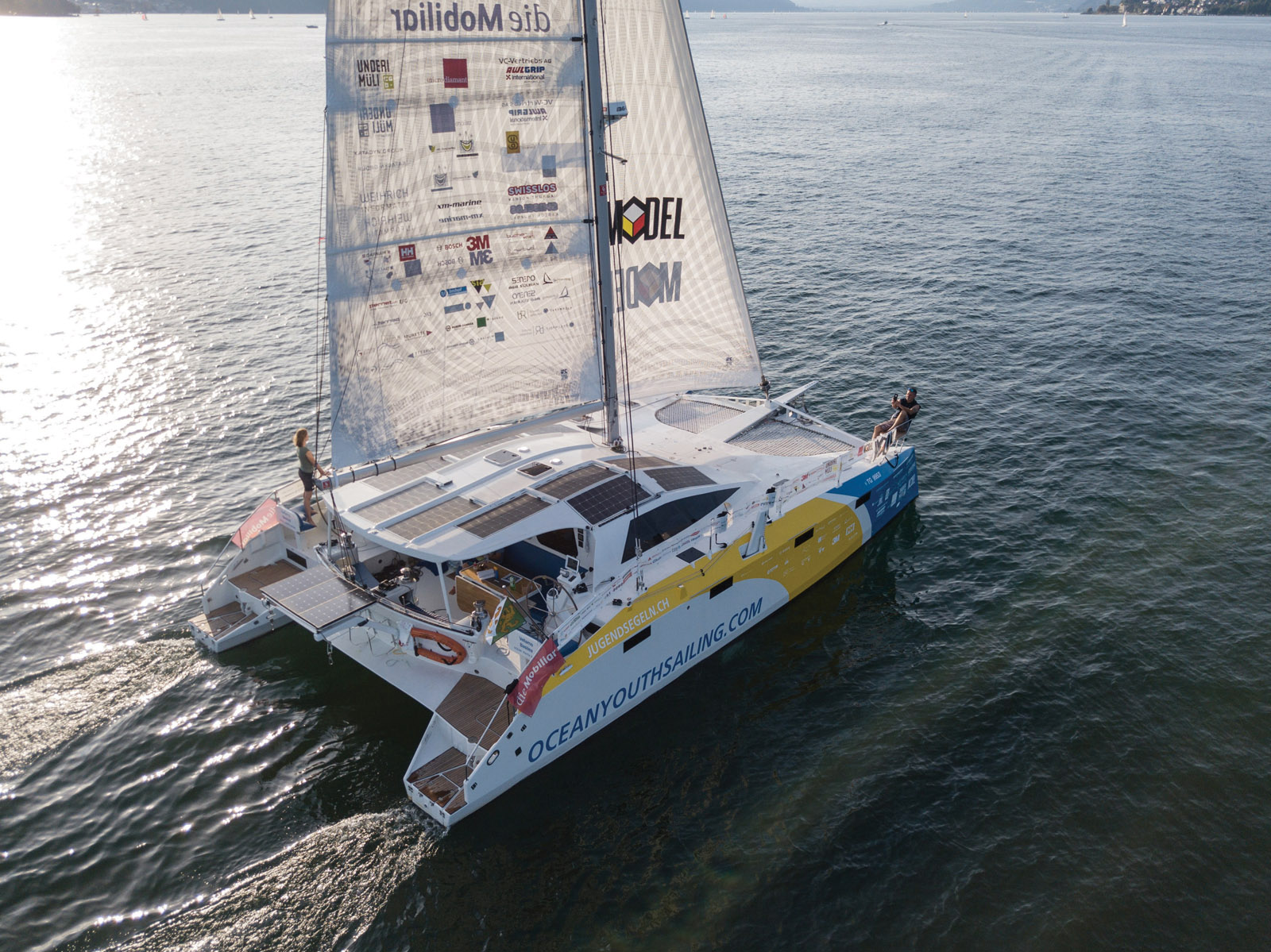
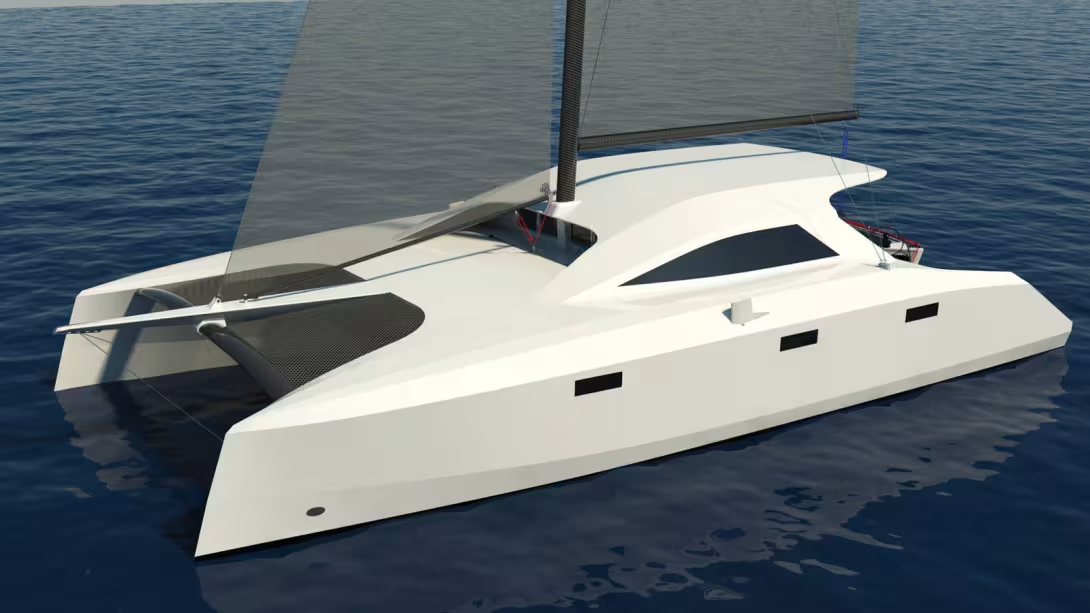
The Italian designer Riccardo Bulgarelli managed to combine elegant lines with an efficient and powerful hull, while offering a lot of volume aft.
Two helm stations
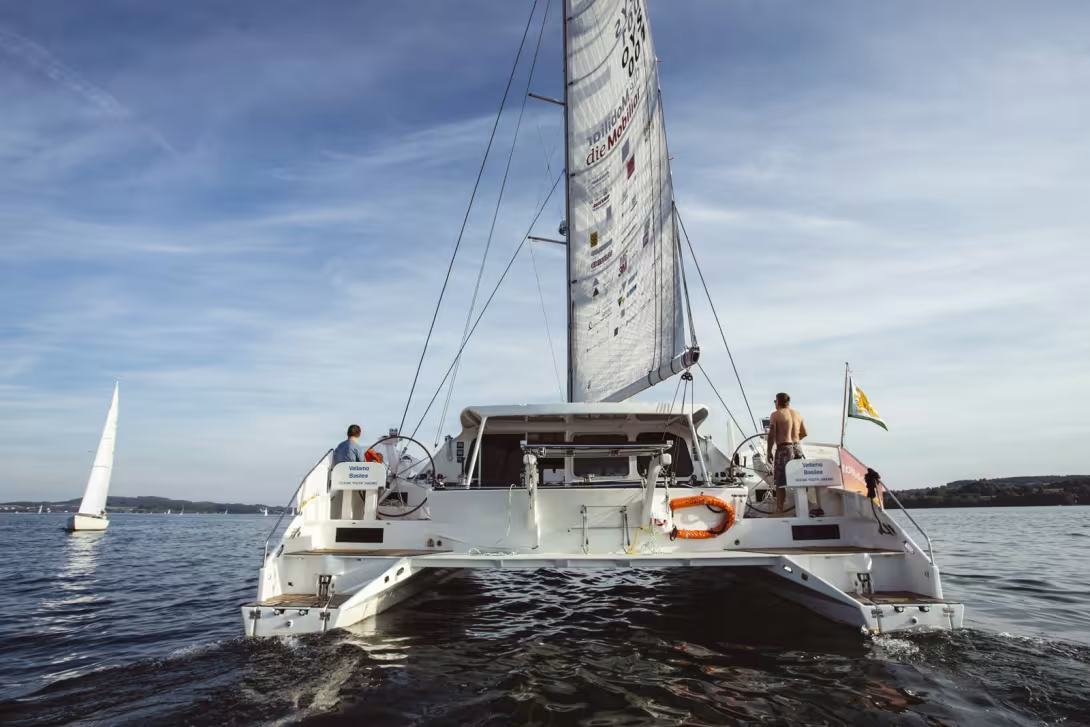
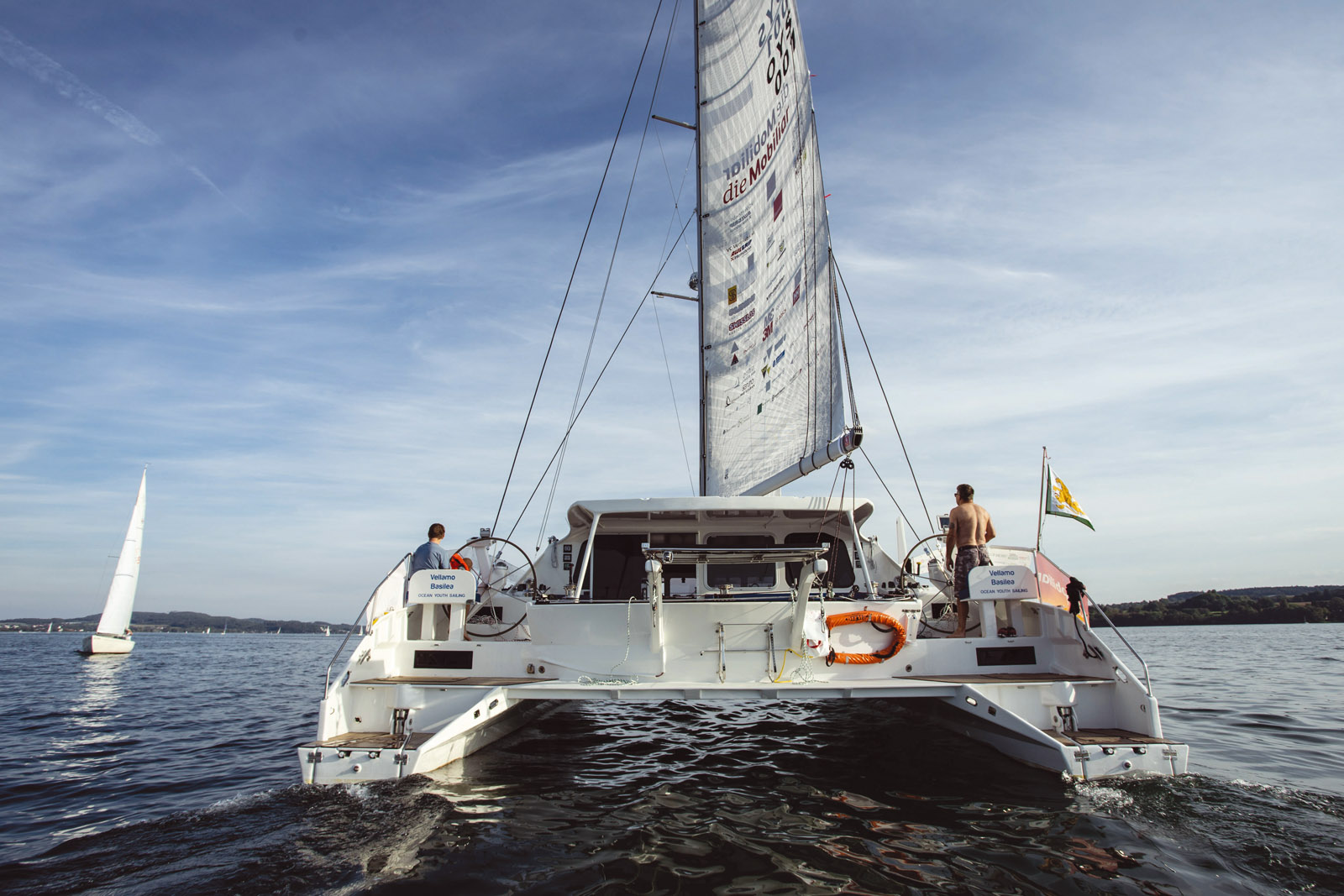
This catamaran has two helm stations, one on either side of the cockpit, giving a clear view towards the sails and mast, from the side of the central fixed bimini. Similar to other catamarans of this size, you can see along the hull from stern to bow on each side. On this boat there are two control stations for the engines, one at each helm station. Also, on both sides, you’ve got B&G instruments for all the useful information: boatspeed and windspeed/wind angle or depth. The halyards and reefing lines are all led back through a channel below the bridgedeck, so in heavy weather, reefing is possible without needing to go to the mast. The boat is equipped with five winches to handle the lines. Three of them are 52´s, operating the sheets and halyards, while the other two are 58´s for the mainsheet and traveler. The foredeck has lots of storage, and also allows safe working during sailing maneuvers. The trampolines are quite small, but this is also a specification given by Schionning Designs. A vertical windlass is mounted centrally in the huge chain locker.
2” (80cm) clear of the water
Up to 12 berths
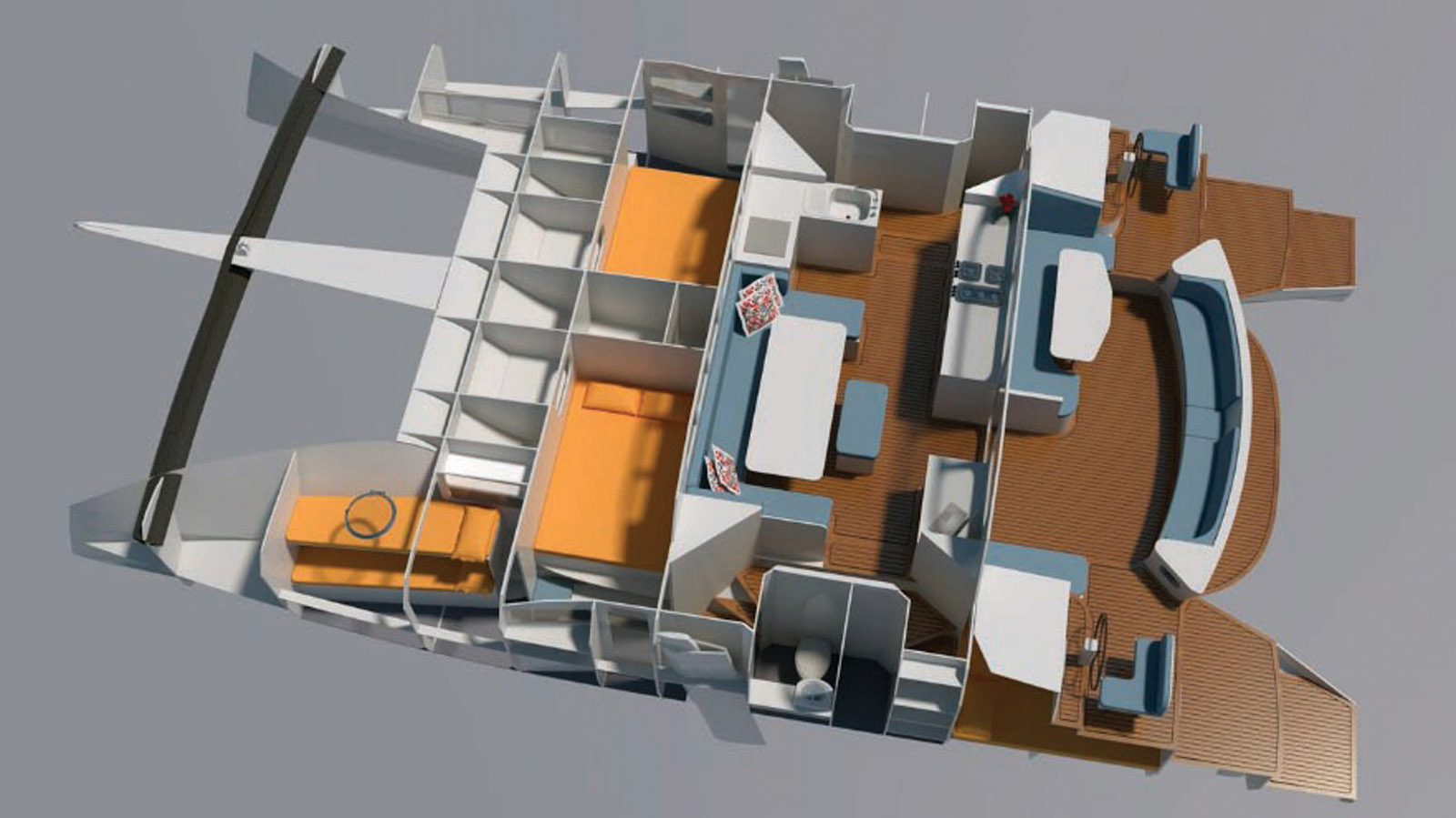
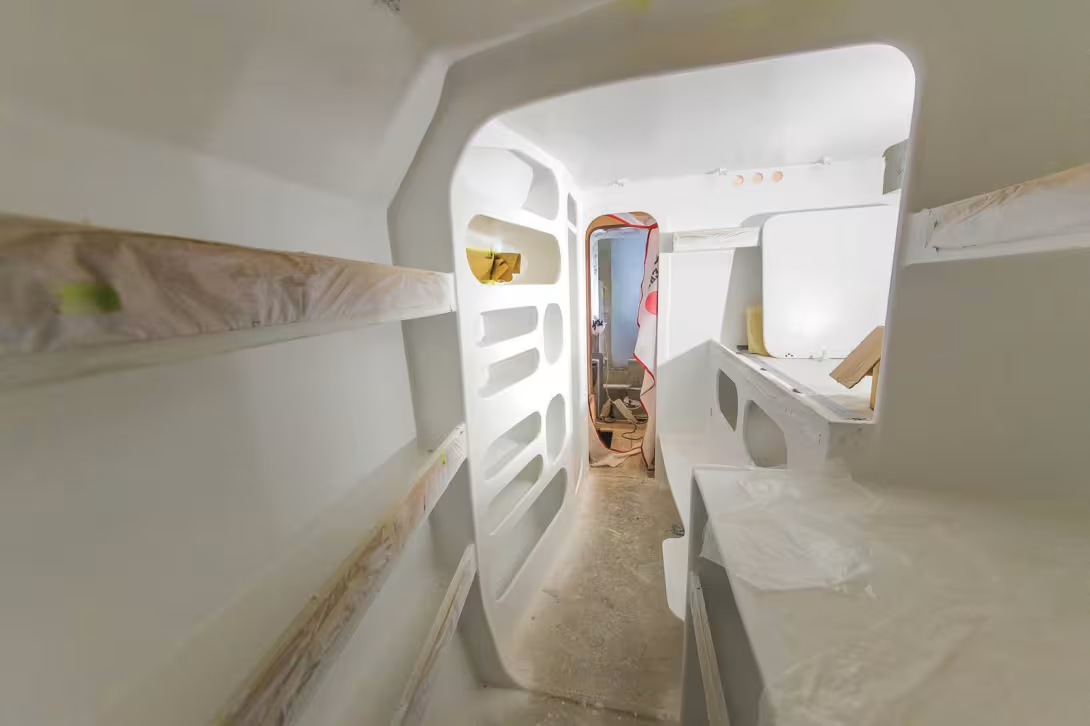
This catamaran offers an extremely large amount of space inside and outside for up to 12 people. The Arrow 1360 has four double cabins fitted out athwartships. In the port hull, there is another cabin forward with two bunk beds, and if needed, there are two spare bunks possible in the saloon. The forward cabin in the starboard hull contains a pretty well-equipped workshop, so any minor repairs can be done by the crew. There is a watermaker for fresh water aboard, as you would expect on such a catamaran.
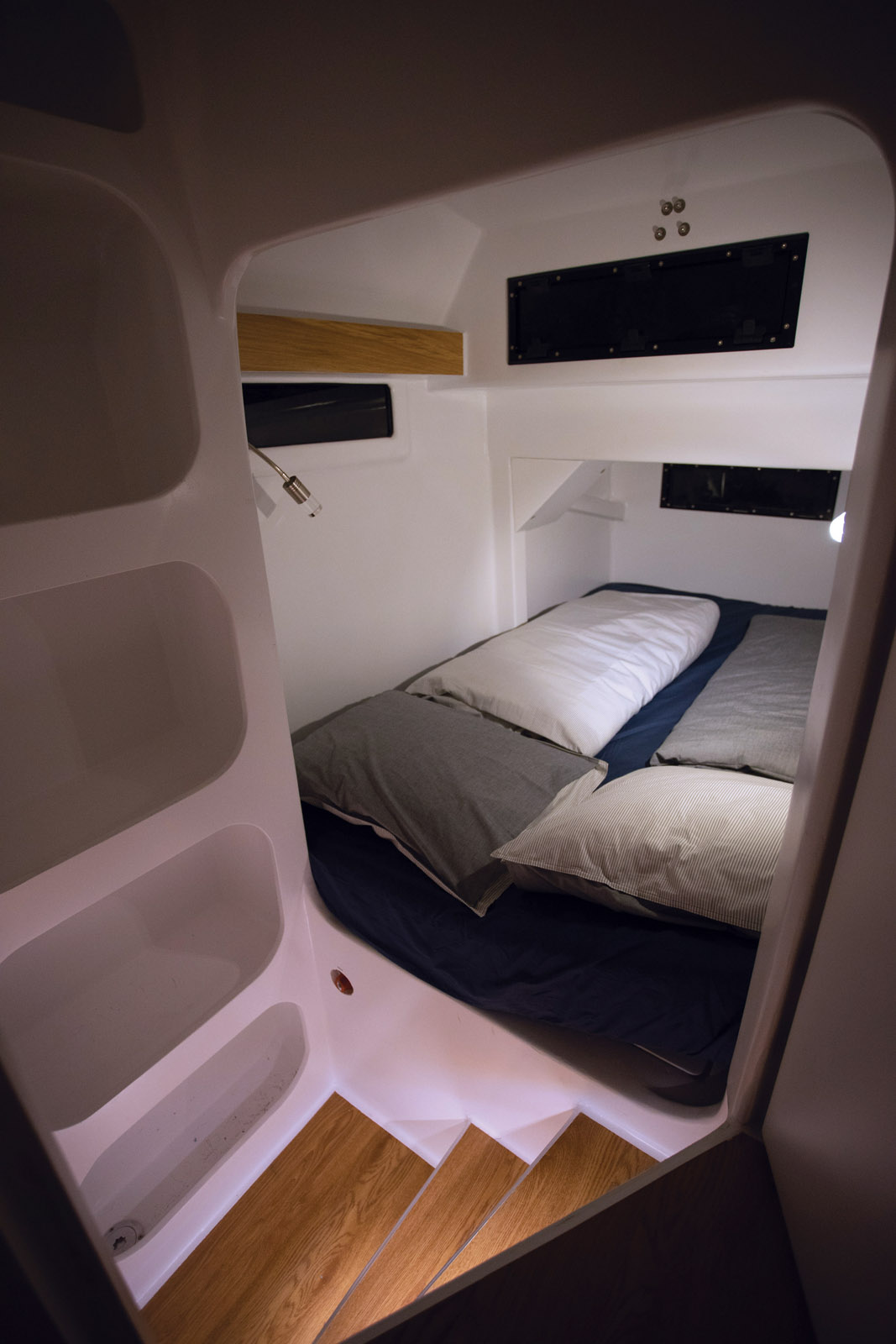
The Arrow 1360 offers five double cabins
Conclusion
This is a very special catamaran – accessible for amateur construction – making it ecological and sustainable! It’s a lot of fun to sail and drive this boat, even in light airs. The enormous saloon, the big galley - everything is ready for the crew of 12, for whom this catamaran was designed.
Ocean Youth Sailing - An amateur construction project and sailing school
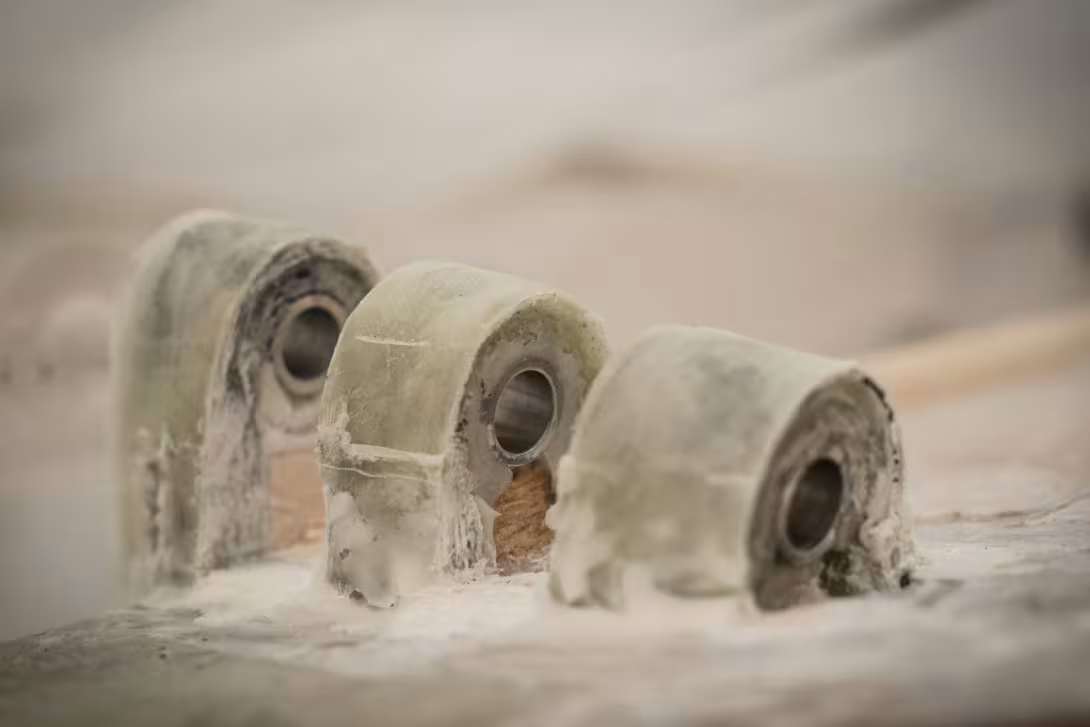
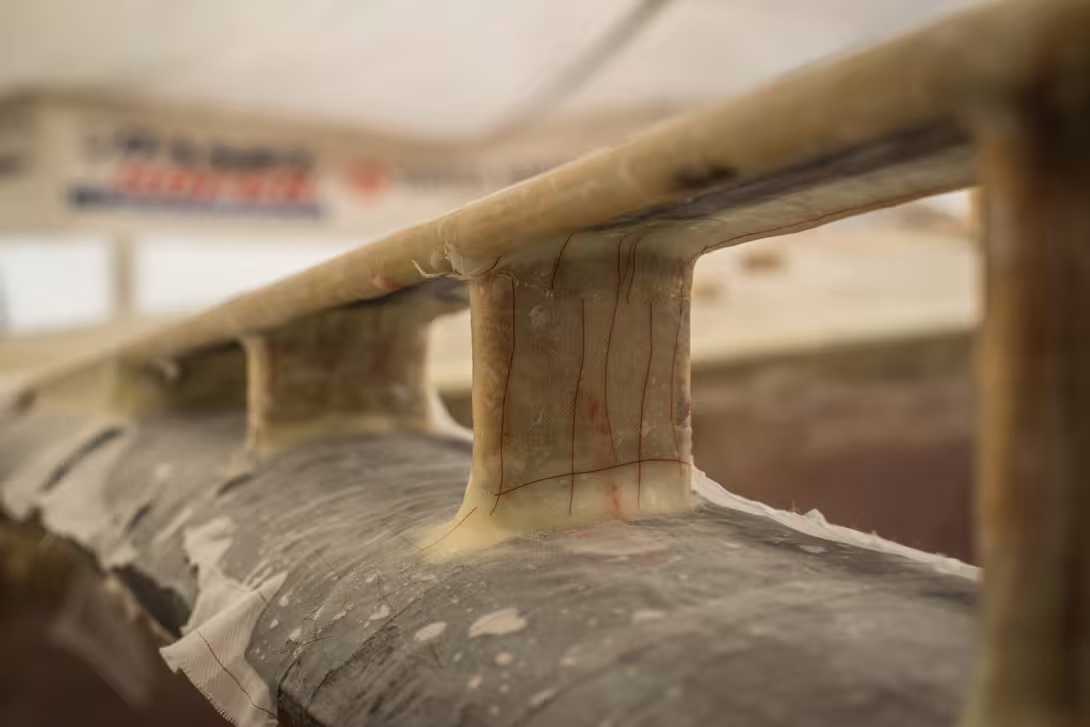
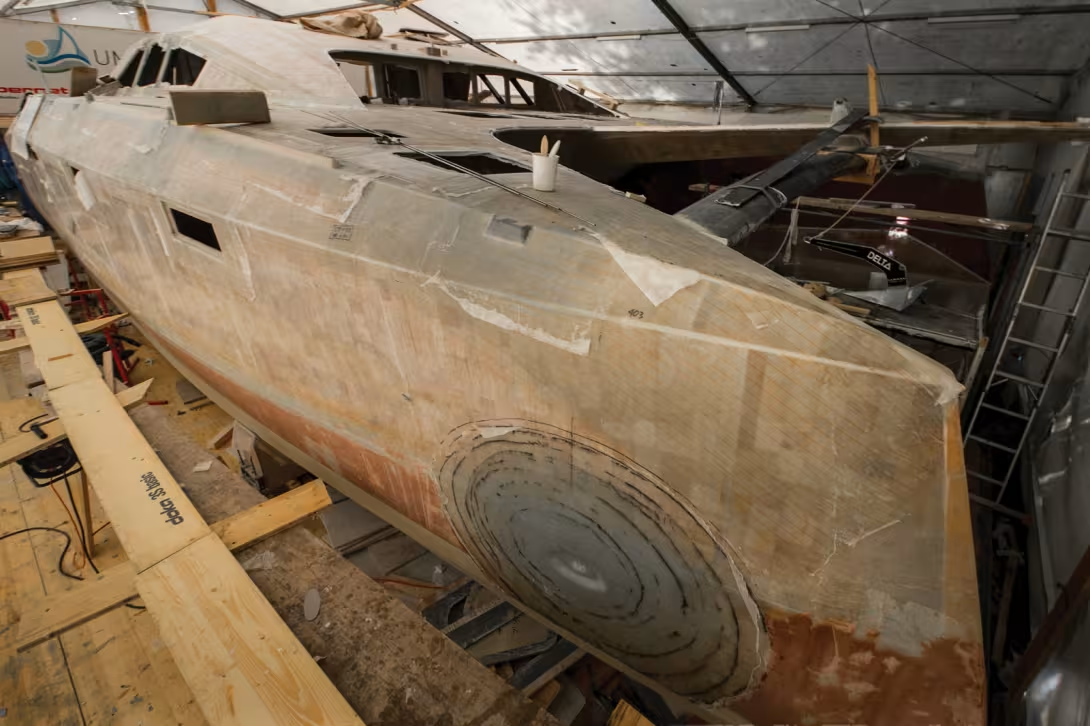
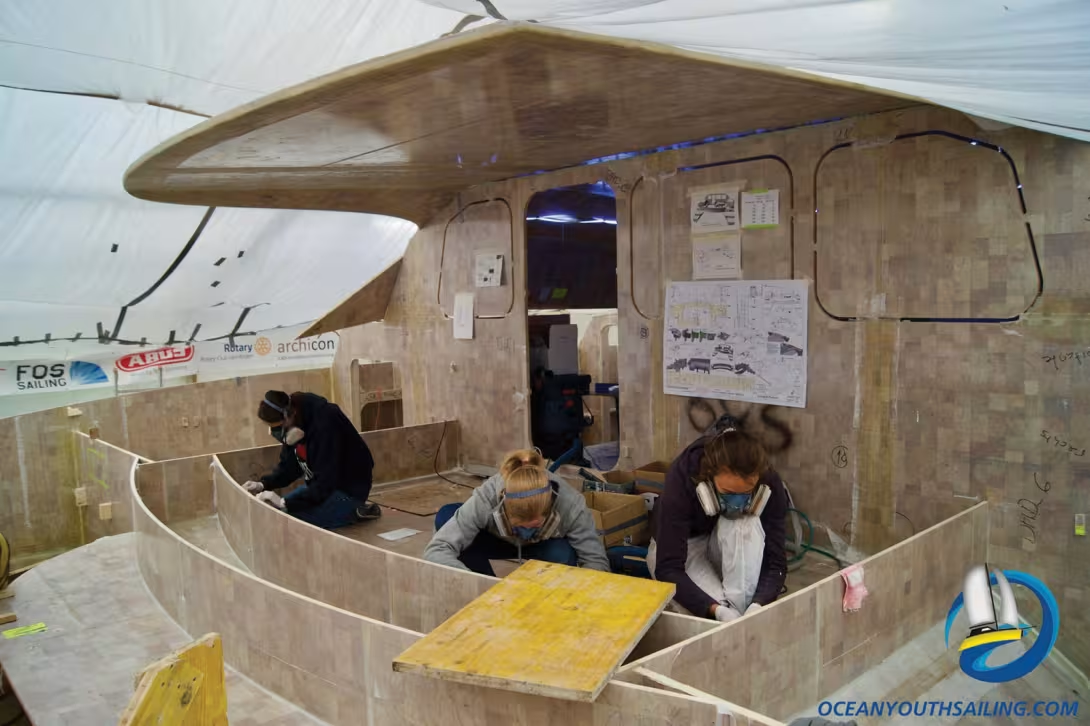
The project was started by a group of 30 young people. The goal was not only to self-build this catamaran, but also to educate and train young people for blue water sailing and to get them their sailing licenses. The association was founded in 2014 and in 2016 there was enough money to start the build. To date, there have been 407 volunteers involved, a total of 20,374 hours of work invested, and 16 refugees integrated into the project. The operational expenses are offset through membership fees and charter income. Anyone involved in the construction receives a discount but has not acquired any shares in the catamaran or any rights to sail. This is the only way to economically manage operations over the years, and the boat should be operated for many years to come. At least 30 years are envisaged. Last summer, Vellamo started its trip down the river to the Netherlands where it will remain through the rest of this year due to the Coronavirus situation. Training will be offered there with a smaller number of crew aboard. In 2021 the plan is to transfer to the Mediterranean Sea and remain based there for the coming years.
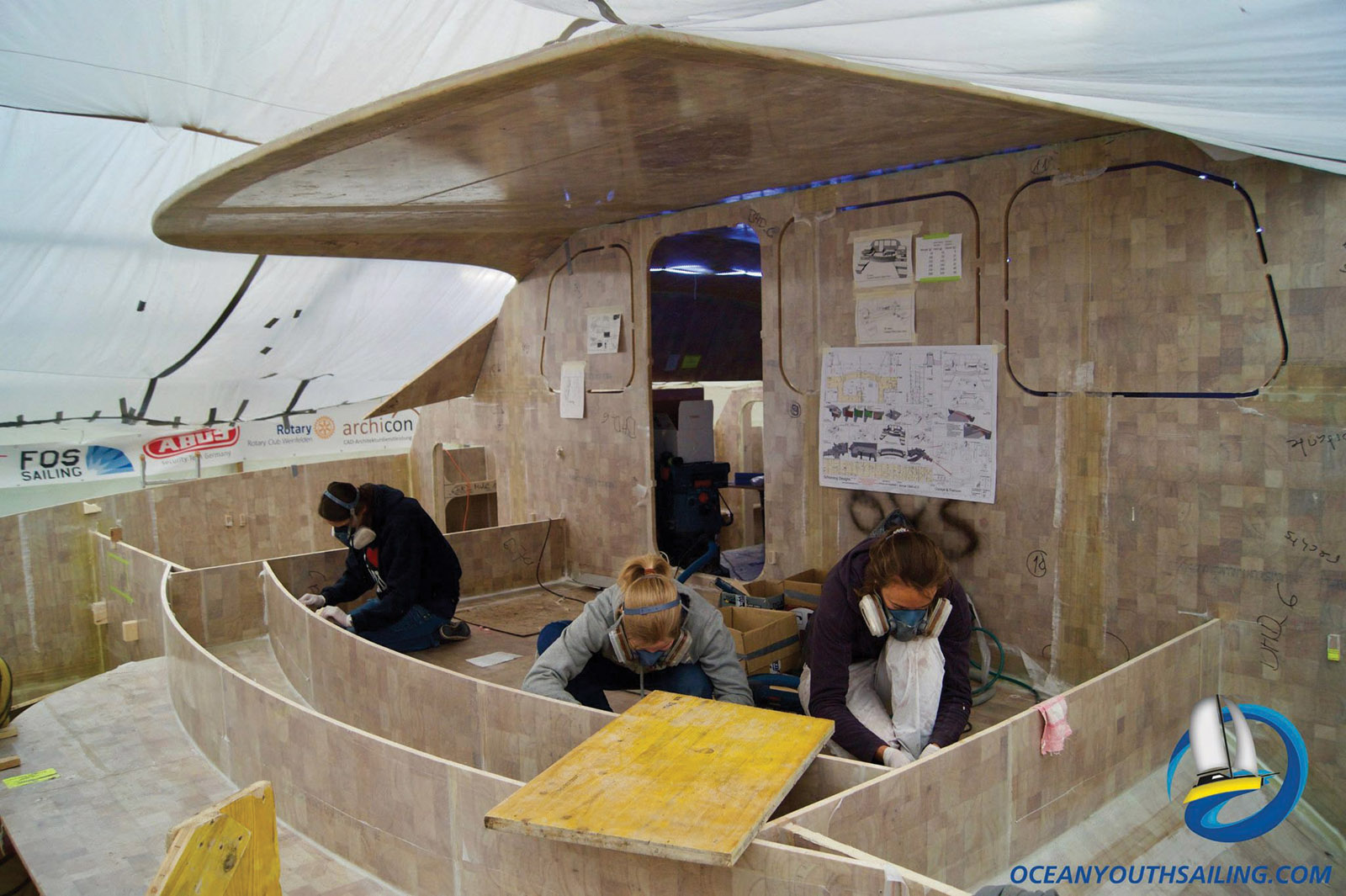
This amateur construction demanded over 20,000 hours of work – 407 people took part!
The Pluses
+ Flattering design
+ Performance in light airs
+ Convincing electric power
The Minuses
- Disappointing feel to the helm
- Lengthy amateur construction timescale
TECHNICAL SPECIFICATIONS
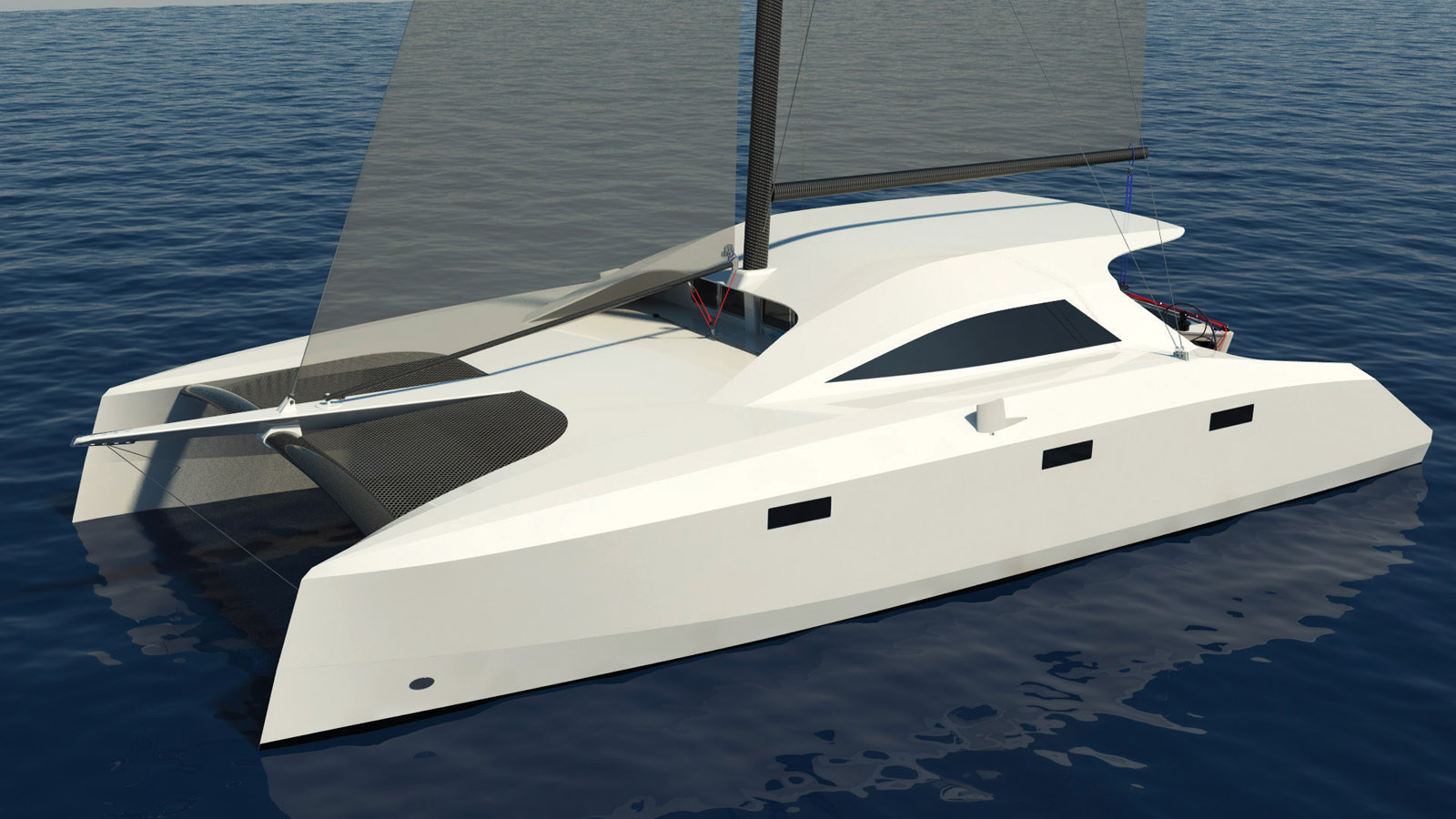
Builder: Ocean Youth Sailing, Swiss Association
Architect: Schionning Designs, Australia
Overall Length: 44’7” (13.60 m)
Beam: 24’3” (7.40 m) Draft: 20” (0.50 m) daggerboards raised
Air Draft: 57’5” (17.5 m)
Displacement: 15,450lbs (7 t)
Bridgedeck clearance: 2’8” (0.8 m)
Mainsail: 755 sq ft (70 m²)
Jib: 365 sq ft (34 m²)
Gennaker: 1,560 sq ft (145 m²)
Code zero: 860 sq ft (80 m²)
Several other foresails are planned and are in the process of being tested
Engines: 2 Oceanvolt Twin Shaft Drive AXC 48 Volt electric motors, 10 kW each
Diesel: 105 US gal (400 l)
Fresh water: 105 US gal (400 l)
Cabins: 5 doubles
Headroom: 6’3” to 6’6” (1.90 to 1.97 m)
Budget The initial budget was calculated at 300,000 Swiss Francs, which is around US$ 330,000 or € 280,000. This was put together thanks to donations and sponsors. Because of the additional costs incurred by fitting electric motors, material costs rose, reaching 385,000 Swiss Francs, around US$ 430,000 or € 360,000.