
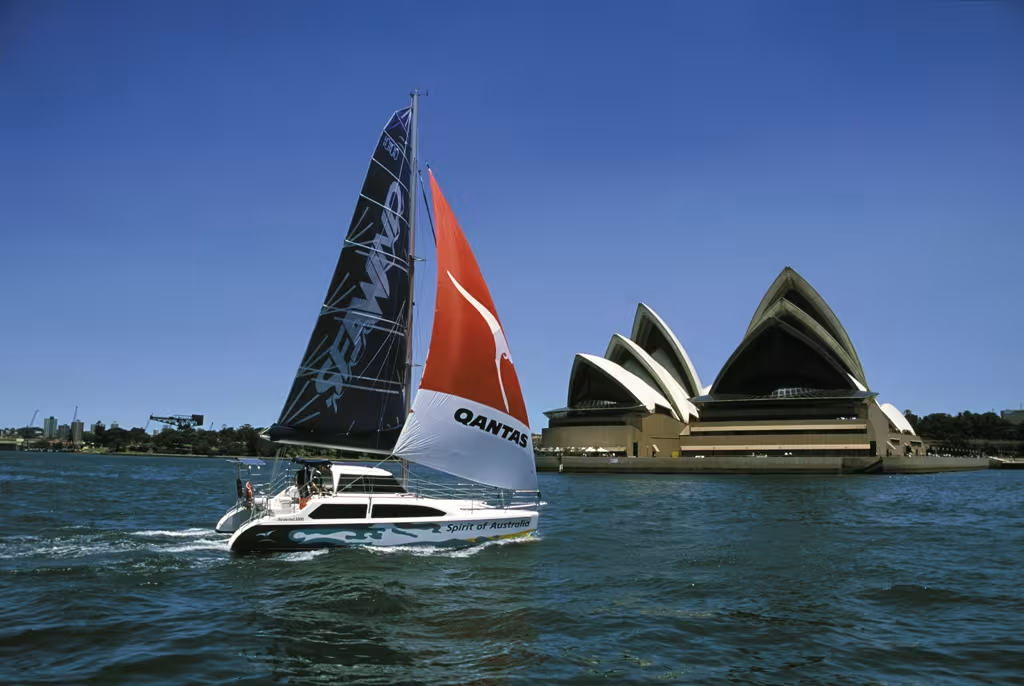
In 2002, the Seawind 1000's builer, Seawind Catamarans of Sydney, Australia, is celebrating launching of the 100th Seawind 1000. A three digit production record is a commendable accomplishment in a world where most builders celebrate production milestones two orders of magnitude lower.
Infos pratiques
- Le chantier : Seawind 1000
- La fiche technique
- Découvrez notre vidéo exclusive
- Financez votre Seawind 1000
- Assuez votre Seawind 1000
- Articles autour du Seawind 1000
Several factors contribute to the Seawind 1000's success. This catamaran is the right size to live aboard for a few weeks, or longer, yet remains small enough for easy operation and maintenance. The formula for a successful 33 foot cruising catamaran depends significantly on an enlightened tradeoff between what is needed, what is desired and what is left off. The Seawind 1000's blend of simplicity and sophistication is what a modest cruising catamaran requires to amply serve the minimum needs of its passengers and what it should have to make sailors want to buy, use and keep a catamaran.
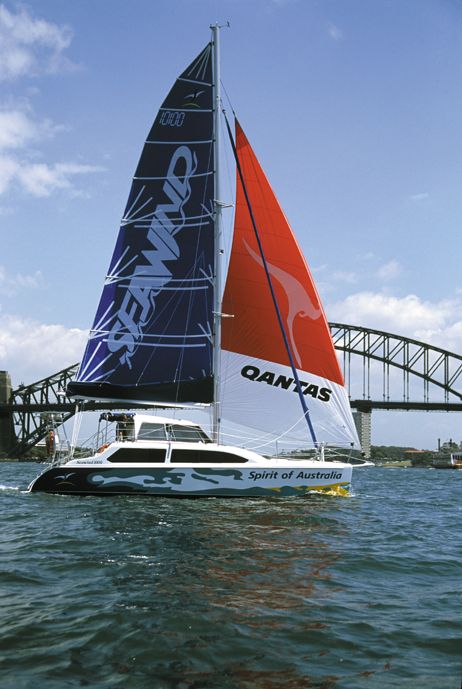
Looking at this catamaran, you can hardly believe she’s “only” 10 meters long!
General Description
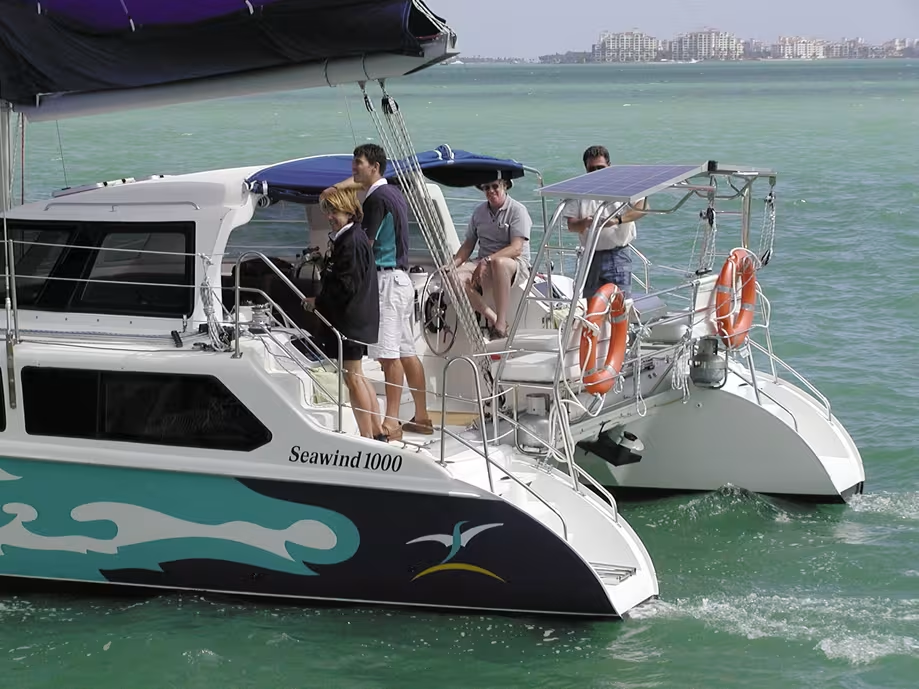
The Seawind 1000's 33 ft length and 19 ½ foot beam put it toward the beamier side, but still well within the of the general envelope of catamaran proportions. A couple of feet of extra beam give it the stability to handle a very full main sail. The hulls have a keel about 1/3 amid ship and spade rudders. The Seawind 1000 has plumb bows with the front cross beam just behind them. The forward deck area includes a mesh trampoline divided by hard deck, the ‘cat walk’. The hard deck chaperones the anchor rode and provides storage for the anchor while underway. The hard deck behind the trampoline rises as two steps around the mast, and as a smooth curve over the hulls. Behind the mast, the cockpit salon roof rises to form one more level on the catamaran. Access between the foredeck and the cockpit salon areas is on a deck that forms the roof of the hull compartments. Four steps leads from the reverse transom to the cockpit deck, then continue up three more steps to the side decks leading forward. Designers might have built only half as many steps, but additional shallow steps makes moving around the Seawind 1000 easy. In these areas, hard deck is covered extensively with molded antiskid. Stanchions run the full length of the Seawind 1000. Bow rails and stern rails include pulpit seating. The cockpits and salon areas on the Seawind are continuous with no bulkhead or permanent partition separating them. The area created by this continuous expanse makes the catamaran seem much larger than expected on a 33 foot catamaran. The cockpit area includes a helm on both starboard and port sides, and a Targa seat behind the cockpit transom. Each helm seat doubles as a mounting well for an outboard engine accessible by lifting the seat cover. A canvas Bimini top covers the cockpit area. The Targa seating may be covered by solar panels, or by canvas.
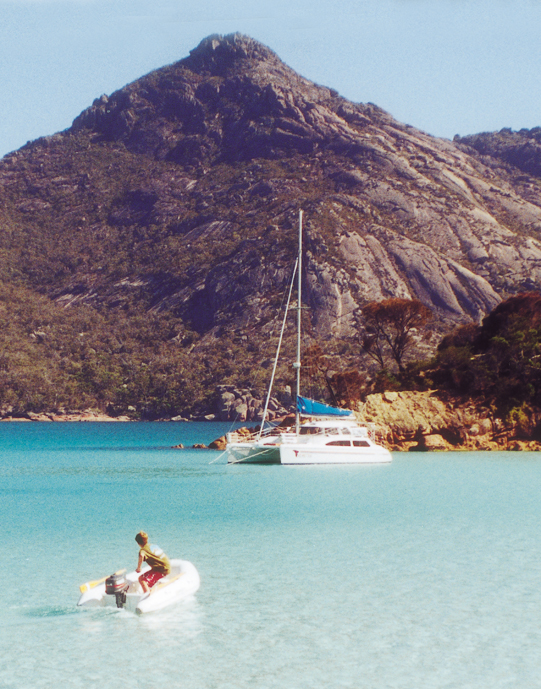
A catamaran as much at ease for a day outing as for extended cruising!
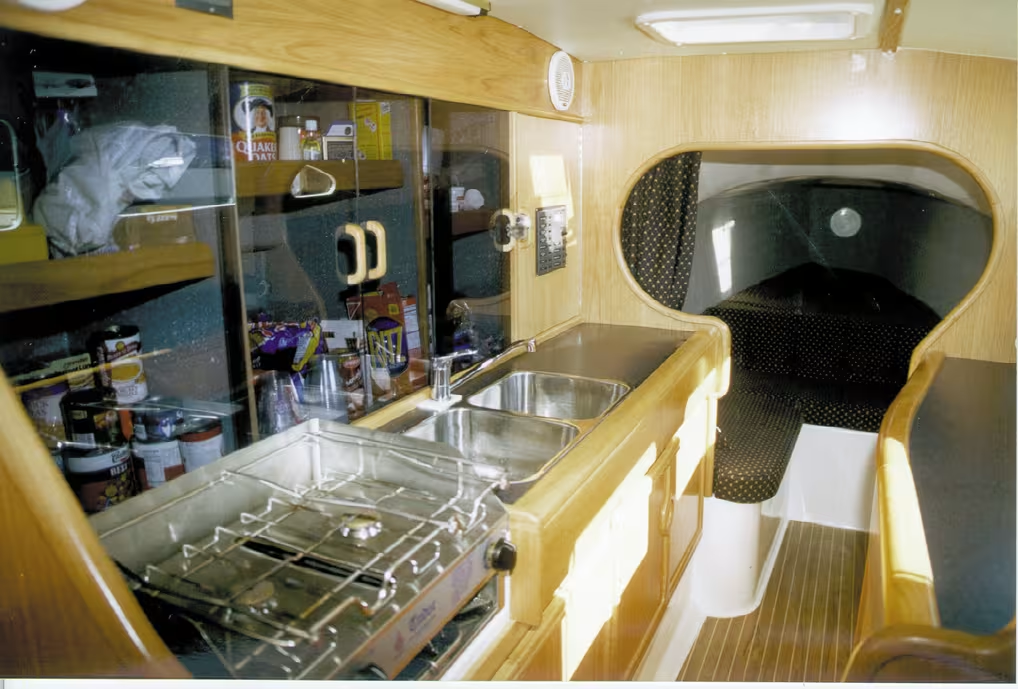
Just forward of each helm station is a companionway to each hull. A large table and U shaped sofa dominate the salon area. In the Special Edition Seawind 1000 touring the US, the table is of a custom laminate of red gum burl and faux leather upholstery is on the sofa . The salon area has a hard roof over it and tinted windows with opening hatches. The continuous flow between the cockpit and salon areas is the most distinctive characters of the SeaWind 1000. During inclement weather, a clear, soft vinyl partition rolls down from the back edge of the hard roof over the salon protect the salon area. The impression on entering hull cabins of the Sea Wind 1000 gives that of being on a different boat. While the upper deck is patio chic, the interiors are extensively finished in American Red Oak. The master’s quarters in the starboard hull include an oak study desk and cabinets that many might like to take home. On the special model sailed for this review, the port hull included 1 master’s stateroom with the head aft in the hull. The starboard has a queen berth both fore and aft with the galley in the middle of the hull. The interior finish includes teak and cherry plank flooring, fashion lighting accents and a color contrasting head liner. It is a notably complimentary and pleasing change of character below deck. The galley in this ‘modest’ catamaran is immediately impressive. Cabinets in the Galley are of American red oak frames with sliding plexiglass fronts. The galley is as functional as it is attractive. It has a 2 burner LPG stainless steel stove with oven. The galley includes a refrigerator and attached separate freezer. The two bowl stainless sink has pressurized fresh water delivery. The galley has a generous area of Laminex® (similar to Formica®) covered counter tops. Australians nurture the image of sailing with extended family or multiple friends. Clearly accommodations on the Seawind 1000 easily make this image a convenient and pleasant reality.
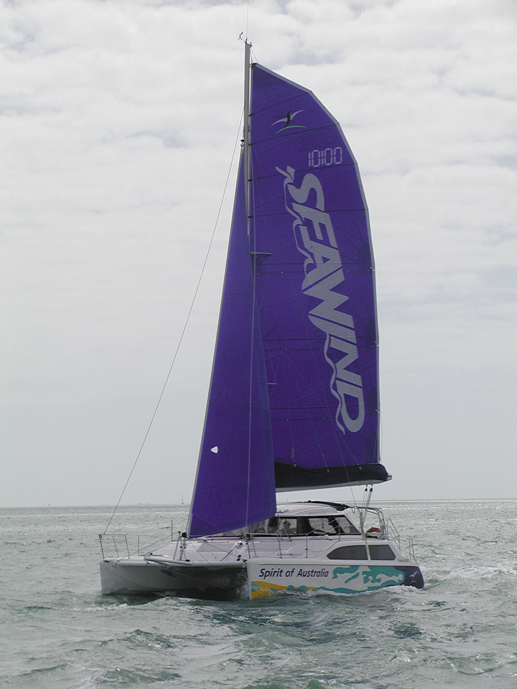
The boat we tested was a “Special Edition Seawind 1000”
Sails and Rigging
Tempo Spars makes the aluminum mast and boom for the Seawind 1000. The mast has double spreaders that include a jumper stay and supports a 7/8 fractional rig. The mast is non-rotating, but hinged to allow lowering on boat. This feature allows the mast to be lowered to pass under low bridges. The mast tilts forward when the shrouds are released. The mainsheet and topping lift control the mast tilt and the inner stays control side to side movement. Lowering the mast is not a routine operation, but much more convenient and safer with this system. The sail plan includes an asymmetrical spinnaker that tacks to a fixed aluminum bowsprit extending forward from the front cross beam. Halsey Lidgard recently became the sailmaker for the Seawind 1000. Prior to this change, Sobstad provided sails. This catamaran has three sails standard. The main sail stows in a ‘stack pack’ that includes a lazy jack system. The main sail has two reef points. A furling jib is on a Profurl furler. The jib is self tacking, running on a straight, deck mounted traveler placed just ahead of the mast on hard deck. A furler mounted asymmetrical spinnaker completes the standard sail plan. All sail controls associated with the mast lead from its base around the side of the cockpit root and then aft along the hull deck to a pair of Harken ST40 winches mounted adjacent to each helm. Reefing lines follow similarly to Spinlock rope clutches. The main sheet traveler is mounted on the low transom behind the cockpit. The lines run in a ‘slot’ behind the Bimini over the cockpit and in front of the Targa bench mounted off the stern of the cockpit, a very efficient use of space with a minimum of structure. The main sheet can be led to a Harken ST65 winch. The traveler has a 2 x purchase with a continuous line system.
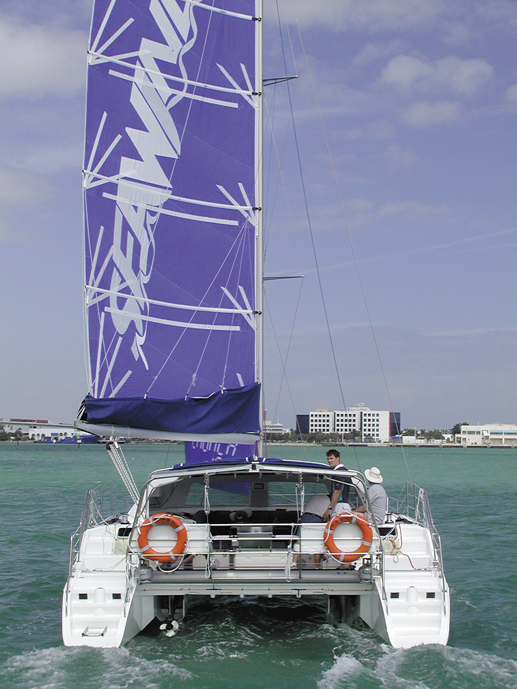
Here, you can clearly see the “cockpit-salon” area with no partitions
Engines and Electrical System.
The catamaran reviewed had two Yamaha10 hp 4 stroke engines. Each is mounted under the helm seating. The engines are raised and lowered with a line accessible under the helm seating. This system makes raising and lowering the engine’s lower units extremely simple. The engines have electric start, so under normal operating conditions, only raising and lowering the engines takes any direct effort or attention from the helmsman. Enclosing the engines reduces noise while underway and protects the engines from spray and other environmental conditions. Use of a single line to raise and lower the motor is a convenience only those who’ve had to grab an engine hanging off a transom can completely appreciate. Clever, Seawind, very clever! The standard electrical system consists of two Besco 487 heavy duty batteries. These batteries start the engines and run house lighting and appliances. They may be recharged by the engines or from solar panels (2 x 75 watt) mounted over the Targa seats. (Both the batteries and solar panels may be upgraded substantially if desired.)
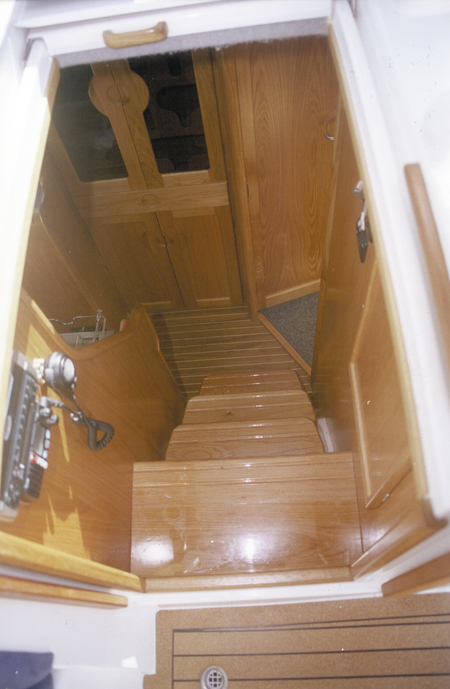
The inside is very different, with chic decoration: here the companionway to a hull
Test Sail
The test sail took place on Biscayne Bay in winds of 12 - 15 kn, with 7 passengers on the Seawind 1000. Both engines started immediately and moved the catamaran, Spirit of Australia, smartly against a moderate current to the sailing area south of downtown Miami. Sails, which on this catamaran, are mounted with a bat car system, went up smoothly and without a problem. The self tacking jib unfurled easily and smoothly as well. We were set up and sailing within just minutes. The area of Biscayne Bay just south of Miami often has short choppy waves due to the influence of shallow water. The Seawind 1000 has 2 ft 8 in clearance off the water. This is good clearance for a catamaran this length and was effective insurance from wave slamming. The helm was balanced and the catamaran was easily steered. With very little additional effort or tweaking, the Seawind maintained a speed of 9 - 11 knots across the wind for the better part of an hour. The Seawind 1000 can be sailed to its fullest capability and racing speed by three or four people handling the sails. With the self-tacking jib, and all other sail controls leading to the cockpit, the Seawind 1000 is an easily singlehanded cruising boat. The Seawind 1000 is a cruising catamaran; it functions equally well as habitat. It’s one most notable feature is a catamaran built around the continuous salon and cockpit. This is a particularly effective design under sail. This catamaran will carry even a dozen people comfortably without cramming them together to enjoy the experience on the water. The entire deck from the transom to the salon table is level and open. It is easy to move around the whole area, even carrying food or beverages, or to handle the sailing controls.
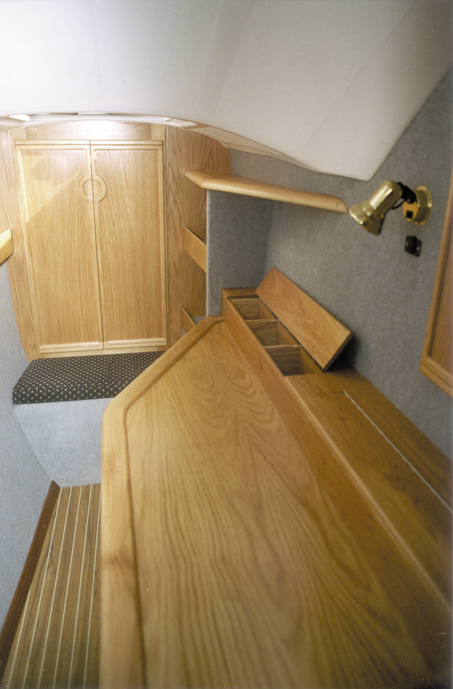
The owner’s cabin
Additional Remarks
The Seawind 1000 debuted in 1993 as a successor to two other Seawind cruising catamarans, the Seawind 23 and the 850. The Seawind 23 in particular was a successful coastal cruising catamaran, well known in the US and Australia. Ancestors of the Seawind 1000, especially the Seawind 23, distinguished themselves as simple designs with all the essentials included to give the full measure of comfortable coastal cruising on a reliable and speedy catamaran. The Seawind 1000 is truly a third generation carrying this perennial tradition. The Seawind 1000 comes in two models. The ‘1000' reviewed here is a full fledged cruiser. The more recent ‘1050' is the same hull and sail plan outfitted as a day sailor or for less extensive cruising. The builder offers a notable range of options, including upgrades on engines, the electrical power system, interior furnishing and appliance upgrades. With appropriate outfitting the Seawind 1000 may span the space from a comfortable, low maintenance day sailor / overnighter to a blue water cruiser completely capable of safely and comfortably traveling regional seas.
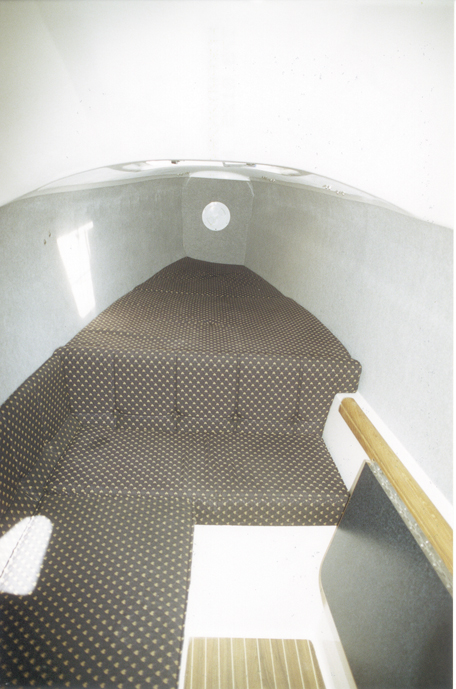
The fore cabin is simple but sufficient
Concluding Remarks
The recent increase in the number of 40 foot plus blue water cruisers available on the market, makes a 33 foot catamaran seem modest in comparison. When the 33 foot Seawind 1000 debuted in 1993, it was well within the main size class of then dominant 36 - 37 foot cruising catamarans. Its big boat feel is no doubt due to an intelligent choice of layout to make the most of space, and rational selection of furnishings and equipment to make the catamaran work well without cluttering or simply filling it up. At the same time, this catamaran has a split personality that pleases on both accounts. The cockpit-salon combination is informal and open. The hulls are cozy, sophisticated and include all the conveniences to make cruising relaxing and peaceful regardless of the weather. In a catamaran this size, success depends not only on what the boat has on it, but also what is left off. The Seawind 1000 is clearly a model that has stood the test of time as a winner.
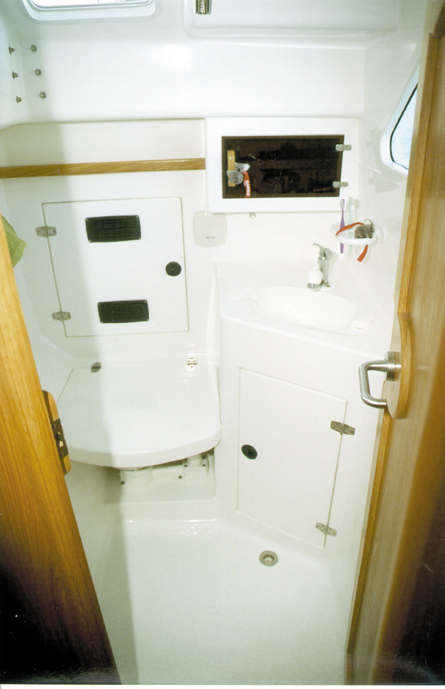
The head: simple and efficient, too
For more information, please see www.seawindcats.com.. This site has a notably well organized organized list of technical specs on all Seawind’s models, including the Seawind 1000. The picture gallery is also a must see if you are interested in this boat.
GENERAL CHARACTERISTICS
Builder: Seawind Catamarans, Sydney, Australia Construction: Hand laid-up GRP using multi layers of quadraxil glass roving, isophthalic and orthophthalic polyester resin.) Hull length: 10 m, 33 ft Underwing clearance: 0.8 m, 2 ft 8 in Overall beam: 5.90 m, 19.5 ft Draft: 0.85 m, 2.9 ft Light displacement: 4 tonnes kg, 8,800 lbs Berths: 4 doubles plus a double in the main salon Water tank: 400 L, 105 gal Fuel capacity: 120 L, 31.5 gal Motors: 2 x 9 hp four stroke Yamaha standard, 25 hp optional Batteries: 240 amp Sails: Full batten mainsail:45 sq m, 484 sq ft Jib on furler: 16.5 m sq, 178 sq ft. (a Genoa is optional) Asymmetrical Spinnaker on furler: 60 sq m, 654 sq ft. Options: Safety certification: Built to Australian Safety Standards
Notable Features
Cockpit and salon continuous and on one level throughout Fine woodworking in hulls Completely outfitted for Cruising Berths in fore cabins: 2 Berths in aft cabins: 2 Seating at the table: 8 adults or more Headroom 6 ft 4 in in hulls and under hardtop in salon Toilets/Shower: 1 in port hull Price: $ 162,000