
A great example of a long-standing model from the southern hemisphere. In build now for 12 years, there is not a wrinkle to be seen! (Re)discover this particularly attractive blue water cruiser.
Infos pratiques
- Le chantier : Seawind 1160
- La fiche technique
- Découvrez notre vidéo exclusive
- Financez votre Seawind 1160
- Assuez votre Seawind 1160
- Articles autour du Seawind 1160
When you discover the Seawind 1160, you’re sure to say that this model doesn’t resemble the other catamarans in its class… and you would be right! With hulls topped with imposing side windows, the compact nacelle and fine hulls, it has a distinctive look. Little known in Europe, it is understandably more popular in its country of origin, Australia, but also in the United States where it is seen great commercial success. Today, the yard is based in Asia and continues to develop. Next year they plan to present their 1600 at the European boat shows, explains Shane Grover, who also manages Corsair Marine. To date, more than 120 examples of the 1160 have been built…and it is still in production! During its long career, this catamaran has had a few evolutions (principally the use of high-tech materials), and note that a “Lite” version has been available since 2014. This is a more stripped-out version with two 20 to 25hp outboard motors instead of the twin diesels and only one helm station. Immediately this saves 500 kg. At the same time, the Deluxe version maintains all the attributes of the original 1160, with in-board motors and multiple options offered as standard, extra bunks available, and it also comes in and owner’s version.
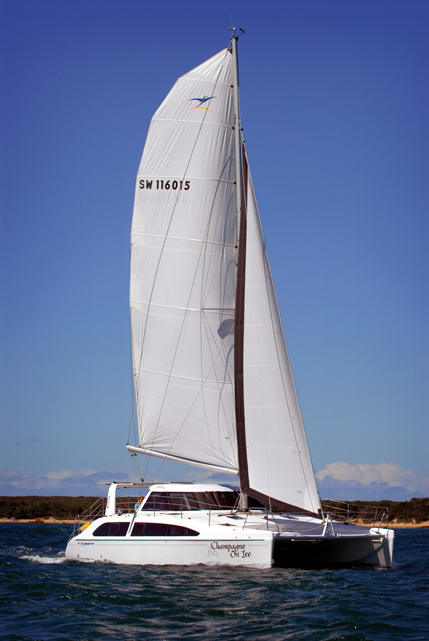
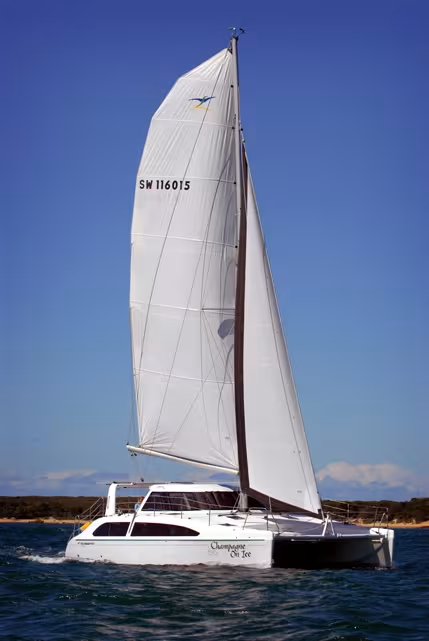
A cat with original lines, but that’s no bad thing. The Seawind 1160 goes well and will take you far…
An original deck layout
The main thing which stands out on the 1160 when you survey the deck, is the noticeable difference in level between the cockpit, perfectly sheltered by the bimini which extends aft, and the side-decks, high up on the hulls. Thanks to wide steps and very gentle slopes, you can move about easily. And the well-placed handrails as well as the useful steps serve for climbing up on the coachroof. A section of the bimini is removable so that the helmsman can, when the weather is good, have a good view of the sails. But the helm stations are too low to allow for a good view of the sea, so you are obliged to look through the salon to really see what’s going on ahead. The 1160 also has a few welcome, clever little tricks: the windlass is controlled from the cockpit; there is a bracket for the boat hook in the bimini; and especially the famous detachable door. Comprised of three modules, this disappears in under a minute into the bimini, freeing up an exceptional amount of space. Does this remind you of anything? Yes, some good ideas have been around for a long time. The new “Open” design boats are only a redevelopment of a concept which has worked well for years! Another plus about the 1160: its aft bench seat, another one forward of the mast and two comfortable trampolines. For relaxing, this catamaran is just as good as the most modern boats available! As for deck fittings, the crew is well catered for. First off, all the lines are led back to the cockpit. Next, the traveler is adjusted with a lug which determines which side you want the car to go and a dedicated winch; a self-tacking solent makes upwind work easier; folding mast steps make it easier if you need to do anything up the rig; and large rope bags keep the cockpit clear. No, nothing is missing!
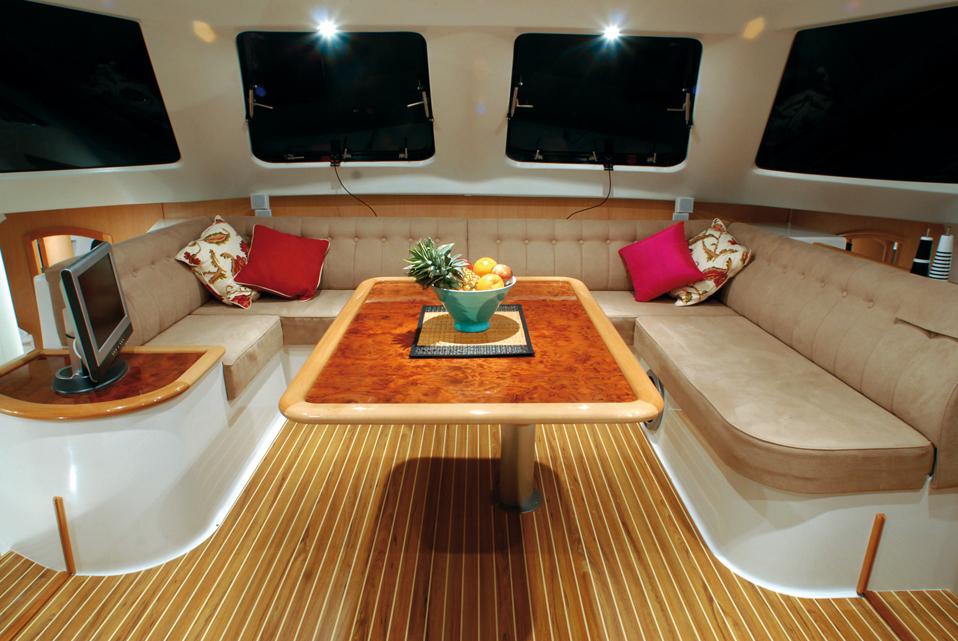
The salon is comfortable, and lacking a galley, it gives an impressive amount of space for a cat of this size.
Lively under sail
Undoubtedly, the hulls being narrow at the waterline is what ensures good performance…you will become aware of this the first time you helm an 1160. Even in light airs, the boat goes really well, and there’s no point in using the motors. With a sail area to weight ratio of 11.29m²/t and sleek rigging, this catamaran shows itself to be a relatively fast boat - in the category of a fast cruiser. Another thing about the 1160, it tacks very easily and picks up again quickly. In fact, 8 knot averages are easily achieved on long tradewind passages. As well as being able to arrive at your destination a day or two ahead of a heavier catamaran, you will really enjoy the sailing. There is a real feel to the cable-linked helms. But also it’s great to have a boat beneath your feet which you can rely on in bad weather, capable of withstanding a big sea and strong winds. The bridgedeck clearance is 74cm, enough to avoid hard slamming when going upwind in a chop. On this point of sail, the short skegs - 1.10m - seem to be sufficiently well designed to inhibit any crab-wise movement. So much the better.
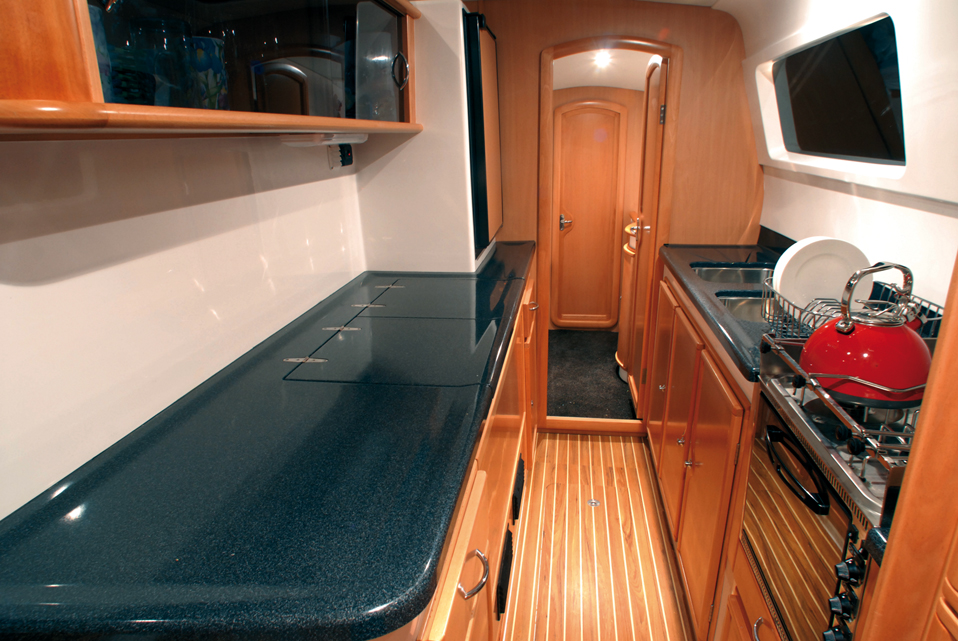
The galley is situated in the starboard hull: the cook will enjoy lots of storage and plenty of light.
Space at a premium in the hulls
If the high coachroof, which is a well-lit and ventilated, wins you over, you may find the volume somewhat reduced compared to current boats… This is due to the narrow hulls, previously mentioned, but also because these hulls are derived directly from those of the Seawind 1000. Sure, they have significantly higher freeboard and are wider in the upper sections, but you get the feeling they are a bit narrow. The yard opted for a galley “down” in the starboard hull - Europeans are not so keen on this idea, considering it less friendly. Note that there is no lack of stowage, the worktop is vast and that the light coming from the huge side window is really good. So, the salon is home to a very comfortable area - it converts into a giant bunk. As for the chart table, well… there isn’t one. Sailors from the English-speaking world have gotten into the age of electronic navigation faster than European types. Coming back to the hulls, to starboard there is the galley and a double bunk aft. The XXL-sized bathroom is right in the bow. To port, two nice cabins and a second bathroom, this time midships.
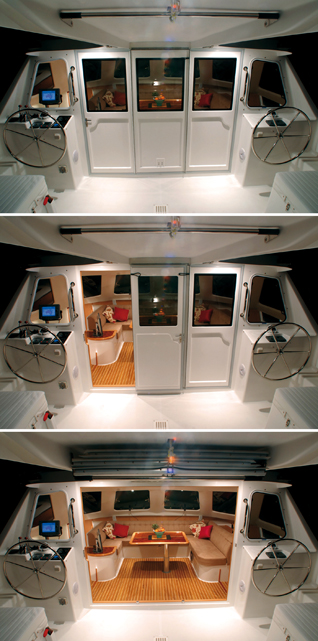
And one, two, three doors which disappear in the blink of an eye, revealing an enormous living space!
Points to check
Particularly well-built, the 1160s have no structural problems. Badly handled in difficult seas and often used by charterers, this model withstands such treatment really well for a production boat. The use of vinylester resin protects the laminate from risk of osmosis. So a survey of an 1160 should concentrate on the peripherals - motors, rigging, sails, plumbing, electrics and electronics.
What we liked:
- Build quality
- Clever little things which making cruising life easier
- Very good performance on all points of sail
What we didn’t like:
- Poor visibility from the helm
- Winches not ideally placed for hauling in Galley down, in the starboard hull
Seawind 1160 Specifications
- Builder: Seawind
- Production: 120 examples since 2004
- Construction: vinylester/foam sandwich
- Hull length: 11.6 m Waterline length: 11.3 m
- Beam: 6.5 m Draft: 1.1 m
- Light displacement: 7 t
- Mainsail area: 57.00 m²
- Genoa area: 22.00 m²
- Motors: 2 x 29 hp diesel or 2 x 20 to 25 hp outboards
- Fuel: 360 liters
- Fresh water: 700 liters
- Secondhand price: starting from €160,000 ex-tax
