Heartily approved of in Australia, best-seller in the USA, Seawind has now arrived in Europe, with a seaworthy and above all clever catamaran: the Seawind 1160.
Infos pratiques
- Le chantier : Seawind 950
- La fiche technique
- Découvrez notre vidéo exclusive
- Financez votre Seawind 1160
- Assuez votre Seawind 1160
- Articles autour du Seawind 1160
An innovative concept
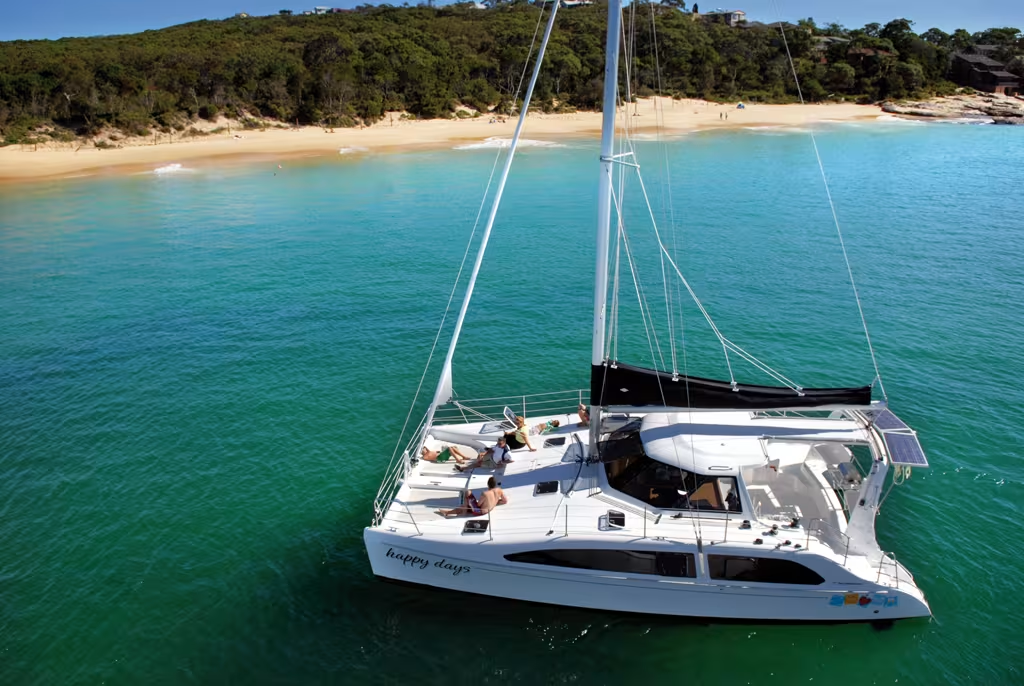
Each time it is presented at a boat show, or arrives in an anchorage, the Seawind 1160 attracts the attention of cruising boat enthusiasts, without fail. Why? Quite simply because it does not look like any other catamaran. Built in Australia by the company of the same name, the Seawind 1160 is the worthy descendant of the 24 and especially the famous 1000, which gave the builder its reputation and made it the undisputed leader of Australian construction. Created in 1982, by Richard Ward, the builder is today offering a coherent range, from the 10m to the 12.5m, via the 1160 we are interested in here. These are really liveable catamarans; comfortable, but also capable of taking their owners to the other side of the world.
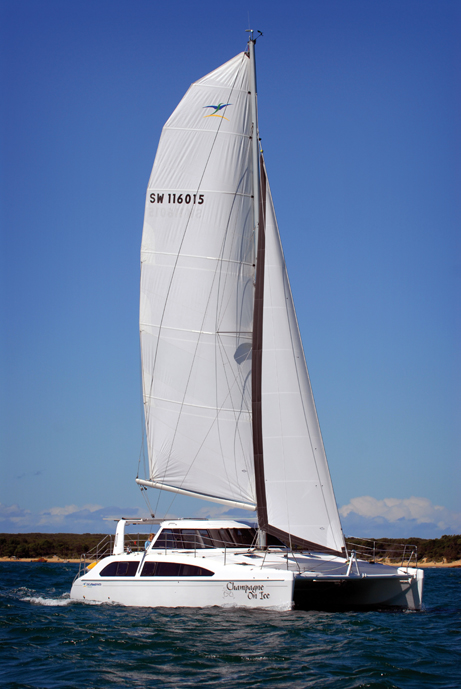
Original lines, here is the cat from the other side of the world: the Seawind 1160…
Construction
The Seawind 1160 is classically built on female moulds for the hulls and decks, with exterior finishing in gelcoat and non-slip integrated in the decks. The hulls are laminated with vinylester (epoxy) resin between the gelcoat and the foam core. For the other elements, the company has opted for polyester resin. Everything is built to Australian, as well as American and, of course, European standards. A strong construction which will last over time, but one which doesn’t prevent rather flattering and tasteful finishing inside.
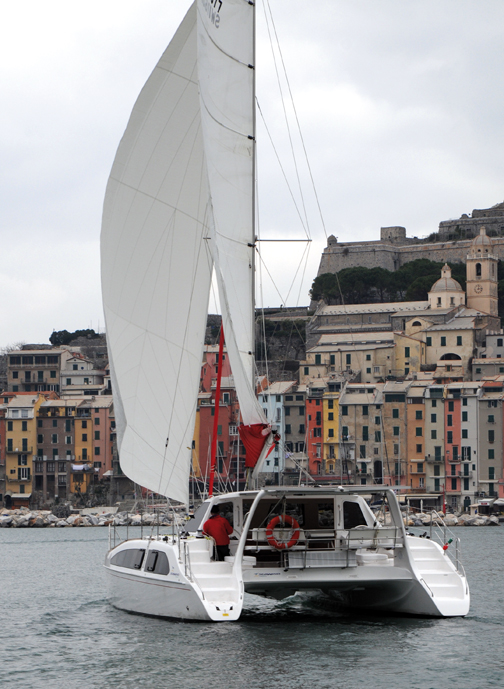
During our test, the weather was not very good... Here we were obliged to tack off Portovenere…
An ingenious catamaran
Although the Seawind’s ‘look’ is unique, its interior is much more conventional. The hulls are not very wide, as they have been developed from those of the 1000, by enlarging them just enough above the waterline to obtain volume, without touching the hull itself too much. Result: the forward sections are slim and allow the catamaran to move in the slightest breeze, as we saw during our test. The cockpit is particularly attractive, and what hits you as you climb aboard is the perfect harmony and intelligence of the design. Everything is in its place, the angles have been perfectly rounded off, and the steps are very nice. You have the feeling that the 1160 was designed by a team which has sailed a lot... The well-protected cockpit is reassuring. Under the gantry, there is an ingenious aft settee which surrounds the superb barbecue. This is the favourite area, both at sea –as it faces forward - and at anchor. Four adults fit comfortably on these settees, which are really very comfortable. On either side of the cockpit, there are two deep and really practical lockers, where fins, the bucket or the charcoal for the barbecue can be stored. These two lockers are topped by a cushion, attached with press studs: simple, easy and practical! Against the coachroof bulkhead there are two steering wheels, which, on a catamaran a little over 11 metres long, is already quite a feat. All the control lines return to the cockpit, to starboard or port, to one of the two winches available on either side, except for the sheets, which can be handled independently on one side or the other. The engine controls, as well as the button controlling the windlass directly from the steering position, can be found to port. Here again, this is a real ‘plus’ in terms of safety, especially for a family crew. The only criticism, but an important one, is that the position of the winches is not ideal. On the other hand, the Harken fittings on our boat deserve only praise. The jammers are well positioned, the winches are of a good size, the (numerous) returns are coherent, and friction is limited. Hoisting the mainsail is a mere formality, as is taking a reef, and all the foresail manoeuvres.
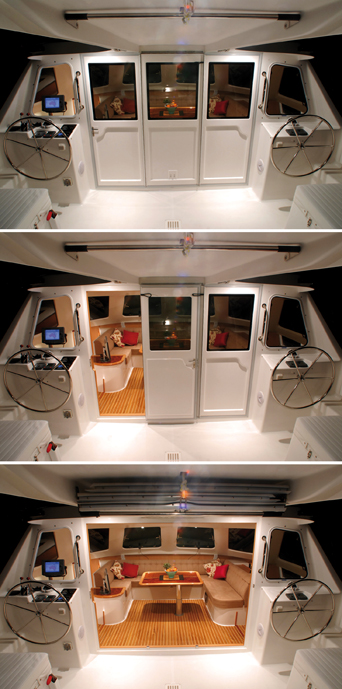
One, two, three doors, which disappear in the twinkling of an eye.
But the ‘must’ is incontestably the main traveller, fitted to the gantry, which also carries the solar panels and the davits. To adjust the main traveller, all you have to do is position the tab to port or starboard, then give a few turns with the winch handle. With no effort, the traveller can be positioned to the nearest millimetre. All this, combined with the self-tacking jib, makes the Seawind 1160 a very easy-to-handle catamaran, even singlehanded, which will be appreciated by families cruising for a few days or a few months... The bimini is also ingenious: its central part is rigid, allowing easy access to the boom and the main traveller, but on either side the cockpit is protected by canvas extensions. These can be rolled and unrolled very easily, and allow you to enjoy the sunshine or the shade, depending on the weather. But the real stroke of genius on this boat is the door which separates the cockpit from the saloon. Made up of three separate elements, it can be more or less open, according to everyone’s wishes. But if you want to enjoy the cockpit-saloon area to the full, the door can be lifted, and disappears into the bimini. A very simple system, consisting of a line which returns to the port winch, a hook, which is attached to the bottom of the door, and in a few turns on the winch handle, the door disappears. It takes less than a minute to go from the closed door configuration to no door at all, and vice versa. During our test, the temperature was just 8°C, yet we opened everything, to take advantage of the huge space thus offered: we felt as if we were on a much, much bigger boat...
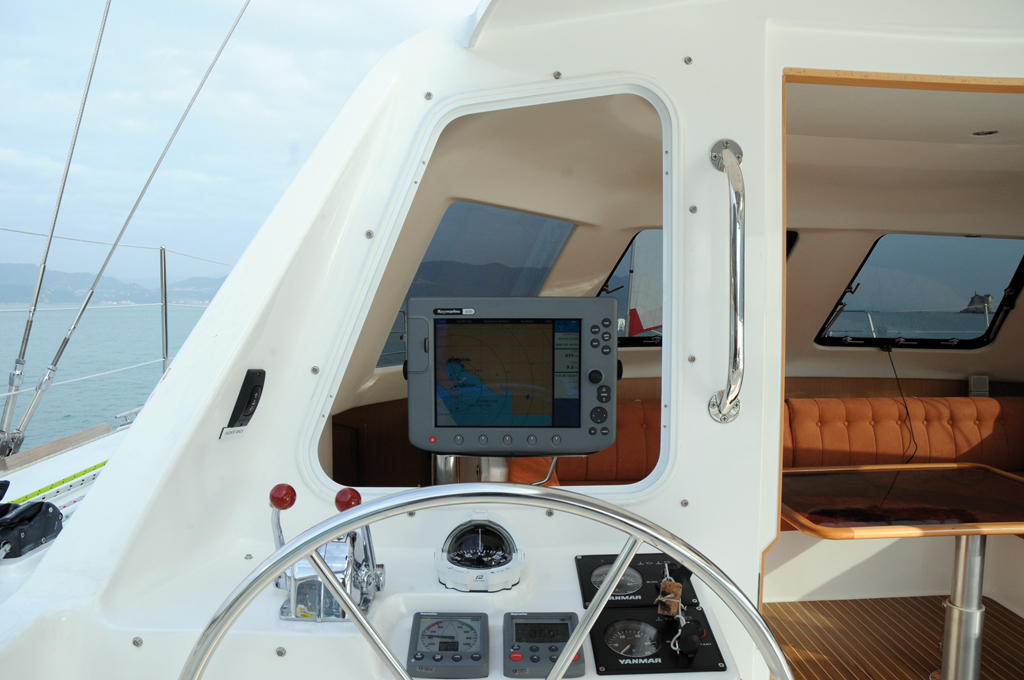
You are at the helm of the Seawind 1160... You can’t see anything? No, neither could we!
A bright and cosy interior
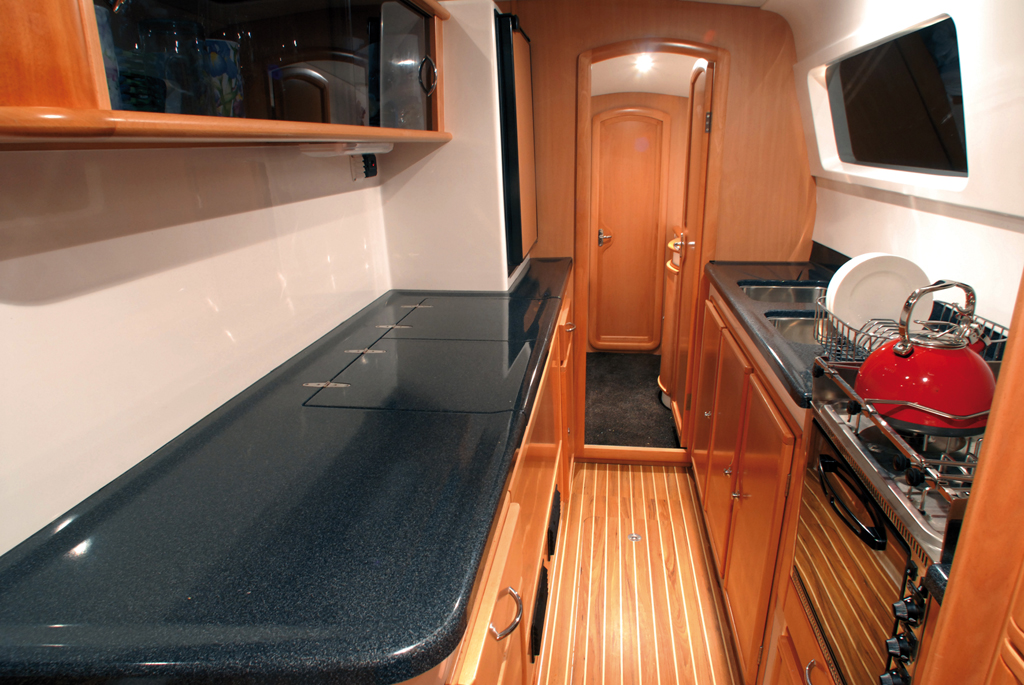
The builder has chosen to offer a galley in the gangway (to starboard). As a result, the saloon is made up exclusively of a superb settee and a table, which together can be turned into a huge bed... This area is very pleasant; the woodwork and the ‘soft furnishings’ are of really high quality. Grumpy people like me will however find that the boat lacks a chart table, to have fun with compass and parallel rulers, but, as the great god computer invaded our cruising catamarans a long time ago, it appears that it is no longer necessary... On the other hand, everyone will appreciate the two (very) big opening portholes; aided by struts, they can be opened and closed with one hand, and offer good lighting and ventilation. We get the feeling that this catamaran was designed by people who are used to cruising in the Tropics... In the starboard hull, the galley is nice; a real work surface, nice stowage and incredible lighting, thanks to a portlight along the whole of its length. Result: you can cook with an uninterrupted view of the sea. The two cabins in this hull, one aft, the other forward of the galley, are of a good size for a catamaran just 11.6m long. Finally, in the forepeak, there is a ‘bathroom’ in which even the biggest people will be comfortable. To port, the aft cabin is identical to the one in the starboard hull, but the forward cabin is really very big, with a high bed athwartships. Finally, a nice ‘bathroom’ between these two cabins completes the accommodation. What hits you in this boat, is of course the quality of the fitting-out, the finishing details (such as the magnets which hold the doors closed), as well as the size of the areas: sub-12m catamarans offering as much are rare.
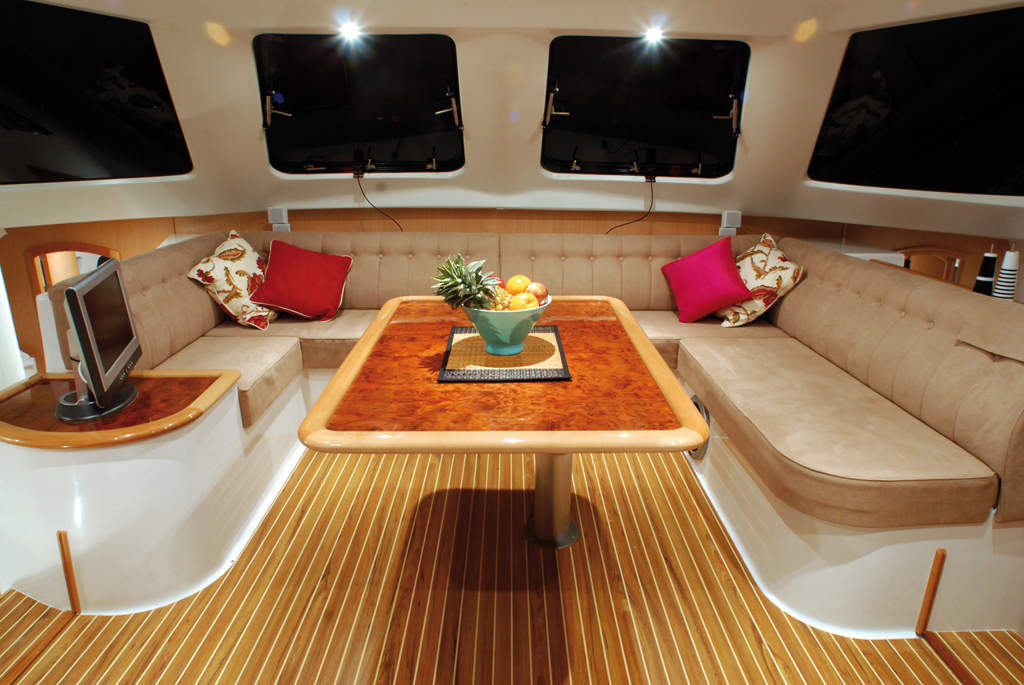
The saloon is a success, with top quality woodwork and ‘soft furnishings’.
At sea
We had an appointment in La Spezia, in Italy, at the end of last January, to test the boat which had caught our eye at the Miami Boat Show, as well as at the last Genoa show, but which we had still not had the opportunity to test. There are often some very nice sailing days in the Mediterranean in winter, with superb sunshine and a very pleasant little breeze. Unfortunately, we had a cold day (8°C at the warmest part of the day), a low, overcast sky and almost zero wind! In the gusts, the anemometer (which didn’t work) would have had difficulty indicating 5 knots. And we had to sail between two islands to try and take advantage of a strange venturi effect. Result: we had to manoeuvre a lot to stay in the narrow channel, which was not easy on a 7-tonne boat with so little wind. But I must say, I was blown away. The Seawind showed itself to be very reactive, linking the tacks with disconcerting ease (thanks to the self-tacker), and accelerating each time amazingly willingly. With the gennaker on its furler, we finally succeeded in reaching 6 knots on one downwind leg, which is quite respectable, considering the wind conditions. Throughout this incessant manoeuvring, we really appreciated the very nice deep rope bins, as well as the feel of the helm (control line system). After a few hours, the wind dropped completely. No problem, a Multihulls World tester is always on the go, and as a good professional, I tested the comfort of the trampoline and the seating area forward of the coachroof. Here again, this will be one of the favourite places on a summer cruise.
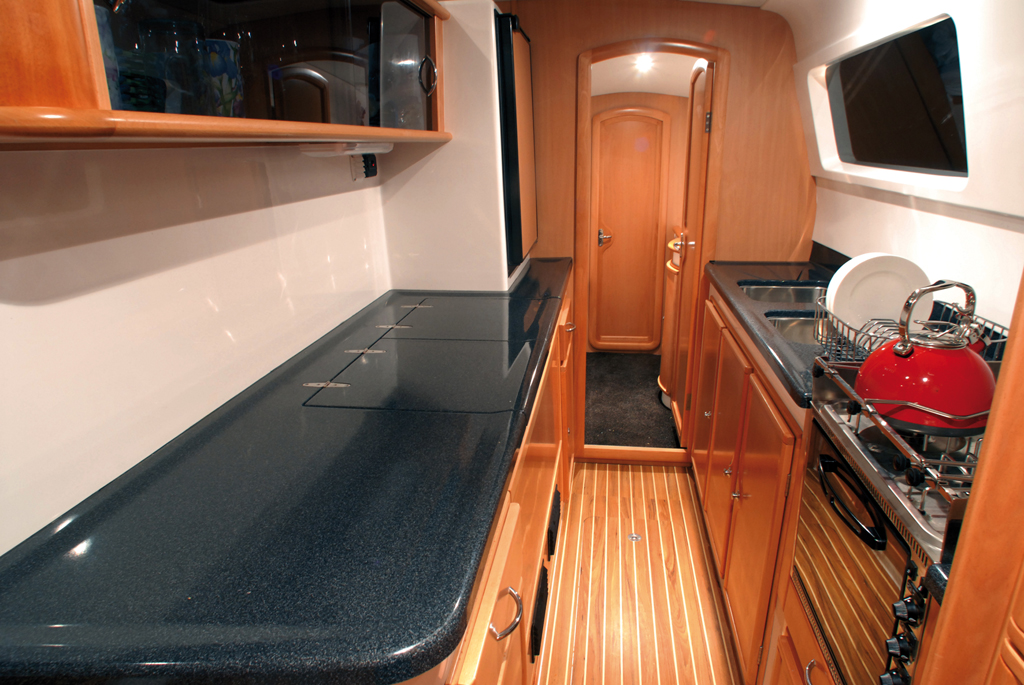
The galley is in the starboard hull: lots of stowage space and excellent lighting will make this a favourite with the cook…
Conclusion
If we found the Seawind 1160 attractive, it was because of the quality of its accommodation and above all, the many clever features which will simplify the crew’s life when cruising. From the folding mast steps via the space under the bimini dedicated to the boathook, to the windlass control at the steering position, or the cockpit door which disappears as if by magic into the bimini, this catamaran is really easy to live with. All that remains is to test it in stronger wind conditions, to validate once and for all the innovative design of this boat from the other side of the world...
The speeds
During our test, and taking into account the wind conditions, we above all validated the performance under power. Note therefore that with both engines at 3,000 rpm, we reached 7.5 knots on a completely flat sea. Under sail, we reached 6 knots downwind, with a very light breeze (the anemometer didn’t work), but it won’t exceed a maximum of 7 – 8 knots. Other people have been lucky enough to sail the Seawind with more wind; they reached 7.4 knots with 16 knots of wind, and notably 5.5 knots with 7 – 8 knots, and no gennaker...
Sport: 2.5/5 Comfort: 3/5
THE PLUSSES
- The saloon – cockpit area: a ‘must’. - The removable door: a brilliant and practical idea. - The aft settee: comfortable and pleasant both at anchor and at sea.
THE MINUSES
- The position at the winch: after a day’s sailing, I still hadn’t found the right position so as not to hurt my back when winching. Unpleasant, especially as there are no electric winches! - The galley in the hull; not very convivial when sailing with the family.
TECHNICAL SPECIFICATION
Length: 11.6 m Waterline length: 11.3 m Beam: 6.5 m Draft: 1.1 m Displacement: 7 tonnes Bridgedeck height: 0.73 m Sail areas: Mainsail: 57 m² Self-tacking jib: 22 m² Screecher on furler: 62 m Engines: Diesel 2 x 29 hp Yanmar + Sail Drives Diesel: 360 litres Fresh water: 700 litres Black water tank: 240 litres Price: 330,867 euros exc. VAT, delivered in Europe.
THE COMPETITORS
MODEL Lagoon 380 Aventura 36 Spirited 380 Mahé 36 Builder: Lagoon Indigo Yachts Spirited Design Fountaine-Pajot Length (m): 11.55 10.60 11.70 11 Sail area (m2): 79 65 96 77 Displacement (t):7,260 3 5,2 5 Price exc. VAT (€): 180,000 150,919 268,000 152,000
Caption
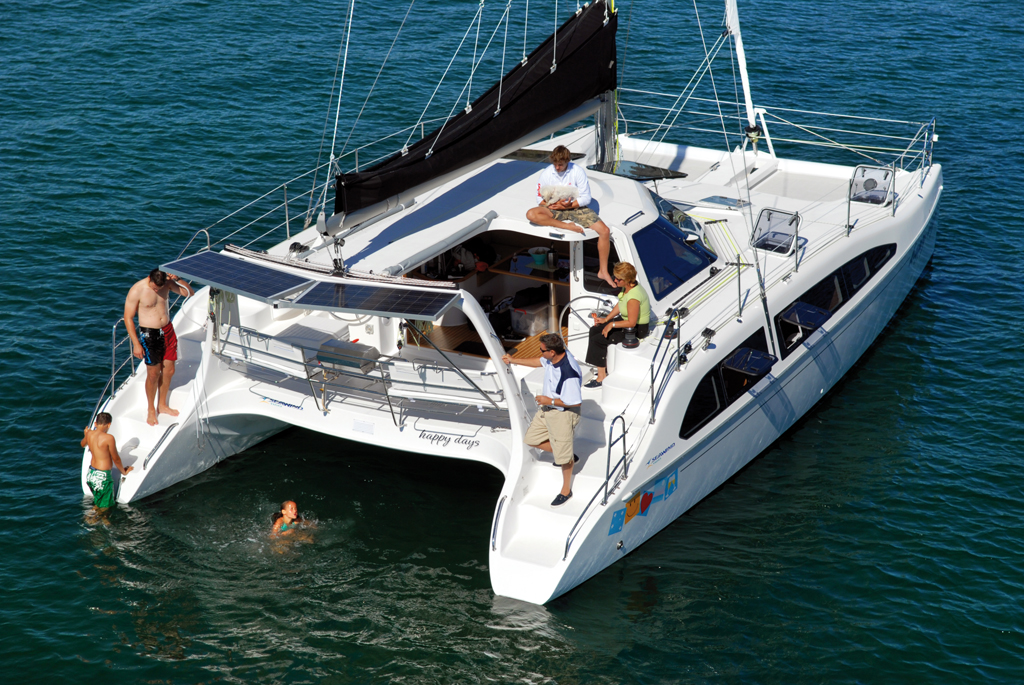
PHOTO 1: The self-tacker greatly simplifies manoeuvres. Aboard this catamaran, singlehanded sailing will be really easy…
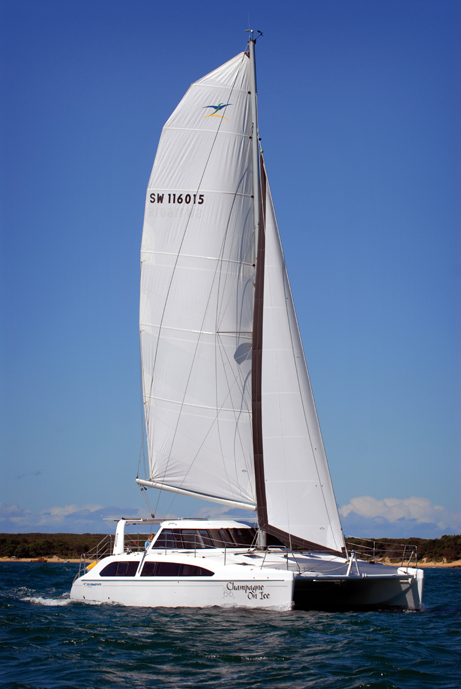
PHOTO 2: Forward, you will enjoy this area to relax or enjoy the view, both at anchor and at sea.
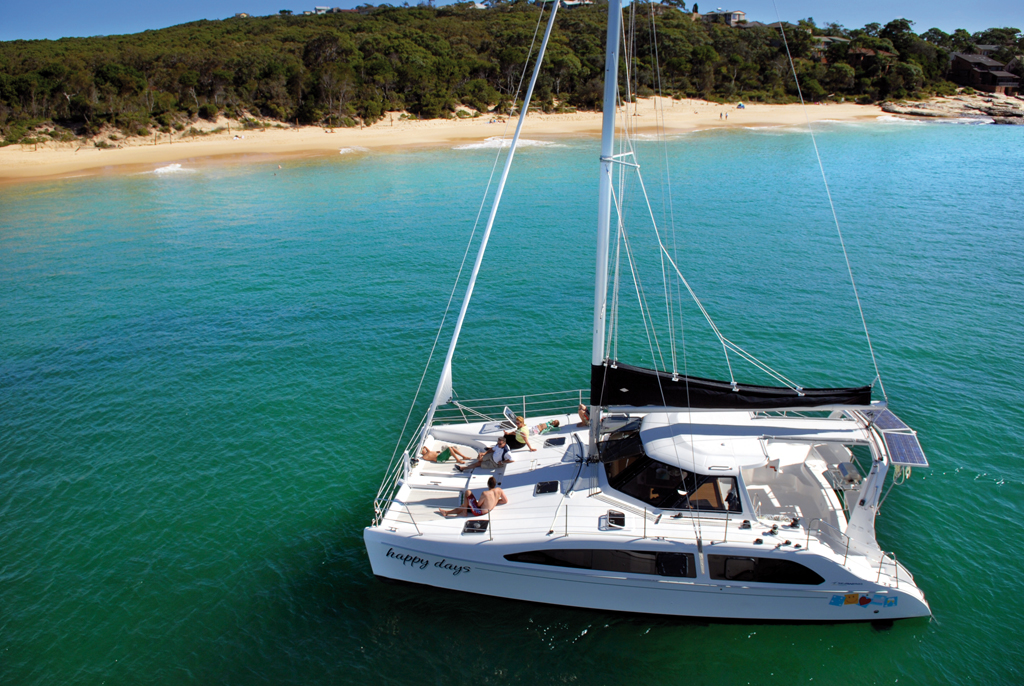
PHOTO 3: Climbing the mast: nothing easier with these folding steps which make climbing accessible to everyone.
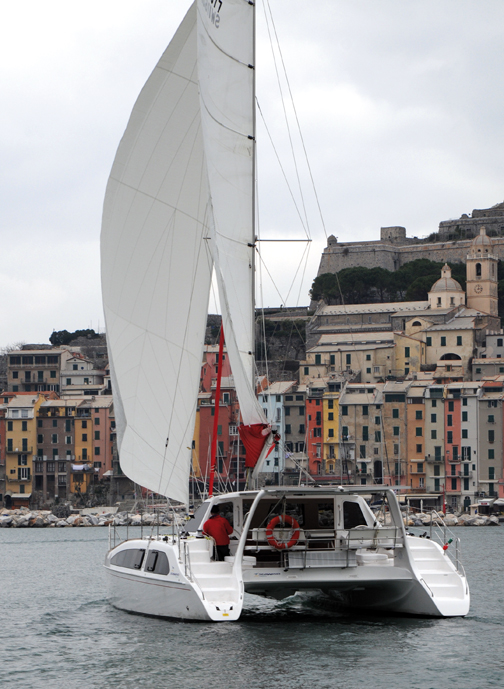
PHOTO 4: Handrails and steps allow worry-free movement.
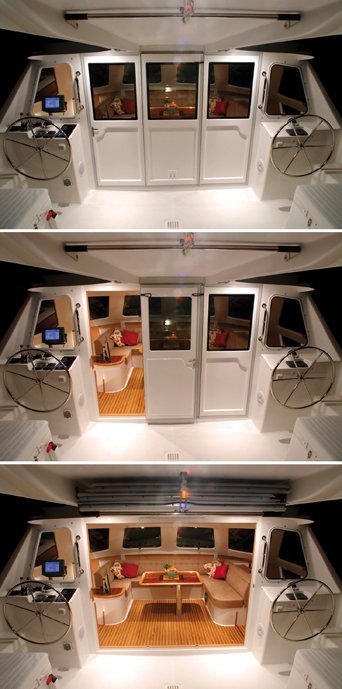
PHOTO 5: A very comprehensive steering position, with nice rope-storage bins for all the control lines which return to the cockpit. Note the windlass control against the bulkhead.
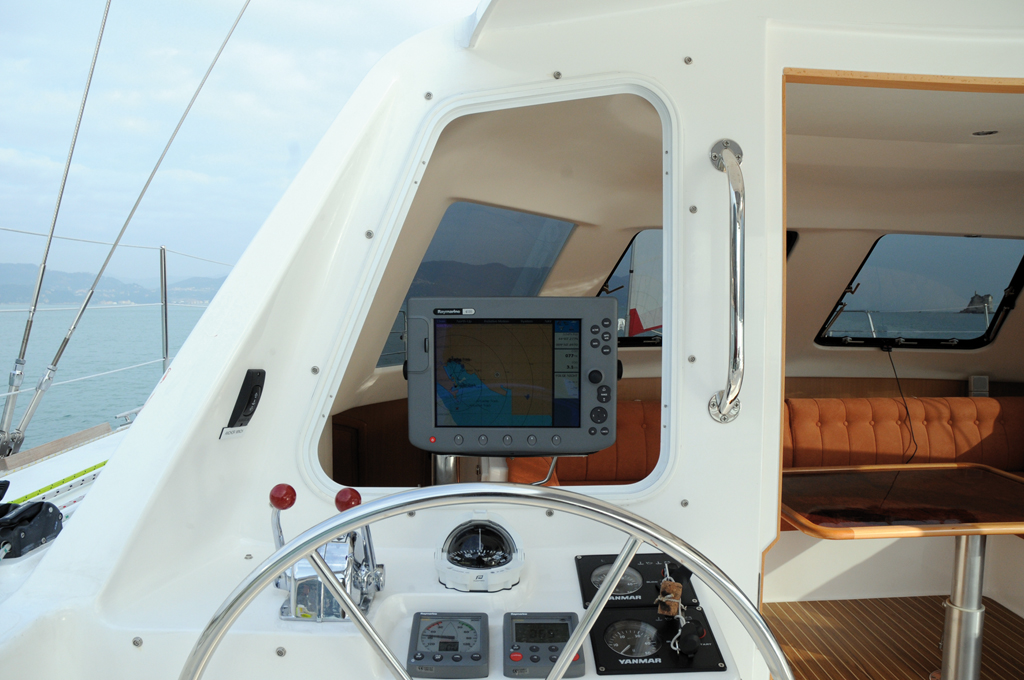
PHOTO 6: The system for adjusting the main traveller is simple: a tab to be moved to the side you want the traveller to go, one or two turns with the winch handle and you can adjust your traveller to the nearest millimetre...
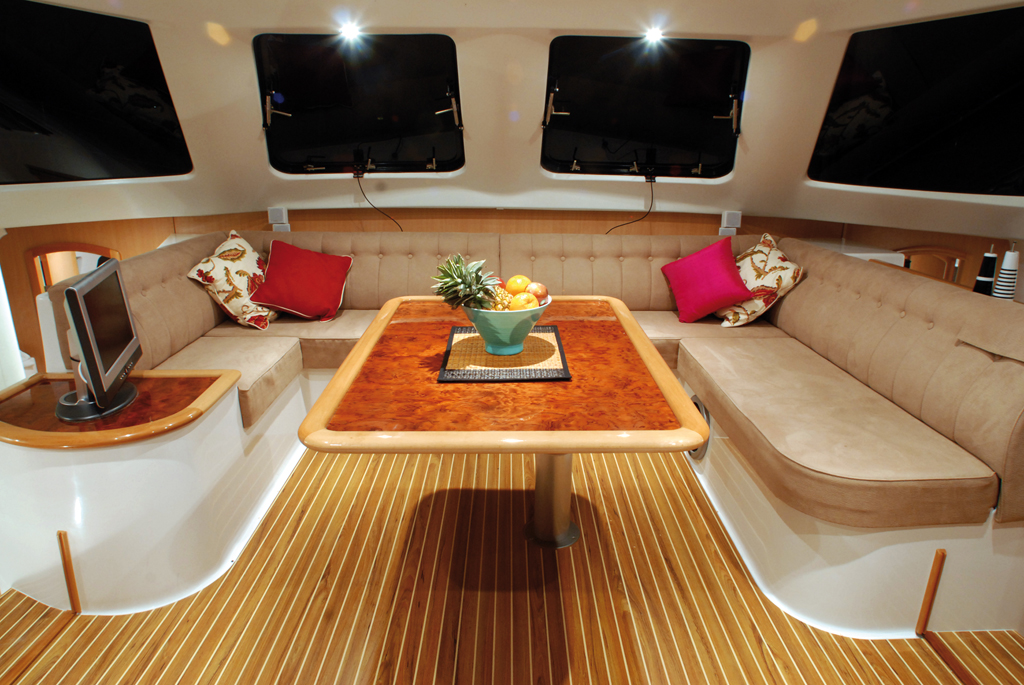
PHOTO 7: The famous aft settee. Even in (very) cold weather, it is very comfortable. And have you noticed the superb barbecue?