
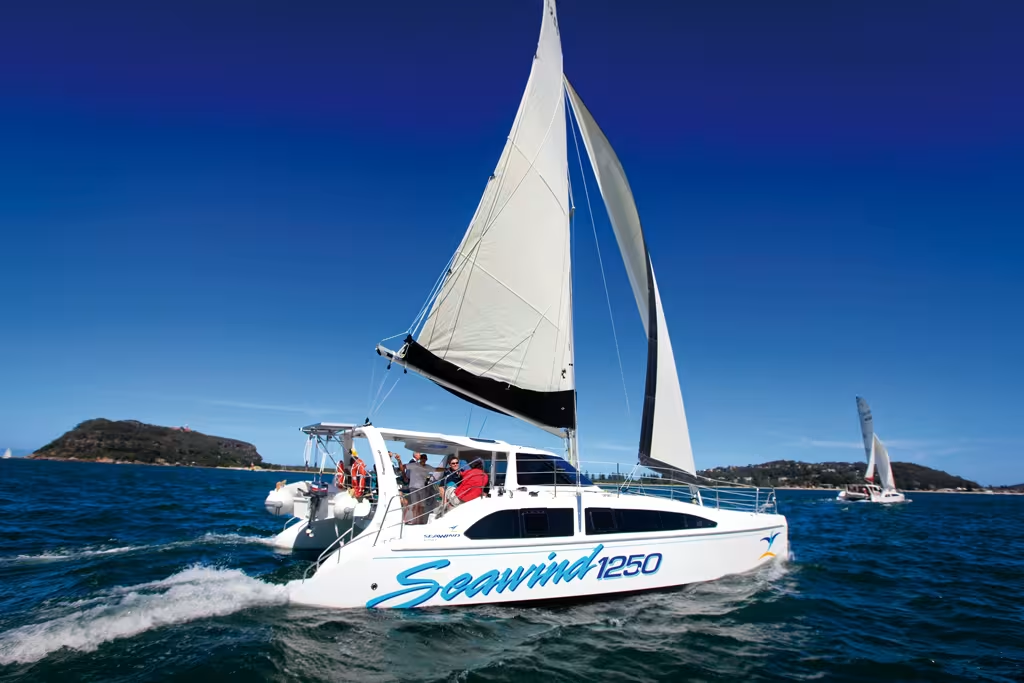
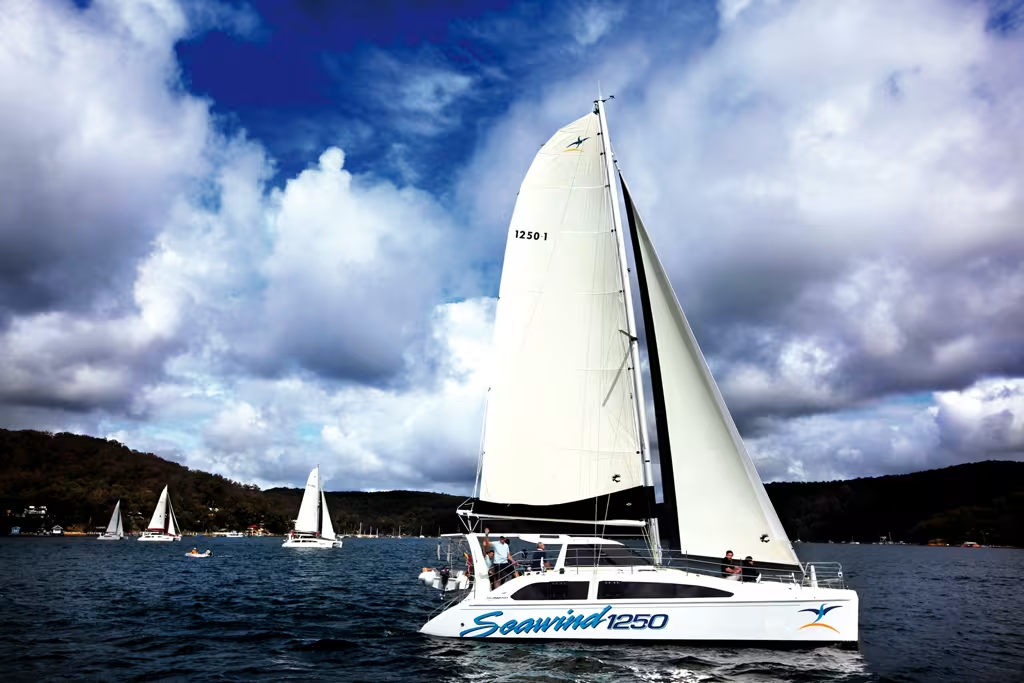
Whether there's a stiff breeze blowing, or the sea is calm, Seawinds are at their best with the "roof off." Sporty by nature without being too aggressive, they are firm favorites with antipodean sailors and, following a restructuring are all set to take on the world. In fact, although still fiercely proud of their Australian roots, the boats are now produced in Vietnam. Despite this, they still retain all of the attributes that have gone towards building their reputation over the last thirty years. So a quick spin around Sydney harbour in the shadow of the fabulous Opera House on board the 1250, the latest model, was a chance not to be missed. Here are our first impressions.
Infos pratiques
- Le chantier : Seawind 1250
- La fiche technique
- Découvrez notre vidéo exclusive
- Financez votre Seawind 1250
- Assuez votre Seawind 1250
- Articles autour du Seawind 1250
In the sailing kingdom that is Australia, the multihull is king. Richard Ward, who created Seawind in 1982, made great efforts to make the boats available to as many people as possible and not just the elite. Over the last thirty years he's seen pretty much everything, even exile! Have no fear, it was a voluntary decision! What happened was that after the 2010 takeover of the trimaran constructor Corsair, which produces its boats in Vietnam, the decision was taken to move the production of the Seawind there too. This was obviously a difficult decision for Richard, but one which made a lot of economic sense in terms of streamlining production with the help of their new Asian cousin. To avoid any damage, the molds were transported by cargo ship. We actually met the happy owner of a boat that had been molded in Australia and fitted out in Ho Chi Minh City! The move took quite a long time, but everything is now in place and production is up and running. The boats can be shipped to you anywhere in the world, or alternatively, you can take possession of your latest purchase in Thailand, and make the most of one of the most beautiful sailing areas in the world without all the usual holdups when mooring!
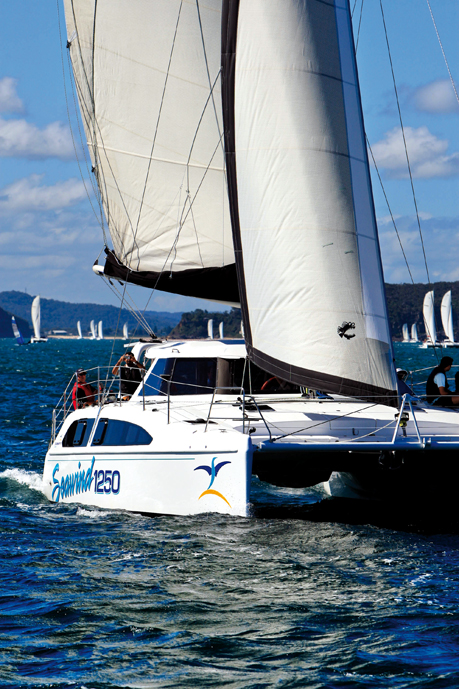
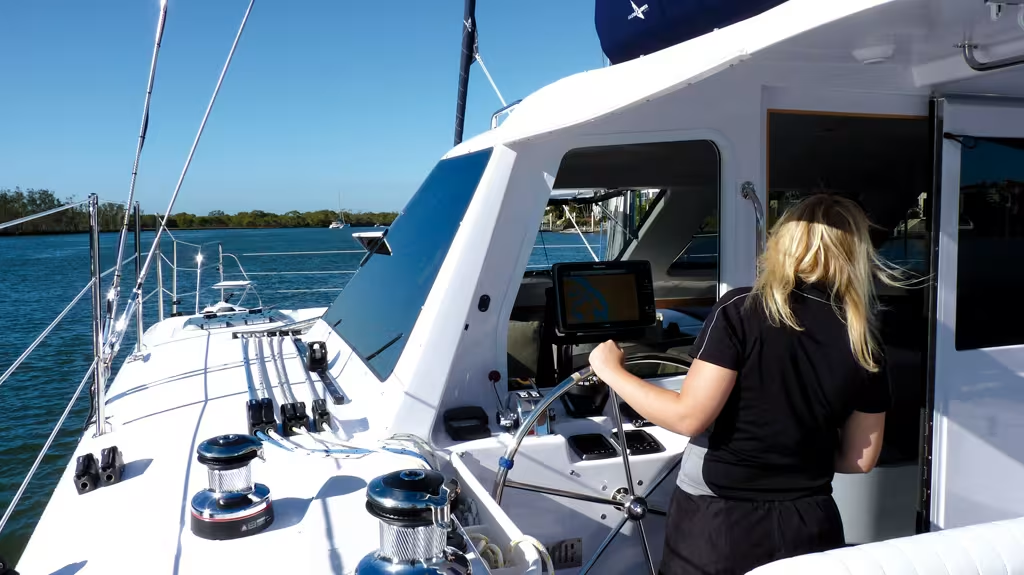
the well-appointed self-tacking jib is extremely easy to use.
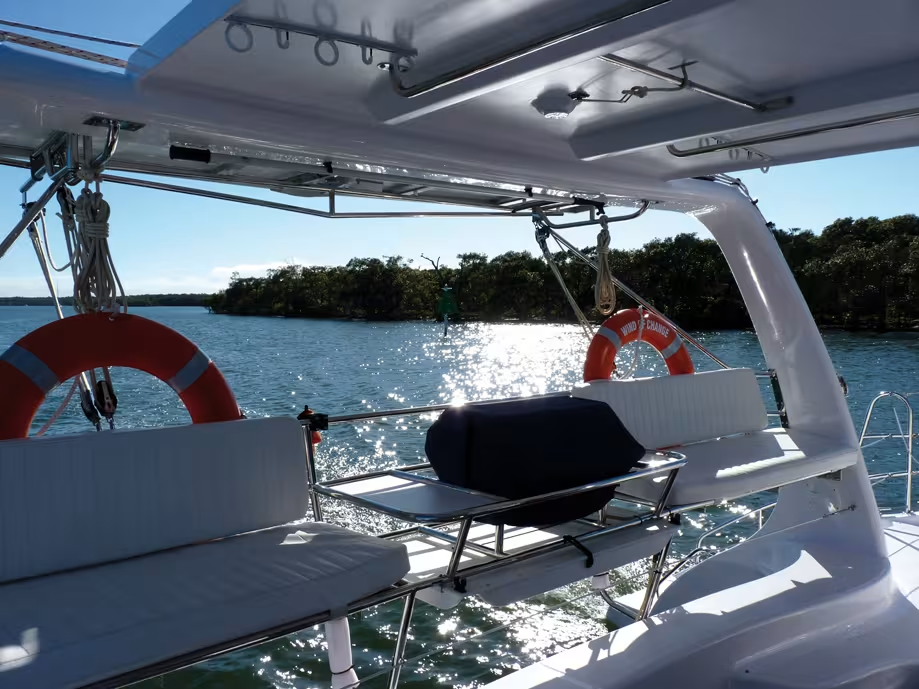
There are three models in the Seawind range: the 1000, 1160 and the 1250, all with certain distinct traits. They are designed and built with the Australian climate in mind: intense heat, bright sunshine and more often than not, light winds. Access on board from the quayside is via wide steps on the transom, which are flanked by very smart and reassuring stainless steel handrails. We don't go straight into the cockpit, but are half-way between there and the bridge, where the aft beam is evidence of the solid construction. Getting around on the bridge is easy, with large open areas and three levels of lifeline cables, always welcome for both old and young! Roof access is via a molded step system in each side of the roof. Coming back down in a rough sea is "interesting", even though the shroud is easy to get hold of. The plexiglass in the roof works perfectly, all of the gelcoat is brilliant and the stainless steel is of a quality that one rarely sees. In short, our initial impressions are that we are dealing with an above average quality of hardware and fittings. The barbecue, which takes pride of place at the back of the cockpit, coupled with the impressive rod rack installed under the roof by the owner, and the self-service tub of sun cream next to the security beacon (there's a message there!) are all tell-tale signs that we are on an Australian boat. One other particularity of the Seawinds which makes them immediately recognisable is the retractable rear face of the roof. The whole thing can open up over the cockpit. Built in three equal parts it is totally modifiable: none, one or two of the lateral parts can be folded back onto the central panel. Once in the middle, the whole lot can be raised under the roof using a practical hoist linked to an electric winch. Combined with the two huge panels on the forward part of the roof (which can be opened), the ventilation as well as the external vision are excellent. It's like having the inside outside...or should that be the other way around! Whichever way you look at it, the barriers are coming down. We love the freedom of movement! How wonderful it is to be out in the fresh air yet constantly protected from the harmful rays of the sun whether by the roof or the rigid bimini which covers the whole of the cockpit. It is a shame however that there is a slight difference between the level of the cockpit and the salon area.
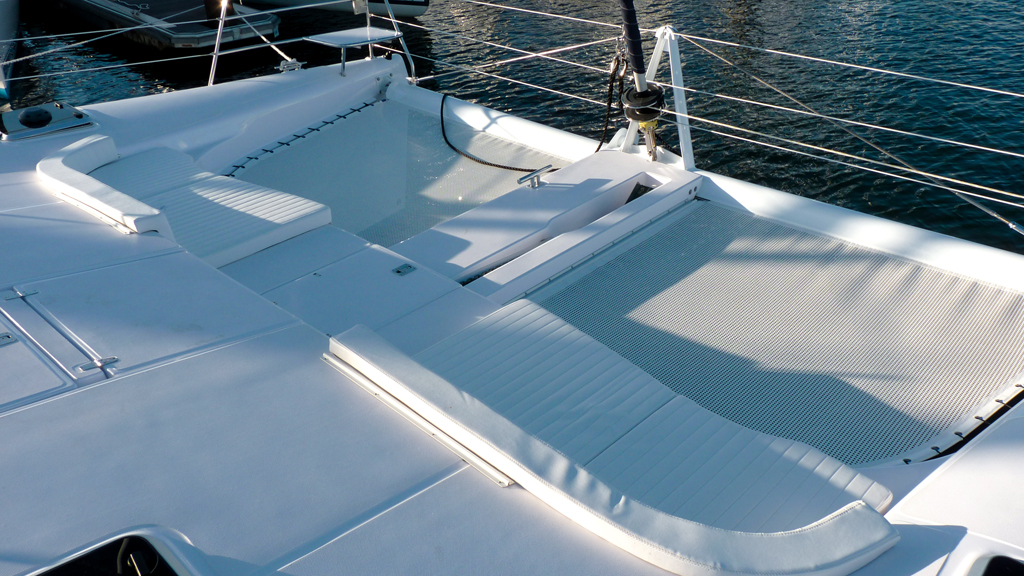
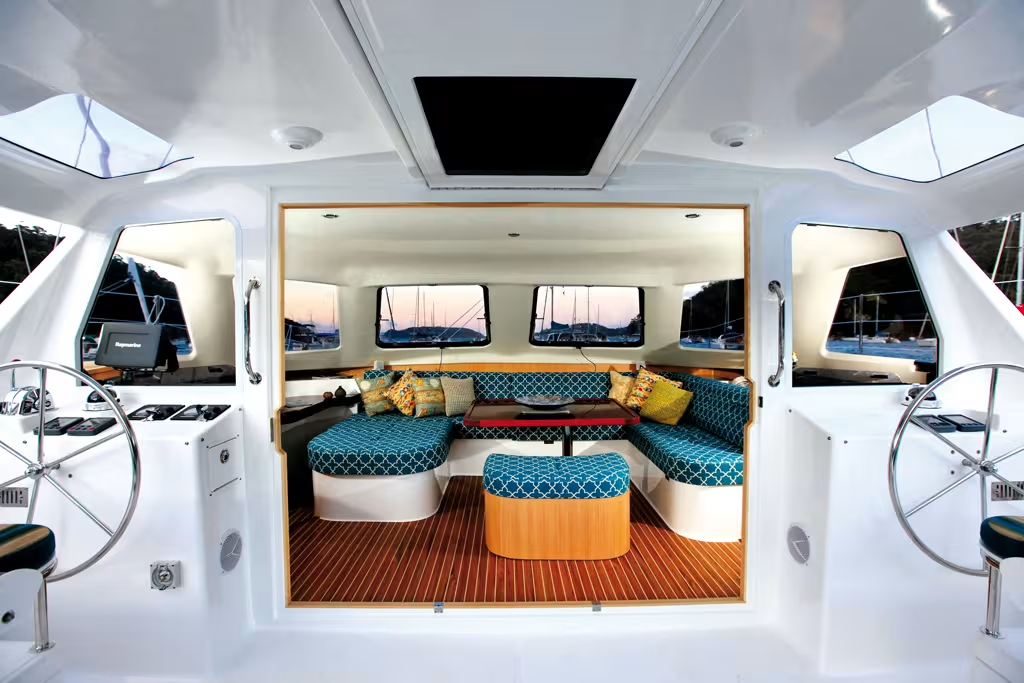
High performance undoubtedly, but comfort is a priority too: these sofas are just made for relaxing.
The two steering stations, situated either side of the rear of the roof of the main cabin, are particularly well protected from UVs as well as from the elements. One surprising detail that takes a while to get used to, is that the frontal view is through the windows of the main cabin. We already have experience of this, where the windows situated at the foot of the mast open wide. Those situated just in front of the helm drop electrically, as they do in your car! As a result, the nav system, fixed to an articulated foot in the inside of the boat is both easy to access and always sheltered from the water, the sun or even those looking to cause trouble when you're not on board. Thanks to two tinted, pleasantly-rounded plexiglass windows that are integrated into the rigid bimini, there is an excellent view of the sails. When you're in a more competitive frame of mind, you can sit on the deck. There, set back from the roof, the helmsman can navigate the boat with the tips of his fingers: very America's Cup! Another distinguishing feature of the Seawind 1250 is that there are two benches overlooking the water at the back of the cockpit. The shipyard is now offering a more classical version with and L-shaped bench around a cockpit table on the starboard side. Whilst the starboard helm is less user-friendly, we appreciated the view and the sociability that the original layout offered. And of course, once everything is opened up, it's as though we're outside again...in the salon area! The stainless steel stanchion and handrail below the radar loop is an impressive and complex component which supports many different features: from seating, to the the barbecue, davits and above on the loop are the solar panels and mainsail track. Arranged like this, and removed from the living areas, the sail still remains adjustable by using a simple winch and pulley to control the traveller of the main sheet. Having already looked at the salon which can be inside or outside depending upon the weather or how the panels of the roof are disposed, what about all the other fittings? The first thing to say is that the combination of white moldings and light furnishings is pleasant and harmonious. To the port side of the salon is a good size chart table. We're prepared to forget the minor inconvenience of the small difference between the levels, as in the entrance, because the view to the outside is so good. Still on the port side, there is a huge bathroom at the rear of the main hull. Whilst on that subject, we should mention the excellent accessibility that there is to the engine via the watertight panel situated in the separate, large shower. Further forward, the main cabin has a queen-sized bed which can be accessed from both sides. This would normally be impossible on a 41 footer with sporty ambitions. They got around this by placing it crosswise, and fairly high up so as not to reduce the clearance between the water and the underside of the main salon, beneath which most of it is situated. A cabin fit for a king!
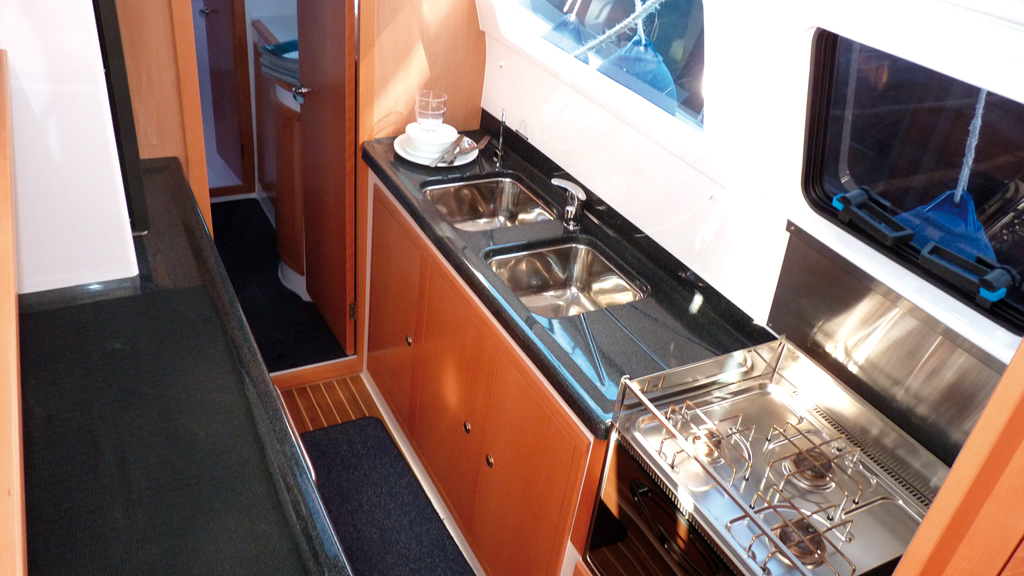
The pleasant and bright galley.
On the other hand, we won't be falling over each other to get to the rear cabin on the starboard side, which shares that zone with the engine. Ideally it will be used as a back-up cabin or as a storage room. Thankfully, forward of the galley, the main guest cabin offers a spacious double bed and a perfectly acceptable head for a 12m boat. In between the two, the galley manages to avoid feeling cramped by opening out into the living area and the fact that the hull has large portholes. The two long countertops will encourage you to get rustling up some tasty dishes, especially as the rest of the galley equipment, such as the microwave and the refrigerator, is comprehensive and well-integrated. We passed under the Harbour Bridge at 6 knots with the engines running at 2200 rpms. Once we had shut off the engines, hoisted the mainsail and effortlessly unfurled the jib from the starboard helm, it only needed the slightest breeze for the Seawind 1250 to get started. This is no doubt down to the fine profile of the hulls, a controlled displacement and a suitable sail surface area. In short, with hardly 10 knots of wind we were doing an acceptable 6 knots at 50° to the apparent wind. The breeze picked up to 15 knots and the boat speed climbed to 8 knots. It then fell back to 7.5knots when we sailed closer to the wind. The helm is quite sensitive and makes for easy control of your course. The triradial sails are not perfect but are efficient enough. The good size Harken winches make for easy maneuvering, especially when at least one of them (as was the case with our boat) is electric. On our first trip, the handles were locked away in two large lockers situated under each of the double seats by the helm! Unfortunately, the skipper had forgotten the key. As your average Aussie skipper tends to be of a different build to your average European journalists, we didn't insist on him breaking the locks, which would not have been to the liking of the friendly owner's representative! We were therefore able to have a look around the particularly well-designed bridge, where a single winch allowed us to do practically everything...although that meant that every now and again there's a part of a line that crosses the cockpit! However, that's only a back-up mode. Luckily the jib is self-tacking ! Not only does this take some of the pressure off in that situation, but it also facilitates things when sailing solo or with a reduced crew. This is also helped by the jib sheet running through a track-mounted pulley and car system. Practically all the halyards and sheets return to the cockpit where they can be stored in nice looking fixed polyester bags which are integrated into the bridge design. Despite being a simple, effective and aesthetic idea, it's the kind of thing that's all too rarely seen. The Seawind 1250 displays simplicity and efficiency as well as a surprising level of comfort for such a fast boat. It is full of good ideas and shouldn't have any difficulty finding an audience in other parts of the world other than its native country and continent. The connecting of the salon area and the cockpit is a great idea, which makes the boat feel bigger, helps with the ventilation, facilitates getting around, improves the all round vision and in short, makes life on the water a pure pleasure! This is no gimmick, it's a real asset, and one which only adds to the already excellent build quality, finish and comfort. In conclusion, the Seawind is definitely worth considering for anyone who wants to have fun on the water with a boat that's out of the ordinary, and which is perfectly adapted to the hottest of climates.
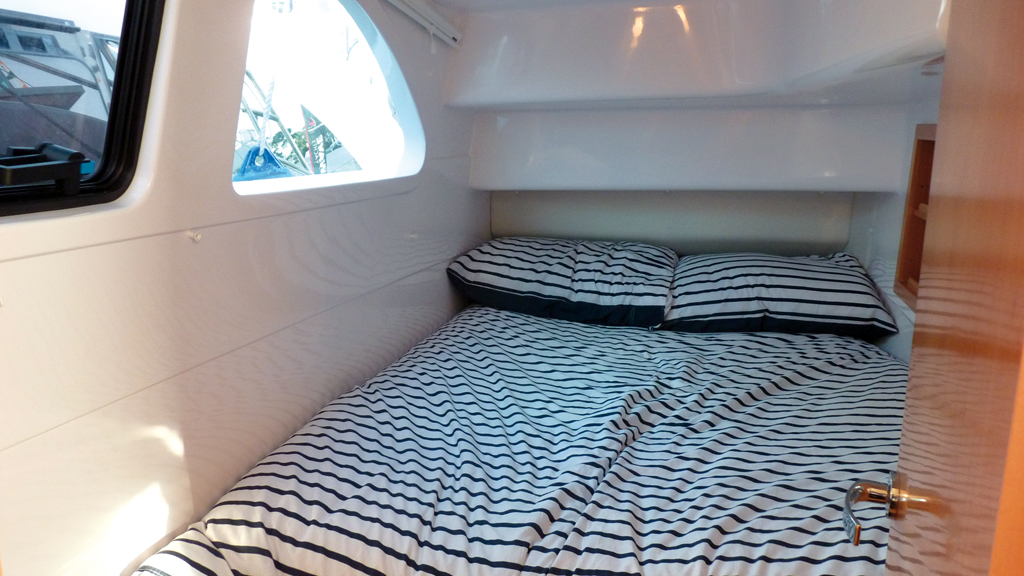
Even the smallest cabin, at the rear of the starboard side, has a bed that is worthy of a 41 footer.
Specifications:
Length: 41ft / 12.45m Width: 22'4" / 6.80m Draught: 3'8" / 1.16m Displacement: 17637 lbs / 8 tonnes Engines: 2 x 29 hp Main Sail Surface Area: 656 ft² / 61m² Genoa Surface Area: 258 ft² / 24m² Spinnaker Surface Area: 710 ft² / 66m² Fresh Water Capacity: 185 US gallons / 700 liters Diesel Capacity: 126 US gallons / 480 liters Price: 355000 Euros/ 485775 USD ex taxes, Ex Works
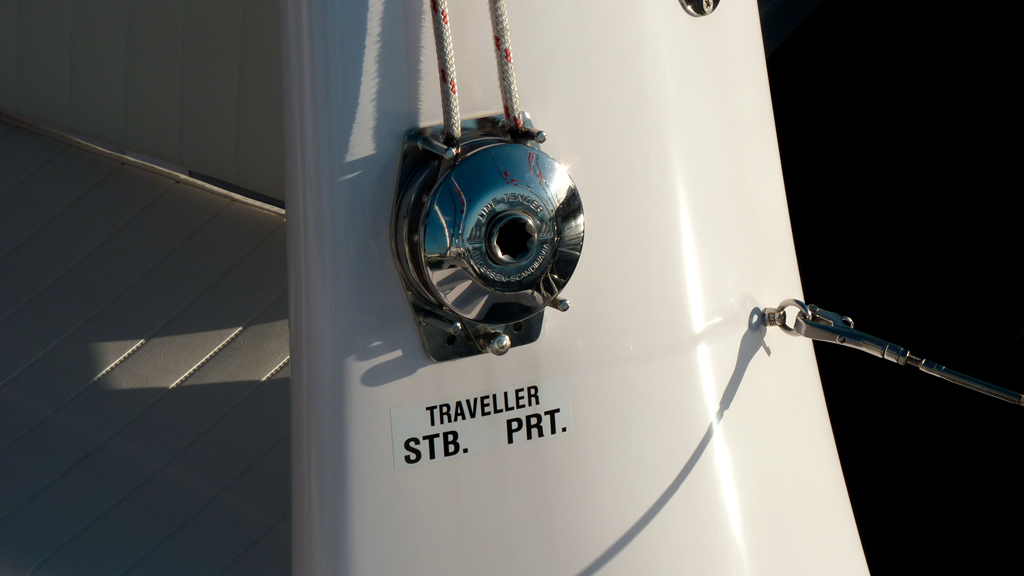
Adjustment of the batten cars is well thought out. It only requires one winch handle!
We like:
- Its performance - the open plan between the salon area and the cockpit -the omnipresent brightness
We're less sure about:
the view from the helms -Difference between the level of the salon area and the cockpit - The beds which are very high up.
