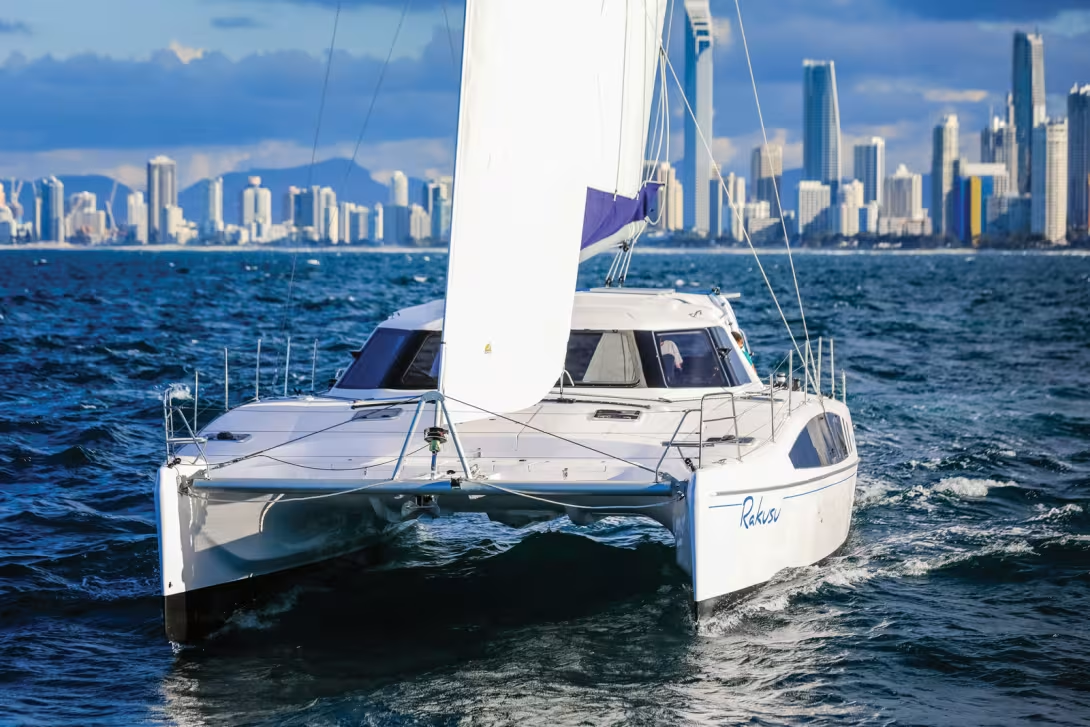
A traditional design, with the weight under control and open layouts, this Australian 41-foot catamaran comes with a proven pedigree, good practicalities and enough speed to reel in the miles for bluewater passage-making. A future classic!
Infos pratiques
- Le chantier : Seawind 1260
- La fiche technique
- Découvrez notre vidéo exclusive
- Financez votre Seawind 1260
- Assuez votre Seawind 1260
- Articles autour du Seawind 1260
The Seawind 1260 was launched in 2018, and was an evolution of the popular 1250 that had proven herself across all the world’s oceans, as had her smaller sibling, the 1160 that continues to be built. Straight away, I got a positive feel, and having sailed on the original 1250s, even delivering one around the north of Australia, I can testify to their seaworthiness after that 1,500 nm voyage in all kinds of weather.
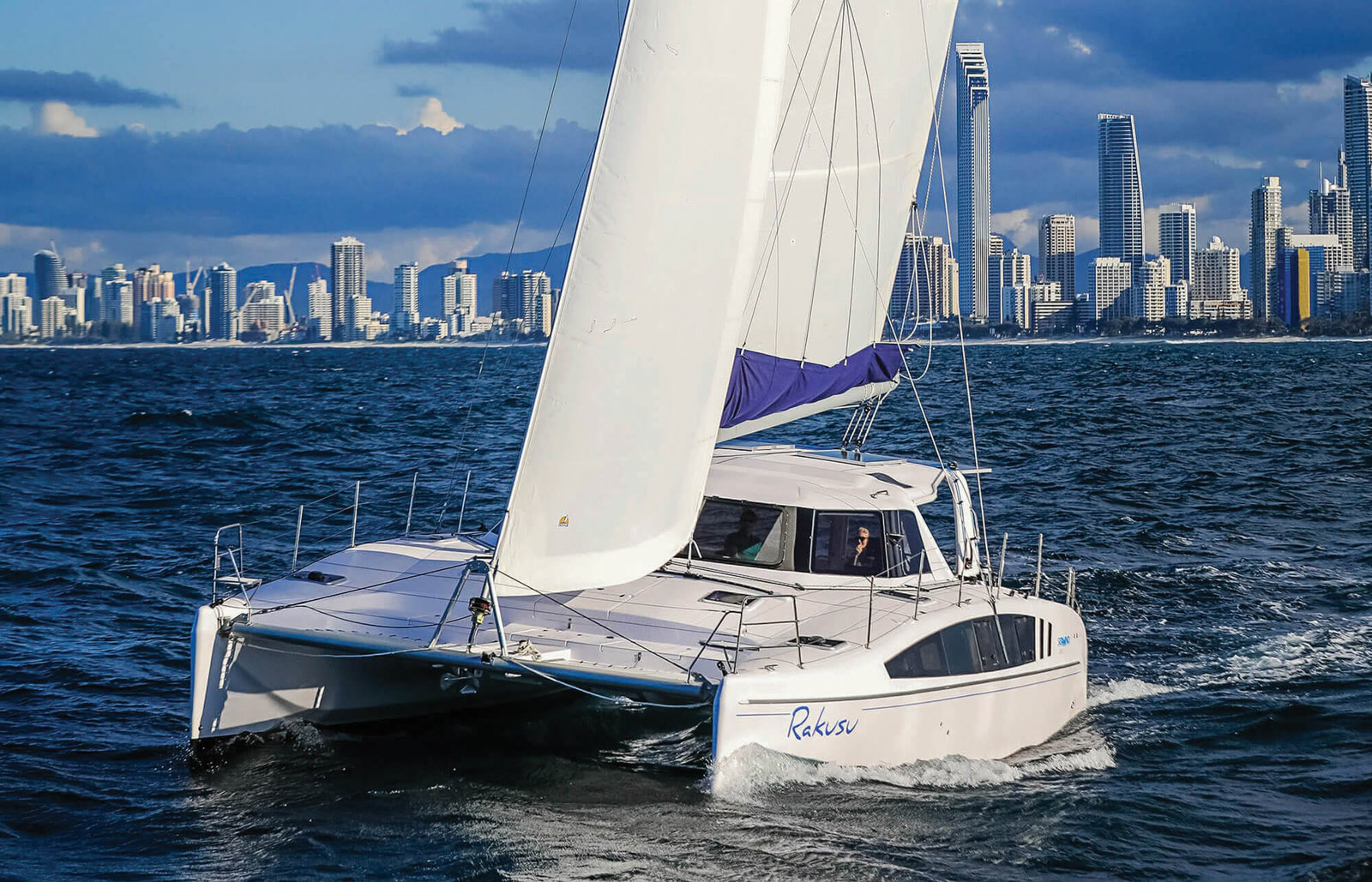
The proven pedigree of the Seawind 1250
Following the financial crisis of 2008, this former Australianbased company saw serious financial difficulties which led them to establish a more cost-effective base in Vietnam, which I visited to see their modern operation. More recently, boss Richard Ward has been telling me about further expansion plans for their Hoh Chi Minh site: the construction of an entirely new purposebuilt yard which will be near the water to allow much easier launching of their entire range of Seawinds and their Corsair brand as well. The 1260 is clearly following in the wake of the previous model, right down to that familiar rounded topside profile that has positive shear and a chine on the inboard side of the hulls, creating more space inside. The coachroof profile reduces windage. For the hulls, Ward aimed to build a “True bluewater boat to sail around the world with confidence”. The other proviso was ease of handling with functionality preferred over ostentatiousness, allowing a couple to manage it easily.
A more comfortable cockpit
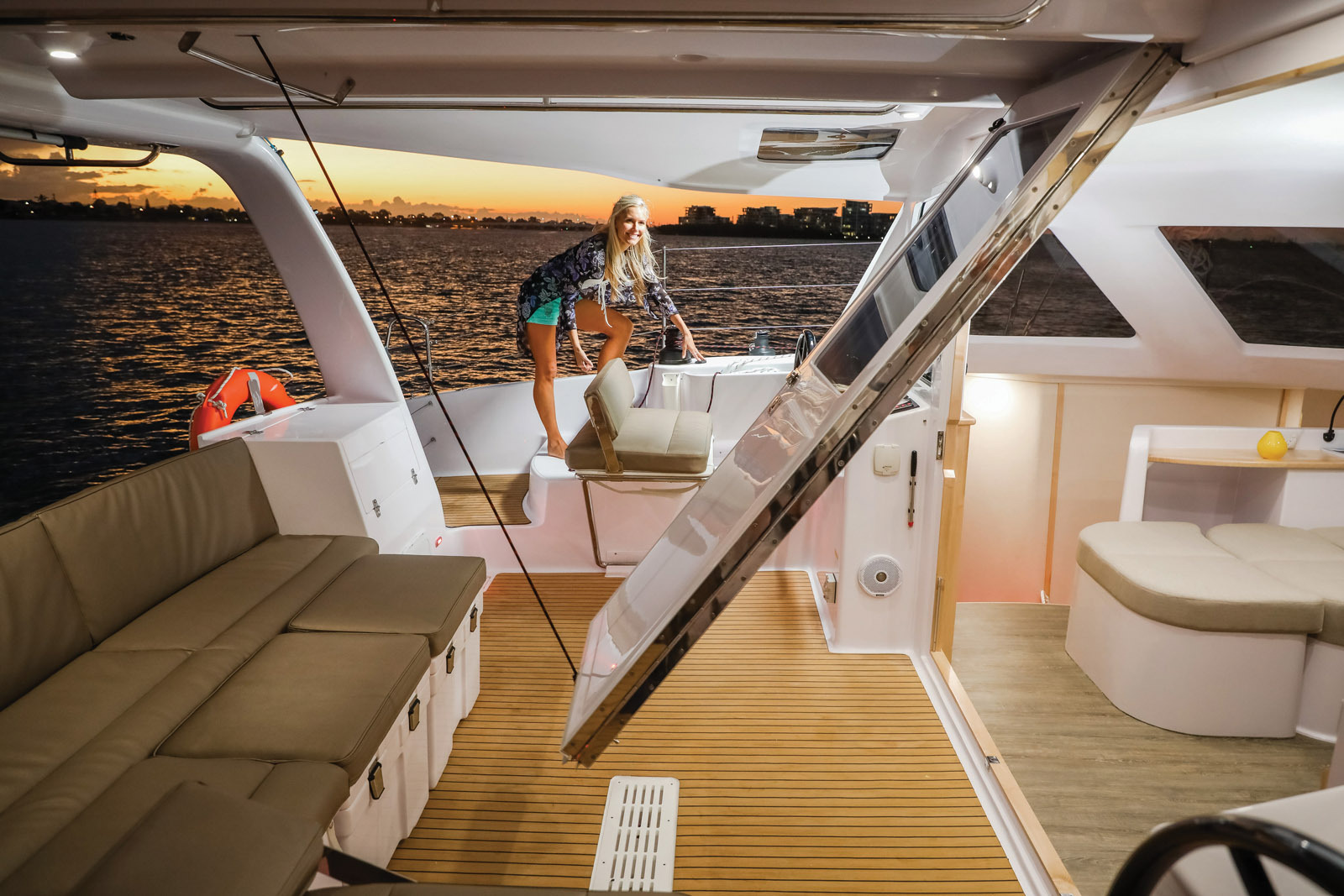
Cruising comfort and accommodation are major advantages that catamarans enjoy over similar-sized monohulls, so the design remit of the 1260 was to maximize these, beginning with the area sailors spend 80% of their time in: the cockpit. This has changed significantly from the 1250. Retaining the open space of previous models, segregated by the company’s popular tri-folding doors but sensibly partitioned with a lip to prevent water ingress, the 1260 devotes the entire transom to seating and a discretely covered cooktop with sink on the port quarter. The addition of a small table is a welcome feature here as well. Protecting the outside cockpit is a wide fiberglass bimini, a similar setup as previous models which includes the mainsheet track, controlled by a winch. Further aft, the builder offers optional solar panels. Davits support the small dinghy and swim access is good on both hulls with wide steps and a ladder. At the twin helms, B&G electronics are used throughout with a plotter and readouts portside. The helms are shaded by the rigid bimini, but wisely, skylights above each give a view of the sails, and the adjoining saloon windows drop down electrically for clear views forward, through the front saloon windows. Our test boat came with an electric Lewmar halyard winch located beside the port helm with another manual one forward of it, and one on starboard. As we found out during our sail, this entire setup worked well, with both the sheltered helms comfortable and the running rigging controls all tidily laid out and secured by large jammers. Another plus was the flat coamings which allowed the helmsman to sit out and adopt a more race-style posture - also handy when docking with the twin portside throttle levers nearby. Clever design is evident throughout this area, including the moveable helm seat backrests, and the GRP steering wheel; the latter an improvement on the metal ones used on earlier boats.
Hulls open to the saloon
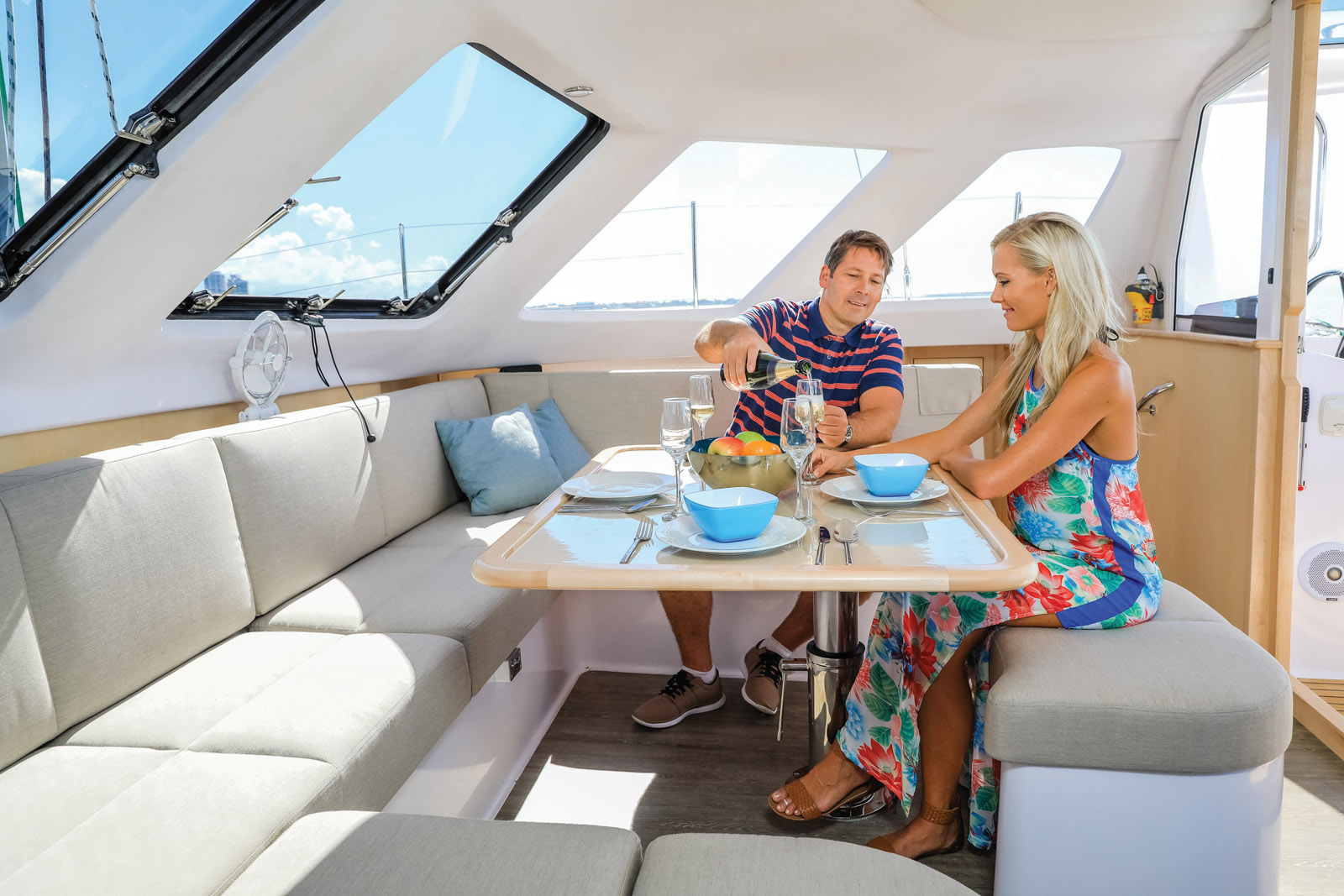
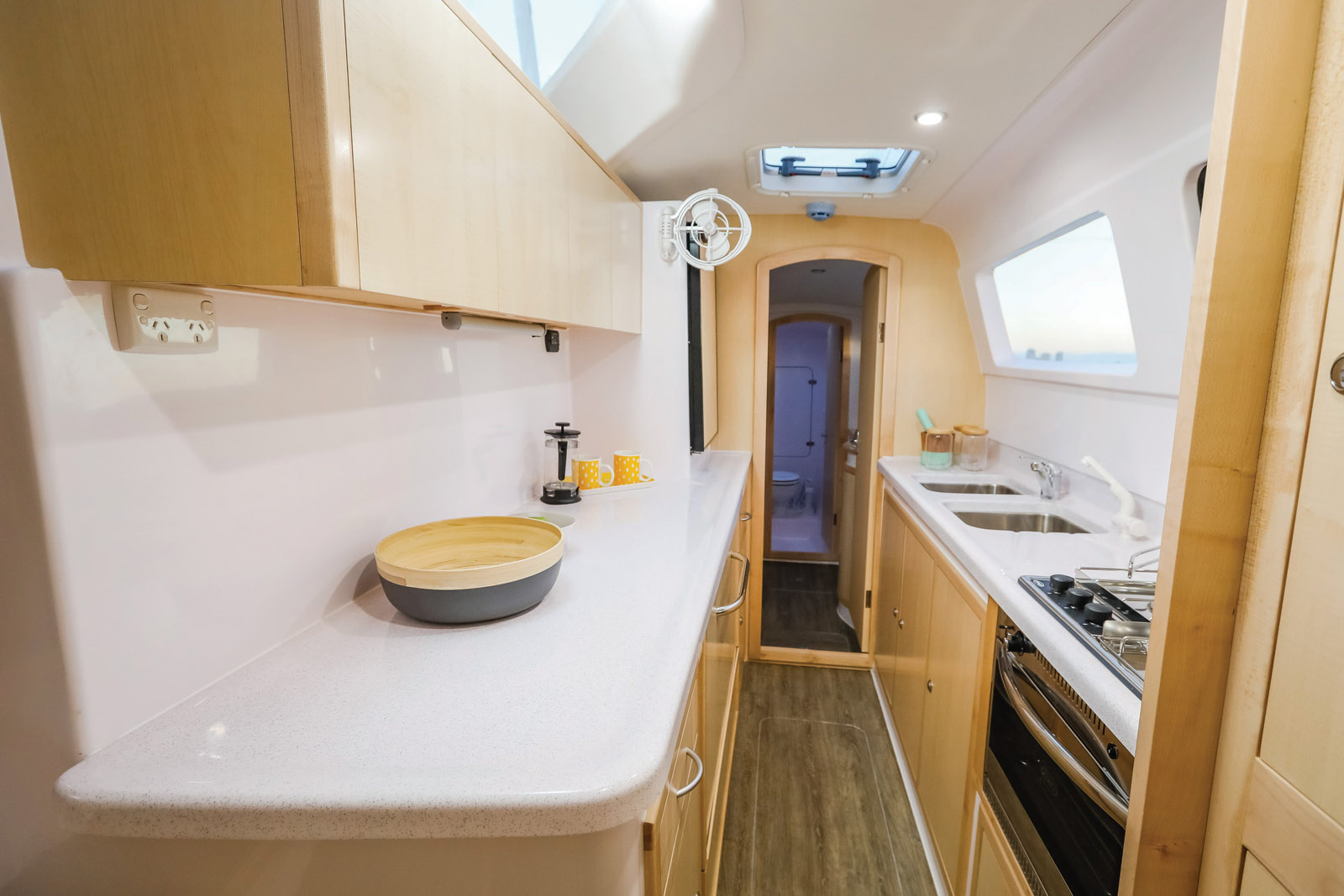
Stepping inside the saloon, the first thing that strikes you is that the coachroof overhangs the hulls, thus allowing parting of the hulls to be integrated into the saloon living area. In the center, there’s a daybed as part of the U-shaped lounge seating. This portside area also adjoins the navigation table which is across the saloon from the chart plotter; the latter is near the port helm and swivels to allow both steerer and saloon-based crew to view. Quality finishes are evident all around the area with real leather coverings and polished hardwood finishes, while 360 degrees views are afforded – so that you could lounge inside and simply steer by the optional B&G remote control, should the weather turn foul. Sloping bulkheads forward reduce windage and large, opening windows give the essential airflow. Seawind’s preferred galley-down arrangement means that the entire area is ded cated to the saloon. The three-cabin layout with the galley down on the starboard side, means the owner’s suite is in the port hull and there are two double berths to starboard. A bathroom in each hull allow spacious ablutions, helped by generous tankage. Heads are manual as standard, with electric options. Privacy is one of the big pluses with accommodation on catamarans and the portside owner’s suit on the 1260 does a pretty good job at this with the forward athwartships island bed and stern bathroom a very pleasant area, plus the option for a small office space in between. Outside views are excellent down here, thanks to large windows, and ventilation is also good, as an opening side hatch is fitted to both hulls. Climbing up the three steps and walking across the saloon and down again into the starboard-side galley reveals panoramic views from the twin sinks which could persuade even the most reluctant crew to wash the dishes. Alongside them is the three-burner gas hob and oven. Good design points here include a large 140-liter (4.9 cu ft) chest freezer on the inboard side and a 130-liter (4.6 cu ft) front-opening refrigerator. The entire area is surrounded by ample synthetic worktops and cupboard space as well. The remaining two double cabins are forward and aft of the galley, with an ensuite bathroom up front, completing a well thought out layout. A lightwood finish of Ash laminates throughout the interior contrasted nicely with the ambience from neutral colored soft furnishings, proving that it’s not just big European builders that can turn on the style. One personal niggle, especially as this a bluewater cruiser, is the lack of escape hatches as standard but again the company can fit these if required.
Practical deck layout
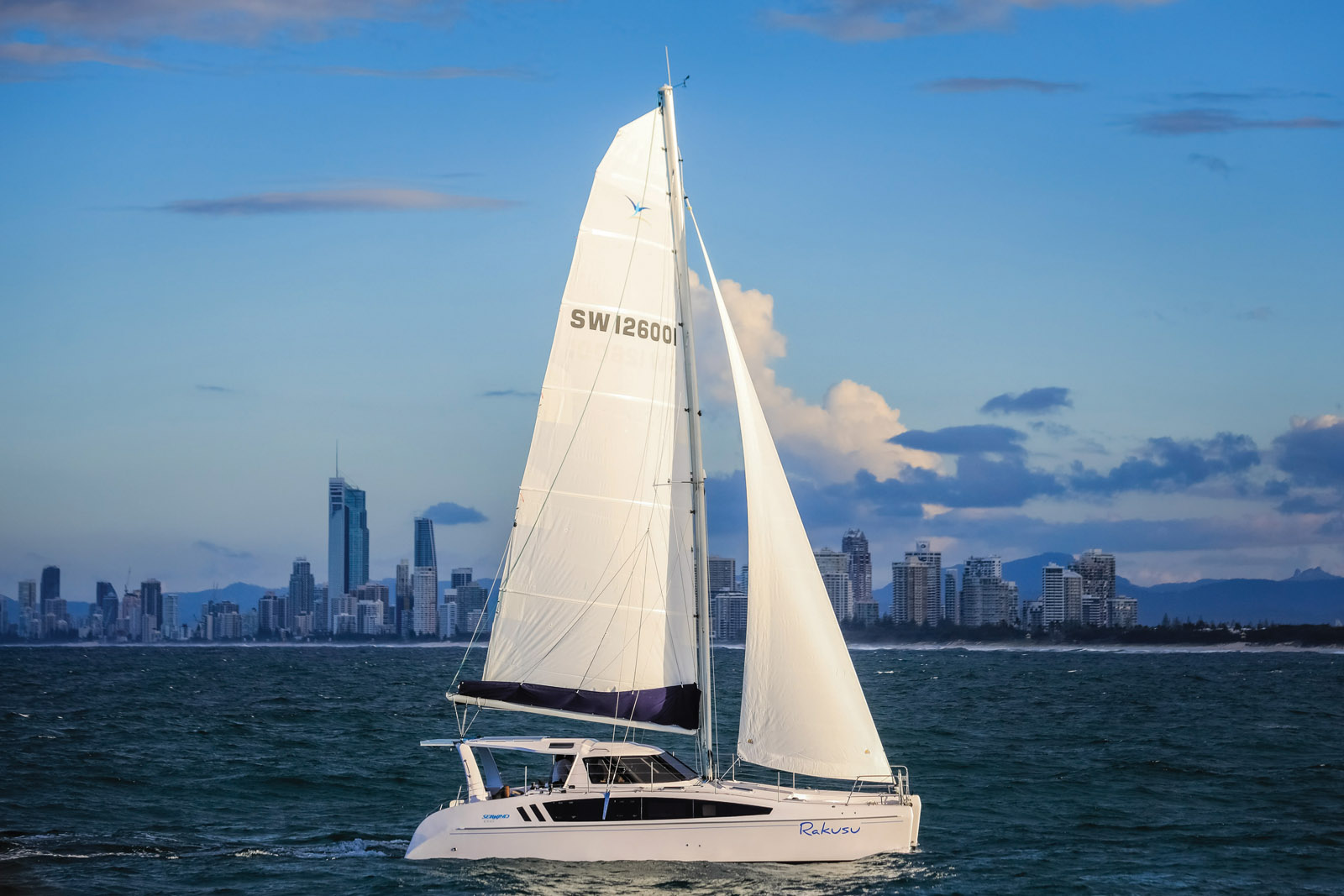
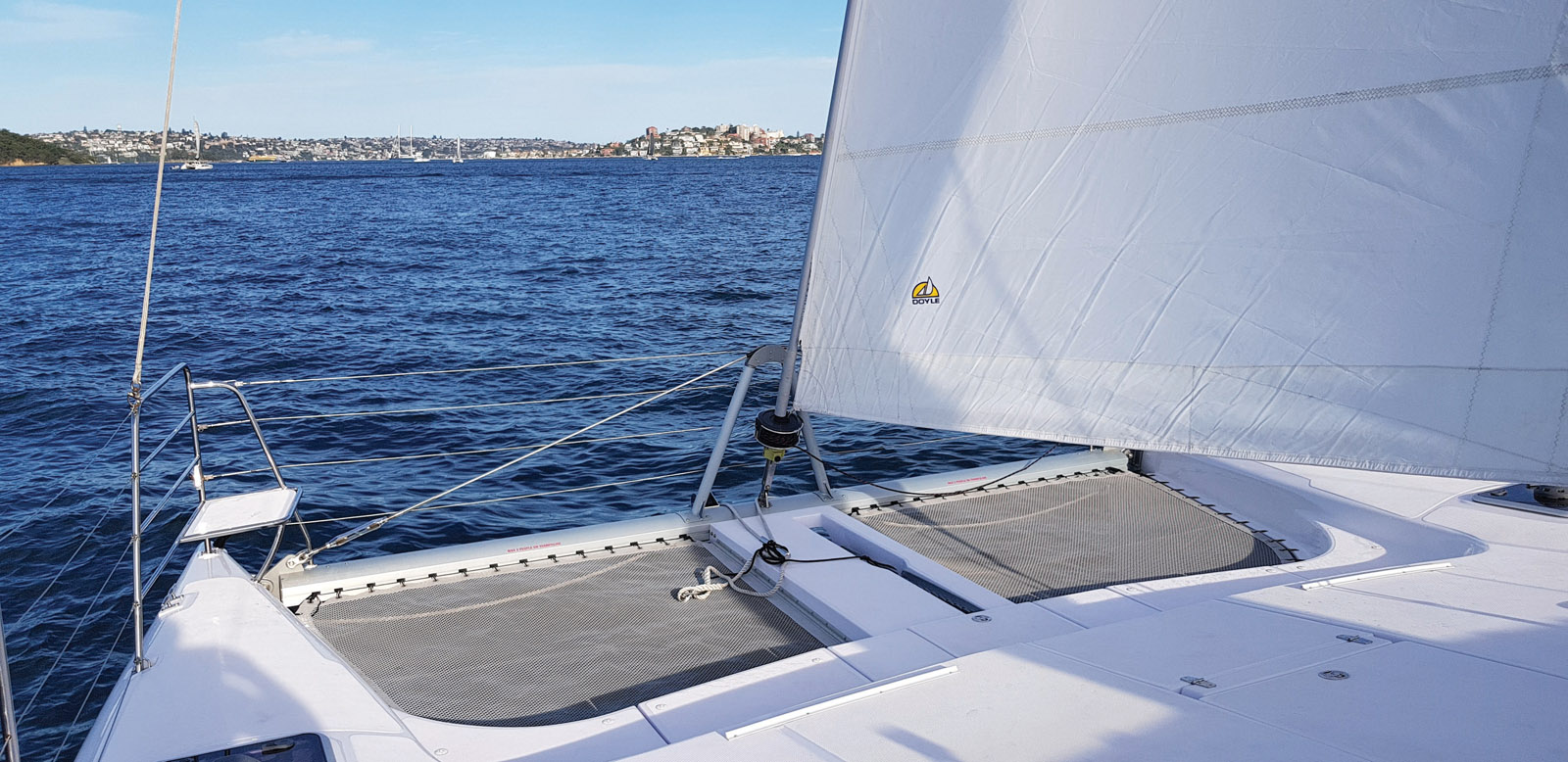
Moving up top and forward, the latter something that you’d rarely need to do unless sunbathing on the trampolines, access is good with strong handholds on the cabin. There also are footholds for climbing onto the flat saloon roof to access the boom. The forward area is uncluttered with all systems in lockers, including the large Muir horizontal windlass with primary rode running below the main beam and there’s a secondary roller installed. Nearby is the track for the self-tacking jib, yet another clever cruising feature of the 1260, that rolls out and once set allows you to forget about. The big roached mainsail fitted to the review boat was a Doyle Dacron cruising cut with full battens, sitting in lazy jacks. Single line reefing, again all operated from the cockpit, finished off a functional sailplan, which can be enhanced with overlapping genoa as tracks are already laid on the wide side decks. For downwind running, big sail options include an asymmetric and screecher with bowsprit. Holding all this up are dyform wire outboard shrouds with substantial chain plates molded into the gunwales, attached to a 7/8 singlespreader alloy mast.
Build quality and ease of maintenance
Seawind build to both European CE standards and Australian ones. In addition, our review boat – hull #11 – was built to Australian commercial survey standard for charter purposes. This required some more structure in the boat and additional safety gear. The GRP hulls are fully foam-cored which both creates strength and more inherent buoyancy, while the vacuum bagging build has also been refined to include triaxial fiberglass cloth in key areas. The 1260 uses mini keels which protect the saildrives when beaching. Importantly, at 0.8m (2’8”), there’s plenty bridgedeck clearance to give an easy motion, as long as you don’t overload it. Engine access is behind the bathroom bulkhead and the two 29HP Yanmars have all their service points accessible. The saildrive legs have twin bladed folding propellers, to minimize drag. Batteries are three AGM 400 amp-hours for the house and a 700CCA AGM for each engine. Apart from the engine alternator, the large cabin top space can accommodate 2 x 125W Solar Panels coupled to a 40 amp regulator; plus, there’s locker space forward for a generator.
Sydney Harbour twilight racing
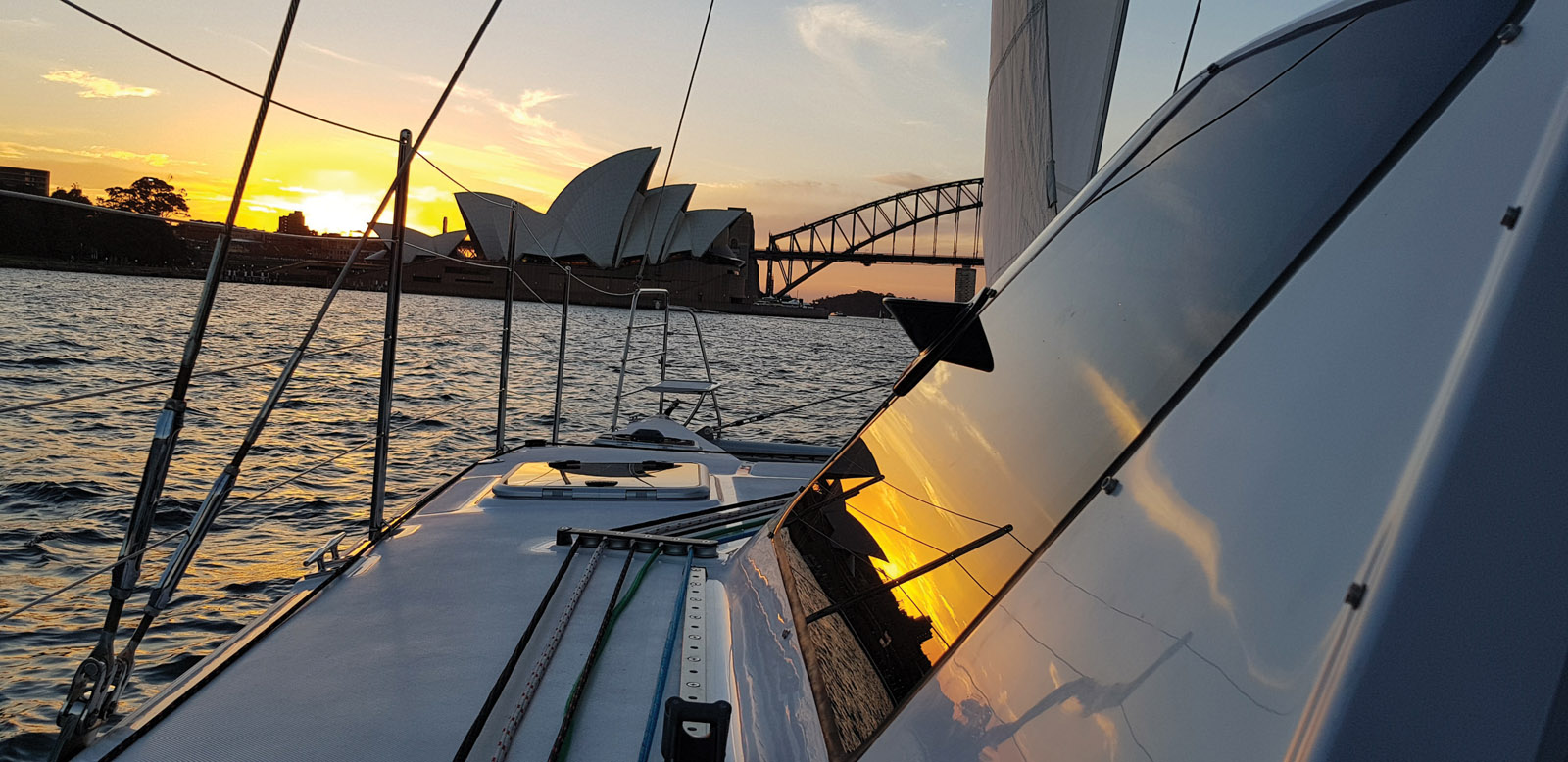
Australia and New Zealand Seawind dealer, Multihull Central’s summer twilight race night was an ideal way to experience the new 1260, since I could measure it against its predecessor, the 1250 and of course other catamarans as well; remembering of course that this was a dedicated cruising boat plus one that was heavy with commercial charter gear such as life rafts. Leaving the tight confines of the Multihull Central’s busy marina was the toughest test of the 1260, requiring it to spin around in its own length – simply done by pushing one throttle forward and the other one back, so no need for a bow thruster. Once clear, motoring along beyond the confines of Rozelle Bay we cruised under power at 7.0 knots with the Yanmar 29s running at 2,500 RPM but reached 7.6 knots when pushed to the maximum at 3,000RPM. Out on the Harbour we met up with a mixed fleet of Seawinds – ranging from early 1000 models, 1160s and others – showing the history of this illustrious marque. Aboard the 1260, sail setting was easily done by going head to wind then clicking the electric Lewmar to quickly hoist the mainsail, before the jib was unfurled; jobs easily done by even a lone sailor, but we had plenty crew on hand. Our crew included dealer Brent Vaughan, and 1260 owner Edward, who was keen to improve his sailing skills by testing them in a friendly racing environment. The non-spinnaker social racing is ideal both for the camaraderie it engenders and the learning experience it gives new sailors like Edward, who has big plans. “Our dream is to explore the western Pacific eventually, and after five years of looking at boats we’re sure we have the ideal boat,” explained the Sydney businessman. Meantime, he and his wife are enjoying coastal hops up to Pittwater and generally getting used to the new 1260, he said. Exploring the capabilities of your boat is quickly done when racing, so after our crew trimmed the sails for our first windward beat, I noted 6.8 knots on the chartplotter at about 40 degrees in the 14-knot breeze as ten boats jostled around us, amid good-natured banter among the fleet. Tacking up the Harbour was easily done since the jib was self-tacking, allowing us to focus on our positioning as we rounded the top mark then eased sheets for the run back down. Interestingly, our speed was the same off the wind but if a large cruising chute was deployed this would have nearly reached double digits. Sitting out on the coaming allowed me to see the headsail telltales and there was sufficient feedback from the cable steering to make it a rewarding experience. Another plus, in a hectic racing environment was the ability to see through the windows and across the decks on the Seawind 1260. This aided us in reaching a podium finish, which reflected both the crew’s efforts and the obvious abilities of this accomplished Seawind, despite not having a genoa. There’s no doubt that with a full sail wardrobe, the 1260 would do even better!
Technical specifications:
Builder: Seawind Catamarans
Architect: Richard Ward/Seawind Catamarans
Overall length: 12.45 m (40’10”)
Beam: 6.8 m (22’4”)
Draft: 1.16 m (3’10”)
Displacement: 8,240 kg (18,170 lbs)
Mainsail: 69 m² (743 sq ft)
Self-tacking jib: 24 m² (258 sq ft)
Genoa: 60 m² (645 sq ft)
Gennaker: 66 m² (710 sq ft)
Spinnaker: 115 m² (1,240 sq ft)
Bridgedeck clearance: 0.80 m (2’8”)
Steering Twin Helms: Cable steering Diesel
Sail Drives: 2 x 29HP Yanmar
Fuel: 480 liters (127 US gal)
Water: 700 liters (185 US gal)
Price: € 355,000 ex-tax