
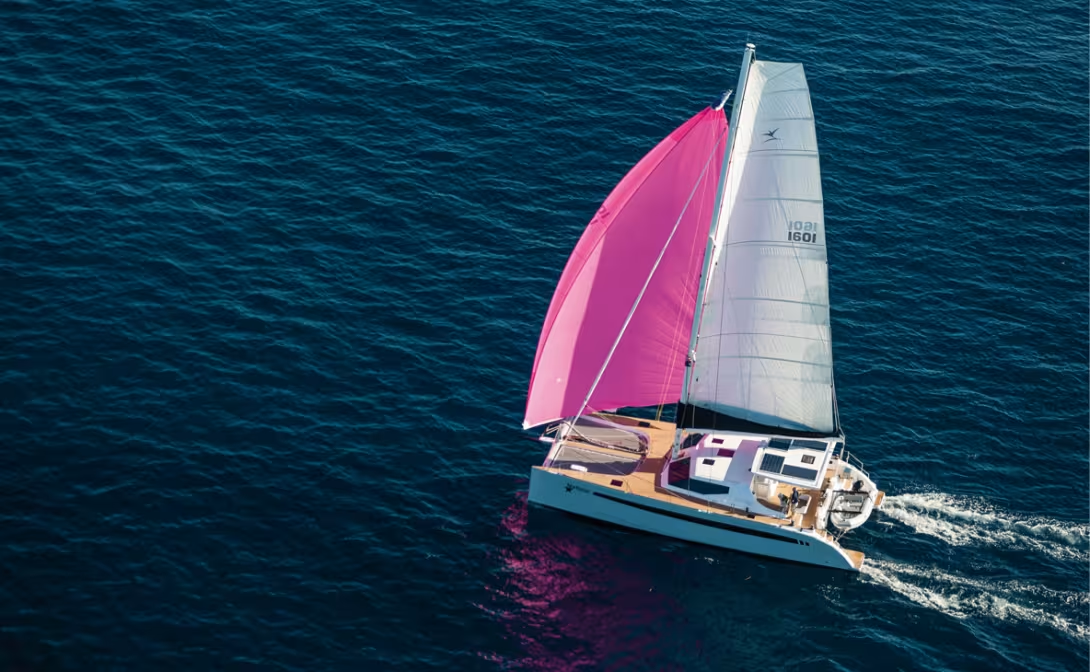
Back in October, visitors to the Barcelona show discovered a brand new model from the Australian builder Seawind: the 1600. Following the Catalan show, we tested this seductive catamaran, designed by the Californian Reichel-Pugh team. Resolutely different from European or South African productions, this catamaran with a distinctive personality gave us some nice surprises.
Infos pratiques
- Le chantier : Seawind 1600 Passagemaker
- La fiche technique
- Découvrez notre vidéo exclusive
- Financez votre Seawind 1600
- Assuez votre Seawind 1600
- Articles autour du Seawind 1600
Building catamarans in Australia for 30 years!
Richard Ward, founder of the Seawind brand is from Queensland’s Gold Coast on the Pacific Northeast coast of Australia, protected by the Great Barrier Reef and an enchanting tropical climate. At the end of his studies, Richard traveled the Pacific cruising and got a taste for racing and regattas (completing in several Sydney-Hobart Races) before founding the company in 1982 and settling in Wollongong in the suburbs of Sydney. The first models manufactured were be small coast-hopping catamarans (the Maricats), then a trailable boat, the Seawind 24. Next came the 850 and 1000 (a real success, with 165 units sold!). The shipyard continued this route during the 2000s by selling 20 to 30 boats a year, and then in October 2010 bought Corsair (the American yard with 1,600 trimarans built to date!). Paul Koch, Corsair’s former owner, had relocated the production of the California plant in Chula Vista to Vietnam: Seawind seized the opportunity to repatriate all the group’s manufacturing to Ho Chi Min City (the Seawind catamarans and the Corsair trimarans). This yard today employs 200 people. The range of Seawind catamarans comprises three models, the 1600, the 12.60 and the 11.90 (Charter or Sport).
Reichel-Pugh a global firm of naval architects
John Reichel is a native of Oyster Bay, New York, who joined Doug Peterson at the height of his career in the IOR scene and would accompany him on projects as diverse as the cruising Hans Christian 48 and 52, or America3, Prada Challenge or NZL32 prototypes. The pair teamed up with Jim Pugh (a native of Liverpool, England) in the design office in San Diego (California), which has been the source of countless prestigious achievements in racing or cruising and exceptional one-offs such as Wild Oats, the 42m Perini Navi, the 130’ Baltic My Song, Alfa Romeo, the Wallys Magic Carpet 3 and Galateia... but paradoxically few multihulls!
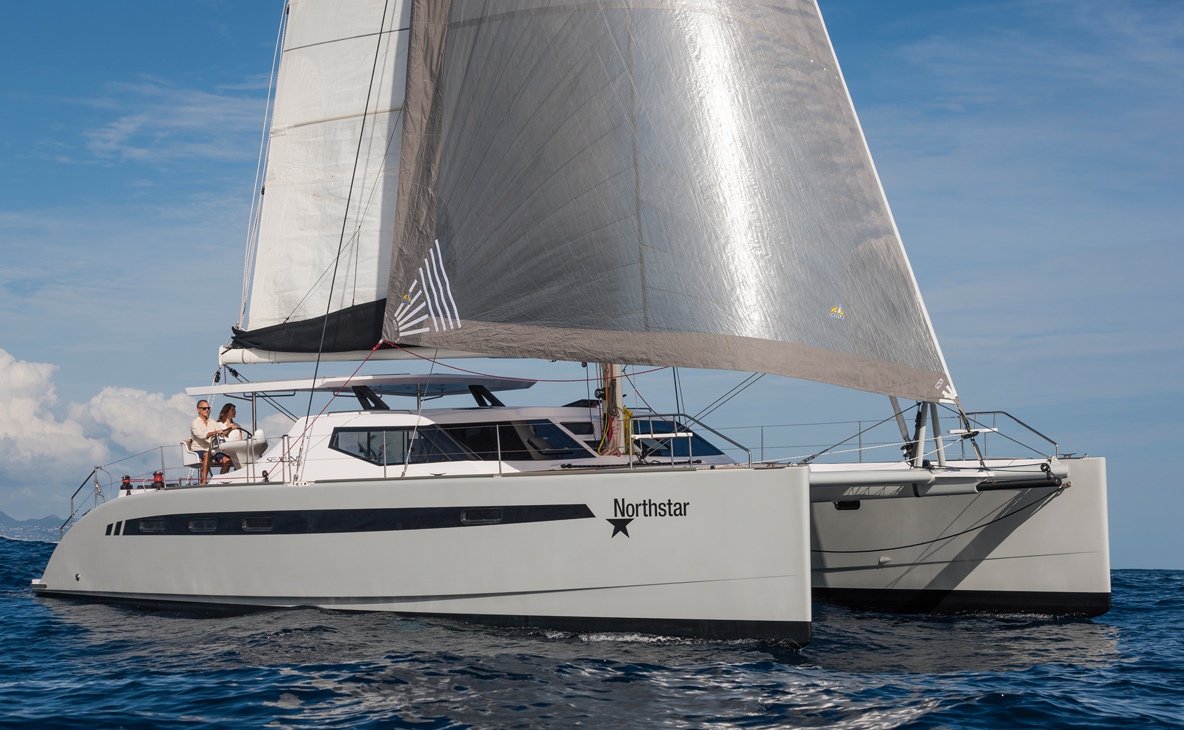
An original silhouette and architecture
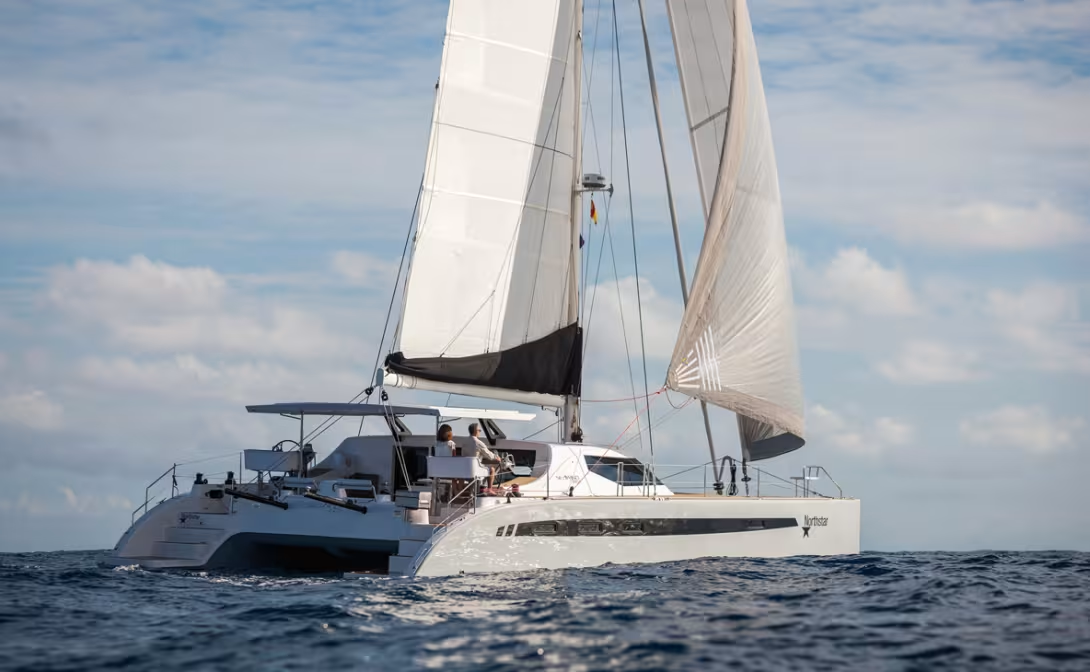
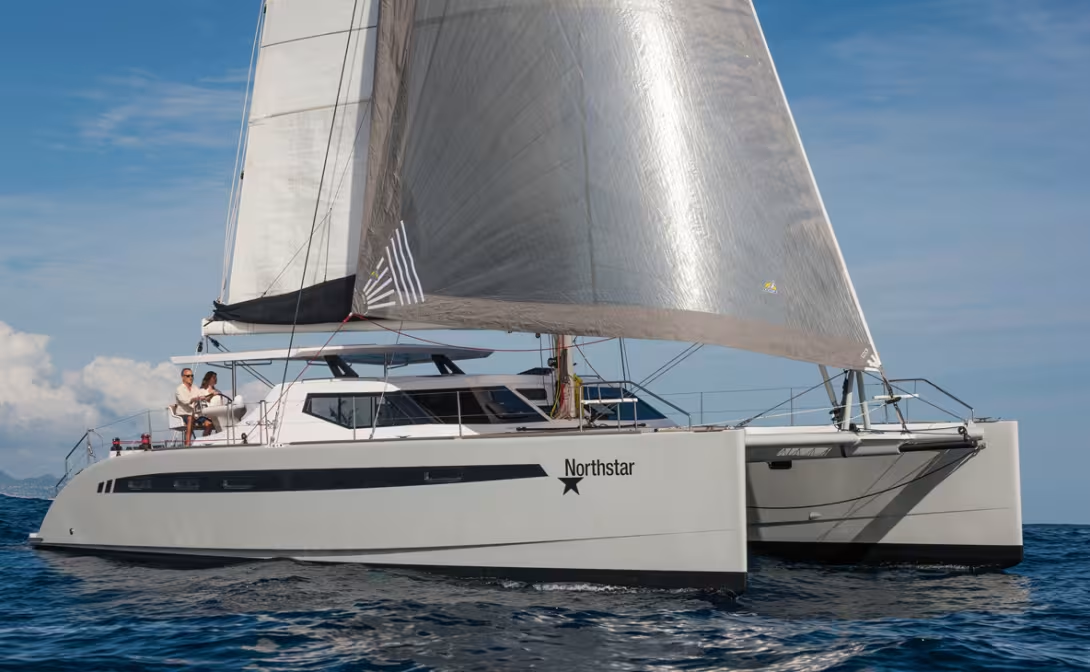
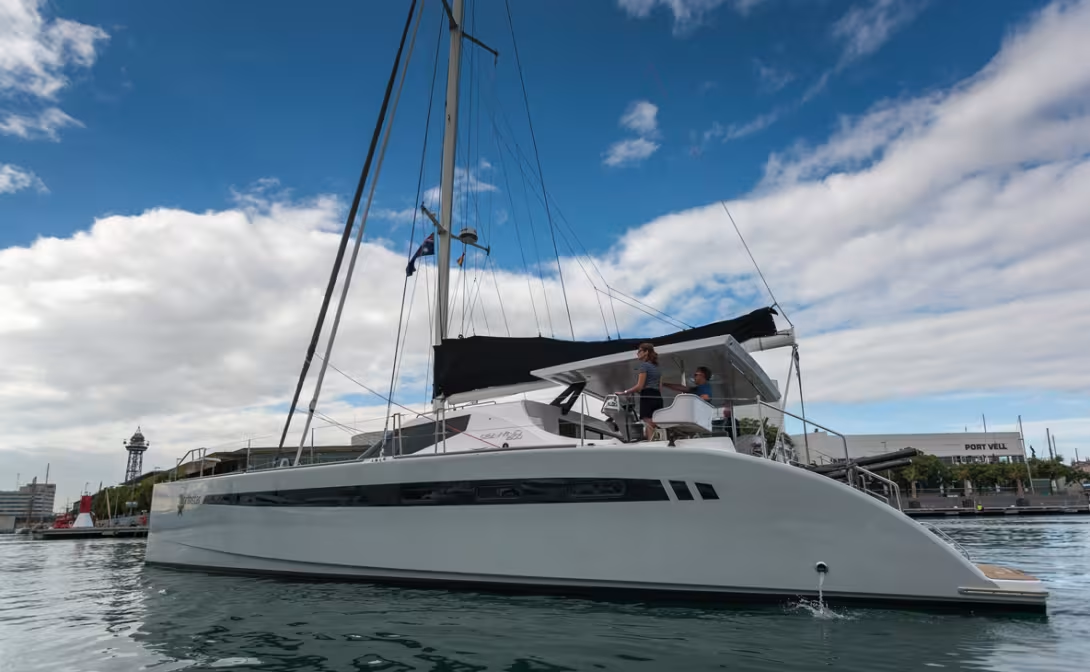
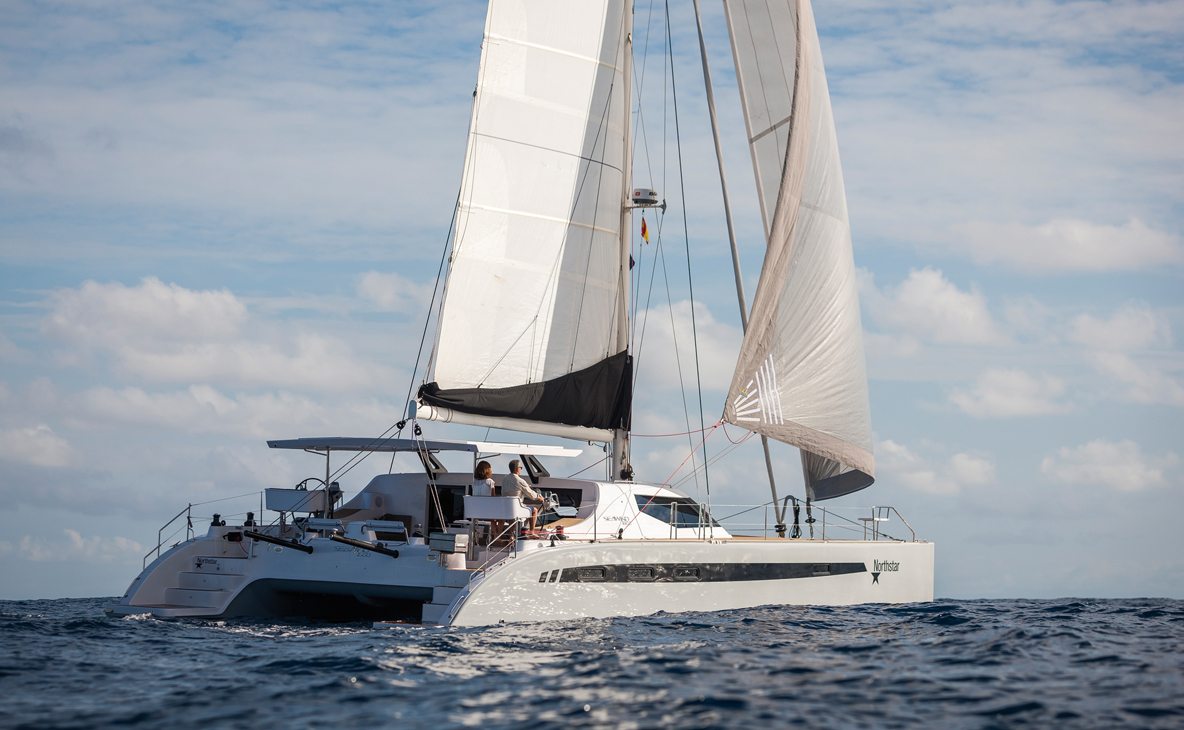
Starting from Seawind's specifications, with fully integrated daggerboards and wanting to offer a high-end catamaran mainly geared towards owners wishing to live aboard for ocean wandering, Reichel-Pugh have designed a multihull which achieves a very real balance between genuine sailing performance, quality of life on board and refined amenities. The hull sections are a deep U, whose volume is graceful and progressive from the immersed forefoot, back to the middle of the hull, before expanding in the after third. The slope of the archway cleverly houses the saildrives, but the curvature of the hull remains lightly pronounced. In terms of exterior design, the Seawind 1600 displays a classic elegance, which is timeless thanks to rigorously designed proportions. The straight bows, the moderate freeboard (despite a nacelle at 80cm), the delicate hull step, the volume of the coachroof, its aft-set position and the beautiful design of the windshields, all allow the overall lines to exude style. On approaching the boat, it is very seductive, as much because of its architecture as the perception of quality which it exudes. Our test model was also presented with a beautiful paint-job (optional, as the boat is delivered with white gelcoat as standard).
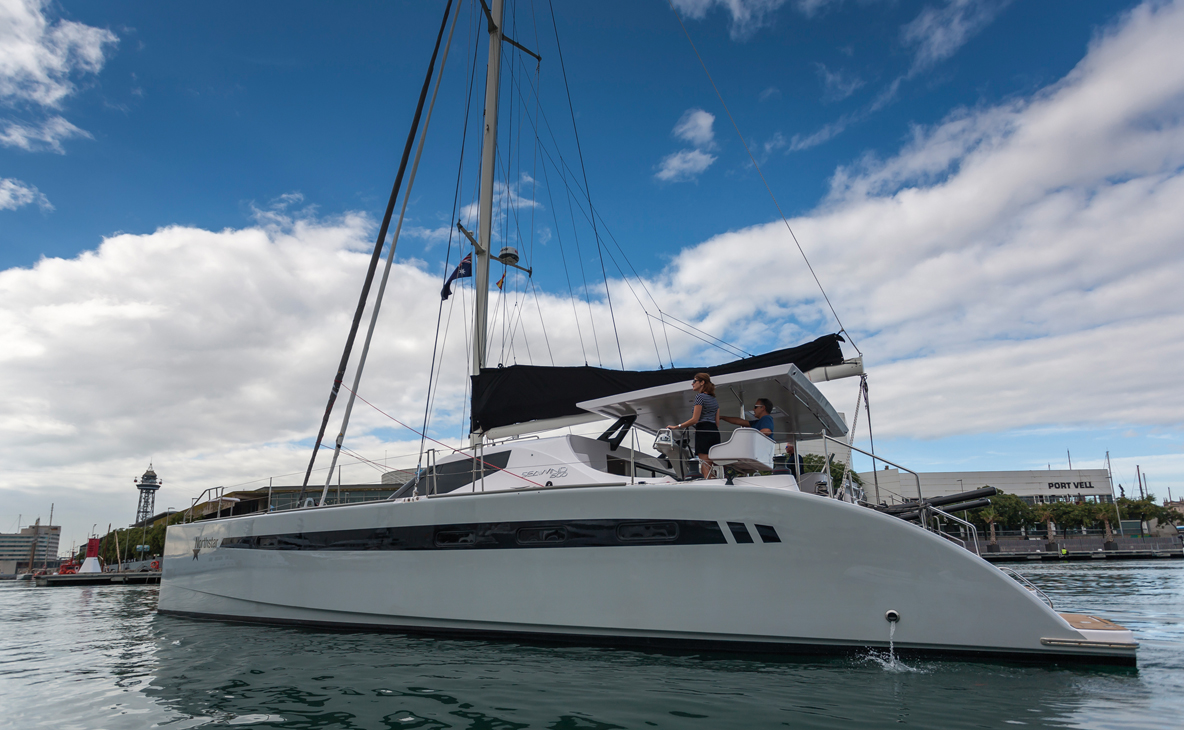
A high-end composite
The full use of Vinylester is a pertinent choice. The mechanical characteristics are close to those of epoxy, but there are fewer constraints to its use, in particular concerning the health and safety of the boatbuilders. The infusion process is widely used and carbon reinforcements (bulkheads) and Kevlar (impact zones) are numerous. The boat is capable of being beached, thanks to the incorporation of a monolithic keel shoe which is 30cm wide. Excellent!
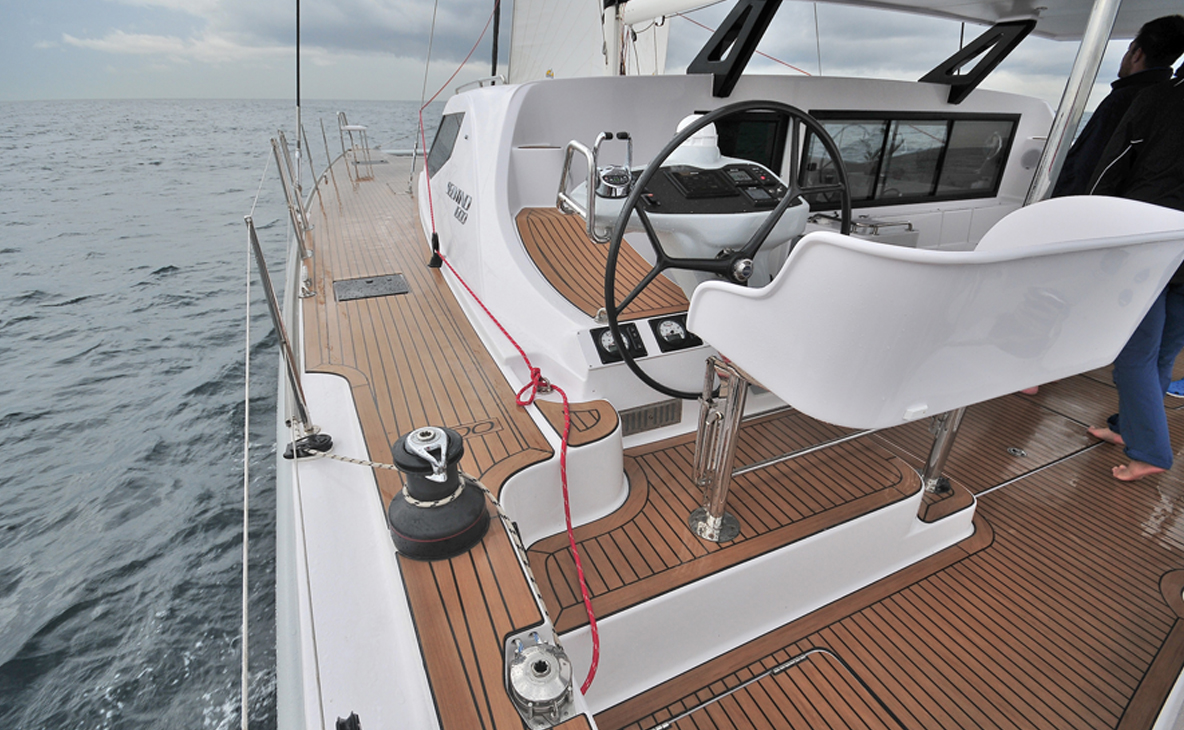
An attractive deck layout
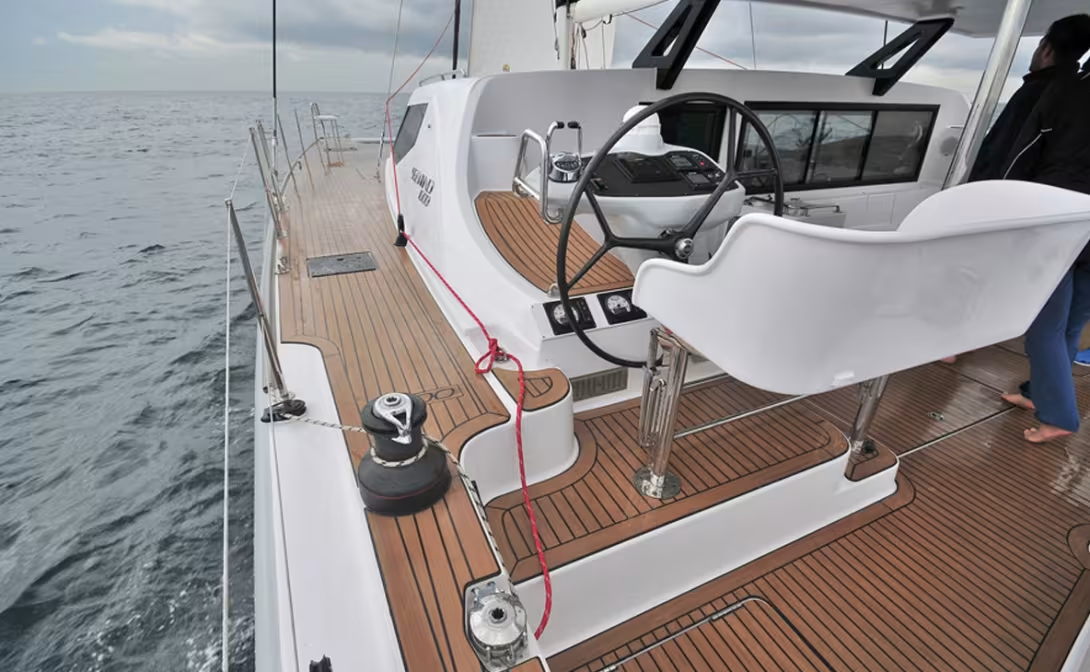
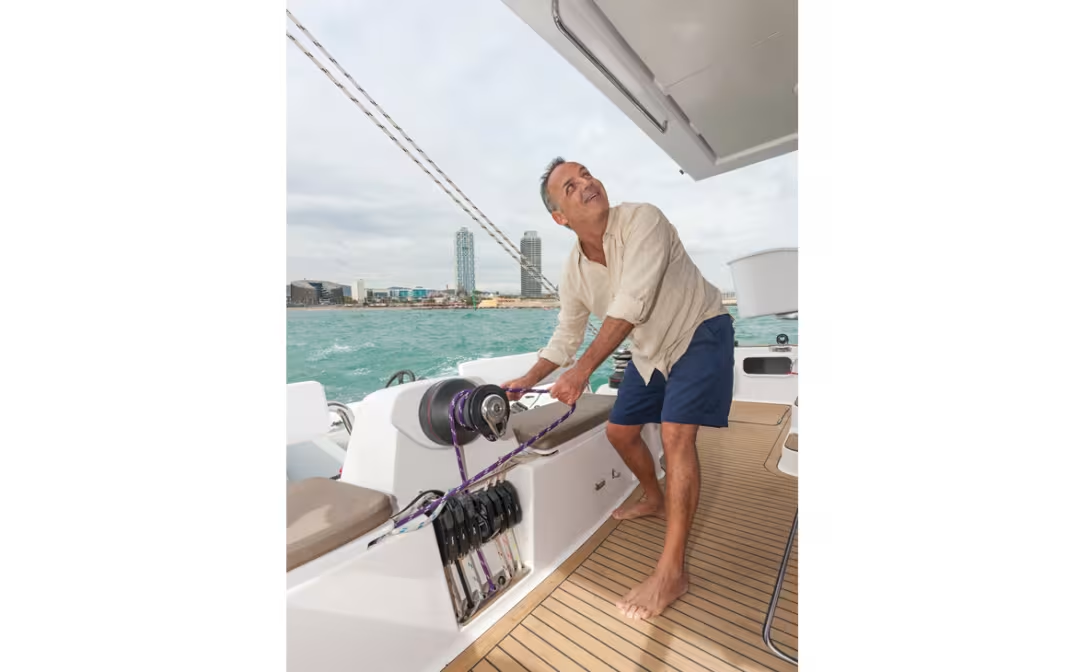
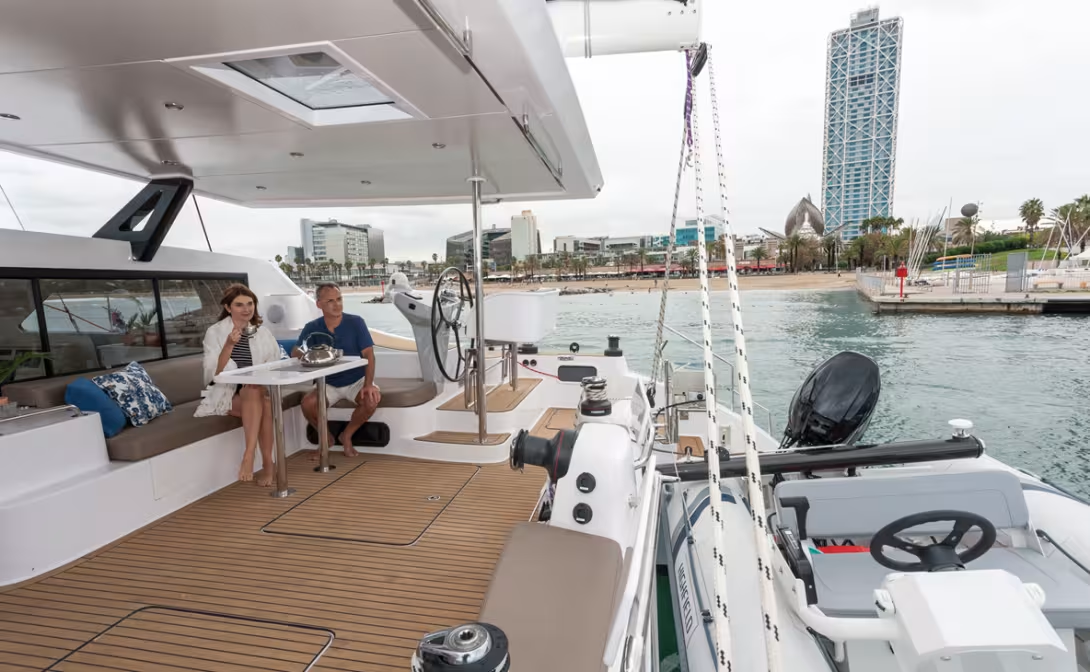
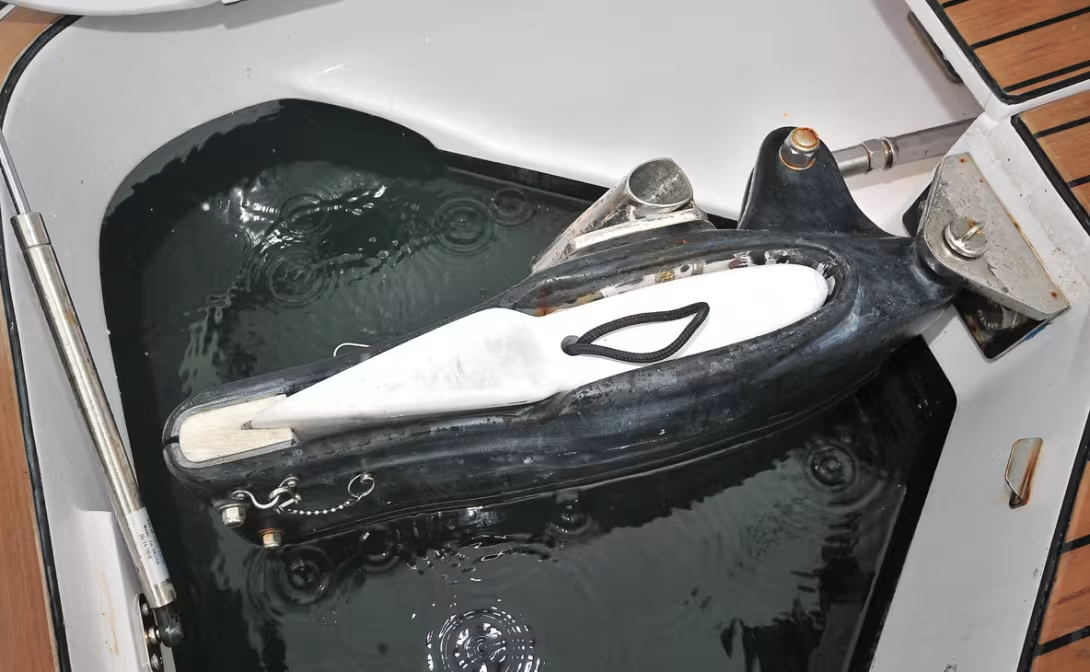
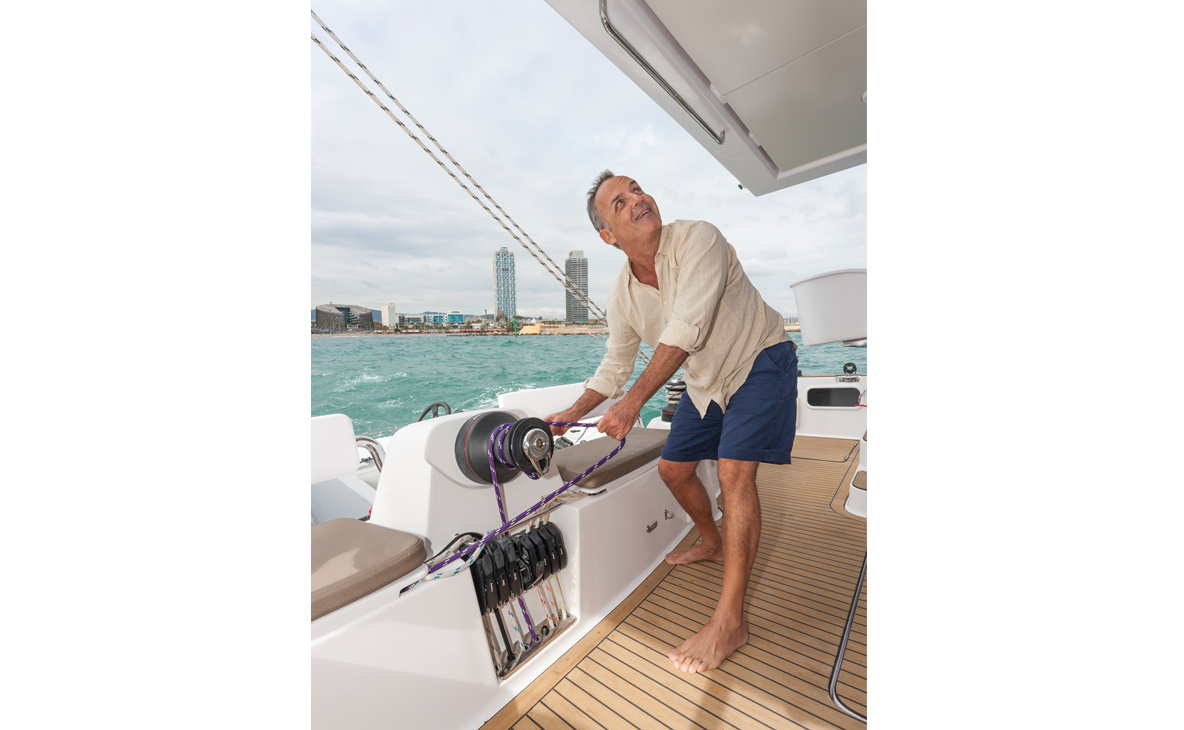
The Seawind 1600 is an owner's catamaran and this philosophy underpins all trade-offs, from the organization of the outdoor living spaces to the ergonomics of helm and sail handling stations. Despite very thin hulls forward, the decks are generous and fully flush, the side-decks are wide and the fixings for the lower shrouds (directly above the coachroof) facilitates passage forward or aft. The connection with the cockpit is well-designed, to great result. Little difference in level, perfectly sculpted steps; the forward-set positioning for the helm stations successfully incorporates this essential function into the deck layout and the very “wraparound” helm seats allow two people to settle down comfortably. A nice sun lounger is opposite, and the access to the top of the coachroof and the bimini is easy and safe. The gooseneck is very accessible and the boom is low enough for easy access when necessary, for hoisting, reefing or furling the mainsail, and the reefing lines and reefing pennants are clear and easy to use. As for the running rigging, the deck plan picks up on an idea popularized by Catana, with two mainsheet tackles and a central electric winch installed horizontally on the aft beam. This geometry makes it possible to conceal the mainsail halyard, the 3 reefing lines, the topping lift and the solent sheet in a ducting beneath the nacelle (via two 90 ° deck organizers) and to avoid any constraints at the aft face of the mast foot. Handling the beautiful daggerboards is done from the cockpit via a line driver (notched pulley with a winch handle socket) and the lines are concealed beneath the deck. The precision of adjustment and the softness of handling are quite striking. The Seawind is a proper daggerboard boat, which also involves lifting the rudders! This system is probably one of the most elegant, even if it does not allow for the appendage to be removed in the event of a collision: it slides up into a pivoting carbon housing connected to the magnificent helm system with rigid links (articulated on stainless ball joints). The parallelism can be adjusted. Just superb!
Interior: a vessel for full-time liveaboards
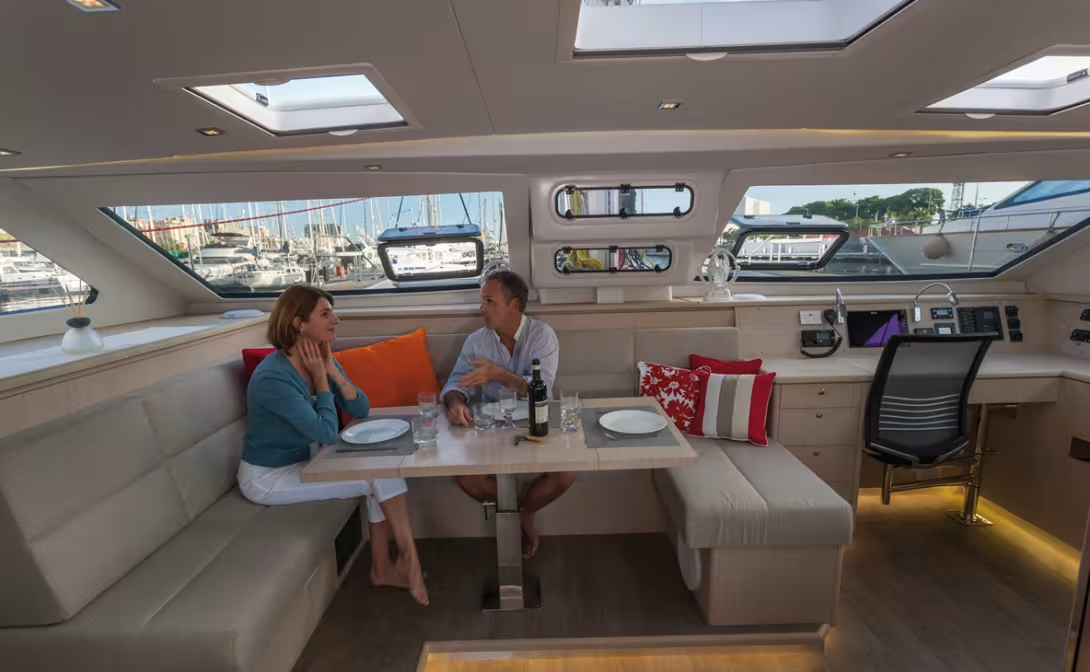
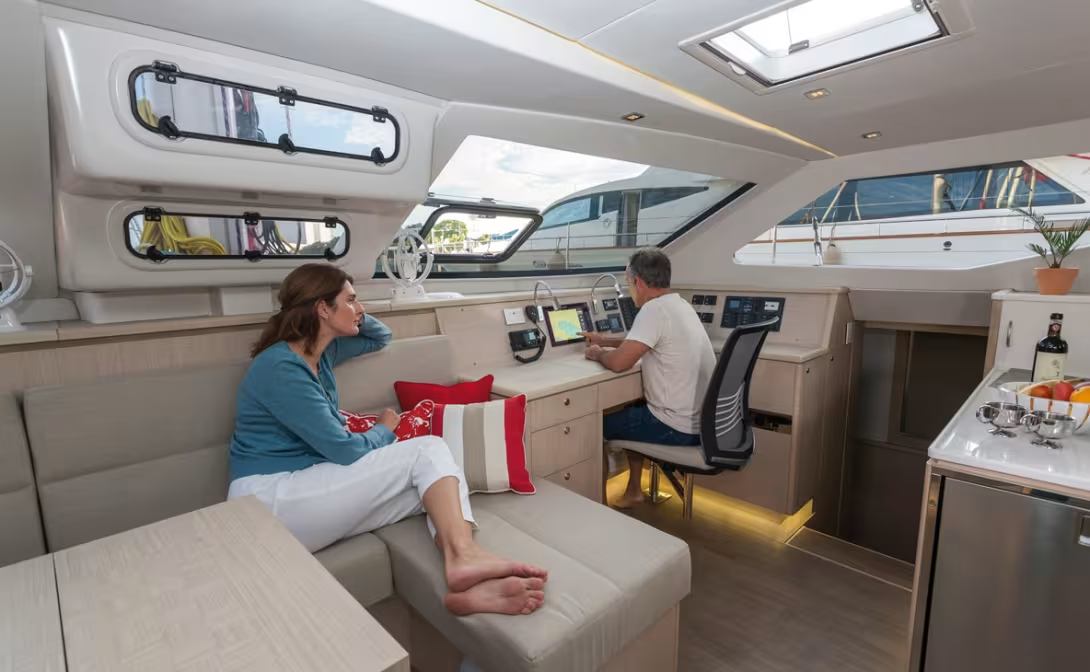
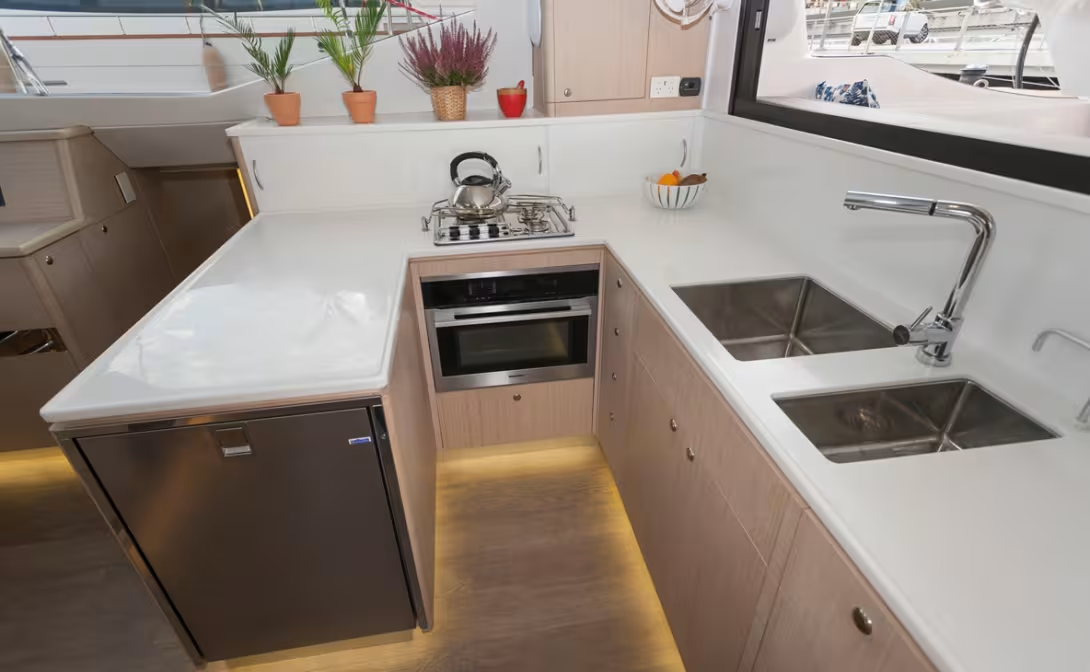
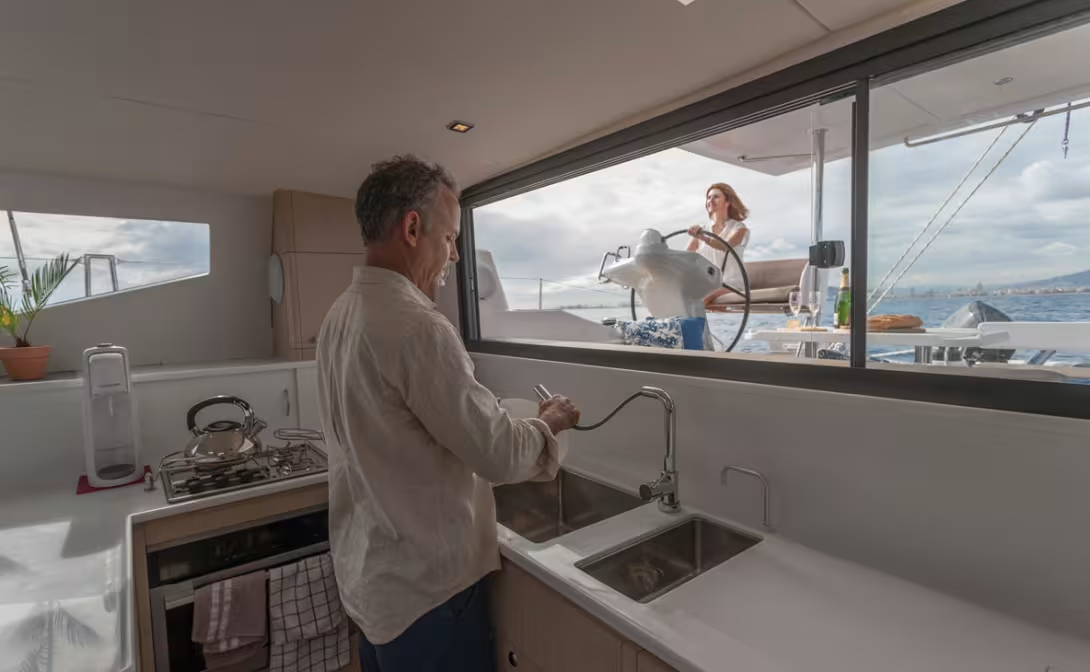
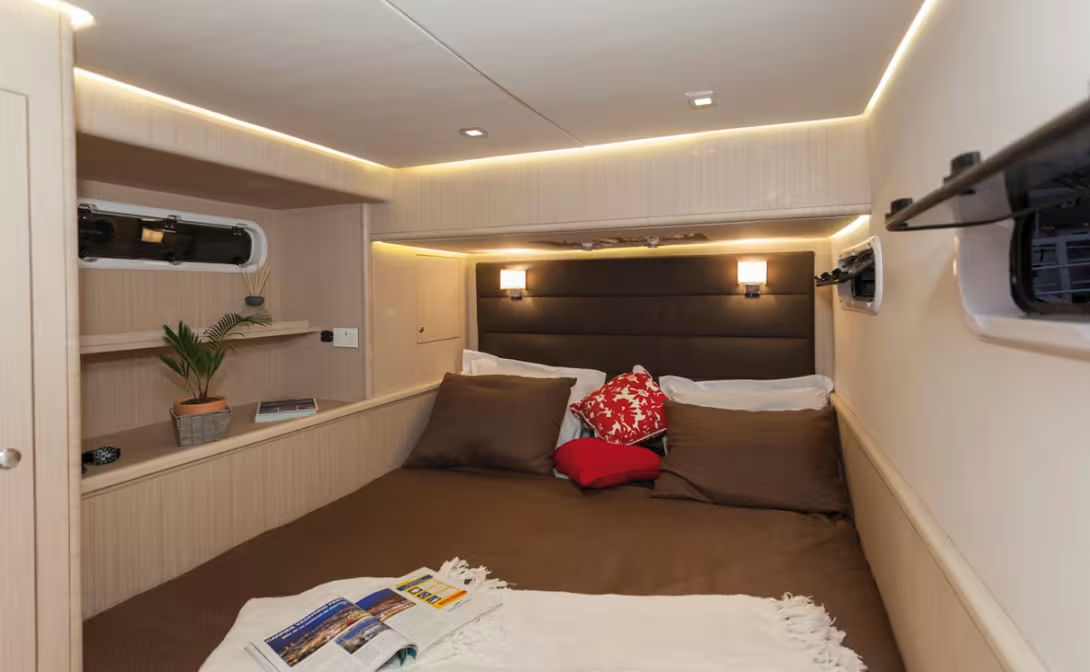
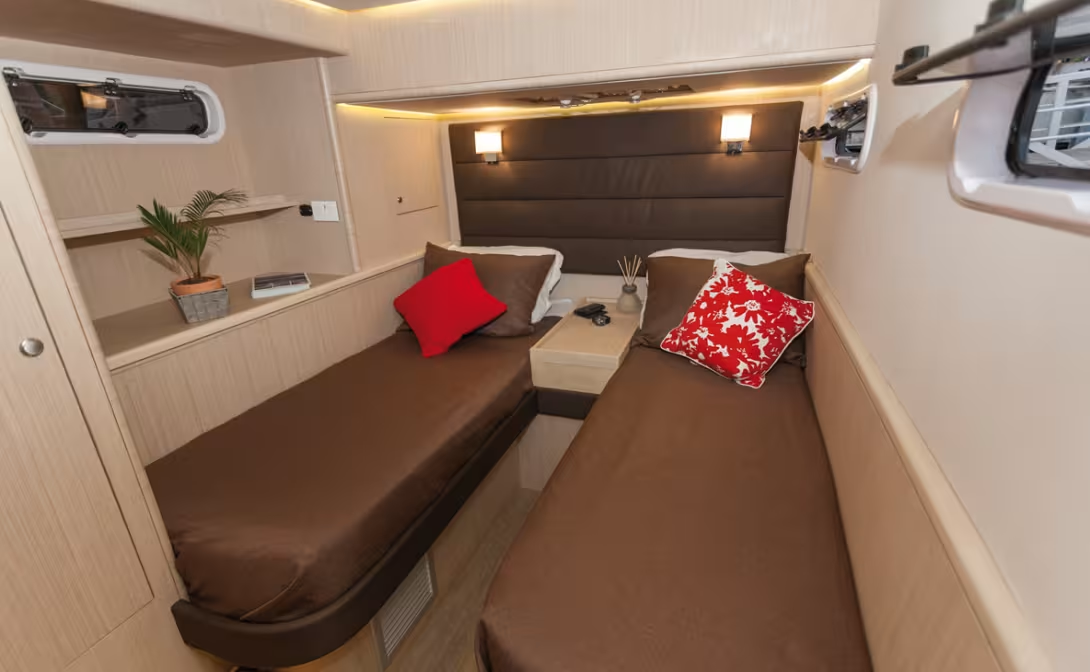
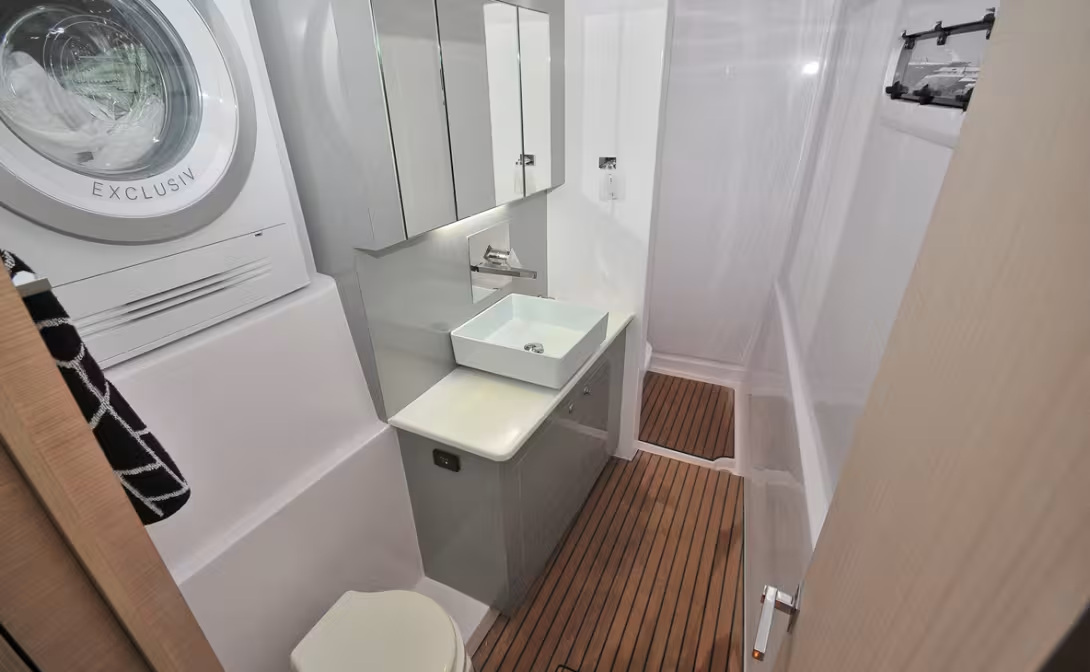
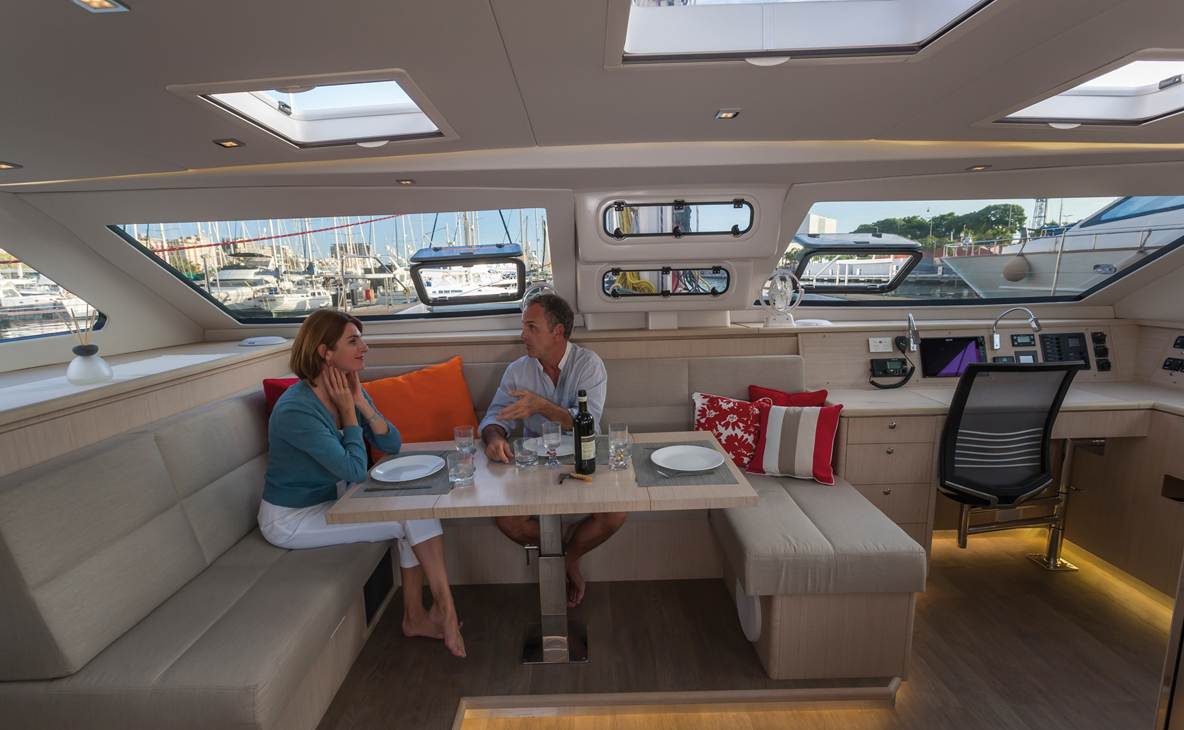
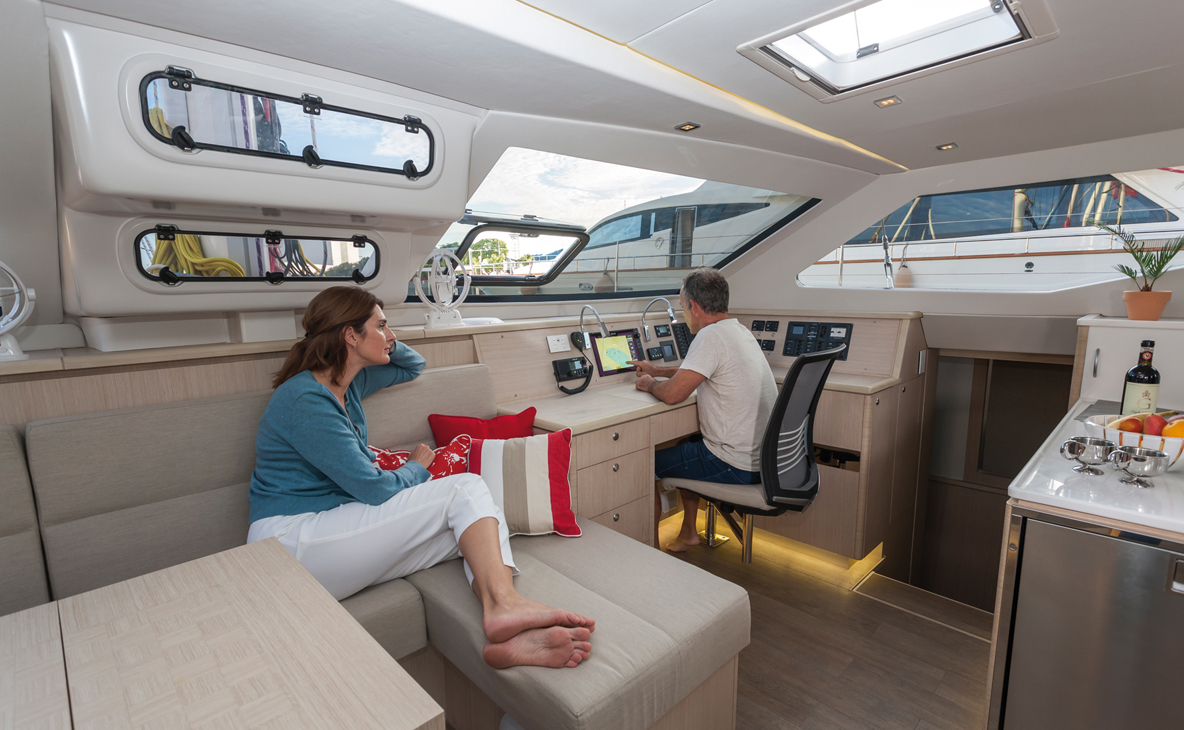
Contrary to the widespread trend of opening up and de-compartmentalizing spaces, Seawind and Reichel-Pugh have chosen a more intimate layout and accessibility. The cockpit and deck saloon are not flush-decked, allowing for a small area where wet boots or oilskins can be left. A sliding door opens to the inside, but it is not an opening bay window. The communication between the galley and the deck saloon (also smaller than many we are used to seeing these days), consists of 2 large sliding windows. This general arrangement bucks the contemporary ideas of perception of volumes and highlights the intimacy of separate, well-defined spaces, yet ones which are intelligently connected to each other in the spirit of sailing or for life on board for all climates. The day of my arrival, the Mediterranean weather nearly generated a flood, perfectly highlighting the relevance of these choices! The Seawind also gives pride of place to the galley, which is a good size, with an efficient layout, enviable worktop areas and remarkable light / ventilation. There are three chilled facilities: a large vertical refrigerator, a freezer and day-use fridge in the cockpit. The boat is also equipped with reversible air conditioning. The 1000W of solar panels, two high-output alternators and the generator will cater easily for these, thus making the catamaran fully autonomous. The cabinetry and upholstery are superb, and the abundant indirect light sources (LEDs) highlight a beautiful perception of quality, and a clean, functional style, creating an attractive atmosphere. The chart table is vast, and the dining table, which is convertible into a sofa, allows 4-6 guests to dine comfortably in this intimate area. The owner's hull houses a welcoming cabin with an island bed, a dressing table, a large wardrobe and a splendid bathroom in which is also housed the washing machine. The port hull is available in different versions (2 or 3 double cabins). Our test boat, in true owner’s layout, had a double and a twin cabin to adapt to different combinations of guests. An in-depth look at the technical aspects convinced me of the quality of the fittings and the care given to their installation, including the electrical set-up (battery rack, protected fuses, neat wiring, clearly installed circuit breakers, etc.), but also the high standard of composite work and the exacting overall finish.
Sea trial
The All Yacht Spars (Australia) lacquered aluminum fixed mast has two sets of spreaders, giving an excellent, simple and sturdy profile that allows for a generous Doyle mainsail (with Ronstan track and batten cars), a self-tacking solent secured to a stainless steel bridle which goes around the composite compression beam, a screecher (a small versatile gennaker) which can be attached to the end of the beam and an asymmetrical furling spinnaker on the telescopic bowsprit. It’s all smart and well designed! The clever helm console design remains fluid and elegant, and it can house multiple repeater screens or a dedicated chartplotter as required! The helming position is very pleasant and the large diameter carbon wheel is coupled to a remarkable rigid transmission (and a few small fine adjustments to the sensitivity will make this perfect). The window in the top of the bimini allows the mainsail trimmer to work without having to perform any contortions. The generous power of the 80hp Yanmars makes for easy maneuvering, and offers performance that only consumption will moderate (count on 8 to 9 knots as an economic cruising speed). Outside the One Ocean marina at Port Vell, the sea is visibly still stirred up from the SE blow during the night and the low sky is dotted with squalls: this makes for great test conditions. The 10-20 knots of wind will allow us to try out several combinations of headsails and mainsail. First off, I was struck by the excellent reactivity and the efficient way the boat slips along under one reef and the solent, with the wind not exceeding 15 knots. This measure seemed to me to be excessively cautious, but it was definitely the right canvas for changeable weather conditions. The hydrodynamic fineness of the hulls and the aerodynamics of the superstructure go some way to explaining the good results, but the well-managed weight and the good quality of the composite (stiffness) also play their part. Picking up again under full mainsail and solent, the Seawind displays an almost sporty temperament and especially shows nicely balanced movement in this confused sea. The catamaran remains alive in the choppy sea with the helm firm and sensitive. The ability to go through the waves is evident in the choppier parts, where the finesse of the bows is wonderful. Our test boat is loaded for long-term cruising with full tanks and provisions, yet remains alive and dynamic. Under gennaker at 110° in 15 knots of SE’ly wind and rough seas, we maintain a speed of 12-13 knots (the polar predicts 14.5 on flat seas and even indicates 23 knots in 30 knots true under main and solent). Close-hauled, the catamaran behaves well and tacks with ease, and is particularly comfortable in a formed sea at 70-80 ° off the wind, something which really stood out for me. The movement of the whole platform, highly damped by a favorable center of gravity (among other factors), contributes to a high level of comfort and a feeling of security. The boat is agile at all gaits and pleasant at the helm with a sensitive combination between the appendages and the sailplan.
Conclusion
The Seawind 1600 is a nice multihull that plays skillfully with current trends, yet which is forging its own path. Sleek aesthetics, build quality, justifiable trade-offs and being enjoyable to use constitute this newcomer’s main assets, establishing an original personality and identity.
TECHNICAL SPECIFICATIONS
Builder: SEAWIND CATAMARANS
Architects: John Reichel/Jim Pugh
Construction: Foam/glass/vinylester sandwich with carbon and Kevlar reinforcement in infusion
Length: 15.74m
Beam: 7.90m
Draft: 0.54/2.60m
Air draft: 22.80m
Laden weight: 13T
Mainsail: 95m²
Solent: 38m²
Screecher: 82m²
Asymmetric spinnaker: 161m²
Motors: 2x57hp (2x80hp Yanmar on our test boat)
Fuel: 2x340l
Water: 2x300l
Holding tanks: 2x60l
Basic price ex-tax: $ 859,000
Principal options in $ ex-tax
- Cruising pack: (boat fully ready to sail offshore: safety equipment, electronics, comfort, washing machine, solar panels, dinghy, spinnaker, 80hp motors, etc): 91 850
- Performance pack: (forward beam, boom, mast and spreaders all in carbon, fiber rigging and racing sails and electronics…): 186,980
- Watermaker: Spectra 54l/h: 11,775
- Screecher and deck hardware: 13,448
- Flexiteek cockpit: 13,000
- Lithium batteries: 11,185
- Fisher Panda 8kW generator: 19,992
MINUSES
Saildrives as opposed to propshafts
Huge rigid bimini
Solent sheet leads through the mast (compression and multiple angles)
Price of the Performance Pack with carbon mast
Pulpit offers little protection forward
Height difference between deck and trampoline
Preventer fixing on the boom (which holds the vang) could be a source of chafe
PLUSES
Superb hulls
Comfort and performance
Composite chainplates
Overall presentation, finish and profile
Appropriately designed for the program
Integral daggerboards
THE ESSENTIALS
Finely balanced design
An attractive model
Well-built
THE COMPETITION
|
BUILDER |
SWISS CAT |
BALANCE CATS |
PRIVILEGE |
DISCOVERY |
EXQUISITE |
|
MODEL |
SWISS CAT 48 |
BALANCE 526 |
SERIE 5 |
DISCOVERY 50 |
EXQUISITE 50 |
|
UPWIND SAIL AREA IN M² |
123 |
149 |
141 |
119 |
142 |
|
WEIGHT IN TONNES |
10.5 |
9.3 |
16.8 |
14.5 |
18 |
|
PRICE ex-tax |
€ 1M |
$ 1,299,000 |
995,000 devise? |
£ 995,000 |
€ 1.2M |
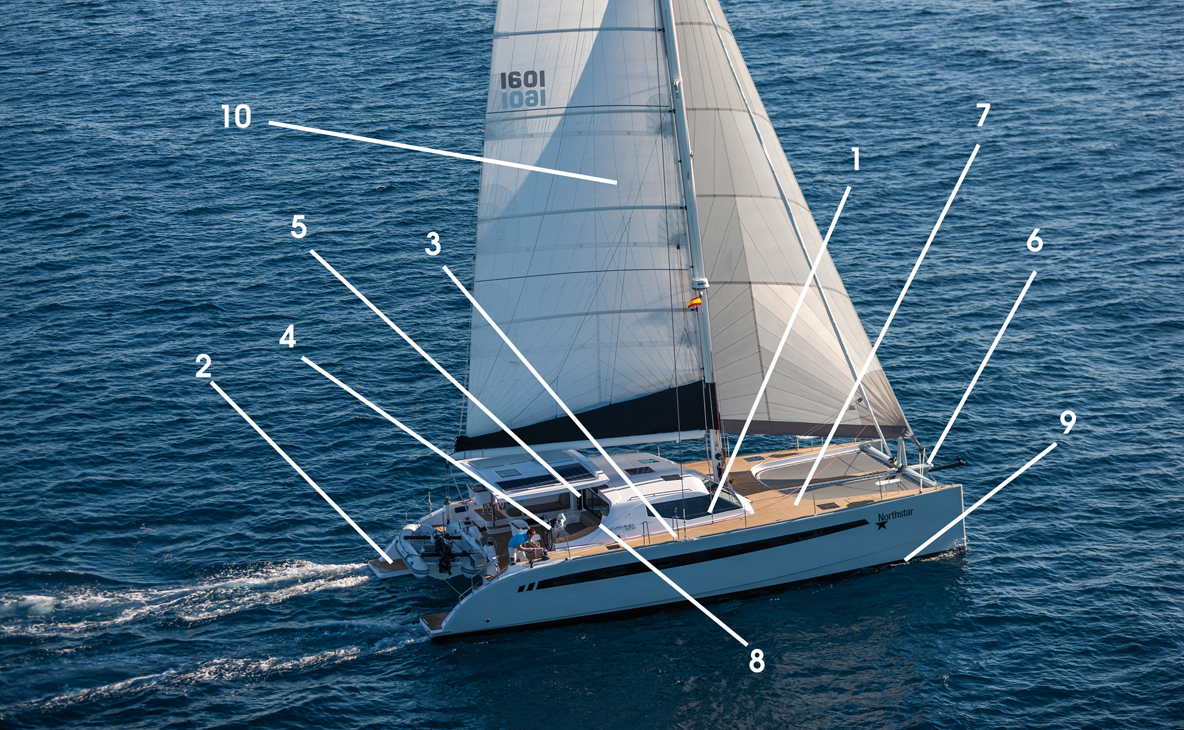
1: The daggerboard wells are centered in line with the coachroof with their movement taking place below deck. Their handling is excellent
2: The rudders slide in a hinged carbon housing which is very accessible from the sugarscoop. The S1600 is a real daggerboard boat!
3: Chainplates are composite (carbon)
4: The helm stations are set further forward than current trends: comfortable, secure and with perfect visibility
5: A single sliding door and large windows opening onto an outside dining area which is smaller than that of the competition clearly show the boat's program: full-time liveaboard in all climates with a small crew
6 : Carbon telescopic bowsprit and small balestron extending the composite compression beam, solent strap chainplate, with staysail possible. A neat design.
7: The Flexiteek-covered side-decks are pleasant under-foot and very ergonomic
8: The outdoor saloon (4/6 people) is very intimate, welcoming, and perfectly connected to the large galley. It can also be used as a watchkeeper’s berth
9: The fine hulls, the general aerodynamics and the centering of weight all favor very good performance
10: 95m² of mainsail and a good combination of headsails for a laden weight of 13t gives an interesting power-to-weight ratio!
