
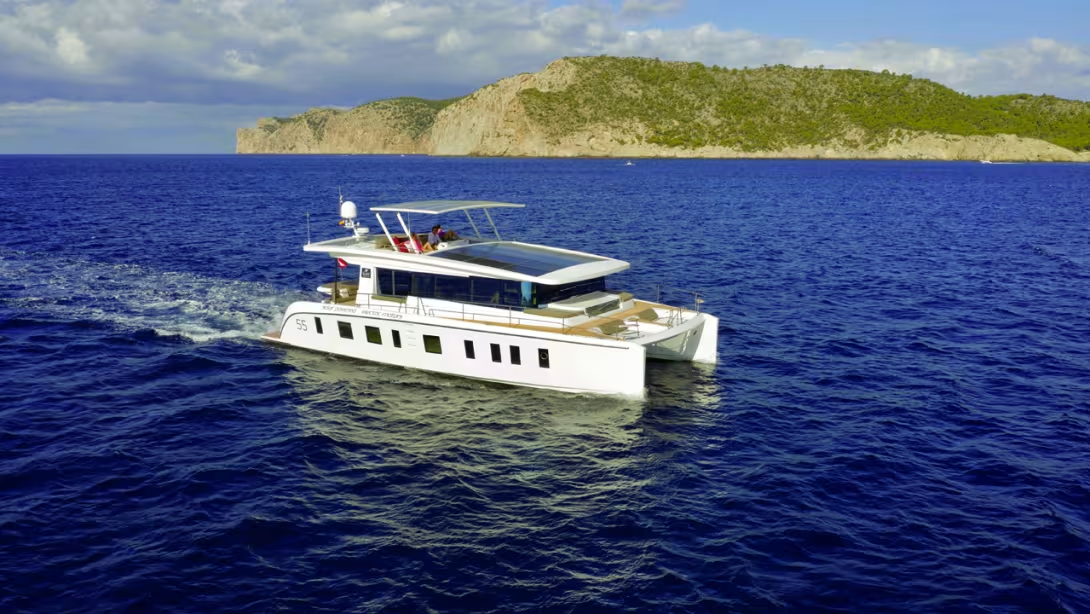
Over the past ten years or so, various multihull manufacturers have been trying out all-electric power - though they have been backed-up by a generator. Silent-Yachts is going one step further: they are the first manufacturer to offer a complete production range. We tested the smallest of their models, the Silent 55, in the warm waters off Majorca.
Infos pratiques
- Le chantier : SY 55
- La fiche technique
- Découvrez notre vidéo exclusive
- Financez votre Silent 55
- Assuez votre Silent 55
- Articles autour du Silent 55
Not a sound, almost no vibration or wash created, zero fumes... an electric multihull has a magical air to it! At the helm is Michael Kölhler: following ten years of testing in almost every sea and ocean in the world and the construction of a one-off catamaran (the Solarwave 46), this pioneering sailor launched the Solarwave 64 and then his Silent shipyard. A complete range (Silent 55, 64 and 79), with at least 10 models already completed... but what is so special about Silent? From the outside, not much distinguishes them from other catamarans in this category. They have a modern design, with large glazed areas, and apart from the impressive square footage of solar panels that cover the coachroof and T-Top, there’s nothing very new. It's inside the hulls where there’s a difference. The Silents are fitted with electric motors powered by a very large lithium-ion battery bank – which will be even bigger aboard future models. At a time when all car manufacturers are producing their ranges of hybrid and now all-electric vehicles, the idea of using this technology on board a boat is very relevant. First of all, because the quality of the equipment on offer - electric motors, solar panels and, above all, batteries - has changed considerably in recent years. Then because a boat allows for the installation of a large surface area of solar panels – this leads one to wonder why the roofs of electric cars are not (yet) fitted with them...? The choice of a catamaran was dictated by three factors: greater comfort for the same length, reduced drag - especially at low speed - and more surface area available for solar panels.
One catamaran with multiple versions
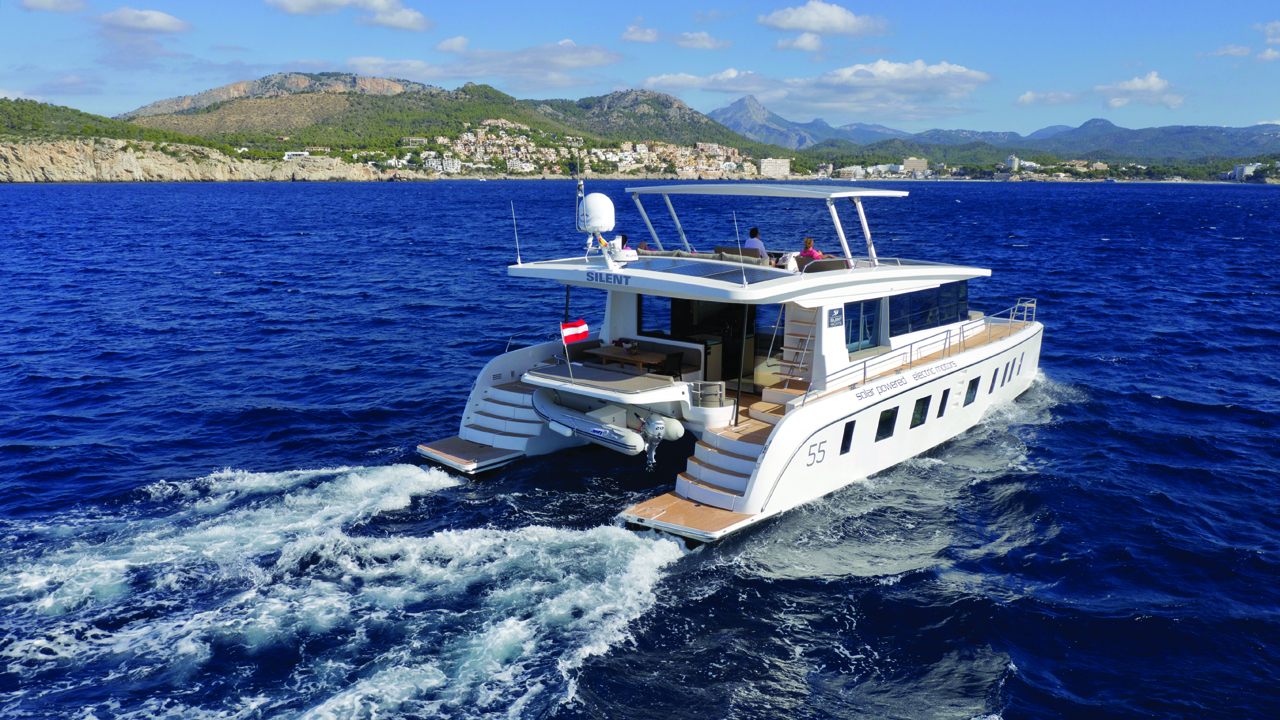
While the basic version of the Silent 55 is indeed a catamaran equipped with two electric motors, the manufacturer is also offering this model with many engine options in terms of power and configuration: two 220 hp regular internal combustion engines (but still with two 14 kW electric motors) or fully rigged, for sailing enthusiasts. Our model we tested can be described as a long-range trawler/ That is to say, its characteristics - and among other things its fuel capacity increased to 1,735 liters (460 Us gal) - allow it to cross oceans. On the current market, few powercats under 60 feet are able to propel themselves for nearly 3,000 nm (a crossing from the Canaries to the Caribbean for example is around 2,700 nm). The Silent 55 offered here is the E-Power version, equipped with two 135 kW electric motors - compared to 30 on board the basic version. A version with 2 x 250 kW is also available. Obviously, increasing the power by a factor of 8 radically changes the behavior and performance of the Silent 55...
After one Solarwave 64 built in Turkey, this catamaran is now currently being built in China - the next models should soon be produced in Italy.
Generous sunshine required
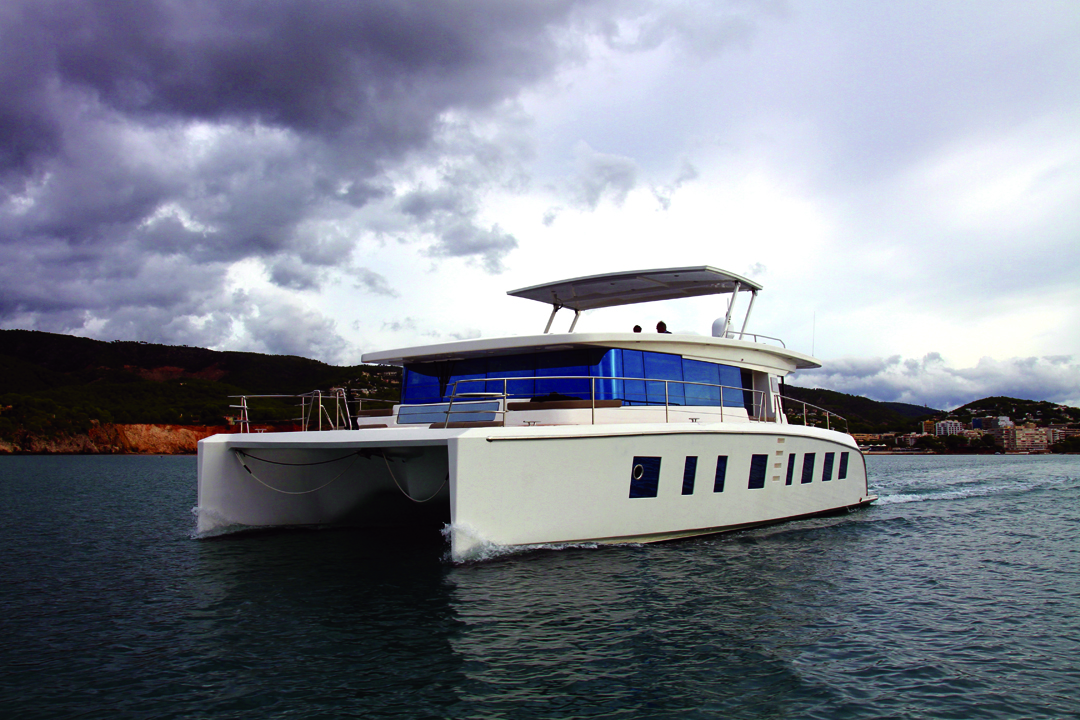
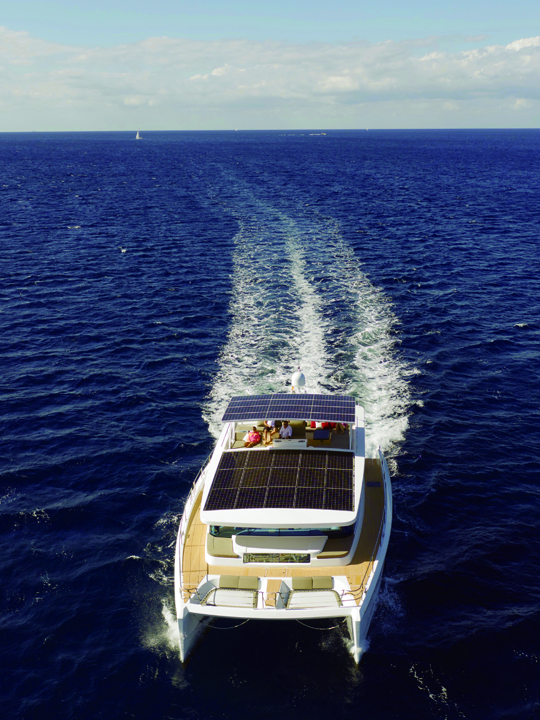
The construction uses foam sandwich and carbon reinforcements to make the structure as rigid as possible. The insulation - thermal and acoustic - has been particularly well taken care of. On deck and inside, no suspicious squeaks or creaks. Electricity production is provided by 18 solar panels. At full efficiency, they reach almost 10 kW. But be careful... firstly, at night, they don't produce anything. Then, on cloudy days, not much. The horizontal panels will be particularly effective under the zenithal rays of the solstice (June 21) of the temperate regions of the Northern Hemisphere - from 11am to 5pm, the time when we’re wearing sunscreen and a hat... The same or better under tropical skies. On the other hand, under a pale winter sun that’s struggling - when it is there - to rise more than 20° above the horizon, the yield will be very poor. So, the zero-emissions concept is sustainable... in the sun! The manufacturer obviously allows for a powerful 100 kW generator (with an hourly consumption of about 30 liters/8 Us gal.) A complex and automated electrical installation allows intelligent management of energy production and consumption; a display panel provides all the data and the system starts the generator as soon as there is too much load on the (70 kW/h at 48V) batteries.
10 knots flat out, not the 14 that were promised…
The torque from these two 135 kW electric motors is pretty impressive! A simple push on the joysticks, and the reaction is immediate. No need to wait until you’re in neutral for the engine to slow down, like a combustion engine: you can do a succession of shifting from ahead to astern and back, and we played with both engines to rotate on the spot... a real game of docking maneuvers! Once in open water, we set our speed at 5 knots. At this speed, subject to optimal sunlight, there is no electricity consumption - i.e. the solar panels recharge what the motors consume. So, at this speed, very long passages would be possible. But of course, we couldn’t resist (in the context of our boat test) to push the joysticks! The verdict: 10 knots, no more... it’s the propellers that are responsible, according to Silent-Yachts, for the 4 knots that separate us from the theoretical performance tables. The most powerful electric motors promise 20 knots. In any case, our 10 knots aren’t really compatible with the boat's zero emission concept: at this speed, the batteries only last two hours. The generator would therefore quickly have to kick in, allowing us, with the optional tanks of our Silent 55 (1,735 liters / 460 US gal. in all), a reduced range of 800 nm. The game is rather to exploit the weather - to avoid waves and headwinds - and even to lower the T-top in these conditions to reduce windage. Of course, there’s no need to mention the pleasure of helming - the autopilot quickly takes over. However, the visibility from the flybridge helm station is excellent - the same goes for the main helm station. And the few wakes we crossed, without excessive pitching or slamming, showed well-designed hulls - with a gull-wing nacelle bottom - and a judicious centering of weight.
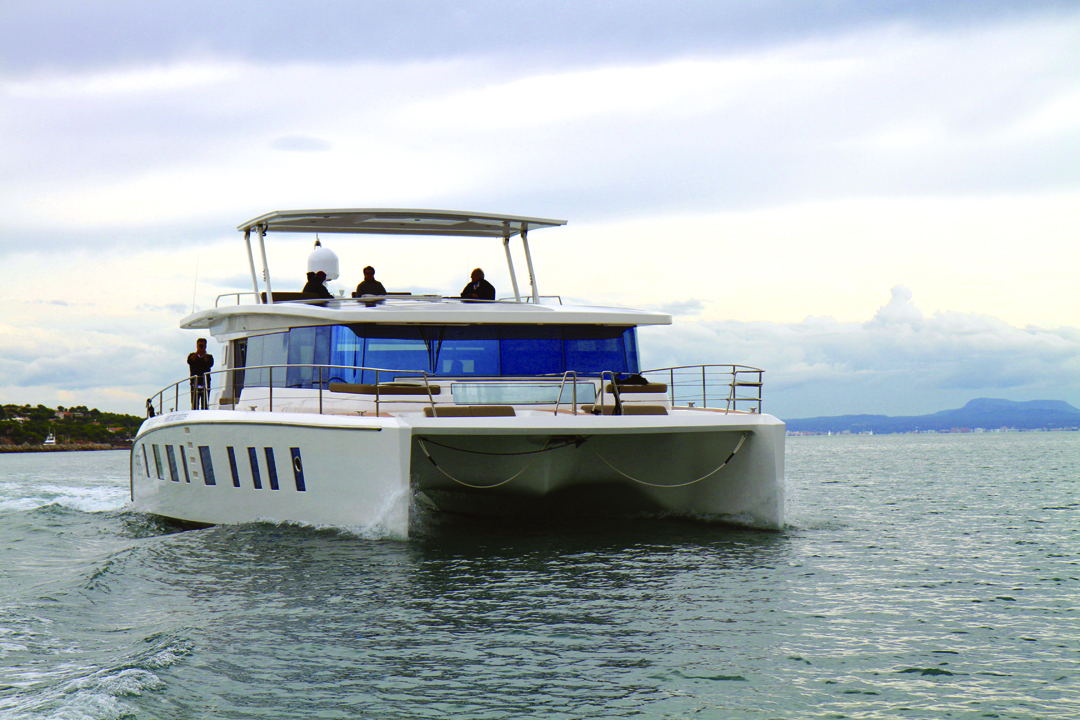
A deck layout dedicated to relaxation
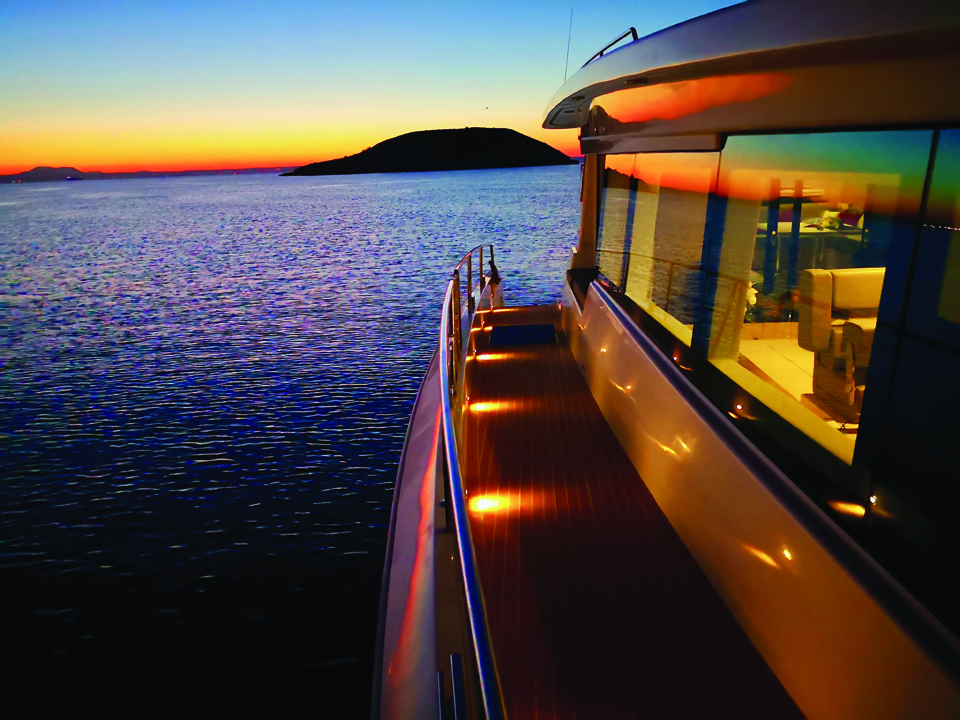
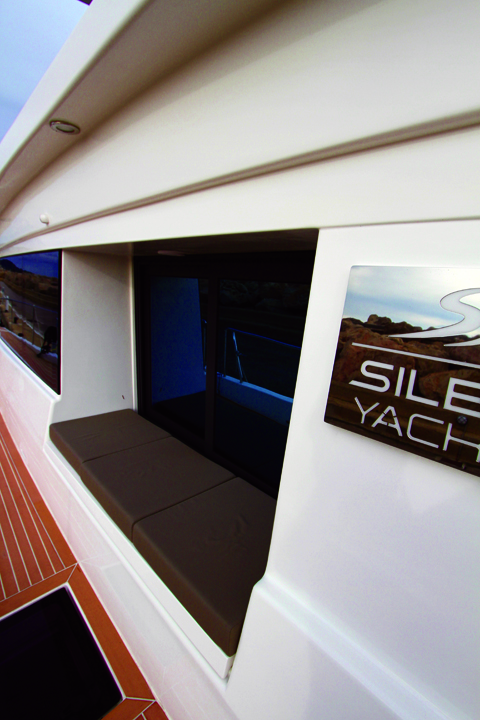
The main interest of a catamaran, in addition to the low drag, is the width the platform offers. The nacelle can therefore sufficient space for moving around without impinging on the living area. Passage forward along the side decks is all the more secure, with the stainless-steel rail that surrounds the deck, which is itself bordered by a large bulwark. Forward, the opening in the guardwires makes it possible to manage anchoring operations as well as possible. The cockpit, perfectly protected by the flybridge deck, offers a table offset to port, numerous seats and two direct accesses to the sea thanks to wide and well-designed sugarscoops. A suspended sun lounger cleverly hides the davits for the dinghy. Recesses in the nacelle offer original seating. The foredeck, between the hulls, offers two sunbathing areas that extend onto the trampolines. As for the flybridge deck, which is easily accessible, it offers, in addition to a large rear sunbathing area, a long L-shaped bench seat and another table.
XXL-sized saloon and 3 to 6 cabins
Inside, the owner has a very big choice when it comes to layout, since the Silent 55 can be fitted with 3, 4, 5 or even 6 cabins. The first three of these versions house a huge master cabin (more than 7 m / 22’ wide, including a bathroom) with a queen-size bed. Obviously, this exceptional width is directly linked to the catamaran’s configuration. The version presented here is the 4/4 - including four cabins and four bathrooms. The 40 m² (430 sq ft) living area includes the galley, which adjoins the cockpit, the saloon (comfortably designed for 8 people) and the helm station/navigation area. The latter two are slightly elevated. There’s an unobstructed panoramic view, thanks to the wide openings, very wide access, on the same level to the cockpit and 2.09 m (6’10”) headroom. Although sometimes an imperfect finish, the materials used are flattering - leather, Alcantrara, hardwoods and stainless-steel. In each cabin, the ventilation is well thought out - even though reversible air conditioning is part of the on-board inventory. The headroom remains generous with more than two meters (6’6”) throughout. USB and 220 V sockets are everywhere. At night we enjoyed the lighting that skillfully exploits the LEDs, creating a warm atmosphere. Are you ready for a transatlantic in slow mode?
+
Option to sail without emissions
Ease of maneuvering thanks to the torque of the electric motors
Many versions of engines and accommodation
-
Very short range above 8 knots
Perfectible finish
Very attractive deck layout both under way and at anchor
Technical Specifications:
Builder: Silent-Yachts
Overall length: 16.70 m (54’9”)
Waterline length: 16.52 m (54’2”)
Width: 8.46 m (27’9”)
CE light displacement: 17.2 t (37,900 lbs)
Draught: 1.20 m (4’)
Construction: glass/PVC sandwich and carbon reinforcements
CE Certification: A 12
Standard motors: 2 x 30 kW electric (2 x 135 or 2 x 250 kW optional)
Maximum speed: 10 to 20 knots depending on the version
Solar panels: 9,000 W
Generator: 100 W
Lithium-ion batteries: 750 Wh at 48V
Fuel: 500 to 1,735 l (130 to 460 US gal)
Water: 500 to 1,000 l (130 to 260 US gal)
Price: € 1,390,200 ex-tax with 2 x 30 kW electric motors
Main options of the model tested:
Retractable T-top
Leather interior upholstery
TV system in the saloon and all cabins
Cockpit table and chairs in teak
Carbon bridgedeck table
Reversible air conditioning
Watermaker
Dishwasher
Washing machine
Outdoor LED lighting
Raymarine Electronics
A word from Michael Köhler, CEO of Silent-Yachts
-"I am convinced that the catamaran market (sail and power catamarans) will continue to grow as it has in recent years, as more and more customers appreciate the capabilities of this type of boat. At Silent-Yachts, we have developed a brand-new concept that is more attractive than either sailing catamarans or motor catamarans. We combine the best of both worlds. Our boats allow you to cruise in absolute silence, with no emissions and without having to worry about possible problems with sails. At the same time, they are as comfortable as motor yachts with a lot of volume on board. But the owner, thanks to our innovative propulsion, is no longer forced to continually monitor fuel levels and maintenance. I think this is the future of yachting."
