
When we first saw the Slyder 49 at the International Multihull Show in 2019, my curiosity was aroused, and to be honest, a great deal of interest too. Testing this catamaran a few months later in excellent wind and sea conditions confirmed my first impressions.
Infos pratiques
- Le chantier : Slyder 49
- La fiche technique
- Découvrez notre vidéo exclusive
- Financez votre Slyder 49
- Assuez votre Slyder 49
- Articles autour du Slyder 49
Brilliant comeback
The Slyder brand first made a name for itself with a beautiful 47-foot catamaran built in Fano, Italy in a reputable shipyard - under the leadership of a Swiss master of composites, Christian Paulitsch. The design bears the signature of Yacht Design Collective (François Perus-Romain Scolari, already at the origin of the very successful Ita 14.99 and Corsair 8.80 - without forgetting the promising Swiss Cat 55). The ups and downs of their industrial adventure determined otherwise: after several boats had been delivered, the company ceased activity. But for Markus Kuhner, a connoisseur sailor and willing entrepreneur, the Slyder adventure couldn’t stop there. He set about completely redesigning the catamaran and her equipment, including the build methods.
Construction at the highest level
Markus has clearly decided to set the bar very high, by setting irreproachable quality standards. He has surrounded himself with the IYacht engineering firm for the design and has entrusted the manufacture of the Slyder 49 to Mazarin, a Chinese yard located on the outskirts of Qingdao. This ultra-modern plant is capable of building 100-foot superyachts, sailing monohulls over 70 feet and multihulls from 50 to 60 feet. Established in 2002 as the result of a company merger with the German group Neptun Shipyard (160 years of shipbuilding history), this site of over 10 hectares has its own port, state-of-the-art equipment, first-rate machine tools, and has long mastered the use of carbon in yachting. The transfer of skills between the German and Chinese teams is part of the company's culture, and both know-how and quality requirements are at the highest level. The factory is certified by Lloyds and has delivered all fourteen of the 70-foot Clipper Round the World Race yachts.
Distinctive architecture and silhouette
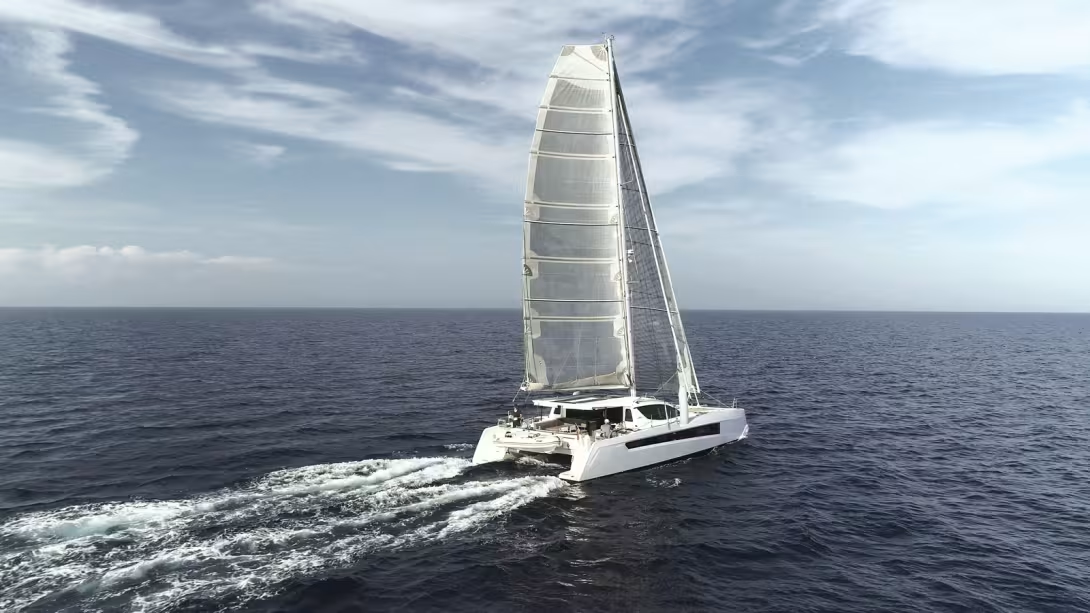
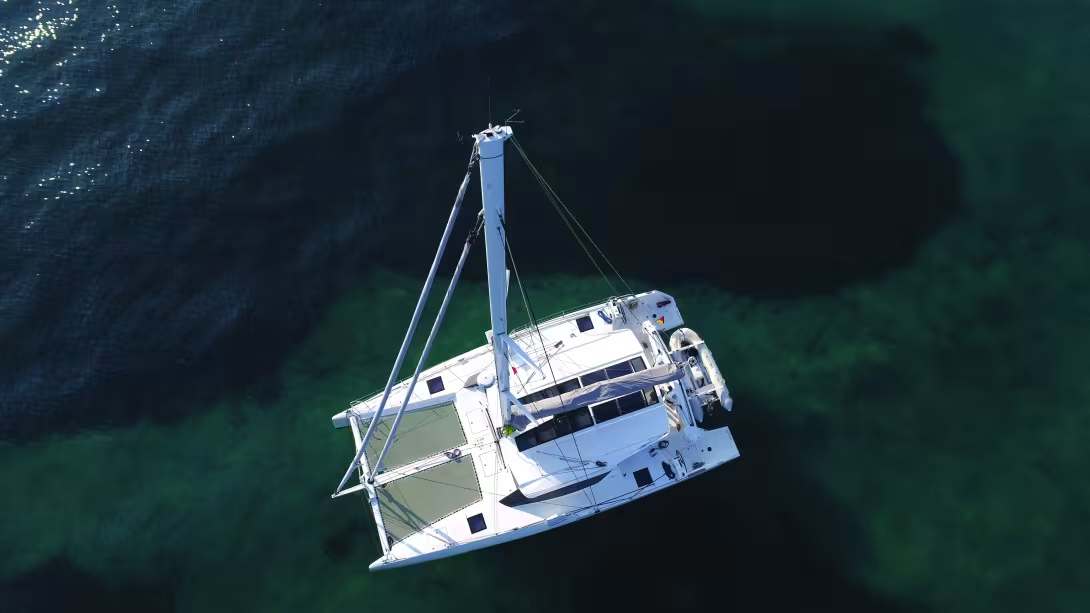
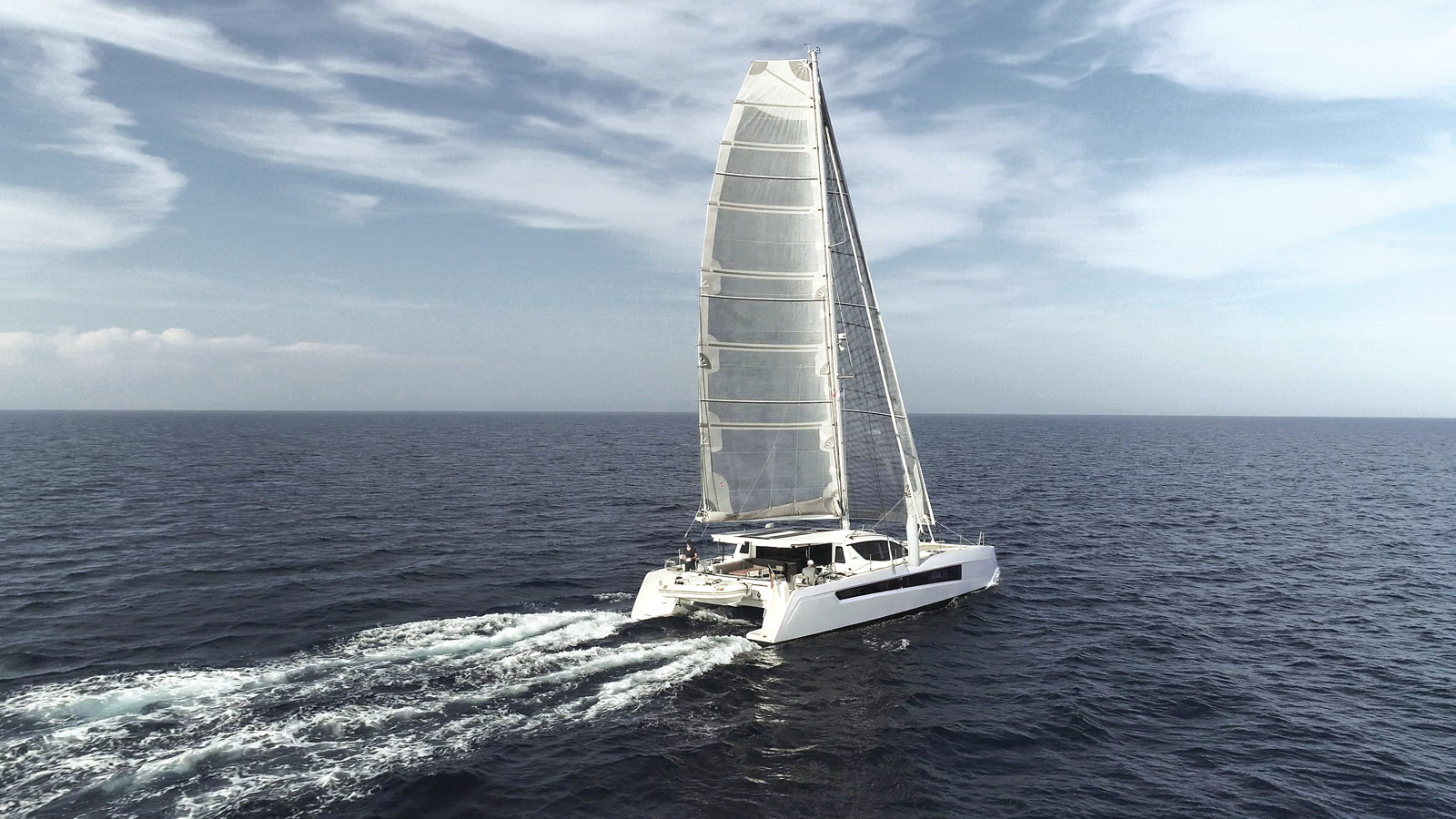
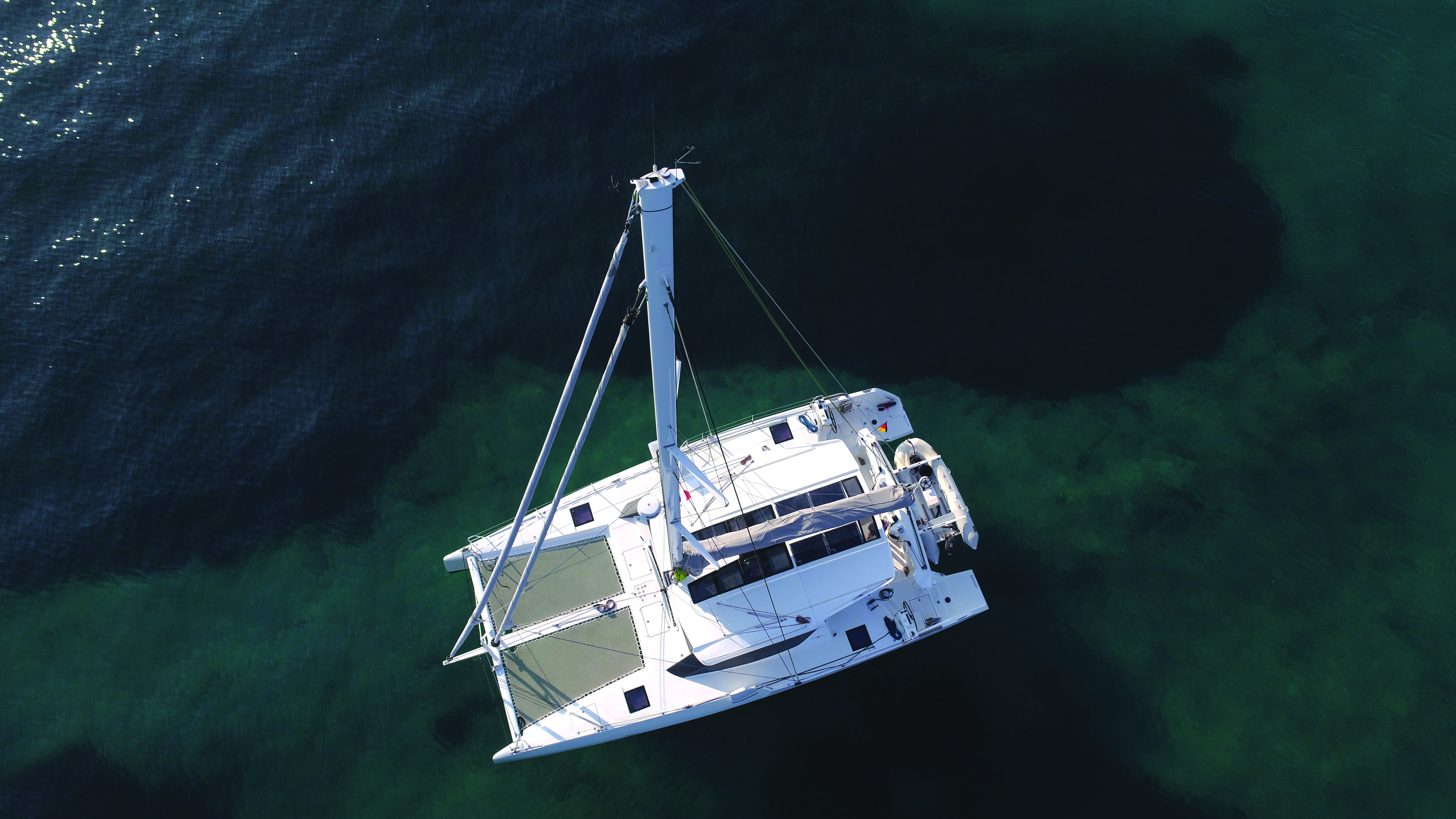
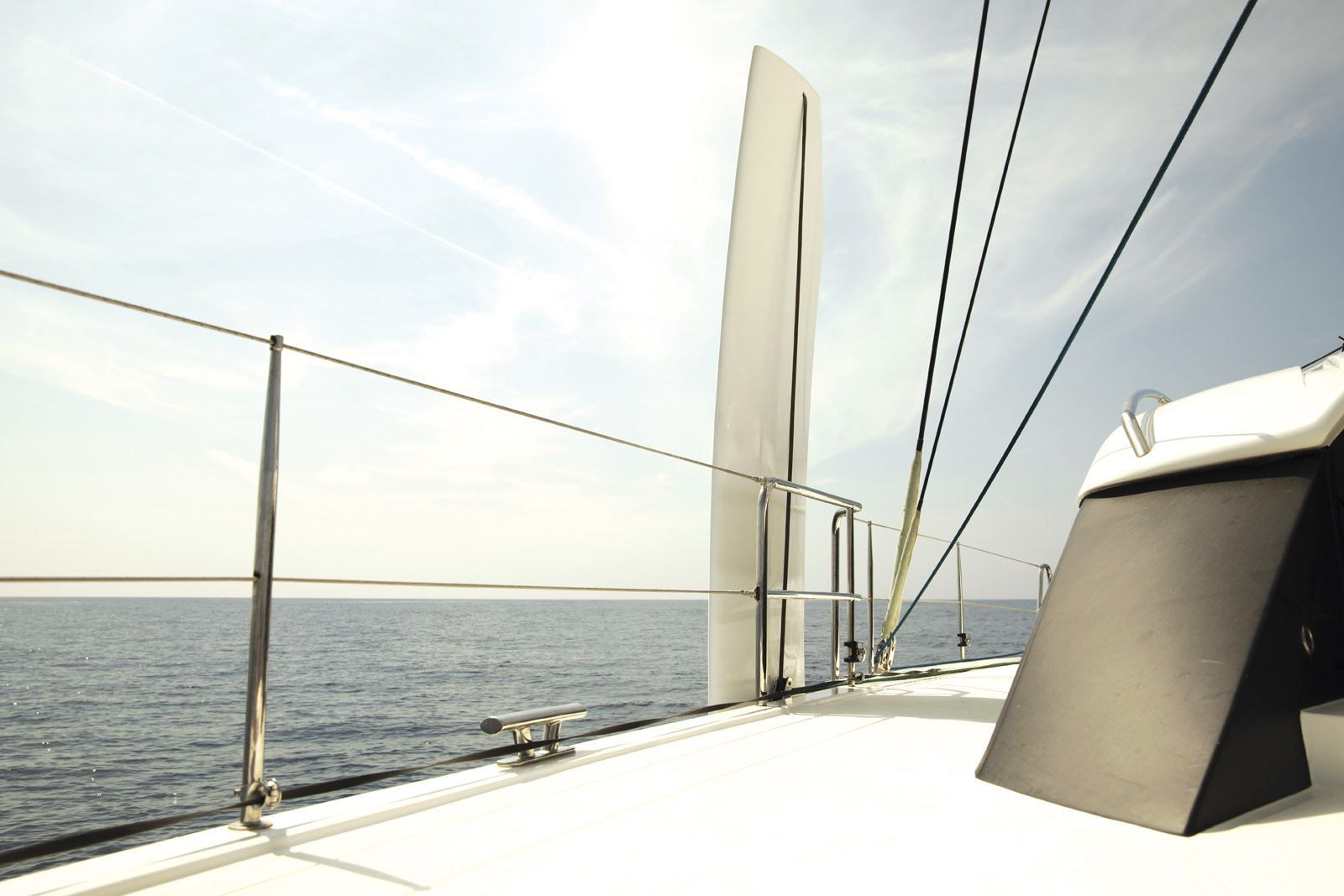
The standards of cruising catamaran design are now fixed around a box-rule which is only evolving bit by bit, as the leading builders have, through their commercial success, built up their brand image and the concept. So it’s quite difficult and even risky for a builder to try and escape this box-rule in terms of design. However, some succeed, and this is the case with the Slyder 49. The silhouette has retained the elegance of her predecessor, the 47: sporty overall lines, aerodynamic coachroof, modern and generous sail plan. The hulls are distinguished by beautifully designed topsides that elegantly break the codes without torturing the construction. The main elements (an upper rib, reveals for the portlights, the bows, and finesse of the daggerboards) make her more attractive than most of her competitors. The quality of manufacture is reflected in the visual perception thanks to the superb paintwork: the catamaran catches the light magnificently. The high bridgedeck clearance promises good performance. As for the slightly asymmetrical axis of the hulls, this provides the small advantage of camber when the sails are loaded up. The hydrodynamics, superb to the eye, benefit from the qualities of a light platform - our test multihull is a super-equipped demonstration model, with many options and is consequently a tonne heavier, but a reasonable specimen should come in at around 11 tonnes laden displacement). The quality of the infused sandwich is excellent in all accessible corners - this catamaran is certainly very stiff.
.jpg)
Welcome aboard
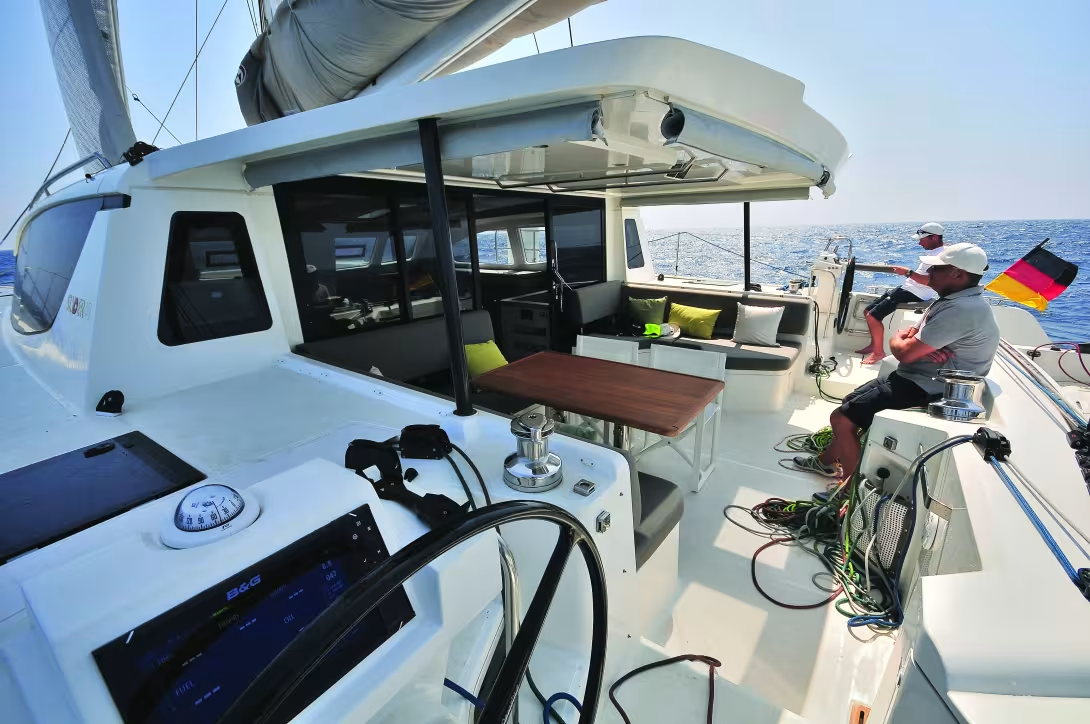
Let's start with the superb cockpit: beautiful lounger to starboard, outdoor table for 6-7 people and composite folding chairs with the most beautiful effect (and they’re comfortable!). The open sugarscoops facilitate both arriving at the boat in the tender, and also climbing back aboard using the integrated swim ladders. These waterborne leisure-platforms are a comfort feature that all manufacturers nowadays treat with the greatest care. The fabric cockpit enclosures are cleverly installed and are quick and easy to handle. In the panoramic nacelle, the magnificent grained oak composite flooring contrasts elegantly with the light-colored woodwork adorned with pink shades. The assembly is of the highest standard. The marine hardware, as with the galley fittings and the electric controls, has been carefully selected. Wherever you look, quality is evident. In our three-cabin version, the port hull is largely open, thanks to the curved daggerboard wells that don’t intrude into the passageways. Privacy is maintained by a clever sliding door. The 200 x 160 cm (6’7” x 5’3”) bed is very accessible. As for the headlinings, they create the most beautiful effect, and the bathroom is as good as you’ll find today.
A successful (and dynamic) test!
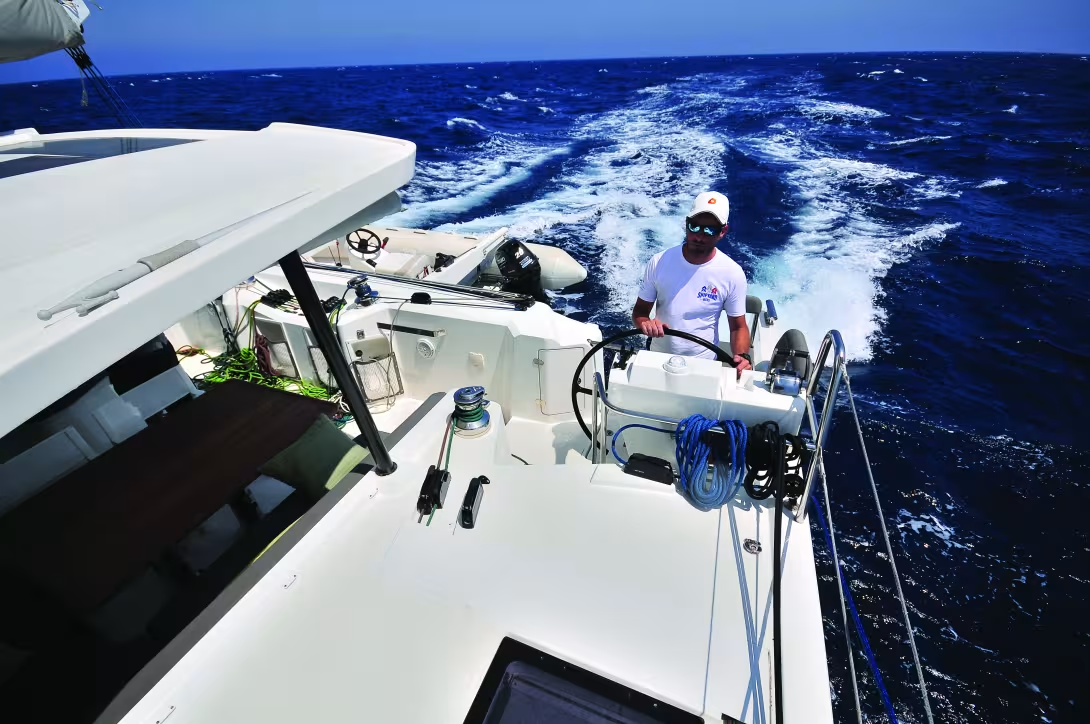
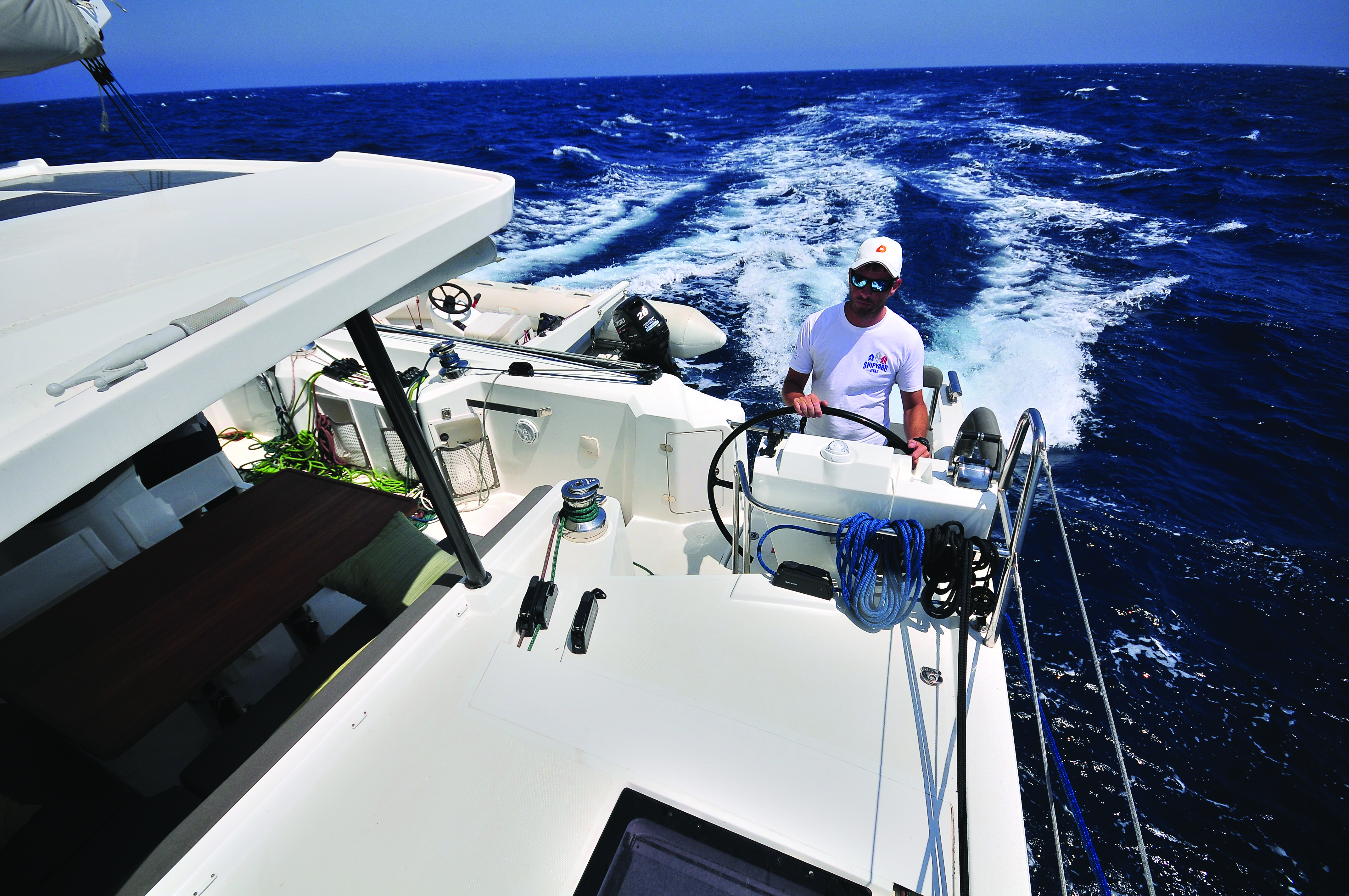
Our test Slyder is rigged with a fixed aluminum mast with two sets of spreaders and quality membrane sails. The catamaran has been well set-up by BMS in Canet-en-Roussillon and immediately shows an obvious maturity. The engine drive is perfect (beautiful installation and soundproofing), all the hardware works wonderfully. The 90 m² (970 sq ft) mainsail is hoisted with one reef as the wind is irregular out of the NW, blowing between 18 and 28 knots. With the solent unfurled, the catamaran immediately takes on her cruising speed while reaching in a short, choppy sea. I know these waters well and am in admiration of the Slyder's behavior in these conditions. The course-keeping and the comfort felt are surprising, the speed (always over 10 knots) and the trim of the catamaran astound me. The course stability is perfect. In spite of her beautiful power, the 49 remains very tolerant and reassuring, even under the strongest gusts. The control of the sails highlights a perfectly thought-out and realized deck plan: everything is oriented towards simple and readable ergonomics. The position of the mainsail clutches in the aft beam, the orientation of the excellent Andersen electric winches, the exacting choice of each line diameter, and the quality of the sailing maneuvers show a concern for perfection that I really appreciate. We hesitated to hoist the gennaker in these conditions, and our top figure of 13.3 knots remains well below the real potential of this catamaran. For me, the strong points that emerge from the test are the ease with which she goes through a sea, the smoothness of movement and the high average speed. Thanks to the magnificent Jefa rigid steering transmission and the quality appendages (curved daggerboards and rudders), the helm control is perfect.
Conclusion
A really good find! Beautiful design, proper performance for fast cruising, quality of manufacture, above average production fittings and equipment: here is a successful catamaran that rises above the standards of her competitors.
Technical Specifications
Builder: Slyder Catamarans
Naval Architect: Iyacht/Henn Design
Shipyard: Mazarin German Yachts
Construction: glass/carbon/vinylester sandwich in infusion (Kevlar© reinforced bows)
Length: 14.95 m (49’)
Beam: 7.68 m (25’2”)
Draft: 1.10/2.20 m (3’7”/7’3”)
Bridgedeck clearance: 0.92 m (3‘)
Mast height: 19.50 m (64’)
Air draft: 22.80 m (74’10”)
Light displacement: 12.1 t (26,675 lbs)
Upwind sail area: 142 m² (1,530 sq ft)
Mainsail: 90 m² (970 sq ft)
Self-tacking jib: 42 m² (450 sq ft)
Staysail: 17 m² (183 sq ft)
Code D: 138 m² (1,485 sq ft)
Code 0: 110 m² (1,185 sq ft)
Gennaker: 155 m² (1,670 sq ft)
Motors: 2 x 34 HP
Generator: 25 kW
Fuel: 160 l (42 US gal)
Water: 2 x 340 l (2 x 90 US gal)
CE Category: A
Base price ex-tax: € 699,000
Main options, in € ex-tax
- Carbon mast: 79,500
- All-carbon construction: 129,000
- Andersen electric winch: 5,900 each
- Electric Traveler: 3,900
- 138 m² (1,485 sq ft) Gennaker with deck hardware: 9,800
- Staysail: 6,500
- Fiber rigging: 6,500
PLUSES
- Attractive lines
- Average speed and platform stability
- Trampoline attachments to the hull
- Build quality and value for money
MINUSES
- Not yet an established brand image
- After-sales service to set-up
