
The Tanna 47 was unveiled at the 2021 Cannes Yachting Festival, replacing the Saona 47, whose main characteristics she takes over. More modern and accomplished than her predecessor that had appeared four years earlier, the Tanna features improved circulation inside the nacelle, an optimized flybridge, and up to 1,700 W of solar panels. A multihull designed to go all the way…
Infos pratiques
- Le chantier : Tanna 47
- La fiche technique
-
 Découvrez notre vidéo exclusive
- Financez votre Tanna 47
- Assuez votre Tanna 47
- Articles autour du Tanna 47
Test location: La Rochelle, France
Conditions: Easterly 5 knots, calm sea
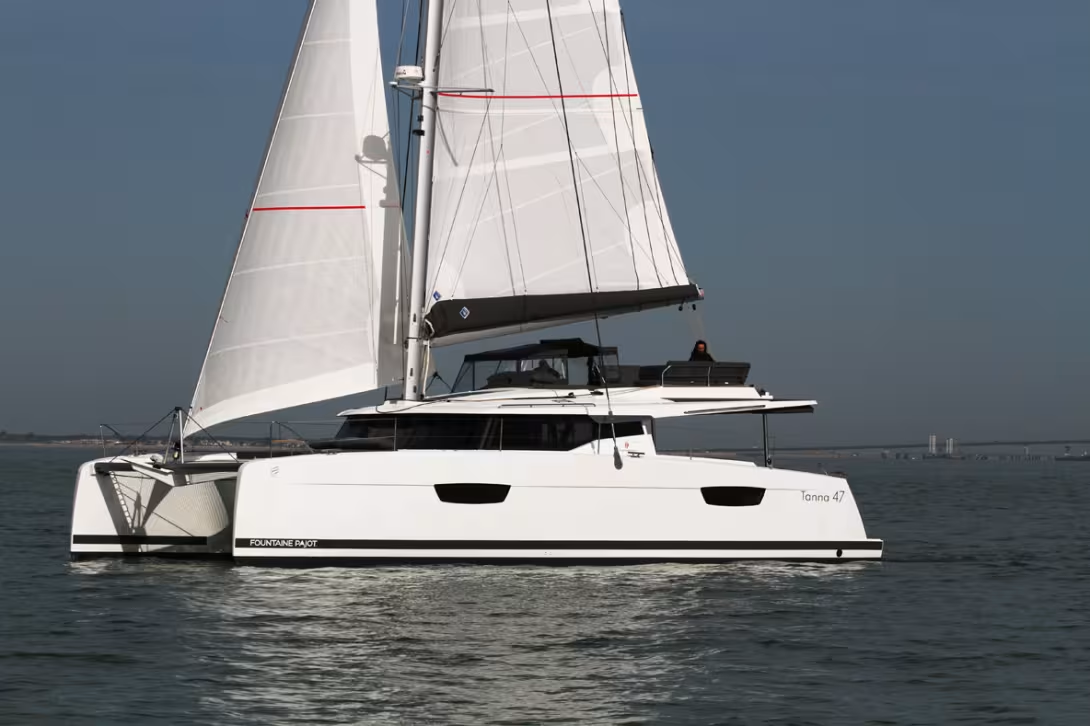
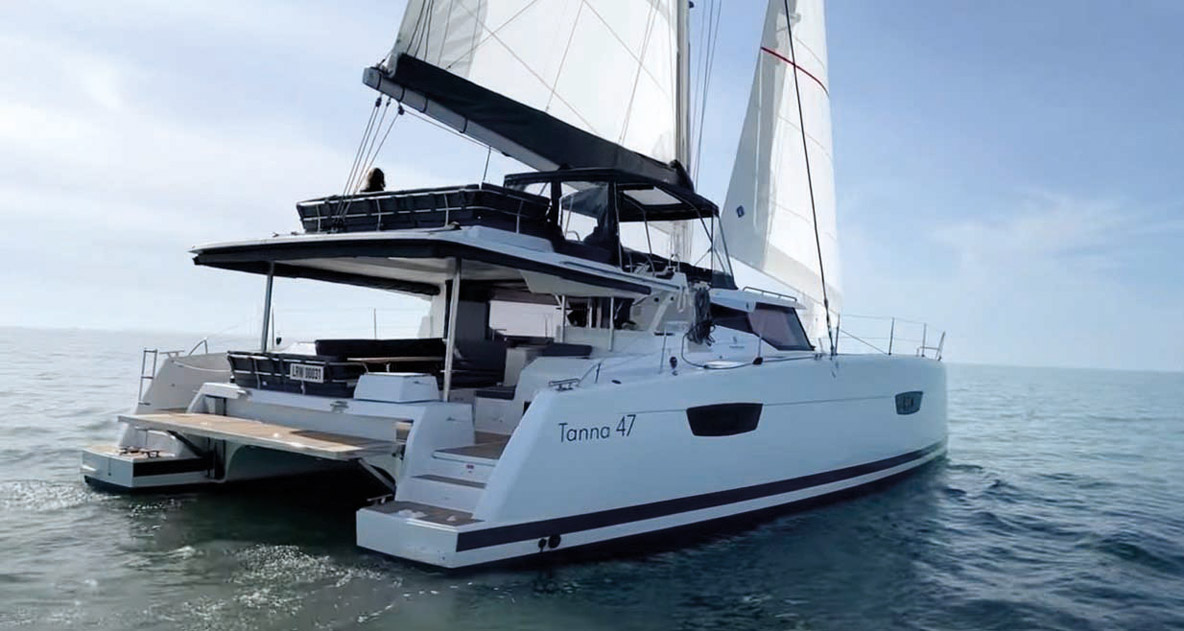
Does the Tanna 47 remind you of the Saona 47? That’s normal, as the molds remain the same and the shipyard has even continued with the same hull numbering – the model we tested was hull #177. In a way, you could call it a Saona 47 Evolution, rather than a completely new model. That said, the accommodation and flybridge have undergone significant changes. In the design of this Tanna 47, which is still perfectly integrated in Fountaine Pajot’s current range of sailing catamarans (the Saona 47 already had inverted bows, which was not the case on the Lucia 40), you can count on a robust and proven construction: the deck and the hulls deck are made using a process of infusion of polyester resin and anti-osmotic resin on cores of balsa and PET foam. The bimini is made using the RTM (resin transfer molding) process on PET foam, while the structural bulkheads are made of balsa sandwich or PET foam) by infusion. As for the two keels, they are attached and glued into a well that’s made of composite. In the event of a violent grounding, this assembly prevents the hull bottoms from being ripped out and the ensuing ingress of water.
Maneuvering station and helm
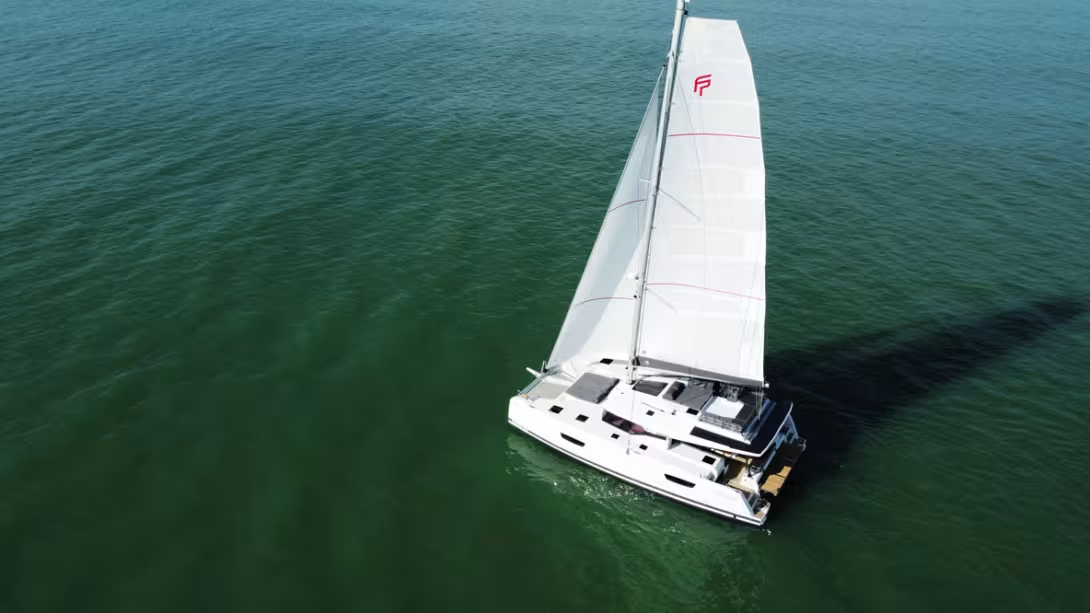
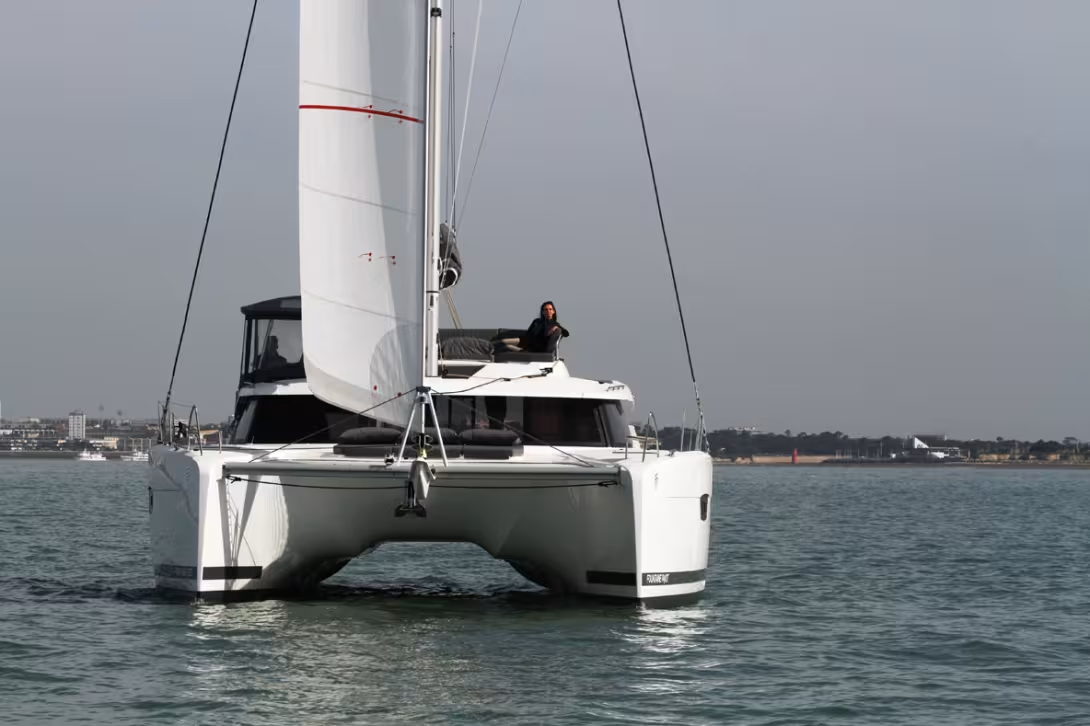
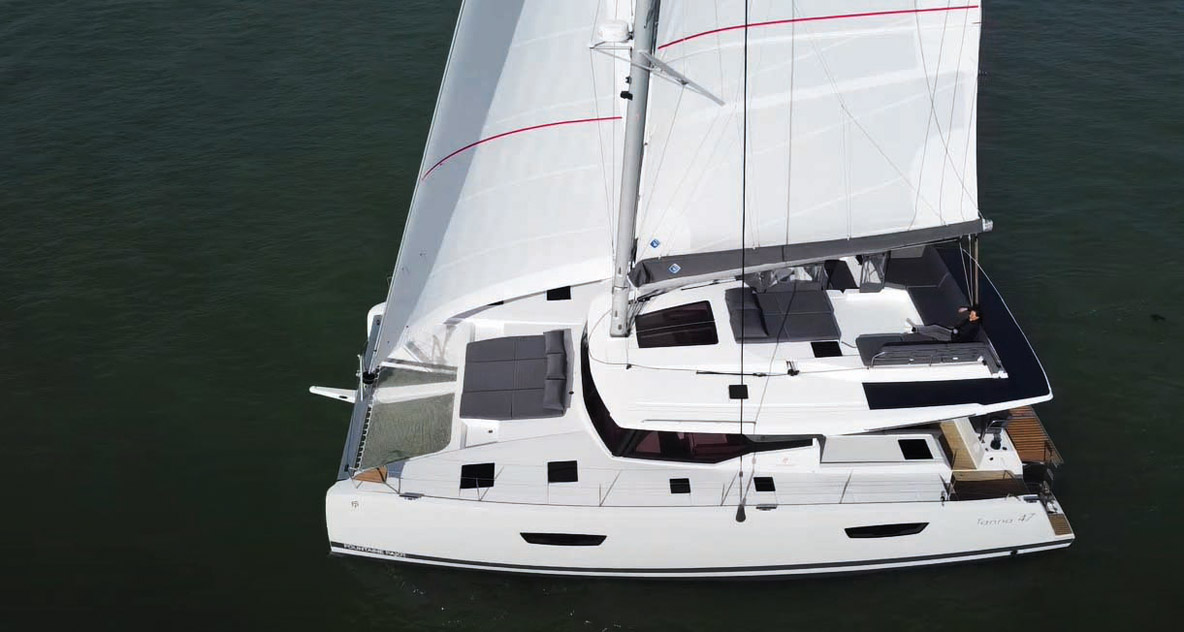
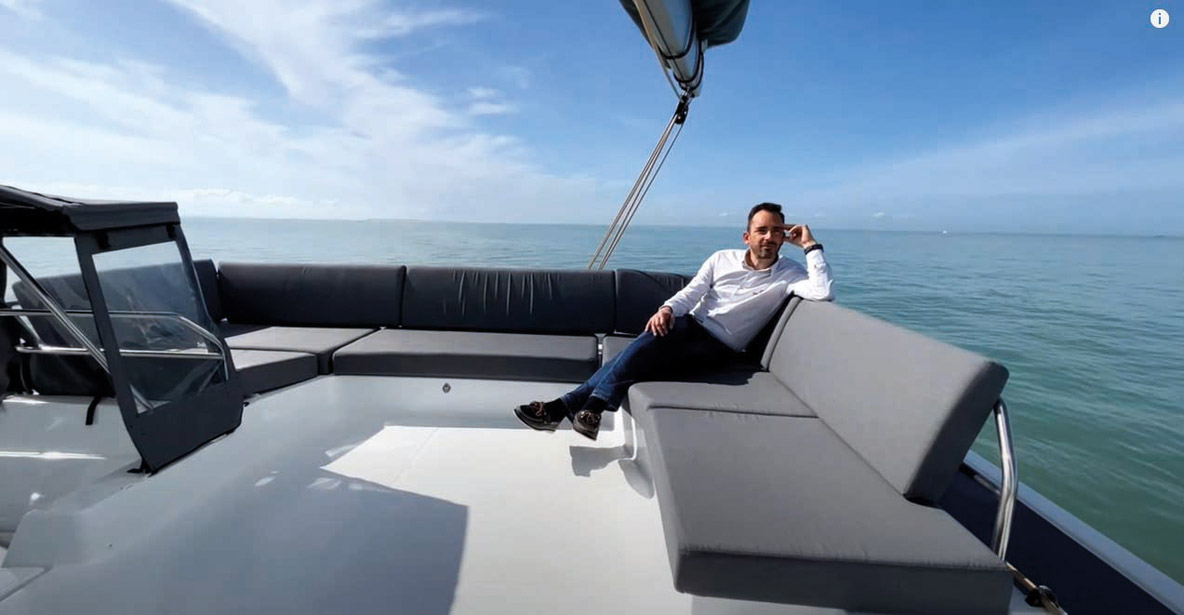
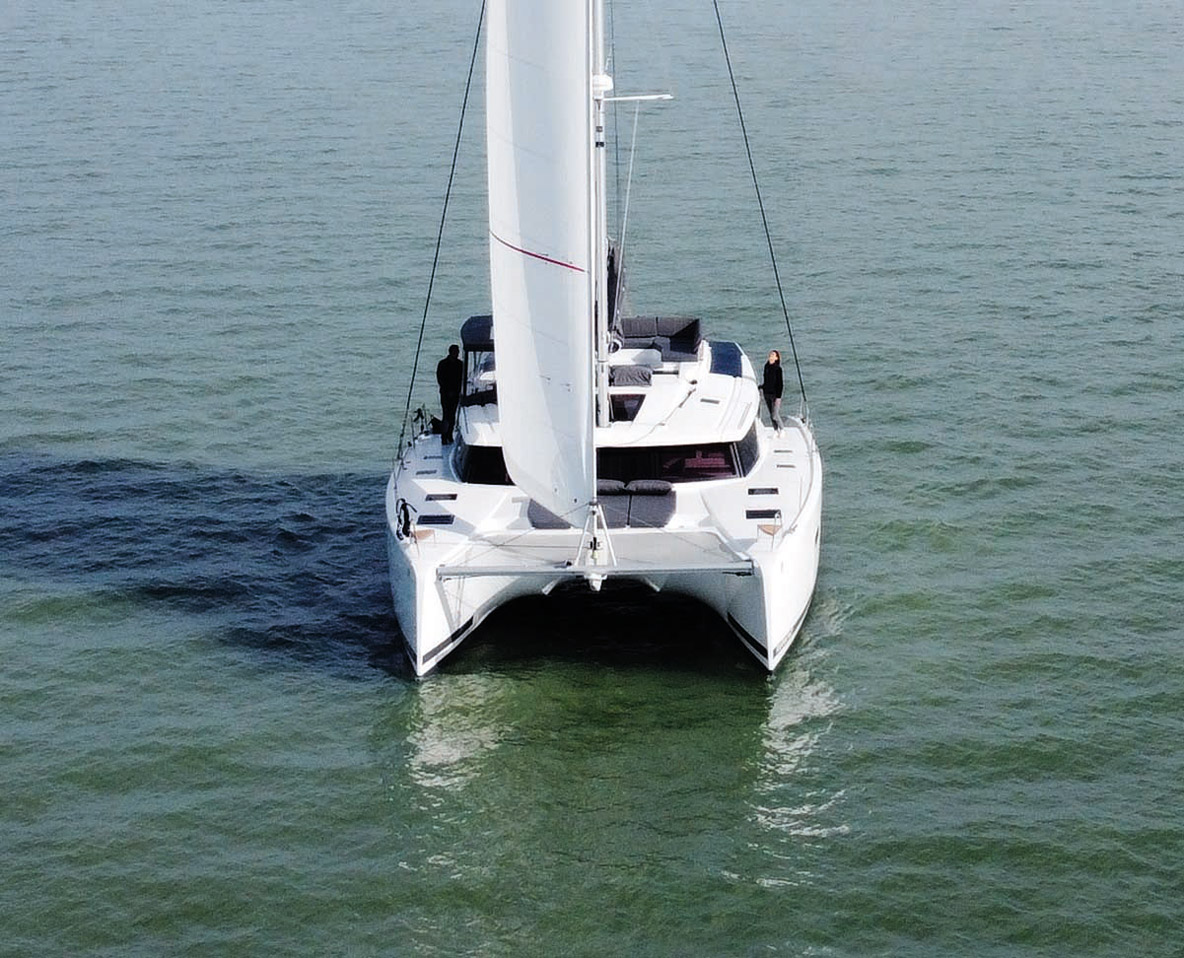
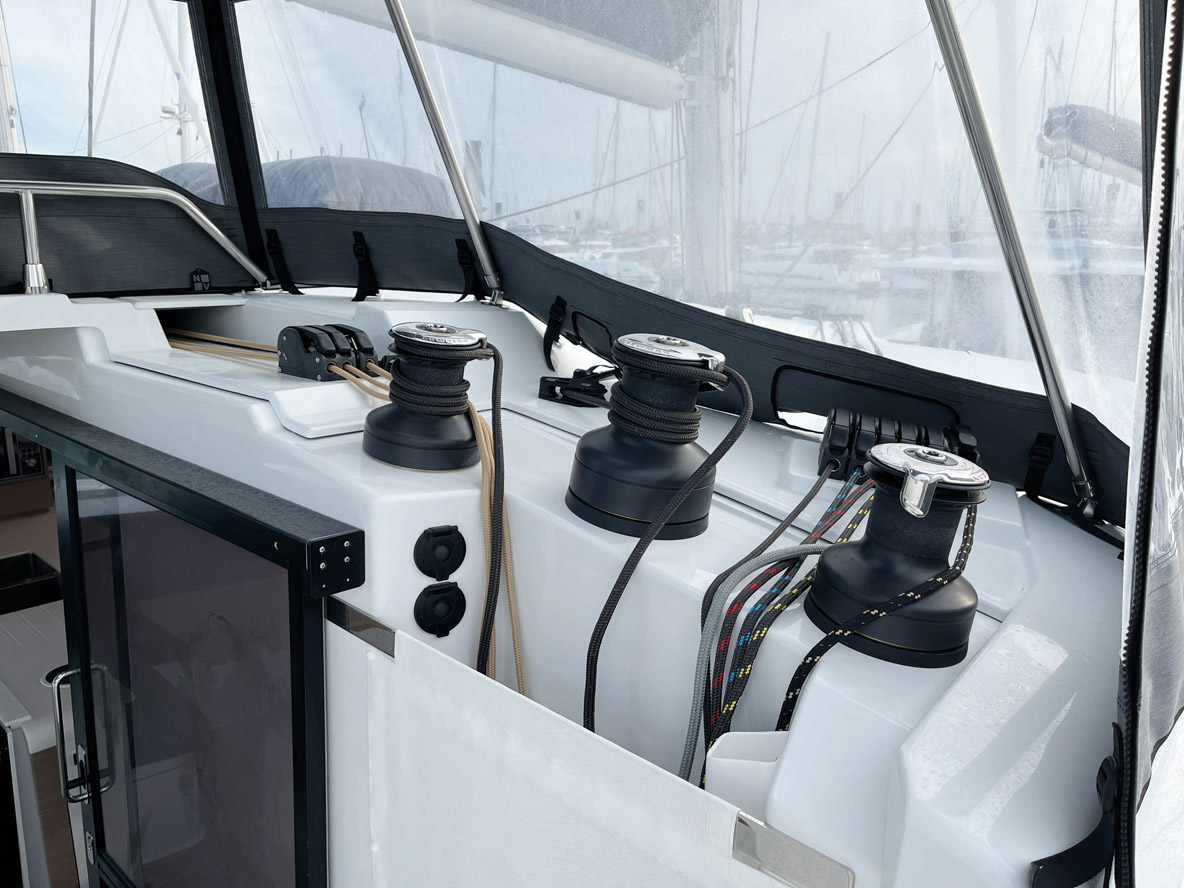
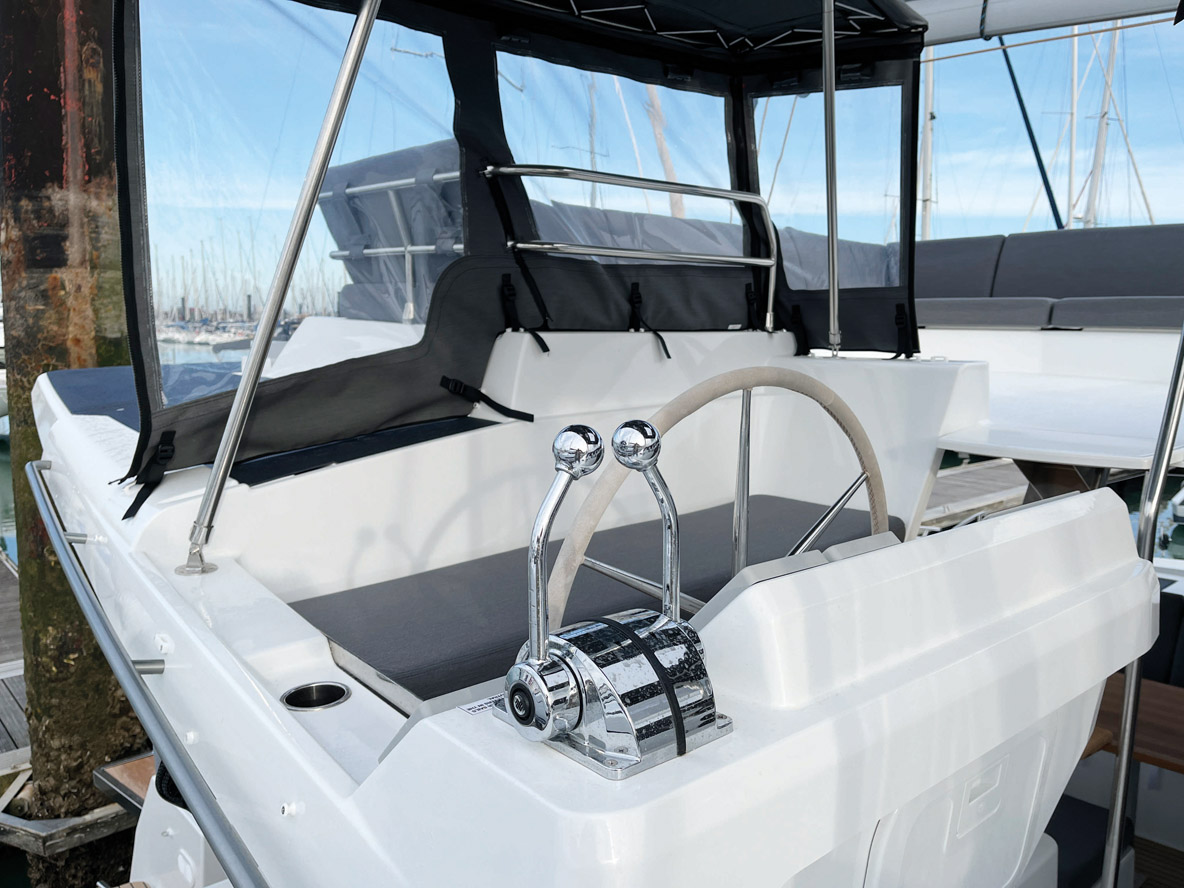
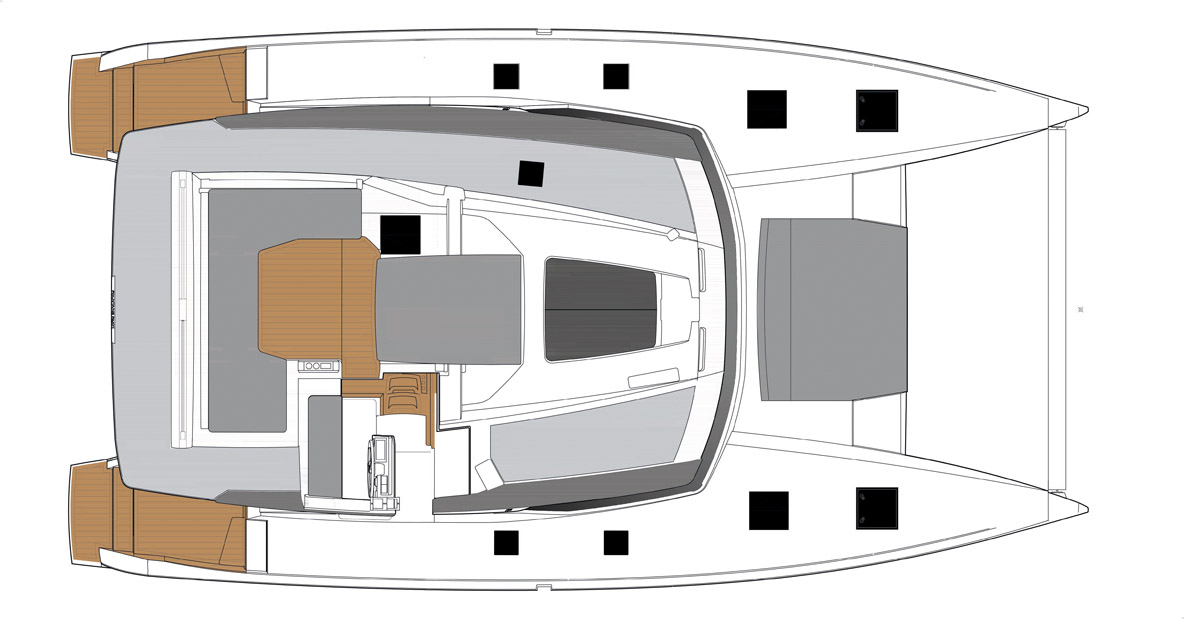
Within minutes of casting off, it was obvious that this 47-footer is perfectly manageable by two people. This ease of maneuvering is primarily due to her balanced sail plan. The builder has never given in to the trend of shifting the rig aft - and particularly to lengthening them. By keeping a compact rig thanks to the 807-square foot (75 m²) square-topped mainsail and the 560 sq ft (52 m²) overlapping genoa, the Tanna 47 remains within the reach of a cruising couple or a small family crew. The double helm/maneuvering station also contributes to the general ease of use. In front of the helm station, all sail maneuvers are within easy reach. This includes the port genoa sheet, and even all the lines coming down the port side of the mast are directly accessible. With Lewmar’s three winches and batteries of clutches, it’s entirely possible to tack and take up the slack in the genoa sheet as the catamaran is going through the wind. And this rotation is ensured by the helmsman, installed just behind. The helm station is also home to the engine controls and the nav instruments. This layout has two advantages: it avoids too much encroachment on the aft cockpit, while allowing communication with the rest of the crew to be maintained, especially as the accesses are well designed. The flybridge of the Tanna 47, which is just a fraction higher, offers a relaxation area called the lounge deck that is twice as large as the one on the Saona. The builder has therefore managed to gain useful surface area at the after end of the bimini but also to integrate 97 sq ft (9 m²) of solar panels capable of producing up to 1,700 W. A very theoretical value since some photovoltaic cells are positioned behind the protections of the helm station - a detail that needs looking at. Also noteworthy is that the liferaft is stowed under the articulated steps that lead to the helm/maneuvering stations from the cockpit. Water drainage has been improved to avoid the “puddle” phenomena found on the Saona.
A vast and well protected cockpit
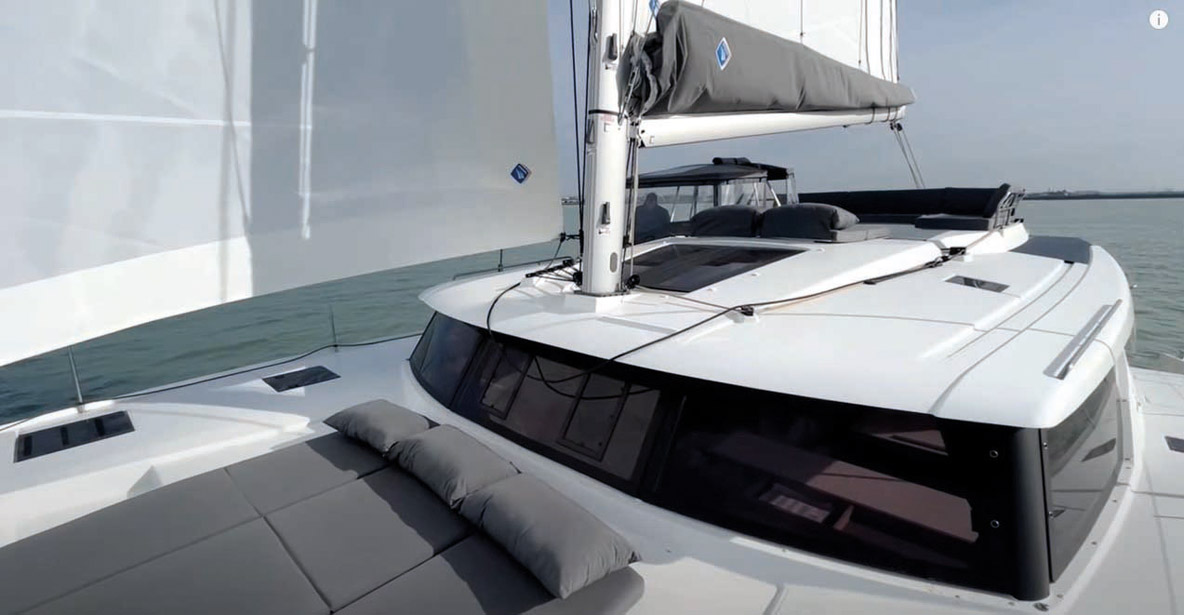
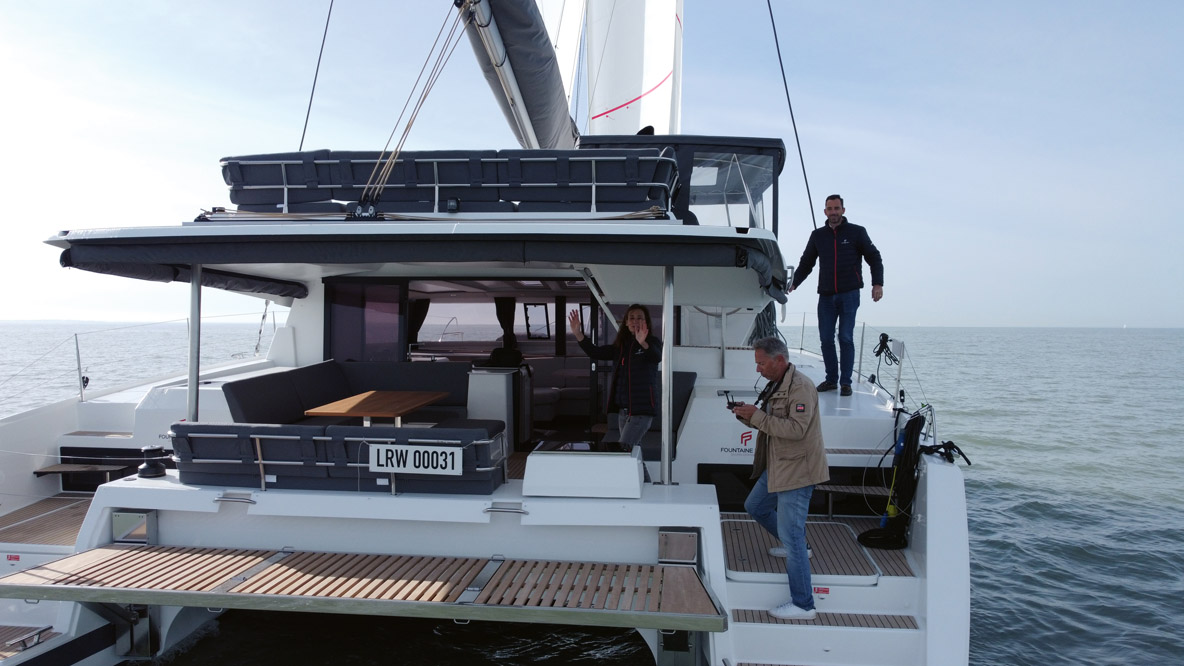
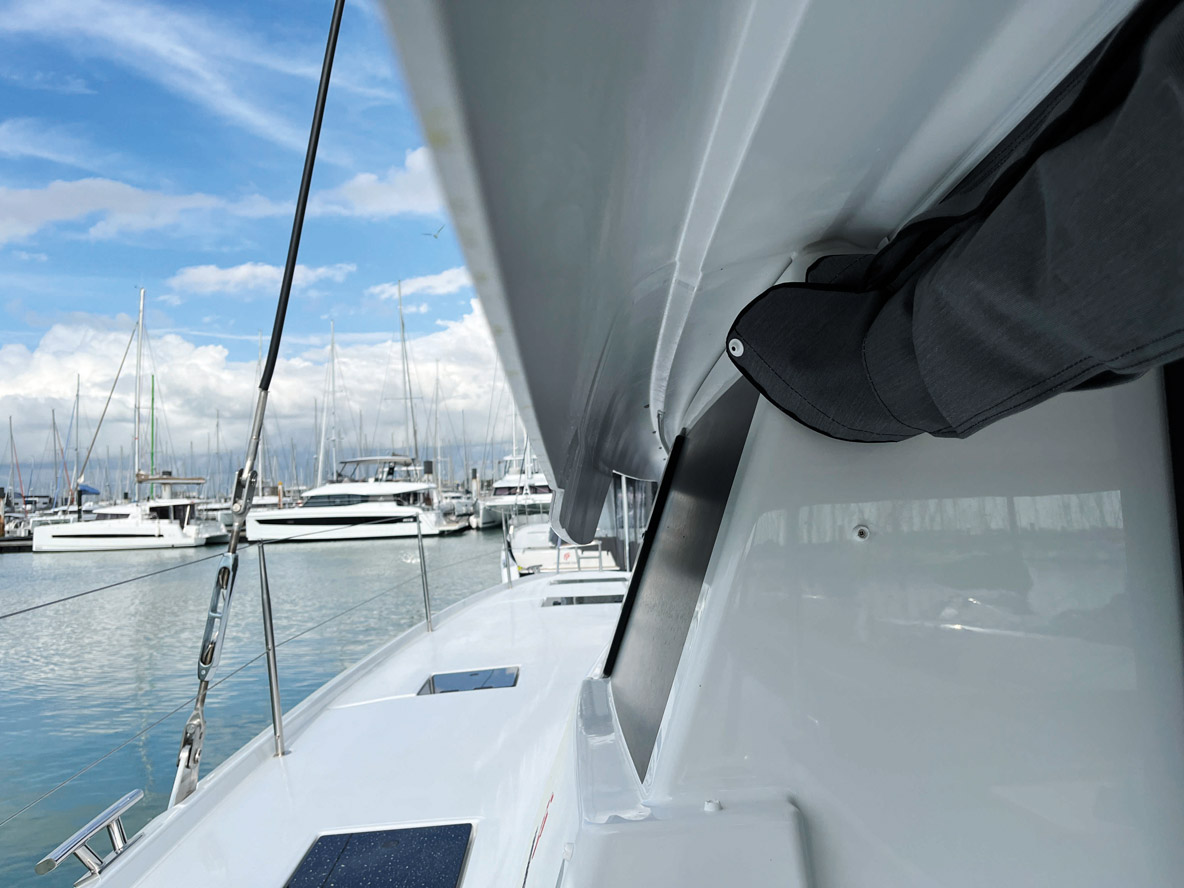
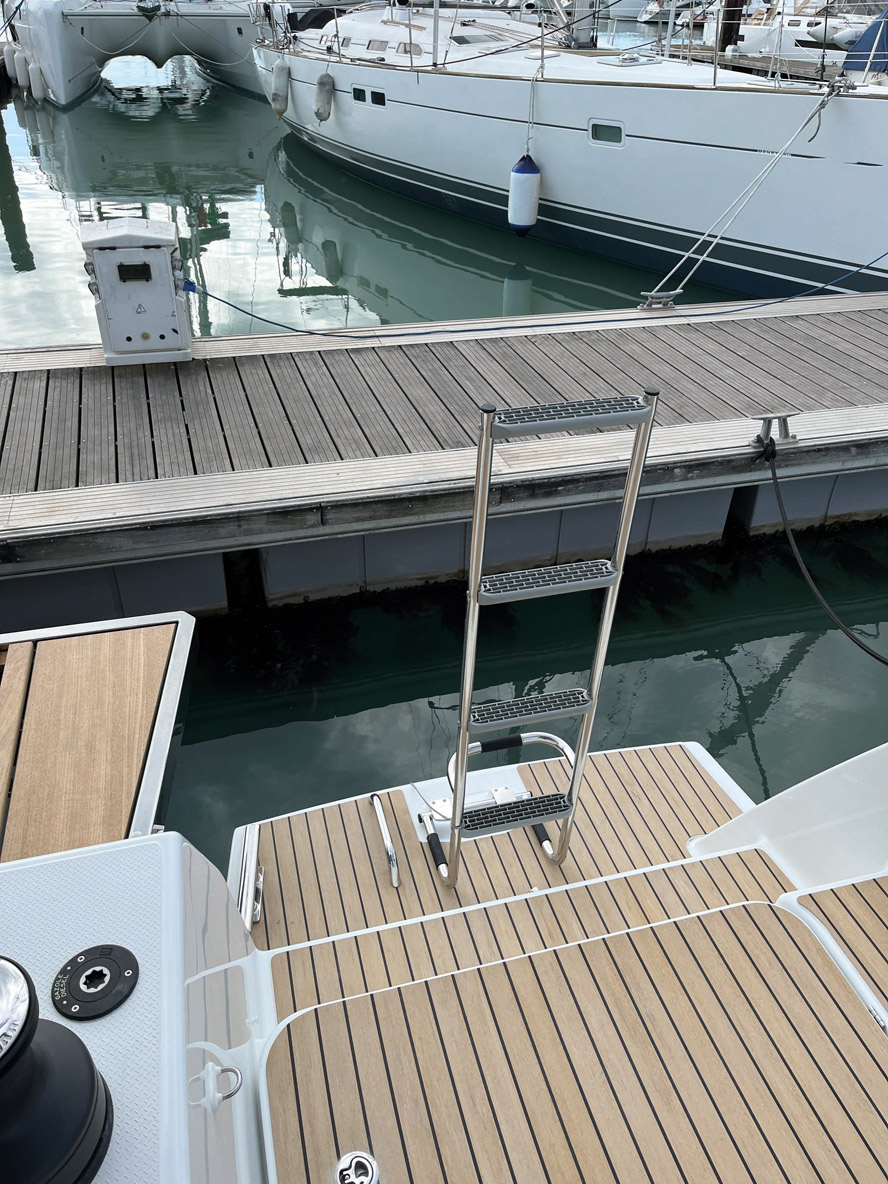
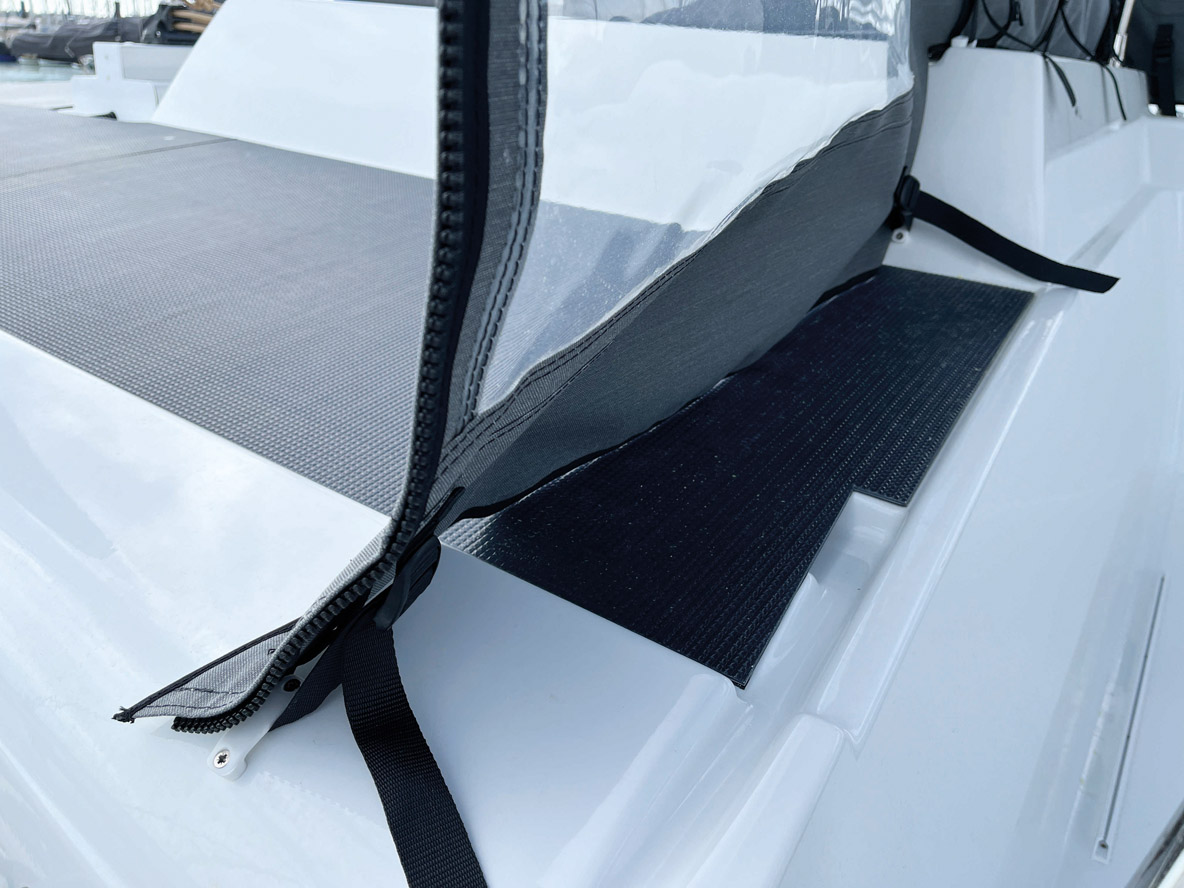
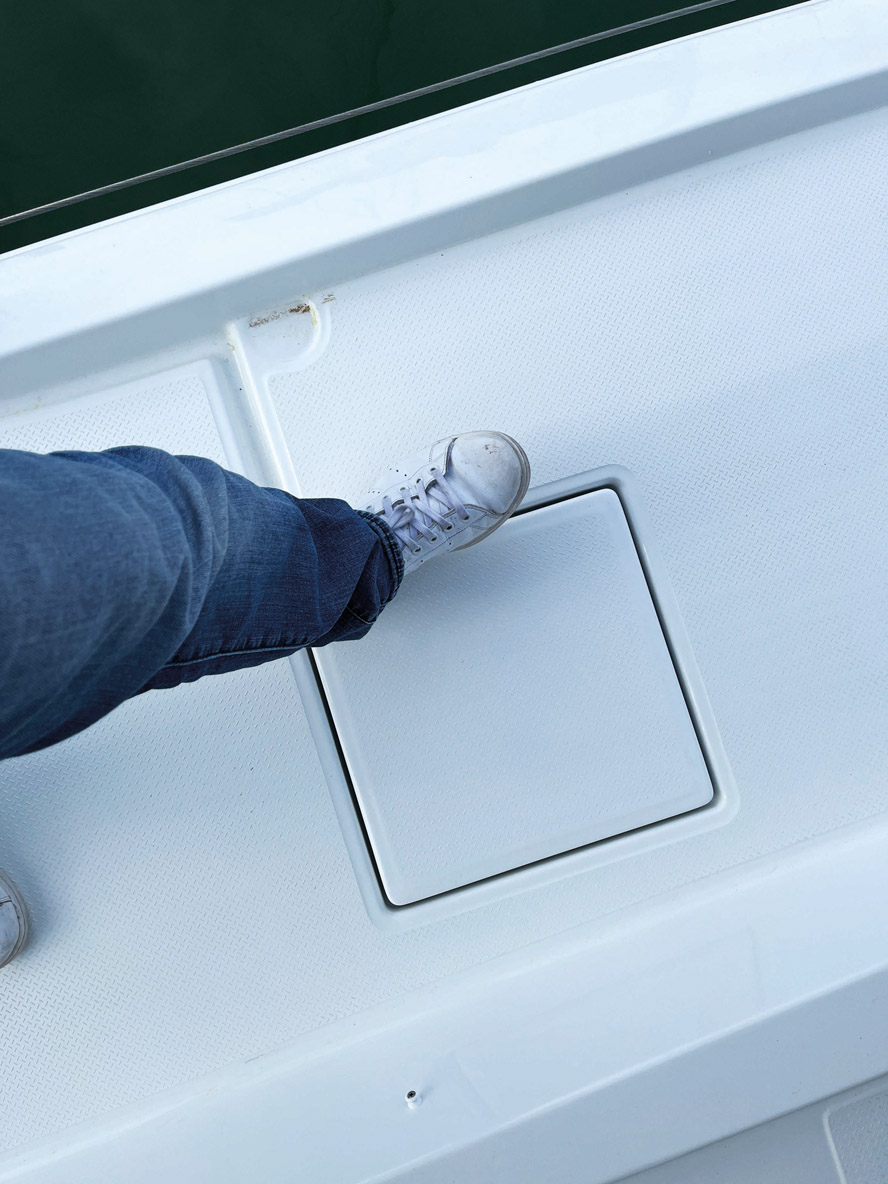
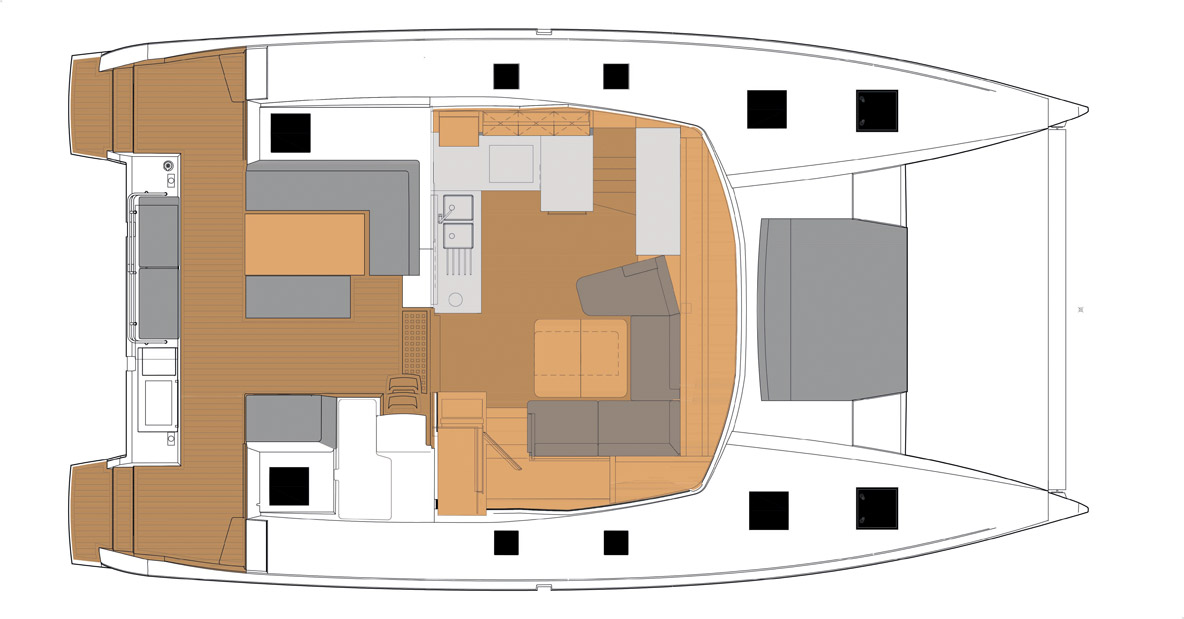
The large cockpit enjoys optimal protection thanks to the size of the bimini. The table, offset to port, can set 8 to 10 people, at 64½” x 33” (1.64 x 0.84 m). An extension for the table is also available. In addition to the table seating, there is a large aft bench seat measuring 7’2” (2.18 m) and a central lounger. The aft platform, available as an option, measures 13’9” (4.20 m). It can be lowered down to meet the sugarscoops to provide a real swimming platform. It is also possible, thanks to the powerful hydraulic rams, to support (and launch) a dinghy with an outboard as long as the whole setup doesn’t exceed 440 lbs (200 kg). One small detail that could be improved: the large bathing ladder looks really cheap in a setting that overall appears high-end and well built. The side-decks, three steps up, are 28¾” (73 cm) wide at their absolute narrowest. They are made safe by well-positioned handrails. The locker lids could use a little more rigidity. Heading along the side-deck, you can see how far the design of the coachroof extends in relation to the uprights and the windows. You then reach a very large foredeck - half of it, solid deck, half trampoline. Vast storage spaces are provided. You may be surprised by the absence of specific facilities other than the sunbathing areas, but this foredeck has the merit of remaining functional when sailing downwind and hoisting or dousing the appropriate canvas.
Undeniable marine qualities
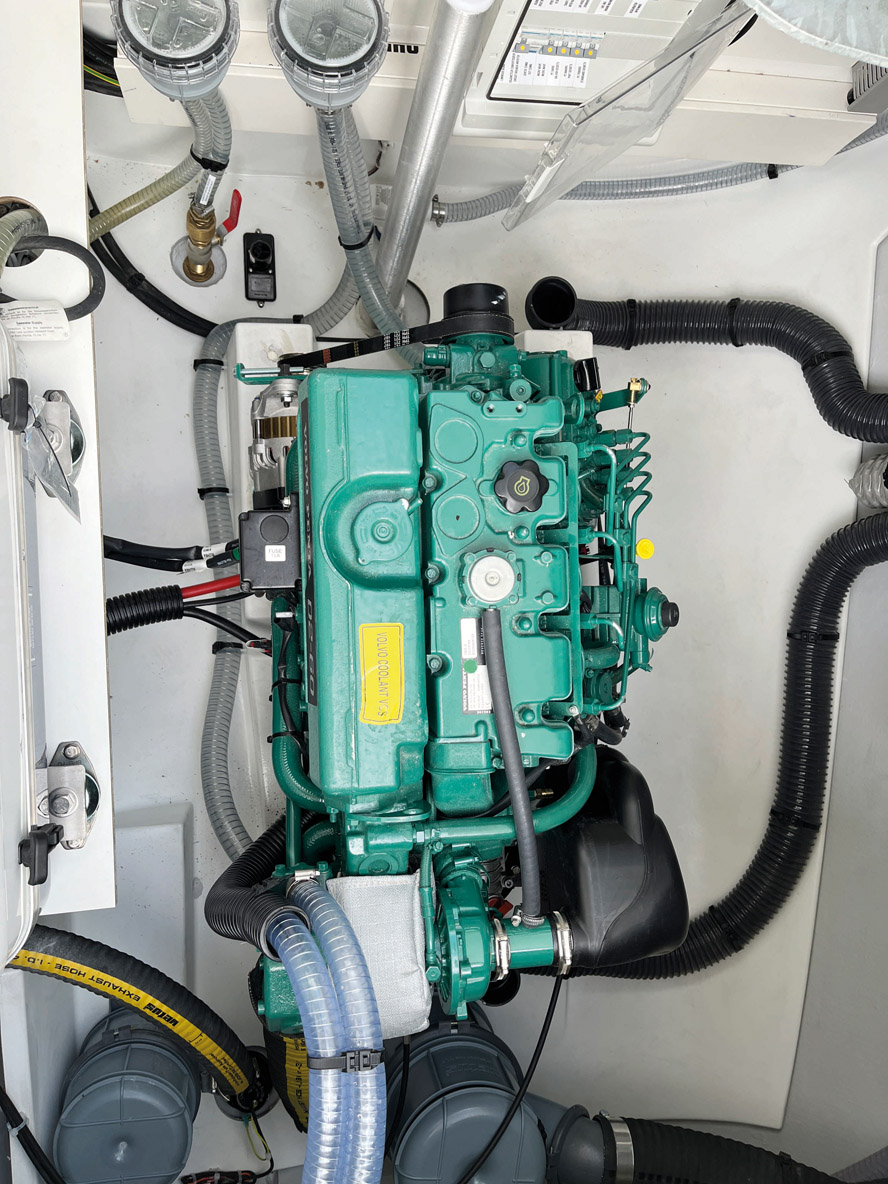
The Tanna is offered with a pair of 50 or 60 HP Volvo motors Unlike the Aura 51, Elba 45 and Astrea 42, the 47 will not be offered in an electric version due to technical issues, and that’s a shame! Our test sail was conducted in light airs, with the wind never exceeding five knots. In these light conditions and despite the absence of a downwind sail, the Tanna 47 performed well and managed to hang on to 3.5 knots by the GPS at 60° to the true wind. The integrated composite bowsprit would have allowed us to hoist a gennaker or an asymmetric spinnaker. With such a sail, we would probably be going along at wind speed. Our two previous tests of the Saona 47 - whose main characteristics are identical – had allowed us to get the measure of the catamaran’s seakeeping qualities. With 12 to 13 knots of wind, the helmsman could already appreciate a nice gliding sensation, with peak speeds of 9 knots. An outing in much stronger conditions off Hyères in the South of France brought good results: with 30 to 35 knots of wind, our journalist Philippe Echelle had 1 reef in the mainsail and a few rolls in the genoa and saw speeds of 10 to 12 knots and even a peak at 13.7. A little later, with the wind up to 40 knots and gusting to nearly 50 knots, the catamaran kept very smooth movements despite short, restless seas.
A nacelle that feels much bigger
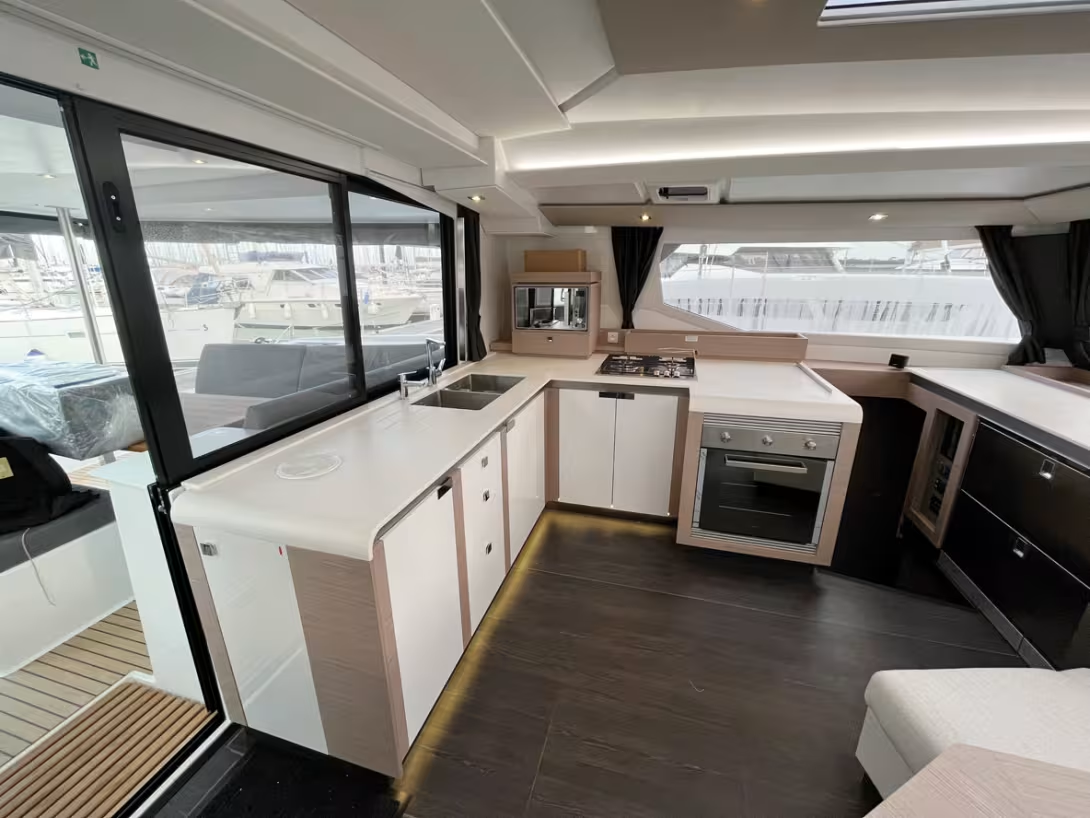
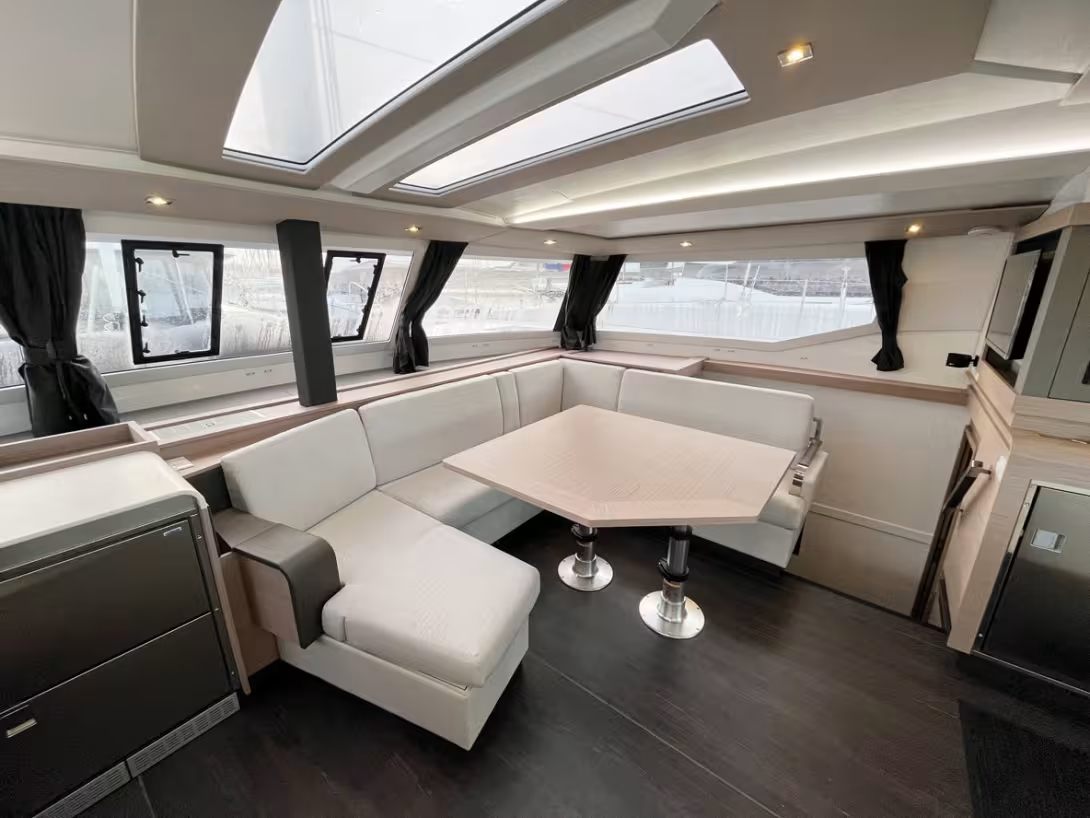
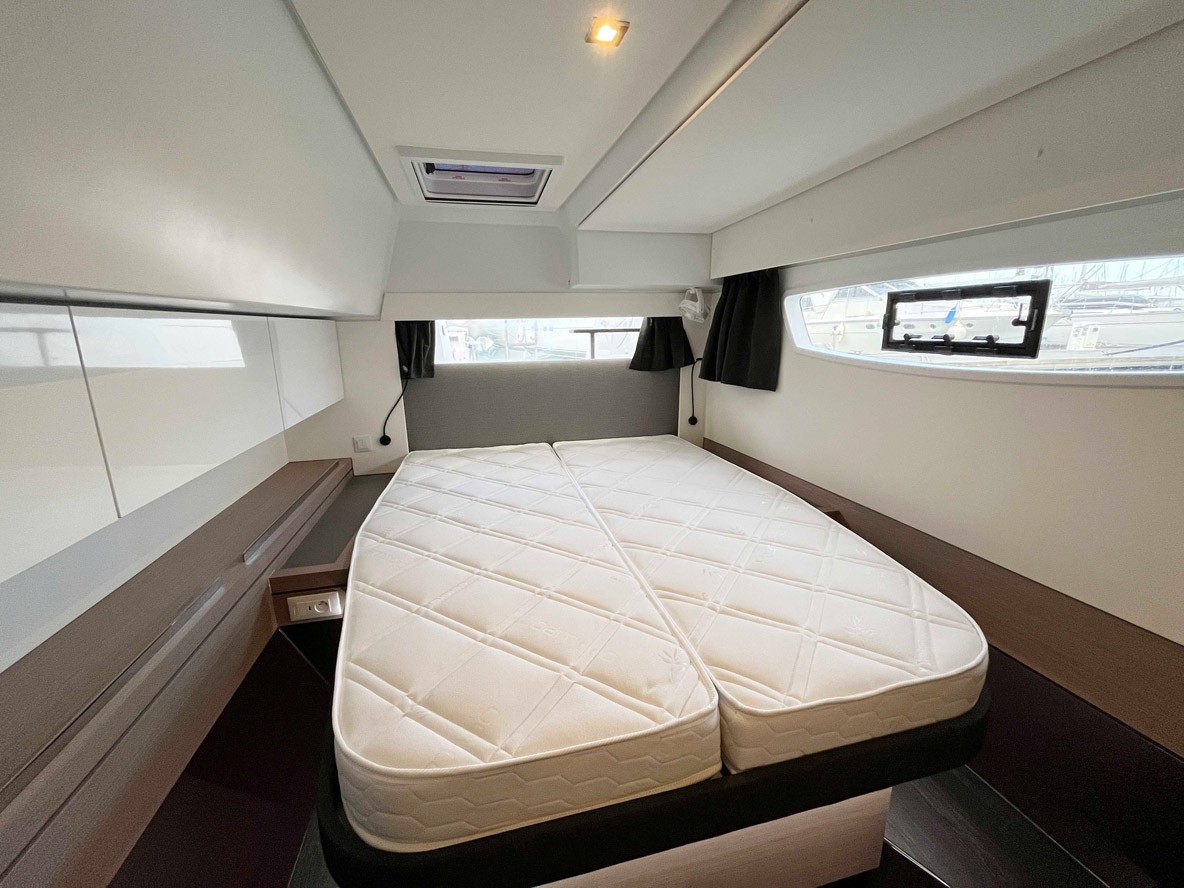
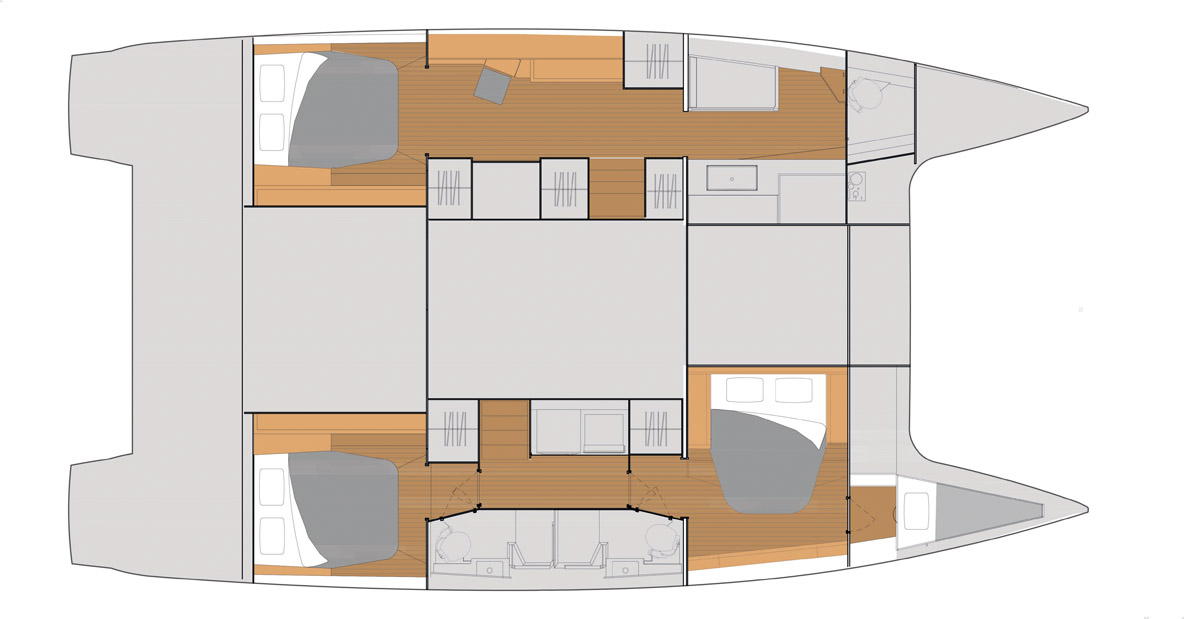
The passage from the cockpit to the nacelle is of course flush-decked. What is surprising at first are the large openings. In addition to the traditional sliding door measuring 6’2” by 31” (188 x 78 cm), the windows allow the galley to be opened to the outside with a moveable glazed surface measuring 4’2” by 3’2” (128 x 98 cm). The galley is completely new as it does away with the central island found on the Saona, to concentrate on a maximum of storage space. The refrigeration system is pushed forward. The floors offer a larger surface area, which is used for larger storage volumes – almost 50 cubic feet (1,400 liters) in total in the nacelle. Compared to the Saona, the Tanna 47 saloon area feels much less cluttered. The traditional chart table has gone, to be replaced by a mini- table and a panel for the screens accessible from the helm station and thus open to the cockpit. With this design, the builder has adapted the general layout of the Elba 45 over to the Tanna 47, with a watch-keeping station adjacent to the saloon. In concrete terms, you sit in a comfortable lounger with a view of the sail plan and the possibility of charging a tablet, which can act as a repeater for navigation information, charting, etc. A modern vision that may frustrate those who want not only a proper nav station - but also a desk in the nacelle. It should also be noted that the overhead windows will soon be protected from the sun so as not to transform the nacelle into an oven. The dining area, offset to starboard, features a table of 49” x 45” (125 x 114 cm). As an option, there’s an electric plateau that can turn it into either a coffee table or even an extra double berth. The cabinetry is made of Alpi and is meticulous worked, as are all the finishes. Five steps lead down to the hulls, which retain a comfortable headroom of 6½ feet (1.97 m). Our test version had the port hull dedicated to the owner. In addition to the large aft berth, which has a good view of the outside and well-designed ventilation, there is a proper desk and a huge bathroom that takes up the entirety of the bow section. In the opposite hull, the berth in the forecabin sits athwartships. All the berths are island bed style, meaning that can be accessed from both sides. Depending on the version, this catamaran can feature from 3 to 5 double cabins.
Conclusion
The Tanna 47 is certainly a well-built catamaran. Fast, seaworthy and comfortable, she has the advantage of being easy to handle. No maneuver will appear demanding to the crew, who will simply enjoy a great platform for cruising and the liveaboard lifestyle.
technical specifications
- Builder: Fountaine Pajot
- Architects: Berret Racoupeau Yacht Design
- Overall length: 45’9” (13.94 m)
- Beam: 25’3” (7.70 m)
- Draft: 4’3” (1.30 m)
- Displacement: 30,425 lbs (13.8 t)
- Sail area: 1,367 sq ft (127 m²)
- Mainsail: 807 sq ft (75 m²)
- Genoa: 560 sq ft (52 m²)
- Cabins: 3 to 5 double
- Fuel: 2 x 124 US gal (2 x 470 l)
- Water: 2x 92 US gal (2 x 350 l)
- Engines: 2 x 50 or 60 HP
- Price for the 3-cabin Maestro version: e 636,212 ex-tax
- Main options in € ex-tax
- Comfort Pack: 66,000
- Garmin electronics pack #3: 16,500
- Off Shore sails (Hydranet): 21,055
- Gennaker: 6,146
- Pole and gennaker fittings: 5,972
- 2 x VOLVO D2 60HP motors: 3,008
- Three-bladed folding propellers/VOLVO 60: 2,475
- Dinghy platform: 26,776
- Electric davit winch: 2,453
- 3.4 m dinghy and 15 HP outboard: 8,367
- Exterior cushions forward lounge: 2,920
- Integrated gas grill: 1,339
- Electric multifunction table: 6,065
- Central heating: 12,382
- Air conditioning: 30,224
- Additional 150 Ah battery: 645
- Underwater lighting: 2,541
- Integrated solar system 1,700 W: 22,383
- Generator: 23,353
- Watermaker: 15,172
- Full safety equipment: 3,807
- Liferaft: 1,650
- 25 kg anchor + chain: 1,246
- Lively and easy to handle catamaran
- Deck plan well-designed for maneuvers, yet generous for relaxation
- Pleasant design
- No electric drivetrain available
- No chart table
- Positioning of the solar panels to be optimized
The competition
| Model | Leopard 45 | Nautitech 46 Open | Lagoon 46 | Neel 47 | Bali 4.6 | Excess 15 | |||||||
| Length | 45’ (13.72 m) | 45’3” (13.79 m) | 45’11” (13.99 m) | 47’ (14.20 m) | 47’1” (14.36 m) | 48’4” (14.74 m) | |||||||
| Displacement | 32,850 lbs (14.9 t) | 23,810 lbs (10.8 t) | 34,750 lbs (15.77 t) | 23,400 lbs (10.6 t) | 29,985 lbs (13.6 t) | 42,000 lbs (19.05 t) | |||||||
| Sail area | 1,297 lbs (120.5 m²) | 1,227 sq ft (114 m²) | 1,366 sq ft (127 m²) | 1,399 sq ft (130 m²) | 1,311 sq ft (121.8 m²) | 1,657 sq ft (154 m²) | |||||||
| Price in € ex-tax | 549,000 | 516,000 | 513,900 | 463,000 | 528,860 | 677,500 | |||||||
| Test in MW issue | #156 | #170 | #163 | #166 | #176 | SI #14 |