
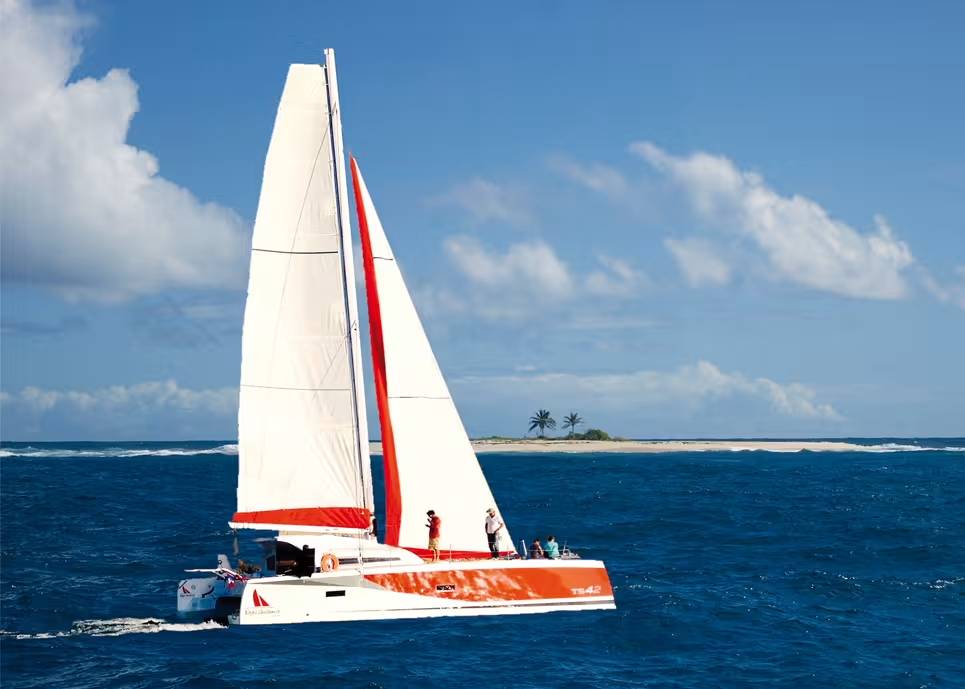
The TS42 bucks the current trend of cruising catamarans which have amazing living spaces on a platform over 50 feet in length, and offers you “just as much as you need” in terms of comfort, yet at the same time it has the attraction of a sporty performance and the ease of use of a compact catamaran. Join us for a lively two-day offshore sea trial!
Infos pratiques
- Le chantier : Ts 42
- La fiche technique
-
 Découvrez notre vidéo exclusive
- Financez votre TS 42
- Assuez votre TS 42
- Articles autour du TS 42
Proud of its origins
The fundamentals of catamaran design are fixed for now! Relatively fine-entry bows, increasing semi-circular volumes and an arch-shape are all agreed on (with some notable exceptions, obviously!) Nevertheless, a more “Darwinian” observation shows evidence of significant evolution with certain innovative designs (and the TS42 is one of these). The TS50 or the 52 stand apart from most contemporary boats by having a power to weight ratio worthy of a GT automobile. The bodybuilding bows, the work which goes into the aerodynamic coefficient and the hydrodynamic qualities of an exceptional hull all combine with a low overall weight to offer enlightened owners some incredible new sensations. Françis Joyon (currently the fastest single-handed circumnavigator) has put this into perspective by putting in several 400 mile days on the boat’s first transatlantic delivery! The TS50-52 has just entered the very select club of the fastest cruising catamarans in the world and still has pride of place, despite the accidental capsize of one boat in extreme conditions (a brutal williwaw coming down off a Scottish fjord). We had been inspired by the test done in 2011 (Multihulls World No.119) and suggest this article as recommended reading as well as the hair-raising video to accompany it (available on our website).
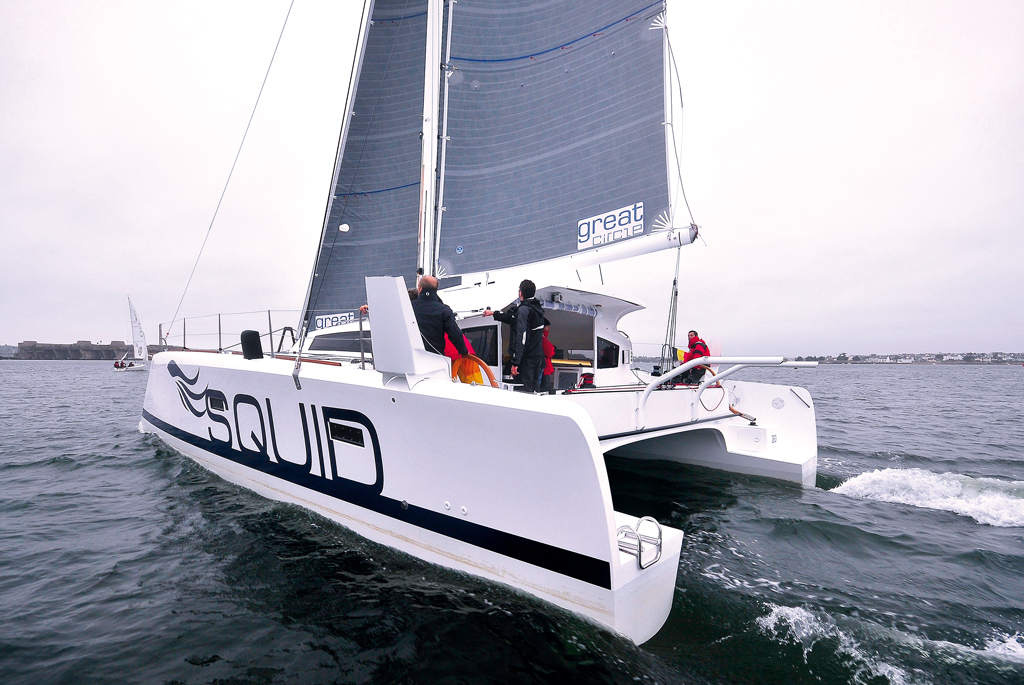
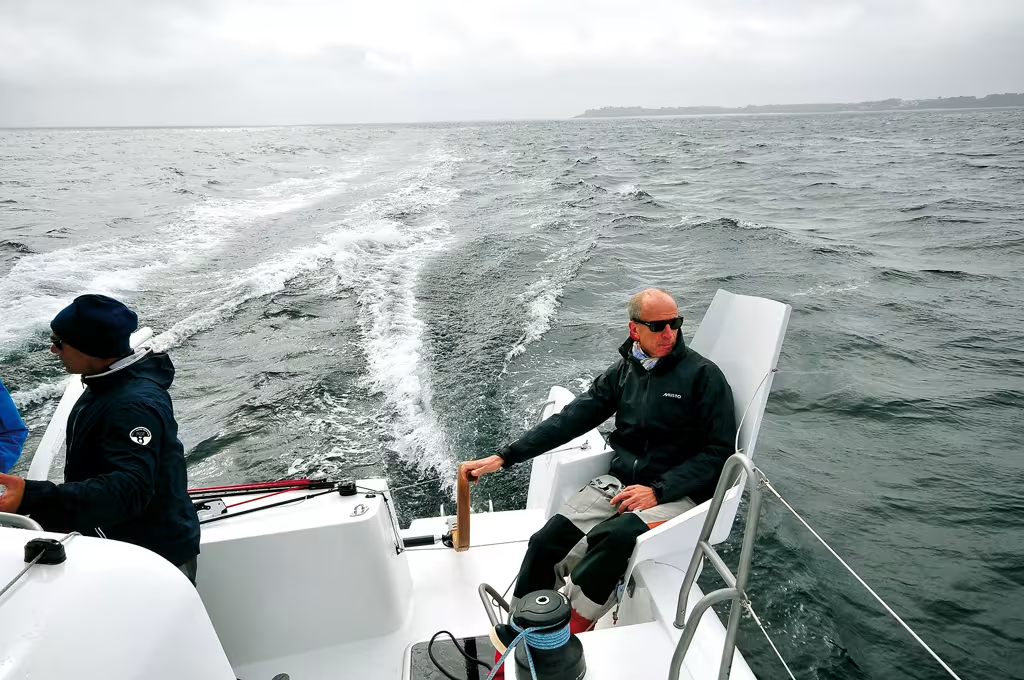
The wake of the TS42 is incomparable. At low speeds, the wakes link up and you might wrongly think it was turbulent, but in fact the hollow wake is remarkable and the hulls slip along exceptionally well
A catamaran with an elegant, creative look
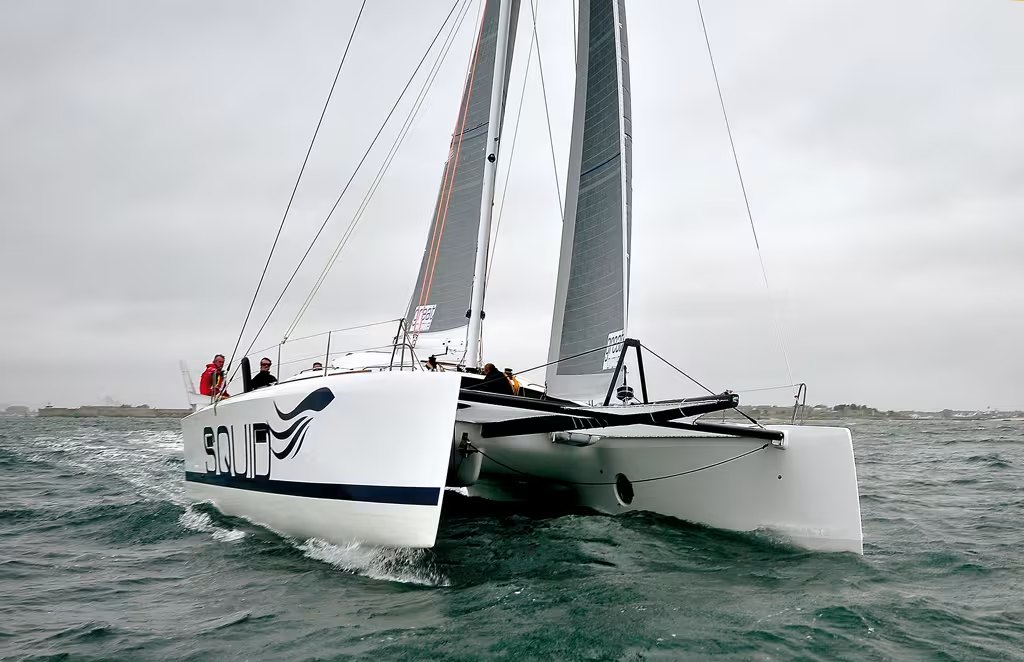
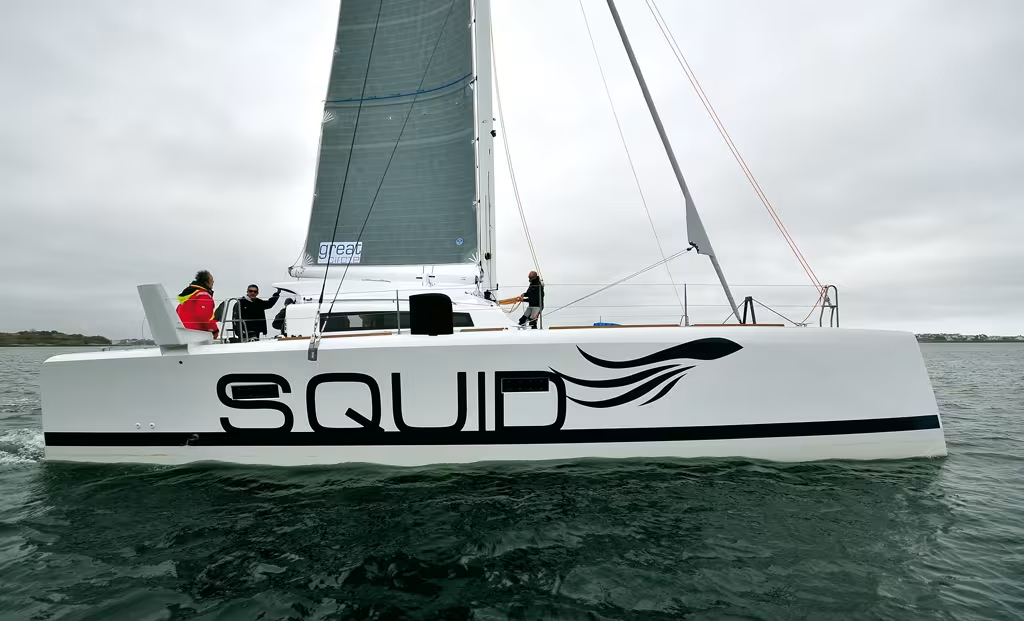
Nobody will fail to be impressed by the TS42’s flowing lines. She seems to be getting quite a following too, if the rumors circulating at last year’s La Rochelle Boat Show are to be believed. (The prototype was on display there, prior to being delivered to the Régis Guillemot charter base in Martinique). Our test boat was hull number 2 in the series, launched the previous day. The characteristic design of the coachroof set aft show the real proportions of the hulls; the light superstructure draws the eye to the artistically inverted bows. The topsides are even more original in that the framework of the noticeable tulip-shape joins the deck via a deflector which is largely in line with the stanchions. The nacelle is high above the water and set well aft; fitted with a central wave breaker, it gently brings together the inner topsides of the hulls, whose arches are cleanly flush-cut. The cockpit is proportionately shorter and set further aft than on the 50-52; the forward face being vertical with a large window acting as a windshield which offers a good view ahead. The design of the roof itself is harmonious and flowing, and gives a good drag coefficient. The top step is linked to the supports by a hollow strake (slippery). Access to the boom is a bit restricted, as is the headroom, right where it would be useful.
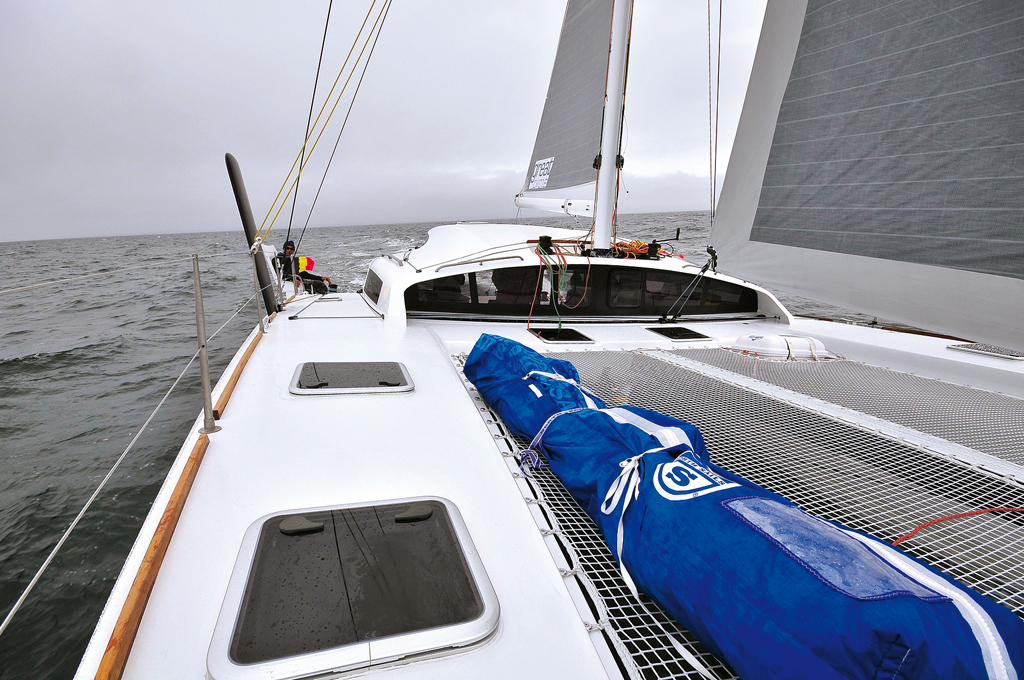
The proportions of the coachroof are creative and elegant. They keep it aerodynamic and maintain good bridgedeck clearance.
Hydrodynamics and construction
The whole design is aimed at performance, but also consistency and precision handling. The power to weight ratio conforms to European directives for multihulls, and the sail area remains reasonable. The secret to the recipe lies in the weight savings, an optimal weight distribution, efficient aerodynamics and inspired hydrodynamics. The forefoot of the TS42’s hulls are fairly well-submerged, and the hulls extend with increasing volume as you move aft, allowing them to rest on load-bearing sections and the arches, while keeping movement easy. The appreciable stability when underway does reduce when tacking. Despite its ambitious objectives, the TS42 is designed to be a catamaran which is rational to both build and use. The basic polyester version has deep, fine, fixed keels which are new to this type of craft, and have shown their worth on hull number 1. It is highly likely that a standard TS42, rigged with an aluminum mast and well-cut and well-trimmed Dacron sails will be very efficient. A tour of the factory, combined with the pedigree of the yard, shows the excellent build quality and how well the infusion technique is used: it is all post-cured at 60°C for 15 hours. Depending on the future owner’s budget, carbon options are available (bulkheads, beams, integral structure), as on our test boat, “Squid”, with the mast bulkhead and aft beam. Several of the larger Catanas (522 - 581) are from this builder, as well as many prototypes with extravagant performance (Paradox 60’ trimaran, 55’ carbon catamaran…), the Absolu 50, the first TS50s, the Nautitech 482 and many other cruising multihulls and refits of racing machines have all come out of this same yard in Lorient in Brittany, France.
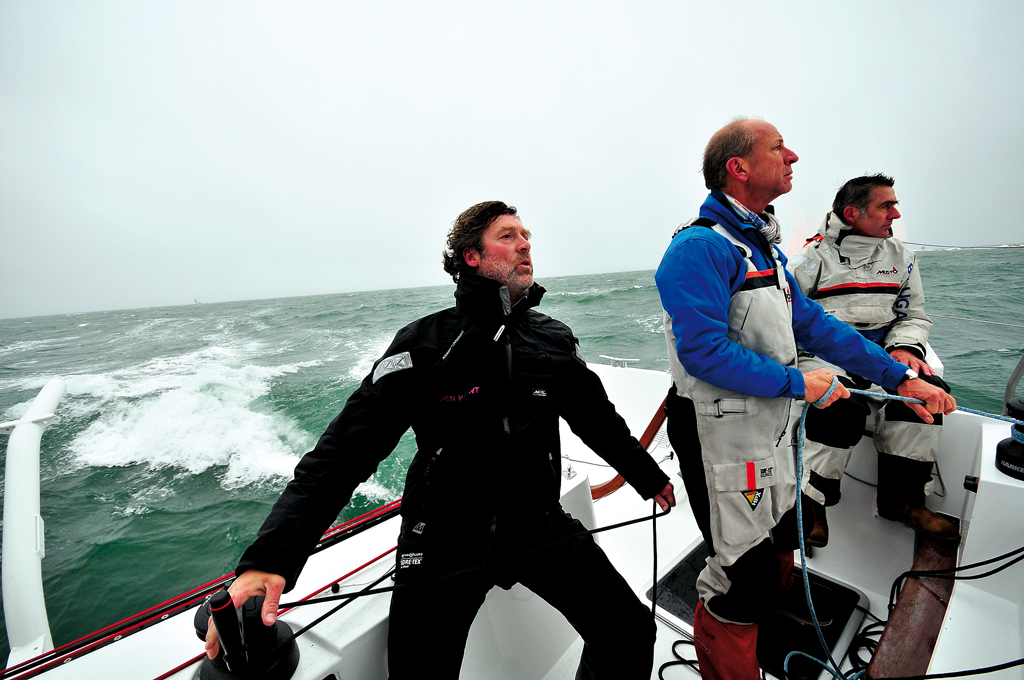
After surfing at 20 knots, Sam Marsaudon (in black) is delighted with the boat’s dynamic qualities
Interior design and concept
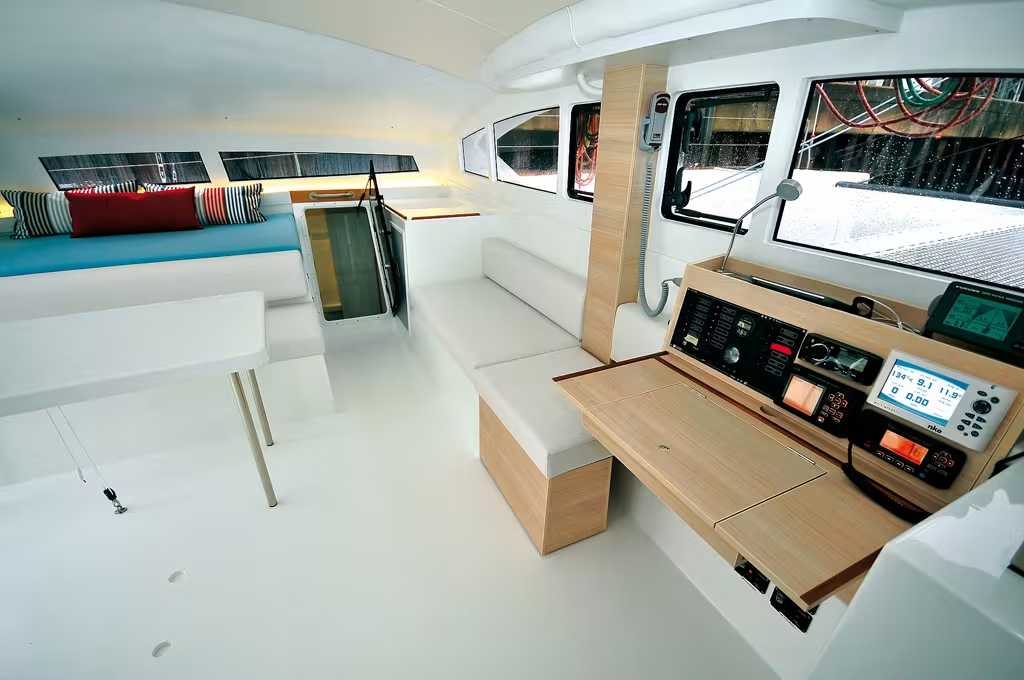
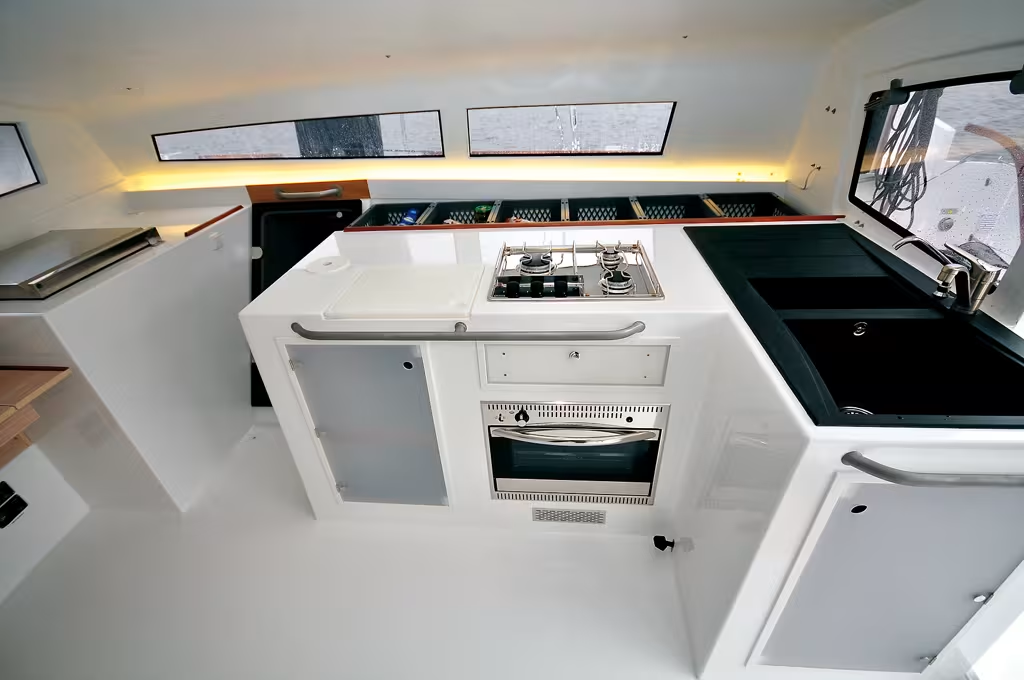
The TS42 is aimed at sailors who like to be in direct contact with their multihull and in return expect a positive feel. The helm seats and the tillers provide exactly this. The cockpit is perfectly suited to handling the boat (the textile rope clutches are great); though feels a little lacking in area, but that’s only a first impression. The open area which it forms with the salon on the other hand offers a good living area depending on the weather conditions. The two large plastic panels aft are removable and a clear fabric bulkhead closes in the salon if the weather requires it. The bimini top continues aft from the coachroof forming a perfect wind-break which no spray will get past. The electronics are on adjustable brackets and are well-sheltered. Inside the deck salon you find the nav station, galley and a large multi-purpose double bunk (watchkeeper’s berth, play area for kids, or guest bed). Simple and pertinent solutions have been used: the large double sink with drainer is perfect, there is good storage, and the built in rack for plastic storage crates is a great idea. Oven, fridge, 3-burner stovetop and drawers meet all the needs. Two wide, L-shaped bench seats create a friendly atmosphere for meals or buffets around a moveable salon table. Folding seats provide extra guest space. Entry to the hulls is through two strong watertight plexiglass doors fitted with opening handles. In the standard layout, the starboard hull on the owner’s version has a double bunk and a large bathroom, while the port hull has two double cabins and a heads compartment. The general style is fairly stark but is well done, but this doesn't impinge on the enjoyment of the various features. Abundant light and ventilation, hot water, a large bathroom with separate wc and comfortable beds: the TS42 has everything a bigger boat would have, but is easier to maintain.
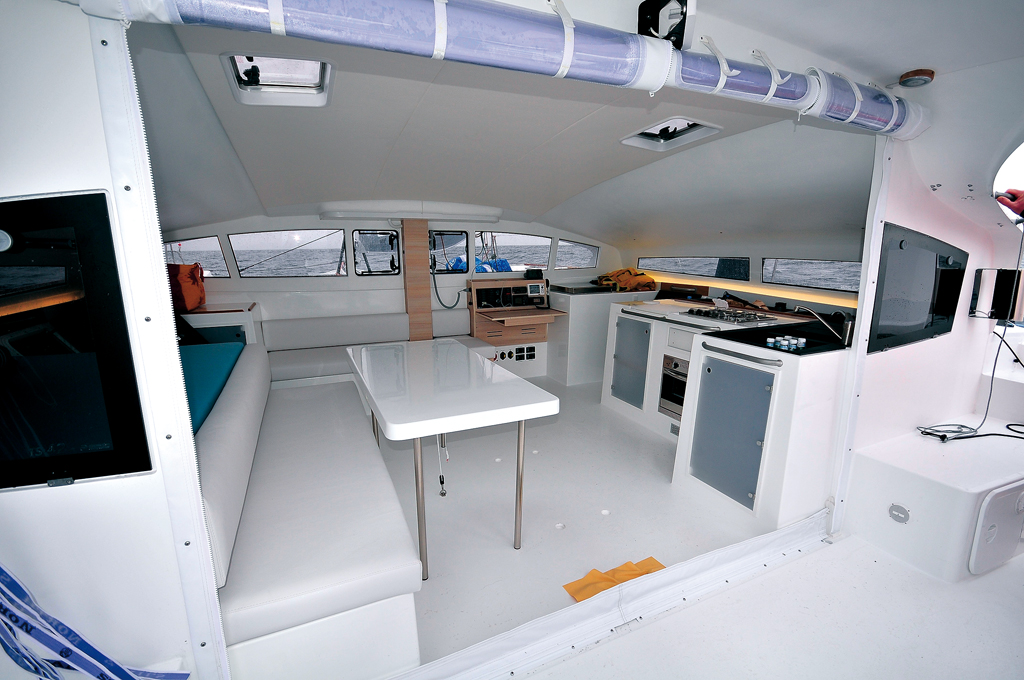
The cockpit and salon form one adaptable living space as dictated by the weather conditions. The hard-top bimini is unusually efficient
Engine installation
Two large hatches give access to the motors which are located in the deck and not not on the sugar scoop steps. This will limit the risk of water ingress. Everything is simple and clear in the engine compartment: a good-sized swan-neck on the exhaust, an easily accessible raw water strainer, an expansion tank, a heater fuel tank, and a battery in a protective case. The molded plastic diesel tanks are strapped to a board fixed to the aft cabin bulkheads.
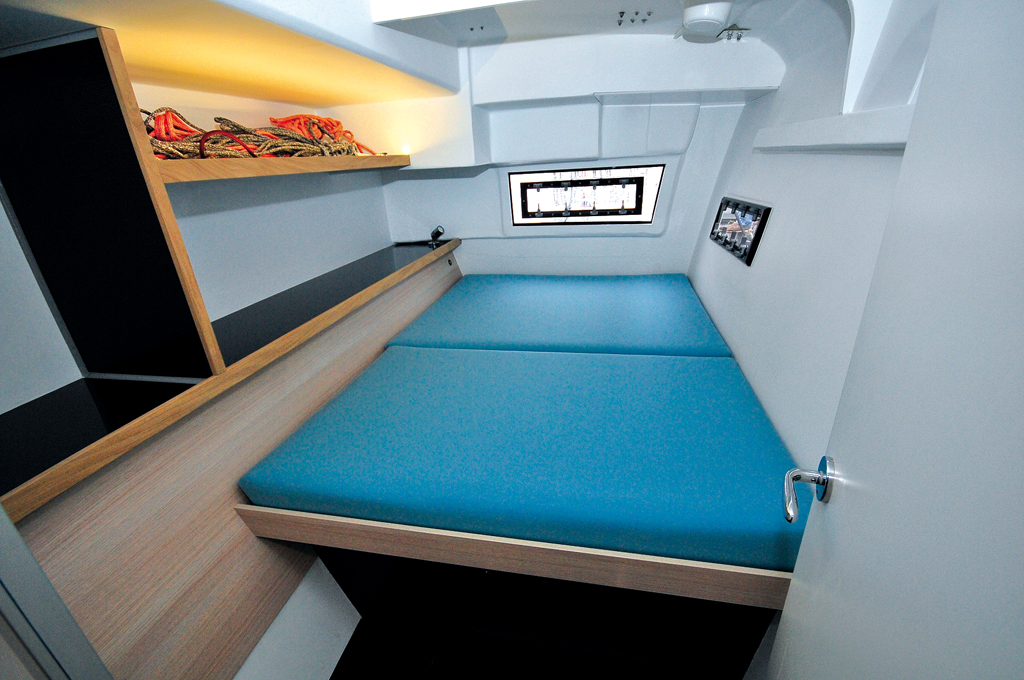
The starboard cabin lacks nothing you would find on a bigger boat.
A lively test
It has been said that the TS42 is pretty, light and well-built, but does it live up to its promises? The weather in Brittany (even southern Brittany) in late March isn’t going to give you sunburn, but offers windy conditions for some dynamic sailing. Let’s get straight to the point: the nice rotating carbon mast was stepped and rigged the previous day by Lorima, and the North Sails bent on. The motors are running, the NKE electronics are switched on, and everything is set for the cat’s maiden voyage! We set out with full tanks and 7 crew on board. The three-bladed folding Gori propellers easily pulled the boat off the dock, despite the crosswind. We effortlessly hoisted the mainsail with its Harken bearing cars, and unfurled the solent on its fiber stay. The feeling of everything being easy would continue for the next two days. The 62m² mainsail and the 36m² solent remain a manageable size, which is good, as some adjustments still have to be made by hand! Those familiar with the entrance to Lorient know that a westerly wind can kick up a difficult chop which comes straight in. But the easiness of the 42 is evident: it sets off upwind in the bay like a hotrod and sets about a valiant attempt on the channel. The helm is perfectly balanced and it points really well (the external rigid linkage, nice elliptical rudder blades with Jefa rudder post and bearings). With the leeward daggerboard down all the way, I was getting a real positive feedback from the boat straight away. Upwind the TS was literally playing the short waves, which are stalled by the arches, allowing the hulls to move along nicely, and we made our way upwind at 10 knots. This point of sail was serene, comfortable and we made our way through the waves with remarkable ease. At the channel entrance, as soon as we were able to bear away and free the sails off a little, we settled down at 12-13 knots at 70° to the wind. The longitudinal balance was surprising, and under full sail in 18-20 knots true, the boat never put a foot wrong. Its stiffness is manifest, the leeward rigging remaining tight: the rigorous build of the structure definitely played a part in the pleasure of helming the boat. Downwind at 15-18 knots, punctuated by long surfs, there is the feeling that there is plenty of both power and safety in reserve: the TS clearly shows a desire to bring out the big guns above 20 knots. The point of sail would have been ideal for an (invigorating) run under gennaker, but we didn't have one. The following day, the forecast was for passing fronts of 28-30 knots, to be preceded by gusts of over 35. So we set out with one reef and full solent (36m²!), and set a course for the west of Groix. The seascape changed tempo, but we immediately felt confident in the boat, as it pulled out all the stops. The good impressions that we had from the day before were all reinforced, but, hard on the wind in this choppy sea, the easiness of the 42 became truly inspiring and its agility seemed to play games with us! In these nervy and testing conditions it remained very tolerant and efficient in the gusts. Its balance put us at ease. Between 9.8 and 12.5 knots (upwind!), this athlete really performed in what could have been a minefield. The suit of 3DI sails (Kevlar-carbon), the cross-shape formed by the forward beam, the A-frame and the compression beam, the aft beam, the mast bulkhead in carbon and the build quality all back up this impression, but the inspired geometry of the design is the essential and noticeable factor. The way in which the hulls swim through the water in all conditions gives a feeling of surfing along with unique satisfaction. This “little” catamaran seems to have a lot more under the hood: the sea was now building with whitecaps blowing off the waves and in spite of reaching speeds of 14-16 knots, we didn’t take any spray! On a broad reach, this deep snow skier pointed his skis and naturally lifted the tips: we were surfing with surprising ease and stability at 18-20 knots. The helmsman, comfortably installed in the large, protective helm seat with footrest, has fingertip control over the direction of the bows with the surgical precision of the rudder blades…
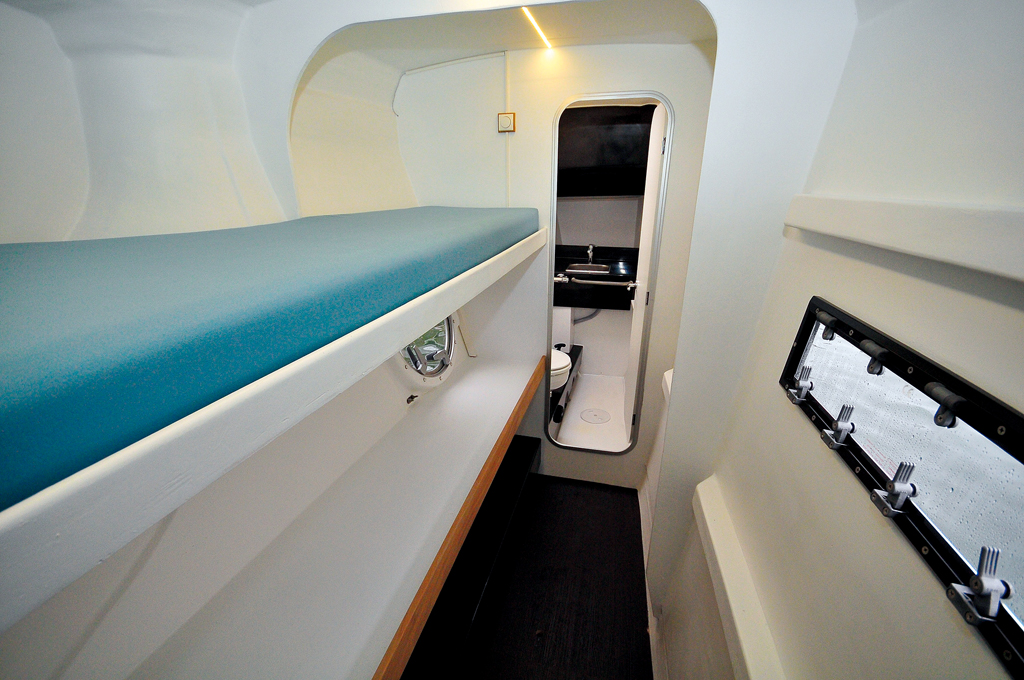
On our test boat, which is also destined for the racecourse, there is an extra bunk-bed for an additional crew member.
Conclusion
In this version, the 42 is a very high performance machine. It is a musician who never misses a note and brings together the crew and the most demanding of helmsmen. A comfortable and liveable catamaran, you get the feeling of being on a prototype! It’s compact size, ease of handling and maintenance are among the additional advantages of an exceptionally enjoyable and meticulous machine whose behavior and performance are worthy of a much larger vessel. Christophe Barreau and Marsaudon Composites have put their name to a remarkable creation.
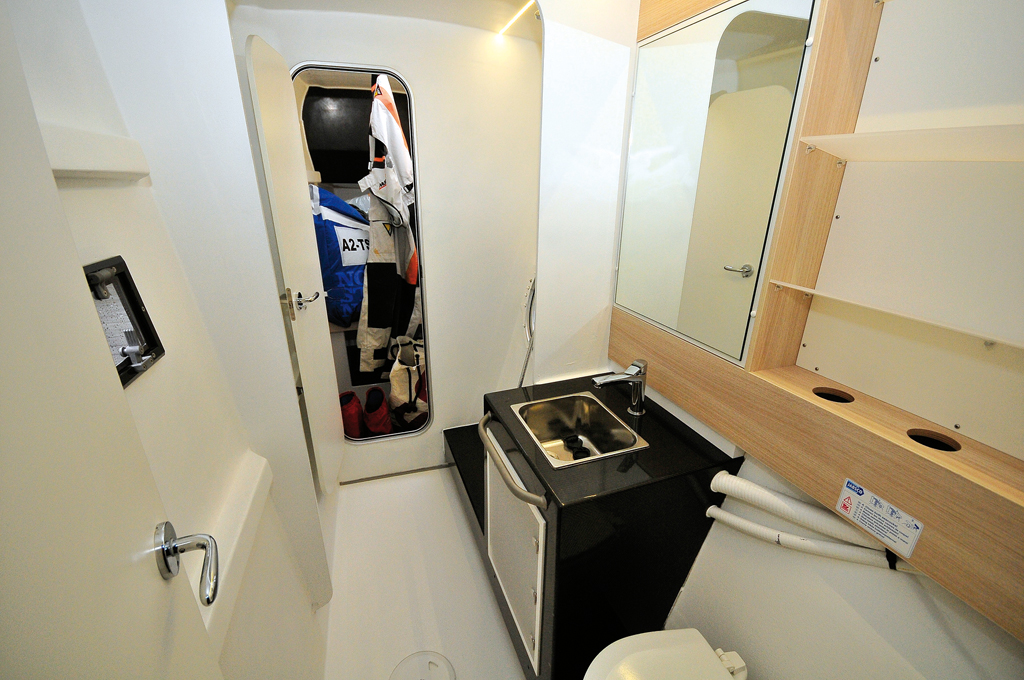
The port hull houses two cabins, separated by the heads compartment.
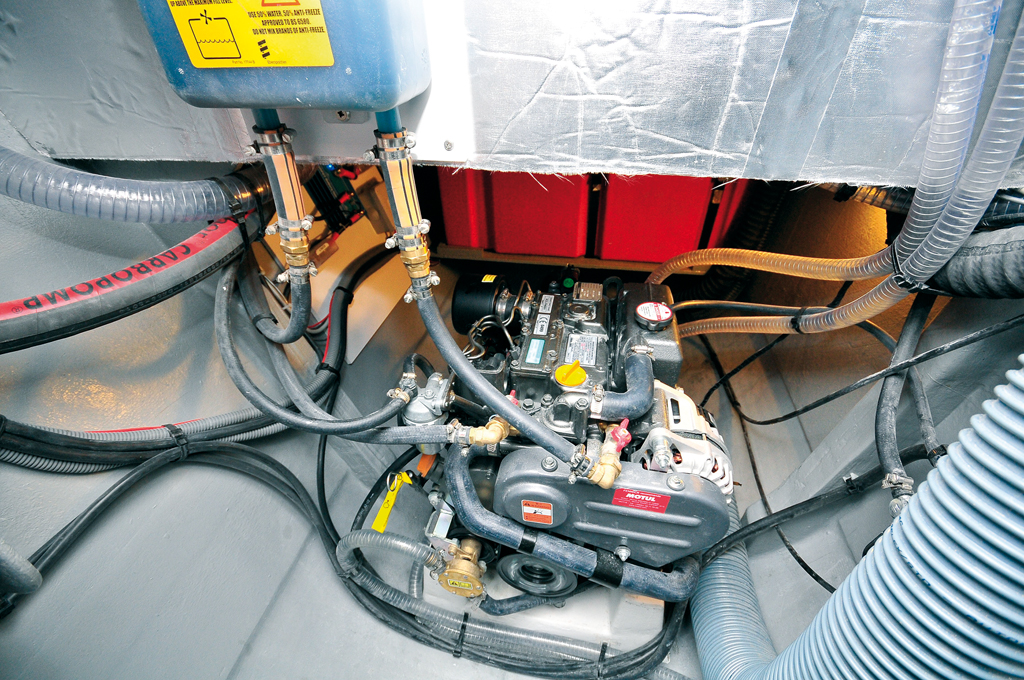
The motor sits in the middle of a clear and accessible engine compartment. The diesel tank can be seen secured to the back of the bulkhead of the aft cabin.
Pluses:
- Attractive lines
- Meticulously produced
- High level of performance
Minuses:
- A few interior finish details
- Salon table needs to be nicer
- Non-slip on the coachroof could be improved
THE COMPETITION
Model Builder Architect Upwind sail area in m² Weight in tonnes Price en € ex-tax Catana 42 CR Catana C. Barreau 102 8.9 379 000 € Vik 124 Legend Marine E. Lerouge 103 4.6 NC Nautitech Open 40’ Bavaria M. Lombard 92 7.8 283 000 € Dazcat 11,95 Multimarine D. Newton 85 4 338 000 £
| Model | Builder | Architect | Upwind sail area in m2 | Weight in tonnes | Price in € ex-tax |
| Catana 42 CR | Catana | C. Barreau | 102 | 8.9 | 379 000 |
| Vik 124 | Legend Marine | E. Lerouge | 103 | 4.6 | NC |
| Nautitech Open 40’ | Bavaria | M. Lombard | 92 | 7.8 | 283 000 |
| Dazcat 11,95 | Multimarine | D. Newton | 85 | 4 | 338 000 £ |
Technical Specifications
- Naval Architect: Christophe Barreau
- Builder: Marsaudon Composites
- Construction: Poly/vinylester glass foam sandwich
- Length: 12.98 meters
- Beam: 7.42 meters
- Draft: 1.60m (keel version)/ 90cm (daggerboard version)
- Air draft: 20 meters
- Light displacement: 5,835 kg
- Max displacement: 7,612 kg
- Mast length: 17.60 meters
- Mainsail area: 56m2/62m2 (square-topped version)
- Solent: 34.4m2
- Staysail: 15m2 (option)
- Gennaker: 80m2
- Motors: 2x30hp Yanmar
- Transmission: saildrive (shaft-driven propellers are an option)
- Diesel: 2 x 90 liters
- Fresh water: 2 x 110 liters
- Number of berths: 3 doubles (1 optional single in the passageway)
- Price ex-tax, with aluminum mast, in the water at Lorient, France: €335,472 Principal options Mast bulkhead and aft beam in carbon: €18,650 Carbon daggerboards: €9,930 Structure in vinylester instead of polyester: €14,000 Kevlar protection on the hulls: €3,500 Engine-driven hot water: €2,200 100 liter/hr watermaker: €11,950 Gori three-bladed folding propellers: €3,600 Refleks diesel heater with modifications to interior: €6,100 euros Forced air heating: €7,150 NKE electronics and autopilot: €10,440 600W hydrogenerator: €6,870
A word from the architect, by Christophe Barreau
Designing the TS42, we only set ourselves one objective, which was to produce a dream boat with a strong ocean feel to it. Designed without marketing constraints, but to be within a limited budget window, we tried to work out what elements would best provide this, and orientate our choices toward what would achieve this. A sailboat is a mixture of subtleties at the point where the water and air meet, and this is what makes it both complex and interesting. It’s the interaction between the elements which has us dreaming and keeps us motivated. Living in the fresh air is a definite choice: rather than dividing the boat into two small spaces - interior and exterior - we have made it so that you can have it as you want: open air or closed-in. Only the sail-handling and helm stations naturally need to be outside, and offer an excellent view of both the rig and the water, aided by an original helm-seat position and a very responsive tiller. Being able to determine the effectiveness of sail adjustments, precise helming, a smooth passage in choppy water with good ability to point upwind, high average speeds downwind and a real feeling of surfing are the enjoyment and safety elements we wanted to incorporate. The need to keep costs down on the basic version led us to design fixed keels. In order to compensate for the drop in efficiency this causes, an adapted hull shape needed to be designed. So the forefoot is fairly deep, and the slightly inclined hull becomes vertical upwind, and the reduction in windage improves the overall anti-leeway performance. The stretched and load-bearing shape allows the 42 to surf when you let it. The daggerboard version performs even better. The lightweight and rigid structure also benefits from the inclining of the hull which limits the loading on the beams, allowing them to be built-in. This feature is accentuated by the pronounced tulip-shape of the topsides, and the fittings are structural. We have designed living areas with plenty of light, which are convivial, adaptable and ergonomic, and we wanted to keep the TS50’s bunk in the salon which offers panoramic vision, something which is very useful at sea. The hulls can be totally enclosed by watertight panels, and this offers real seclusion. The boat is intended to be sailed by a crew of 4-6 people, and maintenance is limited thanks to being kept simple. Longevity and ease of keeping clean have been optimized thanks to all the salon fittings being molded integrally into the nacelle. Let’s make the most of our sailing, make friends, contemplate the scenery, and forget about your toolkit and tins of varnish! The TS42 is an efficient offshore sailboat, on a human scale, designed to give a lot, but with little effort.
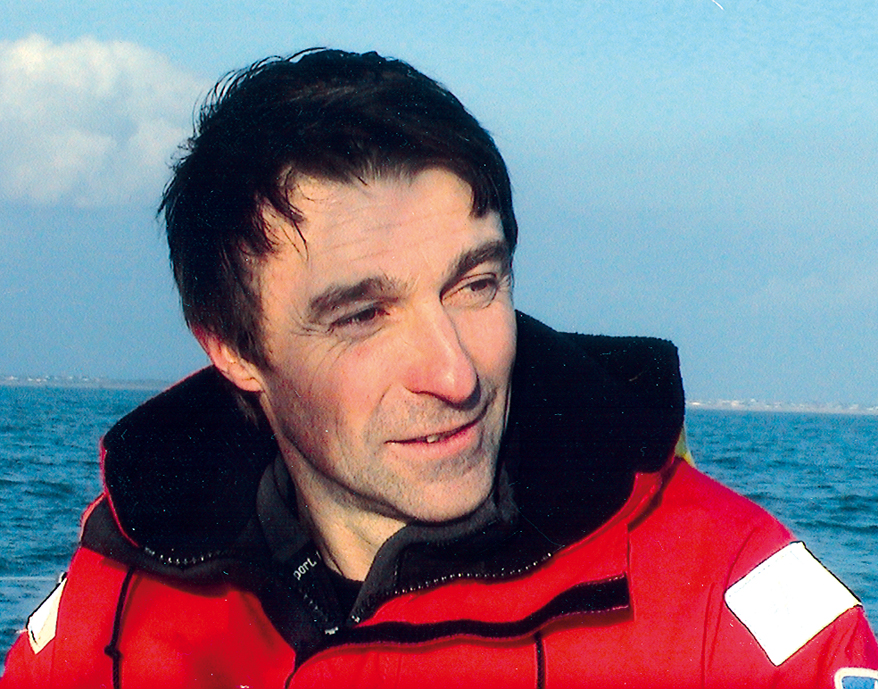
Caption
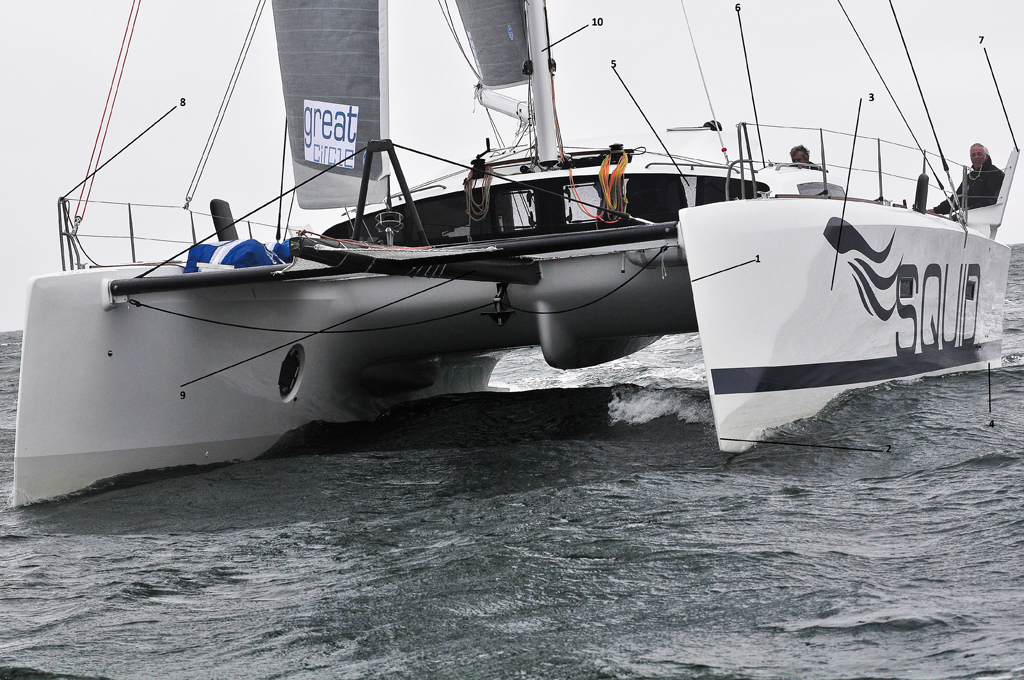
- : The fine bows have a positive angle and are slightly inverted
- : The deep forefoot helps this tight and high performance hull keep a good course
- : The external topsides with their tulip shape join the deck with an elegant deflector
- : The arches are cut off straight, but the indented shape is very practical for getting out of the dinghy
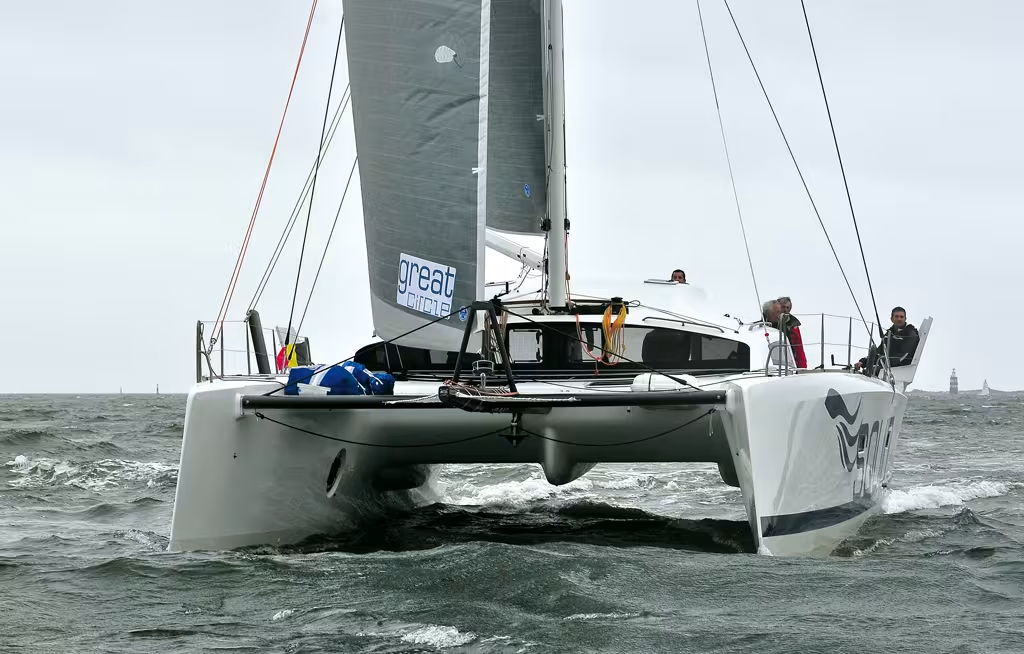
- : The forward face of the coachroof is well-designed, and remarkably, gives panoramic vision and ventilation without being too high
- : Only the central area under the coachroof offers full headroom, with the shape allowing steps on the outside to access the coachroof, all the while maintaining the nice lines and low drag coefficient
- : In practice the wide suspended seats feel comfortable and safe, and getting caught by the spray is rare, even in windy conditions
- : The stanchions and handrails in satin-finish stainless steel are a great look, almost matt titanium
- : The superb carbon cross is an option, integrating the bowsprit and the A-frame with its Kevlar martingale stay. The anchor is launched directly from the nacelle
- : A rotating carbon mast without spreaders was fitted to our test boat, but the aluminum version with Dacron sails also performs very well
