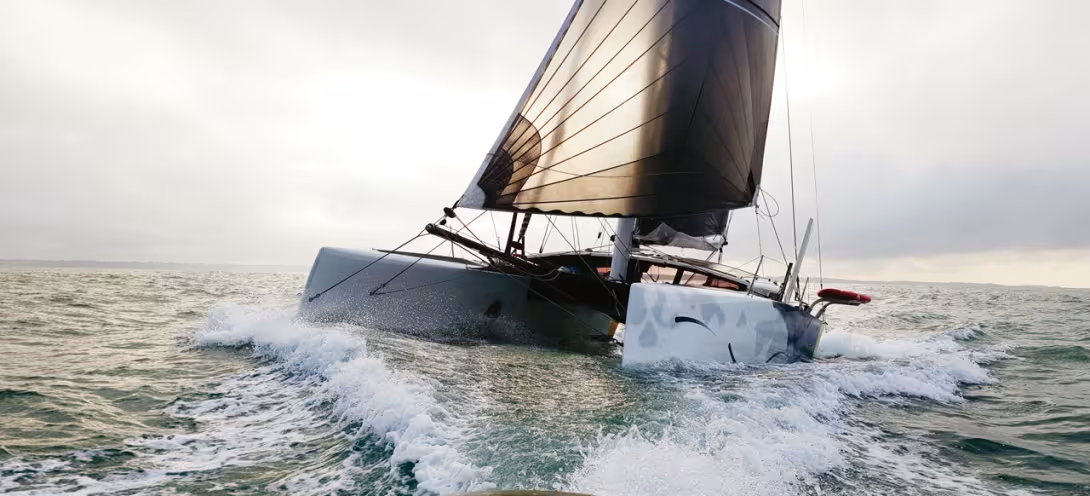
Some multihulls go beyond innovative – they tear up the rule book: their underlying characteristics link them to that previous culture, but their creative originality sets them apart and opens up new horizons. The TS3 could well be one of those!
Infos pratiques
- Le chantier : Ts 3
- La fiche technique
-
 Découvrez notre vidéo exclusive
- Financez votre TS3
- Assuez votre TS3
- Articles autour du TS3
Sensational multihulls
Christophe Barreau succeeded Lock Crowther as naval architect for Catana. He went on to develop the One Off 45, the Absolus, the Outremer 49/51, 45 and 4X. However, while developing increasingly large, luxurious, high-performance boats laden with equipment, he regularly escaped on board either minimalist versions of his boats, or on other sporty craft, to some radical destinations - which shows a certain independence of mind from more conventional cruising plans! This professor of the Paris School of Architecture nevertheless continues to design sensational multihulls. Take the TS, as in Très Simple (Very Simple in French) ... Well it is in his mind at least! The 50 was the fastest production cruising multihull of its generation (in the 50’/15m category. Francis Joyon regularly covered more than 400 miles a day with his vessel! Then came the TS52, followed by the much admired 42, and the TS5, which succeeded the 50-52. This turbulent family shares the same genes: inspired hulls; aft-set coachroof; limited weight; chassis stiffness; powerful sailplan and appendages designed for feel at the helm. Christophe readily admits to his fascination for the seascapes of extreme latitudes and the rough conditions encountered there. The company of Jedi-like adventurers such as Sébastien Roubinet doesn’t help, either. The architect/sailor admired the creative originality of Babouche - the extraordinary little catamaran which was fast, furtive, light, solid, autonomous and amphibious, and which allowed a world-first exploit purely under sail: a transit of the Northwest Passage. Mix all this in Christophe's fertile mind, and the conditions for the creation of TS3 are met....
A modern art sculpture
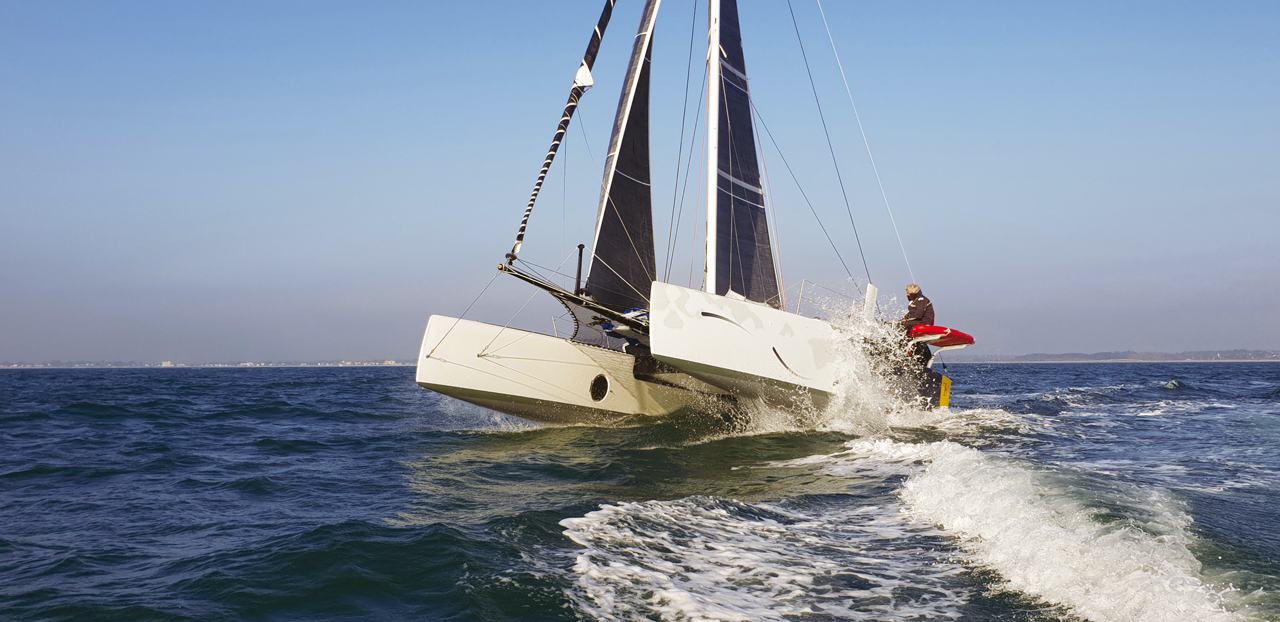
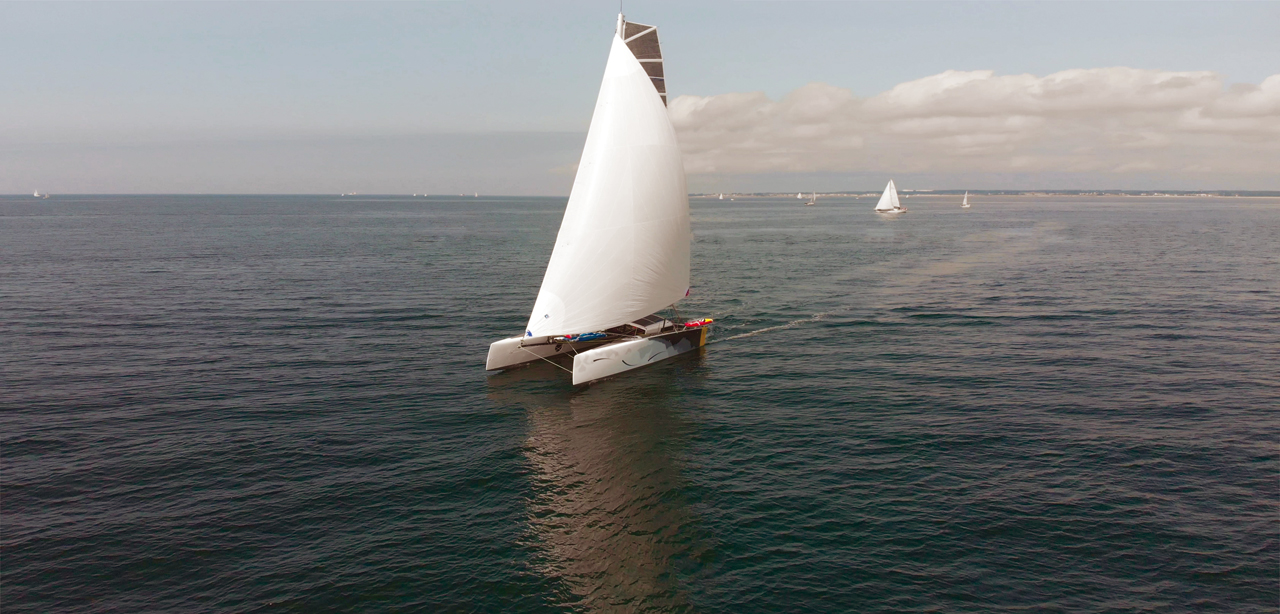
The TS3 is beautiful. Irresistible even! Its seductive power lies in its subtle proportions and sculpted hull forms. The asymmetry and camber create the illusion of a very elegant twist that is similar to the faraway flying proas of the Marshall Islands. The overall finesse and sailplan create the impression of power, and the artistic embodiment of the panoramic nacelle conceals what you find inside: a friendly and logical space in this suspended marine igloo (it really is, since it is fixed on flexible mounts to remain removable and isolated from the vibrations of the structure). The carbon compression beam enhanced by its cathedral strut has allowed for the front beam to be done away with, and the extension of the bowsprit offers wider possibilities for hoisting large headsails. In a few minutes, the informed observer can see the bigger picture: the two large cross-sectional carbon structural beams also provide clues to the machine's potential. A lot of available power, a lot of finesse, revisiting “livability” against the current trend of the usual "cabins", lifting rudders, positive curved daggerboards... Is it a racing prototype, a record machine, a Formula 40 off the lake or a new genre of expedition craft?
A broader program than it seems....
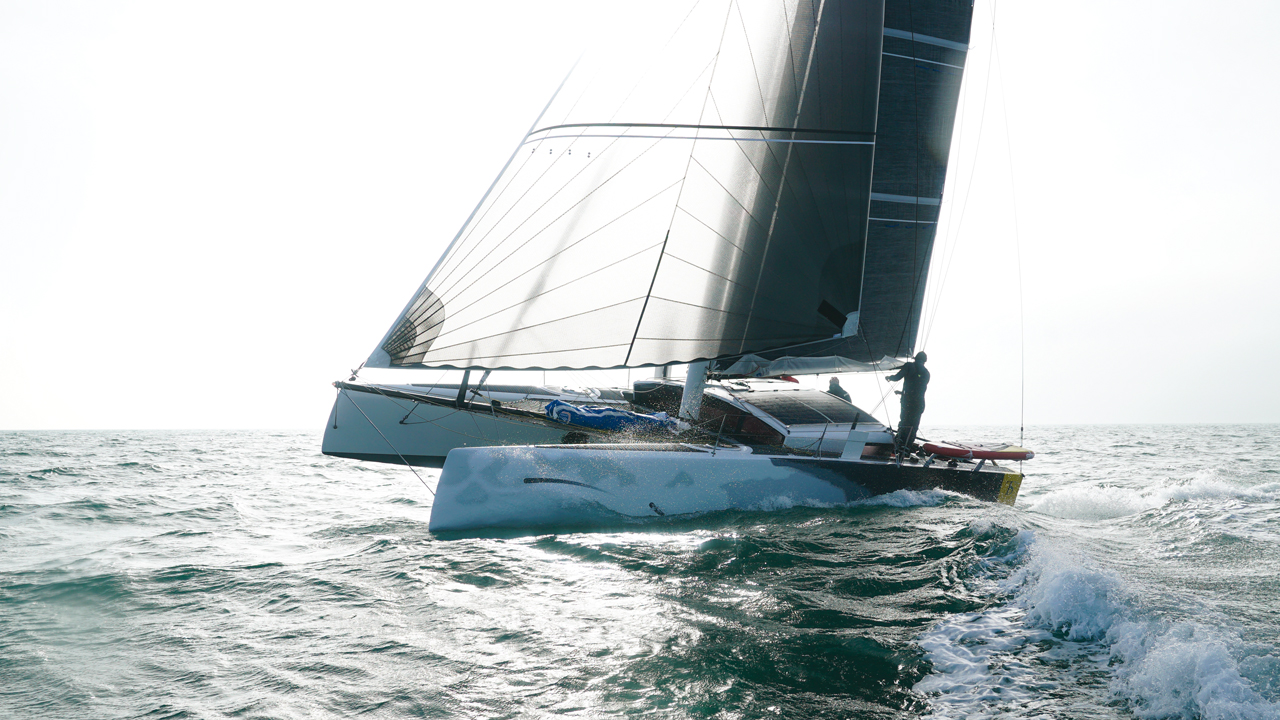
The TS3 cleverly flirts with all of these trends, and even seems capable of satisfying other desires. Impossible, you might say, a boat is for ONE program, not several! You’re right, but the characteristics of the TS3 are a combination of coastal camping, expedition vessel and light sailing sensations, so it meets complex expectations that have been skillfully reviewed. The TS3 is not for beginners and is certainly not the boat for everyone, for obvious reasons, especially financial (even if its quality/price ratio has been carefully calculated). However, this magnificent instrument has the merit of taking you on an immediate voyage, even without having left the dock.
A build as neat as it is clever
Building such a boat requires real mastery of composites on the part of the operators, because, more than on any "comfortable" cruising model, respect for weight is obviously crucial. The prototype from Marsaudon is exemplary in this respect, as is the implementation of the PVC foam/basalt fiber/Innegra sandwich. The mold is also a Marsaudon manufacture. The infusion process is used, and polypropylene (Innegra)/Basalt shielding is applied to the underwater hull - 2 x 270 g decreasing from fore to aft on the outer skin. Polypropylene woven with carbon or basalt (recyclable) provides extraordinary flex properties to the composite, allowing it to push back the limits of catastrophic cracks. The weight/strength ratio is almost unrivalled, impregnation is easy, tensile and compressive strength is exceptional and the composite is UV stable. This cladding is the perfect shield for future abuse with this program - stranding, sled mode, various shocks. I was able to see the boat just assembled coming out of the molds, before its paint job: it was magnificent with a perfectly conditioned surface and impregnation of the composite. The arms - attached to the floats via generous black fiber flanges - and the nacelle are made of post-cured carbon; all the elements are calculated to fit into a 40' container for delivery abroad or shipping to a future exotic cruising spot.
On board? You’ll either love it or hate it...
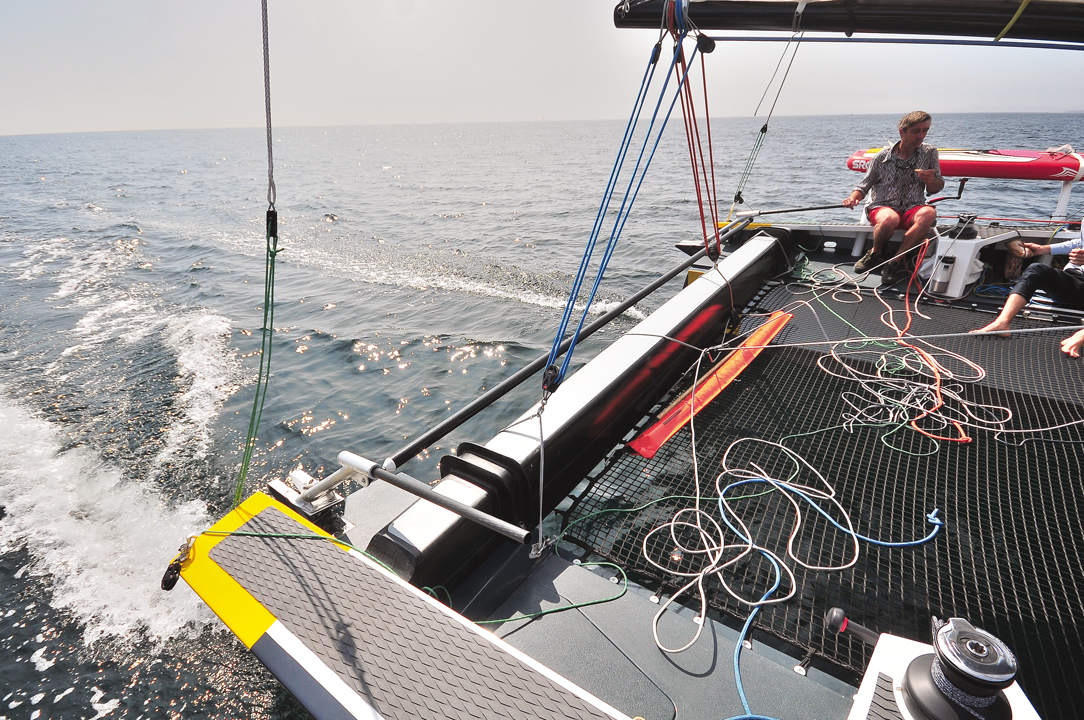
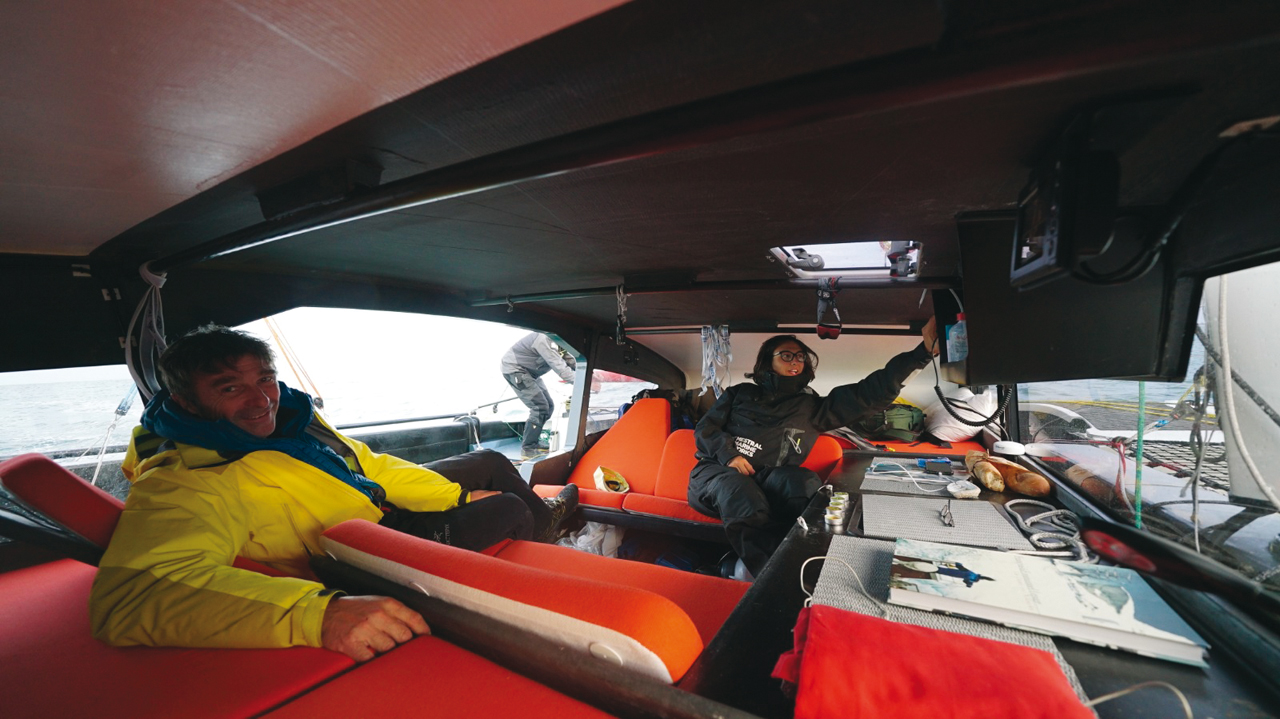
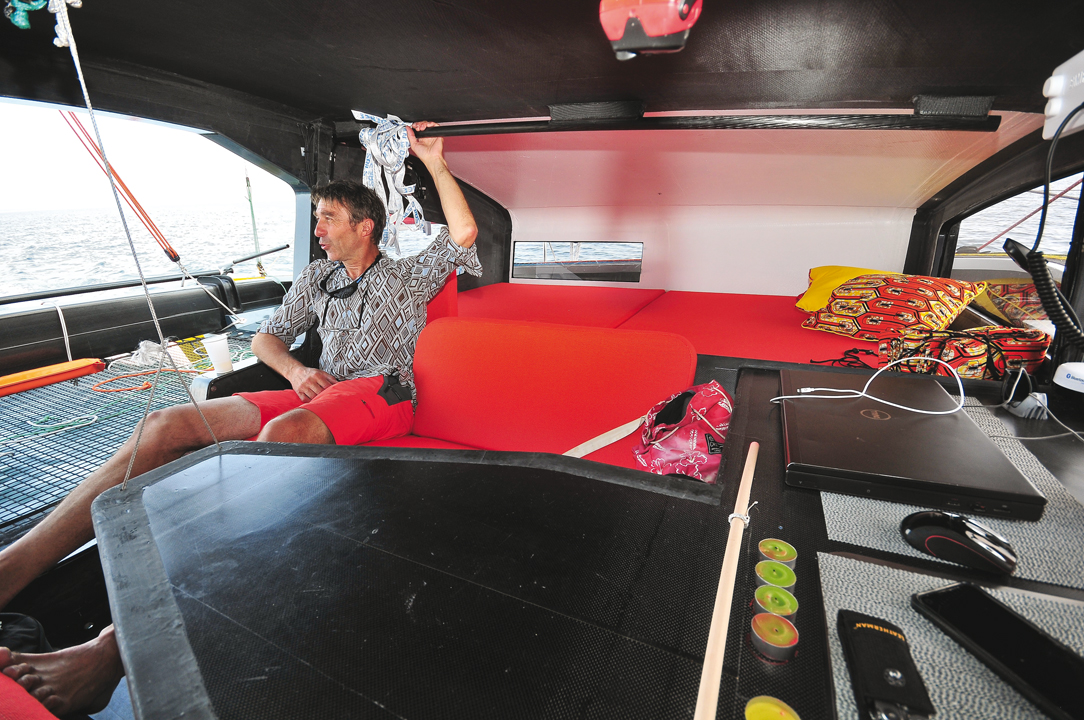
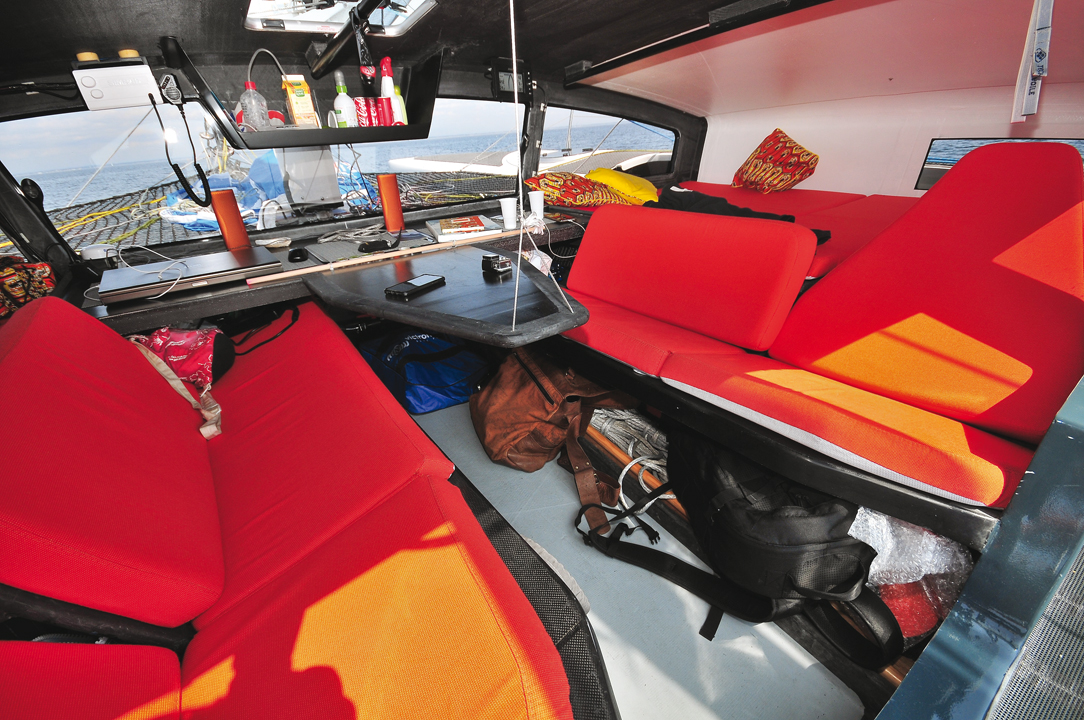
This machine generates impatience! After inflating (very quickly) the paddle-boards that serve as remote helm seats (exemplary rigidity and comfort, an excellent idea!), I am ready for a thorough look around. Four accesses to the hulls are possible via two opening panels at the front and two in the cockpit. There's a lot of volume in these hulls, but they’re not fitted out! It is possible to install a toilet and one or two extra berths, but they must remain empty and serve mainly as technical spaces for the electrical system (centered around the daggerboards), stores, skis, two bicycles, a watermaker... There is a clear and radical conception of life on board: everything happens up top, in the nacelle-pod. This nautical igloo is made up of the dream room of a teenager, a monastic chapel from The Hobbit and the flying shuttles from Star Wars! It is not made for being in port, since light passes through it. For anchoring in the middle of nature, or sailing though, it is ideal. There’s no headroom, of course, but sufficient elevation for comfort, two very large double berths and a four-person saloon grouped around the carbon table - made up of one of the two removable backrests of the reclining seats - and the "chart table/galley/desk" work surface. You either love this, or you’re staying on the dock! But this cave-like conception for living on board has the great merit of pushing you outside the shelter to see the world, the foreshore, the river, the mangroves, even if they are only a stone's throw away. Spend the night out of the marina prison. Cast off, let go, and get on the water! Enjoy this happy frugality.
A truly self-sufficient catamaran
On board the TS3, forgotten are whimsical outboards, explosive fuel, spare parts and so on: the engine is electric. The two "outboard pods", in wells, are located aft in the hulls in watertight housings. They are easily lifted up when not in use, meaning no corrosion, drag, vibration or back-eddies are created. A "cap" seals the integrity of the hull in sailing mode - unless you want some quick charging, because these engines are also hydro-generators. The entire installation (batteries, cables, charger, regulators, solar panels, outboard pods) weighs less than 200 kg (440 lbs) for the equivalent of 2 x 10 hp gasoline-powered equivalents. The installation is very professional, and well protected from oxidation in waterproof housings. Everything is clean and not very invasive. The system can be forgotten about. 1000 W of solar panels on the roof of the nacelle make it possible to envisage almost 50 Ah of free, renewable and maintenance-free charging.
Properly exciting under sail
Setting out from Lorient La Base in Brittany is the opportunity to test our famous electric propulsion. The first surprise is how powerful it is. There’s plenty of torque, beautiful traction and the propellers have excellent grip in the water. The result is an amazing level of maneuverability. On this model, there are low-pitch propellers and a set of high-powered props is also available. Getting out through the entrance channel takes about fifteen minutes at 6-7 knots. The boat is very progressive, guaranteeing easy handling even in a big wind or strong current. The final nice surprise: fully recharging will take less than 45 minutes. Amazing. The "electric outboard in a well" goes completely unnoticed when stored in its housing. The only precaution: make sure it’s switched off when handling to avoid inadvertent start-up by a distracted crew member. There is little wind this morning, but as soon as the main is hoisted, this rocket sets off energetically in 5 knots of wind. Hoisting the gennaker then propels this beautiful creature into a kind of pleasure unknown to most amateurs: that of performance in light airs. 5,6,7,8 knots of wind, with the boatspeed consistently and significantly higher than true windspeed. A steady 9 to 10 knots on flat seas when the thermal wind settles in. Still no white-caps announcing the beginning of a breeze, but simply this magical apparent wind and this pure gliding sensation. Absolute pleasure! And the pleasure of steering is intense. The very carefully designed appendages (narrow, asymmetrical and deep, slightly positive daggerboards; optimized, lifting rudders) combined with the absence of any drag from propellers and outboard or saildrive legs, offers the attentive helmsman his just reward. The feeling of sailing a multihull in light airs aboard a magnificent sports coupé. Back in the day, only the latest generation F40 trimarans would have been able to compete (for boats that remain in the water, using the Archimedes principle) but they weren’t liveable cruising boats! The deck layout is still evolving (a traveler will replace the two mainsheet tackles, a pre-inflated Certec airbag will be inserted into the mast, and some of the lines will be upgraded), but everything works perfectly for what is only the second example of the boat. The handling ergonomics are perfect and the neoprene anti-slip deck is fantastic in terms of efficiency and comfort (the trampoline will also be equipped with this covering). The superb Lorima rotating carbon mast (Axxon on the versions to follow) contributes to the pleasure and performance of this nautical GT. We hoisted the Code 3 to go higher upwind (12 m²/130 sq ft less than the gennaker) and this was the moment the breeze chose to go up to 12, 13 knots, then 15-16... One hand on the sheet and the traveler, and the fun begins. At the helm, it's pure pleasure, with the stiffness of the chassis contributing to the enjoyment of driving and also the feeling of safety, because the directional effect of the rudders is perfect. You can slip into a contact zone between apparent wind acceleration which creates power and the acceleration of the boat without dropping too quickly according to the helmsman's will (or skill), and the windward hull lifts if you wish, but always delicately. This is a very addictive game! The speed on this flat sea and in these medium airs which are just picking up is invigorating, and surfing at a stable 19 knots in such conditions is something you’ll never forget. In the nacelle there is no noise and no vibration, as if we were suspended on a cushion of air...
Conclusion: it’s a cruising Formula 40
What do you ask of a multihull when you have all the experience, when you have done almost everything or after a few rally-raids in sports cats? The question arises of choosing a (very) fast, cruising multihull. Beauty, simplicity, lightness, efficiency, stealth and high-end sensations may be the top of your list of criteria. If this is you, a TS3 is possibly the answer. It ticks all the boxes and has that touch of craziness that you’ll never forget. It doesn’t fly, but I’ll bet that someone will be able to convince Christophe Barreau to install foils on this amazing platform. The electric motorization installation is so successful that it seems quite natural on board this boat, and is simply forgotten.
TECHNICAL SPECIFICATIONS
Architect: Christophe Barreau
Builder prototype: Marsaudon Composites
Builder production models: Mestral Marine Works (Tarragona, Spain)
Length: 10.98 m (36’)
Beam: 5.50 m (18’)
Weight in sailing condition: 1920 kg (4225 lbs) /2150 kg (4740 lbs) on our test boat
Draft: 0.35/2.50 m (14”/8’2”)
Construction: Foam basalt fiber/Vinylester sandwich in infusion process.
Reinforcing in Innegra cloth/Basalt below the waterline/Arms and appendages in carbon
Mainsail area: 44 m² (475 sq ft)
Gennaker: 72 m² (775 sq ft)
Genoa: 50 m² (540 sq ft)
Solent: 19m² (205 sq ft)
Staysail: 8 m² (86 sq ft)
Price: € 198,000 ex-tax – Launch offer for the first three boats in glass/Vinylester/Aircell, equipped with the performance pack and energy pack: mast and beams in carbon, fiber rigging, nacelle fitted-out, deck hardware, solar panels, electric pods, and lithium batteries: € 267,000 ex-tax
Characteristics of the TS3’s electrical system
- Motors: 2 x 4 kW (equivalent to 2 x 10 hp)
- Batteries: 2 x 5 kWh lithium-ion
- Flexible solar panels: 4 x 250 W peak
- Shorepower charger: 2 x 250 W
- Total weight of system (including cabling): 196 kg
The philosophy of the TS3 project by Christophe Barreau
Cruising has very different characteristics depending on the multihull you’re on, despite the sailing program being the same... I noticed this truism a long time ago, during two cruises to Spitsbergen and Lofoten. One was on a comfortable Catana 40, "Diabolo" which I will call the "house boat" even if the performance was more than enjoyable, and then later, on a Hobie 18. We loved the comfort of our nicely heated catamaran, but also the freedom offered by the sports cat and the symbiosis with this exceptional natural environment. Aboard Diabolo, we were spectators; with the 18, we belonged to the surroundings. The low draft, the option to separate ourselves from the boat by leaving it safely ashore, in the mouth of a creek or sheltered in a shallow lagoon, had widened the scope of the trip. The Catana 40 was a very good catamaran, but the sensations were more intense aboard our Hobie (not necessarily faster, by the way!). So I thought about a boat that would be a kind of reasonable sports catamaran capable of going great distances. The constraint of sleeping arrangements and containerized transport defined the proportions of the life pod, designed as an ultra-light rigid tent housing two real double berths and a saloon with seats that can be transformed into a rest/watchkeeping position. In fact, I never envisaged living in the hulls, which can only accommodate, from my point of view, auxiliary supplies. This defined the mass, and set out a hull length which I increased by one meter (3’) to provide a little more longitudinal and diagonal safety in line with the semi-offshore program. I used to dream of a voyage to Japan, and this is still in my head. As I enjoy sailing in the polar regions, the obvious route is to the north. The longest distance to cover without shelter on this route is about 250 miles. Given the accuracy of the 48-hour weather forecast, such a trip can be planned with a small fast boat without taking too many risks. It is therefore with this idea, combined with a racing/raid project for the Northwest Passage, that the idea of the TS3 was born. I designed a minimalist interior living space: sparse, yet bright, ergonomic and relaxing (the nacelle sits on flexible mounts). In order to ensure the pleasure of sliding through the water, high level performance and an exceptional, sensitive and balanced feel to the helm, the appendages were very carefully designed. For safety and freedom, it has a 35 cm (14”) laden draft in order to be able to be secured in the slightest hole in the coast or to climb up onto a beach. For increased sailing autonomy in regions remote from all resources, I opted for electric motors, logical considering the low drag of the hulls. The boat is therefore equipped with two Torqueedo pods that can be lifted into a well with a cap to maintain a perfect shape to the underwater hull when sailing without any loss of buoyancy. The boat has to produce its own energy, which during initial tests worked beyond our expectations. This is of course an eco-responsible approach that is expressed through this choice and the use of recyclable basalt fiber, but also more generally through the minimalist dimensions of the project.
THE ESSENTIALS
Intensity of pleasure
Versatility of use
PLUSES
- Exceptional quality of this machine
- Very high-level performance
- Charisma of the program
MINUSES
Yeah... like you really need to check these!
- Beware of the power
- Not to be put into just anyone’s hands
- Enlightened use, maintenance and proper seamanship essential