The new Vaan Yachts brand is clearly showing its ambitions with this R5, the second model to be launched, barely a year after the presentation of its little sibling, the R4. Measuring 7 feet longer – and still built in aluminum - the catamaran presented to us by brand co-founder Igor Kluin boasts a meticulous design, remarkable cruising comfort and good performance potential. The Vaan R5 is also one of the forever green multihulls leading the way in terms of environmental friendliness.

Infos pratiques
- Le chantier : Vaan R5
- La fiche technique
-
 Découvrez notre vidéo exclusive
- Financez votre Vaan R5
- Assuez votre Vaan R5
- Articles autour du Vaan R5
Conditions: 2 to 3 knots of wind, calm sea
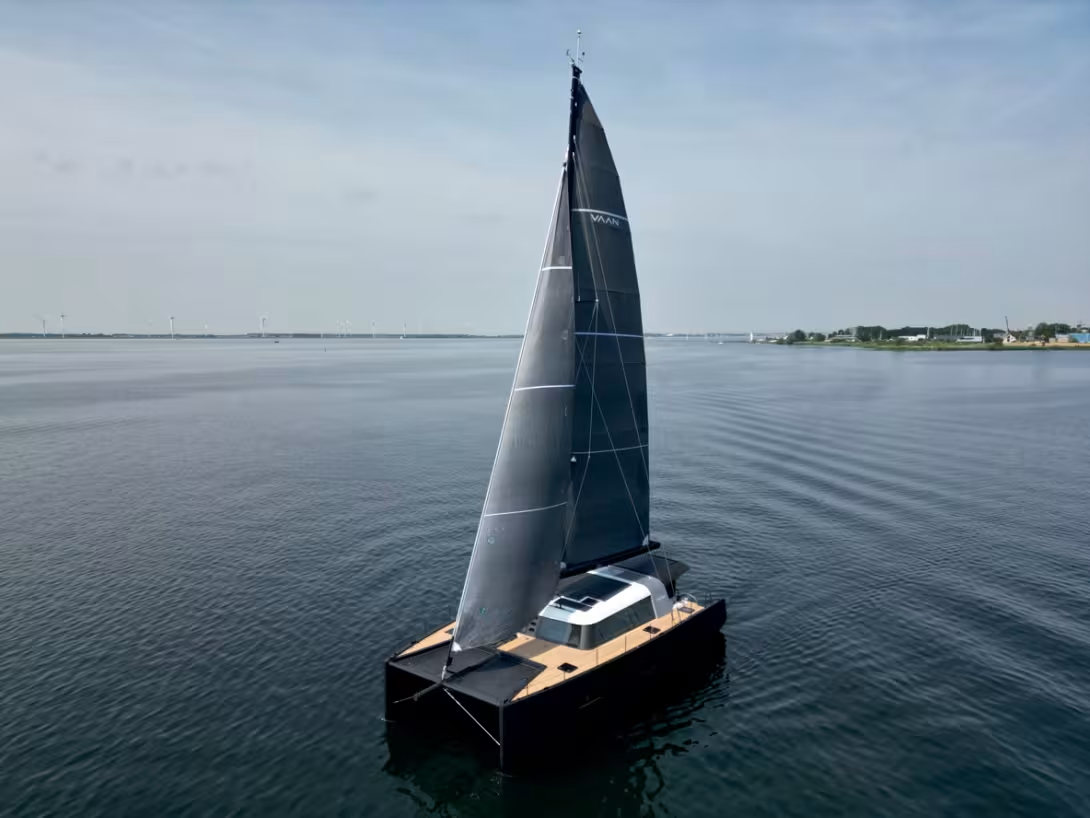
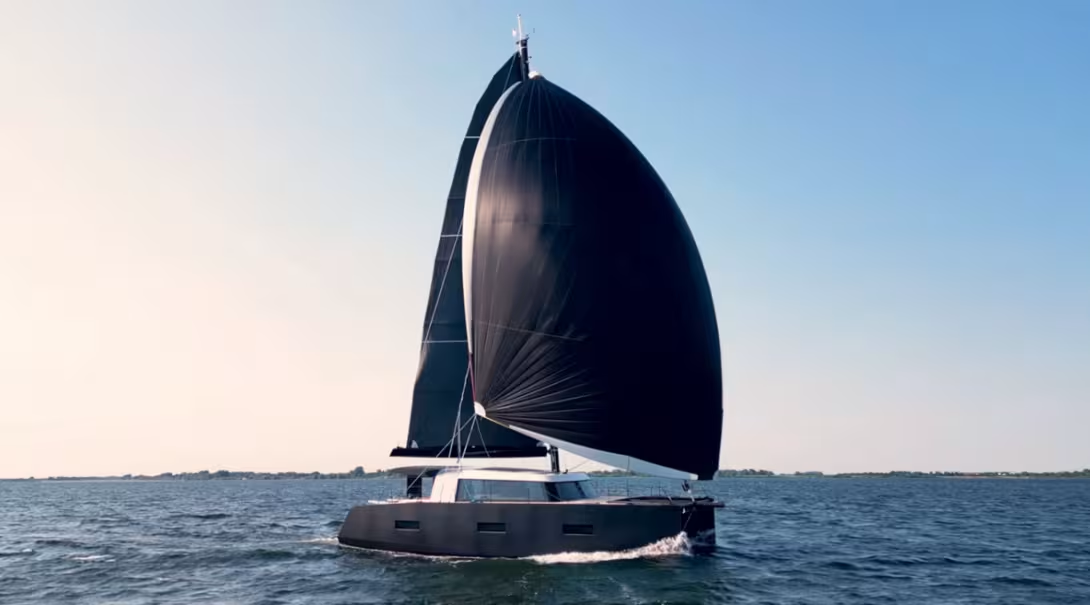
In the dock of the small service yard in Hellevoetsluis, near Rotterdam, we discovered the long-awaited Vaan R5. Hull #001 was still being finished but was to be delivered to her Owner in a few weeks, so the window for us doing a test couldn’t have been tighter! Your eye is drawn immediately to the matt black painted hulls, the metal-gray coachroof, the PET sandwich bimini structure with its canvas in black Sunbrella fabric, the black aluminum Selden mast and the cork-lined deck. The black color used here contrasts with the grey lacquered R4 and underlines elegance worthy of contemporary superyachts. With its attention to design details - the crisp deck edge, angular bows, curved tinted glass roof windscreen - I can’t help but make an association with Van Dutch, an iconic Dutch brand of Open powerboats. Igor Kluin seems to appreciate this flattering comparison, and even admits to having been inspired by these luxury motorboats.
The builder revealed to me the three main criteria that formed the genesis of his brand were “To ensure great sailing sensations, to offer a sleek, chic and comfortable look, and to guarantee a multihull that has ultimate respect for the environment”! That’s a demanding set of specifications, to say the least, for such a young company. Under the hangar, a second Vaan R4 sits on its yard cradle. The aluminum topsides are impeccably smooth, a clear sign of quality craftsmanship, but more on that later. As if reading my mind on this incredible surface finish, Igor smiles: “Good timing, this one’s going to be delivered as a bare hull, so without fairing and paint! ” Only the coachroof will be painted anthracite gray, and the combination of raw aluminum and dark gray lacquer will give the boat a trendy, explorer look that couldn’t be more seductive. With three catamarans built in less than two years and a healthy order book, it’s safe to say that the Vaan formula is off to a good start. At this shipyard (which was originally a maintenance facility) bought by Igor and his co-founder, Nienke van ‘t Klooster the hangars dedicated to construction are seeing increasing work.
Demonstrating quality and commitment
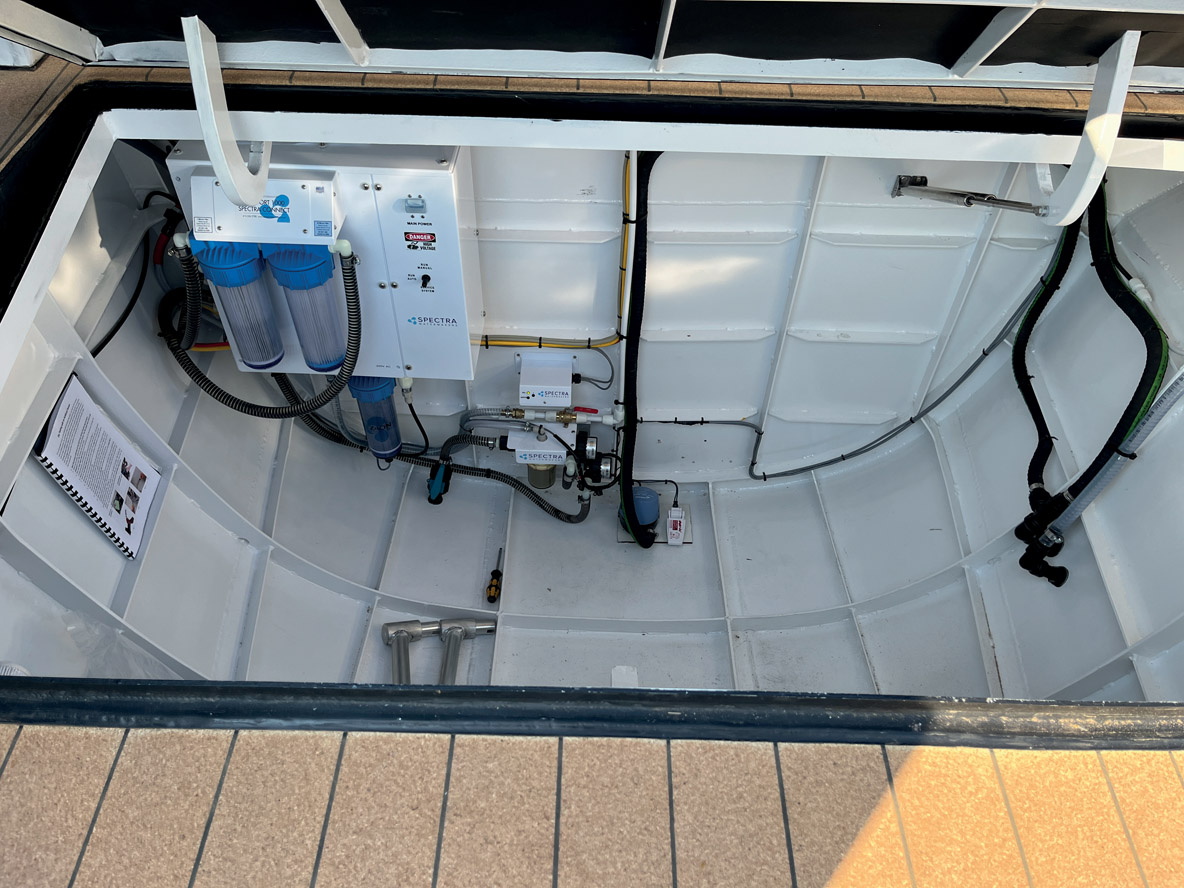
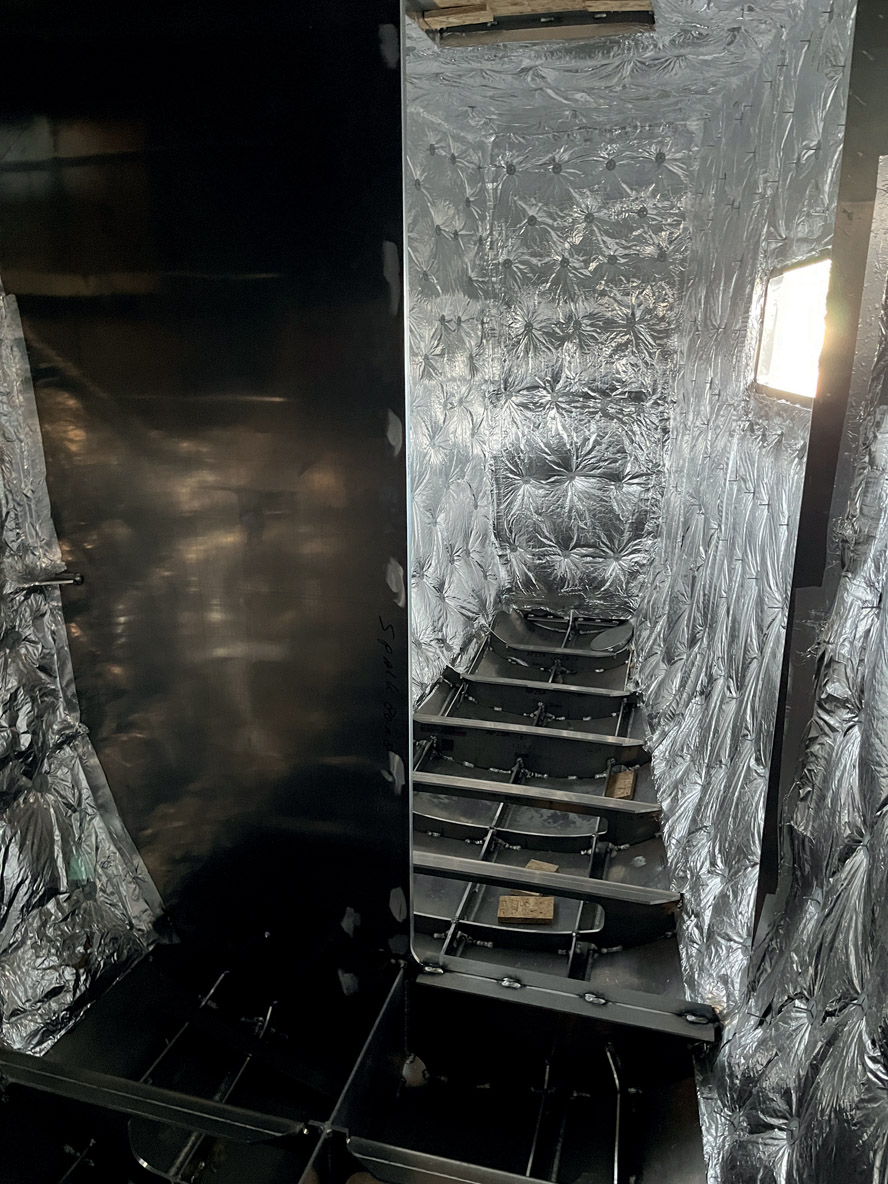
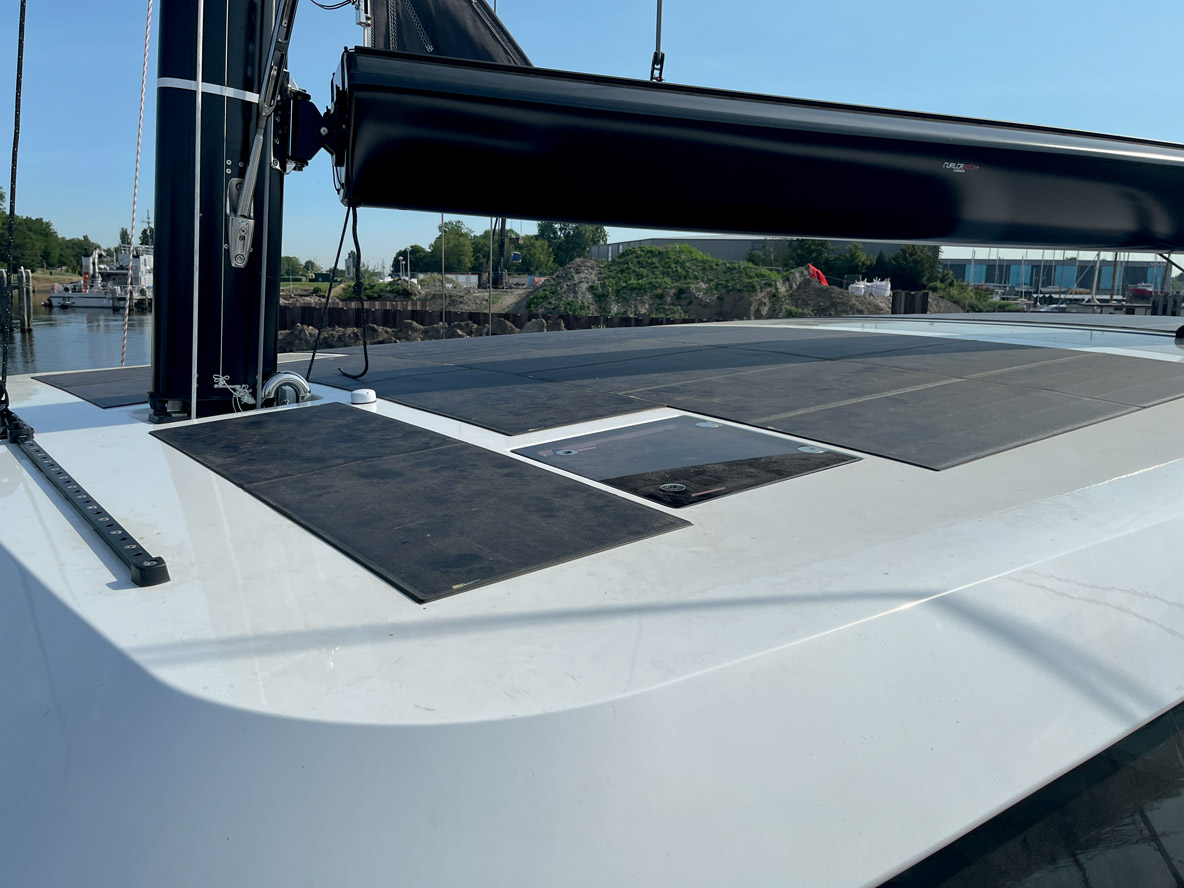
But it’s not enough just to propose a highly advanced, ecologically committed design concept. Mastery of engineering, implementation and the ability to ensure an impeccable finish are the essential requirements for convincing the customer to sign an order form. To achieve this, Vaan Yachts has a clear division of roles and well-selected partnerships. Igor is the project manager, while his partner is responsible for styling and communication. The renowned Dutch firm Dykstra Naval Architects is in charge of the design, structural calculations and supervision of implementation. Former sailing champions and highly experienced engineers also advise this small team of committed enthusiasts. For hull and superstructure construction, Vaan Yachts has three highly experienced subcontractors. Less than an hour’s drive away, they guarantee top quality and smooth logistics. Aluminum (60% coming from recycled from road signs) is used to assemble 6 to 8 mm thick panels, depending on requirements, on a tight gridwork of frames and stringers. The finishing touches are all made at the boatyard, right on the water’s edge. There is no overland transport involved in this the manufacturing circuit: the wonderful Dutch canals and other stretches of water now replace the four-lane highways... Suppliers are also selected for their environmental commitment as well as their proximity. Recycled glass wool for insulation, PET panels for headlinings, Seacork for the deck, an electric drivetrain, large area of solar panels on the coachroof, glass for the windows, Ecoplex joinery, sisal fiber carpets: everything is designed to do as little damage as possible to our future resources. The absence of molds to manufacture the R5 is also an ecological argument, reinforced by the fact that virtually all the materials used have demonstrated that they’re legitimately green before being accepted on board.
Two layout versions
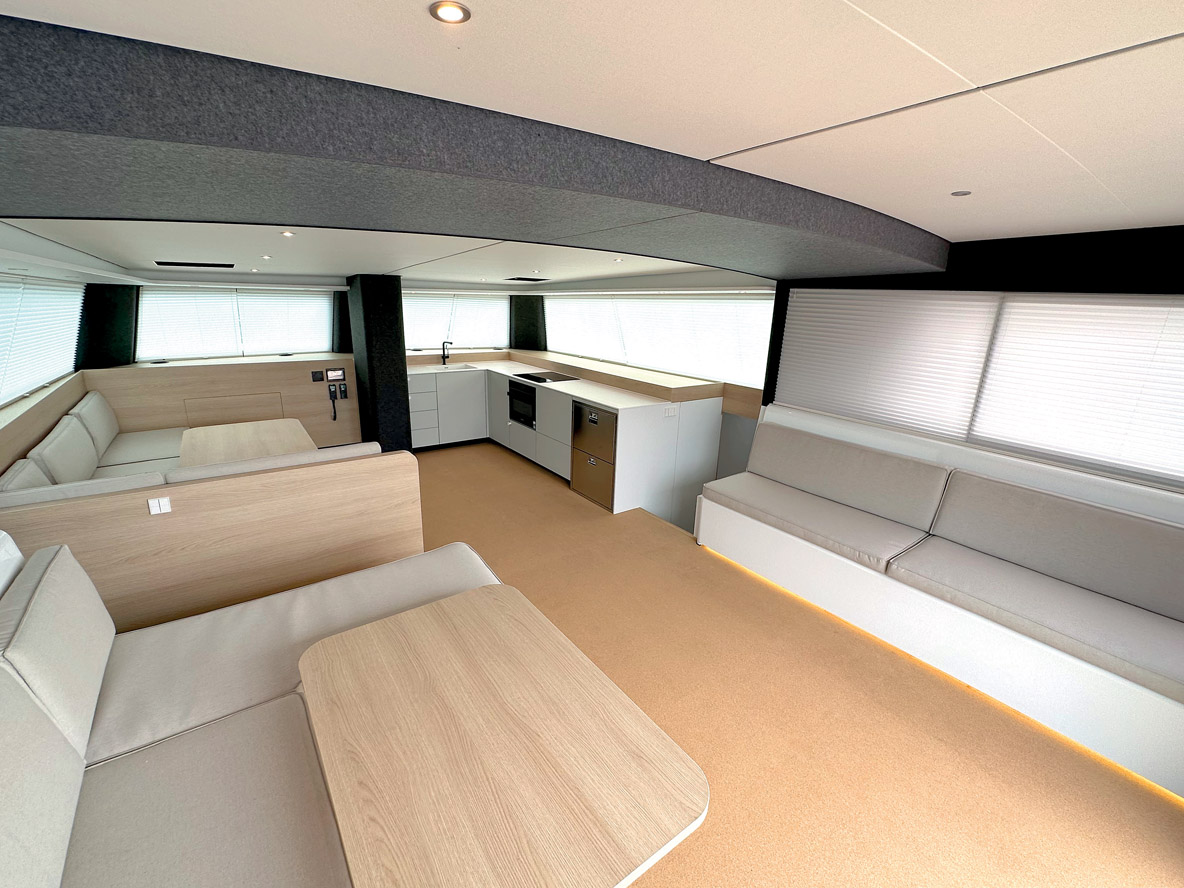
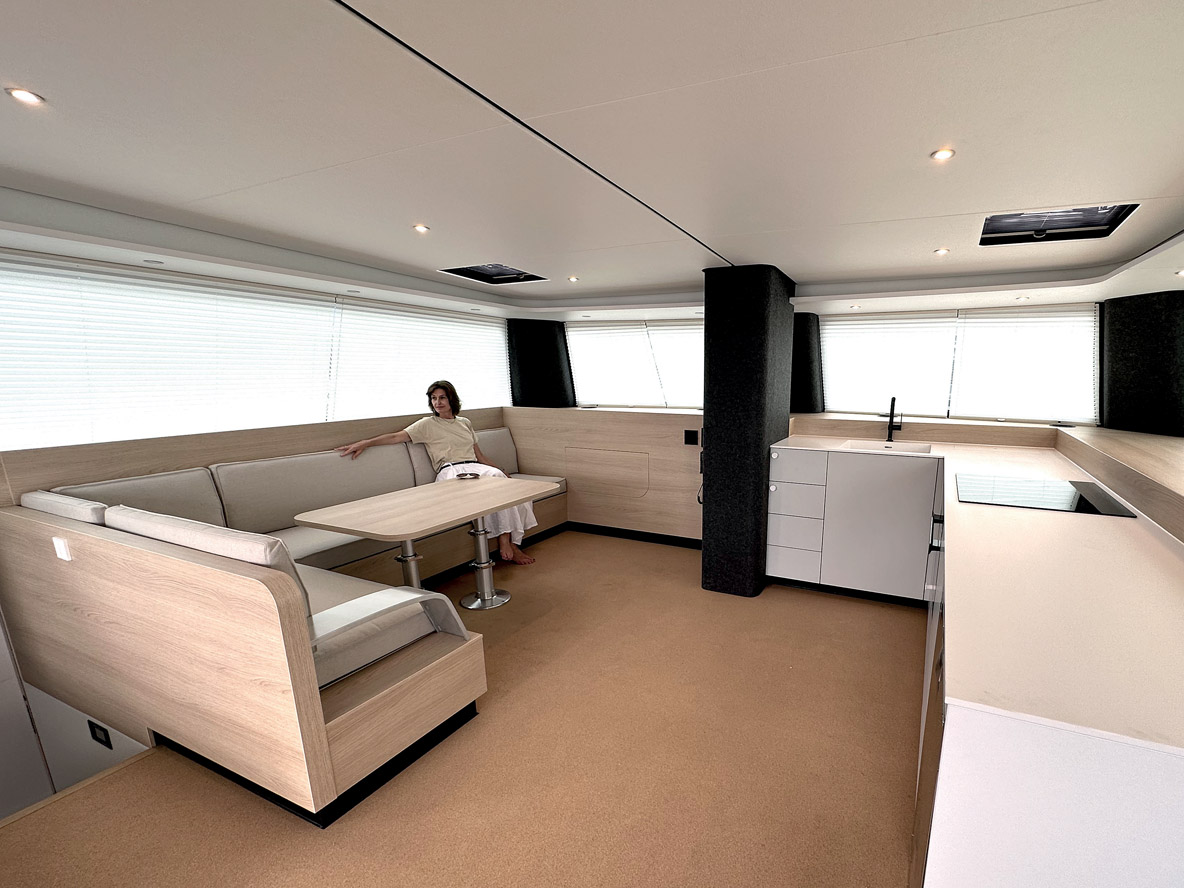
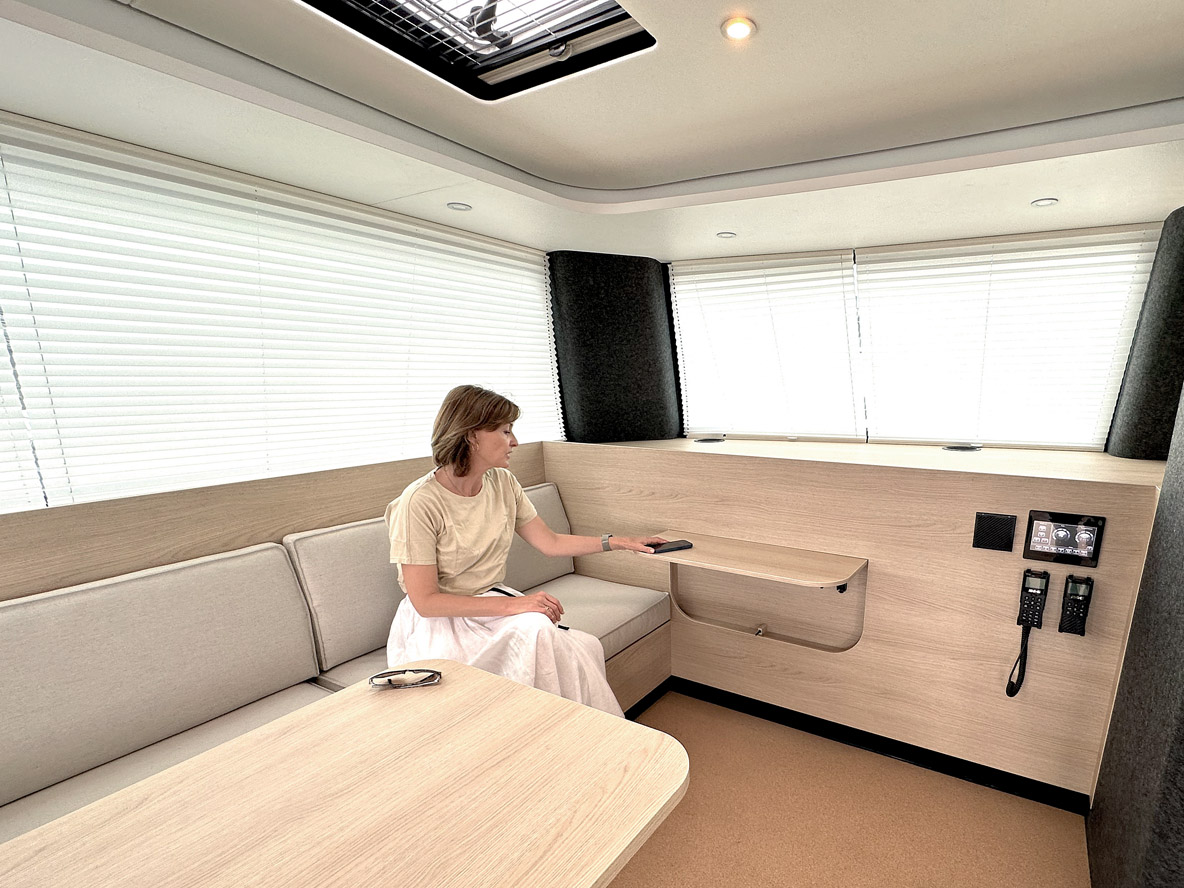
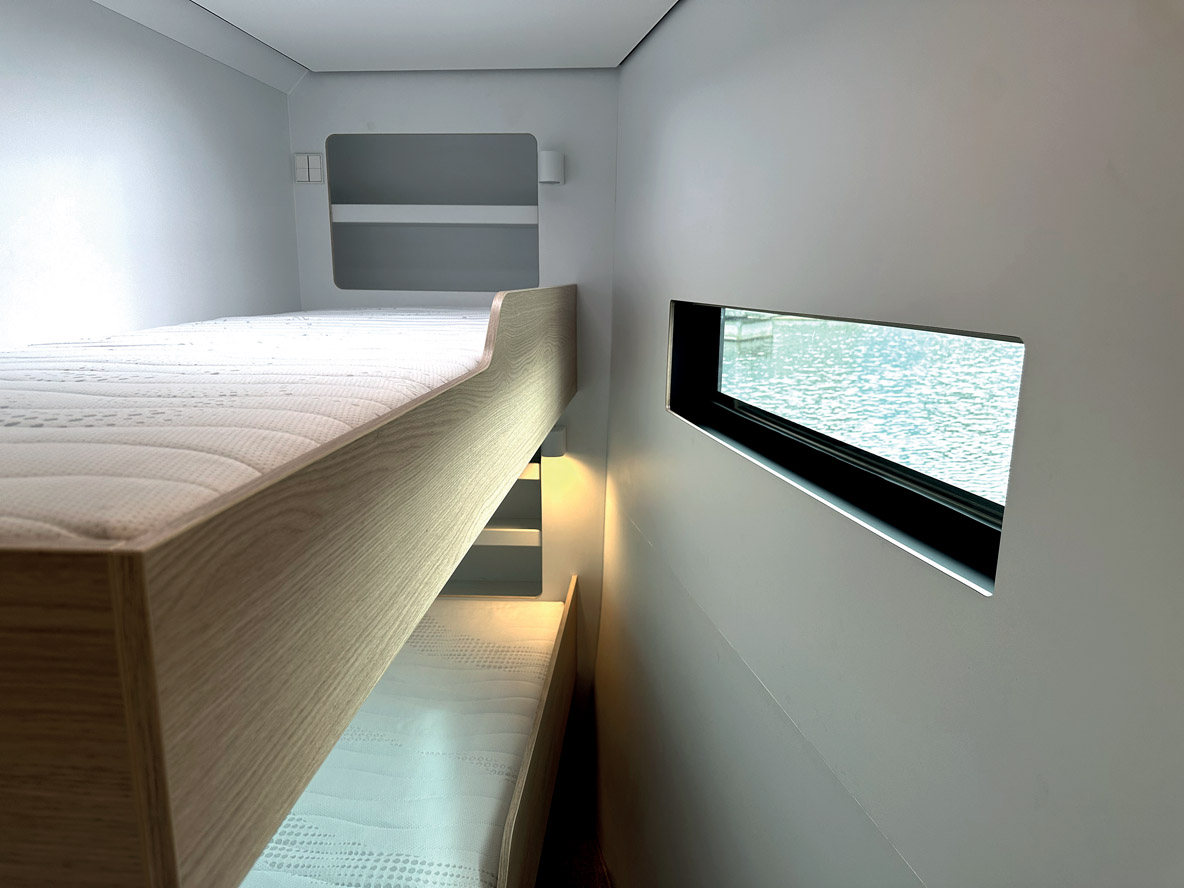
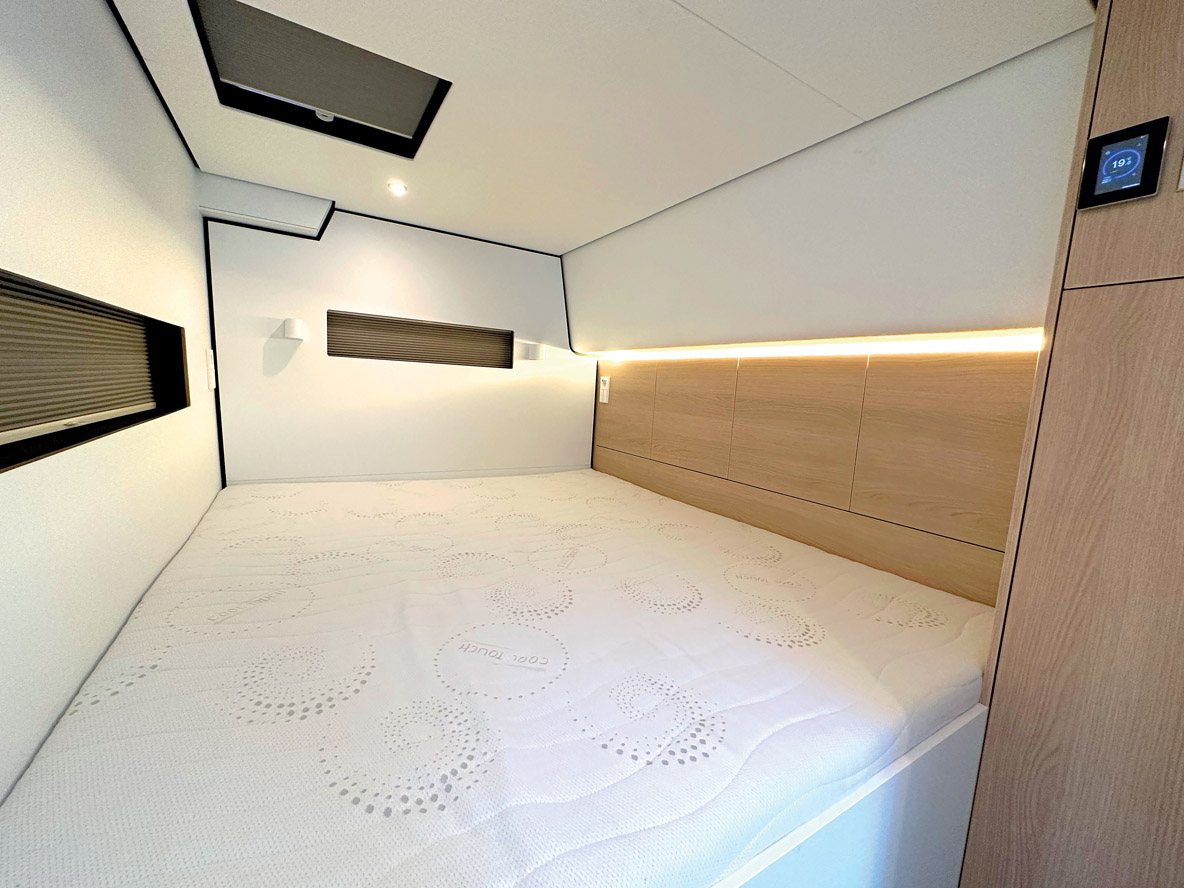
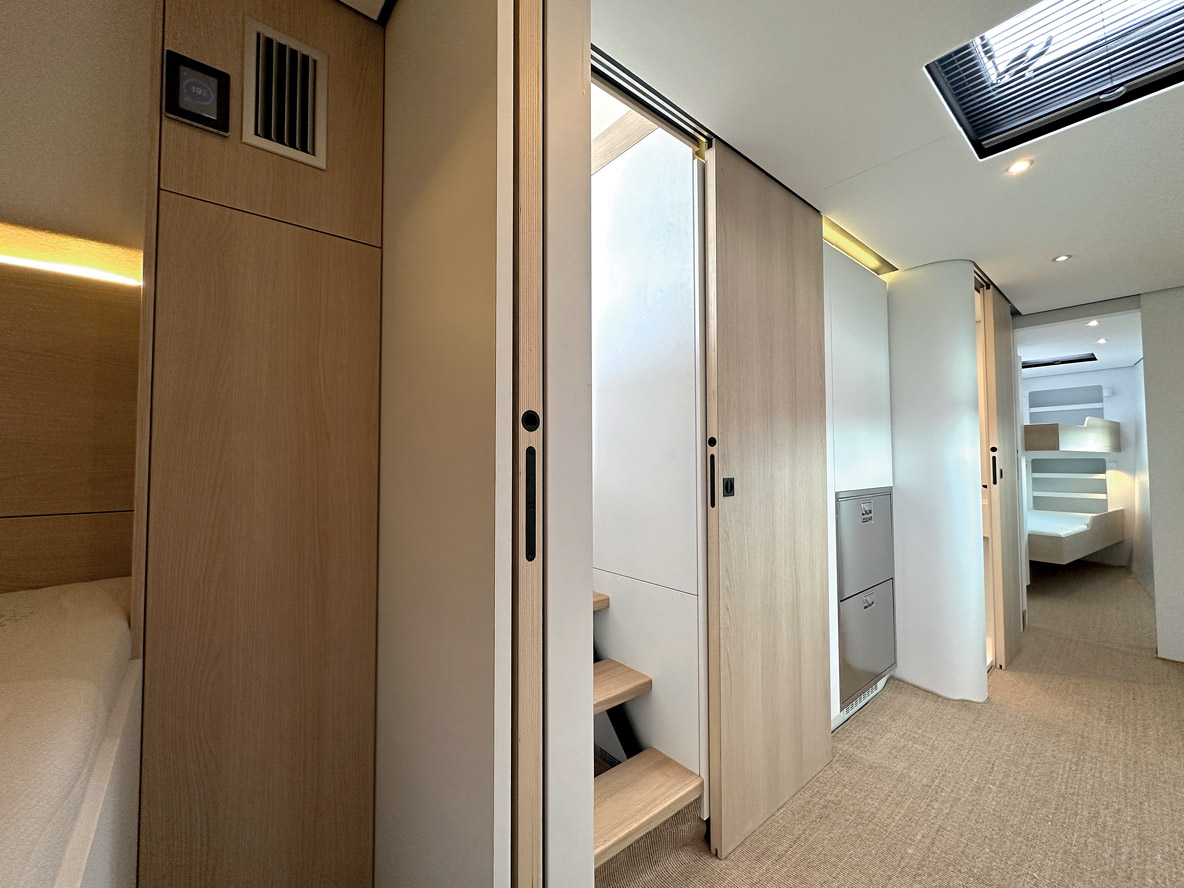
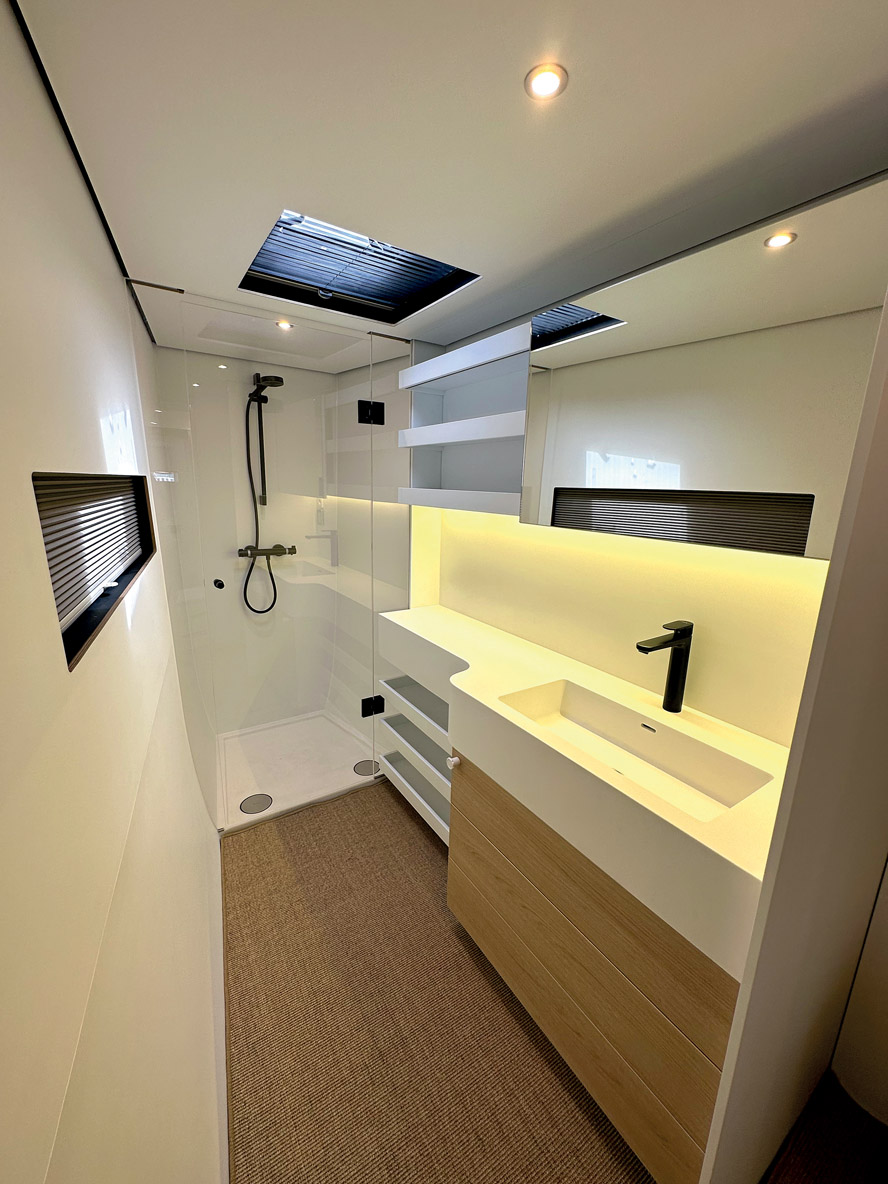
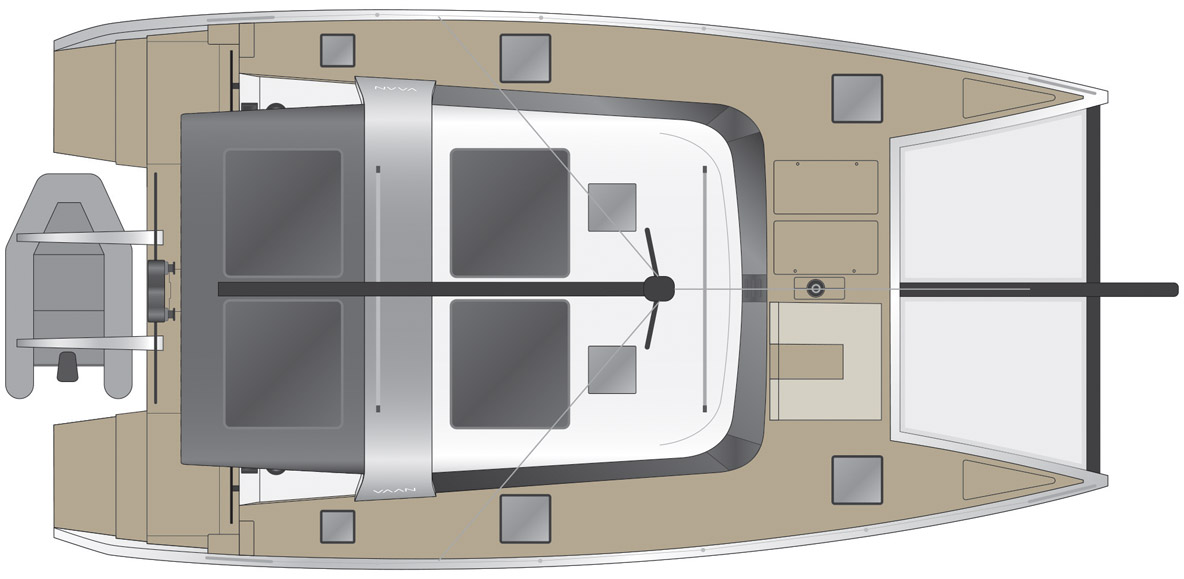
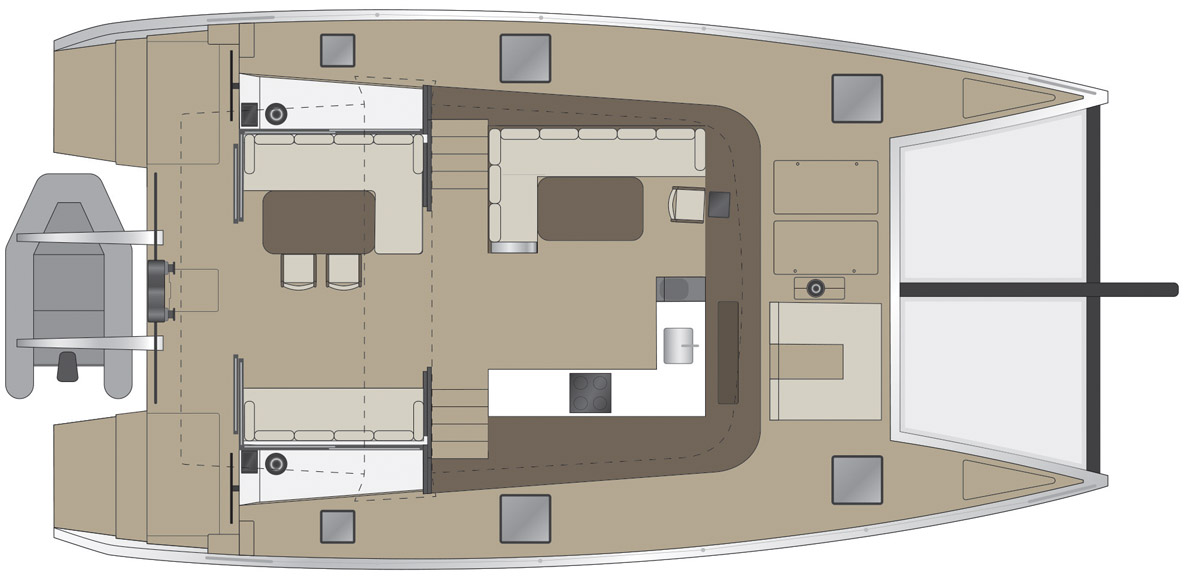
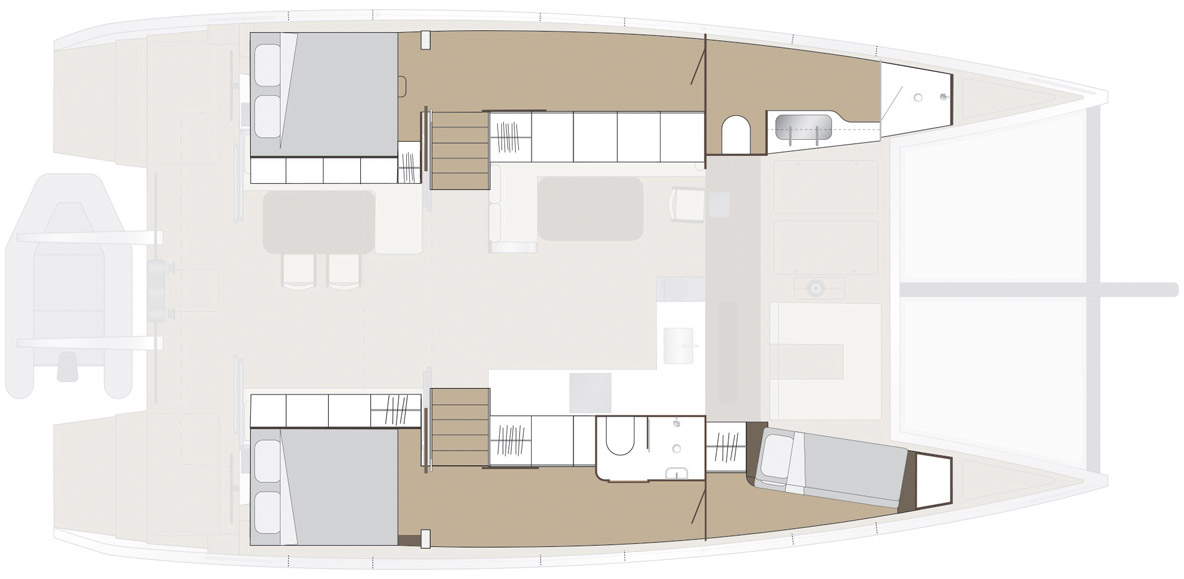
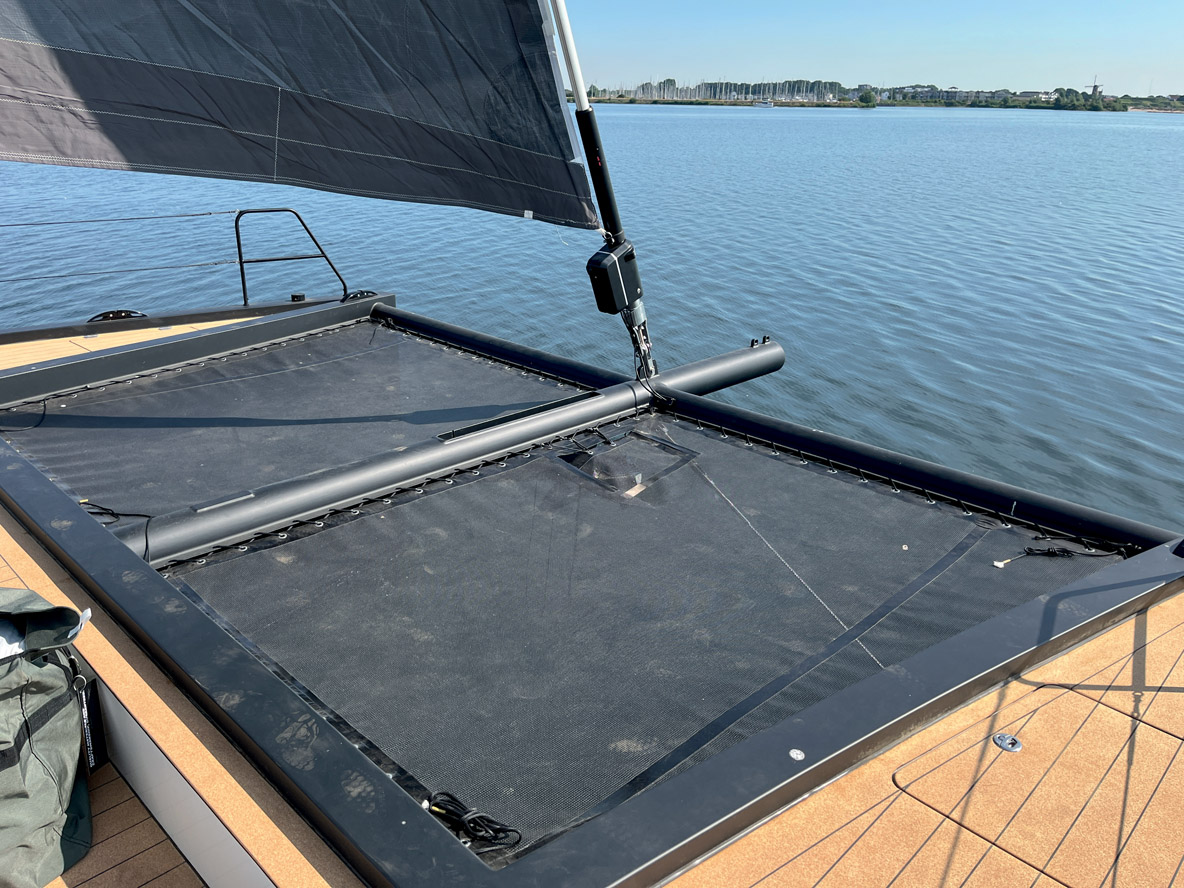
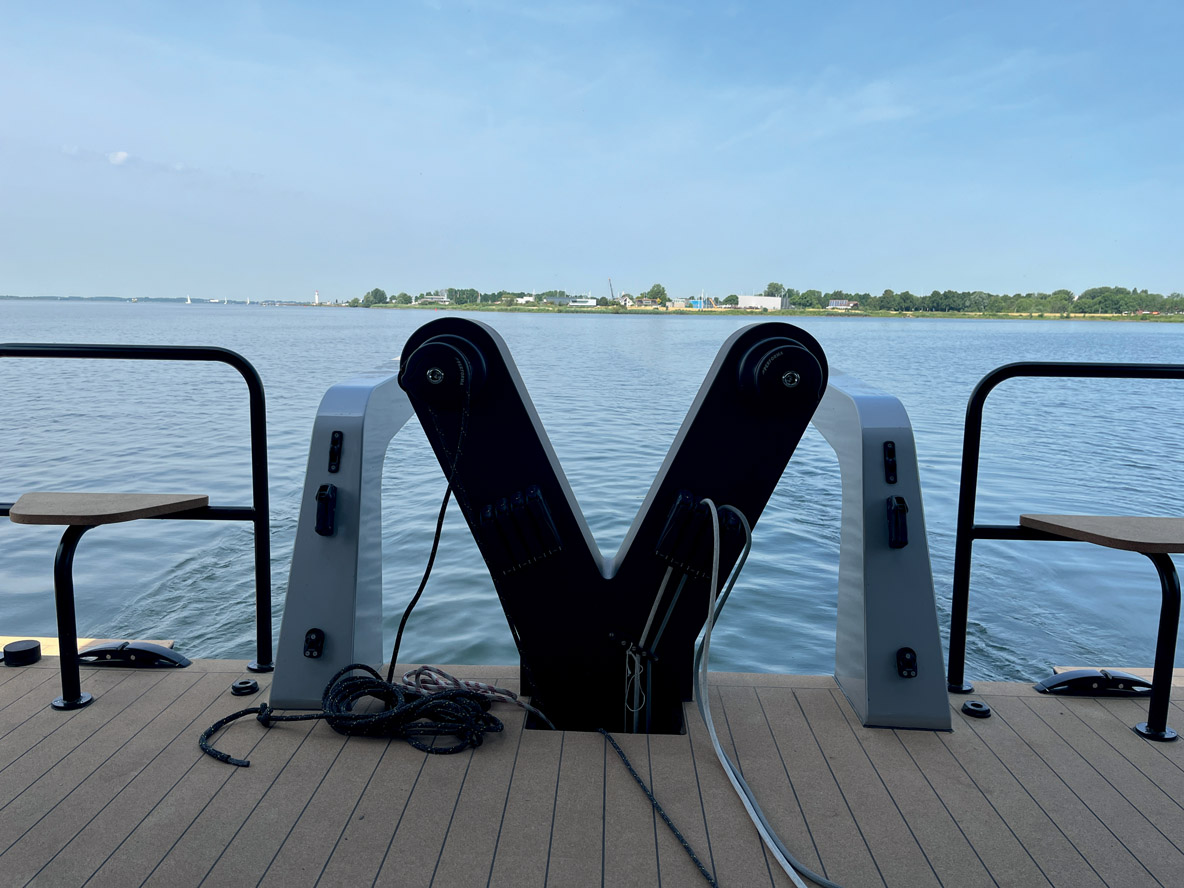
The R5’s size - obviously significantly larger than that of the R4 - makes it ideal for longer ocean passages. The open-cockpit version, introduced on the R4, still features, but here it is complemented by a closed-cockpit version called the “LA” – short for Live Aboard. The cockpit enclosure, comprising side glass panels and an aft sliding window, opens and closes generously, giving the sensation of being outside or inside, depending on your mood or the weather. This formula has already proved its worth aboard catamarans from other manufacturers and avoids duplicating functions between inside and outside. The result is a large galley, a lounge area that can be arranged in a variety of ways, further extending the galley, a huge dining table and spacious sofas. All of which offers the ease of moving around that you’d find on a 60-footer. A dozen guests can enjoy good times in this bright, well-ventilated space. However, the cabins will only accommodate six. The owner’s suite occupies the entire port hull, with ample storage space, while the two cabins to starboard cabins, separated by a wide passageway, also offer spacious accommodation, with either a double bed forward or bunk beds. The berths are of excellent quality and are nicely spacious. Tall people (the Dutch are the tallest people in the world!) will feel right at home on board: the aft berths are 6’11” (2.10 m) long and 5’9” (1.80 m) wide, and headroom is 6’11” (2.10 m) throughout. The design style is uncluttered yet welcoming, with warm tones for upholstery, woodwork and flooring. A hushed, cozy atmosphere prevails, which is not always the case with this modern style. Optimum insulation and the use of sisal in the cabins contribute to the pleasant feel. When moving around on deck, the cork provides an undeniable softness underfoot. The equipment runs solely on electricity – there’s no propane or butane here. The 80-kWh battery bank is divided in two, with 76 kWh at 48 volts dedicated to the drivetrain, while the remaining 4 kWh at 24 volts are for the service and domestic side - including the windlass and winches. Without denying performance under sail, the R5’s foredeck features a cockpit that can, for occasional use, be transformed into a mini swimming pool.
Up to 138-mile range in all-electric mode
With all this equipment, the lightship displacement of the Vaan R5 is close on 18 tons, which remains reasonable compared with catamarans of equivalent size (9.7 t for the C-Cat 48, 14.8 t for the Bali 4.8, 19.05 t for the Excess 15, etc.) The brand offers a range of power ratings for the motors. The new Oceanvolt ServoProp models can be had in 15 or 24 kW. On our test boat, R5-01, the same brand’s shaft-driven system was installed, but using three 10-kW modules, i.e. 30 kW in each hull. With good propellers, it’s a drivetrain that makes it easy to motor upwind in strong conditions. On the day of our test sail, the sun was out but the wind wasn’t keen to make an appearance - it barely deigned to caress the water at 2 or 3 knots. I started with the engine readings. At 4.5 knots, power consumption is just 2.1 kW, and at 7 knots it rises to 9.5 kW. Based on keeping a 15% reserve, the battery bank’s autonomy (without photovoltaic or hydrogen generation) at low speed is 31 hours, or 138 miles, and at high speed 7 hours, or 49 miles. With a strong wind and short waves, consumption could be limited to 3.5 hours, or just over 20 miles. In these conditions, simply sailing at 5 knots means twice as much time, and therefore a 35-mile stretch. No emissions, virtually no noise (the propshaft seems to eliminate the transmission noise that would be inherent using sail drives) and no vibration.
That’s it for the all-electric “balance sheet”.
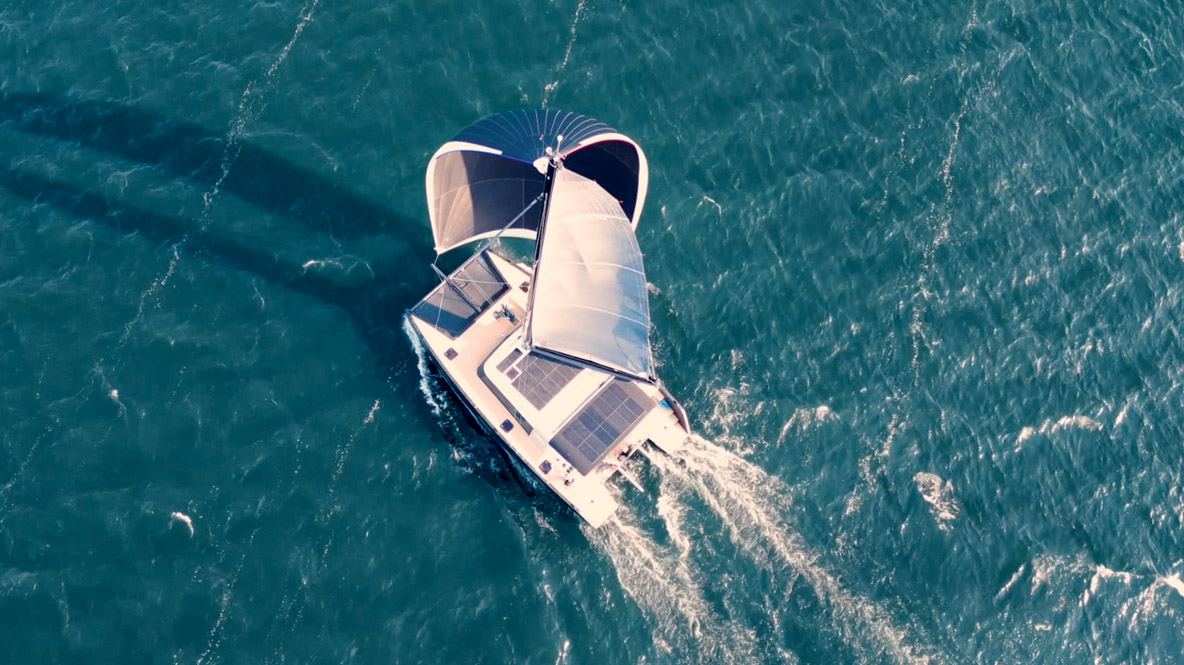
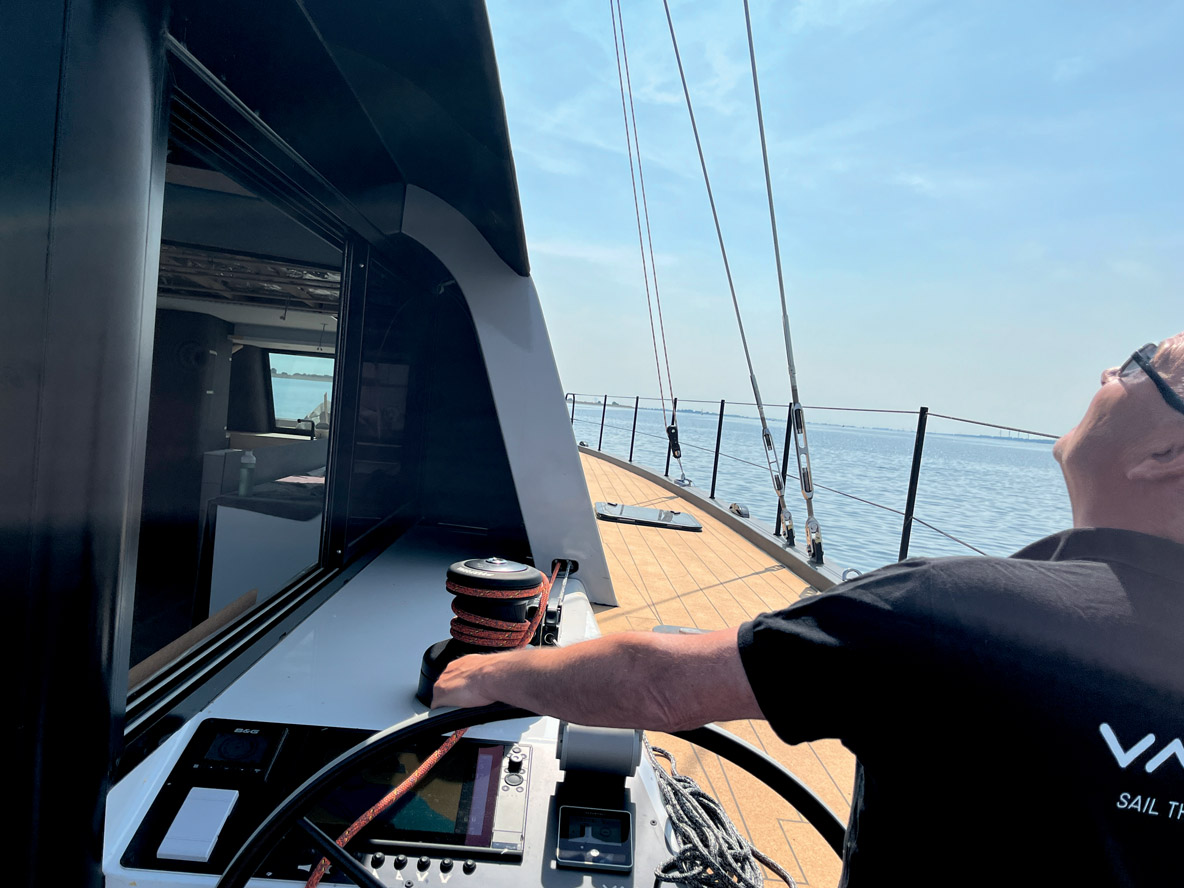
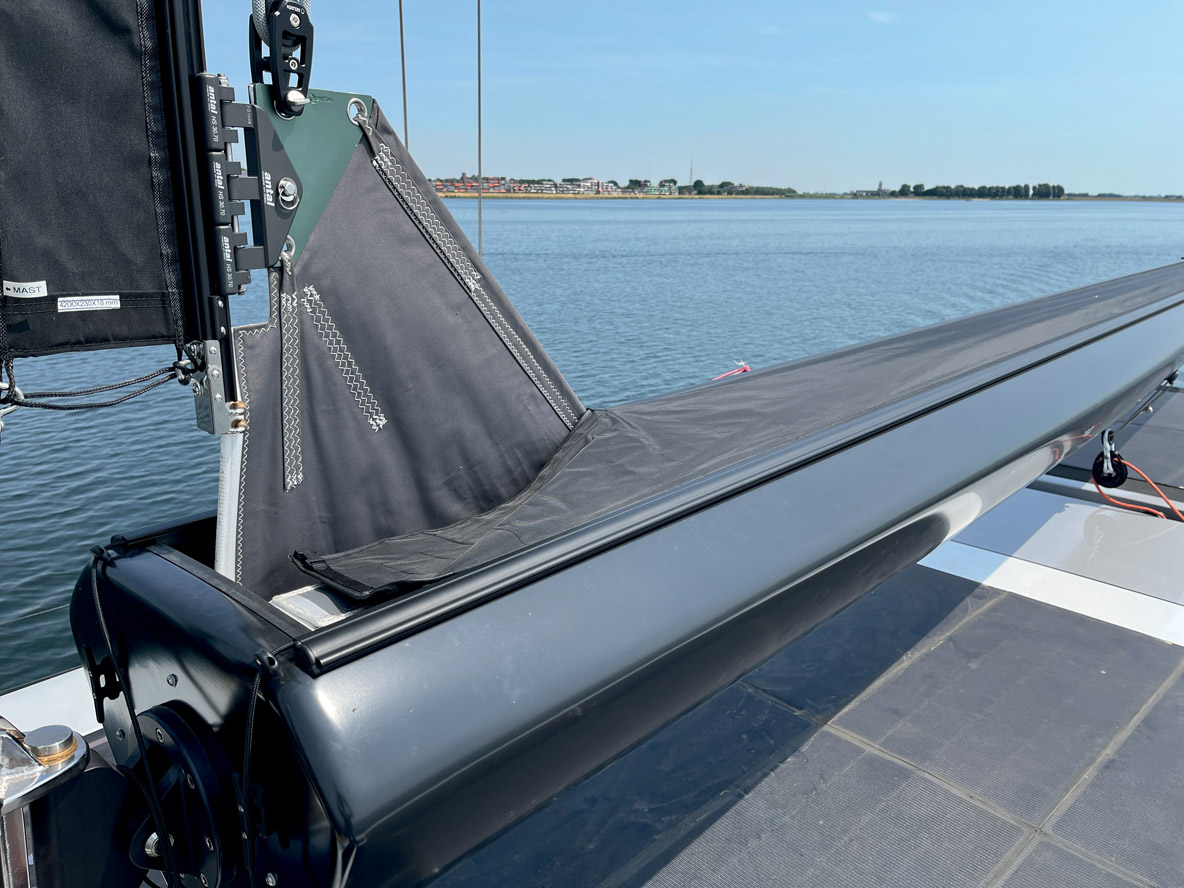
The optional Fischer Panda generator is available in 15 or 22 kW. With this installation, the safety margin is clearly very high. The good motoring aptitude is also confirmed under sail. The sail plan (Quantum, also available in sustainable fabric) is set on a black- lacquered spar which is centered enough to rig a 485 sq ft (45 m²) self-tacking jib and a 861 sq ft (80 m²) mainsail. The Facnor electric furler-mounted jib and Furlerboom-mounted mainsail are quickly set thanks to all the lines being led aft under the nacelle to a central console. Despite the anemic wind, the catamaran is instantly moving, even in wind speeds just slightly exceeding 3½ knots. Tacking is a breeze, with the hulls maintaining way as they go through the wind. The rod-linkage steering system still needs some fine-tuning, but it’s direct and very precise. We start dreaming of the breeze coming in, but unfortunately, it wasn’t to be, so we’ll have to refer you to the test video, which is quite evocative of the helming pleasure this ultra-rigid platform can provide. You only have to look at the crossbeam, devoid of a martingale, to be convinced of the strength of this boat. Igor kept in touch with us during the delivery trip, and the builder seems delighted with the R5’s performance under sail - in more suitable winds, that is!
The helm stations on each hull are equipped with optional winches for the downwind sheets: code 0 and/or gennaker, also optional. Our model was fitted with a 4’5” (1.35 m) -draft keel. 6’7” (2 m) fixed keels are a standard alternative, while pivoting centerboards of the same depth are available as an option.
Conclusion
You might be thinking that aluminum is reserved for exploration multihulls or hardcore one-offs, for which the material’s adaptability offers almost limitless customization possibilities, so in a way, the Vaan R5 breaks new ground. The young, dynamic brand demonstrates that ecological transition need not be synonymous with gloom and resignation. On the contrary, the R5 is all about pleasure, with its well-groomed looks, helming sensations that should be right on the mark, and smart, comfortable interiors. The R5 is designed to appeal to customers who appreciate the uncompromising green credentials of the brand.
Minimal carbon footprint
Great habitability in enclosed cockpit mode
Fine-tuning of finishing details required
Limited versatility to interior layouts
Technical specifications
Naval architect: Dykstra Naval Architects
Interior design: Vaan Yachts
Exterior design: Vaan Yachts
Length overall: 49’1” (14.95 m)
Beam: 26’1” (7.94 m)
Draft: 3’11” or 6’7” (1.2 or 2 m)
Mast height: 78’1” (23.8 m)
Bridgedeck clearance: 3’ (0.91 m)
Light displacement: approx. 37,500 lbs (17 t)
Motors: 2 x 15 or 2 x 30 kW
Mainsail: 861 sq ft (80 m²)
Self-tacking jib: 485 sq ft (45 m²)
Code 0: 1, 291 sq ft (120 m²)
Water: 177 US gal (670 l)
Prices in € ex-tax:
Base price with 2 x 15 kW: approx. 1,000,000
Version we tested: approx. 1,600,000
Principal options in € ex-tax
Live Aboard version: 25,250
Custom interior: 22,500
Cork deck and cockpit sole: 23,600
Propshaft drivetrain: 57,500
Air conditioning: 43,160
In-boom furling system: 36,530
4 kWp solar panels: 32,700
22 kW generator: 34,065
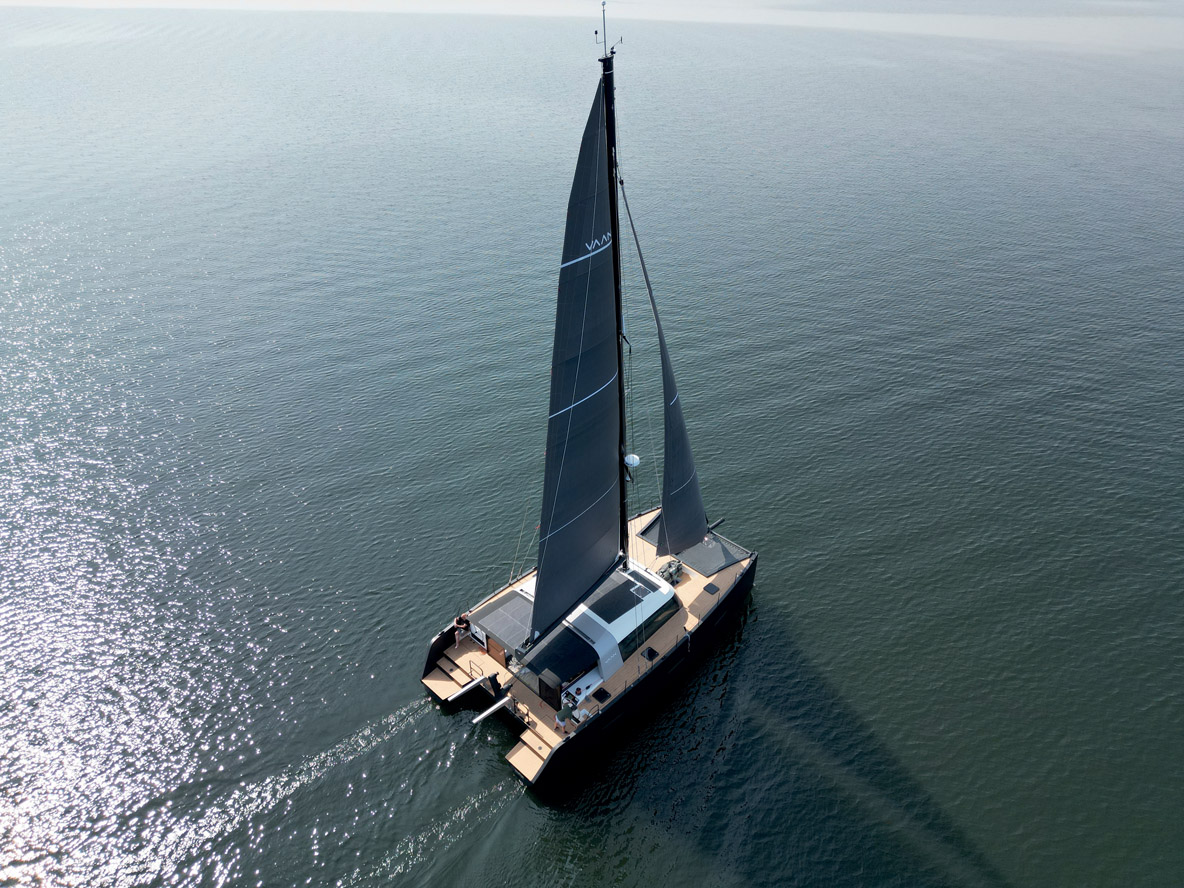
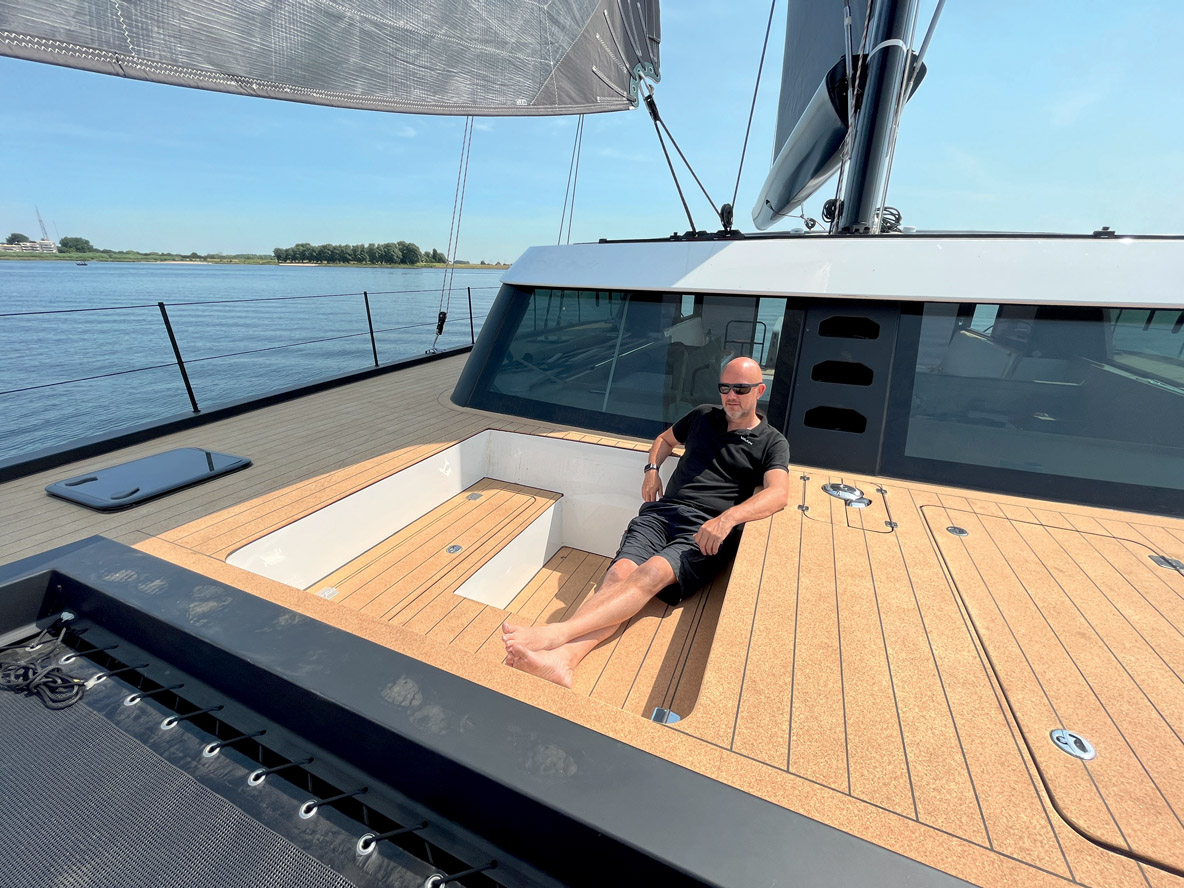
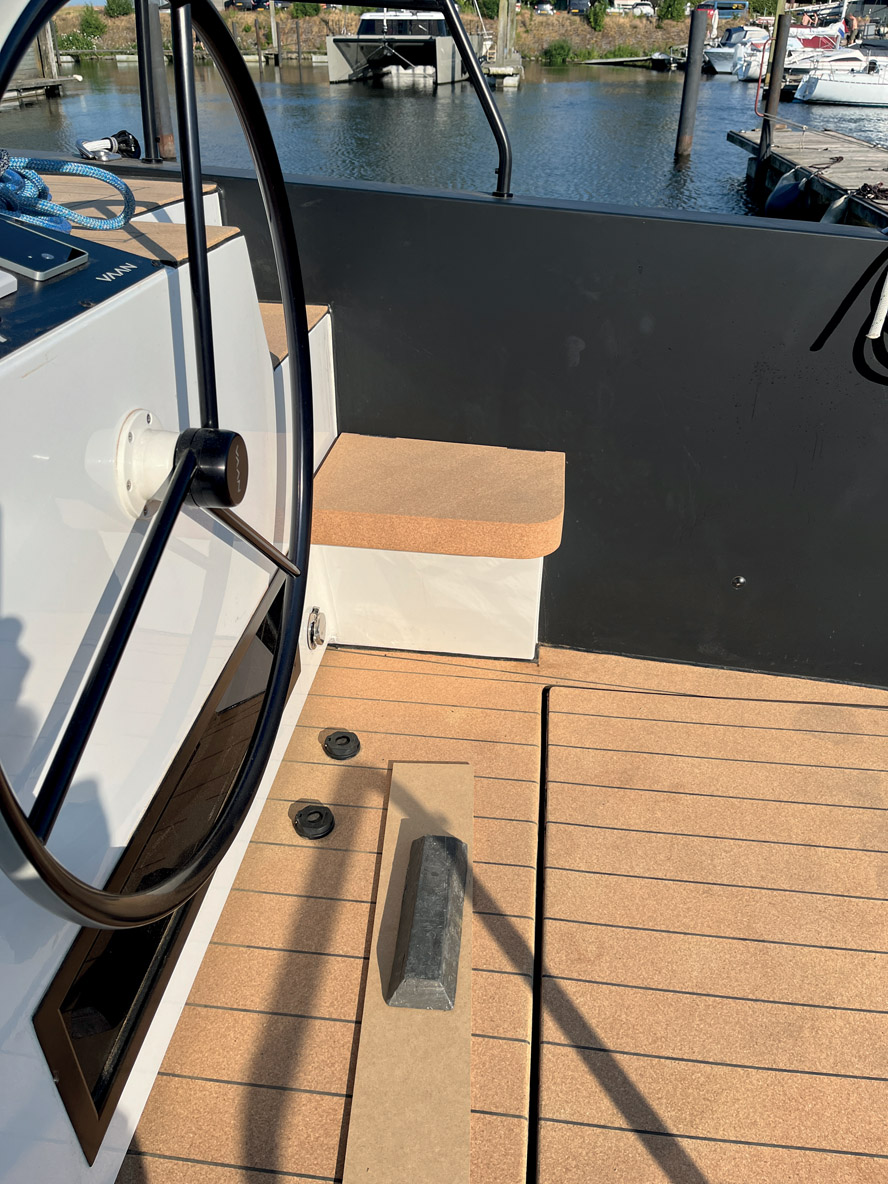
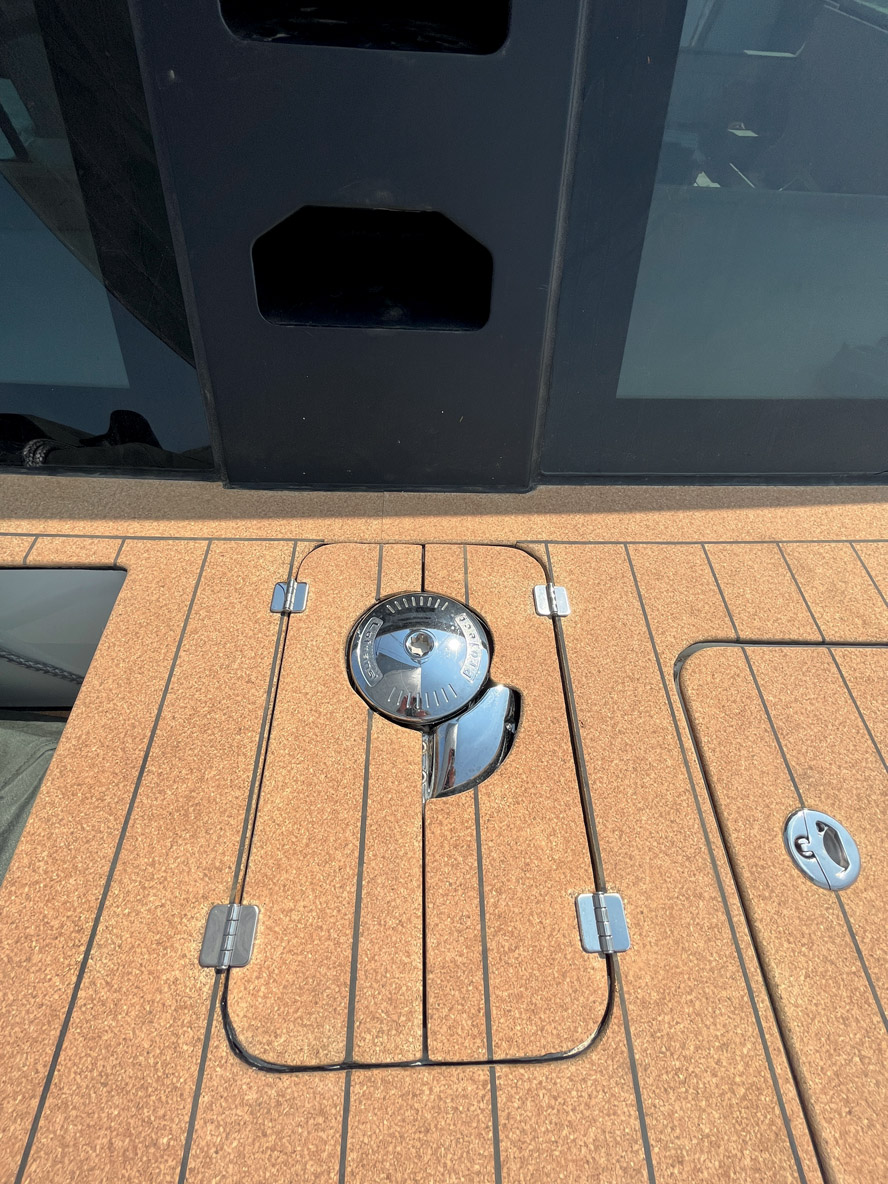
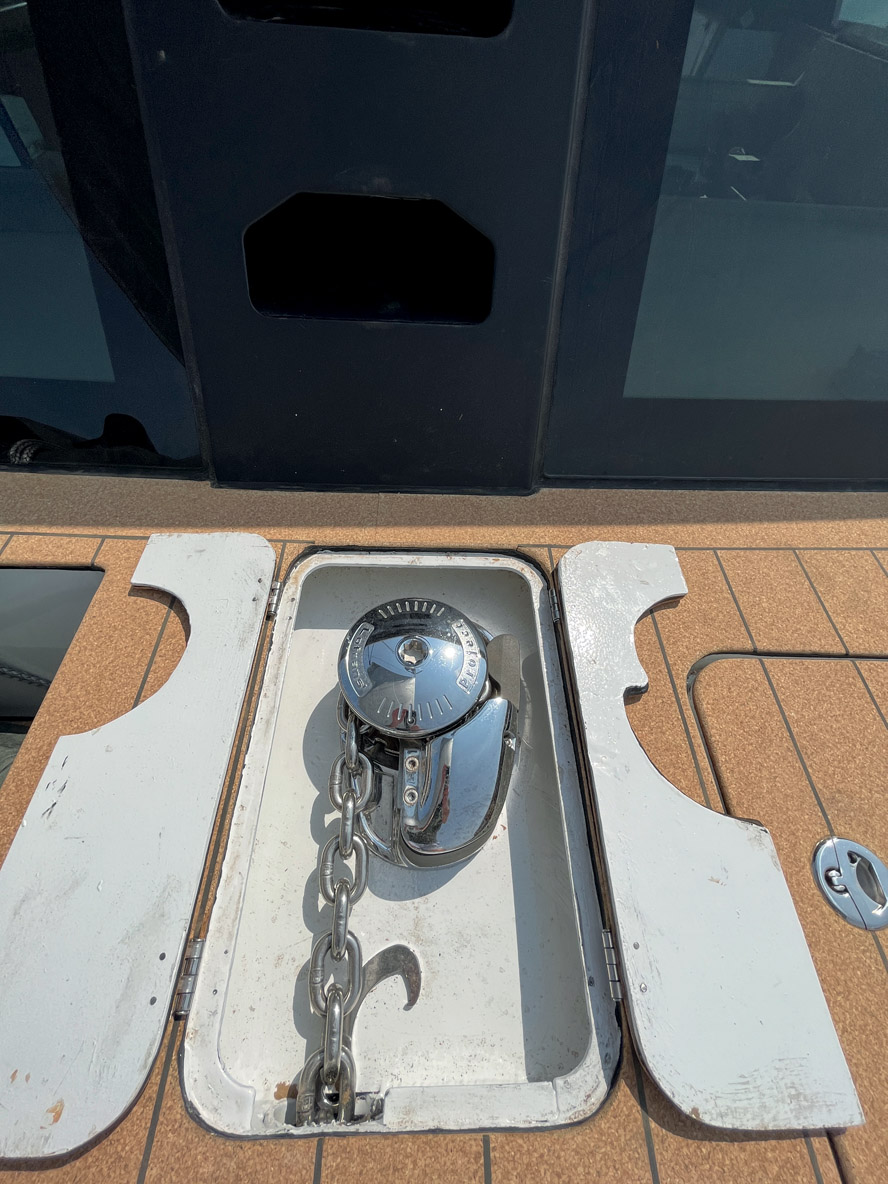
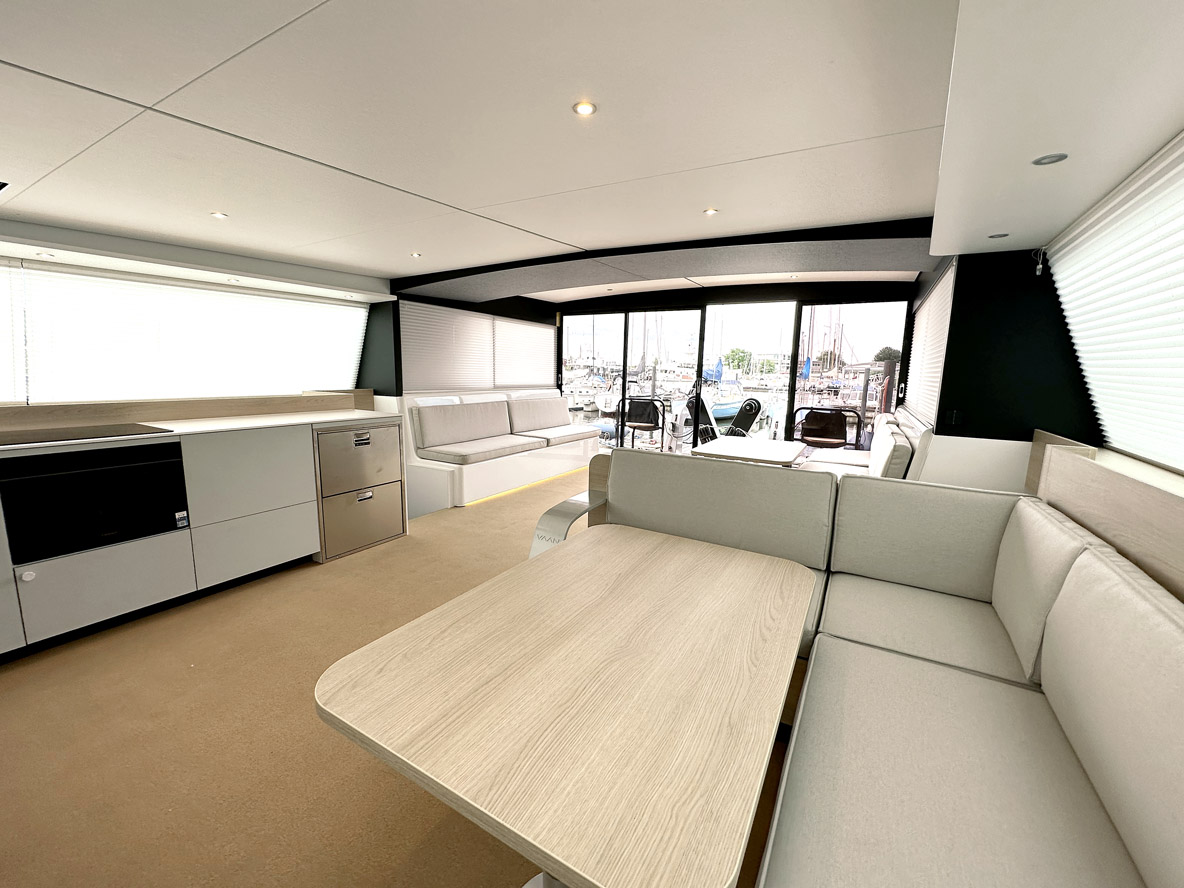
The floor is lined with cork, a material that provides excellent thermal and acoustic insulation.