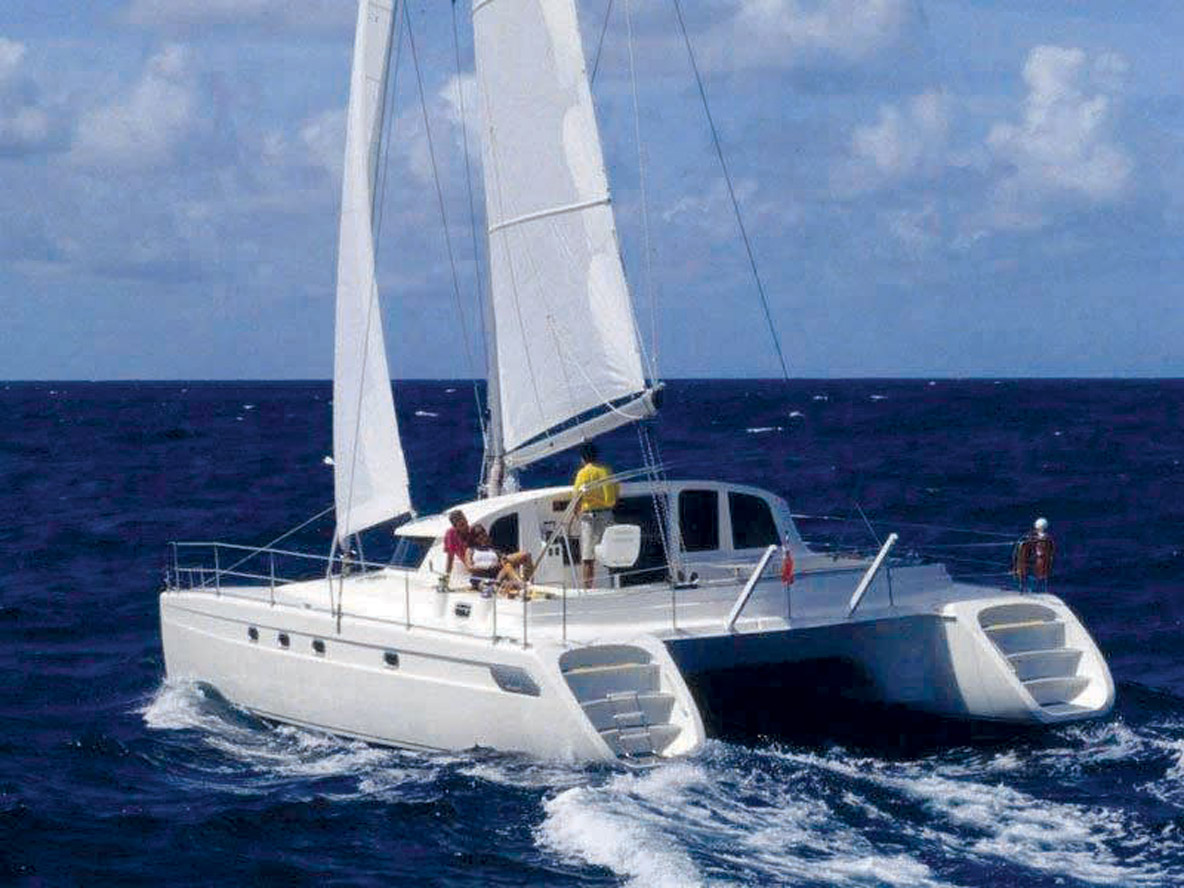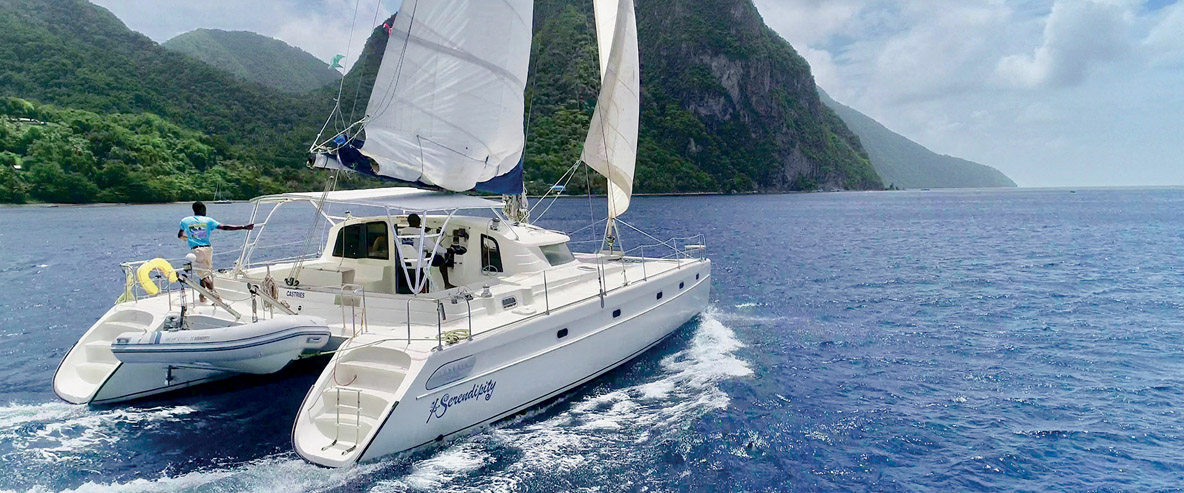
The Venezia 42 was one of Fountaine Pajot’s emblematic models, being the first to validate the famous coachroof sun visor – a feature that’s still as relevant as ever, more than 30 years later. In the manufacturer’s range, this model also replaced two others in one go - the Fidji 39 and the Casamance 44. A daring gamble that paid off, with 200 examples of this catamaran sold - an excellent commercial achievement for its time.
Infos pratiques
- Le chantier : Venezia 42
- La fiche technique
- Découvrez notre vidéo exclusive
- Financez votre Venezia 42
- Assuez votre Venezia 42
- Articles autour du Venezia 42
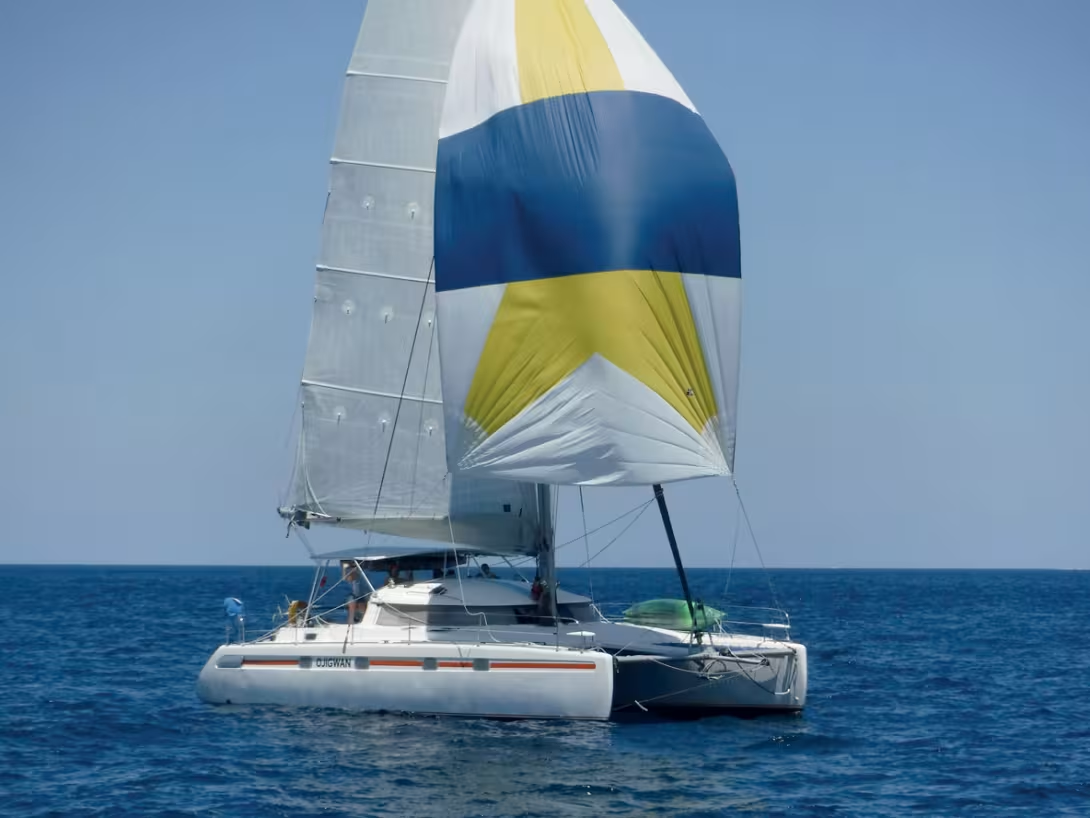
Yes, in the world of multihulls, the year 2000 was already a long, long time ago: cruising catamarans and trimarans were just beginning to make their mark as a sailing platform - and of course for liveaboard cruising. So taking a look back at a catamaran launched in 1992 could be like evoking prehistory... but in fact, the Venezia 42 is quite modern. Its silhouette retains the sloping bows so dear to the Joubert/Nivelt naval architecture firm, but the deck sheer is less pronounced. As for the coachroof, it is larger than that of its predecessors thanks to more vertical sides and front - the evolution of this design being linked to the appearance of the visor, which protects the windows from the hottest of the sun’s rays. This innovation is regularly attributed to the Venezia, though in reality, it appeared a year earlier with the Marquises 56. Overall, this new model appeared very modern back in the early 1990s, though we will see that many details still betray a dated design - you can’t have everything for a third of the price of a new boat...
An old-school deck plan
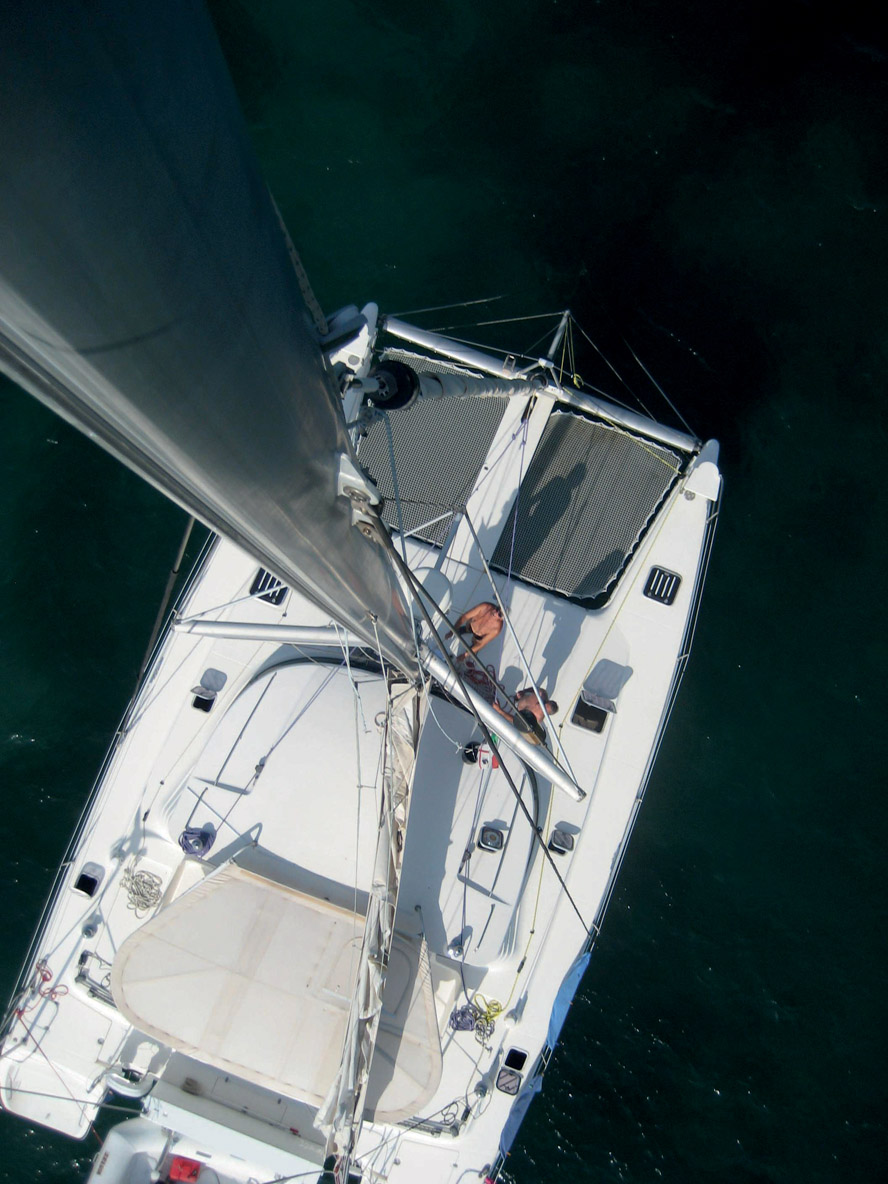
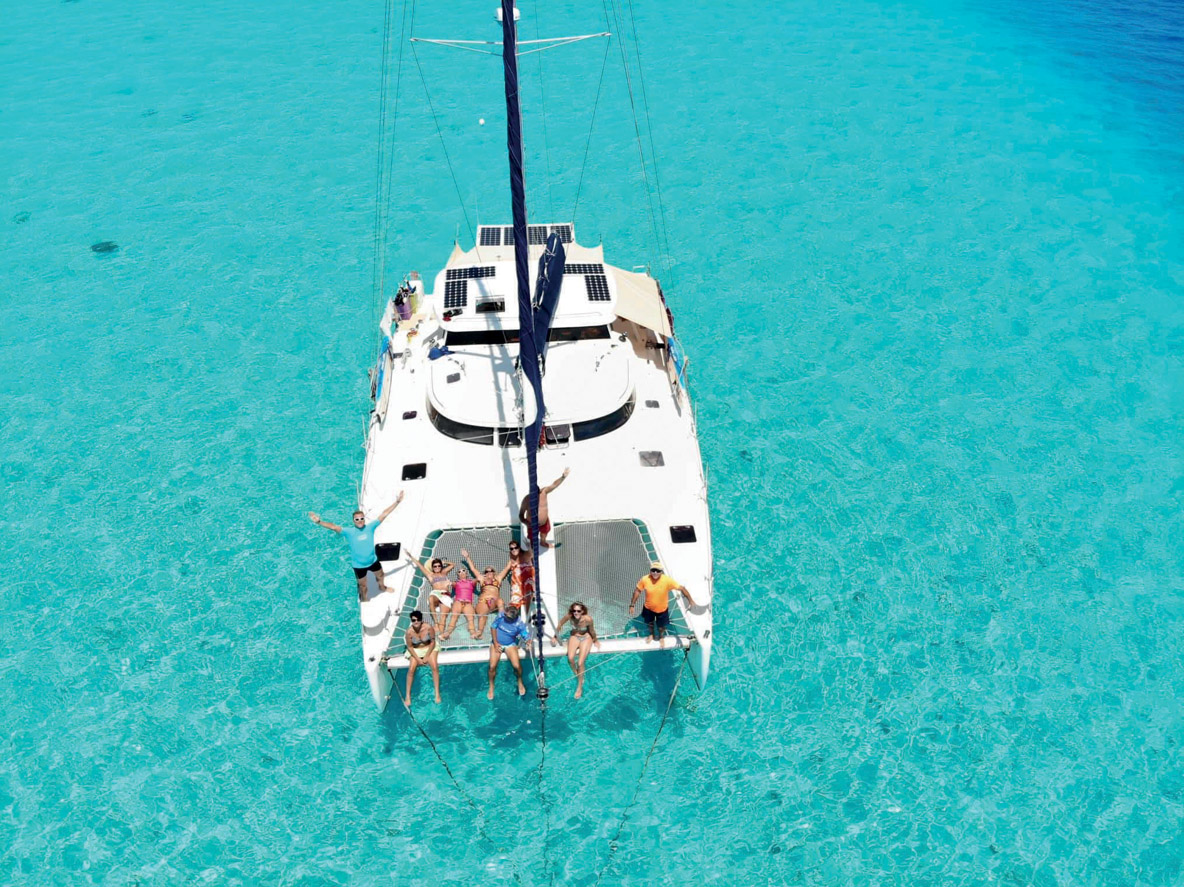
The moment you step aboard, you notice that the deck layout is somewhat dated. As for the two trampolines separated by a solid fore-and-aft passerelle, that’s nothing to complain about. The same goes for the side decks: they’re fairly wide and above all flat and clear (the opening hatches are offset to the inboard side, on the discrete step in the coachroof). There is also a passageway round at the very back of the boat. On the other hand, the cockpit contrasts with today’s style - the Venezia’s cockpit seems somewhat barricaded by its coaming. As protection, it’s undoubtedly effective to ensure safety in heavy weather, but less convincing in terms of traffic flow when you want to access the sugarscoops or the foredeck. The seats/sunloungers have to be straddled first. On the earlier examples, equipment was basic. There was no bimini on the first one, though all Venezia 42s have subsequently adopted a fabric cockpit protection. The slightly raised helm station is positioned on the aft bulkhead of the coachroof, slightly offset to starboard. Sailing maneuvers, on the other hand, are scattered all over the place - halyards and reefing lines are handled at the foot of the mast, the jib sheets run to winches on the coachroof, while the mainsheet and its traveler are on after cockpit coaming. The progress made in 30 years can be made in terms of ergonomics... but that being said, the Venezia remains easy to manage, even when short-handed.
A catamaran built for a breeze...
The shipyard’s choice to combine a beautiful fully-battened mainsail with a small jib (590 sq ft/55 m² against 375 sq ft/ 35 m²) produces good results in medium conditions and a good breeze, but makes it somewhat lazy in light airs. Adding an overlapping genoa and ad hoc sheeting points are enough to radically change the behavior of this catamaran upwind in light conditions, especially in choppy seas. The skeg keels are not particularly deep, but you can count on making an upwind course at 50° from the true wind. The hull goes through the sea rather well, and if the nacelle sometimes slams, that happens more so when downwind as the catamaran catches up with the waves. At least, it does move forward! Most owners report decent averages of 8 to 9 knots on passage. The racing heritage of the builder is very much in evidence here: the hulls have fine-entry bows, voluminous sterns and relatively high bridgedeck clearance. Displacement is just 13,600 lbs (6.17 tonnes), and this feather weight is the result of a beautiful ISO9002-certified construction that required the use of 34 molds, integrated PVC honeycomb sandwich for the bulkheads and a nacelle structure reinforced with KLEGECELL® foam. One cannot help but notice that less than 30 years later, the corresponding 42-footer in the manufacturer’s range has doubled in weight - the Astrea 42 coming in at 28,000 lbs (12.7 t). Note that the sail area upwind has increased from 970 sq ft (90 m²) to 1,195 sq ft (111 m²), which translates into a sail/weight ratio of 14.61 m²/t for the Venezia as opposed to 8.74 m²/t for the Astrea.
A really small door!
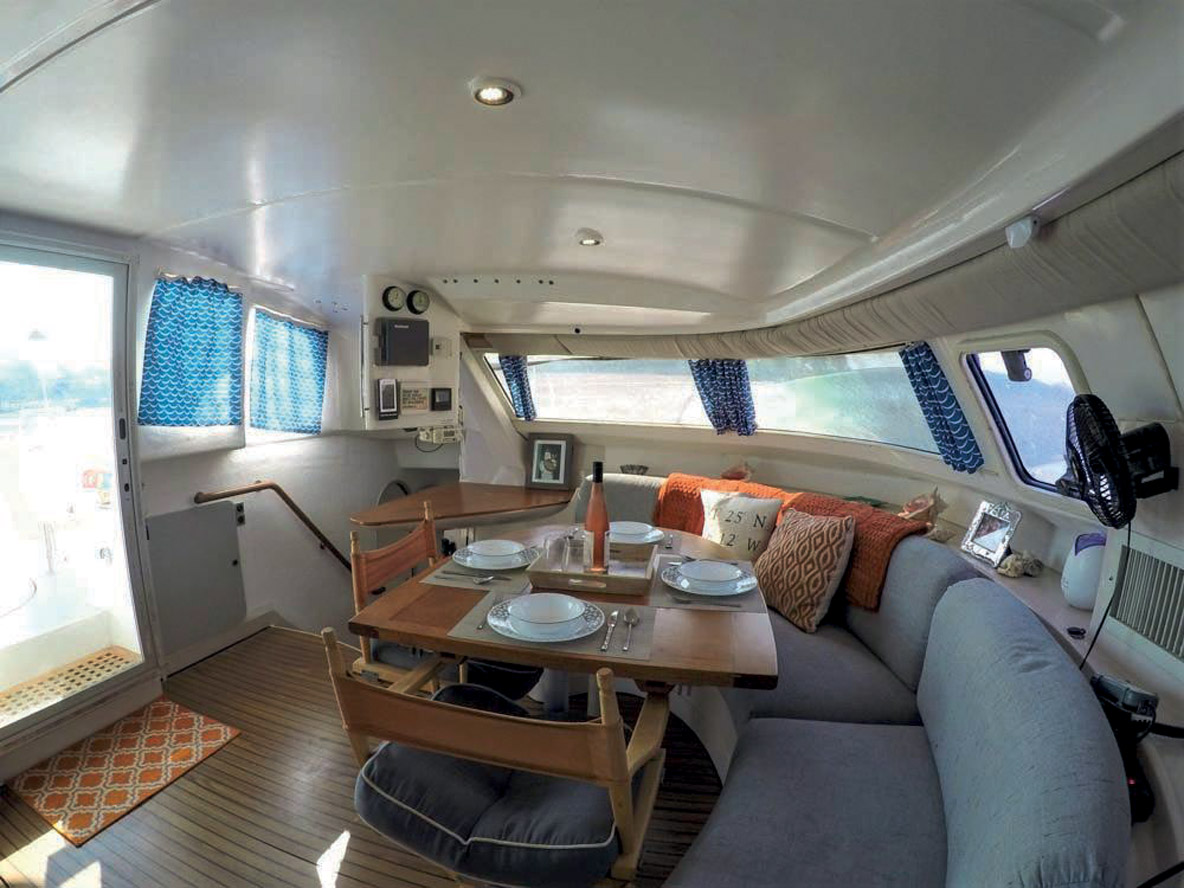
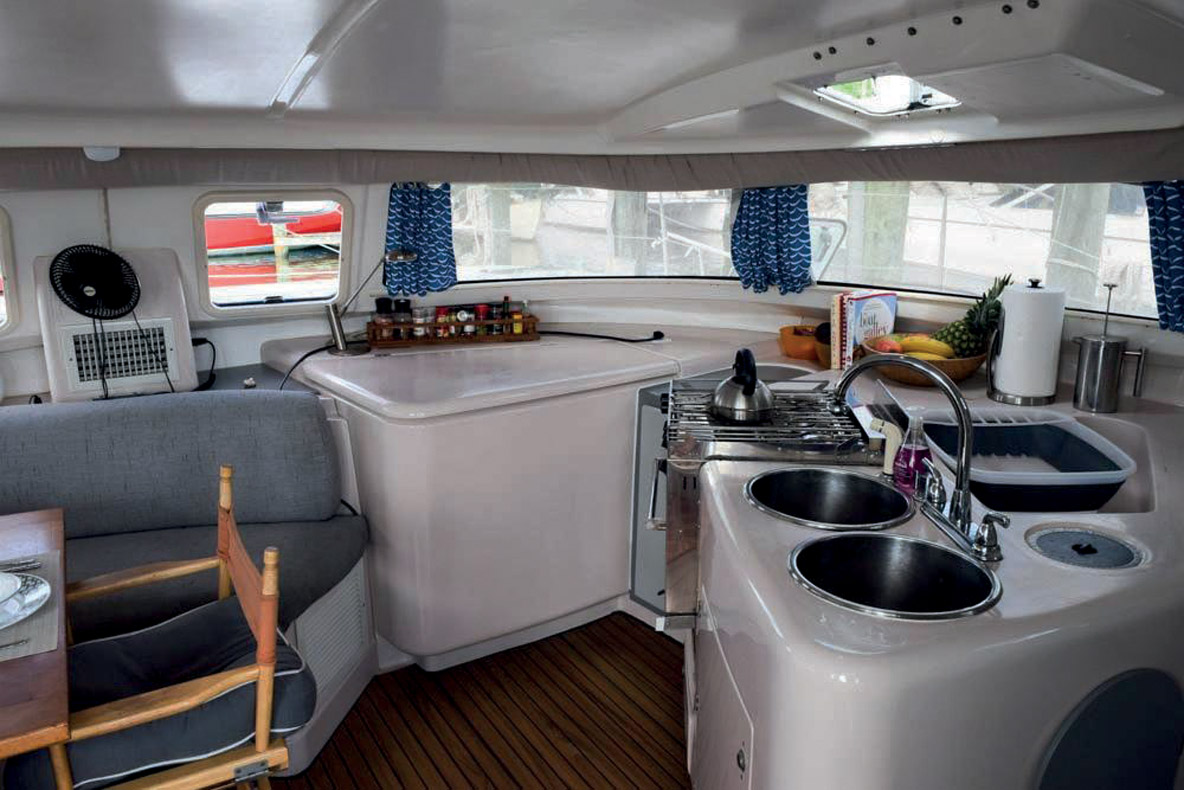
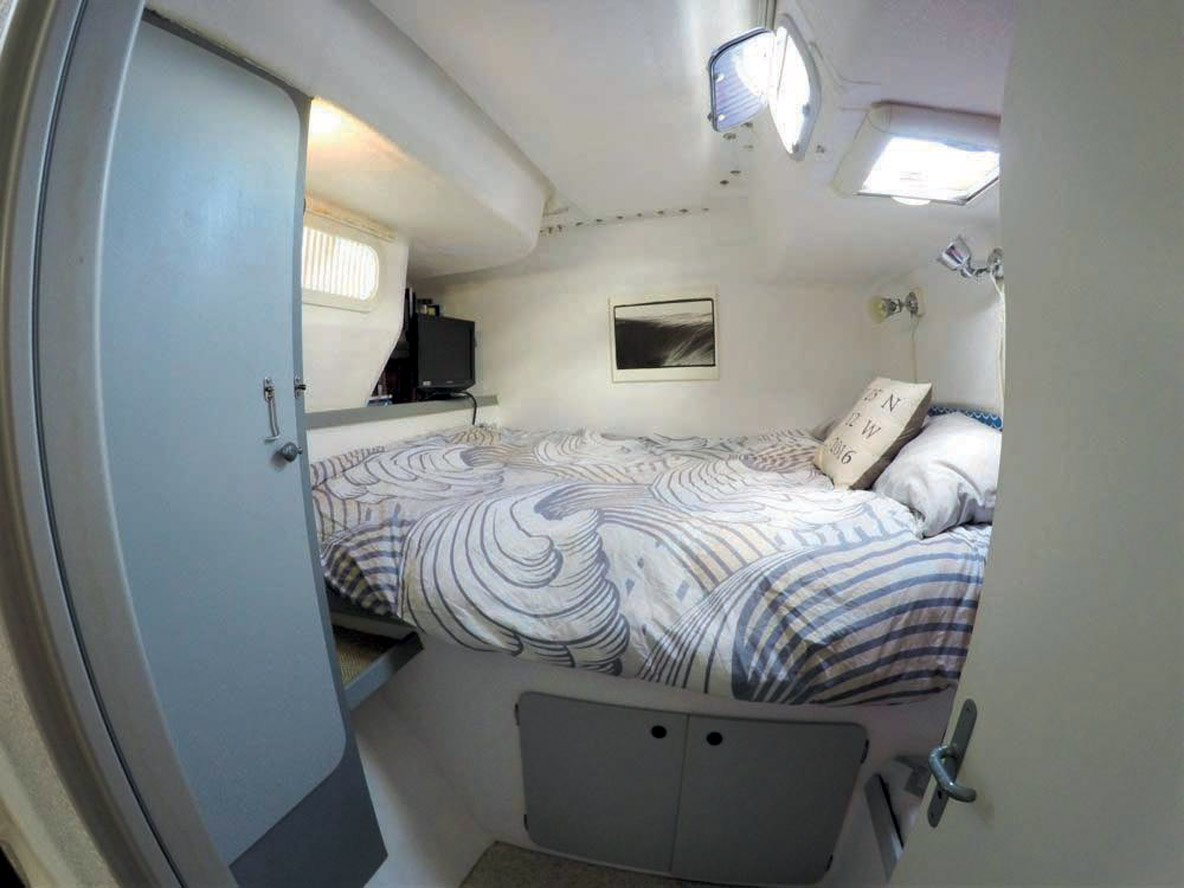
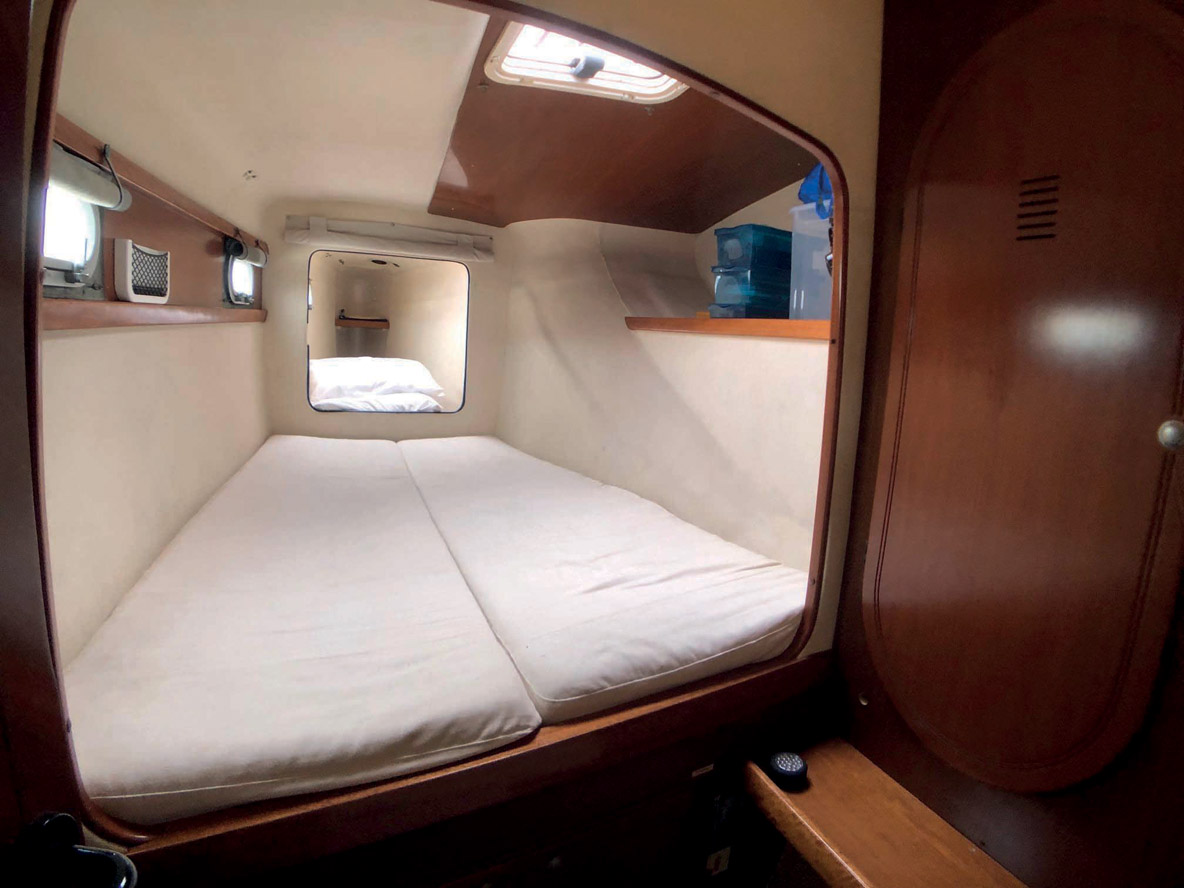
As for what’s most dated on the Venezia 42, it is certainly the tiny size of the saloon door that strikes you first - the aft face of the coachroof seems almost blind... but, once inside, you still enjoy an almost panoramic view, extending over 220°. The finish, which has obviously aged, was considered neat at the time, with a light beige gelcoat, Pabouk woodwork and camel headlining. The oval table is offset to port, and opposite is a chart table and the galley, which is compact but perfectly functional. The wide companionways ensure easy access to the hulls, where the cabins are equipped with climb-in beds measuring 6’6” x 5’ (2 x 1.5 m). The slatted bed bases guarantee good comfort. Storage space is well thought out, but not huge due to the limited overall volume of the hulls. Ventilation is provided by three opening hatches per cabin. The layout of the Venezia 42 may seem rustic today... but in 1992, it was the height of luxury!
Conclusion
With its sound and sturdy structure, this model lends itself perfectly to being completely prepared as an excellent platform for a family looking to go blue water cruising. You might be surprised by the high price - the latest Venezia 42s on the second-hand market are asking € 230,000 (excluding tax). Until recently, later multihulls have kept a good price, but this wasn’t always the case for 30-year-old models. The general price explosion observed in the ads is obviously linked to the very high demand (even more so since the average lead time for new boats is now two years) for multihulls, not to mention inflation.
Points to check
The Venezia 42 is known for its general robustness, which makes this catamaran a good basis for a refit. Obviously, on a multihull that’s now between 23 and 31 years old, certain elements - engines, sails, rigging, plumbing, electrics, etc. – all deserve a thorough examination. In more detail, some owners have reported corrosion problems at the mastfoot, leaks from the diesel tank - this tank seems difficult to remove without significant work. Inside, the laminate finish in the galley may need to be redone and reinforced.
Good seakeeping behavior
Excellent base for a refit
Maneuvers far from the helm station
Door into the nacelle from the cockpit is narrow
Technical Specifications
Architects: Joubert/Nivelt
Design: Flahault Design & Associates
Overall length: 42’4” (12.9 m)
Waterline length: 41’4” (12.6 m)
Beam: 22’6” (6.86 m)
Draft: 3’11” (1.19 m)
Air draft: 62’ (18.9 m)
Light displacement: 13,600 lbs (6.17 t)
Upwind sail area: 970 sq ft (90.12 m²)
Engines: 2 x 28 HP
Fuel: 95 US gal (360 l)
Water: 132 US gal (500 l)
Material: PVC/polyester sandwich
Production: 200 units built from 1992 to 2000
Second-hand price: from € 180,000 ex-tax