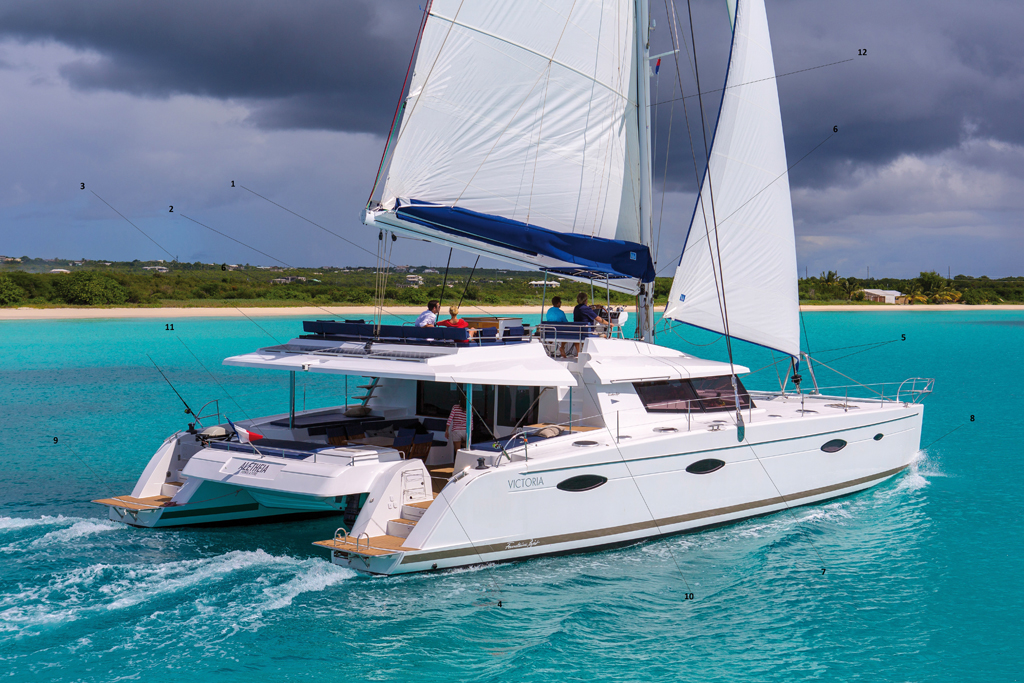
The France-based builder launches the Victoria 67', its very first catamaran topped with a flydeck. This innovation represents a sharp break with the historical position of the manufacturer, who never designed this architecture on boats under 65'. We spent 2 days on board, after the 2013 Grand Pavois boat show, to share with you our first sensations
Infos pratiques
- Le chantier : Victoria 67
- La fiche technique
-
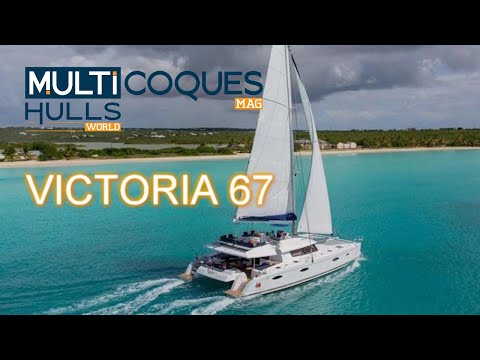 Découvrez notre vidéo exclusive
- Financez votre Victoria 67
- Assuez votre Victoria 67
- Articles autour du Victoria 67
Fountaine Pajot conquering the multi-yacht
With the Sanya 57 and the Helia 44, the Charente-based builder opened a new chapter in its industrial history, asserting an aggressive technical and design move that visitors to these models had detected since 2011. It is not strictly speaking a break with the adventure which has continued since the advent of the Louisiane in 1983, but rather a leap forward in quality, supported by reading about the expectations of the international clientele which represents nearly 80% of their sales! This little internal revolution is also supported by a company strategy, introduced several years ago, as much from the technical point of view (innovations in infusion and injection) as the organizational, with a view to producing bigger boats. The Aigrefeuilles site is a superb installation, but its geographic position implies road transport to the sea, and limits the size to 45’. At the end of the 90s, the group therefore set itself up in La Rochelle, in the former SCAN seaplane factory, and diversified its activity with the Iris catamarans (fast modular ferries). The two huge 2500m² cells with direct access to the sea have allowed Fountaine-Pajot to test the big multihull market (Eleuthera 60’ and Galathea 65’), before the more frontal attack represented by the Victoria 67.
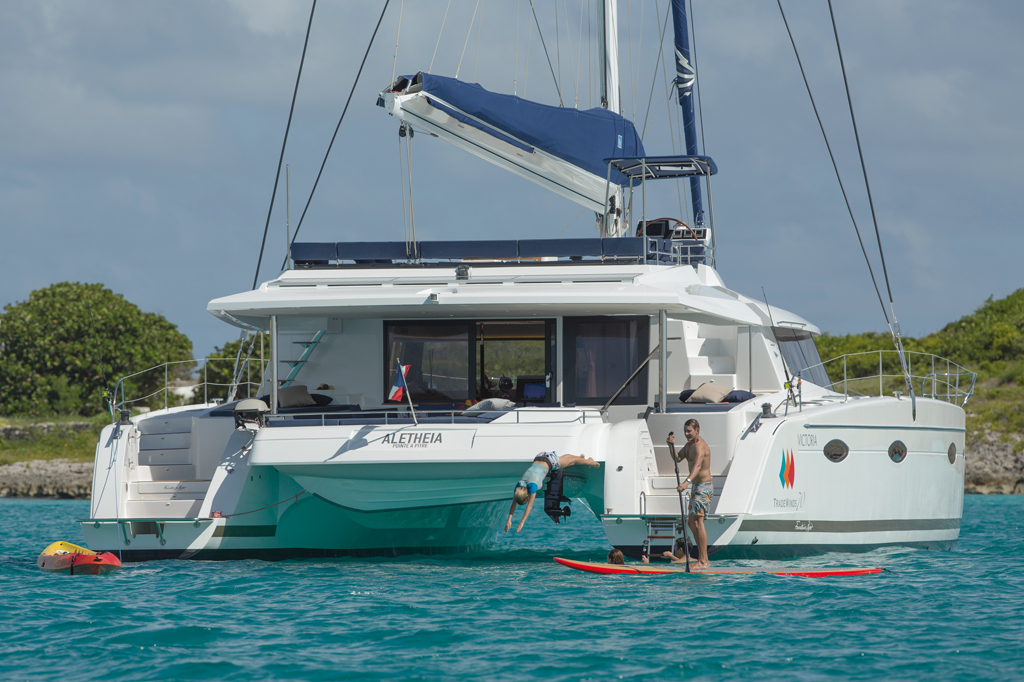
A boat which is intended for both luxury charter and demanding private owners.
The segment with all the challenges!
Spurred on in part by the extraordinary energy and the rapid success of Sunreef, the leaders accelerated their reflections, by taking decisions concerning what Fountaine Pajot calls the Flagships: the bigger, up-market catamarans. With calculated caution, the established builders all seem to be turning towards a middle ground positioning, allowing them to be players in the 65 to 75-foot semi-custom multi-yacht market, whilst for the moment leaving the giants to predisposed infrastructures, such as Pendennis Shipyard in Falmouth (44-metre VPLP-designed Hemisphere!), the Poles in Gdansk (Sunreef) or other occasional participants in Asia, Turkey or New Zealand. The fast, ‘grand tourisme’ prototypes (Sig, MC2 60', Gunboat, Tag…) remain protected from the ambitions of the leaders by their low marketing area. Multiplast, the legendary world leader in high speed sailing, doesn’t want to take any more orders for yachts, however they started the hostilities in 1996 with the Magic Cat. Catana is preparing a 70’, Lagoon is positioning itself in this market with its twin, CNB, specialist in one-off monohull yachts, Privilège is repositioning its range on the 50 – 62’ segment, Robertson and Caine doesn’t seem to be displaying any aim in the field. Certain experts operate on a piecemeal basis, such as JFA in France (with an 85-foot Lombard design currently under construction) or Salt House Boatbuilders (Ciliam 92') in New Zealand, but the list of regular players in this exclusive market remains short.
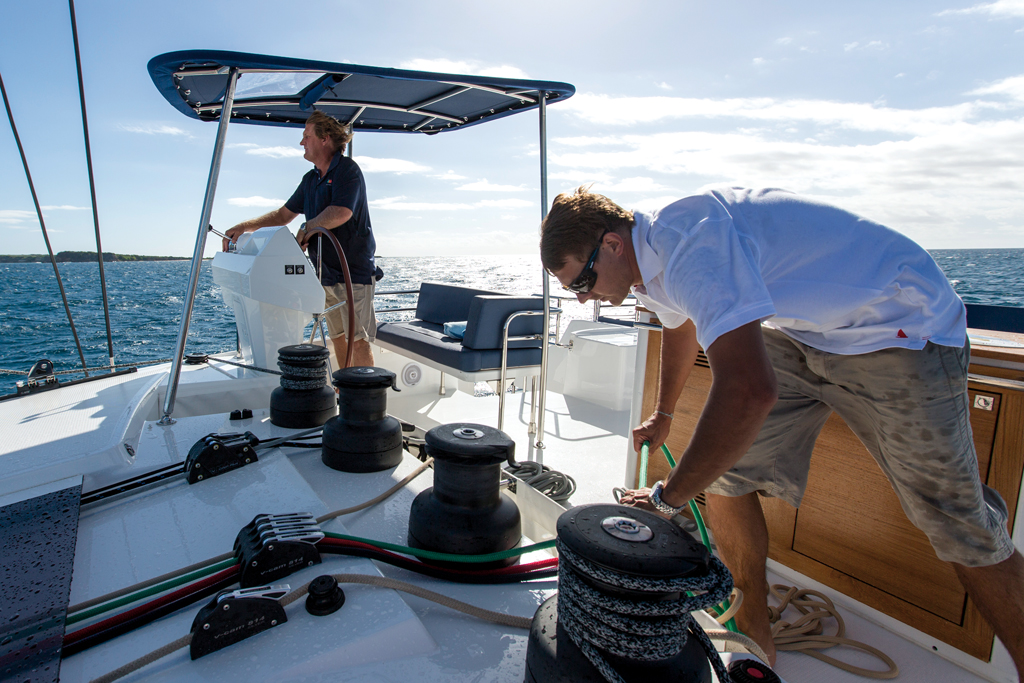
All the control lines return to the steering position; the view over the water is perfect…
Victoria, a patronymic with strong ambitions
This 20.5-metre catamaran is Fountaine-Pajot’s flagship, it is also the beginning of a family handover, as its project manager is Mathieu Fountaine. Jean-François, former Olympic medallist in the 470 (with Yves Pajot) was also a respected ocean racer aboard the visionary Charente Maritime I and II, whose resounding victories in La Baule – Dakar and La Rochelle – New Orleans contributed to the success of the French multihull school in the 80s. He has always kept total control over the philosophy of the models created by his company. His reticence concerning flybridges was well known, this is why he insisted that the designers replace them with steering positions at mid-height, characteristic of the company, and picked up by other builders. The boss could only see the flydeck organisation on cats of over 65 feet; this has now been done, with the Victoria 67’, whose size and elegant silhouette mark the La Rochelle-based company’s entry into the world of multi-yachts.
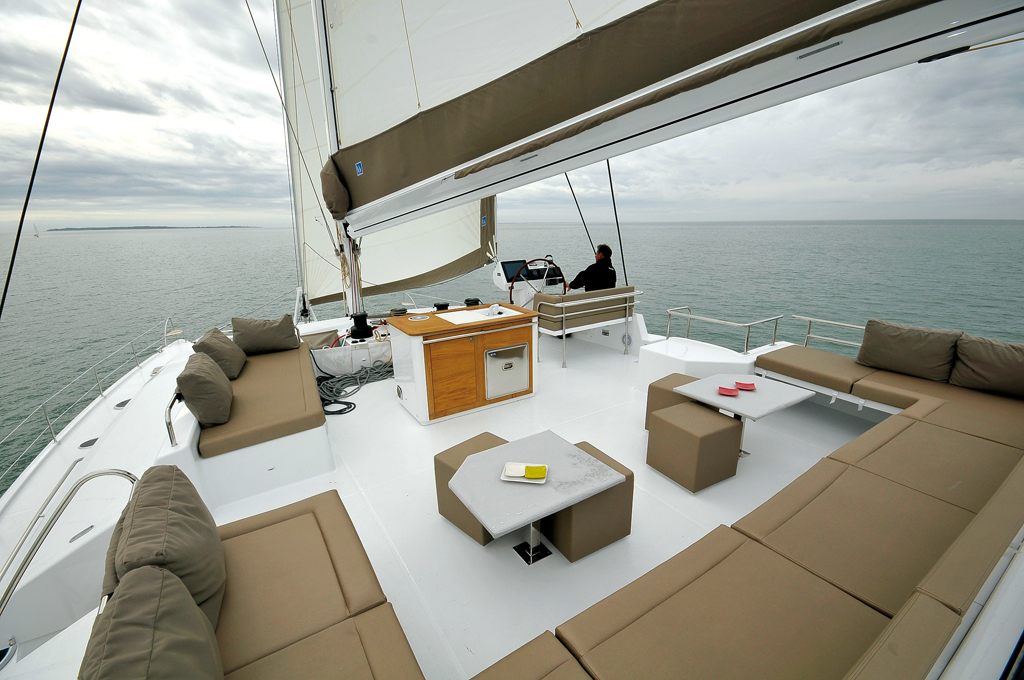
The Victoria’s flydeck: a gigantic area where everyone will be comfortable, both at sea and at anchor…
A flydeck 67’ with a boosted silhouette
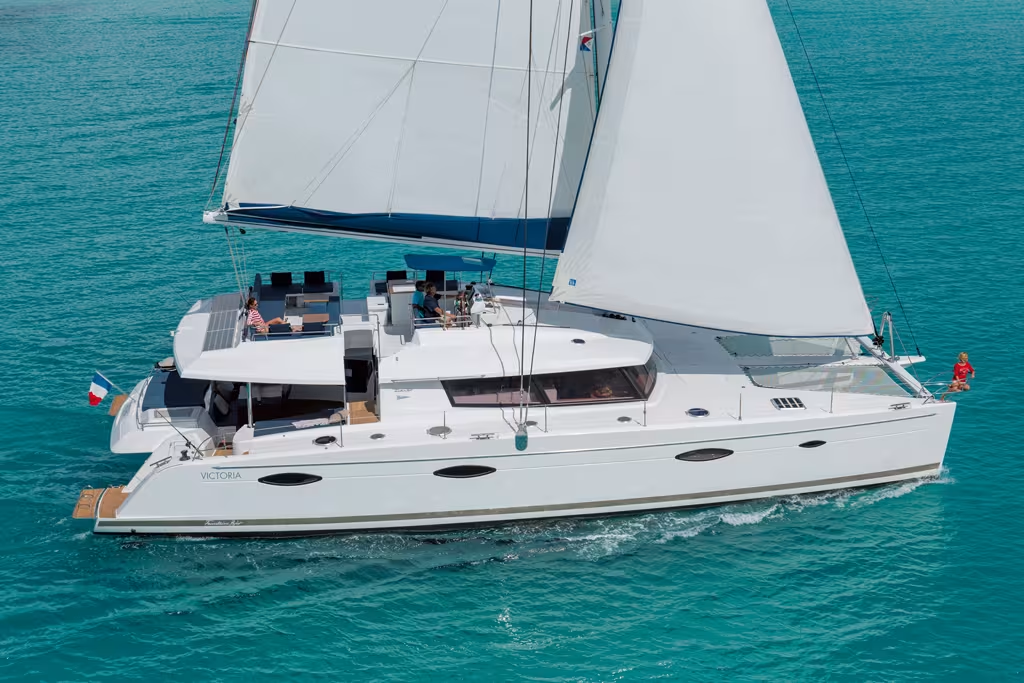
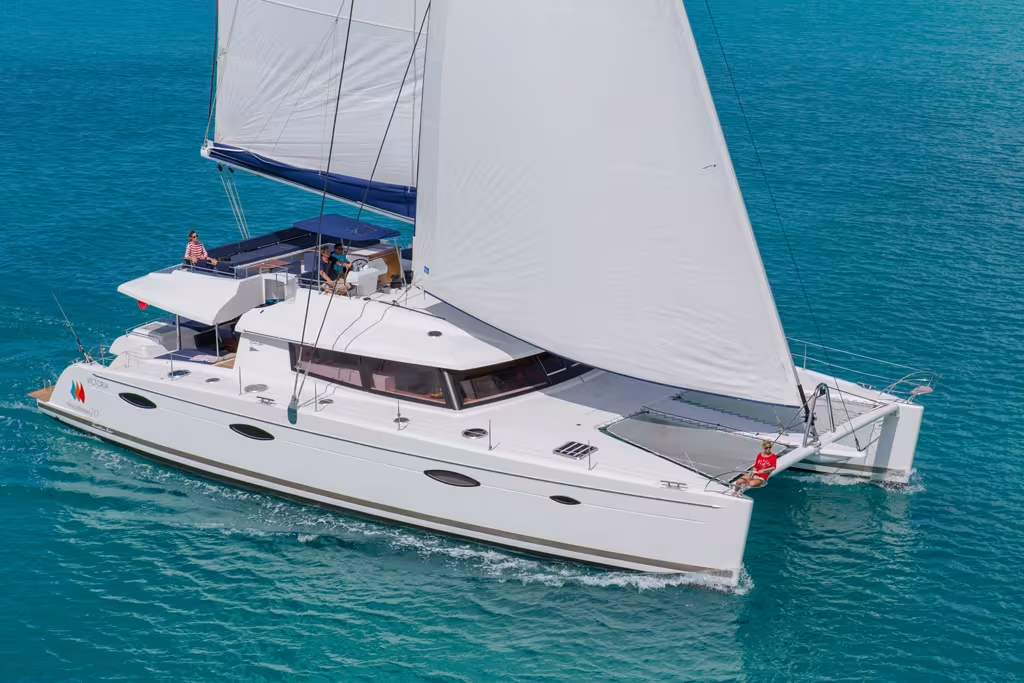
The Galathea 65’s underwater lines are well-proven and only needed slight restyling, but all the rest is different. The mast has been moved back and is now stepped on the coachroof; this arrangement favours a direct kinematic from the mastfoot to the deck plan, a secondary advantage of the flydeck, avoiding all the turning blocks! This upper level is both a fully—equipped terrace with an uninterrupted view, and a comprehensive nav station. The architect, Olivier Racoupeau, has used his talent to draw flowing lines, and the result is indisputable! For a test, it is a masterstroke, as although the relevance of the new living area can't be ignored on this kind of boat, the aesthetic impact still produces resistance amongst traditionalists. Here the balance of the proportions, the clever positioning of the boom and the integration into the overall silhouette preserve this sensitivity. The meticulous styling work on the ridges, the volumes, the flydeck extension, and the sugar scoops make up refined, sober, but determined lines. I can imagine an example with coloured decoration, and am certain of the appeal this beautiful multihull would have on any stretch of water.
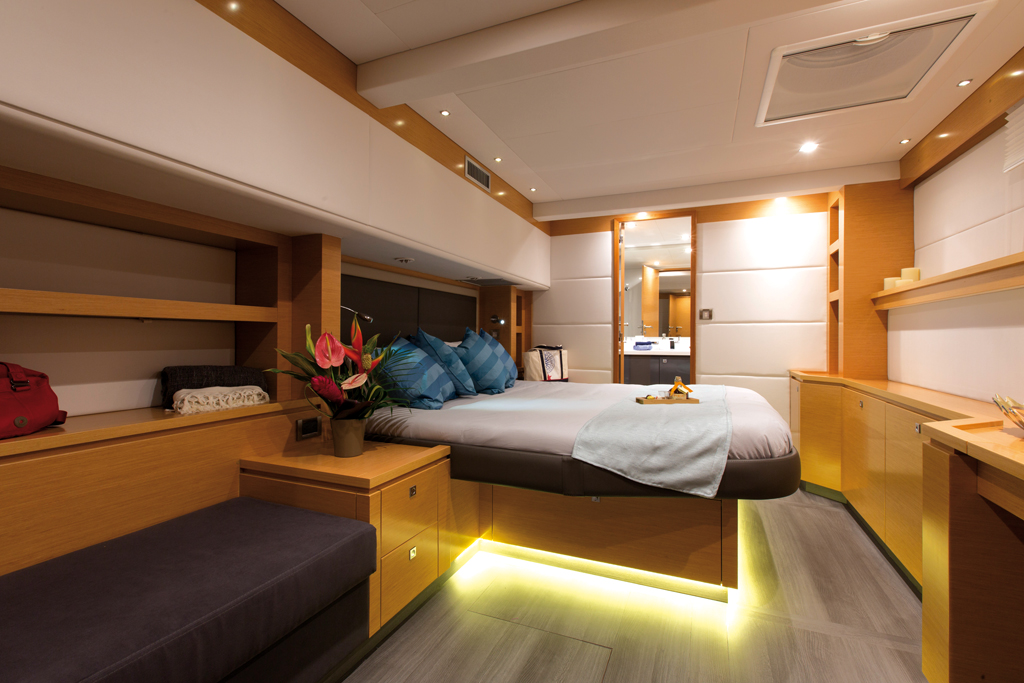
In the Maestro version, the owner’s cabin is particularly well handled.
Life aboard: ‘urban chic’ and nautical ergonomics
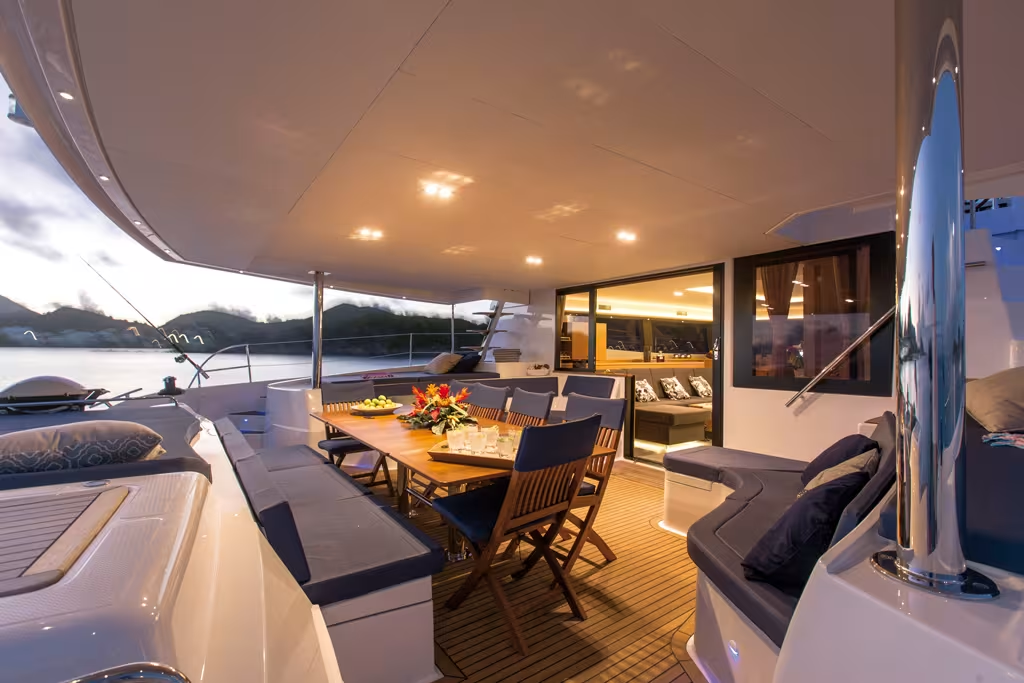
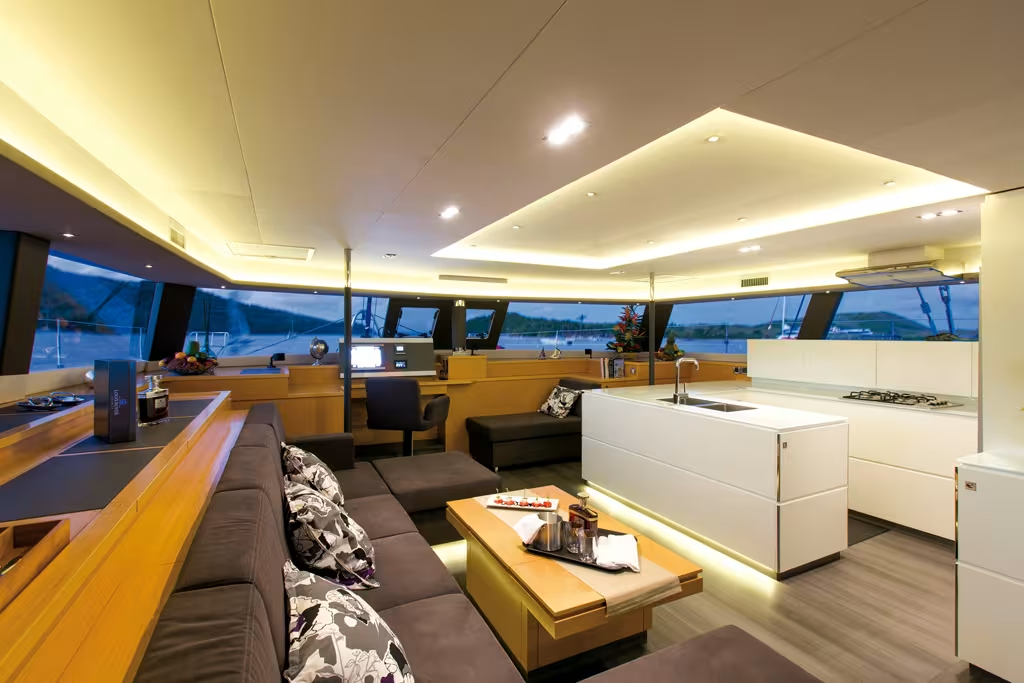
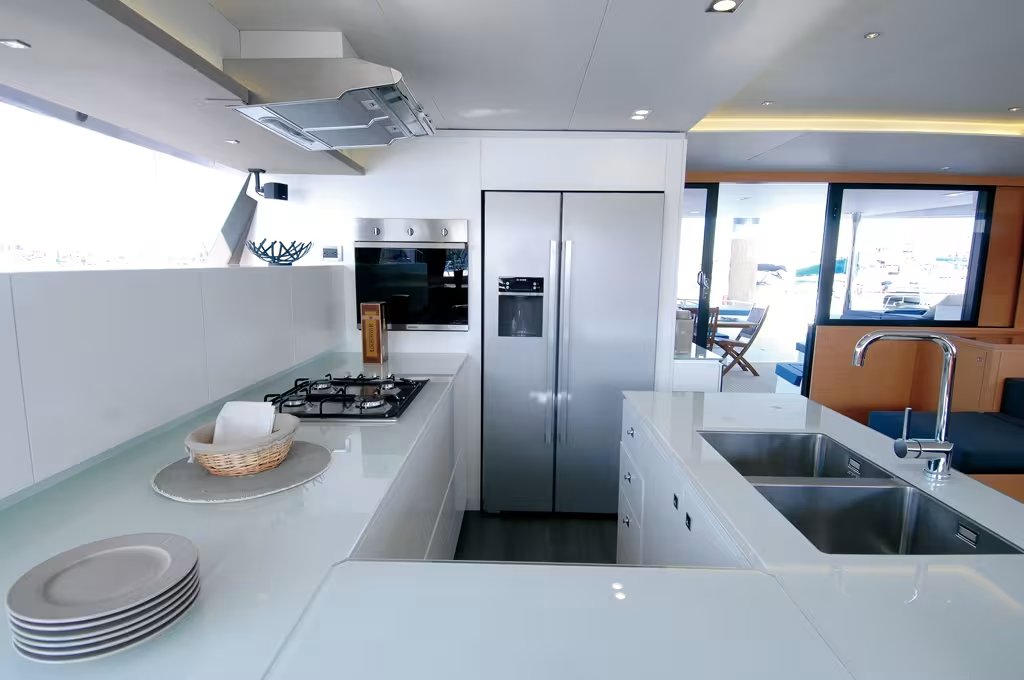
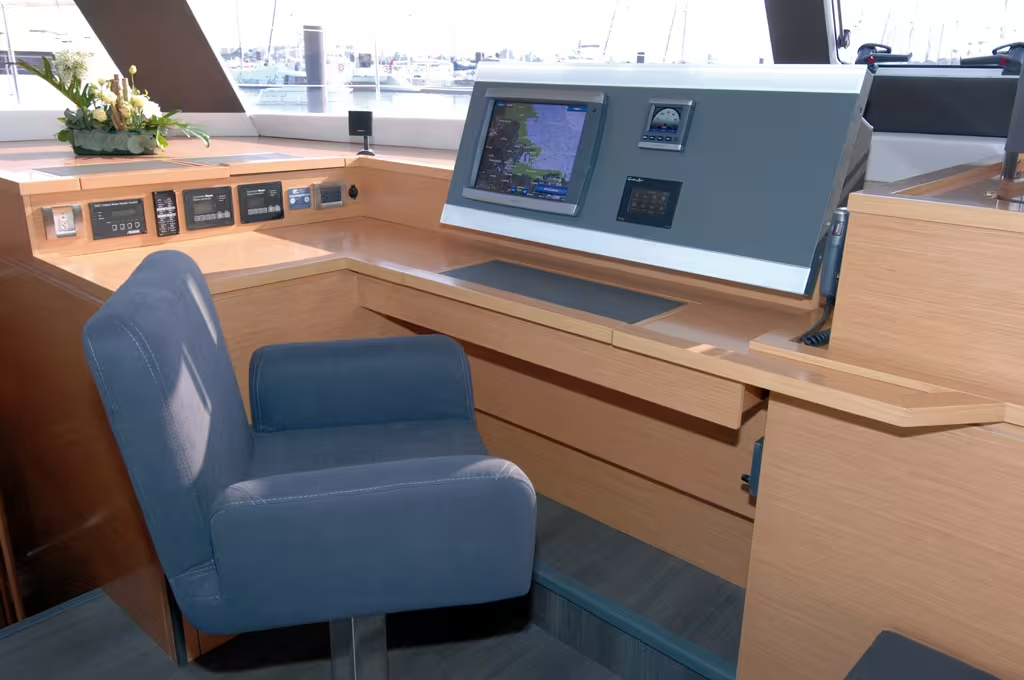
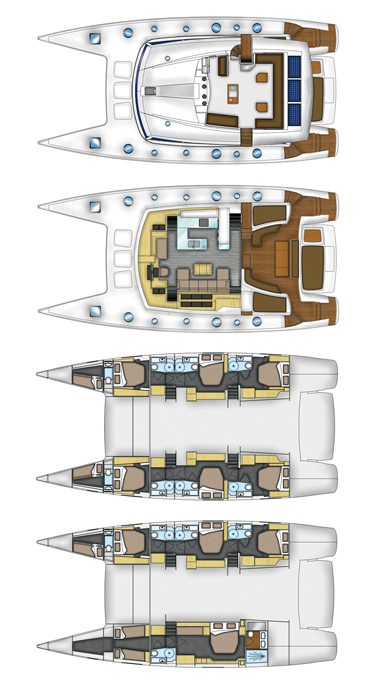
On visiting the Victoria at the opening of La Rochelle’s 2013 Grand Pavois, I was struck by the extraordinary area of the flydeck, which I hadn’t suspected from the pontoon. Such a machine is not made for staying in marinas, of course, but if necessary (in summer), life aboard will find an unassailable welcoming area ‘upstairs’, with a very nice view point and privacy, for resting, lazing around or having a meal away from the view of passers-by. The safety of this aerial area has been particularly reinforced; a tubular stainless steel rail extending the settees’ backrests effectively takes care of the risks of falling. This solution was only made possible by automating the movement of the main traveller, to avoid the traveller lines passing through the flybridge. The two nice little coffee tables are very practical; a set of mobile ‘pouffe’ seats is available, and a fully-equipped island galley occupies the place of honour in the centre of this nautical hanging garden, allowing you to set out, prepare and serve. Forward of the leisure area there is the navigation station, organised around a sturdy, comfortable navigation seat, a steering wheel and its instrument console, and all the control lines grouped around 6 enormous Antal electric winches. The safety of the helmsman and crew has been taken into consideration perfectly; handrails abound. For protection against the sun, an optional tubular frame tops the nav. station; the awnings for use at anchor are stowed in the canoe-type boom. The main access to the flydeck is the perfectly safe half-spiral staircase to starboard, but a second access to port is planned, to make movement more fluid. On the lower level, the cockpit reveals other resources: 3 huge sunbathing areas are fitted on the gunwales, one of which overhangs the wake, above the dinghy stowage. The settees, which face each other, are welcoming, comfortable and reassuring in all weathers (excellent soft furnishings). The exterior dining room for 8 – 10 guests is organized around a central teak module and two hinged leaves, all secured to a double base in large sized stainless steel tubing. The automatic lifelines giving access to the sugar scoops retract into the bulwarks, a very good idea, instead of seeing the cables on the ground or damaging the gel coat! There is a technical locker in the aft crossbeam, which houses the remote controls for lifting the dinghy, and the 220V supply line, which you never know where to stow. Clever and practical! Aft winches, well positioned and sized, allow the mooring lines to be handled under tension, also a nice feature. The efforts by the interior designer, Isabelle Racoupeau (a defector from motor yachts) have paid off particularly well in this boat. Of course, the size of the 67’ gives potentially creative volumes, but the ease with which it brings to life the lines and the furnishing elements via an ergonomic style known as ‘urban chic’ is brilliant. The galley takes pride of place again, and reasserts its primordial social role; the chef, the hostess or the lady of the ‘house’ will here find a rewarding, very pleasant ‘piano’. A large central island houses the sinks and the worktops; it also functions as a bar. All the stowage and the domestic appliances are housed discreetly in the wonderful U-shaped unit, completely covered in thick glass. The fitted American refrigerator completes this superb installation with an inspired design. The navigator is accommodated forward and to port, a genuine reclining chair will make long stays easier in this strategic L-shaped office, opposite the instrument console. The designer’s agile pencil has expressed itself fully in the fitting out of the 4 cabins of the Maestro version tested (an owner’s suite and a twin berth cabin to port, 2 double guest cabins to starboard). The mastery of the use of the materials, the composition of the geometric lines, the light oak Alpi covering bathing in a studied light, provide a sparkling atmosphere in very good taste. The Victoria’s overall style is a success, and the build quality is excellent.
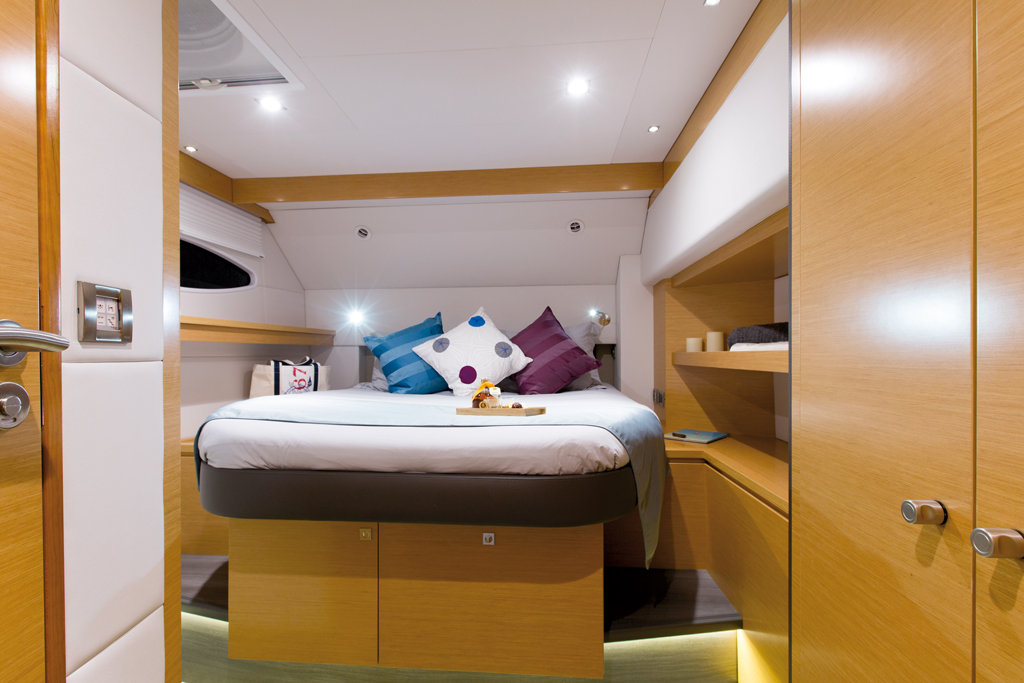
The guests have not been forgotten, and the cabins dedicated to them offer excellent comfort.
A flagship for ocean cruising...or coastal navigation.
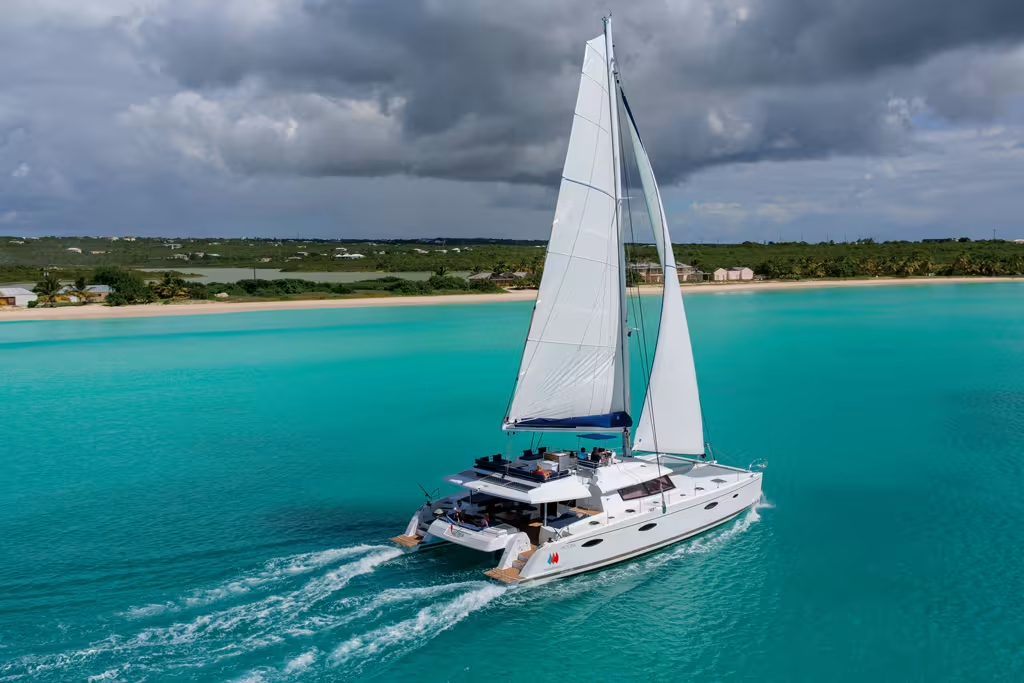
On arriving aboard for the first day of our test, I took advantage of the time spent leaving the channel to get to know the engine room. Congratulations are due for the acoustic discretion which reigns in this style of vessel. The two 110 hp, 6-cylinder Volvos are positioned directly below the aft crossbeam; access (vertical) is via a large assisted opening hatch. Down below, the area is divided into two parts. Aft, the rudder post tube is laminated to the bottom of the hull, and the rudder post passes through a large transverse corner plate, to which the bearing and the autopilot are fixed. All this is very healthy, but a doubling plate would in the long term spread the significant shearing forces of the very powerful hydraulic ram’s fixing points. This area offers an interesting viewpoint for the realization of the lamination (chassis infused, and parts attached); the fillet joints are reassuring, as are the size and quality of the balsa core. The quality of the impregnation of the cloth is obvious; the composite phase appears very healthy (a shame to leave an electric wire visible in the middle!). The engine installation itself is covered by a thick soundproofing mattress, which has to be unhooked to see the engine. The technical installation is clean, and the floor made safe with a metallic grill floor. The machine and its peripherals are accessible and readable. During our first day’s sail, there was very little wind; it was the opportunity to confirm that this big catamaran moves once a breath of air can be felt, and that it responds well to the helm, sails to windward whilst remaining well-balanced and gybes easily, all in 6 – 10 knots! The 22.5-metre, white-lacquered Marechal tube offers the usual qualities of this top of the range aluminium product. The stand-up articulated halyard return blocks (Antal), just like the rest of the deck plan, inspire confidence; the readability of the paths is perfect, which will avoid many problems in use, with these overpowered winches. The electric sheet winches are an option, however their assistance is obviously essential! Stowage of the lines (large diameter, very long) in deep open cavities is judicious. In the framework of our two-day test, I was very pleased with this simple, intelligent, efficient deck plan, which allowed us to handle easily such a large sail area, and the forces it induced. Adjustment of the traveller is delegated to a captive windlass, the push-button control of the traveller adjustment is fast and powerful – what a good arrangement! The reliability will have to be checked on the first examples, but the feedback from the 2 Victorias which have crossed the Atlantic doesn’t mention any problems from this point of view. Our test boat wasn’t equipped with the roller staysail which seems to be essential. The Victoria 67’ sailed well in the light weather, but it has above all been intelligently designed to remain easy to use in moderate conditions and strong breezes. On the second day, we sailed in a good force 5 with full sail, without feeling the slightest anxiety. This aspect of the Victoria’s personality will contribute much to its appeal to crews, as it will be capable of covering long distances, without requiring many manoeuvres. Above 25 knots of true wind, the genoa would be rolled up and the staysail would be the all-weather working sail. The composite compression strut is perfectly suited to this model. The realization of the forward crossbeam, with its mechanically welded metalwork is up to the constraints and inspires confidence. Despite hydraulic steering transmission with very little feel, the 67’ is pleasant to sail; it is quite lively and manoeuvrable, reacts to the trimming, and quickly reaches a good speed on all points of sailing. Acceleration out of a tack is not sluggish and the fin keels work well. The return, downwind, with around twenty knots of wind, had the boat slipping along steadily at 10 to 12 knots, which revealed the potential of this cat, one of the most agile in its segment.
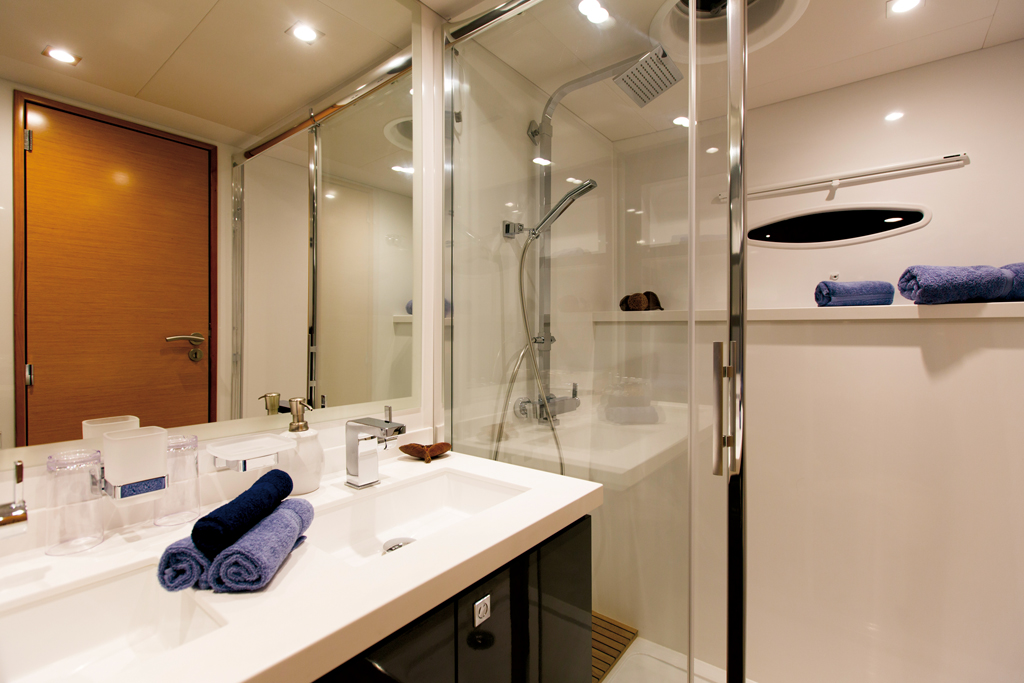
4 or 6 double cabin versions; in both cases, the bathrooms are comfortable and pleasant to use.
Conclusion
Bringing out the Victoria is a successful strategic step to be credited to the fruitful collaboration between Olivier and Isabelle Racoupeau and Fountaine Pajot. The launch of an exceptional, small production run multihull is an ambitious challenge; the 67’s elegant silhouette, its modern interior design, its good build quality and real nautical qualities, associated with the power of a world distribution network, should favour the success of a model with a promising patronymic.
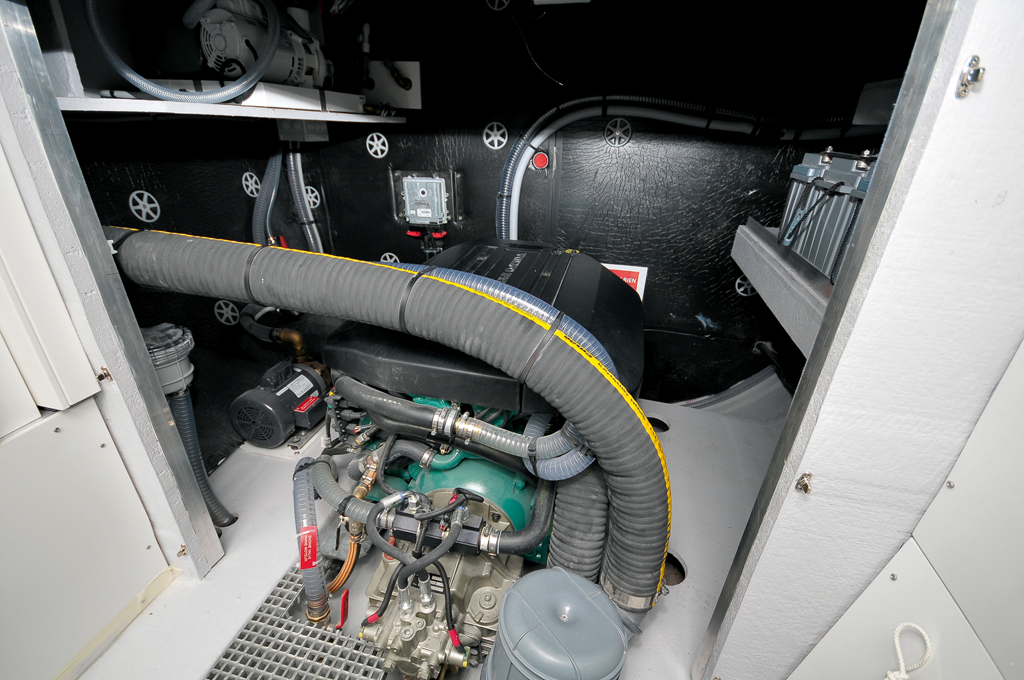
The engine room: grill floor for safety. The generator, its supply and the peripherals are accessible and readable.
The architects’ comments
When designing the Victoria, we wanted to situate it unequivocally in the world of luxury leisure sailing. We first outlined the volumes which define the living areas suited to each moment of life aboard, whilst giving preferential treatment to the owner’s and guests’ movements around the boat. As for the exterior styling, this new boat picks up the company's DNA: a refined profile, enhanced by the strong but sober lines of the coachroof – to sum up, an elegant sailing boat with a distinct nautical character. From the performance and handling point of view, very few compromises: waterline length and very moderate displacement, associated with the well-proportioned sail plan give it speed and good ability to pass through the seas. The boat’s dimensions have allowed the flybridge accommodation, which had already been outlined on the company's previous models, to be taken further. The steering and manoeuvring position has naturally found its place in the front part, clearly separated from the huge relaxation area by a functional exterior bar. Equipped with a double access, this flybridge is a logical extension of the cockpit. We appreciate open spaces, so we extended the cockpit as naturally as possible, like a loft over the lounge and the galley. As for the cabins, the Victoria is available in an owner-Maestro version and a charter version with 6 cabins plus crew. Particular attention has been paid to the interior decoration; the company’s style is still very visible, and has been enhanced everywhere by the new ‘Urban Chic’ atmosphere. This association of colours and materials, a mixture of discreet contrasts and light, is based on the introduction of new elements, such as glass, stainless steel, lacquer or leather. The textile headlinings bring a new richer and more contemporary dimension. Apart from this work on the materials, special attention has been paid to all the aesthetic and functional details. Olivier and Isabelle Racoupeau
Technical Description
Architect: Olivier Racoupeau Interior designer: Isabelle Racoupeau Length: 20.44m Beam: 9.50m Draft: 1.55m Equipped unladen displacement: 23.6T Mainsail area: 120m² Genoa area: 77m² Gennaker area: 150m² Engines: 2 x 110hp Water: 1050 l Diesel: 1400 l Construction material: Balsa – glass – vinyl-polyester sandwich, infusion process Price: 5-cabin Maestro version: 1,545,000€ exc. VAT, 6 cabins: 1,576,000€. VAT Main options, price in € exc. VAT: Hydro-generator: 7740 Solar panels: 4696 90 l/h low consumption watermaker 12500 (220 l/h: 15018) 2 x 150hp Volvo engines: 5500 3.5 KW generator 19980 Roller staysail: 15366 Electronic pack and autopilot: 12600 Dinghy + 25 hp, 4-stroke outboard: 9262 Electric genoa winches: 7419 Safety equipment + 8 person liferaft: 6300 Commissioning: 6500
Plusses
- Elegant silhouette - Dynamic qualities and manoeuvrability - Luxurious, functional accommodation
Minuses
- Hydraulic steering ratio too low - A little more effort could be made with the finishing in hard to access areas - Electric genoa winches optional
The competitors
Model Builder sail area in m² Weight in T Price in €, exc. VAT Catana 70’ CR Catana 215 22 2,838,000 Sunreef 60 Loft Sunreef. 182 33 1,360,000 Lagoon 620 Lagoon 243 27 1,142,000
Caption
1: The superb suspended area of the flydeck, in the centre of which a fully equipped bar sits prominently. 2: The safety of the flybridge settees is remarkable. 3: The Victoria 67’ is thought out for eco-cruising; it has several pieces of innovative equipment in this field (solar panels, hydro-generator, consumption monitor). 4: The very ergonomic sugar scoops have automatically retracting lifelines. 5: The modern cutter rig with genoa and staysail on rollers is the ideal for this boat, but requires the genoa to be part rolled when tacking. 6: The flybridge nav. station is comprehensive, pleasant and reassuring. The immediate proximity and perfect readability of the deck plan, associated with the power of the electric winches, rationalise the use of this big catamaran. 7: An excellent mark for the design of the coachroof and the quality of the interior light. 8: The slim bows open up the Victoria 67’s wake; the dynamic qualities are remarkable for such a comfortable boat. 9: The lines aft are delicate for a big boat, and the trim is perfect. 10: Access to the flybridge is one of the most fluid in the segment, and safety is taken care of. 11: The sunbathing areas take on an aerial dimension on the Victoria; these will probably be popular areas. 12: The JP Marechal aluminium mast is a strong, reliable top of the range product whose life span is remarkable.