
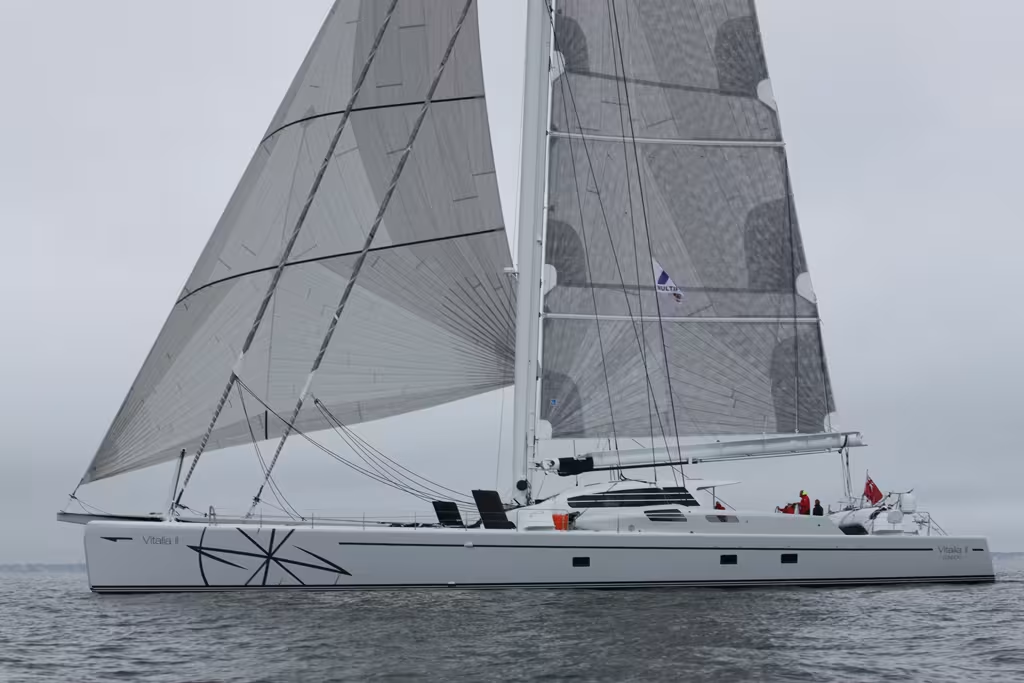
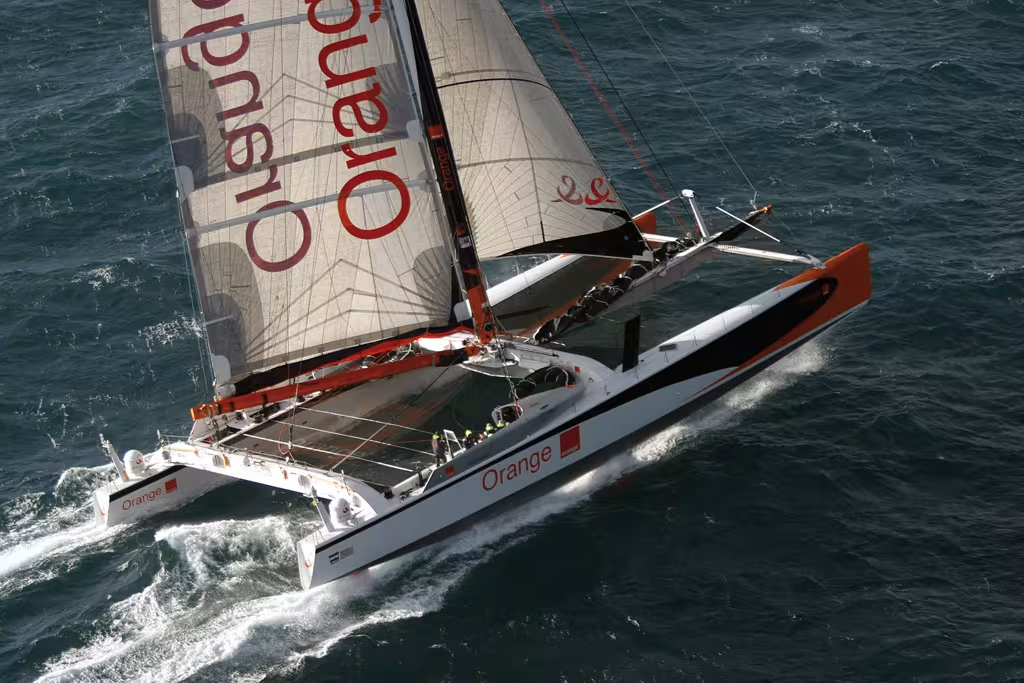
There are certain multihulls that we hold dear to our hearts. They have allowed us to become intoxicated by the ocean, to savour the taste of adventure, to win races, or sometimes even to survive. That said, only a few exceptional models manage to rewrite maritime history before disappearing from public view. Orange II is one example of this type of machine which overcame enormous difficulties on the racecourse with masterful ease and has outlasted her short-lived fame. Her potential, and design and build quality are such that she remains the only catamaran to still be competitive when put up against the latest-generation of trimarans. Now she has been majestically reborn under the name of Vitalia, the fastest cruising boat in the world!
Infos pratiques
- Le chantier : Vitalia
- La fiche technique
- Découvrez notre vidéo exclusive
- Financez votre Vitalia / Ex-Orange II
- Assuez votre Vitalia / Ex-Orange II
- Articles autour du Vitalia / Ex-Orange II
The Jules Verne Trophy (or the fantastic ride of Orange II’s 14 crew)
Bruno Peyron’s objective in Vannes, France on December 22nd 2003 was to launch a performance multihull which would not be surpassed for the next five years, and to win the Jules Verne Trophy (Round the World record, fully crewed, via the Great Capes). The maxi cat is 3.50 meters longer than her predecessor,Orange I and weighs an extra 10 tonnes, but has a mast 6m higher and carries an extra 200m² of sail upwind (and 600 downwind!). She flies a hull in 13 knots of true wind, and the target speed upwind climbed to 21 knots. Gilles Ollier concentrated all his 25 years’ naval architecture in multihulls into this boat! After 35 Atlantic crossings and a promotional trip around the world for the ultimate race which he came up with (The Race), Bruno, from La Baule in Brittany, two-times holder of the Jules Verne record, was hungry for more! His new record-hunting catamaran made two attempts in 2004, having to return after 24 hours (due to a defective crashbox), and then off Cape Verde again (for a broken propshaft) the second time. In 2005, Cheyenne’s Atlantic record (she was 38.10m with her extensions) was within half an hour’s reach, but then the Ollier design completely smashed the 24 hour record (702 miles! - which in 2006 he pushed to 766.8 miles). The Marseille - Carthage record, across the Mediterranean to Tunisia, was simply a formality, and the boat was ready to take on the ultimate challenge, as were the crew. One tonne of weight savings had been achieved on the 2004 version: the 100 hp motors had been retired, to be replaced by two 30 hp generators, and new rudder blades which worked perfectly between 30 and 40 knots with no more cavitation. After 11 days at sea, in the middle of the South Atlantic, Bruno and Roger Nilson set the stratospheric rocket into orbit ahead of a much coveted low pressure system. At an average of 30 knots, Orange 2 zoomed across a flat sea, ahead of the fronts and moving at the same speed as the weather down in the 40th and 50th parallels. Her very high freeboard enabled her to avoid the impacts which had weakened the 3 Ollier designs in The Race, and her exceptionally high build quality made her very reliable. A collision with a whale off the Falkland Islands did not lead to any serious consequences and this great catamaran crossed the line after 50 days and 6 hours: an incredible time in those days! The record was only beaten five years later by Groupama III (F.Cammas) in 48 days 7 hours, then by Banque Populaire V in 45 days 13 hours (with Loick Peyron as skipper!).
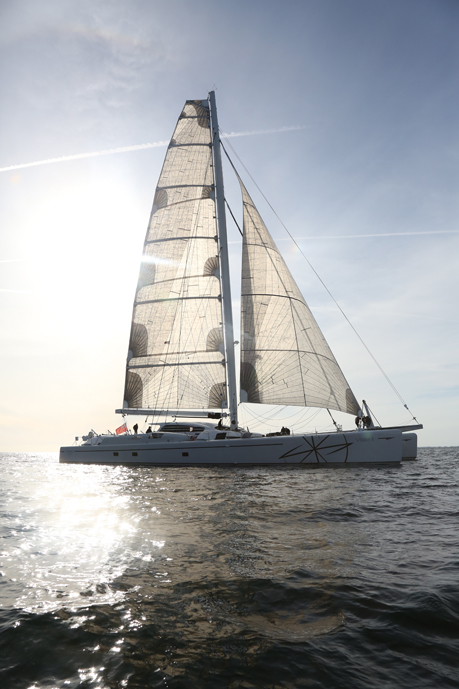
Vitalia today! An amazing transformation and a second life for a catamaran which had become a legend in high speed sailing
You only live twice!
Multiplast is a superlative shipyard known for the quality of its builds (revolutionary racing catamarans, Magic Cat, Orma 60, Groupama 3 among others), but it’s also the home of some visionary architectural work. The proa “Funambule” was a great success and remains the fastest and most reliable double-ender ever built. The saga of Jet Services propelled the catamaran into the modern age: the three giants built for The Race were as much a design wonder as an incredible challenge to build. Orange 2 sat at the pinnacle of this dynamic. The construction required 90,000 extremely experienced man-hours. Bruno Peyron wanted a reliable and solid boat with high safety factors. He was looking for a platform capable of maintaining staggering average speeds in total safety, though outright speed was not the goal (even so, the boat’s record touched 44 knots!) This philosophy allowed the transformation which was to follow. In 2007, Bruno bought back Orange II after the loss of the sponsor, but he was not able to find an equivalent budget and the boat was put ashore at Multiplast in 2009. François Bich, whose father Baron Marcel Bich invented the emblematic ball-point pen and took part in three editions of the America’s Cup (from 1964 to 1980, he was the instigator of the qualifiers between the challengers which was to become the Louis Vitton Cup), is deputy CEO of the group, and CEO of the Bic lighter division. François had sailed a lot on 12 Meter Class boats, and was patron of the schooner “Shenandoah”, before becoming captivated by speed on board Magic Cat and the Formula 40 “Triga” which he still owns (and on board which Steve Ravussin competed in the 1998 Route du Rhum). He bought Orange II in April 2014 and entrusted the transformation of the boat to the team at Multiplast: Yann Penfornis, Jack Michal and Franck Martin (Gilles Ollier having retired). The trio accepted the challenge and the responsibility of tacking on, in the most elegant way possible, a nacelle housing a large saloon, a galley bar, an owner’s cabin and an exterior saloon with every comfort imaginable, without adding too much weight, nor exceeding the 240 t/m righting moment. The rigging therefore had to be set up with the help of strain gauges and the programmable UpsideUp safety system. This transformation involved 50 people and needed 30,000 hours of work. Daniel Domergues of Agence Narrative joined up with the Multiplast team for the exterior design, and Stephane Lauro of Domicile Fixe was entrusted with the interior design in association with Golfe Agencement (a specialist in the layout of cruising boats). Patrick Sassier, Valdimir Dzalba Lyndis and Didier Ragot oversaw the project on behalf of François Bich.
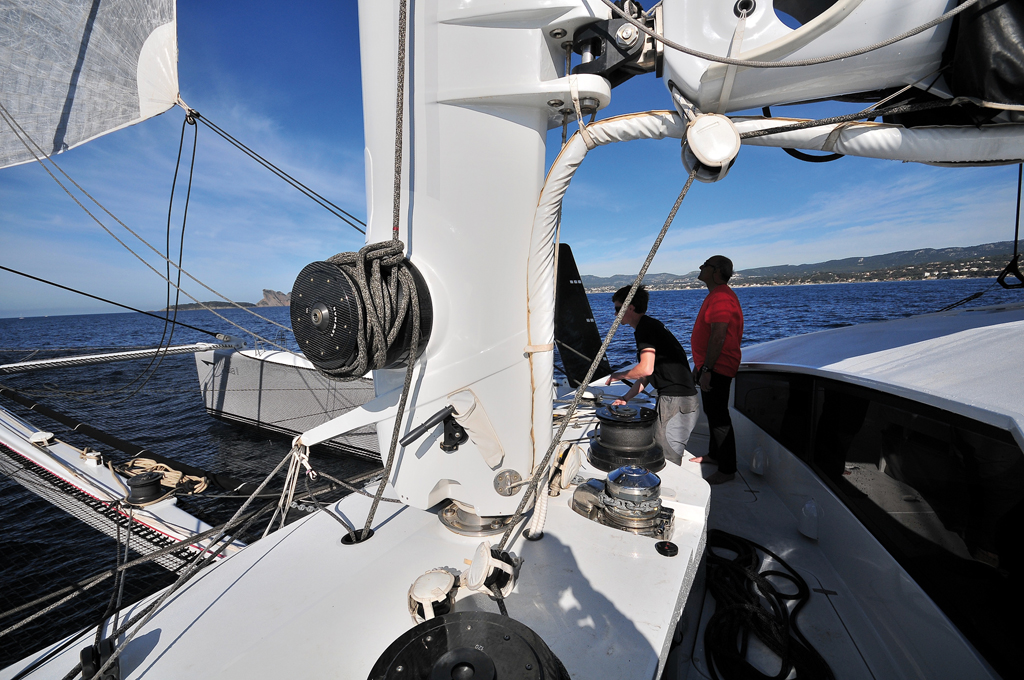
The cockpit at the mast foot with some of the world’s largest carbon winches. Previously, the boom came up from the arm, but is now rigged on the mast
First encounter at La Ciotat
The wet dock at the big shipyard at La Ciotat, on France’s Mediterranean Coast, normally makes sailboats look minuscule, but the gigantic dimensions of Vitalia fit perfectly here. Arriving on foot in front of the bows, it took my breath away. I had been on board Orange 2 in Lorient after the Atlantic record and retained memories of her power (but was a little apprehensive of her transformation!). The amazing force of the boat was still there, almost enhanced by the new design, as if the Multiplast cocoon had added something to an already perfect form! The extraordinary depth of the paint job, the combination of the fantastic original profile with the nacelle now added aft of the central beam, full of vitality and elegance: the radiant proportions of these XXL-sized multihulls with their immense hulls and the absolute perfection of the deck fittings made me think I was standing in front of the most beautiful boat in the world… And also the fastest! This idea stayed with me despite the incongruous nature of this claim. Despite losing the attributes of an out and out racing boat, and the ostentatious paintwork, a part of the myth has disappeared, but the original has appeared again in a new form. In this way, some models lose their soul, others step into the light. Vitalia’s metallic gray livery shows off the perfect sculpture designed by Gilles Ollier and his team. What an amazing work of architecture and refit!
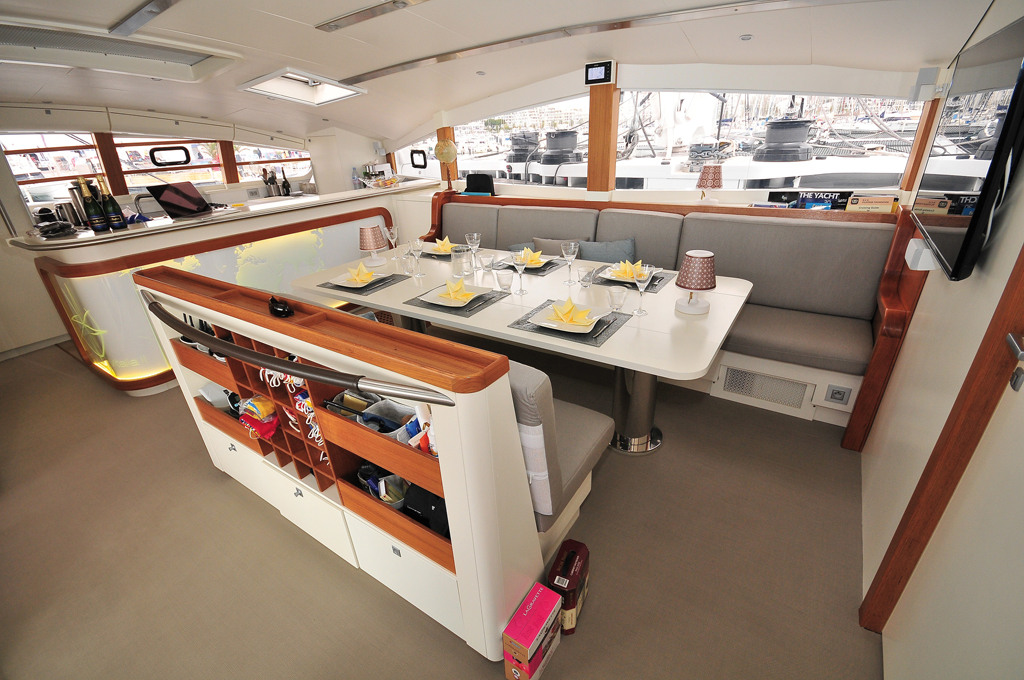
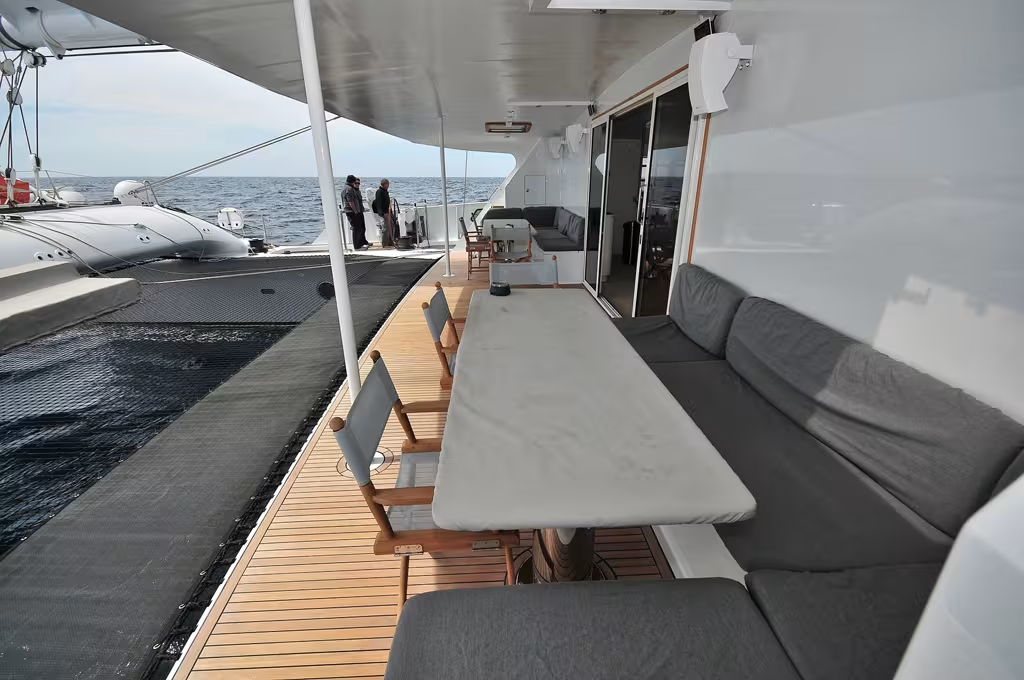
The nacelle living space which has been added to Orange 2! Vitalia is born! This deck salon has become a real opera house when the orchestra is playing the machine
An incredible sailing machine
When it came to the (very impressive) domestic set up on Vitalia, I felt a little dizzy: how do you go about fitting out a luxury interior to a nautical Formula 1 machine such as this, without it looking trashy, or out of place? The cleverness of the transformation is testament to this. An enlightened owner, passionate about speed, who knows the thrill of competition, combined with one of the best multihulls teams in the world… It’s time to have a look around! The idea of Vitalia is simple and clear: rather than design a one-off machine to imitate, on a reduced scale, a luxury performance craft, why not transform the world’s best catamaran? The key to success consists of a formula which combines the balance of the shape, respect and understanding of the basic structure and a desire for perfection.
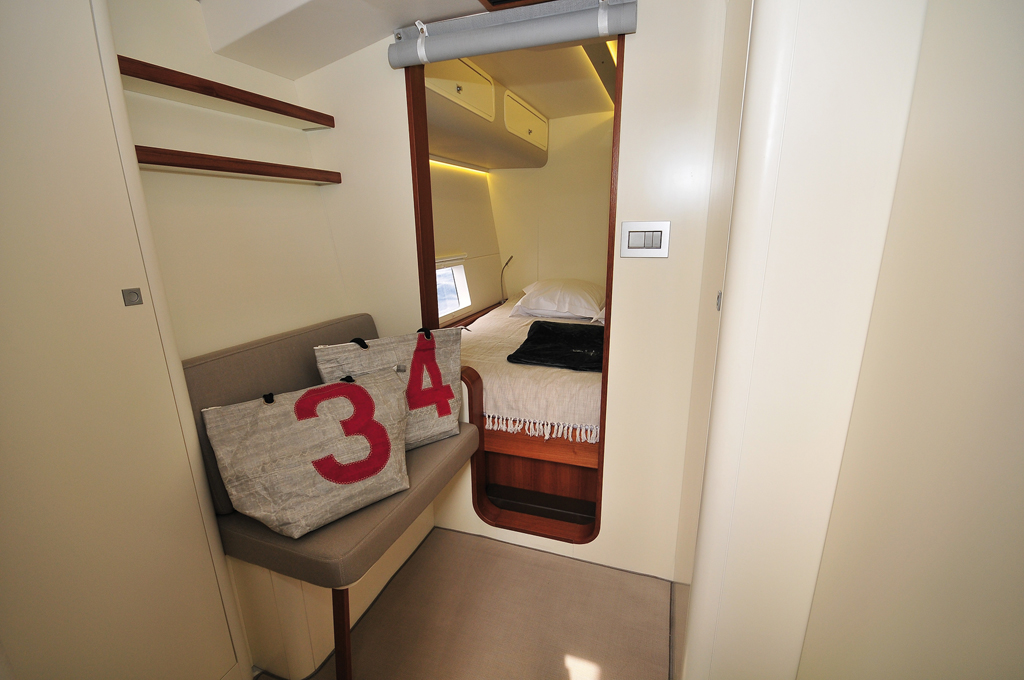
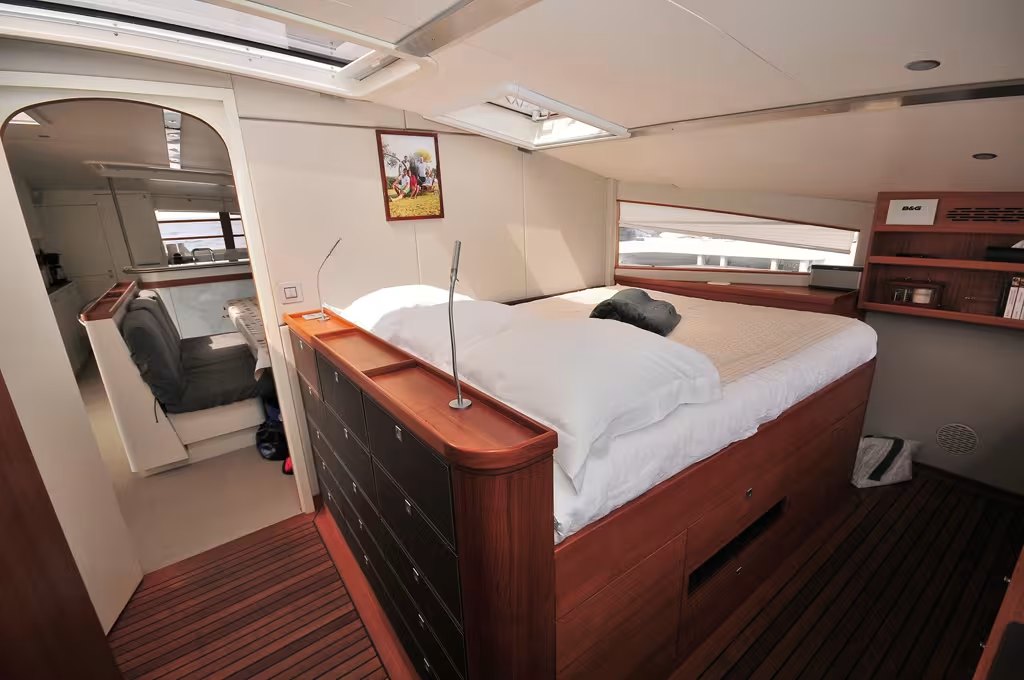
The carbon hulls house comfortable cabins
Welcome on board
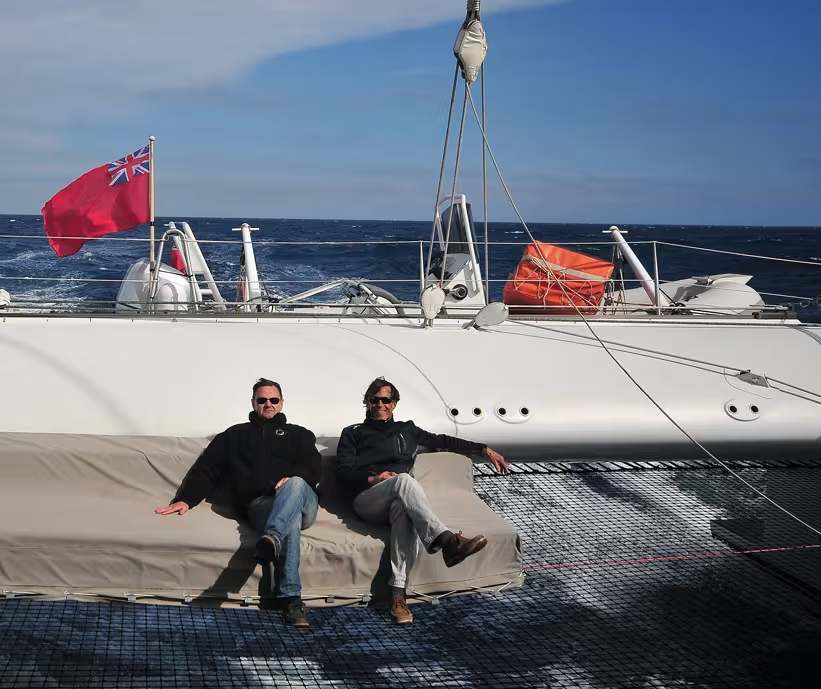
The interior layout of Vitalia is dictated by the original structure. However, I found a rare feeling of comfort on this boat! The minimalist atmosphere of the cabins is well designed and completely functional: the contrasting mix between the cozy alcoves and the carbon giant is without doubt the key to extraordinary sailing which will also serve as a means of transport. Star Wars fans might try and imagine their own private space on the Millennium Falcon! The six cabins and the two crew areas are assigned subject to your function on board. The twin cabins offer a remarkable level of privacy. The nacelle (air-conditioned) is a really neat bit of architecture which combines the owner’s suite and a formidable dining area which can seat a dozen friends next to an XXL-sized bar and the chef’s galley. The panoramic view is amazing, with the view forward overlooking the sail-handling cockpit and some of the world’s largest carbon winches. In the center is the incredible 45 meter high rotating mast. Beyond that, it’s a further 20 meters to the bows. Aft, you have the most exclusive lounge-terrace on the planet. You’ve got the best seats in the house, and the orchestra of only five musicians is going to play to you as if you were at Carnegie Hall or the Royal Albert Hall listening to a philharmonic orchestra. Conjure up either listening to Mozart or Mark Knopfler, at 25 knots adjust the salon’s (hydraulic) bench seat, and enjoy an amazing spectacle with which no theme park in the world or any 3D film could compete!
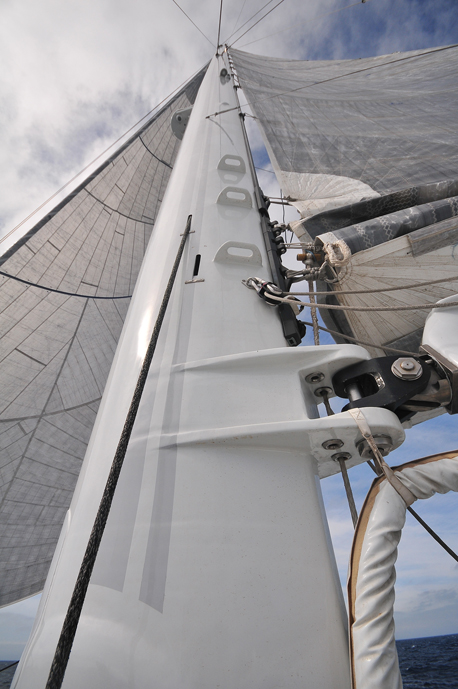
The original 45m mast supports the 380m² mainsail in Cuben Fiber and 1000m² of sail downwind
110 emotion-filled miles
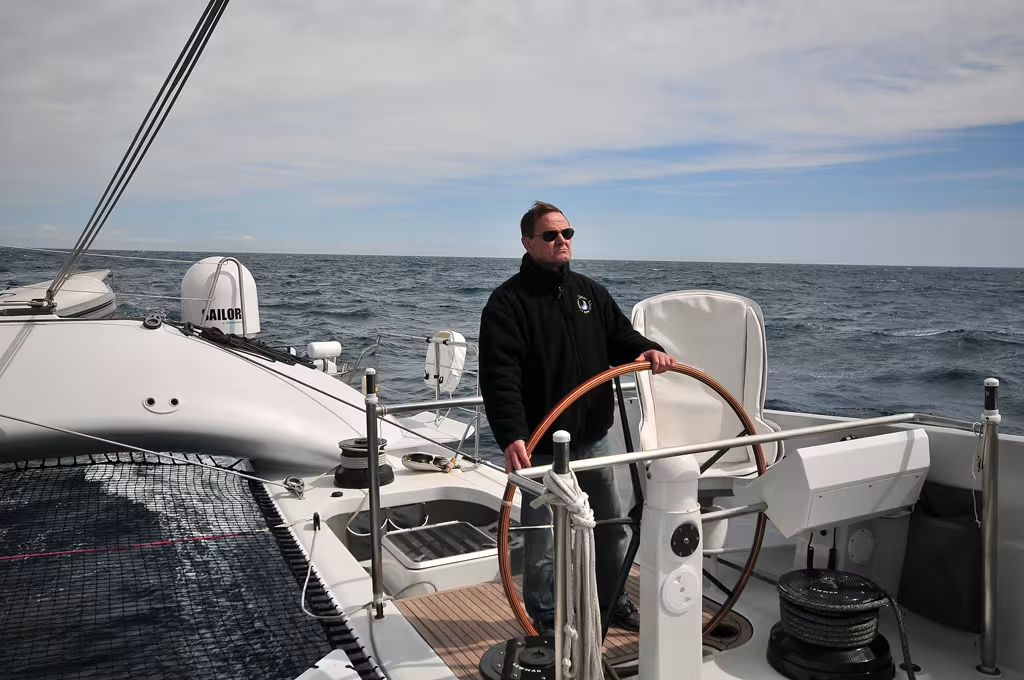
To get a 38m x 22m vessel off the dock at La Ciotat is not at all like coming out of an ordinary slip. The composure of Patrick Sassier, the captain, with help from the dock-master’s boat, and the vigilance of Vincent in the inflatable “guard-dog”, and the power of the two 180 hp Volvos linked to four-bladed folding propellers gently extracted the enormous catamaran. This was the first trip out this season after refitting the sails, so hoisting the main was going to be the moment for a full check of all the deck hardware. Sheltered by the high cliffs which enclose the bay from the east, the mast crew (Alexis and Vincent) set about their work! There was 90 m of halyard to take in, and I spared a thought for the 14 men of the crew of Orange who did this day and night with coffee grinder winches for 50 days. The third gear of the Harken custom hydraulic winches (all the deck winches are hydraulic) is an overdrive with astonishing speed. In experienced hands it allows the headboard to be up past the lazyjacks in just a few seconds and launch the 380m² of Cuben Fiber on to the 45 meters of pure carbon. Unfurling the 268m² solent is completed in a few seconds, with the sheet being literally swallowed up by the cockpit winches. It’s a lovely day and we’re passing the little green island which keeps watch over the bay, at 16 to 17 knots with 15 knots of wind from behind. Patrick Maurel is at the helm (he has been overseeing the work carried out by Sailing Concept throughout the winter). On a broad reach on port tack, we were quickly leaving the coast behind at an average of 15 knots. Vitalia, like a magician, accelerated to over 20 knots in the strengthening southeasterly breeze. Despite being totally comfortable through the water, the first level alarm sounded briefly, calling for the first reef. As soon as the reefing line was hooked by Vincent in the Park Avenue-sized boom, the majestic movement of the 37m hulls met with a choppy and cross sea left over from a previous NW gale. The crew deeply respects this boat but they also love to share it, and the gift of twice spending an hour and a half at the helm is an unforgettable experience. It is difficult to follow what the VMG is telling you (bearing away in the wind) because coming up by a few degrees on the course you find yourself addicted to this playing field which accelerates the giant boat to over 22 knots! But we’re not bound for Gibraltar, and we need to gybe to maintain our course (at 20 miles, we can no longer see the coast!). The islands off Marseille soon appear downwind and we gybe again into the Golfe de Fos for a high speed crossing of the Camargue, before one final gybe to take us down into the bay of Aigues Mortes. These 110 miles have been covered at an average of 15 knots. Helming this giant in these breezy conditions has been an incredible, unforgettable experience, interrupted only by the enjoyment of a delicious lasagna prepared at sea by the chef, Laurent, and the hostess, Anne, whilst we were forgetting all about reality at the helm of this thoroughbred. Going from 32 to 46 tonnes lightship, Orange/Vitalia has managed to retain the essential part of her extraordinary potential, abandoning the 1,000 hp (the power to weight ratio of a Formula 1 racing car) of her original “motor”, in favor of 700, but these are chariots of fire horses! The applause from the hundreds of exhibitors preparing for the opening of the International Multihull Show at la Grande Motte on our arrival was testament to the fact that Vitalia had won us all over!
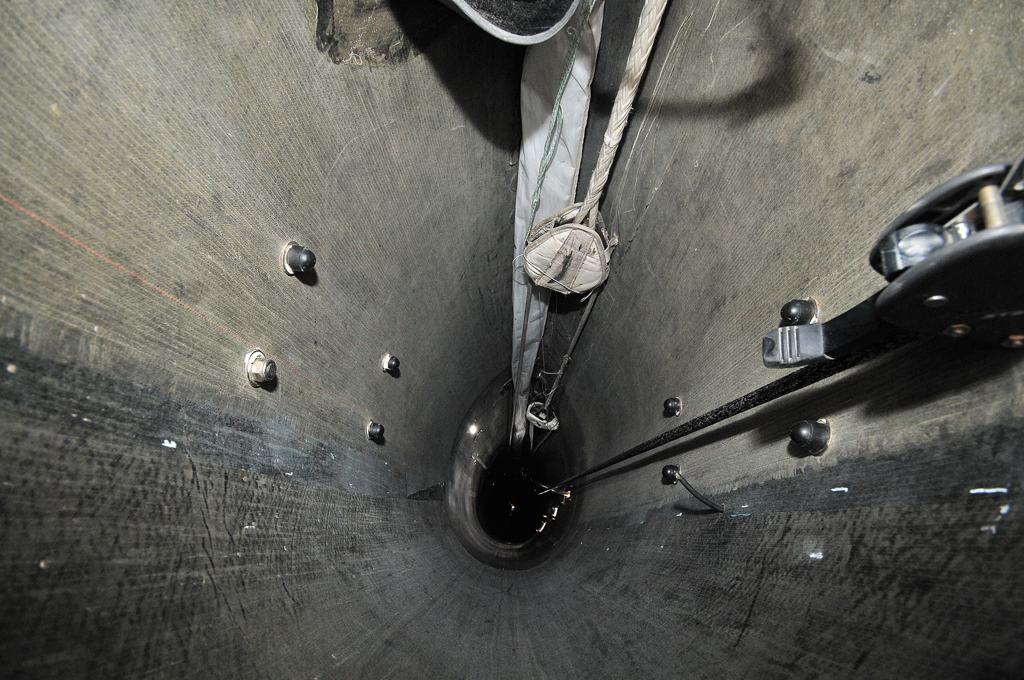
The interior of the Vitalia’s mast, seen from the foot, and above, 45m of the black fiber
Conclusion
In conclusion, I am aware that there are a thousand more things I wanted to share, notably a tour of this extraordinary multihull’s technical innards, but I don’t have space. I was hypnotized by the grace and agility of the boat, and a part of me remains at the helm of this giant. There’s the video footage as well, but try and do better than me: don’t leave it on repeat!
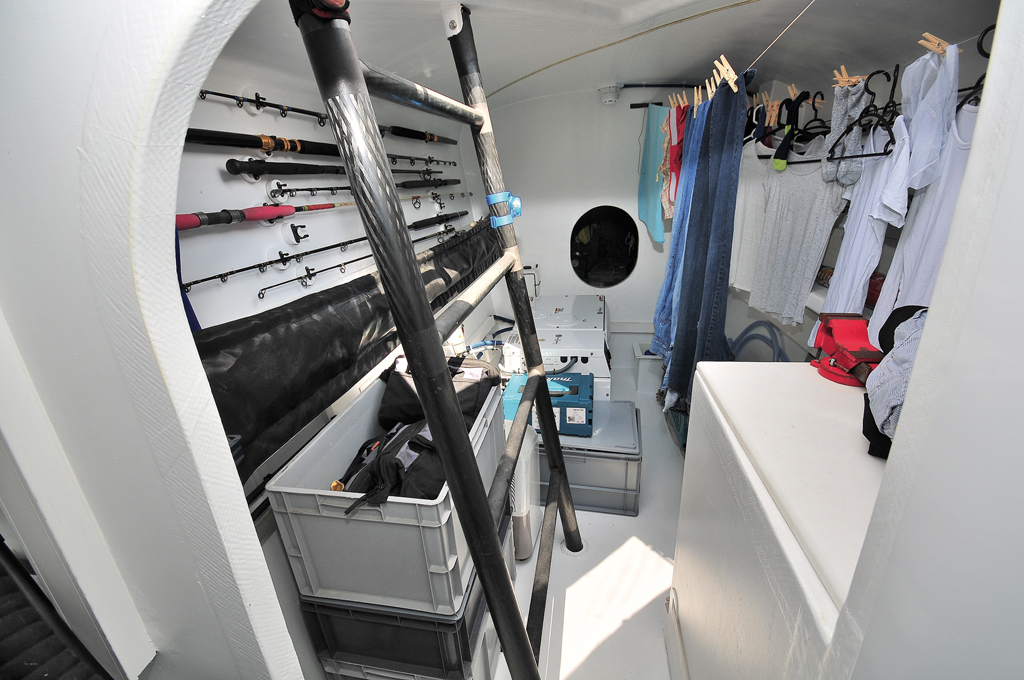
One of the equipment holds (port side forward)
Technical specifications
- Naval Architects: Gilles Ollier and Multiplast Design Team
- Architects for the conversion: Jack Michal, Yann Penfornis, Franck Martin and Samuel Napoleoni
- Exterior Design: Daniel Domergues
- Interior Design: Stéphane Lauro Shipyard: Multiplast
- Overall length: 36.80 m
- Beam: 16.90 m
- Air draft: 48 m
- Lightship displacement: 46.4 t
- Laden displacement: 52 t
- Upwind sail area: 700 m2
- Downwind sail area: 1000m2
- Draft: 2.95 m/5.85 m
- Motors: Volvo D4 2x180 hp Diesel: 2 x 1100l Black water tanks: 2 x 350l Gray water tanks: 2 x 300l Hydraulics: Tenderlift (boom vang) and Hydraunautic (winches) Generators: Cummins 7KVA+27KVA Service
- Batteries: 7 Mastervolt lithium batteries Watermakers: 2 (Compagnie Hydrotechnique)
A word from François Bich
I already had the chance to sail on Vitalia last year in August and in particular we went to watch the racing at Porto Cervo. The boat is great fun, well balanced and very fast. We reached 31.4 knots. This spring, leaving from La Grande Motte after the International Multihull Show, we sailed down to the Canaries in one go, and saw up to 35 knots of wind on quite a rough sea. The boat nicely demonstrated her safety aspects and speed. We dropped down as far as Dakar with the wind behind us, making for a very enjoyable cruise. I’m intending to sail this summer in the Mediterranean, and then set off in November bound for the West Indies, Panama and the Pacific for a big adventure. I’m going to be accompanied by friends who have chosen the part of the voyage that they prefer. We’ve already got some fishing lined up. I am very happy with Orange 2 as a base and with her transformation.
Caption
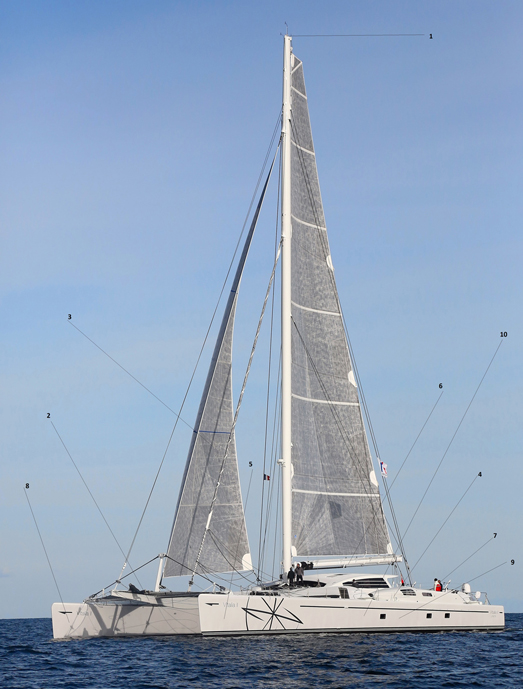
- : At 48m above the water, the headboard of a mainsail in Cuben Fiber measuring 380m²! The mast, like all the vital organs is original, of course
- : The compression pod is an essential piece of the structure of the boat, supporting the martingale stay which rises more than 3m above the forward beam
- : The solent is a sail which is short in the foot but very tall, coming in at 268m²: the high-reduction hydraulic furler allows the sail to be furled/unfurled very quickly
- : These aeronautical-style coachroofs protect the companionways into the hulls and house comfortable watchkeeping shelters
- : The gigantic bows are one of Vitalia/Orange 2’s secrets when it comes to wave-piercing agility
- : The boom, previously rising up from the beam, now articulates on a gooseneck: a hydraulic ram controls and adjusts the sheet and the “quick-release” safety system (automatic dumping via the UpsideUp system depending on the amount of load
- : The helm stations are perfectly sheltered by the carbon wall which extends from the coachroofs
- : When you’re at the helm, the bows are smoking downwind at 30m in front of you! From the viewpoint in the nacelle or the owner’s cabin, it’s a unique spectacle
- : The central part of the hulls houses the fitted out area and technical equipment. The installation of the generators (7 and 27 kVA), lithium batteries, watermakers, hydraulic pump and motors are a real feat in a boat like this
- : A look at the arms (in the center and aft) allows you to take stock of the power of this carbon cathedral
