No visitor to the recent Cannes Yachting Festival could have possibly missed the almost revolutionary profile of the Wave 50, making its first appearance among the multihulls on the west quay of Port Canto. Our philosophy here at Multihulls World has always been to be open-minded and charitable about innovations, whatever they may be: a condescending maxim that might claim to summarize five years of development is not our thing! On the contrary, we were desperate to find out more this UFO (unidentified floating object), and of course, to take it out for a sail. We were not at the end of our surprises…




Infos pratiques
- Le chantier : Wave 50
- La fiche technique
-
 Découvrez notre vidéo exclusive
- Financez votre Wave 50
- Assuez votre Wave 50
- Articles autour du Wave 50
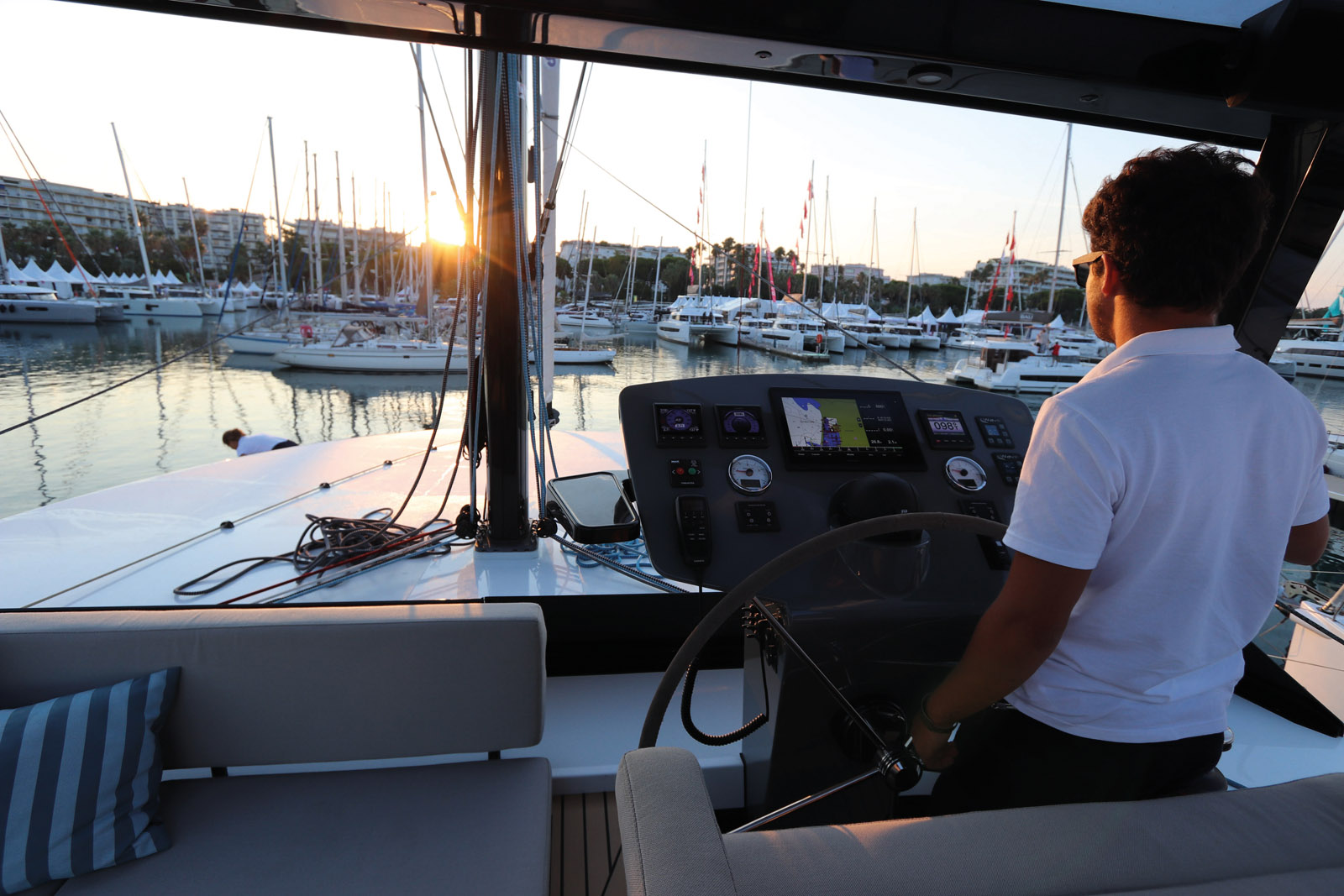
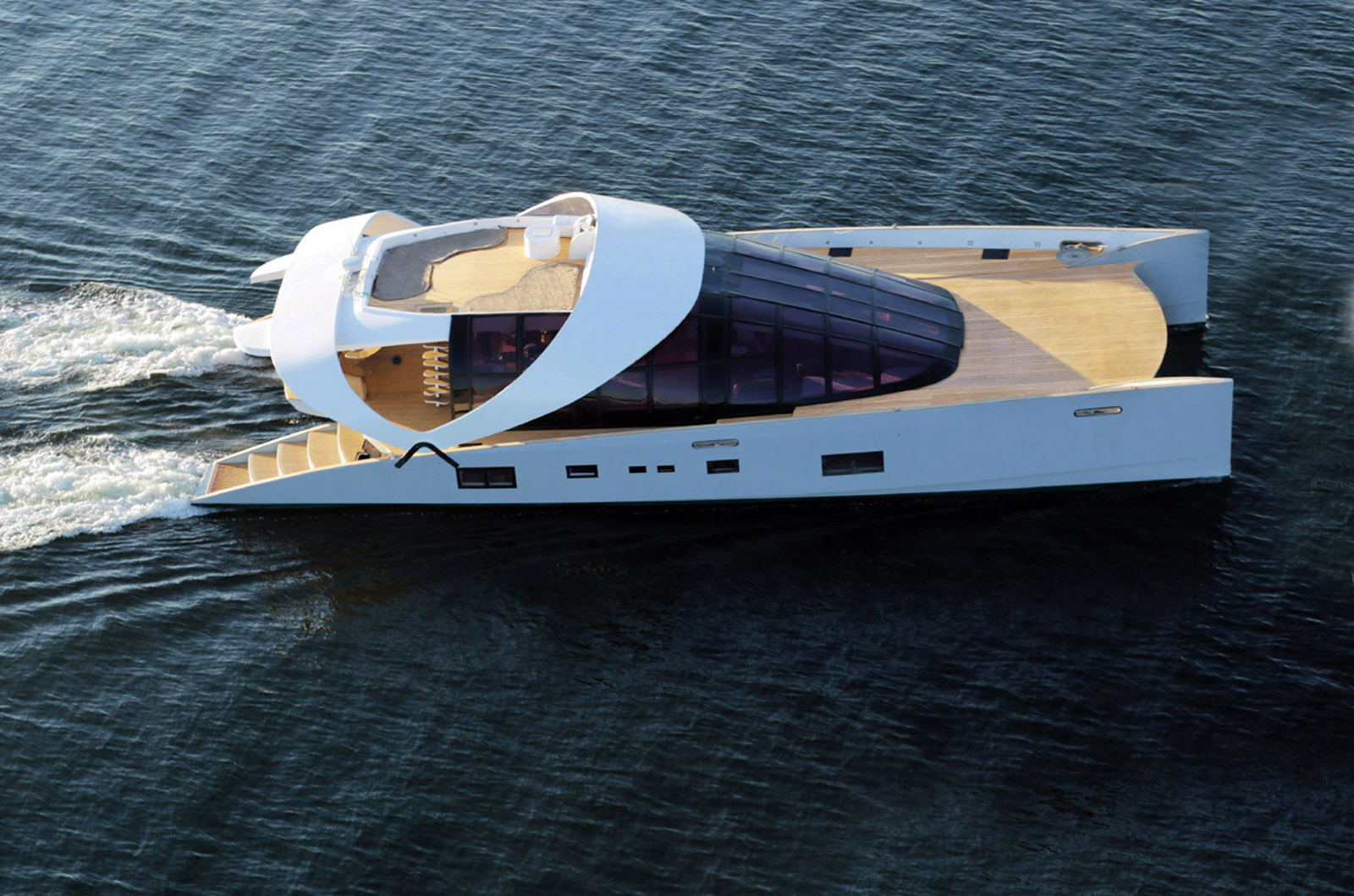
While the term ‘disruptive’ has been somewhat overused in recent times, it finds its full meaning to describe the design of the Wave 50: “A concept creating a real breakthrough within a sector of activity by radically renewing its function.” Some would even go so far as to speak of provocation. Agneszka Bona, the young Polish designer in charge of the project, assumes her role… and any criticism. She reveals that the concept of this multihull is “Something that catches your eye, that’s maybe a bit eccentric. The catamaran is destined for Caribbean charter work, so the idea was to have some shade at the bow. Right from the initial sketches, I drew this rather original shape. I’m lucky that the shipyard trusted me to create something that had never been done before.” The market is certainly not lacking in multihulls that have a reassuring classicism to them - though perhaps not exciting. So, don’t deny yourself the pleasure of seeing a new player with such thrilling ideas. To generate so much excitement and commentary is even refreshing in this somewhat corseted nautical world: we remember only too well the gasps and shrieks heard at the launch of the first Lagoon with vertical roof windows, then Leopard’s front door... Innovative concepts that were infamous, even heresy, but that today we can no longer do without! And the Wave 50 goes even further - it ventures into the realm of motoryachts, which are much more accustomed to stylistic liberties. However, our catamaran here is indeed propelled by the wind. Unlike a concept car you might see at a motor show, heralding future trends of auto manufacturers, but not one that would ever see the road, the Wave 50 seeks to be perfectly successful and fully operational. And we got the chance to try it out it in real conditions - even though the breeze was fairly light.
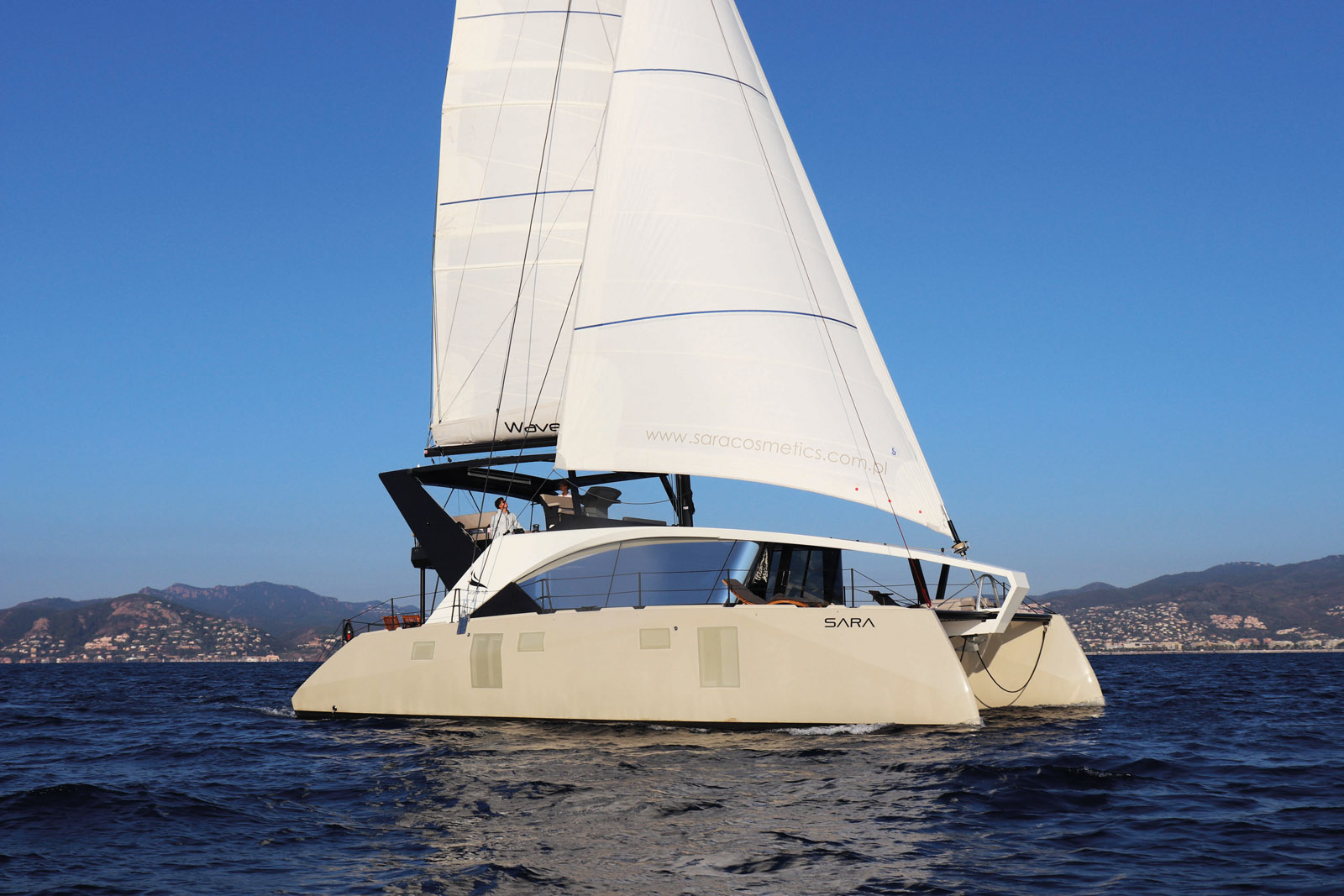
The white coachroof supports blend in nicely with the black arch, aft. The design exercise would certainly be more convincing with longer hulls.
A deck plan designed down to the finest details
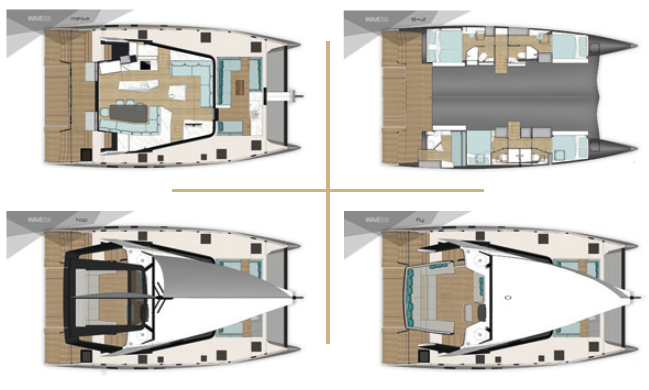
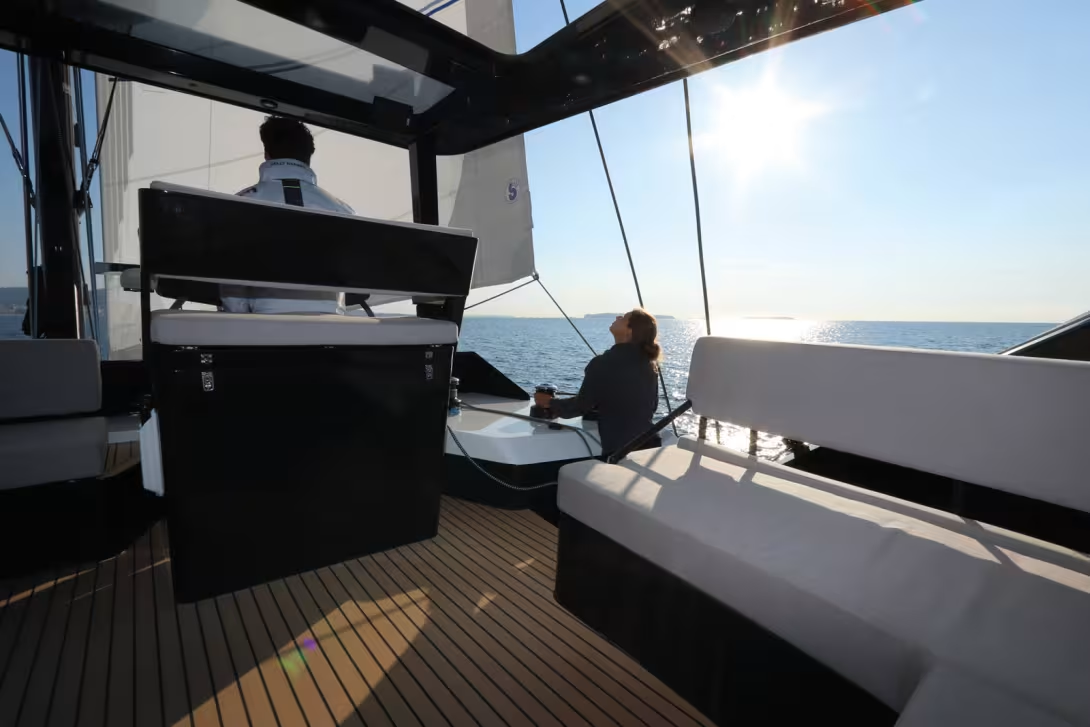
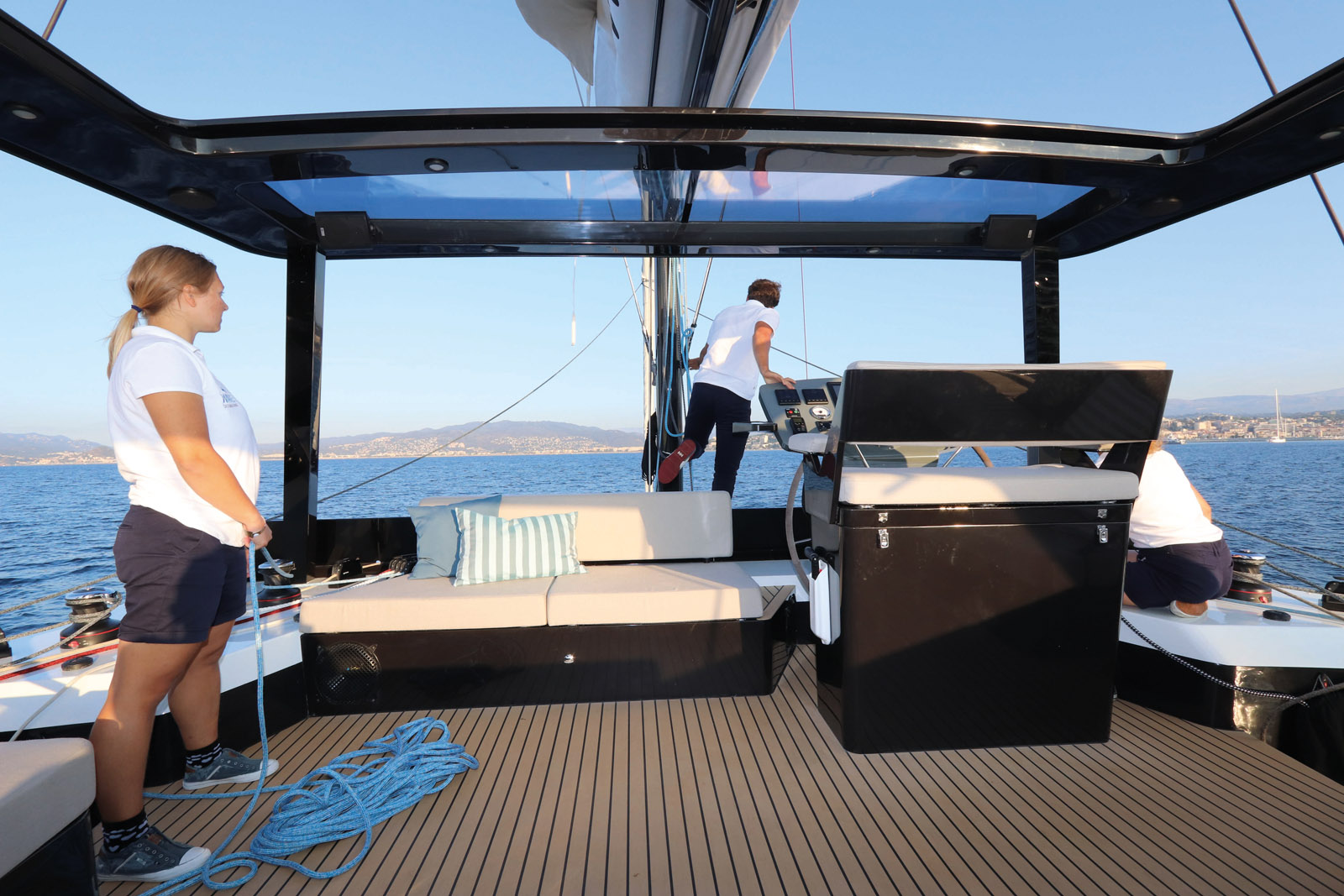
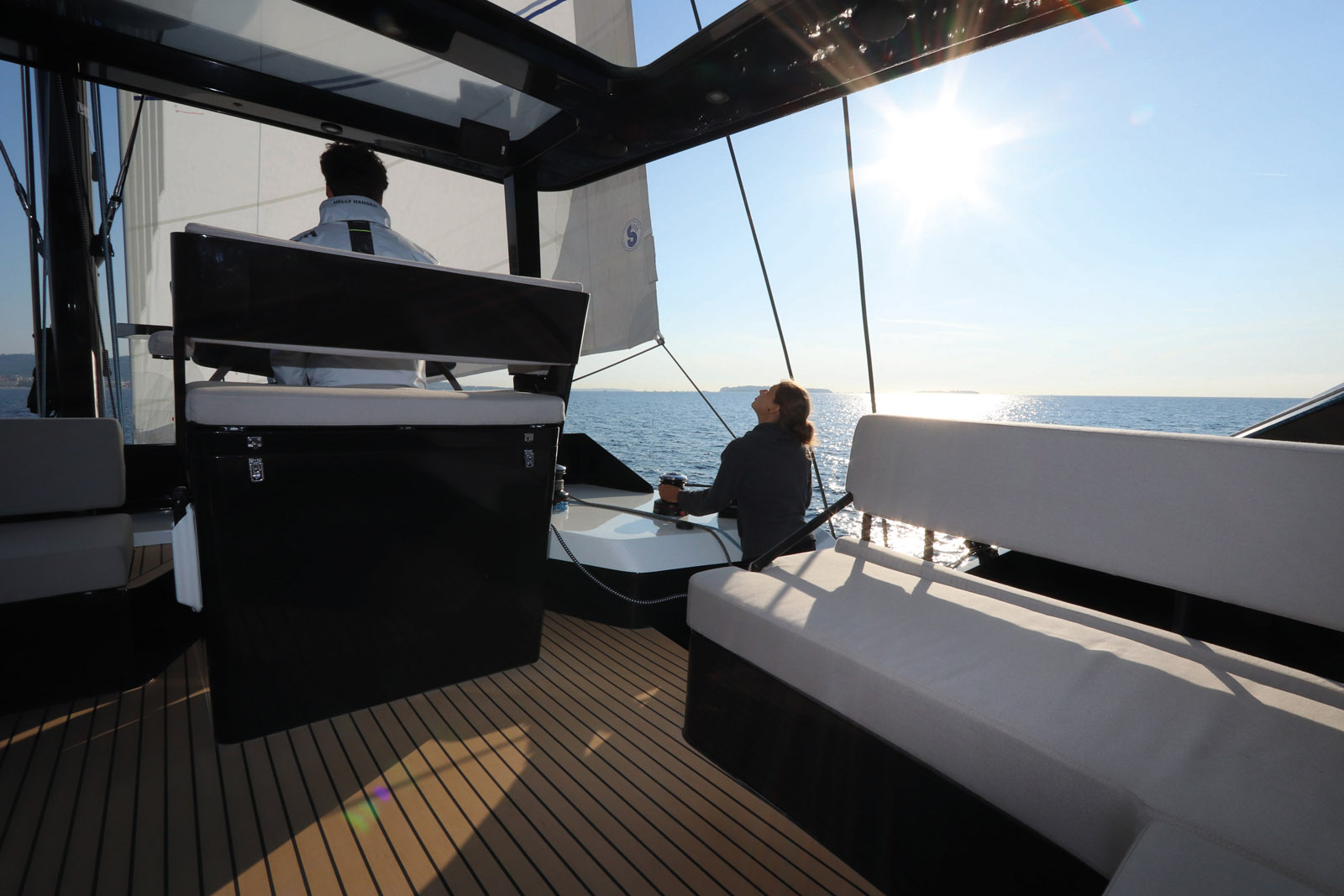
From the dockside at Port Canto, there was really only one step required for getting aboard, thanks to the hydraulic platform, which becomes a passerelle when not in use as the dinghy platform or as a terrace over the water. In the raised position, it is perfectly flush with the nacelle. Surrounded by stanchions and guardwires, the platform enlarges the aft cockpit, equipped with just two loungers. Despite the silhouette of the Wave 50 being a manifesto for radically different aesthetics when viewed from ashore, the impression is quite different once you step aboard. It becomes obvious that no detail, technical or otherwise, has escaped Agneszka Bona’s sharp blue eye. Even the subtly engraved door sills have obviously been passed by the design studio. But don’t think that aesthetics is more important than function: usually on a flybridge, winches, sheets and clutches are found at shin level - which is not very ergonomic, to say the least. Here, the flybridge access steps feature a landing that provides the perfect height for sail maneuvers on each side. It also provides a very good view of the sails and additional relaxation space on the upper deck. Integrating a flybridge into the lines of a 50-foot catamaran, and one with a rigid bimini, is never easy. Agneszka Bona has obviously devoted a lot of time to the subject. The black lacquer of the rear arch contrasts with the white of the coachroof struts, making the arch more discreet. It supports both the mainsheet traveler and the flybridge roof. Up here, you’ll discover discreet solar panels, and forward, a windshield ensures that the helmsman (who is forward, to starboard) enjoys a perfect view of the sail plan. A short bench seat has its back to the mast foot, and there’s large, forward-facing U-shaped seat that can be transformed into a huge sunlounger. The space between the backrests and seats, the beige upholstery and the black platform, supported only by two discreet black cylindrical posts, all contribute to give the rear of the flybridge an airy feel, as if suspended above the cockpit.
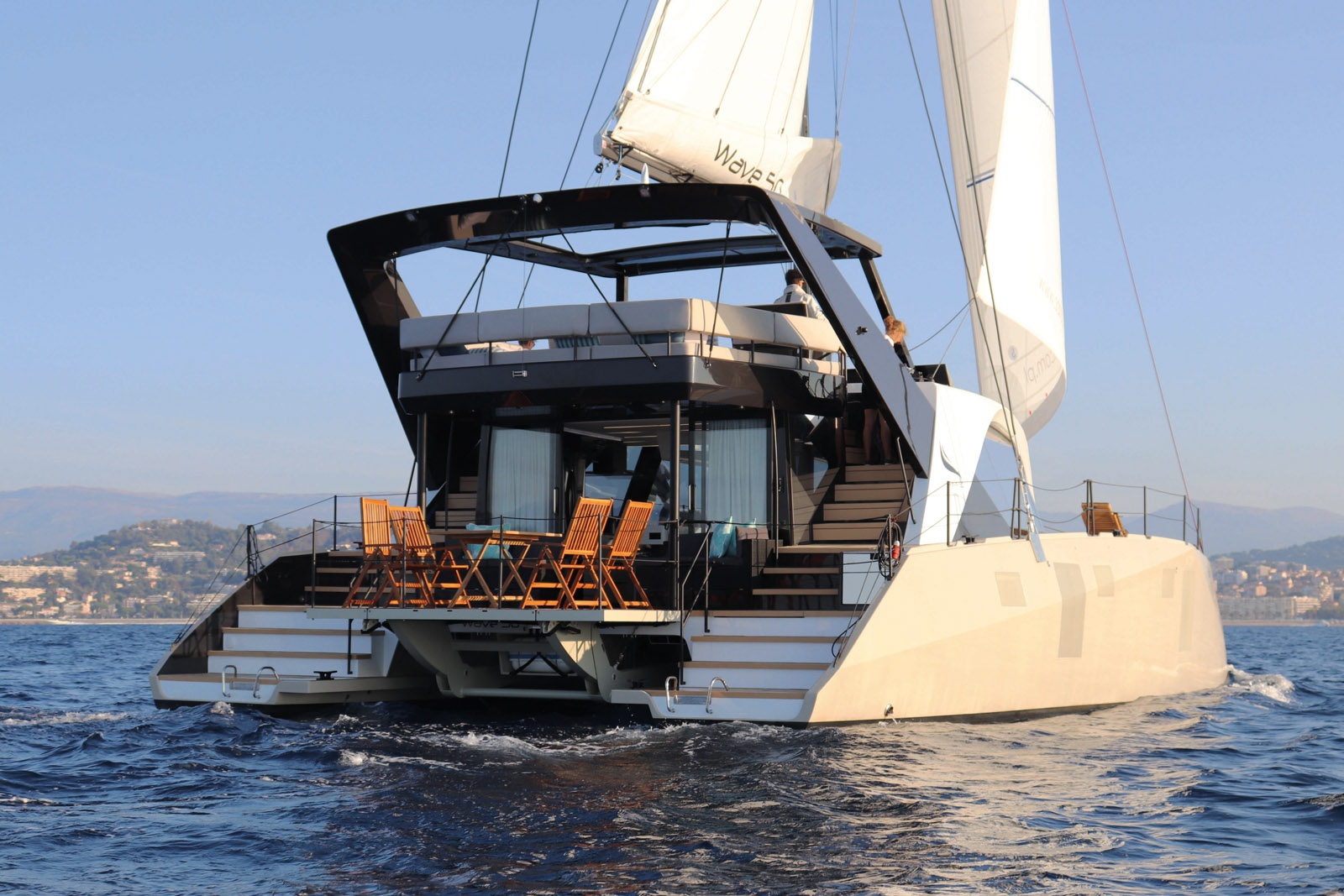
The aft cockpit is reduced to having two loungers – it’s the platform that extends the nacelle. Note the uninterrupted steps from the sugarscoops to the flybridge.
A 2,000-nautical mile handover!
Beyond the boldness of the lines, the young designer has worked to make the impressive volumes offered by the Wave 50 as discreet as possible. To begin, a rib runs diagonally from the top of the bow to the bottom of the sugarscoops, dividing the imposing height of the topsides. Next, a micro-perforated film, pearly like the hull, hides the immense hull windows. Finally, the mirror effect of the coachroof windows reflects the sea, the sky and the light, make you forget the clear glass that measures over 4 feet (1.30 m) at the forward end. But what is the value of this almost artistic approach on the water? Despite being built in infusion, combining fiberglass and carbon where necessary, the Wave 50 still shows 29 tons on the scales. A significant displacement which doesn’t augur well with the very slow rotation of the anemometer at the masthead on the day of our test. The Baie de Cannes isn’t interested in hearing about autumn yet - the waters still have summer weather in store for us. Leaving the crowded harbor in the midst of the chaotic traffic seems a formality from the flybridge helm station: peripheral vision is excellent, and Filip steers with precision. It must be said that our skipper knows the Wave 50 better than anyone else, having taken charge from the moment it was launched in Poland and has since sailed it to the Mediterranean. A voyage of some 2,000 nautical miles, completed in less than twenty days, which is pretty reassuring for the level of reliability of this very first example.
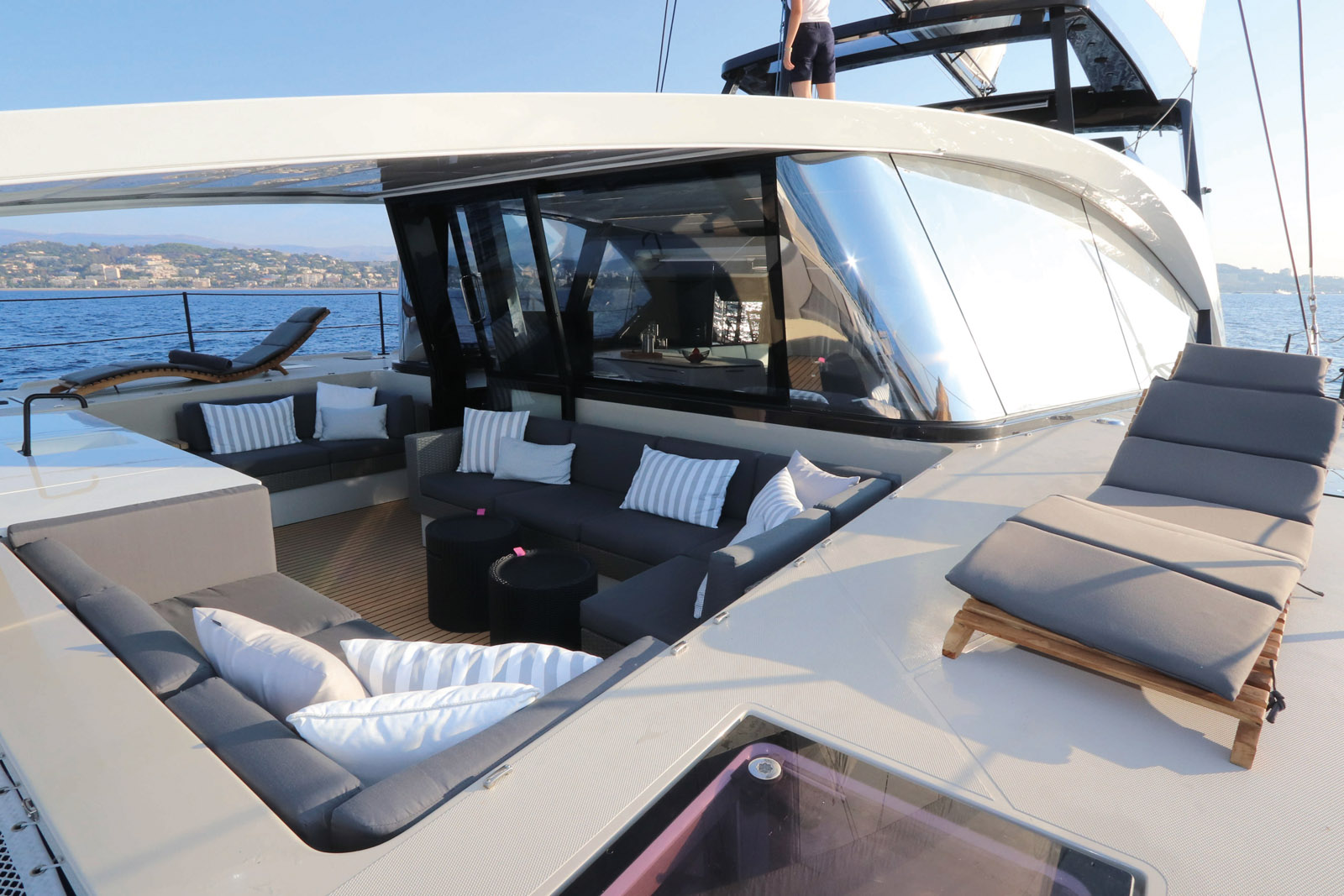
The largest on-deck relaxation area is at the front of the coachroof.
A nice surprise under sail
The mainsail is hoisted from the flybridge. It’s easy to get from the helm station to the aft-set mast foot to help the reefing lines to run free. The genoa area has been optimized: its foot runs parallel to the coachroof right back to the maneuvering stations. Looking while undertaking our photo shoot from the tender, the geometry of the whole seemed obvious to me, though but it must have required a lot of work to accomplish both aesthetics and performance. The Wave 50, with its almost 1,500 sq ft (139 m ) of upwind sail area, surprised us rather pleasantly - without overwhelming us. Despite the true wind never exceeding 10 knots, the log oscillated between 5 and 7 knots depending on the point of sail. Upwind, at 57 degrees to the apparent, the Garmin electronics showed 5 knots of boatspeed. Even in these light airs, tacking was performed without having to resort to the engines. You just have to leave the genoa backed for a moment, until the mainsail passes through the wind and that’s it. The fixed skegs, although very far aft, seem to be effective under way. These appendages also protect the saildrive legs and the rudders from grounding. Even though our skipper of the day is a racing sailor at heart, trimming the sails to a fraction of an inch, the Wave 50 still has power in reserve. To grasp it though, you’ll have to dip into the catalog of options: carbon mast, gennaker, spinnaker... So many more square feet and so many less pounds that we would have liked to try in the light conditions of this test, but that’ll have to be for another time. Let’s rather discover the interior of this catamaran, which is quite unlike any other. Is the inside as original and innovative as its exterior lines?
 |
 |
 |
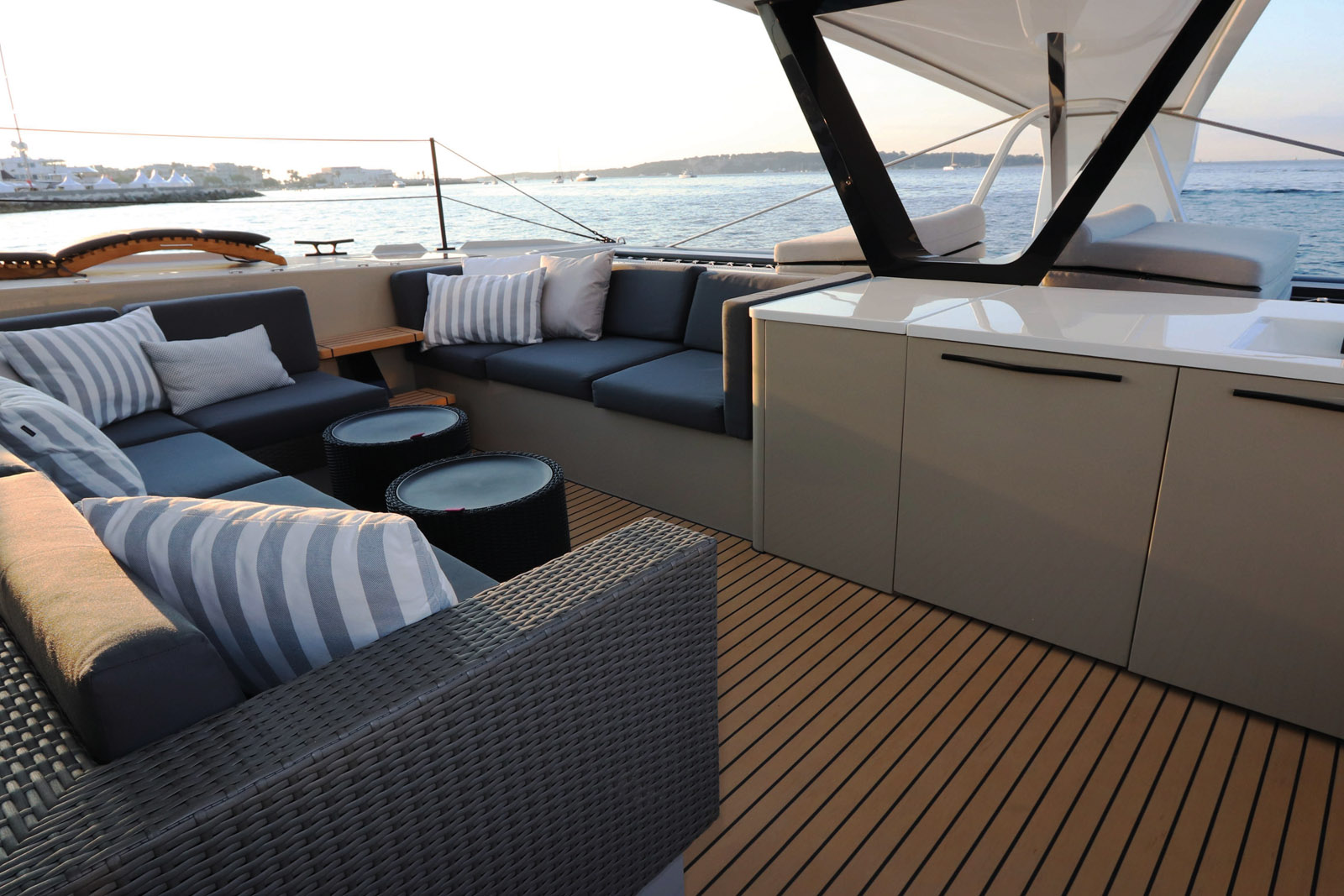 |
The flybridge with its hardtop is home to the helm and maneuvering station, as well as some beautiful seating and a galley.
Same creative freshness inside
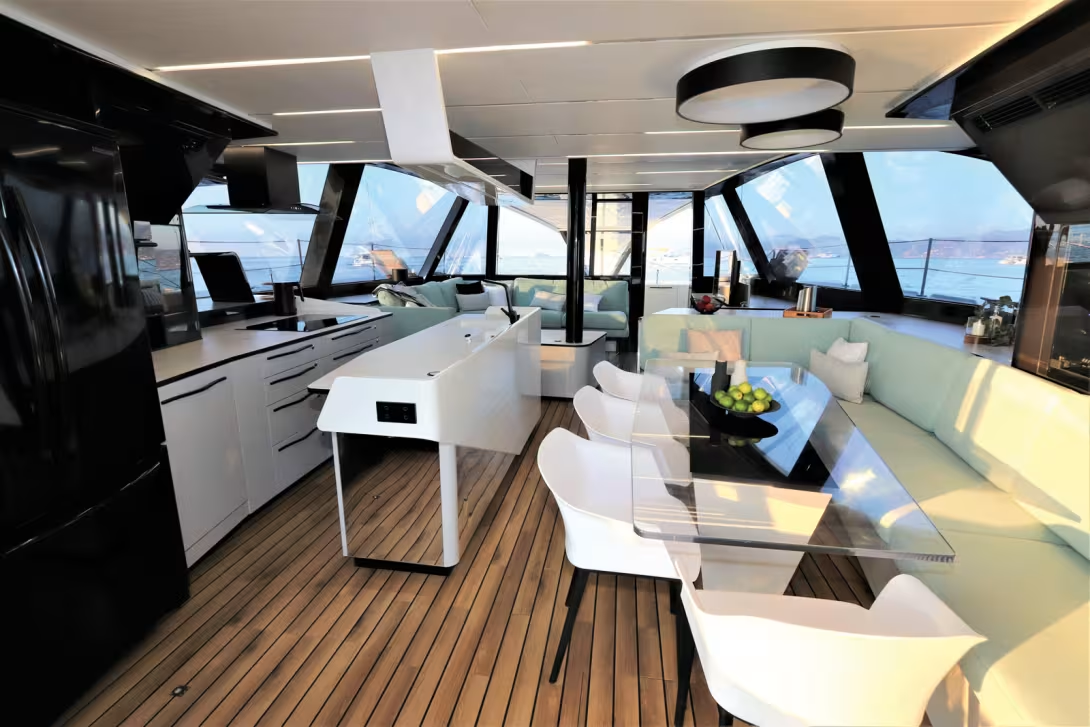
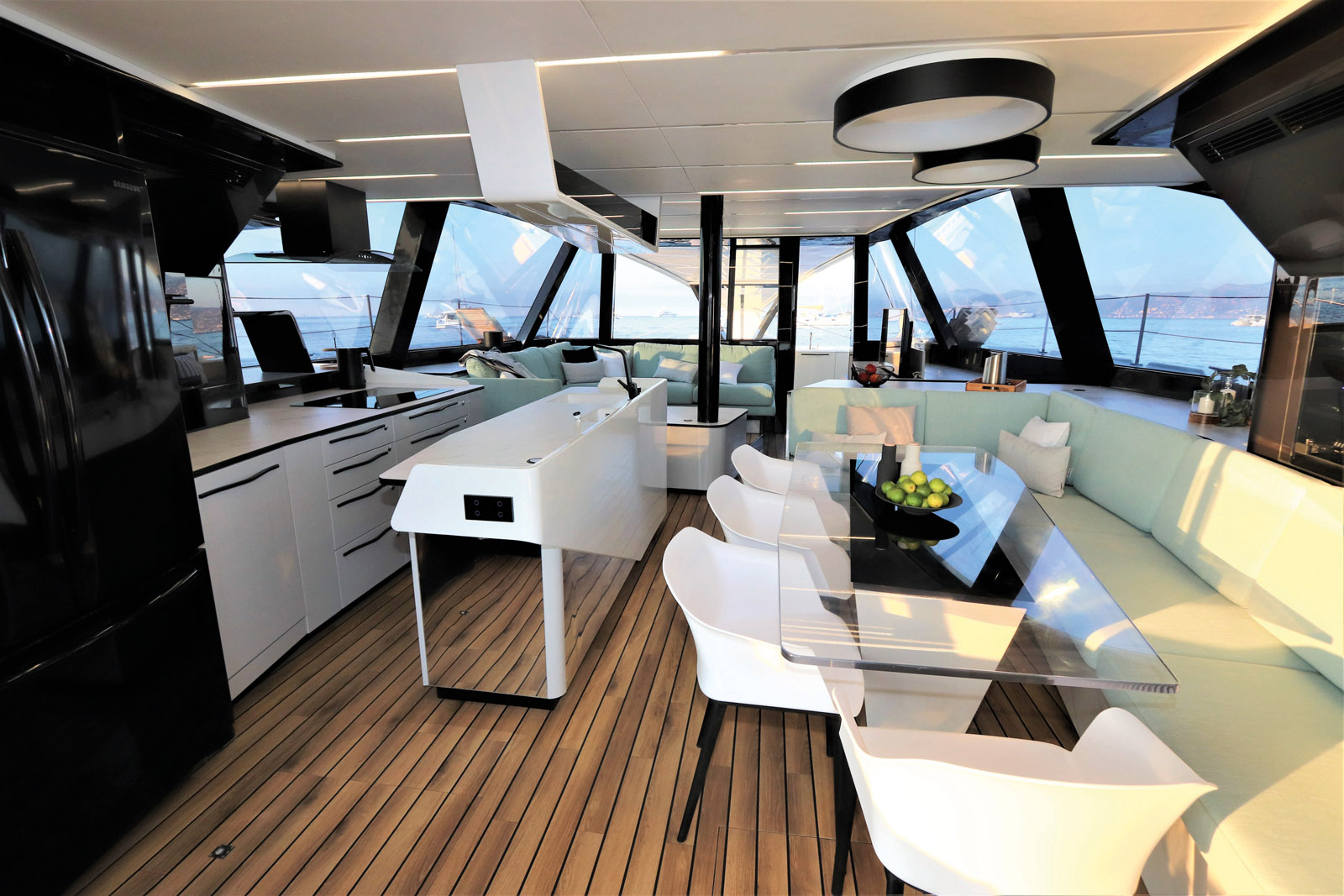
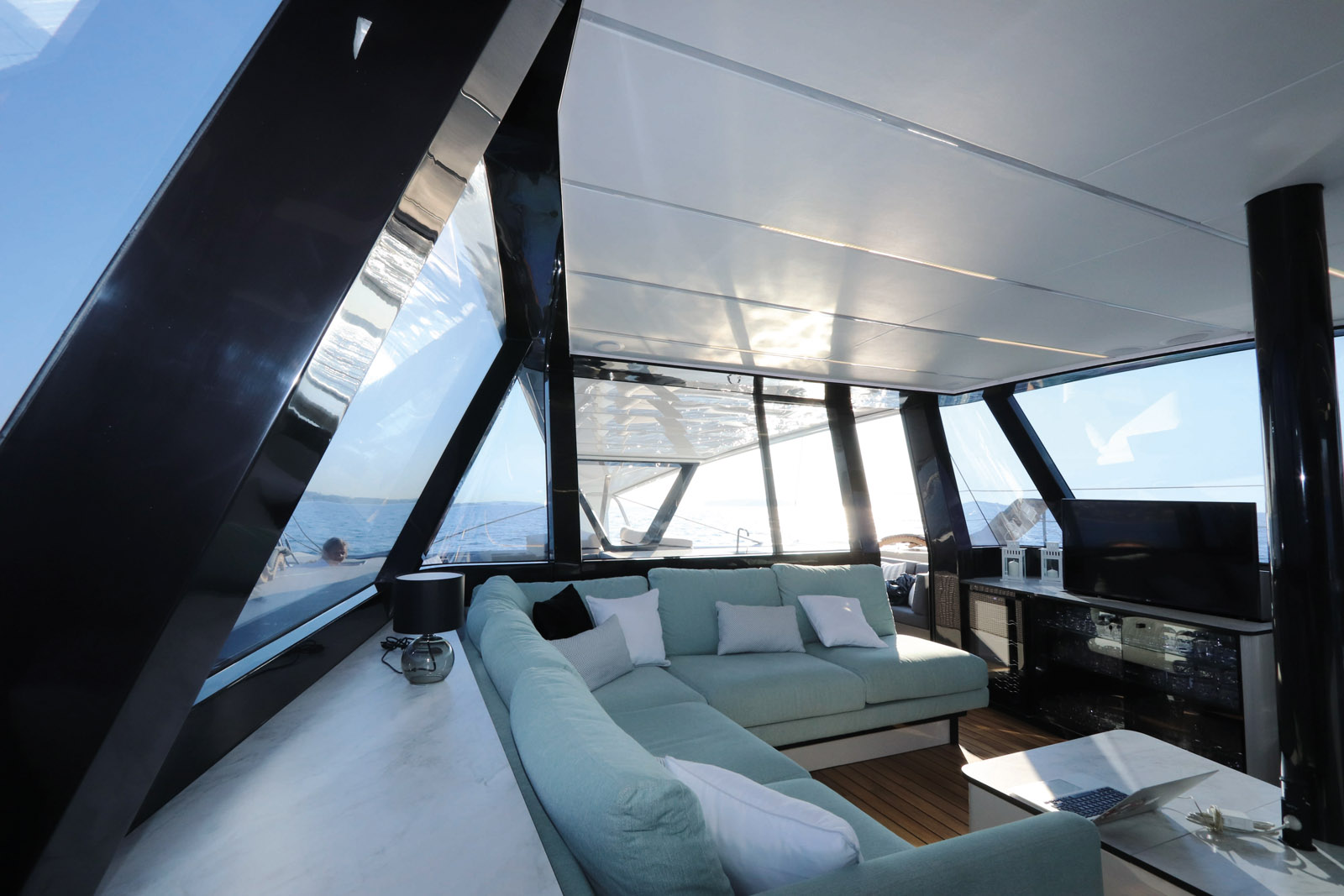
Doing without an aft cockpit is not new, as we’ve already witnessed with McConaghy. It’s a coherent choice and therefore perfectly assumed on the Wave 50 - between the forward cockpit and the flybridge, there are already sufficient beautiful “al fresco” spaces available, even before you open the bay window that gives access to the interior. It’s quickly clear that Agneszka Bona has dealt with the interior layout using the same creative freshness as she has on the outside. The width and above all the length available - nearly 23 feet (7 meters) – have allowed her to offer three beautiful and distinct areas: the galley with a central island, to port; dining area on the starboard side and a very large saloon forward of the mast support strut. A clever, though not revolutionary, layout. No, where the Wave 50 once again revisits all the codes of yachting is in the design of the furniture, the way surfaces are finished, or the materials used. The central unit in the galley is a concentration of all the creative audacity that went into this project. The immaculate white Corian narrows down at the back and ends up as if suspended above the mirrored cupboard doors, which reflect the waxed teak deck planks with their long, black, caulked seams. The shelf is even more ethereal - this is suspended below the ceiling (6’9” / 2.06 m headroom) whose lighting has been subtly worked. The extractor hood above the hob is just like the refrigerator, the oven and all the domestic appliances, “like at home” in capacity and quality. On the starboard side, there’s seating around a long glass table, between an L-shaped bench and white wraparound seats. Ahead of the mast support strut, a large saloon area faces a crystal-clear bar and a large retractable TV screen. But above all, this lounge offers an absolutely captivating panoramic view thanks to the huge windows that surround it. To starboard, a sliding bay window gives access to the forward cockpit with its own outdoor galley, protected from the hottest sun rays by the famous coachroof extension that runs to the center of the forward beam. The Wave Catamarans team tell us that this original “roof” is not a mandatory feature.
 |
 |
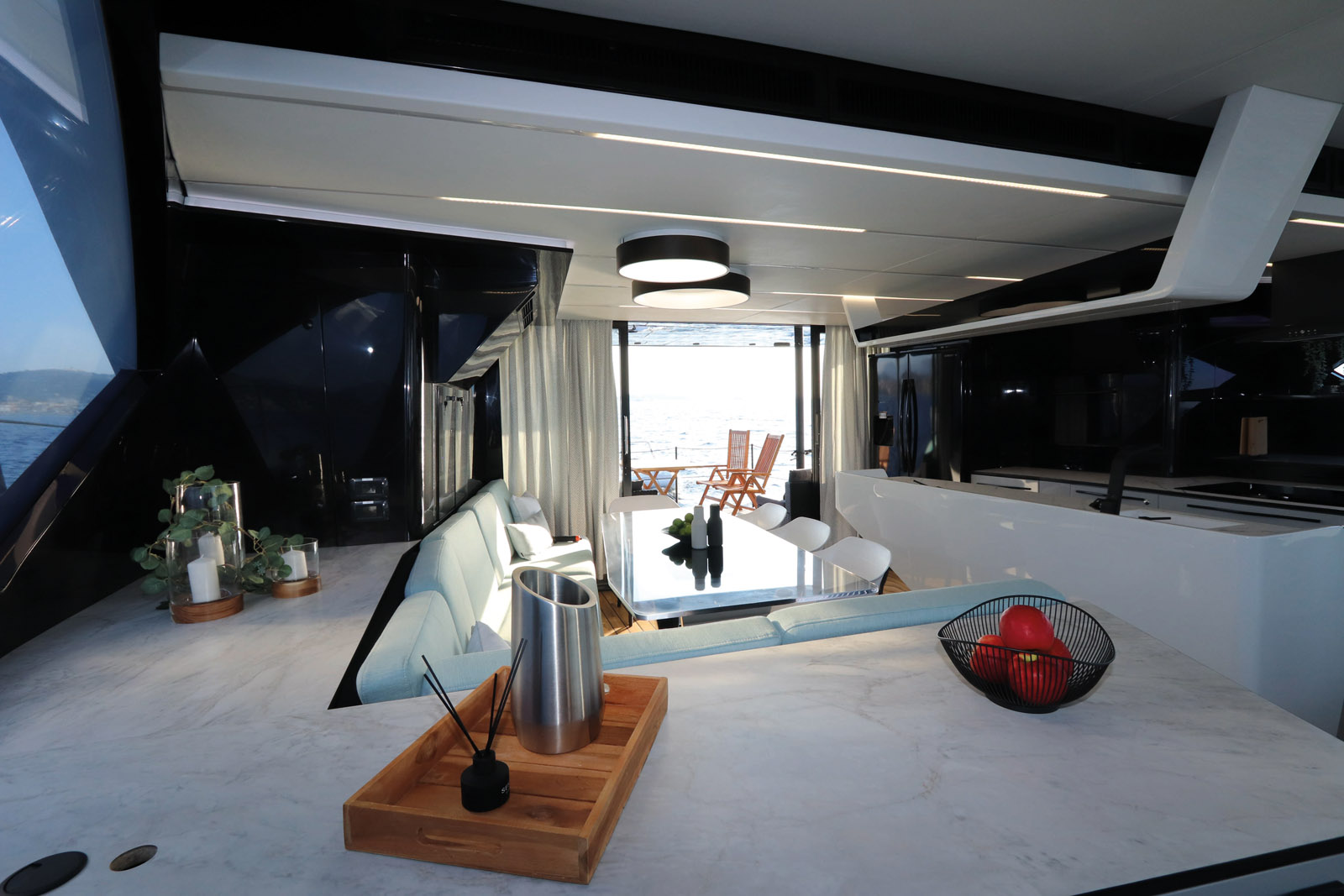 |
The huge nacelle is illuminated by giant windows... as for the furniture, that displays an undeniable originality that doesn’t impact its functionality.
Three layout options
Down below, there are three layouts on offer: three cabins, with the port hull dedicated to the owner; four cabins, all quite similar in size, with the same number of bathrooms; or four cabins plus crew accommodation. It is in this last format that the Wave 50 Sara was built, and this is perhaps the area where we were least convinced: the crew cabin, accessed from the outside via the starboard sugarscoop, is really small. As for the rest, there is not much to tell. The quality of the workmanship is indisputable, the materials rich, the light floods in through the large vertical hull windows and the upholstery is very soft. What bothered us? Perhaps it’s a more tortured design, more loaded, less fluid than on the platform. The too many mirrors don’t just make our photographer’s job more difficult - they give the impression of a somewhat kitschy ice palace. But these are only subjective impressions. The shipyard is happy to create the interior of each example to suit the customer’s requirements.
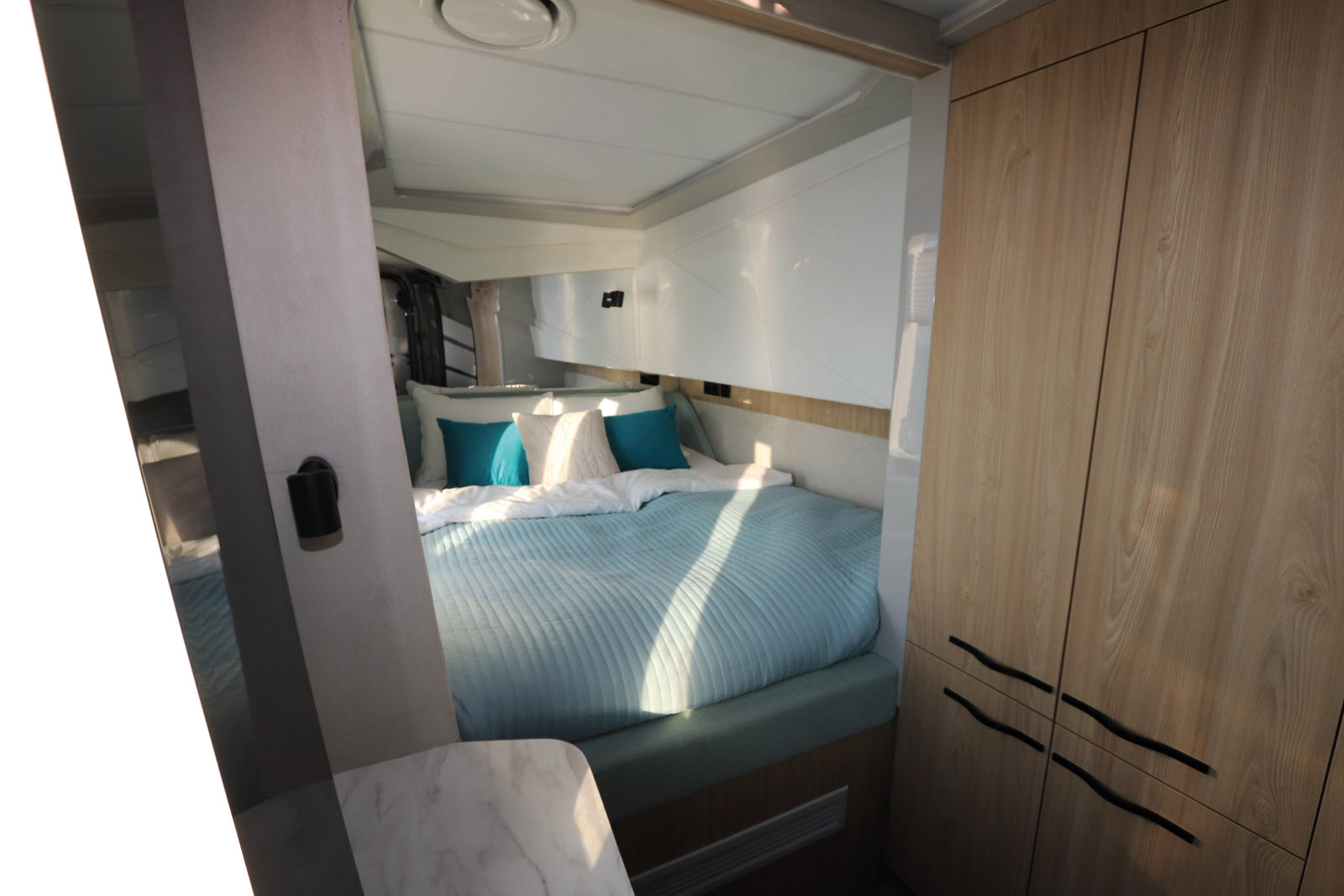
There are several layout versions available. All cabins are comfortable, but the crew cabin(s) are somewhat cramped.
Design Inspiration - From Norman Foster to Guggenheim?
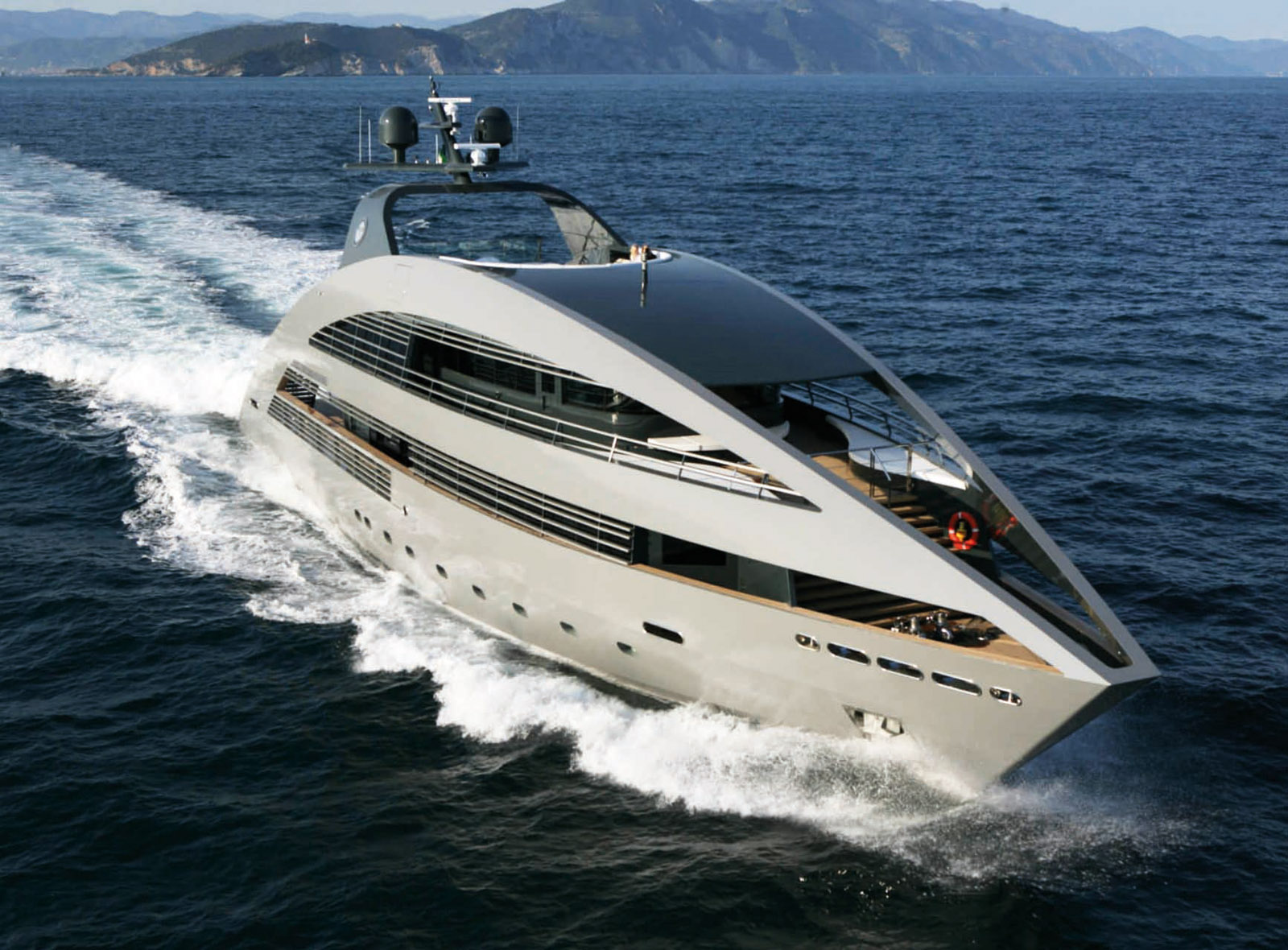
So rather than consider the Wave 50 to be a UFO that’s appeared just a short distance from Cannes’ famous La Croisette boulevard, we should freely compare this catamaran to other achievements. The first thing that springs to mind is the famous British designer Lord Norman Foster and his superyacht Ocean Sapphire, whose roof line also extends to the bow, while the steps fly seamlessly from the sea to the flybridge. The general boldness of the lines and the roof entirely covered with mirrored glass are reminiscent of the AIR 77 by Oxygene Yachts, which made headlines at the Cannes show back in 2013. In the magical light of the French Riviera mornings, the sun’s reflection on the large windows of the coachroof is almost reminiscent of those you would see at the famous Guggenheim Museum in Bilbao - we are dealing with the genius of Franck Gehry. The objective here is not to pass off the Wave 50 as a work of art, but to provide some insight into the inspiration behind this project.
 |
 |
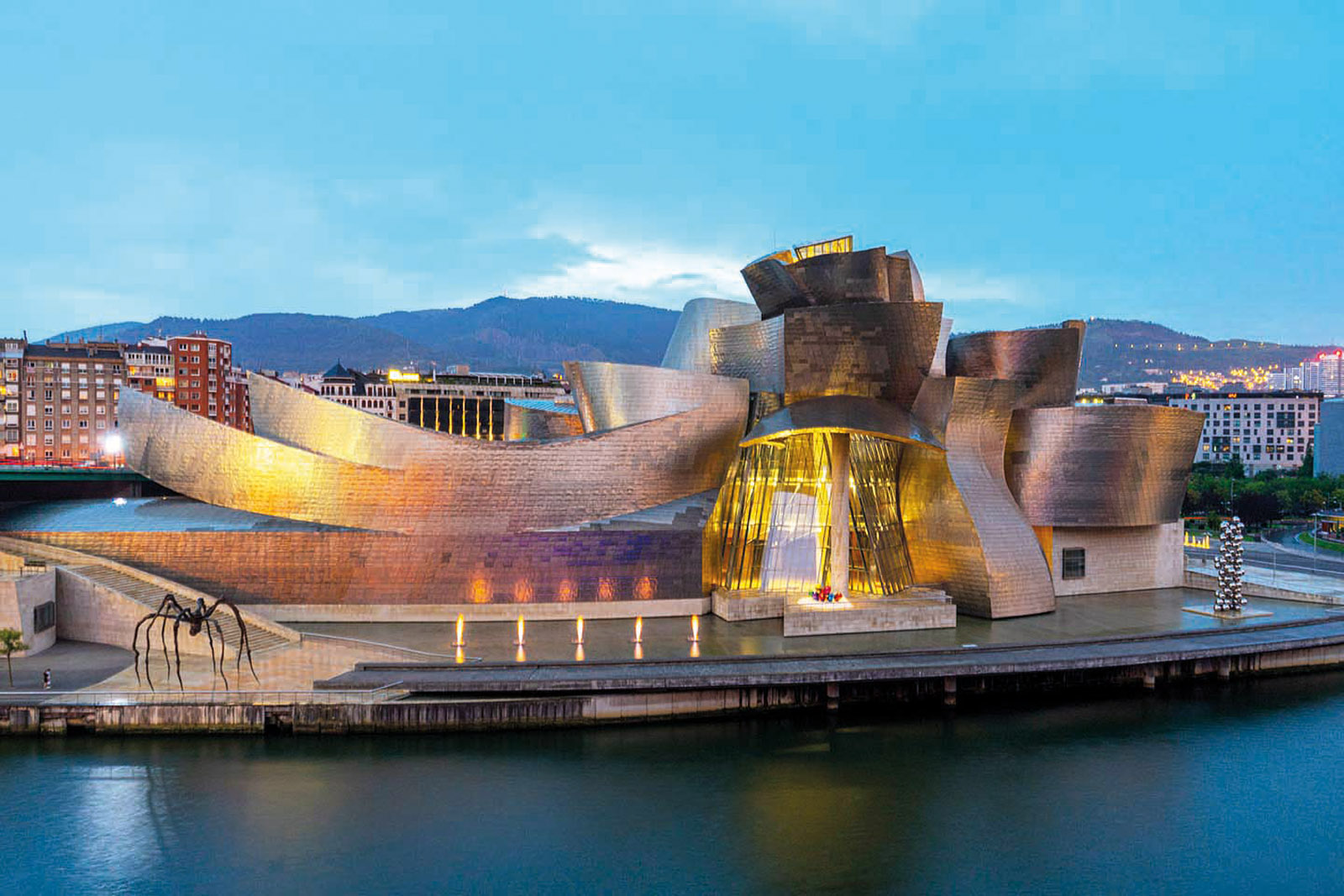 |
AIR 77 - Ocean Sapphire - The Guggenheim museum in Bilbao
Conclusion
Wave Catamarans have sought to create a lasting impression with this striking 50-footer. And they have certainly achieved that aim. This fifty-foot cat is not just a boatshow concept boat – it’s a real sailboat as demonstrated by the fact that it navigated right around Europe as a maiden voyage. A more powerful Breeze version is in the works, but most notably, a 60-foot boat based on the same concept is being built. These ten extra feet might just refine the overall lines and the finish, to win over even the most conservative of sailors.
The Pluses:
+ Bold and refreshing exterior and interior design
+ The notion of sailing hasn’t been forgotten
+ The lovely forward cockpit that’s shaded and well-equipped
The Minuses:
- Aft platform mechanism very low on the water
- Massive silhouette when viewed from certain angles
- Minimalist crew cabin starboard side, aft
TECHNICAL SPECIFICATIONS
Builder: Wave Catamarans
Architects: Wave Catamarans
Design: Agneszka Bona
Overall length: 57’9” (17.60 m)
Beam: 30’ 2” (9.20 m)
Draft: 4’ 6” (1.30 m)
Mainsail: 755 sq ft (70 m2)
Genoa: 745 sq ft (69 m2)
Storm jib: 195 sq ft (18 m2)
Gennaker: 1,990 sq ft (185 m2)
Spinnaker: 2,370 sq ft (220 m2)
Engines: 2 x 60 HP Volvo Penta D2-60’s
Fuel: 2 x 98 US gal (2 x 372 l)
Water: 2 x 90 US gal (2 x 340 l)
CE category: A
Price: on quotation (version we tested, € 1,300,000 ex-tax)