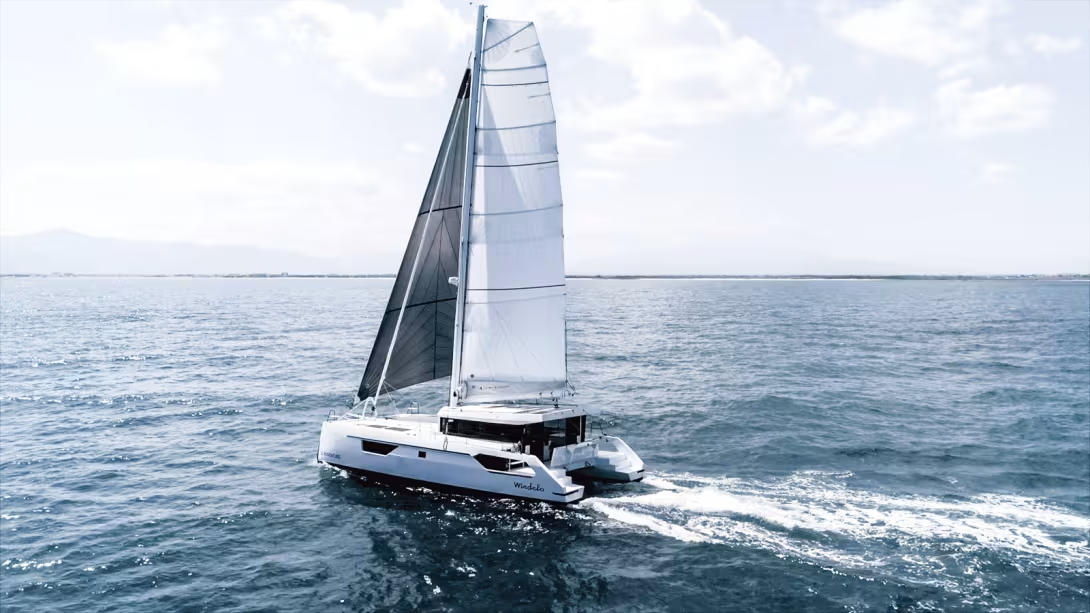
For the brand-new Windelo shipyard, the launch of this first 50 Adventure is the consecration of long months of research, process implementation and thousands of hours of work; a form of consecration that calls for others since a 54 is under construction and five more catamarans are on order. For us, discovering this Windelo 50 was an opportunity to measure the incredible possibilities of innovation and evolution offered by multihulls in general: this model is like no other, and so much the better
Infos pratiques
- Le chantier : Windelo 50
- La fiche technique
-
 Découvrez notre vidéo exclusive
- Financez votre Windelo 50 Adventure
- Assuez votre Windelo 50 Adventure
- Articles autour du Windelo 50 Adventure
Test location: Canet-en-Roussillon, France
Conditions: Wind ENE 6-10 knots ; Sea state slight
A new shipyard
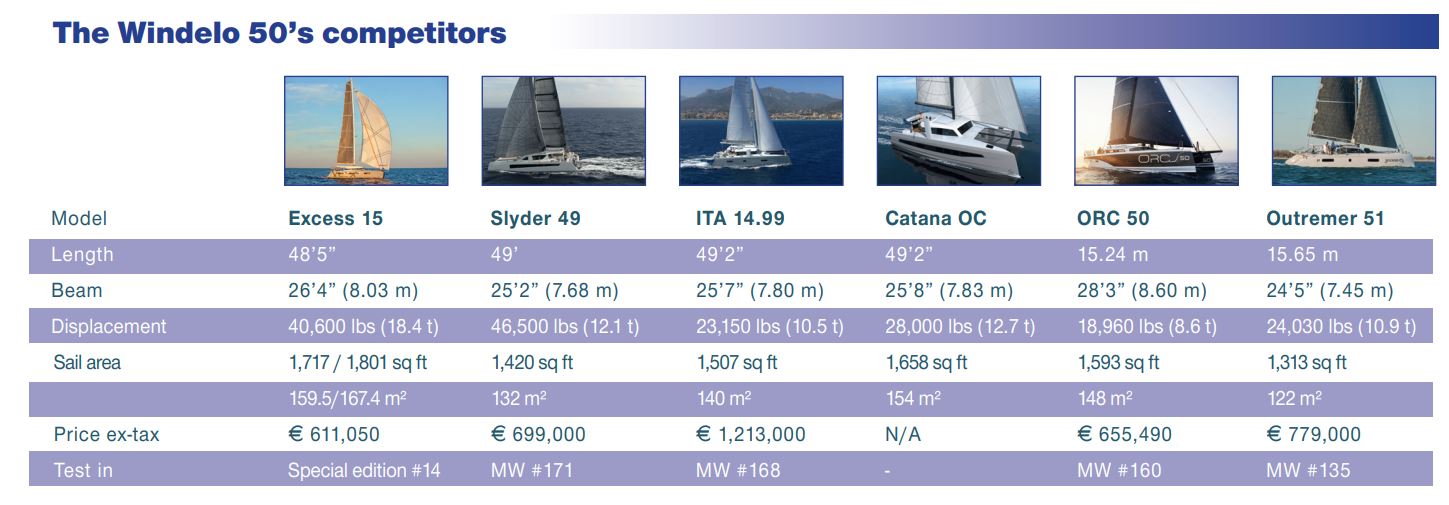
We’ve been anticipating the launch of this famous Windelo for weeks now. And then we waited a few more weeks, so that everything would be working perfectly... In short, we couldn’t conceal our delight the day when, at last, we were able to sail in the Mediterranean. Let’s wind back to the beginning of the story. On the catamaran market, Olivier Kauffmann is looking for a fast, light and comfortable 50-footer. But he can’t find what he’s looking for: “the ORCs are a little too sporty for my taste, the Catanas have lost their initial philosophy and the Outremer 51’s nacelle lacks volume”. Olivier set about studying the possibility of building a one-off catamaran. It should be noted that our man knows how to manage projects - he was General Manager of Decathlon France, Chairman of the Board, then CEO, of Cabesto and Orange Marine. The opportunity to create a shipyard, supported by his son Gauthier, became obvious. The Windelo brand (a name close to Mindelo, a port of call on the island of São Vicente, in Cape Verde) was created and it was already an invitation to travel. The shipyard was set up in Canet-en-Roussillon in the South of France on a large area of available land. If necessary, the building size can be increased - two, three or even four times, it is possible! The industrial director is none other than Jean-Pierre Prade - one of the founders of Catana. Olivier worked with the naval architects Barreau/Neuman and many materials specialists to give an ecoresponsible direction to the construction. The principle is to use as many recyclable materials as possible. The use of basalt fiber and PET foam (55% since PVC foam is still used in some areas) reduces the environmental footprint by 47%. Building light is of course ecological but continuing the effort on water is also on the agenda. This new range has been launched with the 50 and 54. It will soon be completed by a 47 and a 57. Each model is available in three versions: Adventure, Yachting and Sport. Today, Windelo employs 35 people.
 |
 |
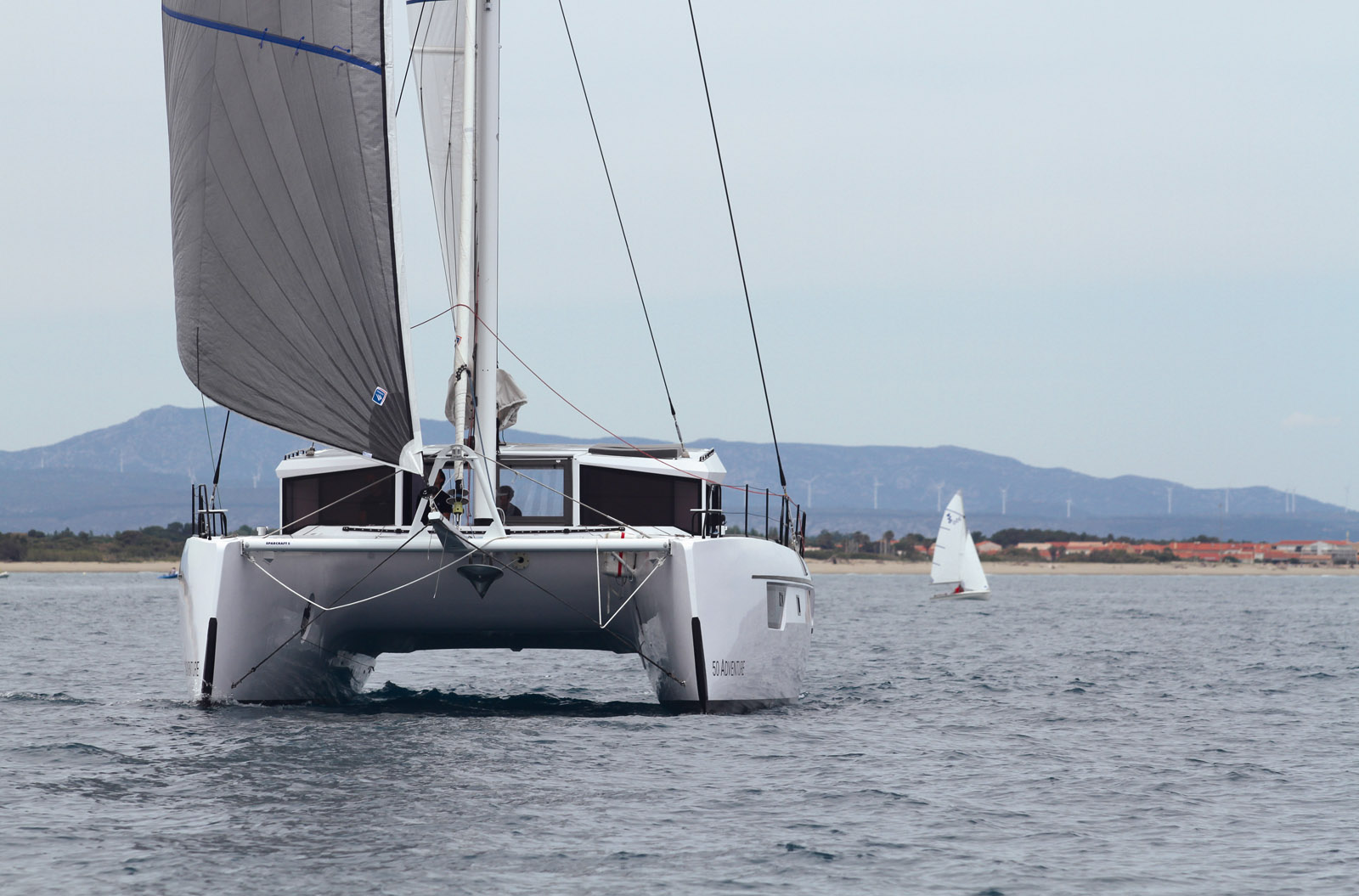
Viewed from ahead, the Windelo 50 reveals an angle between its two hulls - reminiscent of the old Catanas!
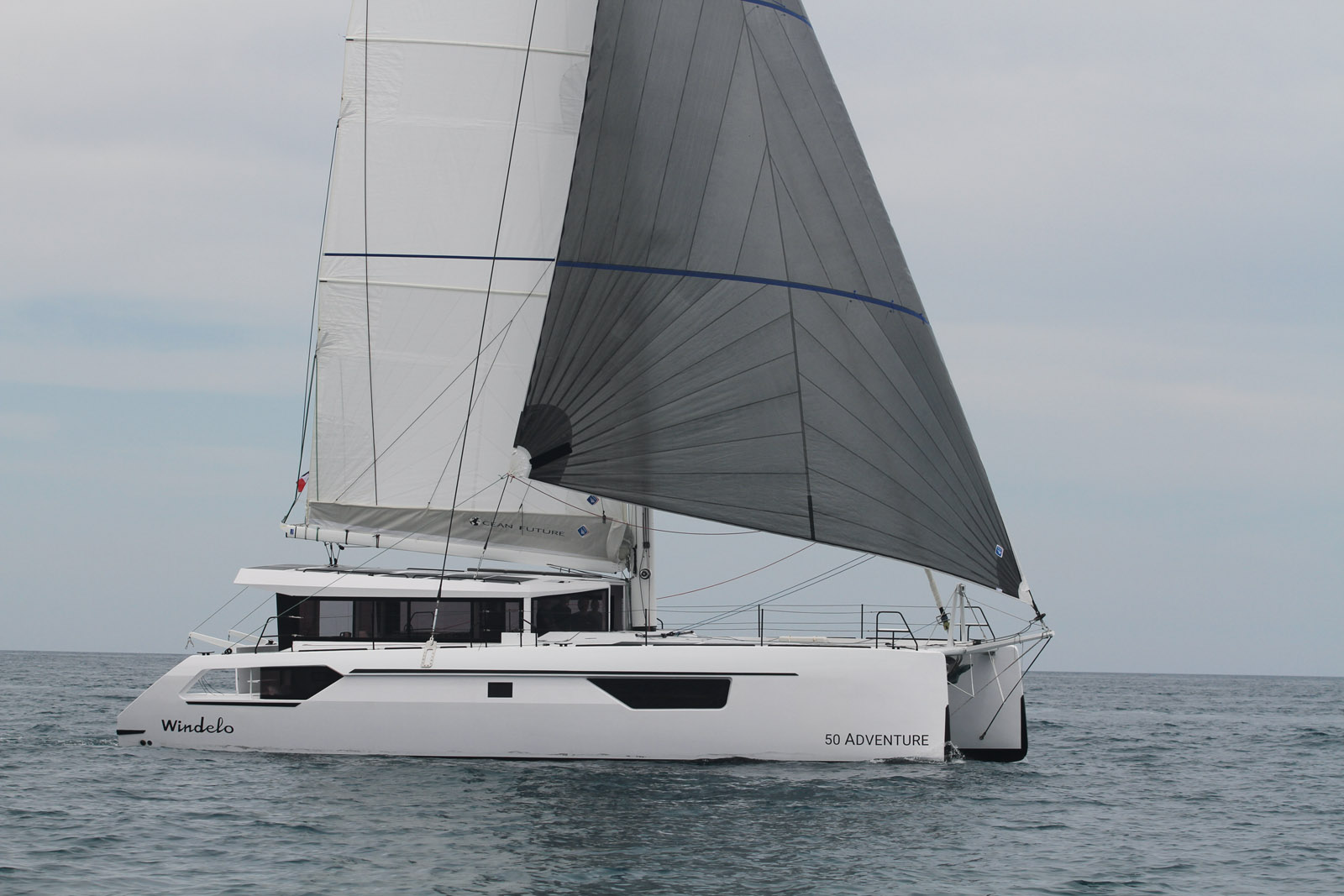
The imposing nacelle is set very far aft... but the openings at the back lighten the silhouette.
The silence of electricity
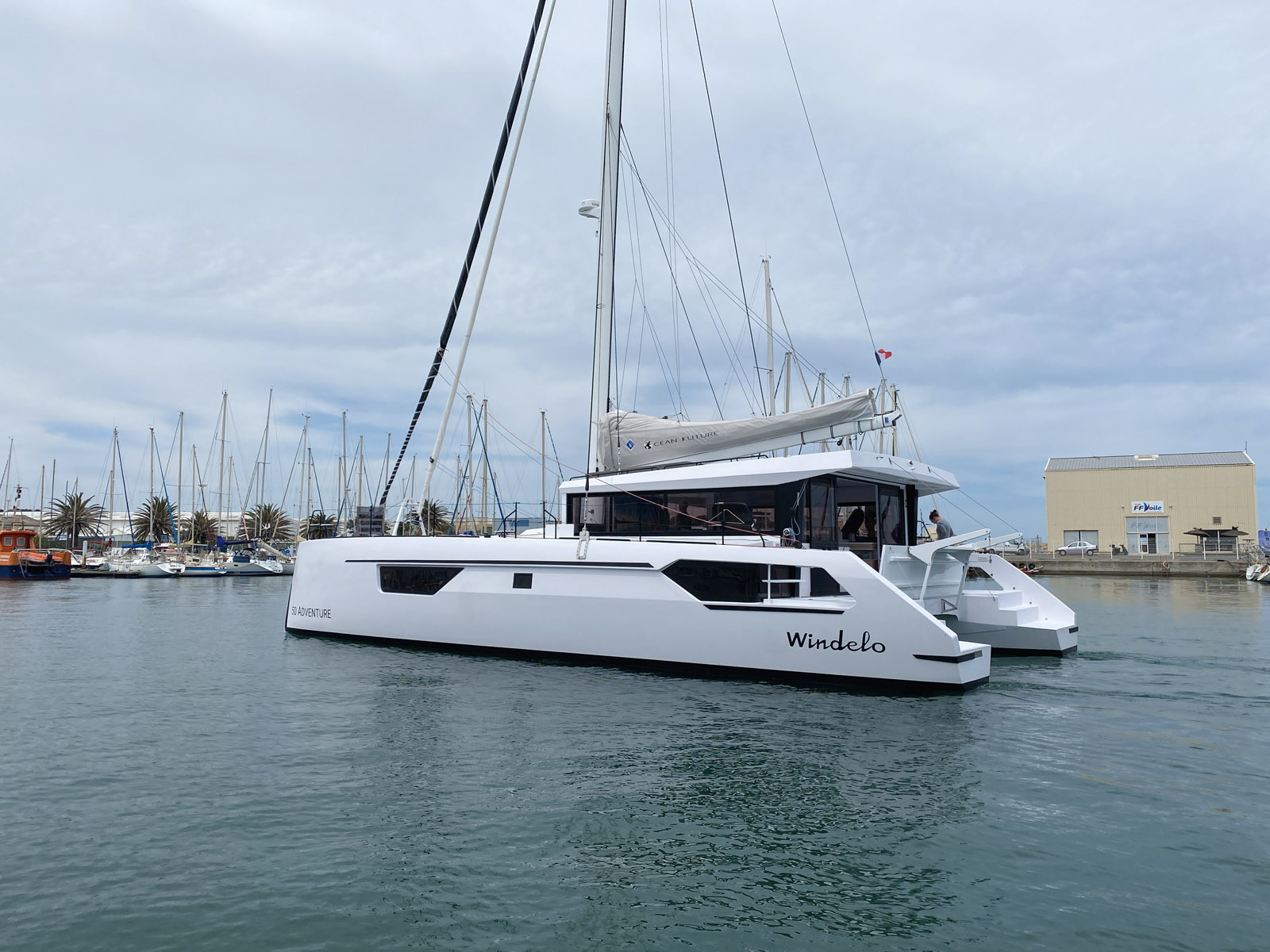
We discovered the Windelo 50 right in front of the shipyard - the advantage of having a building just a few feet from the dock... The boat had just returned from an inaugural cruise with its owners. So, what does she look like? That’s not an easy one to answer... you could be tempted to say that the hulls would be close to those of an Outremer, with a little more freeboard, the imposing and very recessed nacelle is reminiscent of a Bali, but then the helm and forward maneuvering station is like that on... a Gunboat! In short, we’re dealing with an original catamaran. Note: the opening of the topsides above the sugarscoops manages to lighten in a rather subtle way the somewhat massive silhouette that you see from astern. Port maneuvering with the twin electric motors is surprisingly easy... but notably, it’s silent. The manufacturer has chosen two motors mounted in V-format in each hull, giving a total of 40 kW of thrust. The power supply is ensured by 3,300 Wp of solar panels and an 18-kW generator. With the standard battery bank of 560 W in 48 V and 300 W in 24 V, the Windelo 50 is capable of motoring for 90 minutes at 6.5 knots without needing to start the generator. The manufacturer offers various formulas – a more powerful battery bank, or double generators. Hydrogeneration is possible from 7.5 knots of boatspeed under sail and the range with the 500 liters (132 US gallons) of fuel is 1,100 nautical miles.
The twin 20 kW electric motors are in fact each a coupling of two motors. The transmission is via propeller shaft line, which is considered more robust.
Excellent sensations
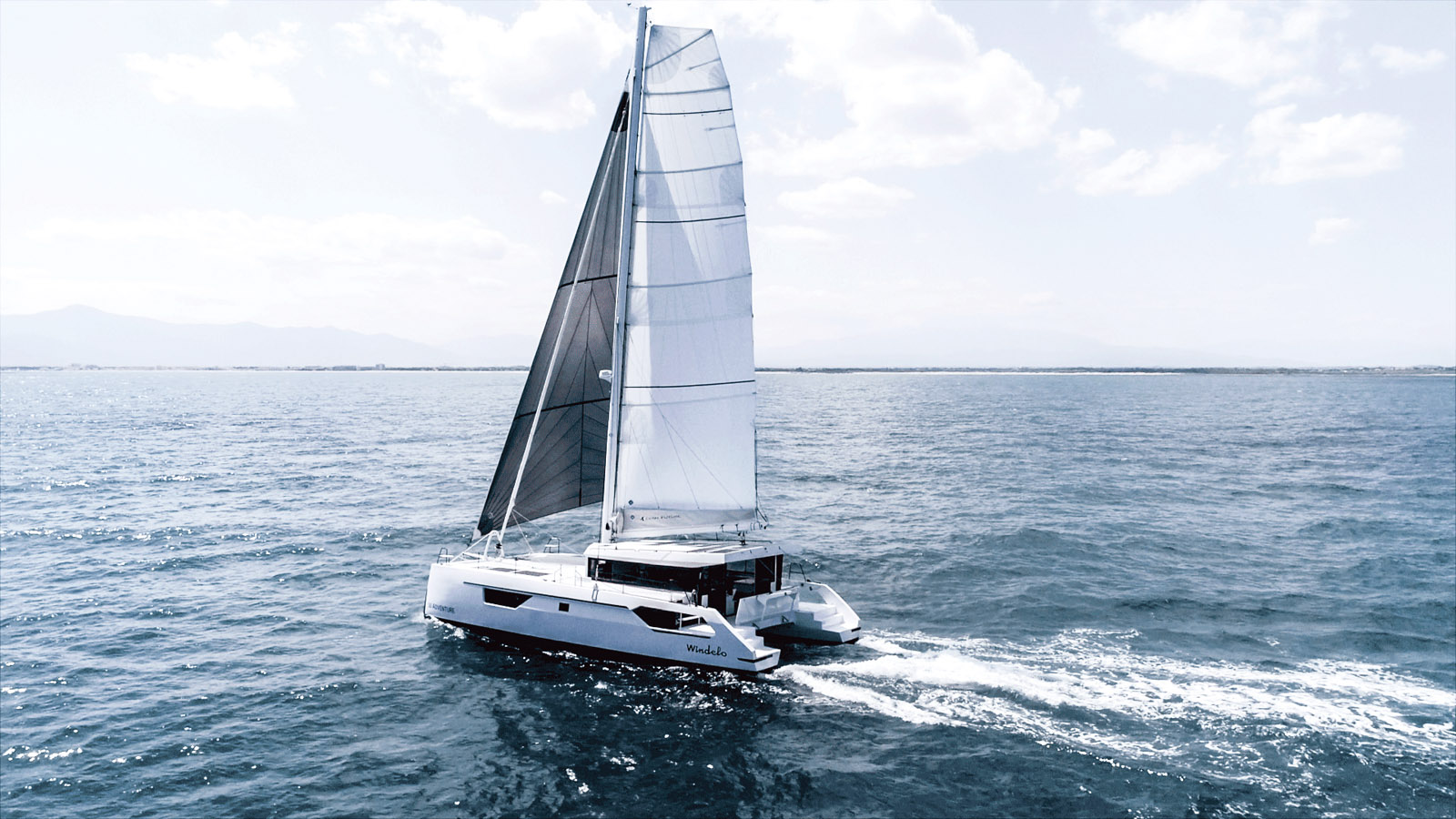
The deck plan features a vast tilting platform at the stern, which integrates cleverly-designed dinghy davits. Forward, large trampolines extend on either side of the longitudinal beam. Solar panels are spread out across the coachroof and the front of the side decks. A sunbathing area can be installed on the port side of the coachroof. The light wind encouraged us to seek speed by unfurling the large gennaker rather than going upwind. We immediately realized that the Windelo is light - 12.8 tons loaded - as you can feel it set off at the first ripple. The GPS showed we were making 7 to 8 knots, whereas the true wind was barely more than that. The catamaran doesn’t want to do anything other than accelerate! I’d better specify that with its carbon mast, it plays the role of the Sport model pretty well. The naval architect promises speeds of 20 knots. We won’t see that today, but the quality of the hulls, the careful weight centering, the measured displacement and the generous sail plan clearly promise excellent potential. Steering from the front of the nacelle offers incrediblesensations: you can keep an eye on the headsails. You can sit to windward or to leeward. The helms, thanks to their very carefully-designed transmission, are incredibly smooth: “We didn’t want a hydraulic system”, smiles Gauthier. All the sailing maneuvers in this forward cockpit are done on three winches, except for the solent and gennaker halyards and the topping lift - these remain on the mast.
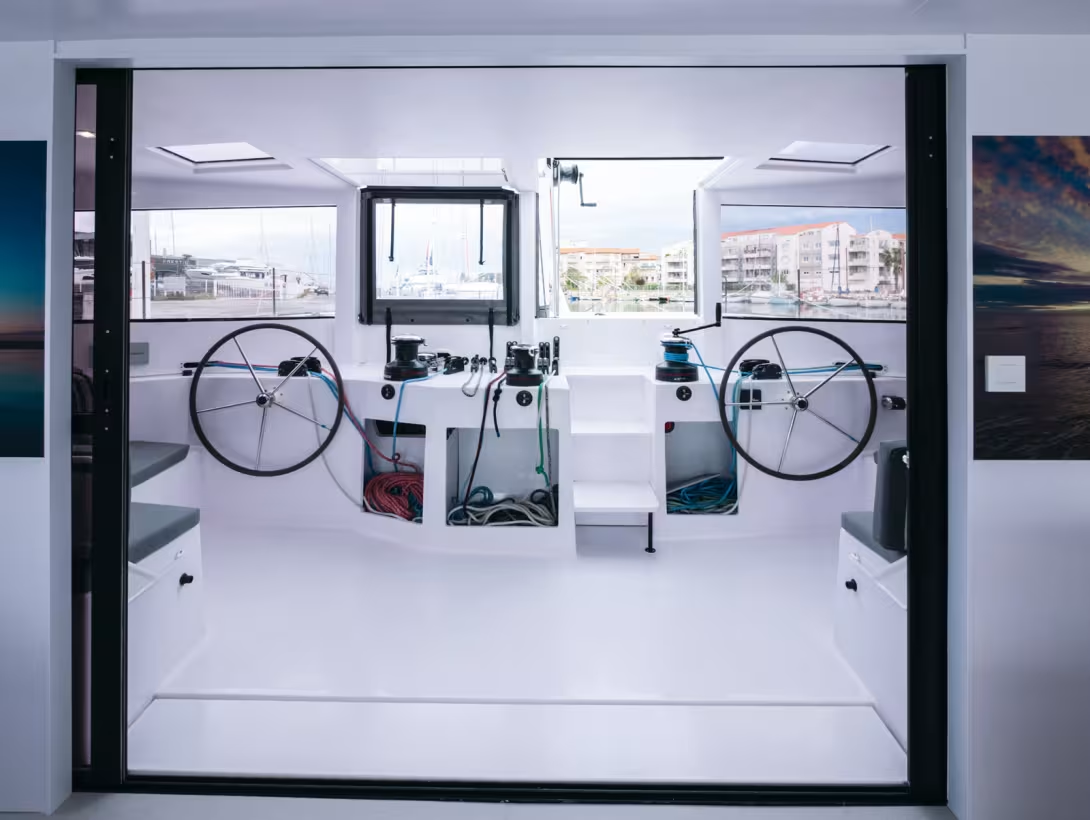
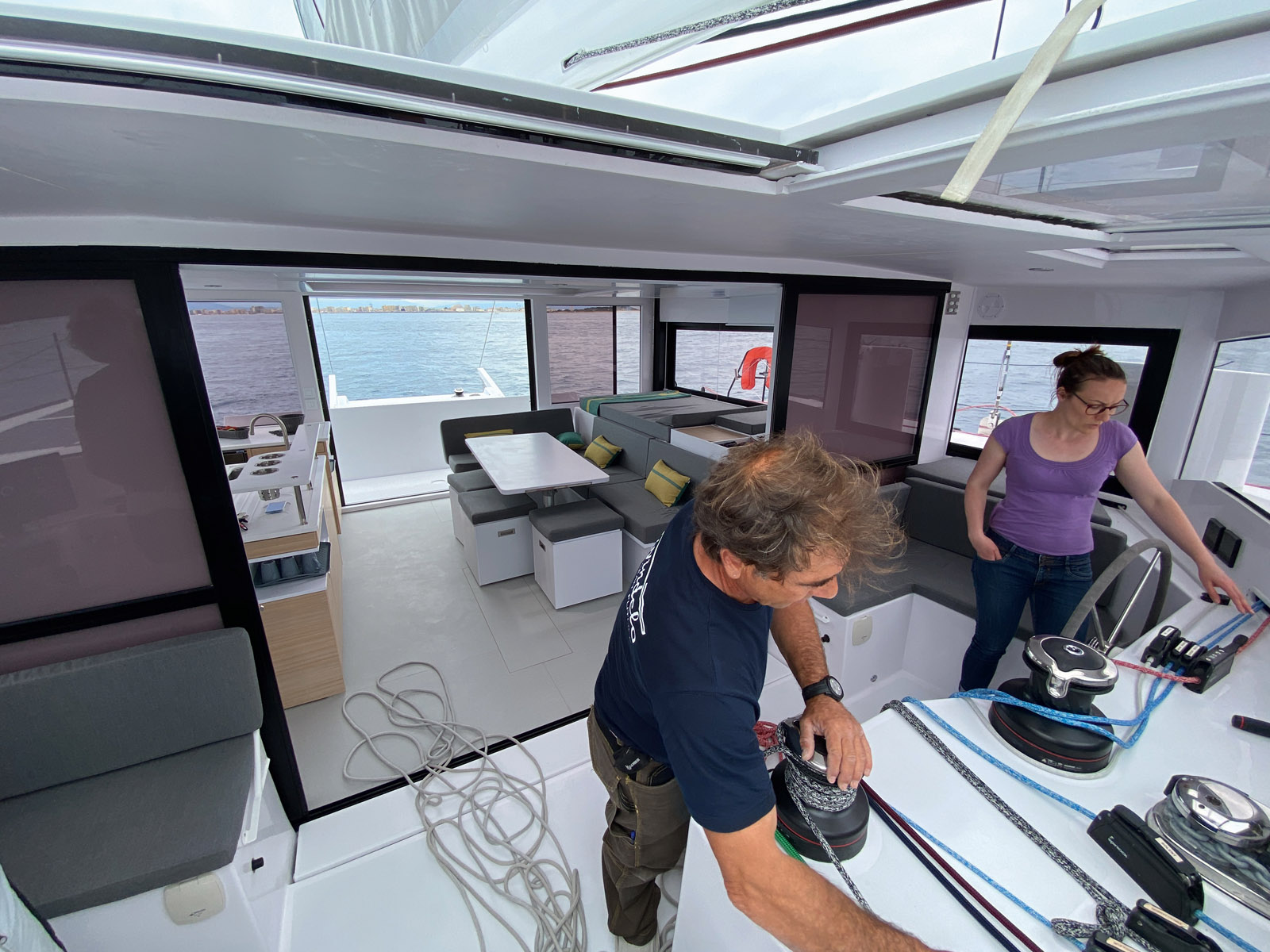
Forward helm station
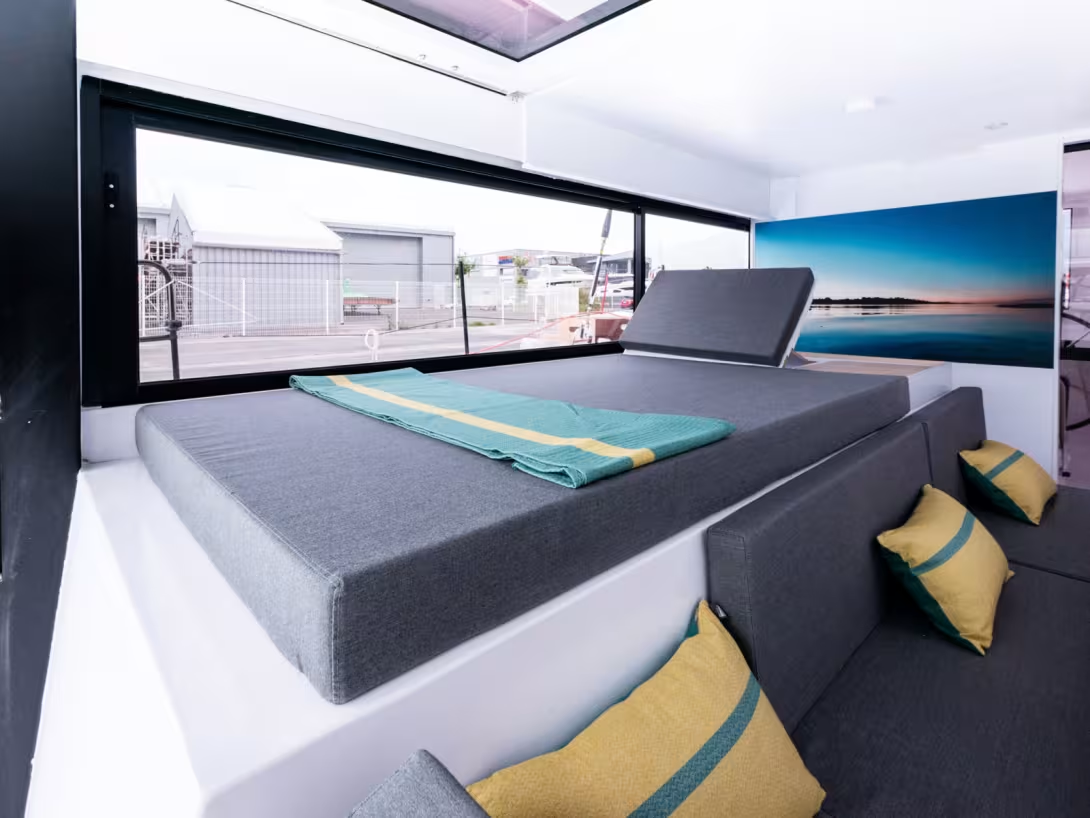
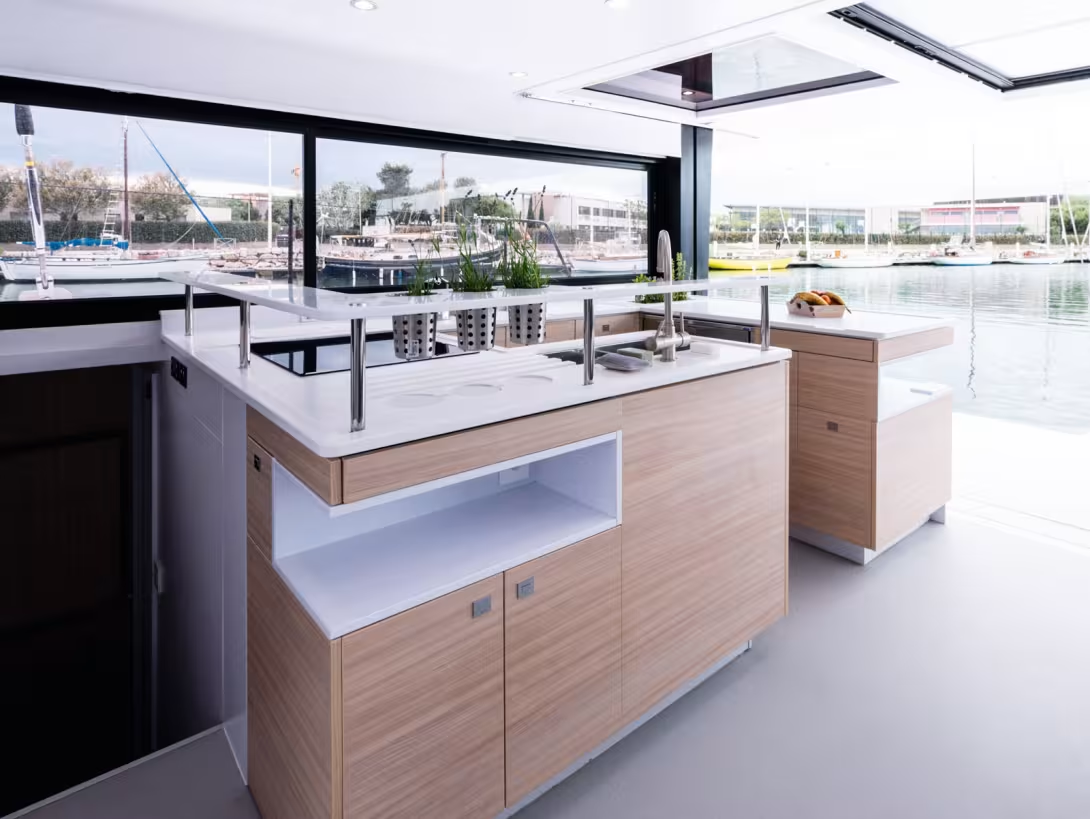
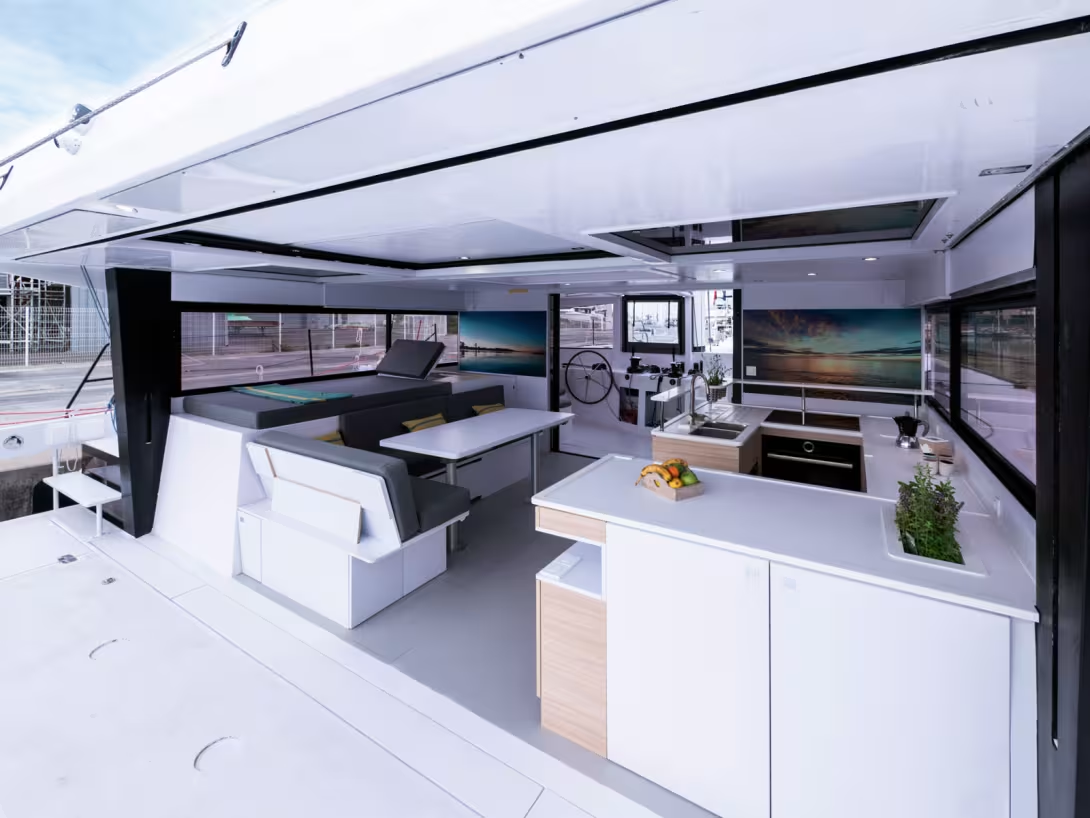
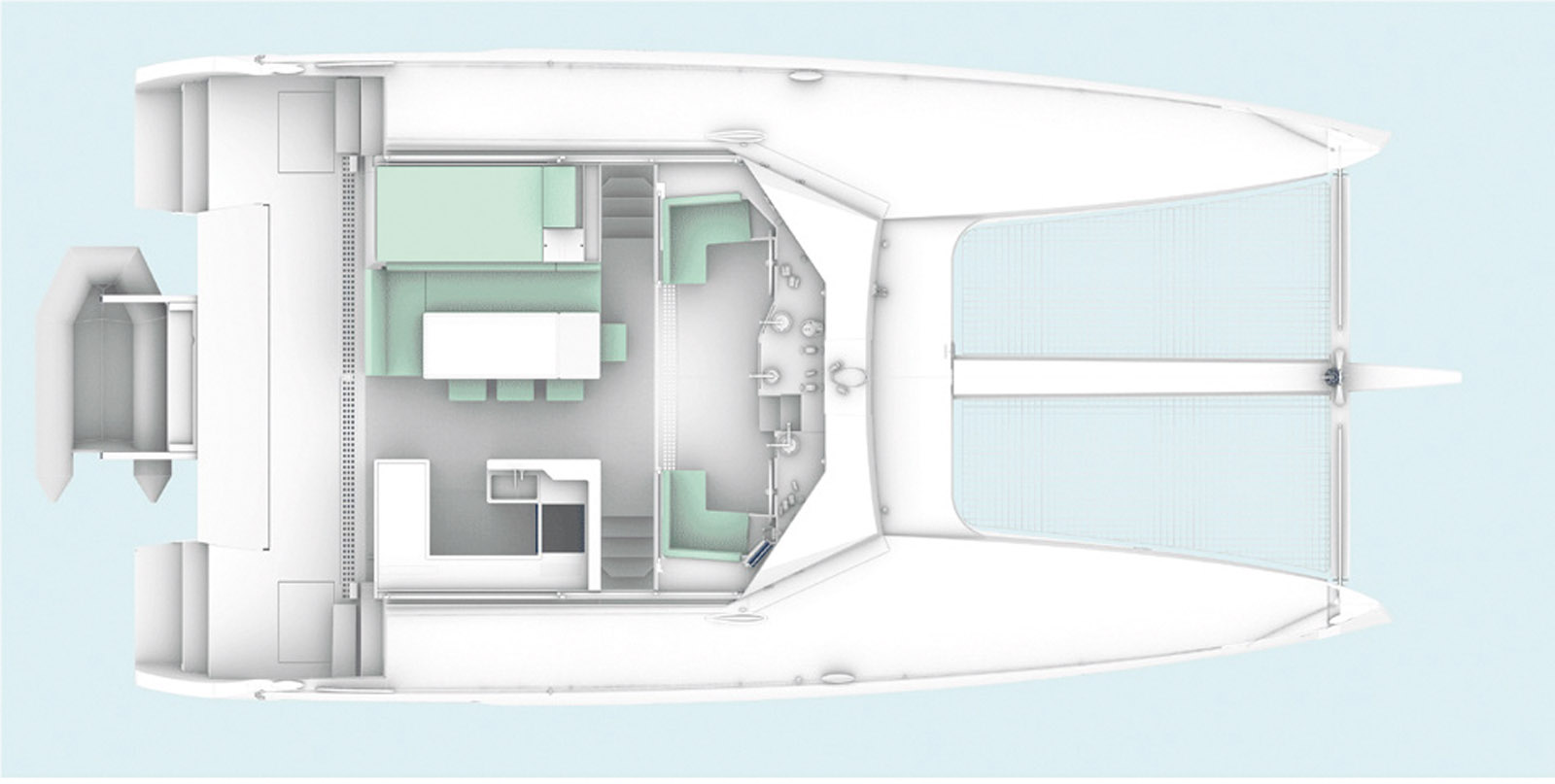
The hatches and side openings allow you to create an almost cabriolet feel. You can leave everything open since the deck of this area is self-draining. On the other hand, you can close the 7’3” (2.22 m) wide watertight door. Seen from behind, the wheels, winches and lines offer an unusual view. But in use, you quickly get used to this central layout that gives the impression that you’re maneuvering a catamaran much smaller than 50 feet. And as for all the lines, there are two large storage boxes for them... Like the Bali, the nacelle opens completely thanks to big sliding side windows but also a tilting door - here much lighter, but also less rigid. This door is gigantic; to be honest, it’s the first time on board a multihull that I’ve ever measured something that’s over 16 feet long (4.95m). I now know that my tape measure goes up to 5 meters... The builder offers many versions of layouts (U or L shaped galley, saloon table extended, or not). The minimum headroom is 6’6” (1.98 m); most of the time, it exceeds two meters. To port on our test version, there’s a table measuring 63”x30” (160 x 75 cm), a very practical watchkeeper’s berth for nights at sea, and an imposing galley.
 |
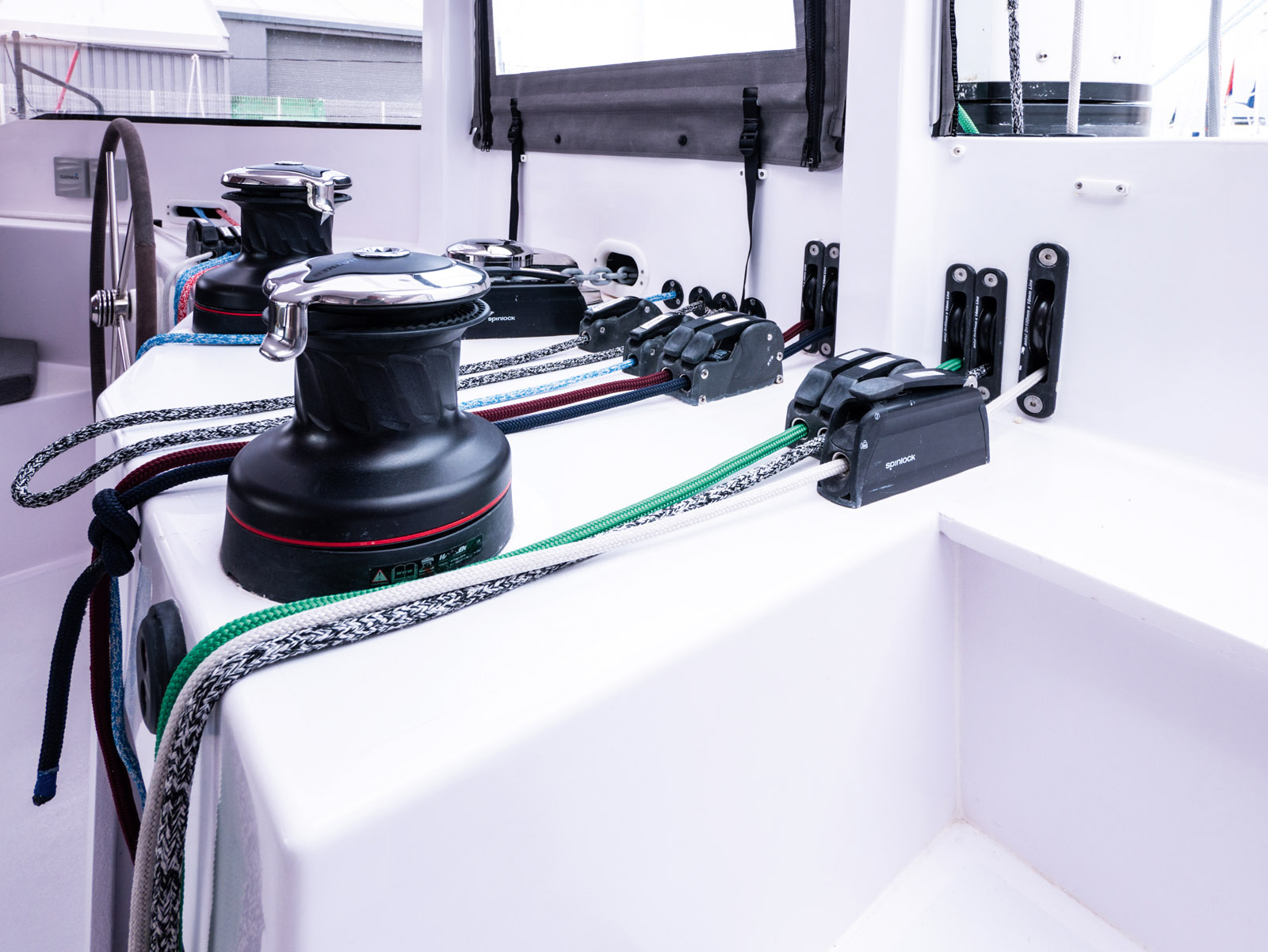 |
The helm and maneuvering station is positioned at the front of the nacelle, almost at the foot of the mast. Various hatches and windows allow you to open the space right up.
Cabins on demand
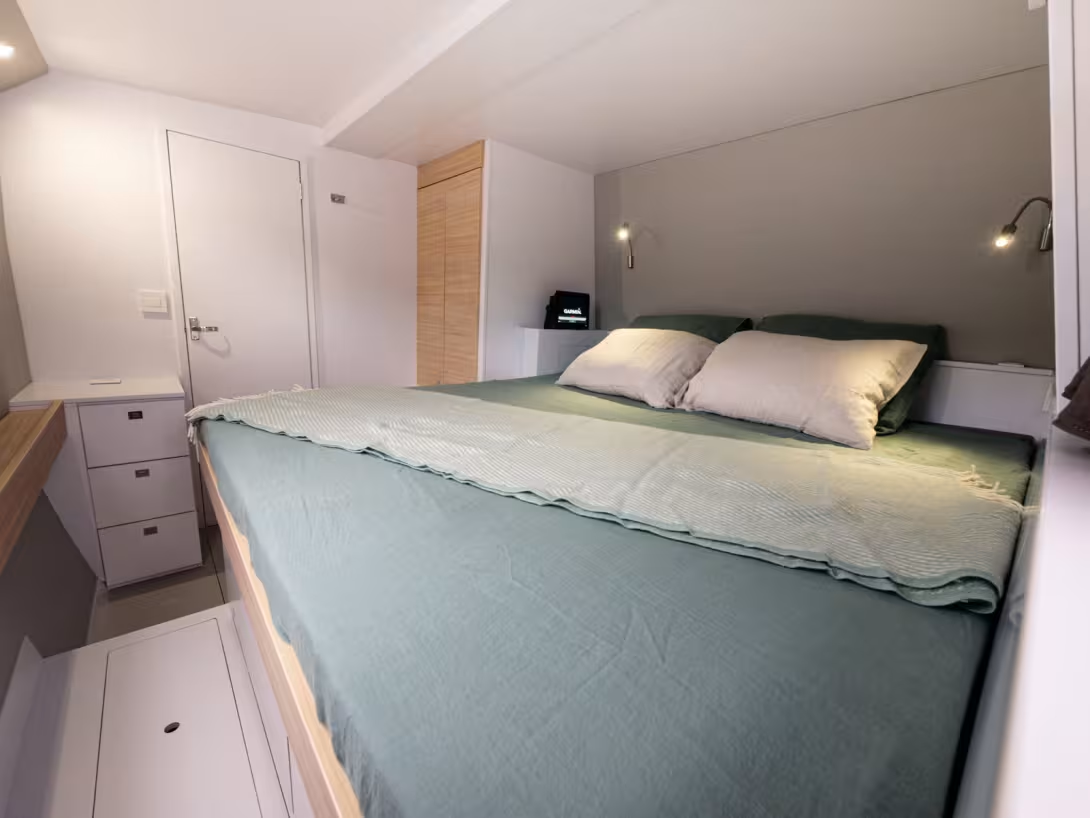
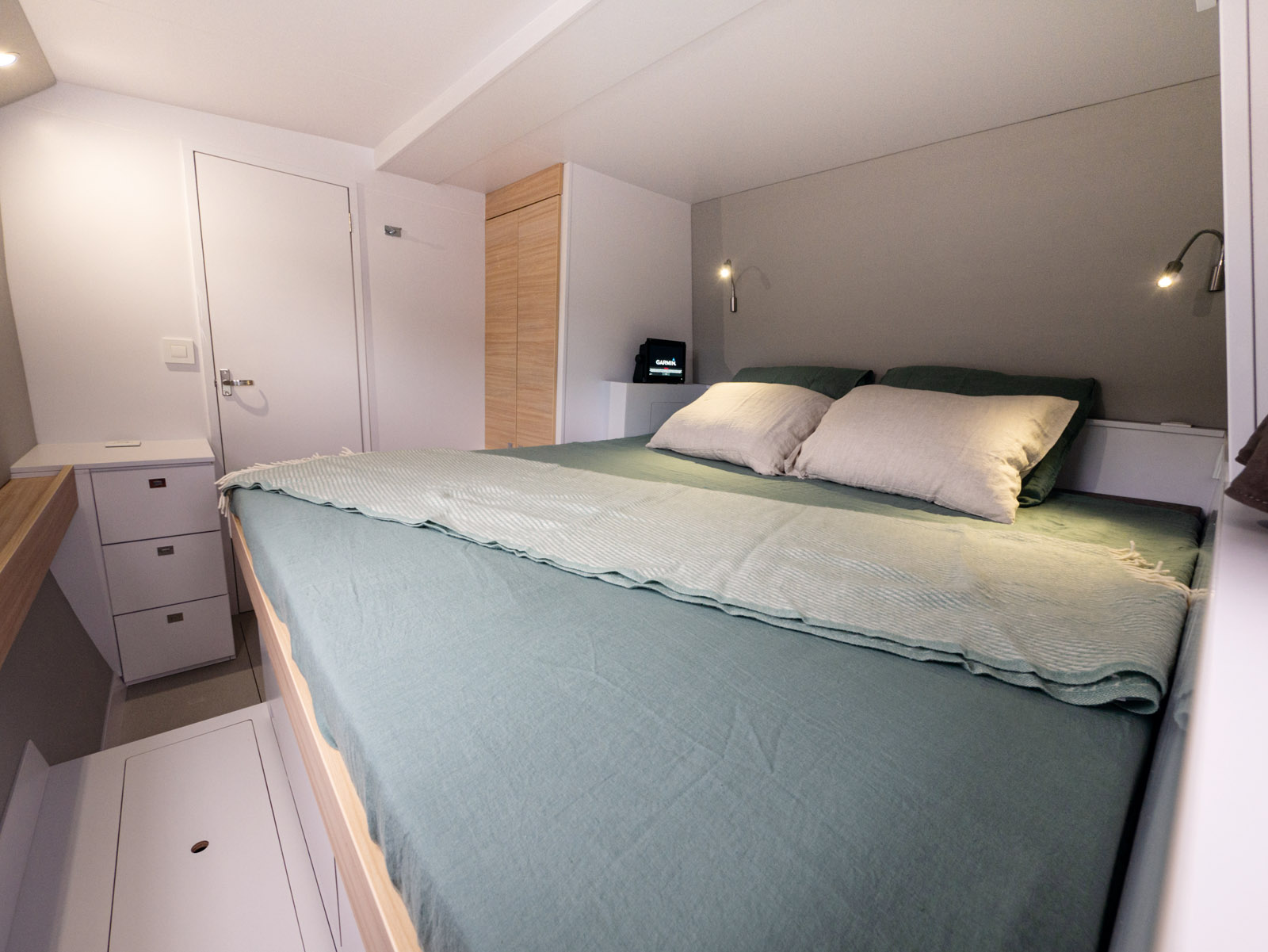
The aft cabins offer an incredible view of the sea and create an amazing impression of volume thanks to the hatch that wraps around the corner. Note: the opening of the topsides as an extension of these hatches, above the sugarscoops, manages to subtly lighten in a rather subtle way the somewhat massive silhouette that you see from astern. On the port side, the bed in the owner’s cabin slightly encroaches into the nacelle, allowing the 5’11” (1.80 m) wide mattress to be set athwartships. A desk is installed forward, which explains the absence of a nav station in the nacelle. This workspace is adjoined by a single folding berth. In the starboard hull, there is a 4’7” (1.40 m) wide berth aft, and two singles at the front. The two forward panels can be glazed on future models. On the whole, the layout seen here is convincing, and the possibility of customizing your catamaran is very attractive. The only downside to this very first model is that the finish could be improved. Assemblies, joints, squeaks in the floors - these are a number of small details that the builder intends to correct as soon as possible in order to present a perfect boat at the Cannes Yachting Festival, which will be its first presentation to the public..
 |
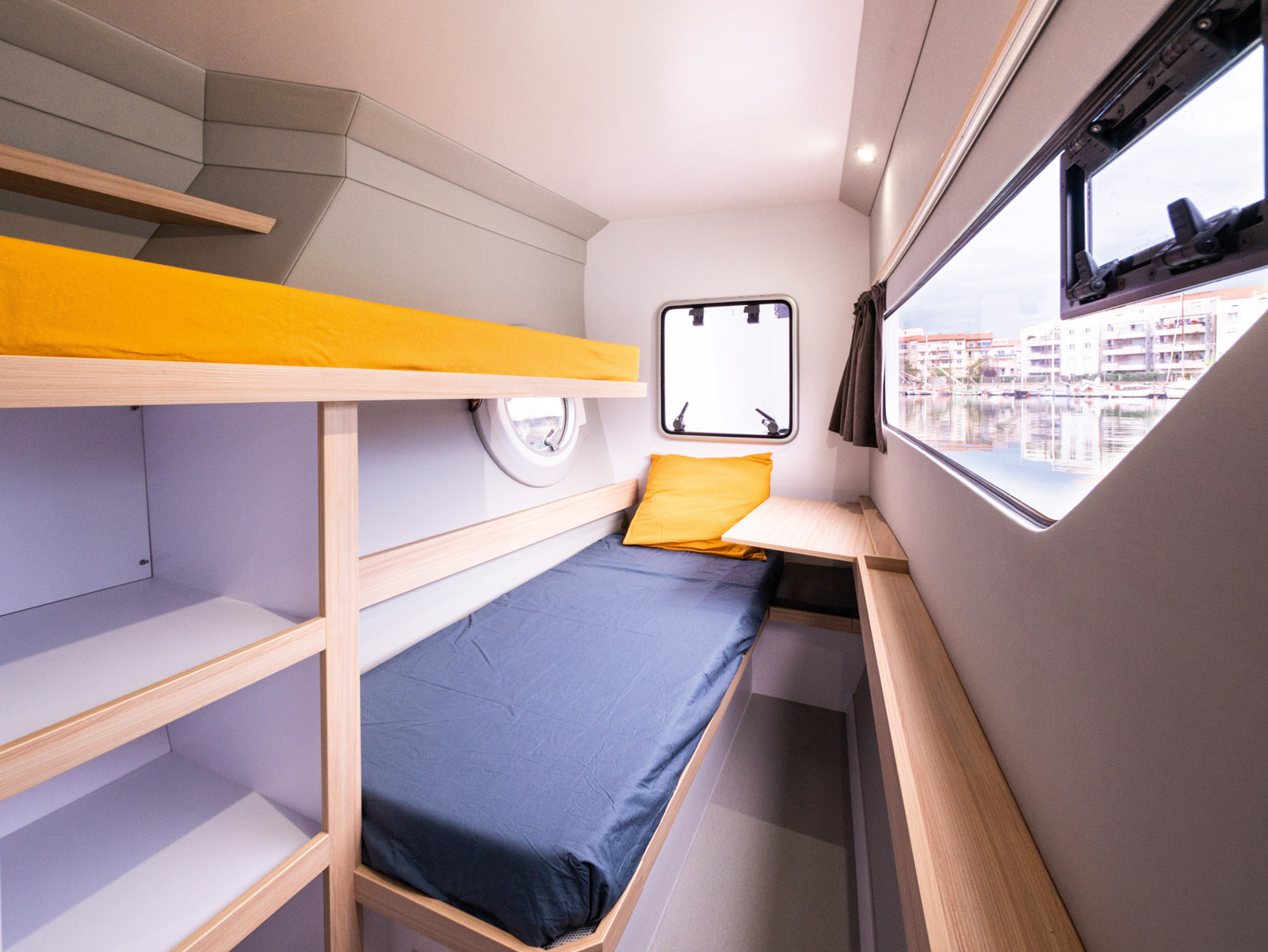 |
With a bed extended to 6’ wide, a standard bed of 6’7” x 4’7”, bunk beds or folding bunks, the manufacturer is able to customize the layouts.
Conclusion
Discovering the very first multihull from a brand-new shipyard is certainly a privilege for a boat tester: it was of course with a new eye - but an approving look - that Multihulls World was able to appreciate this innovative catamaran with its forward helm and sail maneuvering station and its open nacelle. Gunboat or Bali? A bit of both, but then again, neither one nor the other. The environmental dimension is more evident, with the will to use a maximum of recyclable materials and to favor electric propulsion. Windelo is clearly determined to make a place for itself on the market: the production objective is 10 units a year.
Discover our exclusive Windelo 50 video
The Pluses
Performance
Forward helm and maneuvering station
Modularity of the layout
The Minuses
Little exterior seating
Finish could be perfected
TECHNICAL SPECIFICATIONS
Builder: Windelo Catamarans
Architects: Barreau/Neuman
Material: basalt-PET/PVC sandwich
Length: 50’ (15.24 m)
Beam: 26’ (7.92 m)
Draft (keels): 5’2” (1.58 m)
Draft (daggerboards): 3’11” / 7’7” (1.20 / 2.32 m)
Air draft: 76’ (23.15 m)
Light displacement: 24,700 (11.2 t) / 23,800 (10.8 t) for Sport version
Fully-battened mainsail: 990 sq ft (92 m²)
Solent: 463 sq ft (43 m²)
Code 3: 990 sq ft (92 m²)
Gennaker: 1,733 sq ft (161 m²)
Water tank: 105 US gal (400 l)
Fuel tank: 132 US gal (500 l)
Hybrid electric drivetrain: 2 x 20 kW (or 2x24 kW as an option)
Price Windelo 50 Adventure: € 735,000 ex-tax
Price Windelo 50 Yachting: € 789,000 ex-tax
Price Windelo 50 Sport: € 829,000 ex-tax
Main options of the Windelo 50 Adventure as tested:
Carbon mast: € 79,500 ex-tax
Hydranet mainsail and solent pack: € 14,450 ex-tax
Code 0 on furler with deck hardware: € 11,050 ex-tax
Electronics pack:€ 17,900 ex-tax
3,321W flexible solar panels + regulators: € 24,900 ex-tax
15.8 gph (60 l/h) watermaker: € 9,400 ex-tax
Tilting rear door with bay window: € 38,500 ex-tax
Price of the model we tested: € 967,640 ex-tax
 |
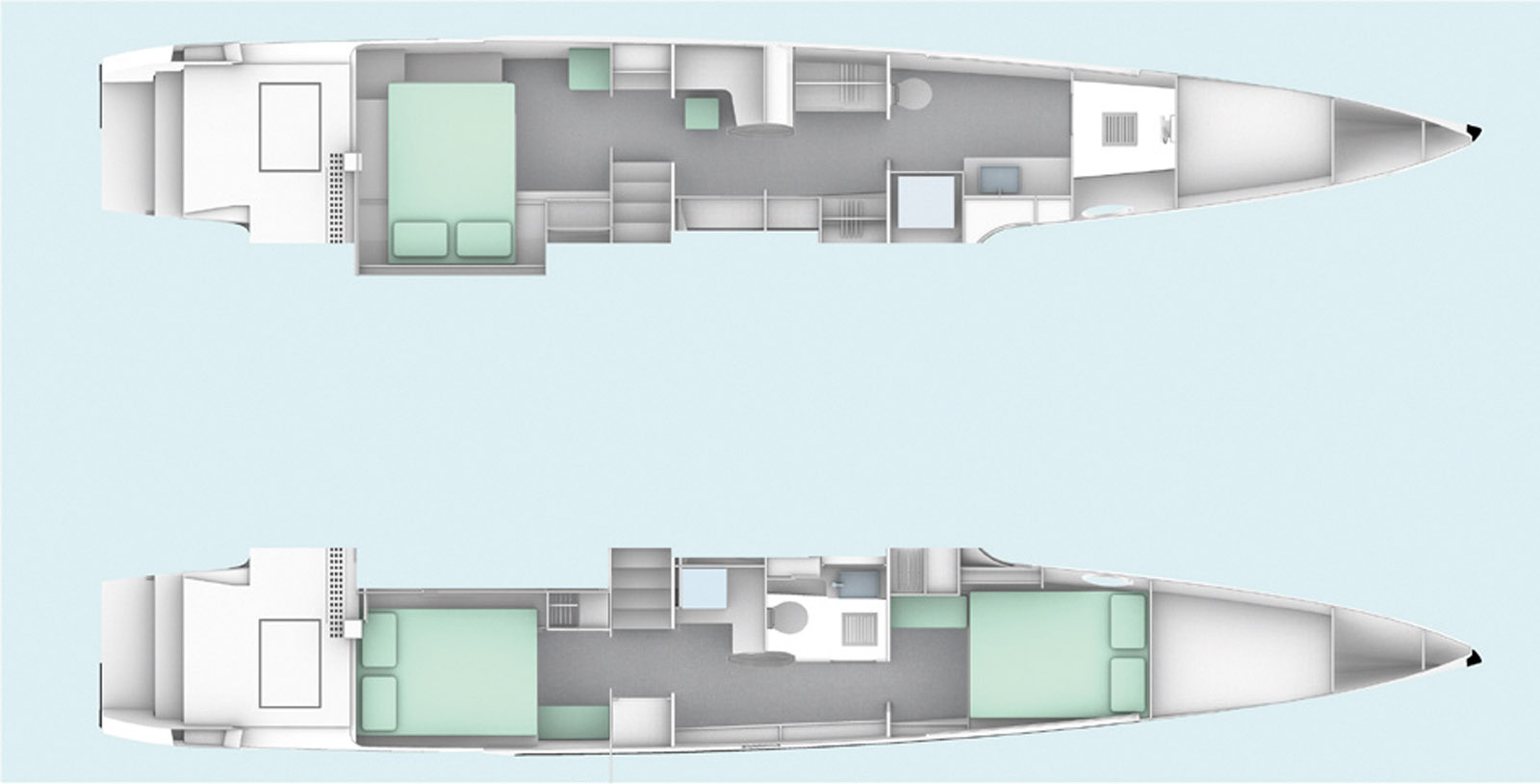 |
These layout plans correspond to the model we tested: other possibilities such as an L-shaped galley, a chart table and custom cabins are possible.