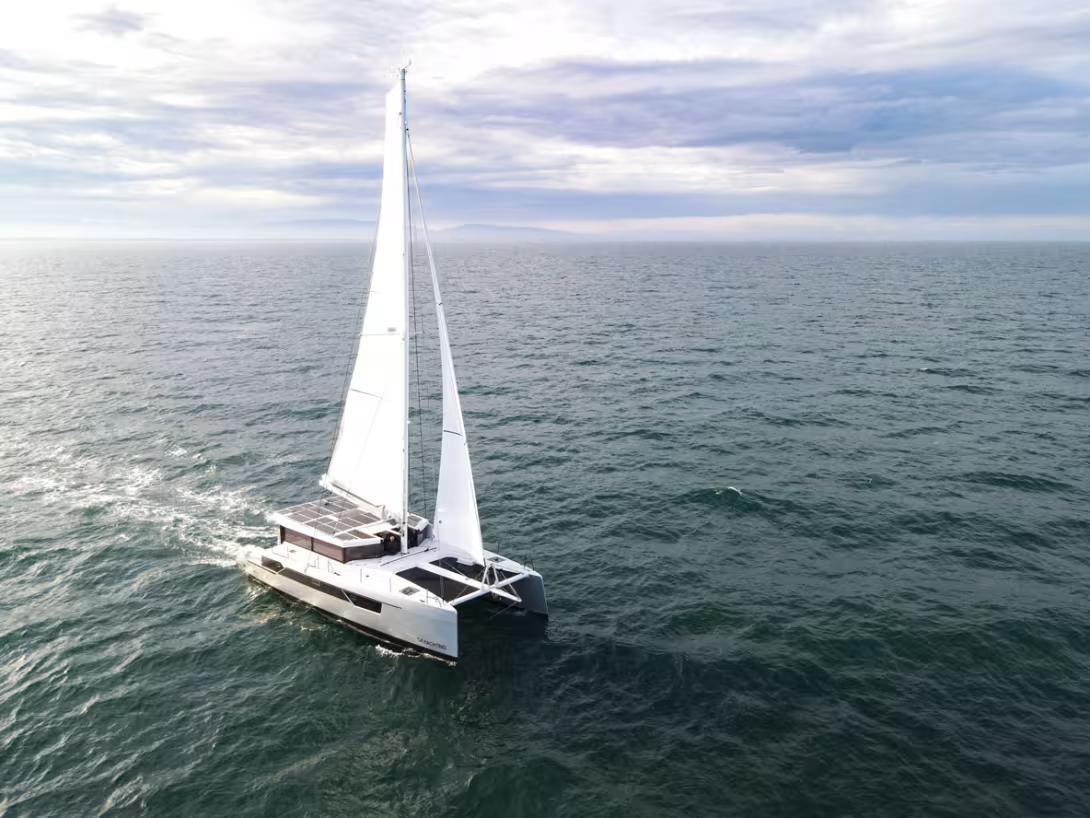
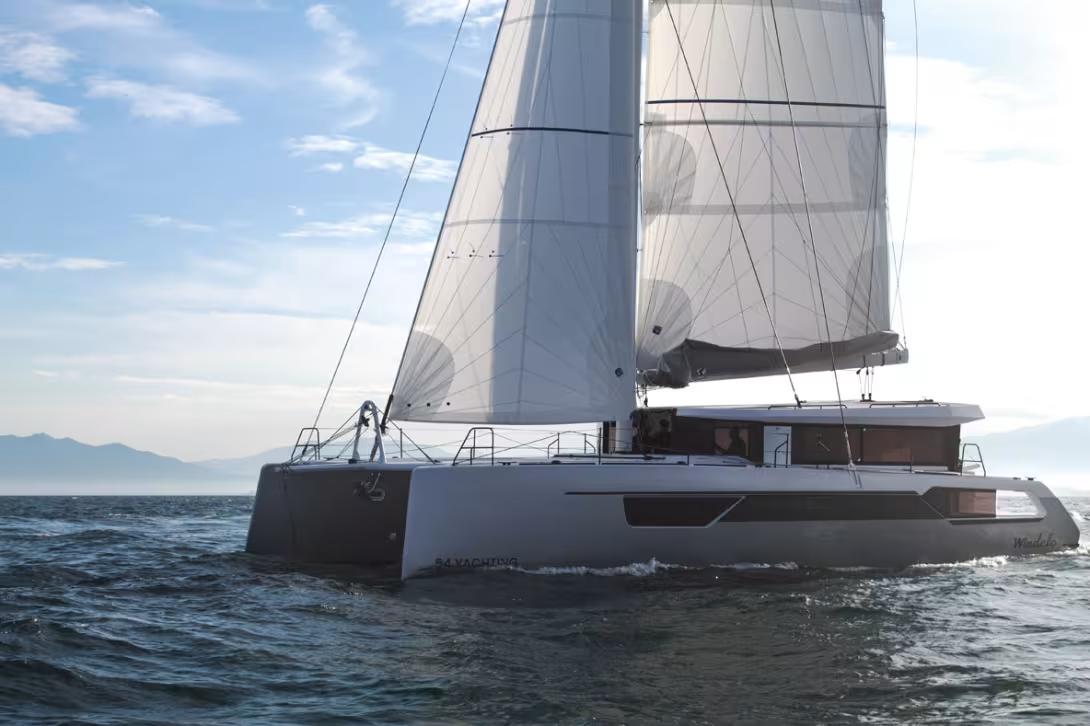
A year after the launch of their first catamaran, the young builder Windelo, who are heavily implicated in eco-responsible construction and sailing, have launched their second model, the Windelo 54. With 4 feet (1.22 m) more hull length compared to the 50, this 54 keeps the same characteristics as her little sistership... with even more comfort and performance!
Test location: La Grande-Motte, South of France
Conditions: 5 knots of wind, calm sea



Infos pratiques
- Le chantier : Windelo 54 Yachting
- La fiche technique
-
 Découvrez notre vidéo exclusive
- Financez votre Windelo 54 Yachting
- Assuez votre Windelo 54 Yachting
- Articles autour du Windelo 54 Yachting
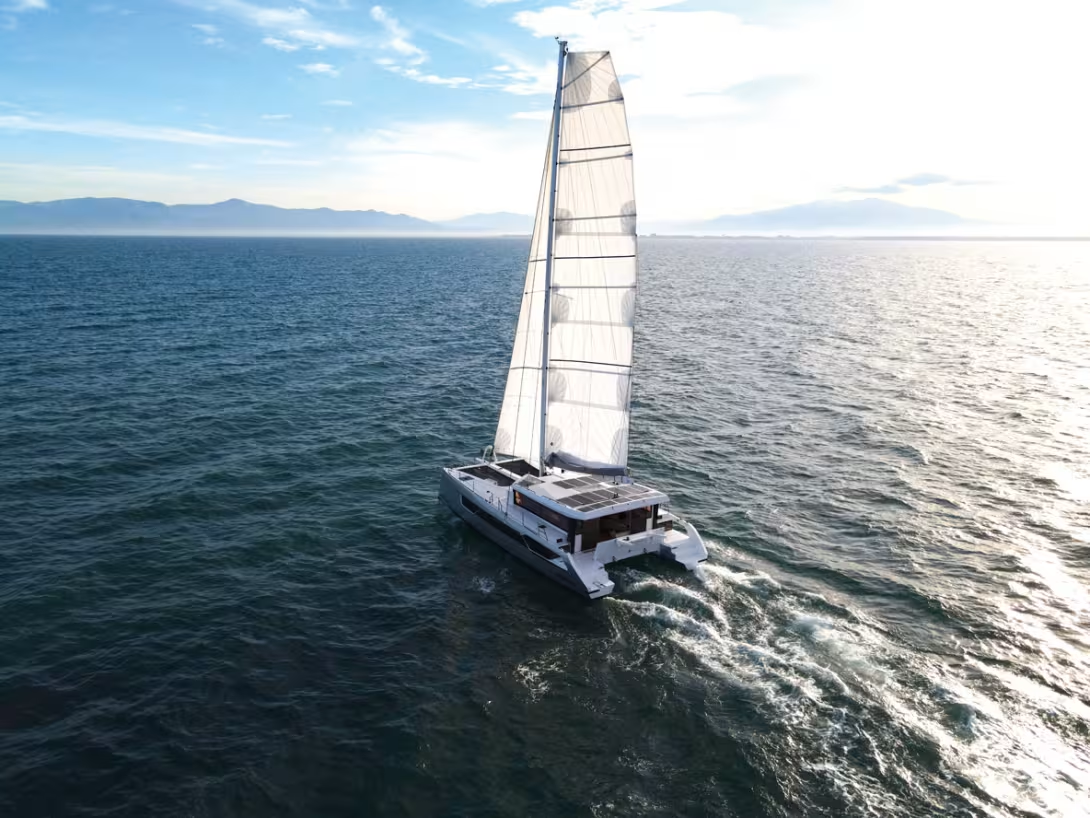
We were able to discover the Windelo 54 Yachting at this year’s International Multihull Show at La Grande-Motte in the South of France back in April. In her gray livery, the catamaran looks great: she picks up on the design of the 50 with narrow but tall hulls, bows noticeably reversed and imposing nacelle windows that are all vertical. That briefly explains the outline of this design by Christophe Barreau, and then the construction is very innovative with the use of basalt fiber and PET foam (from recycled plastic bottles/PVC). The shipyard estimates their carbon impact to be reduced by 47% thanks to the use of this material, but also to internal manufacturing and local supply.
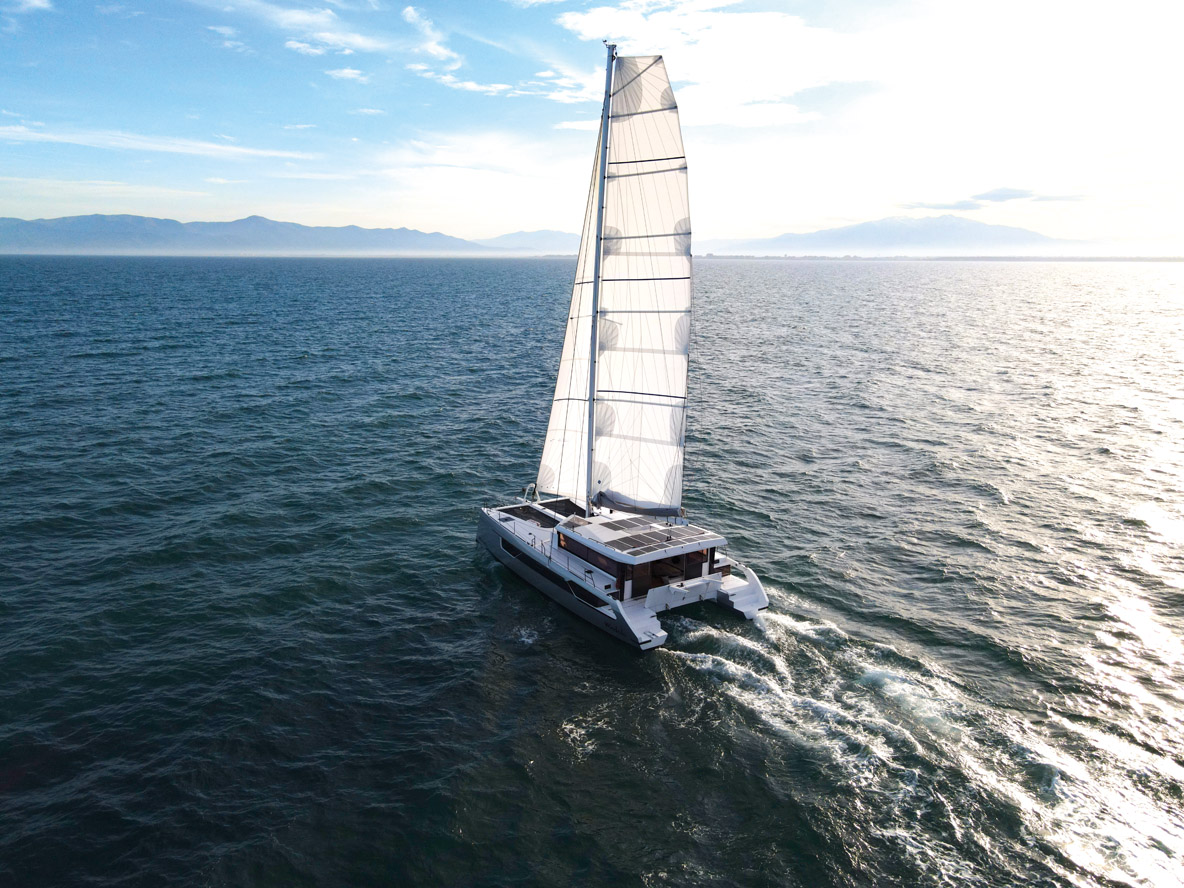
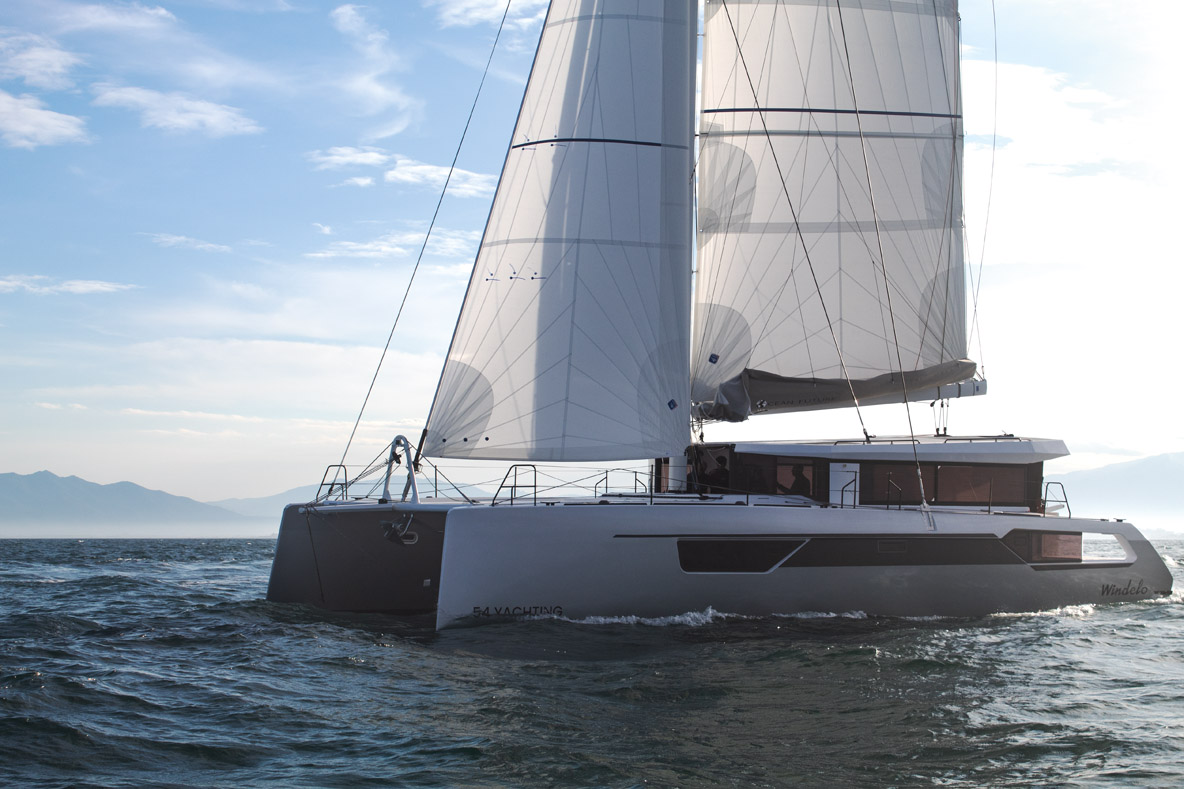
The manufacturer’s promise to reach 20 knots under sail is not utopian: the day before our test, the Windelo 54 was clocked at 17.5 knots…
Hybrid electric propulsion
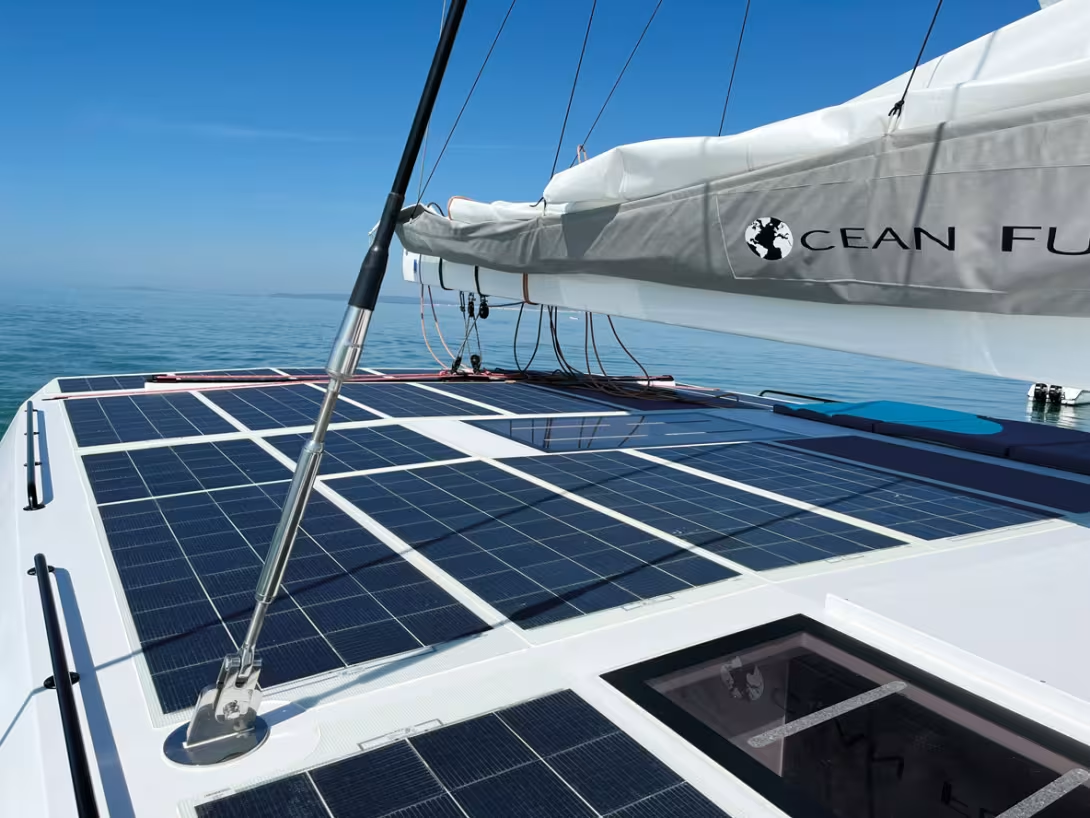
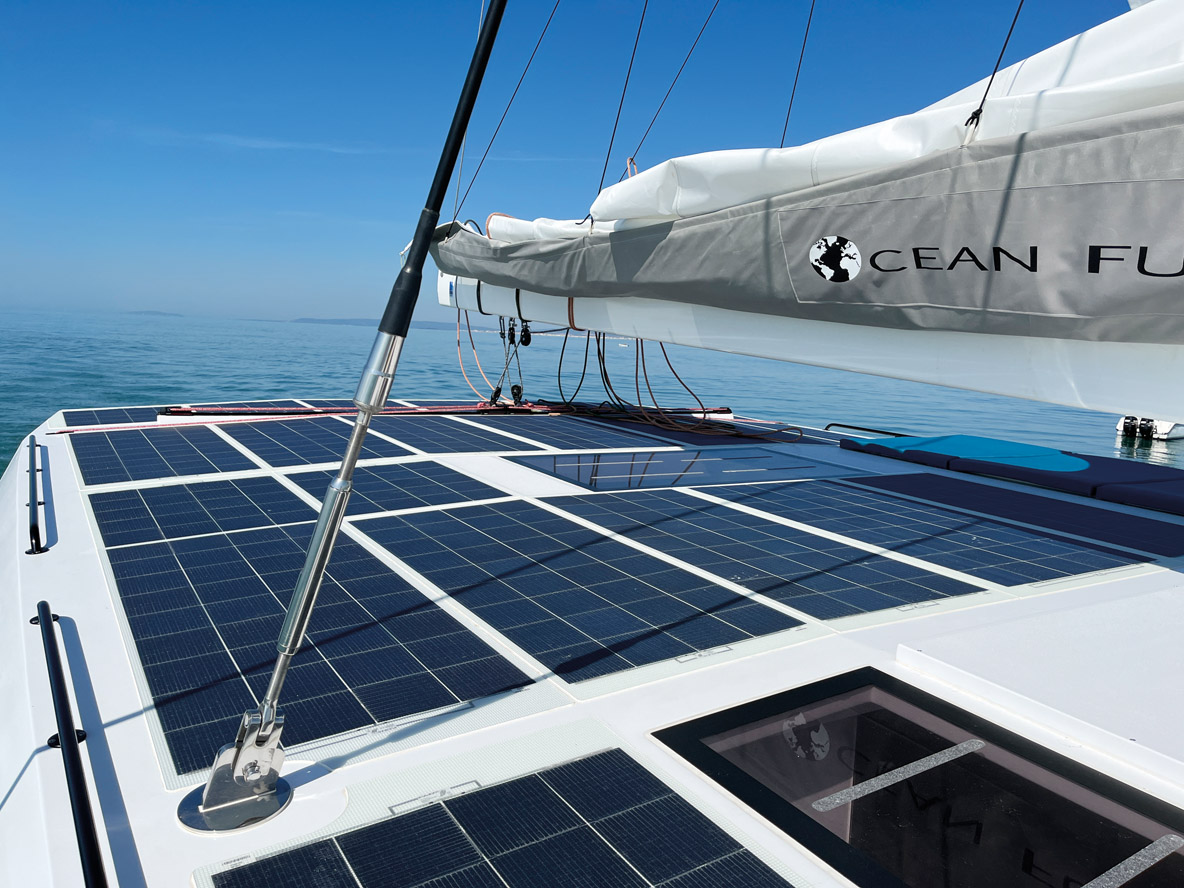
The builder has obviously opted for electric motors: on this example, 2 x 20 kW and various means of charging. To start with, an imposing array of solar panels totaling 4,500 Wp. The manufacturer claims a recharge of the 1,120 Ah / 48 V battery bank from 20 to 80% in 22 hours, so 1.8 days’ worth. At a good speed (11 knots) under sail, the hydrogeneration system can recharge the whole battery bank in 24 hours. Theoretically, the battery bank is able to supply the two 8-kW motors each for a little more than three hours. Speed is the key data for establishing the range: we go from 50 nautical miles at 4 knots to just 8 nm at 8.5 knots... The manufacturer promises 4 hours per day at 6 knots: on a good sunny day and with a few hours under sail, it should be possible to ensure such daily draw by the motors and even to keep enough energy to supply the other equipment on board. The principle is of course to delay firing up the generator. The latter, alone, guarantees a range of 1,100 nm under motor. This setup is therefore intended to be as green as possible while maintaining a safety margin that is essential for an offshore project. The only regret is that the list of options includes numerous pieces of equipment such as diesel heating or regular, internal combustion outboards, which in our opinion are a bit out of place in a forever green philosophy. On the other hand, the builder has gone to great lengths to ensure that all the technical components of this catamaran are easily accessible.
 |
 |
 |
As on the Windelo 50, there’s a self-tacking solent, the nacelle is set far aft and there are the same open sugarscoops.
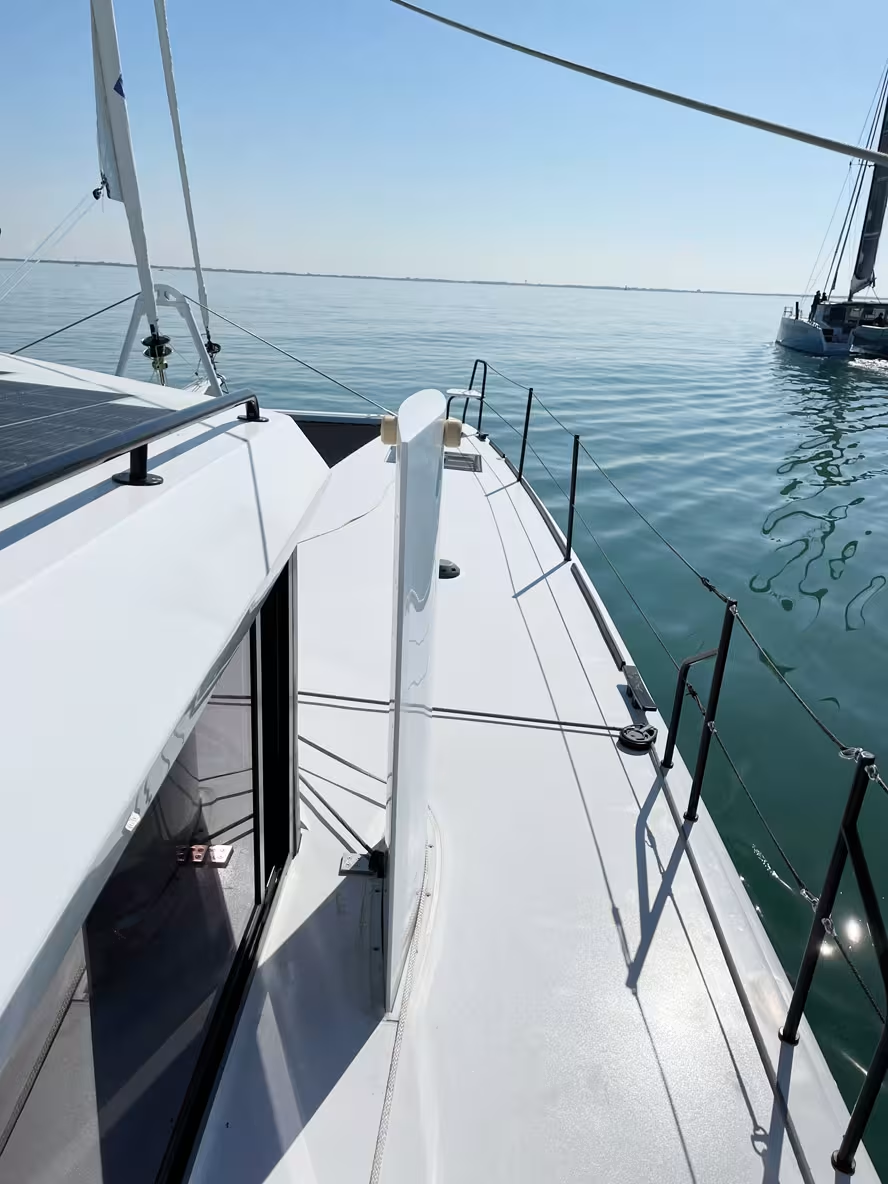
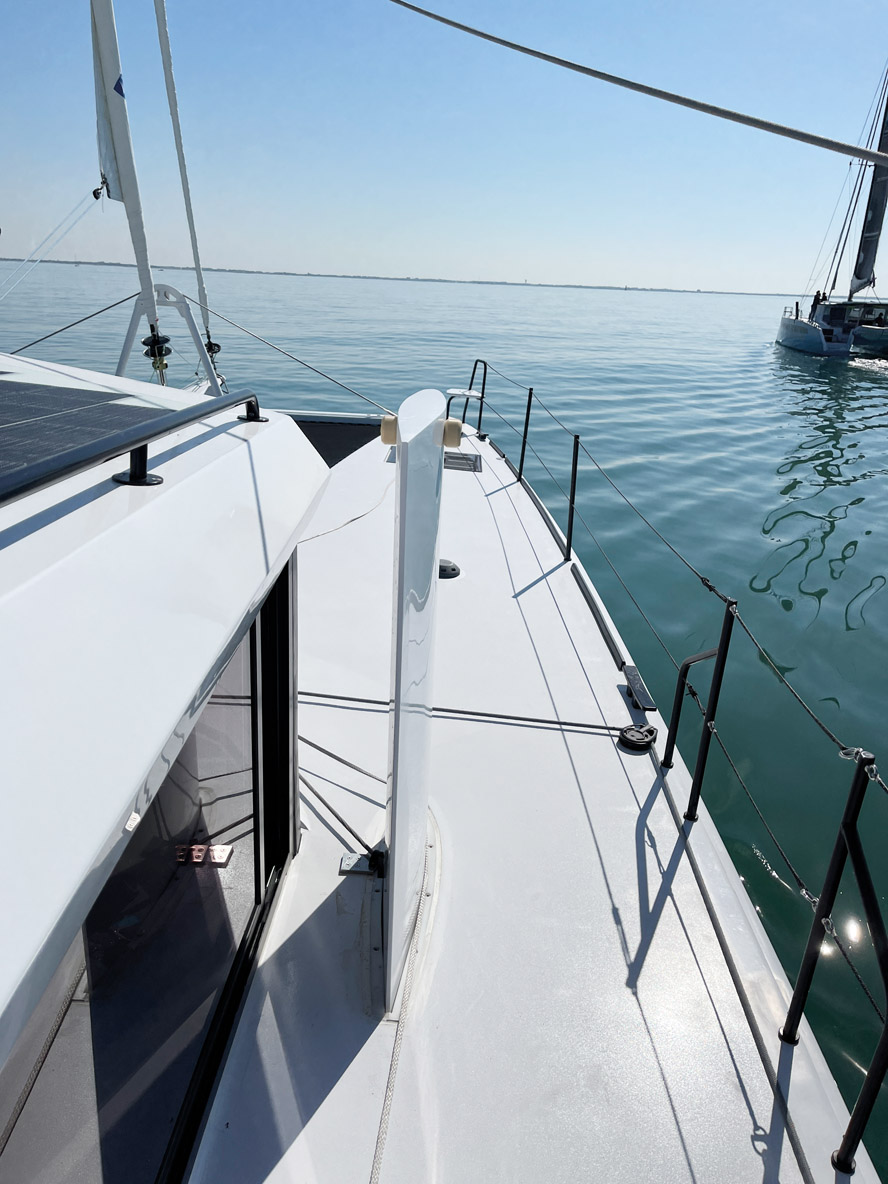
Even when raised, the daggerboards do not hinder circulation because the side-decks remain very wide.
The nacelle is logically occupied by solar panels - up to 4,500 Wp.
Accommodation open to the exterior
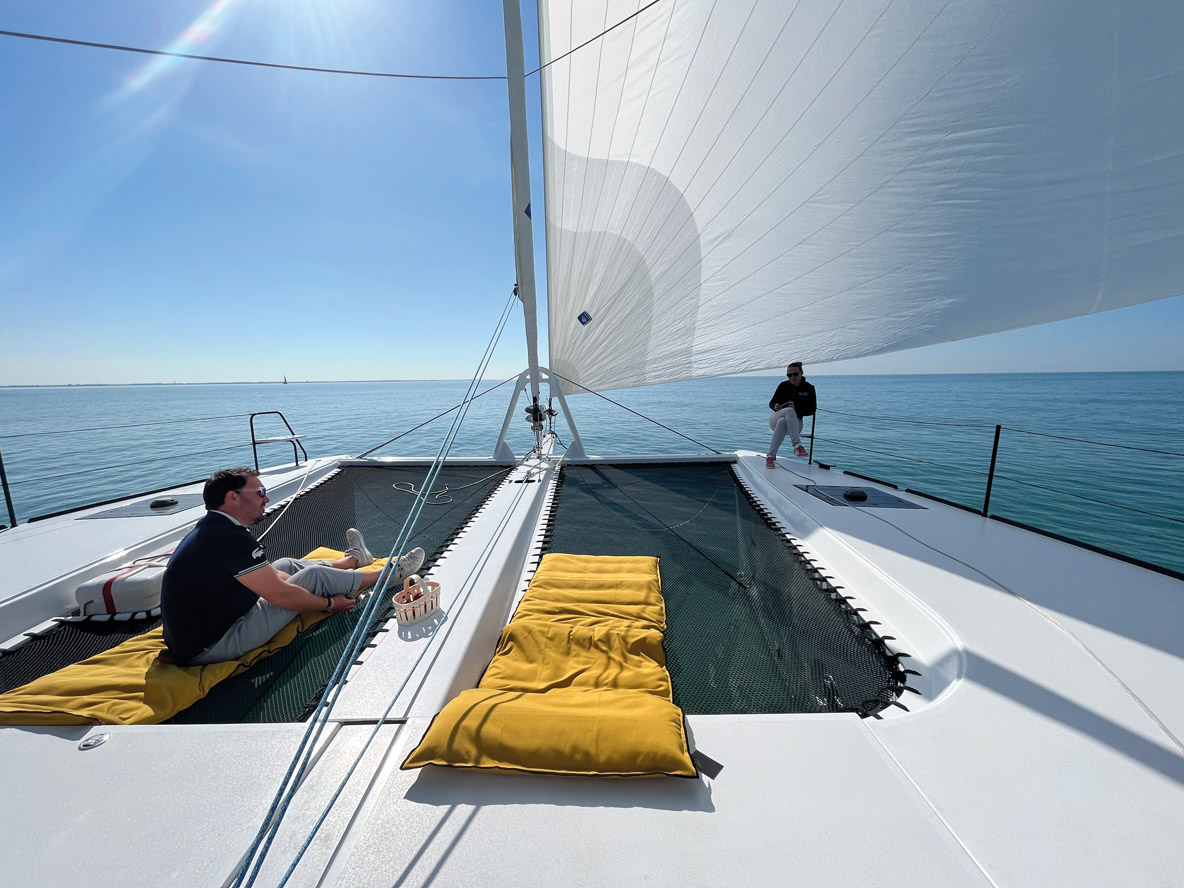
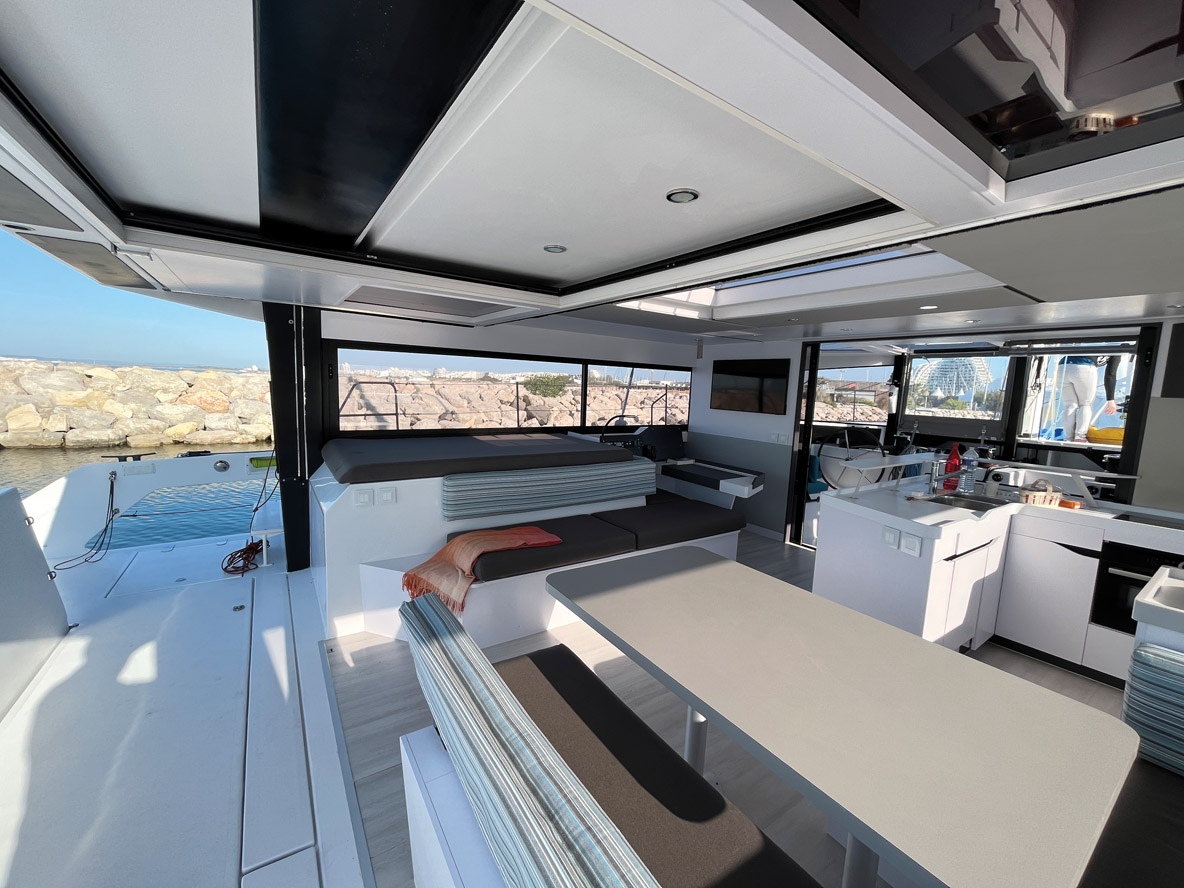
Using the winch to open the large overhead door (16’1” wide by 6’3” high/4.9 m x 1.9 m!) allows the catamaran to be completely open to the outside. The builder recommends sailing with this large hatch closed – there’s still a traditional door to get from the cockpit into the nacelle. This huge part seems to lack somewhat in rigidity, but it does have the merit of perfectly integrating into the ceiling. As standard, the Windelo 54 is equipped with a double sliding door. In all cases, the side windows are openable, allowing you to regulate the ventilation according to the weather conditions at the time. At the stern, there are the two sugarscoops and a wonderful platform measuring 13½ feet (4.1 m) that can be raised electrically. Otherwise, raising the davits and the tender is done using a winch. The aft cockpit itself is limited to an aft passageway - however, it is possible to install an additional table. Even though the daggerboards are positioned at the inner quarter of the width of the side-decks, circulation remains easy and secure thanks to the numerous handrails. At the front, lockers are immediately followed by two imposing trampolines.
 |
 |
The foredeck is home to two trampolines.
As an option, the tilting door allows the platform to be completely opened up. You can also retract the side windows.
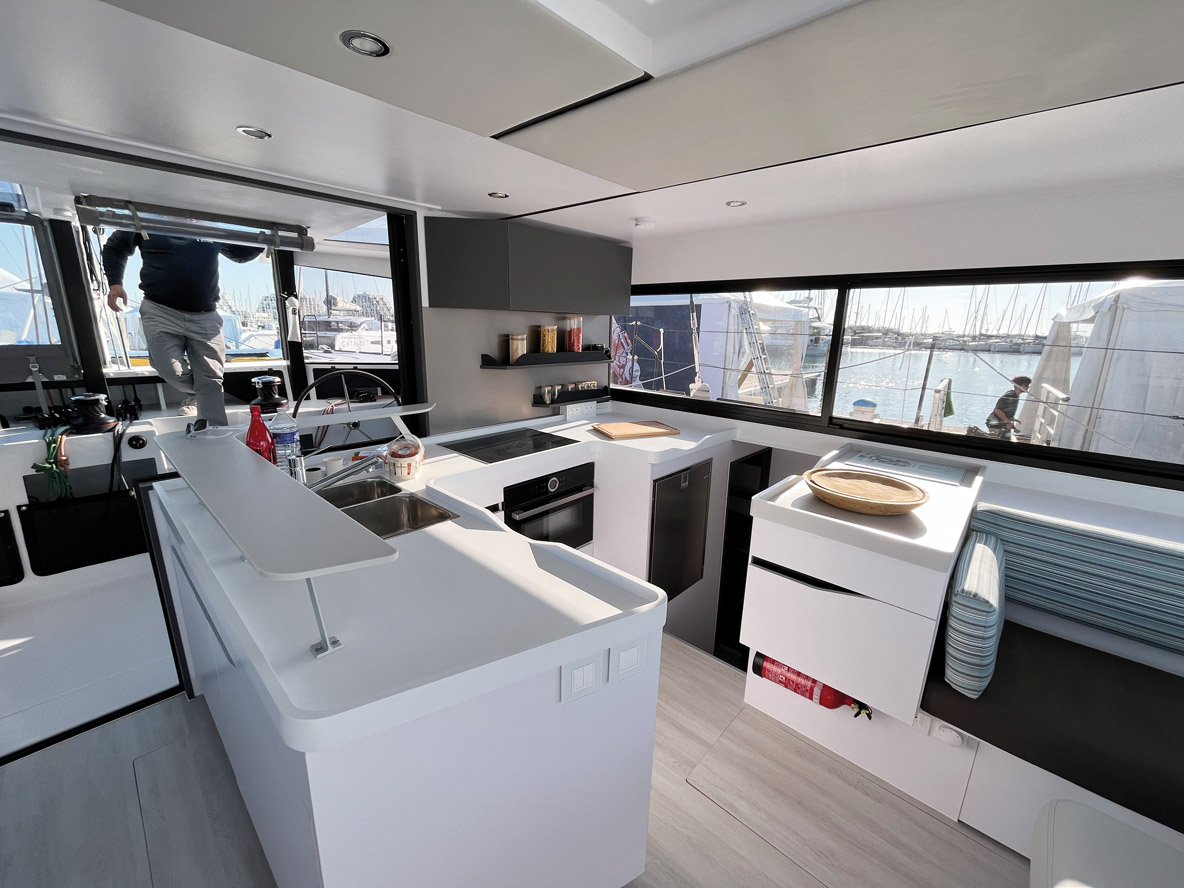
U or L shaped galley
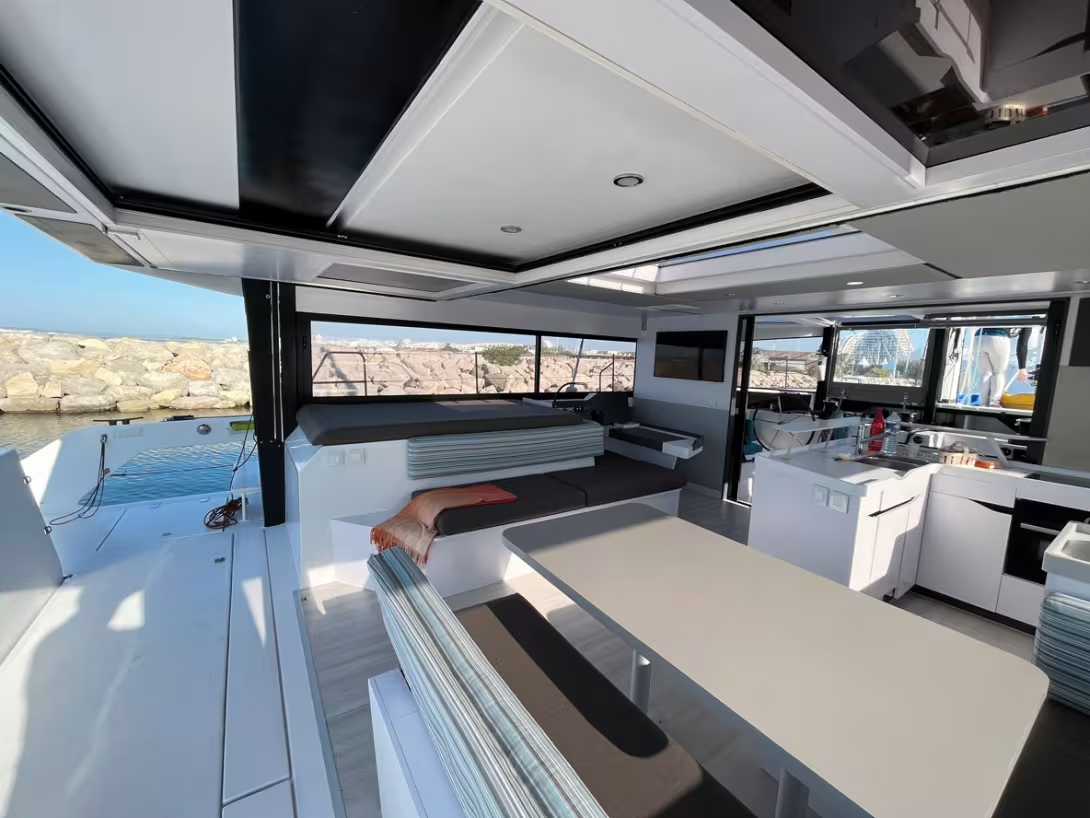
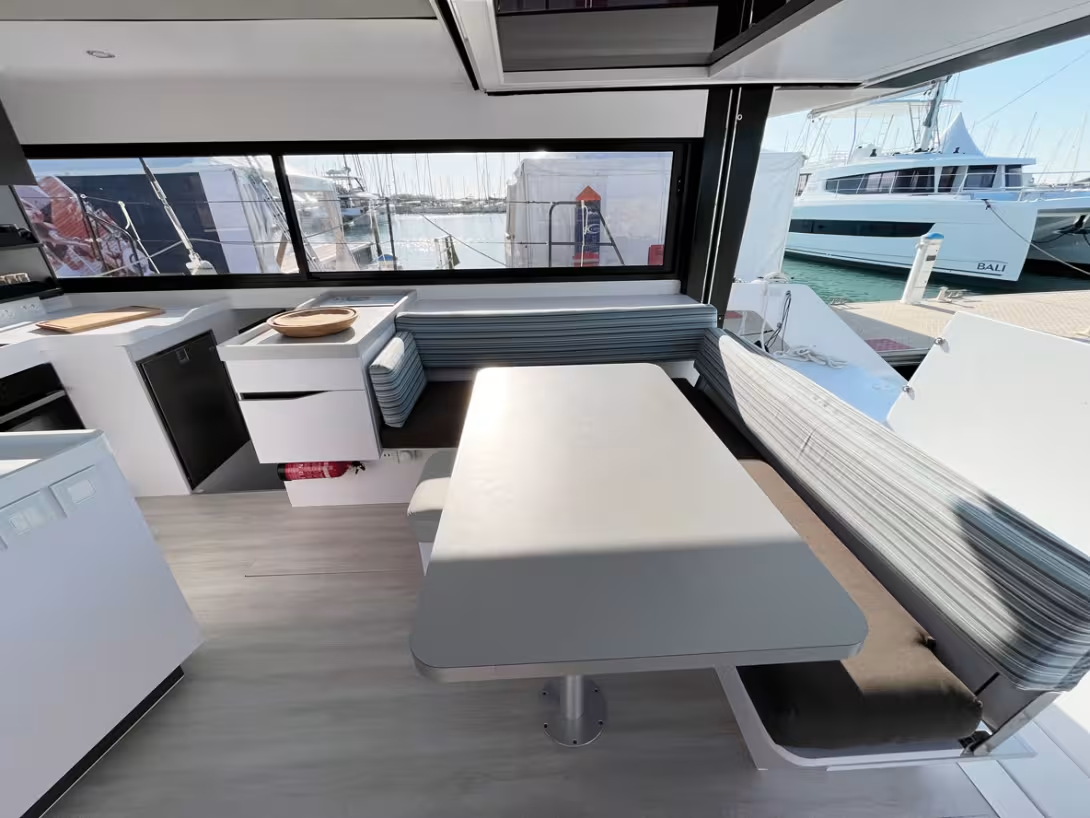
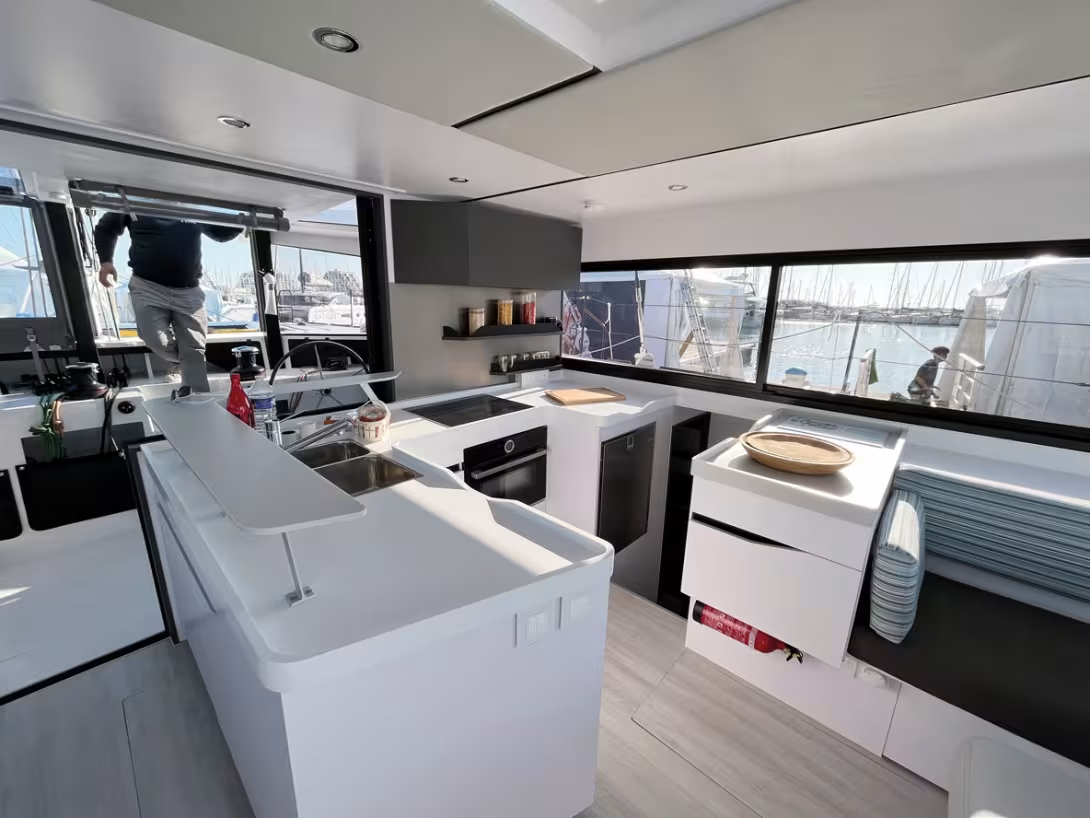
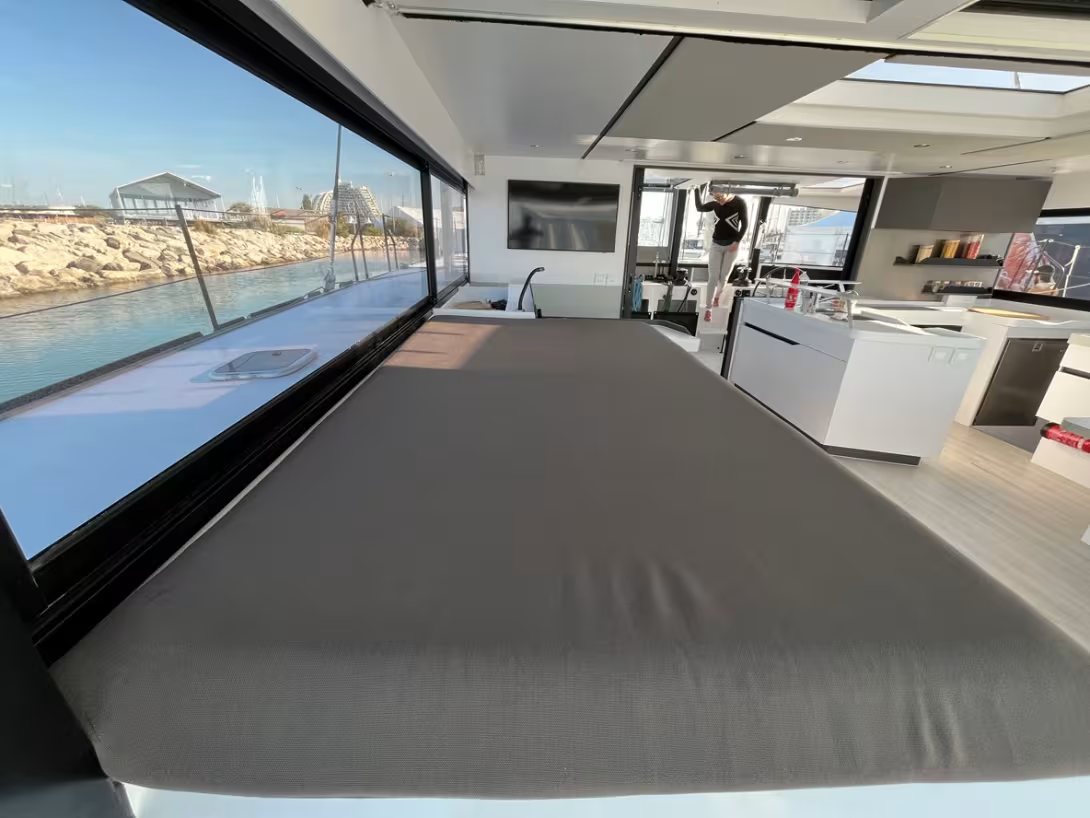
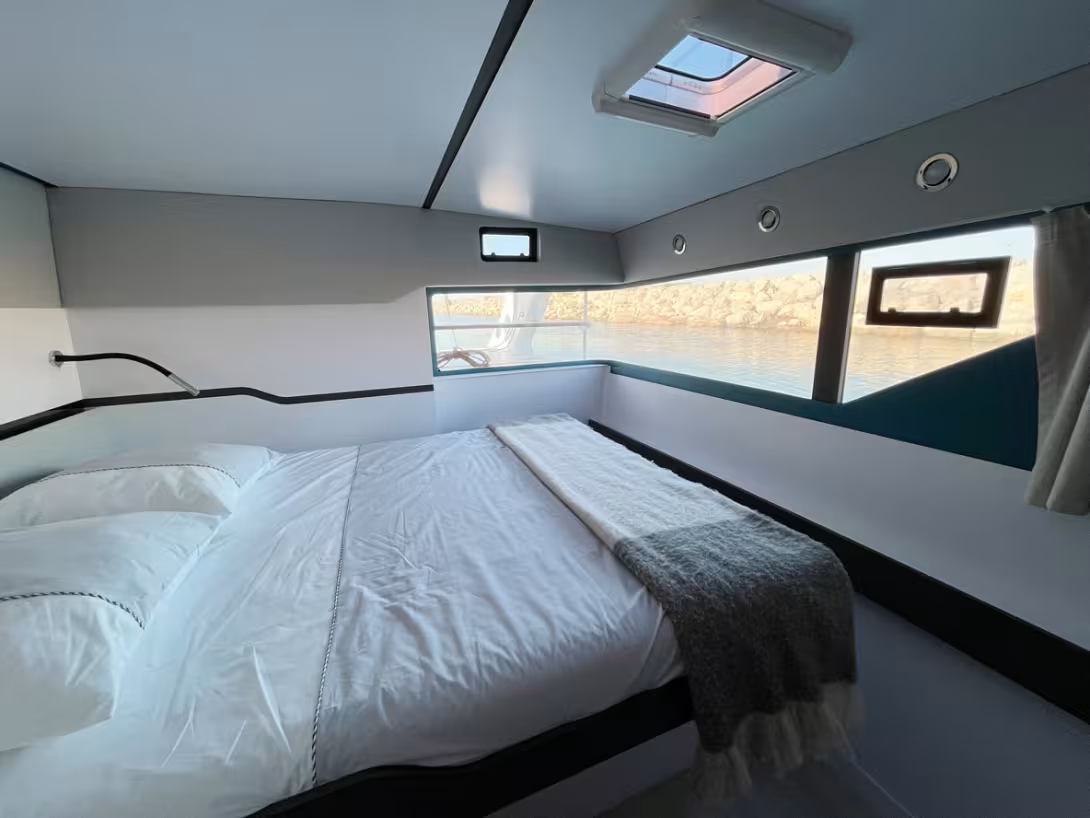
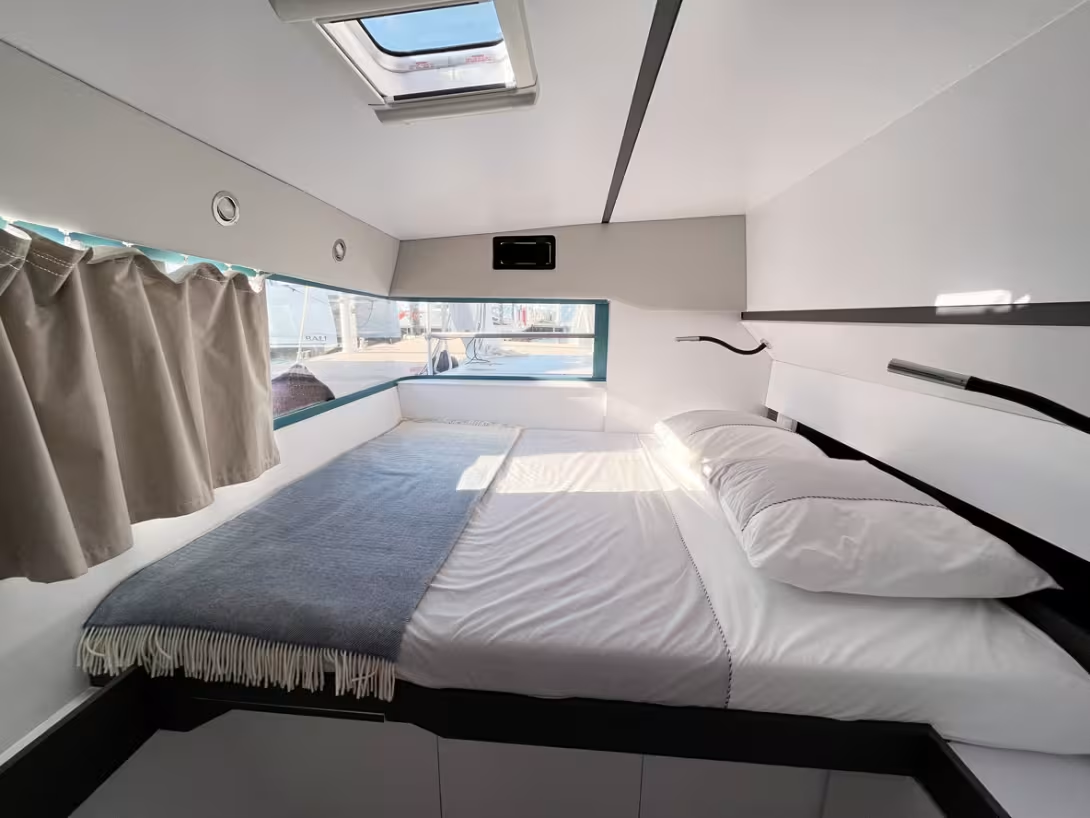
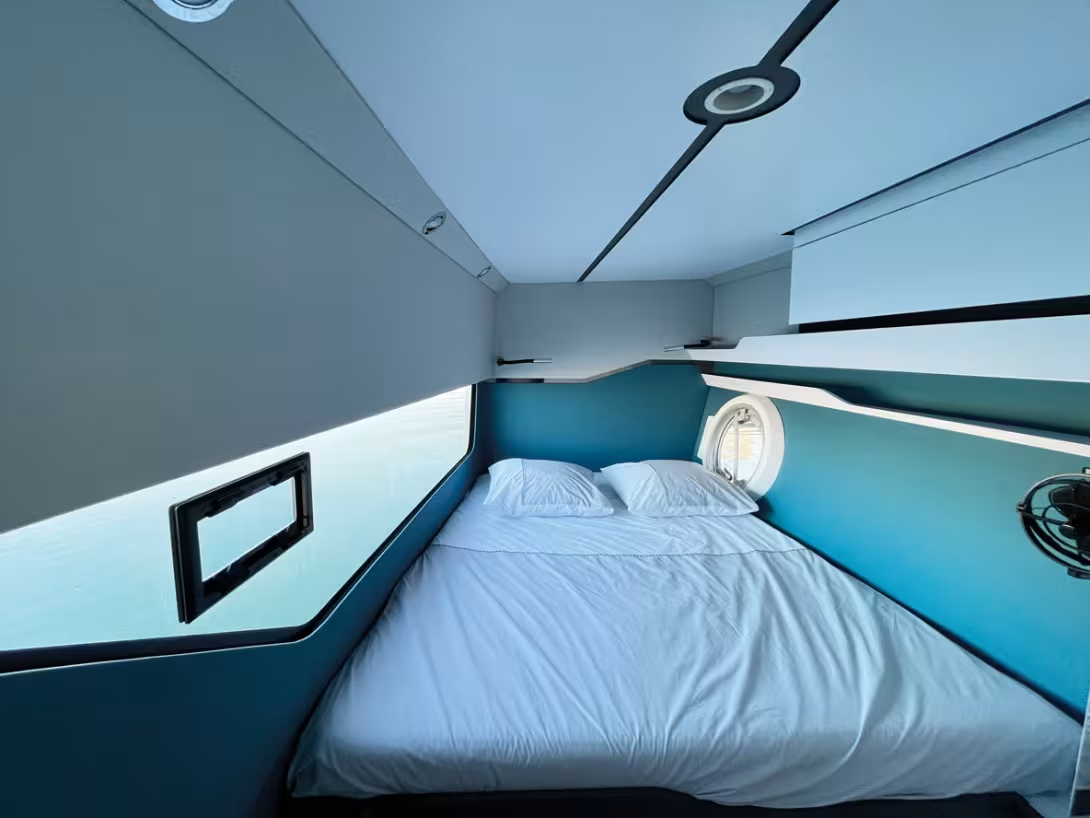
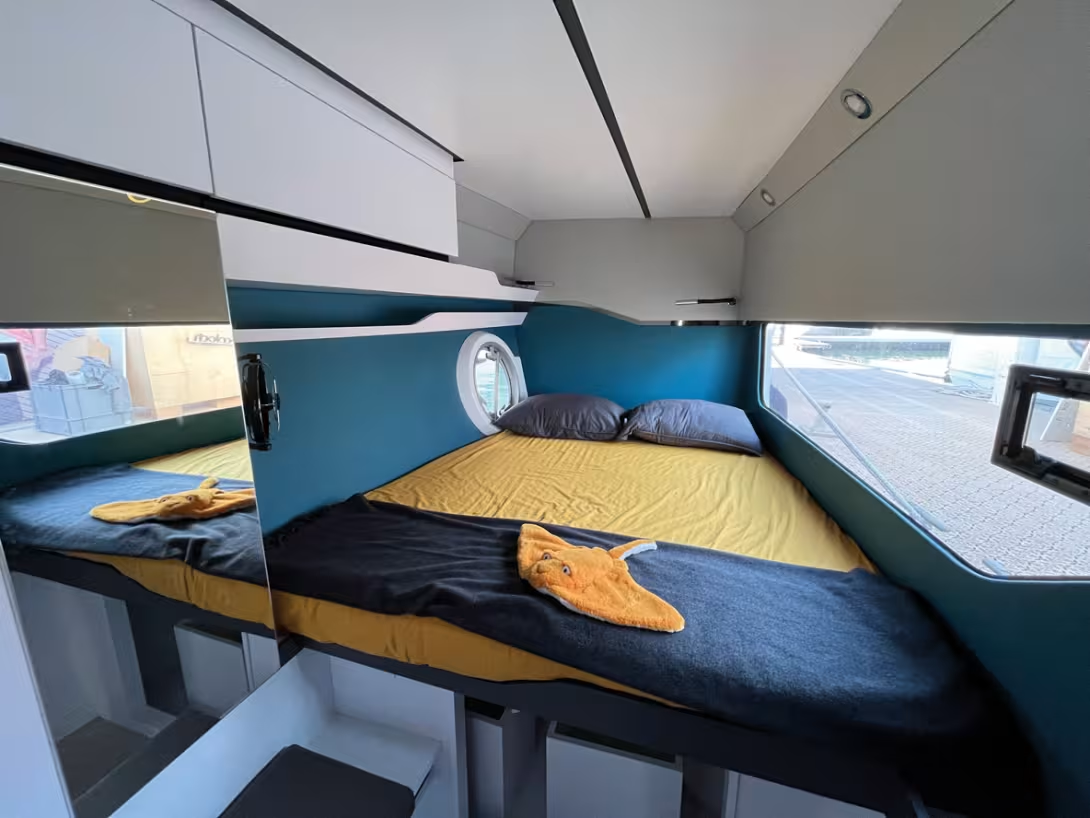
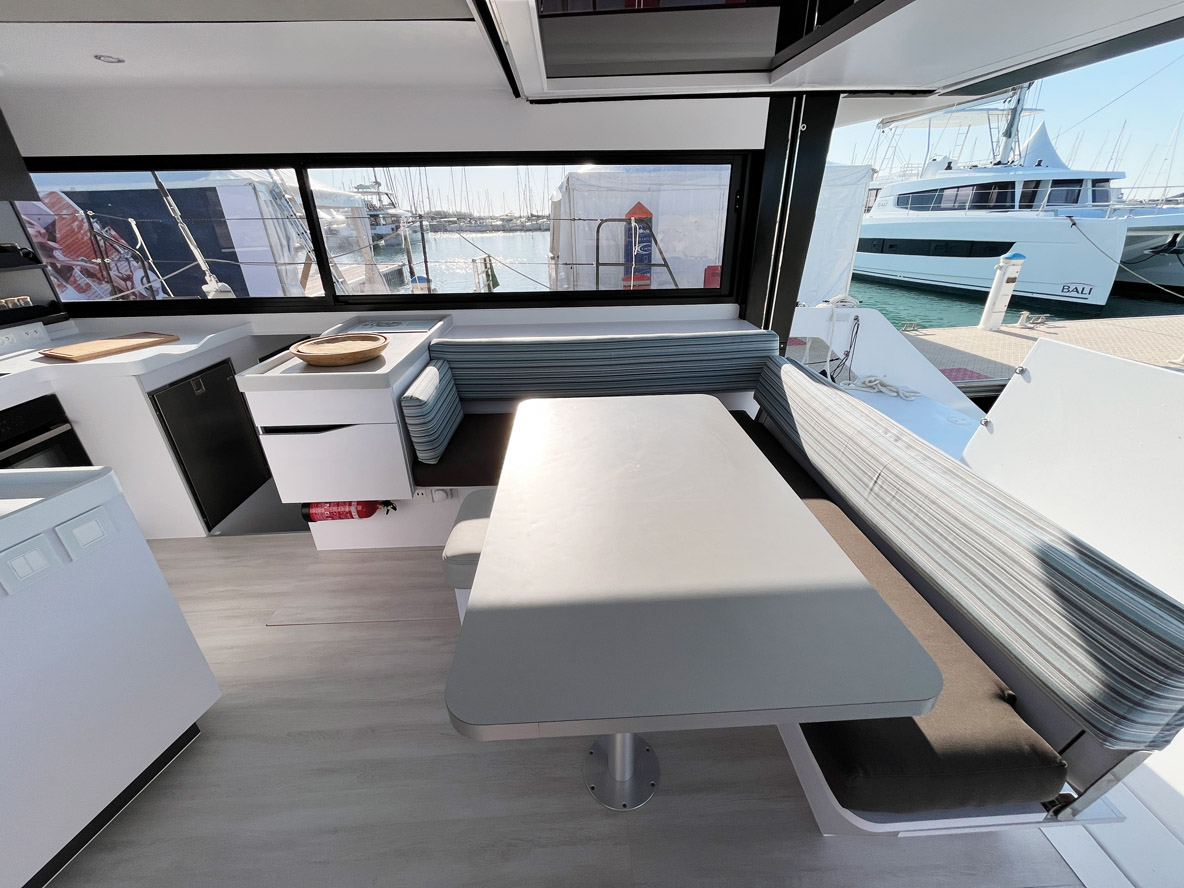
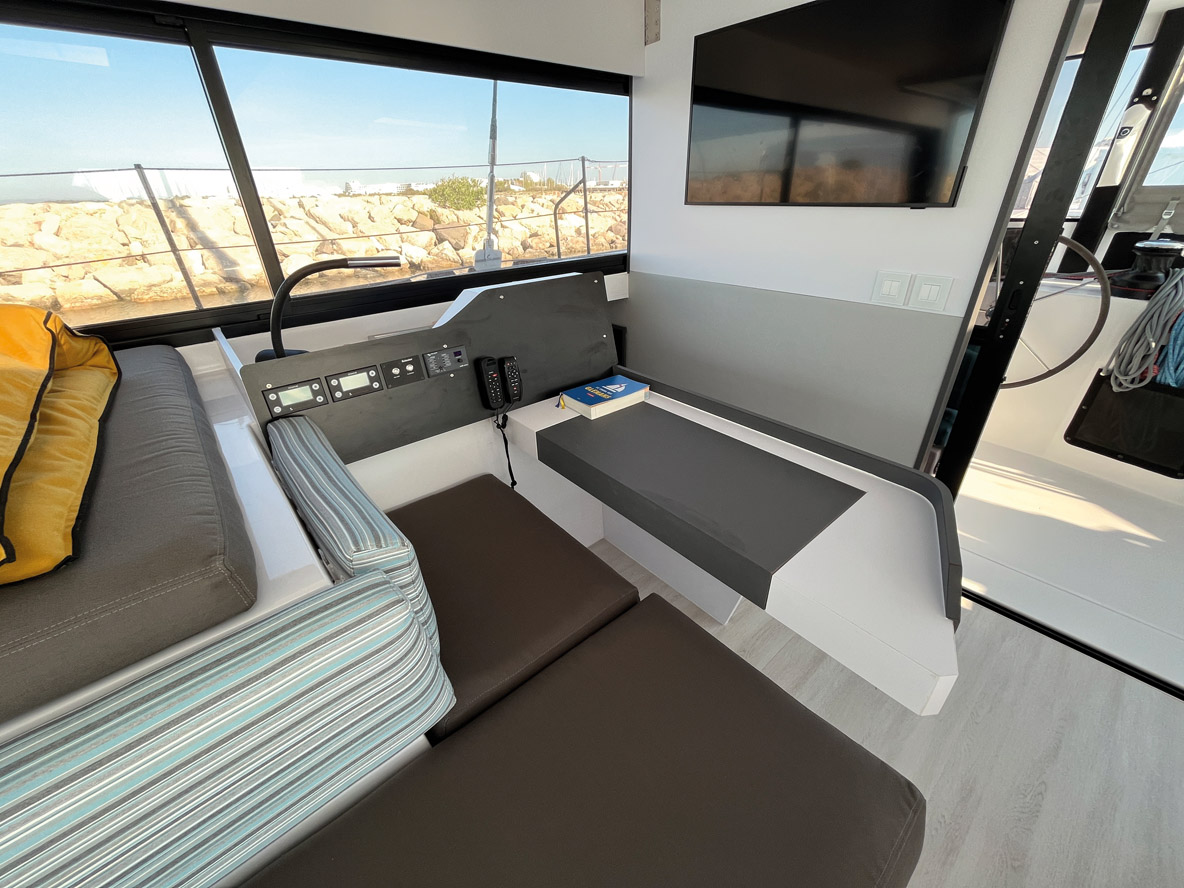
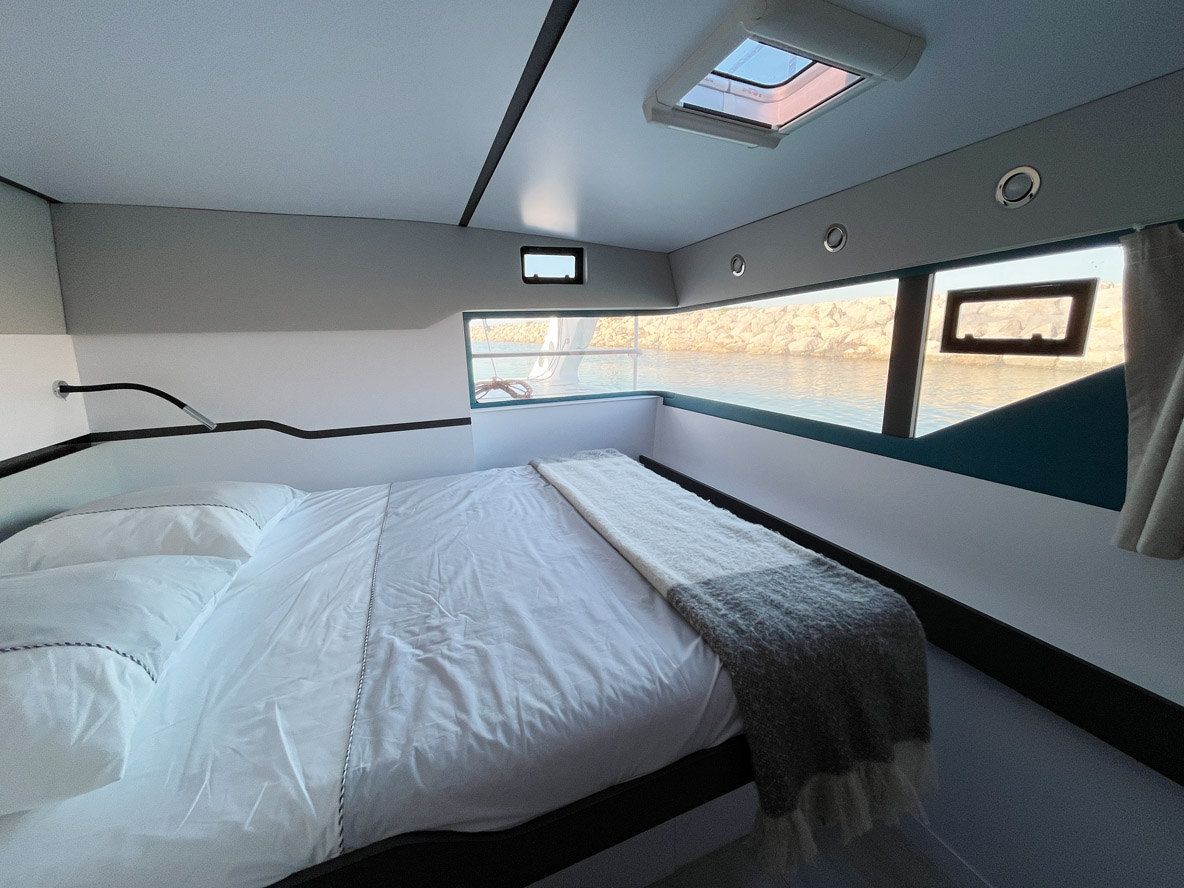
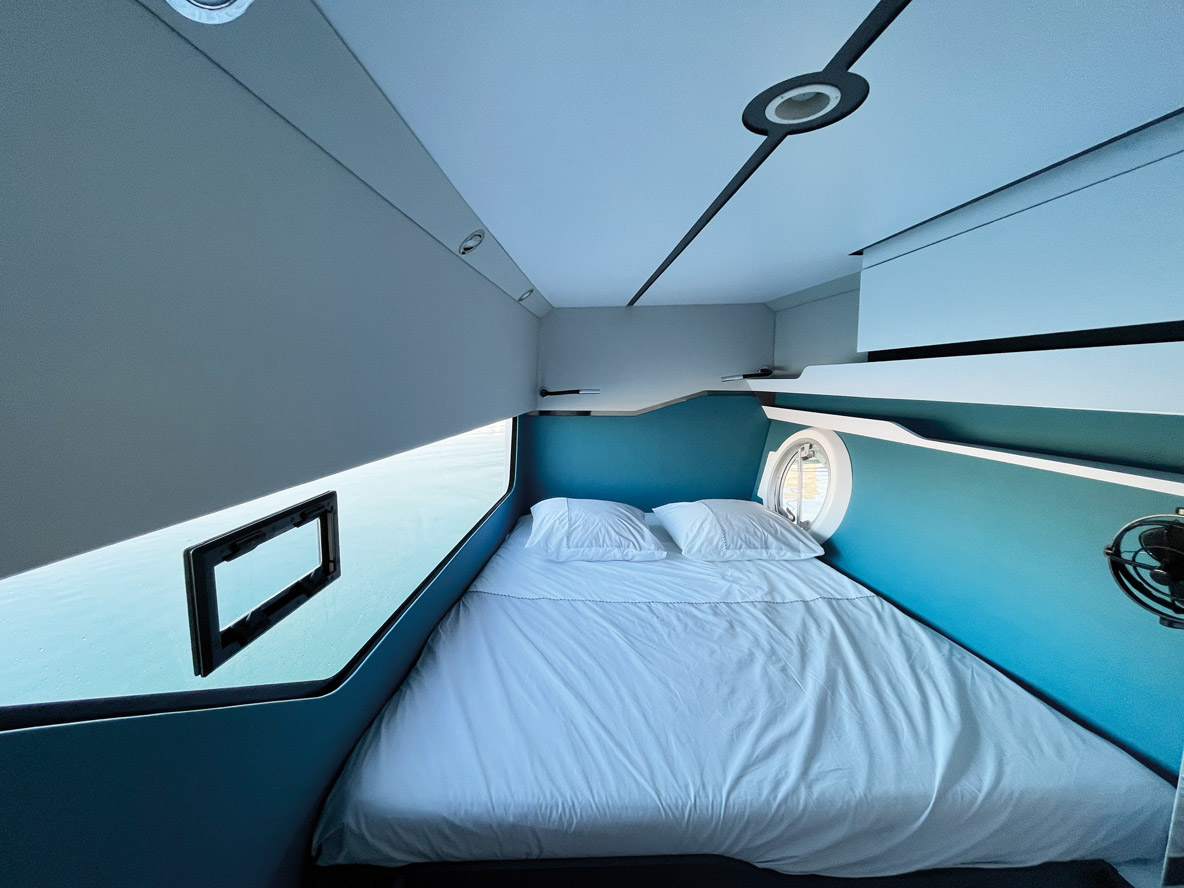
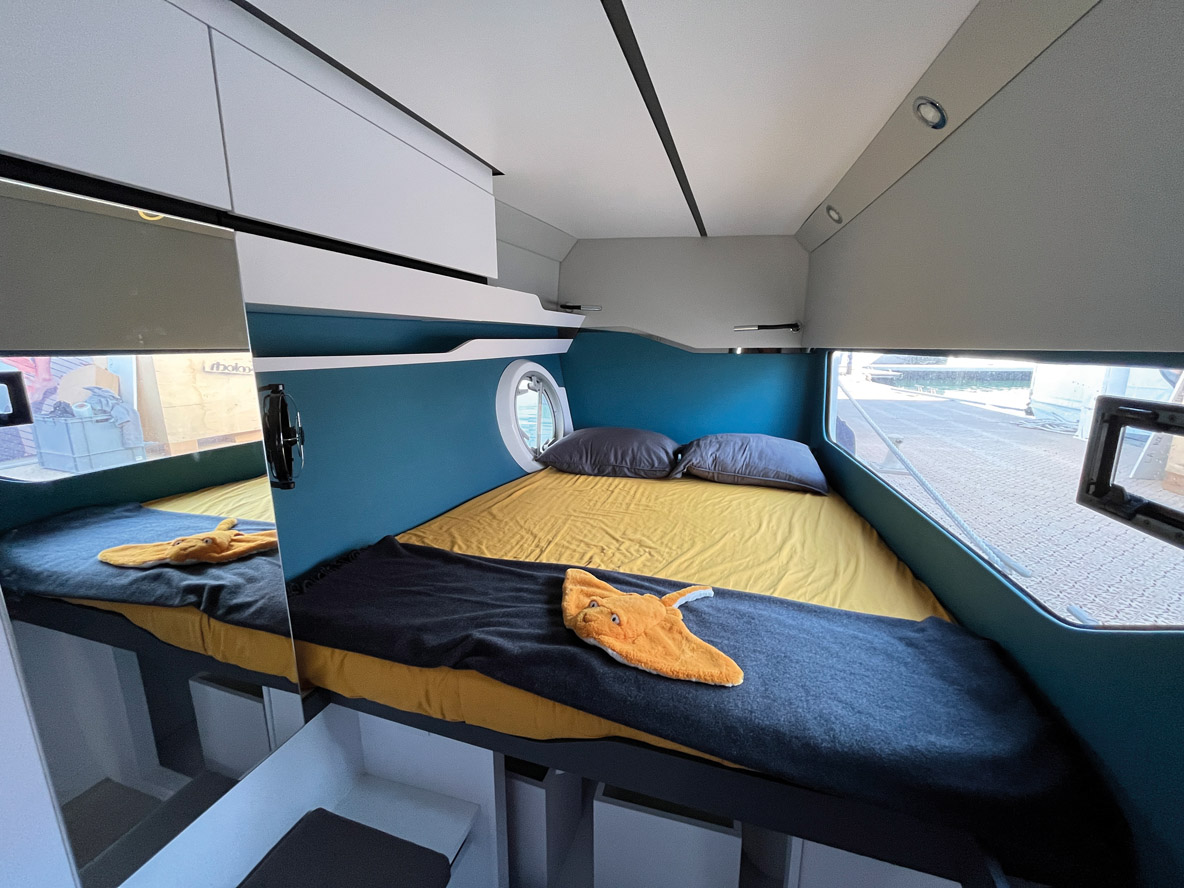
Inside the nacelle, there’s headroom of 6’3” (1.9 m). Compared to the Windelo 50, the 54 offers an extra 18” (50 cm) forward in the hulls - usable for storage and the crew cabin - and 2 feet more (60 cm) aft - used for the nacelle and the rear cabins. Our test model featured a huge U-shaped galley, though an L-shaped configuration is also possible. The saloon is offset to starboard and has a table measuring 55” x 31½” (139 x 80 cm) that can seat six. An extension allows you to push this to 10 guests, but this would hinder traffic flow somewhat in the nacelle. On the port side, there is a vast lounger 46” x 79” (117 x 200 cm) perfect for watch-keeping, with the forward-facing chart table installed just ahead. The hulls house three or four berths, and their headroom is 6’7” (2 m). The ventilation, in addition to the numerous opening panels, has been particularly well designed with air extractors. The berths in the aft cabins measure 6’7” x 5’3” (200 x 160 cm) and these are set athwartships. The large corner windows already seen on the Windelo 50 are the same - these offer an incredible sea view when you’re in bed. At the front, the berths are logically narrower, though - they are still 51” (1.3 m) wide at the feet, though there is no question of island beds... The escape hatches are cleverly used as additional portholes inside the hulls.
A few visual finishing details and the occasional sharp corner deserve to be revised, but overall, the interior of the 54 is very attractive. The Yachting finish offers many more comfort features such as upholstery, but also white anodized rigging, custom hull covering and there are all sorts of optional features offered by the Adventure finish.
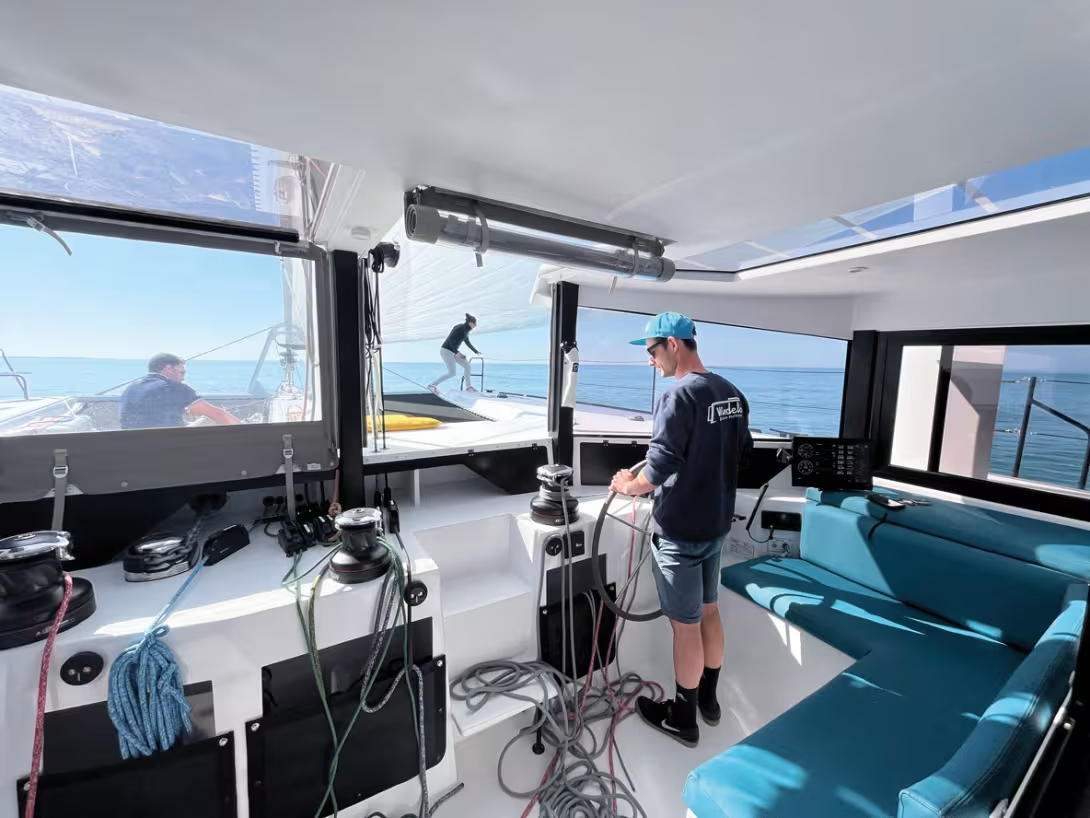
The special feature of the Windelo is its helm station at the foot of the mast. A large area at the very front of the nacelle is therefore dedicated to maneuvering (lines return to three winches, between the two steering wheels). This area can be open on the foredeck and the nacelle or completely closed depending on the conditions. The main advantages of this forward cockpit are first of all a direct contact with the sail plan, with a reduction of the length of the various lines and therefore a reduction in friction, but also the possibility of sail handling in the dry. User-friendliness has also not been overlooked, with two corner seats.
 |
 |
 |
The saloon can seat 6 guests - or even 10 by using the table extension and additional stools.
The galley is offset to starboard and can be arranged in a U or L shape.
A chart table is forward-facing, though a cutout in the bulkhead would allow a view of the water in front of the bows.
Some figures from the manufacturer to help understand
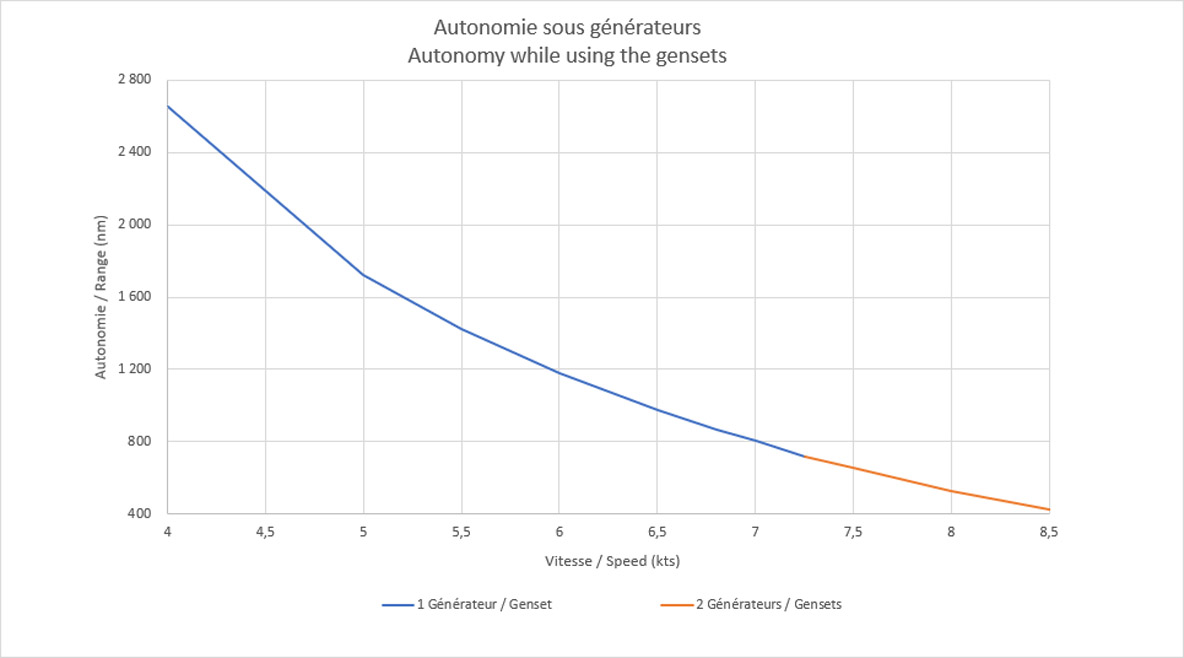
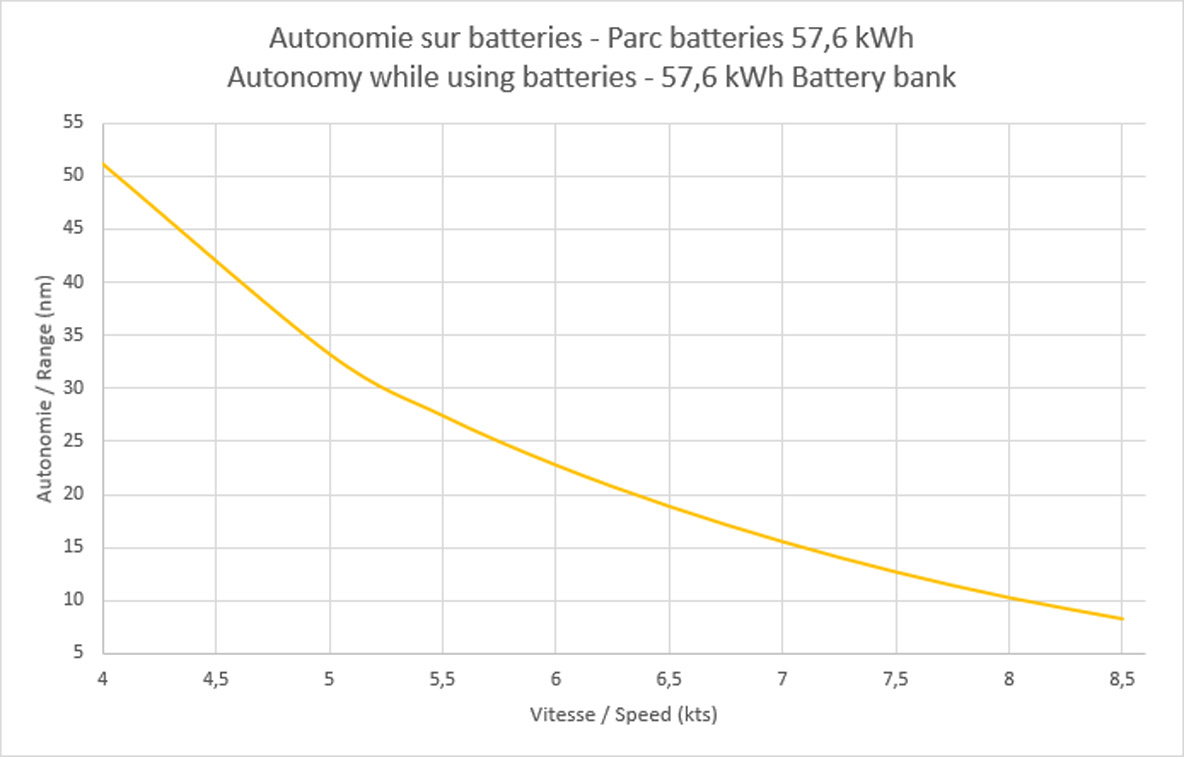
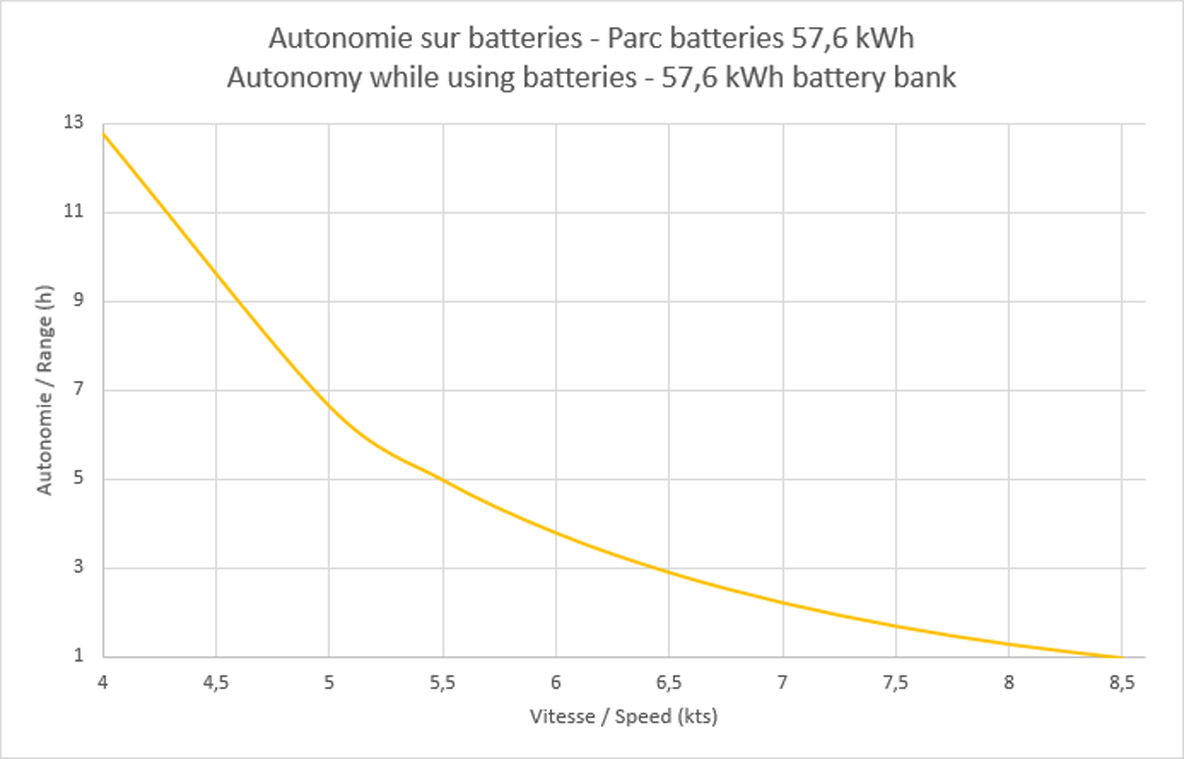
Charging time for the 48 V bank from 20 to 80%* of charge
- 4,500 Wp panels: 1.8 days (22 hours of charge)**
- 3,300 Wp panels: 2.4 days (29 hours of charge)**
- Hydrogeneration at 11 knots under sail: 1 full day of sailing
(*) Given that the range of discharge/charge will be between 20% (manufacturer’s minimum) and 80% (the same as for a car) for an optimal longevity of the batteries.
(**) OEM data taking into account the effective performance
These battery charging times are theoretical, based on separate charging and discharging periods as would be the case for a car, and without considering that the various energy sources and up being combined (solar and hydrogeneration, with the optional addition of wind generators, for example, to broaden the green energy supply). In real-life use, the catamaran is in a scenario of simultaneous load and consumption. The main thing is therefore to have an energy balance using the energy mix that we choose.
To illustrate the above data, here are some scenarios in realistic use:
These examples of consumption developed by the engineering office (and confirmed by real use data) show that:
- A Windelo 54 equipped with 4,500 Wp of solar panels produces 18 kWh via solar per day (calculation taking into account the yield indicated by the equipment manufacturer).
- Consumption by on-board equipment and navigation instruments (including the autopilot) is 13 kWh per day.
- Consumption cruising under electric power is 5 kWh per motor.
- If you don’t do any motoring, you consume just 2/3 of what the panels can produce over 24 hours (for life on board, including watermaker, etc. and navigation equipment). The energy balance is therefore positive by up to 5 kWh (making available 30 minutes of full electric autonomy for motoring).
- Solar energy covers the navigation equipment (including the autopilot) and all life on board requirements by being very generous to the equipment in operation.
Scenario 1
A day of coastal sailing with no wind:
Going out for a day trip with a recharged battery bank (so 48 kWh of battery capacity available before recharging required) you could, in the total absence of any wind, navigate on average 4 hours under motor at a speed of 6 knots. If it were a sunny day, you would be recharging your batteries in parallel thanks to the solar energy being able to spread out across the life on board requirements and navigation equipment. At the end of the day, if you wanted to recharge the batteries in order to be able to enjoy 4 hours’ motoring the next day, you would have to fire up the generator (not more than 40 minutes – 0.6 US gal/2.2 liters of diesel) or connect to the shore power (upwards of 5 hours).
Scenario 2
Coastal day trip where you can sail:
Let’s imagine setting out for a day of boating with a recharged battery bank, where you’re under motor for 2 hours (20,000 Wh consumed) for port or anchorage maneuvering, then typical use for navigation and life on board equipment (13,600 Wh consumed). Wind conditions are good and allow you to sail at 11 knots, thus allowing you to hydrogenerate 1,500 kWh. 4 hours of hydrogeneration and the production of 18,000 Wh by the solar panels will allow you to arrive back at the anchorage in the evening with full batteries.
Scenario 3
Offshore passage making (For example 5 days under way from Las Palmas to Cape Verde):
Let’s imagine departing with full batteries and no wind with the use of electric motors for 4 hours at 6 knots, then sailing afterwards. The batteries would be fully recharged after 30 hours of hydrogeneration, while the navigation and comfort equipment consumption is absorbed every day by the solar panels. So you have a multihull that’s totally autonomous in green energy and you’ve still got 4 hours of motoring autonomy to get into port.
Peaks at 20 knots!
The slip where the Windelo 54 was moored, wedged in between a corner of the pontoon and the west dock of the port, made for an excellent opportunity to gauge the maneuverability of this large catamaran.
The Windelo crew is young and dynamic: warps were retrieved quickly, and Julie Rosière, the shipyard’s Marketing and Communication Manager, stationed herself in the right spot with her roving fender. The Windelo made its turn, pivoting in its own length. Outside, the sea was particularly calm and the wind didn’t exceed 5 knots. With its 1,076 sq ft (100 m²) square-topped mainsail and 1,819 sq ft (169 m²) gennaker, the Windelo 54 managed to glide along at 4 knots.
The day before, the wind was much stronger, with the wind instrument displaying between 15 and 22 knots. On a long run under Code 0, the catamaran was making between 16 and 17.5 knots. Under mai sail and solent, the speed was still 12 knots. The builder promises a top speed of 20 knots - a performance indeed within the reach of the 54. The daggerboards allow for good closehauled sailing, and for picking up again easily having gone through a tack - the catamaran doesn’t crab at low speed but is straight away on the new heading.
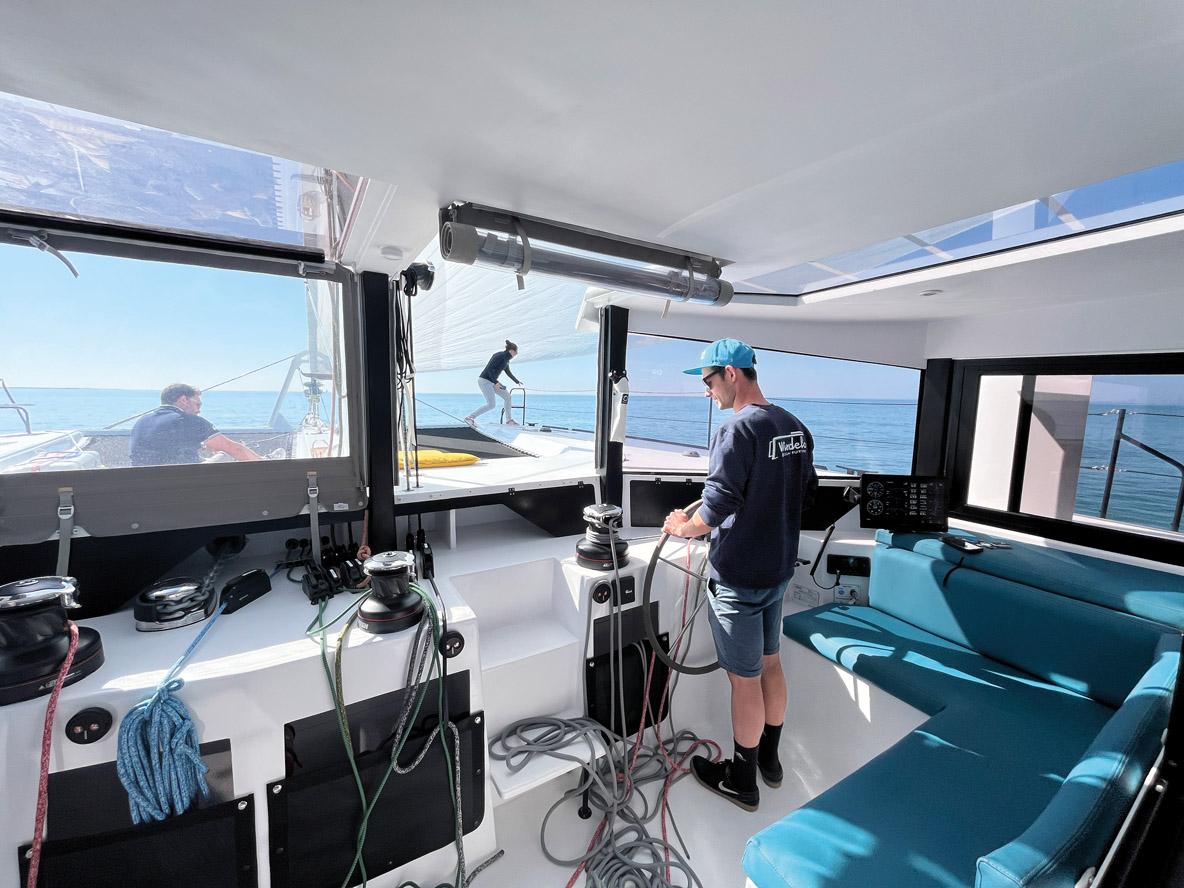
Like on a Gunboat, the forward cockpit combines all the maneuvers and the helm station.
Conclusion
The Windelo shipyard – in the same way as Vaan Yachts - has a special place in the multihull market: this new builder has made respect for the environment a priority, right from the start. The Windelo 54, with its new recyclable and less polluting materials, shows that important evolutions are possible in boatbuilding. In terms of use, the 54 still plays the green card, with an electric motor and advanced production systems. This first model is destined to be operated as a charter boat out of Hyères in the South of France, demonstrating that green sailing is not just intended and reserved for a particular clientele of committed owners.
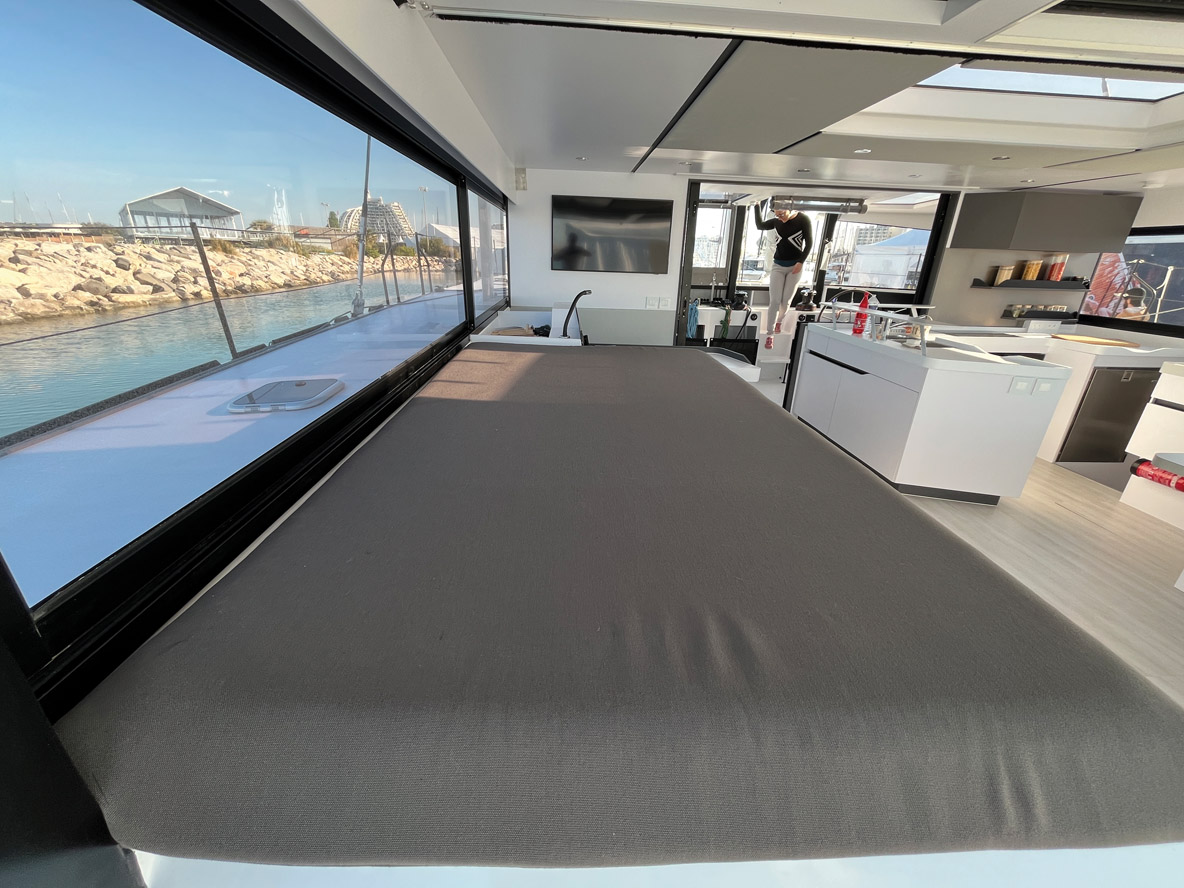
This big lounger is ideal for relaxation or settling in for watchkeeping.
LES + :
+ Excellentes performances
+ Poste de barre/manoeuvres très convaincant
+ Possibilité d’ouvrir la nacelle
+ Hublots d’angle des cabines arrière
LES - :
- Nombreuses options peu écoresponsables
- Manque de rigidité de la porte basculante
- Niveau général de finition à améliorer
 |
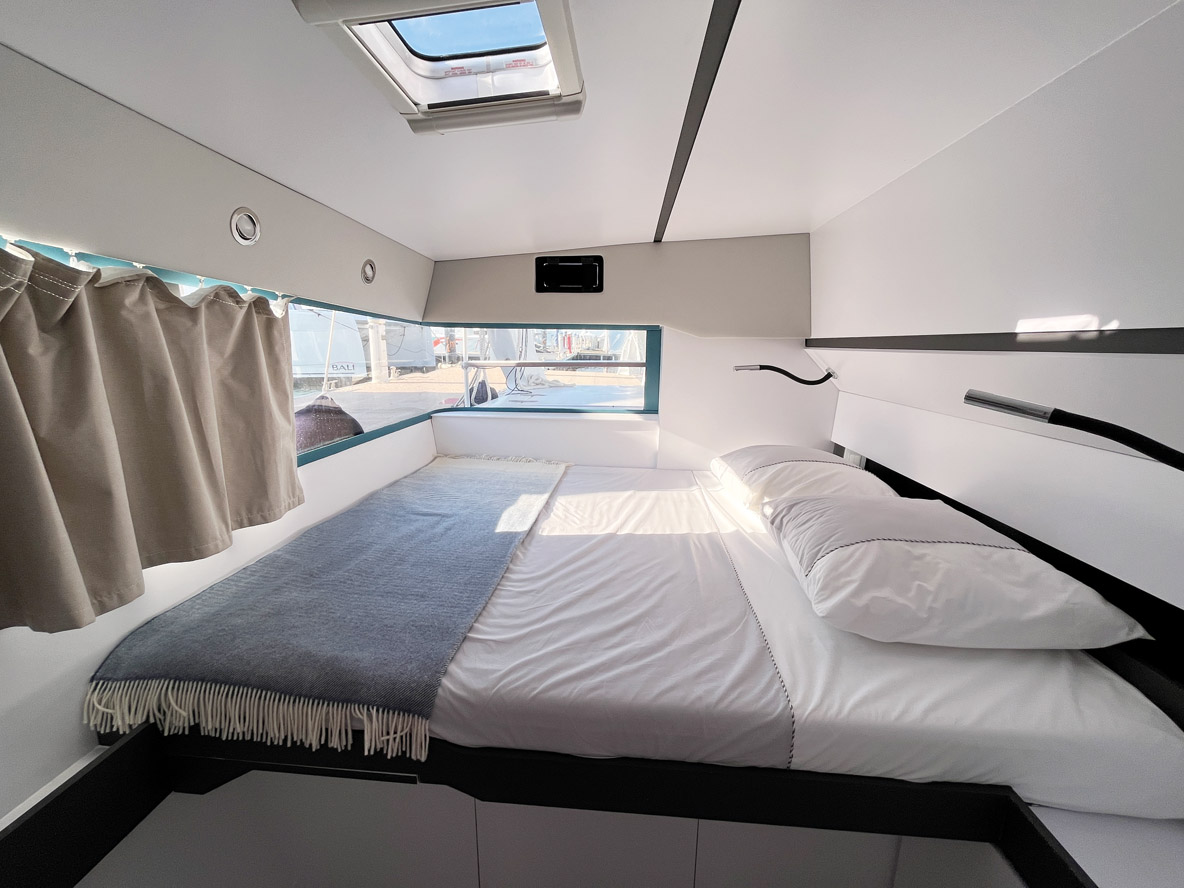 |
The aft cabins are equipped with transverse berths and a corner window offering a breathtaking view.
TECHNICAL SPECIFICATIONS
Builder: Windelo
Architect: Christophe Barreau
Material: basalt and PET/PVC foam sandwich
Length: 54’ (16.46 m)
Beam: 26’2” (7.98 m)
Displacement: 28,220 lbs (12.8 t)
Draft: 3’4”/7’9” (1.05/2.35 m)
Mainsail: 1,055 sq ft (98 m²)
Solent: 484 sq ft (45 m²)
Gennaker: 1,819 sq ft (169 m²)
Drivetrain: 2 x 20 kW
Batteries: 1,120 Ah at 48 V
Generator: 1 or 2 x 18 kW
Fuel: 145 US gal (550 l)
Water: 105 US gal (400 l)
Price: € 1,175,000 ex-tax
Price of the tested unit: € 1,277,160 ex-tax
Principal options in € ex-tax
B&G electronics pack: 18,900
Three-blade folding propellers: 4,450
Pulpits with seat: 2,350
2 underwater spotlights: 2,350
Carbon mast: 94,900
Carbon boom: 21,900
Carbon longitudinal beam: 9,900
Carbon bowsprit: 1,900
Hydranet mainsail and self-tacking solent pack: 17,550
Code 0 on furler and fittings: 11,625
1 electric winch 50: 2,650
Flexible solar panels 4,500 Wp: 38,900
Watermaker 13 US gal (50 l)/h: 9,450
Modular electric saloon table: 2,300
4 poufs in the saloon: 1,560
Forward cockpit cushions: 3,250
Safety equipment for 8 persons: 3,850
Dinghy pack 3.50 m (11’6”) with 20 HP outboard: 9,450
Antifouling: 3,950
Mooring lines: 1,950
Preparation, launching, commissioning: 7,500
 |
 |
Forward, the escape hatches also serve as windows... between the hulls.