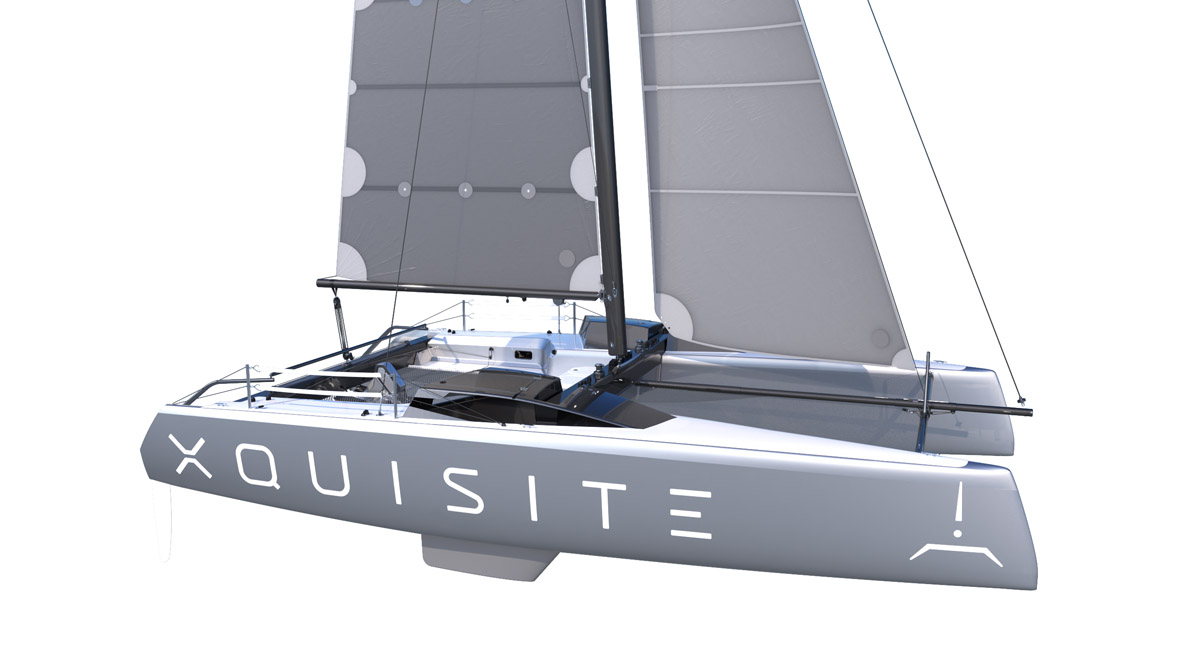
Specializing in cruising catamarans, the South African shipyard has just launched a “big” sports catamaran reminding us of the famous Kat 28 (aka KL 28) from the 80s . A somewhat unique concept in today’s multihull world, yet not without interest. At least, that’s the feeling of those who have made a few tacks at the helm of this original platform.
Infos pratiques
- Le chantier : Xquisite 30 SportCat
- La fiche technique
-
 Découvrez notre vidéo exclusive
- Financez votre Xquisite 30 SportCat
- Assuez votre Xquisite 30 SportCat
- Articles autour du Xquisite 30 SportCat
Conditions: north-easterly wind 6 to 14 knots, calm sea
Xquisite Yachts is a young brand, having been founded in 2014 with the intention of building catamarans that are innovative, solid and high-performance. The range currently includes three sailing models soon to be complemented by three powercats - they’re in the pipeline - all ranging from 30 to 60 feet. The models are for the most part built in Cape Town, except for this 30 SportCat, built in Poland.
After the X5 and the Sixty Solar Sail, two cruising catamarans, the shipyard has unveiled a very different boat, essentially a 30-foot sports catamaran. At first glance, this may seem a surprising turn of events, but once the concept is explained, it makes sense. In fact, this catamaran was originally created for the Xquisite sailing school. Located in Grand Bahama, in the Bahamas, this structure is dedicated to the brand’s 50 or 60-foot customers who need to learn the rudiments of sailing. For this purpose, the shipyard had the idea of creating a multihull that would be easy to handle and safe, yet sporty enough to offer a little thrill and allow customers to feel the effect of the various settings.
Designed for the Xquisite sailing school
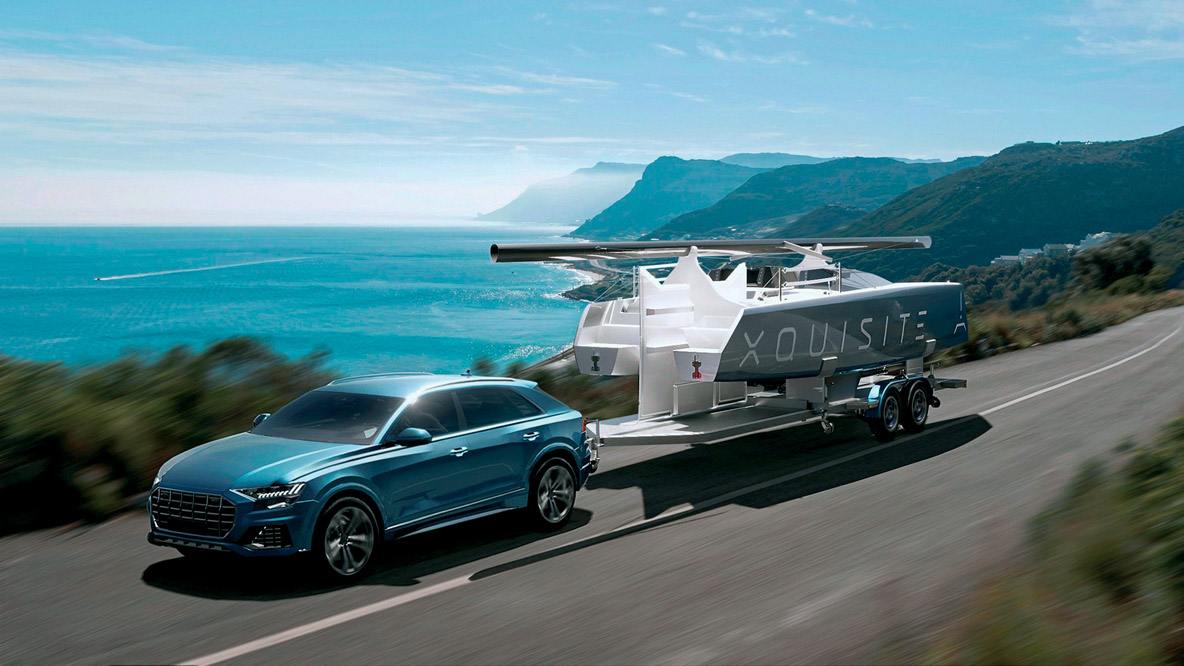
To create the 30 SportCat, Xquisite started with a prototype designed by Yacht Design Collective (François Perus and Romain Scolari) and subsequently modified by the shipyard. The watchword throughout design and construction was to keep things simple. Another challenge was to ensure that the catamaran could be easily transported by road, without having to be declared as an oversize convoy. So, to be towed behind a car, the 30 SportCat can be partly dismantled to fit onto a trailer that can be towed by a simple passenger vehicle - the catamaran weighs just 1,875 lbs (850 kg) empty. Once at the cruising site, it takes around 4 hours to assemble and rig.
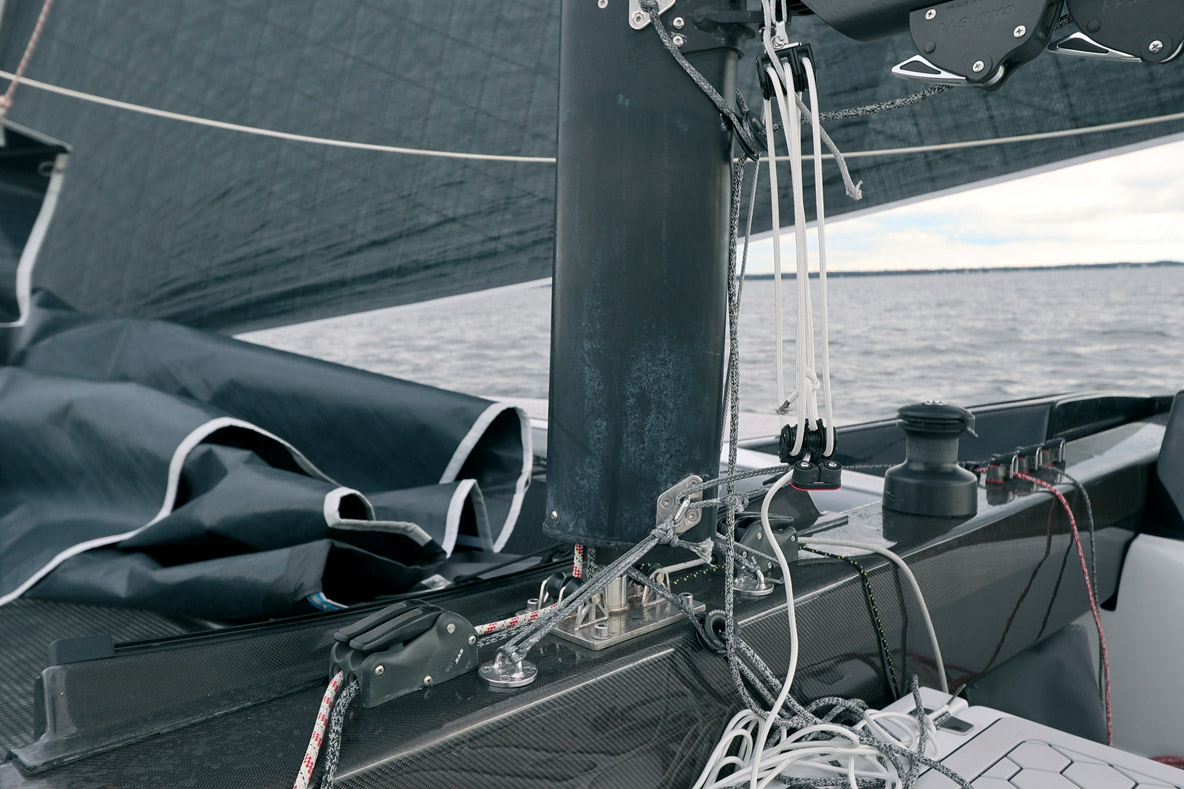
Regarding the construction, the 30 SportCat is made mainly of fiberglass, with a few carbon components. These include the connecting beams, rudders, mast and side stanchions.
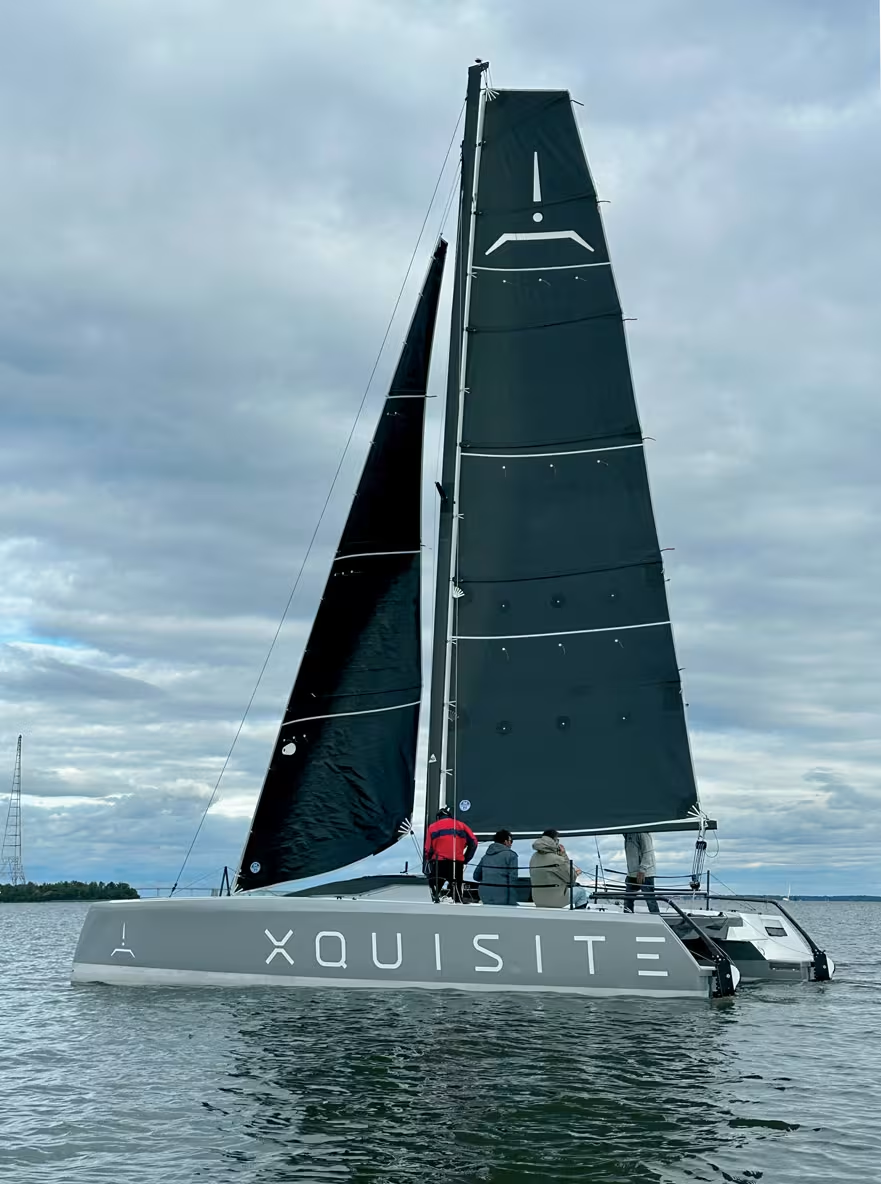
Aesthetically, the catamaran boasts a resolutely modern, sporty look, with totally inverted bows, a gray color with black elements, and 3Di North Sails to great effect.
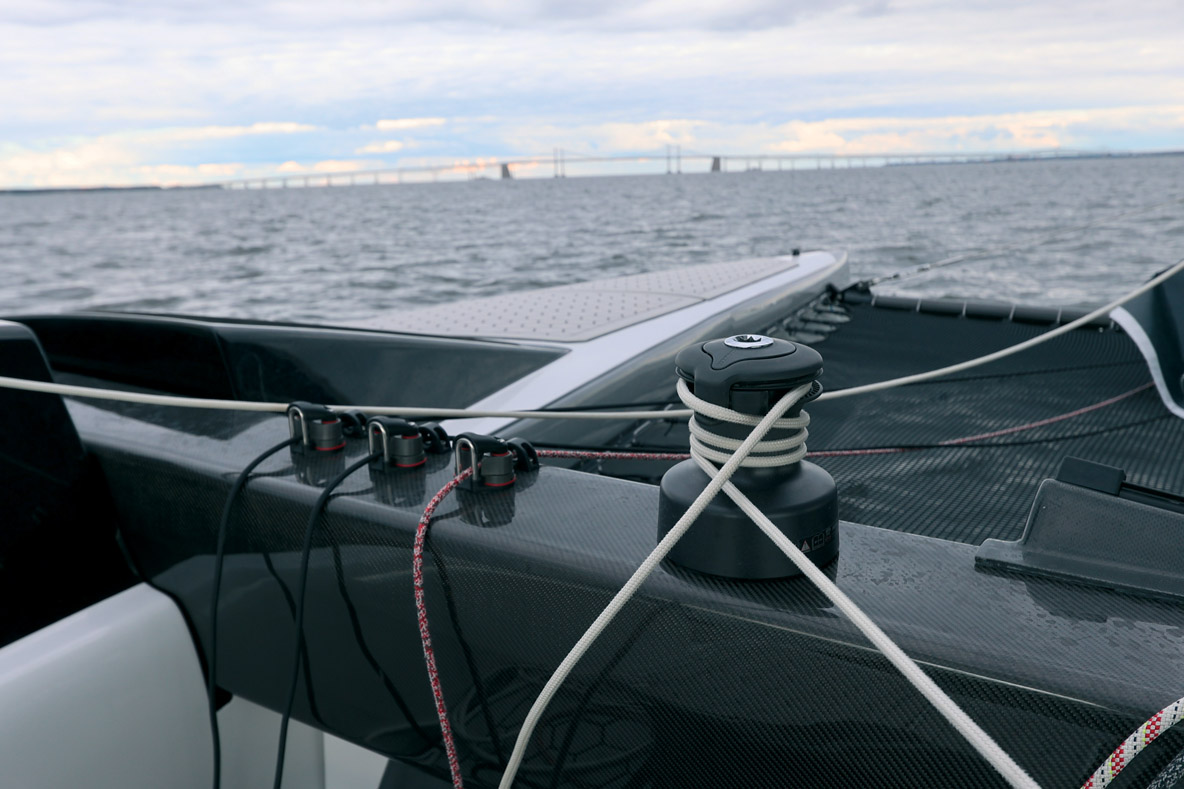
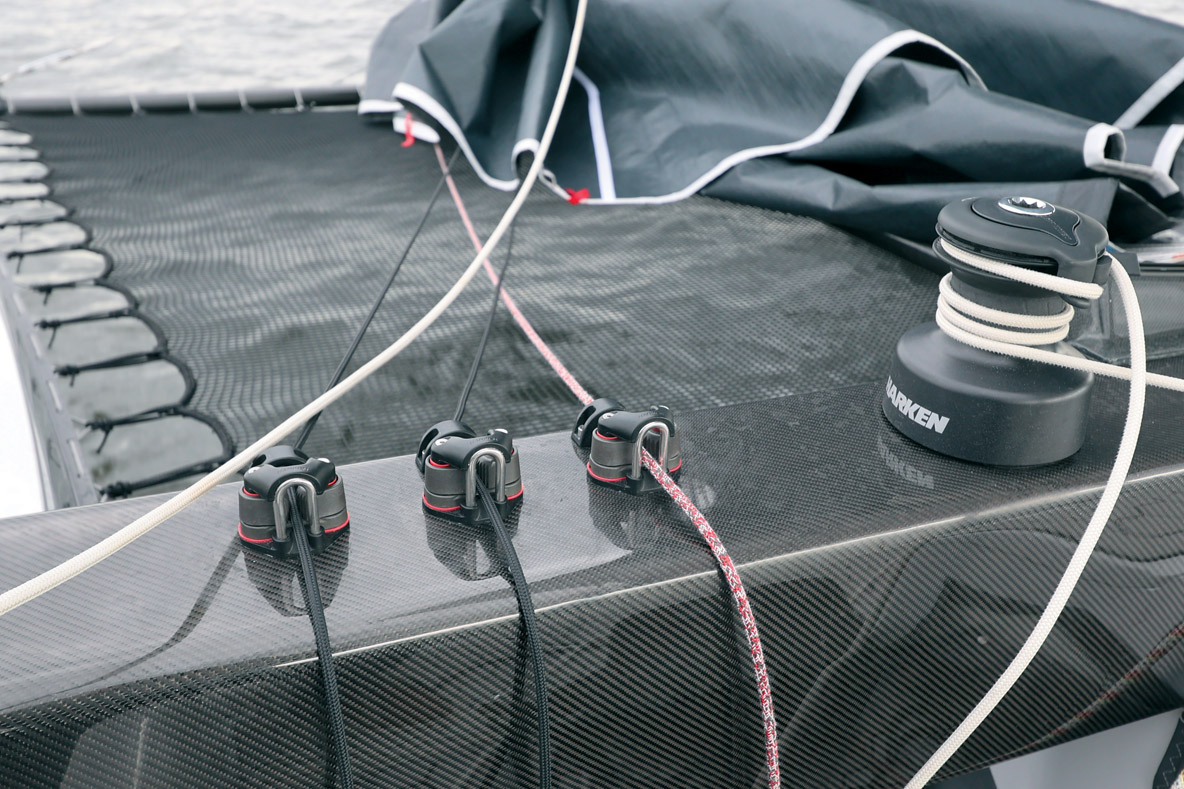
Even when stationary, its tapered lines evoke speed. And it’s not just the overall design that gives this catamaran an impression of speed: on closer inspection, you’ll find a rotating carbon mast to take the wind as far as it will go, and the Harken hardware also give confidence.
Simplicity first
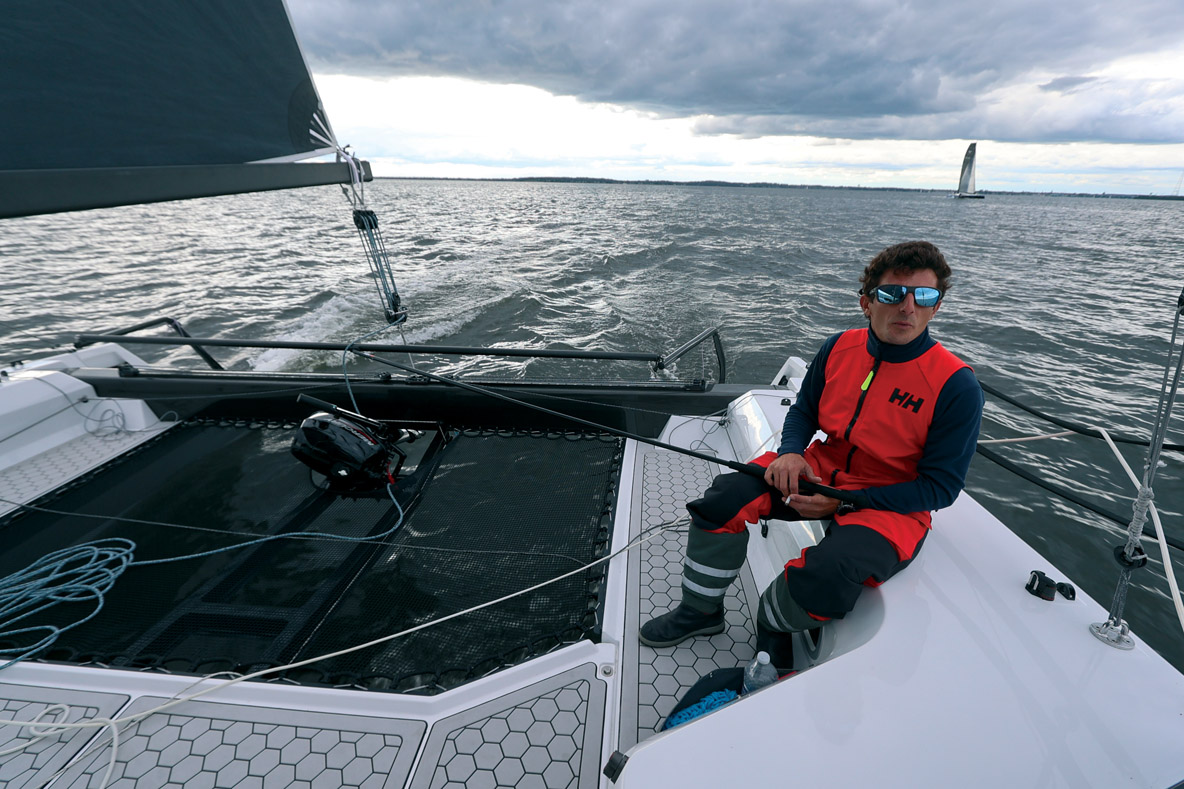
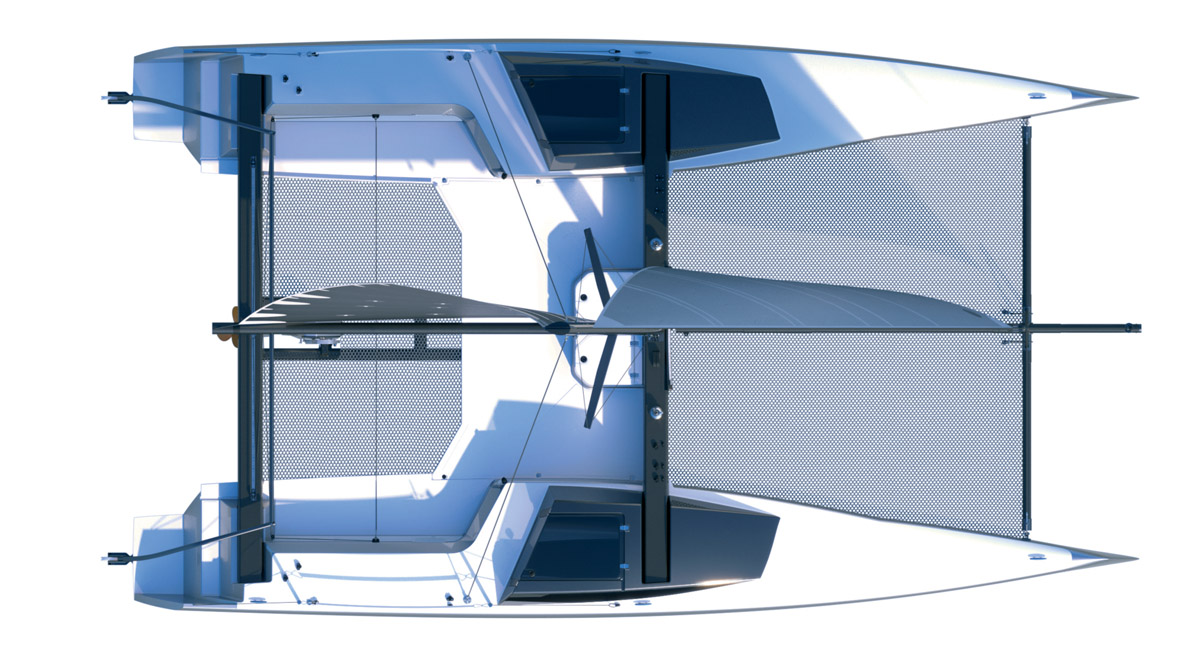
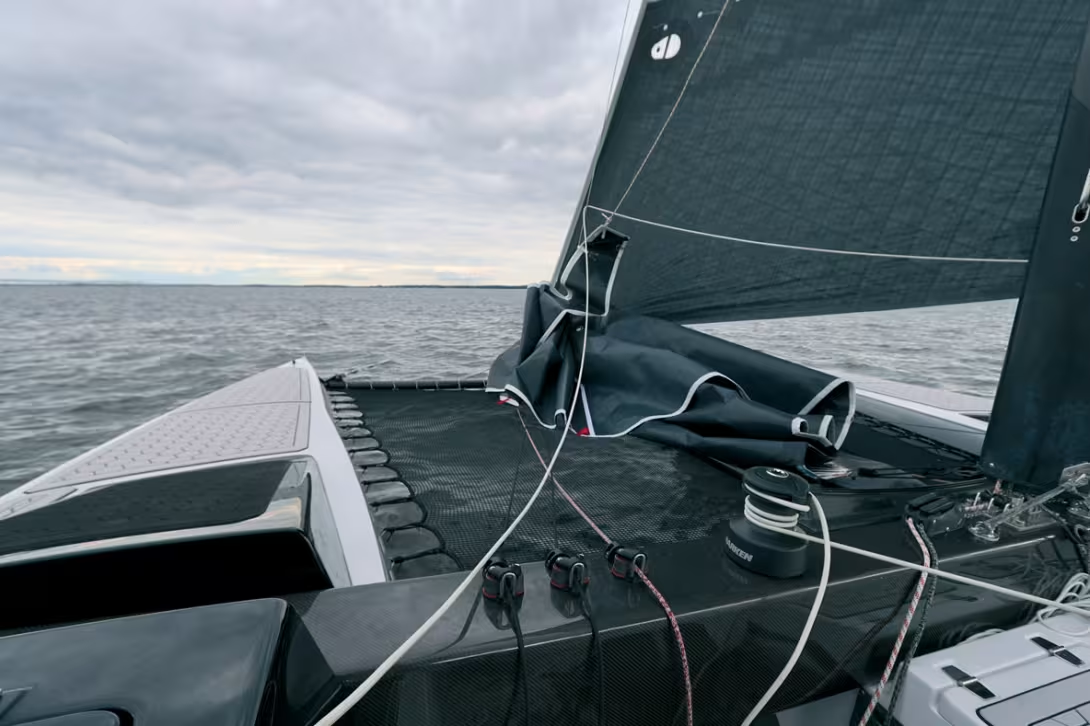
Once on board, simplicity prevails as always. The two hulls are joined by two carbon beams and a rigid central deck. The central beam houses most of the deck hardware, including two Harken winches. A bench seat on each side provides comfortable steering position, while the remaining space between the hulls, fore and aft, is occupied by a trampoline. To facilitate maneuvers, the mainsail traveler is mounted on the aft beam and the catamaran is also equipped with a self-tacking jib.
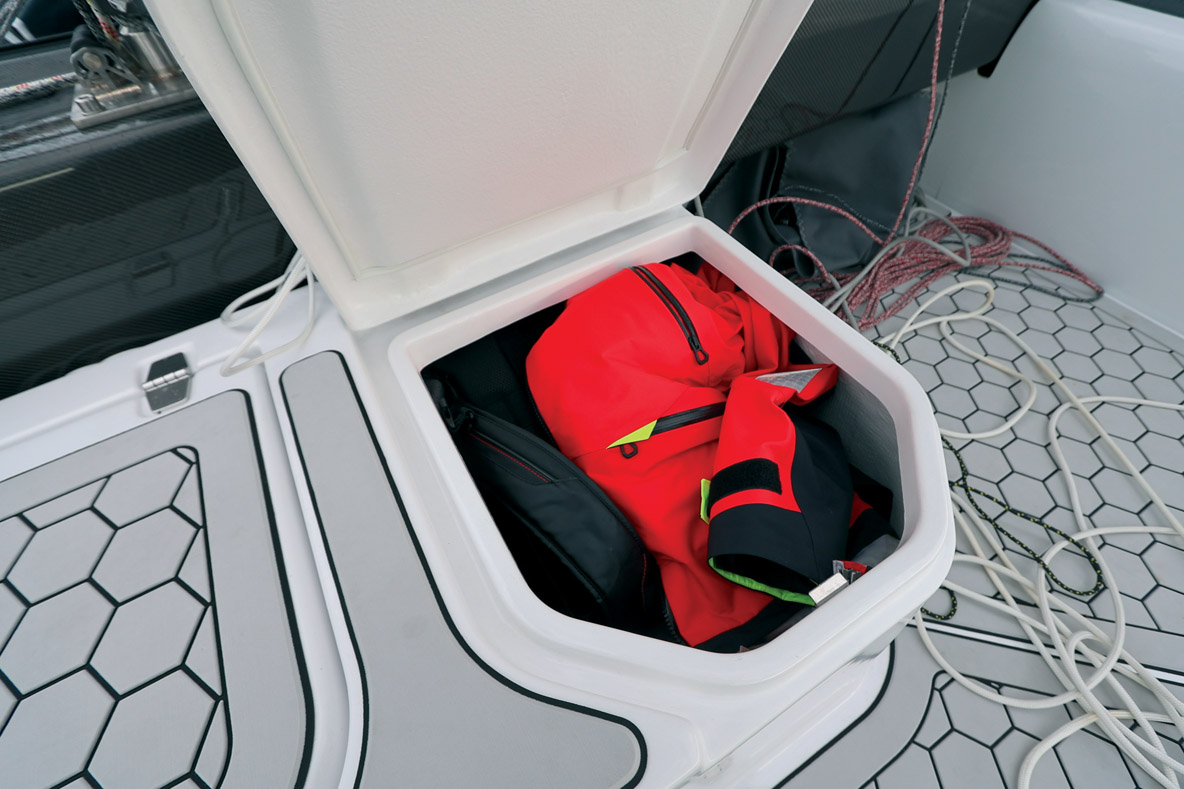
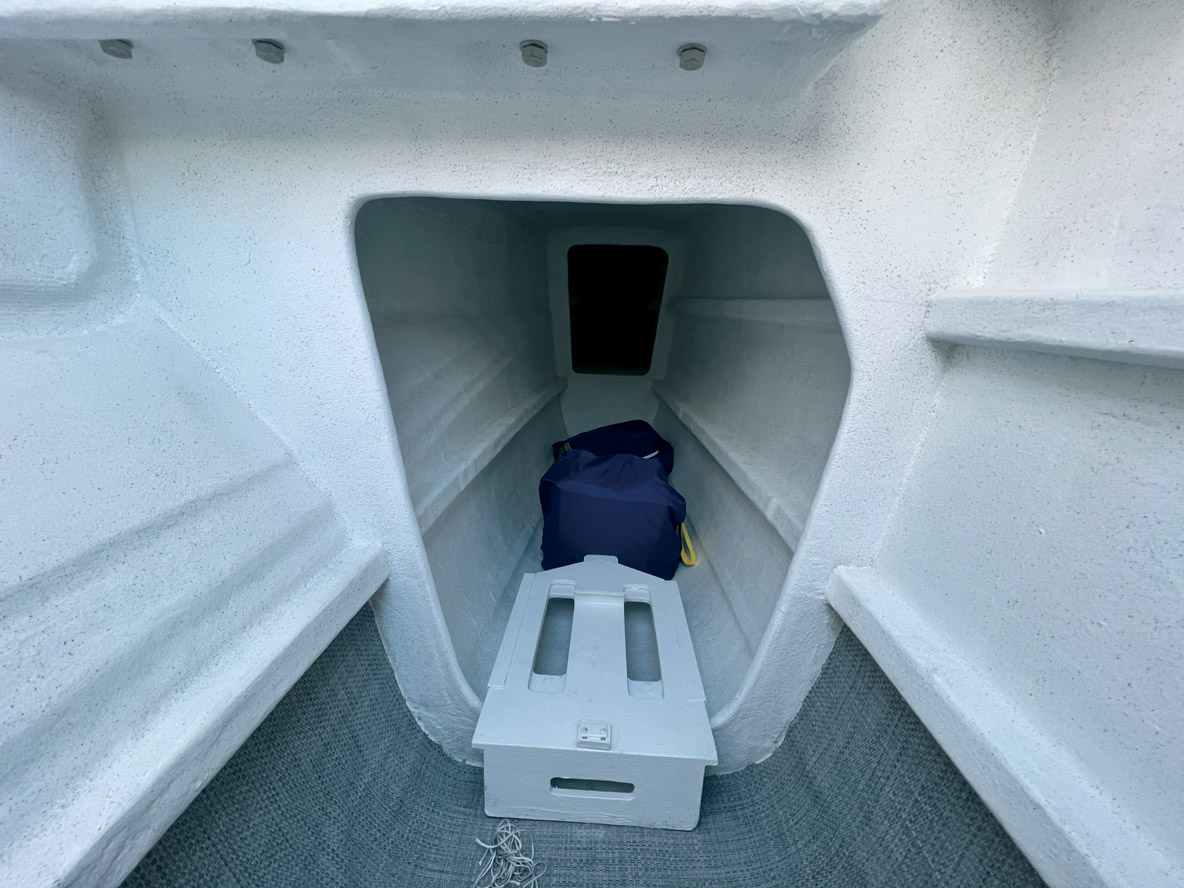
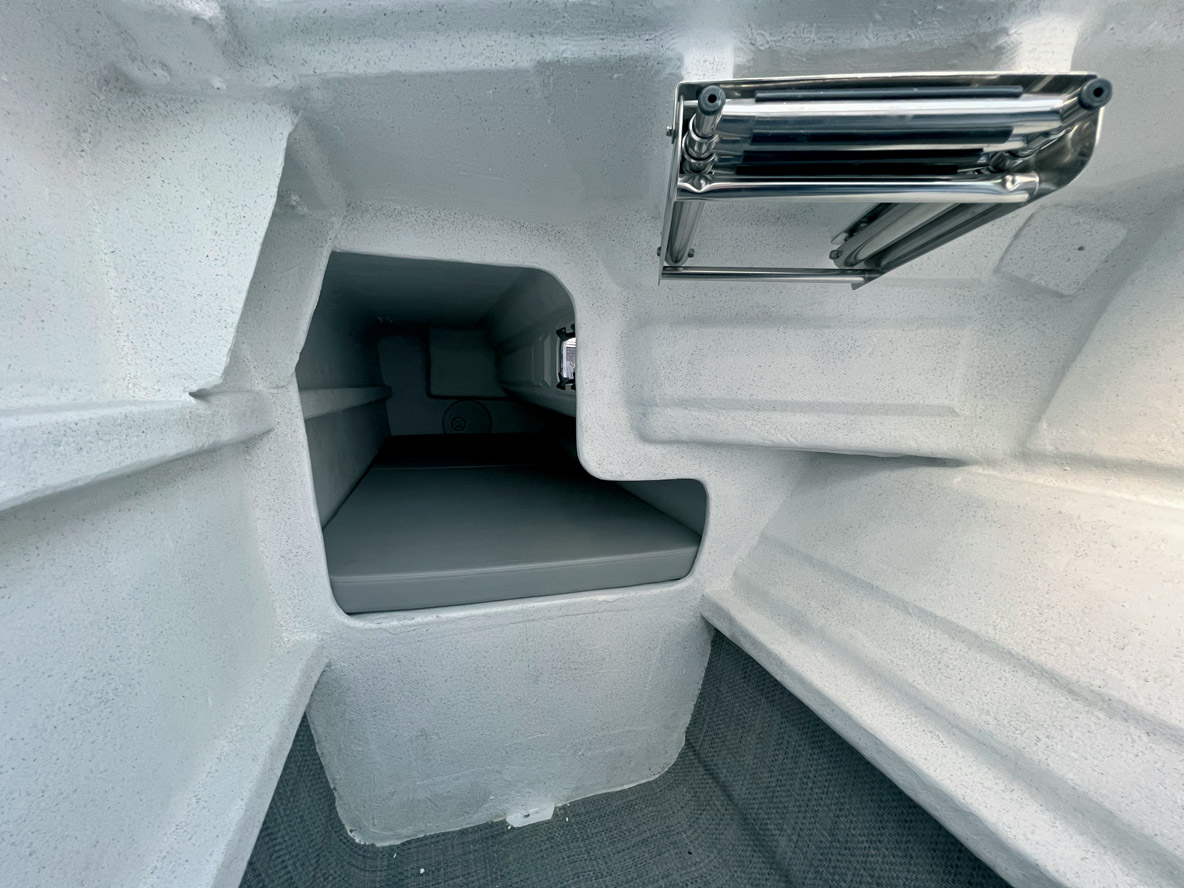
Finally, the interior of the hulls is very spacious. This space has enabled the shipyard to install a single berth on each side, the rest being used for storage or the installation of a chemical toilet. These comfort features make this boat ideal for coastal camping.
Weighing less than a ton, the 30 Sportcat doesn’t need a large sail area to come to life. In fact, the 43’3” (13.2 m) mast provides a sail area of 463 square feet (43 m²) – 312 sq ft (29 m²) for the mainsail and 150 sq ft (14 m²) for the self-tacking jib. Nothing impressive at first glance, but the sail area-to-weight ratio is nonetheless 50 m²/t...
Added to this is a 398 sq ft (37 m²) gennaker. The North Sails mentioned above come as standard, which augurs well for performance.
Less than a ton empty
Once on the water, a light breeze is all it takes to leave the marina. On the day of our test run, the wind was blowing between 10 and 12 knots, peaking at 14 knots. Enough conditions to have fun on the Chesapeake Bay, especially when there are already a few large multihulls on the water. Once out of the shelter, the 30 SportCat takes advantage of the slightest breeze. Because it’s so light, acceleration is straightforward, and you’re soon up to wind speed, if not a little faster. Extremely agile at different angles, the catamaran is at its best around 35° to 40° to the apparent wind. It was precisely at this angle that we took advantage of a light breeze to accelerate to 14 knots, enough to overtake a rival (but a friend nonetheless) multihull, then a second. No doubt about it, the performance is there, and the manufacturer even announces a top speed of 19 knots. This is already a very decent figure, which will soon be surpassed... This liveliness is made all the more enjoyable by the fact that it can be achieved without inordinate effort. In fact, you don’t have to pull on the lines like a madman, nor do you have to systematically trapezing to properly handle this catamaran. However, with a good breeze, an experienced crew and the desire to push this little racer to the limit, you can really enjoy yourself.
Nevertheless, the primary objective was to design an introductory catamaran, and it’s fair to say that not only has the challenge been met, but the result goes well beyond the sailing school’s objectives. The 30 SportCat is very docile and easy to handle. Comfortably seated on a bench, tiller extension in hand, you can enjoy the scenery and the breeze. Another plus point is that the catamaran can accommodate up to eight people on board, making it ideal for day trips. Two small berths even allow you to spend the night on board in camping mode.
Equipment is unsurprisingly fairly basic, but there are a number of interesting options, such as carbon daggerboards, solar panels and even a kite sail.
Another almost indispensable option is the iPad, with its waterproof case containing all navigation data.
Finally, the Xquisite is designed for a small internal combustion outboard motor, but can also be equipped with an electric motor.
Conclusion
A catamaran for pleasure, the 30 SportCat restores light sailing to its rightful place and allows you to rediscover sensations sometimes forgotten on large cruising catamarans. Popular in the 80s, small catamarans have gradually deserted the sub-30-foot multihull market in favor of folding trimarans - with the notable exception of the manufacturer Windpearl. While the commercial future of this new 30 SportCat, priced at nearly $300,000, is not assured, the success seen during its initial boat shows is really encouraging.
Flattering performance
Successful modern design
Limited program
Technical Specifications
Architect/designer: Yacht Design Collective / Perus-Scolari and Xquisite Yachts
Length overall: 30’3” (9.25 m)
Waterline length: 29’3” (8.95 m)
Beam: 16’9” (5.15 m)
Draft: 2’6” (0.75 m) with keels
2’10” (0.87 m) with motor
Mast height: 43’3” (13.2 m)
Light displacement: 1,875 lbs (850 kg)
Laden displacement: 3,196 lbs (1,450 kg)
Mainsail: 312 sq ft (29 m²)
Self-tacking jib: 151 sq ft (14 m²)
Gennaker: 398 sq ft (37 m²)
Berths: 2
Fuel tank: portable gas tank
Water tank: no
Maximum engine: 10 HP
Price: from $285,000 ex-tax
Main options (prices on request)
Carbon daggerboard
Solar panels
Hull paint
Ipad with waterproof case
Electric outboard motor
Trailer
Kite sail