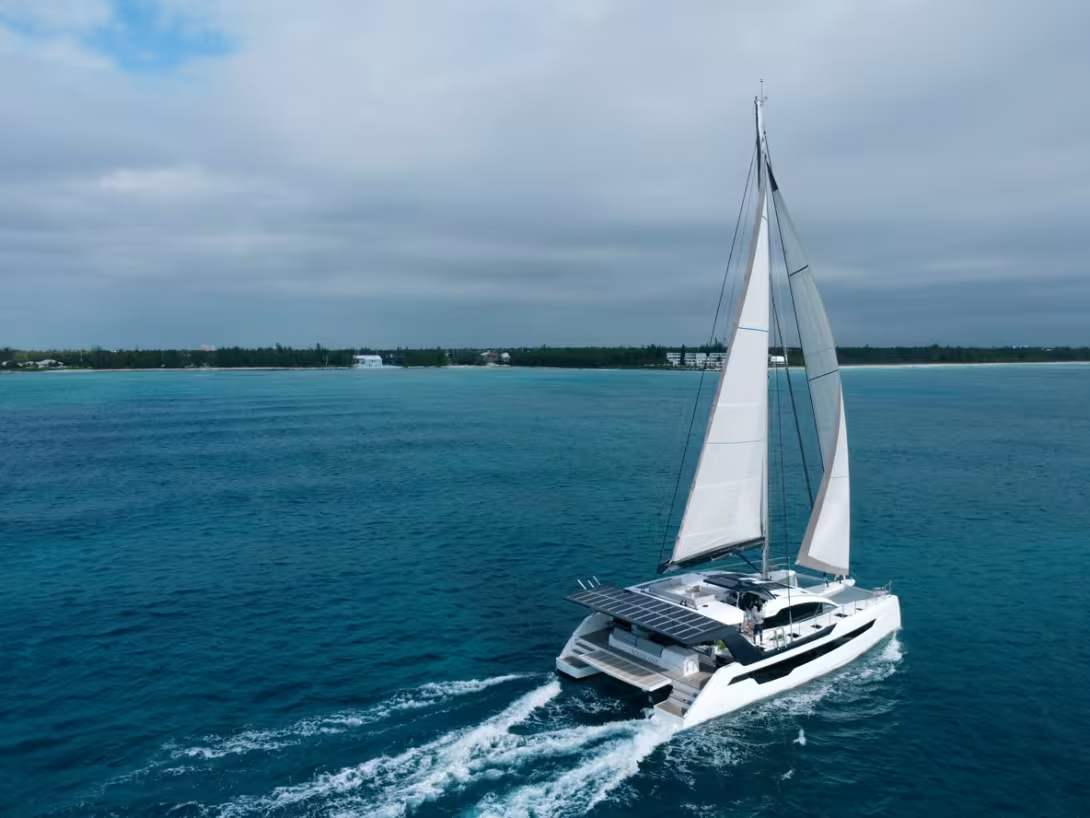
Previewed at the Annapolis Sail Boat Show back in October, the new Sixty Solar Sail enters the (very) large multihull market with a highly accomplished concept, the fruit of over 10 years’ experience. To design this catamaran, the shipyard took all the good ideas from previous models and added customer feedback to design - or at least attempt to design - the ideal multihull. After a few tacks on the Chesapeake Bay, we were convinced by the relevance of this new model.

Infos pratiques
- Le chantier : Sixty Solar Sail
- La fiche technique
-
 Découvrez notre vidéo exclusive
- Financez votre Xquisite Sixty Solar Sail
- Assuez votre Xquisite Sixty Solar Sail
- Articles autour du Xquisite Sixty Solar Sail
Conditions: East wind 7-9 knots, calm sea
The Xquisite Yachts brand is still relatively new to the market, having been created in 2014. From the beginning, however, it has benefited from an experienced team, a factory in South Africa that has nothing left to prove, and above all a determination to do a good job. In concrete terms, Xquisite’s ambition is to offer top-of-the-range catamarans with excellent seaworthiness, many innovations and luxurious interiors. The all-new 60 Solar Sail follows this mantra to the letter. In fact, this catamaran is a logical evolution of the highly successful X5 and X5 plus.
Modern, High-end Design
With this in mind, the team put down on paper all the customer feedback and details and ideas for modifications they’d come across over the years. To this was added a list of things they would like to see in the catamaran of their dreams. A few long meetings later, the concept of the Sixty Solar Sail was born.
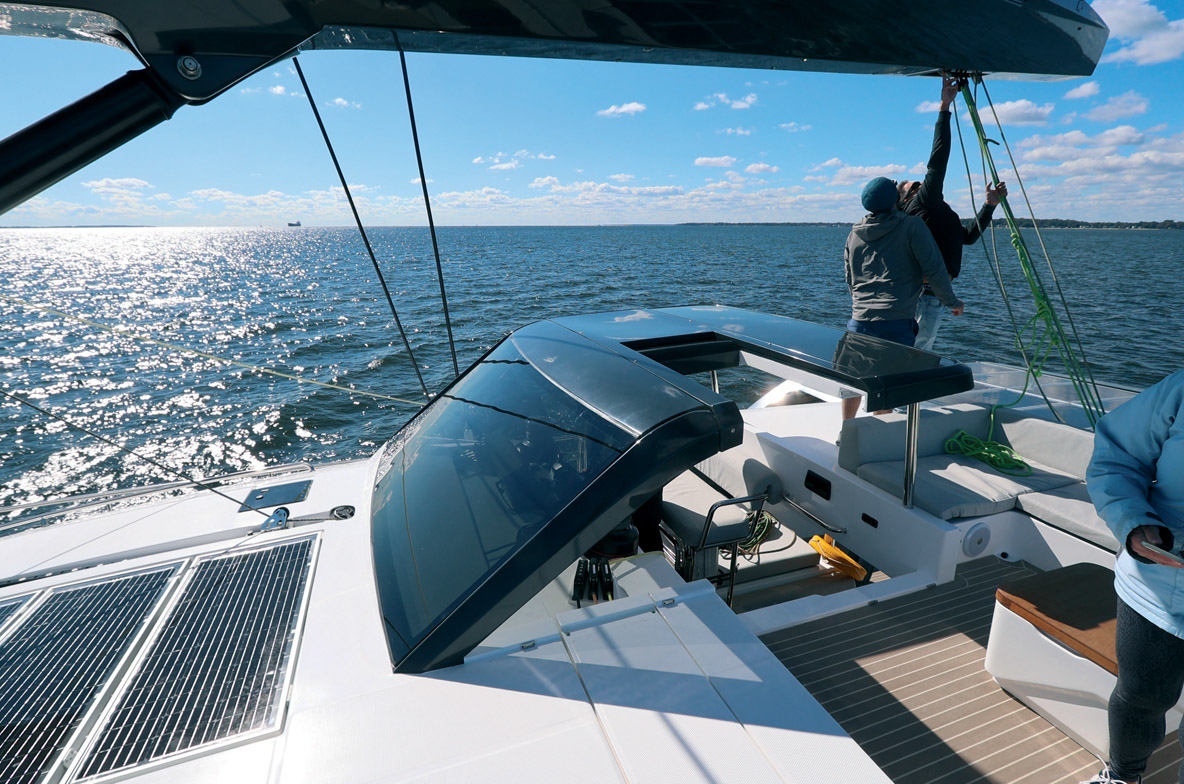
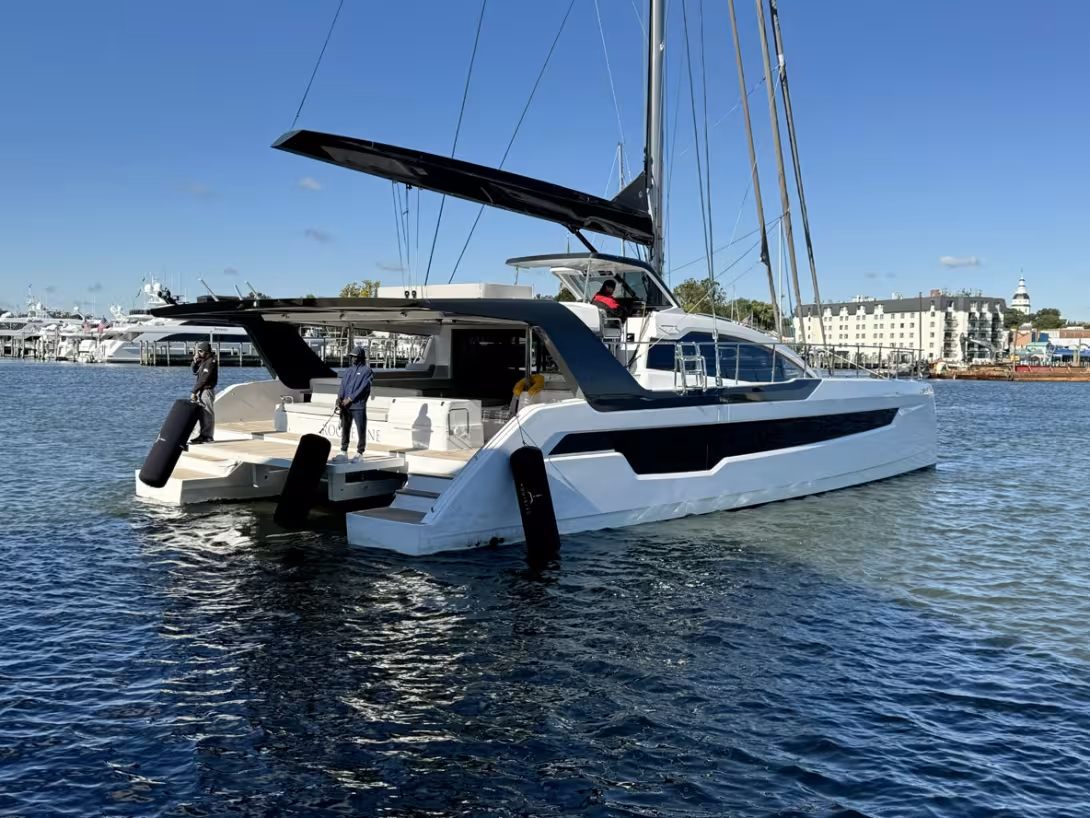
The first thing that catches the eye is the very modern design. The slightly heavy profile of earlier models, with their many portholes, is a thing of the past, the Sixty Solar Sail has a much more dynamic line, underlined by a single long hull porthole. In the same spirit, the rear arch has been refined and better integrated into the overall silhouette. This arch serves as a support for some of the solar panels. The helm station is now topped by a small T-Top, a good idea for staying in the shade or protected from the elements. In a nod to the rest of the Xquisite family, the front window, recessed between the two coachroof uprights that anchor a little further forward, has been retained. Finally, the stern appears lighter, with a straight bimini and the disappearance of the thick transom in favor of a hydraulic platform (optional) that supports the tender or provides a very large rear swim platform. As a small bonus, a carbon crane is also available (again as an option) to facilitate launching the tender.
In addition to offering a more modern exterior design, one of the major challenges was to reduce weight. To reach this goal, the designers - and architect Bill Dixon in particular - opted for a longer platform than that of the X5 Plus, to minimize the impact of weight on board, while offering an excellent level of comfort and equipment. The aim was also to offer high levels performance, even if the Sixty Solar Sail is not designed to become a racing multihull.
Finally, this catamaran was truly designed for those who spend a lot of time on board, and its conception was truly inspired by sailors, not by software or by someone in a design office who would never have set foot aboard a boat. That makes all the difference.
An Oversized Cockpit
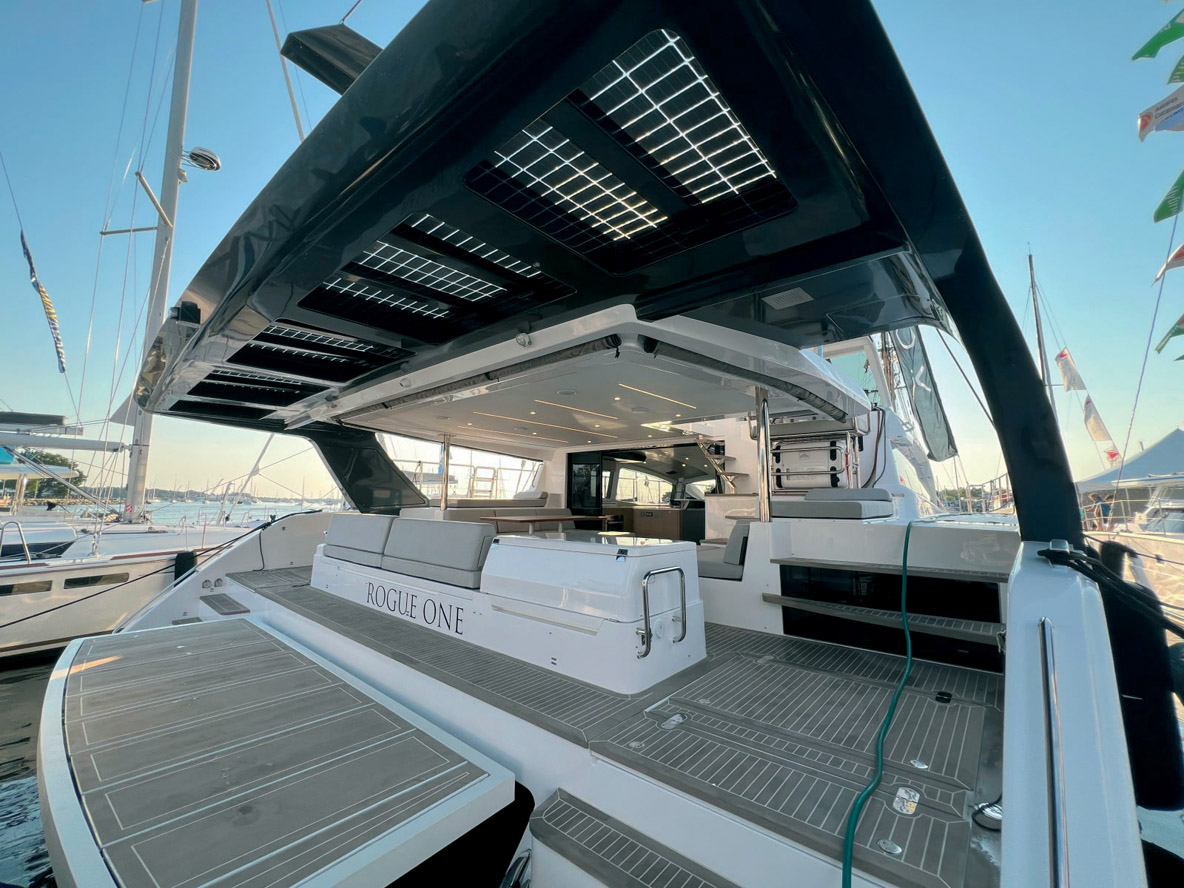
This “seafaring” spirit is evident as soon as you step aboard. From the dock, three steps in the wide transoms lead up to the cockpit. The very wide cockpit really gives the feeling of being aboard a 70-foot catamaran. The fact that the cockpit is not enclosed accentuates the impression of space. However, options exist for securing this cockpit space with guardrails or even protecting it completely for winter periods or bad weather days with canvas enclosures.
The aft section features an outdoor galley with grill and a bench seat. The reversible backrest means it can be used facing the cockpit or the sea, depending on what you’re doing on board. Similarly, a huge storage locker is concealed beneath the seat, perfect for storing diving accessories, boards or other toys. This storage compartment is all the more conveniently located as the equipment can be placed directly on the hydraulic platform, which is then lowered to water level. Last but not least, a compressor for scuba tanks (optional) is installed under the grill, right next to the aft platform. Another small but important detail is the shower installed in the ceiling, just above the starboard steps, for rinsing off after a swim.
The cockpit itself is very spacious. It offers L-shaped seating around a large table, two large seats aft and yet another seat to starboard. In all, 12 people can easily be seated in this space, while maintaining excellent circulation around. Two little bonuses: the table can be lowered to form an additional bed or a lounge seat for two, and a slightly raised cushion on the port side can be used to relax while staying in contact with the other people in the cockpit.
This space is entirely covered by a ceiling extending the coachroof, and by the solar panel support on the stern. As this support is open, the underside of the panels gives a very hi-tech look to the ceiling, even if this was not necessarily planned from the outset.
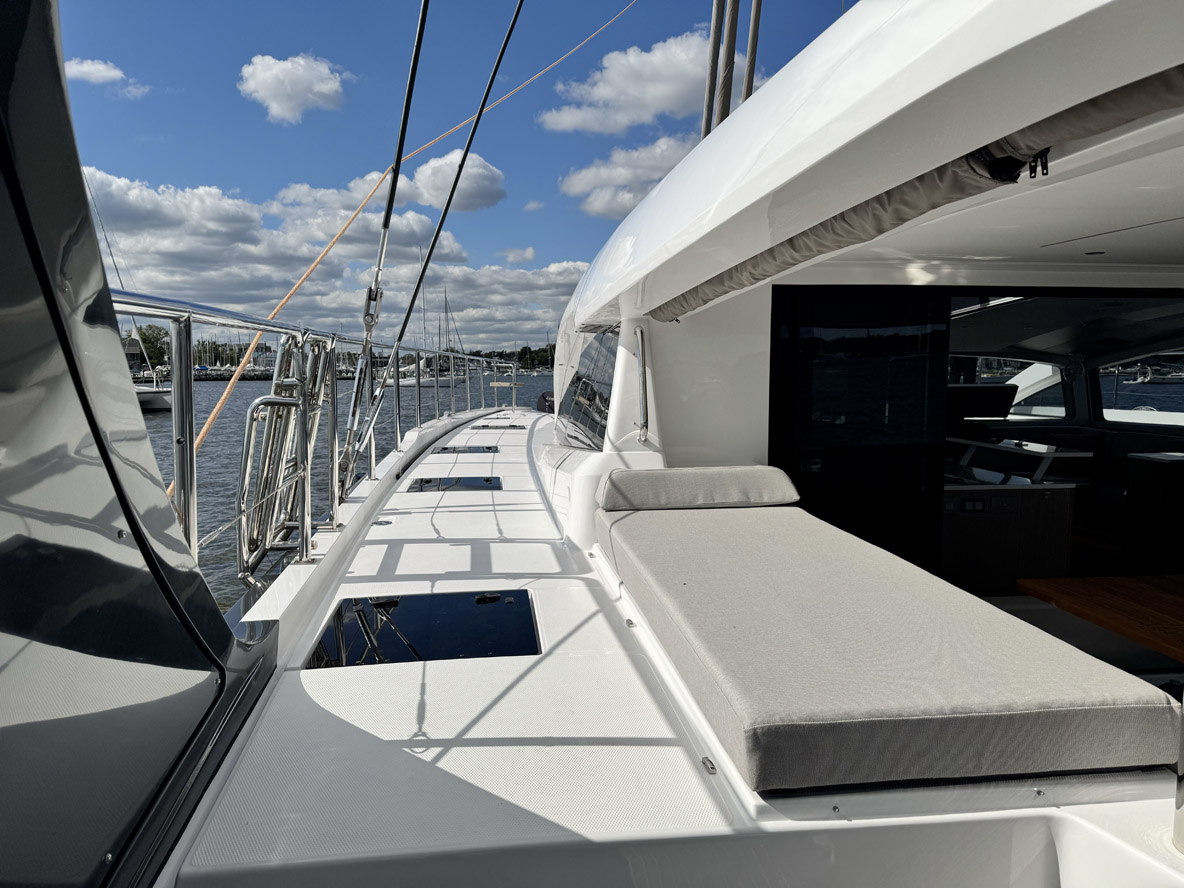
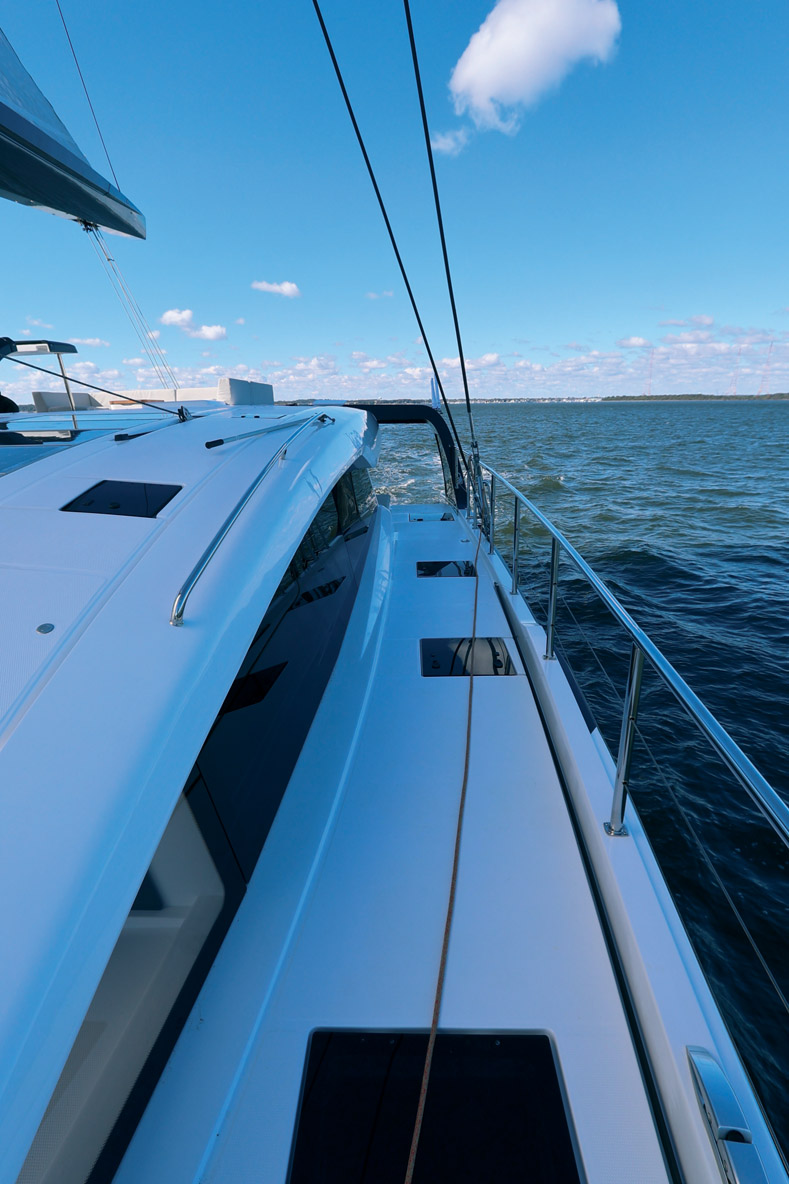
From there, on the starboard side, a staircase leads directly to the helm station and flybridge, but you can also choose to head along the side-decks. Wide and uncluttered, they feature a completely flat surface with flush deck hatches, handrails throughout and a high guard rail for maximum protection. There’s also a folding ladder on each side for easy access on board.
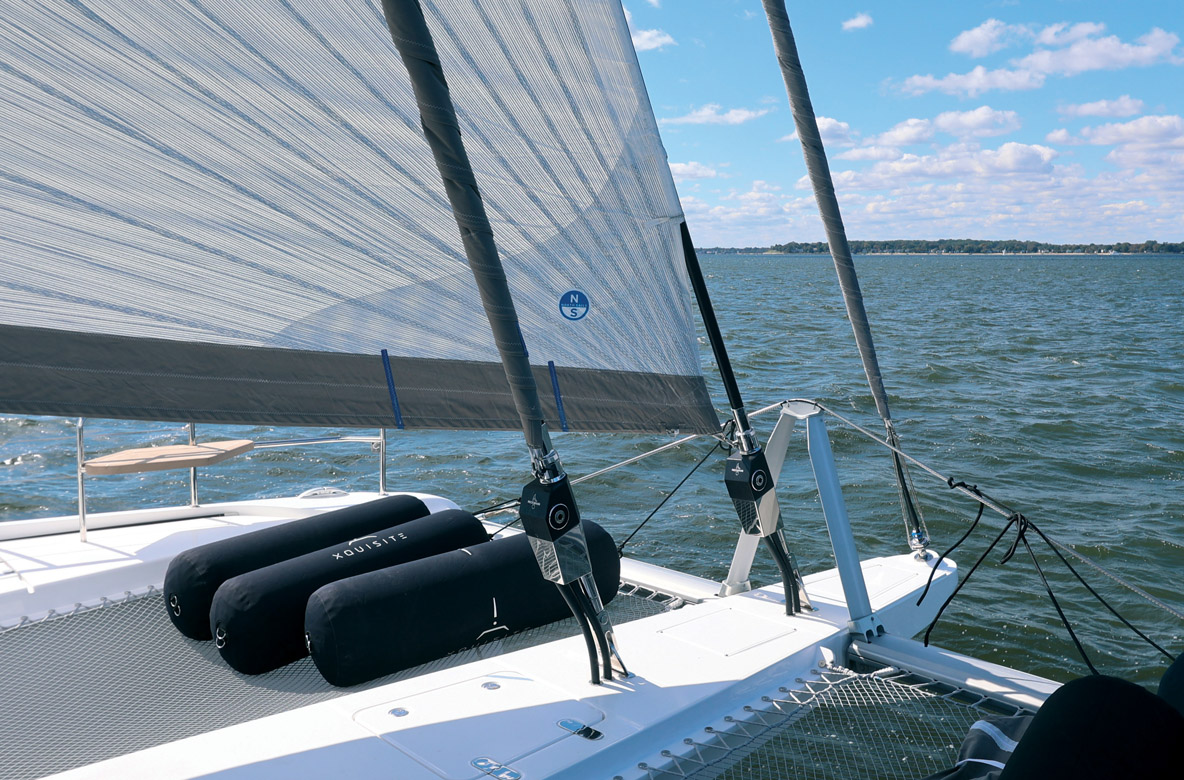
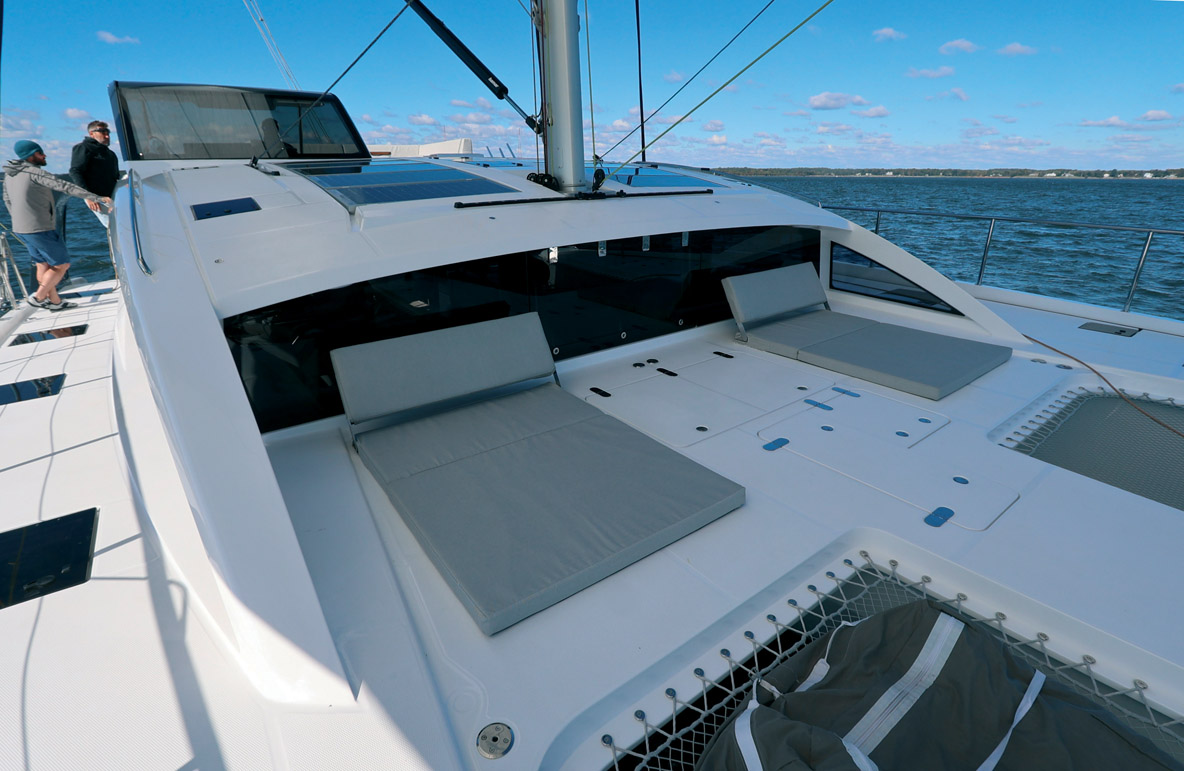
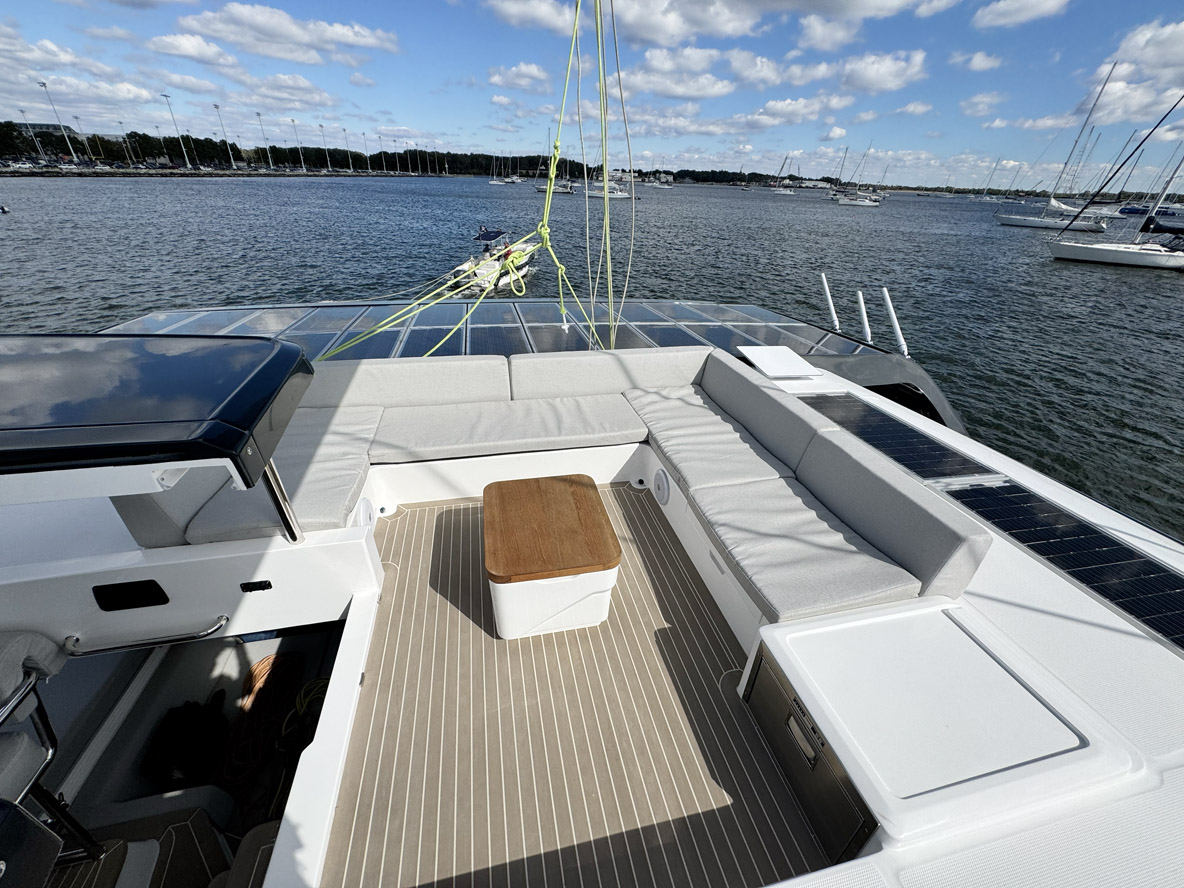
To maintain the perfect balance between comfort and performance, part of the foredeck is taken up by lockers and sun loungers, while the other half accommodates a simple trampoline to save weight. A massive central beam ends in a small bowsprit and supports the imposing Reckmann electric furlers - two or three, depending on the chosen configuration.
The anchor can, of course, be lowered and raised from the helm station and, a slightly unusual detail of on a sailing catamaran, the Xquisite Sixty Solar Sail is equipped with a bow thruster in each hull.
To complete the tour of the exterior, we mustn’t forget the lounge, or flybridge. Located right next to the helm station, this little lounge can easily accommodate six or seven people around the coffee table. It’s the ideal place to enjoy the sun, but if you want shade, an electric retractable shade sail is installed directly in the boom.
A Spacious, Modern and Cozy Interior
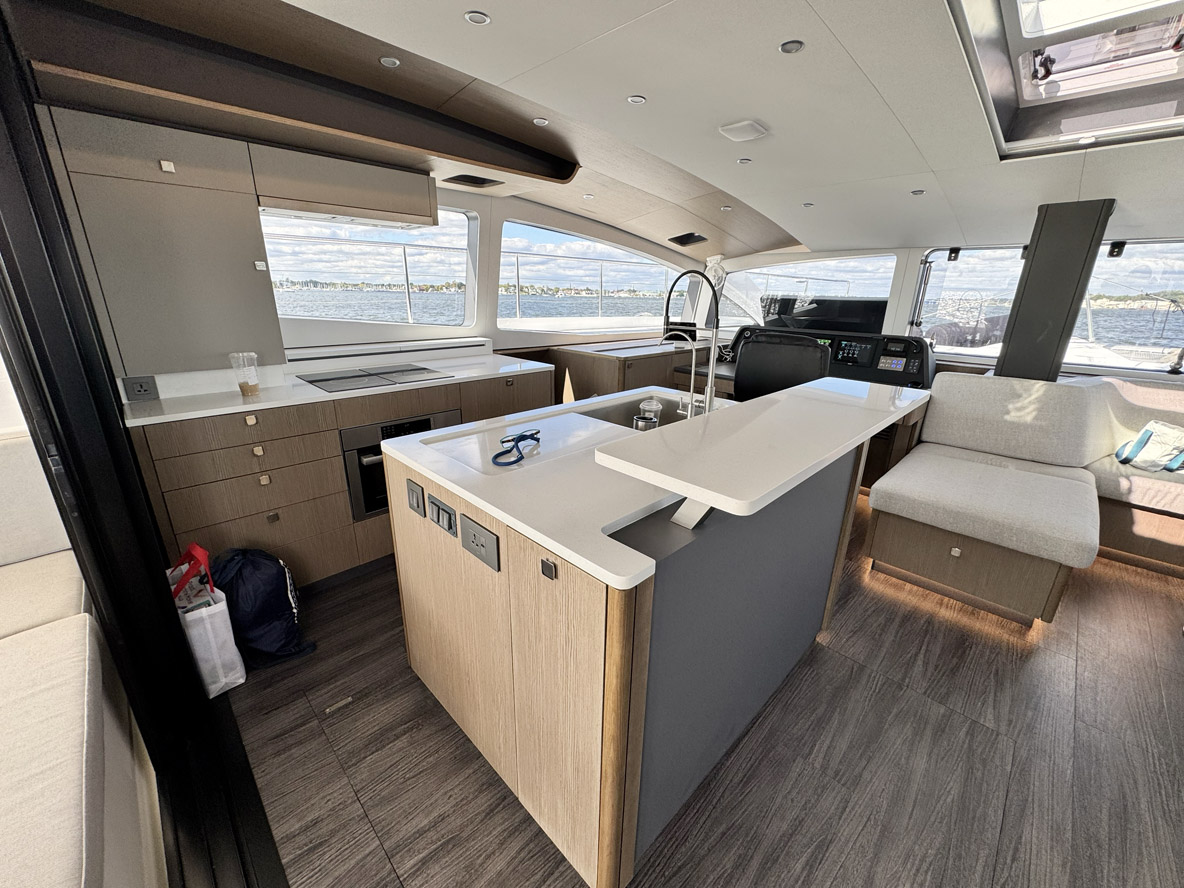
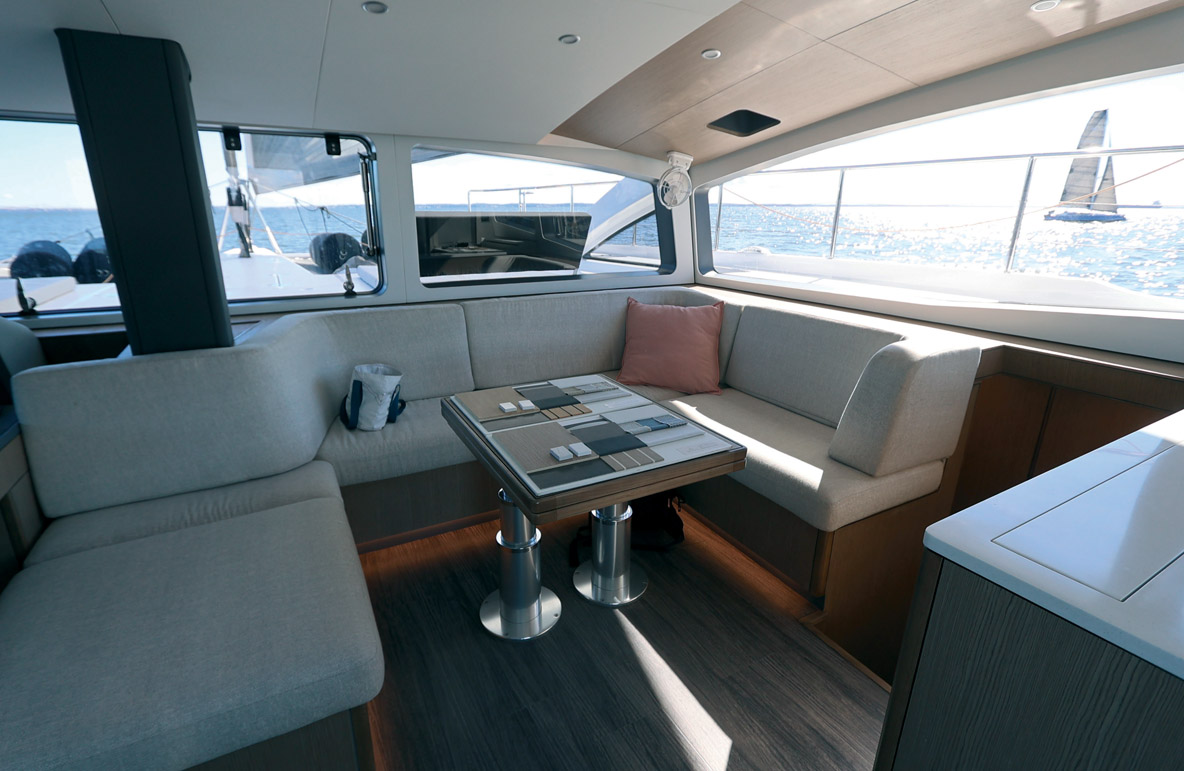
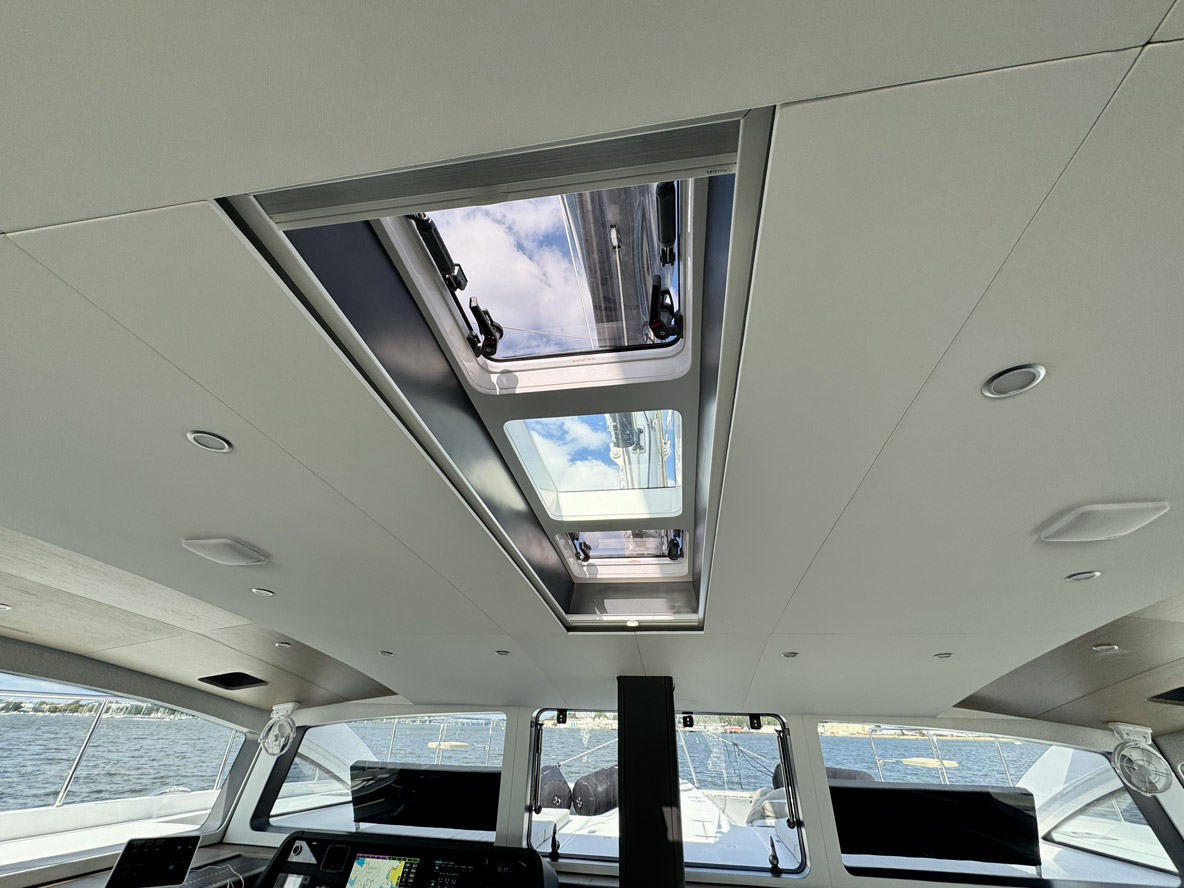
The impression of space doesn’t stop at the exterior. From the cockpit, a very large sliding door opens completely onto the main deck. From here, you discover an open concept with a galley to port, a large central island incorporating the beautiful sink and a saloon area to starboard. This area benefits from a maximum of light, thanks to the large bay windows and opening roof windows. Air circulation has not been forgotten either, as the central forward bay window opens electrically.
This well-equipped galley can be almost completely customized to suit the customer’s wishes.
On the starboard side, a bar houses the boat’s giant refrigerator, as well as a niche dedicated to a coffee machine or blender for smoothie lovers. This is also where you’ll find a 50-inch TV that pops out of the cabinet on demand.
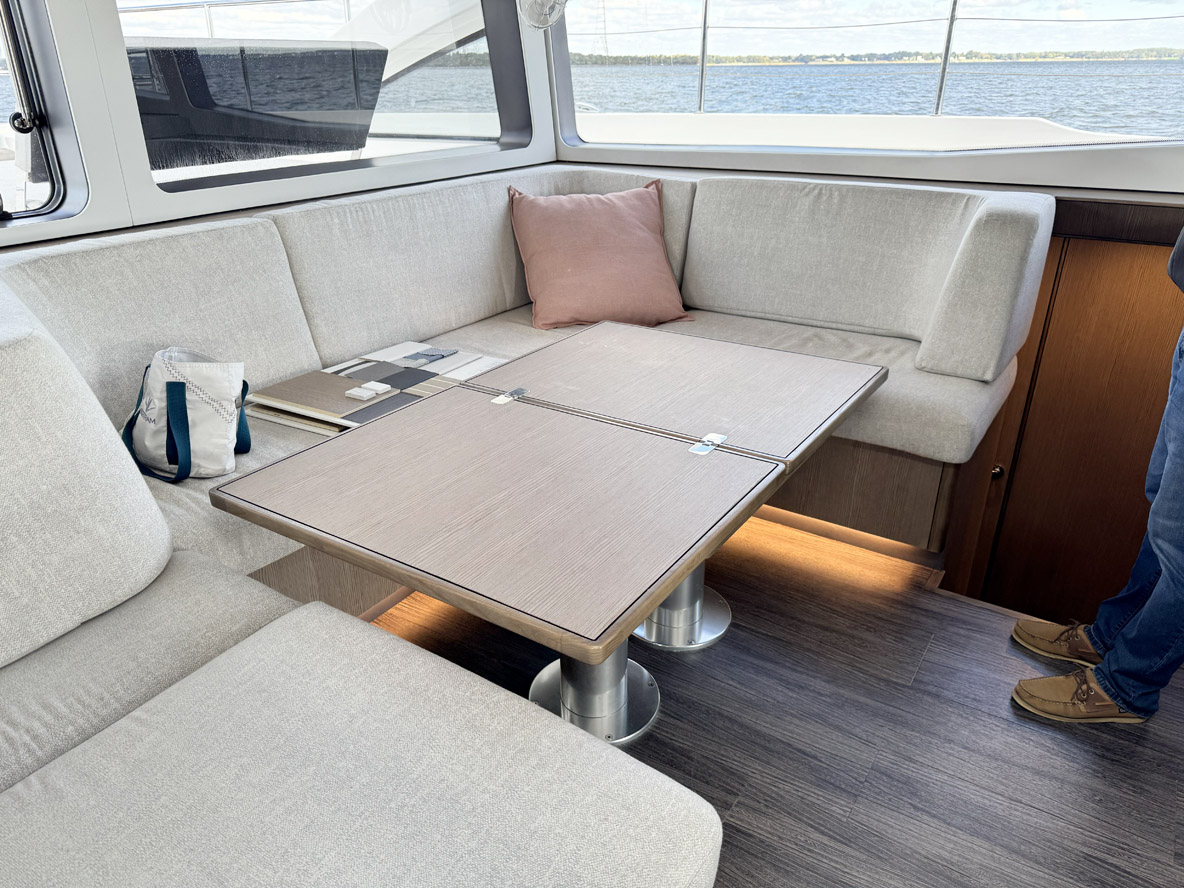
The dining area itself is large enough for five or six people, and the table can be lowered to turn it into a lounge and, if required, an additional double berth.
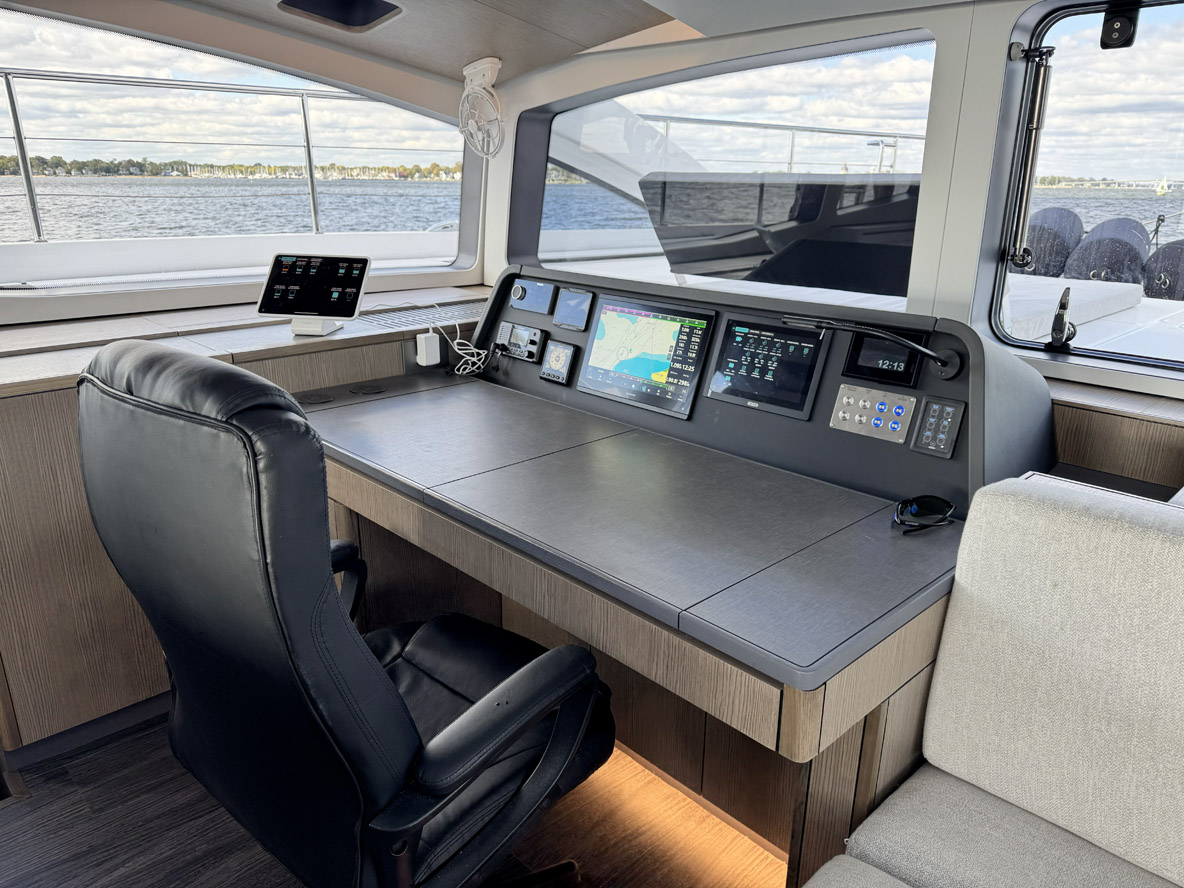
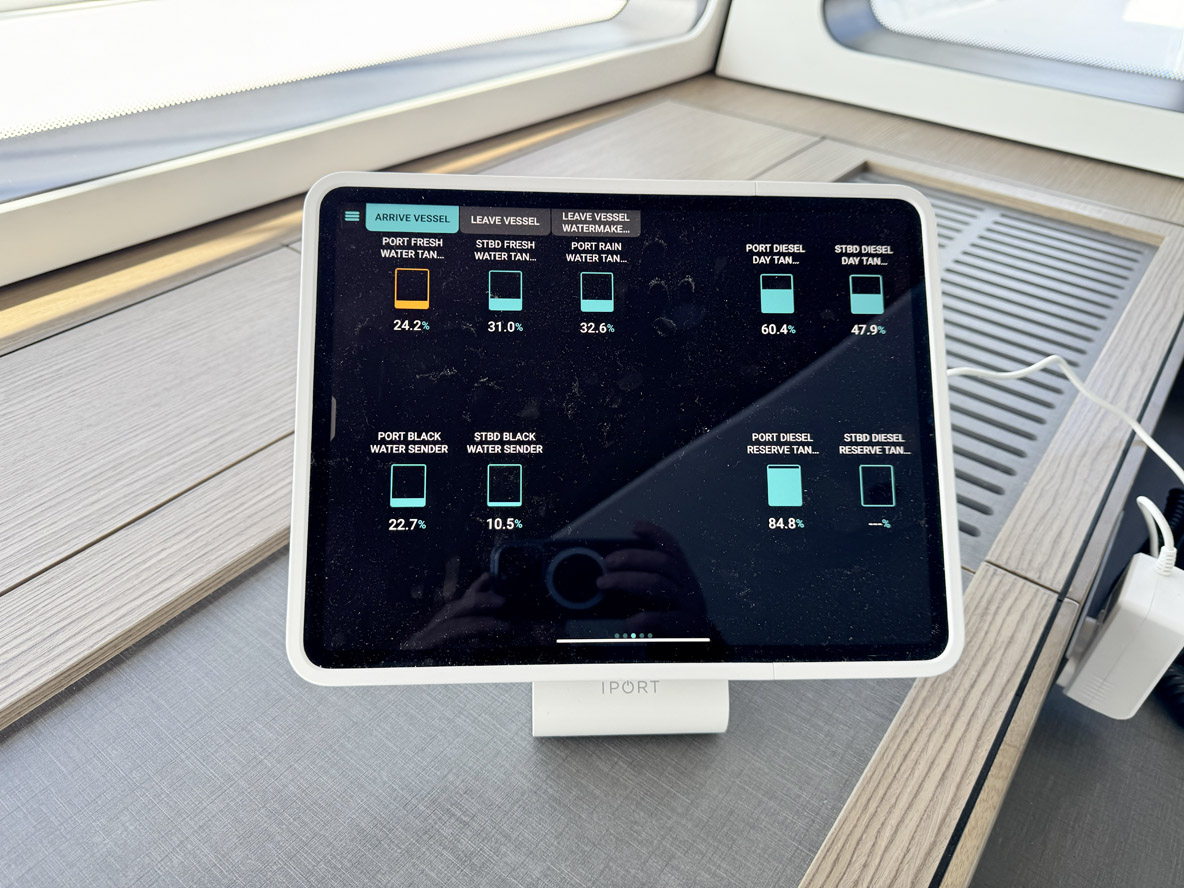
The nav station is located forward, to port. Generously sized, this area can be used as an office for working on board, and when preparing your navigation, you’ll have all the electronics you need, from the VHF to the audio system controls, and there’s even a spot for the printer. If conditions get really bad, you can also keep an eye on the rig from this indoor station, taking advantage of the various cameras installed on board. Finally, a tablet also allows you to monitor everything from the cockpit or sofa. In addition to their very modern appearance, the main deck and cockpit are packed with storage space for all sorts of things, a real plus when it comes to keeping the catamaran tidy.
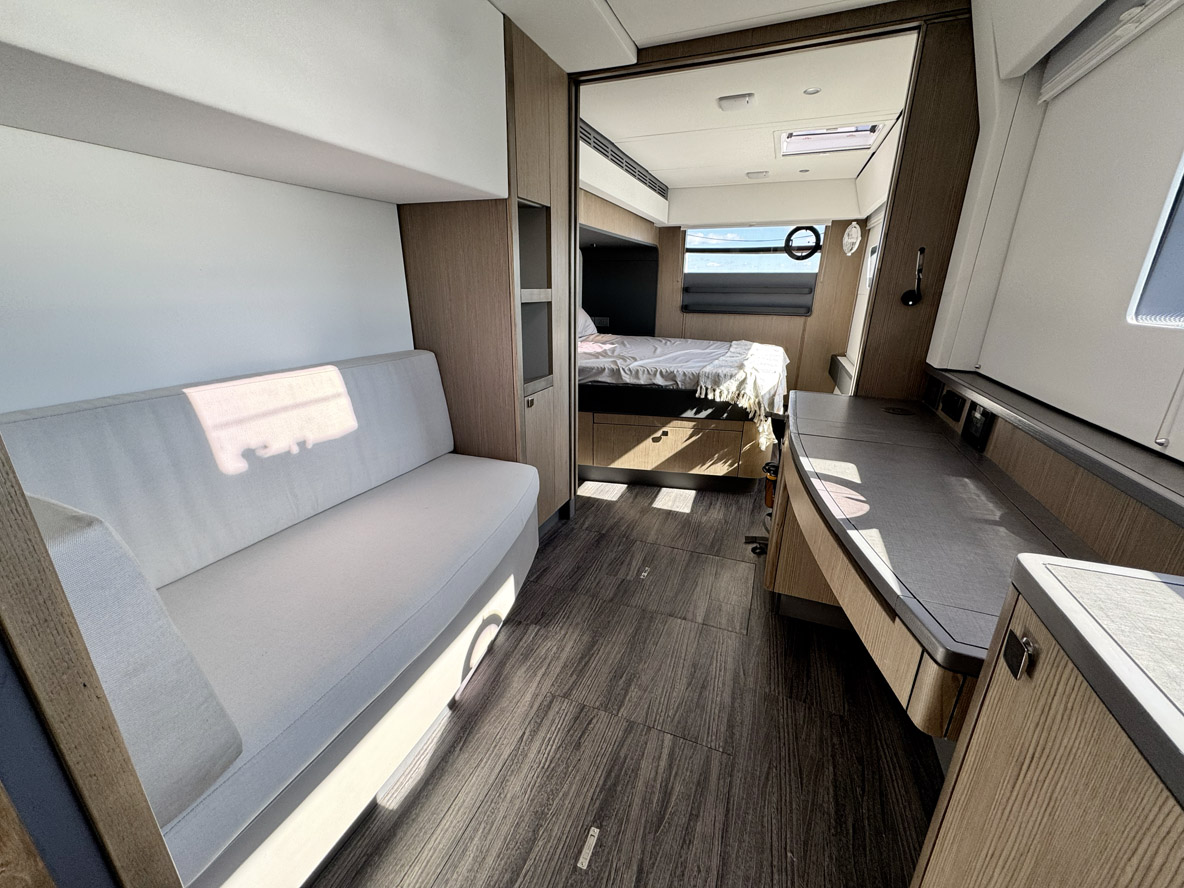
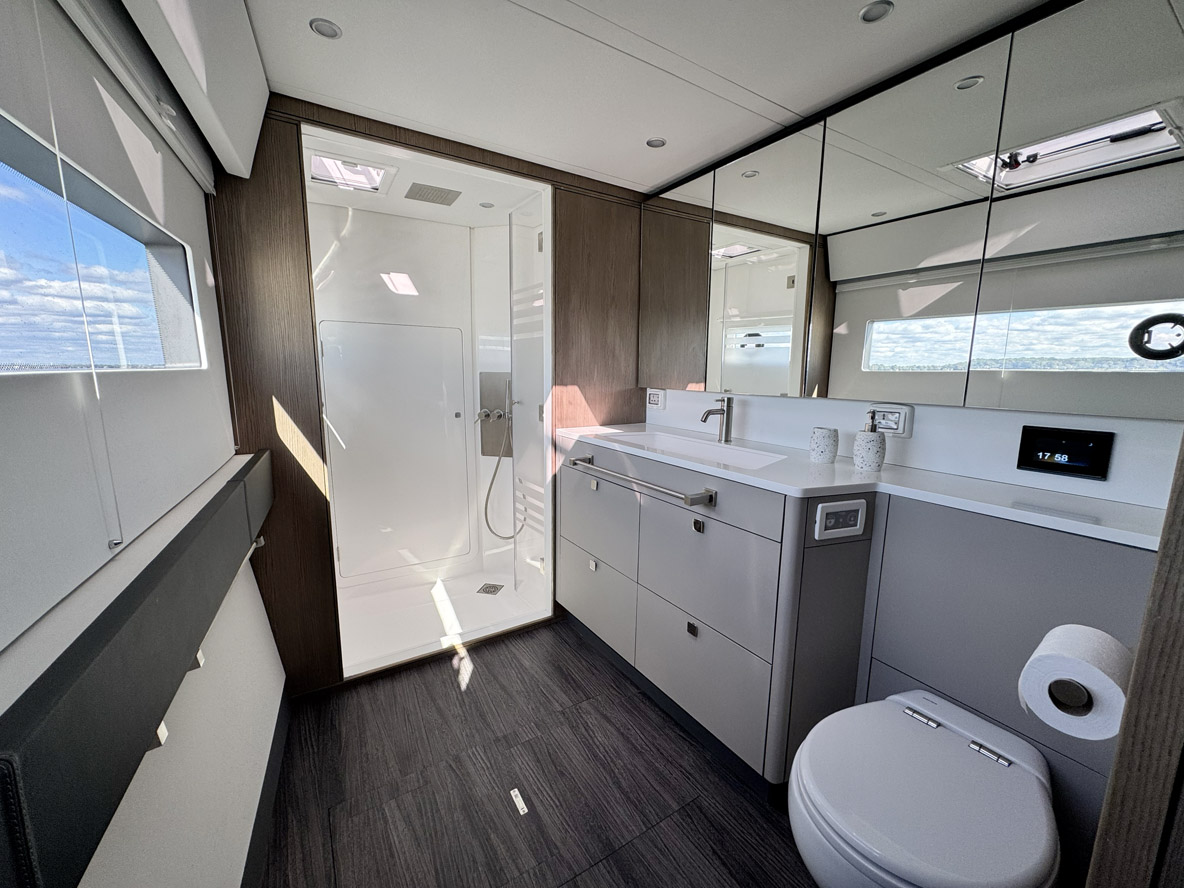
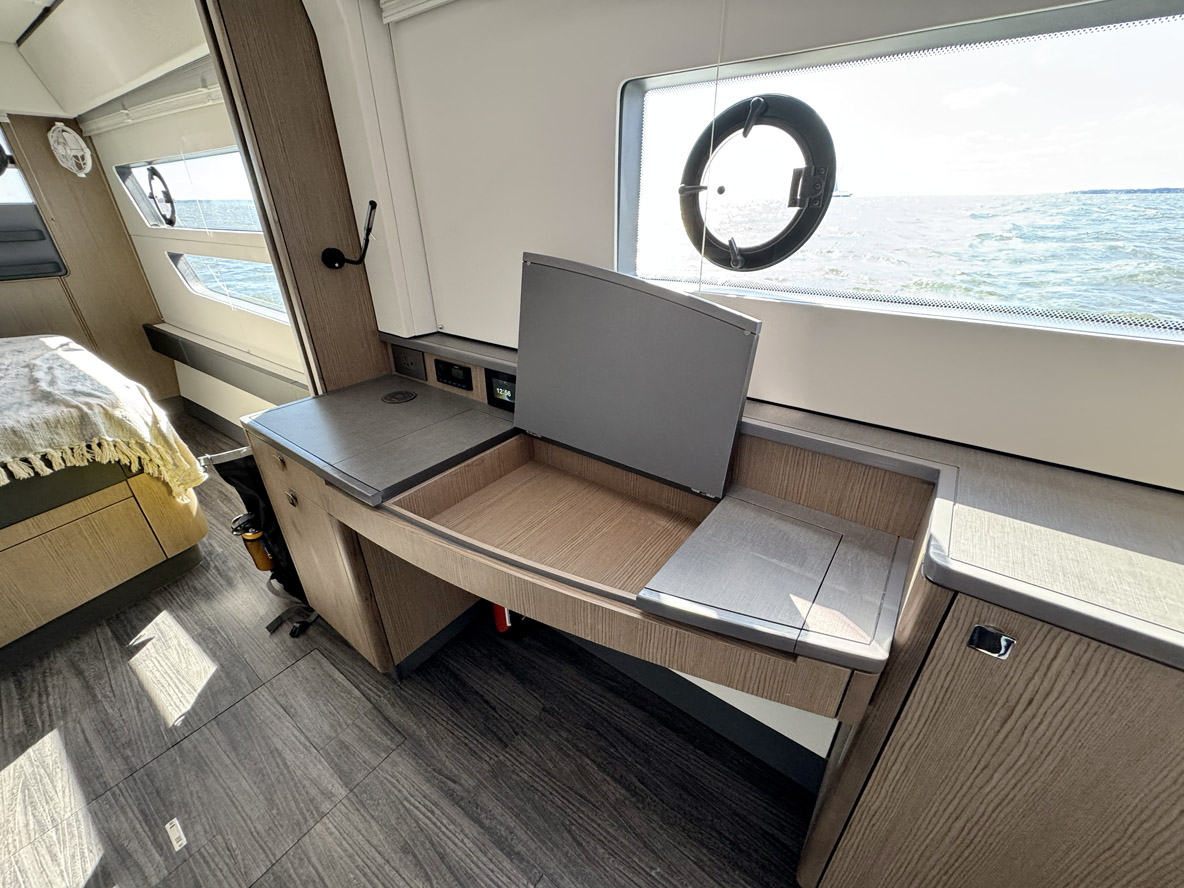
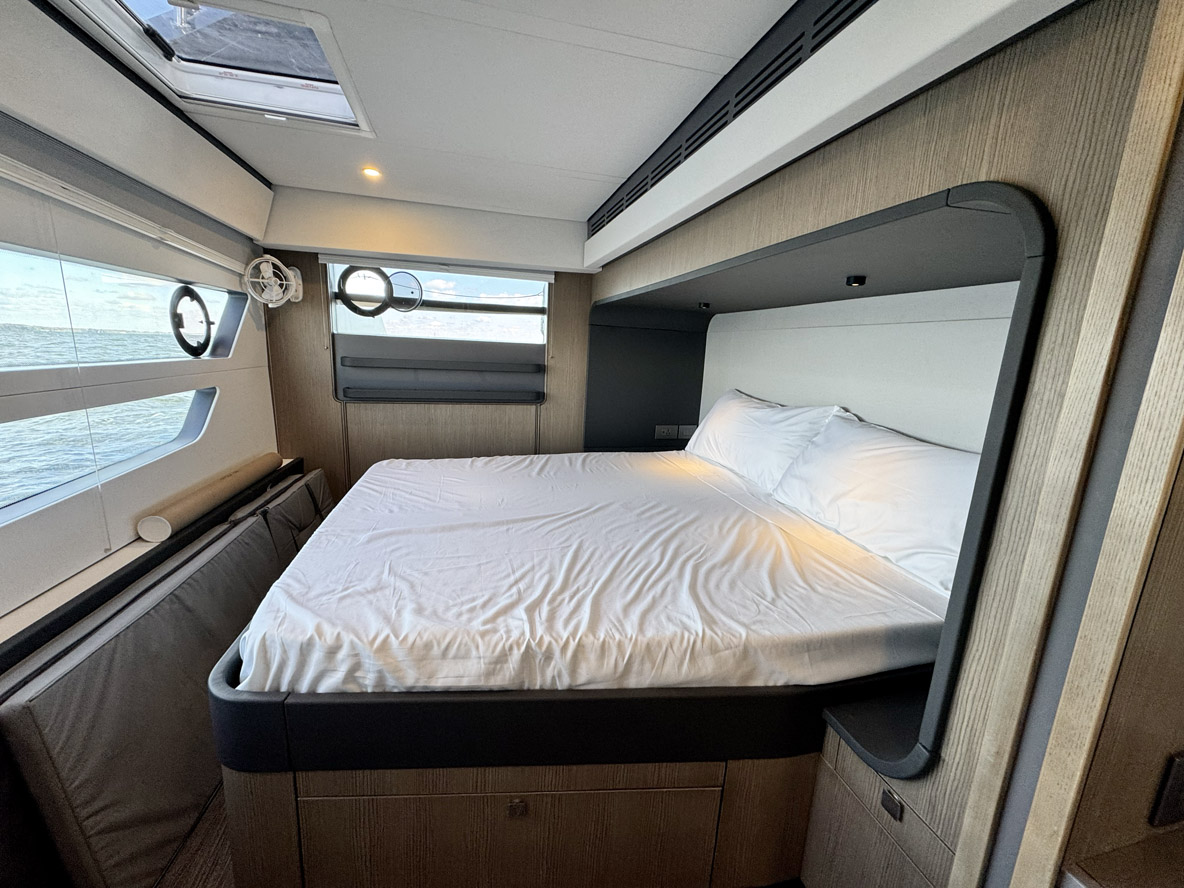
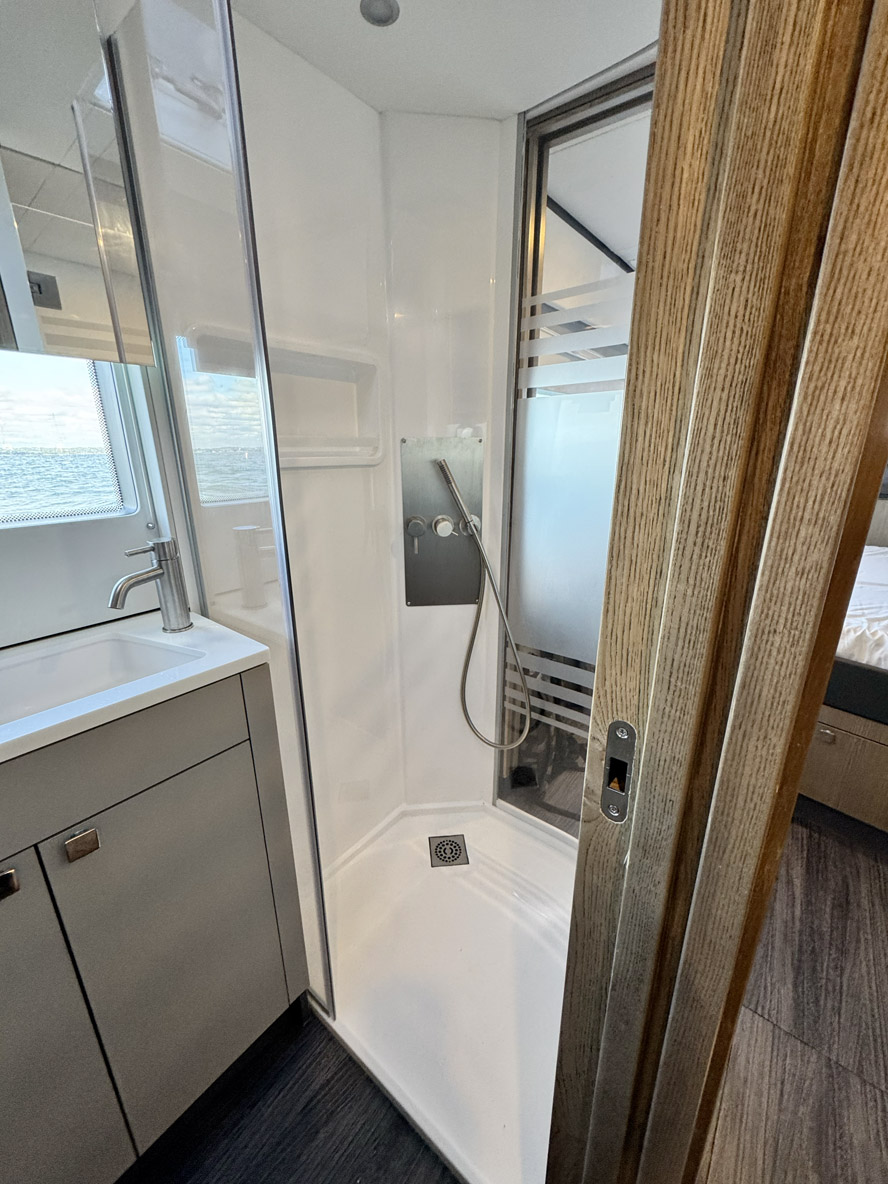
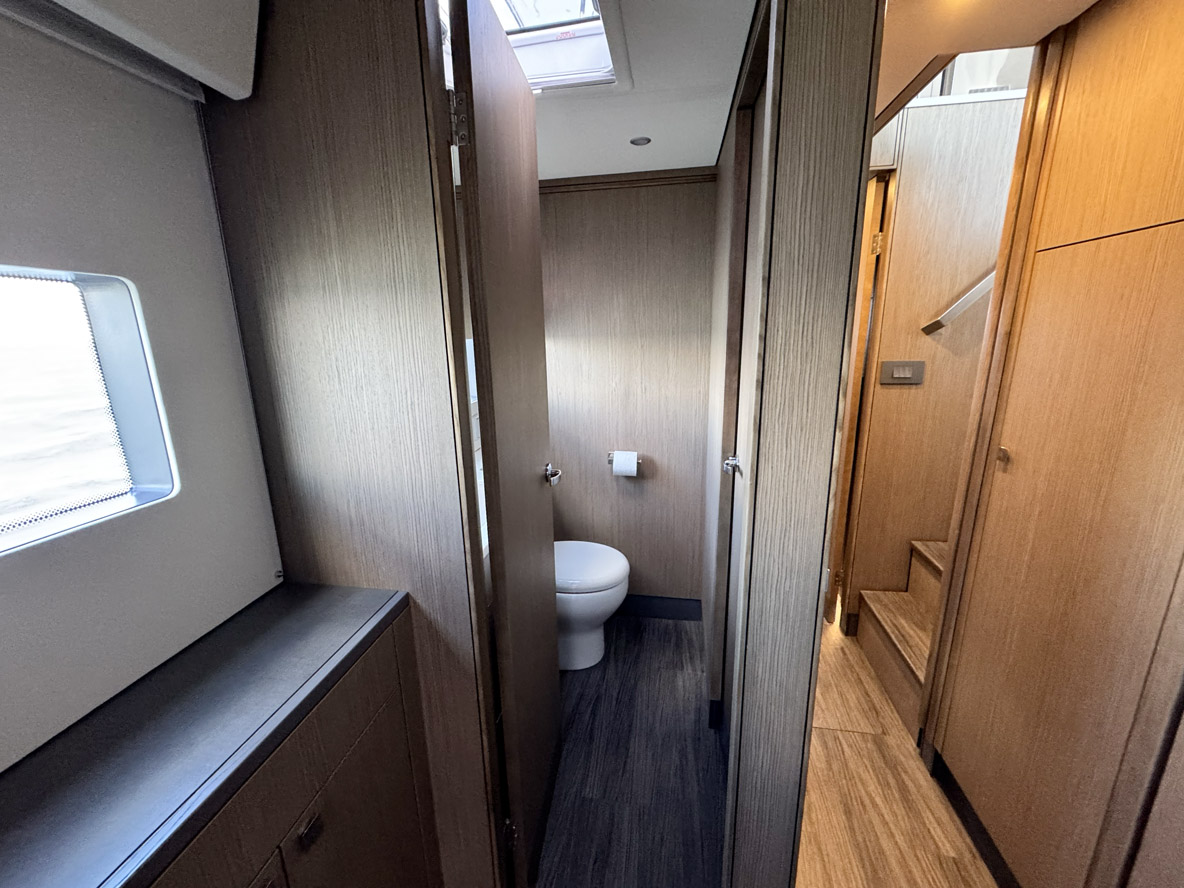
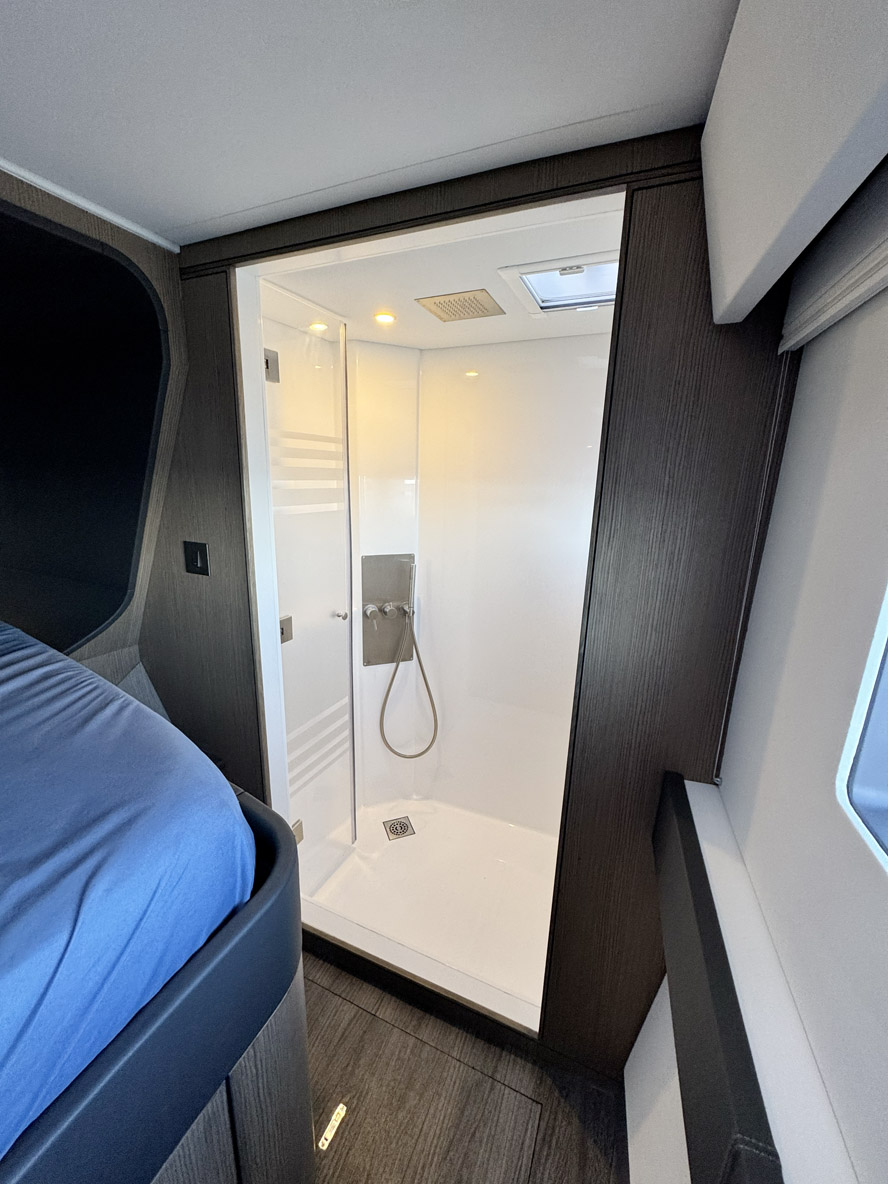
As for sleeping accommodation, the Sixty Solar Sail is available in three or four cabins. For our sea trial, we sailed the three-cabin Owner’s version. In this configuration, the Master cabin occupies the entire port hull and provides immense volume. The aft part features a king-size bed with panoramic sea views and an opening deck hatch for ventilation. The great width of the hull has also made it possible to accommodate a small sofa in the hallway, as well as a desk/vanity table, while storage space is to be found absolutely everywhere. As you head towards the bow, a door opens onto a real walk-in closet, not just a wardrobe, which is rather unusual on a catamaran of this category. The head features a full-length sink, ideal for a couple, a toilet and, of course, a separate XXL shower. Last but not least, a door in the shower opens onto a washing machine with dryer function. The location may not be ideal, but it’s handy to be able to do your laundry on board.
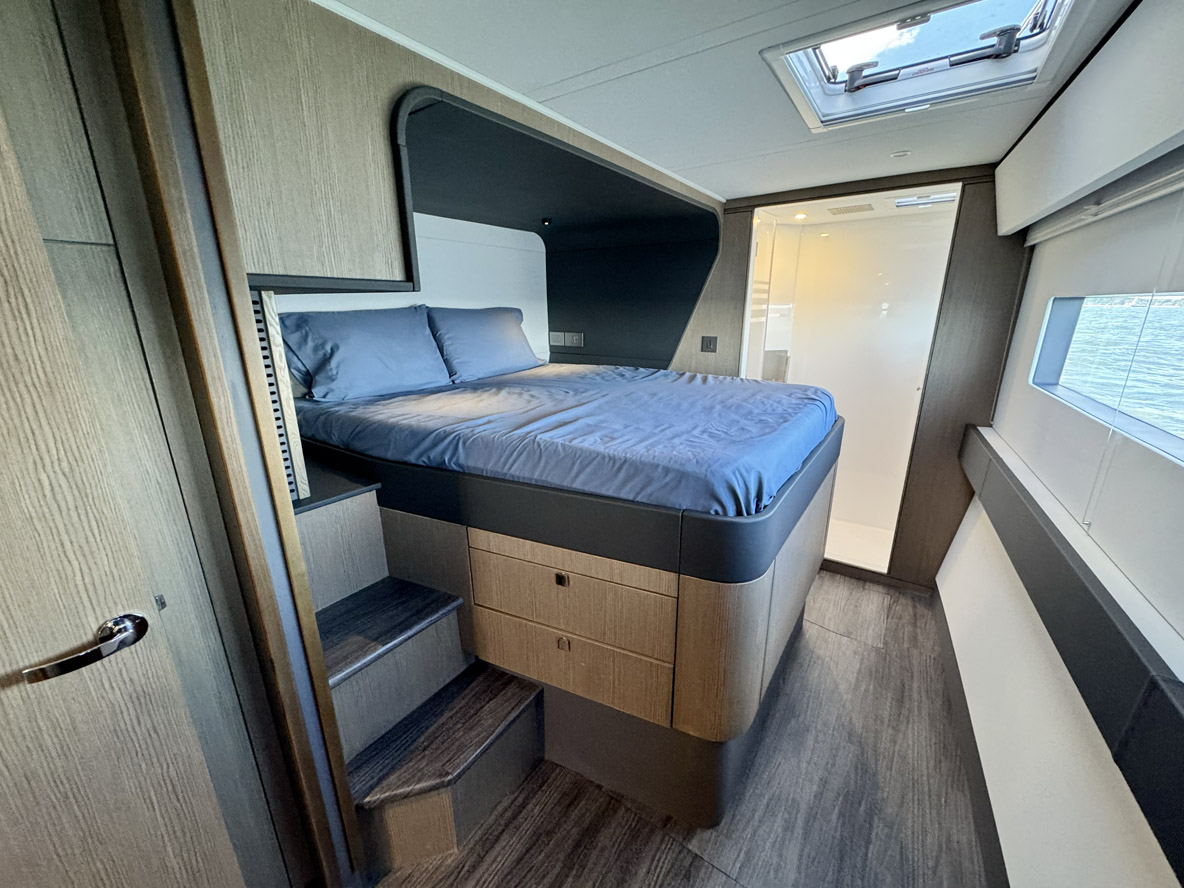
The starboard hull is reserved for guests and/or children, with a queen-size bed forward and a very large separate shower. The second part of the head is located on the other side of the bed and is equipped with two doors, so it can be used as a head for everyone during the day. Aft, we enter what is considered the VIP cabin, with a king-size bed, panoramic views, a small desk and a private head separated from the sleeping area by blurred glass.
As on the port side, the width of the hull has made it possible to create an enormous amount of storage space, while retaining enough room to move around effortlessly. It’s also worth noting that virtually all windows feature opening portholes, a real plus for ventilation. Finally, even though this is hull #1, the level of finish is already quite remarkable. Equipment is, of course, to be determined at the time of purchase, but on our test model it seems that there was practically everything you could imagine for a 60-foot catamaran.
What’s more, the shipyard offers several ambiances to choose from, but there’s nothing to stop you opting for a more personal decor. In terms of equipment, there are international-standard electrical outlets (110-220 V) throughout, induction phone chargers, a Bluetooth network, indirect LED lights and, of course, air conditioning. As this is a semi-custom model, this part is also up for discussion at the time of ordering.
On the practical side, the Sixty Solar Sail has a fuel tank capacity of 1,440 liters (380 US gallons), a water tank capacity of 860 liters (227 US gal) and, of course, a watermaker. These figures make it possible to envisage long passages without fear of running out of water, fuel or electricity.
A Catamaran Designed for Single-handed Sailing
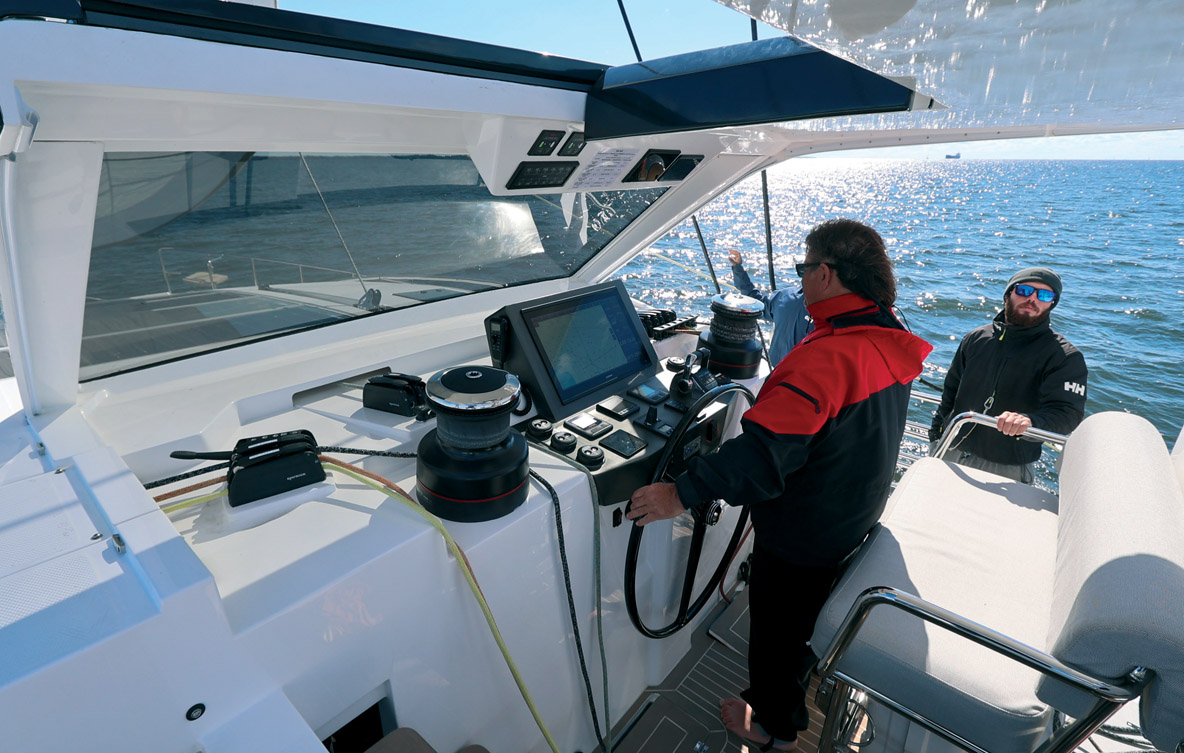
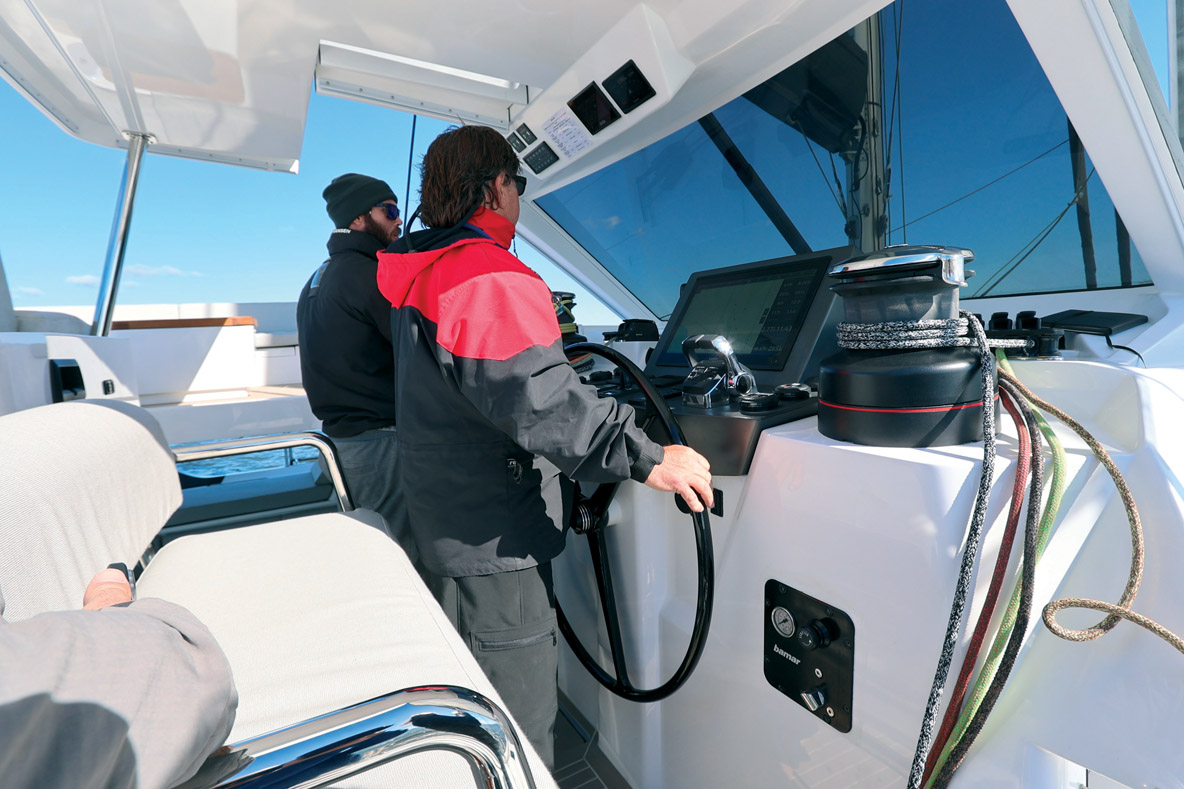
Located on the starboard side, the helm station offers excellent visibility while being totally protected by a glass windshield and hardtop and can even be completely enclosed by transparent canvas. The helm station is very complete, with a 22-inch screen, all engine controls and various controls for the running rigging, which benefits from electric assistance. This rigid structure has also made it possible to install instruments above the helmsman’s head, which is very convenient. All halyards are run back to the two huge Harken winches, and there’s even a halyard well in the floor.
Surprising as it may seem, this catamaran was designed to be sail single-handed. Apart from the fact that the halyards all return to the helm station, all systems are electric, from the furlers to the boom and vang. To assist the helmsman during maneuvers, cameras have been installed in all the critical areas, enabling you to monitor the furling of a code zero or the mainsail, for example, and to help you fine-tune the sails and keep an eye on all the important systems, even at night - the cameras have night vision, which is pretty impressive.
The rig itself is rather well dimensioned for a catamaran, with a 27.28 m (89 ft) high mast and a carbon canoe boom. In fact, this is an electric in-boom furler that can be controlled from the helm station or from the inboard navigation station.
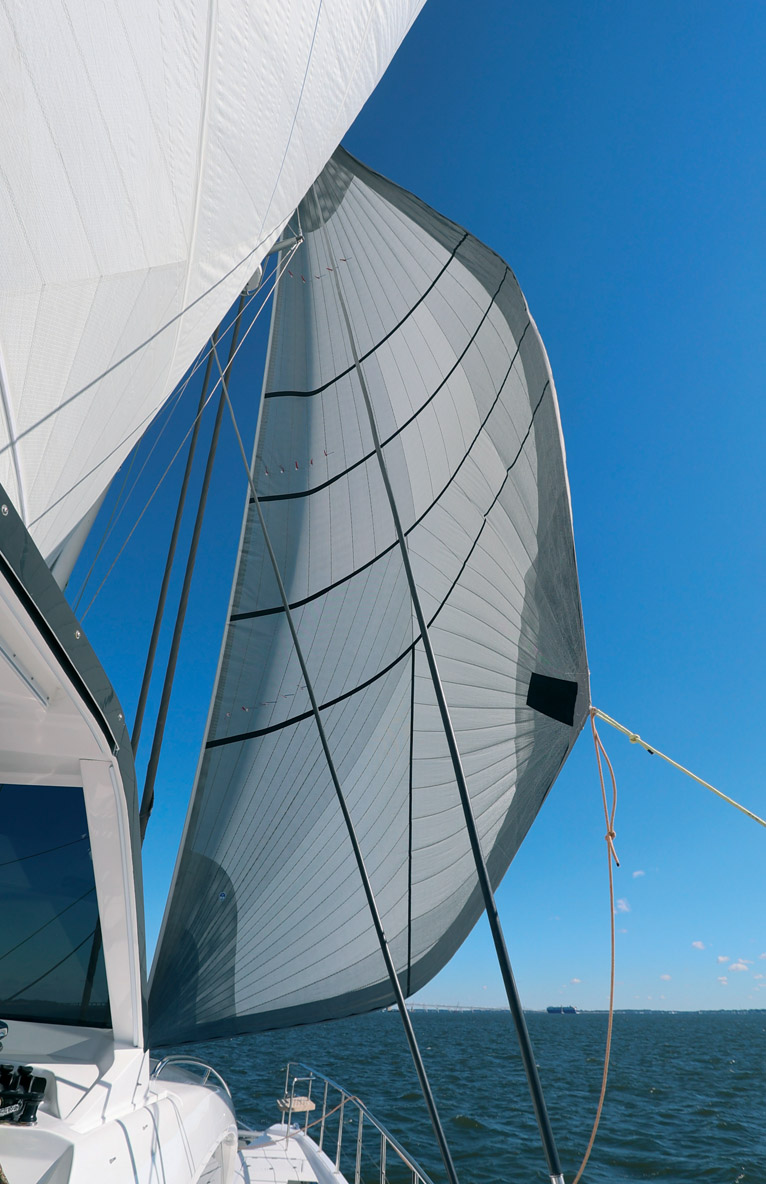
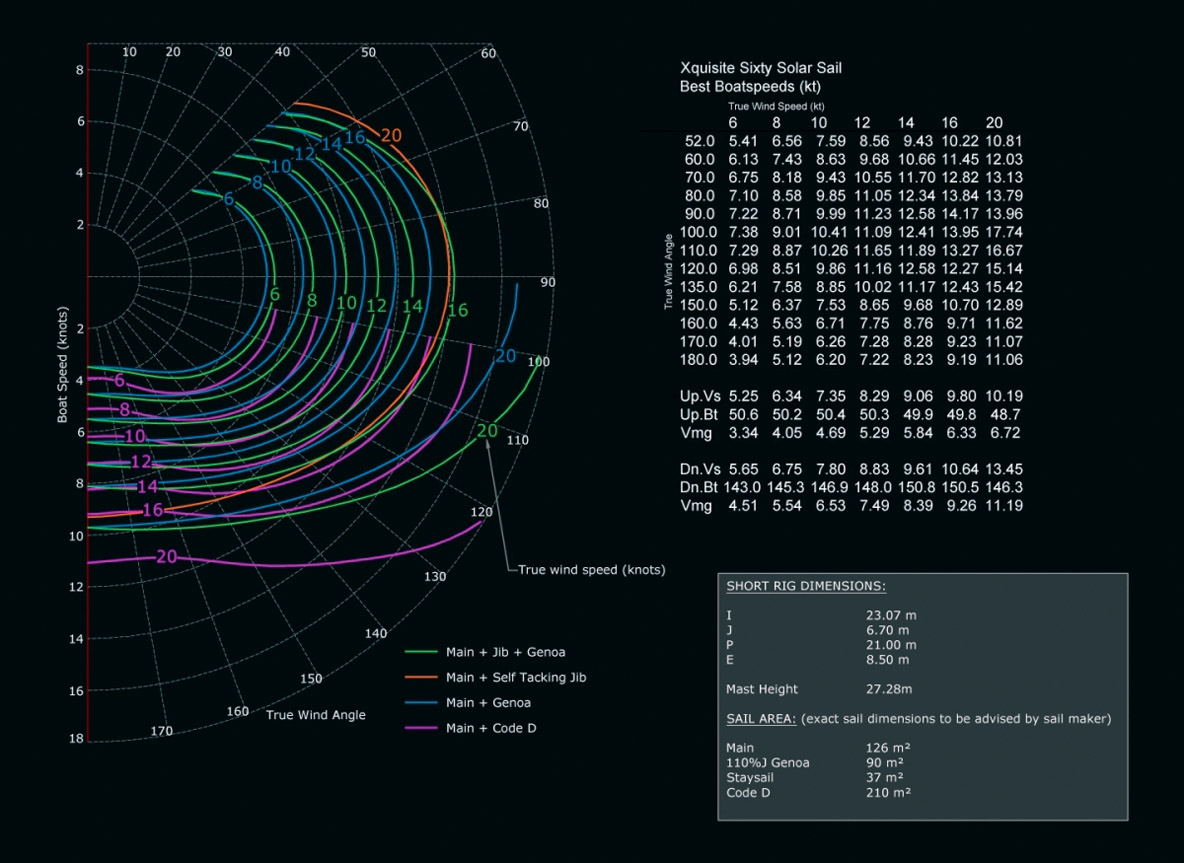
To make maneuvering easier, even for a single person, the Sixty Solar Sail is equipped with a 38 m² (409 sq ft) self-tacking jib. This is complemented by a 135 m² (1,453 sq ft) mainsail, a 90 m² (968 sq ft) genoa and a 198 m² (2,131 sq ft) code 65. You can also opt for the 266 m² (2,863 sq ft) furling gennaker, a substantial sail area that gives the catamaran excellent performance. For example, with 13 knots of wind under genoa, we sailed at just over 8 knots. Unfurling the code 65, we managed to exceed 9 knots. With a good breeze of over 20 knots, at an angle of 100°, the Xquisite is capable of between 16 and 17 knots, according to the speed polars drawn up by the architects. In moderate weather, this means an average speed of 12 knots, which is pretty good for a 60-foot cruising catamaran.
Solar Solutions for On-board Energy
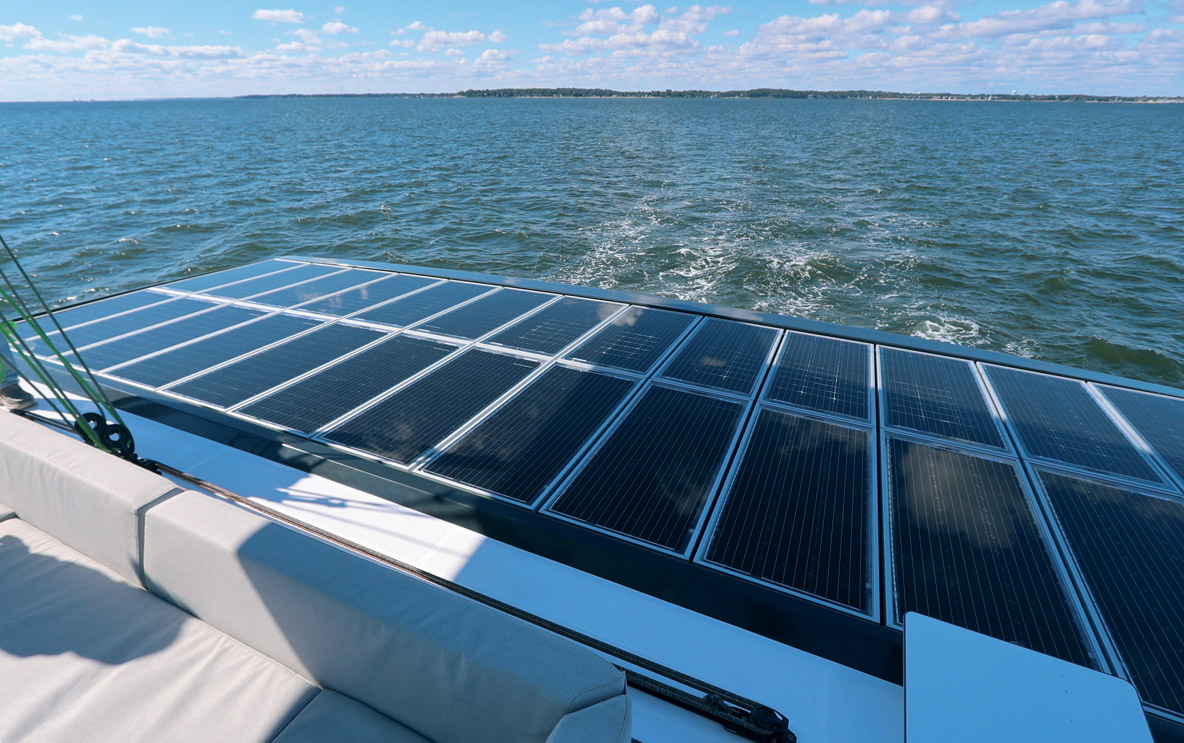
As its name suggests, the Sixty Solar Sail is all about renewable energies, and solar power in particular. The catamaran incorporates a series of solar panels installed behind the flybridge and on the coachroof, giving a total of up to 7 kW, depending on the options chosen by the owner. To store this energy, the Xquisite is equipped with a 60-kW bank of lithium-ion batteries and a 10-kW inverter, more than enough to power all the vessel’s electrical systems.
However, the boat we tested retains traditional propulsion with two 110 hp Yanmar diesel engines. As an option, you can also opt for a hybrid system. In this case, the Yanmar engines are each fitted with a 15 kW (equivalent to 20 HP) electric motor with a hydrogeneration system to help recharge the batteries. This solution also makes it possible to dispense with a generator, or at least to have a smaller model on board.
Conclusion
The Sixty Solar Sail confirms what we’ve seen with previous models, namely the desire to propose a top-of-the-range, high-performance cruising catamaran. This model also adds a healthy dose of innovation and equipment, and above all the possibility of being truly energy self-sufficient. The construction, which includes carbon fiber reinforcements, is of a very high standard, the finishes are excellent and, generally speaking, everything has been thought out taking into account customer feedback and the experience of the Xquisite team sailors. With a starting price of around three million dollars, the Sixty Solar Sail is certainly not the cheapest in its category, but it definitely ranks in the high-end segment and gives you a lot for this size and this price.
Space on board
Equipment and standard of finish
Protruding corner above guest bed
Price
Technical specifications
Architect: Bill Dixon
Length overall: 61’8” (18.8 m)
Beam: 29’3” (8.91 m)
Draft: 5’5” (1.65 m)
Light displacement: 55,000 lbs (27.5 t)
Mainsail: 1,453 sq ft (135 m²)
Self-tacking jib: 409 sq ft (38 m²)
Genoa: 968 sq ft (90 m²)
Gennaker: 2,863 sq ft (266 m²)
Code 65: 2,131 sq ft (198 m²)
Engines: 2 x 110 hp Yanmar
Electric motors (optional): 2 x 15 kW
Fuel: 380 US gal (1,440 l)
Batteries: Lithium-ion 60 kW
Fresh water: 227 US gal (860 l)
Black water: 113 US gal (430 l)
CE Category: A
Price: US$ 3,000,000 ex-yard (South Africa)