
In 2010, the Dean 5000 became a big hit at the La Rochelle boat show, but then the actual launch of this model got bogged down with the various problems at the yard which eventually led to its demise. Phoenix Marine, a major South African manufacturer (in the composites fabrication and shipyard sector) bought the rights to the plans and asked architect Rudolf Jonker to take up the project and design a completely new boat within the existing lines: the Xquisite X5. We were able to get a first look and try her out in some great weather conditions.
Infos pratiques
- Le chantier : X5 Sail
- La fiche technique
-
 Découvrez notre vidéo exclusive
- Financez votre Xquisite X5
- Assuez votre Xquisite X5
- Articles autour du Xquisite X5
Direct marketing!
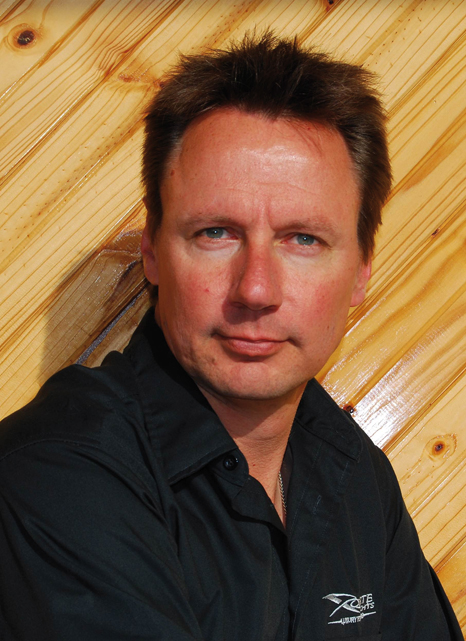
Tamas Hamor, the commercial director and developer for the X5, is a professional skipper: a seasoned and a well-experienced sailor, he is passionate about the techniques and the development of boats. Owner of a Dean 5000 which he has had in charter for several years, he has put a lot into the specs and quality control meaning that a top-quality multihull goes on the market. The quality of build and of equipment used reduces any potential problems and makes resolving them easier thanks to closely-monitored technical maintenance. As a day-to-day user (short-handed, with his wife) of a big catamaran, he is easily able to envisage things from the point of view of a future owner. The approach is original and genuine, the result convincing.
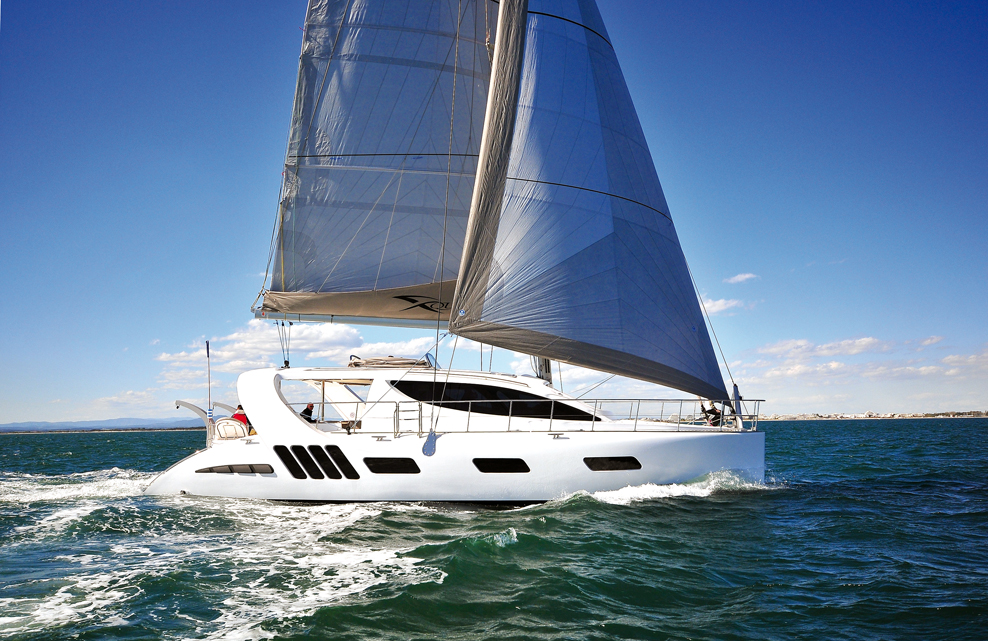
All the X5’s windows are in toughened laminated glass. No more leaks or expanding.
A new boat which is already familiar
Rudolf Jonker was formerly a naval architect at Dean Catamarans. He has his own design team at Phoenix Marine and has redesigned a large part of the original boat. The waterline, the bows, the interior layout, the build technique and the layout plans are all new. So why keep the original lines with a boat which has been so significantly redesigned? It’s simple really: the developers like the shape, it is well-proven at sea and above all, it clearly stands out from the rest of the South African and European production. It was important to create a brand identity and good exposure in a very competitive global environment.
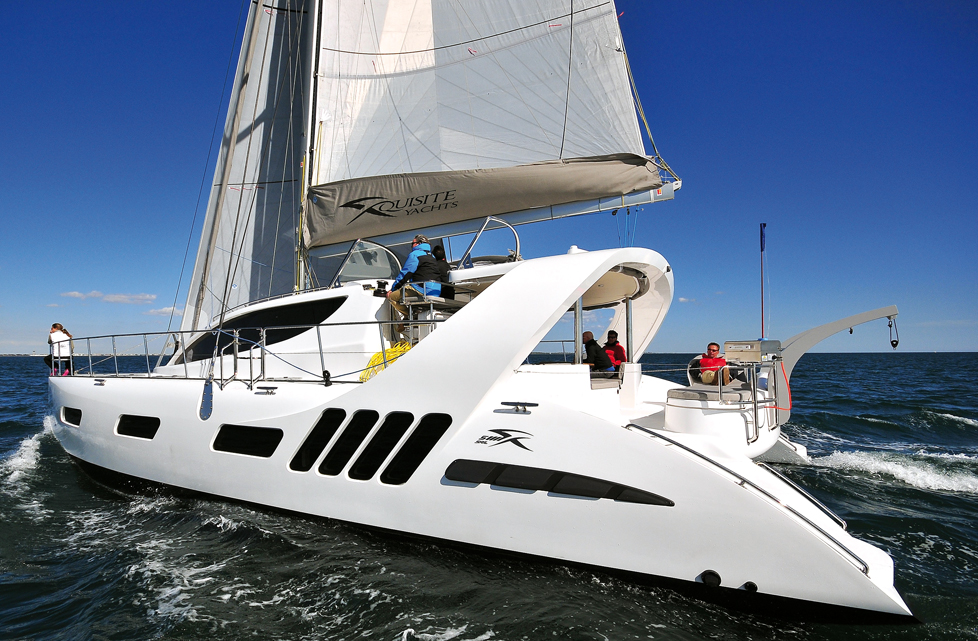
Functional ergonomics are one of the strong points of the X5. The rigid handrail is reassuring on a family cruising catamaran. The layout of the various areas is very successful such as the accessibility around the helm station.
Built by craftsmen in a safe commercial and industrial framework
The Xquisites (the X5, for the moment, and the forthcoming X5 Power) are built at the Phoenix boatyard, a small, dedicated yard which knew how to draw on all the know-how in and around Cape Town, where the majority of South African multihull builders are to be found. The main tooling (lower part of the nacelle, with inner half-hulls and structure to support the skegs, the outboard half-hulls and deck) are built here, along with 60 other small molds required for the build. The hull and deck are manually laminated (using a vacuum) in glass/vinylester sandwich foam for the underwater hull with epoxy gluing techniques. A balsa core is used for the deck, with bulkheads in 24mm marine ply, reinforced by multidirectional E-glass cloth. The build process and the sampling has been subject to the approval of Swedish specialist Composites Consulting Group. To help with the initial production costs, Xquisite secured payments from the first five clients, paid into an escrow account independent from the yard. This unique process guarantees that the buyer will end up with the finished product and peace of mind.
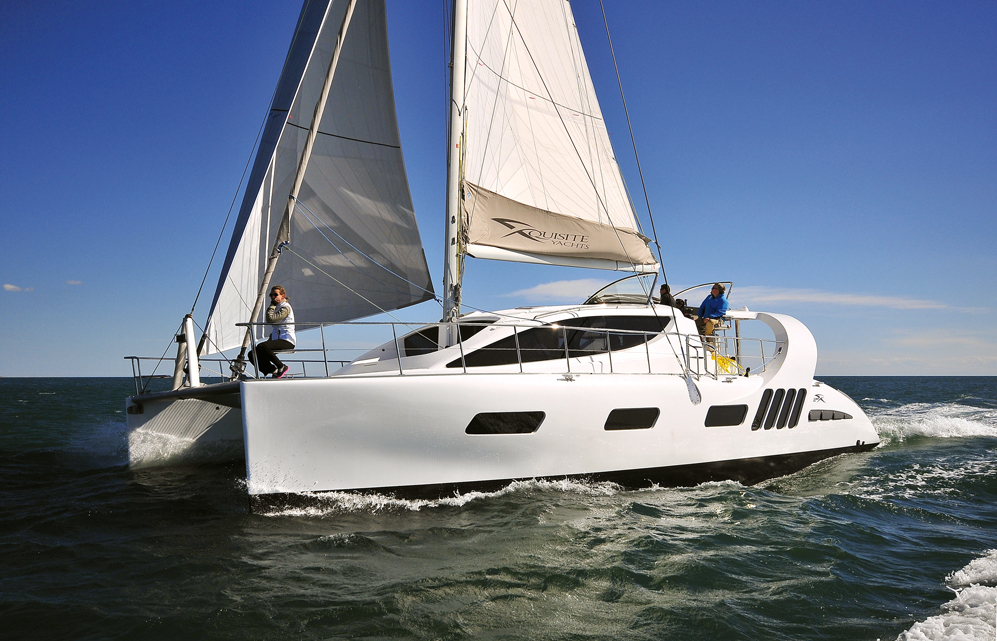
The Xquisite X5 is a luxury catamaran capable of producing good performance. It goes very well in light and medium airs.
Different lines and a functional design
The curvaceous style of the boat is fluid and aerodynamic. The forward face is composed of a vertical windshield in two sections which is cleverly designed and offers a great view, and the split between the lateral port lights in the coachroof is innovative and provides a remarkable panoramic view, with great quality of light, thanks to the use of high-strength, tempered laminated and glued glass. So no more expansion, sources of leaks or the crazing associated with Plexiglas). Having them inset creates a protection against the harmful effects of UV light. The sleek sailplan shows this to be a robust and quick cruising boat. The helm station is well integrated into the overall lines, and is protected by a clever convertible bimini. The large archway after seems a little out of place and is easier to accept or when you understand the program. The cutaways for the topside hatches extend the functional style, also making use of high-strength glass.
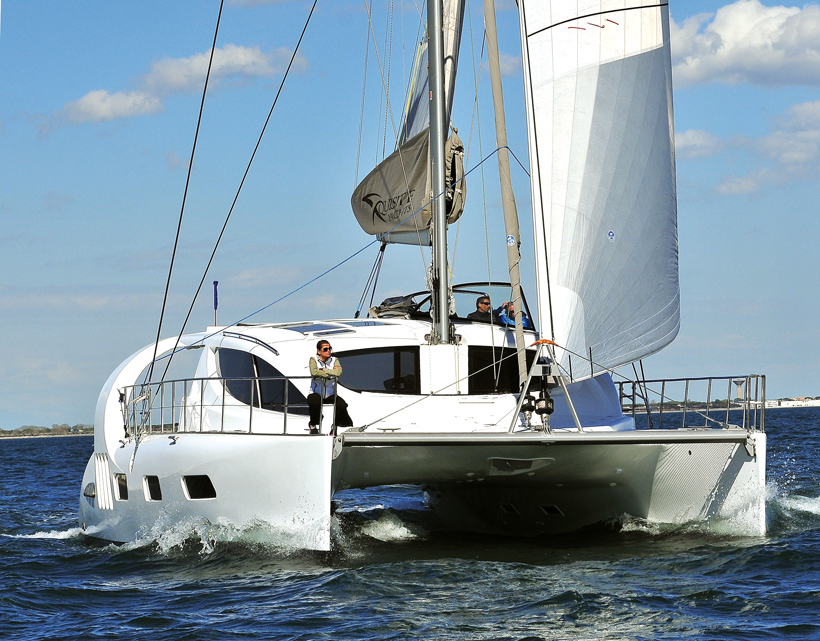
The rear arch is not very attractive, but it houses some interesting features which make it easier to accept. The anchoring set-up is exemplary. Note where the anchor launches beneath the platform.
Top of the range deck fittings and a well-designed deck layout
The usual guard wires have been replaced by a rigid stainless rail, 75 cm high which is much safer than the current recommendations require, and the solid rail can also be used as a step. Access on board is either aft via the sugarscoops, or via a very well-designed pivoting lateral cut-away. The side decks are wide and ringed with handrails on the coachroof. Space is increased by a raised area which is not fitted out, but which houses lockers (watertight with carefully draining hatches) concealing the furling lines. Very flat, with a good non-slip surface and lacking in any trip hazards and line-ends, this design choice illustrates well the philosophy of the boat. It is streamlined with the installation of a proper blue-water anchoring station. A first locker gives access to the 1500W windlass while a second reveals the chain lead as far as the pivoting bow roller. The general design of these vital elements for anchoring highlights that nothing has been forgotten. The attachment of the indispensable bridle (often requiring improvised and dangerous maneuvers) is done here in perfect safety. This neat device also allows the Harken furler for the staysail and the big reacher to be clipped on (no more fiddly preparing the gennaker before hoisting it!). It’s also this which takes the strain from the anchor and not the forward beam. Its structure conceals the two furling lines. The sail-handling station is at the heart of the X5: the two big Harken 60 electrical winches are powerful tools which can be used for everything (halyards, reefing lines, sheets and traveler). The solid frame of the windshield is used to support the removable bimini, which has articulated battens on mini bearing cars - a formidable solution which allows a perfect panoramic view to be maintained for maneuvering, combined with unrivalled all-weather protection. Other clever ideas include a rain water catchment using the drains incorporated in the coachroof, as well as the 900W solar power station fitted in the roof, with adjustable angle panels (6 x 125W/60Ah in optimal conditions!). The South African Sparcraft mast with only one set of spreaders has two diamonds stays, and lateral forces held by lower shrouds and capshrouds. The anodizing on the mast, and the way the hardware is secured to it such as some part being welded (gooseneck, mast foot, turning blocks) all indicate a remarkable build quality.
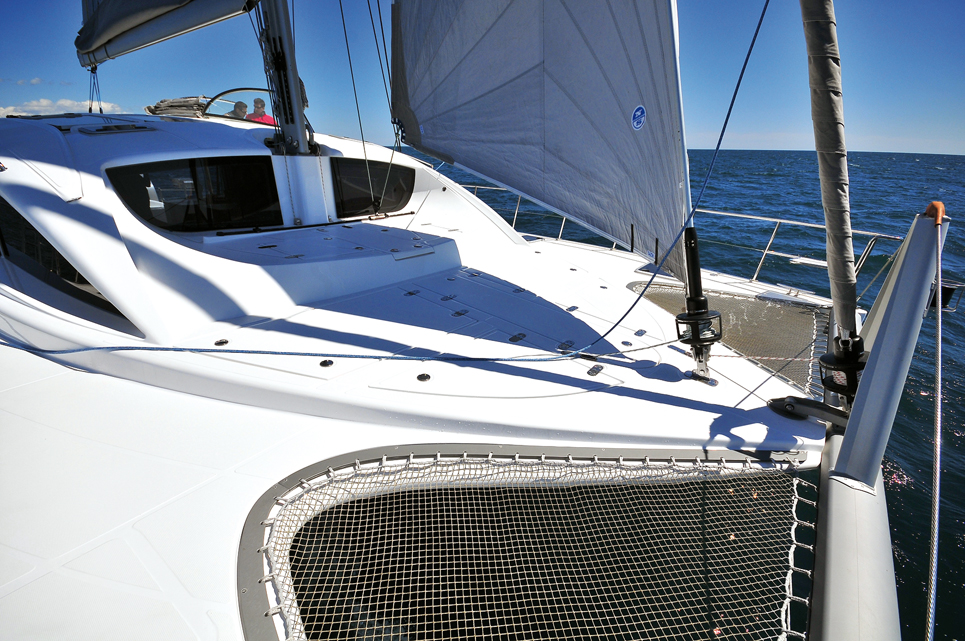
The split sailplan (self-tacking solent / big, overlapping reacher on furlers) and the choice of sailcloth (North membrane) show a level of excellence.
A refined interior
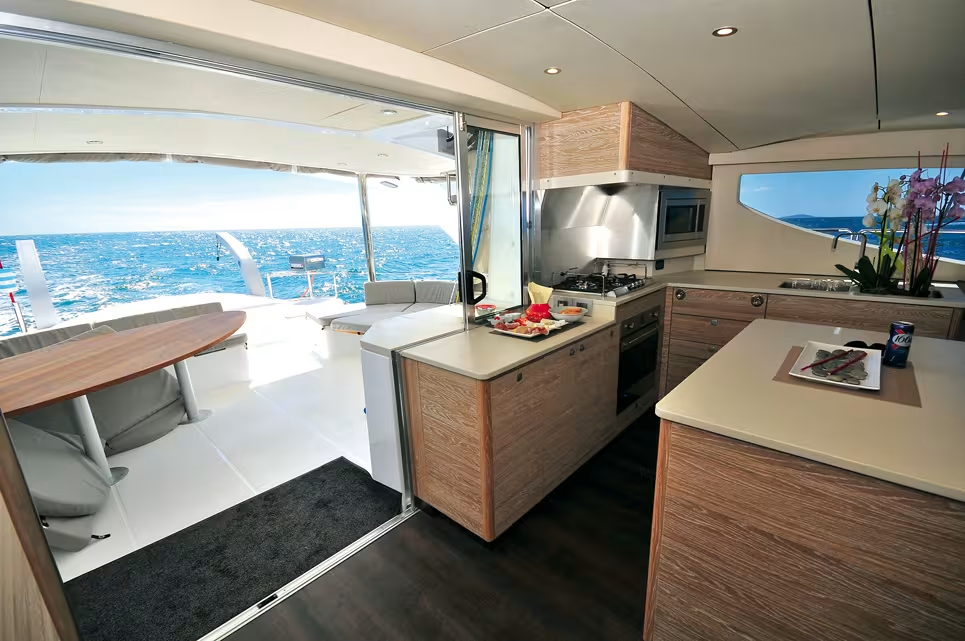
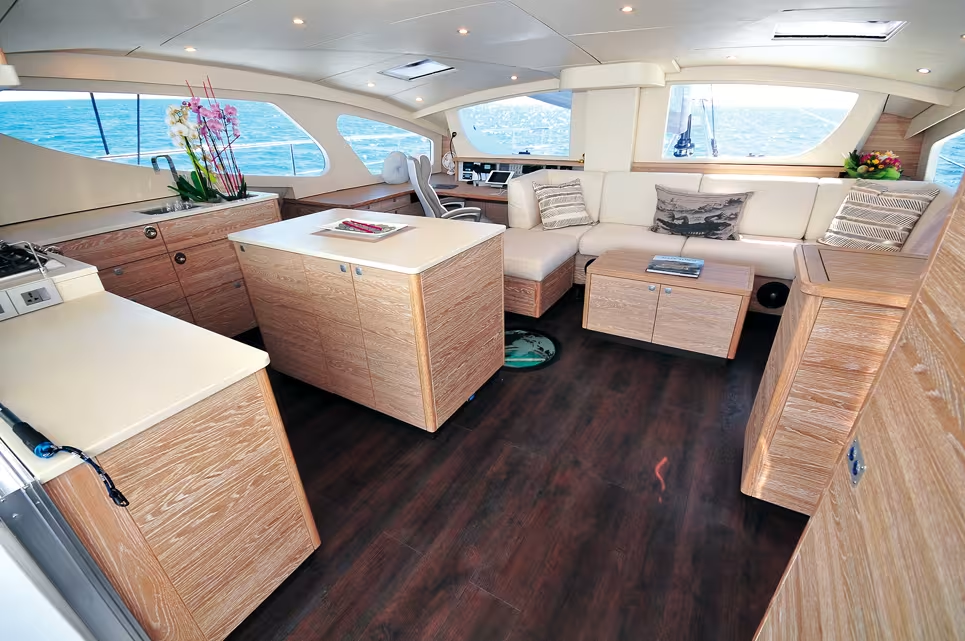
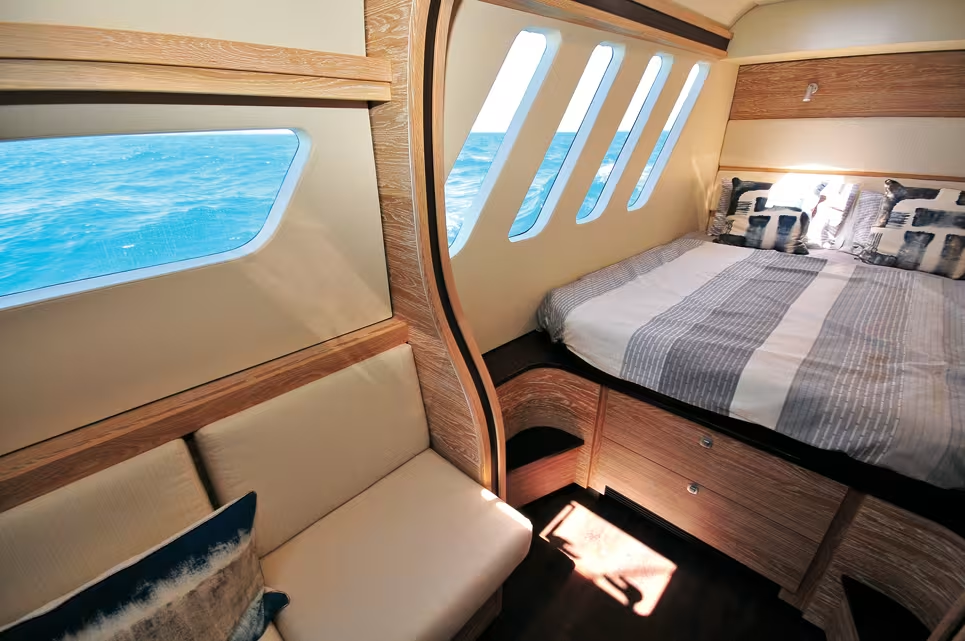
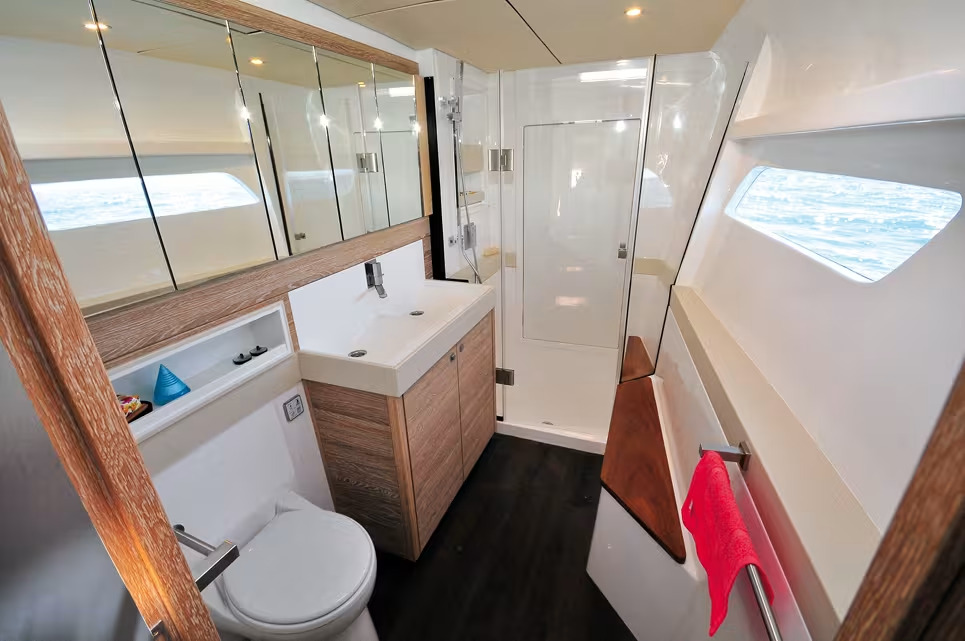
The majority of catamarans these days have a cockpit which serves as additional living space, a kind of multi-purpose balcony with many different uses forced upon it. The X5’s response to this a traditional one (bench seating around a large table, spacious lounger opposite and an adjustable bench seat aft), but this whole area can be quickly enclosed (to create a more private space when in harbor, or if the weather requires while at sea or at anchor). In fact, the cloth screens are permanently fixed in the recesses in the arch, and it only takes a few seconds to set them in place! The bimini roof has a nice headlining and is well lit with LEDs, and this creates a great atmosphere in this outdoor saloon. A wet kitchen and a refrigerator perfectly complete the setup - you can heat things up (or cool them down) as necessary! The galley is brilliant: set in an L-shape to port around a central island, it is a superb, well-finished installation, with neat little touches such as the brushed stainless cooker hood which makes cleaning easier and reduces fire risk. The lounger in the saloon is really comfortable, and is alongside the nav station, which is the nerve center of the boat, with everything accessed via an iPad on a stand. The quality of the woodwork (designed and built in-house) is remarkable, as is the choice of domestic equipment and materials. Everything is a well-built, solid and entirely suitable for marine use. The lime-washed oak trim comes from the well-known Dutch supplier Leewenburgh, and is used over sandwich construction. There is excellent light in the hulls, which have a pretty finish and plenty of storage. The utility room in the starboard hull is really designed for long-term used and the bathroom is quite simply perfect, with refined detail, comfort and quality (electric WCs, luxury faucets, light, ventilation and space). The two guest cabins to port offer are equally neat facilities, with really well-designed bathrooms. All the plumbing and cabling is run in separate galleries beneath the floor, and not in the bilges.
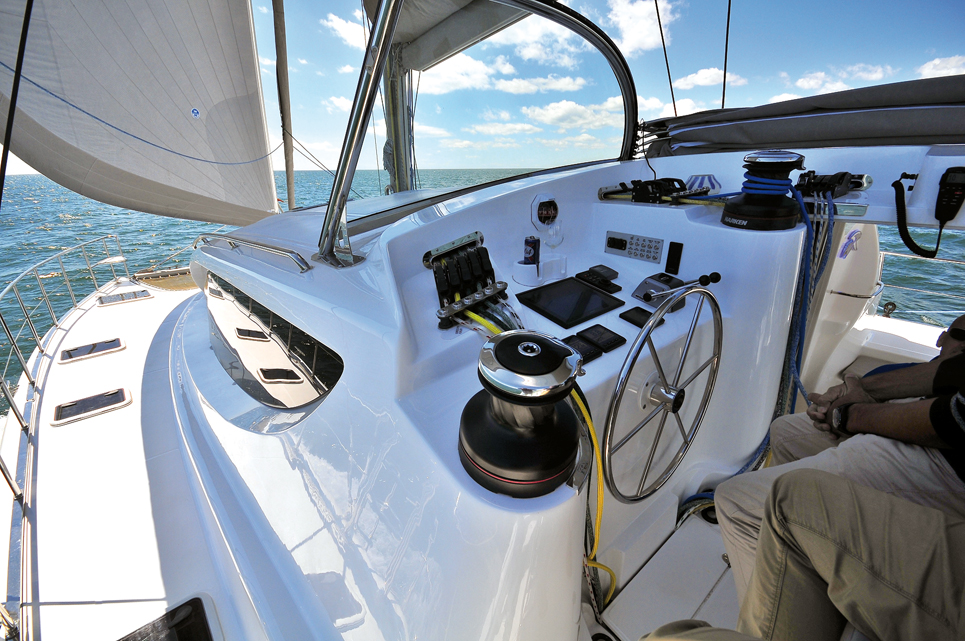
The X5’s helm station deserves praise. The design and finish are excellent, and handling this 50 footer on your own is a pleasure. Note the clear layout of the deck, with the functions of everything shown on engraved plates.
The neat electrical system with real-time information
The cabling is fire resistant and the whole installation is insulated. All the sockets are US and European compatible, with the voltage being programmable. The whole of the Mastervolt charging and inverter system is run by an easy-view controller, accessed along with the rest of the technical systems aboard, using the tablet supplied. Access to all the main information about the boat is instantly available and can be saved at any moment by the yard’s design team for diagnostic purposes. The screen also displays reminders for maintenance.
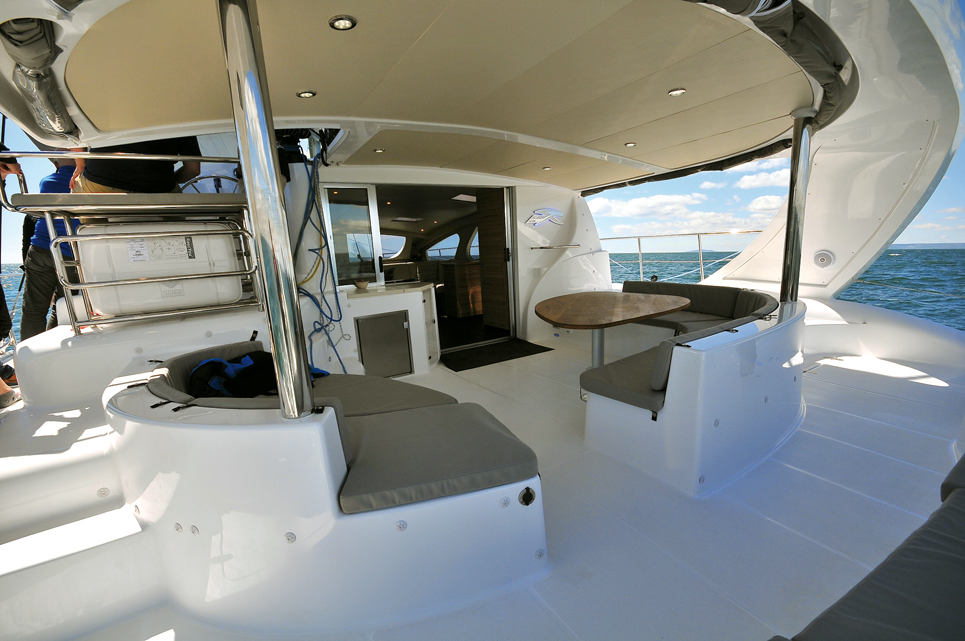
The cockpit comprises three clever areas (outdoor saloon, angled sofa and aft lounger). The wing houses the cockpit enclosures in a recess, allowing them to be deployed quickly.
A lively catamaran which is fun to sail
The amount of torque available from the 80hp Yanmars is very comforting, with three-bladed Maxprops really biting the water, giving great directional control for maneuvering on the dock at low revs. With no experience of handling the boat astern, I had no problem getting into our slip with 18 knots of wind on the beam. On the day of our test we enjoyed good winds, starting with 5 knots from the NE picking up to 18 knots from the NW for the majority of the day over a run of 32 miles. Once clear of the dock, I hoisted the mainsail from the helm station using the electrical winch. Being totally unfamiliar with the boat, I asked Tamas Hamor to stay close by and keep an eye on me to make sure I didn’t foul anything up. 30 seconds of explanation was all that was required to have a good understanding of the deck layout which is exceptionally well-designed and built. Everything is led back to the cockpit through three tunnels, whose outlets have sacrificial polished stainless anti-chafe sections carefully installed. The 14 Spinlock clutches are generously-sized and are all ergonomically within reach. Everything is clearly laid out, and each line (colors and characteristics carefully selected depending on their job) is identified on an engraved plate at the deck organizers. With of the cover stowed in 3 seconds, I had a perfect view as the main went up between the lazy jacks. Once it was set, I bore away and cut the motors. After a slight adjustment to the mainsheet car and a little bit in on the mainsheet, I unfurled the reacher. I checked the color of the line at the furler, released the clutch of the lazy sheet and pulled. Despite being complex, the maneuver was amazingly fluid, with no friction anywhere. Nothing caught up because all the leads are carefully organized. The reacher sheet for example, comes back as far as the wing of the bimini! Straight away had the feeling that I knew the boat and would be able to react immediately and make any adjustments with ease and dexterity. The quality of the development of this hull number one is absolutely remarkable. The wind was backing, but then quickly settled in the NW and was picking up. With this amount of sail area (183m²), the boat starts to move in just four knots of wind. The quality of the North membrane sails, combined with a faultless deck layout, made for a nice surprise at the start of our test. A good breeze was now blowing across the water, leading us to another exercise: I rolled up the reacher in a jiffy by bearing away and giving a bit of a lee from the main, easing the sheet with one hand and operating the furler with my foot. Fantastic doing this on your own compared to a gennaker! The self-tacking staysail was quickly unfurled and once set for a close reach, I turned my attention to reducing the mainsail. With the traveler out and the sheet eased, the sail is empty but it doesn’t flog. Thanks to the engravings for the lines, there is no confusion and I don’t need to ask Tamas a thing: ease the halyard, hook on the strap at the mast and re-tension, making a visual check (thanks to the hatch in the cover) that nothing has caught, and we’re off again! This magic deck layout gives me great confidence and I imagine it would be the same for any sailor. The feel of the helm is good for a hydraulic linkage, and checking the mechanical parts (welded stainless connections and rudder stock) inspired respect. The X5 is agile for such a well-equipped model, it tacks perfectly, accelerates through a bit of a chop and knows how to keep up good average speeds between 8.5 and 10.5 (our maximum speed on the day) in 15-18 knots true. In the conditions we encountered I found it to be a very stable platform with a gentle passage through the water.
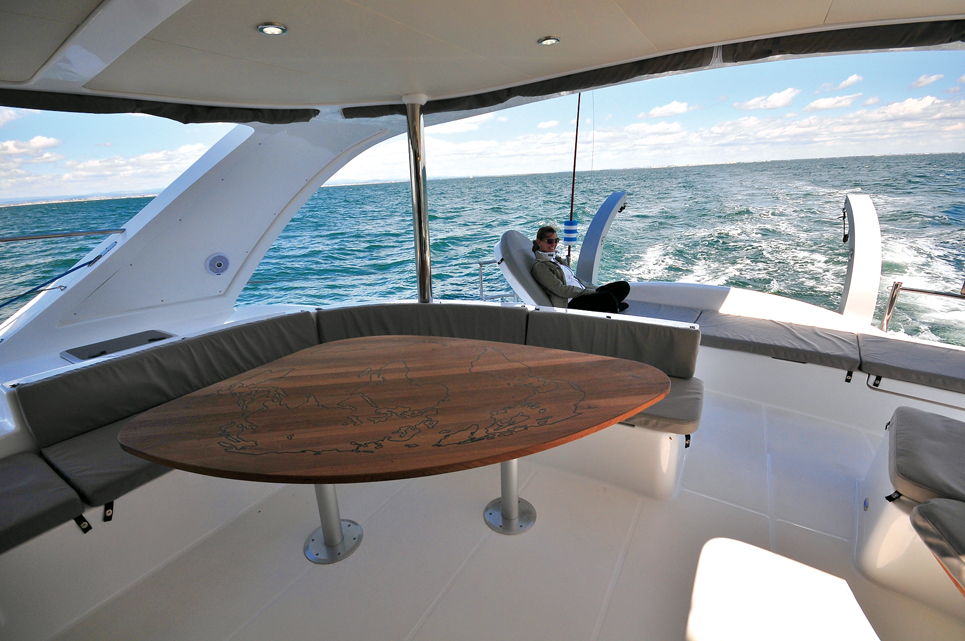
Clever: the aft bench seat reclines! The map of the world engraved into the cockpit table is an invitation to let slip the lines on a catamaran totally designed and equipped for such a program.
Conclusion
The X5 is a total success. This “turn-key” catamaran is attractive with its rigorous specifications, fall top of the range equipment and exacting quality. The ease of use by a short-handed crew is undisputable, and the watchkeeper has no need to panic at the prospect of changing a headsail or reefing the main.
The plusses :
- Build quality and standard of equipment
- Remarkable deck layout
- Ease of use and suitability for the program
The minuses :
- Unconventional profile
- Enormous rear arch
- Saildrives as opposed to shafts or V-drives
Specifications
- Builder: Phoenix Marine (South Africa)
- Naval Architect: Rudolf Jonker
- Length: 15.44m
- Beam: 8m
- Displacement: 18-22t
- Bridgedeck clearance: 1m in lightship condition
- Mast height: 21m
- Air draft: 24m
- Mainsail area: 100m²
- Reacher area: 83m²
- Furling jib area: 33m²
- Motors: 2x80hp Yanmar
- Fresh water: 4x215l + Spectra Newport 400 60l/h 12v watermaker
- Fuel: 2x395l Price: $1,200,000 ex-tax
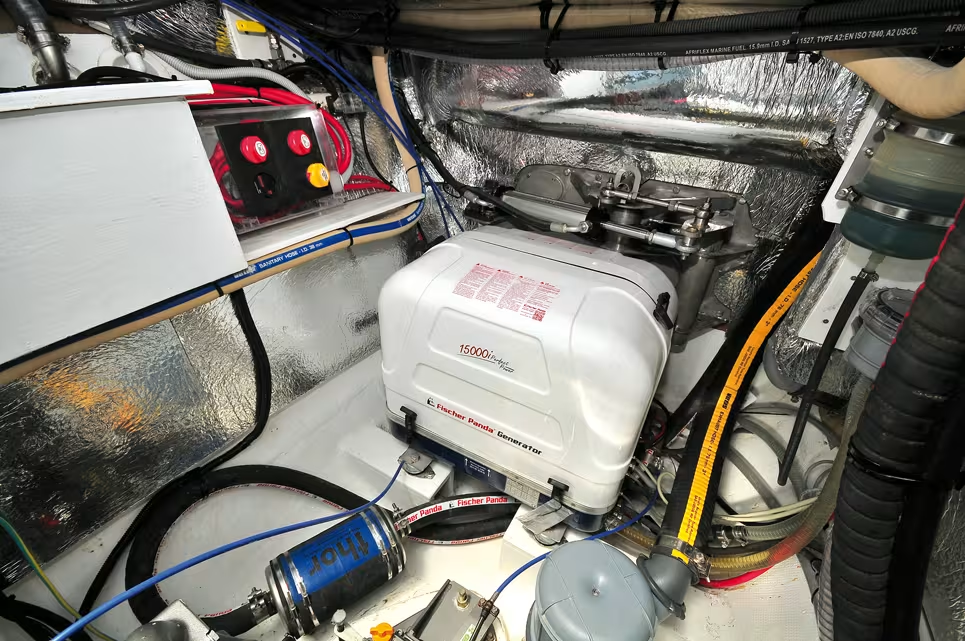
- Equipment included: Full Garmin electronics (plotter radar, autopilot, basic instruments) Integral boat systems monitoring on iPad Fisher Panda 12kW generator (variable speed) Air conditioning, washer/dryer, rainwater collection on the deck Freezer, refrigerator, icemaker and cockpit bar-fridge, 40” electrically retracting TV screen
- Full Harken deck hardware and electric winches Membrane reacher and jib on furlers + North membrane mainsail
- Safety pack with liferaft 750A Batteries in 2V Mastervolt cells + 900W of adjustable solar panels Three-bladed folding Maxprop propellers
- Launch in Cape Town with antifouling and epoxy primer
A word from the designer, by Rudolf Jonker
The aim with the X5 was to create the perfect cruising catamaran with excellent seaworthiness, good sailing ability, safety and comfort as key ingredients. Many years of building custom cruising catamarans laid a good foundation on which to develop a boat that would satisfy the most proficient yachtsman/cruiser. It was also important to have a boat with a distinctive aesthetic appeal with unique signature lines. The sail plan was chosen to provide ease of use while still giving good all round performance. Very importantly it must be able to be comfortably sailed by one person. The hull was designed to give a balance between performance and carrying capacity. Extra storage has been added inside the boat and on the deck, perfect for blue water cruising. From a technical perspective it was important to create a boat that was easy to maintain: virtually every component on the boat takes maintenance into consideration, often an oversight by many. A lot of time was spent to ensure the owner's personal requirements are taken into consideration with bespoke interior moldings and state of the art electronic digital switching technology. Boatyard systems and procedures ensure consistent build quality. The performance of the boat is one of elegance and comfort. The boat's construction is built to be robust, giving me peace of mind knowing that our proud owners will be safe in any deep sea crossing.
The competition
| Model | Builder | Sail area in m² | Weight in T | Price in € ex-tax |
| Serie 5 | Privilège | 141 | 16.8 | 945,000 |
| Discovery 50 | Discovery | 138 | 14.5 | £1,440,000 |
| Saba 50 | Fountaine Pajot | 141 | 14 | 605,495 |
| Balance 526 | Balance Cats | 157 | 9.4 | US$ 1,299,000 |
| Lagoon 52s | Lagoon | 156 | 26 | 625,000 |
| Seawind 1600 | Seawind | 144.5 | 13 | US$ 939,000 |
Boat details
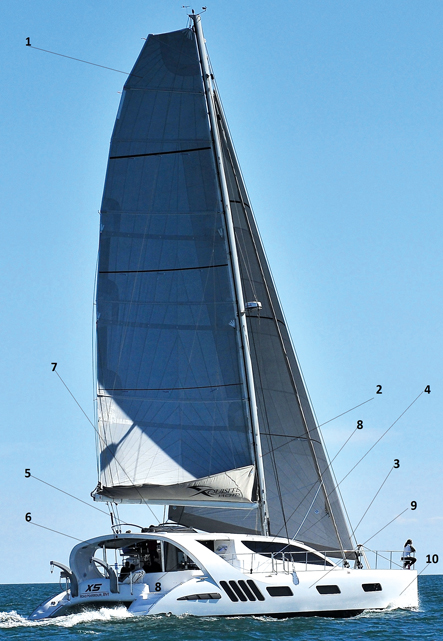
- : An impressive sail area (100m² mainsail) of a remarkable quality (membrane by North)
- : Sparcraft mast with one set of spreaders and two diamond stays: an excellent set up, held in place by dyform rigging (stainless wires whose strands are flattened and prestressed, making them 30% stronger)
- : The big reacher on the furler is a real alternative to a gennaker for cruising. Nothing to set up beforehand, easy to reduce sail when short-handed leading to more frequent use.
- : The self-tacking solent is a traditional solution which perfectly complements the reacher. Note the perfect organization of the lines which run under the platform and come back to the sail handling station.
- : The X5’s retractable bimini-dodger is one of the best solutions possible for a targa top. The battened material runs on Harken cars and rings which allow for an almost instantaneous folding or unfolding.
- : The big wing aft gives it a heavy silhouette, but houses several neat features: as well as the cockpit enclosures which are tucked away and instantly usable, there is the deck shower. In the extended section there are 900W of adjustable solar panels, as well as the rainwater recovery system.
- : The X5’s helm station is a model example. 2 electric Harken winches provide the power, while the clarity and the quality of the deck layout and the sail handling maneuvers are simply excellent.
- : All the portlights use glued, toughened laminated glass, instead of plexiglass. A luxury and defining solution!
- : The interior layout includes top level cabinetry and the technical elements match this (fire-resistant cable runs in conduits insulated from the bilges, wifi monitoring, full domestic equipment as standard, etc)
- : The X5 goes well, is reasonably fast, well-balanced and above all, is easy to use short-handed.
