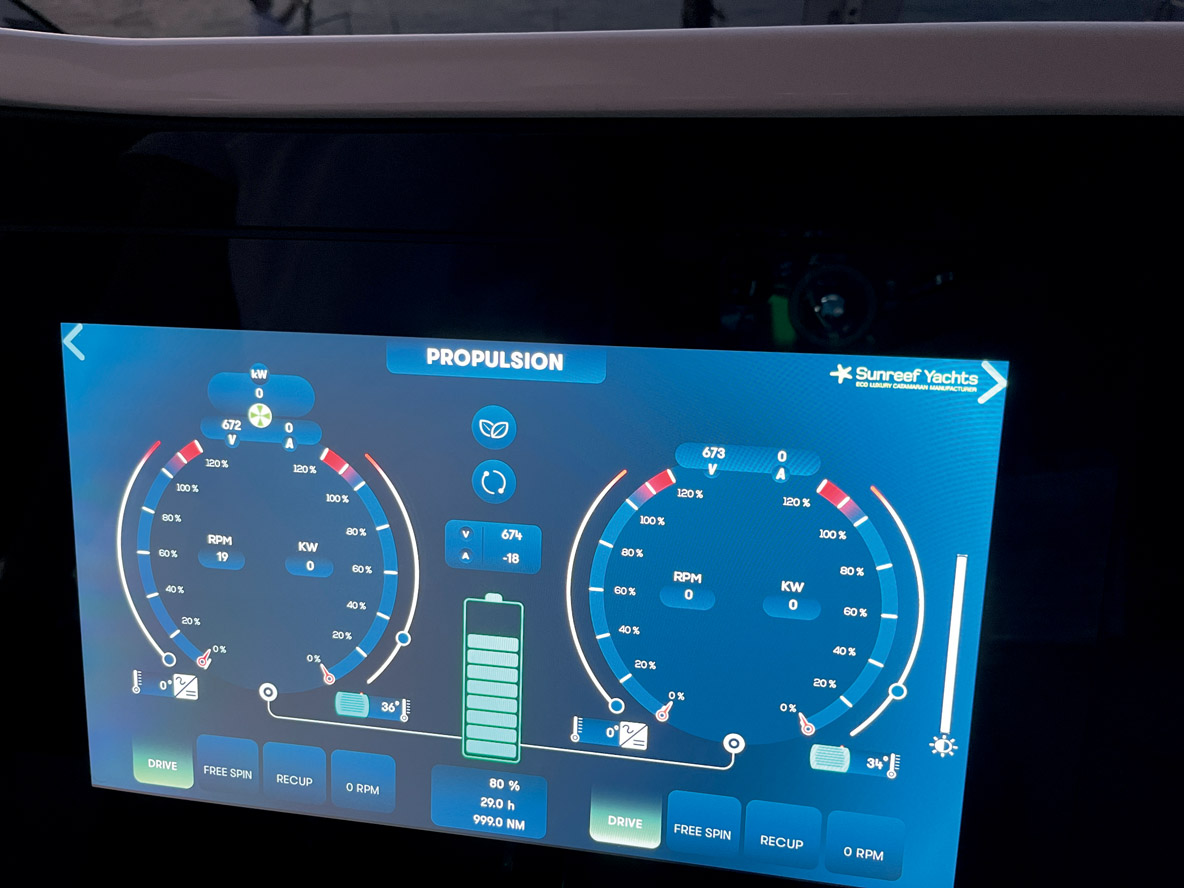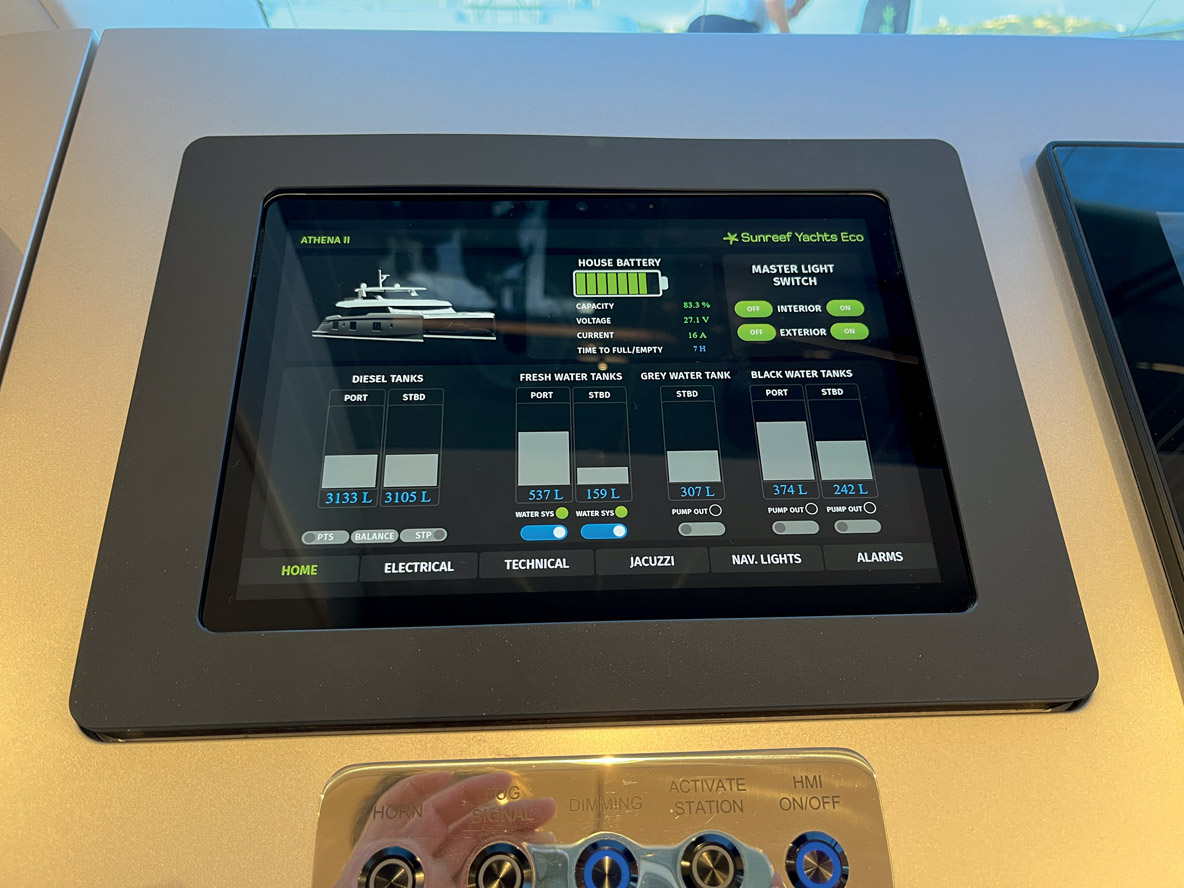
A year after the launch of the first 80 ECO sailing yacht, Sunreef Yachts has now presented a Power ECO version. This luxury multiyacht has abandoned its rig but retains its electric motor. We got the chance to sail aboard this exceptional unit at the Cannes Yachting Festival. Once past the bling of the French Riviera and the gleaming stainless steel, we naturally wondered about the relevance of the builder’s ecological approach: Is it possible to reconcile luxury yacht performance and ecology - or at least a significant reduction in fuel consumption - in the same powercat?
Infos pratiques
- Le chantier : 80 Sunreef Power Eco
- La fiche technique
-
 Découvrez notre vidéo exclusive
- Financez votre 80 Sunreef Power Eco
- Assuez votre 80 Sunreef Power Eco
- Articles autour du 80 Sunreef Power Eco
Conditions: 8 to 10 knots SW wind, 3-foot chop
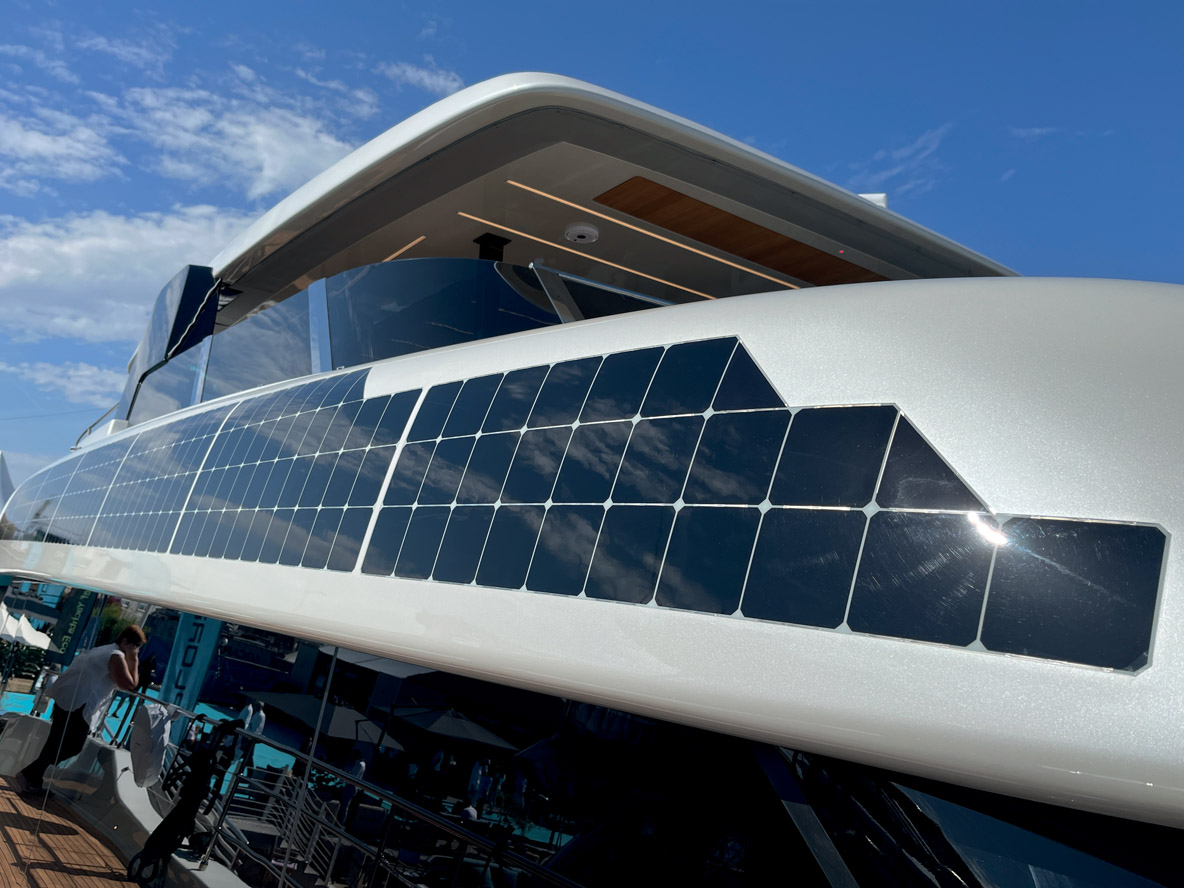
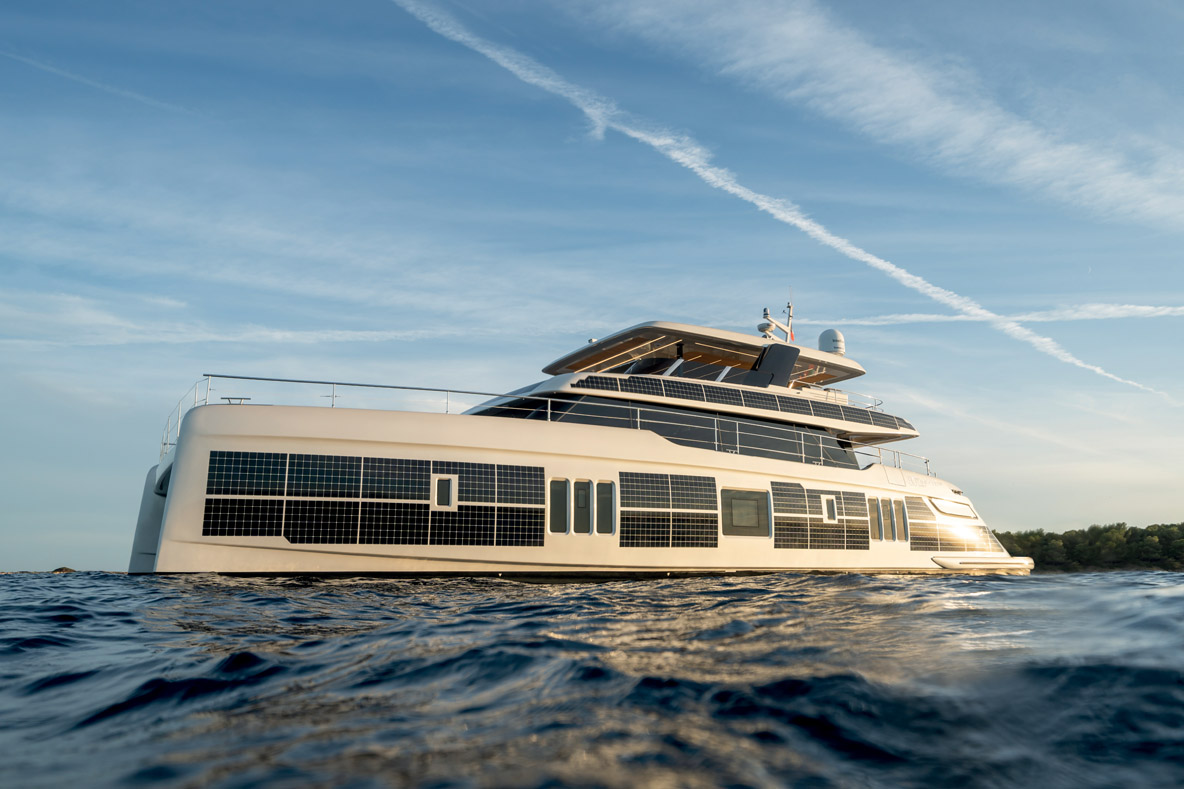
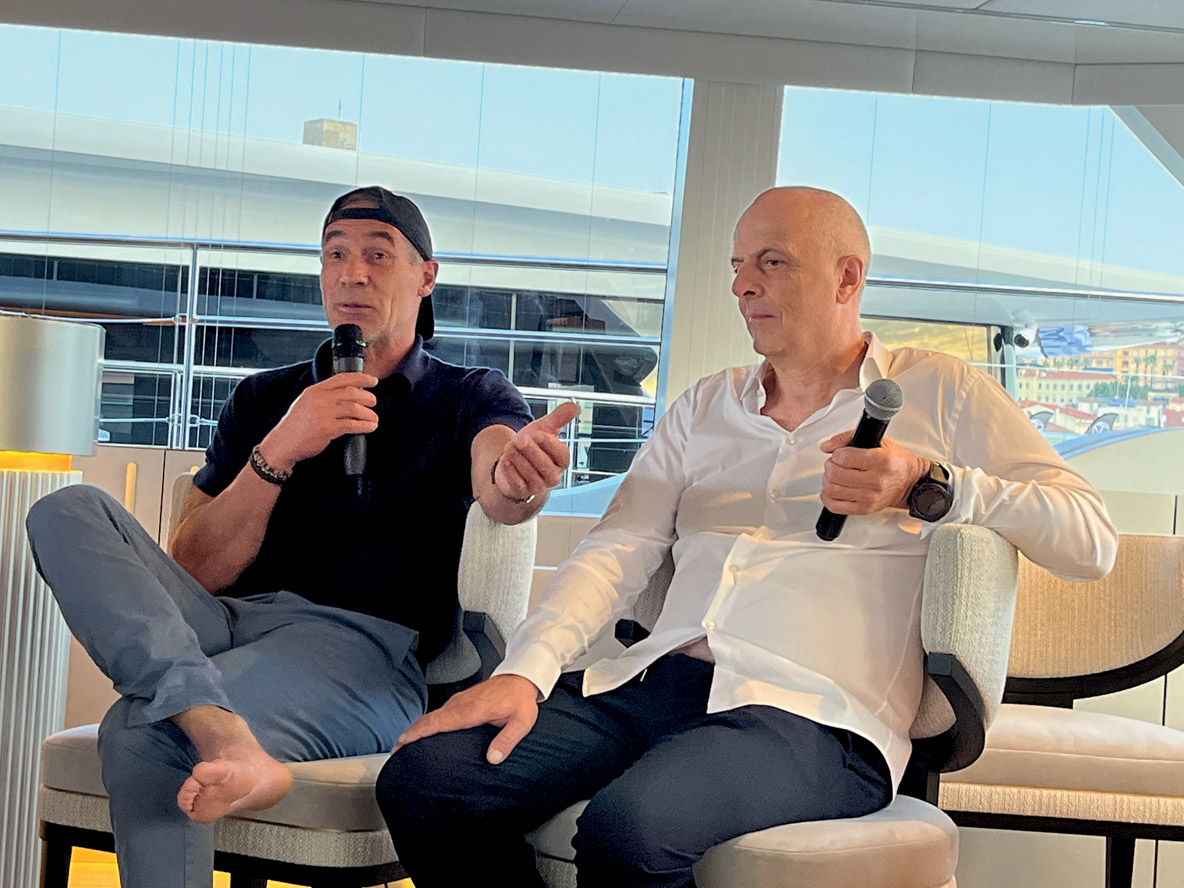
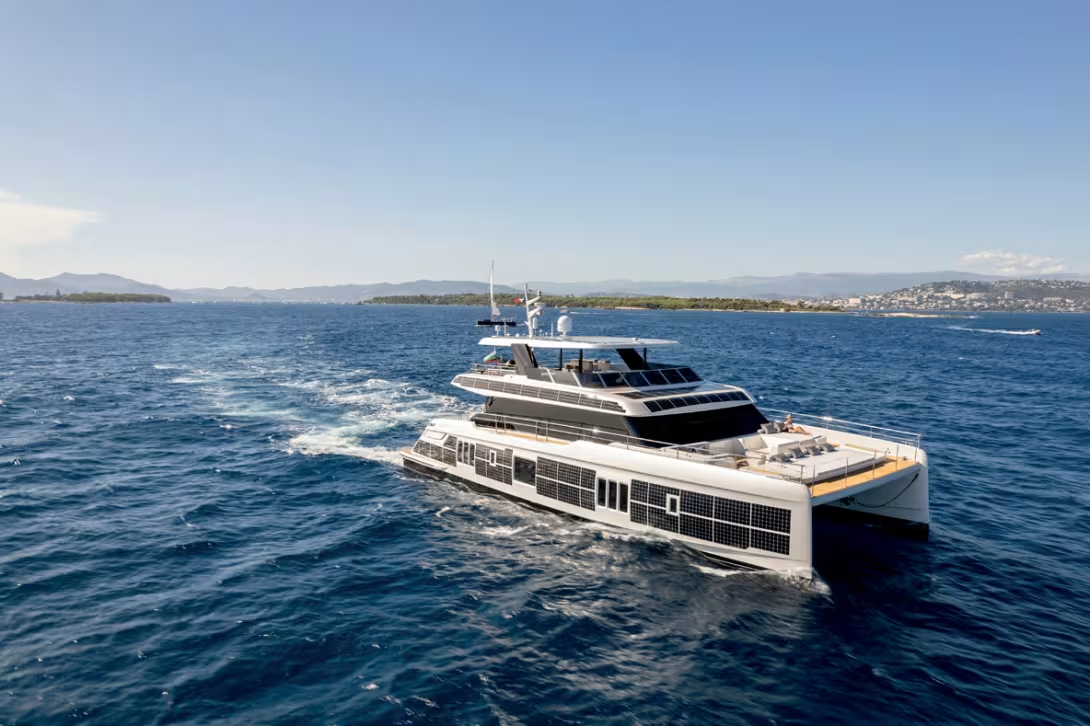
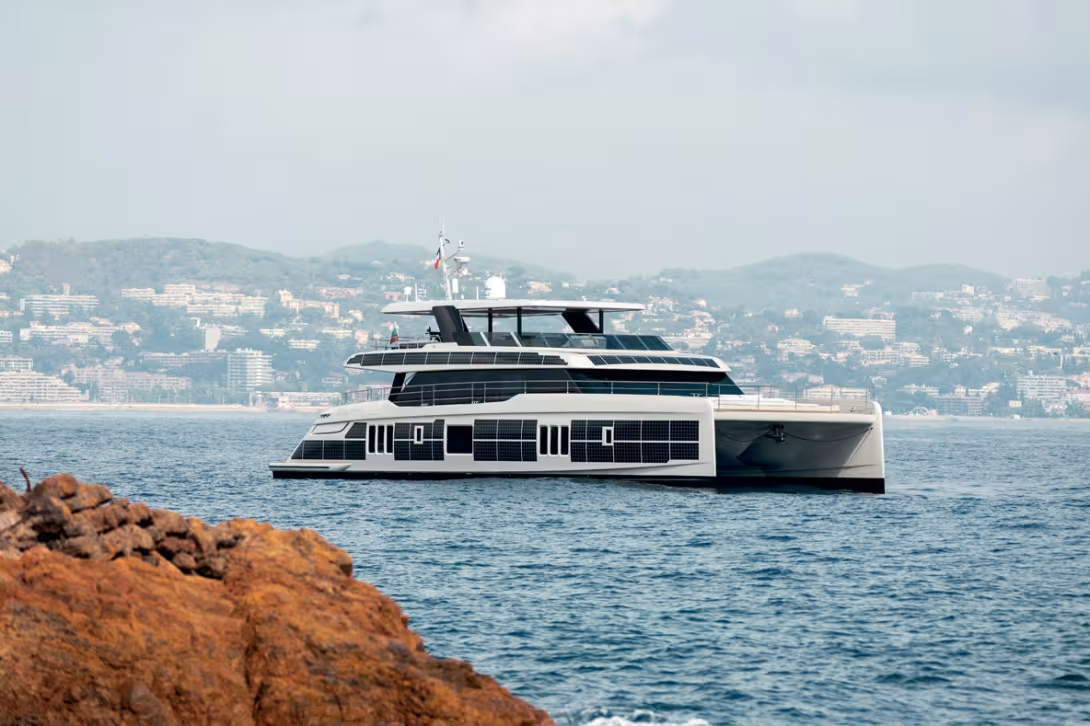
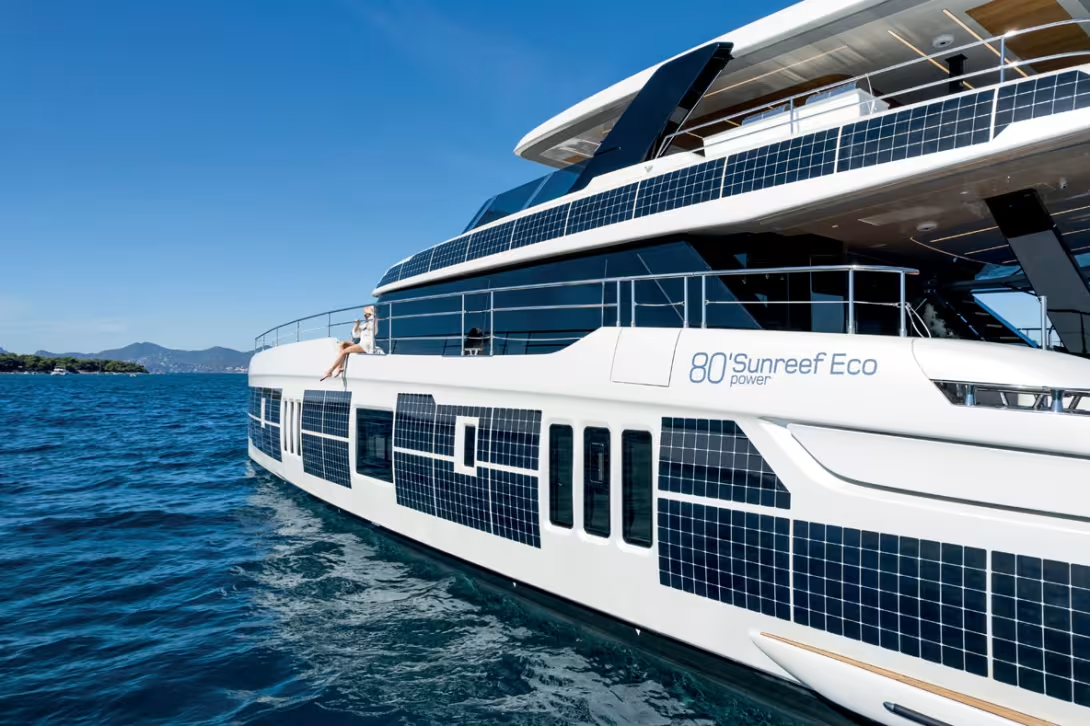
In recent years, the leading brand of luxury catamarans has become accustomed to the presence of a world star at the launch of its new models. After tennis player Rafael Nadal for the 80 Power and racing driver Fernando Alonso for the 60 Power Eco, it’s now the explorer Mike Horn who graced us with his presence at the World Premiere that took place at the recent Cannes Yachting Festival. The illustrious adventurer is very much involved in the field of new, environmentally friendly energy sources, notably by developing, in collaboration with the French Alternative Energies and Atomic Energy Commission, or CEA (Commissariat à l’Énergie Atomique et aux Énergies Alternatives), a fuel cell which could certainly be installed on board our recreational multihulls in the future. Its presence confirms the green positioning that the brand asserts and assumes, bringing environmental legitimacy. The 80 we discovered does not deviate from the brand’s usual minimum standards. Record habitability, a diversity of spaces and tailor-made luxury confirm the Sunreef signature. But this time, it’s not the glittery paintwork that stands out. As with the Sunreef 80 ECO sail we discovered in Dubai in spring 2022, the imposing surface of the hulls and superstructures are entirely clad with photovoltaic cells, which are integrated directly into the composite. 20 years ago, the visionary Francis Lapp created his own brand because he couldn’t find a catamaran to his taste on the market... the same approach was applied to these cells, which didn’t exist among specialized manufacturers. Conceived by the Sunreef design office and produced in-house, the cells are thin and flexible enough to fit the curves of the hull topsides, the coachroof and the hard-top bimini, so as to cover every available surface. Over sixteen hundred square feet (150 m²) of solar panels are laid out to capture all the photons that a day (preferably a sunny one, of course) can provide.
Engineering at the service of luxury and energy savings
With this extraordinary photovoltaic system, the Sunreef can recover 30 to 40% more energy than a catamaran fitted with conventional horizontal solar panels. The latter only capture the sun’s rays at the zenith of its path, i.e. when the angle of the sun is greater than 45° above the horizon. In temperate regions in the summertime, this sunshine pattern is long. By mid-season, however, it is all but non-existent. As for intertropical zones, the duration of optimum sunshine is limited to an average of 6 hours out of twelve. Sunreef engineers have established that the daily yield of vertical panels is limited to 60/70% of the potential offered by a sunny day. In fact, these panels produce almost nothing during the period between sunrise and the sun’s 45° ascent. The same applies when the sun is descending towards the horizon. With the cells arranged vertically and obliquely, the sun’s path is followed throughout the day, increasing energy collection by the same amount. With all the cells providing a theoretical value of 33.4 kWp, we can normally expect to recharge the battery bank to the tune of around 200 kWh on a fine day. It’s certainly the most efficient yacht today in this respect, but what about the rest of the story? Optimizing solar energy production is one thing, but aren’t the luxury and comfort features so dear to Sunreef aficionados too energy-hungry? The brand has logically taken several initiatives to reduce consumption. The first is the use of virtual towing tanks to improve passage through the water. We found that the first 80 Power - the ICE (internal combustion engine) version - was satisfied with “only” 13.2 US gal (50 l)/h of fuel at 9 knots. This very interesting figure for a boat of this tonnage was already an advantage when it came to switching to electric drive. The second was the optimization of the propulsion system and its management. Two 180 kW shaft-mounted motors are powered by an in-house 330 kWh battery bank. To take over in the event of cloudy days or the need to sail fast, two 135 kW generators are set to start up as soon as the critical remaining charge threshold is reached. The third point that’s been reviewed is the large on-board consumers. Chilled units and air conditioning have also been treated in-house to drastically reduce their consumption. It is now possible to spend the night with the air conditioning on, without the generators firing up unexpectedly (which was not the case until now). The green system is impressive, so much so that the ultimate luxury available on board every day is covered by solar energy alone. Our more specific questions about the technology behind all these systems were not necessarily to be answered - the manufacturer believes it has a head start in this field - and intends to maintain it.... Our only judge of peace will therefore be the day’s sea trials.
Tailor-made finishes and features
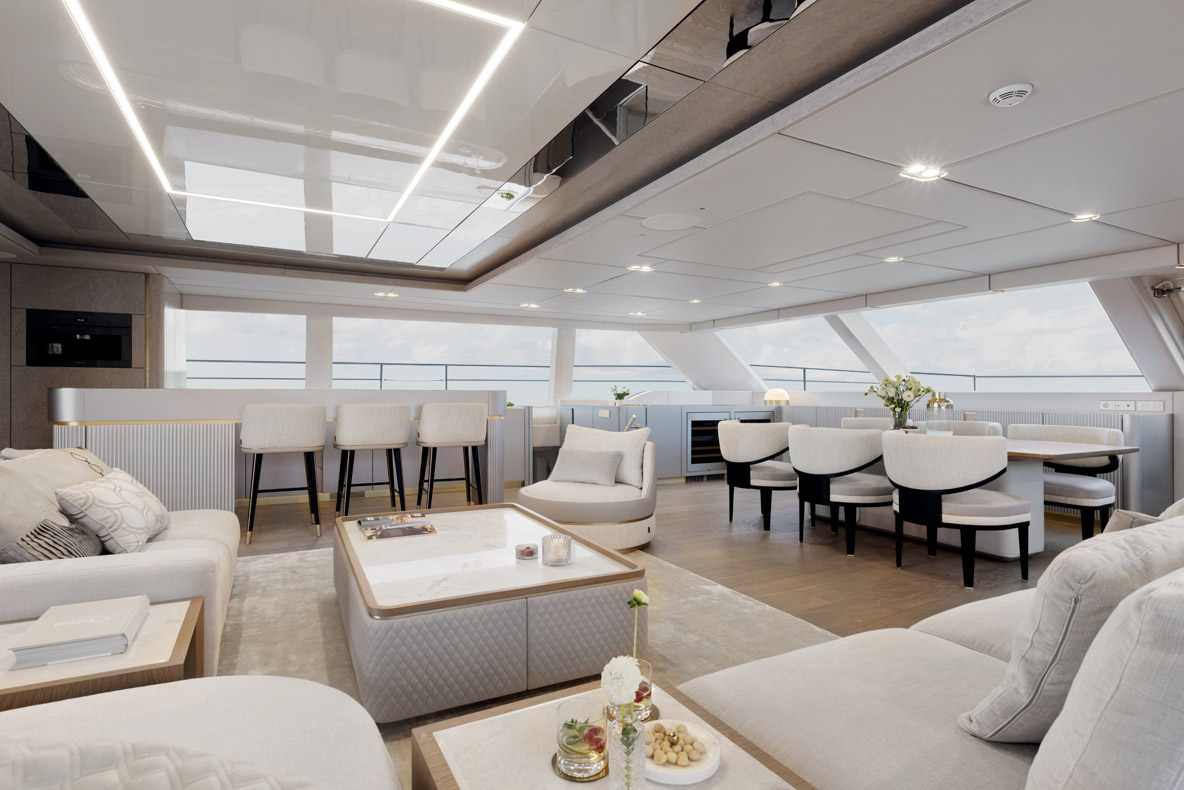
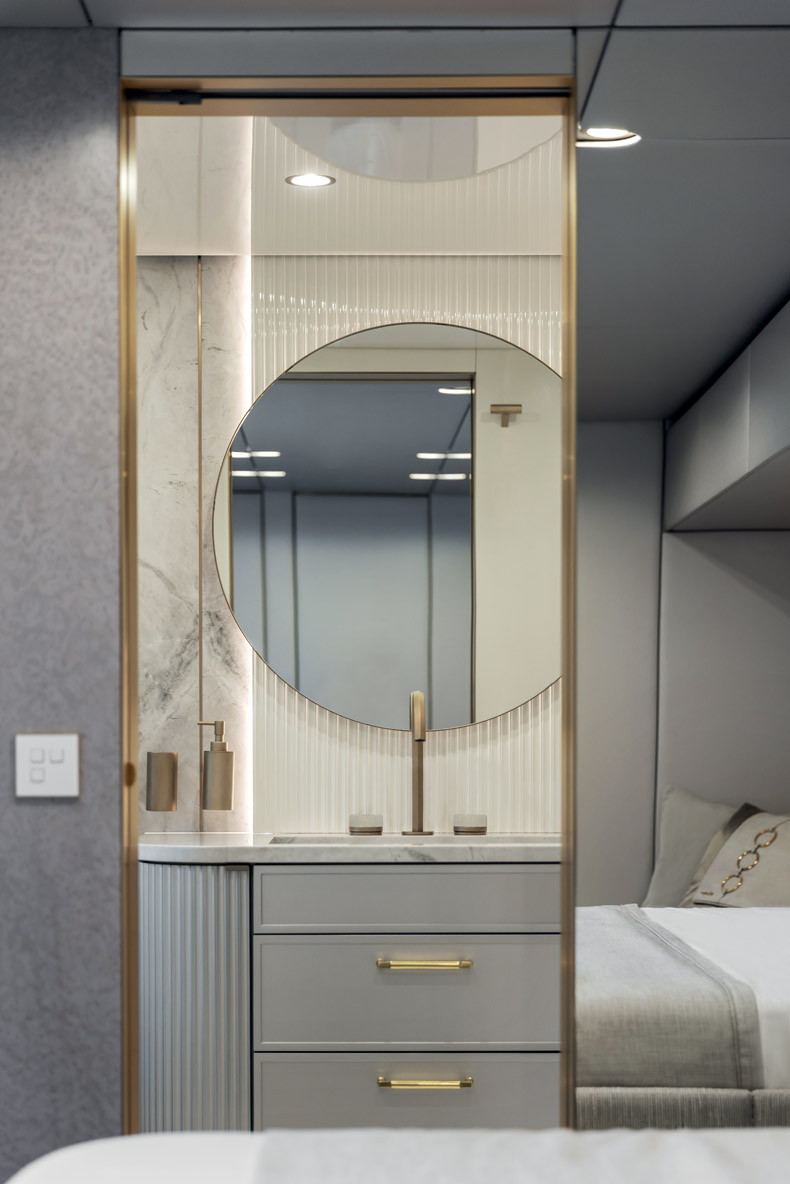
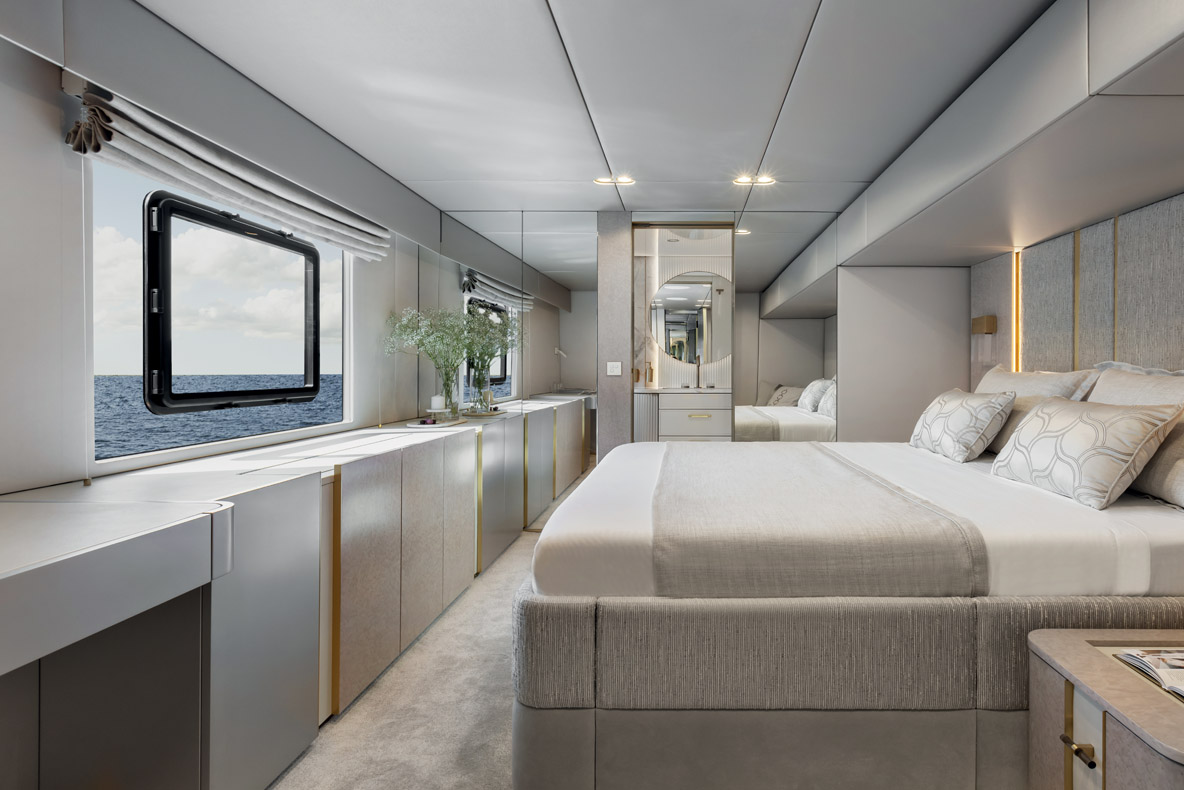
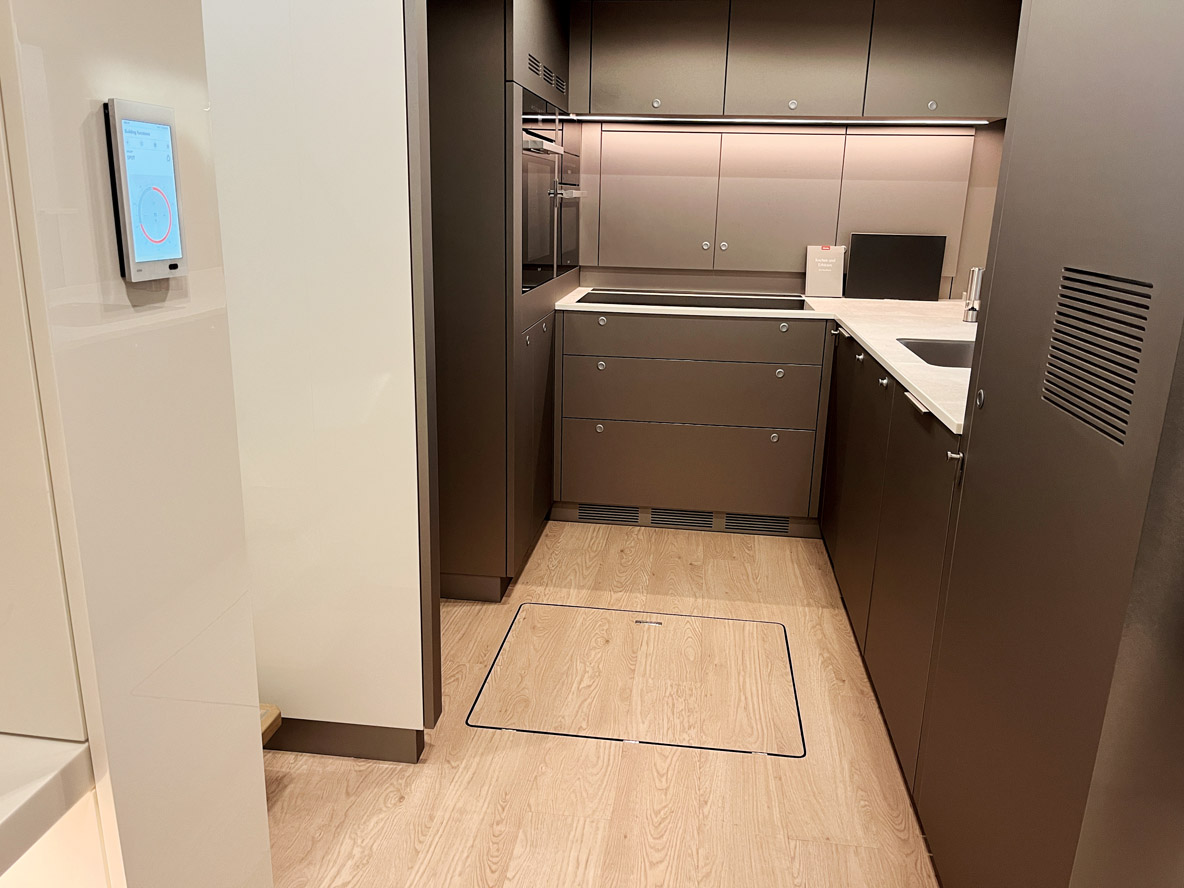
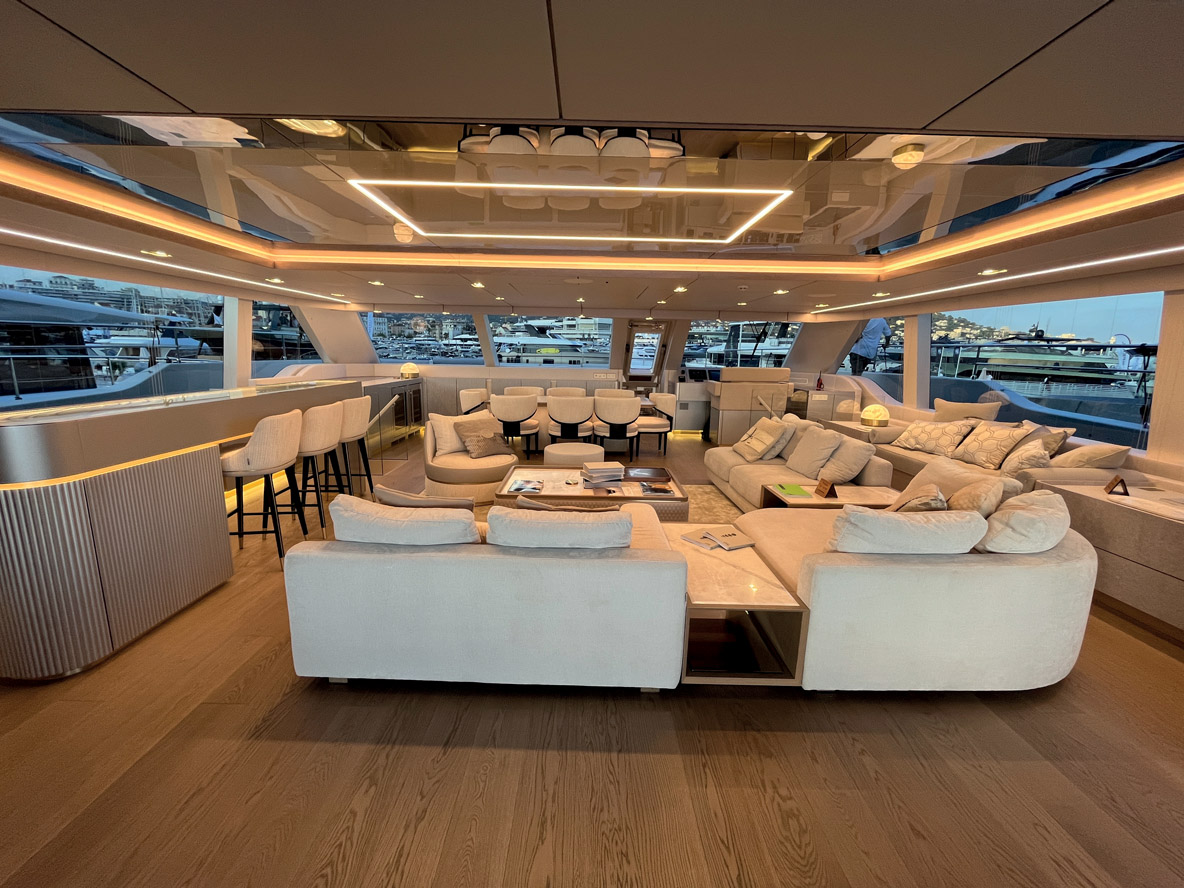
There’s really no need to go into the extraordinary accommodation capacities of the Sunreef 80 Power again. We covered them in detail in our MW171 review. XXL space and omnipresent luxury on all multipower decks guarantee the most enjoyable time on the water. All the customer’s wishes are taken into account to the letter, to coincide not only with the future Owner’s decorative tastes and layout requirements, but also with their cruising and self-sufficiency desires. This still applies to the ECO line. By way of example, the second 80 Power ECO features a much more powerful propulsion and energy configuration than the first model. The motors have been upgraded to 2 x 360 kW, and the battery bank is close to a megawatt (990 kWh to be precise). The two 300 kW generators, and the weight of the high-tech batteries, announced at less than 5.2 kg (11.5 lbs) per kW, complete a mechanism that is unrivalled in the yachting world, at least in this under 24-tonne sector.
Focus on cruising speed
All these figures are enough to make you dizzy, but the moment to put them into practice had (finally!) arrived. The enormous torque of 200 newton-meters (147.5 foot-pounds), delivered by the electric motors to the 27” propellers, makes port maneuvers very reassuring. In fact, our Captain seemed to make light work of the traffic jam clogging up the exit from the Vieux Port at the end of the day. The absence of noise and vibration was our first observation, and we couldn’t wait to see what happened offshore. We went back and forth a few times, with and against the wind - it was blowing at ten knots coming down off the Estérel. The high bows swallowed the 3-foot chop without too much pitching - the comfort inside remains unsurpassed. We gradually pushed the engine control lever (yes, we don’t say throttle anymore!). Maximum speed was reached at ten knots downwind and 9.5 knots upwind. At this speed, fuel consumption is 350 kW. Less than an hour at this speed will use up the entire battery bank, and the two 270 kW generators won’t last more than half an hour either. This speed can therefore only be used as a short acceleration to avoid a collision course or to force against a current. We lower the pace and settle on the recommended cruising speed - i.e. between 7 and 8 knots. Our measurements (see table) show a consumption of 200 kW at 8 knots. At this speed, the impact of the wind is significant: if the wind is from the ahead, you need to run both generators to spread out the energy consumption. But if the wind speed is reduced to 7 knots, no more than 120 kW are required, and only one generator is used. In this case, fuel consumption is around 35 liters (9.25 US gal)/hour, equivalent to that of the ICE version. With 8,000-liter (2,100 US gallon) fuel tanks and the support of solar power, transatlantic range is possible, provided that you manage your expenditure carefully according to the ever-present cloud cover. At 6 knots, you’ll have three hours’ autonomy, i.e. almost 20 nautical miles under way, allowing you to visit harbors, bays and anchorages without emitting CO2. So it’s easy to see why an XXL battery system like the one installed on the second 80 Power Eco is so useful, extending the non-polluting range to over 100 miles. As soon as you drop speed to 4 knots, consumption falls below the 20-kW mark, finally granting the unlimited range so long dreamed of, though this low speed is not (yet) compatible with the demands of cruising.
Conclusion
Combining luxury with ecology is a major challenge for Sunreef. Clearly, the goal of covering the energy needs of an unrestricted “palace lifestyle” without polluting emissions has been achieved. For the moment, this is less true for propulsion, which, except at very low speeds, still relies heavily on fossil fuels (as much as the ICE model), but for how long? The brand is announcing major innovations, including the production of hydrogen from ethanol, though their electric propulsion system is already convincing. The experience gained in adapting to it should pay off - especially when it will be possible to obtain, via fuel cells, as much energy as burning fuel allows today.
No engine noise
Peaceful, “clean” living at anchor
Still needs diesel, but for how long?
TECHNICAL SPECIFICATIONS
Architect: Sunreef Yachts
Design: Sunreef Yachts
Construction: fiberglass/foam/balsa composite
Length overall: 78’7” (23.95 m)
Beam: 39’4” (12 m)
Draft: 6’1” (1.85 m)
Laden displacement: approx. 100 t
Motors: 2 x 180 kW
Fuel: 2 x 1,050 US gal (2 x 4,000 l)
Water: 420 US gal (1,600 l)
Cabins: 3 to 5 + 3 crew
Guests: up to 10 people
Crew: up to 5
Price: on request