
Specialist in day-cruisers and cruising power catamarans, the Aquila shipyard unveils another facet of its talent with a true sport fishing boat capable of going fishing offshore or offering maximum comfort for the family.





Infos pratiques
- Le chantier : Aquila 28 Molokai
- La fiche technique
-
 Découvrez notre vidéo exclusive
- Financez votre Aquila 28 Molokai
- Assuez votre Aquila 28 Molokai
- Articles autour du Aquila 28 Molokai
Test location: Clearwater, FL (USA)
Conditions: Slight chop, 20 knots of wind
Aquila may be one of the leaders in the powercat market, but the brand isn’t intending on resting on its laurels. After the imposing Aquila 70 Luxury yacht catamaran, the builder is expanding its range of small boats with the Aquila 28 Molokai. This catamaran inaugurates the new offshore range, which should soon include larger models.
Until now, the American/Chinese company had no involvement in the open catamaran fishing sector, a field dominated by brands like World Cat, Invincible and many others. But now it is, as the 28 Molokai is indeed a fishing boat and has all the required attributes.
As is typically the case, Aquila doesn’t do things the same way as everyone else... To design its new model, the shipyard sought inspiration from Hawaii, and more particularly from the architect Kirk Clark, a true figure of naval design in this Pacific Ocean archipelago. It is also from one of these tropical islands that the name of the boat is taken.
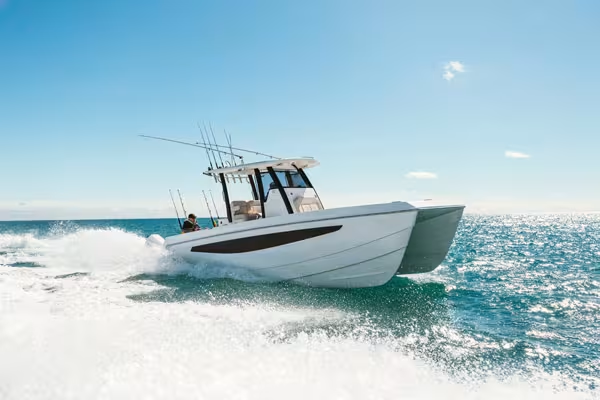
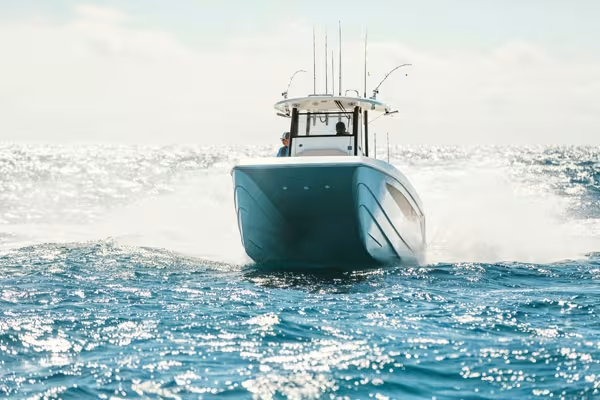
With that as the background, it’s time to discover this boat which, in many ways, stands out from the competition. The first thing that strikes you is the very square aspect of the catamaran, with a totally straight bow and a deck line that shows almost no undulation, except at the stern, where the profile softens to reach the bathing platform. The beam remains fairly moderate at 9’7” (2.93 m), which opens the doors to “normal” marina slips for the Molokai. The bows are as sharp as a Japanese sword: their profile is somewhat reminiscent of the Aquila 32 and 36, but are much finer. Next, because of a very narrow foredeck perched on high bows, the boat offers an airy and very sporty look. It even evokes the world of performance racing catamarans. Last but not least, a long, fake window is painted on the hull on both sides to recall the design of the other models of the brand.
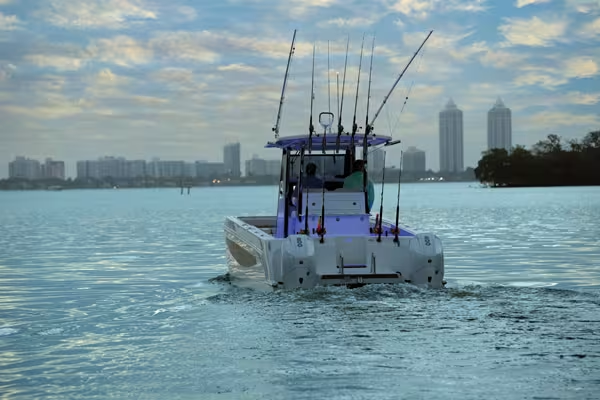
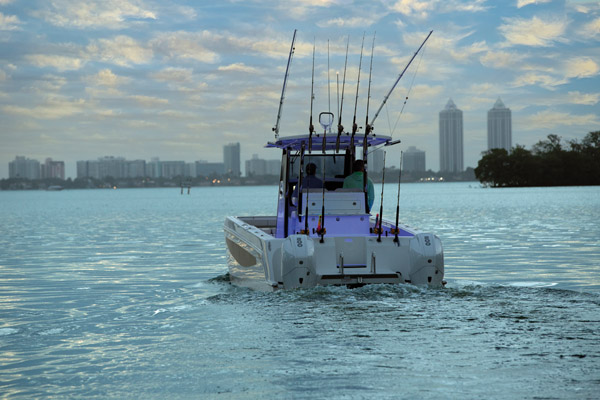
The fishing accent is notably provided by the large center console and the optional T-Top on which five rod holders are installed. In fact, there are rod holders almost everywhere on this boat, both on the stern and on the side decks.
 |
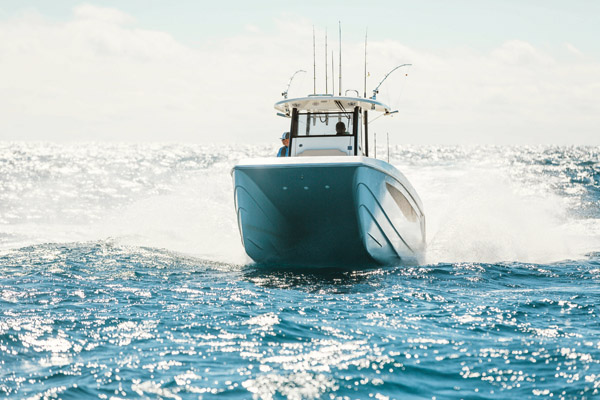 |
Aesthetically, the Aquila 28 Molokai evokes both the world of fishing and of offshore catamarans. The side markings match the identity of the other models from the brand.
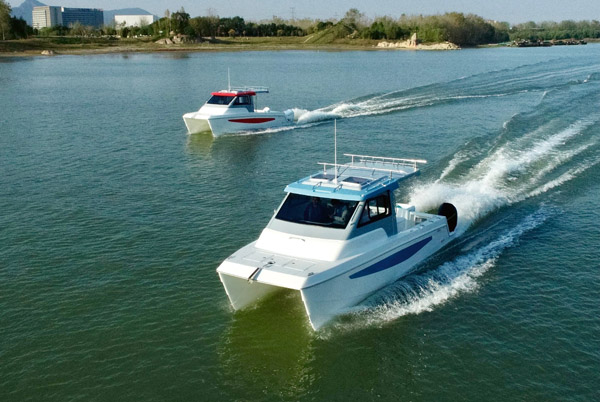
Designed by a Hawaiian naval architect, the Aquila 28 rests on two floats with very sharp bows. Note also the large tunnel and the slim deck that acts almost like a wing.
Very sporty lines
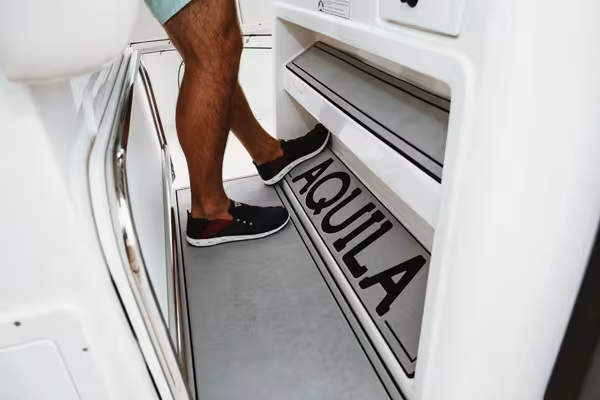
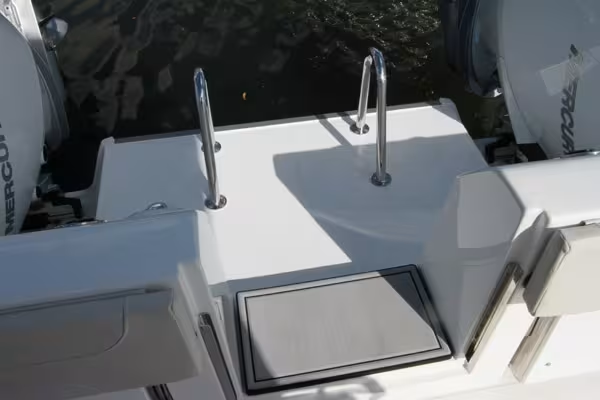
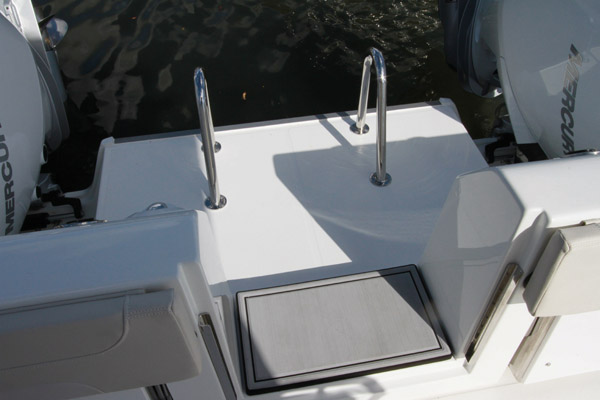
The engines are installed in line with the floats, while the central space between them is used for a nice swim platform with handrails and a removable swim ladder. Access to the boat is via the side or via the rear deck, as a passageway is provided in the center of the transom. A passage that can of course be closed by a gate. On the other hand, we regret the absence of a side door, an element that has become almost indispensable in this market. Like most of today’s fishing boats, the Molokai plays the versatility card, in order to satisfy the angler, but also his family. Once on board, the Aquila 28 is organized around three areas. The aft cockpit, reserved for fishing, the large center console with the helm, and the forward space or iented towards the family.
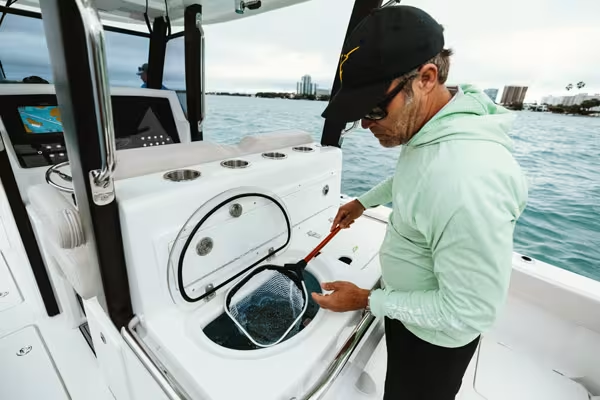
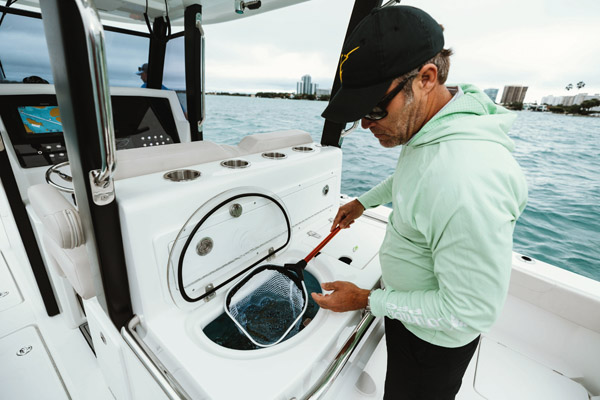
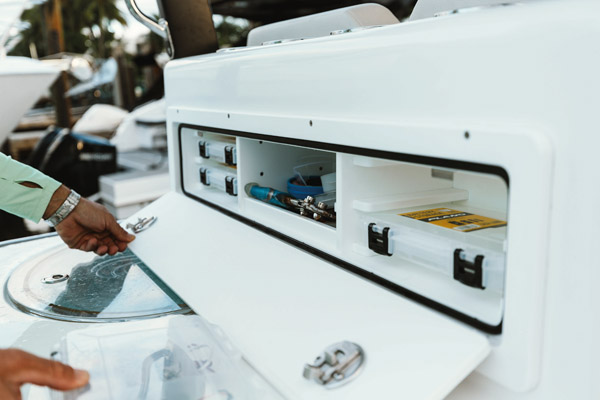
The cockpit is a good size, featuring padding on the sides to support your thighs while fishing, a very nice touch. It also has folding seats at the rear, but to benefit from these, you’ll have to opt for the «Pro Comfort» package. Another good point is the floor storage compartments, some of which can be used as fish tanks. On the back of the leaning-post, a unit includes a livewell (30 gal/113 l) and a small sink, as well as storage for the lure boxes. The upshot of this is that there’s no room to install a grill or a stove.
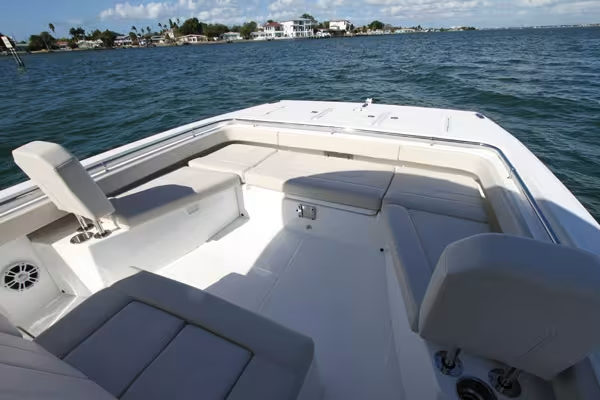
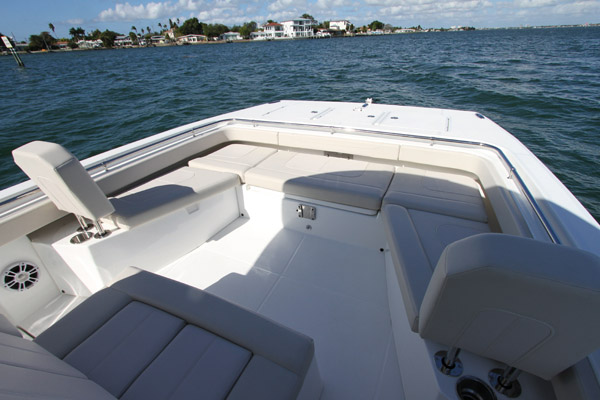
Taking advantage of the very square design of the bow and of course of the space offered by the catamaran design, the front of the boat offers a nice saloon area with, on each side, removable backrests to transform the bench into a lounge seat. A table with an offset leg can be installed in the center. Unfortunately, nothing is planned to transform the whole space into a sun lounger, which is a pity. Stowage has not been forgotten, since the seats hide large storage compartments, two of which have a drain. However, the front central locker is not counter molded... A double seat with backrest is installed in front of the console, a good place when under way, but a handrail is missing.
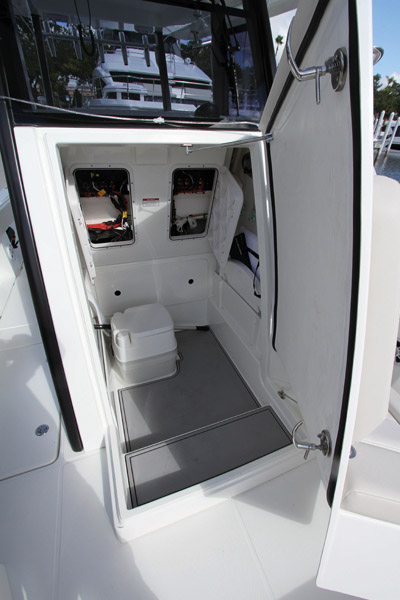
Lastly, the entire front part of the console, including the double seat, opens up to give access to a nice storage space or to a heads compartment if you take the “Pro Comfort” option. With a headroom of 5’3” (1.6 m), this cabin also has portholes. It also allows easy access to the electrical connections behind the dashboard.
 |
 |
 |
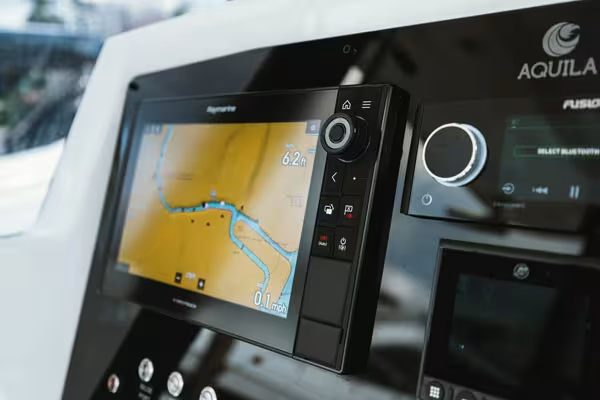
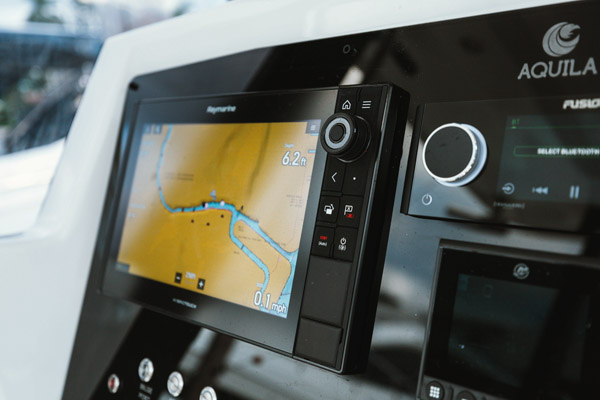
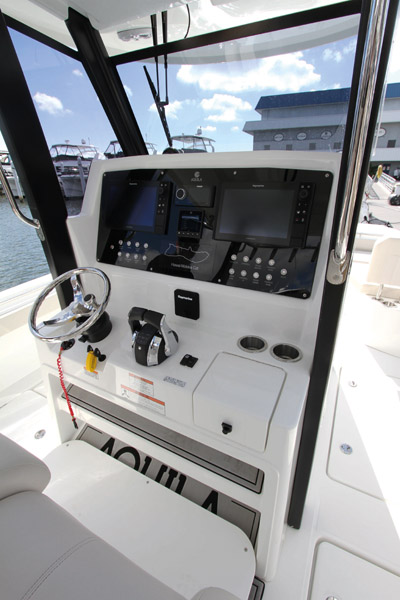
The helm console is similar to almost all fishing boats on the market, with maximum protection and enough space for two displays.
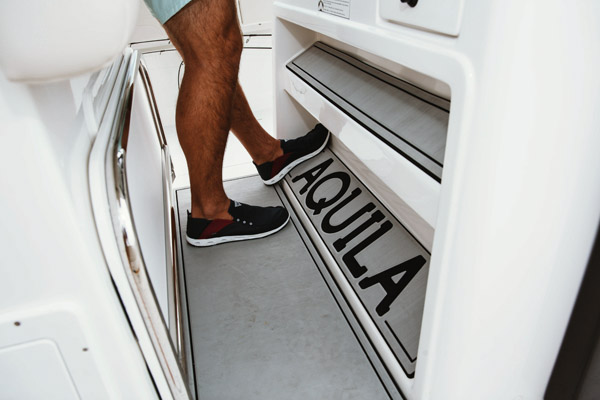
The seating position is well designed, with a large footrest and a folding board for smaller people.
A real fishing boat helm
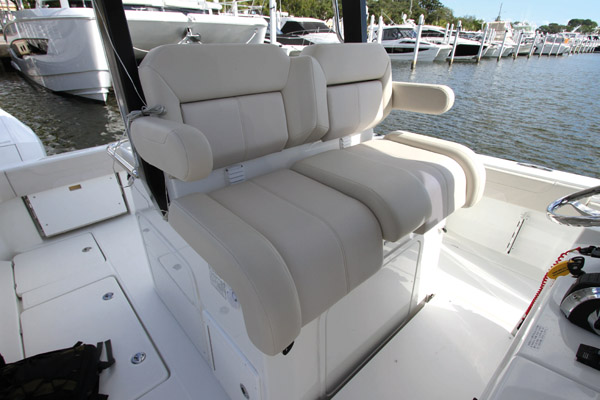
The last space of this interior, the cockpit is typically that of a fishing boat. With a large vertical dashboard where one or two screens can be integrated, depending on the option chosen, well-placed switches and throttles, and even a closed glove box for small items, we are really into the American tradition. The helm station also benefits from maximum protection thanks to the high front windshield and side windows, and it has different levels of footrests to accommodate people of all sizes. As for comfort, both seats can be used in a sitting or leaning position, and they even have armrests. In this trim level, the Aquila 28 Molokai comes with a beautiful T-Top that gives the boat even more character.
As always with Aquila, the construction quality is quite remarkable, especially when it comes to safety. Each hull has four separate compartments that can be drained individually. The level of equipment is overall very complete, with for example, two fish tanks of 355 l each (94 US gal), the cushions, the swim ladder, the table, the audio system, the livewell, the cutting board and even USB plugs everywhere - the list goes on. To fully enjoy this powercat, however, the “Pro Comfort“ package is recommended, since it offers the toilet, the front lounge seats, the battery charger, the folding seats in the back and even underwater lights (essential to show off at the marina). If that’s not enough, there are plenty of options to customize your powercat.
 |
 |
 |
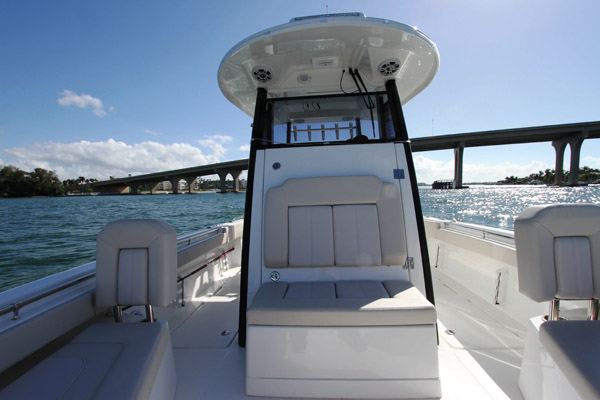
Located in the center of the boat, the console provides plenty of room to move around. It also has a double seat on the front.
Whether the leaning-post or in the front, comfort has not been forgotten, with removable backrests and a central table.
Molokai Cuddy - A cabin version to come
In addition to the open version, Aquila is going to produce a Cuddy version of the 28 Molokai. With the same hull, this version has a helm that is further forward, a much more spacious cockpit with a large storage unit, and a lounge seat. The helm is followed by a small cabin, while the T-Top extends largely towards the rear. This roof can also integrate roof bars, useful for transporting kayaks, surfboards or even professional equipment. In short, an even more versatile model, more adventurous or more utilitarian.
Speed and comfort
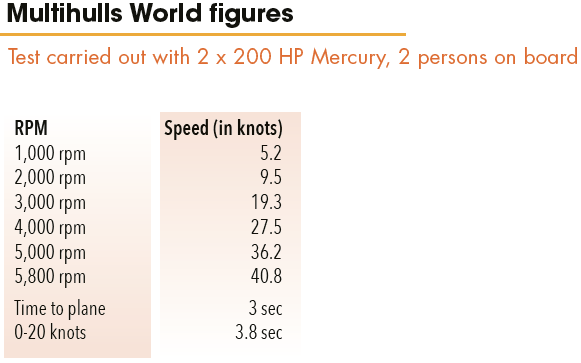
Even when moored in the marina, this catamaran gives off a feeling of speed. This impression is down to its offshore racing look, its high and slender bows, its stretched lines and the slimness of its foredeck. The tunnel is also very impressive, which bodes well for performance. As for the engines, the manufacturer rates the Aquila 28 up to 2 x 200 HP, a power that may seem almost modest in comparison with the mechanical overkill that we usually see. Here, regarding the small wetted surface and the reasonable weight, this powertrain should be sufficient. To see for yourself, there’s nothing like a test run in Tampa Bay, where the wind was well established at about 20 knots that day. Easy to handle, the catamaran is of course extremely stable, which makes it even easier to move around on board. At the helm, visibility is optimal and the protection very effective. Once out of the channel, the powercat doesn’t need much time to get out of the water. In fact, the boat planes in just 3 seconds... hang on! It takes less than a second more to reach 20 knots, so we are talking performance worthy of an offshore racing boat. By pushing down the throttles, we quickly reach a cruising speed, around 30 knots, which allows us to consider a nice boating program. Finally, by pushing the powercat to the limit, we can easily reach 45 knots. A good result which could however be improved with a little more fine-tuning. The 17“ propeller was not the most efficient and, in the end, we were missing some rpm. Apart from the speed, what impresses most about with this catamaran is its ease of handling the chop. Its bows literally cut through the waves, while you can feel the air cushion when accelerating. Once the Aquila is planing, it is not only fast, but also comfortable and safe. The big strakes ensure guidance and grip; even in curves, the catamaran stays almost flat. These qualities open the doors to offshore fishing for the Molokai, as the owner of this first model is doing when he’s going to fish tuna and swordfish 100 miles off the coast... Nevertheless, if your program is more conventional, this powercat will be able to bring you back to the marina even if the weather deteriorates. The 28 also offers real comfort at cruising speed, perfect for a good family day on the water.
As for the engines, while the twin 200 HP motors do indeed bring interesting performance, 2 x 150 HP should already make this powercat pleasant to drive, and a little more economical to buy and to use.
 |
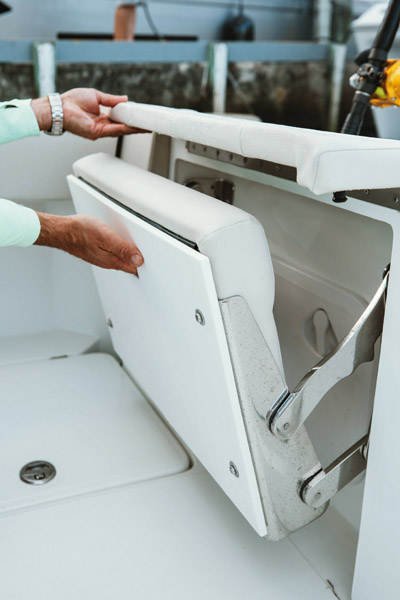 |
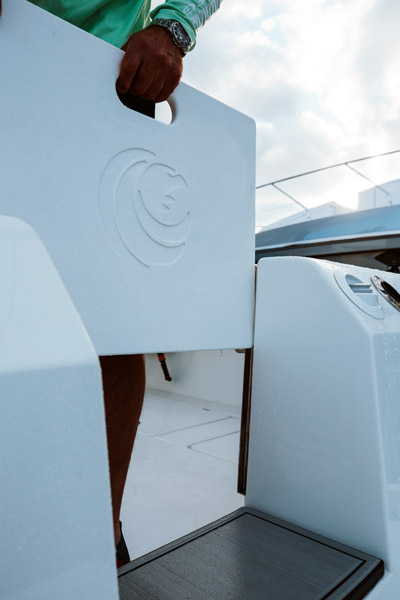
The Aquila is full of practical ideas, like the removable central door on the transom or the folding cockpit bench (optional).
Conclusion
With the Molokai, Aquila is making a remarkable entry into the world of fishing catamarans, a sector that is becoming increasingly popular, especially in the United States. Performant, comfortable and relatively versatile, this powercat is capable of adapting to a real fishing program, but also to accommodate family activities and water sports sessions - all with the comfort of a catamaran, of course. Finally, for colder regions, the manufacturer is preparing a Cuddy version of this model as a way to satisfy all users…
THE PLUSES:
+ Performance
+ Versatility
+ Comfort under way
THE MINUSES:
- Lack of front handrail
- No sun loungers
- No side door
 |
 |
 |
 |
The bathing platform, located between the engines, has two beautiful handrails to help getting back aboard.
If you go for the “Pro Comfort” option, the entire front of the console opens to provide access for stowage or for a toilet.
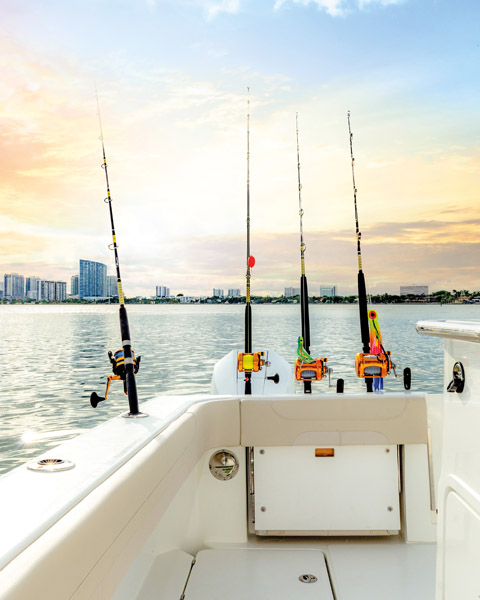
Between the T-Top and the gunwales, there are a good 15 rod holders.
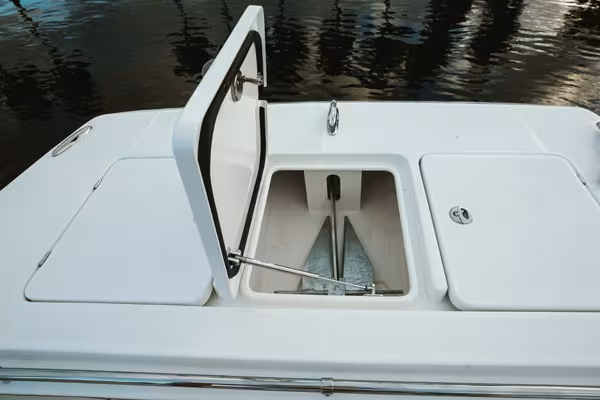
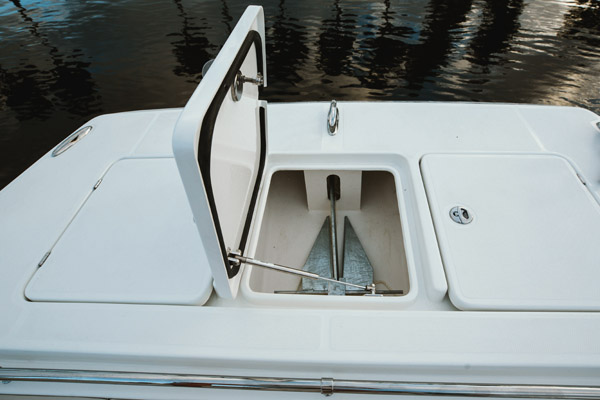
The chain locker and its specially designed storage for the anchor are a neat touch, as they prevent it from moving around too much.
TECHNICAL SPECIFICATIONS
Manufacturer: Aquila (China)
Designer: Kirk Clark (USA)
Overall length: 30’9’’ (9.38 m)
Waterline length: 28’2’’ (8.60 m)
Beam: 9’8½’’ (2.96 m)
Draft: 2’6’’ (0.77 m)
Unladen displacement: 6,166 lbs (2.8 t)
Fuel: 2 x 75 US gal (2 x 285 l)
Water: 16 US gal (60 l)
Max power: 2 x 200 HP
Recommended power: 2 x 150 HP
People: 11 (USA)
Sleeping accommodation: 0 CE
Category: B
Price and options: TBA
 |
 |
 |
The main livewell, which backs onto the leaning post, has record capacity.
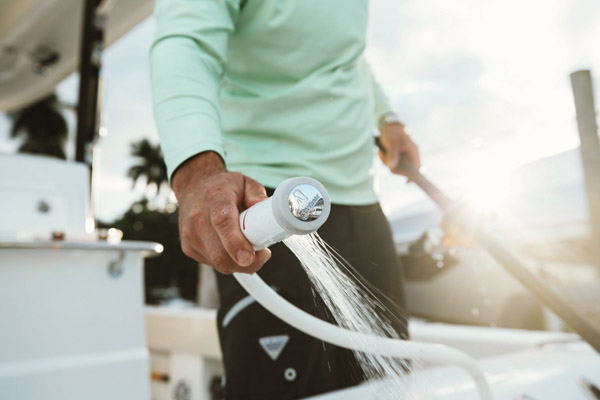
Options include a small showerhead. Useful after swimming.
The Aquila has four lure storage areas on either side of the livewell.