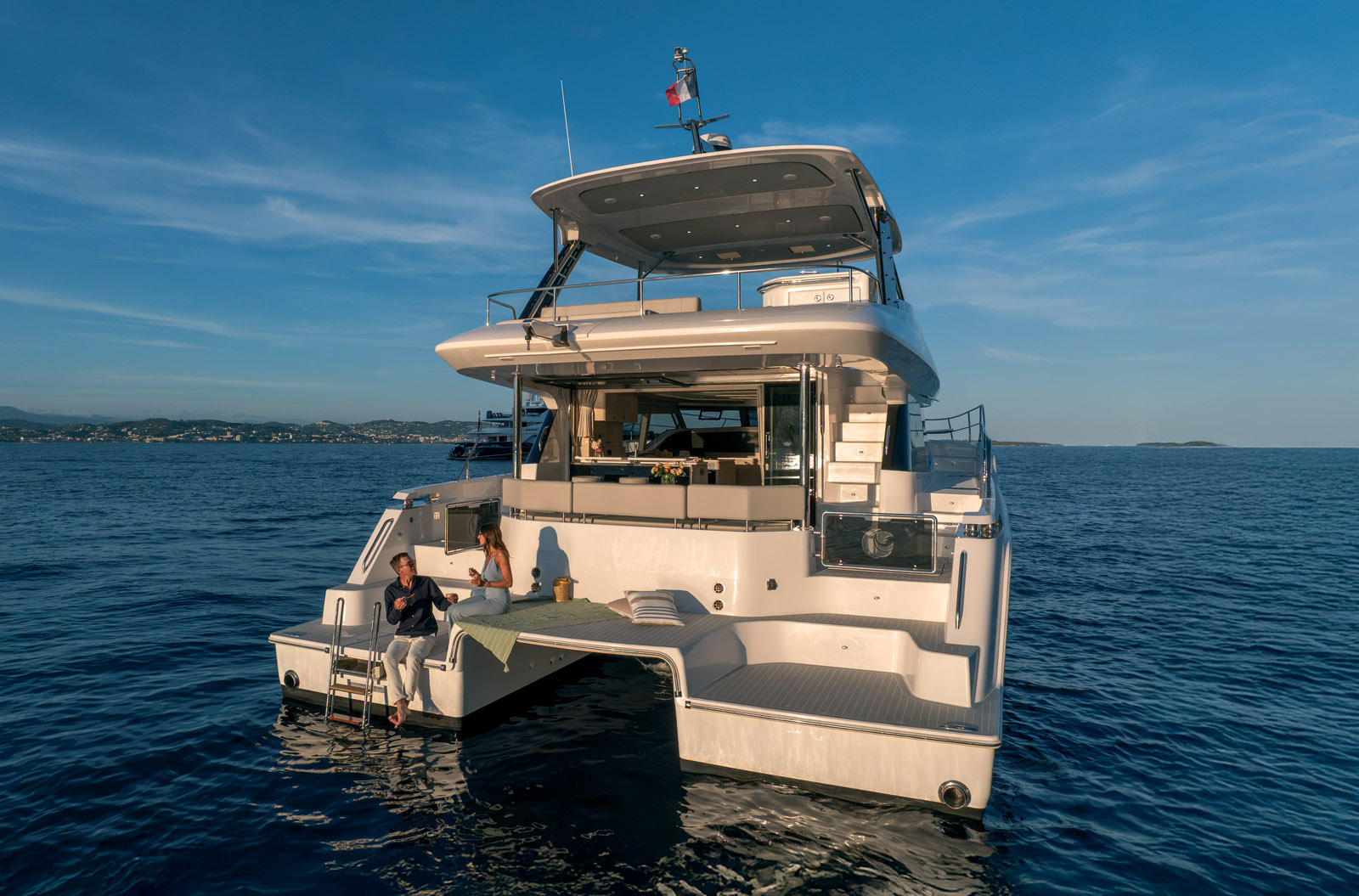
Clearly, Aquila Boats has chosen to surprise us this year... the brand has launched no fewer than four new powerboats and has just announced a complete range of sailboats! Among these announcements, the Aquila 46 Yacht stands out: in addition to replacing the brand’s best-selling 44, it made its world debut in Europe. So, a few days ahead of its official presentation at the Cannes Yachting Festival, we got the chance to discover this new model.
Infos pratiques
- Le chantier : Aquila 46 Yacht
- La fiche technique
-
 Découvrez notre vidéo exclusive
- Financez votre Aquila 46 Yacht
- Assuez votre Aquila 46 Yacht
- Articles autour du Aquila 46 Yacht
Conditions: 2 to 6 knots of wind, calm sea
If we look back to 2015 (10 years ago already, an eternity), Aquila Boats was a young brand born just three years previously, and it launched an ambitious powercat, the Aquila 44. This model immediately stood out for its full-width forward cabin at the front of the nacelle and direct access from the flybridge to the foredeck - two strong features that were quickly copied by other competing brands, proving the vision of its creators. The years have passed, and the competition has repositioned itself. Now is the time for Aquila, which has since developed its motorboat ranges (Sport, Molokai, Yacht, and now Coupe), to regain the upper hand with new, highly accomplished models. Just as the new 50 Yacht replaced the 48, the 46 Yacht is set to take over from the 44. This change is evident first and foremost in the significant difference in hull length (47’1”/14.36 m instead of 44’1”/13.44 m) and secondly in the optimized versatility of the boat’s program. While the 44 was only available with three or four double cabins, the 46 can offer three, four, and even five double cabins, all with their own private bathrooms. The potential customer base is much broader, particularly for charter, as in the five-cabin version, one of the twin cabins can be used to accommodate crew. Let’s not forget that Aquila was created in 2012 from a partnership between Chinese composite giant Sino Eagle and US motorboat charter leader Marine Max.
As you might expect, the Aquila 46 Yacht has many other features to discover, and they will likely be more than enough for it to overtake the Aquila 44, which has sold in some 200 units, making it the best- seller in its category. From this point of view, the powercat market is very buoyant and the 46 could well match or even exceed this commercial performance.
A Raised Foredeck
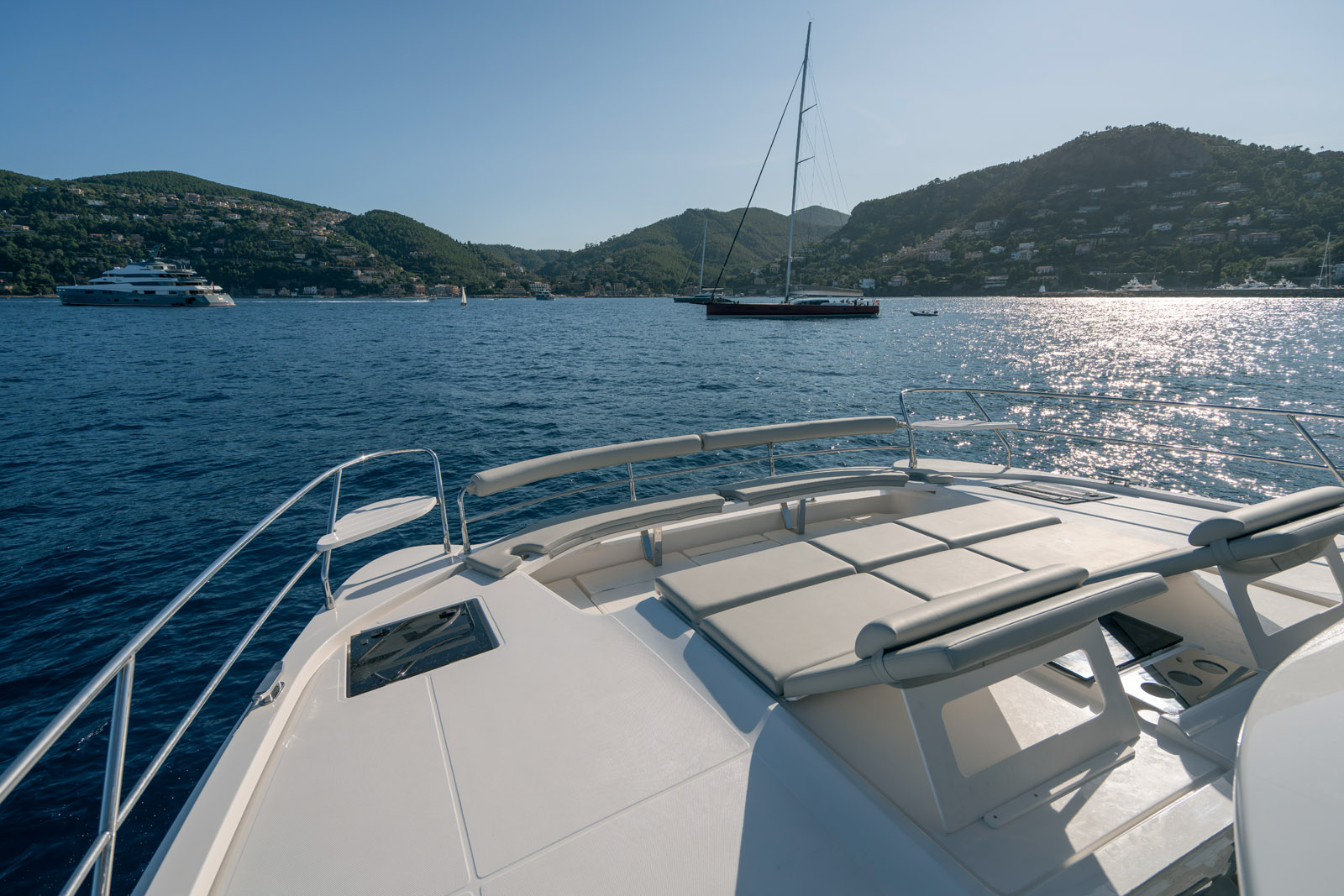
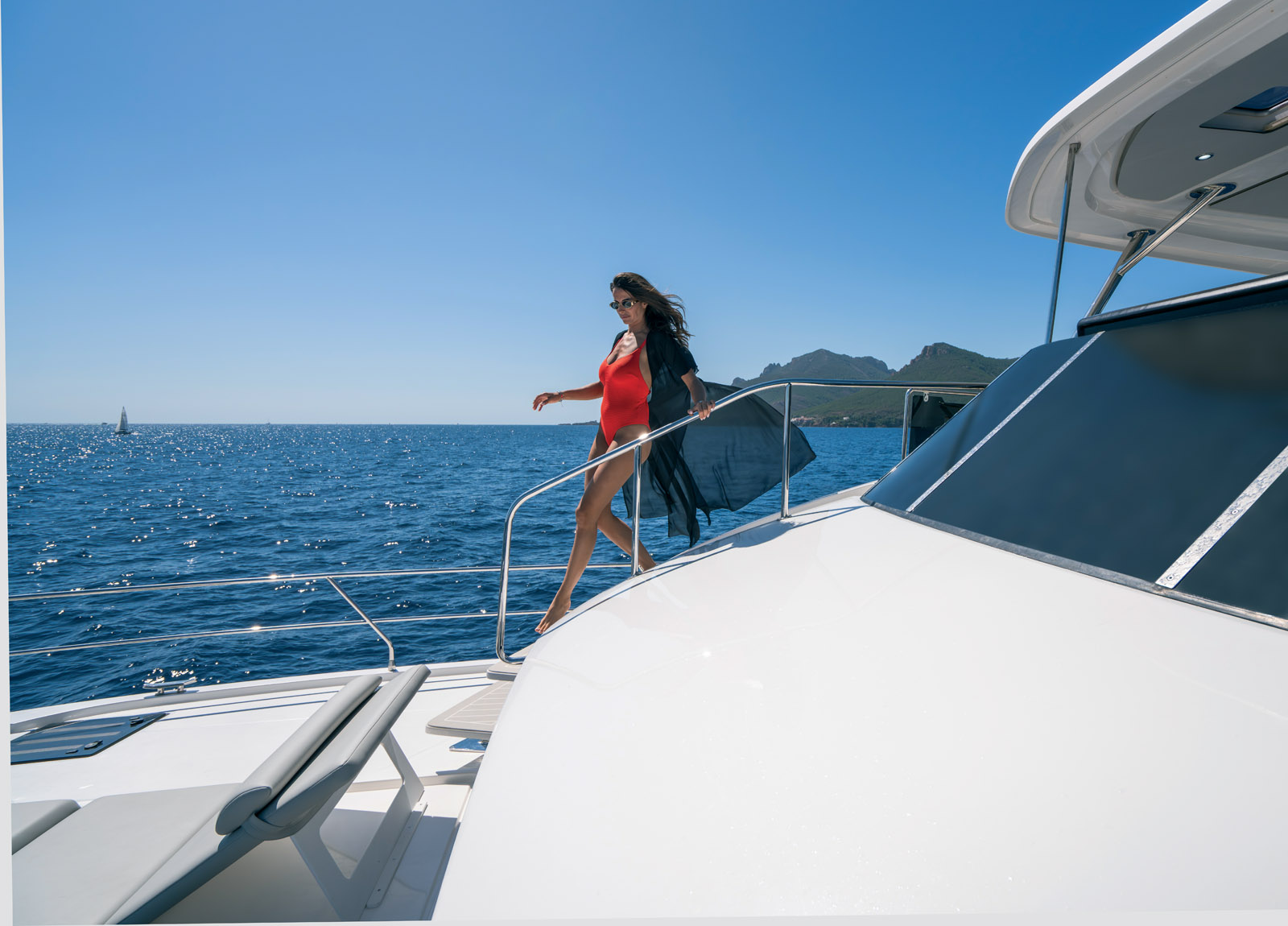
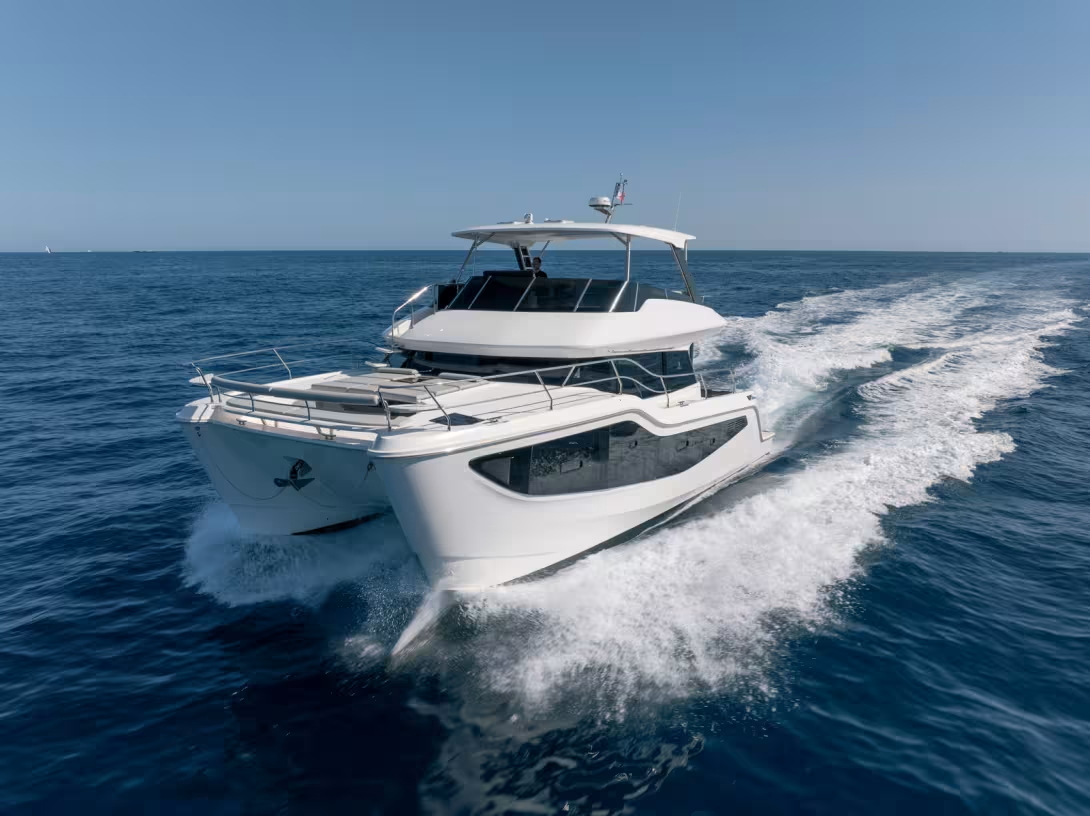
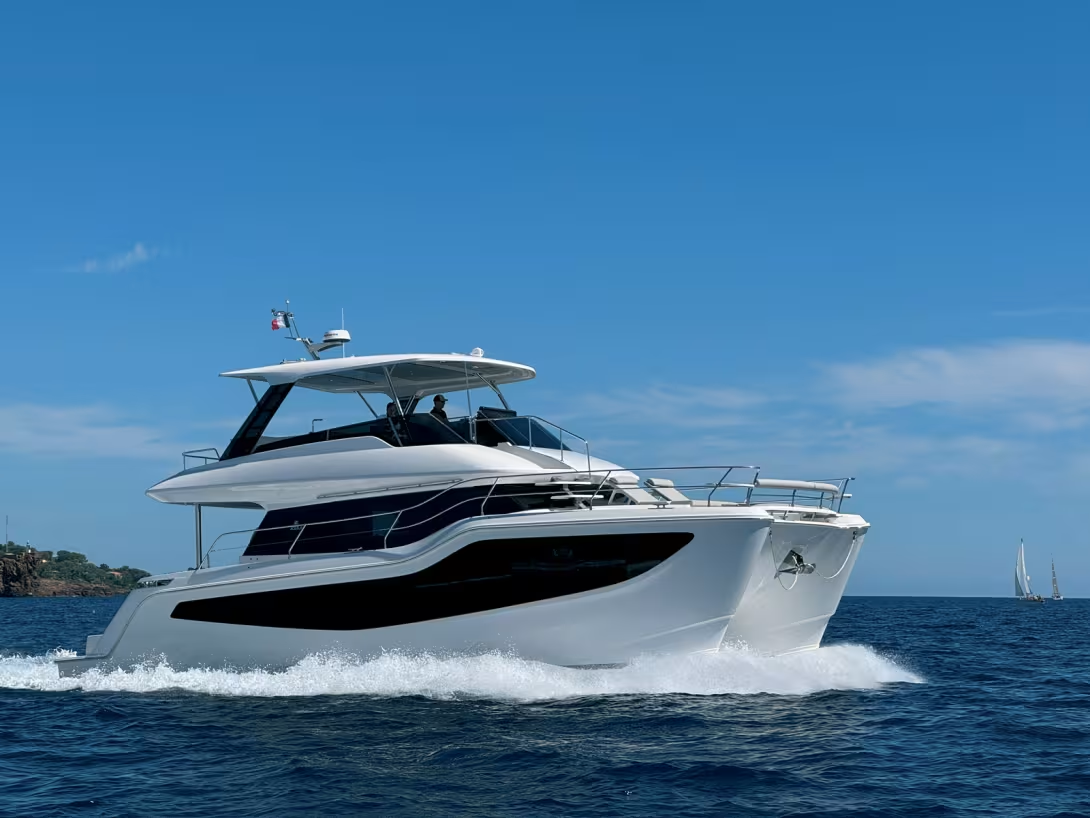
Over the past twenty-odd years, we’ve witnessed a gradual rise in the height of foredecks in the world of large motor yachts. This began with the retrofitting of workboats with very high foredecks, similar to ocean-going tugs, into true luxury yachts. This rugged look was initially appealing, before designers realized that it greatly improved the boat’s habitability. In fact, superyacht builders followed the trend in order to accommodate impressive suites in the bow. The same formula has been applied here aboard the 46: the longitudinal break in the bulwark, which raises the freeboard at the point where the windshield sits and effectively increases the height of the foredeck (thereby providing better protection against waves), is very successful. This design exudes power and a feeling of protection... In short, we already have the impression that we are dealing with a small exploration vessel. It also allows for the incorporation of a huge surface area of hull portholes without detracting from the silhouette, especially as the raised foredeck shortens the windshield and smooths the transition to the large flybridge canopy, in which part of the companionway is cleverly concealed. The way these upper superstructures blend in, including the hardtop, is undeniable despite an air draft getting on for 20 feet. It should be noted that the bow slope remains “classic” - a traditional legacy championed by the founder of Aquila Boats, Lex Raas himself. And he can’t be blamed for this, as American customers are not great fans of inverted bows, that’s a fact...
Well-designed Exterior Spaces
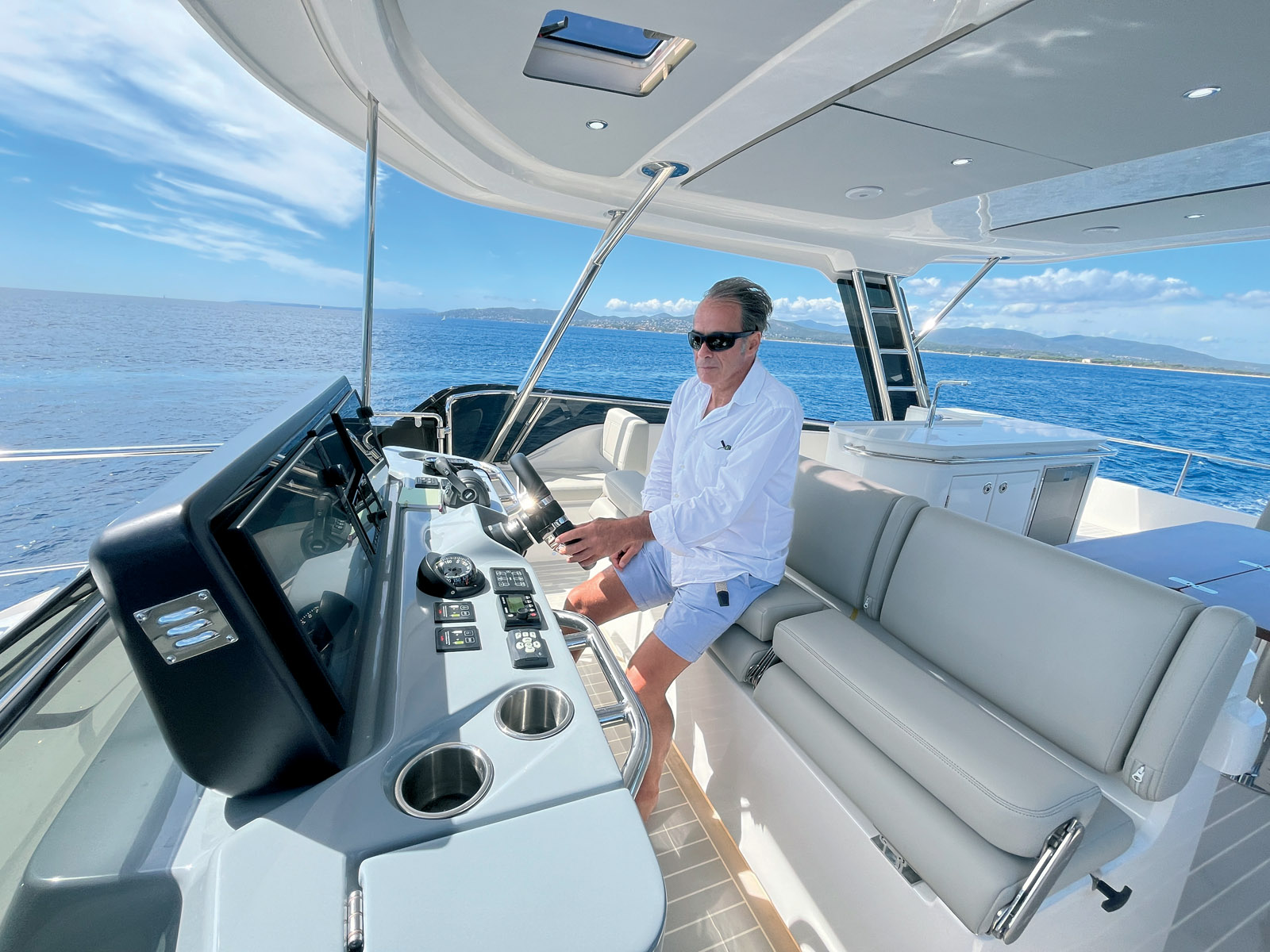
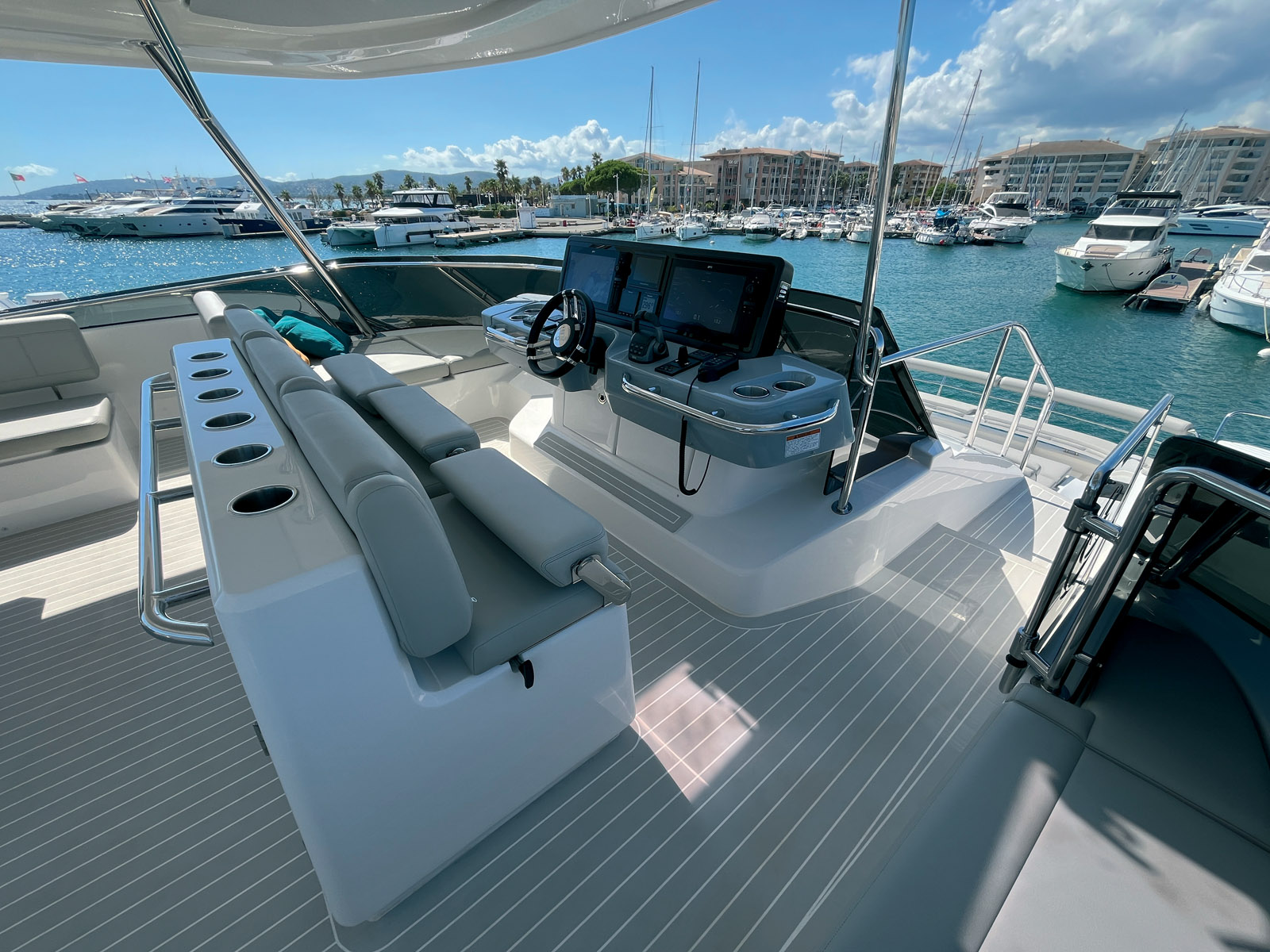
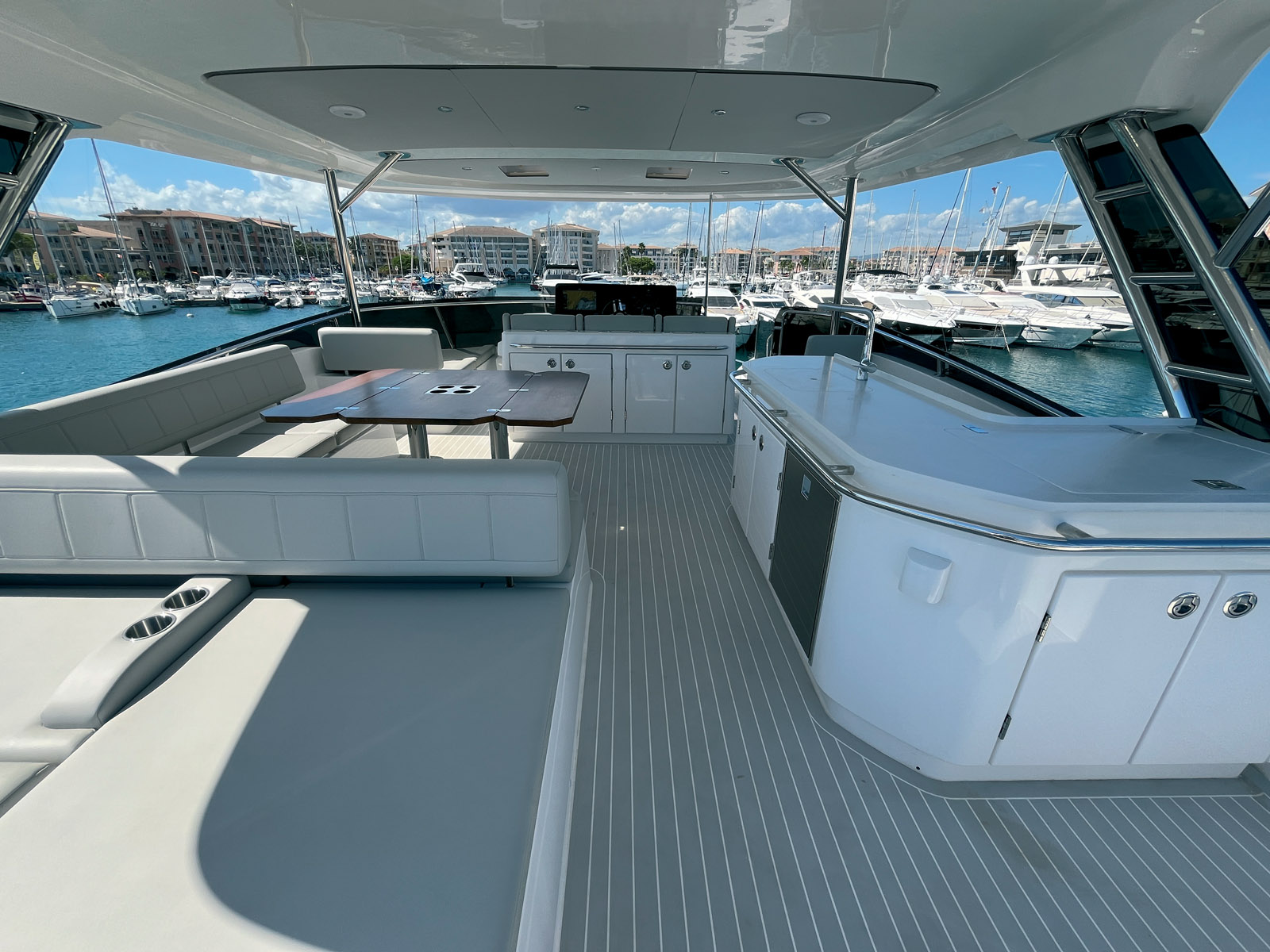
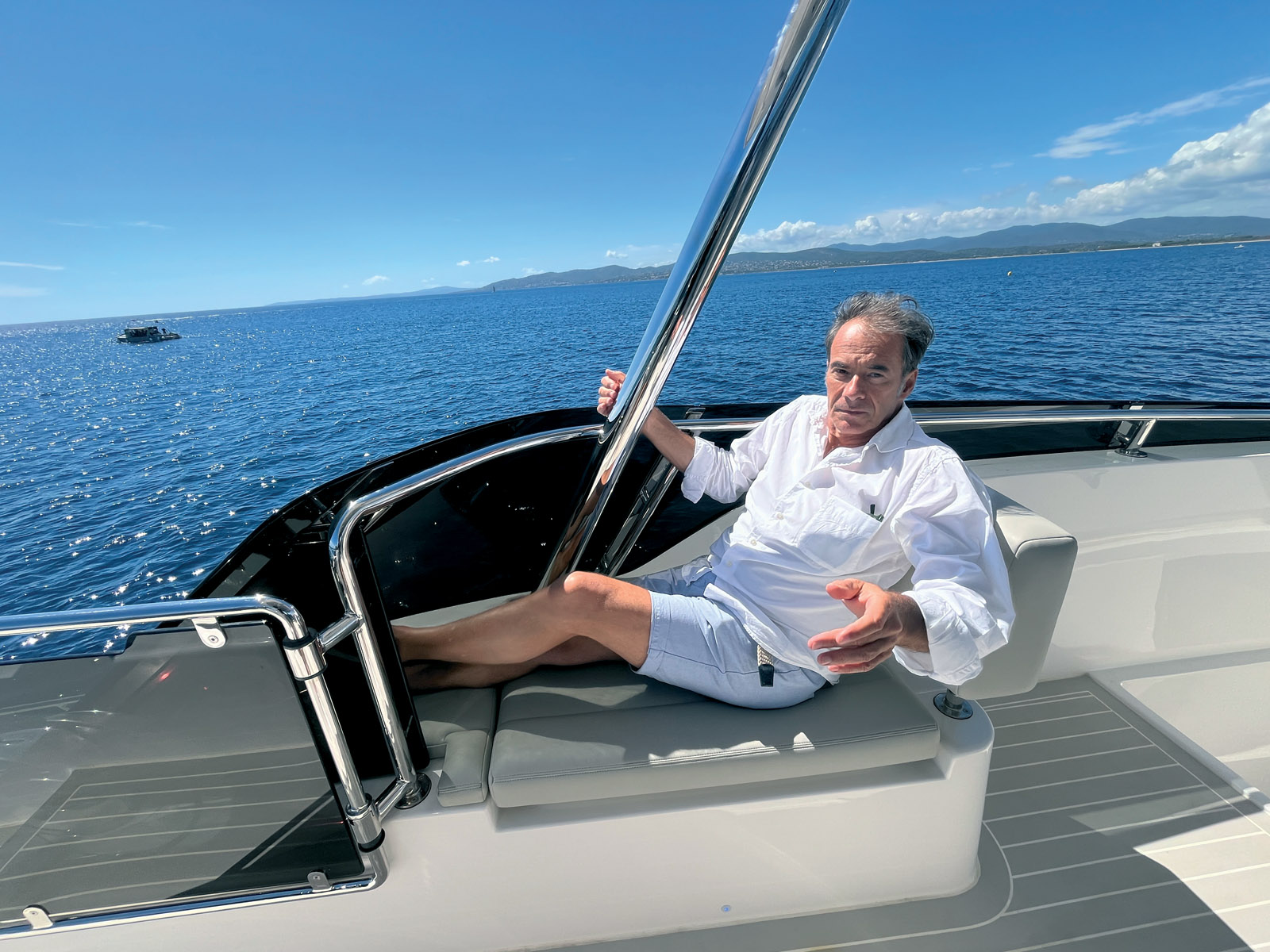
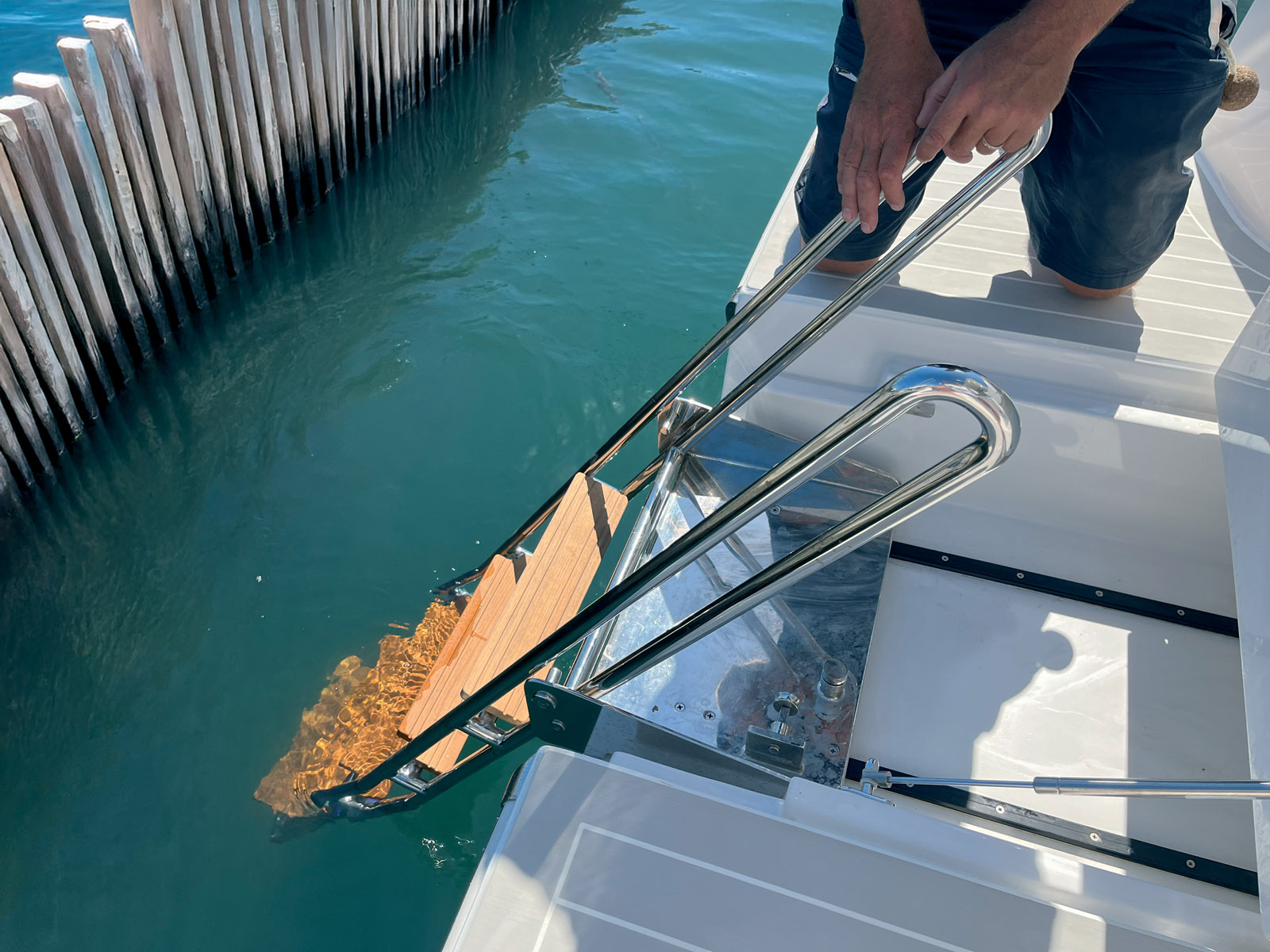
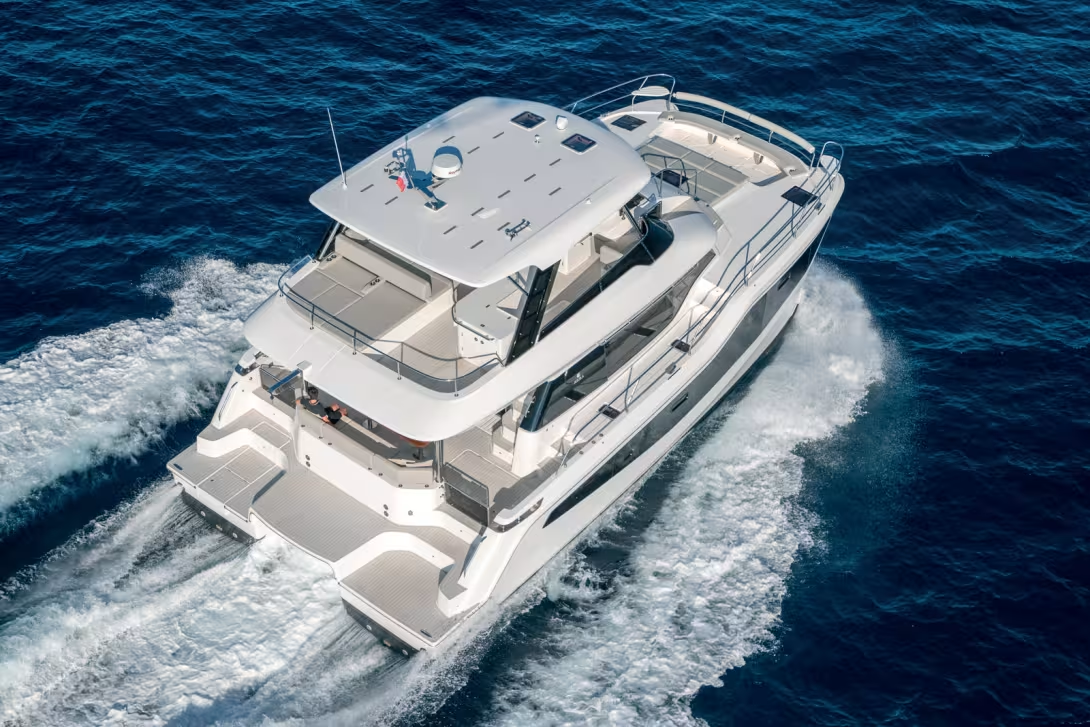
On the subject of the flybridge, the important point is the redesign of a second access from the foredeck, on the starboard side. This layout allows the central helm station to be moved closer to the windshield, thus providing a larger area at the back. Here, you’ll find a very large table with an L-shaped bench seat facing a well-equipped galley (which includes a grill, all sheltered under the hardtop mentioned above) and a wonderful relaxation area with a large sun deck and drinks holders. The highlight, however, is the two loungers surrounding the cockpit, a double on the port side and a single on the opposite side. The passageway between the two staircases does not disturb guests in any way. The foredeck is equipped with a huge sunbathing area that can be converted into a lounger and a small saloon area with benches at the bow. This layout allows for the portholes in the forward cabin, but for now, there’s no option for installing a table here - the shipyard is due to remedy this. The aft cockpit is fairly traditional and is large enough to accommodate a beautiful table that can seat eight guests very comfortably. The separation from the interior still features the famous bar that made the 44 so successful. This configuration ensures very efficient communication with the galley, as the bar can be used as a serving hatch at mealtimes. When it comes to access to the water, practicality once again prevails. The sugarscoops are very wide, extending beyond the bulwark on either side for easy access to the dock, as well as to the interior, cutting into the fixed central platform. The swing-out swim ladder is worthy of a villa swimming pool, with high handles to pull yourself up - brilliant! The reason the central platform is small is simply because it supports the beautiful Highfield 340GT tender. The dinghy protrudes slightly on each side, but this is of no importance since it is launched by a retractable crane (capable of lifting 1,000 lbs/supporting 450 kg) that unfolds from the coachroof overhang. It’s simple and super-efficient, especially in a choppy anchorage. For this size, it’s fair to say that the outdoor spaces are optimized to the max and particularly pleasant to use.
An Incredible Owner’s Cabin!
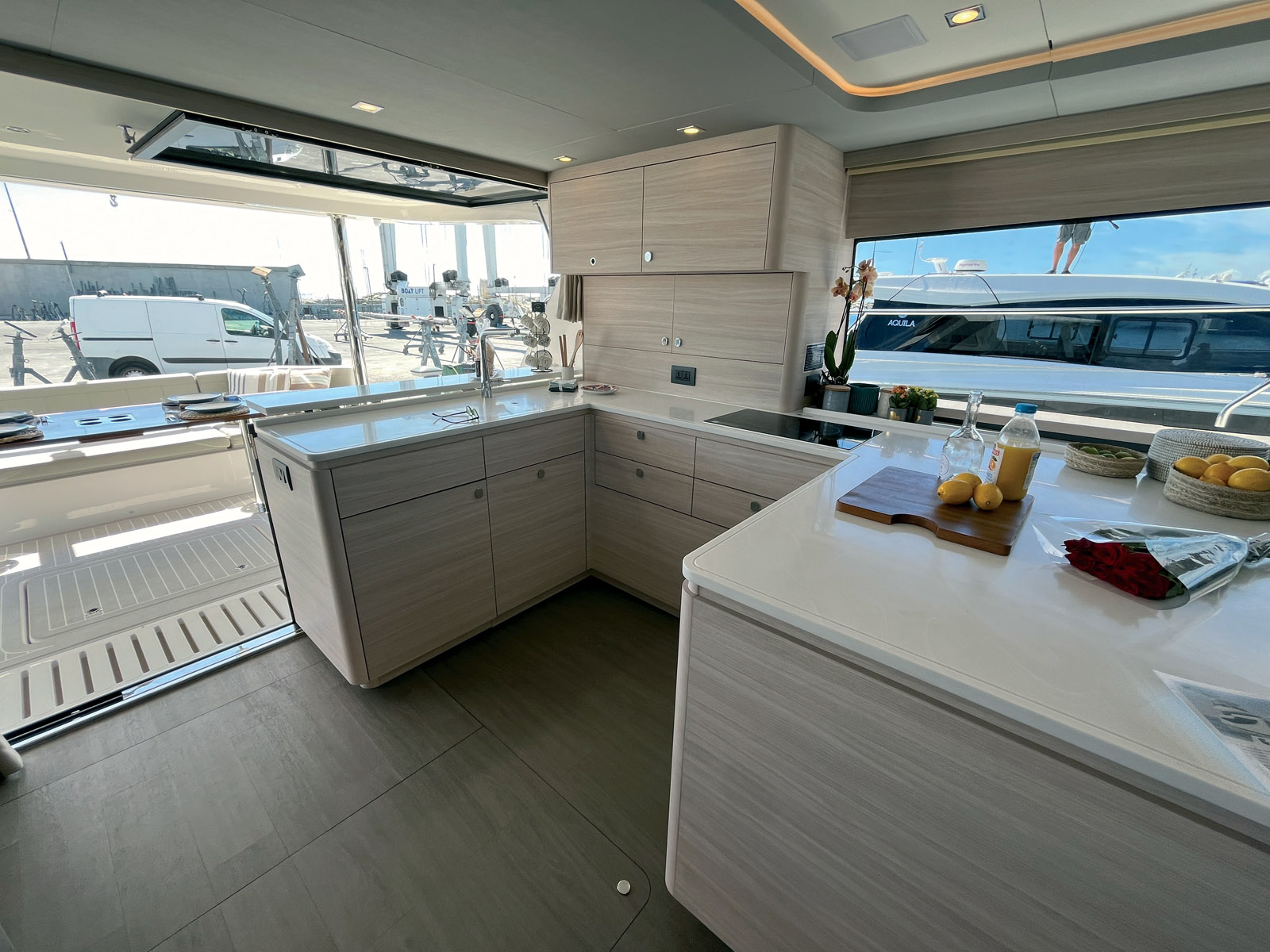
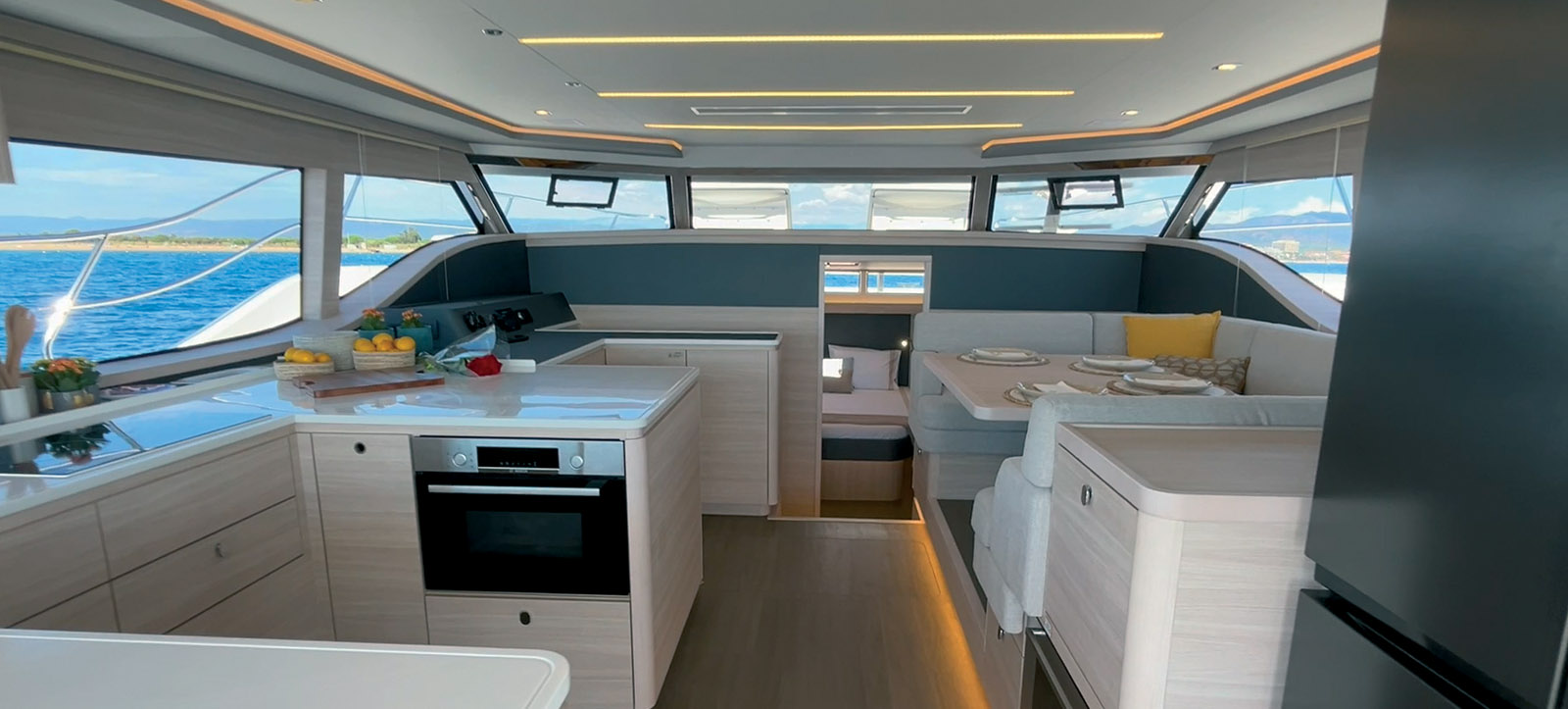
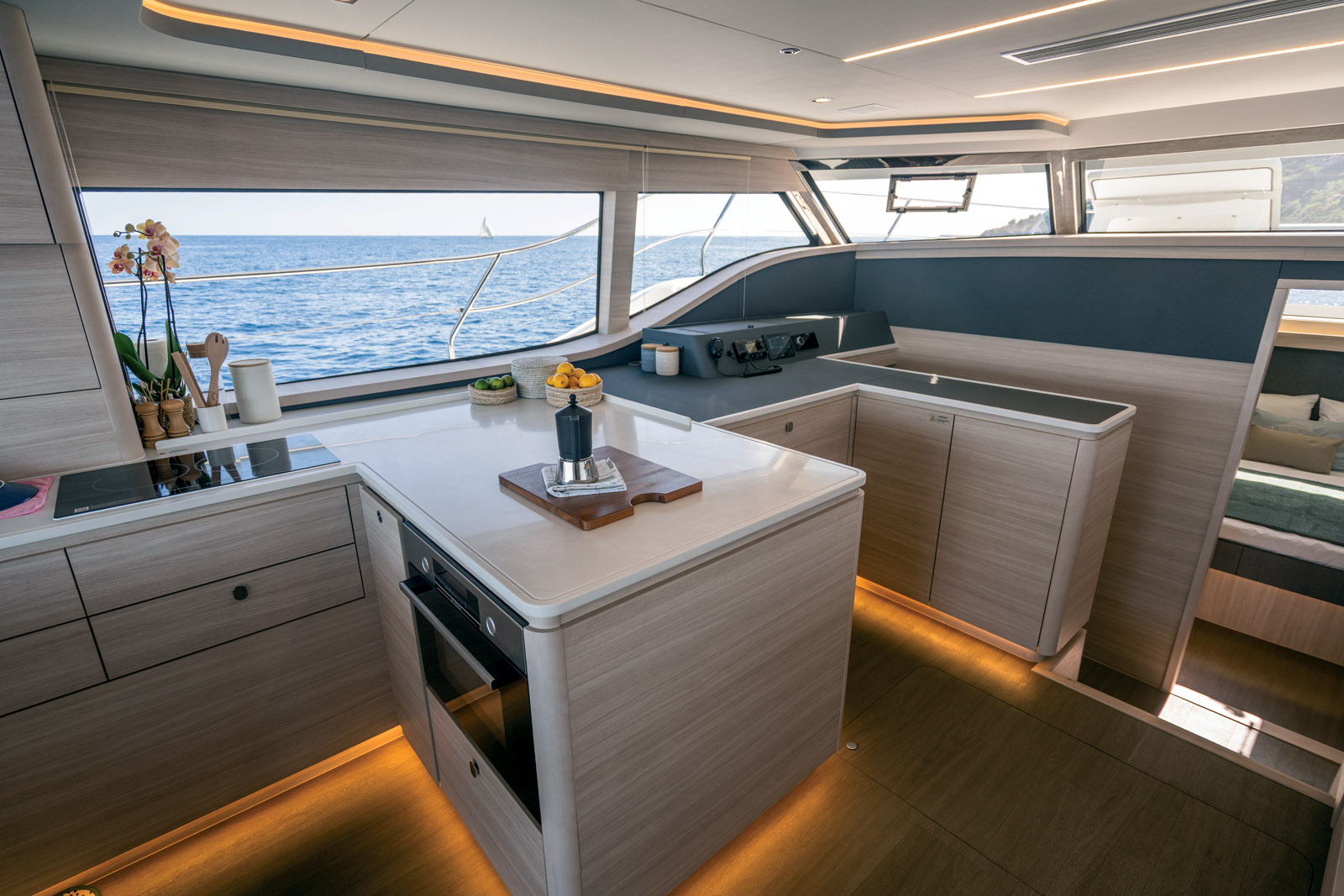
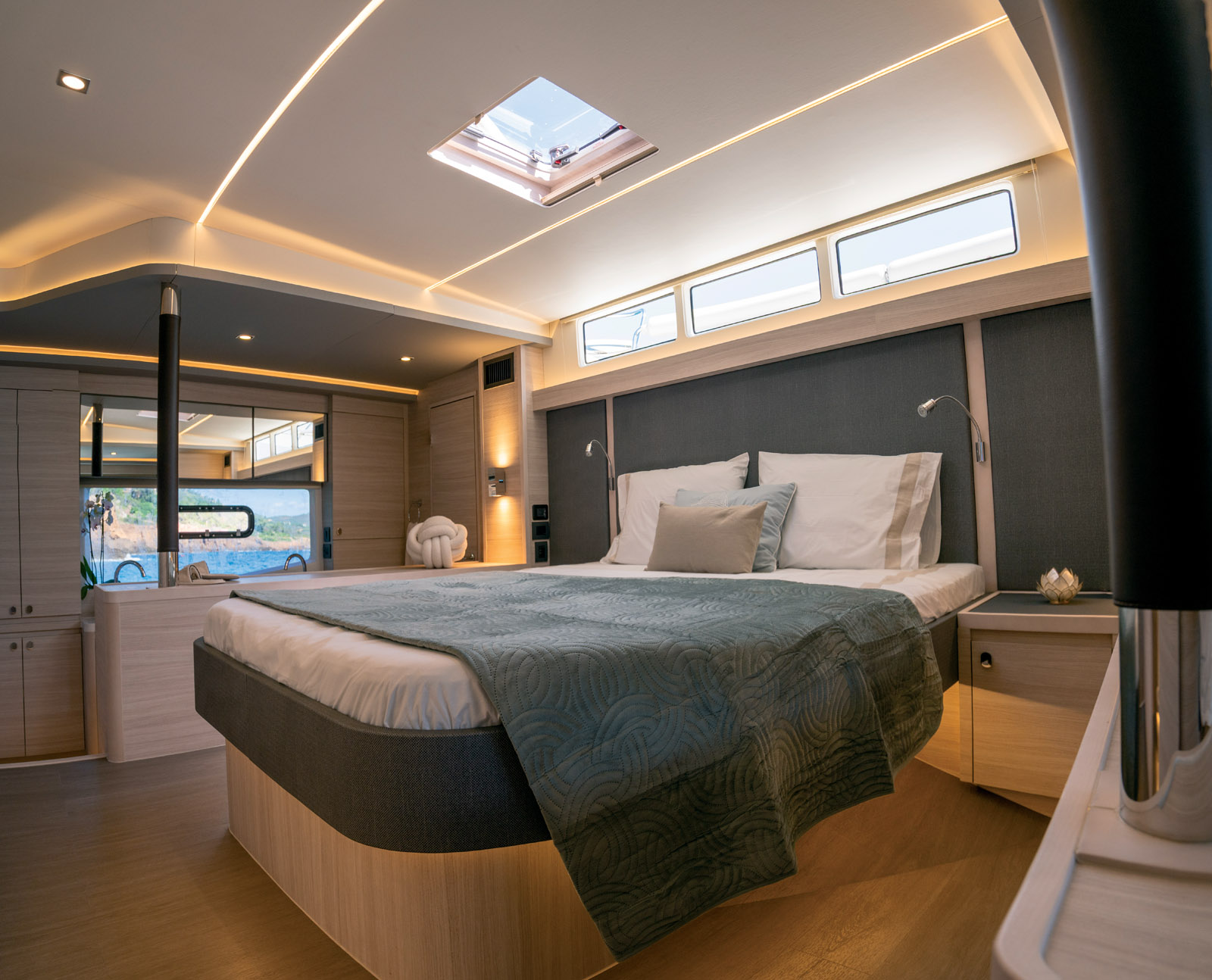
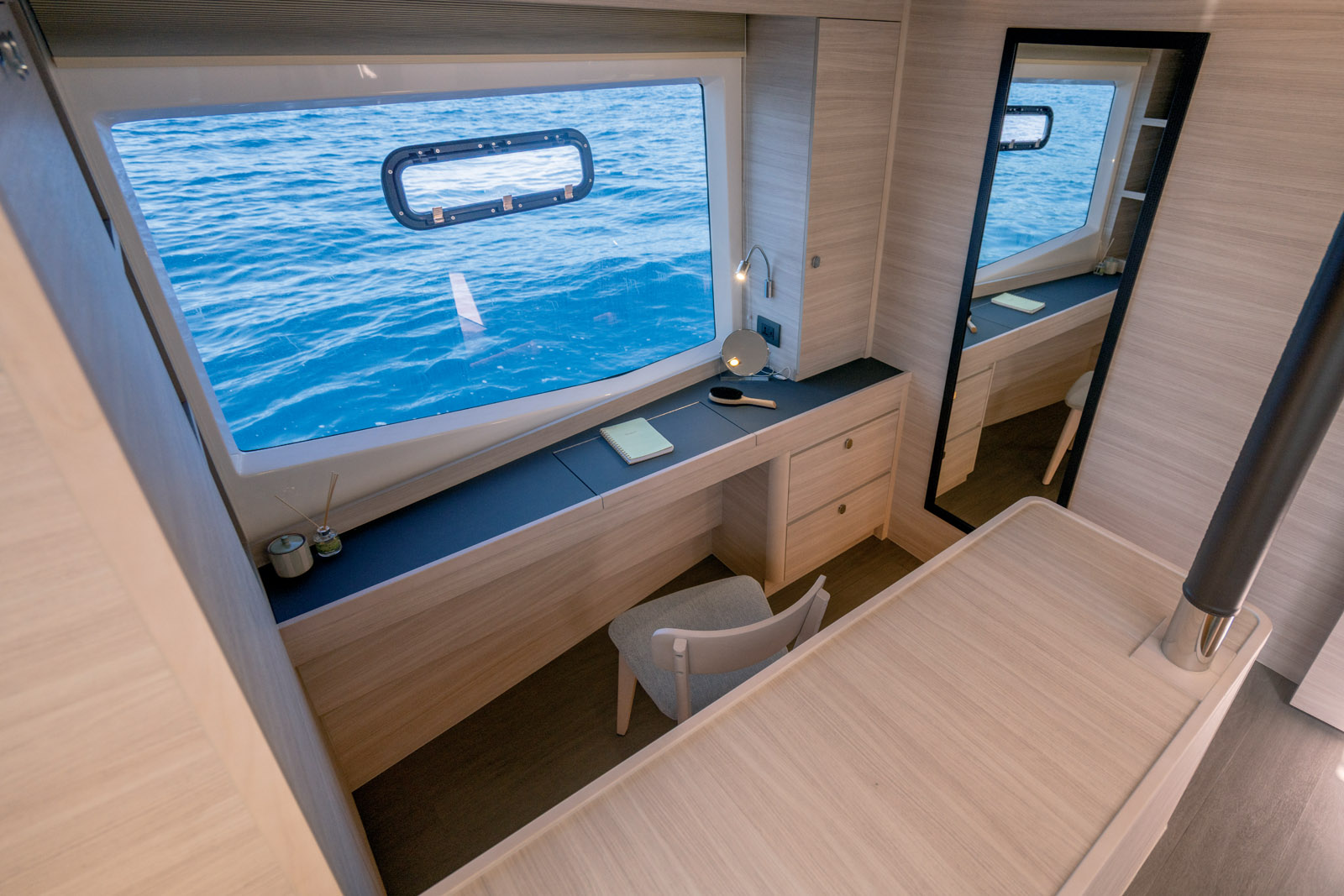
Always attentive to the requirements of its demanding clientele, Aquila Boats has further refined the ergonomics of the layout that made the 44 so successful. First, the raised foredeck allows the owner’s suite to occupy the entire available width and almost all of it on the same level. Next, the main improvement concerns the layout of the cabins. The two lateral companionways from the middle of the saloon, between the galley and the lounge area, have been moved forward in line with the central cabin entrance. A passageway with two steps below provides level access to the Owner’s cabin opposite, while on either side, three more steps down lead to the guest cabins. Aboard the three-cabin Owner’s version, there is a VIP cabin aft on each side. But in the four- or five-cabin versions, there are one or two cabins forward. In fact, the Owner’s suite on hull #1, the example we tested, is so spacious that it can be divided into three cabins! We were really surprised by the volume and comfort offered by a catamaran less than 50 feet in length. The bed is bathed in light from the forward cockpit portholes. To reach the bathroom and sofa area on either side, you only have two steps, and everywhere, the sea view is exceptional. Back in the saloon, the removal of the two companionway staircases allows the U-shaped galley to use more space, with a worktop measuring over ten feet (three meters) in length. This also allows for a large, mirrored column refrigerator, a must-have for cruising these days. Forward of the galley, a bar area can also be converted into an interior helm station. As the forward view requires a little more height, the chair is adjustable to suit. The only caveat is that the smaller dining area opposite cannot seat more than four, but this dinette is very cozy and there is no shortage of large exterior tables. The reconstituted wood and veneered joinery is very well made. Two finishes, light or dark, allow you to create a personalized atmosphere.
Remarkable Stability
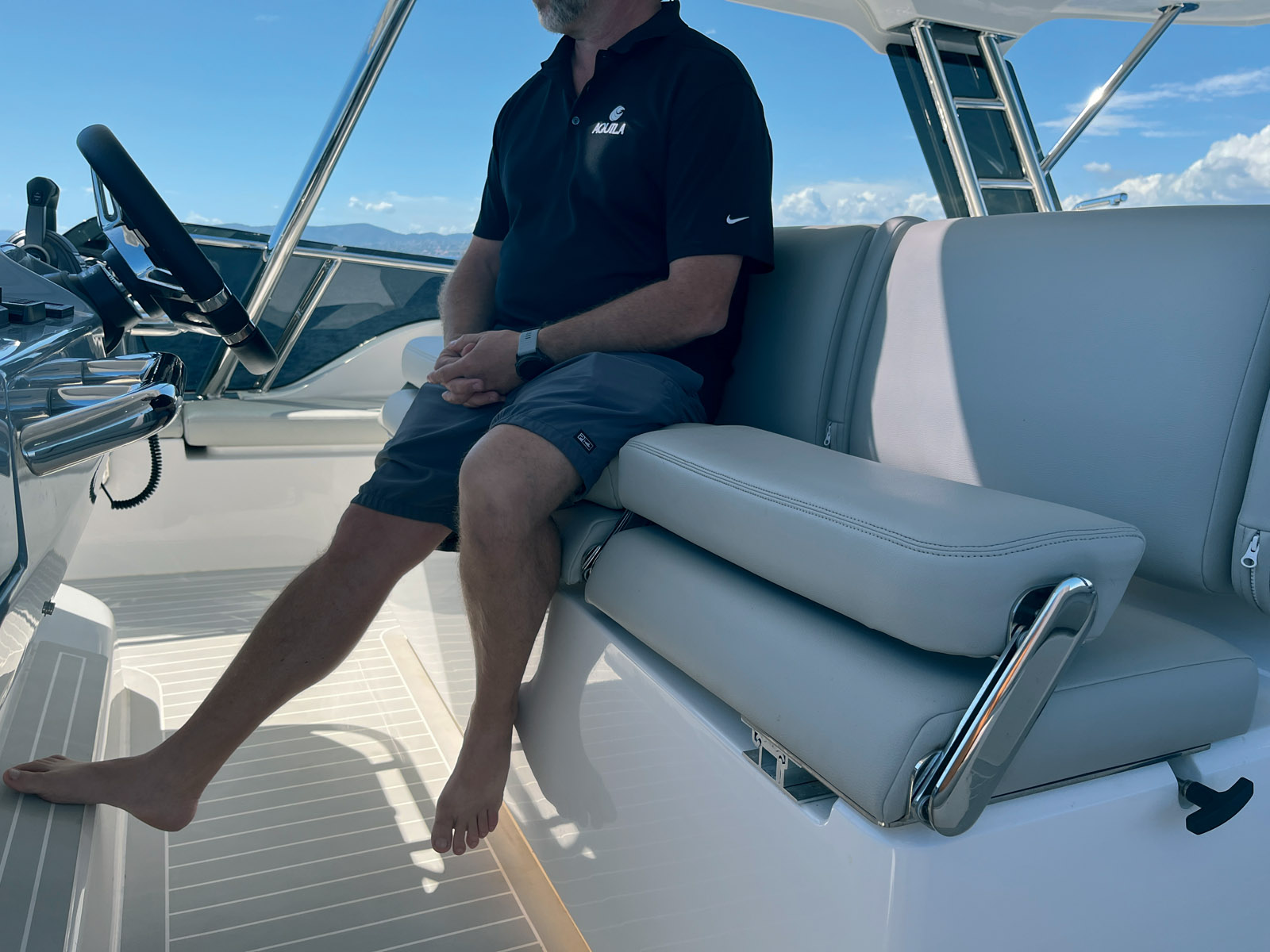
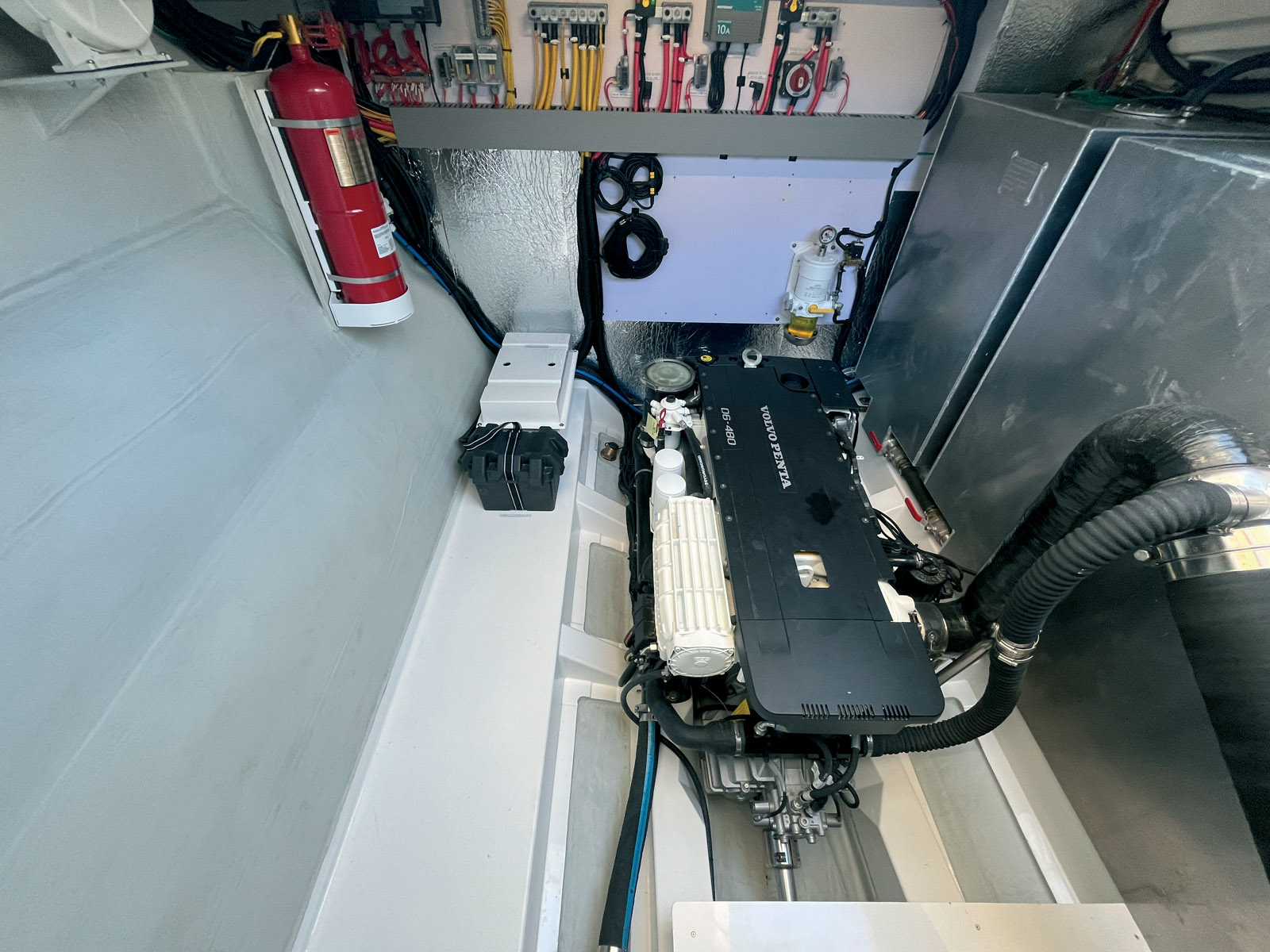
On the day of our test, the sea was calm and flat - perfect conditions for testing a cruising powercat, but our test model was not equipped with the optional foil connecting the two hulls, which was a shame... If you check out our review of the Aquila 42 Coupe, which was equipped with it, you’ll find out more. In any case, safety has not been overlooked. This is evidenced by the wave-piercing hull bulbs, which are separately molded parts attached to the stem. In this regard, the forward and aft rear crash boxes, installed up to watertight bulkheads, are a plus. Aquila hulls are tested in a virtual towing tank, and the propshaft-driving powertrain is well forward, ensuring a very balanced longitudinal trim. Our version was equipped with twin 480 HP Volvo D6 motors. We felt these to be well-suited to this hull, and that the standard 320 HP option is a little underpowered in our opinion, unless you’re not looking to exceed trawler speed. The flybridge steering console is very well laid out and features a three-seater bench seat with adjustable depth, which is very practical for both short and tall sailors. In the very flat bay, we easily reached a speed of 20 knots in a very light breeze, which suggests a speed of 21 to 22 knots with the wind behind us. The Aquila’s fuel consumption at this speed is 49 US gallons (185 liters) per hour. At 15 or 16 knots, that figure reduces to 30 US gal (112 l)/hour, and we’d be curious to see what the foiling version would deliver under the same conditions. Course changes are smooth, with no noticeable heeling. When underway, the powercat’s movements remain gentle, which should be greatly appreciated by those inside. We took advantage of the wake created by an Aquila 42 Coupe to simulate passage through a chop: the bows swallowed the waves with ease...
Conclusion
By continuing with the five fundamental concepts of its yacht range (namely wave- piercing bulbous bows, flybridge access from the fore and aft, a tender crane, cockpit bar, and large full-width owner’s cabin), Aquila Boats completes its Yacht range with this 46, featuring a more assertive adventurous design. This powercat is not only very attractive and safe but also offers much more living space than the already very satisfactory 44. The owner’s cabin is the big winner in this new layout, and the extra volume also benefits the five-cabin charter version. The seagoing qualities of the Aquila 46 Yacht, even in rougher conditions, are those of a well-balanced powercat whose practical ergonomics make life on board easier in all situations.
Successful design
Comfortable underway and at anchor
No forward cockpit table
No hybrid version available
Technical Specifications
Architect: VPLP Design
Interior design: Aquila Boats
Length: 47’1” (14.36 m)
Beam: 23’4” (7.1 m)
Draft: 4’1” (1.24 m)
Air draft: 19’7” (5.95 m)
Light displacement: 45,650 lbs (20.7 t)
Laden displacement: 58,000 lbs (26.3 t)
Powertain: 2 x 320 HP Volvo D4
Maximum speed: 20 knots
Cruising speed: 15 knots
Fuel: 475 US gal + optional 105 US gal (1,800 l + 400 l)
Water: 210 US gal (800 l)
Solar panels: 2.6 kWp
Cabins: 3/4/5
CE Category: A8/B12/C16/D24
Price
Base price: US$ 1,100,000 ex-tax
Price of the model we tested: US$ 1,600,000 ex-tax
Options in US$ ex-tax
Volvo D6 480 HP: 76,400
Hydroglide foil: 31,390
5 cabins: 30,070
Interior helm station: 29,070
Electronics pack: 25,019
Air conditioning: 47,800
Electric crane: 21,370
Highfield CL340GT tender: 24,889
12 kW generator: 47,720
Lithium battery bank: 62,618
www.aquilaboats.com