The second model in Aquila’s fishing range, the 47 Molokai, accumulates superlatives and propels the brand into the world of big game fishing, with a highly original layout.
Infos pratiques
- Le chantier : Aquila 47
- La fiche technique
-
 Découvrez notre vidéo exclusive
- Financez votre Aquila 47 Molokai
- Assuez votre Aquila 47 Molokai
- Articles autour du Aquila 47 Molokai
Conditions: calm sea, 3 to 4 knots of wind
With the 28 Molokai, the world’s leading manufacturer of power catamarans showed its determination to tackle the world of fishing by producing a high-performance open catamaran. This time, the manufacturer is pushing the cursor much further. This second model not only confirms this orientation, but above all, with its generous dimensions, it makes a remarkable entry into the world of big-game fishing.
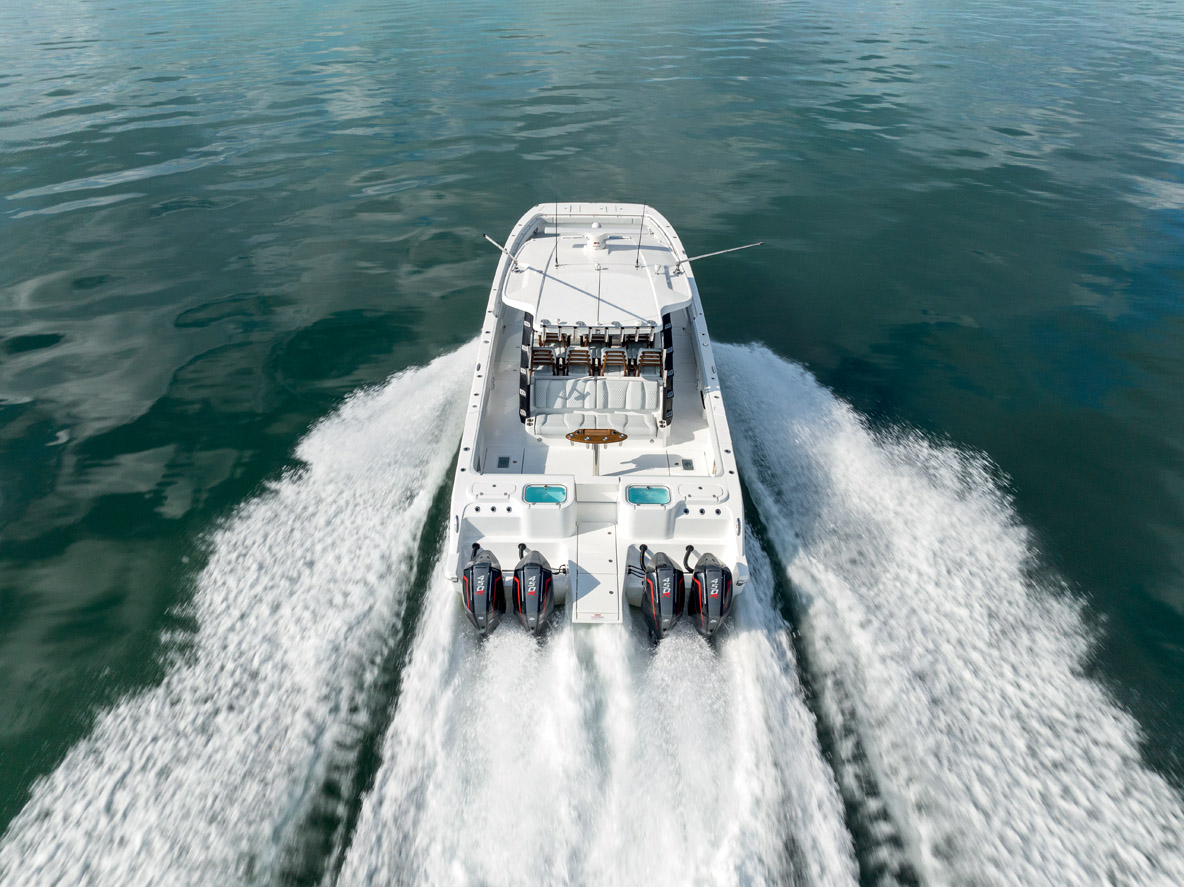
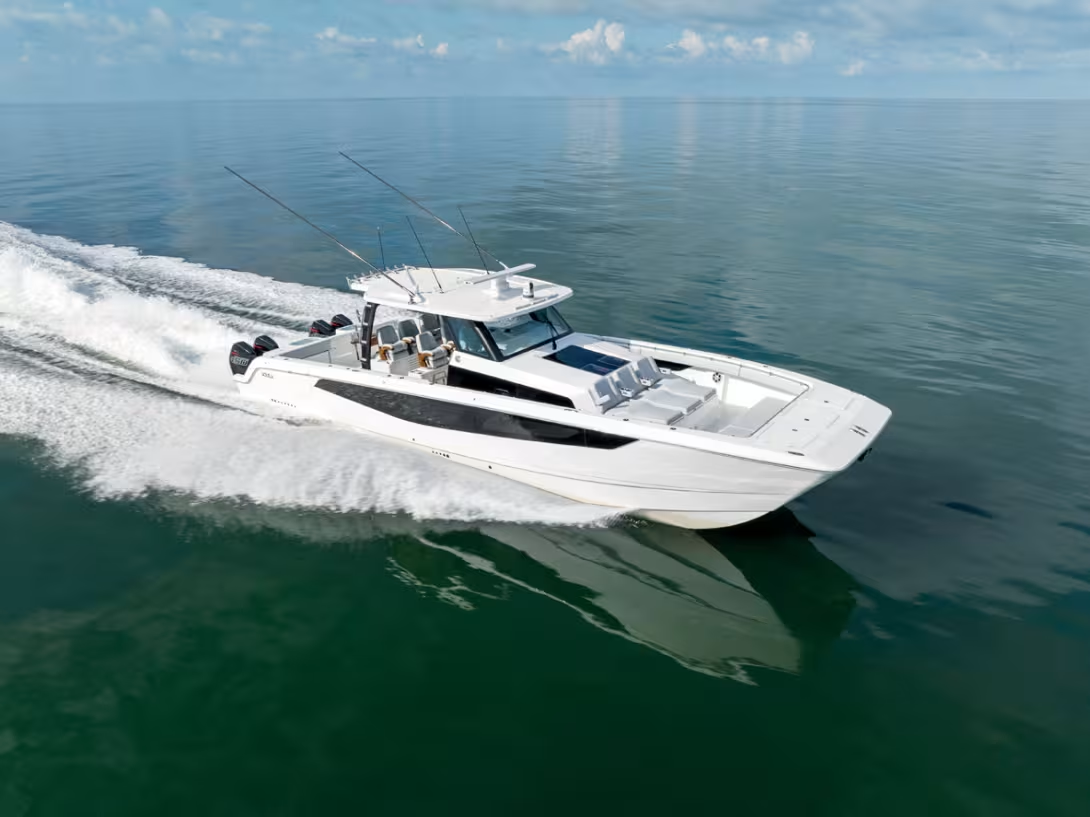
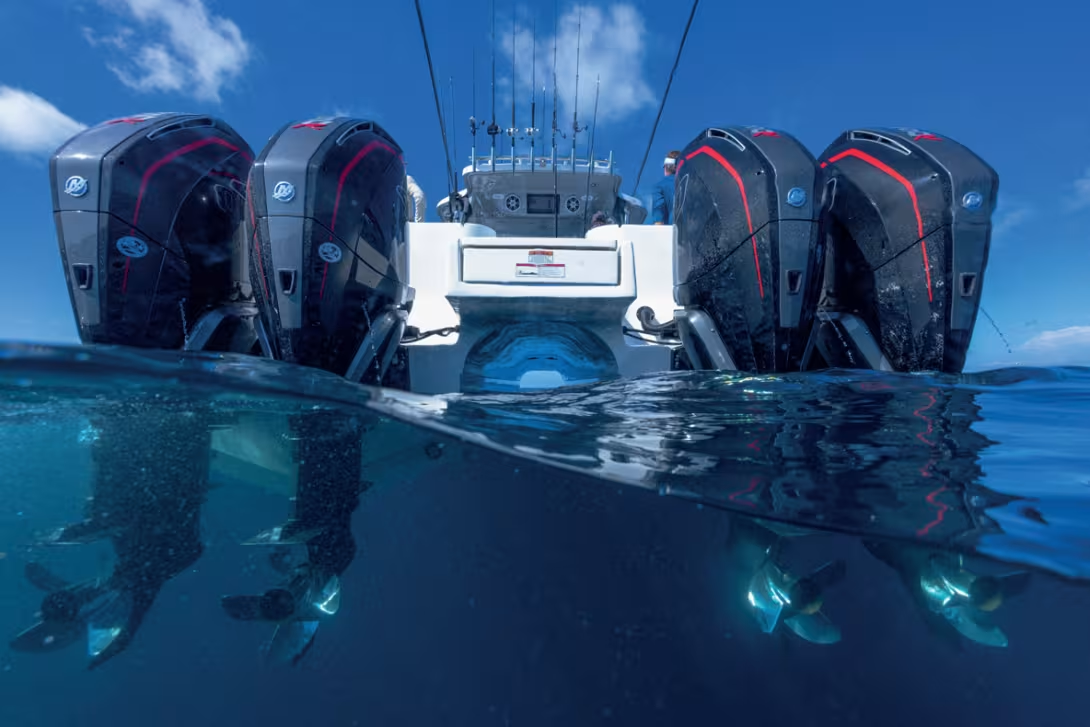
It was in Pompano Beach, Florida, that the manufacturer arranged to meet us. Surrounded by two motor yachts, the powercat doesn’t stand out - quite the contrary. With an overall length of 49 feet (15.06 m) and a beam of 14’7” (4.44 m), the Molokai is a big baby that looks more like a 55-footer. In addition to its width, the boat boasts four 450 hp engines behind it, which also sets the tone for its anticipated performance...
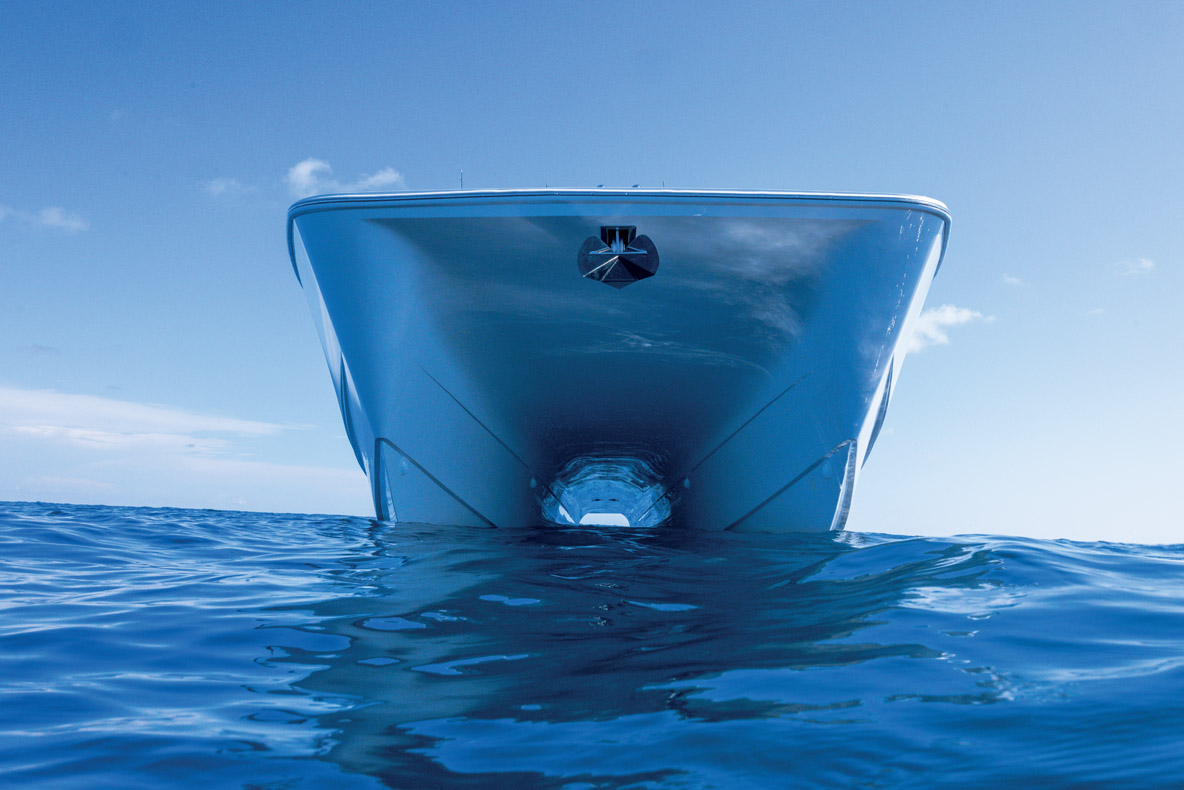
Unlike the 28, the 47 was not designed by a Hawaiian architect, but by Chris Peart of the South African firm Peart Yacht Design. While there are several similarities with its little sistership, starting with the long hull porthole, the 47 is also different. For example, the bows are less vertical than on the 28, and the overall line is much more tapered and sportier. An interesting detail is that the long hull portholes open onto the catwalks, while other portholes have been installed on the sides of the cabin, giving a view of the sea.
Offshore-inspired hulls
Another interesting feature of the Aquila is its very wide hulls for its class. Not only does this improve buoyancy and seaworthiness, it also provides a substantial interior volume. As a result, the tunnel is quite narrow, but relatively high, as the front of the nacelle is rather thin. The hulls are also very slim - at least at the front - and are supported by a large inverted strake and a second strake that becomes a lively chine. Last but not least, the architect has integrated two steps in the style of offshore hulls, a real plus for performance, but also for fuel consumption. To top it all off, the builder has grafted four 450 R engines, Mercury’s racing version, onto the transoms. Although the hulls are wide at the rear, the two engines almost seem a little cramped. The commercial version will be available with 4 x 400 HP V10 or 2 x 600 HP V12 engines, and even more unusual configurations on request. Lovers of big engines will be delighted.
Once at the helm, needless to say, the power delivered puts a large smile on your face. Barely out of the harbor, all you have to do is push the throttle just a little, and you’re cruising at 28 knots. Cruising speed is reached a handful of seconds later, at around... 35 knots. At this point, the catamaran is going so well that you have almost no idea what speed it’s actually going. Nothing moves, waves are swallowed with disconcerting ease, and the air cushion under the hull contributes to smooth sailing. Add to this the excellent protection provided by the windshield and side windows, and you’re ready to put in the miles. Encouraged by the powercat’s good sea keeping, we push the throttle and the GPS goes wild: 40, 45, 50 knots and counting. In no time at all, we’re up to 60 knots, and still in total comfort. The craziest thing is that we don’t even have the right propellers, so we’re missing a few rpm... As for the curves, they’re swallowed up at high speed and with very little angle. If you want to play around a bit, you can desynchronize the trims between the port and starboard hulls to be more aggressive when cornering, but in absolute terms, it’s not even necessary, as this catamaran is really sound. In fact, it will be interesting to see how it performs with 2 x 600 HP V12 engines, as the smoothness of the hulls and these engines should be a perfect match.
A catamaran designed for deep-sea fishing
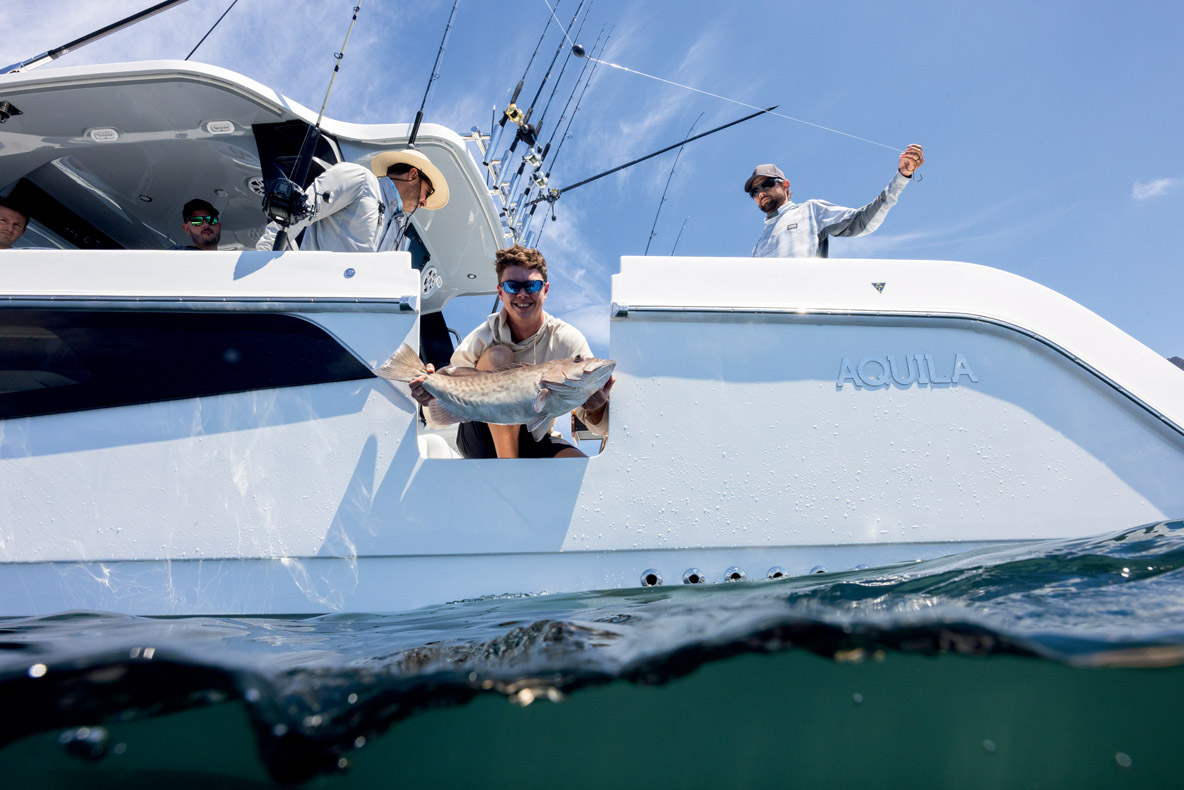
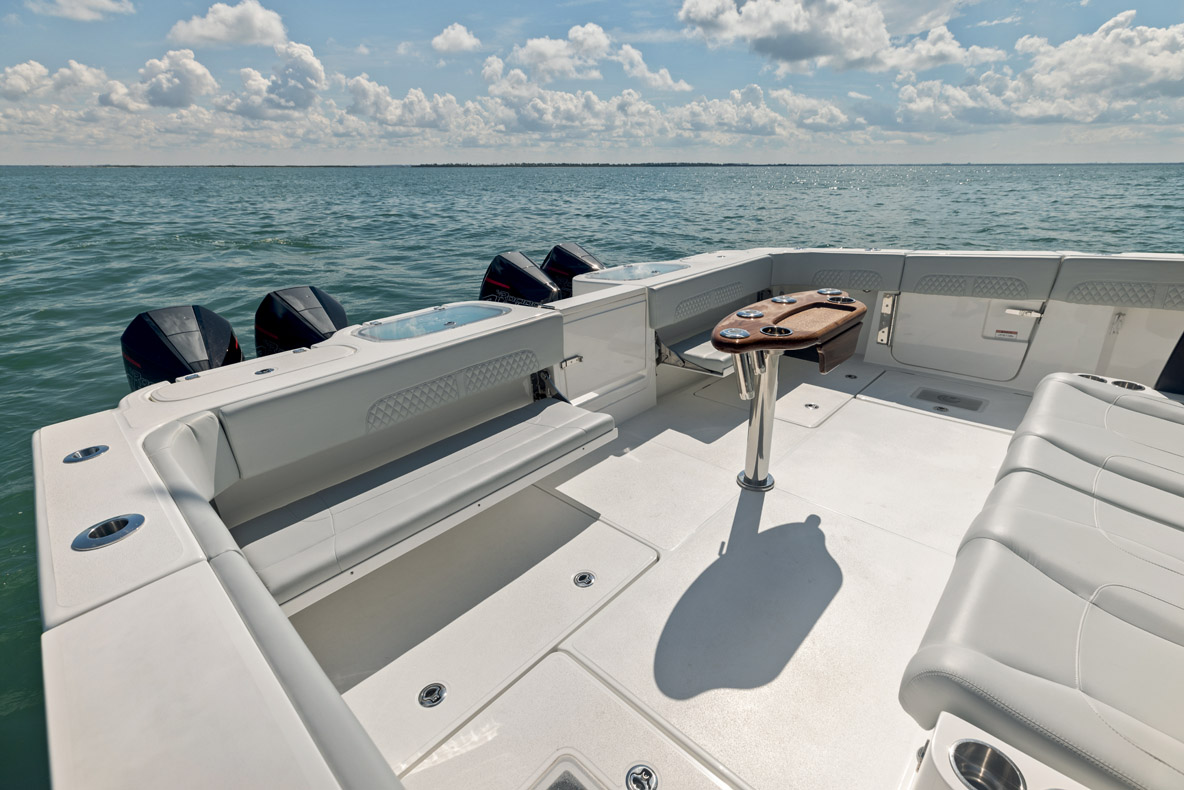
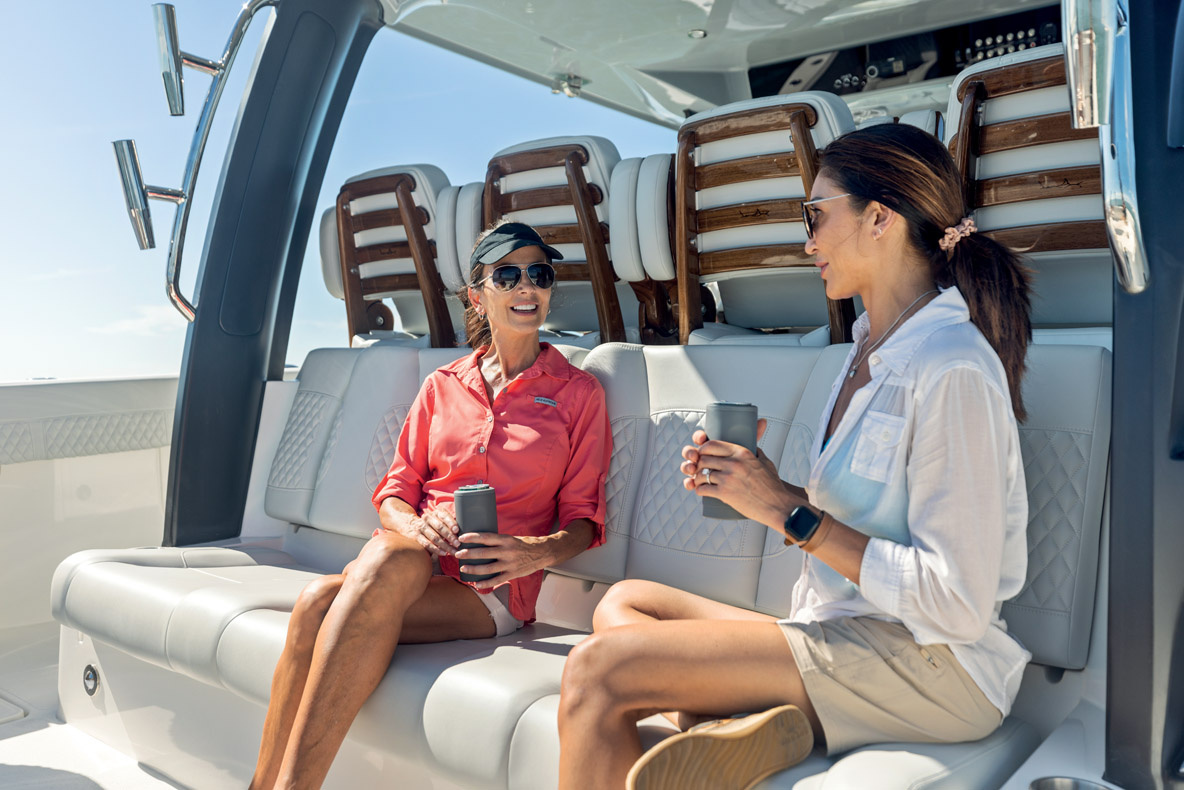
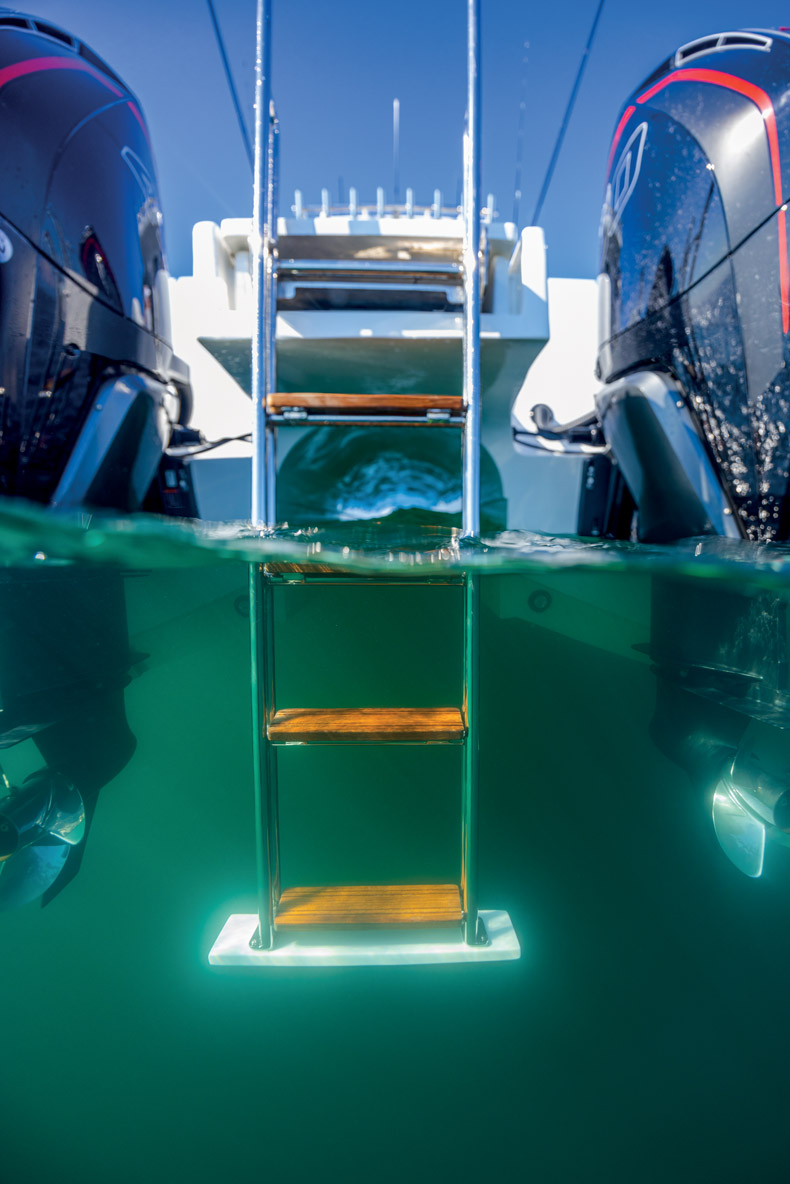
In addition to its not inconsiderable dynamism, which allows you to go offshore fishing quickly, the Molokai 47 features a comfortable and highly versatile deck layout. Of course, this is a fishing boat, and this is reflected in the large cockpit, which can accommodate a full set of rod holders or even a fighting seat. There are also two good-sized livewells, not to mention thigh cushions and two lateral doors, very practical for reeling in your catch or simply for accessing the boat. Another original feature is the transom, with a door in the center that extends into a long swim platform between the engines. This platform itself conceals a very well-made swim ladder with handrails to facilitate climbing back on board. Definitely a good idea. Retractable bench seats disappear into the transom and several lockers are concealed in the floor, two reserved for technical access and two that can be used for storage or transformed into a livewell, as on our test model. Backing onto the center section, a bench seat allows you to observe fishermen or boating activities. It also features two coolers under the seats and a large lure box behind the backrest. If required, this bench seat can be replaced by an external galley with a grill, two sinks and a refrigerator.
All in all, this cockpit boasts over twenty rod holders and even, as an option, sockets for electric reels. On the rear of the hard-top, a screen has been installed to act as a repeater for the fishfinder or GPS. Finally, the Aquila has been designed to accommodate a Tuna Tower, which can be accessed via the steps on the rear sides of the hard-top.
At this point, it’s also worth talking a little about the construction. Mostly made in infusion, the powercat features carbon bulkheads on the front and rear to save weight and increase rigidity. The hard-top is also made of carbon, which obviously makes it very solid and rigid.
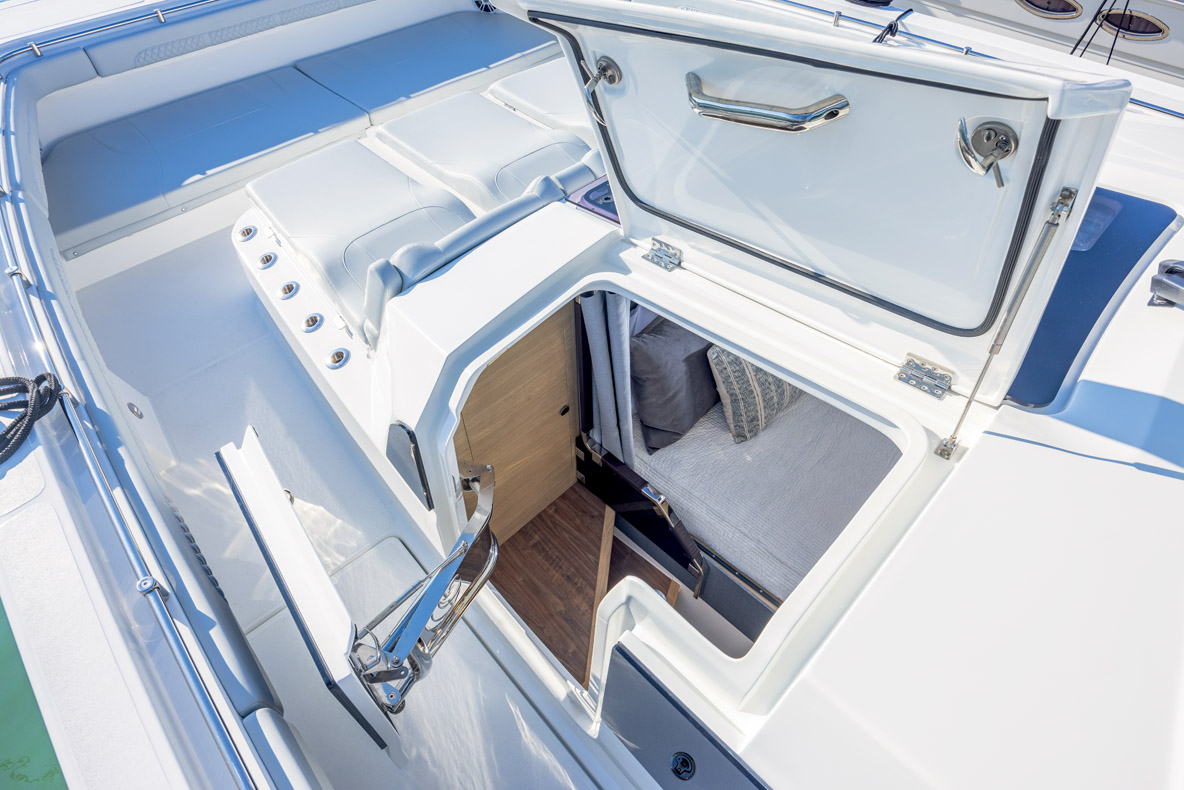
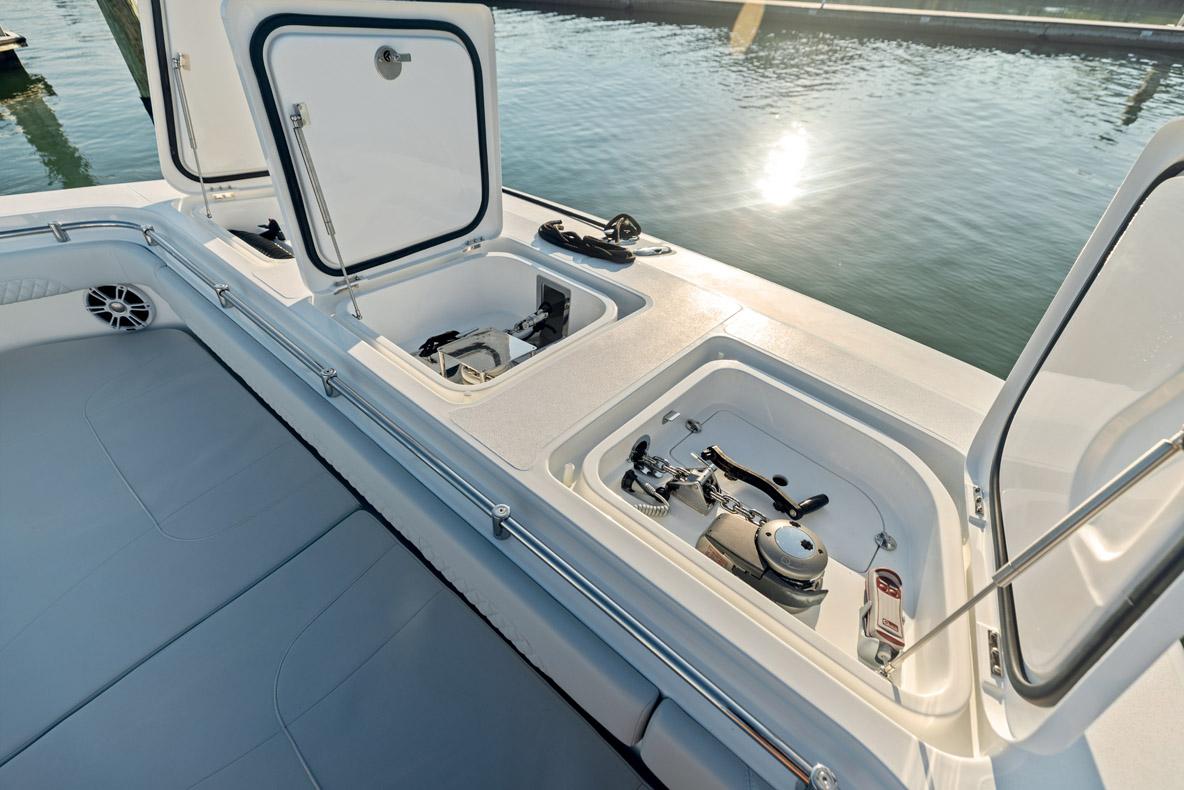
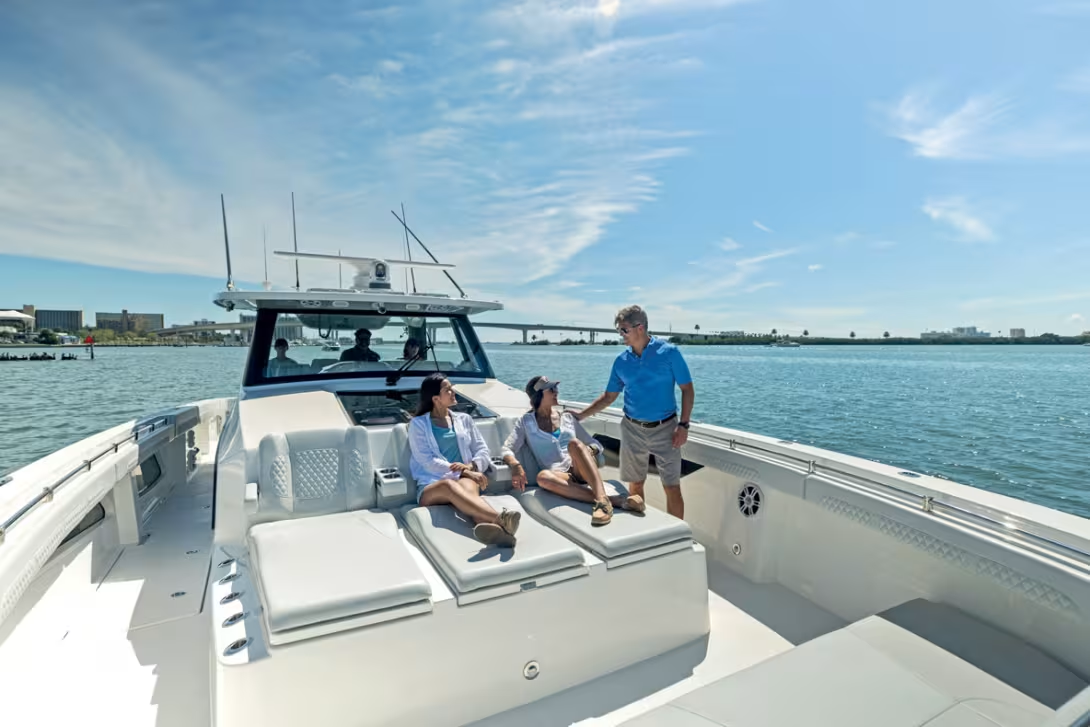
Continuing forward through the wide, deep catwalks, you discover two large fish boxes on each side. This passageway leads to the front section, which is dedicated to relaxation. There are three lounge chairs on the cabin roof and a well-sheltered sun lounger on the bow. It’s a pity there are no tables either forward or aft. To make the most of the volume, storage space is provided under these seats, as well as under the solarium. The nose of the boat features three lockers, two dedicated to the electric windlass and chain, and a third which includes a pressurized rinsing system and can be used as a storage locker using the entire depth of the hull. A good point, but with a downside: if you drop something on the bottom, it’s hard to retrieve.
Comfort on board has not been forgotten
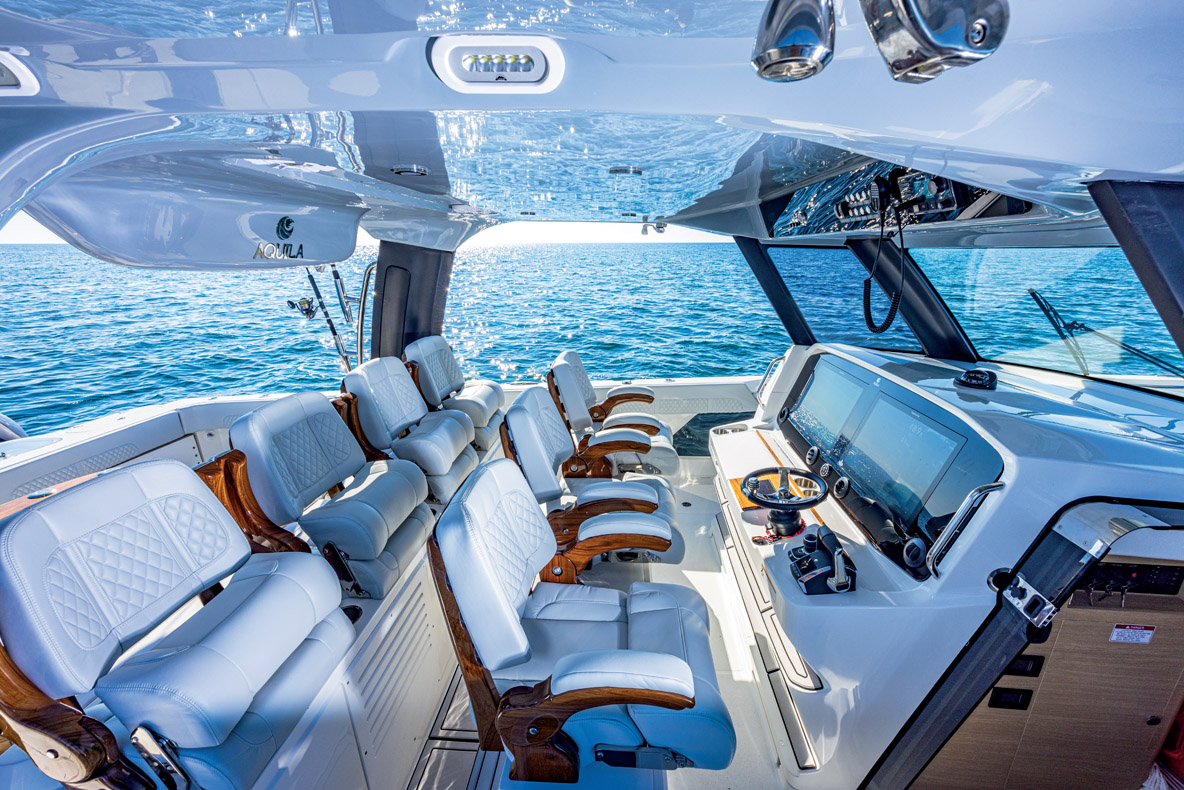
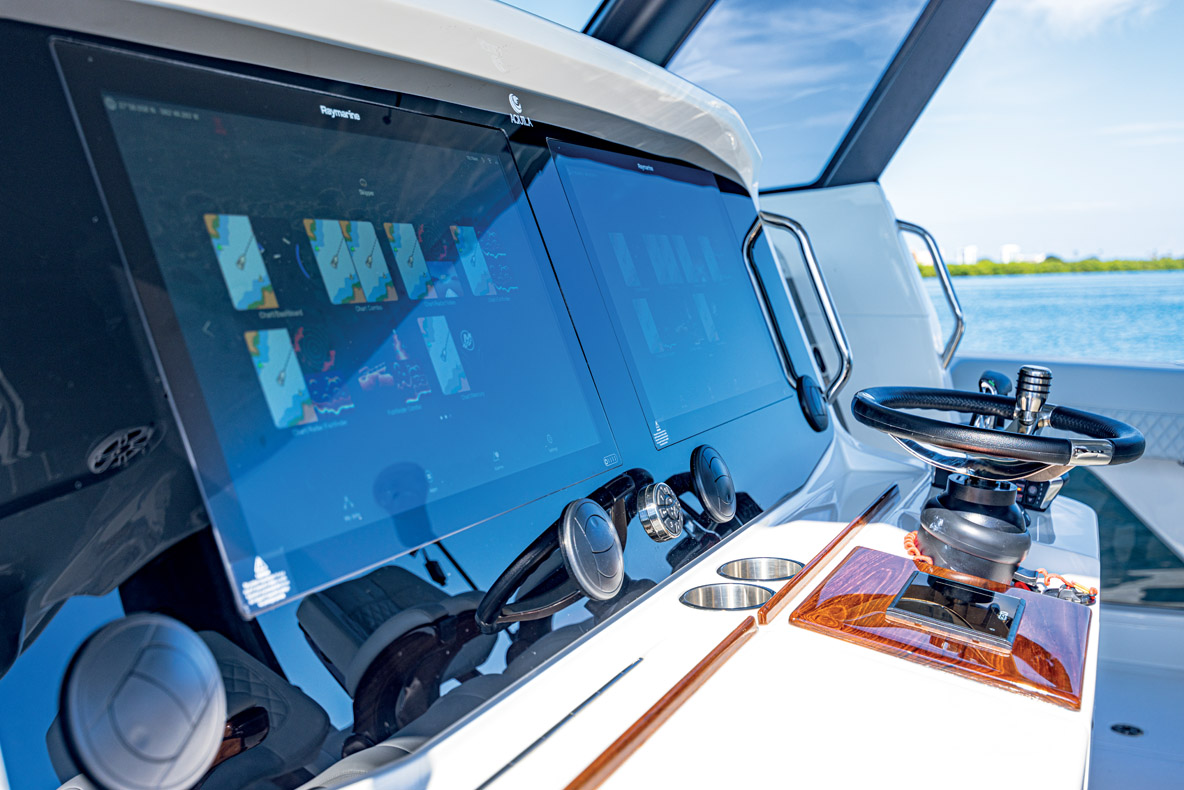
Sheltered by the hard-top and windshield, the Molokai’s mid-section features two rows of individual seating for a total of seven passengers. The rear row is a little higher to allow passengers to enjoy the view, and all have footrests. The helm itself is in the image of the best fishing boats on the market, with a glovebox, a few switches, cupholders and a gloss black front panel. Depending on the option package chosen, there are two or three large screens, all well integrated for a sleek, modern look. Despite the modest size of yours truly, visibility at the helm remains decent, but you can also use the floor riser, which makes things even easier, especially when maneuvering. By the way, all seats have a leaning-post position.
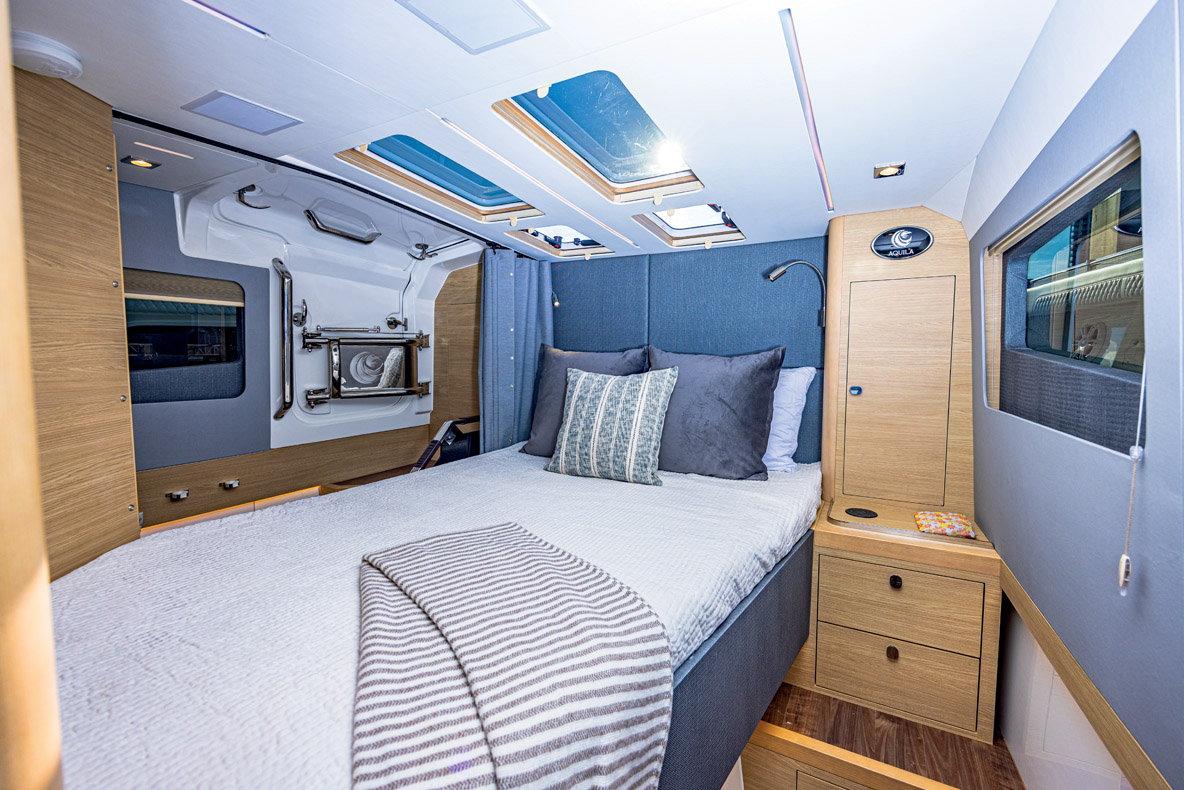
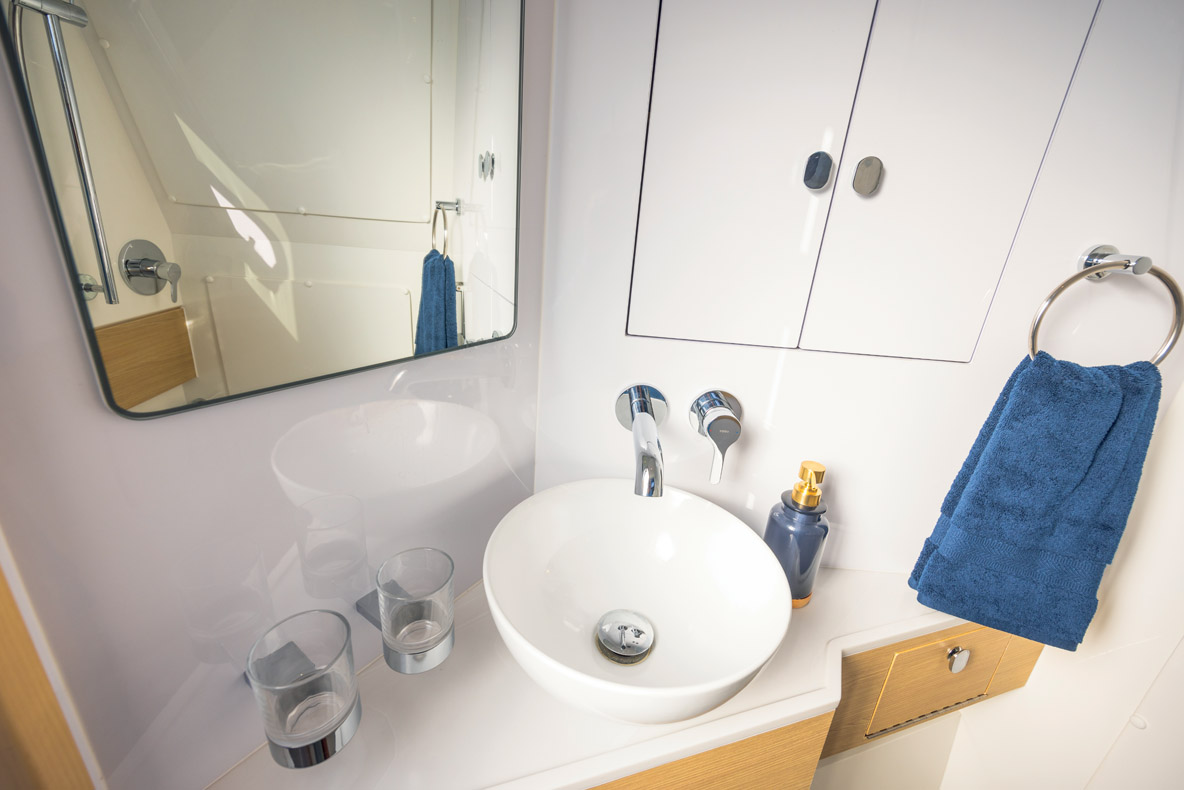
Then there’s the cabin, and that’s not the least interesting part. It’s not easy to design an open fishing boat based on a catamaran and add a real cabin while maintaining a sporty, low-profile design. But that’s exactly what the architect did, since this powercat is totally open, but still has a cabin with a double berth, a real shower room and some storage space. The trick was to place the bed on the tunnel and use the hollow of the hulls to circulate on either side, which is quite clever. On the downside, to get from one side of the bed to the other, you either have to climb over the bed, or use the two openings, one on starboard, next to the helm, and the other on port, in the catwalk. The starboard side has a few storage compartments, while the portside also houses the head. This head is not very large, but it allows you to use the restroom and take a shower without too much contortion. For relaxation, there’s a TV at the end of the comfortable bed. When it comes to energy management, Aquila has opted for a bank of lithium batteries with a total of 900 Ah. A solution that avoids the need for a generator and has enough power that you’ll never really go without when off for a long day.
Like the rest of the boat, build quality and finish are of the highest order, and this is the very first of the series. The GRP is well made, the woodwork well protected and the assemblies reliable. The standard equipment is rather generous, and the catalog of options is long enough to provide something for everyone.
Conclusion
High-performance, seaworthy, comfortable and versatile, the Molokai 47 is also pleasant to look at. Designed for long-distance fishing or coastal cruising, this powercat also offers a bit of comfort for family outings, and even allows you to spend a few nights on board, with the galley option if possible. A real challenger in the still rather small club of fishing catamarans over 45 feet. Combining the best of both worlds, monohulls and multihulls, the Aquila should appeal to a broad clientele looking for a boat to go far and to go fast.
TECHNICAL SPECIFICATIONS
Designer: Aquila (USA)
Architect: Peart Yacht Design
Length overall: 49’4” (15.06 m)
Beam: 14’7” (4.44 m)
Draft: 2’2” (0.65 m)
Air draft: 9’7” (2.93 m)
Light displacement: 22,818 lbs (10.3 t)
Laden displacement: 33,400 lbs (15,1 t)
Passengers: B7/C12
Berths: 2
Fuel: 1,048 US gal (3,960 l)
Water: 80 US gal (303 l)
Max power: 4 x 400 HP
Recommended power: 2 x 600 HP
EU certification: B
Price: $1,298,250 ex-tax
Performances
Clever layout
Small heads compartment
Optional galley