
Aquila continues to make its own mark on the powercat world. Having taken the lead in the 40-foot market with its incredible 44, the shipyard intends to make a place for itself in the motoryacht market with this surprising 70, which combines space and comfort.
Infos pratiques
- Le chantier : Aquila 70 Luxury
- La fiche technique
-
 Découvrez notre vidéo exclusive
- Financez votre Aquila 70 Luxury
- Assuez votre Aquila 70 Luxury
- Articles autour du Aquila 70 Luxury
Test location: Clearwater, FL (USA)
Sea state: calm; Wind: 3 to 4 knots
The catamaran yacht market continues to grow with more and more players joining the sector. However, when a leader decides to enter the field, combining space with comfort and style, the result is breathtaking. In order to find a niche for itself in the luxury market, the manufacturer has reorganized its fleet to create a «Yachts» series. While the Yachts range includes the 44, 54 and 70, it is this last model that really defines the contours. Unveiled at the beginning of the year, the boat arrives with great ambitions. The brand intends to demonstrate that a catamaran has all the arguments to convince owners of traditional single-hulled yachts. The idea, as Lex Raas the brand’s president, explains, was to design a catamaran that looks like a superyacht, both inside and out, with the added bonus of the space offered by a multihull. The Sino-American shipyard therefore went looking for inspiration from Europe and in particular from Italian brands that have significant experience in this field. The result is really appealing. From the very first glance, the Aquila 70 catches the eye, starting with its imposing dimensions. Over 68 ft (21 meters) long, 26.9 ft (8.2 meters) wide and with a hard top that rises 25.5 ft (7.8 meters) above the water, this XXL-sized powercat is hard to miss.
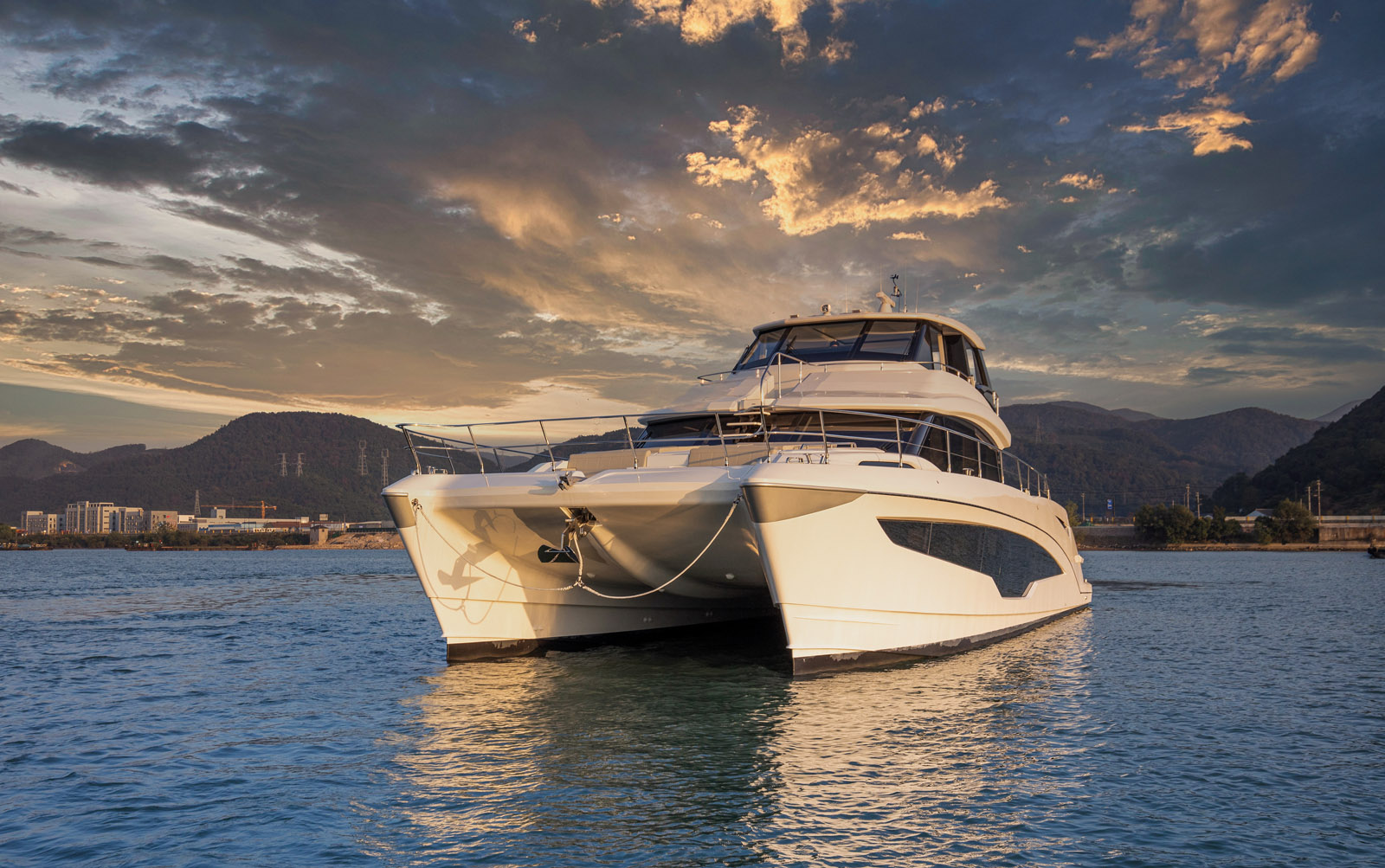
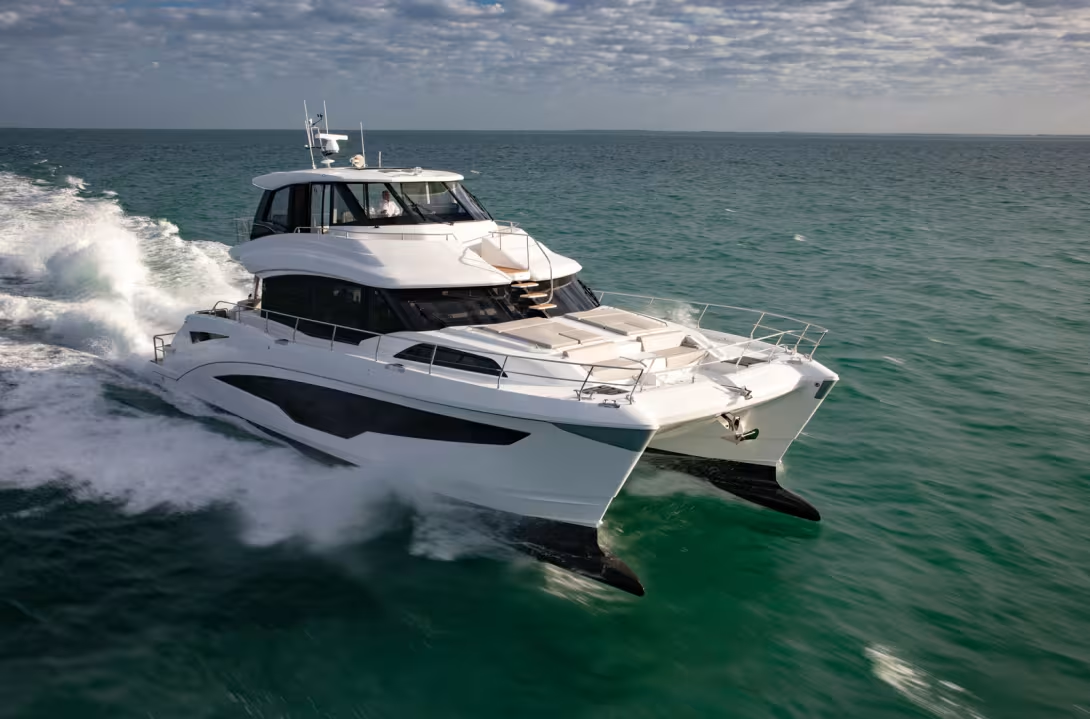
From three quarters forward, the Aquila is imposing and has a very powerful look. The tunnel under the nacelle is huge and the deck line very high.
A European-inspired design
From the exterior, the 70 clearly follows the lines of the 54 with a very slender bow and superstructures that seem to have been sculpted by the wind. The slope of the windshield on the main deck is well aligned with the flybridge, giving a very aerodynamic look to the profile. The huge glass surfaces also enhance the style, and this is particularly evident in the long hull window directly inherited from the motoryacht world. From the side, it is difficult to tell that we are in the presence of a catamaran. From the front or from three quarters,
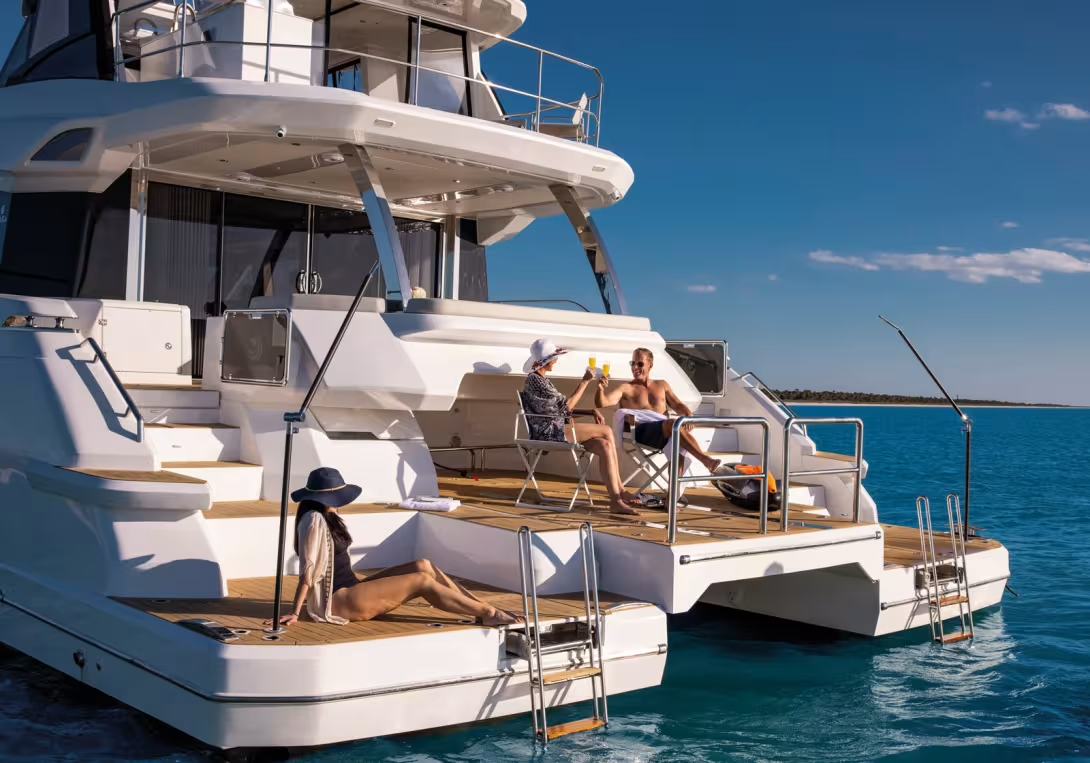
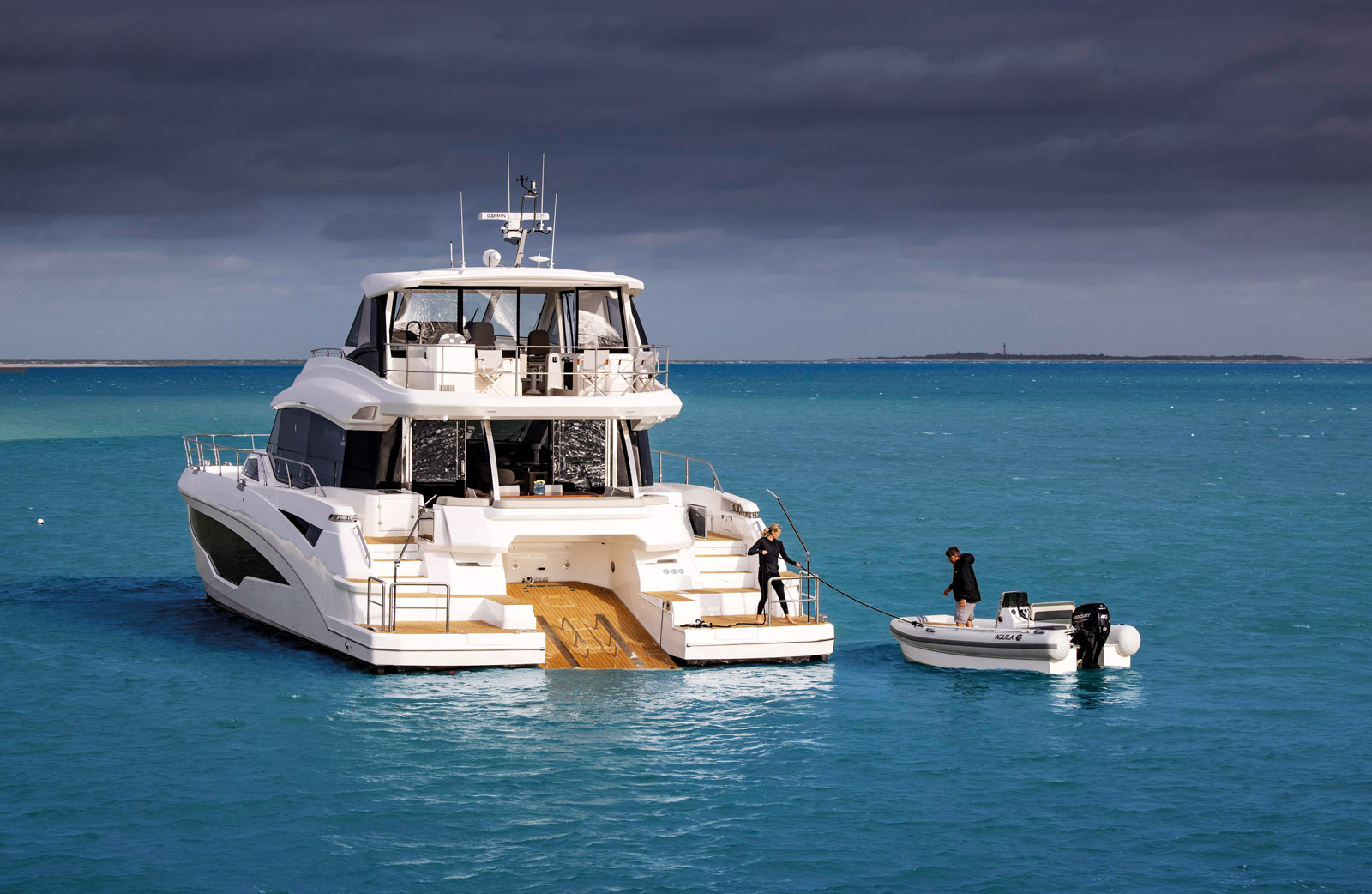
it is the nacelle that impresses. Very thick, it gives a very robust aspect to the boat while the line of the very high forward deck accentuates the powerful stature of the catamaran. The same impression of power can be found at the stern, where the Aquila 70 offers a huge bathing platform across the entire beam of the boat. In fact, the builder has taken dvantage of the width of the two hulls to install two large bathing platforms on the transoms, while the central part tilts down to accommodate a 15-foot (4.5 m) tender. Once the tender is in the water, this central platform becomes an additional deck for relaxing. In addition to this ingenious layout, the platforms feature a stainless-steel balcony, storage for wet gear and a magnificent stainless steel swim ladder patented by the brand. In short, your own private
beach with all the comforts you need, including an optional shower on each side.
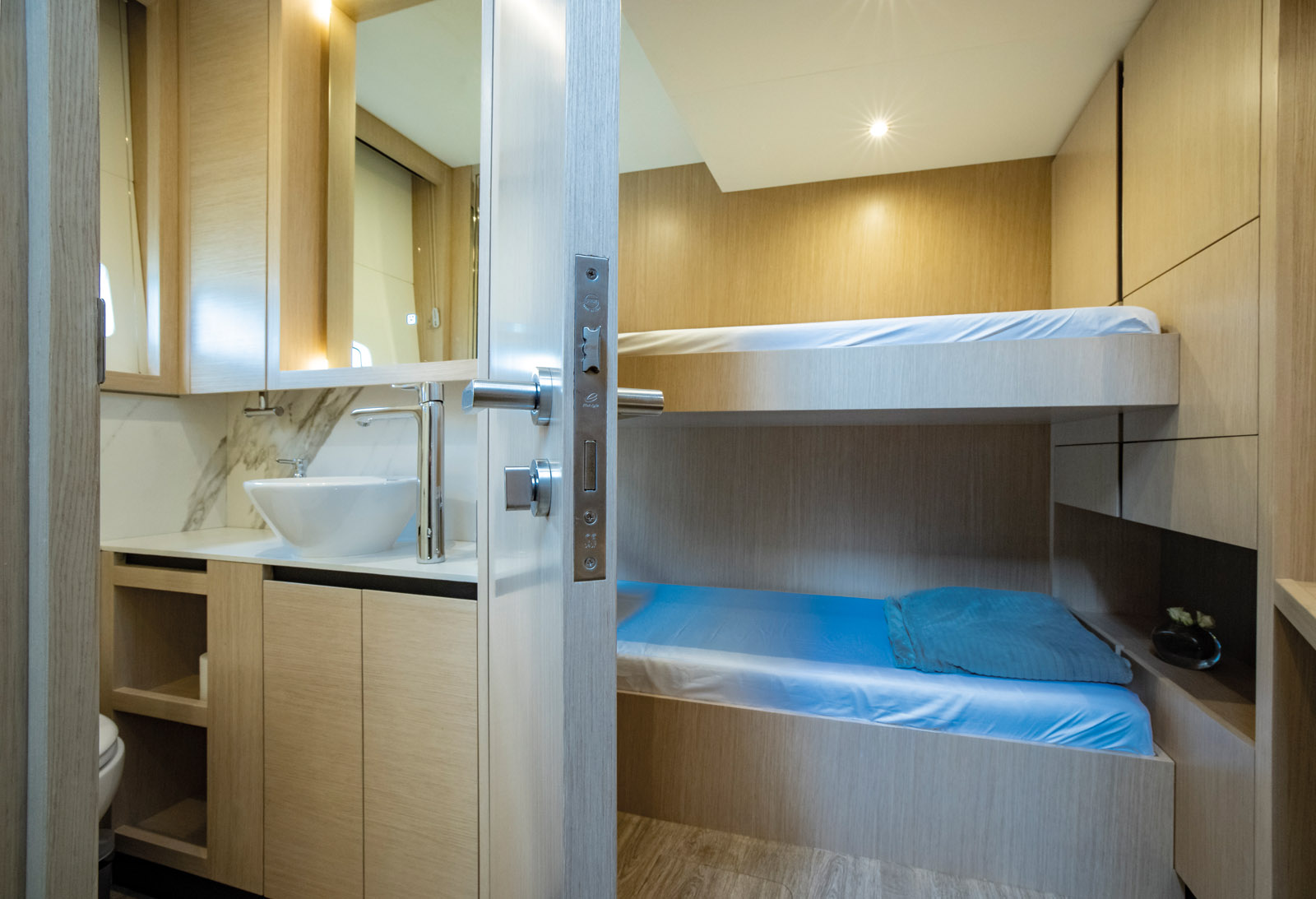
From this space, four steps lead to the cockpit. We liked the gate on each side, a real plus for the safety of children. Very well protected by the flybridge, the cockpit is organized around a large aft bench seat in front of which a table for six to eight people can be placed. There are also a few storage lockers to starboard and access to the crew cabin on the port side. Note that the crew’s quarters have been rather well treated, with a private bathroom and proper windows.
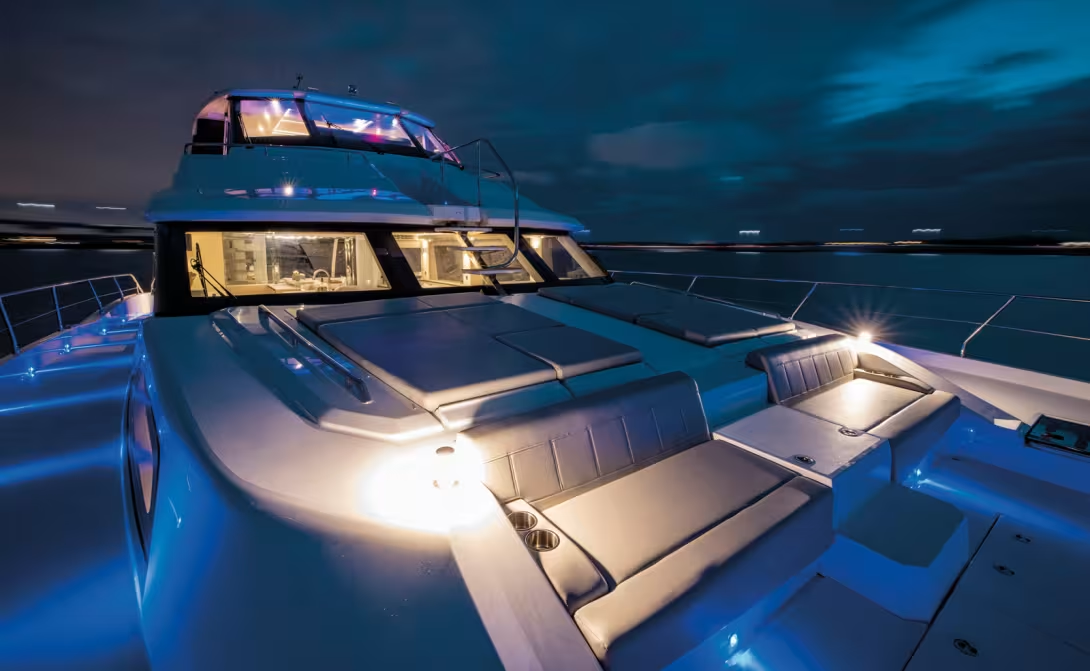
To reach the foredeck, you can choose between the port or starboardside-deck, both pretty wide and well protected by a stainless-steel handrail. However, a few additional handholds would have been appreciated. Taking advantage of the length of the catamaran, the foredeck is more than welcoming. In this space, circulation is very easy, as is access to the forward lockers with transparent covers or access to the huge anchor locker. In addition, this area features two levels: the upper part offers two double sunbeds while below, two double bench seats simply create an invitation to relax or to contemplate your surroundings. Unfortunately, there is no table. The central section leads directly to the flybridge via a Portuguese bridge with by a large handrail, which is pretty neat.
 |
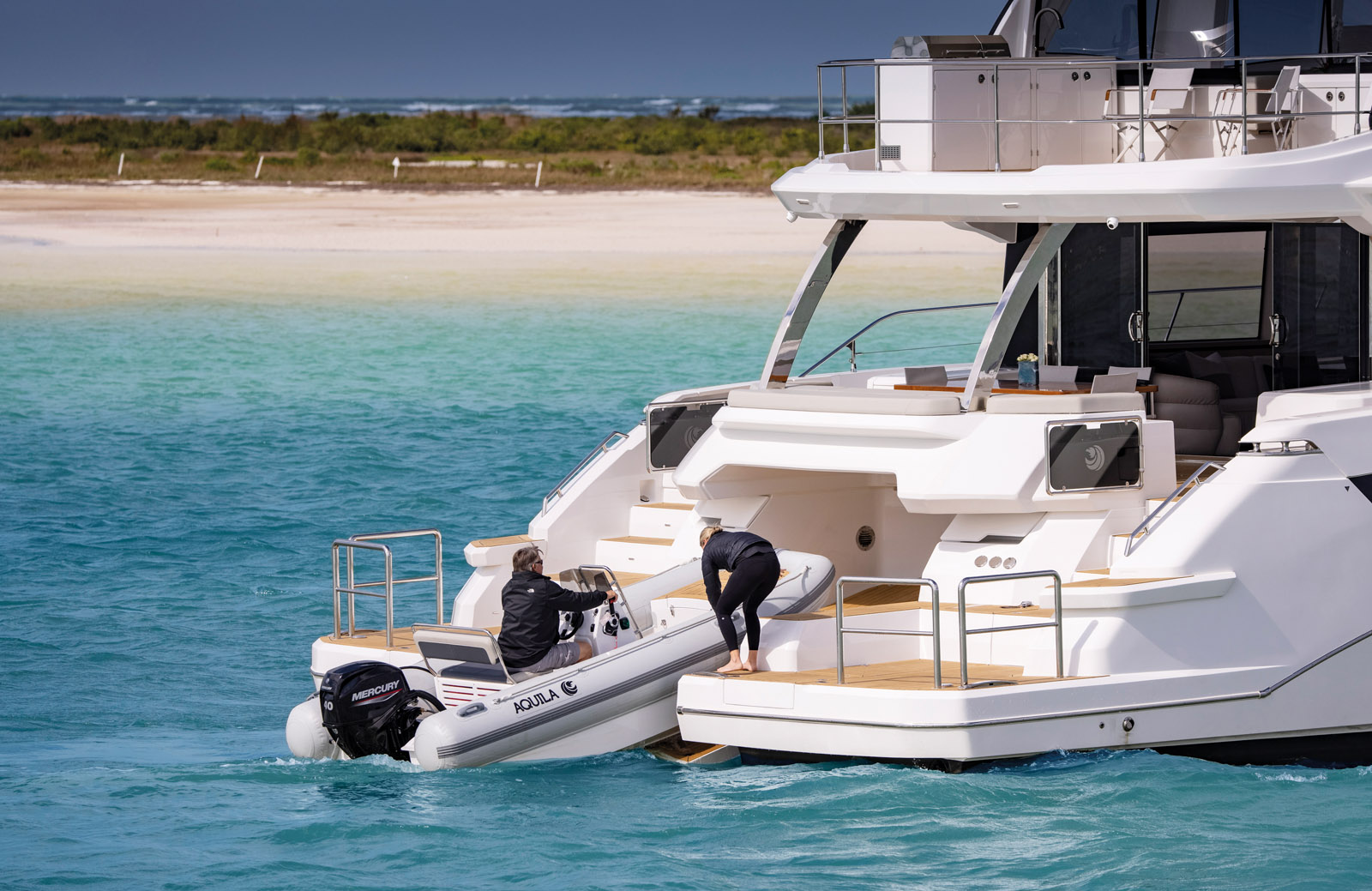 |
The aft section can be lowered to accommodate a good size tender. Once the tender is in the water, this ramp becomes an additional deck to enjoy the surroundings.
A main deck with a 360° view
To go from the outside to the inside, there’s a large bay window where each door slides to the side. It is well done, but it’s a pity thatthe threshold of this door isn’t integrated into the floor, so you must be careful with your feet... Taking advantage of the huge lateral glass
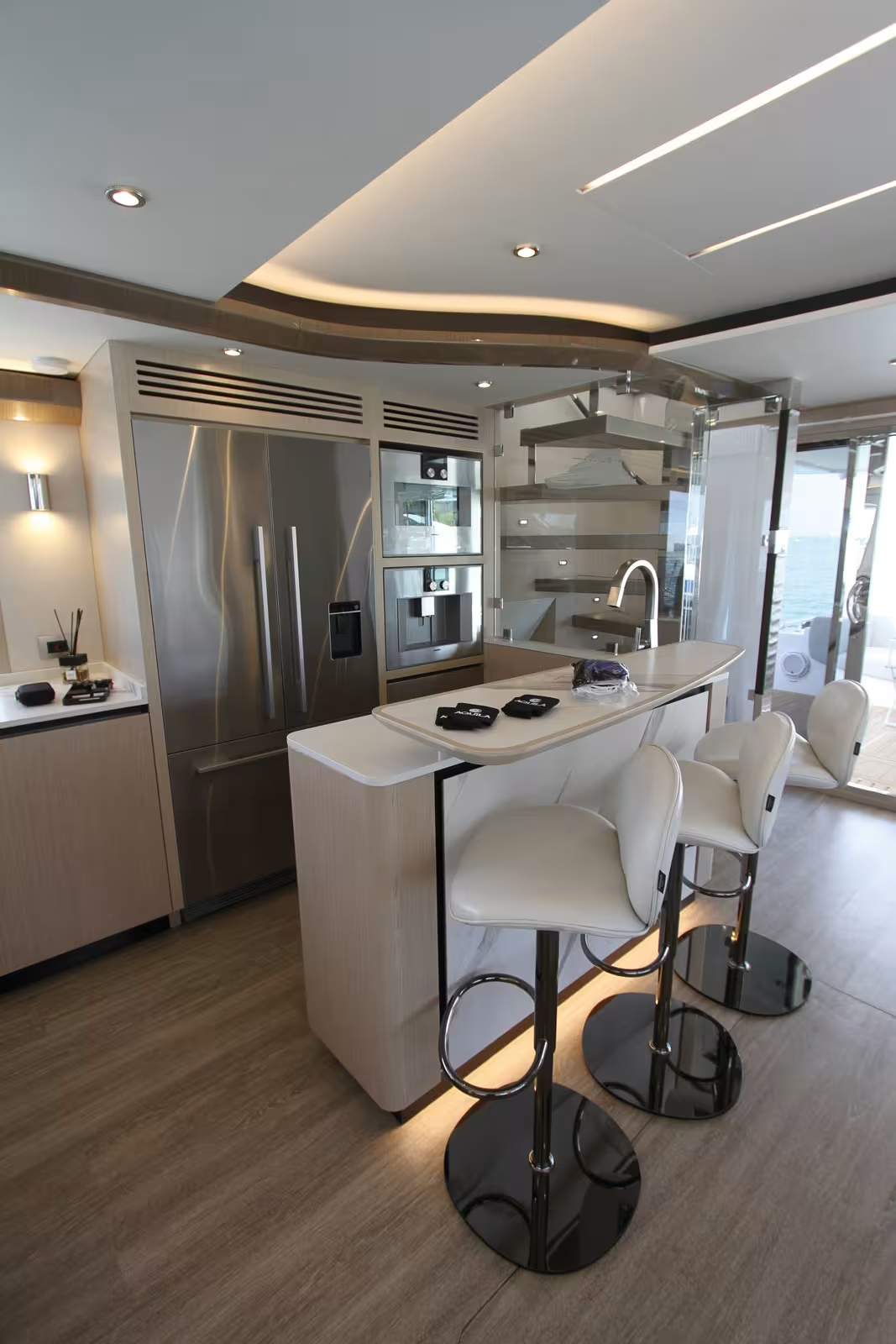
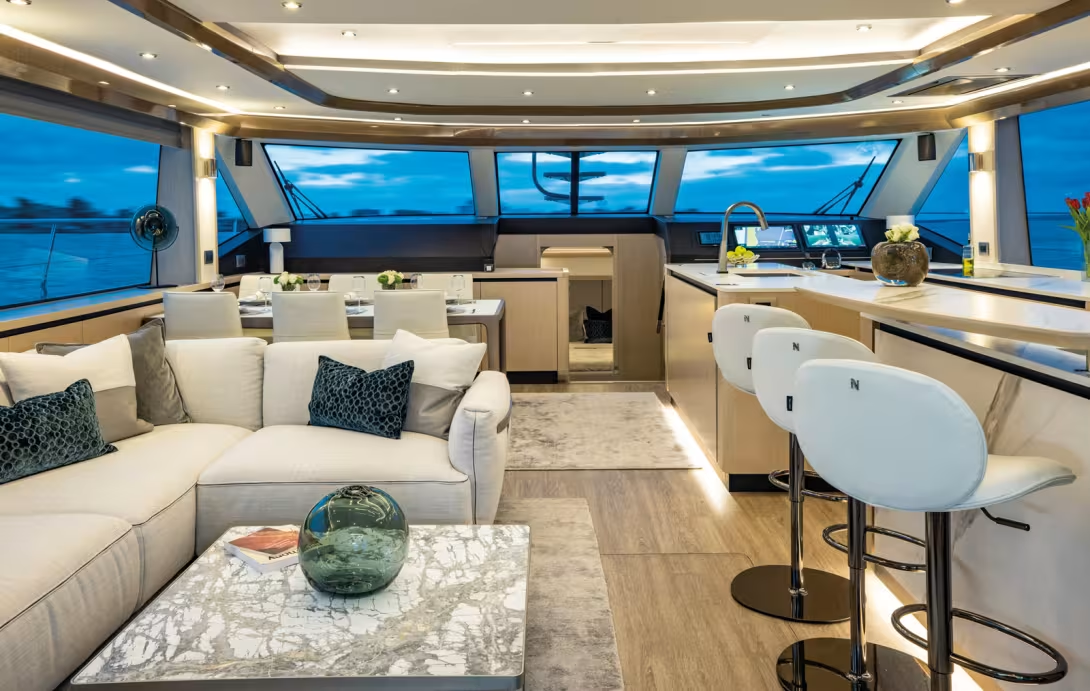
surfaces, this main deck is bathed in light. As a catamaran, it also benefits from an exceptional surface area and the builder has even accentuated this impression by playing the ‘open concept’ card. In fact, from the entrance to the forward windshield, nothing blocks the view. Aquila called on Italian design firm Manzoni & Tapinassi to make sure that everything was just right, and you can feel it as soon as you step inside. On the port side, there is a long L-shaped sofa by Natuzzi called «Moby Dick» with a structure reminiscent of a whale’s tail, all served by an elegant coffee table. The dining room table follows, and like the rest of the main deck, it enjoys a 360° view. To starboard, just after the stairs leading to the flybridge and down to the cabins, there is a bar with double refrigerator, freshwater dispenser, and microwave oven. Following on round, the galley features an island with central sink and perfectly integrated appliances. One small subtlety is that a frosted glass window rises to form a screen, allowing guests to enjoy a cocktail or dinner without having the galley mess in front of them. A small detail that is very important for the well-being of the passengers. Finally, forward and to starboard, an interior helm station with a joystick, throttles and some screens remind us that we are actually on a boat and allows us to perform some
maneuvers from the main deck.
From there, the flybridge is easily accessible via the interior staircase. Partly closed, this flybridge, which becomes a «sky lounge» according to the term used in the yachting world, offers an exceptional view of the surroundings. There is of course a full helm station with three seats, but also a small bench seat on the port side and another L-shaped bench aft, with a nice table for dining with a view. All of this also benefits from air conditioning, a blessing in the tropical heat. At the back, the terrace integrates an outdoor galley with grill and sink and leaves enough space to put some lounge chairs or a small sofa, at the owner’s discretion. In addition, you can enjoy an incredible view from this terrace.
On the practical side, this flybridge integrates a sliding lateral door that allows access to the upper gangway equipped with a high bulwark, then to the Portuguese bridge to reach the foredeck. A layout that makes it easy to get around and also provides a nice place to walk around and enjoy the scenery.
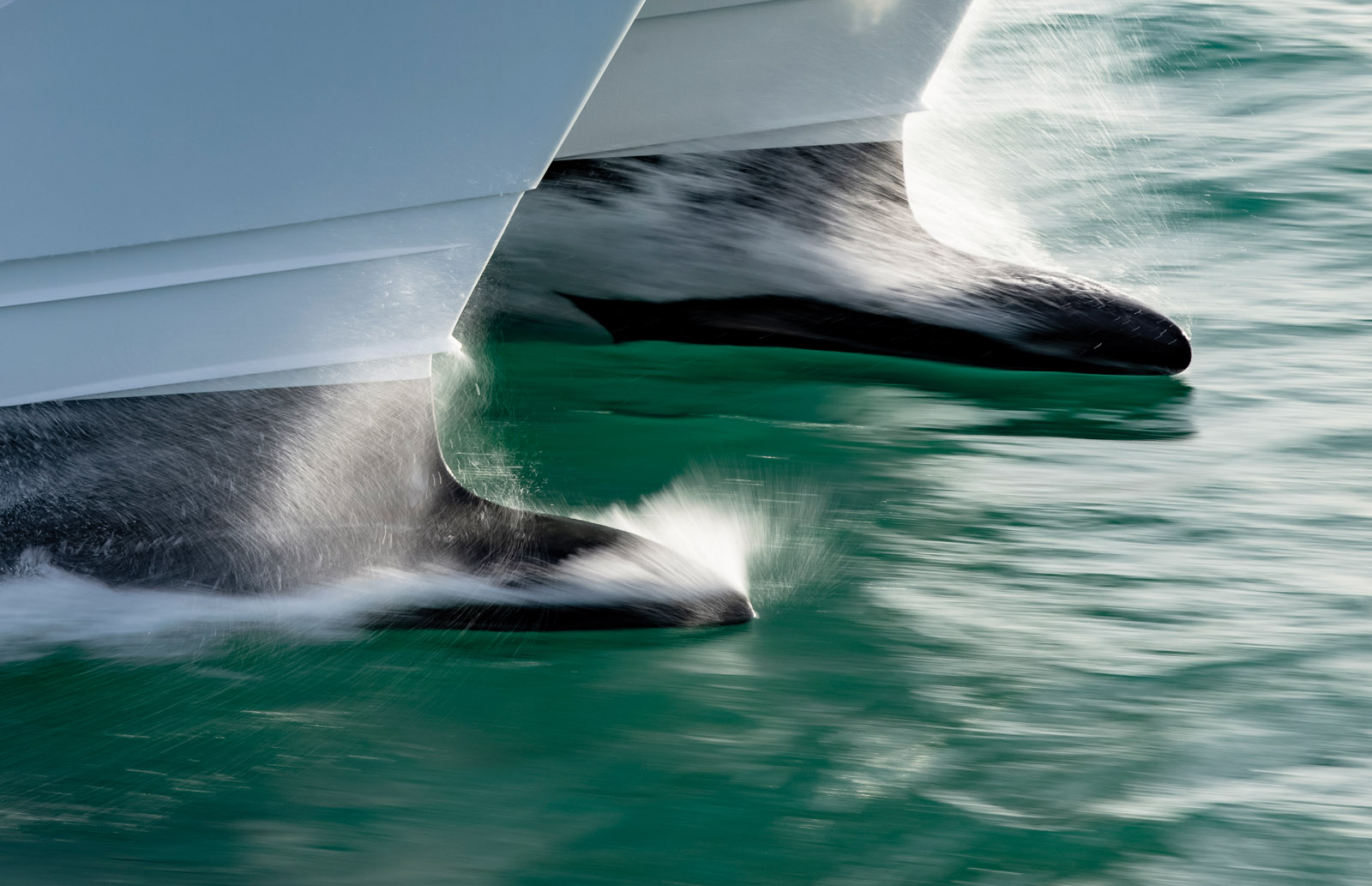
A true trademark of the shipyard, the bulbous bows are very efficient when under way.
Well-separated cabins for privacy
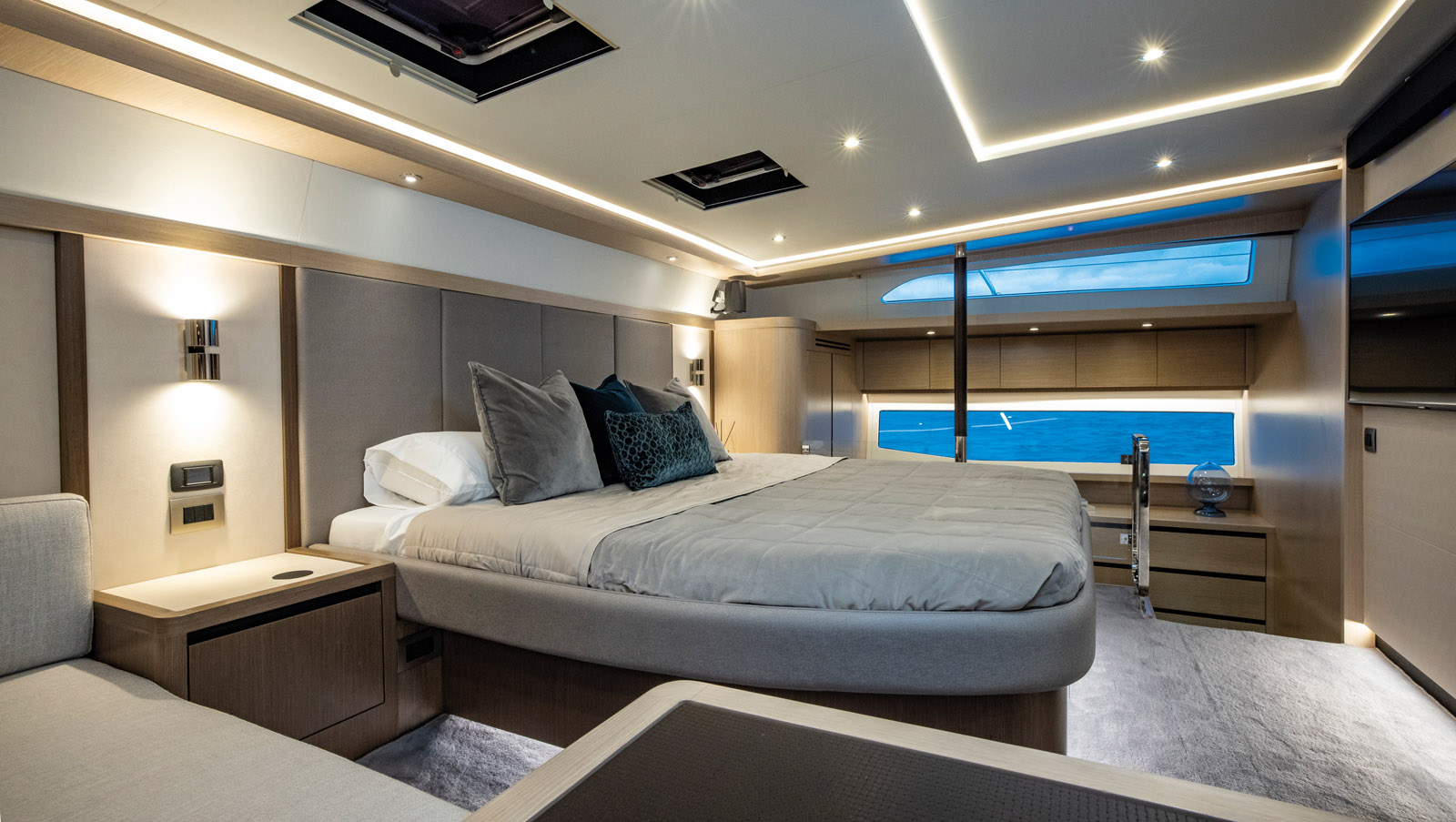
Moving on to the night area, once again the shipyard has optimized the space particularly well. Available in a standard version with three cabins plus the crew quarters, the catamaran is also available in a four-cabin version plus the crew’s area. Housed in the nacelle and at the front of the hulls, the owner’s cabin, or more accurately the owner’s suite, takes up the entire width of the vessel. This allows for a king size bed with nightstands, each including a wireless smartphone charger. There is also a comfortable sofa and a desk. On the port side, two steps lead to the bathroom area with a vanity featuring two sinks, a separate shower, and a separate toilet, all with a magnificent view of the sea. The starboard side is dedicated to storage with a closet and several drawers. However, it’s a bit surprising not to find a real walk-in closet as featured on the 54.
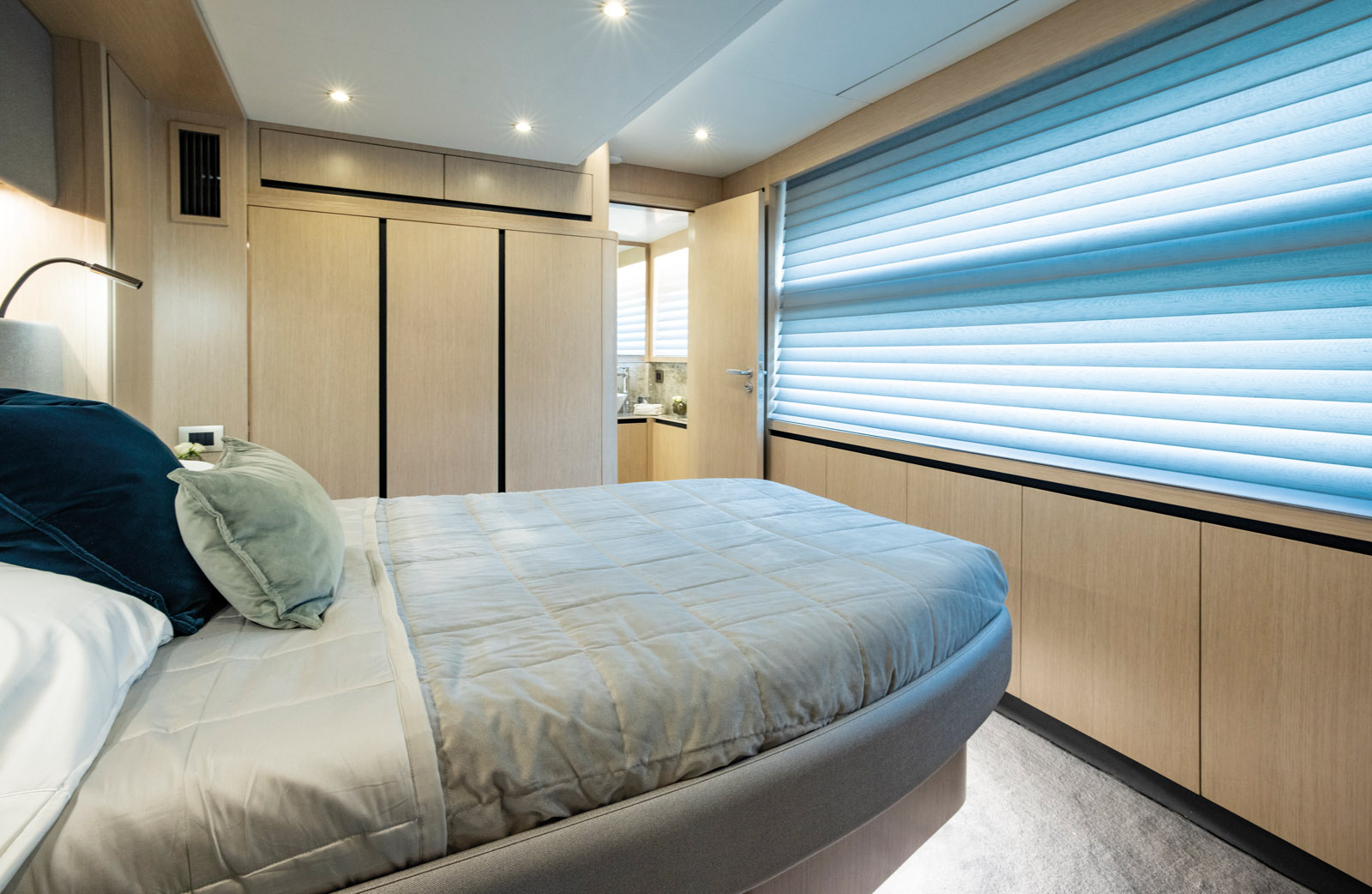
Leaving the owner’s suite, a small staircase on the port side leads to the first guest cabin. Thanks to the width of the hull, this space benefits from a nice volume with a bed installed athwartships, allowing guests to enjoy an unobstructed view on the sea when lying down. There is also a complete bathroom and plenty of storage space.
Access to the starboard hull is from the rear of the main deck, which gives a certain independence to the second guest cabin. This cabin benefits the same layout as the first, with a bed positioned athwartships to enjoy the view, a nice bathroom with a closed shower and plenty of storage space.
In addition to a comfortable cabin, this starboard side has a laundry room with washing machine, dryer, and storage. If necessary, this space can be converted into an additional cabin for kids. The rear of this hull also has a bathroom for guests, which allows, when you have friends aboard or have been swimming, not to use one of the cabins’ bathrooms - definitively a good idea. Finally, it is from there that you reach the engine room. Ultimately, we could easily envisage a family with children in the owner’s area and a couple of guests in the starboard cabin, each keeping their own living space. The same principle applies to the daytime spaces, as the choice is vast between the foredeck, the flybridge, the main deck, the cockpit, or the swimming areas.
Apart from being well thought out, this interior also benefits from a special care that goes far beyond what is usually found on a cruising catamaran. With good quality fabrics, sober color woods, indirect lighting, and quality equipment, the Aquila 70 is truly heading towards the world of luxury. This multiyacht also features the latest technology available, starting with LED lighting, numerous TV screens cleverly hidden in the furniture or ceiling, USB sockets, electric curtains and wireless charging stations for smartphones everywhere. What’s more, while this is not a custom boat, some degree of customization is available when ordered. Finally, this equipment can of course be adapted to the needs and desires of the customer.
 |
 |
 |
The central part of the owner’s cabin features a king size bed and a desk.
The two guest cabins are almost identical with the bed fitted athwartships, a breathtaking view, and a complete bathroom.
The crew cabin is well equiped with a private toilet and a proper window.
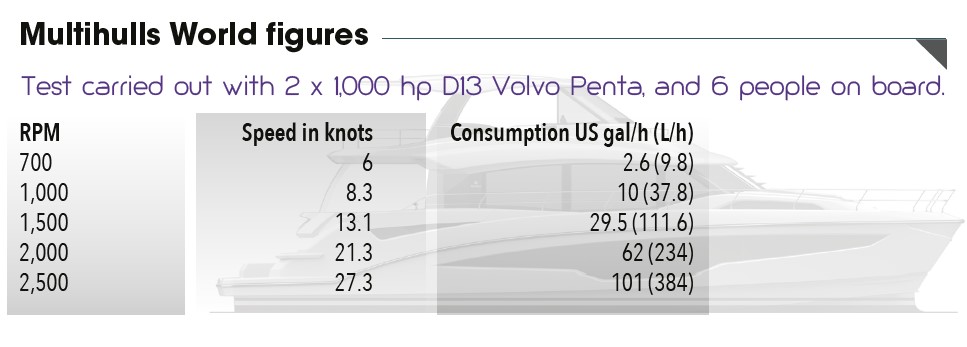
2 x 1,000 hp giving 23 knots cruising speed
Like the other models in the family, the 70 Luxury is built partly in infusion, which ensures good rigidity, but also well-controlled weight. The hulls are based on the same design ideas as those of the 54, with two solid inverted chines that repel sea spray and improve steering, and bulbous bows that, like commercial ships, allow the boat to maintain better trim by keeping the bow in contact with the water. Under way, this provides more flexibility, especially in choppy waters, since the bulb attacks the wave before the rest of the bow. The system prevents the catamaran from rising too much on the bow and finally, it avoids the spray phenomenon. In addition, the narrow and sharp bows ensure a good comfort in the waves. In fact, this hull was designed from the start for a powercat, it is not a question of any sailboat adaptation, and that makes a huge difference. The weight distribution is also exemplary which, combined with the air cushion effect of the tunnel, gives the boat excellent seakeeping behavior.
However, at nearly 55 tons in running order, the Aquila requires some power. To obtain satisfactory performance, the shipyard didn’t hesitate, and installed two Volvo D13 motors of 1,000 HP each in the engine rooms. The quality of the engine installation is to be commended, with a space large enough for mechanical maintenance without contortion, and there are handrails and stainless-steel platforms for working on the engines. Each engine room is almost identical and houses a 21-kW generator. An interesting detail is that the fuel tanks can operate independently, but a transfer can also be activated to keep the same level of diesel in each hull so as not to alter the balance of the boat. Finally, the catamaran has a total of twenty-four lithium batteries continually allow the use of all the systems on board, even on long cruises.
Very well insulated, the motors are barely audible and even less so when you are at the helm, on the flybridge. From there, you have a panoramic view, a real plus for access channels or crowded anchorages. Another good point is the helmsman’s seat which integrates a joystick and control keyboard in the armrests. The rest of the helm station is more conventional with three large screens, throttles, and a few switches. Despite its 55 tons, the 70 is quite responsive and a few touches on the joystick are enough to get it out of its slip. The height of the helm station eliminates some of the notion of speed, but a glance at the GPS quickly surprises you. It only takes a few seconds for the powercat to get going on the water, settling into its lines, and you don’t even notice it, because the boat doesn’t rear up at all. Everything happens in a progressive and smooth way. Once it’s up and running, the Aquila 70 makes good speed, cruising at about 21 knots at only 2,000 rpm, thanks to the big Volvo diesels. When pushed to its maximum, it reaches more than 23 knots, but in reality, the 70 will evolve more between 15 and 20 knots, a speed which also offers avery good autonomy. At 15 knots, you can expect traveling more than 460 nautical miles and 100 additional nautical miles at 11 knots, which already give you some good possibilities. For those in a hurry, the range at 27 knots drops to 350 nautical miles, which is far from being ridiculous.
As far as maneuvering is concerned, the Aquila 70 is once again very responsive and above all very precise, a definite advantage when using the joystick. What’s more, considering the comfort at sea, the autopilot will certainly be much appreciated for longer trips.
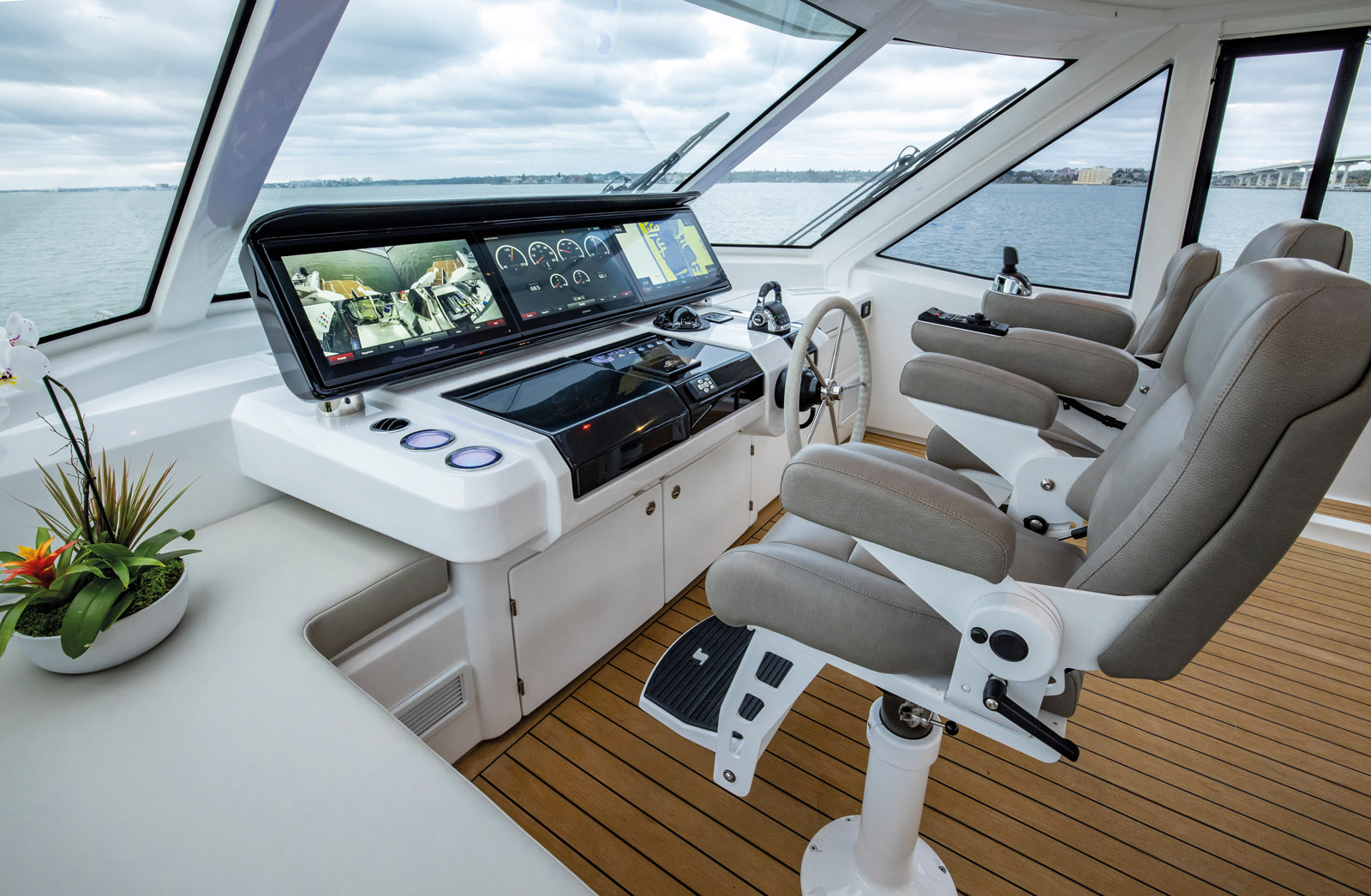
The closed flybridge offers a full helm station with three large screens, a seat with the controls in the armrests, and a panoramic view.
Conclusion
By naming the 70 «Luxury», the Aquila shipyard is not lying. This unit really allows the manufacturer to take an important step forward in the world of motoryachts. In addition, it enters the market with some considerable advantages over monohulls, notably the space and the stability when underway. Two advantages that could well attract new clients to the catamaran world.
The Pluses
+ The distribution of the spaces
+ Two independent night areas
+ High-end decoration
The Minuses
- Floor tread of the main deck door
- No real walk-in closet
- No table on the foredeck
TECHNICAL SPECIFICATIONS
Builder: Aquila (China)
Designer : Aquila (USA)
Interior design: Manzoni & Tapinassi (Italy)
Overall length: 69’9” (21.26 m)
Waterline length: 67’5” (20.55 m)
Maximum beam: 26’11” (8.20 m)
Draft: 4’9” (1.45 m)
Air draft: 25’7” (7.8 m)
Light displacement: 43 t
Laden weight: 54.6 t
Number of cabins: 4 (optional 5 cabins)
Sleeps: 8 (10 in 5-cabin version)
Fuel tank: 1,160 US gal (4,400 L)
Water tank: 412 US gal (1,560 L)
Max. power: 2 x 1,000 hp
Recommended power: 2 x 1,000 HP
Approval category: A
Price: from $ 4,200,000 with twin D13 Volvo
Penta 1,000 HP motors
