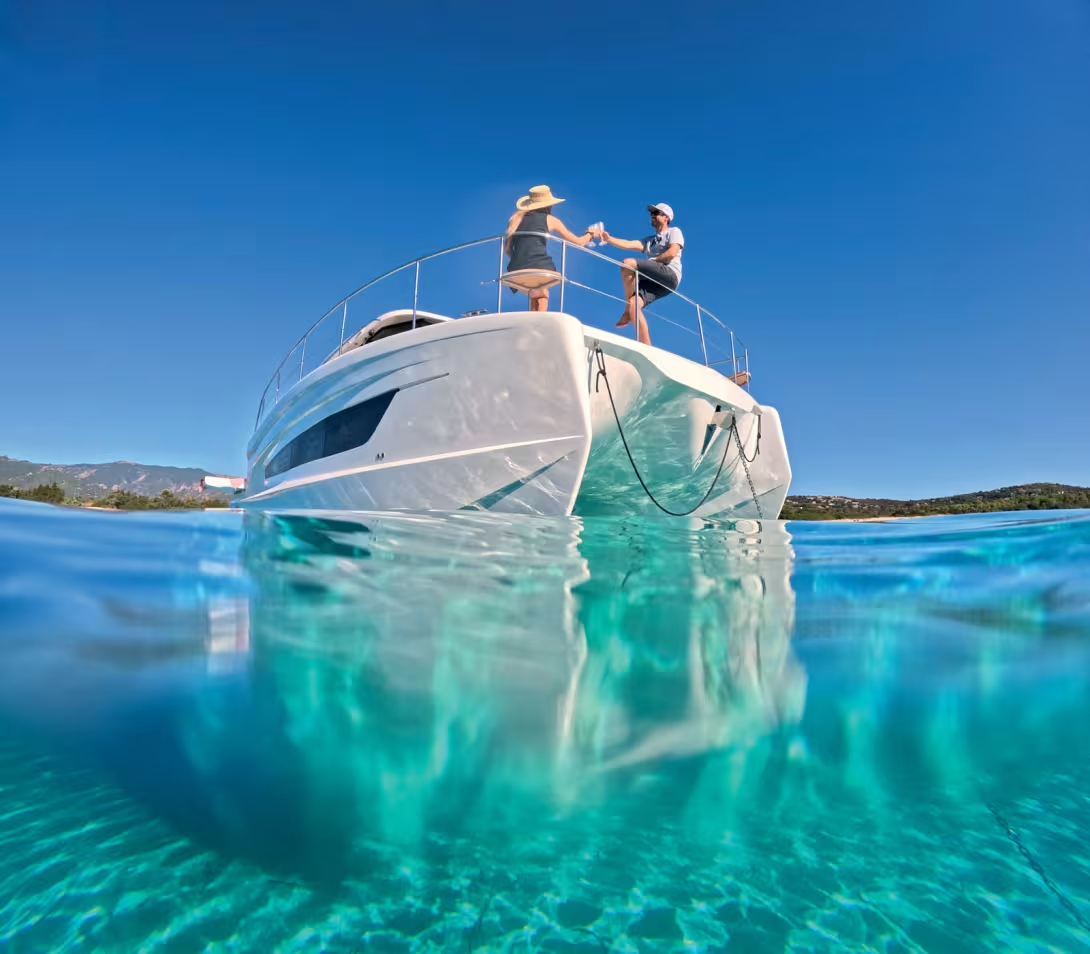
The first Aventura 38 departed the factory at Bizerte, in Tunisia, just before Christmas last year. That model was an SC (Sport Cruiser) version that we were able to test in Denia, Spain, a few months later... That was the test we had planned to share with you, but in the meantime, the shipyard has gone and launched two other versions of its new model (the Flybridge and the Sedan) before embarking on latest version of the 38, the Sport. Yard bosses insisted that we check out the Sedan model, arguably the most attractive of the range... which is why I found myself in southern Corsica right at the end of the season.
Infos pratiques
- Le chantier : Aventura 38
- La fiche technique
- Découvrez notre vidéo exclusive
- Financez votre Aventura 38 Sedan
- Assuez votre Aventura 38 Sedan
- Articles autour du Aventura 38 Sedan
Conditions: 5 to 10 knots of westerly wind, calm sea
The advantage of traveling in October to a destination that’s more popular in the summer is that everything goes very quickly - baggage collection at the airport, taxi transfer time... Add to that an early morning arrival in Figari a little ahead of schedule, and there I was at 8:30 am in Porto Vecchio stepping aboard the Aventura 38 Sedan. I was greeted by Gaël Tannou and Morgane Nicolle- Malpas, who work for Corse Grand Large. Their company offers sailboats for charter, runs a sailing school, and are official dealers for Aventura Yachts. The sun was just rising in a blue sky as the twin 370-HP motors were purring away in the engine compartments. The coffee machine was also humming away, accompanied by pastries. I’d had a short night’s sleep, but I wasn’t complaining.
Up on the Plane at 13.5 knots
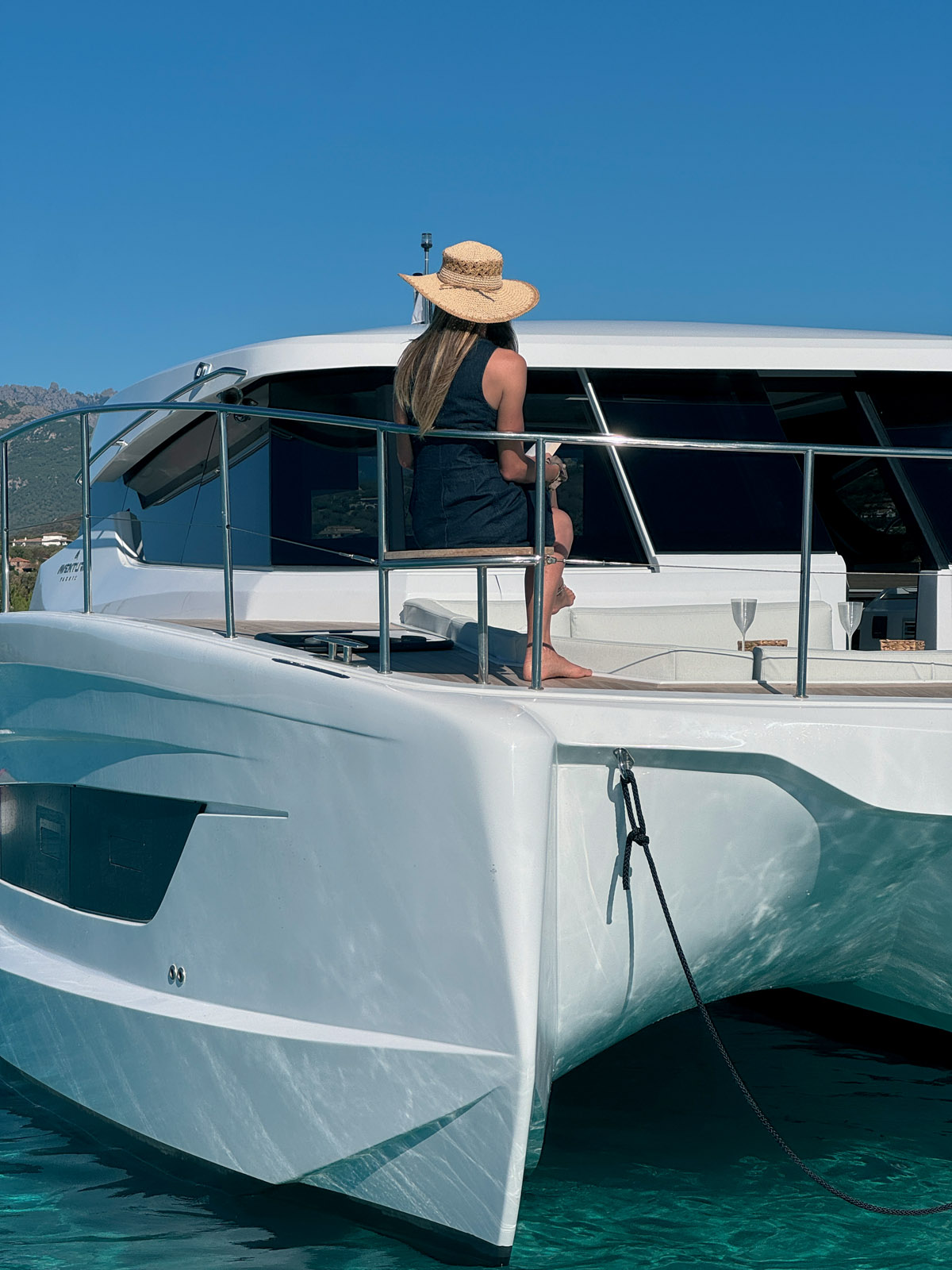
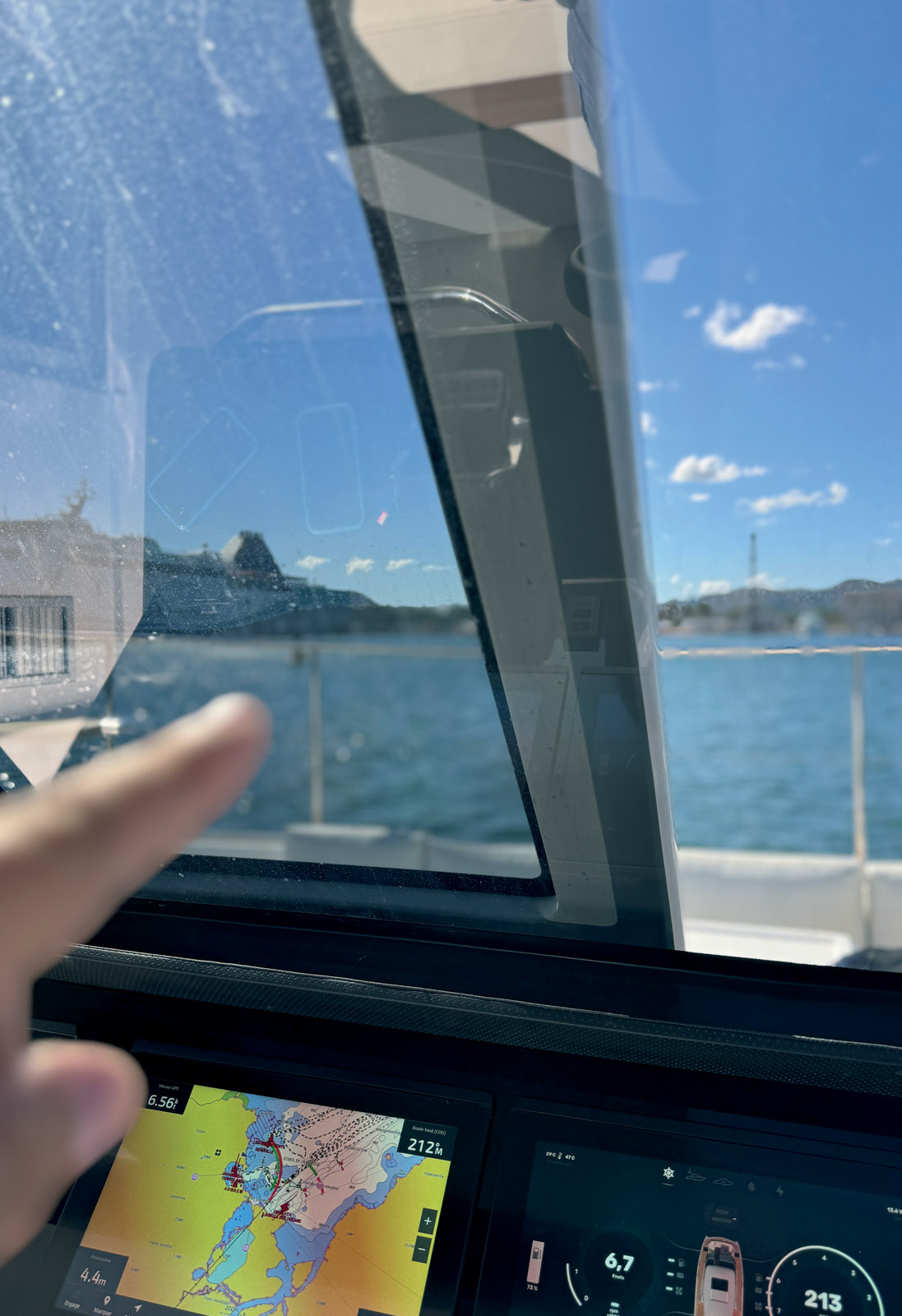
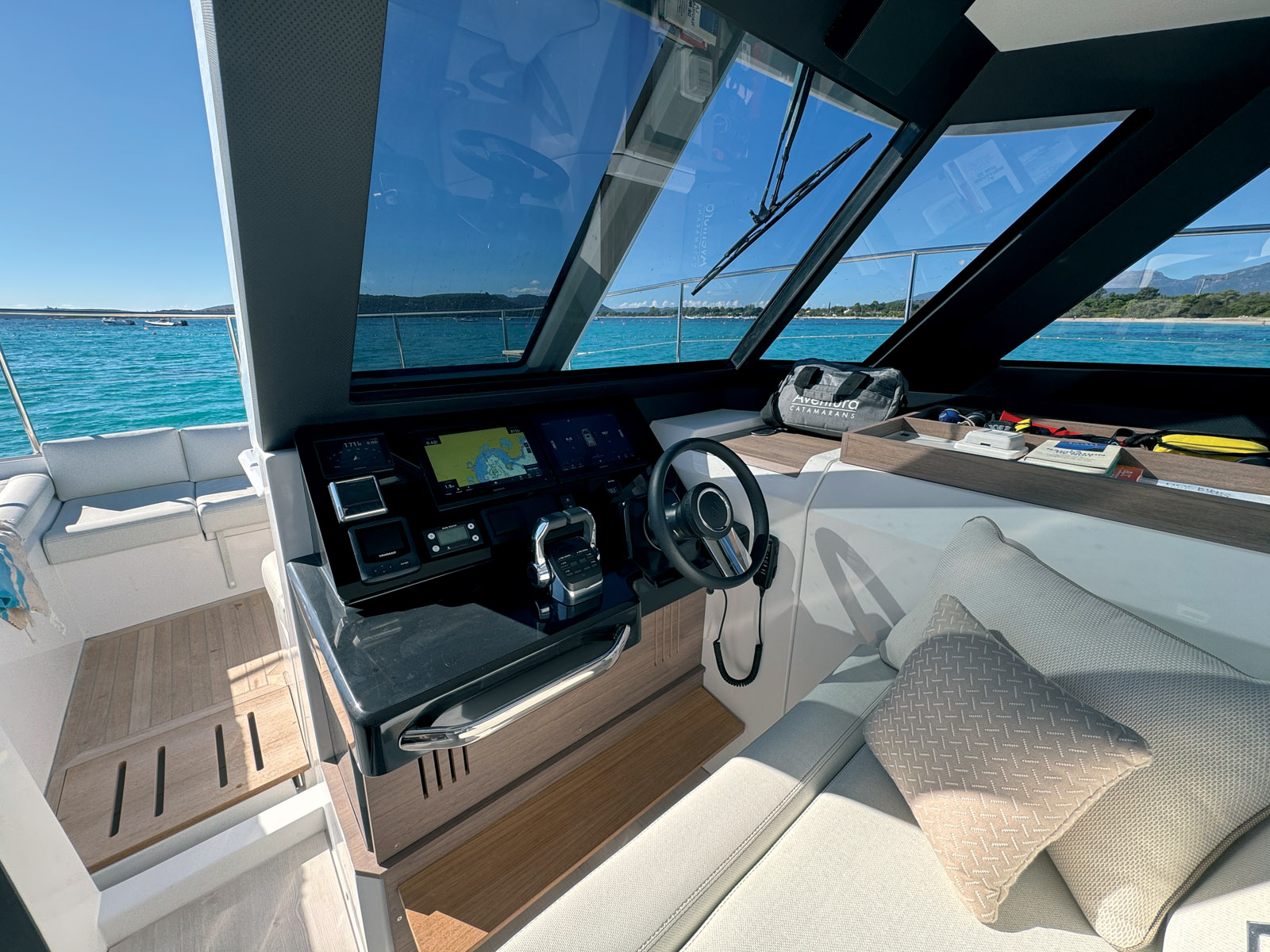
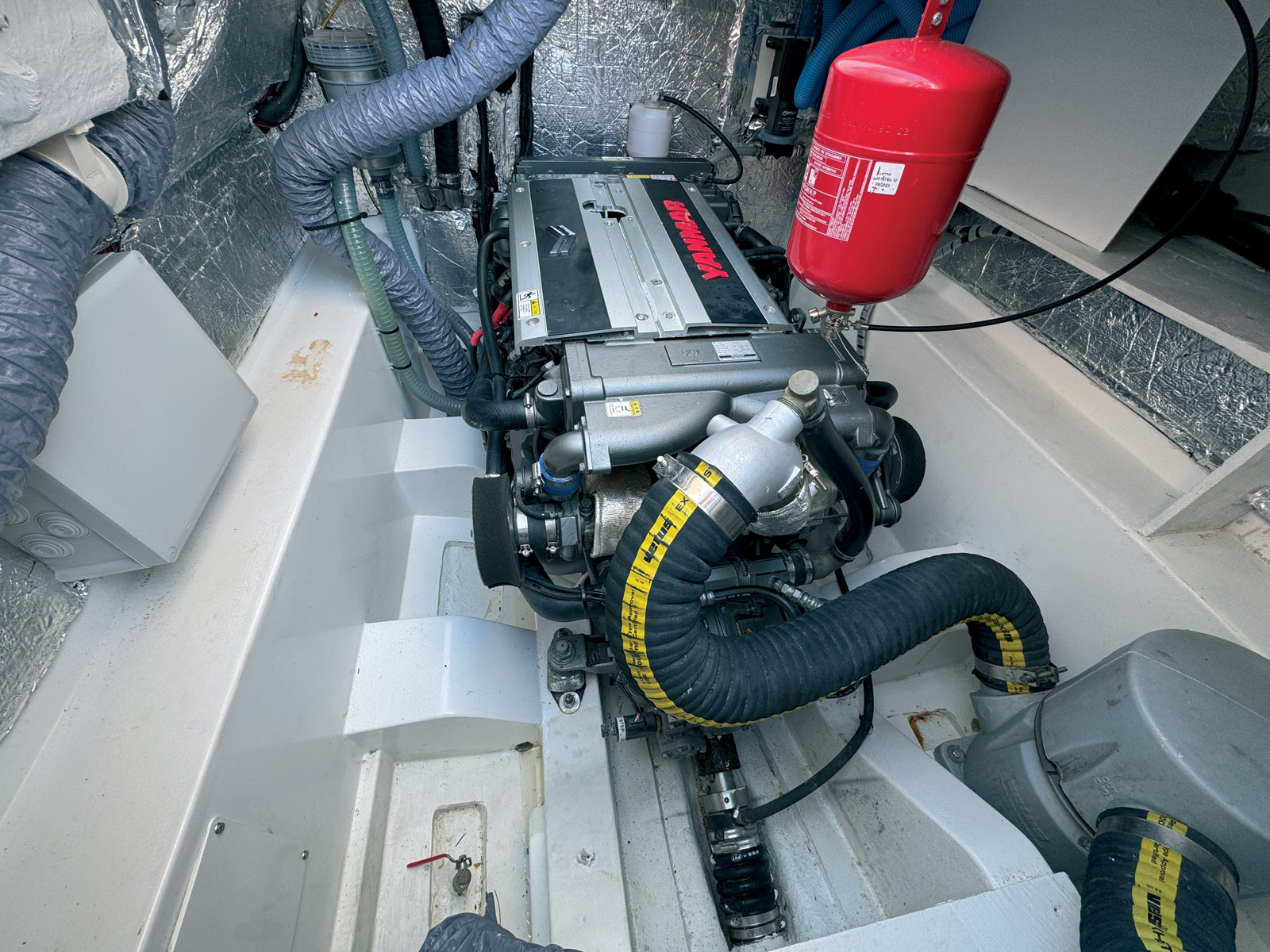
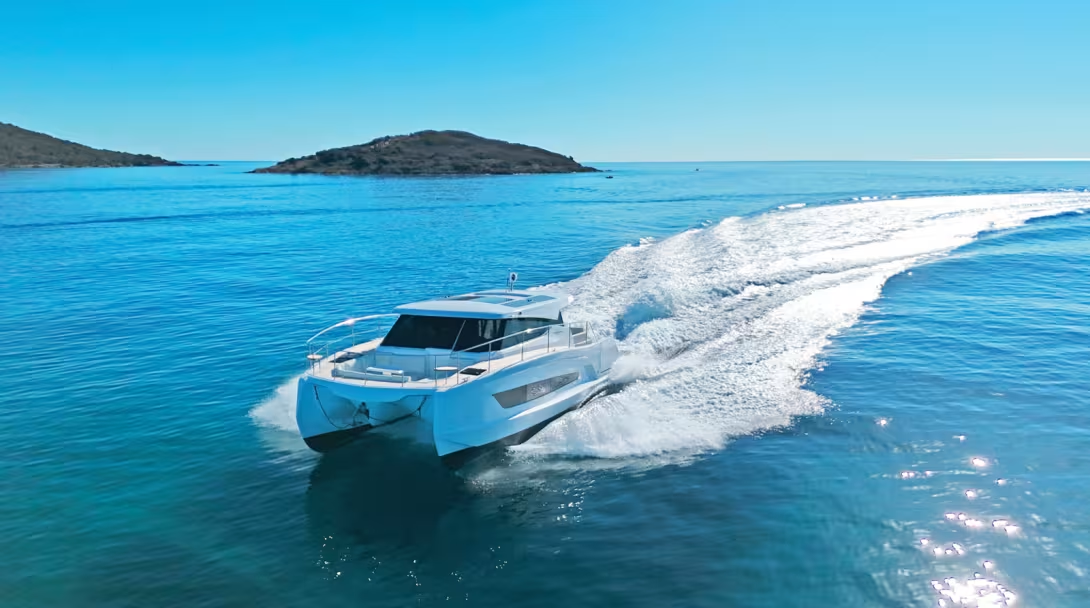
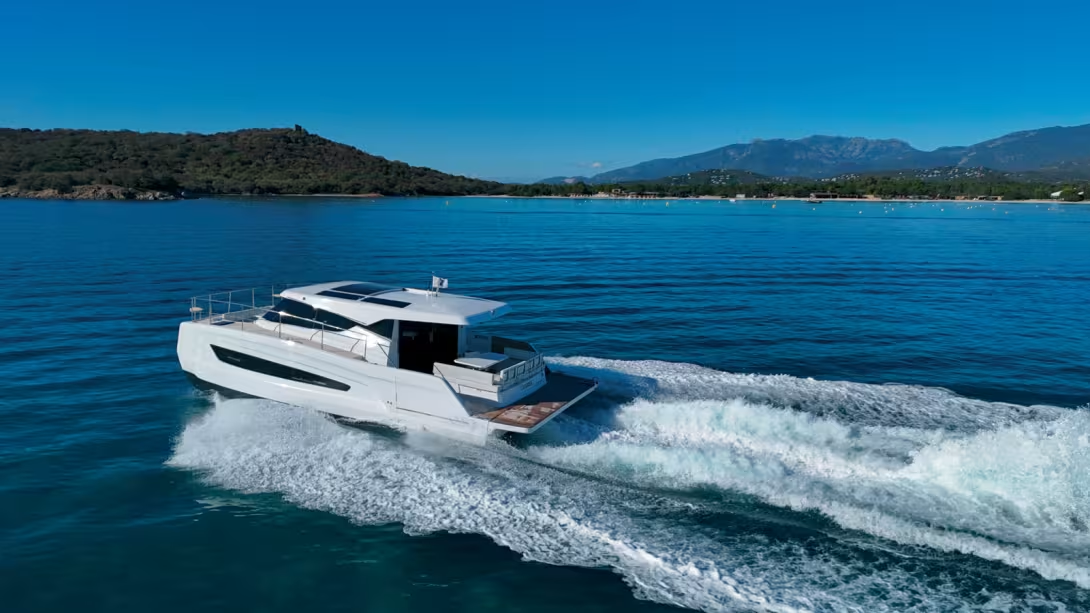
Porto Vecchio harbor is undergoing construction work, which makes the channel a little more winding than usual, but we quickly reached open water. Seen from the outside, the Aventura 38 Sedan reveals a stocky but pleasing silhouette with its angular bow, inverted deck sheer over the forward two-thirds, and well-integrated hull portholes. Above these windows, a recess in the molding in the central area of the topsides subtly corresponds (diagonally) to the chine at the bow. Above 2,000 rpm, the 370-HP motors are a little noisy if you leave the nacelle open. From the helm console, you’ve got good visibility of the water, though slightly less so if the forward door is open and salt spray gets in. The instruments are as modern as they are comprehensive, and the helm station is perfectly designed. The tunnel between the hulls is preceded by an imposing central rib, which has three functions: to stiffen the platform, to deflect waves, and thirdly, to house the anchor. The 38 planes at precisely 13.5 knots - Gaël Tannou was able to tell us all about the sea-keeping behavior of this powercat as he was the one who delivered it from Tunisia. A beautiful crossing of the Mediterranean completed in 20 hours at an average speed of 15 knots with just one refueling stop in Sardinia. In fact, the 14 to 16-knot mark is where the two 370-HP inboards offer the most interesting performance, at 10 to 12 US gal per hour (40/45 l/h) per engine - even if the range hardly exceeds 200 nm at an engine speed of 2,750 rpm. The “tunnel” effect between the hulls is already appreciable, easily dampening waves, chop and the wake of other boats. At the helm, handling is smooth and serene, even if making tight turns. It should be noted that the Aventura 38 is designed to be simple and accessible – there are no trim tabs, for example. When you push the throttle, you quickly reach 3,300 rpm and 20 knots. Comfort at sea remains excellent - the slender bows cut smoothly through the waves, while the double chine limits the effects of pitching and spray. In theory, the motors have another 400 rpm to offer, for reaching 25 knots, but the propellers on this first model seem unsuited to that – a classic problem with new boats. Access to these powerful engines (the range starts at 2 x 250 HP then 2 x 320 HP) is easy from the large aft locker lids. It should be noted that the shipyard can also offer twin outboard propulsion (up to 2 x 400 HP) or even dual electric propulsion.
After our speed, fuel consumption, and handling tests, we headed a little way north to Saint-Cyprien beach. There were only three or four boats anchored there, offering us crystal-clear water as far as the eye could see.
Sunroof and Forward Door
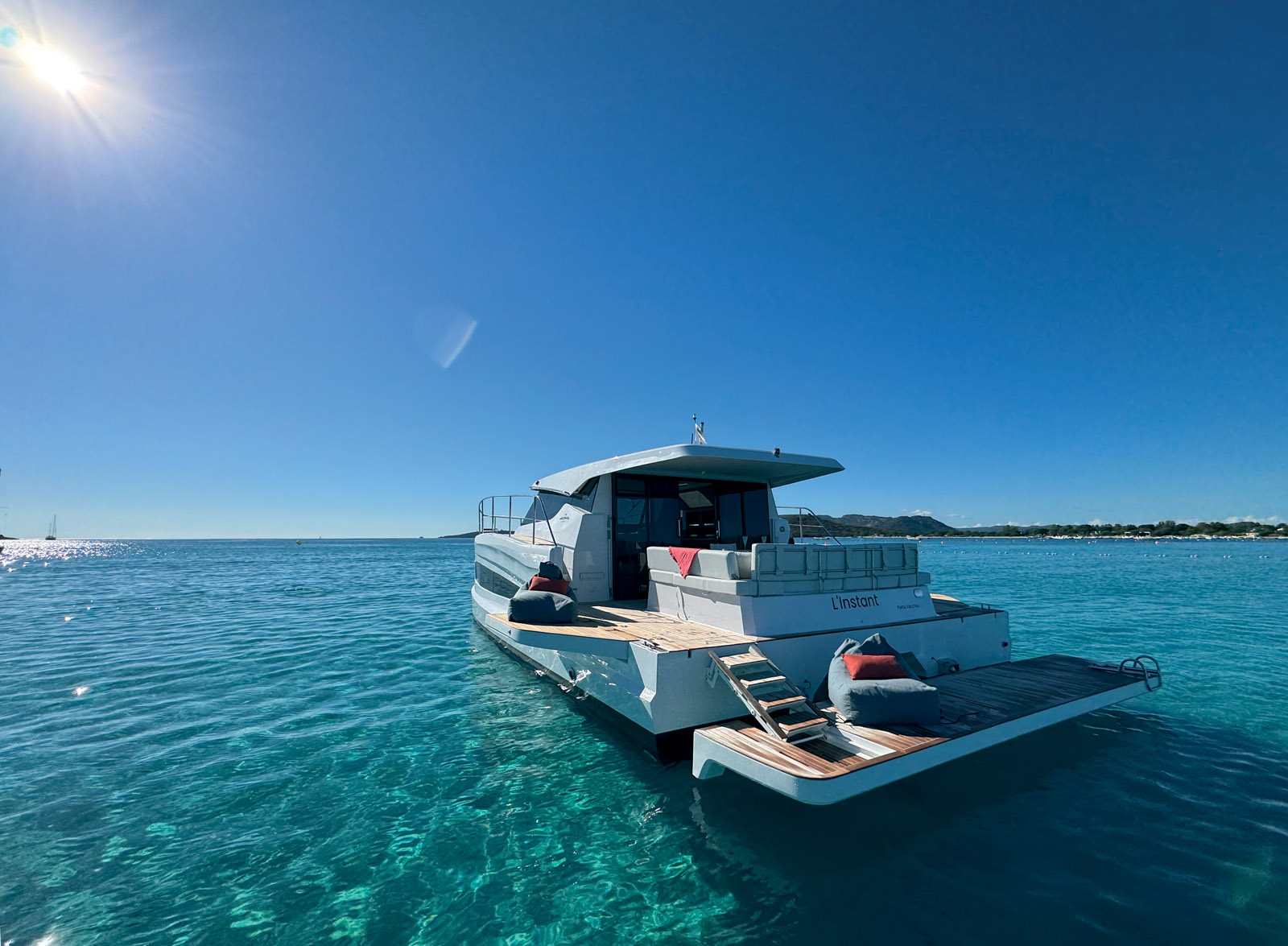
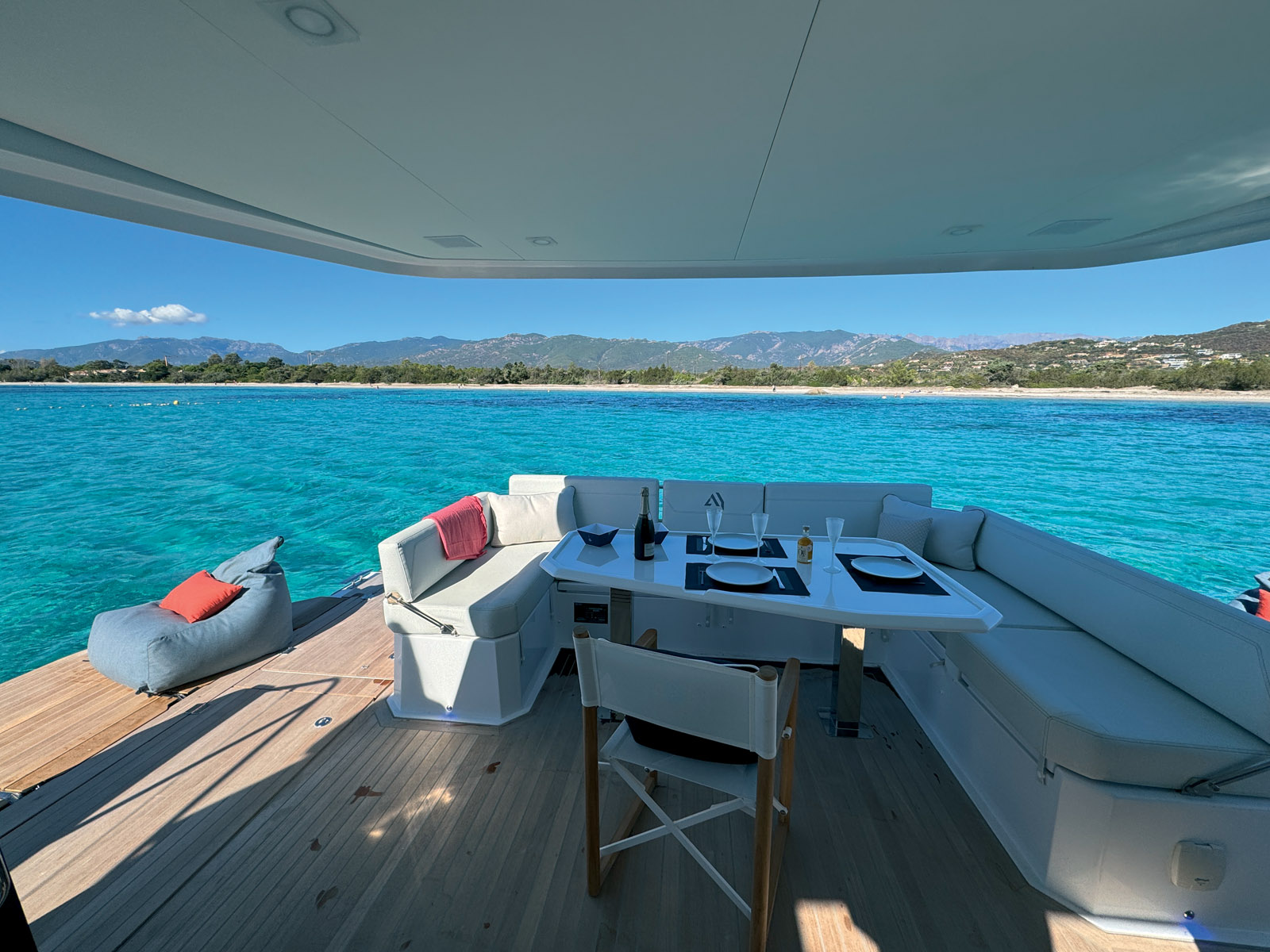
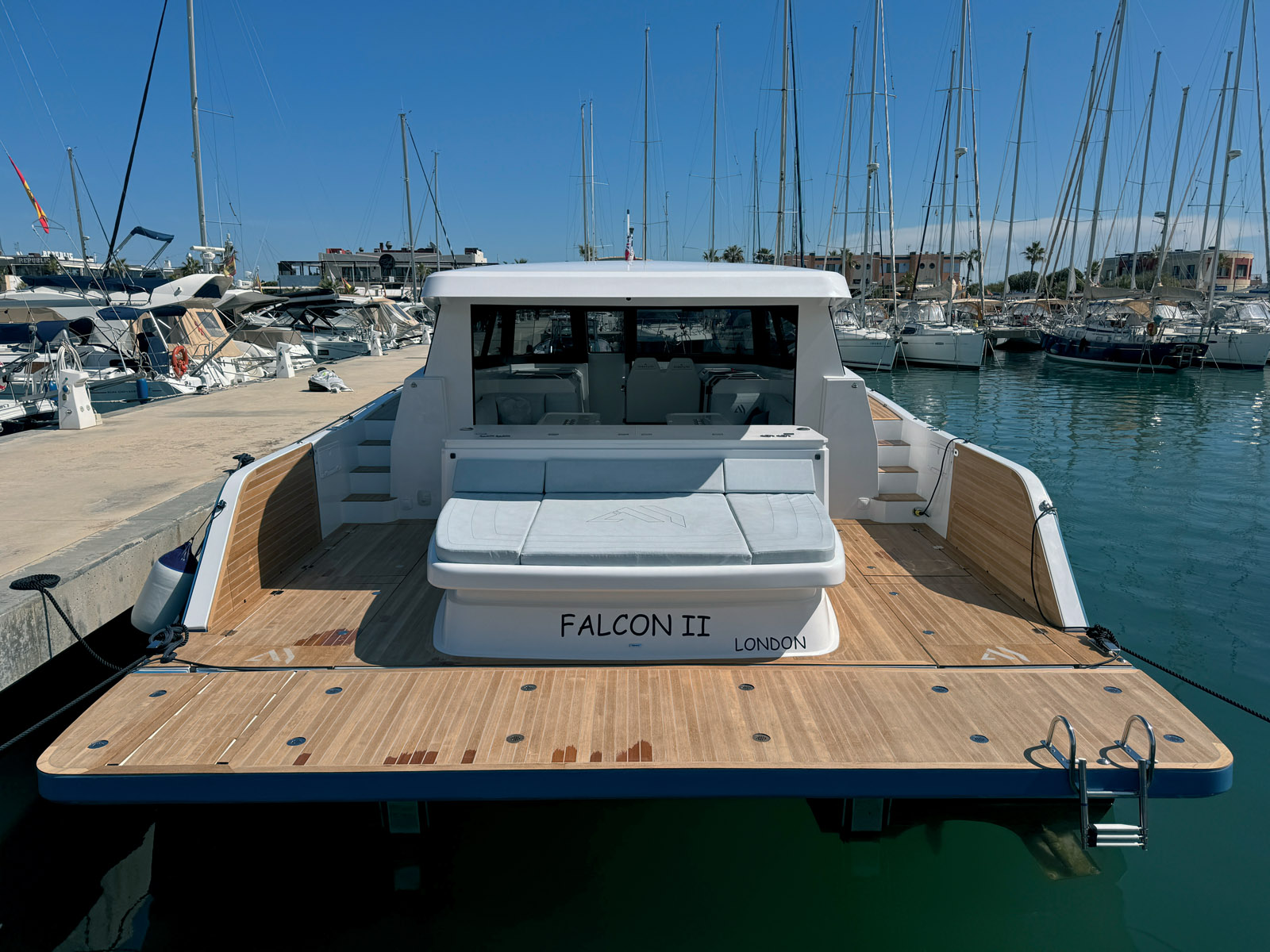
It’s time to start the owner’s tour, which is not me by the way... My first observation compared to the Sport Cruiser model I discovered back in April is that the large sun-lounger/galley module has been replaced here by a more traditional U-shaped bench seat, complemented by a table measuring 66 inches long by 32 wide (1.67 by 0.8 m) – as an average, because the table is slightly triangular. There is room to seat eight people here. On each side of the boat, the large fold-down bulwarks allow the cockpit to be increased in size when at anchor. This is operated by electric winches. As for the huge aft platform, this can be submerged on demand while remaining easy to access thanks to its integrated staircase.
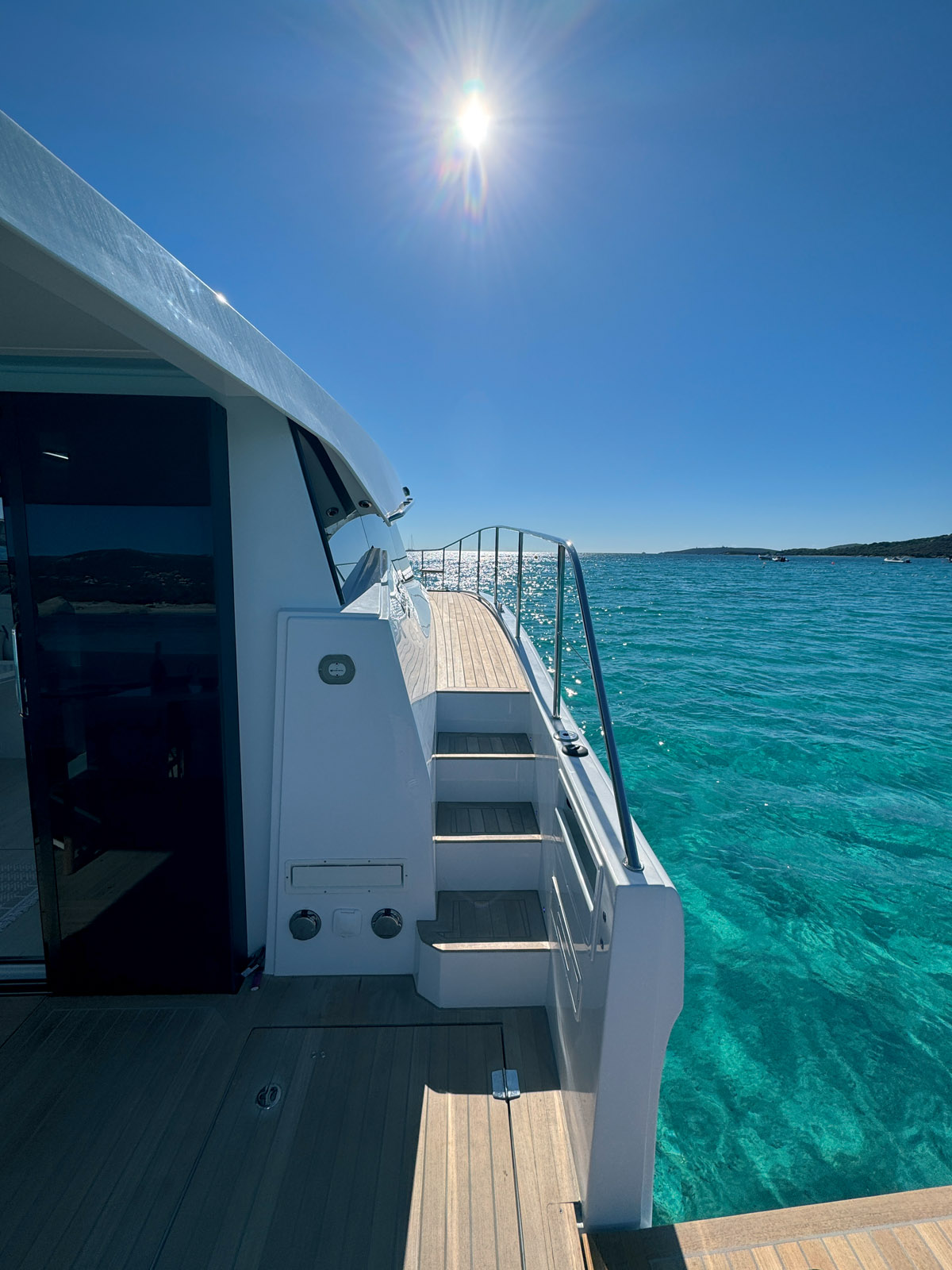
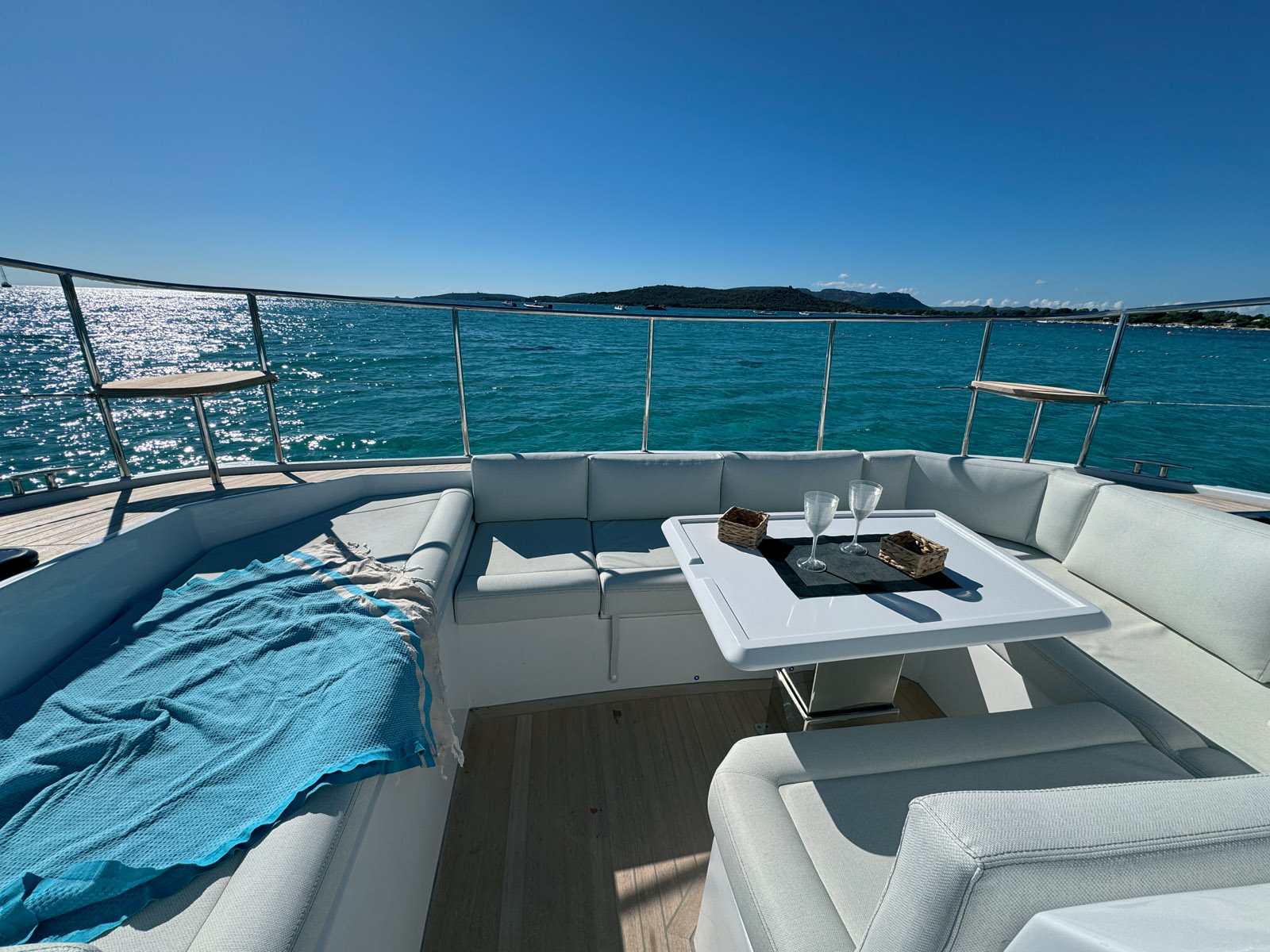
Contrary to the general trend observed on new sub-40-foot powercats with a central passageway, the architectural team at Lasta Design has stuck with proper side-decks. And although the access steps from the cockpit side only go up 15 inches (38 cm), you quickly gain 20 or even 24 inches (50 - 60 cm) as you move forward. I appreciated the well-placed handrail, which allows you to hold on tight if the sea is at all rough. On the coachroof, there’s obviously no flybridge on this version, but there are solar panels and, above all, an incredible 6’ by 3’ 9” (1.84 x1.14 m) electric sunroof. I timed Morgane as she used the remote control - in less than 15 seconds, it’s open or closed (but it is a bit noisy...). At the bow, the rigid deck accommodates a charming forward saloon with a 38” x 27½” (96 x 70 cm) table that can be converted into a sunbathing area. As for the anchor locker, it is pushed back into the central locker all the way forward.
2 or 3 Cabins
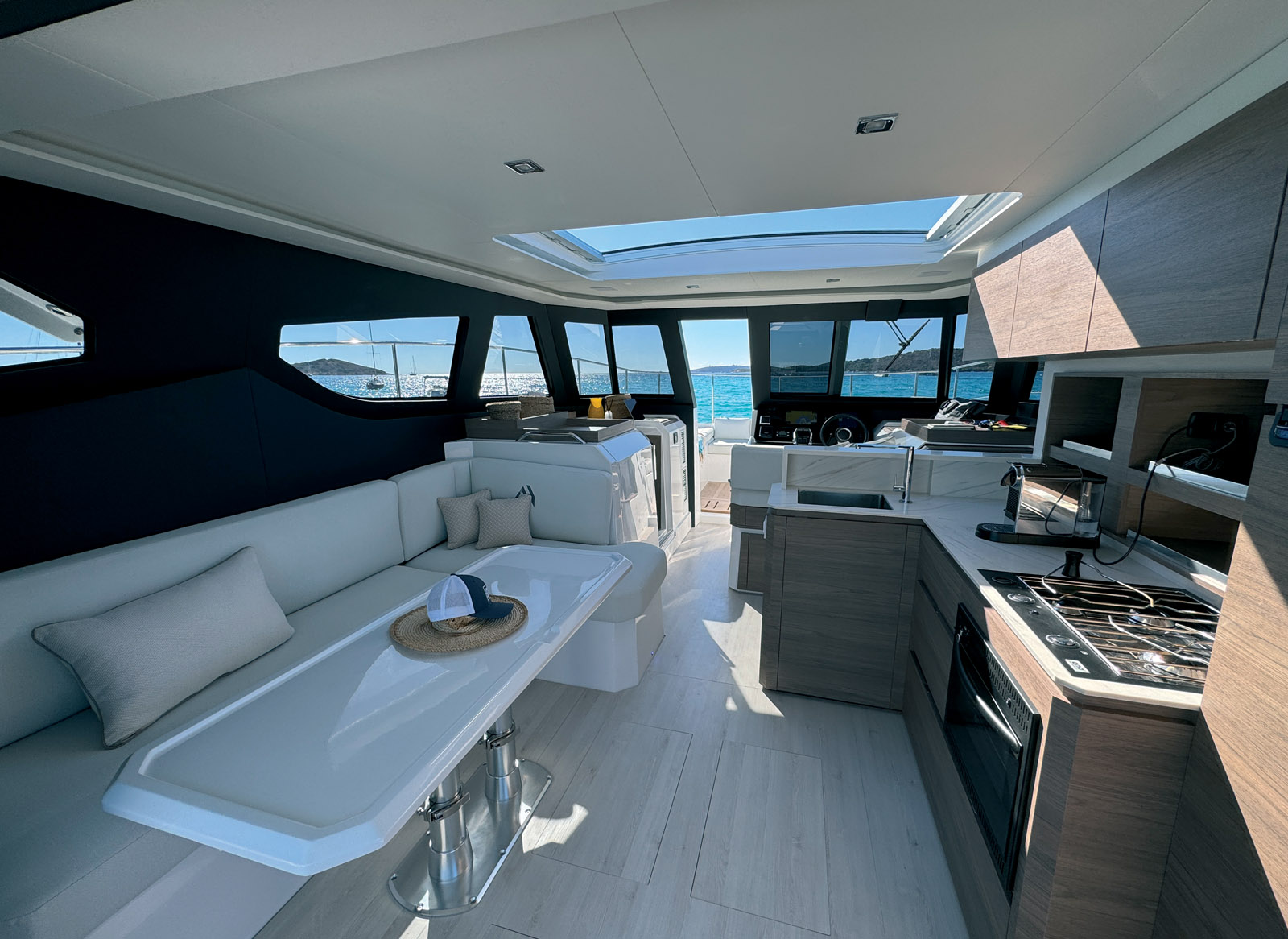
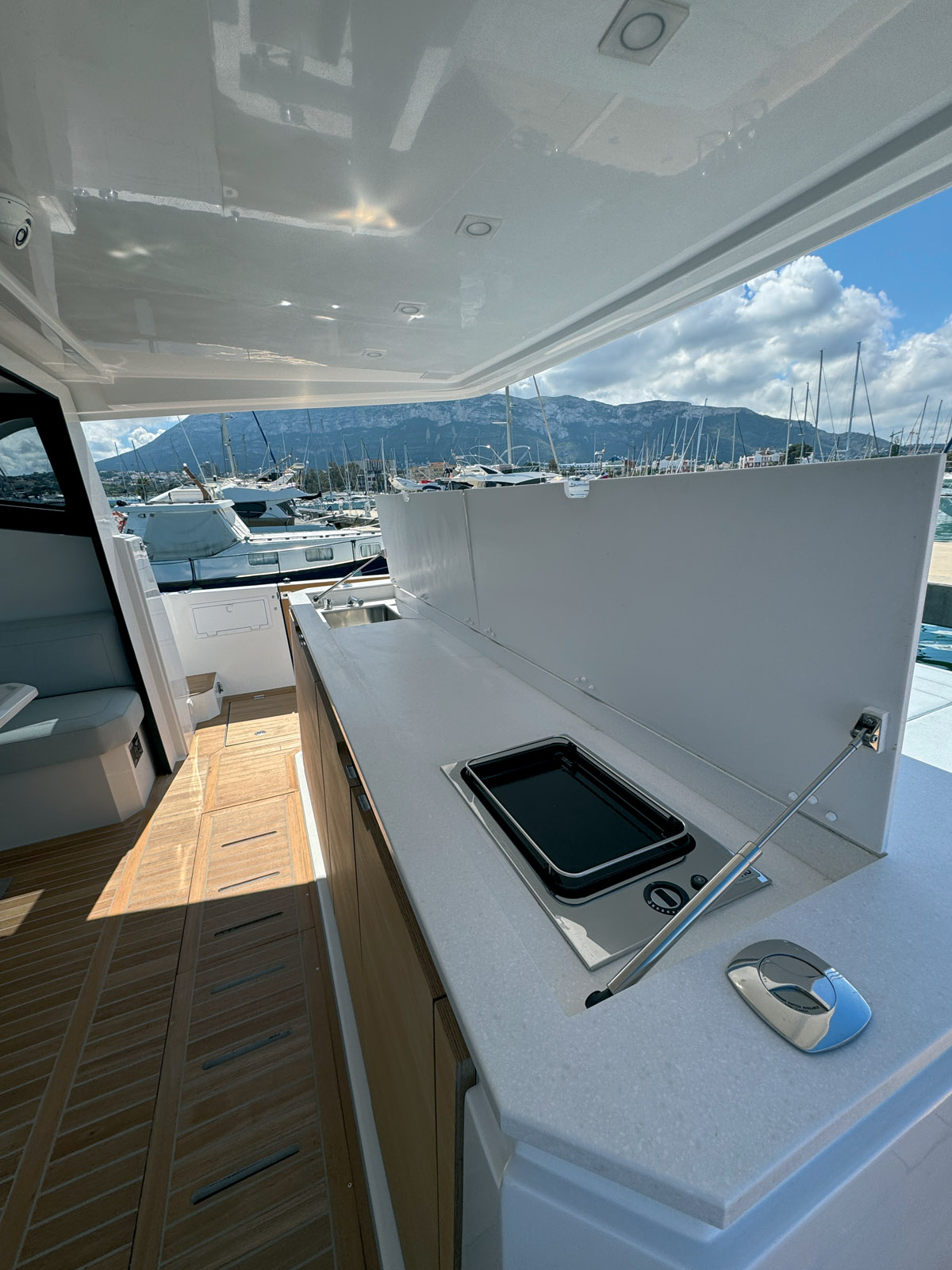
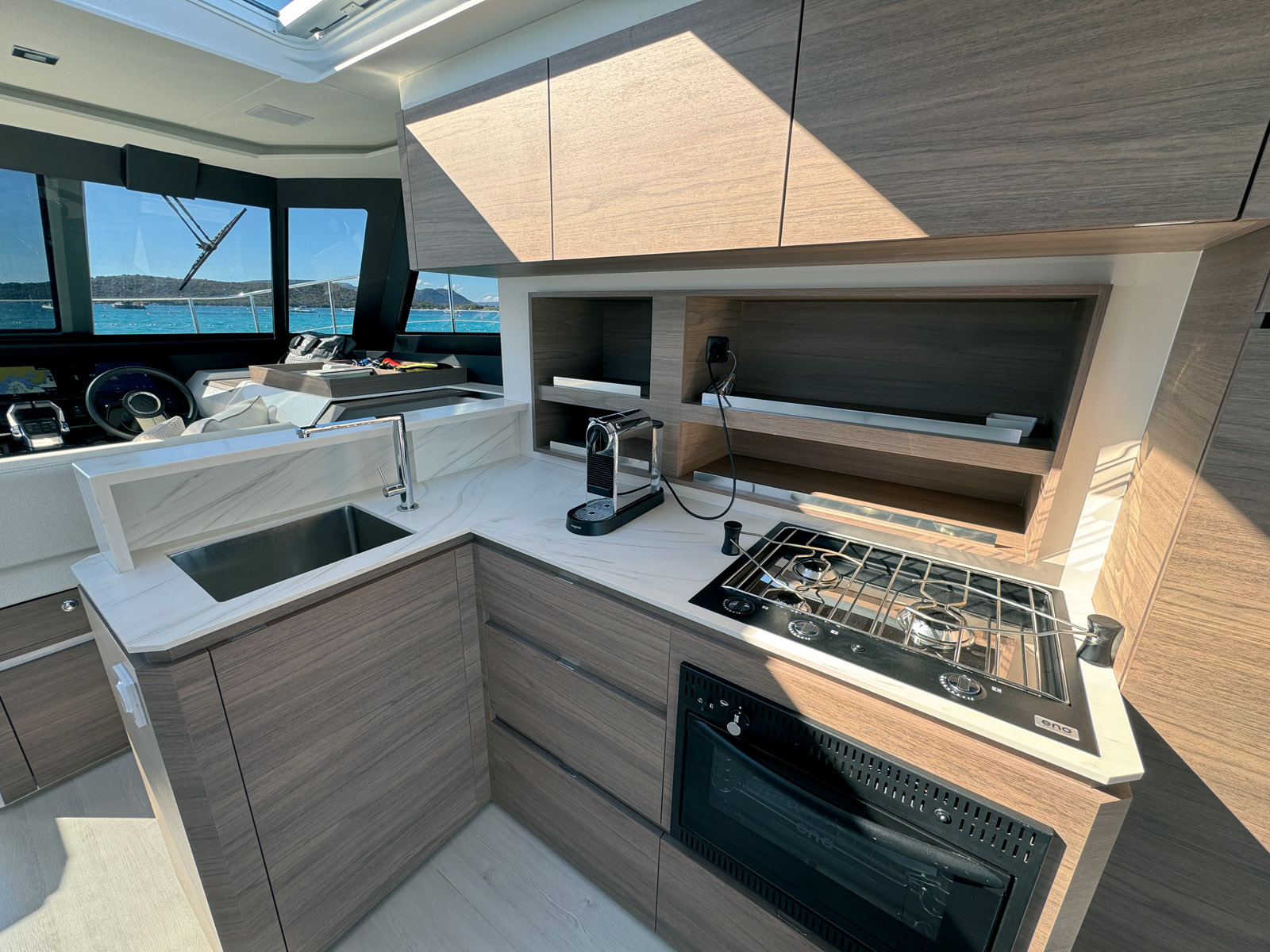
The cockpit features traditional access via a 6’2” (1.87 m) high by 5’9” (1.74 m) wide opening, but also via a forward door that opens in two sections (width = 18½”/47 cm), making it particularly easy and convenient to move around on board the Aventura 38 Sedan. Ventilation is also excellent - the three large openings obviously optimize air circulation, sometimes even a little too much, which may require the front door to be closed quickly. The maximum headroom is 6’7” (2.01 m). The finish is attractive; my only regret is that many of the furniture elements have very sharp corners, which can be dangerous in bigger seas. This is an easy detail to fix with some carpentry work. The after end of the cockpit features a beautiful saloon on the port side with a 61” x 26” (1.55 x 0.66 m) table; the benches can seat 5 to 6 people, and even more with a couple of extra stools. Opposite this, the shipyard has fitted out a large, fully equipped L-shaped galley, making this layout therefore very different from the SC version, which has two symmetrical tables. The cabins are accessed via two staircases (5 very wide steps) further forward. Sliding L-shaped doors provide privacy.
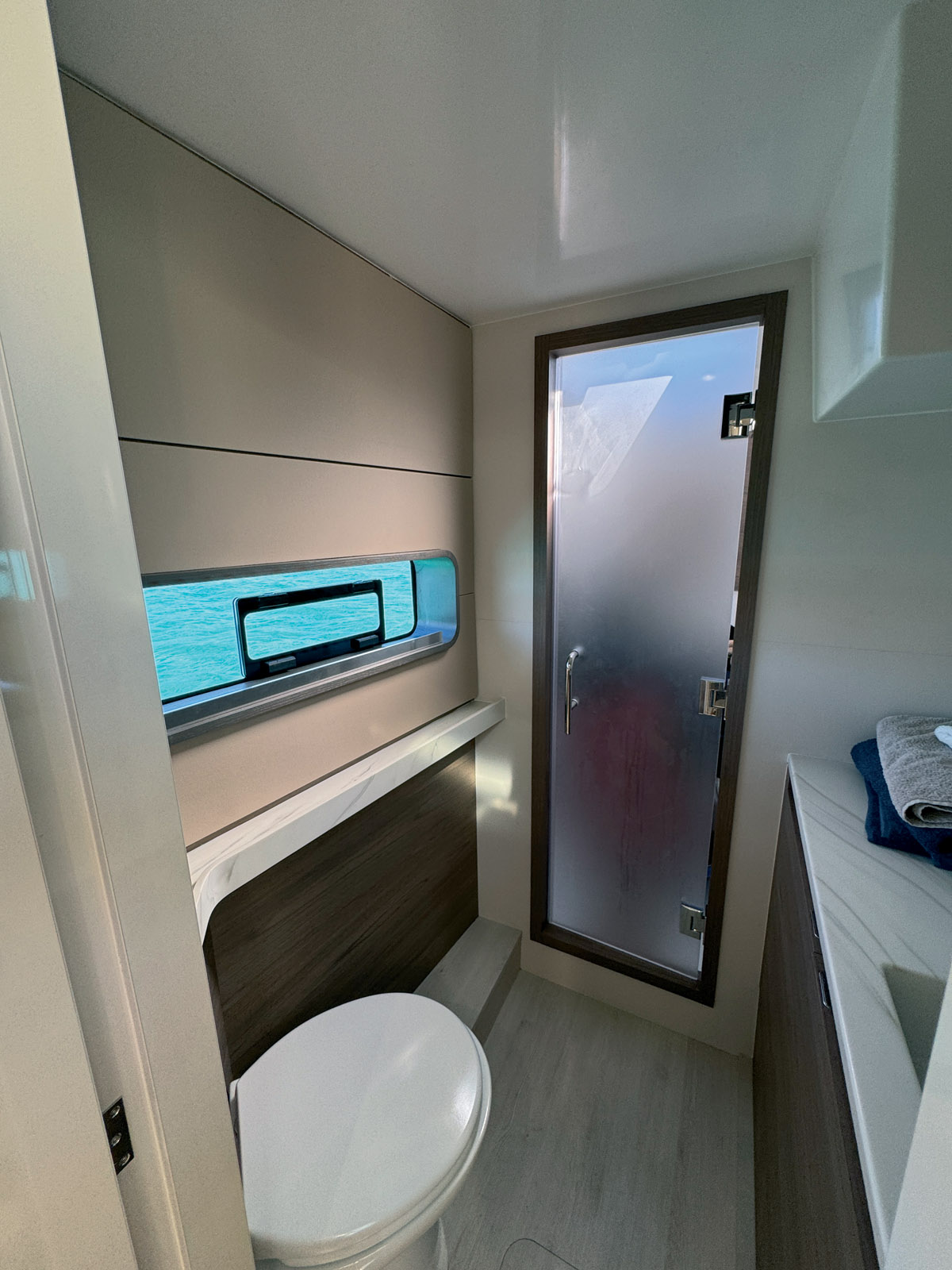
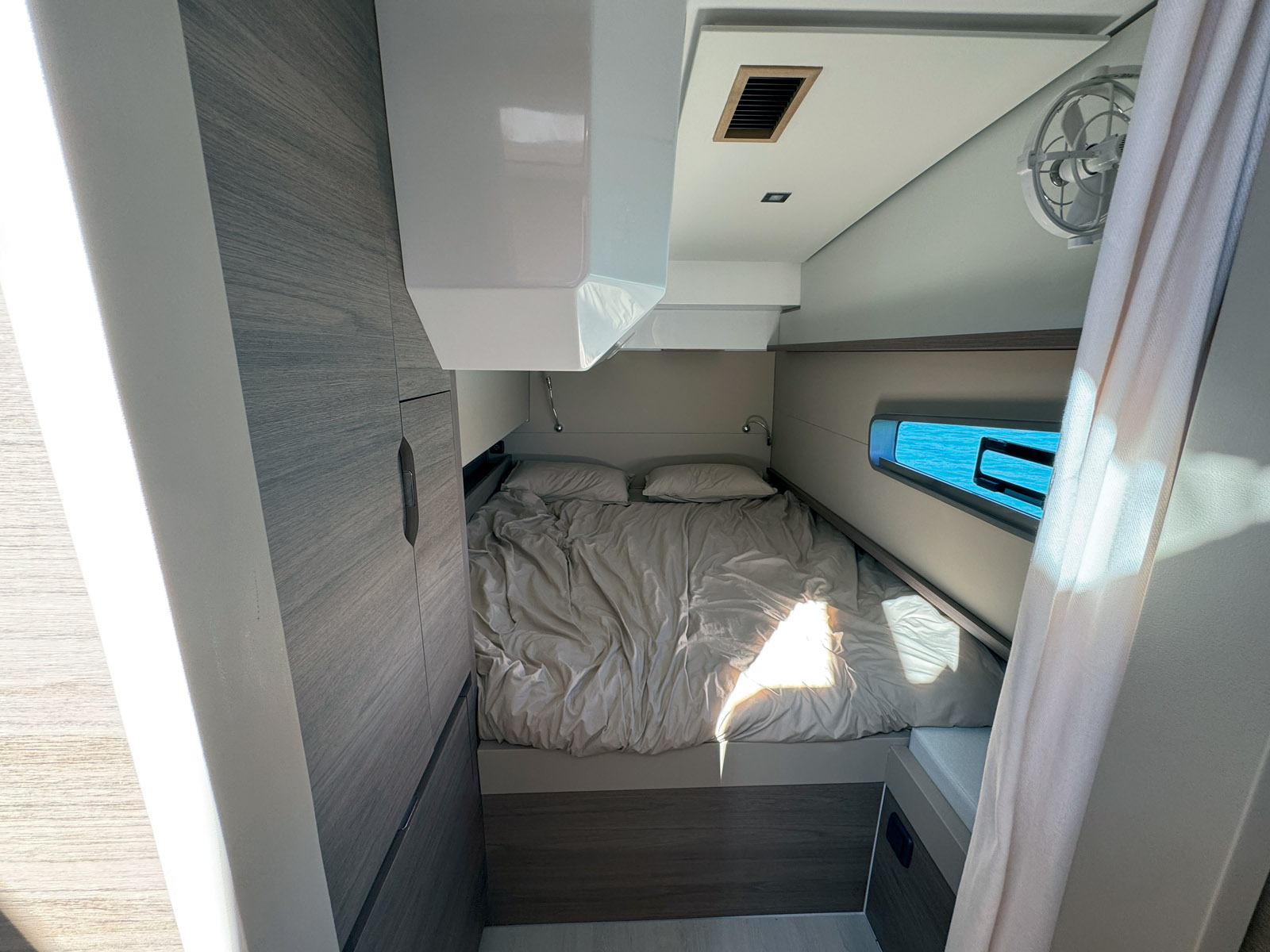
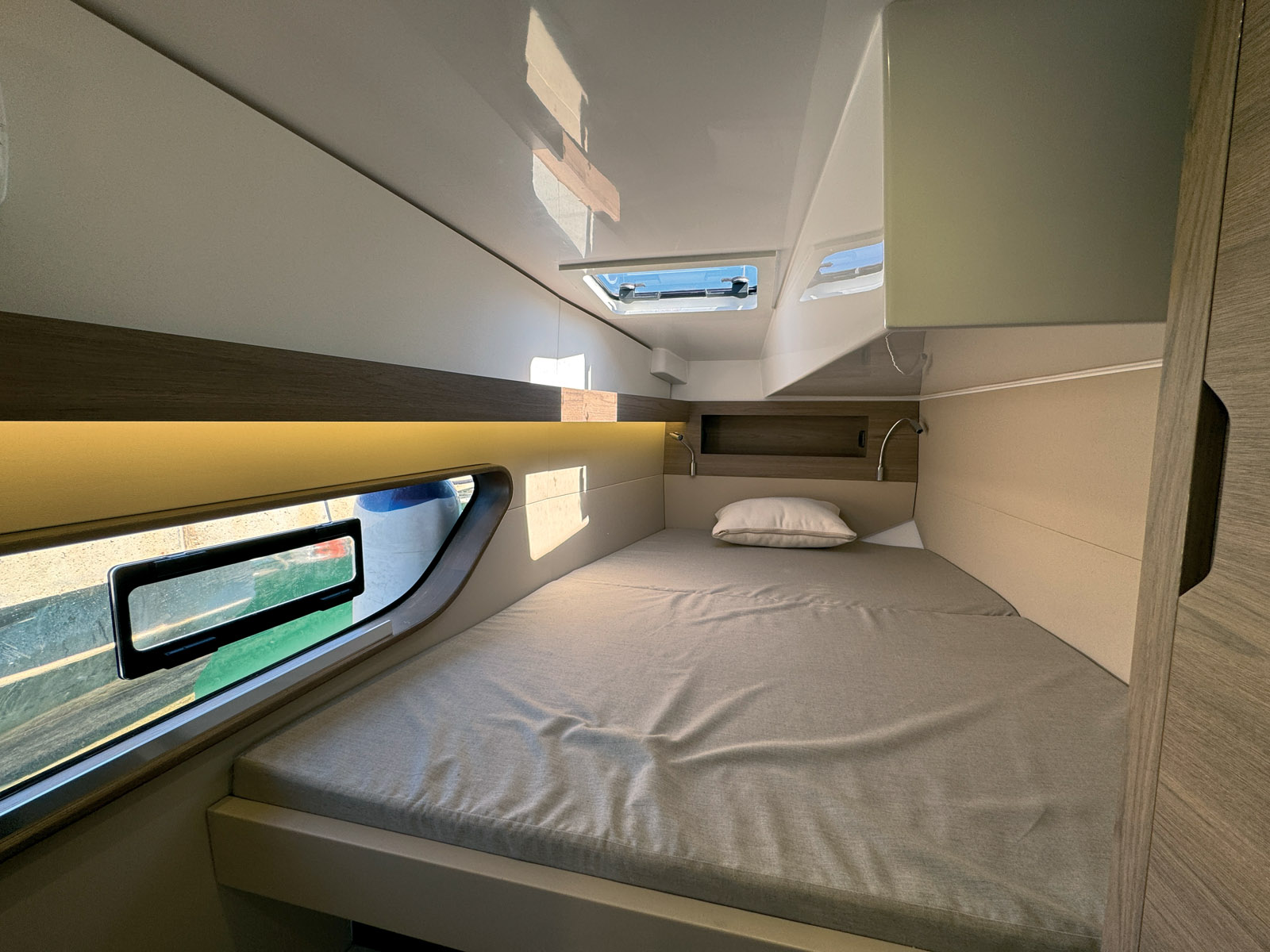
Aboard this example - hull #3 - the owner opted for just two cabins. The portside cabin is reserved for him, this one being further forward than its starboard counterpart and, above all, offering an additional closet in the middle, which was custom-made. Each cabin has generous headroom of 6’6” (1.97 m), large 79” x 63” (2.0 x 1.6 m) beds, unobstructed sea views, and a large bathroom at the front. The 3-cabin version redistributes the space with the owner’s area to starboard, but without the aforementioned closet. The port hull houses two cabins either side of a smaller central bathroom.
Conclusion
So, already three versions in three hulls, not to mention the different powertrain options available! The first Aventura 38 was a Sport Cruiser, followed by a Flybridge model and then a Sedan... The Sport version will have a single windshield to transform it into a true convertible of the seas. Still, we can’t blame the folks at Aventura for wanting to put this hull #3 in the spotlight: the Sedan we discovered in Southern Corsica is definitely more versatile than the SC. On board, comfort and enjoyment for day cruising are guaranteed, but you could easily envisage sailing from cove to cove during the summer or cruising the warm, turquoise waters of the Bahamas...
Good seakeeping
Very attractive unit for coastal cruising... but not only!
Engines a little noisy when the nacelle is open
Many sharp angles in the interior
Technical Specifications
Length overall: 39’2” (11.95 m)
Waterline length: 34’ (10.36 m)
Beam: 18’6” (5.63 m)
Draft: 3’1” (0.94 m)
Light displacement: 21,600 lbs (9.8 t)
Powertrain: 2 x 250/320/370 HP inboards or up to 2 x 400 HP outboards or hybrid
Fuel: 315 US gal (1,200 l)
Water: 105 US gal (400 l)
Cabins: 2 or 3
CE Certification: B10/C18/D24
Price: from € 495,000 ex-tax