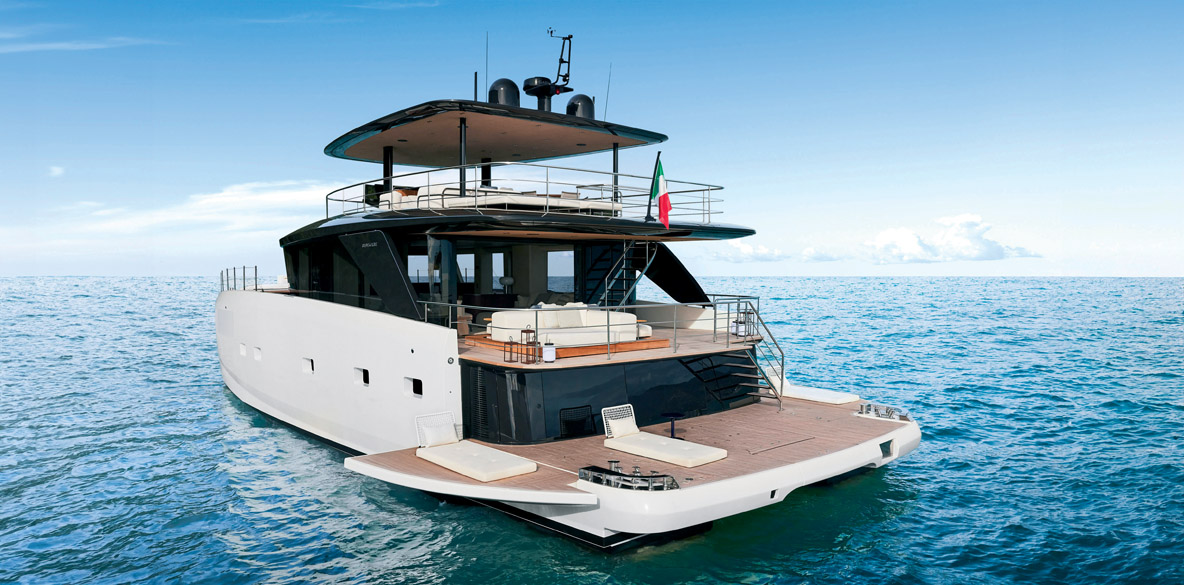
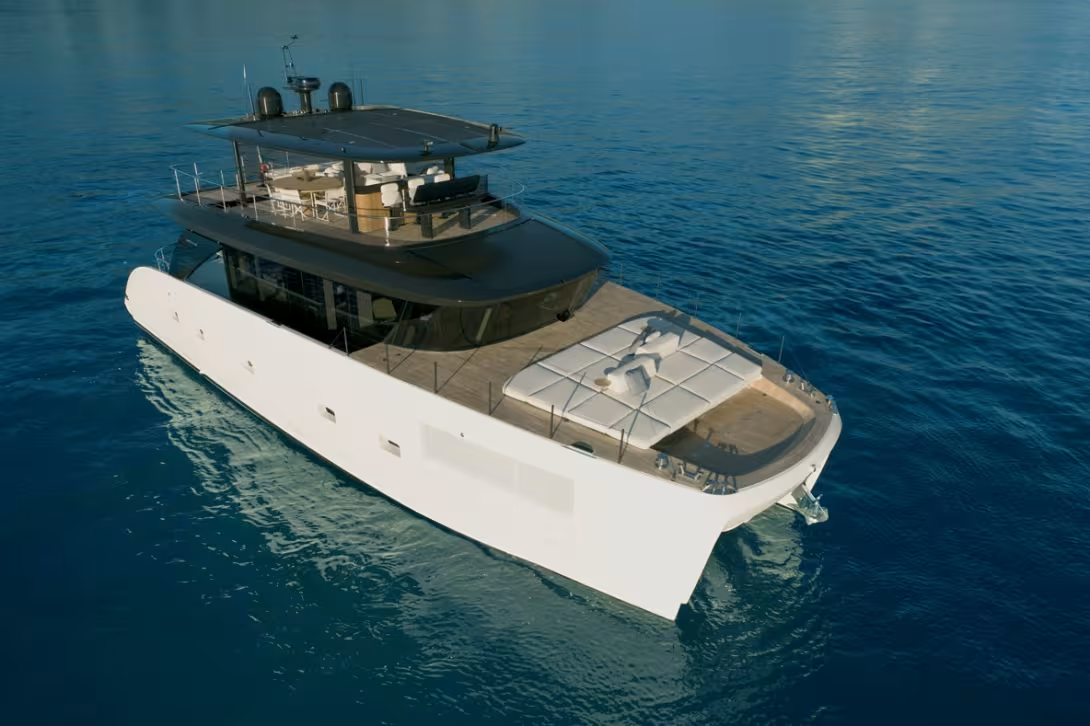
With the launch of a luxury motor catamaran under the banner of its innovative Bluegame range, the Italian brand Sanlorenzo has made a remarkable entry into the world of multiyachts. Aimed at lovers of the sea and of aesthetics, the all-new BGM 75, which we were able to discover back in September at the Cannes Yachting Festival, offers interesting alternatives that have clearly been developed with the aim of not disorientating its motoryacht clientele, who are still very attached to the idea of a monohull.
Infos pratiques
- Le chantier : BGM75
- La fiche technique
-
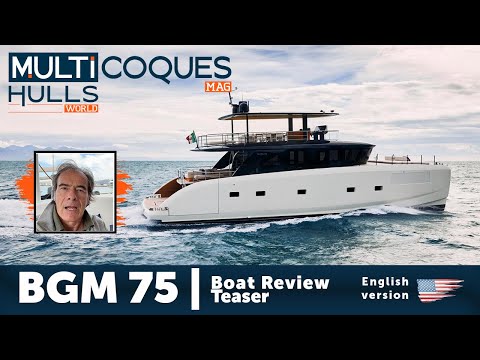 Découvrez notre vidéo exclusive
- Financez votre BGM75
- Assuez votre BGM75
- Articles autour du BGM75
Conditions: 2 to 4 knots of wind, flat calm sea
Known in the world of luxury yachting for 60 years for its high-end yachts, Sanlorenzo has been at the forefront of the industry for the past decade, with a number of models that are very much in vogue. Carried along by favorable winds, the iconic builder has decided to integrate the Bluegame brand, founded in 2004 by architect and designer Luca Santella. The task has been entrusted to Carla Demaria, who joined the Italian group in late 2018 after spending 10 years at the helm of the Monte Carlo Yachts brand, which is part of Groupe Bénéteau. Luca’s passion and creative spirit are full-on, so development opportunities are emerging rapidly. Bluegame cultivates the difference: its slogan “For Bluegamers Only” emphasizes that its yachts are not for everyone. This determination to offer alternatives, beyond the mainstream, has resulted in some of the most innovative designs of recent times, such as the BG74’s revolutionary aft-facing owner’s cabin and the BGX65’s indoor/outdoor beach club. But the new Bluegame we discovered on the French Riviera is undoubtedly Luca’s boldest achievement to date. The BGM75’s specifications called for a slightly wider beam than that of a traditional monohull, allowing for greater habitability and better stability. The catamaran formula was a natural choice, especially as it offers substantial fuel savings... but there was no question of abandoning the “classic” elegance of monohulls (which are still the preferred choice of 90% of the brand’s customers) by imposing rectangular lines. The challenge was also about avoiding excessive marina charges and not imposing narrow cabins in the hulls.
Developed Down to the Millimeter
Before launching the first BGM75, three years of research and considerable investment were required. A dream team was quickly put in place: Philippe Briand for naval architecture, Bernardo Zucon for above-waterline design and Piero Lissoni for interior design. The objective was to dare to set up an innovative project - and of course in keeping with the spirit of Bluegame - a brand created for lovers of the sea that clearly stakes its hedonistic goals. In a way, the operation involved cutting a monohull in half and widening it, but not too much. In fact, a study carried out by the shipyard shows that with its 8’9” (8.15 m) beam, the BGM75 claims a berth similar to that of a ninety-to-one-hundred-foot (27 to 30 m) motoryacht - a size that corresponds to the habitability offered by the 75. On the other hand, if they’d widened it beyond 33 feet (10 meters), we’d be in the ballpark of a 200-plus foot (65 m) superyacht - a completely different category in terms of luxury, but above all in terms of the availability and price of dock space. As the architect points out, the length/beam ratio chosen for the BGM75 favors the angle at which the bow waves meet in the central tunnel. The result is less resistance to forward motion, and this can have an impact on stability, but we’ll come back to that later. This one-piece concept has already been implemented, notably by Aquila, in the field of purely series production units. Here, the addition of a prominent V-shaped rostrum, which almost forms a third hull in the center of the nacelle, is designed to improve wave dissipation in bigger swell. The freeboard has also been significantly increased in height, justifying three complementary objectives: firstly, to sufficiently increase the bridgedeck clearance; secondly, to allow for a level main deck including the saloon, in the style of the big motoryachts; and finally, to allow for height inside the nacelle, between the hull and the deck. In terms of layout, it was imperative to integrate a full-width, single-story owner’s cabin forward, to offer space in front of the beds in the hull cabins, and to have a garage able to accommodate a 16-foot (5 m) RIB tender as well as plenty of nautical toys. All the essential attributes for the target clientele..
Style, Always Style...
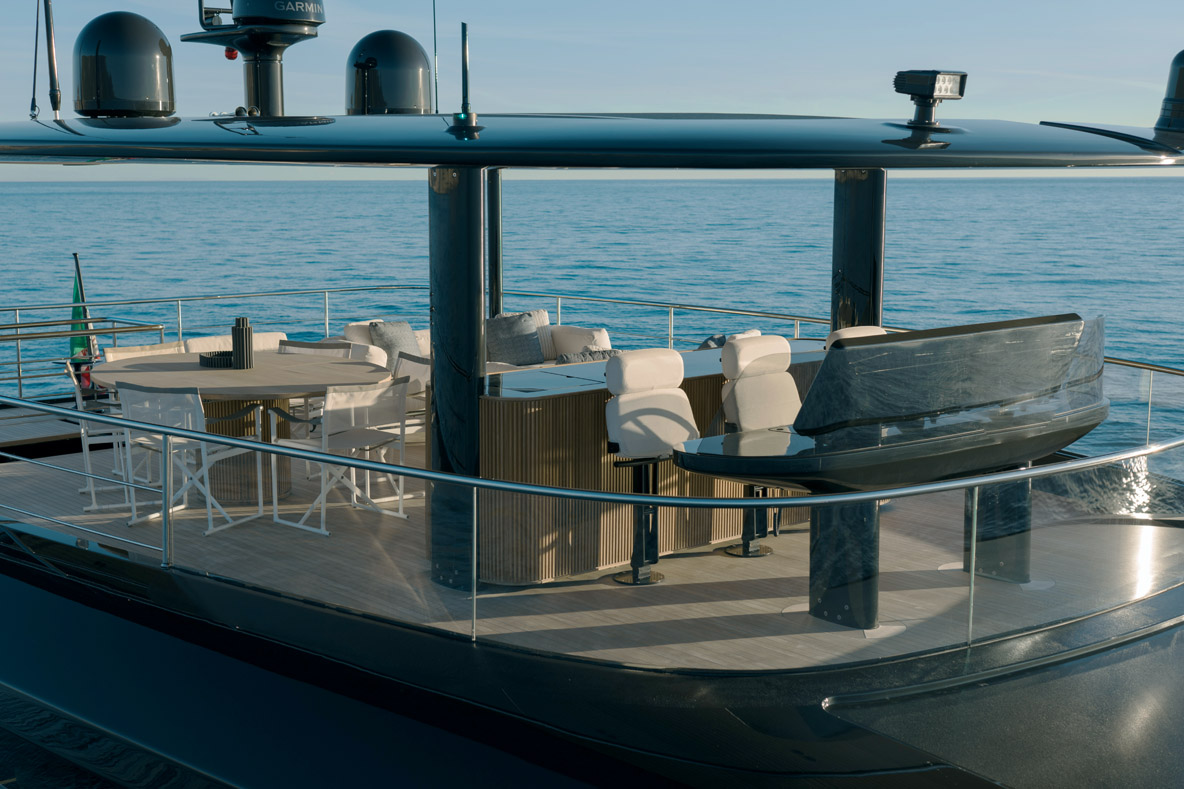
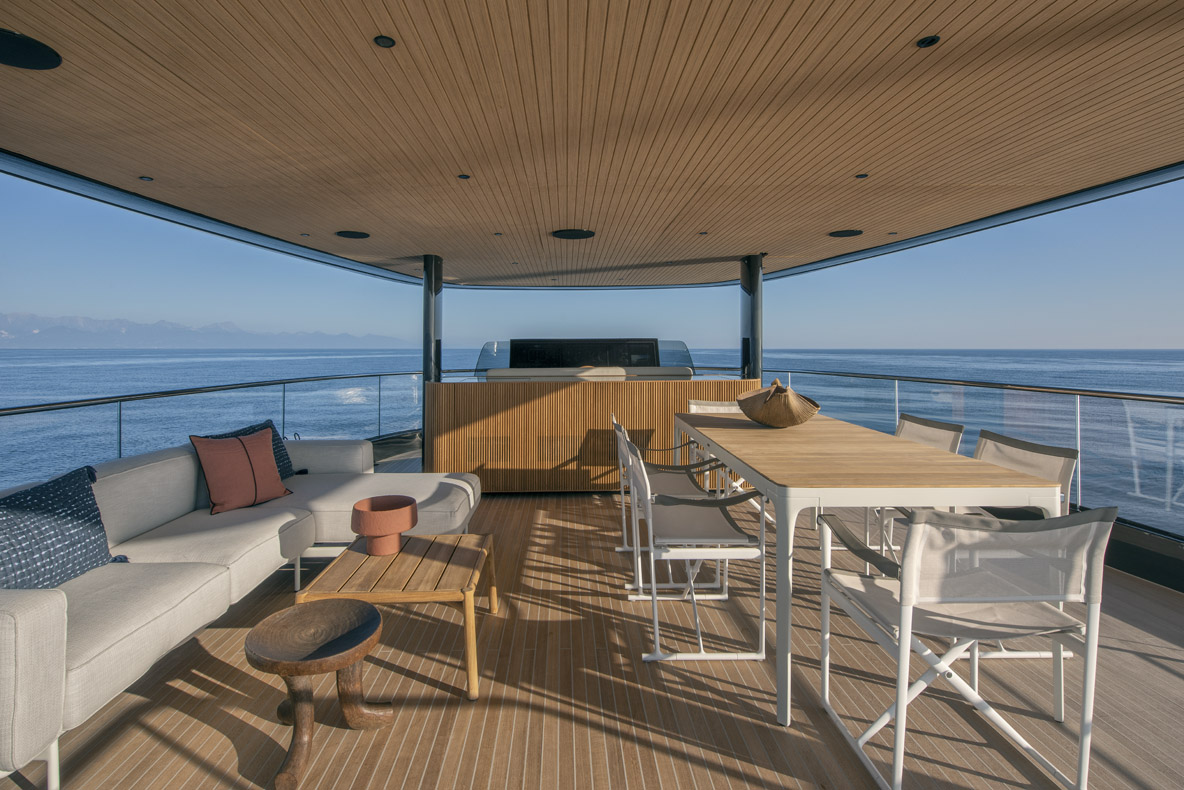
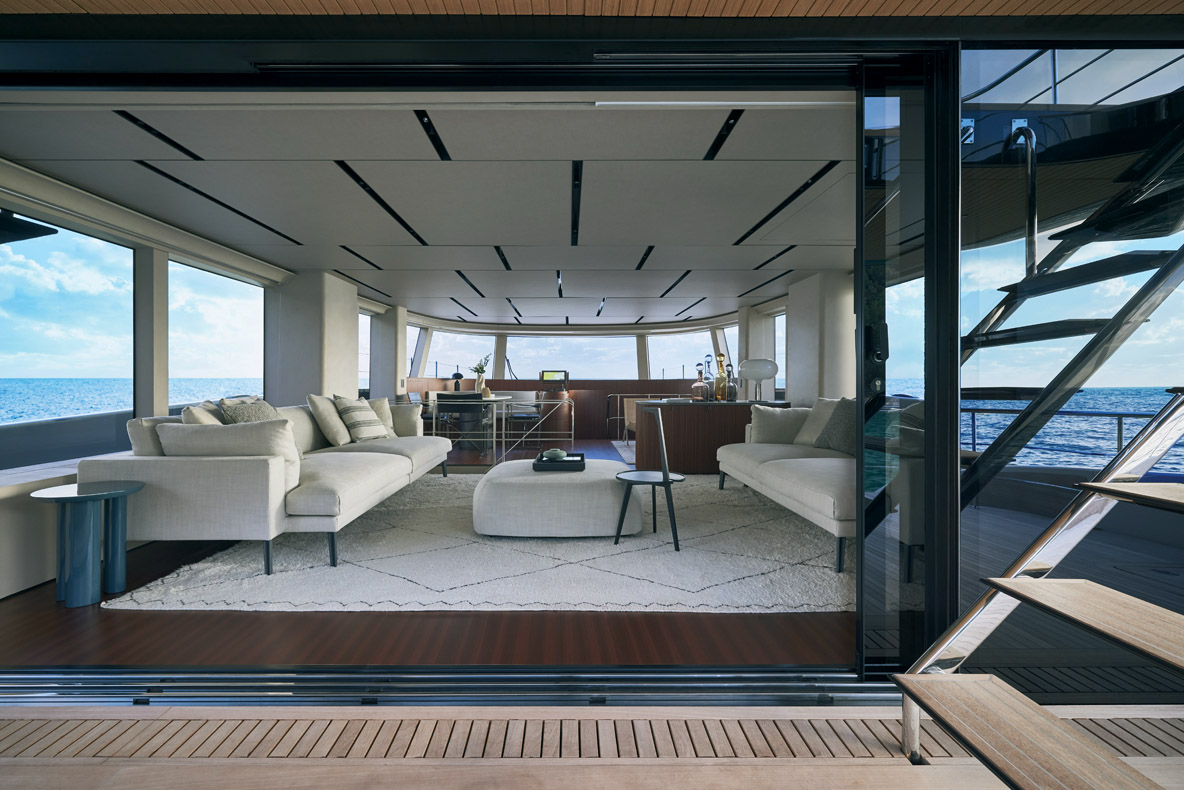
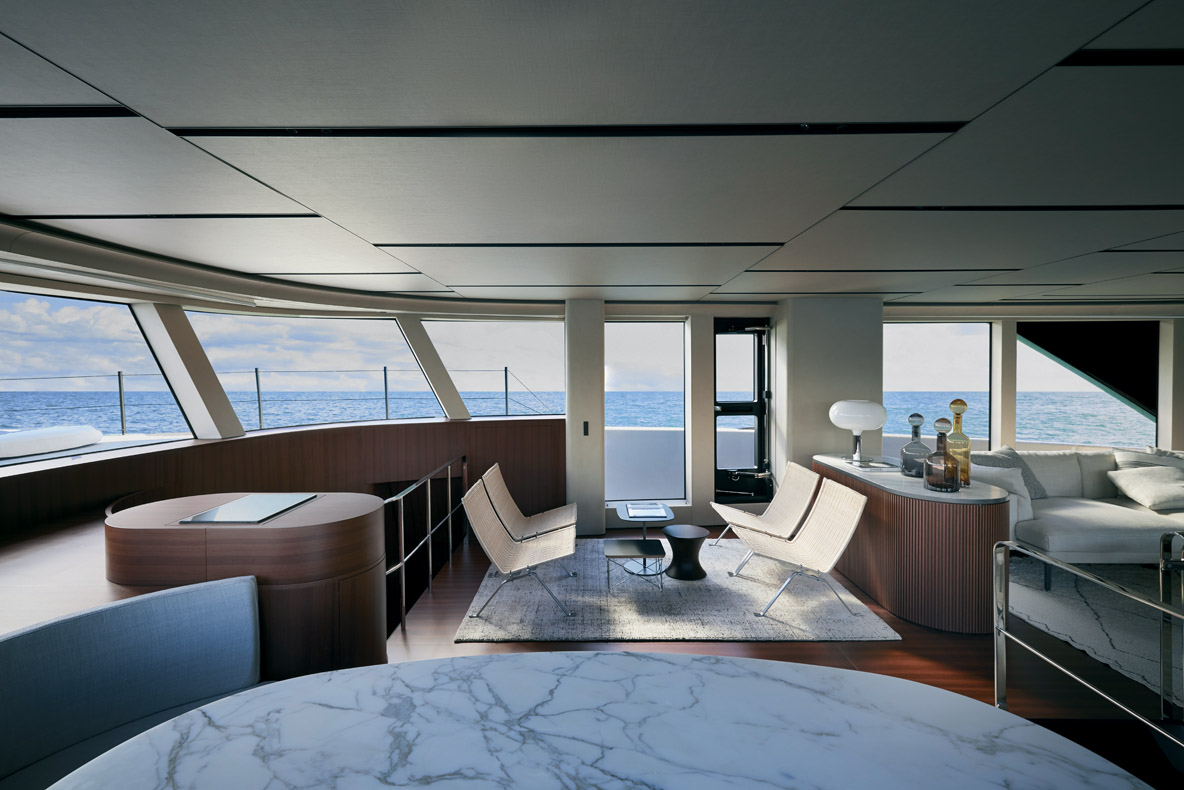
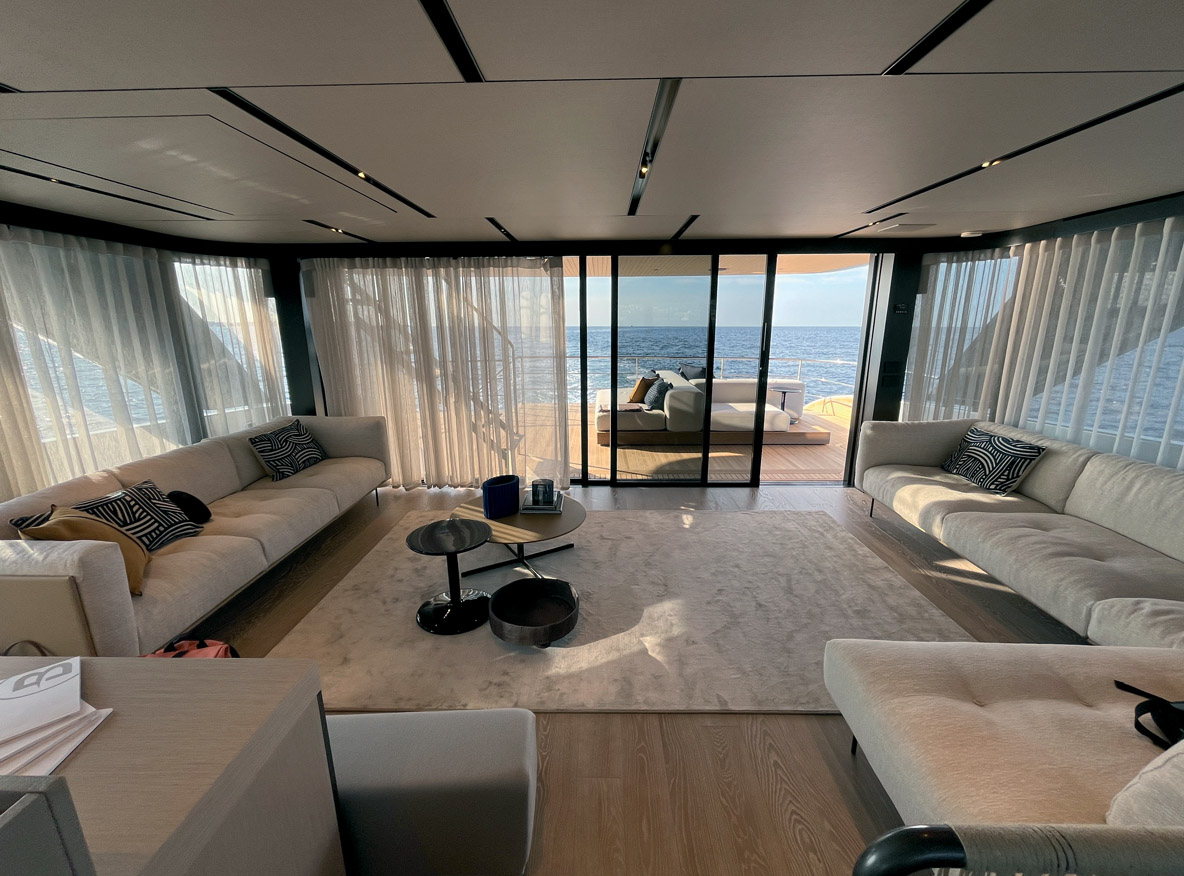
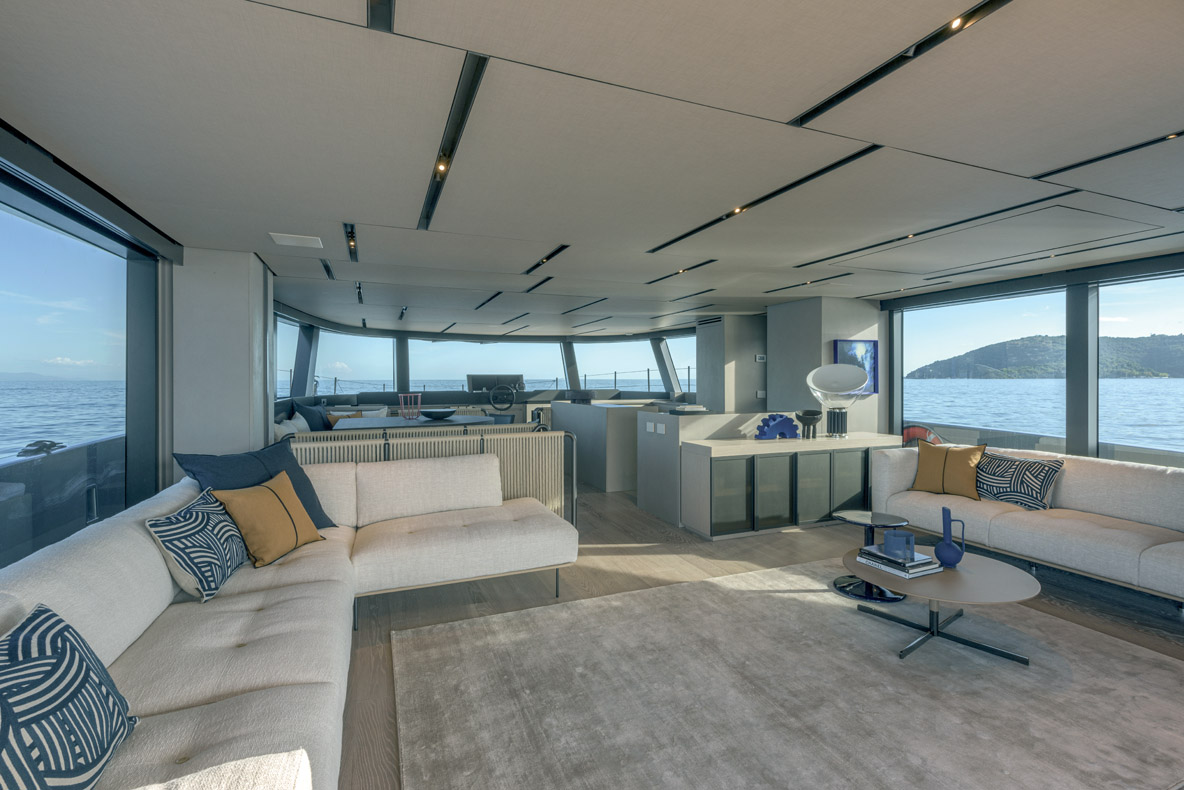
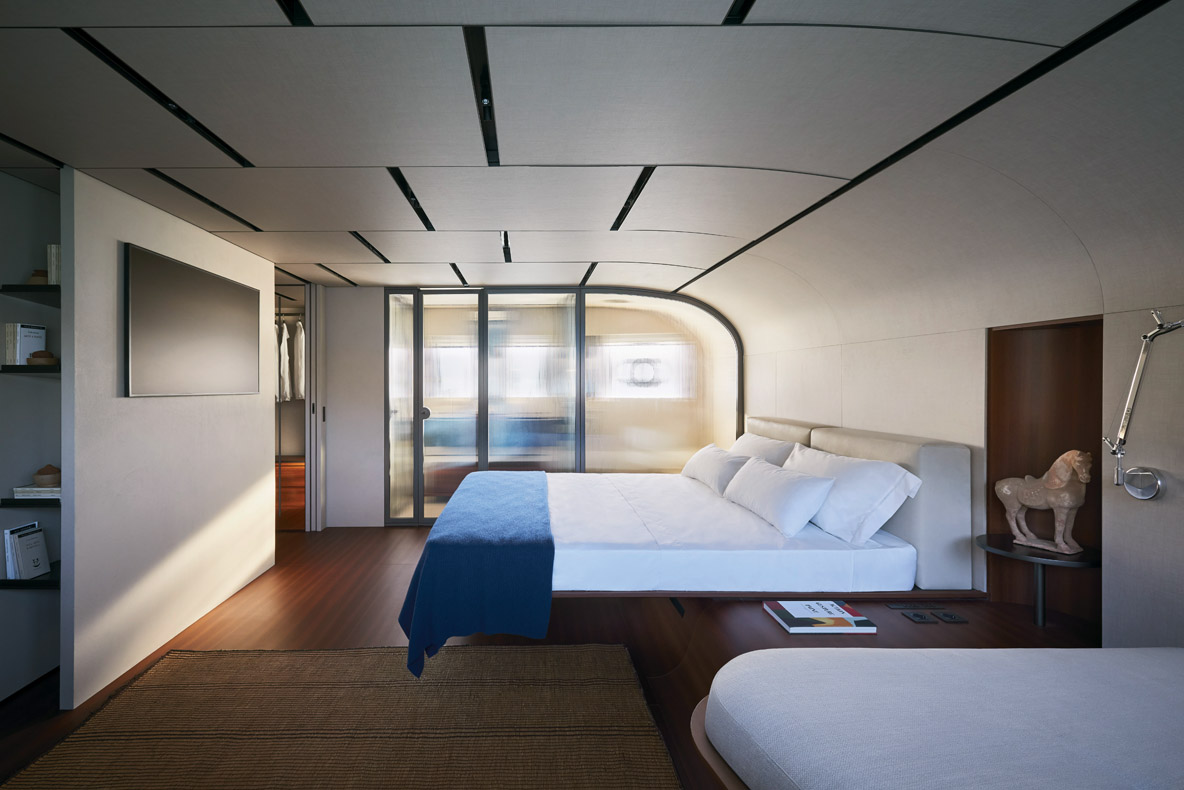
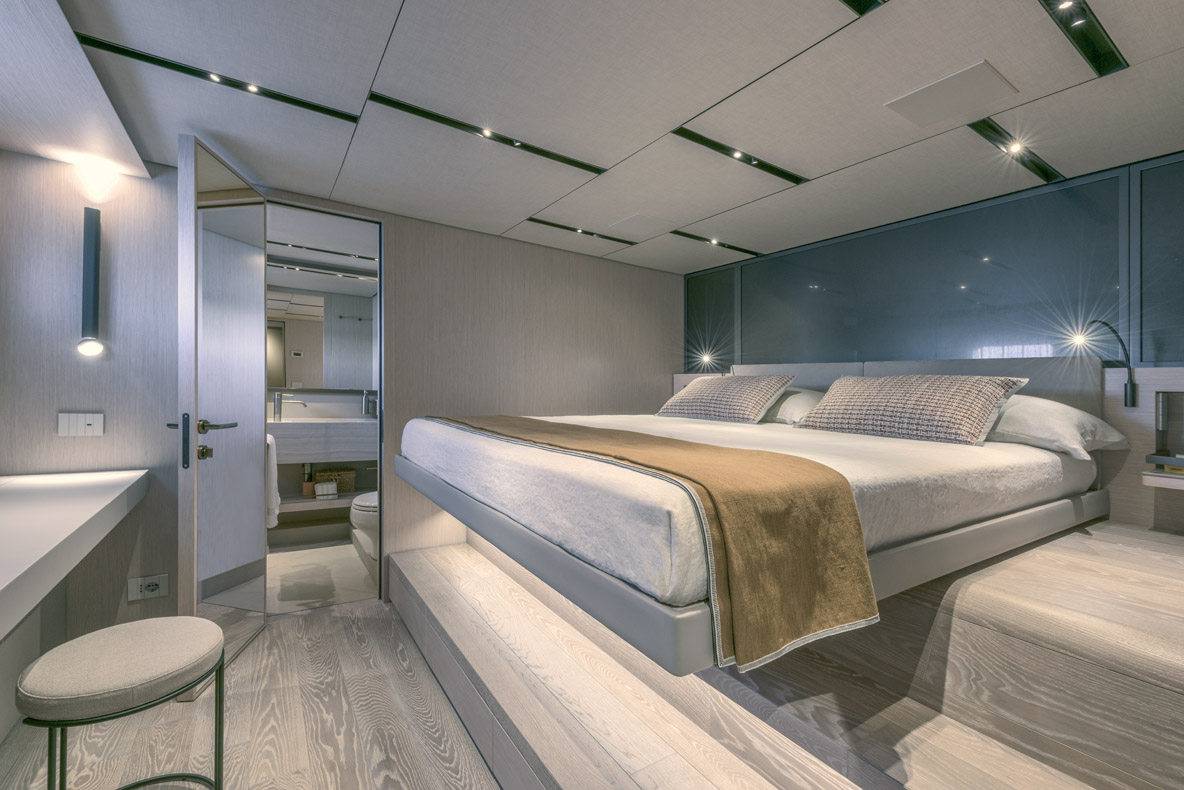
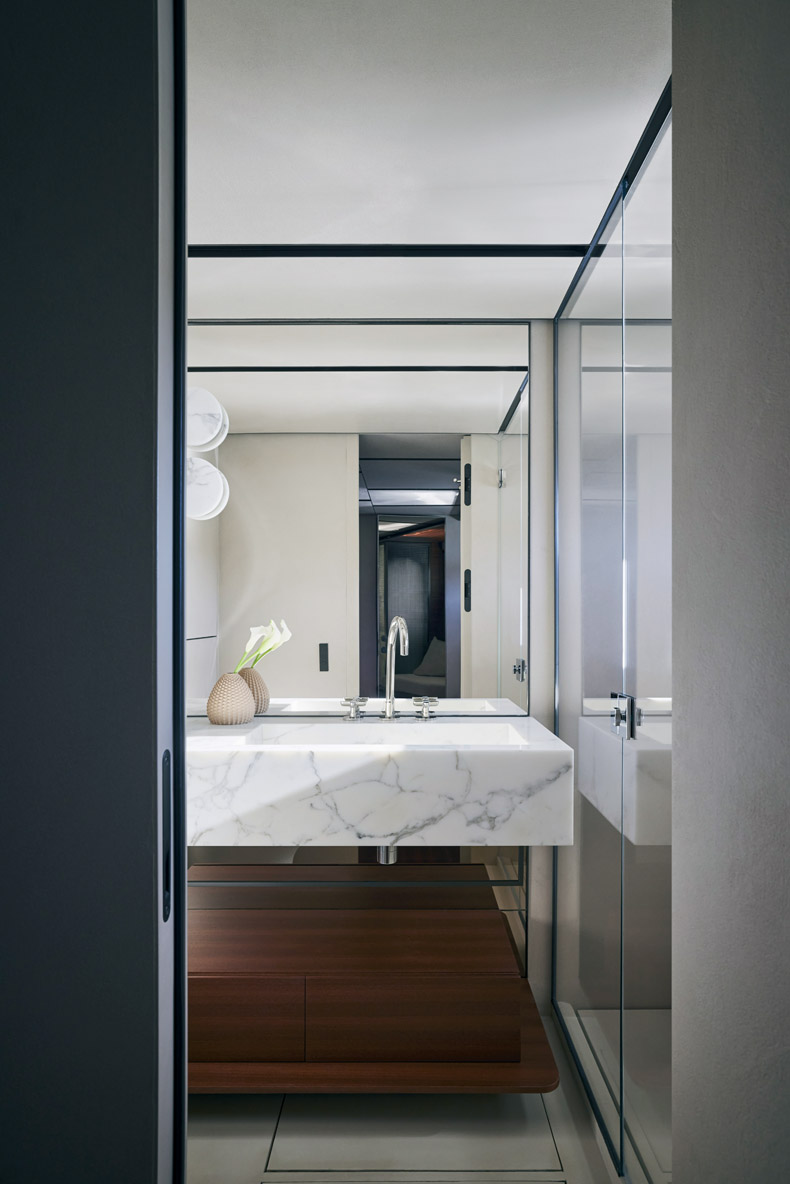
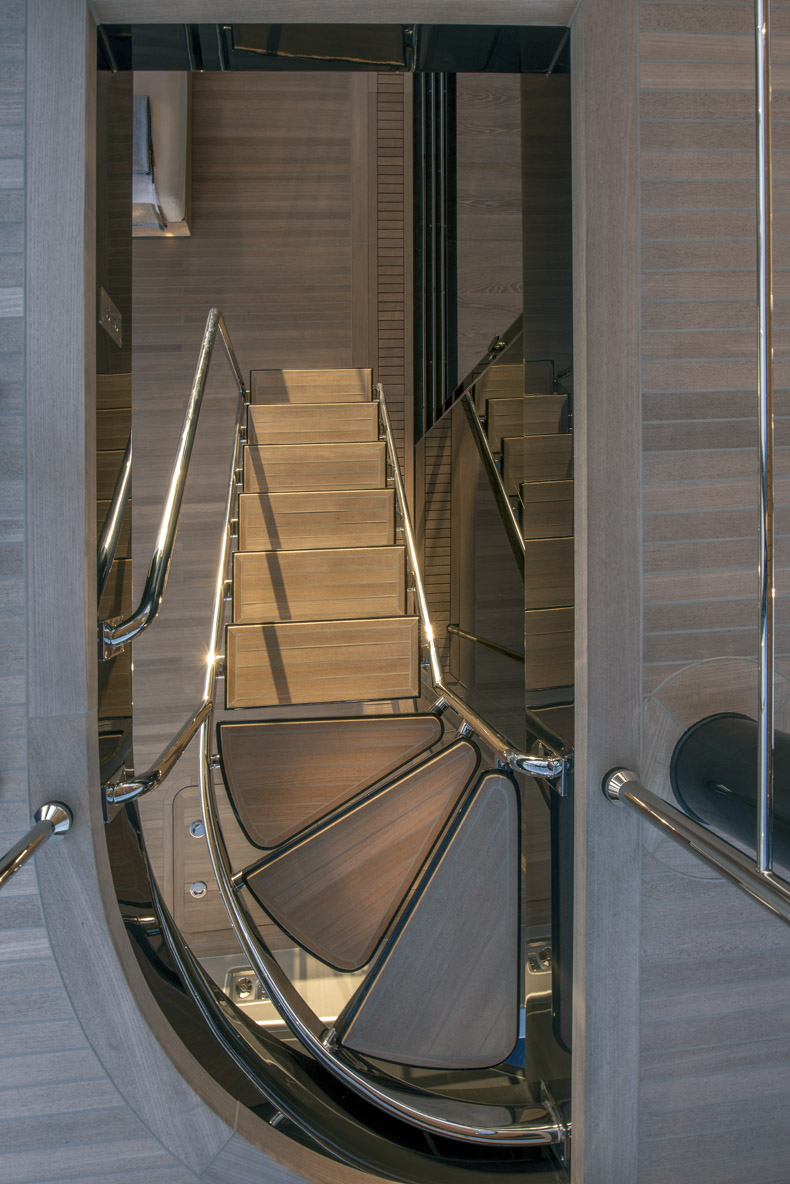
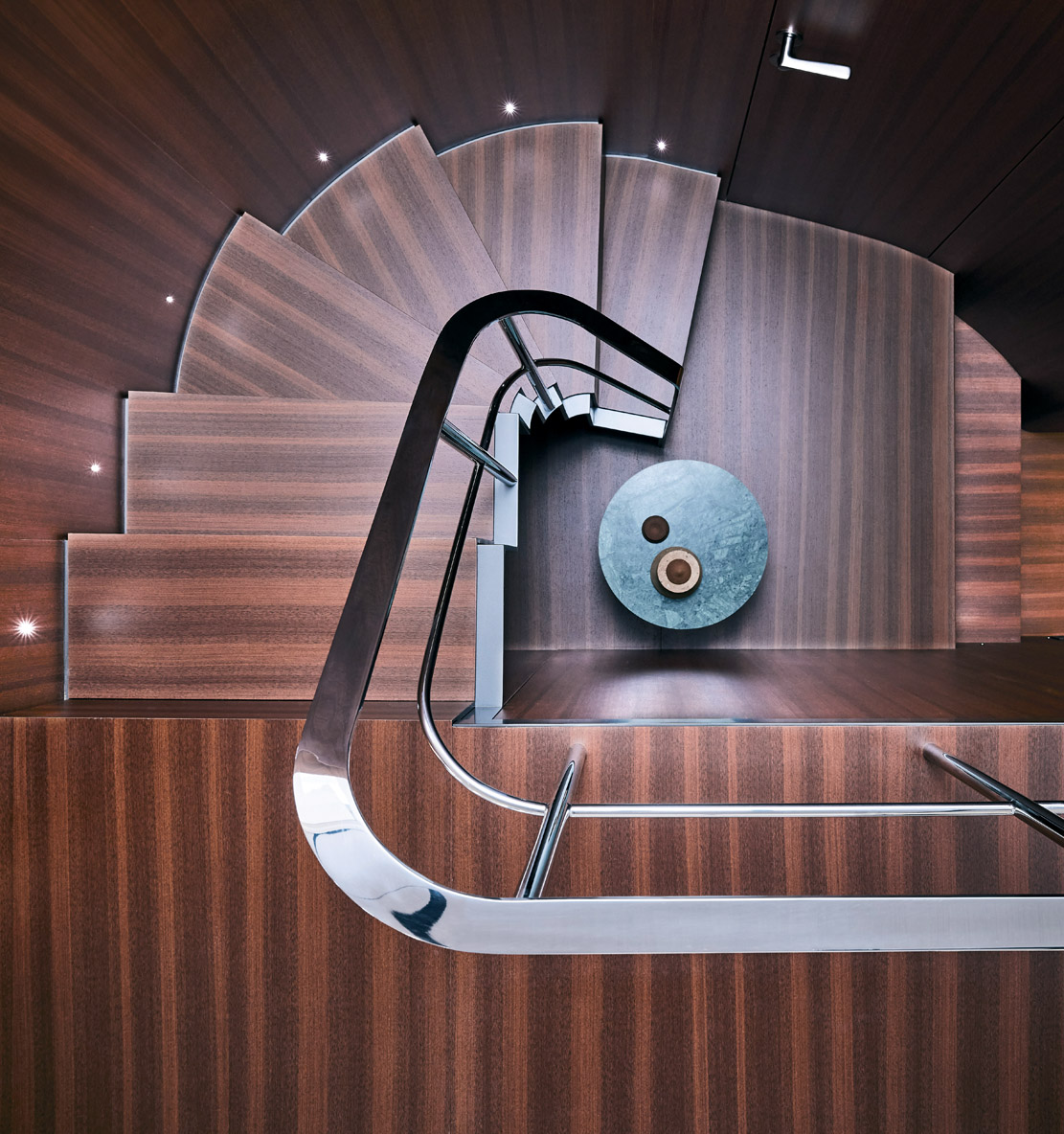
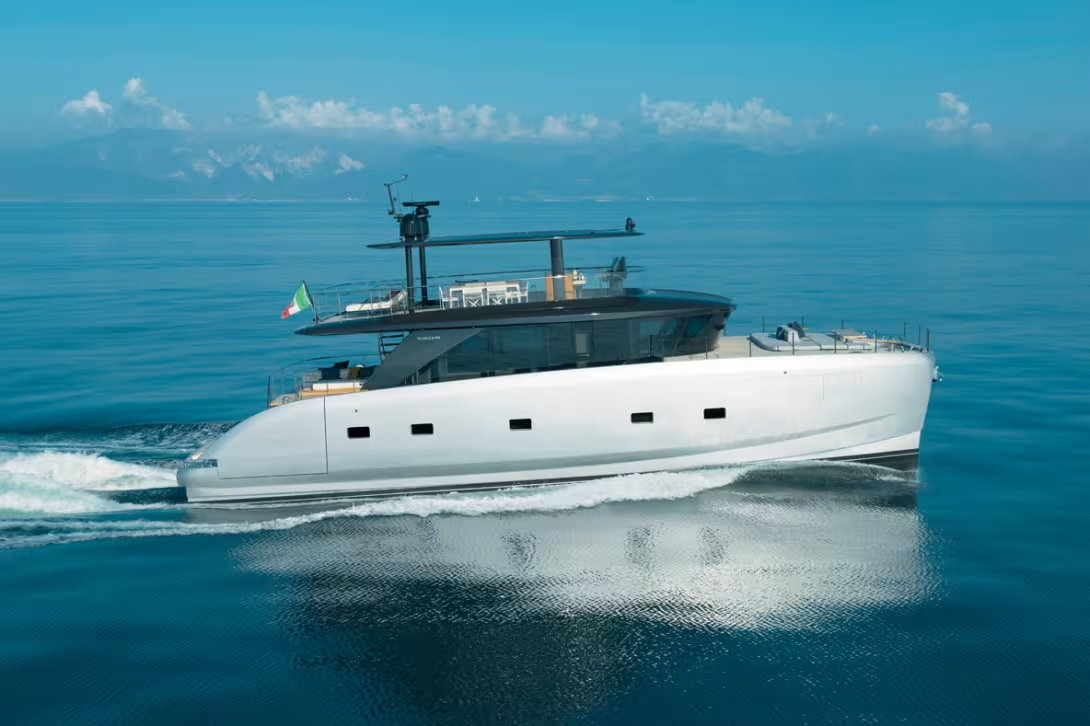
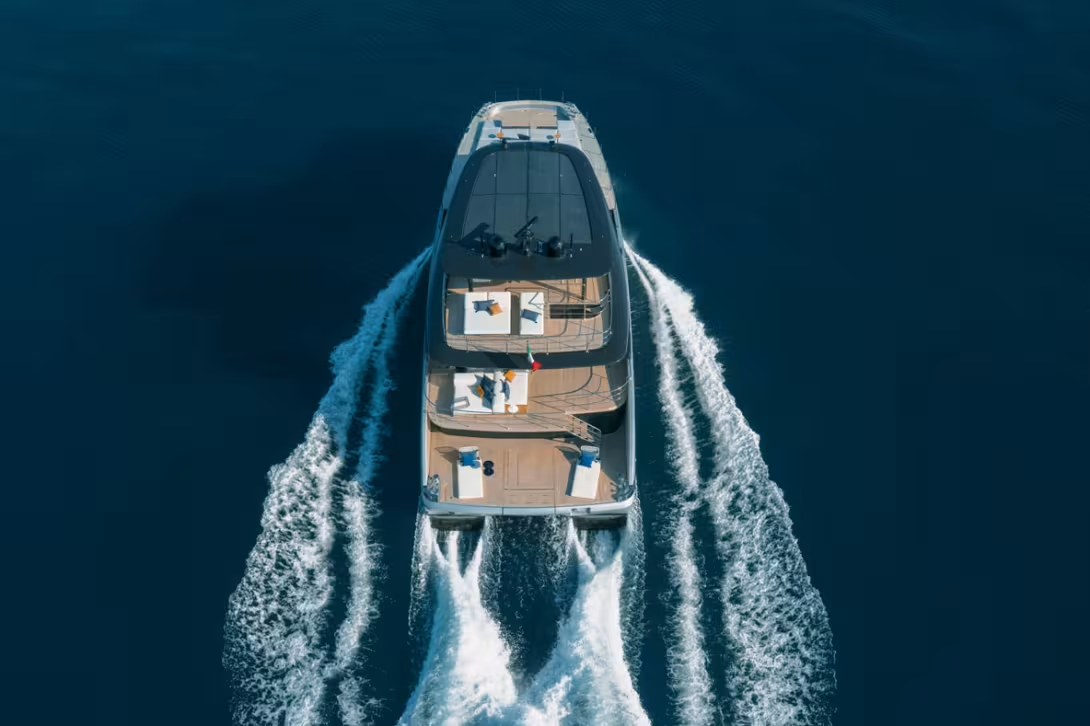
But in seeking to eliminate all constraints and retain only the best qualities, isn’t there a risk of creating a monster? Not if you count on Italian design mastery: Bernardo Zuccon and Piero Lissoni have ensured that their BGM is just as elegant and luxurious as the usual Bluegame/Sanlorenzo monohulls. The lines feature a double curved chine, which emphasizes the topsides of the hulls while widening them. The superstructure consists of a full 360-degree glazed surface on one level. Forward, the angle is reversed to ensure optimal protection. These rounded lines, without protrusions, somewhat in the style of a rotunda, provide remarkable visual fluidity. This lightness is reinforced at the deck edge, where the bulwark is composed solely of stanchions. The same applies to the flybridge guardrail, which is fully glazed and rounded, preserving perfect visibility and giving the impression that the T-top resting on its four slender pillars is flying like a fin. The two-tone colors, with the black roof and lighter hull, contrast subtly and perfectly match the desire to offer “chic on the water.” The main deck is entirely covered in teak, a luxury that is becoming rare these days. The aft deck, above the tender garage, and the foredeck are both furnished with sofas that can be arranged as desired. While the interiors with three cabins and the galley on the lower deck of hull #1 were designed by Lissoni & Partners, the layout of the second BGM75 built was entrusted to Zuccon International Project. Our test model has four cabins and the galley is located on the main deck, in line with specifications that called for a certain degree of flexibility. The highlight is undoubtedly the owner’s cabin, forward, on the lower deck. Spanning the entire width of the boat, it features a rounded ceiling, somewhat reminiscent of a suite you’d find on private jet. The materials are warm yet understated. Throughout the boat, the harmony of colors and materials is impeccably elegant. The aft deck is accessed via a wide staircase, a little like stepping out of a villa onto a swimming pool. This beach club, very low on the water and equipped with fold-down bulwarks, reinforces this feeling, especially when the color of the water in the anchorage of the day is turquoise. The rear garage door conceals the space between the hulls, a solution already used by Sunreef Yachts’ Supreme models, but here the door is made of dark glass, reinforcing the appearance of a large monohull superyacht.
40% Fuel Savings
In their quest for greater fuel efficiency, Bluegame’s design office claims impressive results, with the BGM75’s fuel consumption reduced by 40% compared to a 90-foot monohull yacht. During the first 300 hours of testing, Bluegame estimated that their multihull yacht saved around 17,500 US gallons (66,000 liters) of fuel and 175 tons of CO2 compared to a monohull with equivalent interior volume but higher displacement and that needs to be driven by two engines of at least 1,200 HP. During our trip off the coast of Cannes, the situation was slightly different as we had more powerful engines than the standard propulsion system.
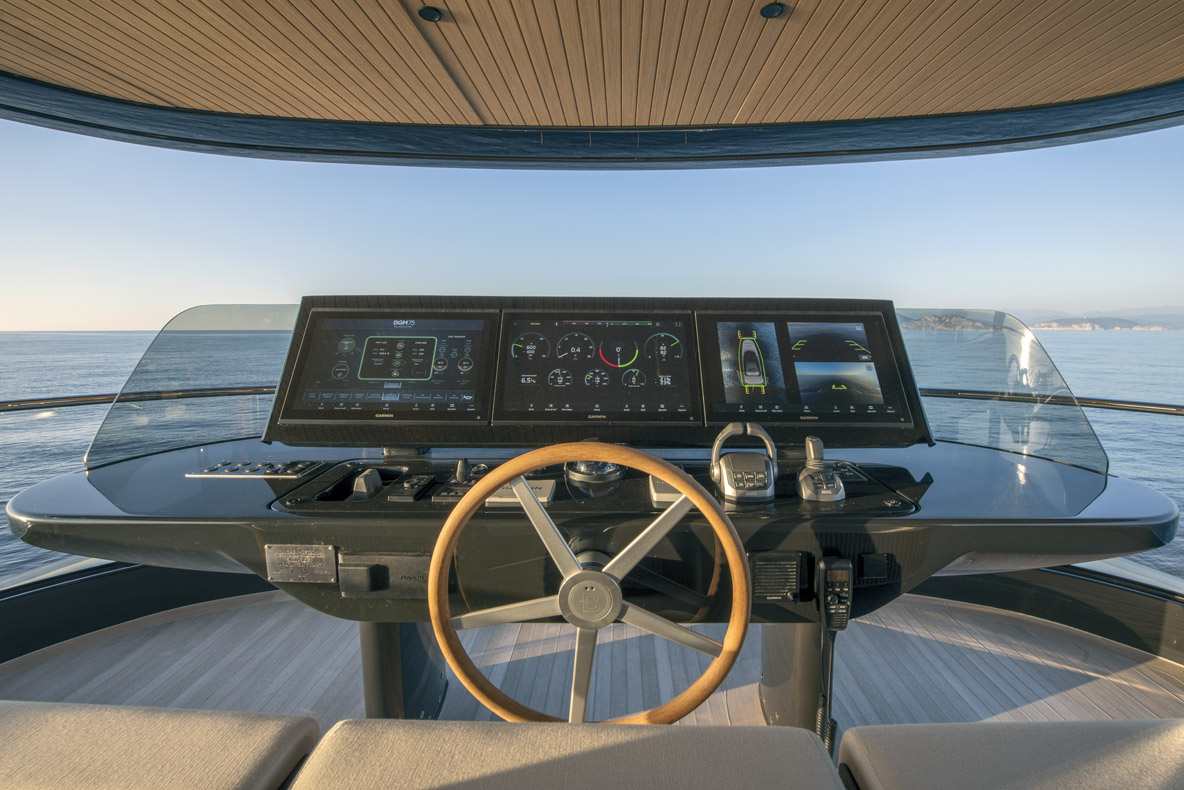
The interior helm station is reduced to its bare essentials—just a console with a joy-stick and thruster controls and nothing else. On the other hand, the flybridge console is regal, especially as the transparency of the guardrail mentioned above offers excellent visibility from all angles. This is particularly pleasant both under way and at anchor, but also allows for millimeter-precise maneuvers in port, as we witnessed on the day of our test.
Outside the harbor, the sea was flat: perfect conditions for revving the engines. We reached a top speed of just over 22 knots and at a cruising speed of 18 knots, fuel consumption was 69 US gal (260 l)/hour – compared to a 90 to 100-foot (27-29 m) monohull motor yacht that would be burning well over a hundred gallons (400 l) of fuel per hour at this speed. The savings are therefore very real, even with more powerful engines, but that’s not the only important point. When cornering, powercats (unless they are compact units powered by outboard motors) tend to heel towards the outside of the curve, where the opposite would be preferable. This behavior is not dangerous aboard big boats but can be unpleasant — which is why the BGM75 is equipped with twin SmartGyro gyroscopic stabilizers (see inset). There is one in each hull, and they work together, linked by a central computer. The demonstration of lateral trim correction is even more convincing at anchor – the narrow catamaran is naturally more stable than a monohull, but less so than an extra-wide platform. During our test, we experienced stopping the multiyacht by positioning it across the wake waves and turning the stabilization system on and off. Verdict: the difference in behavior is noticeable, making it perfectly possible to sit down to dinner even in anchorages exposed to cross swells.
Conclusion
This new Bluegame, the first catamaran developed by the Sanlorenzo group, is perfectly suited to luxury coastal and semi-offshore cruising, turning its back on the idea of a long- distance explorer program. Nevertheless, the BGM75 is perfectly coherent and even significantly advances the standards of powercat architecture and design. Of particular note are the curved surfaces that blend seamlessly into one another, creating lines that appear to integrate elegantly with the sea.
Stabilization: One of the Major Challenges for Luxury Cruising
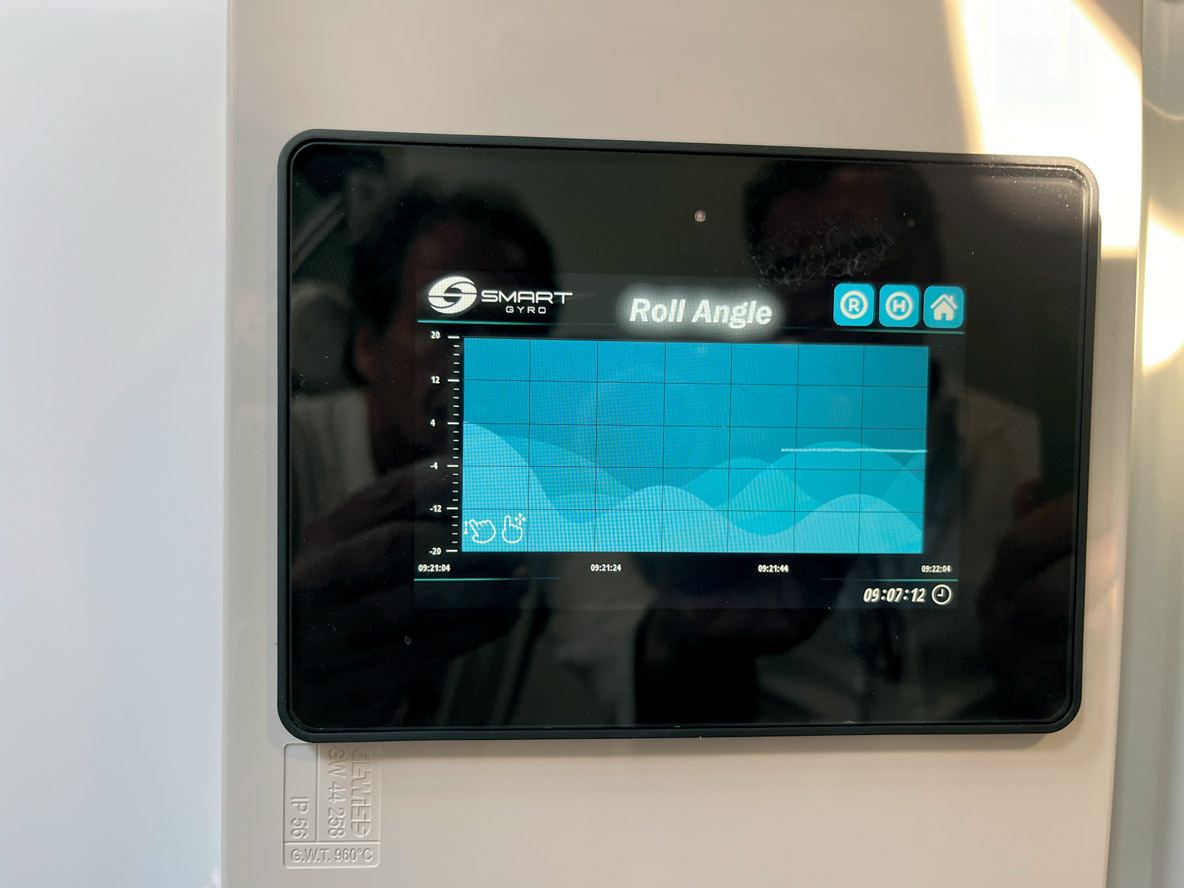
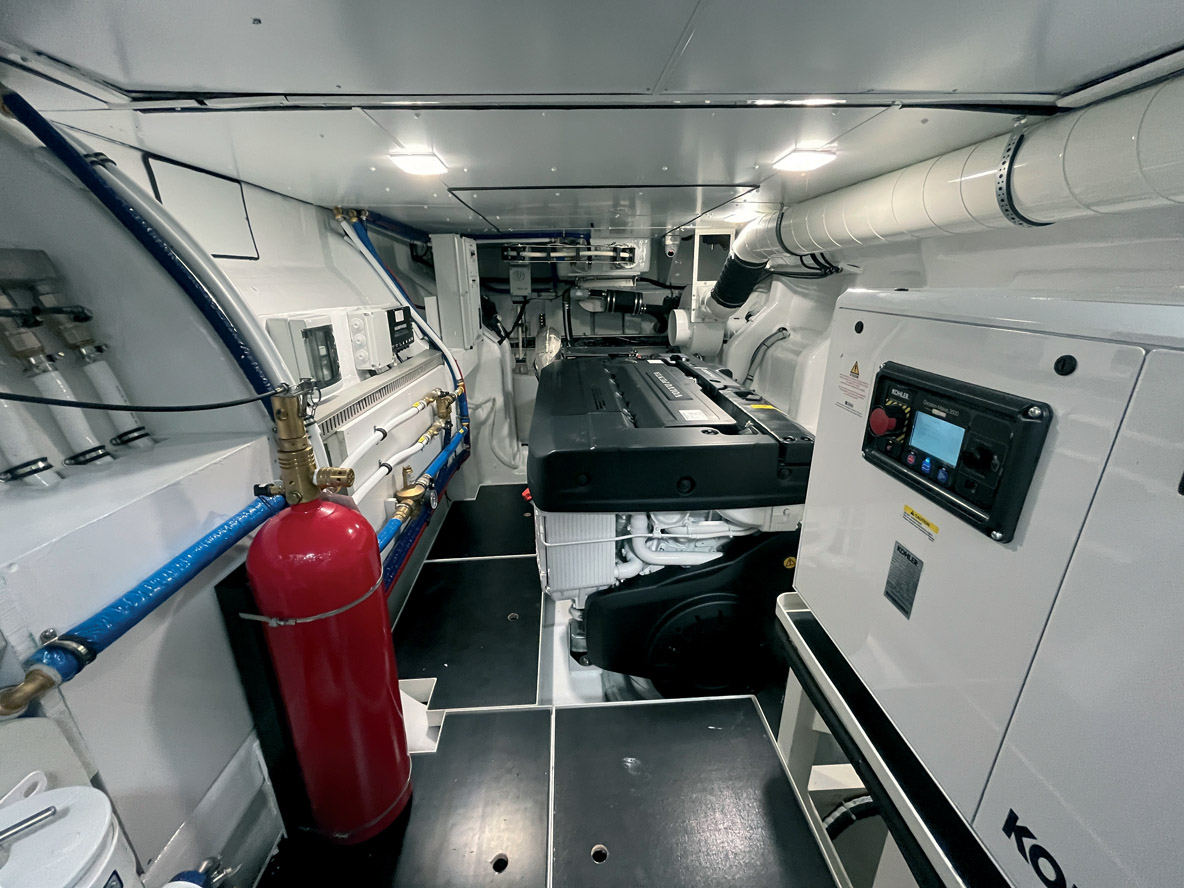
Aboard the BGM75, the has been dealt with by installing two synchronized stabilizers, one in each hull. To this end, Bluegame partnered with Smartgyro, which has many years of expertise in this field. The equipment manufacturer provided the builder with data on the maximum forces that could be generated by the stabilizers, enabling Bluegame’s R&D team to adapt the hull shapes accordingly. With no existing mathematical model for catamarans, the team first had to study how to install and operate two gyroscopes in parallel in each hull of a catamaran. This required significant adjustments to the Smartgyro software control systems and determined the calibration required for the BGM75. While a 50-ton monohull only requires a Smartgyro G60, a G80 was selected for the BGM 75, which displaces 48 tons. Thanks to a dedicated test hull, it was possible to validate the theories and refine the gyroscope algorithms to ensure optimal parallel operation in variable sea states and achieve a significant reduction in roll.
40% reduction in fuel consumption
Owner’s cabin worthy of a superyacht
Program limited to semi-offshore cruising
Technological complexity that can be demanding to maintain
Technical Specifications
Architect: Briand Yacht Design
Length overall: 74’8” (22.75 m)
Beam: 26’9” (8.15 m)
Draft: 5’3” (1.6 m)
Light displacement: 48 t
Drivetrain: 2 x 800/900 HP Volvo D13 IPS 1050/1200
Max speed: 22 knots
Cruising speed: 18-20 knots
Cabins: 3 to 5 + 1 crew
Fuel: 1,585 US gal (6,000 l)
Fresh water: 475 US gal (1,800 l)
Black water: 132 US gal (500 l)
CE Certification: B16
Price: from e€5,600,000 to e€7,500,000 ex-tax depending on version and engine option