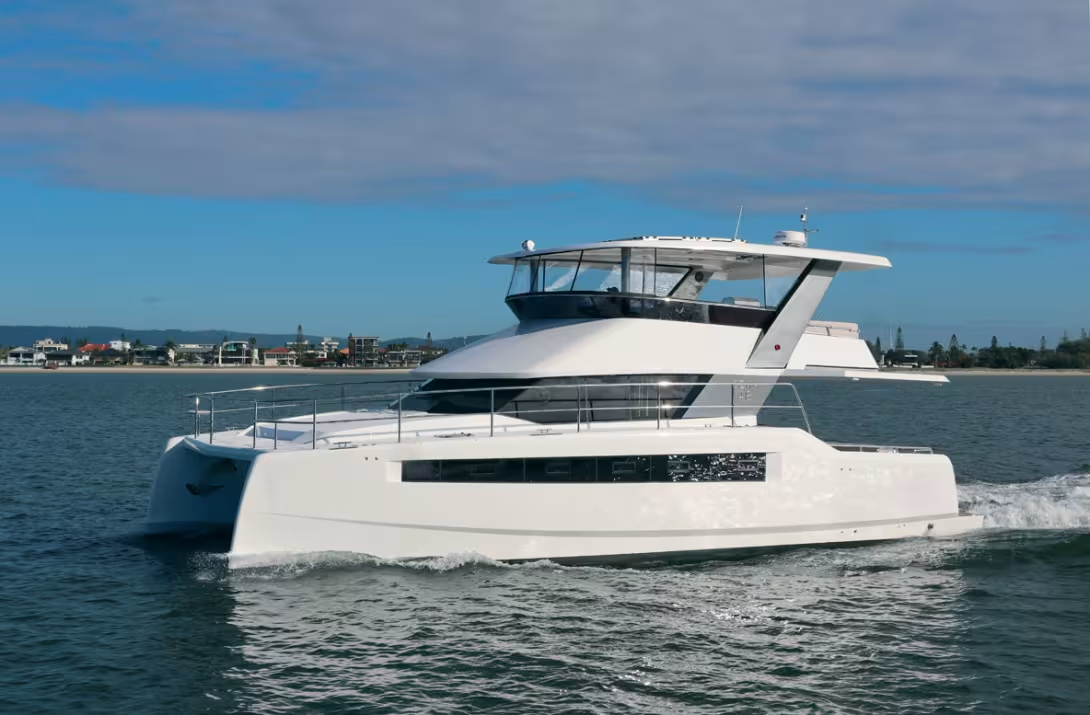
The Cora 48 Catamaran is a newcomer to 40 to 50-foot powercat arena. And yet, even if the sector is increasingly competitive, it relies on the know-how of a highly qualified shipyard and brings with it resolutely top-of-the-range manufacturing quality and services.

Infos pratiques
- Le chantier : Cora 48
- La fiche technique
- Découvrez notre vidéo exclusive
- Financez votre Cora 48
- Assuez votre Cora 48
- Articles autour du Cora 48
Conditions: Southeast wind 7 – 9 knots, calm sea
Powercats are prolific here in Australia, as I saw at the recent Sanctuary Cove Boat Show, with all the major global brands represented. Climbing aboard them are unusual buyers because many are first-time boat owners. The attraction for many I spoke to is lifestyle, centered around vast living spaces and relatively easy handling. Add to this frugal fuel consumption, an especially important feature because of Australia’s vast coastline, and the reasons for the Cora 48 Catamaran’s arrival are apparent.
A New Brand, but a Solid Background
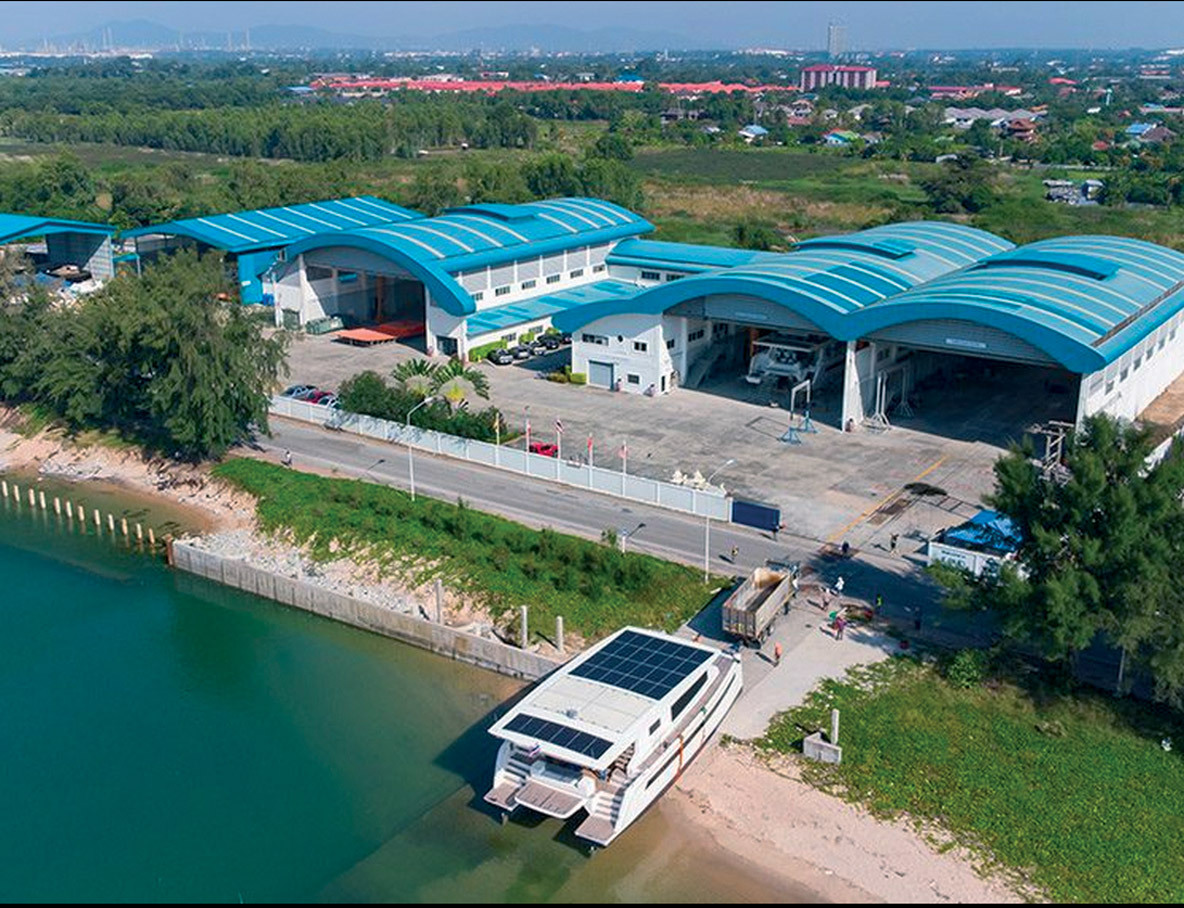
The Cora brand name is newly coined but the Thailand yard, PMG Shipyard, are very experienced builders of sail and powerboats between 38-105 foot, principally catamarans. Philippe Guénat, originally from Switzerland, established the yard on the Gulf of Thailand at Rayong, a few hours south east of Bangkok in 2004. The management has a strong European flavor such as naval architect Dr Albert Nazarov and with key Asia Pacific staff, including project manager Dean Thompson from New Zealand. After graduating from the New Zealand Shipyard Marine Technical college, Dean has specialized in the use of vacuum-infused carbon fiber for sailing catamarans, including a recent 80-foot Berret-Racoupeau Yacht Design model.
The other part of the equation – sales – comes from experienced Australian dealership, The Yacht Sales Co, which has specified other semi-custom brands such as its popular Iliad catamaran range. The boss, Mark Elkington believes that the Cora 48 fits nicely between their production brand, Fountaine Pajot, and their high-end adventure brand, Iliad.
Philippe Guénat explains that “The Cora 48 is an evolution of the popular Heliotrope boats built in a semi-custom way for several years with hulls specifically suited to Australian waters”.
Indeed, the Heliotrope series has already met with some success in Australia, and the shipyard intends to continue in this direction. Given the high degree of customization, the yard plans to build only about three boats built annually, reinforcing the exclusive nature of this confidential production.
Modern, Timeless Lines that Command Respect
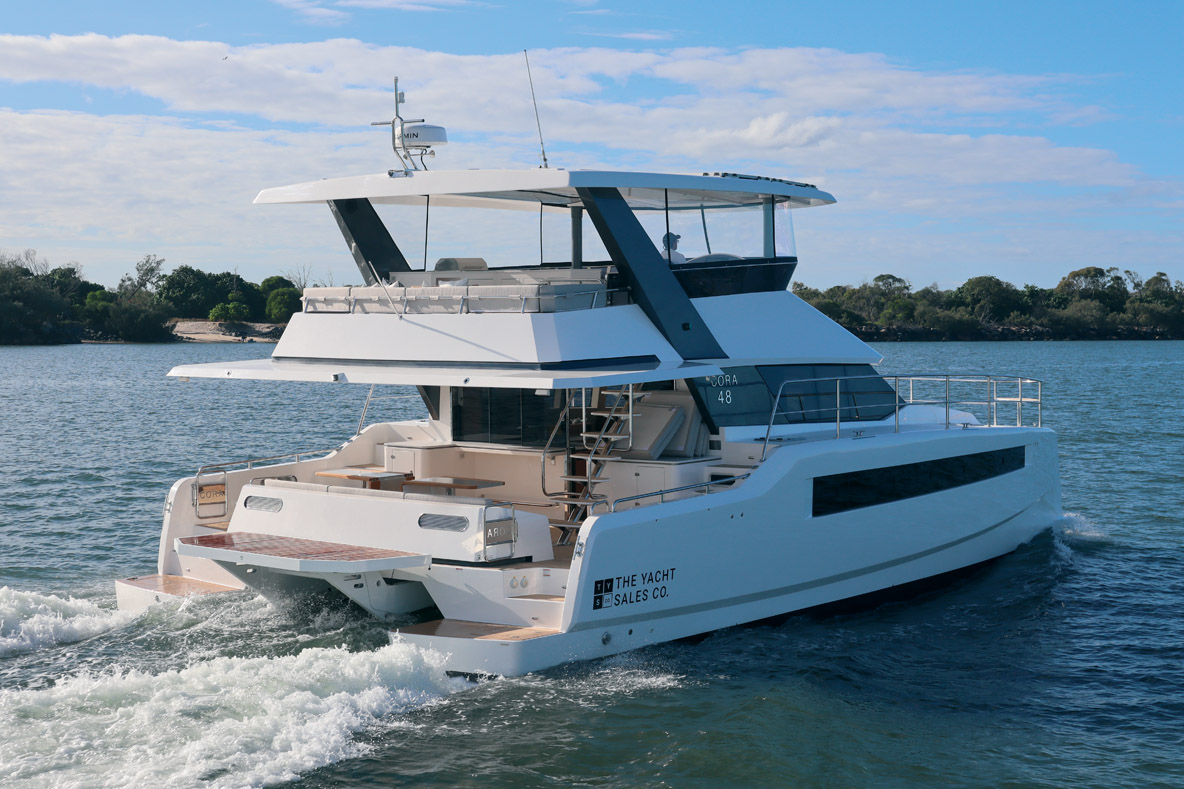
Designed by Albatross Marine Design, the Cora 48 has a modern though not extravagant look. The simple lines are relatively fluid, giving the design a timeless look. The Cora 48 also stands out thanks to its very large hard top (perhaps even a little too large). This feature provides optimum protection for the flybridge, and also allows for the installation of solar panels. The flybridge also extends wide on either side to protect the entire cockpit.
Seen from aft, this design gives the catamaran a very sturdy appearance, especially as it benefits from a good width. The sugar- scoops are not that wide, but they are complemented by a central hydraulic platform that accommodates the tender thanks to chocks - this large, flush surface can also be used as a private beach when at anchor.
Good aesthetics, apart from being easy on the eye, often translate into an efficient vessel, and the Cora 48 ticks this box. Angular yet sloping lines reduce windage while the hull uses a hard chine to minimize drag while offering more volume above the 48-foot waterline, and reverse bows set a contemporary tone, while little winglets limit spray reaching the foredeck.
A Simple, yet Functional Deck Layout
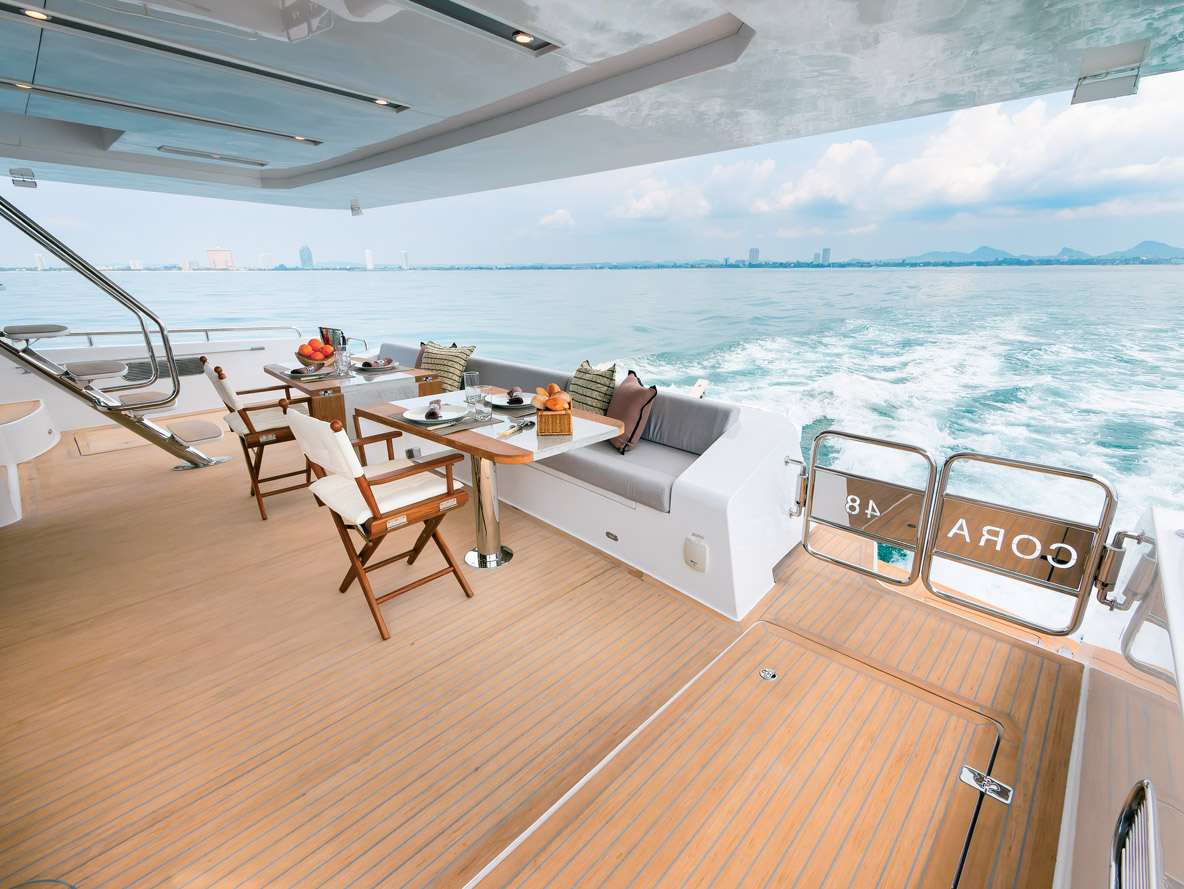
From the sugarscoops, two steps lead up to the aft cockpit, a large Flexiteek clad space with transom bench seating behind twin tables - all covered by the flybridge. A bar shelf runs along the inside, adjoining the galley inside, so ideal for alfresco dining. Good storage includes under-bench and a cupboard under the flybridge steps housing the washer-dryer. Elongated hatches each side give easy access to the engine rooms and above are large grills for air-intakes. Fittings include 316 stainless throughout the rails and stylishly branded transom gates.
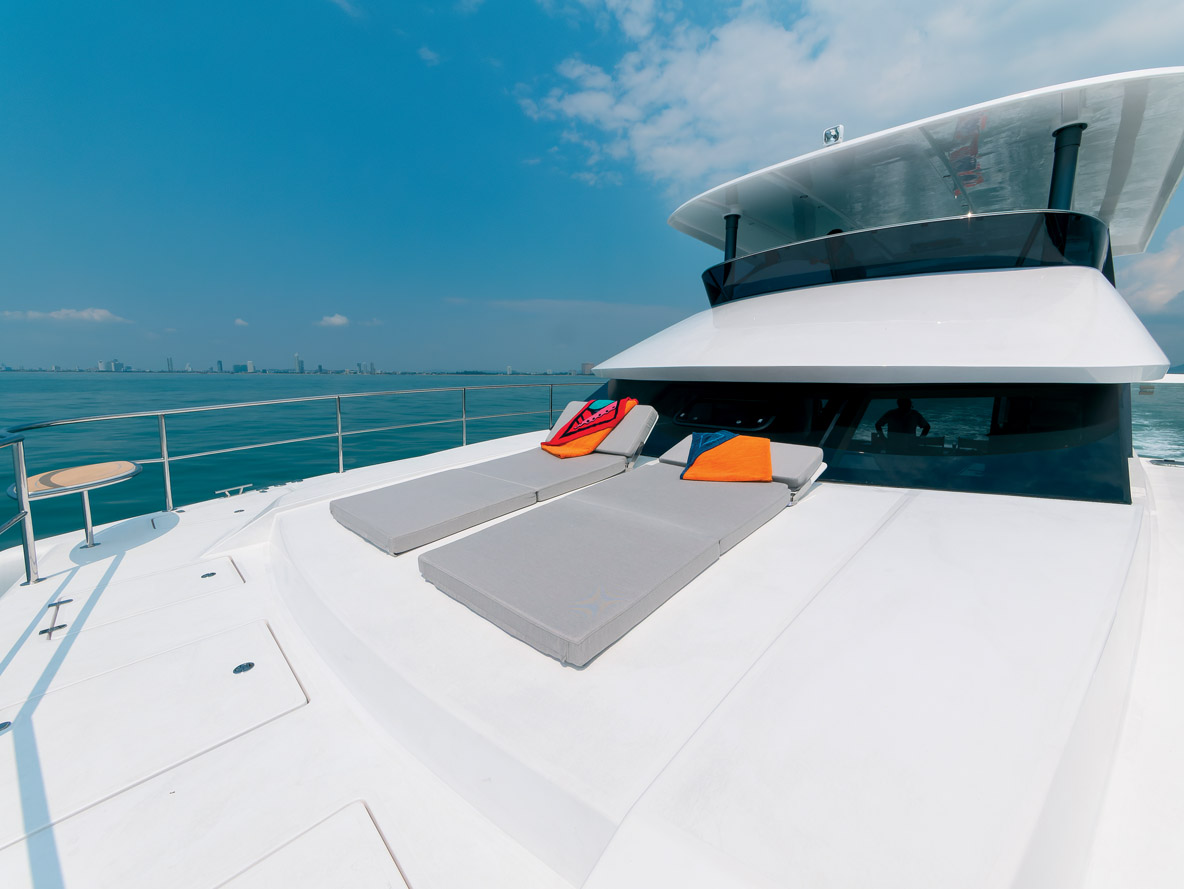
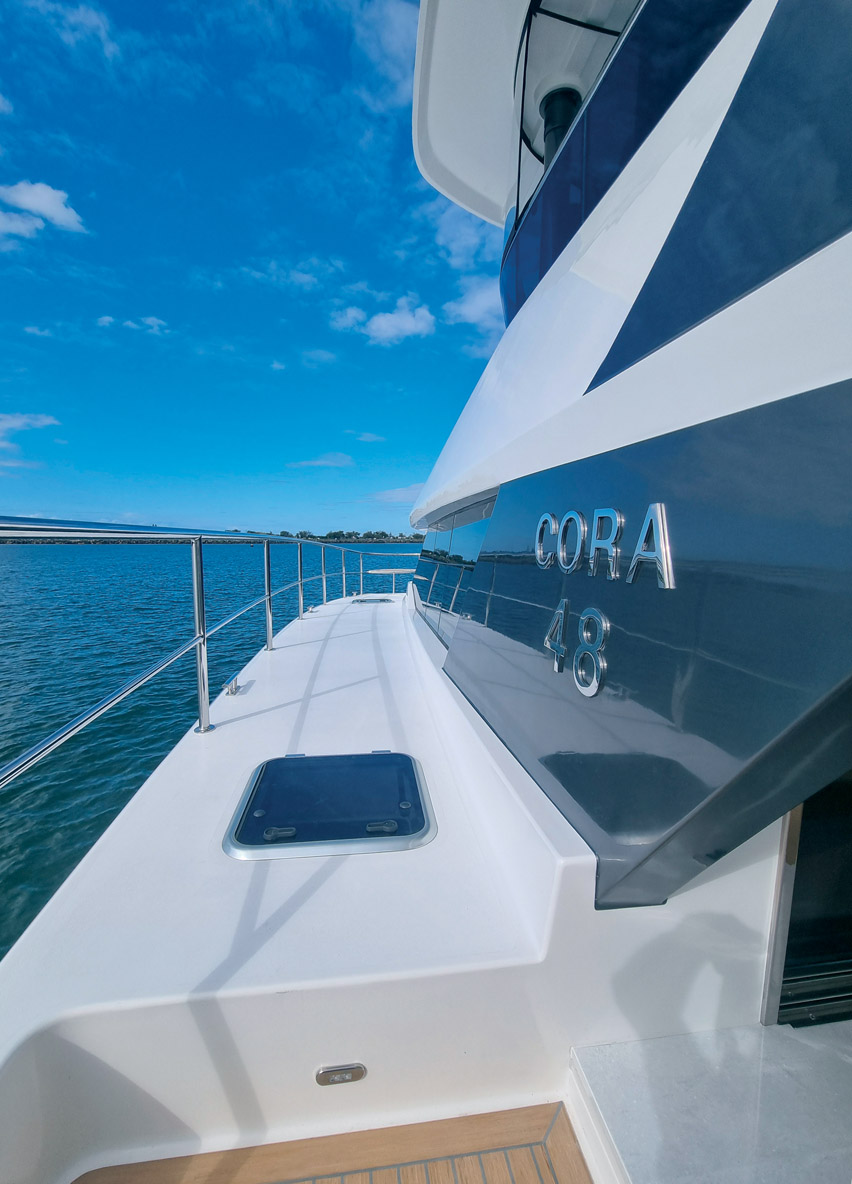
Moving forward on the Cora 48 Catamaran is aided by wide sidedecks and tall guard rails. The raised skylight covers may not be pretty but are my preference, rather than indented ones that can leak. The spacious foredeck is sunbed central at rest but cleverly reduces windows by using fold-down head rests and is unadorned when underway - ideal. Beneath are several lockers, including the chain well and vertical windlass attached to an under-deck bow roller and 30kg (66 lb) Delta anchor with 50m (165’) of chain. In addition, three sets of cleats each side, ensures safe docking.
A Flybridge for Helming in the Open Air
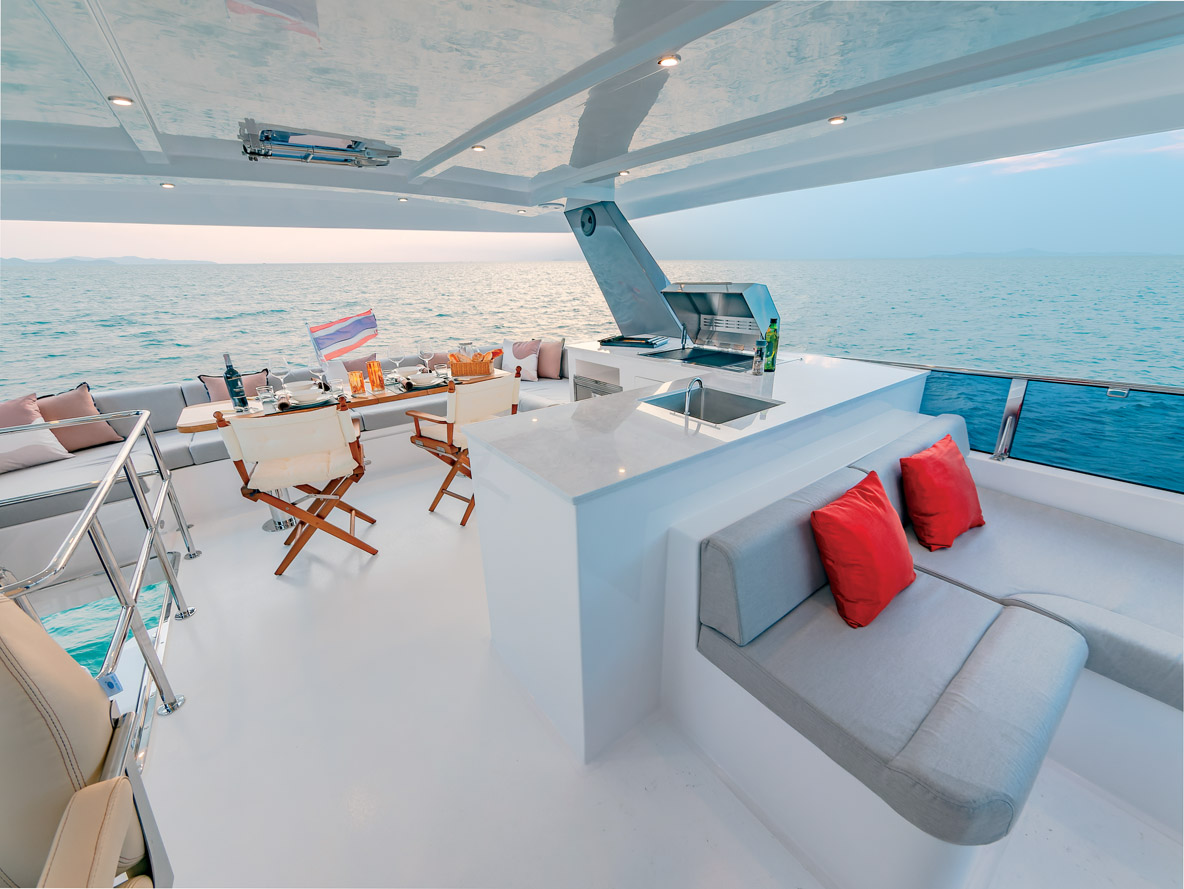
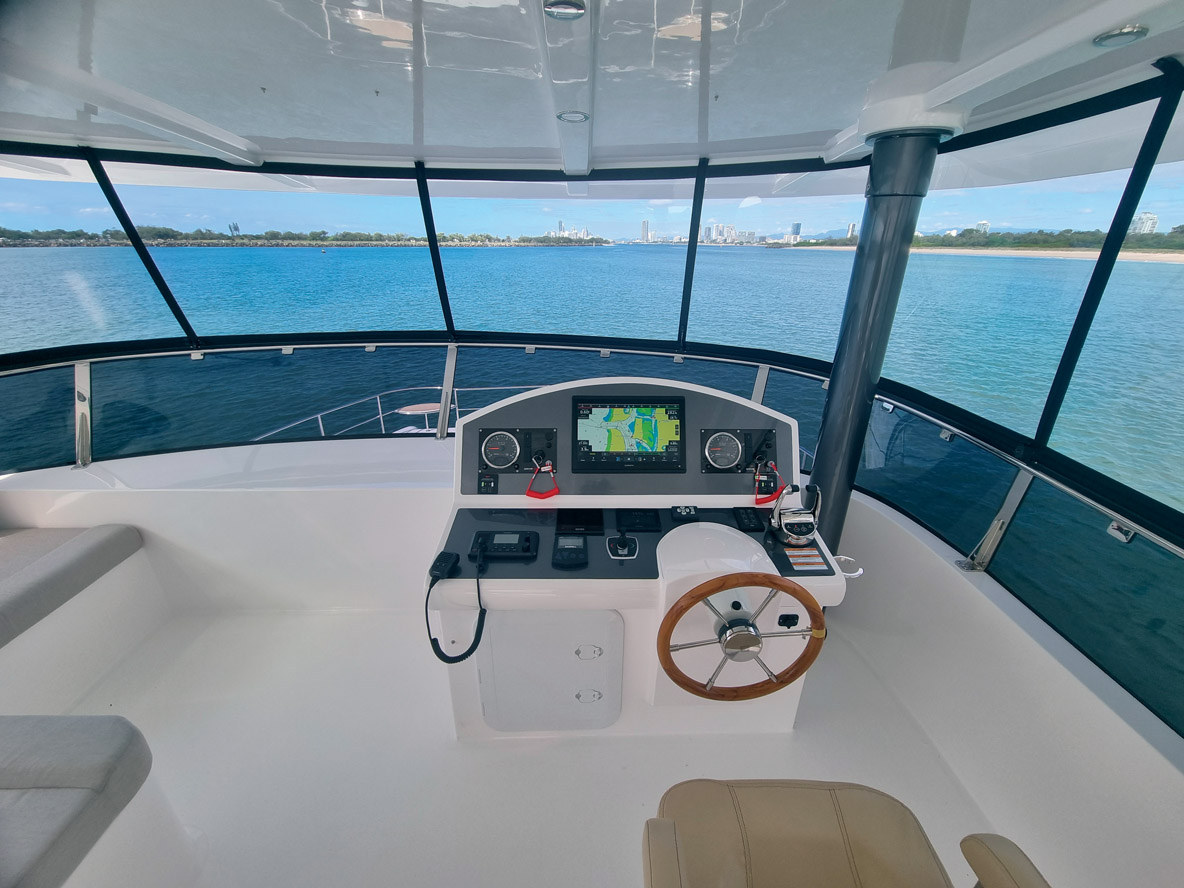
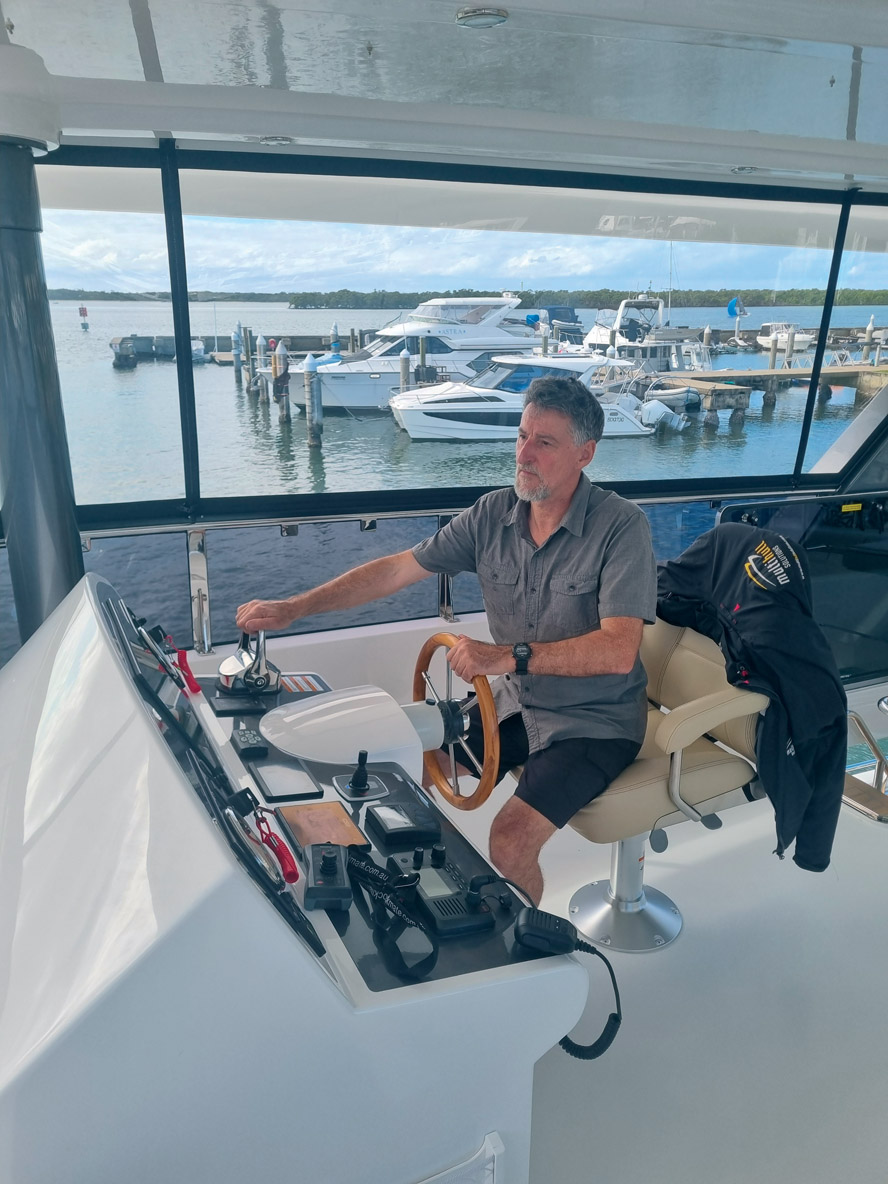
Of course, the flybridge adds windage and on the review hull this was accentuated by the owner adding plastic sheeting – to keep both our tropical insects and rain off the steerer – but the benefits are a cozy third living level with dinette and bench seating aft. Unusual quality features here include twin hand-crafted teak tables with inlays and large L-shaped wetbar and barbecue. A functional yet stylish area for sunset cocktails. Forward, under the GRP hard top is the single steering position on starboard with single adjustable bucket seat and couch alongside. Controls are a nice mix of old and new – analogue rev counters for the twin Steyr 280 HP motors – along with bow thruster paddle-stick and Garmin navigation screen.
Main Deck Designed for Longer Cruising
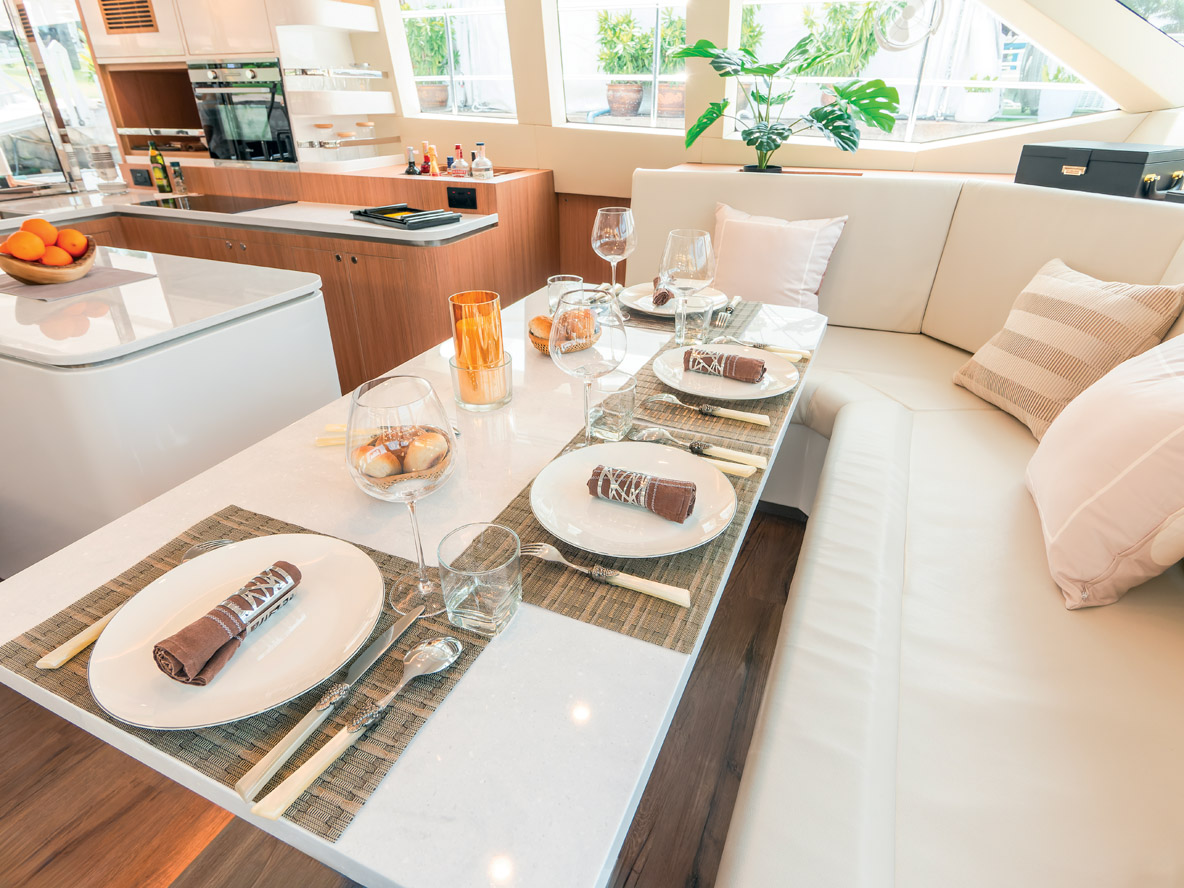
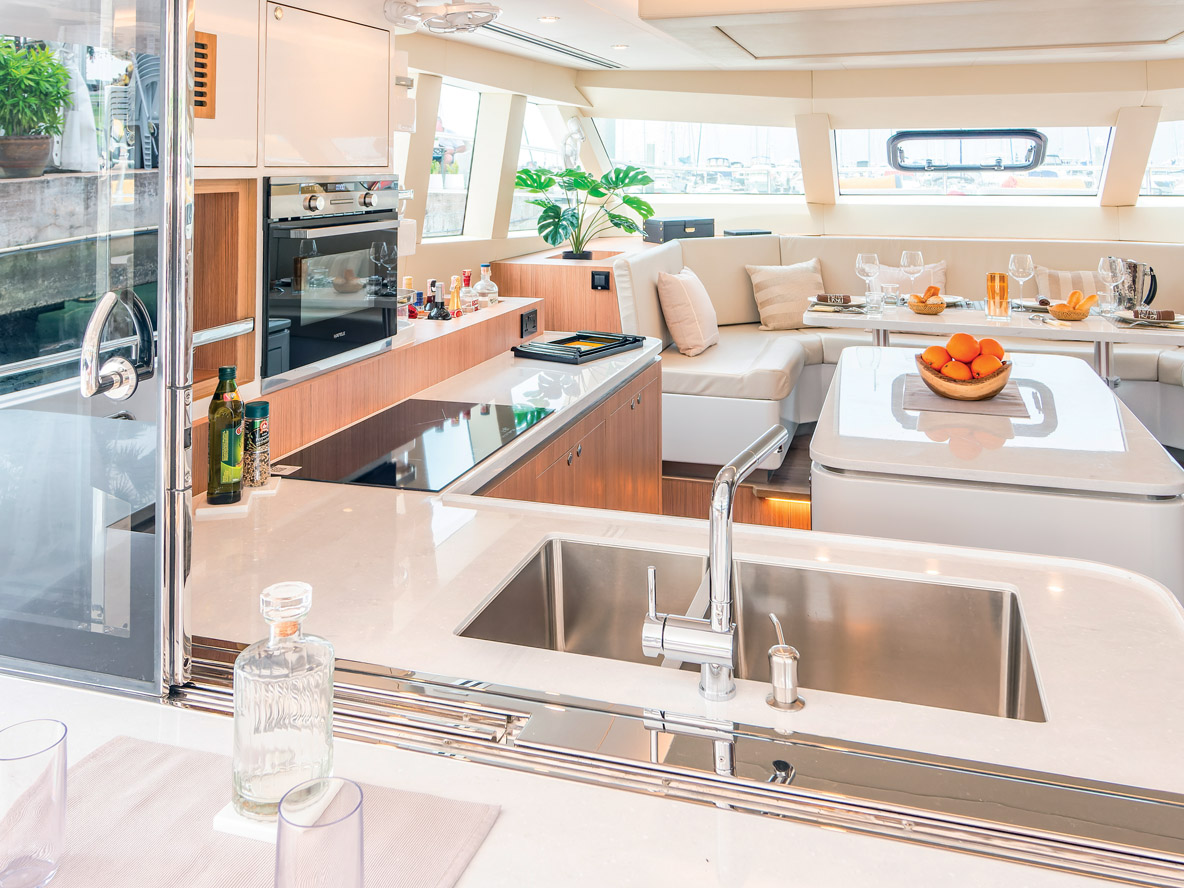
The cockpit flows into the saloon, on the same level, yet is well protected by sturdy sliding doors. Once through the door, to port you find the galley with its central island. This kitchen area is also very workmanlike, thanks to that large island bench allowing several cooks and the composite Hi Max worktop space around the twin sinks and twin plate ceramic stove cooktop with convection oven above. There’s also space for a microwave. Along with tall household fridge and twin freezer drawers, the Cora 48 Catamaran is well equipped for extended cruising.
Continuing forward, a stepped bulkhead that heightens the lounge-diner, giving clear views when seated. Again, practicalities abound, including the elevating table that becomes a bed and the large front window for natural airflow, plus quality Caframo electric fans. Tall headroom and vertical side bulkheads make this an airy space, something essential for tropical cruising. The finish is a lightwood laminate, gelcoat finishes and with rounded ends on all furnishings, including the bunks. This type of attention to details shows the degree of overall care.
Intelligent Layout
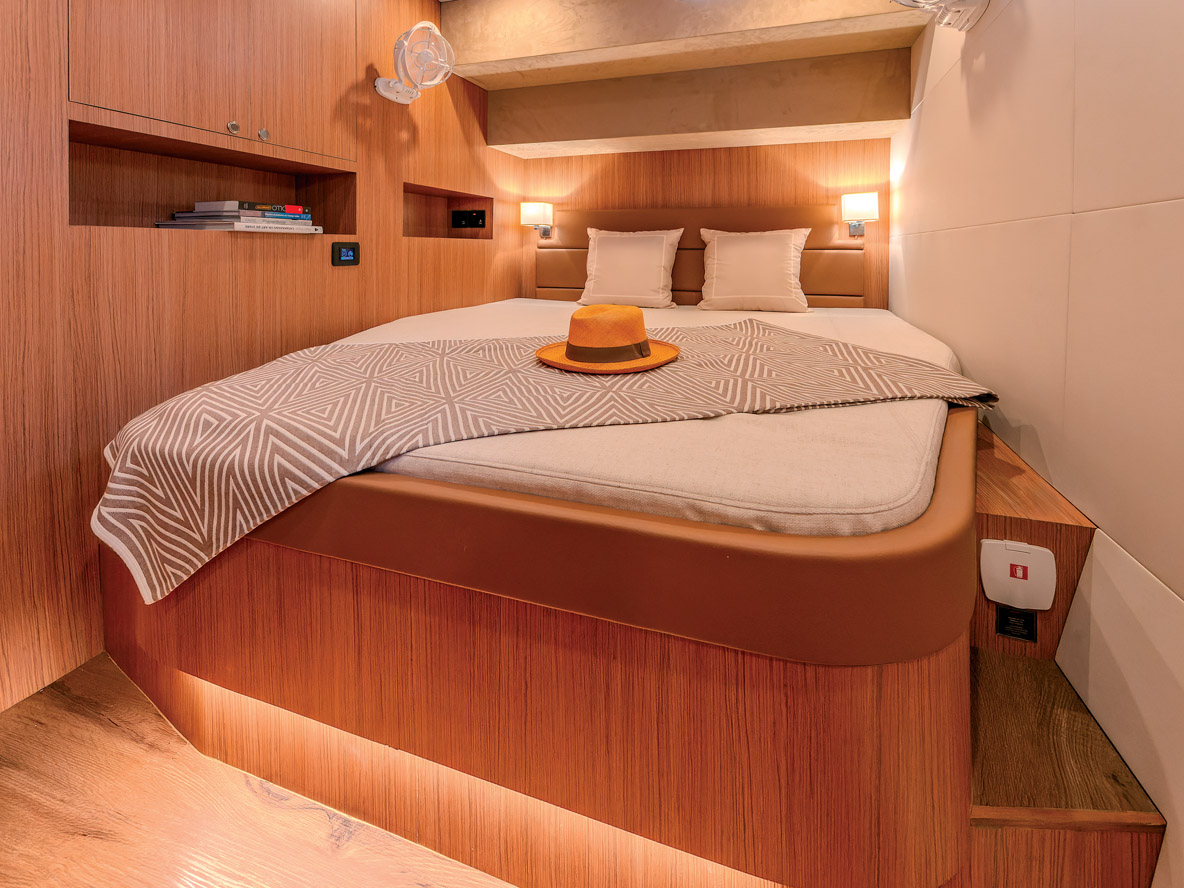
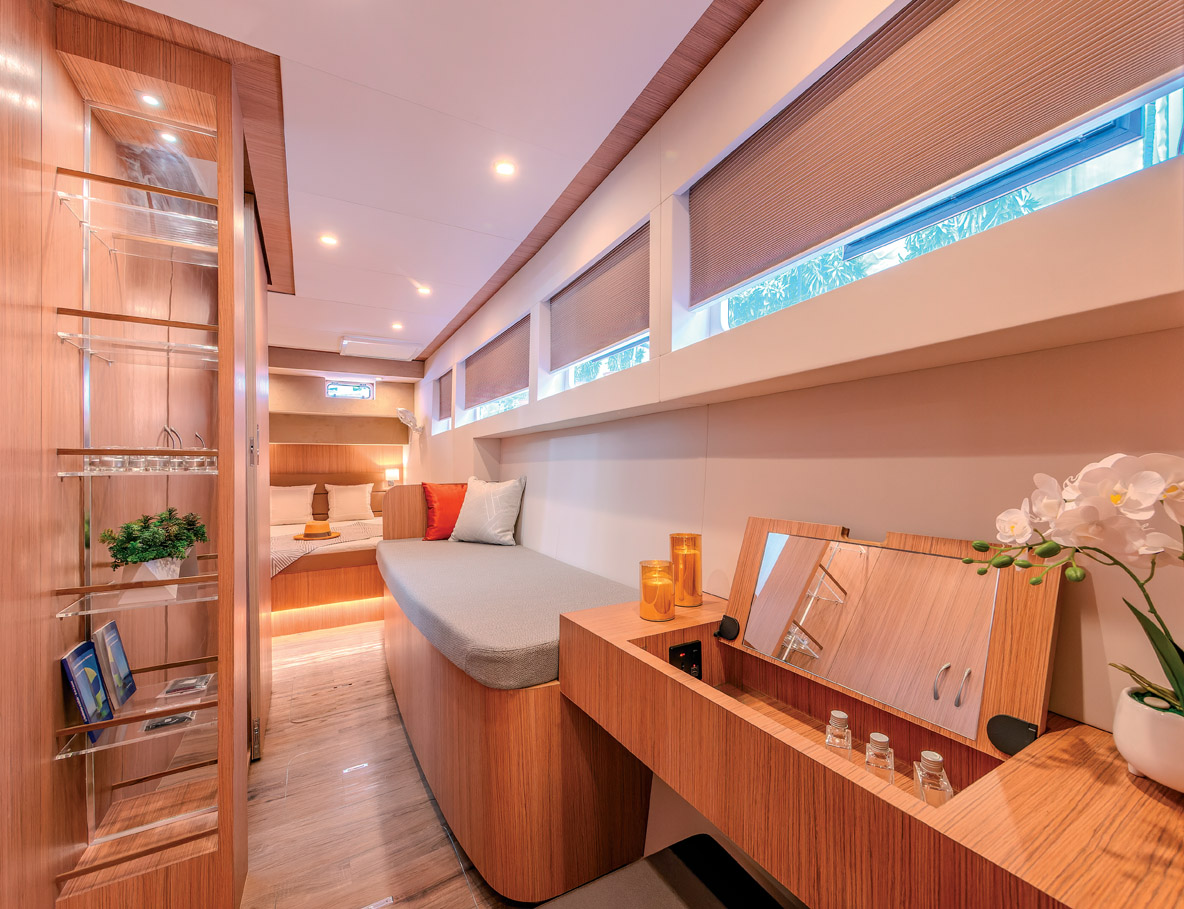
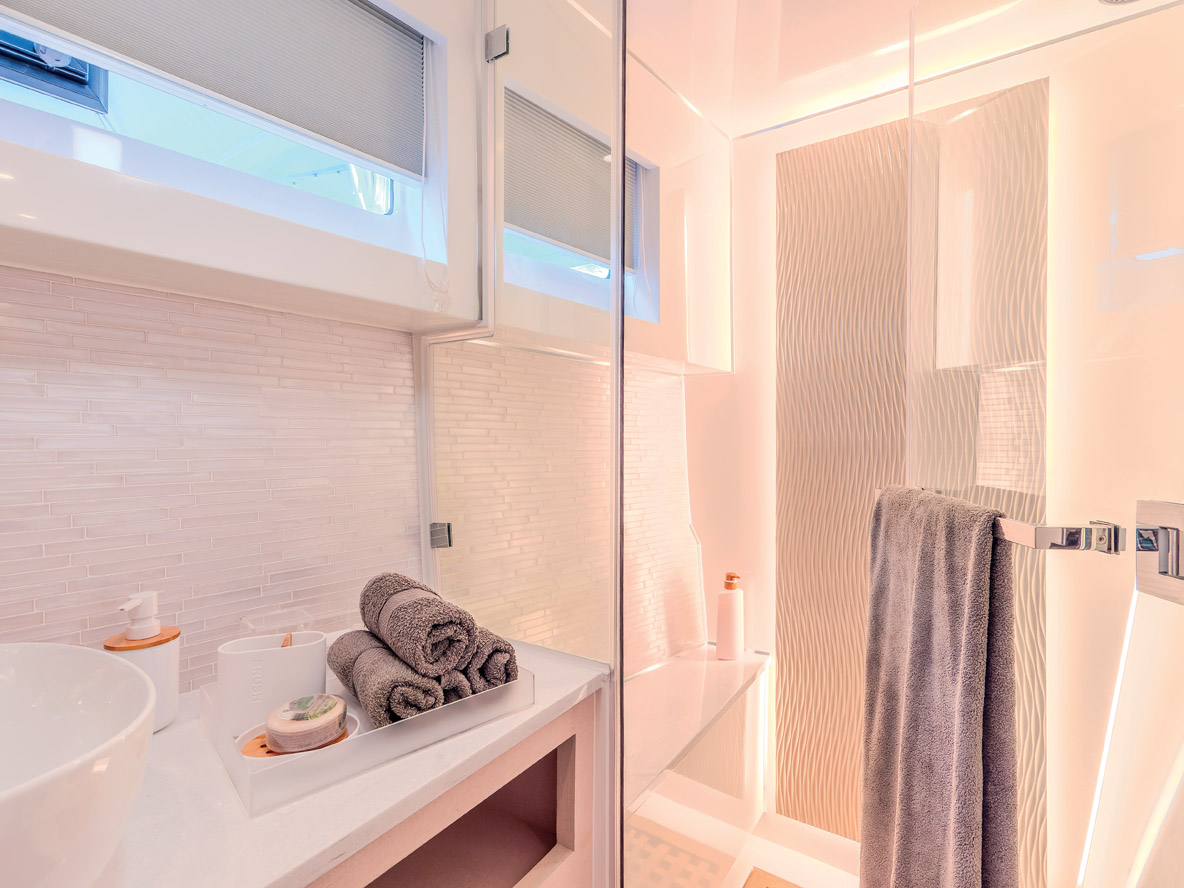
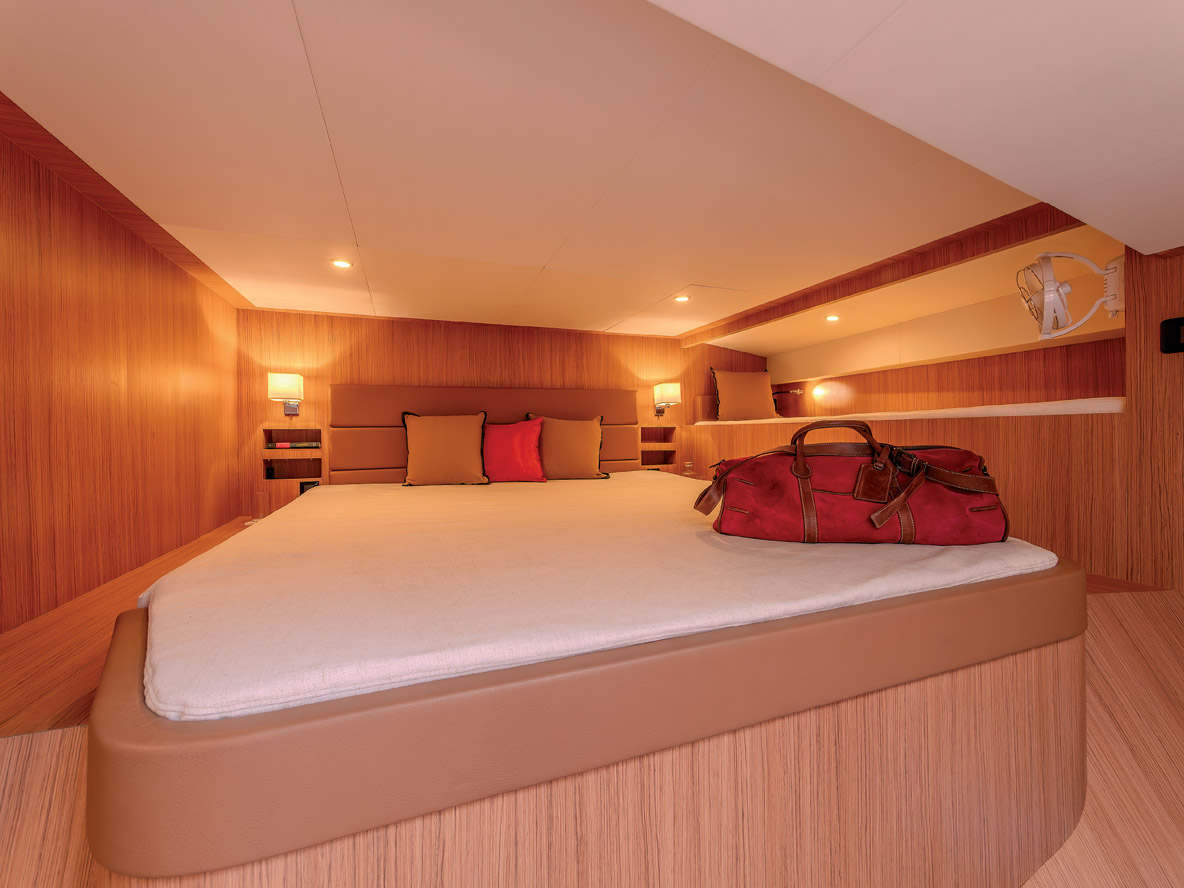
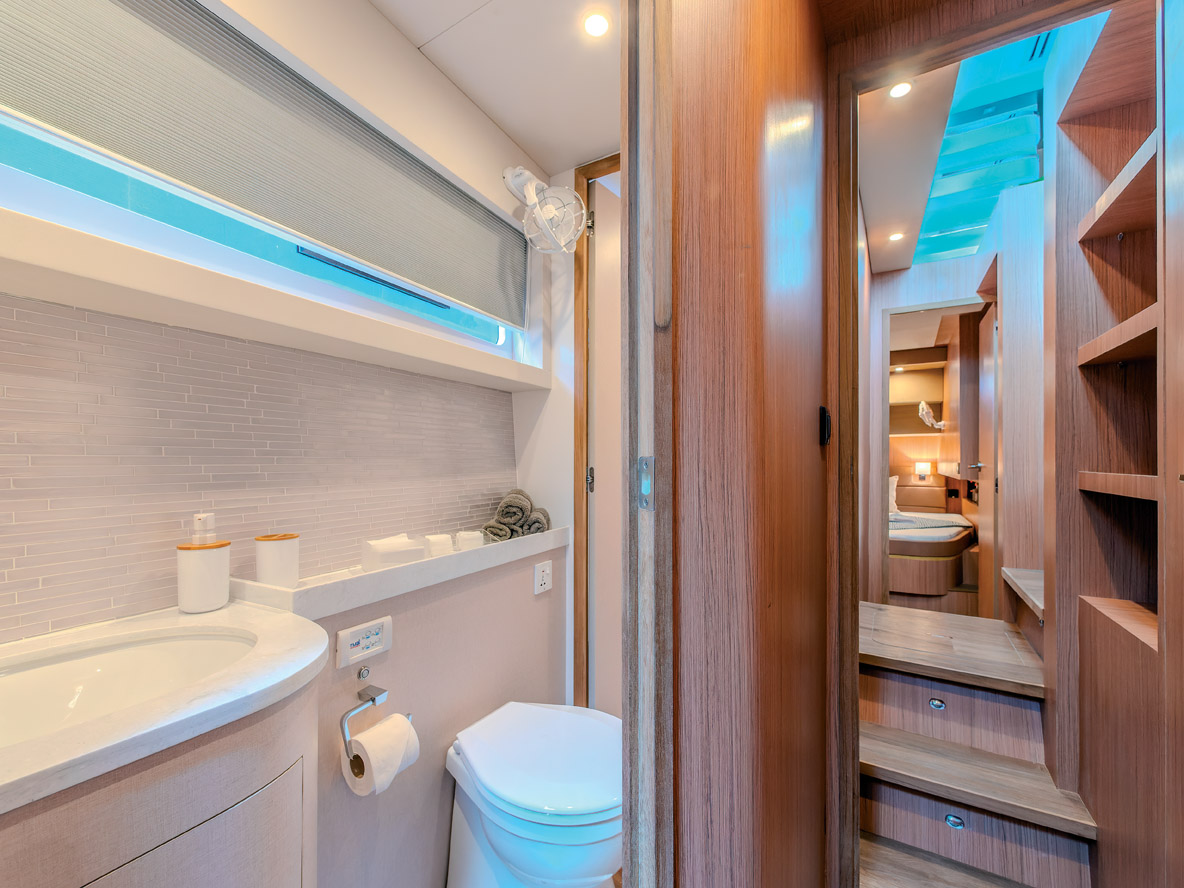
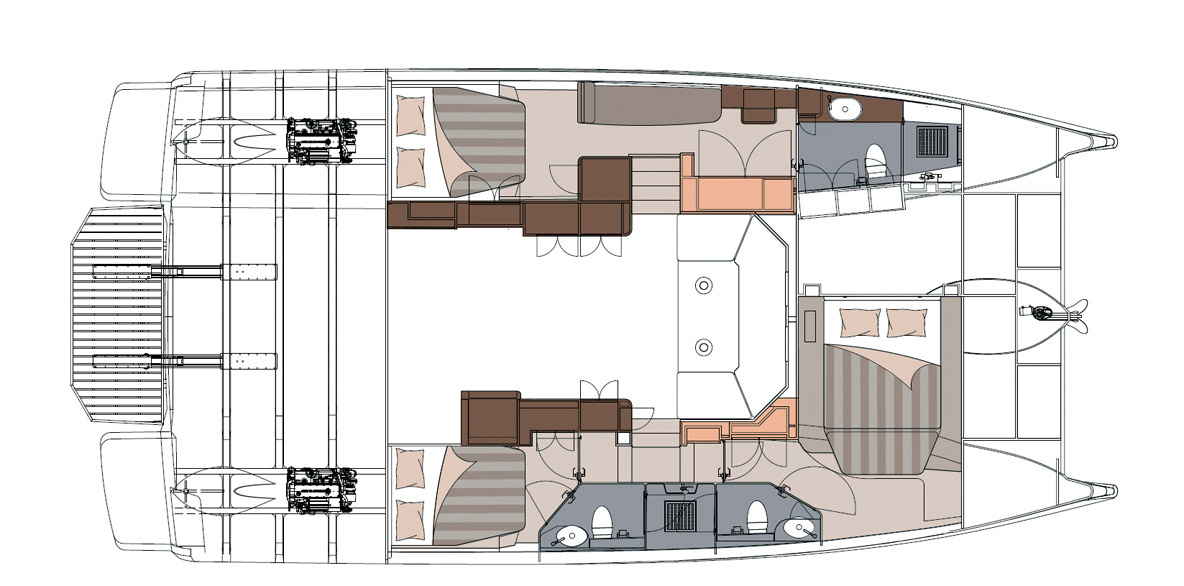
Available in four or three cabins, the former ideal for charter. Our review boat was a family vessel for the owner and his children, so had the entire port hull as one suite. Stepping down into the cabin, I’m met by a chaise longue style couch that could do for overnight, while to the aft is the crawl-in double bed, measuring 67” x 78” (1.7 x 2 m). Surrounded by tall wardrobes and big cupboards, with lots of natural ventilation, again the Cora 48 shows its practicalities. Walking forward takes me past the vanity table with seat, to the longitudinal bathroom with stylish tiled sides and teak finishes. The shower has a seat and teak grating with large drainage.
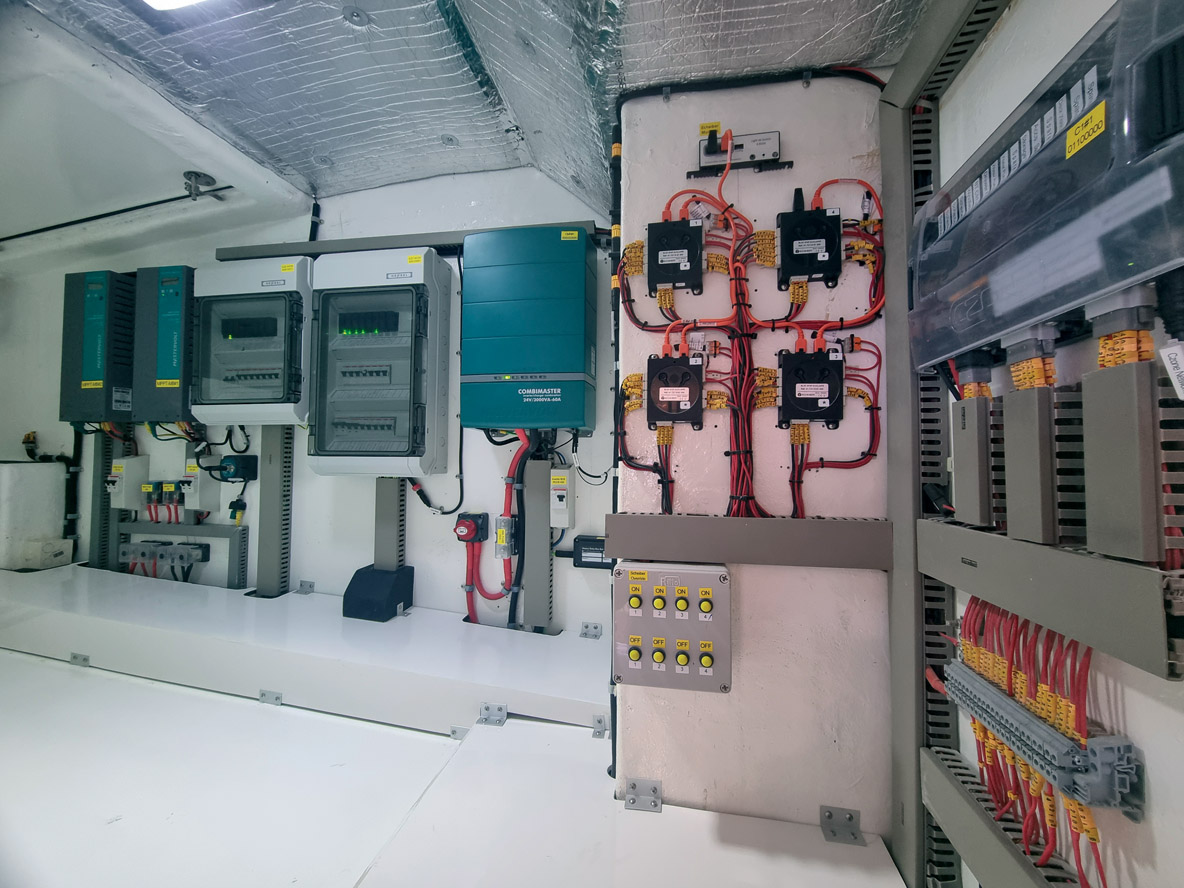
Near here lies a secret – a door behind another door - leading into the nacelle that is a large crawl-in space for the electrical system: a technician’s dream.
Walking across the saloon, in the starboard hull are twin cabins with ensuite between along with a shared shower unit. Impressive. The forward athwartships bed has enough space to allow occupants to sit upright and the skylight gives air. The aft guest bed is the same as the owner’s, so spacious and again with good storage natural ventilation. In terms of the fixtures and fittings, quality metal catches and perfectly fitting doors are the norm on this impressive Cora 48 Catamaran.
A Robust Hull with Good Sea-keeping
Coastal cruising is ideal territory for this type of flybridge powercat, away from the rigors of the open ocean which can make this style of vessel uncomfortable. Instead, hugging the coast and even beaching the vessel is in the remit of the Cora 48 Catamaran, and a major reason the owner – a Queensland farming family – chose this particular vessel: “We live in a place call Bowen which is muddy and with a long beach and being farmers, we plan to tow it up the sand with our tractor,” he explained.
Australia’s far north has some of the largest tides in the world, reaching 33 feet (10 m) plus. Having sailed there and seen vessels beached, I appreciate the PMG Shipyard’s efforts in ensuring the Cora 48 Catamaran can be dried-out: the rudders and hull shoe protecting the propellers. Monolithic around these pressure points, with foam vacuum infusion beyond. This creates a fairly lightweight hull, more easily propelled by the modest 280HP motors. Hull structure includes watertight bulkheads – for the engine rooms and bows. Build standards offered by the yard include to AMSA Australian charter and European CE, as well as Lloyds. Looking at the nacelle height during my sea trial, it looked more than adequate and is quoted as 2’9” (0.85m), light displacement.
Motoring in the calm conditions behind the sheltered islands of Australia’s Gold Coast was ideal for the Cora 48, albeit a rather easy test. Yet, this is what cruising owners will mostly do. However, the wake from passing powerboats created substantial wave motion that was easily dealt with, as the swell was swept beneath the tall bridgedeck. Performance is modest, as expected for the power-to-weight ratio, yet if required, the nearly 17 knots was available when I used maximum throttle. At cruising speed – about 10 knots – the Cora 48 Catamaran happily jogs along with frugal fuel figures noted of 2.5 US gallons (9.45 liters) per hour. According to my workings on our sea trial, the Cora 48 can cover 1,600 nautical miles on a single tank, which is pretty good.
The Steyrs were quiet and their gearboxes smooth when I engaged reverse to spin the vessel round. For experienced powercat skippers the thruster is hardly needed but for others, it’s handy for coming alongside a dock when a side wind is blowing the tall topsides. Sitting on the bucket seat proved comfortable and the clear plastics sealed the console, along with the shade from the hardtop.
Conclusion
Ultimately, the Cora 48 lives up to its promises: this powercat is built for purpose – a coastal cruising vessel with moderate power and plenty functionality and comfort. Its moderate power combined with large fuel tanks gives it record range. This new model also offers a host of features and maximum comfort. Last but not least, it’s a semi-custom catamaran, which means it can really be adapted to your needs, and at a sharp price. What more do you need?
The Pro’s Opinion: Intelligent Systems
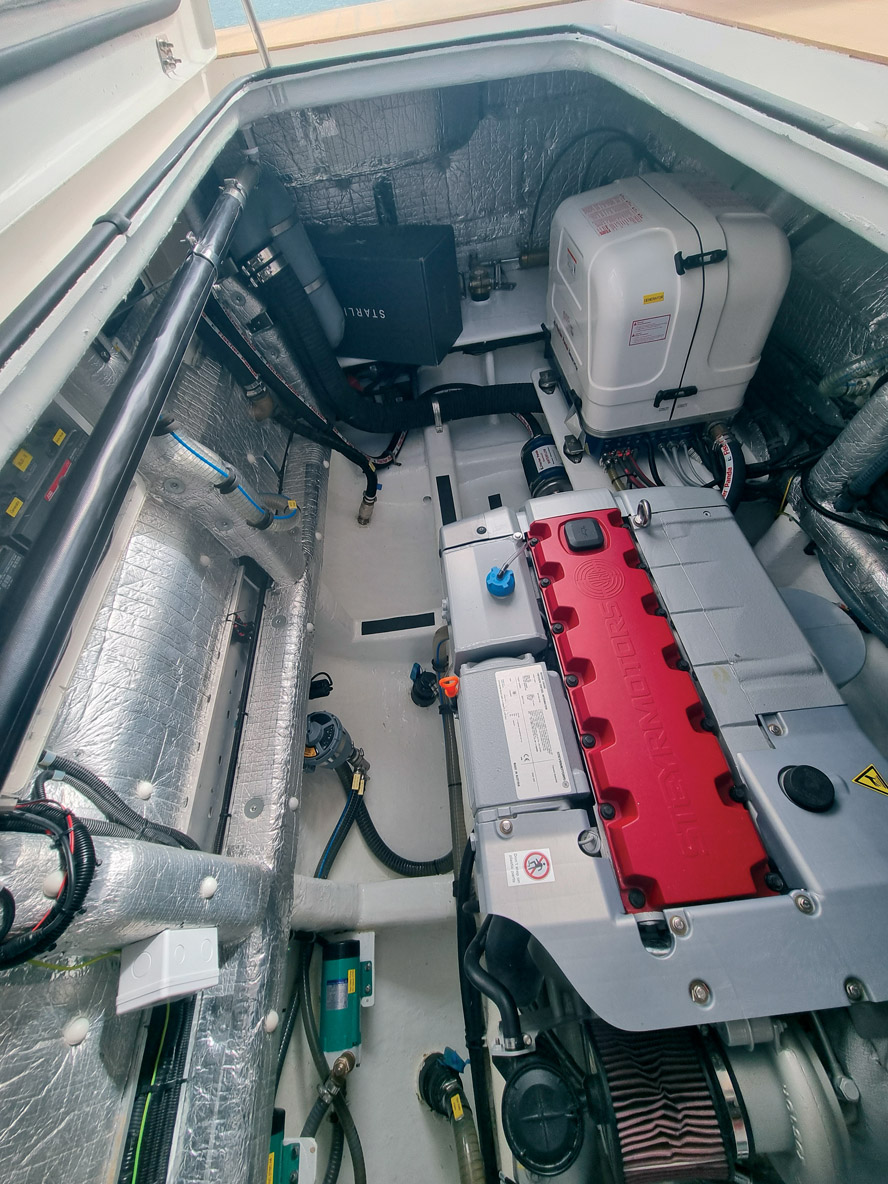
In terms of engines, the twin 280 HP Styre alloy engines are designed for displacement speeds only, thus the long ranges available. Their alloy construction and forward gearboxes with V-Drive save a lot of space (yet the trim was fine when at sea I found). Generous space is available around the engines to reach all service points. Outboard of them I noted the sturdy quadrant and crossbeams for the hydraulic steering system. The starboard side also housed the Fischer Panda 15 kVA generator while over in port was the 42 gal/160l per hour Stella watermaker with 64,000 BTU reverse-cycle air conditioning system. Other notable features in both engine rooms include good ventilation (from grills in the topsides) and the Fireboy fire suppression system.
Range
On-board comfort
Step before the interior saloon
Sugarscoops a little small
technical Specifications
Architect: Albatross Marine Design
Length overall: 48’5” (14.75 m)
Beam: 23’9” (7.23 m)
Draft: 3’3” (0.99 m)
Air draft: 22’8” (6.79 m)
Light displacement: 28,160 lbs (12.8 t)
Laden displacement: 52,910 lbs (24 t)
Standard engines: 2 x 280 HP Steyr
Fresh water: 211 US gal (800 l)
Fuel (approx.): 528 US gal (2,000 l)
Black water: 79 US gal (300 l)
Grey water: 79 US gal (300 l)
CE Certification: Category A
Price: US$ 1,450,000 ex Shipyard (Thailand)