
We now know that the catamaran is inevitably the future for motor boats… The proof, with this Flash Cat 44.
Infos pratiques
- Le chantier : Flash Cat 44
- La fiche technique
- Découvrez notre vidéo exclusive
- Financez votre FlashCat 44
- Assuez votre FlashCat 44
- Articles autour du FlashCat 44
We are always happy to see new players in the world of multihulls. For three years now, the Spanish builder Flash Catamaran has been very seriously developing its motor catamarans. It presented its latest boat at the La Ciotat Boat Show, and we were able to test it. Whilst a spring climate had reigned over the Mediterranean coasts for several weeks, the greyness and the low ceiling of the famous 'sea air' took pleasure in reducing the brightness of our test day. We did our best not to see in this a symbol of the surrounding economic context, but rather the image of a motor multihull market which is slow to take off. In fact, since Lagoon withdrew, and apart from Fountaine Pajot which is persevering with success, and Leopard, which more and more regularly points its South African bows in the direction of Europe and the USA, very few big production companies are involved with more exotic productions, or those closer to the super-yacht (Bamba, VG, Alu Marine...). Not forgetting Sunreef and its famous 70' of course, which, by attracting Monsieur Laurent Bourgnon himself, threw a huge pebble into the sailing catamaran pond!
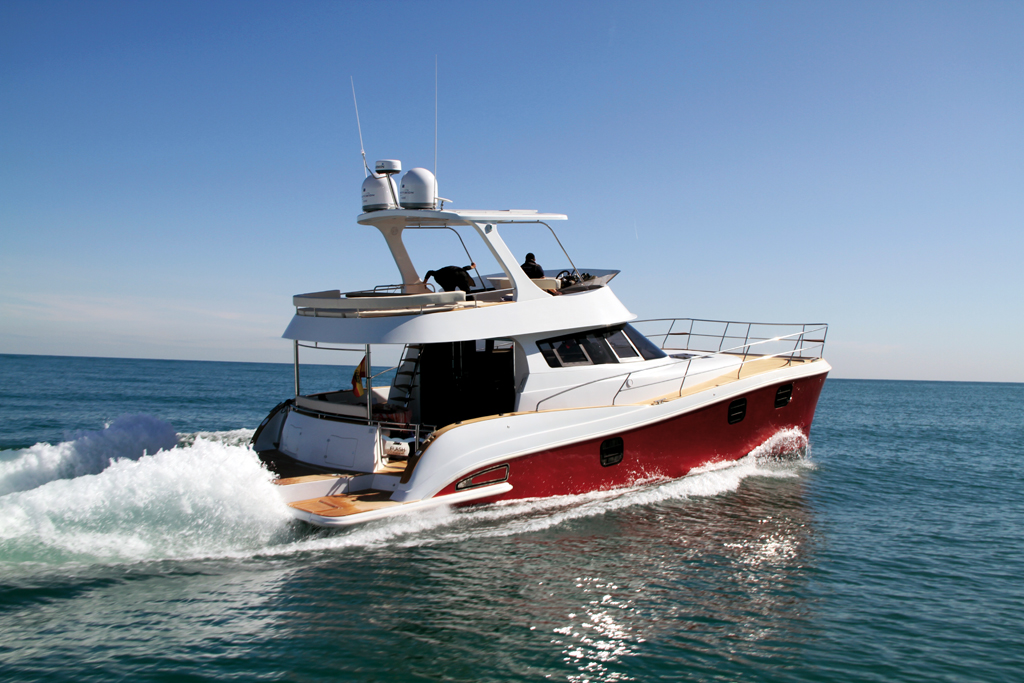
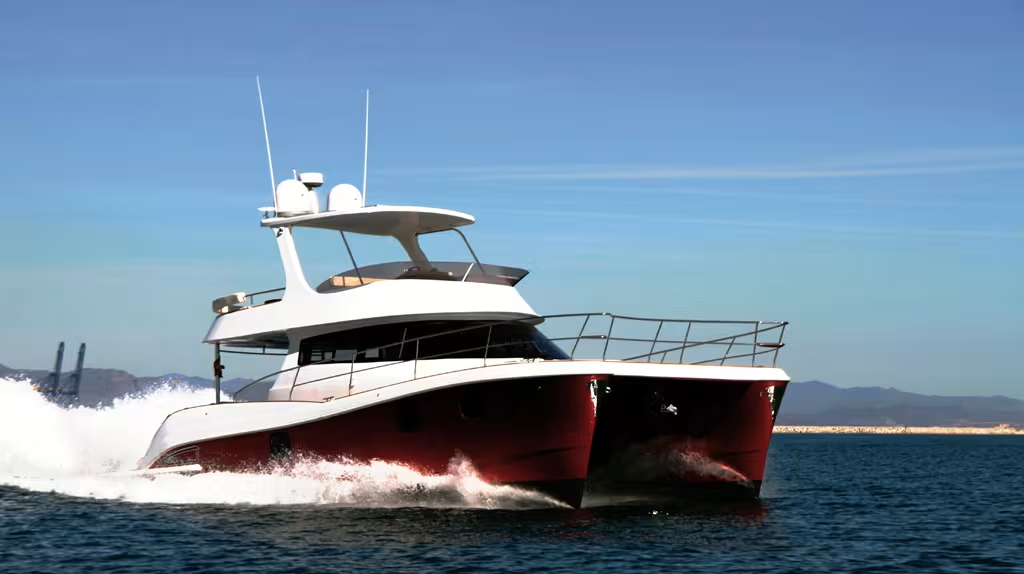
Flat out, the Flash Cat took us to 23 knots with ease.
Flash Catamaran: birth of a builder
A formula with many attractions and few players; this is all it took to convince the enterprising Jordi Molina, three years ago, to launch himself into exciting, but oh so risky project of creating a boatbuilding business. We raise our hat here to him for this step, which was wise, methodical and rational, but which for all that did not lack ambition. The first good reaction, for the first model, was to engage the services of a well-known boatyard in Almeria, which specialises in working catamarans (fishing and passengers): the result was a 43-footer dedicated to leisure fishing, the 43 Fishing. Boosted by the good reception and conscious of the need to reach a wider clientele, a first more cruising-oriented development was launched, with notably a much larger flybridge: this was to be the Flash Cat 435. The yard was then repatriated to Valencia, to be closer to its head office, control production better and go up-market. The idea was also to satisfy a clientele which is certainly cosmopolitan (100% of sales are for export), but attracted by the Mediterranean climate and the proximity of the Balearic archipelago.
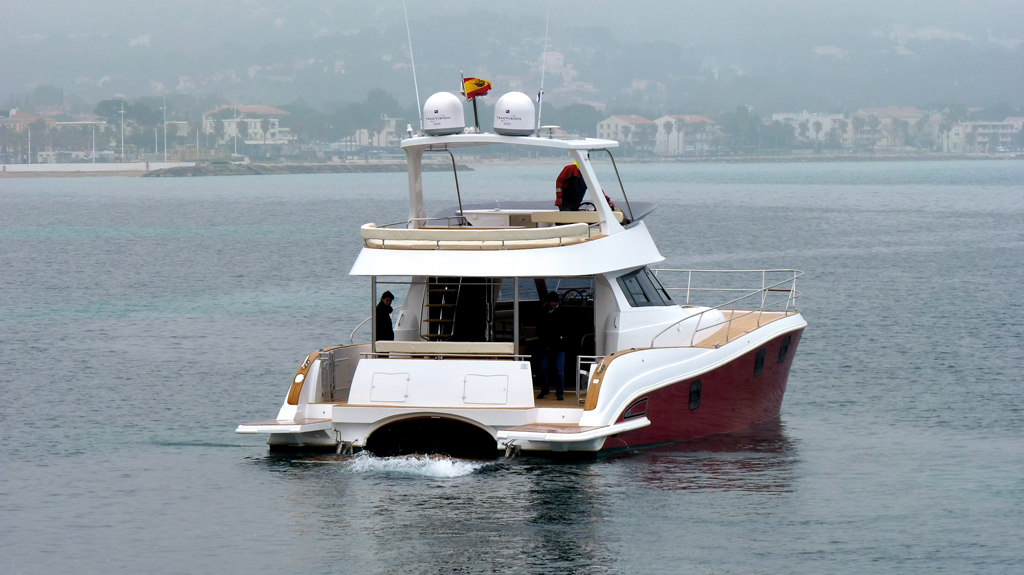
Although the weather didn't cooperate for this test, we were able to enjoy to the full this motor catamaran which offers the prospect of some good cruising…
A modern, attractive 44'
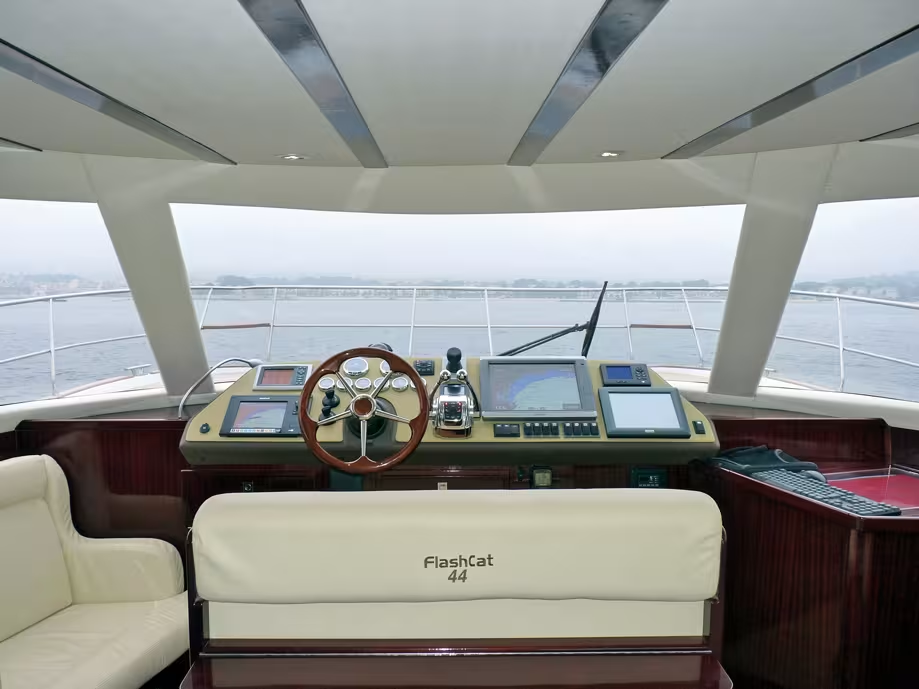
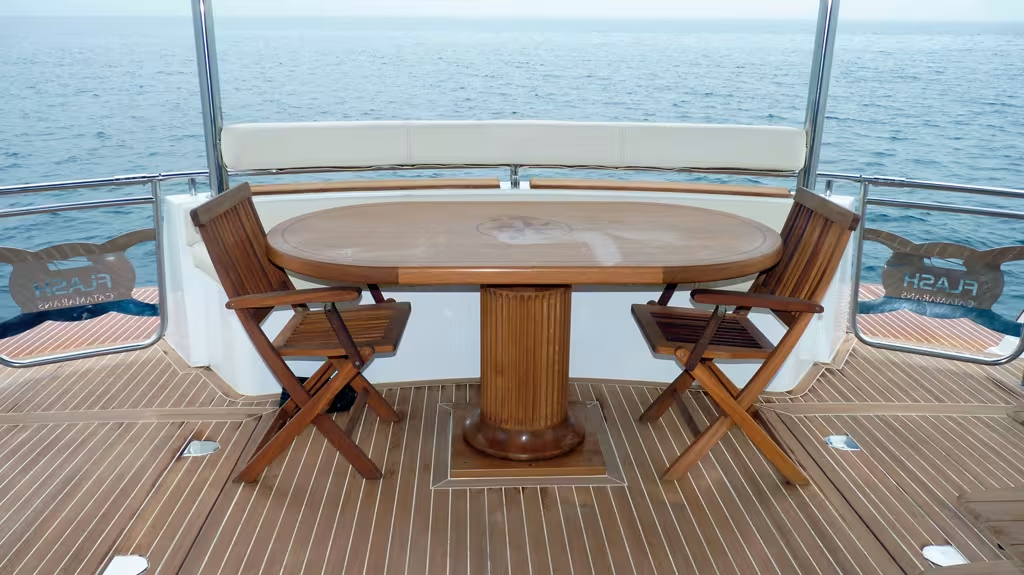
The latest in the series, the Flash Cat 44, which we discovered two days before the opening of the La Ciotat Show, is the fruit of three years' development. In the 'raspberry red' livery chosen by the owner, it could not be missed in the basin. Stocky, but with a well-designed shape, the bows are high and well-protected, and a PVC protection bulwark girdles the whole boat. First impressions: this is a real ocean traveller which will fear nothing. And the construction processes confirm this: hull in monolithic polyester, with a first layer in vinylester to do away with any risks of osmosis, seriously dimensioned floors, and all this carried out using the infusion process. But on looking closer, the lines, designed by the Italian architects Mezzera and Gandino, descend again prettily towards the bows. The aft platform, the cockpit and the teak deck give a first warm touch. The stainless steel gates with the builder's coat of arms and the wonderful three-door 'picture window', which opens wide onto an opulent interior, finally reassure: this boat is also civilised. And this is the biggest difference from its predecessor, the 435: the accommodation is much more rational, the impression of space is unrivalled, and the finishing has progressed noticeably. And although every centimetre gained between the hull's exterior and interior moulding (the same as those on the 435) is important, although the 30 cm added to the aft platform are not anecdotal, it's above all the modification of the accommodation plan which has changed everything. By gaining a door, the 'picture window', opens wider onto the interior, which is on the same level as the cockpit, assisting communication and conviviality. By getting rid of the heads which intruded on its predecessor's nacelle (not really essential at this level), the 44 has gained in all other respects: a real saloon, a galley worthy of the name and an interior steering position which is, how can we say it...magnificent! Central, offering a panoramic view which is as pleasant for enjoying the scenery as it is reassuring for avoiding any dangerous encounters, its double settee will comfortably accommodate the pilot and co-pilot in bad weather.
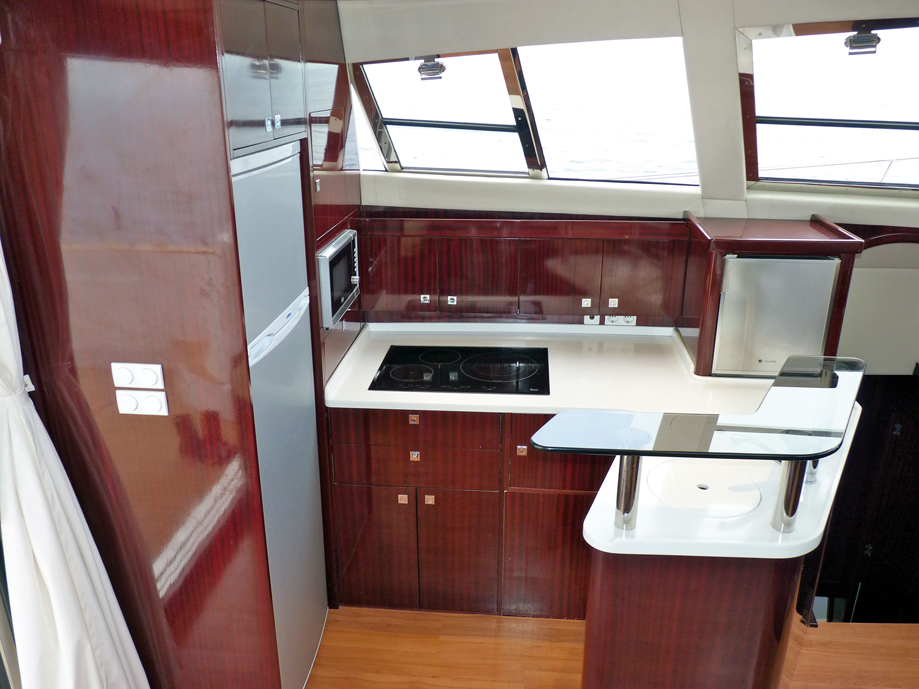
The new accommodation is really successful and the atmosphere aboard is very pleasant...
A first trip round the deck before the departure. The side decks are wide, and the stainless steel tubular rail displays the attention paid to safety. With few obstacles and additional handrails where needed, the Flash Cat is reassuring. To go up onto the flybridge, the 435's imposing polyester staircase has been advantageously replaced by a very nice stainless steel and teak ladder, which is much more visually discreet. As a consequence of maximum protection of the cockpit, the cut-out in the bimini is quite small and you have to keep your head well forward to avoid bumping it. But the angle of the whole assembly allows you to descend facing forwards, just like a real staircase. On the upper level, the area is impressive (18m²) and accommodates: - a double sunbathing area (135 x 185 cm), - an aft saloon, - an exterior galley, - a central steering position with a two-person seat. This is the ideal steering position for leaving the quayside, whilst for coming alongside, an aft camera will prove to be almost essential.
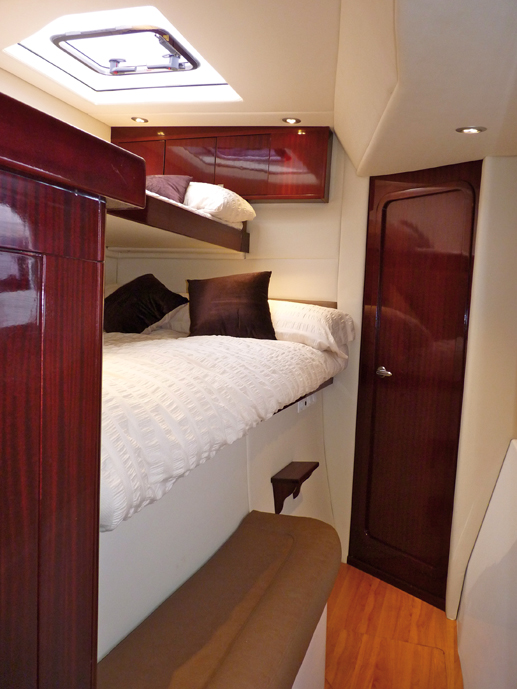
The forward cabins are pleasant and both the ventilation and the light attract only praise.
At sea
Once the mooring lines were cast off, the Flash Cat zigzagged between taut mooring lines, pontoons and shallows with disconcerting ease. Is the multihull's traditional ease of manoeuvre, assisted by two engines offset from the boat's axis, the only reason for this? No. Flash Catamarans has done even better by fitting the Zeus system, from the American engine manufacturer Cummins, to our test 44. The precursor of the pod navigation systems since 2006, Zeus offers a 360° joystick steering system which is quite simply amazing, in the absence of a bow thruster. Loaded with all possible options, and easily exceeding the unladen 13.5 tonnes given by the builder, the owner has opted for 400 hp engines (which are easily accessible from the cockpit, but almost too powerful) to replace the standard 170 hp engines. The latter, as even the builder acknowledges, will be advantageously replaced by the 270 hp version, which is the most rational engine for the size and displacement. But we must admit that positioning this already sizeable boat to the millimetre is real child's play: rotation around the axis, lateral displacement, everything can be done with the fingertips, and just one hand. Simply starting to turn the large knob which controls both power and direction miraculously corrects any deviation from the desired axis. With double controls on the flybridge and inside, as well as the wireless model, you are always in the right place to carry out the manœuvre of your choice: MAGIC! In the absence of rudders, the two pods, which turn through 360°, are each equipped with two contra-rotating propellers, one with four blades, the other with five. Advantages, according to the builder: 30% lower consumption and a 15% increase in both cruising and top speeds. The last 'thing' which confirms the end of traditional navigation: the 'Skyhook'. If you want to stay at a fixed point without having to drop anchor (waiting for a berth on the quay, or for the fuel pump to be free...), press the ad hoc button, the electronics will integrate your GPS position and play with the throttles and the orientation of the pods, so you do not move a whisker. Reassuring.
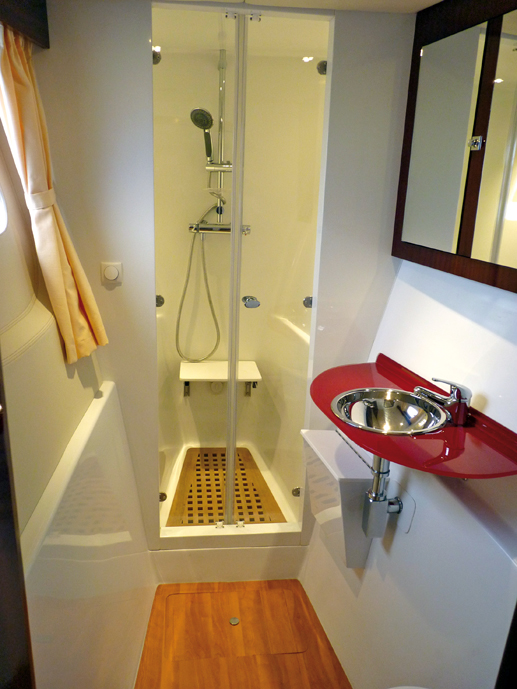
The heads, especially the forward ones, are very attractive, with even a separate shower and...a sauna!
But on our test day, the air was cold and damp! It was time to climb down from the flybridge and return to the comfortable interior. From the twin steering position, we would be comfortable to test the various engine speeds. Manuel, the builder's likeable skipper, set the throttles to 2,700 rpm and we were immediately at 19.6 knots. My preference was rather for a steady 15 knots at 2,300 rpm - a source of economy, because the consumption is reduced from 60 to 43 l/h per engine, and more in accordance with the concept which favours comfort/consumption over speed. If you are in a hurry, however, note that we easily reached 23 knots. From the nacelle, whatever the engine speed chosen by the skipper, noise and vibration were always well-contained. But this crucial point is best judged from the cabins. The forward ones are inevitably the quietest. That's fine; they are also the most spacious. Only the access to the very high-perched bed (110cm) could be criticized. But the dimensions of the berths (triple to starboard and 180 x 190 cm to port), the brightness offered by the large deck hatch, the ventilation it provides, and the equipment are irreproachable. The heads also cannot be criticized. Although the aft ones are of a minimum size, because of their central position, those forward are very attractive. Notably the one in the port hull in our test version, which had a separate shower and even...a sauna! A real problem for the builder to fit in, but the kind of challenge that only a small structure is able to take on, to allow its customers all their eccentricities. These are not all to be reproduced: thus the starry sky of leds under the flybridge's rigid bimini is certainly superb at night, but during the day, the random scattering of the multitude of tiny holes reminded us more of a finishing problem!
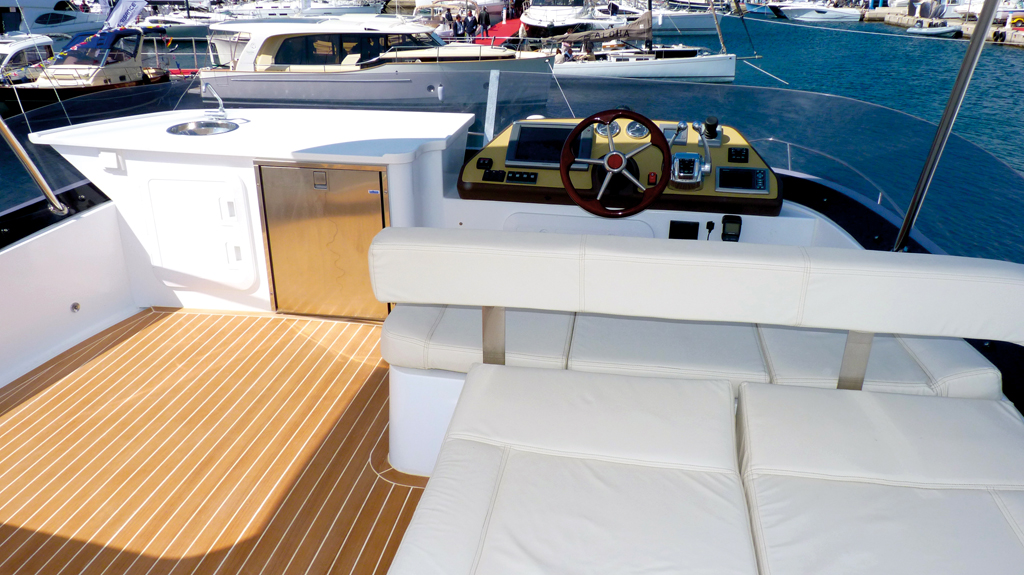
The key part of the Flash Cat 44, the flybridge, is of course an essential on a motor cat, with its nice steering position.
Before returning to the harbour, a little demonstration of the hydraulic platform was essential. The weight is certainly significant (800 kg), but here again, what comfort! Whether for access from the quay, swimming, raising the dinghy or, as planned by the owner, a jet ski, it is ideal. Once we had returned to our place on the quay, we could take advantage of the saloon for a while longer. Our Spanish hosts, Barbara and Sefo, know how to welcome guests and got out the tapas. The galley is perfectly fitted-out: lots of stowage space, a white Corian worktop which is as aesthetically pleasing as it is practical, double stainless sinks and a fridge just like you have at home, but with the view in addition. A washing machine, essential when you really want to live aboard is missing? Not at all, it is just hidden to starboard of the steering position. Top-loading, it is perfectly integrated and practical. The grey weather didn't stop us dreaming. We easily imagined ourselves embarking aboard, and not just for 2 – 3 days. Living aboard the Flash Cat 44 is not just imaginable, it's tempting! From the Greek Islands to the Nordic fjords, via the Balearics, of course, every destination is attractive. We are looking forward to its 75-foot big sister which is on the drawing board and will offer, we hope, the range for an Atlantic crossing!
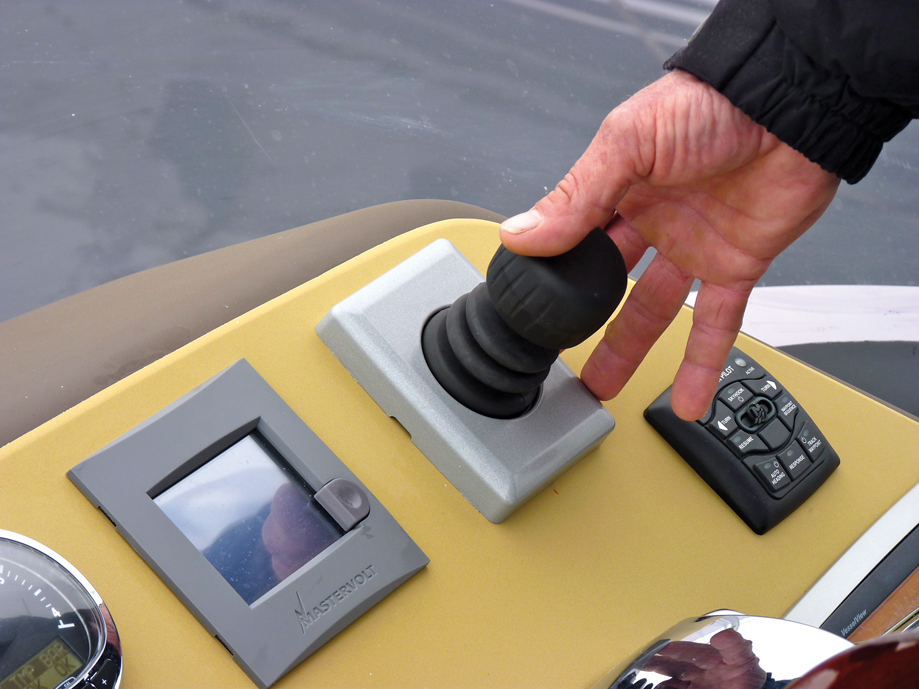
Manœuvering a 44-foot cat with two fingers: it's really easy. A real plus for the Flash Cat.
Technical specifications: Flash Cat 44
Architects: Mezzera and Gandino (Italy) Builder: Flash Catamarans (Valencia – Spain) Length: 13.50 m Beam: 6.10 m Draft: 1.15 m Unladen displacement: 13.5 t Diesel capacity: 1,450 l Water capacity: 450 l Standard engines: 2 x 170 hp Cabins: 4 (3 doubles + 1 triple) Standard price: 448,000 exc. VAT Main options: 2 x 270 hp engines: 24,900 euros exc. VAT 2 x 425 hp Cummins Zeus engines: 108,800 euros exc. VAT Aft platform, cockpit and flybridge Tecaflex: 10,900 euros exc. VAT Tecaflex deck: 8,900 euros exc. VAT 6 kVA generator: 14,670 euros exc. VAT Air conditioning, forward cabin and saloon: 15,800 euros exc. VAT Flybridge bimini: 17,900 euros exc. VAT Hydraulic aft platform: 22,650 euros exc. VAT
The plusses
Living comfort aboard The reassuring seaworthy aspect The Cummins Zeus engines
The minuses
A few finishing details The height of the berths The ventilation of the aft heads
Performance / Consumption
Engine speed RPM 3050 2700 2300 1900 1550 1350 Speed Knots 23 19.6 15 10 9 8.5 Cons/engine Litres/hour 90 60 43 28 16 10.5 Range Nautical miles 179 229 244 250 394 567
