
Fountaine Pajot was certainly the first yard to take a long term view on building power catamarans … and how right they were - today the market is booming! At Porquerolles in the South of France, we took a look at the latest model in the Motor Yacht range, the MY 37.
Infos pratiques
- Le chantier : MY 37
- La fiche technique
-
 Découvrez notre vidéo exclusive
- Financez votre Fountaine Pajot MY 37
- Assuez votre Fountaine Pajot MY 37
- Articles autour du Fountaine Pajot MY 37
100% Motorboat
Fountaine-Pajot have always believed in powerboats. They were initially pigeon-holed as Trawlers, (a name which doesn’t do justice to these boats which truly are yachts), and the yard then decided to completely overhaul their range, whilst maintaining two key principles: boats designed 100% as motor boats and with powerful motors. There's another new thing with our MY 37: it signals the abandoning of the boats being named after exotic locations or paradise islands - Queensland, Maryland, etc. Their sailing catamarans have kept their nice christian names, but the power range is now content with a simple MY, which stands for Motor Yacht. Here’s the difference: some manufacturers have simply amputated the rig from an existing catamaran, and developed the lines of the hulls to be able to carry greater loads, thanks to larger motors and to counter the effect of the bow coming up. Fountaine Pajot on the other hand produces models which are designed and conceived purely as power boats. Significantly, these catamarans are higher and narrower. So in a way, they are closer to traditional motorboats, with which they are in direct competition. As for the motors, the MY 37 offers either 2 x 150 hp or 2 x 220 hp under the hood. Compare this with the Lagoon 40 MY with only 2 x 75 hp, the Nautitech Power 40 with 2 x 40 hp (or 2 x 55 as an option), or the Bali 4.3 MY which goes up to 2 x 160 hp. Only Leopard, admittedly with a boat two meters longer overall, stands out, with 2 x 260 hp. What this means is the possibility to maintain a higher cruising speed. And not necessarily consuming more fuel at the same speed, contrary to many expectations: at 7 knots, each motor, large or small is using about 5 liters per hour. Fountaine Pajot is gambling on the fact that owners of power catamarans won’t be satisfied by a low top speed preferring, for short passages to be able to put the throttles down and be nudging 20 knots.
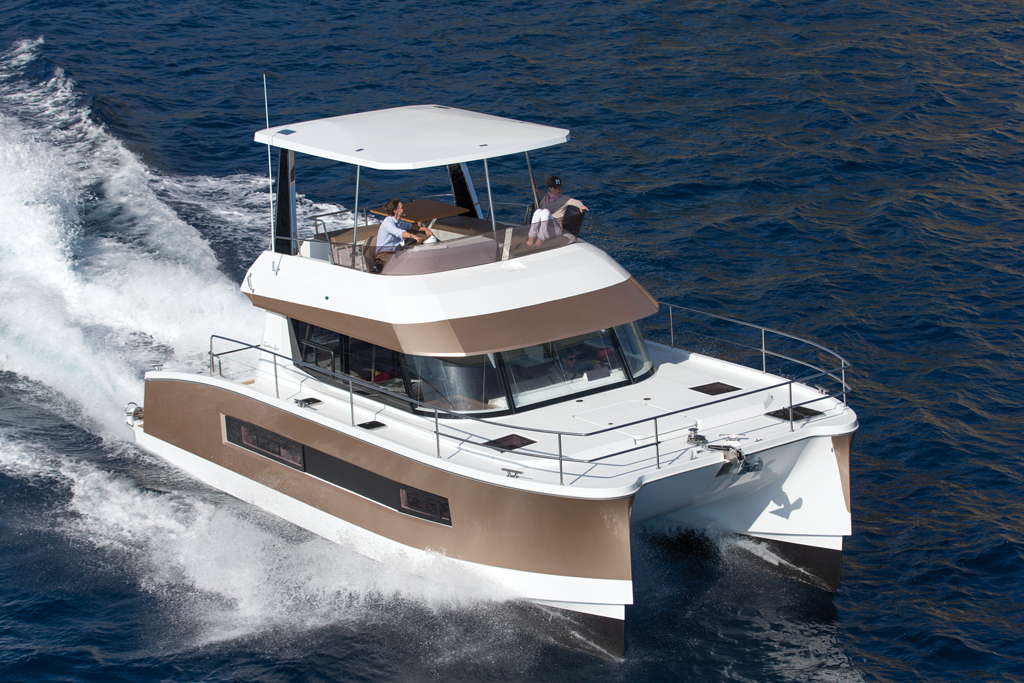
The hulls are fine at the waterline, but increase in volume above this with a marked step. This gives greater volume inside, and also deflects spray.
A good-looking boat
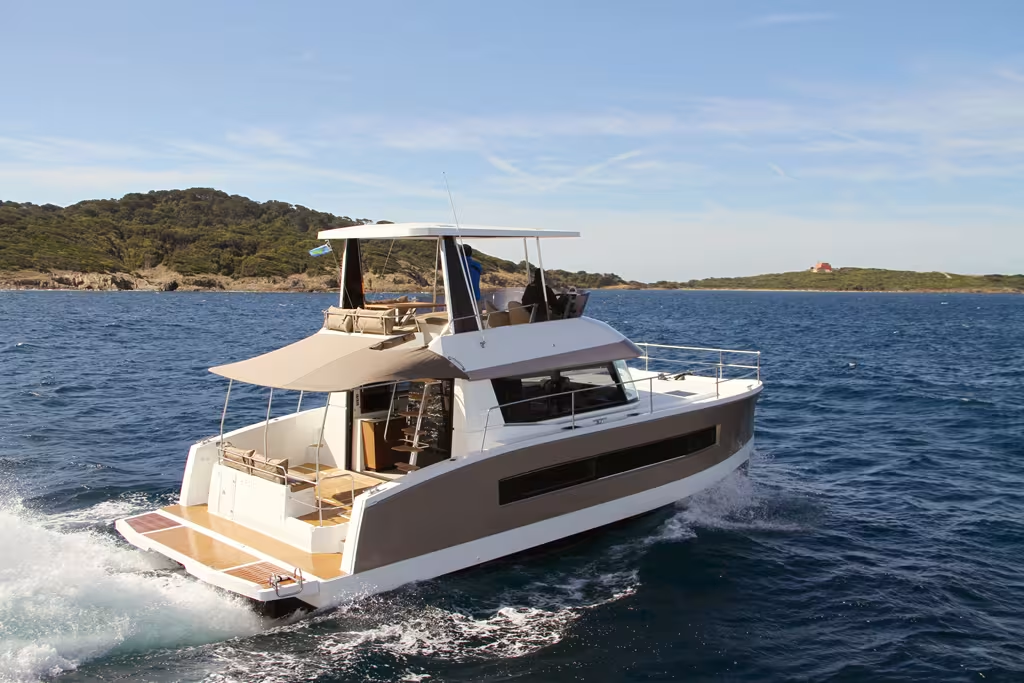
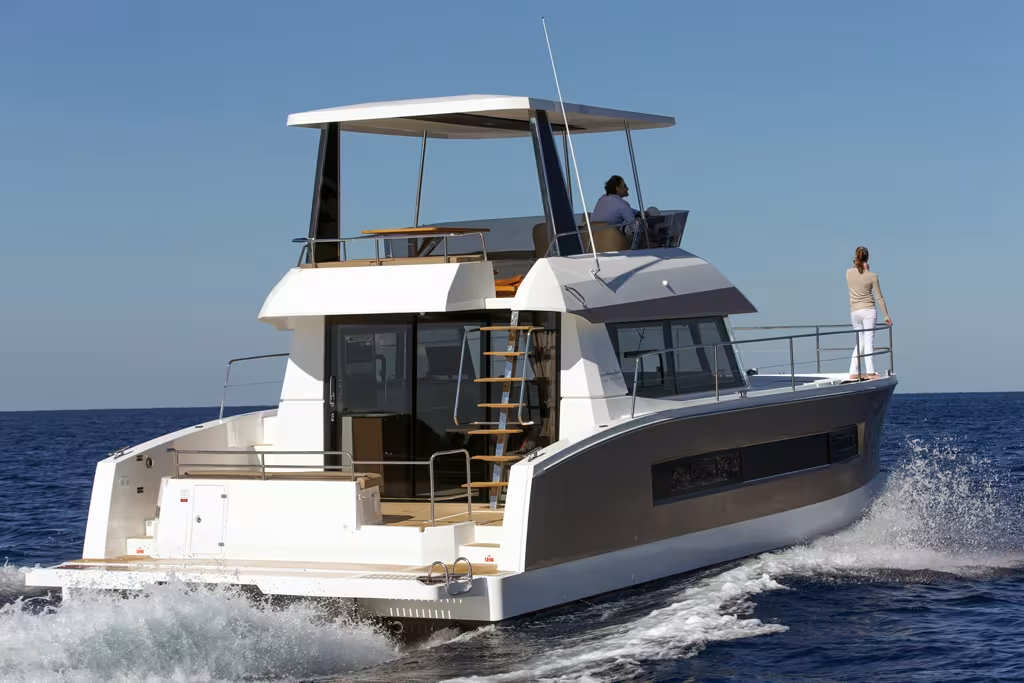
The MY 37 is higher off the water (average freeboard of 91cm) than her competitors, but more importantly, is narrower: 5.10 meters, as opposed to the 6.79 meters of the Lagoon 40 MY which is only just longer. A few dozen centimeters which can reduce your marina charges… and gives neat aesthetics, enhanced by the color scheme: white for the lower hull, bronze for the topsides, a black reveal containing the hatches, and then another bronze layer for the coachroof overhang. All this gives an elegant and modern look to the MY 37, which, as the smallest in Fountaine Pajot’s motor yacht range, is seen as an entry-level boat. Daniel Andrieu’s design team has opted for fine-entry bows which then step out, forward above the waterline, to become a step which continues around each hull. This immediately gives a reduction in wetted area to reduce the wake - and therefore the amount of energy required for propulsion - but is equally effective as a spray deflector. Even though the need for an anti-leeway design is nothing like as important as with a sailing catamaran, the architect has nevertheless drawn the 37 with stubby keels - giving a draft of only 80cm - so as to maintain a bit of grip when maneuvering slowly at close quarters with the wind on the beam. This is important, because the MY has fairly significant windage, especially with the hard-top. And the motors are not so far apart… so perhaps the bow thruster option designed by the yard might not be such a bad idea in the busiest of marinas. The helmsman, up on the flybridge, enjoys an excellent view generally, but can’t see the four corners of the boat. A crewmember on the deck would be handy.
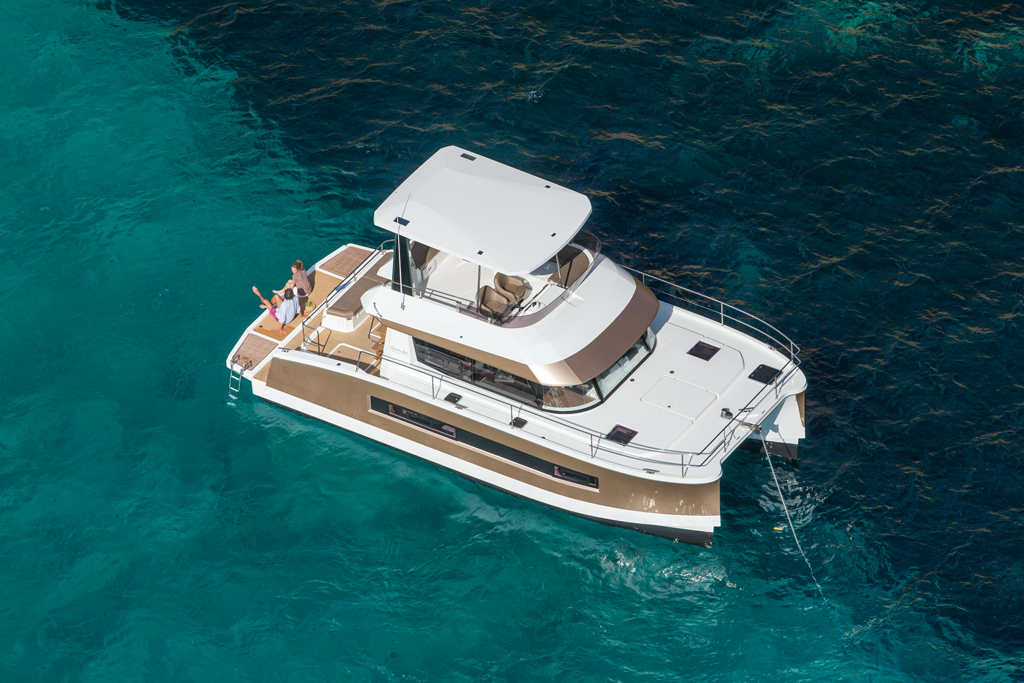
With a maximum beam of 5.10m, the MY 37 sits between powercats originating from sailboats - 6.79m for the Lagoon 40MY, and motorboats - 3.84m for a Velasco 37F, for example.
Sea-keeping qualities
Setting out from Porquerolles, we were met by a chilly 25 knot mistral, a choppy sea and lots of white horses. The MY 37 set off by showing her power, but note that our test boat had the optional 220 hp motors as opposed to the standard 150s. The shaft drives are linked to four-bladed propellers. So we started out very nicely: little pitching and slight rolling, with an excellent passage through the water and very little spray - thanks to the deflector step mentioned above, but also to the very effective inverted windshield. At full throttle (4,000 revs), the 37 pretty much achieved her theoretical top speed of 20 knots. With the sea behind us, the boat willingly surfed down the waves, but remaining in control of the helm. There was no noticeable yawing, and the behavior of the MY remained safe at all times. You can even have some fun putting the helm hard over at full throttle: the boat turns on the level without slipping. Not something you would necessarily attempt with a powerful monohull! Note, however, that the hard-top supports had some play: something which perhaps needs looking at. On flat water, downwind of the island, and at 3,500 rpm, the 37 slipped along at 15/16 knots gently and comfortably. The figures we established under power were as follows: 3 knots at tickover; 3.5 at 1,000 rpm; 5.7 at 1,500; 7.5 at 2,000; 8.8 at 2,500; 11 at 3,000; 15 at 3,500; and 20 knots at 4,000 rpm. And the consumption? Limited to 2 x 5 liters/hour at 7 knots, giving a range of 1,000 nm, climbing to 2 x 22 liters/hour at cruising speed and 2 x 40 liters/hour flat out. But be careful - going along on one motor, a technique much employed on sailing catamarans to assist in light airs, is counter-productive. The boat moves crabwise, and the amount of helm required to keep on a straight course creates a not insignificant amount of drag.
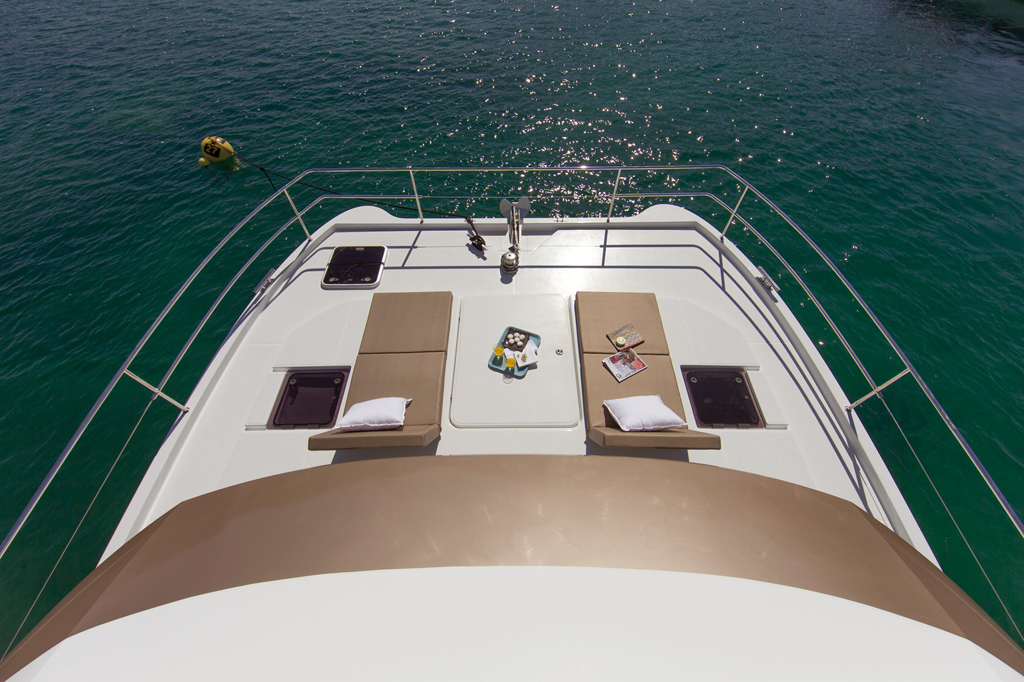
The foredeck is great, especially at anchor.
At anchor
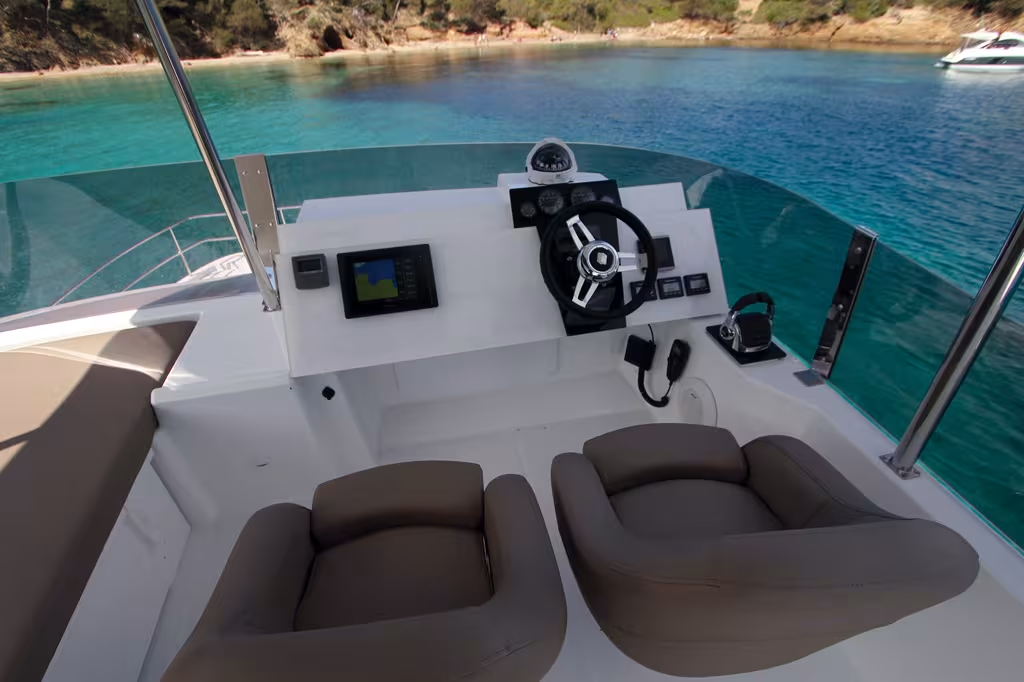
Porquerolles and its crystal clear waters… our first dream anchorage is at La Plage d’Argent. Perfectly sheltered from the Mistral and from the swell, we used the windlass remote control to lower the anchor and the thirty meters of chain. With the beach ahead of us, this operation was easy. We also tried in the Baie d’Alycastre with its azure water, but this bay is exposed to the chop from the west, so it was to the east of Cap des Mèdes with its great rock formations where we discovered a few deserted anchorages. It’s great sailing out of season! Forward of the coachroof, the deck continues almost up to the bows, allowing space for the (optional) sun lounger. The side-decks, noticeably narrower than those of a larger sailing cat, remain very useable, given that they are enclosed by very reassuring stainless steel handrails. The second relaxation area is the traditional cockpit: there is a table which seats six (this is an option, as the yard has designed a table which is for both the salon and for outside), a diagonal way through to the aft platform (which can be completely submerged), and a large bench seat, aft. Access to the flybridge is via a fairly steep ladder, as one of the engine covers is just behind it. Up top, in addition to the helm station and its two bucket seats, there is a table, chairs and vast sun terrace.
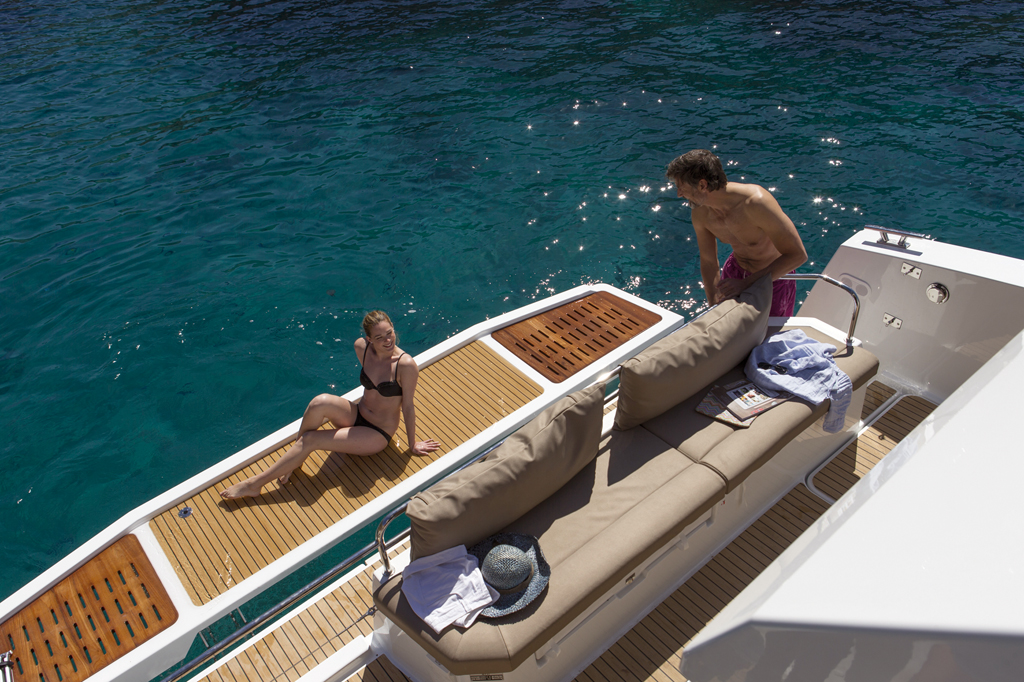
The platform, mounted on struts, can be submerged to a depth of 30cm. It’s just crying out for swimming!
An uninterrupted view
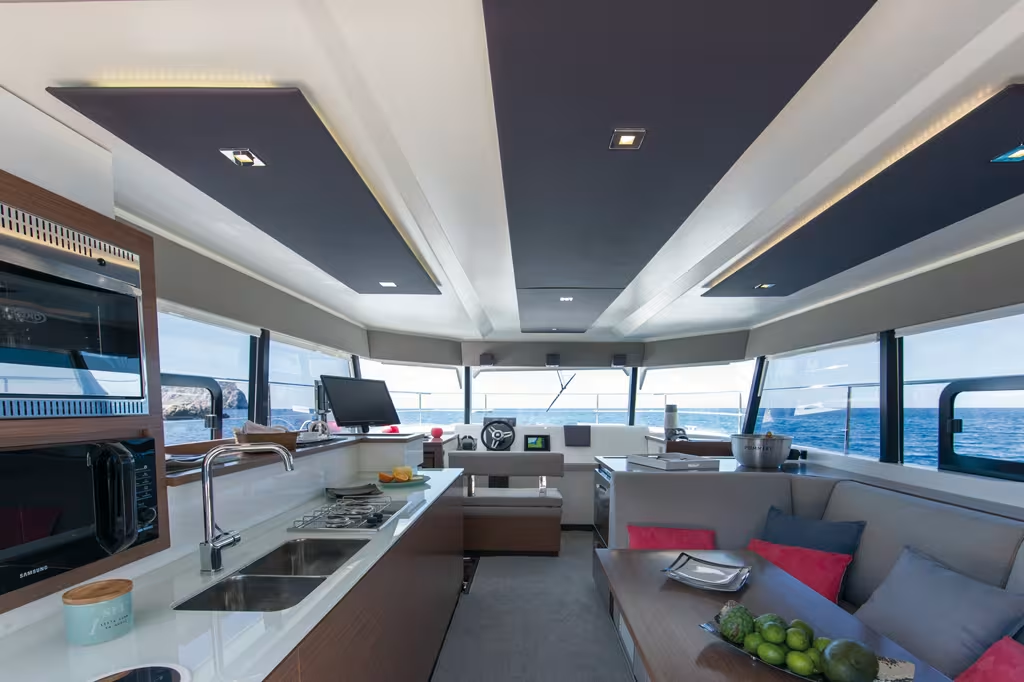
The interior layout is stunning. First off, the doorway is wide, with headroom of almost two meters, and the impression of volume is amazing. The huge nacelle, flush with the cockpit, adopts a style more common to a motor yacht than a sailing catamaran: the dining area is offset to starboard, with a fully fitted galley opposite. All the way forward is, optionally, a cleverly designed secondary helm station. As standard, the yard fits an aft-facing bench seat. Everywhere there are shelves and lockers and cupboards, including three lockers below the deck (in our case, two are occupied by the aircon) which are opened using a clever suction pad. Even the helm seat lifts up to reveal more storage space. The standard of finish and the quality of the materials used are excellent; natural light is omnipresent throughout the day thanks to large glazed areas, and at night, indirect LEDs are most welcome. Unfortunately there are a few sharp corners which could cause the odd bruise in a lively sea. In the hulls, there is the option of three or four cabins. Our test boat is the former version, on which the entire port hull is the owner’s suite. This benefits from an enormous bathroom, with head and shower. In all the cabins, there is headroom of 1.91 meters.
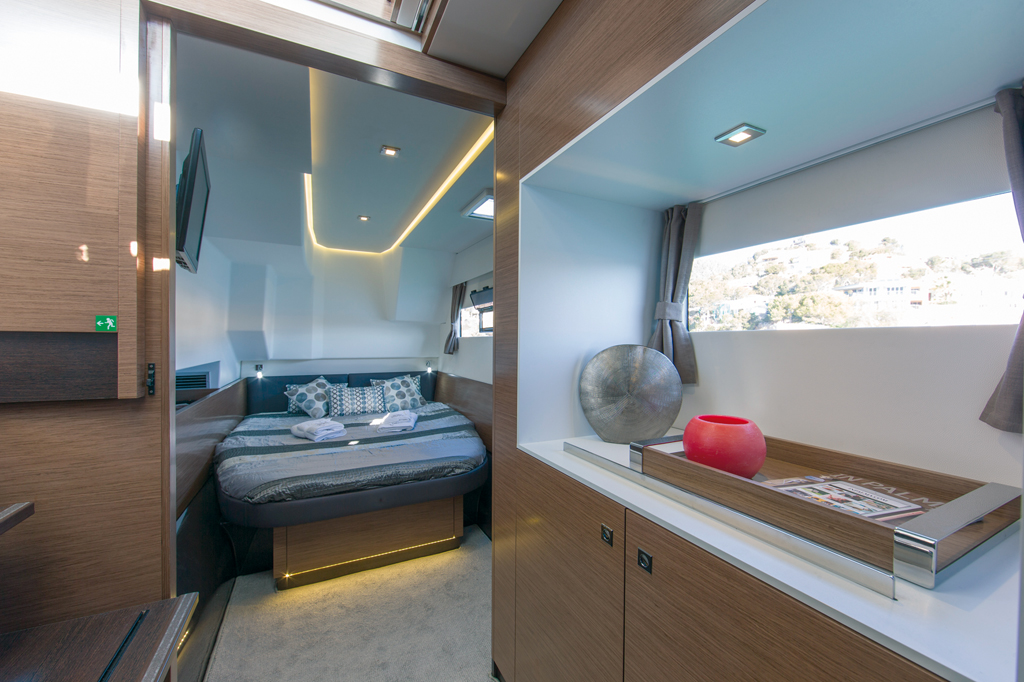
The cabins are really spacious, with great natural light and ventilation.
Conclusion
Already proving popular with the public, the MY37 will be etched in the pages of the company’s history. This is a company which has had the courage to design a proper motor catamaran. Owners of other Fountaine Pajot models, also gathered at Porquerolles, were very enthusiastic about it. Without doubt, this is surely the best reaction that the yard’s directors could wish for!
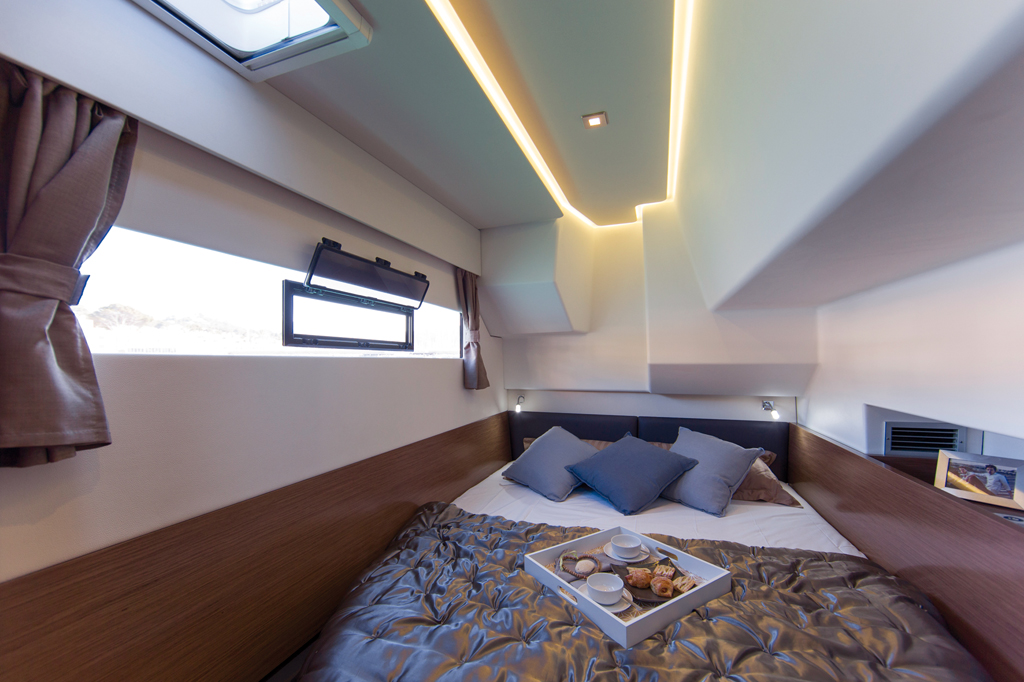
The aft guest cabins, 1.60 m wide are particularly comfortable.
Pluses
- Excellent sea-keeping qualities 1,000 nm range
- Impressive volume for a 37 footer
Minuses
- Rigidity of the hard-top needs reviewing
- From the flybridge, the view of the bows and sterns a is bit limited
- Lack of hand-rails inside
Technical specifications
- Naval Architect: Andrieu Yachts
- Design Builder: Fountaine-Pajot Motor Yacht
- Construction: polyester
- Year first launched: 2015
- Overall length: 11.00 m
- Beam: 5.10 m
- Draft: 0.80 m
- Weight: 8.9 tonnes
- Motors: 2 x 150 or 2 x 220 hp
- Fresh water: 350 liters
- Fuel: 2 x 600 liters
- Range: 1,000 nm
- Cabins: 3 or 4
- CE Certification: B
- Basic price: €284,000 ex-tax
- Principal options ex tax: Teak deck: €9,293 Motors 2 x 220 hp: €6,948 Solar panels: €4,850 Hard top: €11,616 Fixed platform: €7,000 Hydraulic platform: €27,000
The competition
| Model | Builder | Motors | Weight (T) | Price in € ex-tax |
| Lagoon 40 MY | Lagoon Catamarans | 2 x 75 hp | 11.67 | 264,500 |
| Nautitech Power Cat 40 | Bavaria Yachtbau | 2 x 40 hp | 7.4 | N/A |
| Leopard 43 PC | Leopard Catamarans | 2 x 260 hp | 11.7 | 379,000 |
| Bali 43 MY | Catana | 2 x 160 hp | 10.8 |
