
Open powercats are much more popular - for the moment - in the United States than in Europe and many manufacturers are expanding their ranges to meet this promising market. Garnet Offshore, for its part, was born only a few years ago in Brazil, near Rio de Janeiro, and offers two models, the 270 and the 300. We got to try out the larger of the two in its Flybridge version with a second helm station.


Infos pratiques
- Le chantier : Garnet 300 HT Fly
- La fiche technique
-
 Découvrez notre vidéo exclusive
- Financez votre Garnet 300 HT Fly
- Assuez votre Garnet 300 HT Fly
- Articles autour du Garnet 300 HT Fly
Conditions: Wind – southeast 5 to 8 knots / Sea state - slight
The first impression of the Garnet 300 is one of lots of power contained in a compact size. The designers have indeed drawn a rather narrow but well-defended powercat: the beam is, in fact, less than 10 feet (3 m) but the maximum freeboard reaches 3’9” (1.14 m). The very pronounced deck sheer is even accentuated by the topsides that plunge down toward the after part of the hull. Stopped in the water, the hull reaches its maximum height in the forward third, while the aft section is only 31” (80 cm) from the surface. The hulls have two chines in the upper part that limit the spray and dampen the pitching in bigger seas. The two-tone grey and white livery, enhanced by an orange waterline stripe, is very successful.
Weather and sea conditions at their best!
This was one boat test where we were really lucky: we’d been invited to discover the Garnet 300 HT Fly in the heart of the Arcachon Basin on France’s west coast. It’s a unique stretch of water nestled between dunes, pines and of course the ocean - it is accessed through a channel that can be rough if swell and headwinds get their say. But there was none of that on the day: late September was like an Indian summer with a warm wind and a flat sea. And the best thing – it was a Monday and there was nobody else out on the water!
Made for heading offshore
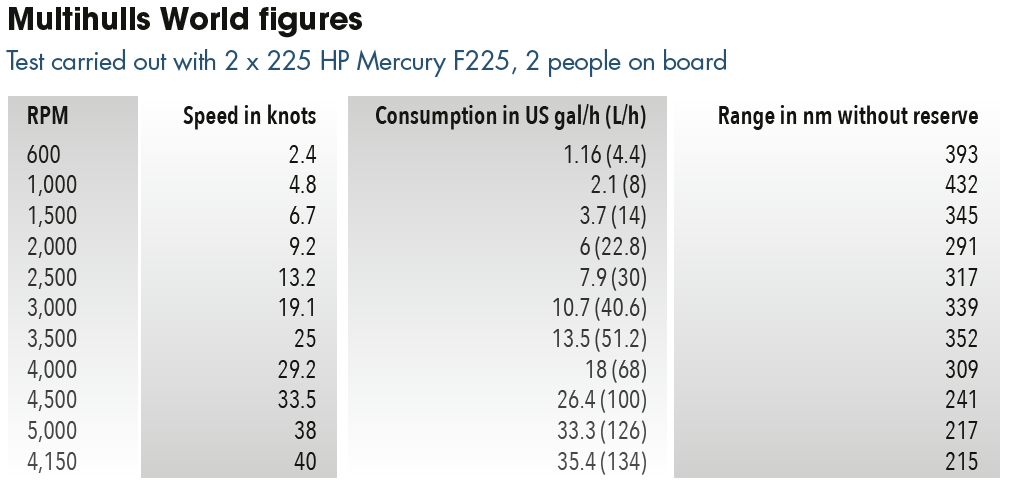
Getting the hang of the controls is immediate; as we pulled away from the dock, I wondered if the relative narrowness of this powercat would affect its maneuverability, but the twin 225 Mercurys are powerful enough and set far enough apart to ensure a rotation on the spot. The steering is smooth and precise, and an optional “full electric” system is available. Thanks to a favorable power-to-weight ratio - the displacement of the Garnet with its two engines and full tanks can be estimated at 8,400 lbs (3.8 t) - the powercat makes no hesitation when asked to accelerate: it gets up to 15 knots in 5.2 seconds and reaches 20 knots in 6.75 seconds. Its relatively high and narrow tunnel can slam into a boat’s wake at low speeds, but the hull seems to glide over the water at 20 knots and above. The air cushion effect does the job, perfectly damping any “imperfections” in the water’s surface. For our high speed tests, we headed out to sea with very calm conditions. Tight turns result in a slight counter-heel at first, followed by a slight heel outward when the turn is maintained. While this is healthy behavior, the Garnet’s objective is not to draw a curvy wake for a water skier... the aim of this powercat is to get out of a rough sea to go to a fishing spot whatever the weather conditions. The 300 manages to do this very well, as demonstrated by its presence at the La Rochelle boat show, arriving there by sea - a lengthy passage in the Bay of Biscay of nearly 100 miles. And it is also by sea that Jérôme Pourtalet, importer of the brand in France, reached his home port. The optimum performance of the engines in terms of speed and consumption is reached at 3,500 rpm. Here, the Garnet makes 25 knots and consumes 13.5 US gallons (51.2 liters)/hour, which corresponds to just over half a gallon (about 2 l) per mile. - an excellent value. At full throttle, the boat reaches just shy of 40 knots. No doubt it would do another 10 knots with the maximum engine size fitted - but do you really need to?
Priority to fishing
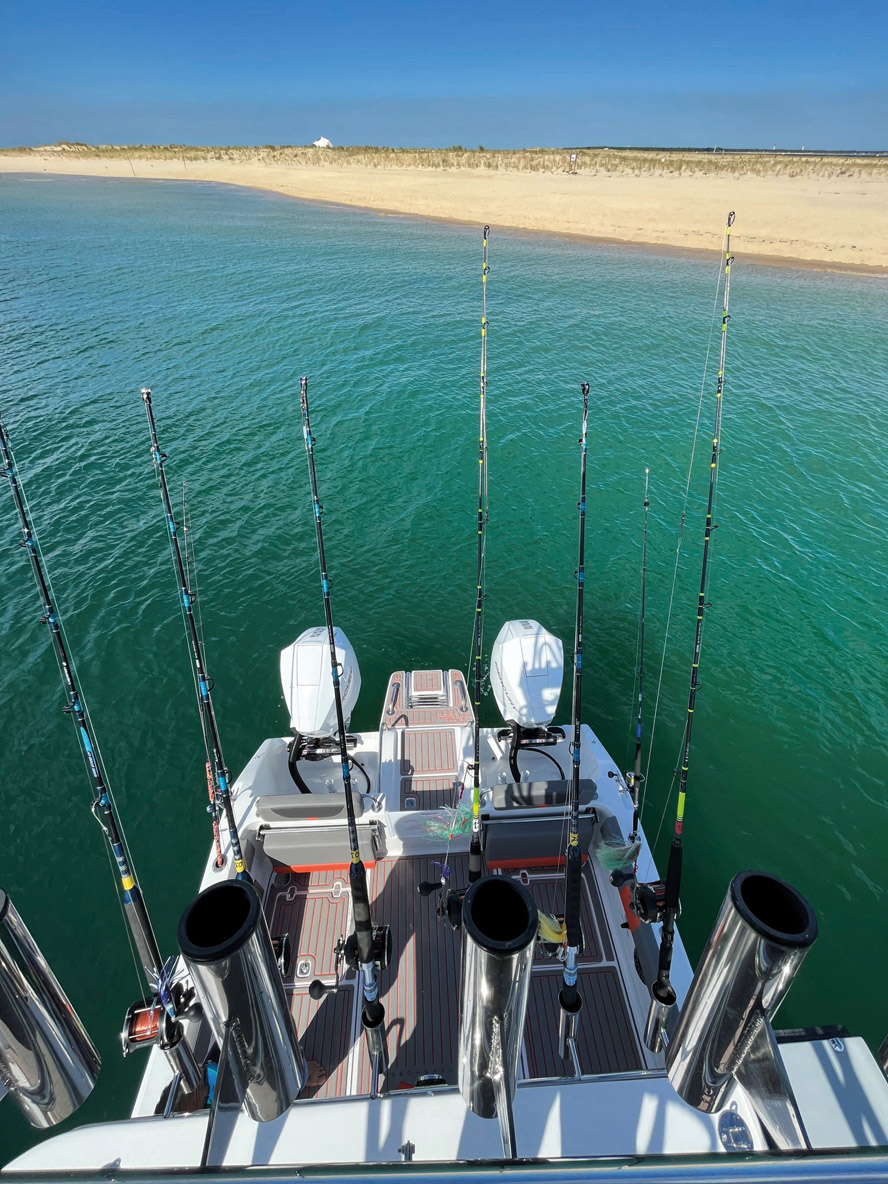
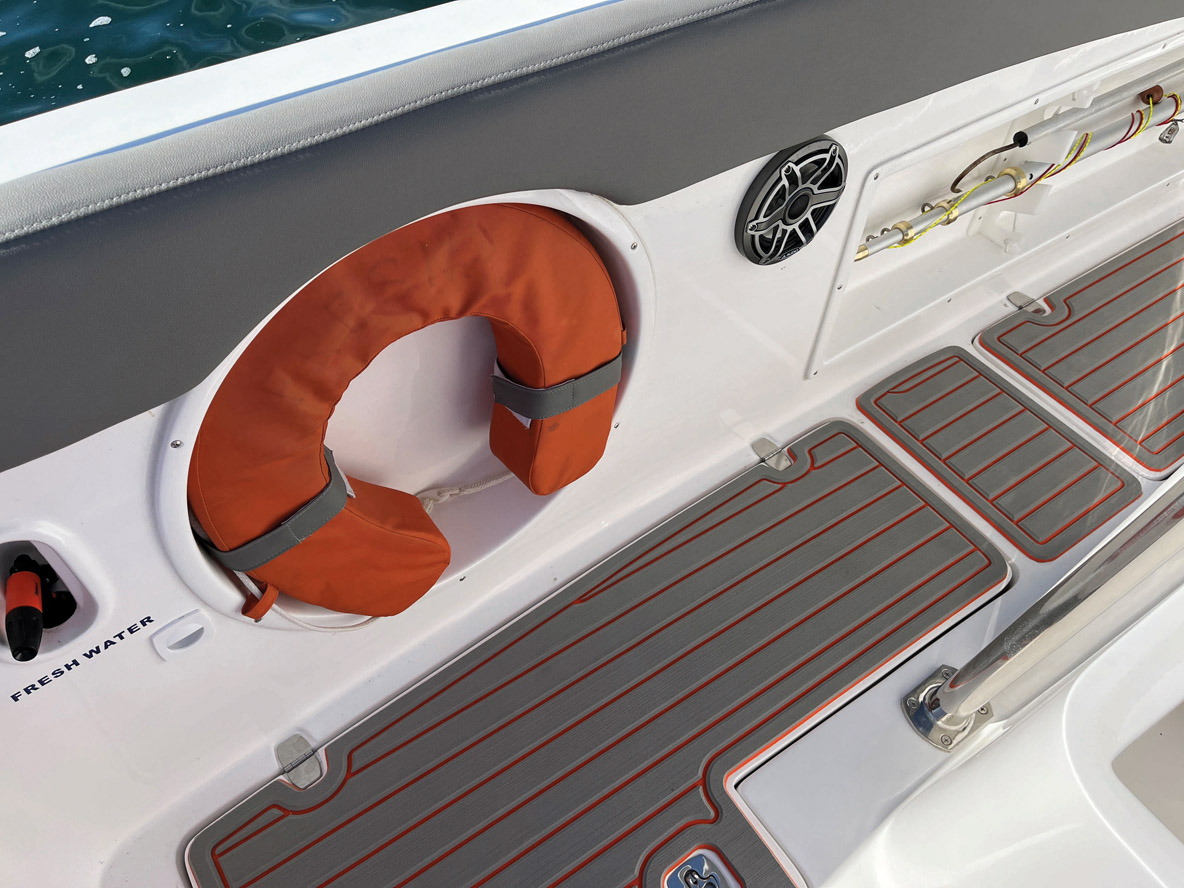
If you have any doubts about the Garnet 300’s fishing abilities, you’ll soon be convinced of its capabilities with no less than 20 rod holders (8 at the bottom, 6 at the top and another 6 at the back of the flybridge) and two holders for 20-foot (6-meter) spreaders. The bulwarks (24” / 0.61 cm) are fitted with cushions to protect the thighs. In addition to the anchor locker, there are numerous other lockers and livewells - the largest is located behind the console. Some of the hatches would be better off with rams and also fitted with stops. The deck plan logically favors circulation rather than having big spaces dedicated to relaxation. The deck covering is great, very soft even barefoot: it doesn’t burn in the sun and remains non-slip when wet. There is nonetheless a sunbathing area at the front of the boat, 6½ feet (2 m) wide at its base, a bench seat of the same length and a narrower seat of 45” (1.15 m). Moving around on board is safe thanks to many handholds and two side rails. The lifering is perfectly integrated into the bulwark and is ready to be used in case of need.
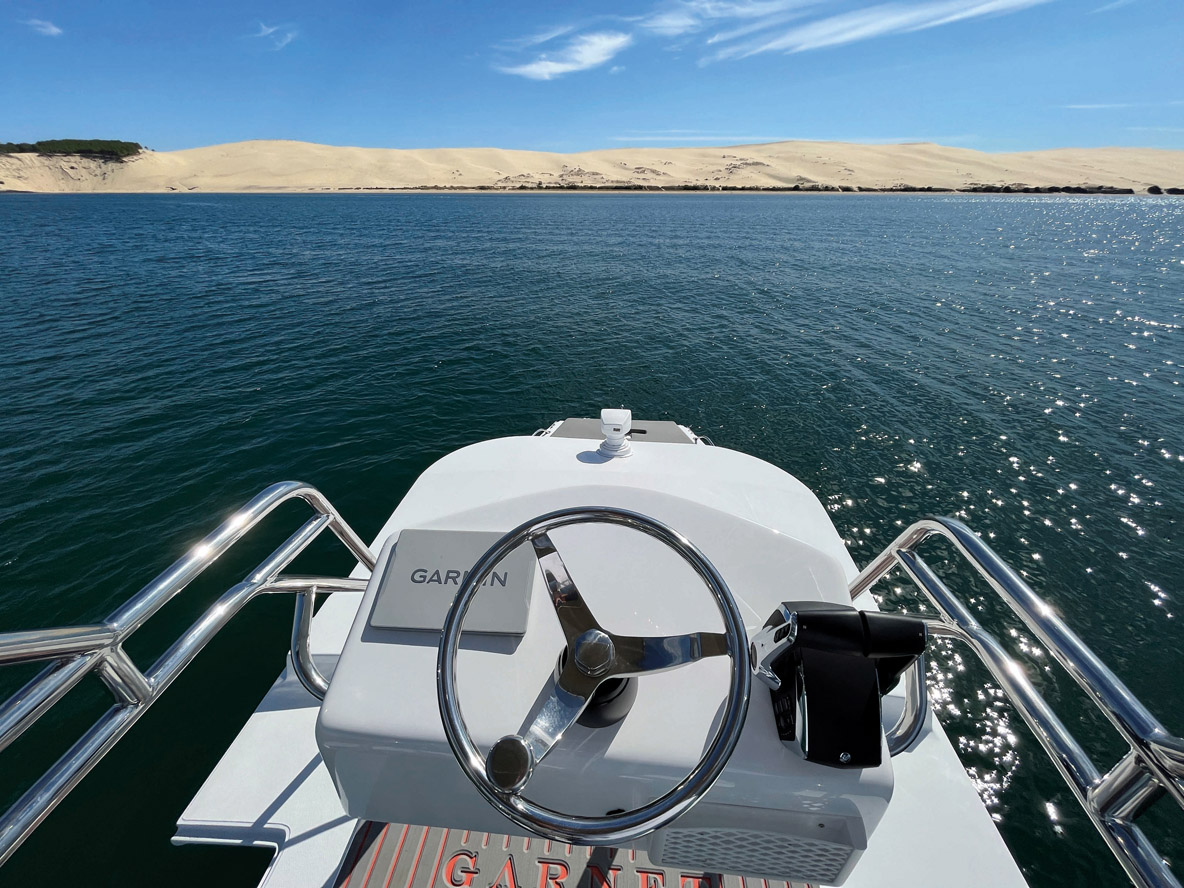
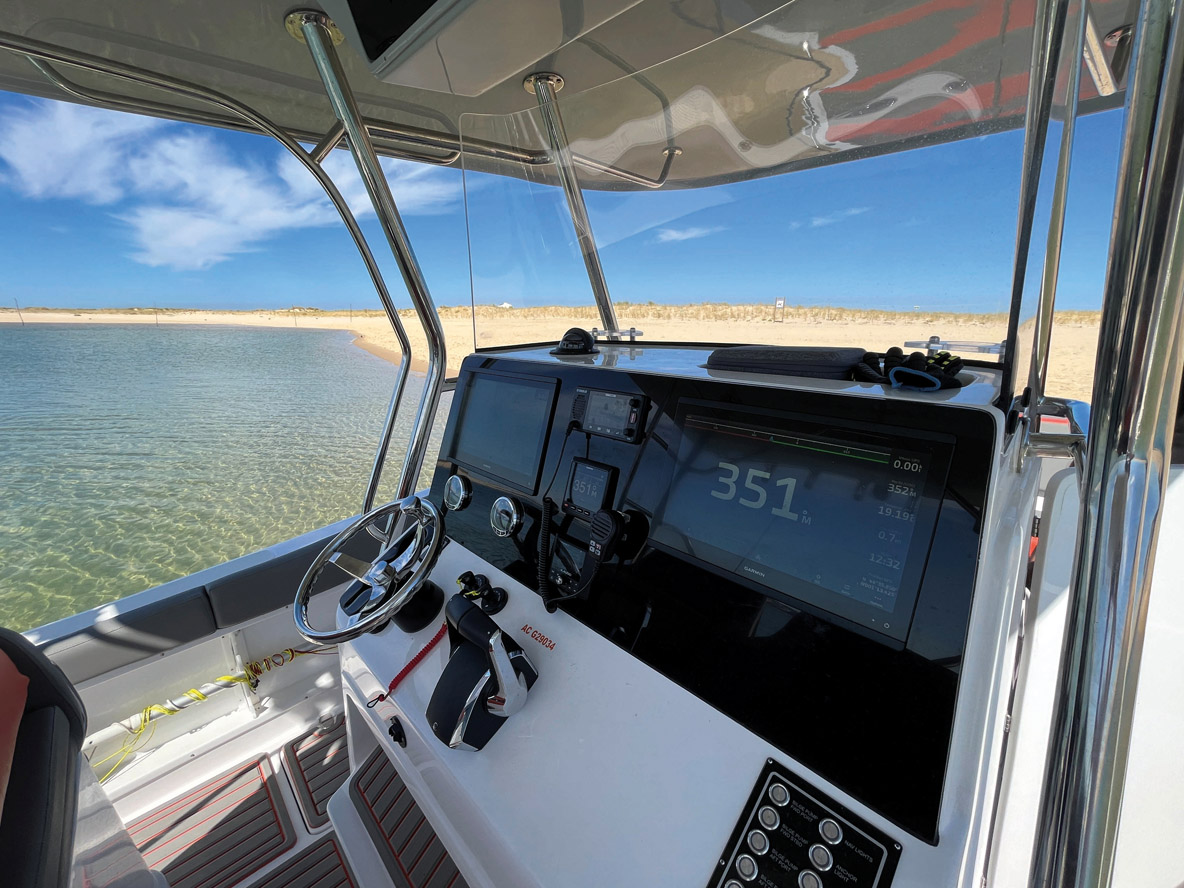
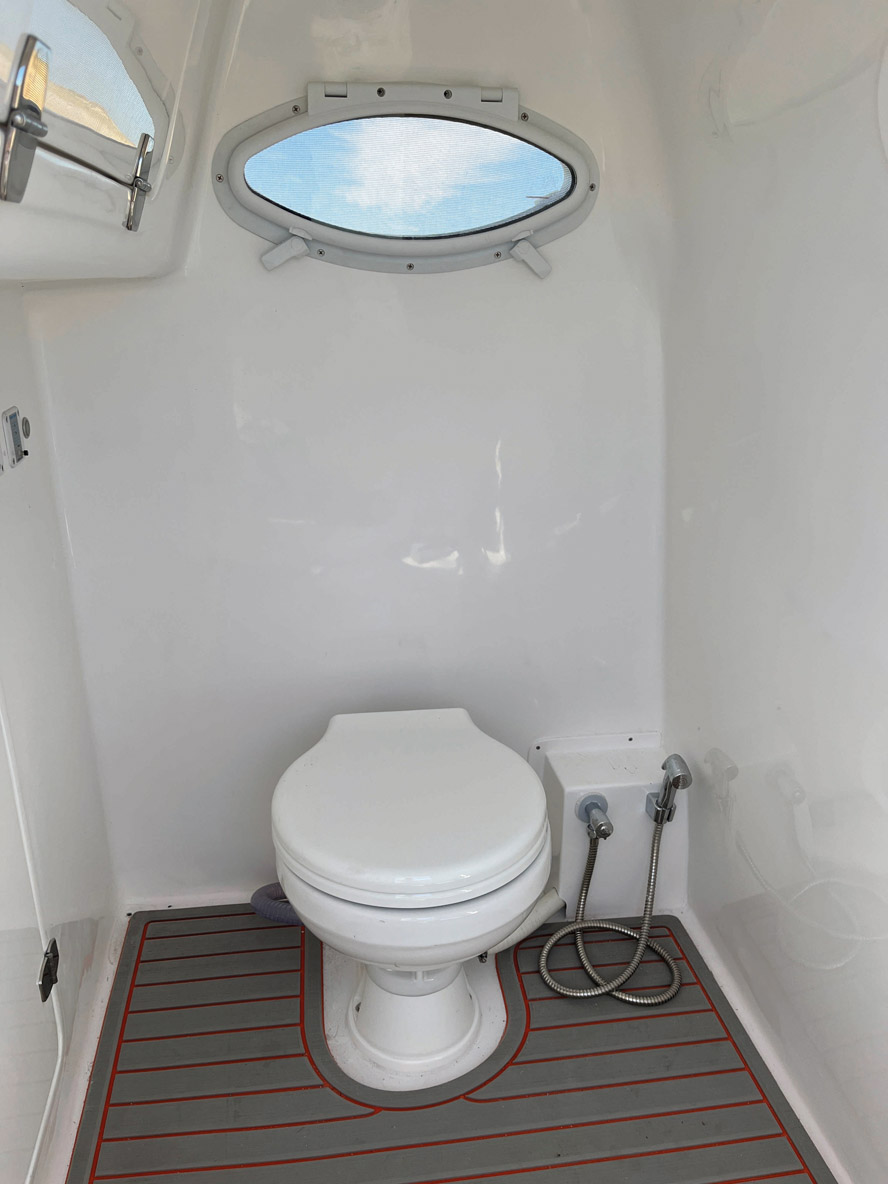
The helm station is organized around a robust console - the layout of which is wide enough to accommodate a toilet. The console is well protected with a perfect view of the water. The two seats are designed for sitting or standing. The instrumentation is clear and remains readable in all light conditions. The aft deck is more specifically reserved for fishing - it is however possible to sit at the console and all the way back - these seats being foldable. A passageway - closed off using by a gate as required - is provided in the center of the transom; this leads to a small aft platform nestled between the outboards. Here too, there are surrounding handrails. A telescopic, flip-down swim ladder is integrated.
The Flybridge option with a second helm station is obviously perfect for fishing - the elevated position makes for much better fish spotting. Access is by first climbing onto the gunwale before climbing the ladder. You’ll have need to open the hatch first to free the access. Ideally this could better - especially if the sea is rough. But once in place, standing at the controls, the Garnet’s handling is ideal.
Conclusion
This new brand offers a very attractive powercat for fishing. At the expense of a few minor improvements, the Garnet 300 will make an excellent platform for venturing offshore thanks to its undeniable seakeeping qualities. The drivetrain on our test model - twin 225 HP outboards - seemed ideal to us. Overpowering the hull with a pair of 300 HP motors seems unnecessary.
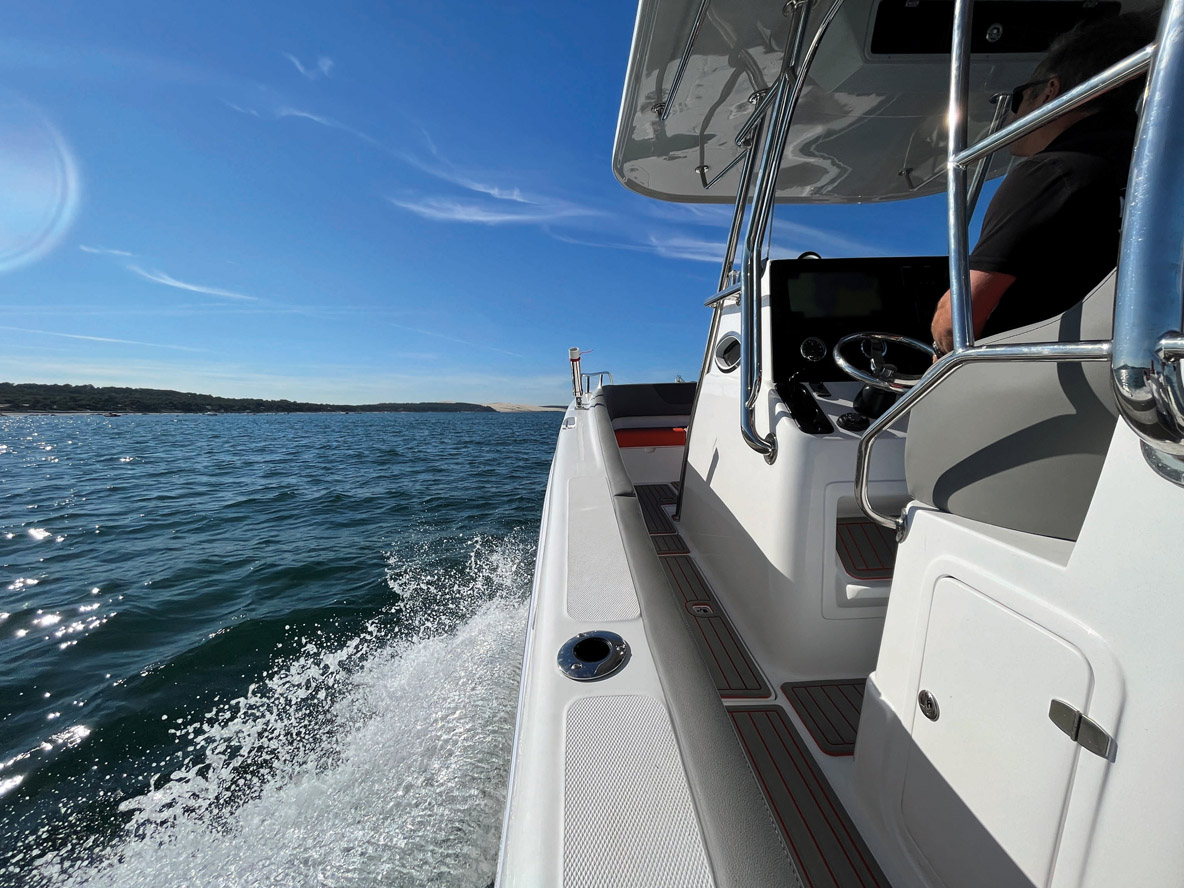
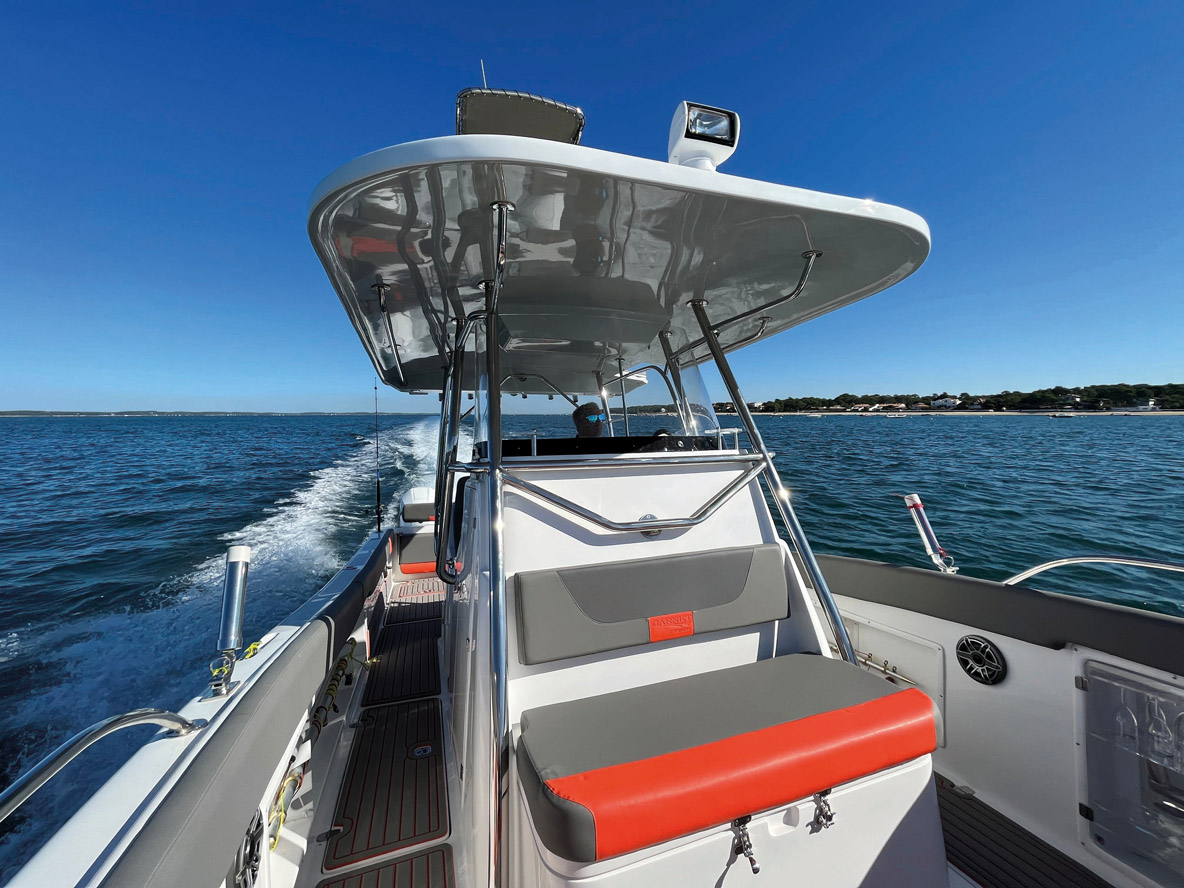
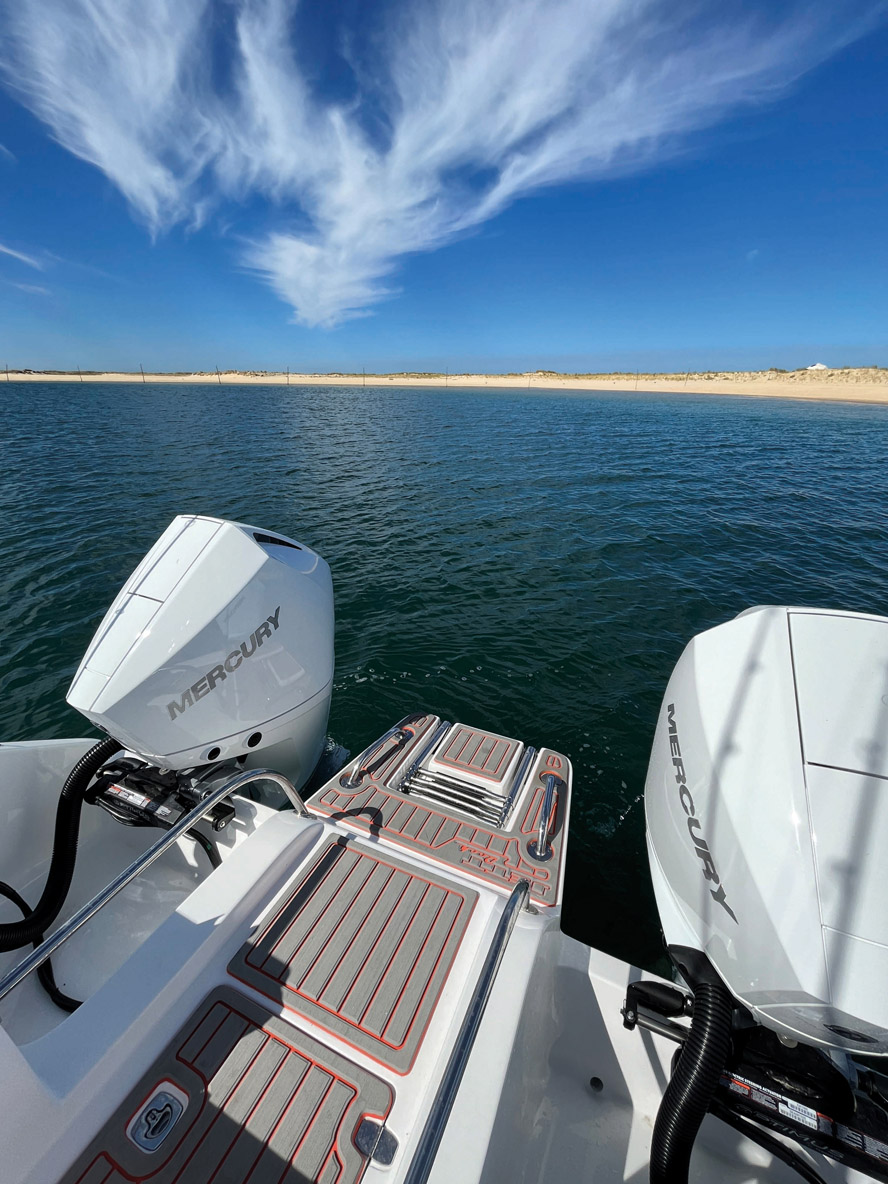
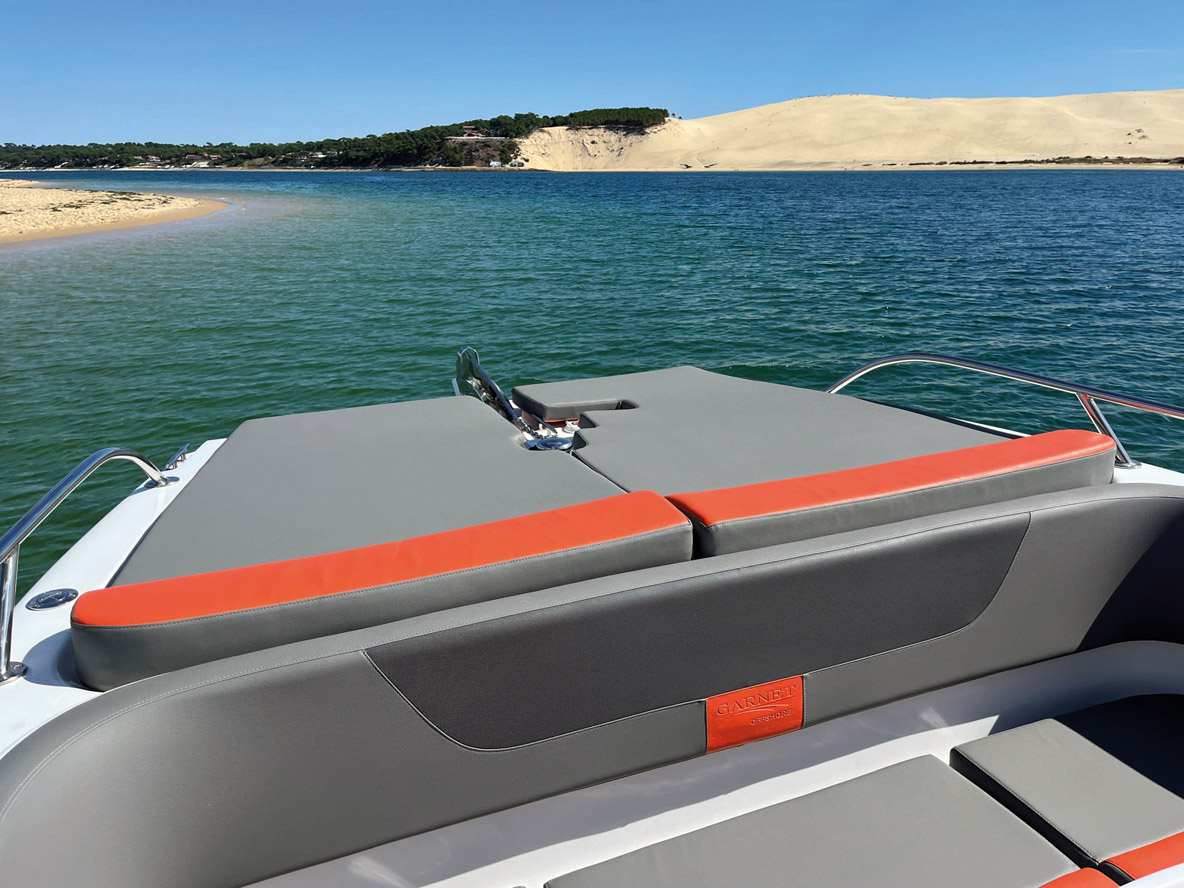
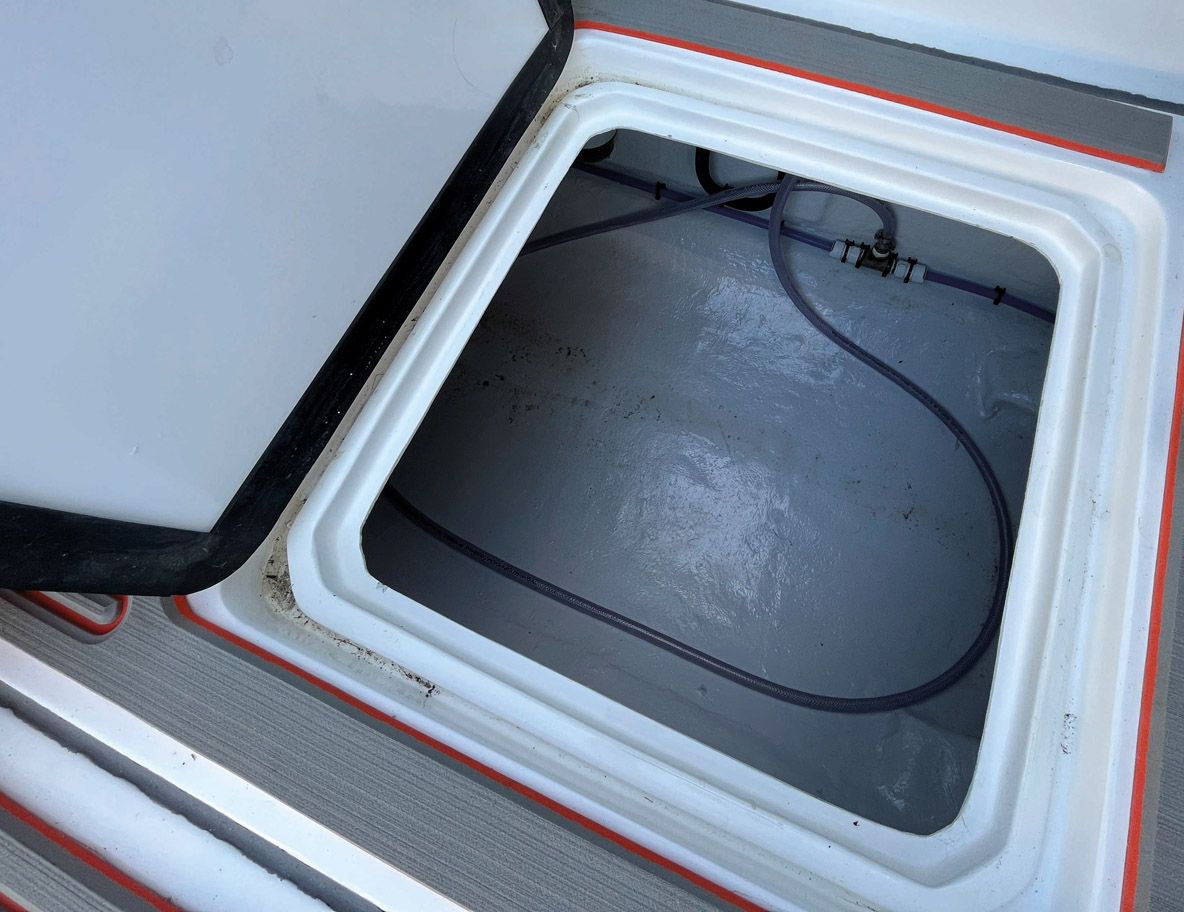
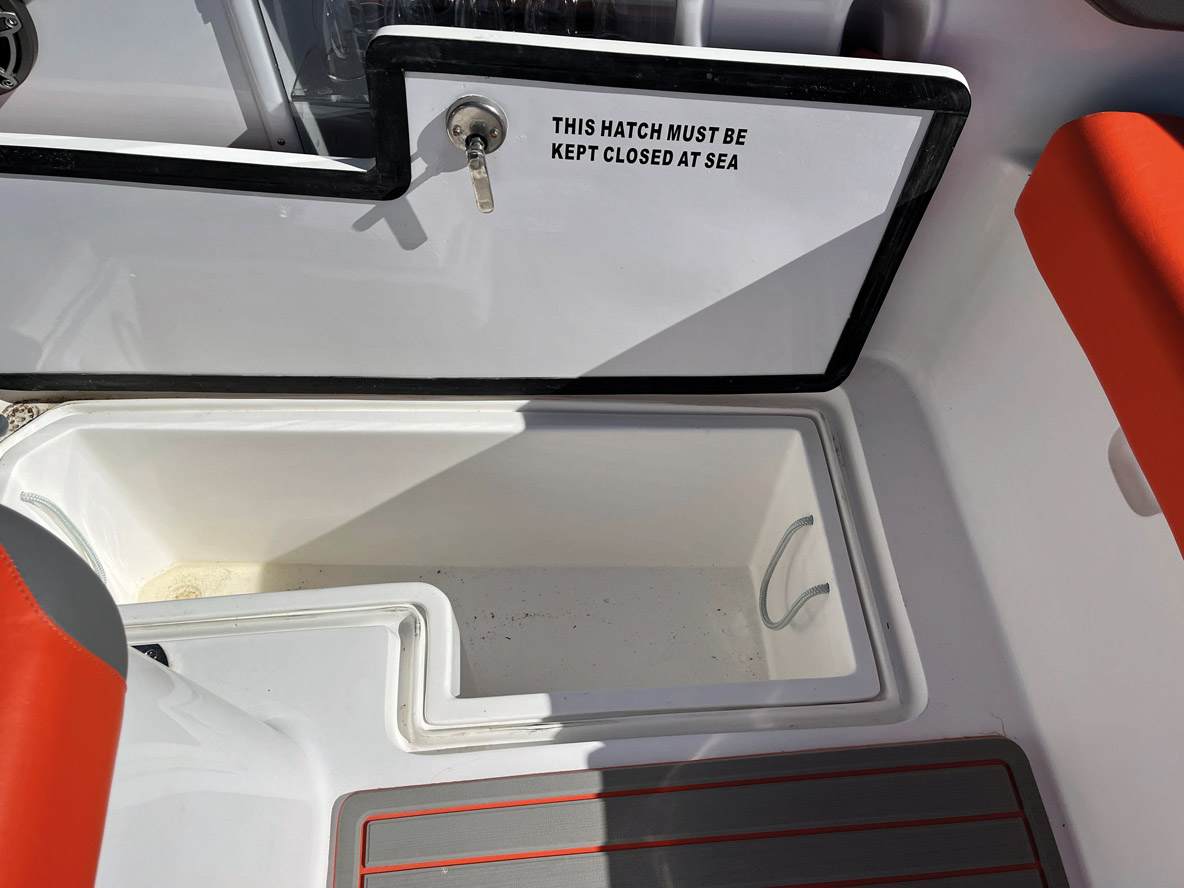
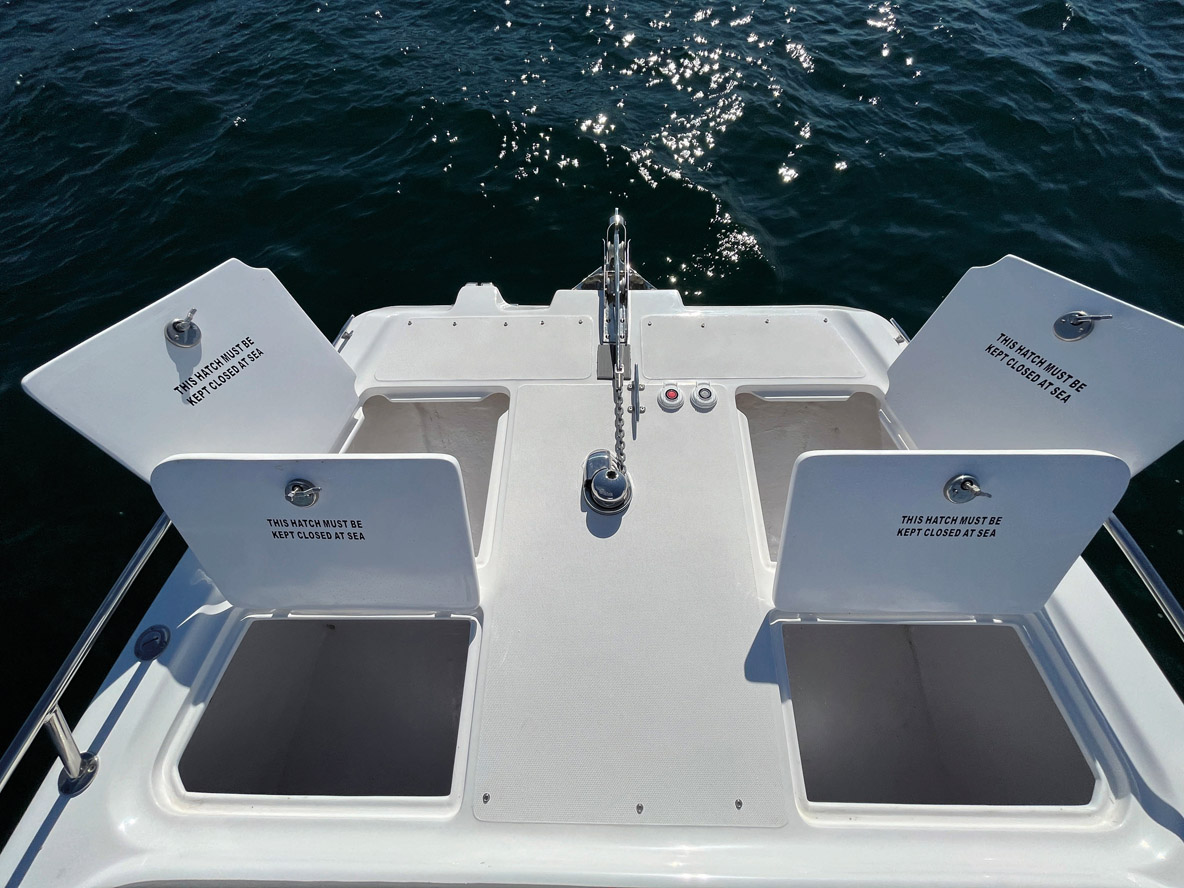
Functional deck layout
Pleasant helm position
Lockers could be better equipped
TECHNICAL SPECIFICATIONS
Length: 28’5” (8.65 m)
Beam: 9’6” (2.89 m)
Draft: 12” (0.30 m)
Displacement: 5,500 lbs (2,500 kg) without engines
Engines: 2 x 200 to 300 HP outboards
Max speed: 40 knots with 2 x 225 HP
Fuel: 190 US gal (720 l)
Water: 26.4 US gal (100 l)
Hull price: from € 112,793 ex-tax
Second helm station on the flybridge: € 23,100 e-tax
2 Mercury F225 White outboard motors - Seastar Optimus Full-electric steering: € 58,333 ex-tax
Main options in € ex-tax:
Double helm seats: 1,685
EVA foam floor: 1,945
Black dashboard: 207
12 gal (47 l) Holding tank: 1,271
Hull color + decorative stripe: 2,281
Electric windlass: 2,567
Bar (glasses + bottles storage): 602
LED lighting: 161
Aft door: 312
Forward cushions: 492
Beaching ladder: 804
Aft platform with swim ladder: 1,529
Searchlight: 504
Cockpit table: 778
Retractable GIBI outrigger: 2,500
Electronics pack: 25,000
VHF Navicom RT1050: 742
Sound system: 3,000
Ground tackle kit: 1,682
Safety equipment for 6 persons: 2,708
Shipping, preparation, registration, handover: 30,000
Epoxy primer + antifouling: 1,242
Price of the model we tested: € 275,833 ex-tax