The world of fishing catamarans continues to grow in importance - you only need to visit the Miami International Boat Show to see this for yourself. For now, American shipyards still dominate the market. But gradually, the arrival of new players in this sector, such as HammerCat catamarans, designed and manufactured in South Africa, is changing the game...
Infos pratiques
- Le chantier : HammerCat 30
- La fiche technique
-
 Découvrez notre vidéo exclusive
- Financez votre HammerCat 30
- Assuez votre HammerCat 30
- Articles autour du HammerCat 30
Test conditions: Wind southeast 5-7 knots, 3-foot seas
Created by Uwe Jaspersen, the Hammer Yachts shipyard was relocated after the death of its founder to a larger facility near Cape Town Airport. The brand is known for its fishing-oriented powercats, notably the famous HammerCat 35 launched six years ago - this model is now available in a cabin version with the HH version.
The range now includes four models from 30 to 45 feet.
The Smallest of the HammerCat Family
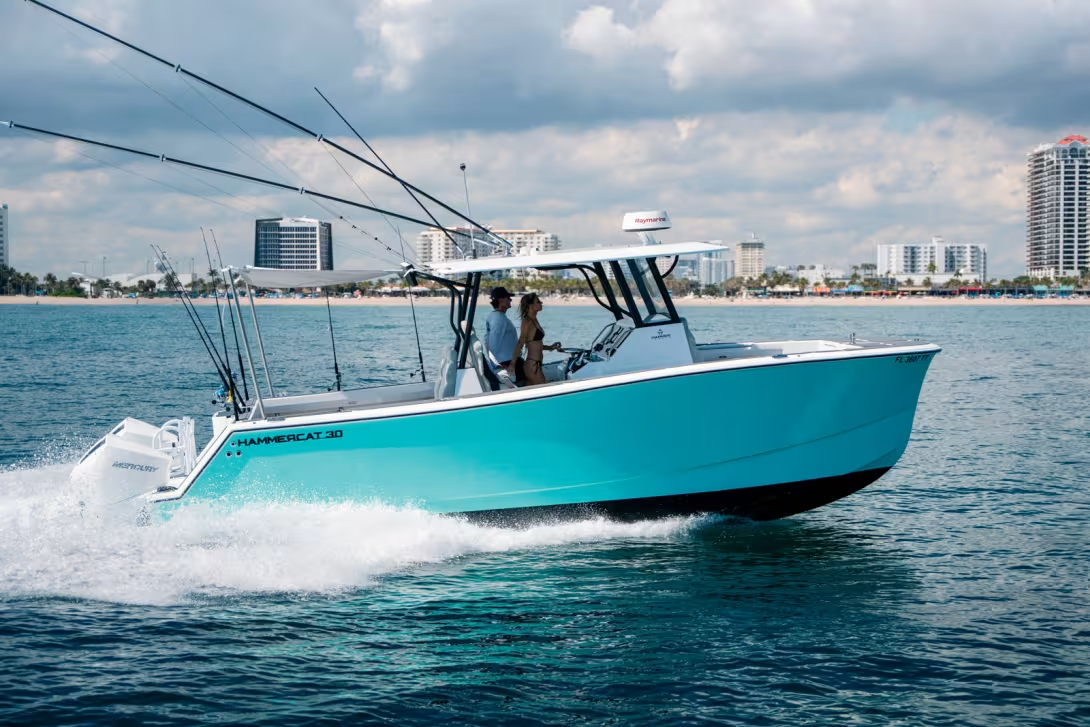
The HammerCat 30, at 28’8” (8.74 m) long, is the smallest of the family, and the shipyard’s idea was to offer a compact, affordable unit that meets the same high standards as the larger models.
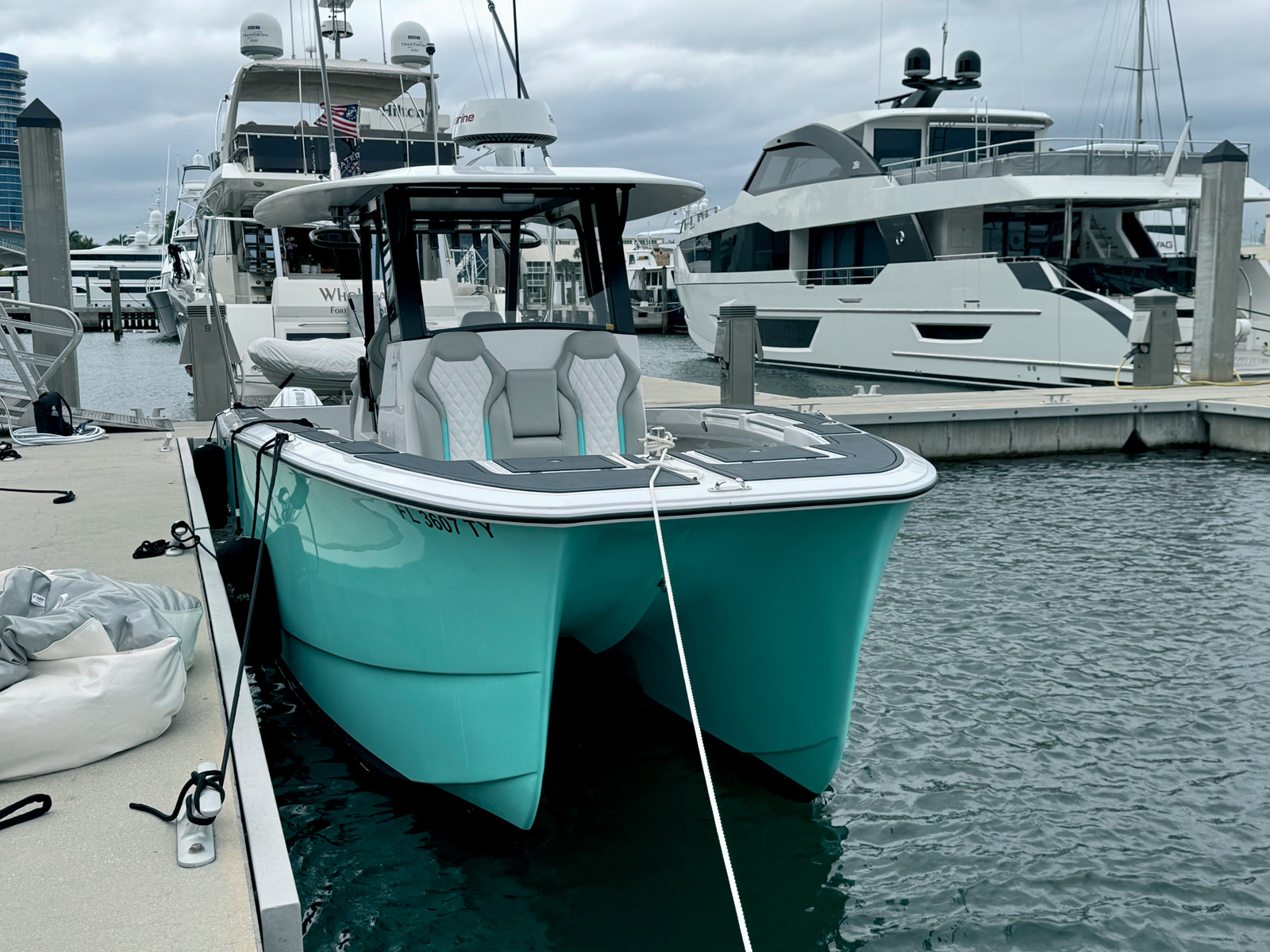
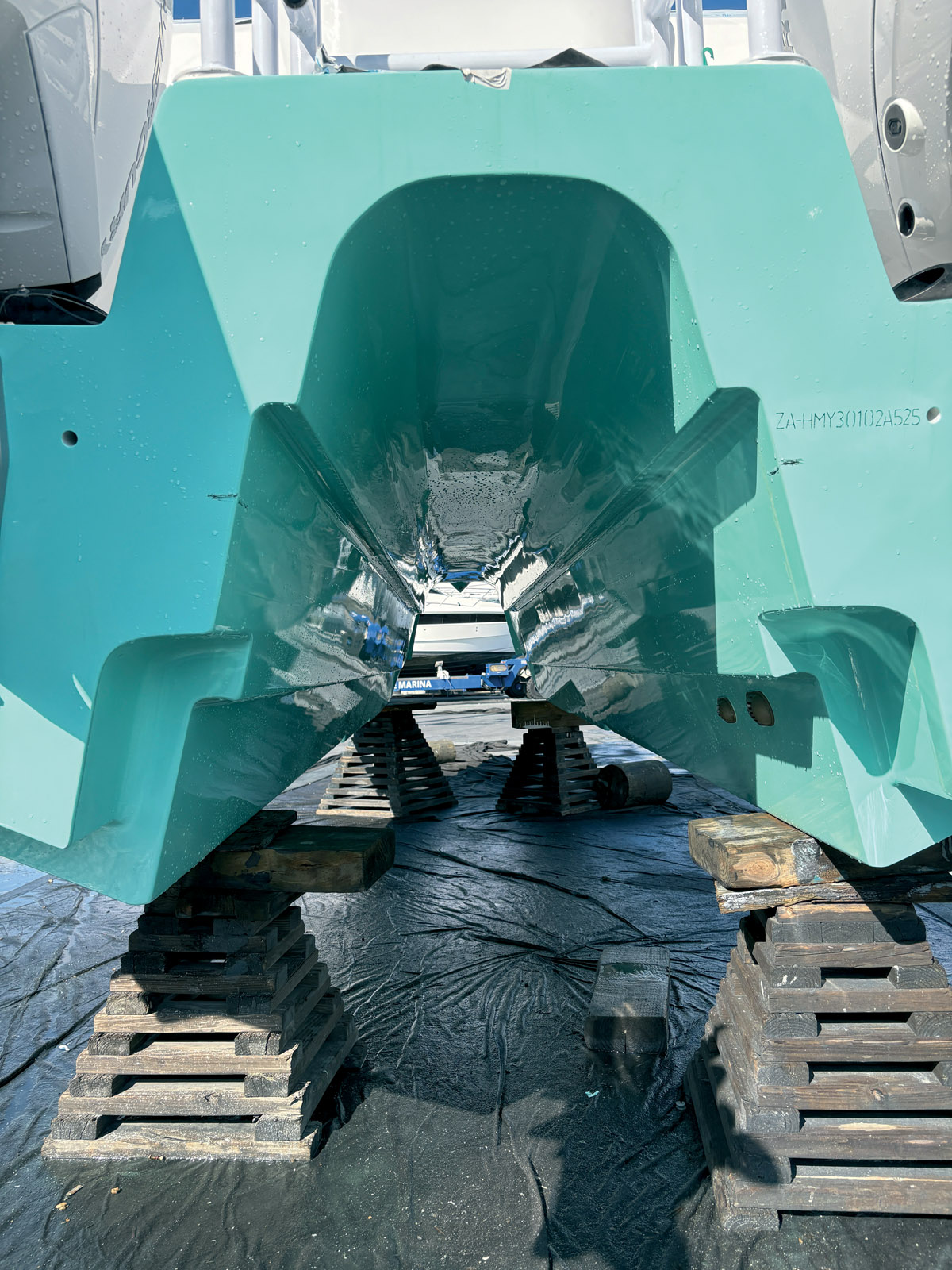
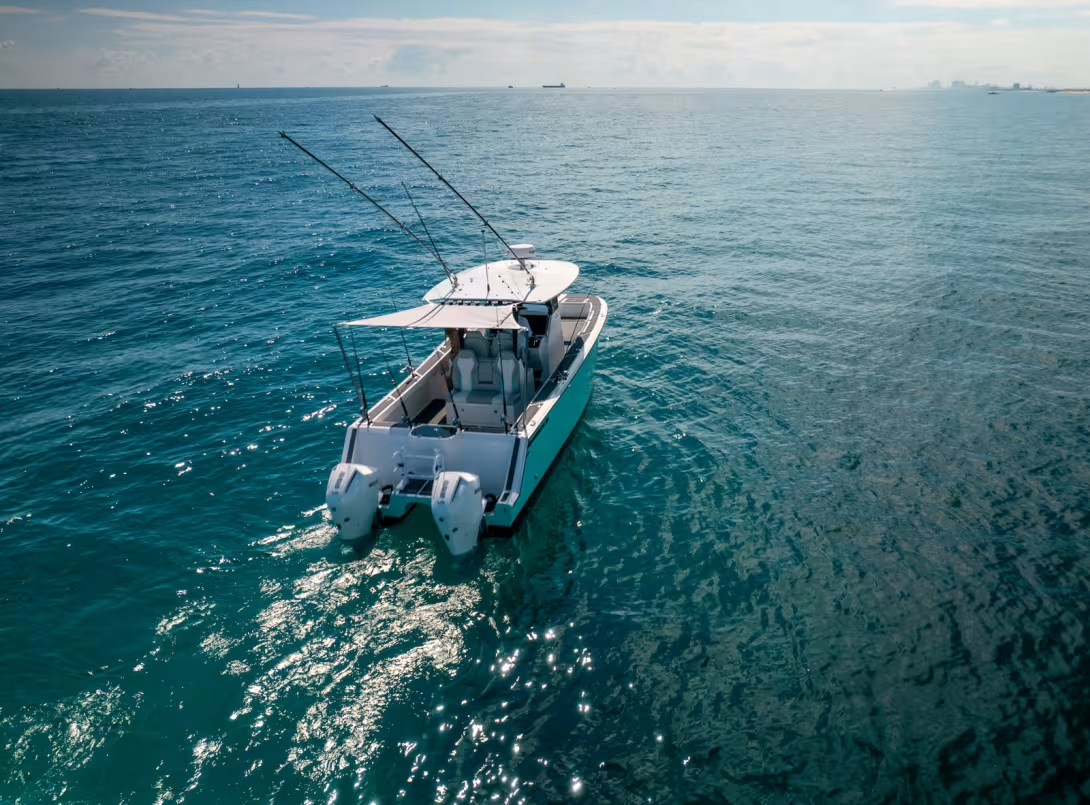
Aesthetically speaking, the HammerCat 30 is both faithful to the spirit of the brand and to the codes of other fishing boats, particularly American ones. It has hulls that are quite imposing for its size, as they are high on the water with fairly vertical bows, a decked bow, and a high, narrow tunnel that accumulates air very well. The console is located almost at the front third, which frees up space aft, and the whole is topped by a well-made T-Top. Ultimately, this design evokes an idea of robustness, sportiness, and power.
This impression is confirmed by the fact that the HammerCat is built using infusion with a closed-cell foam core, a method known for its strength without adding too much weight. For example, the T-Top weighs only 150 lbs (68 kg), which is quite impressive. In total, the powercat weighs less than three tons when empty, which is rather encouraging - especially considering that it can be powered with up to 2 x 225 HP outboard motors.
Last but not least, the shipyard presents the HammerCat 30 as unsinkable.
Fishing Atmosphere, but With a Neat Finish
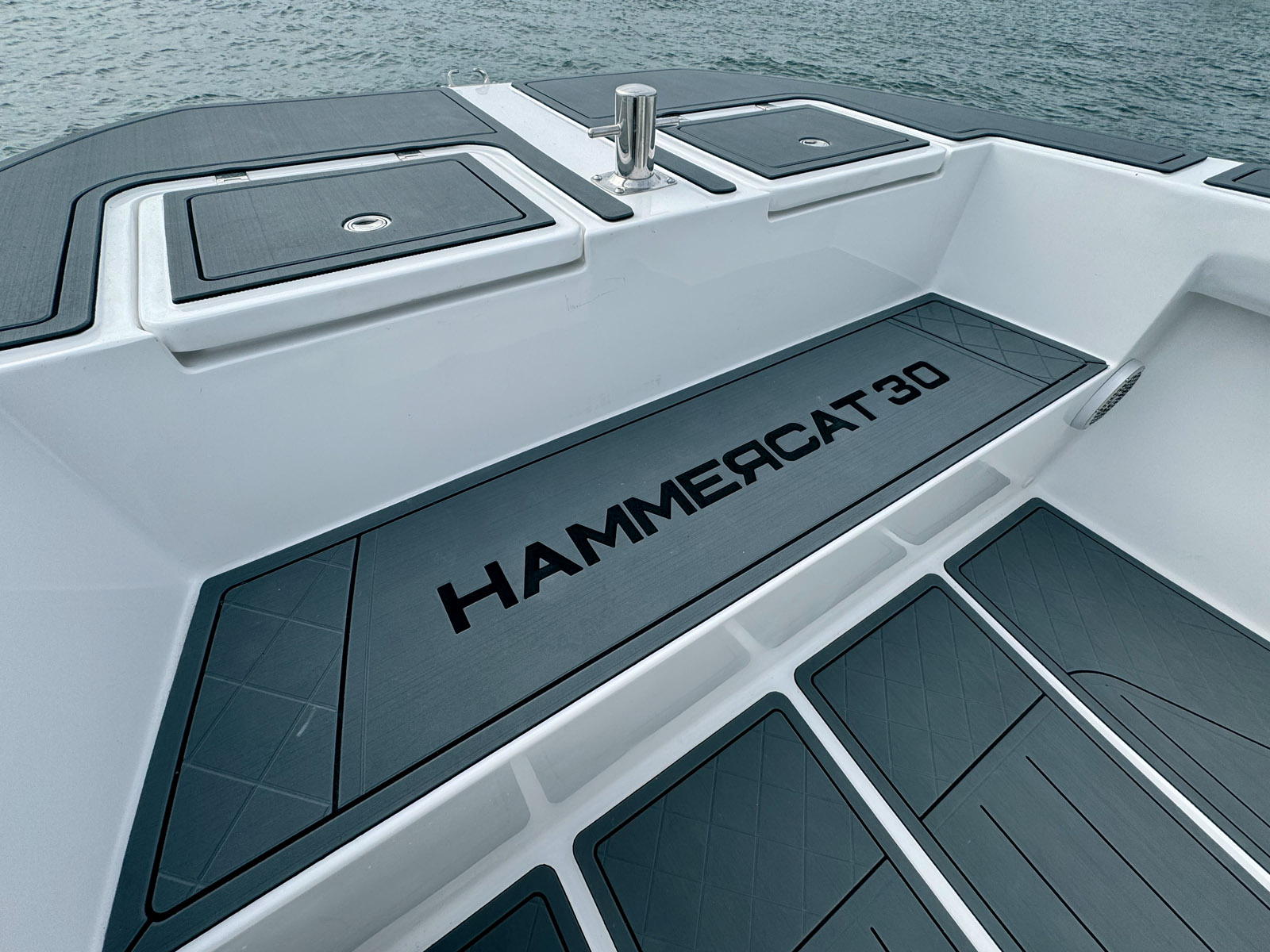
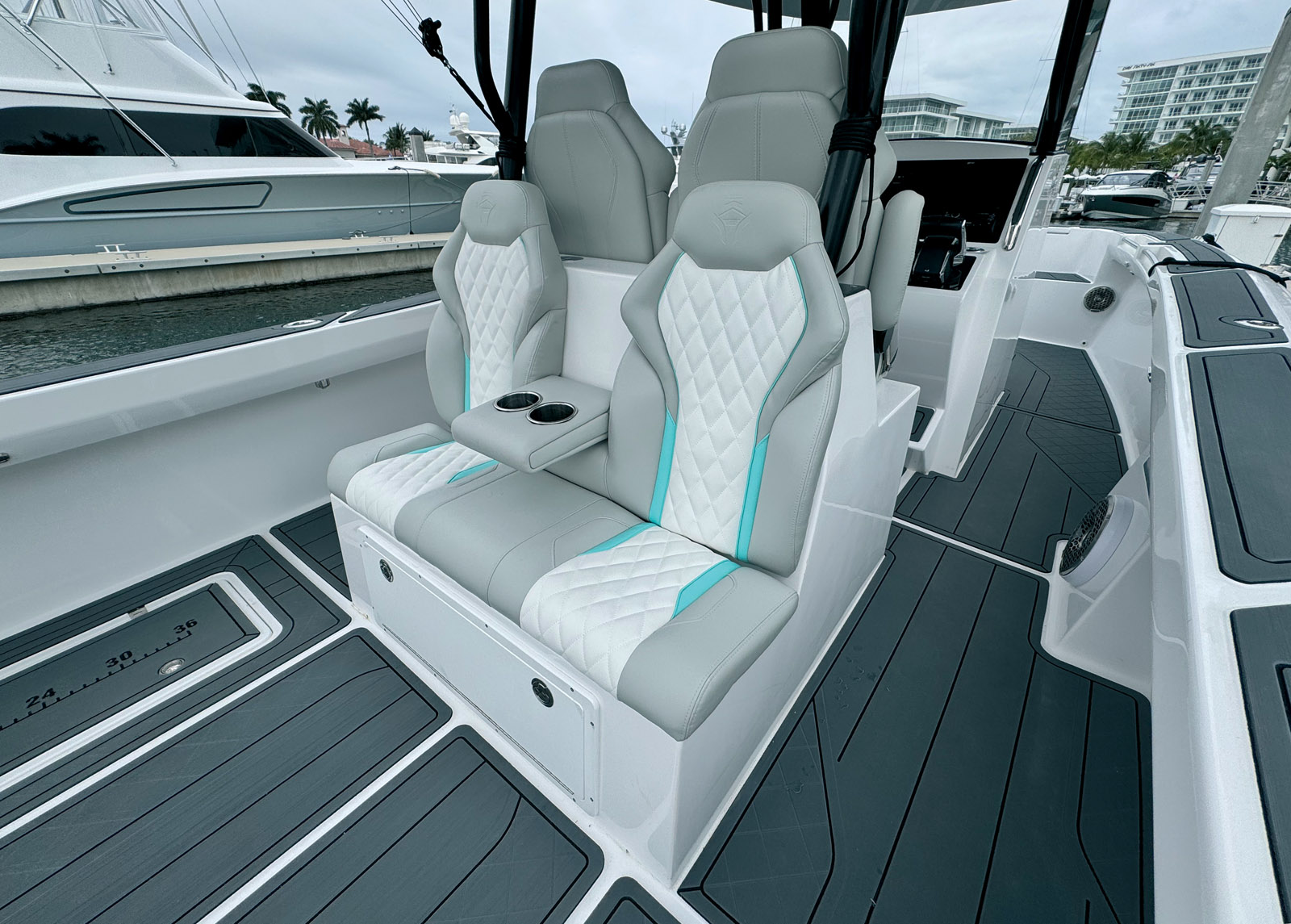
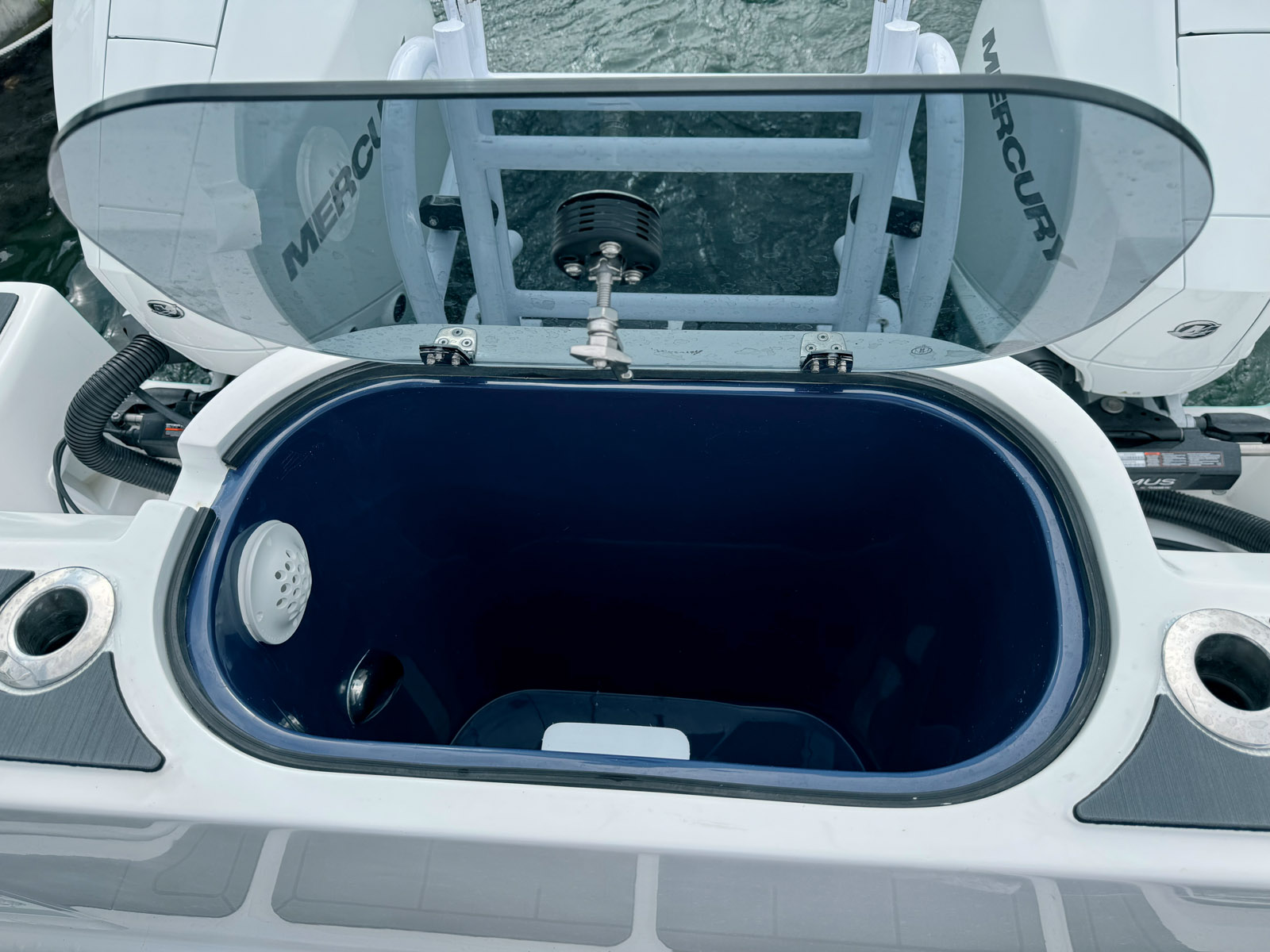
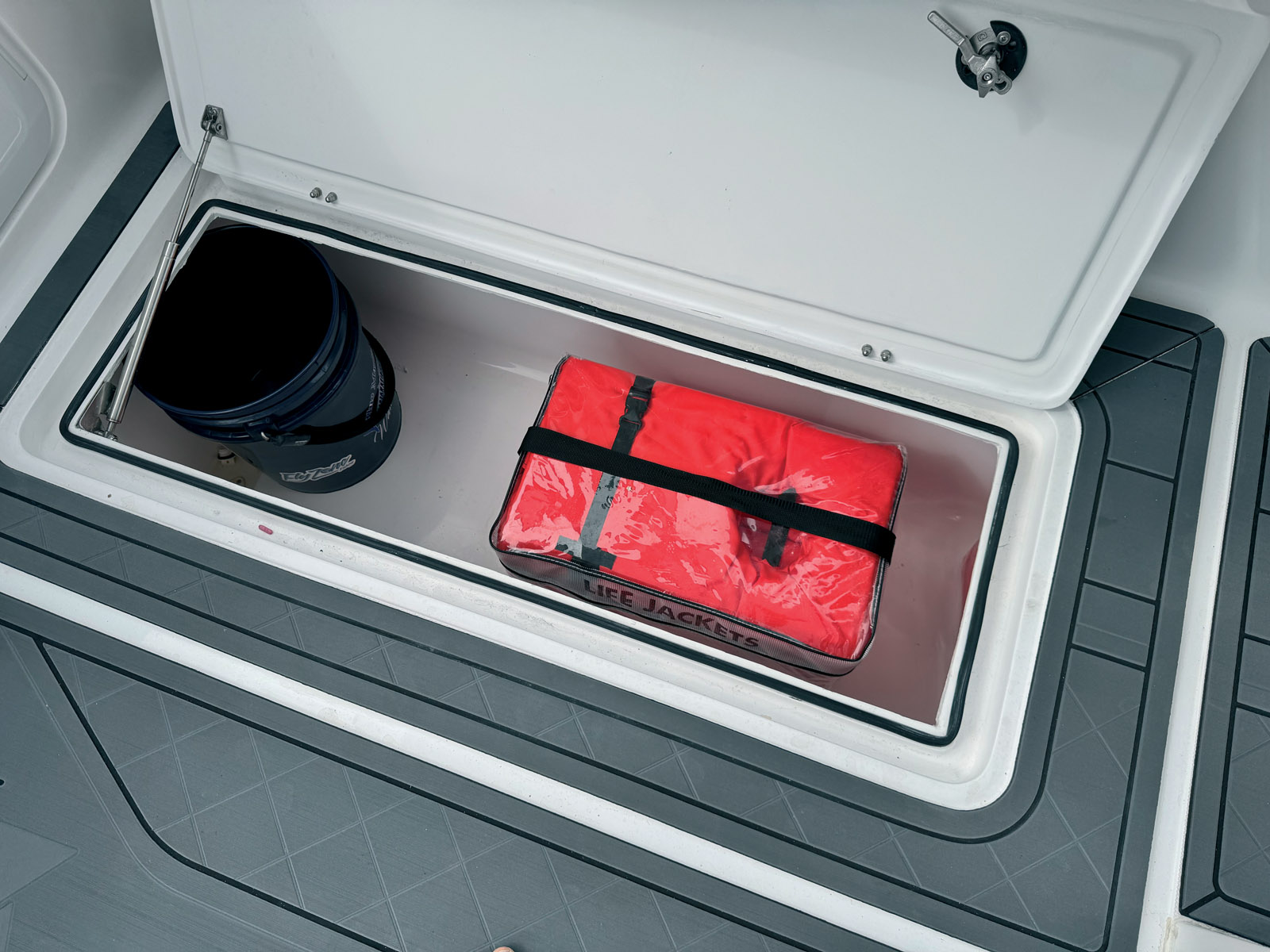
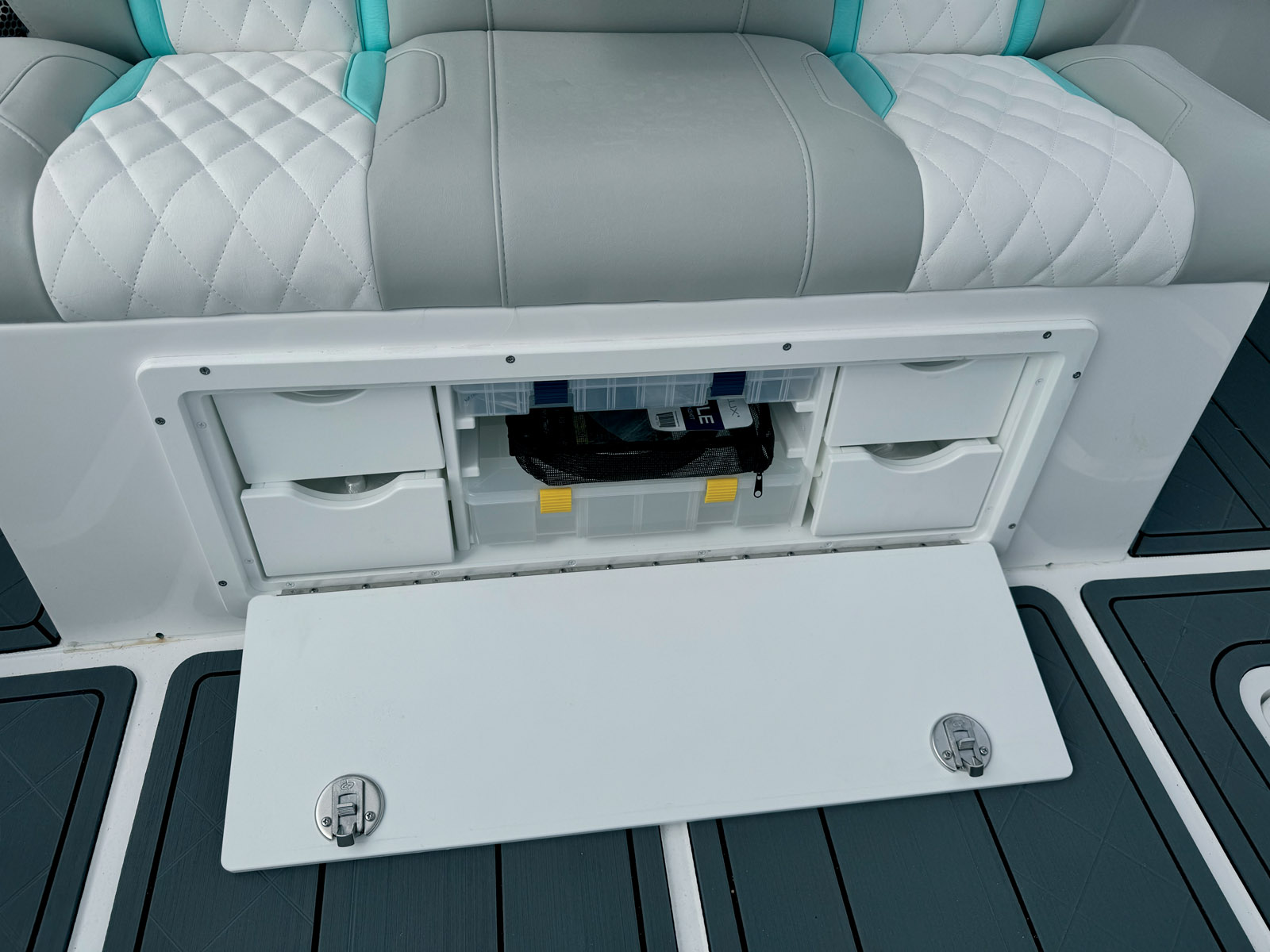
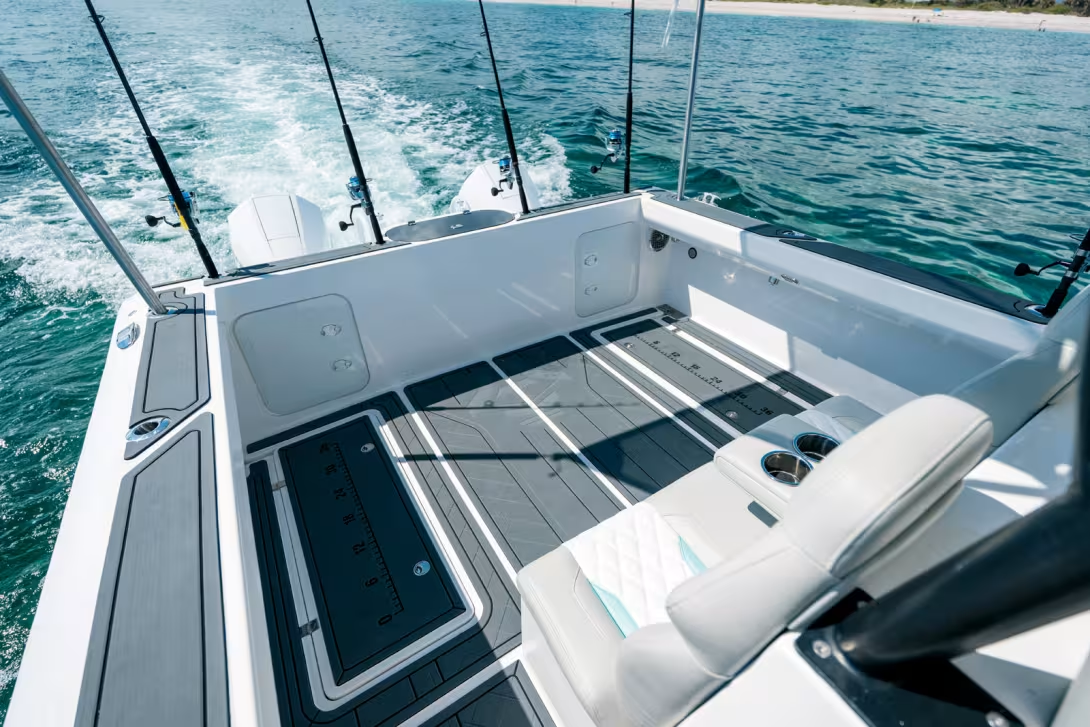
At first glance, the HammerCat 30 inspires confidence. The finish is neat, with attractive deck covering that also extends to the gunwales and a solid structure for the T-Top. The catamaran is primarily designed for fishing and, logically, there are numerous rod holders (10), a 50-gallon (190-liter) livewell in the center of the transom, fish lockers, and even storage for tackle boxes under the double aft seat.
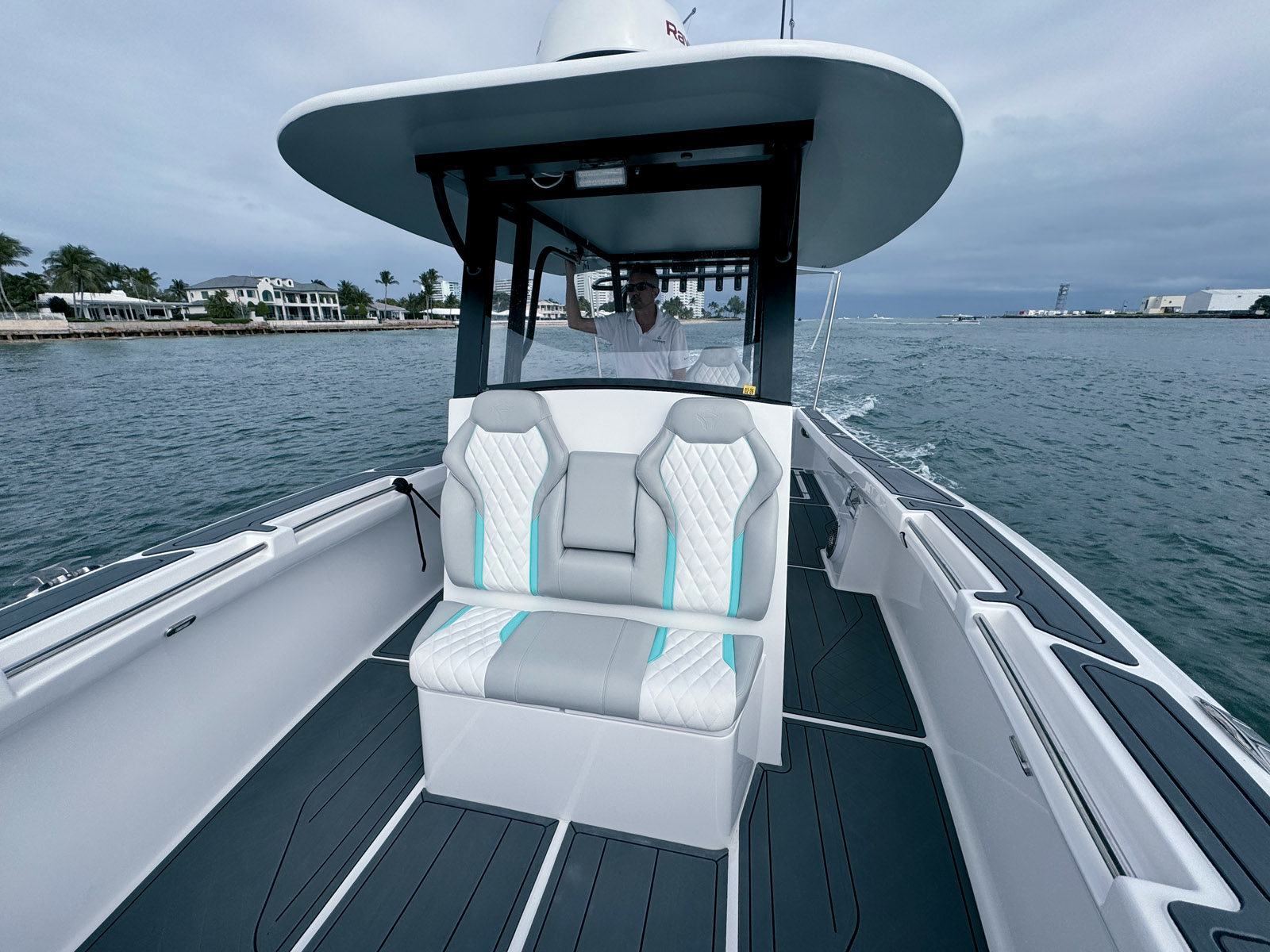
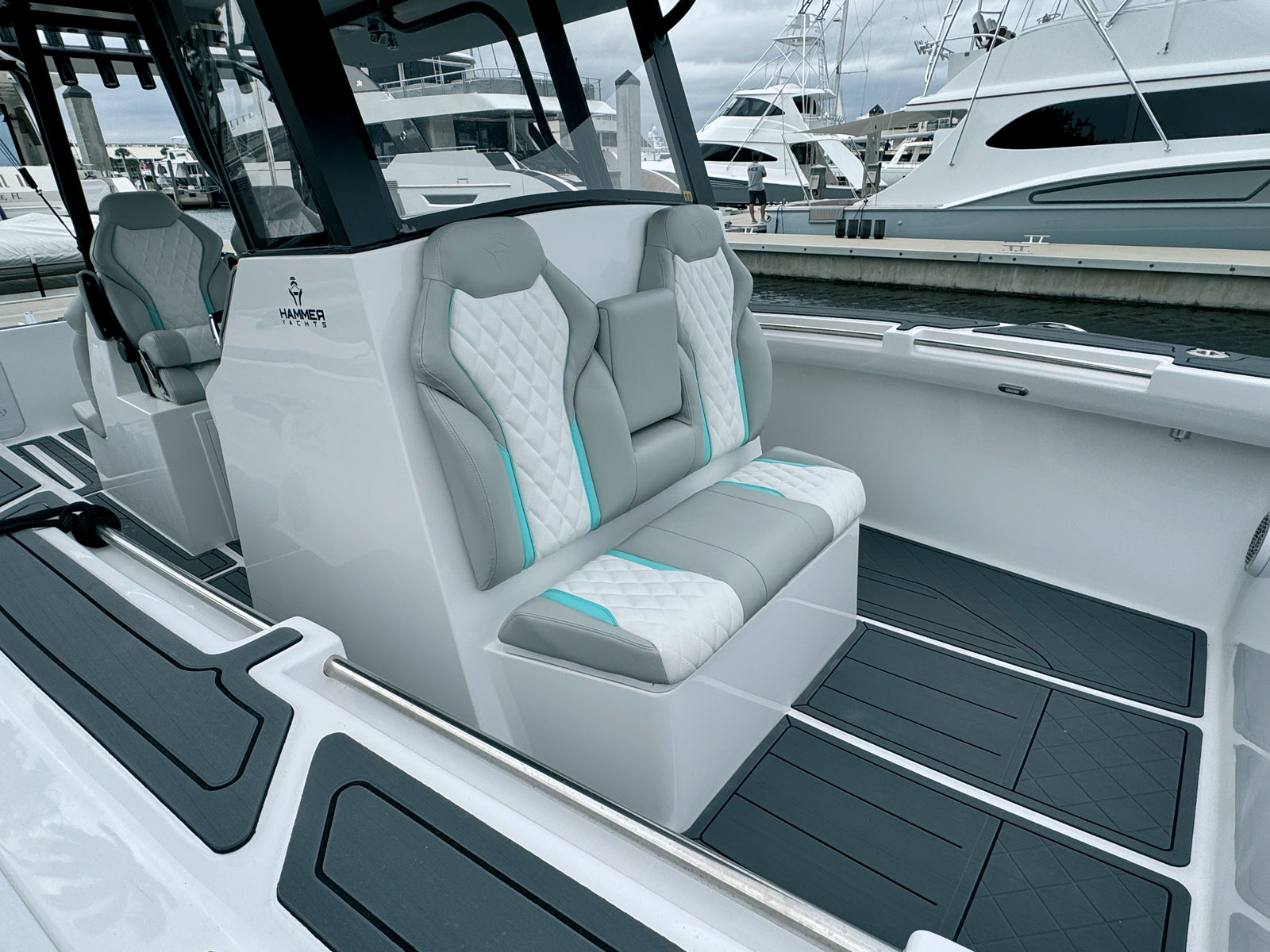
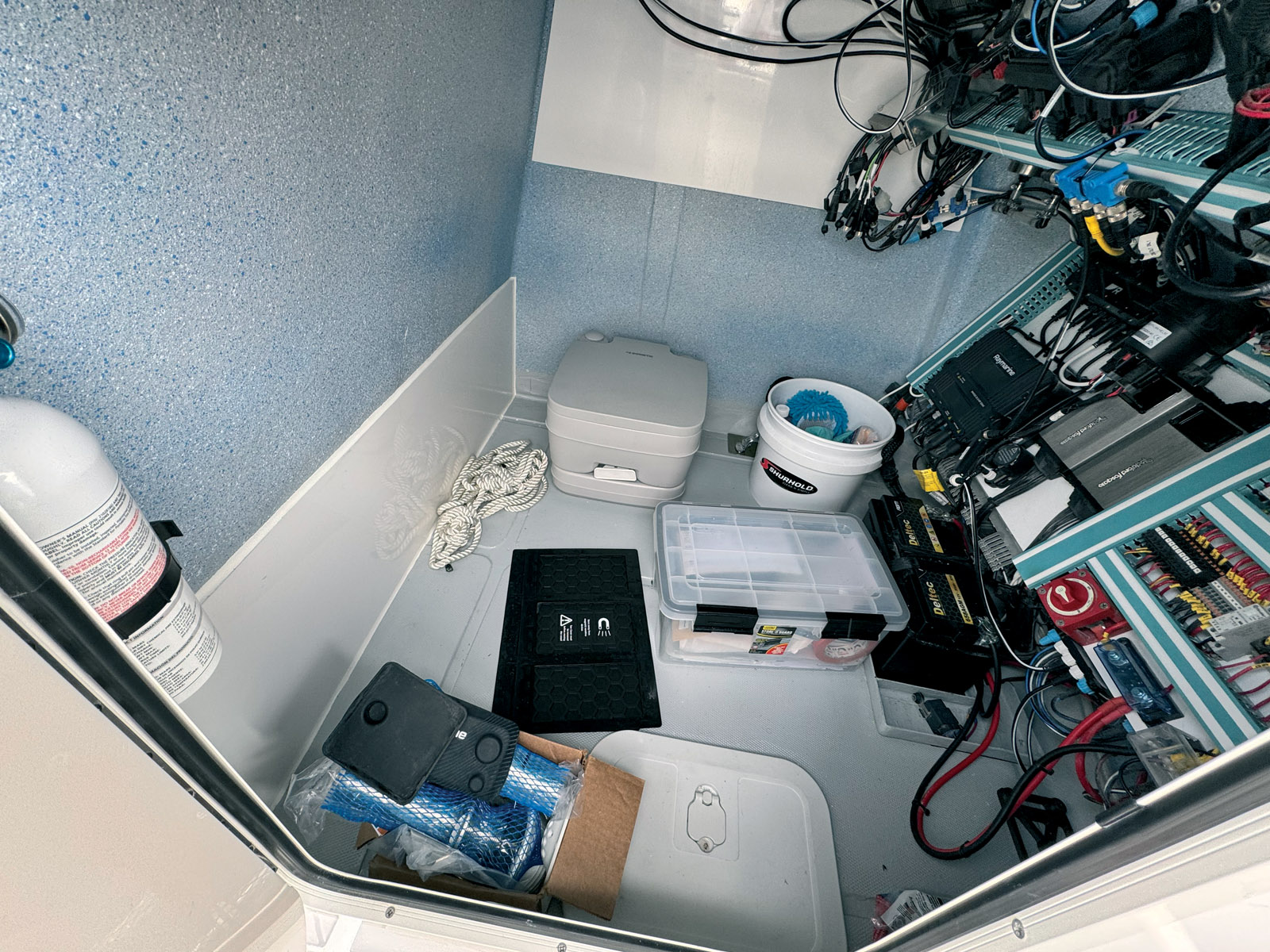
However, although primarily intended for fishermen, the catamaran also targets families by offering a versatile and comfortable layout, starting with the beautiful aft bench seat behind the pilot seats and another double seat with backrests and central armrest, this time located in front of the console. There is also a hidden toilet in the console. The space is not huge, but it also provides access to all the electrical connections and is perfect for storage.
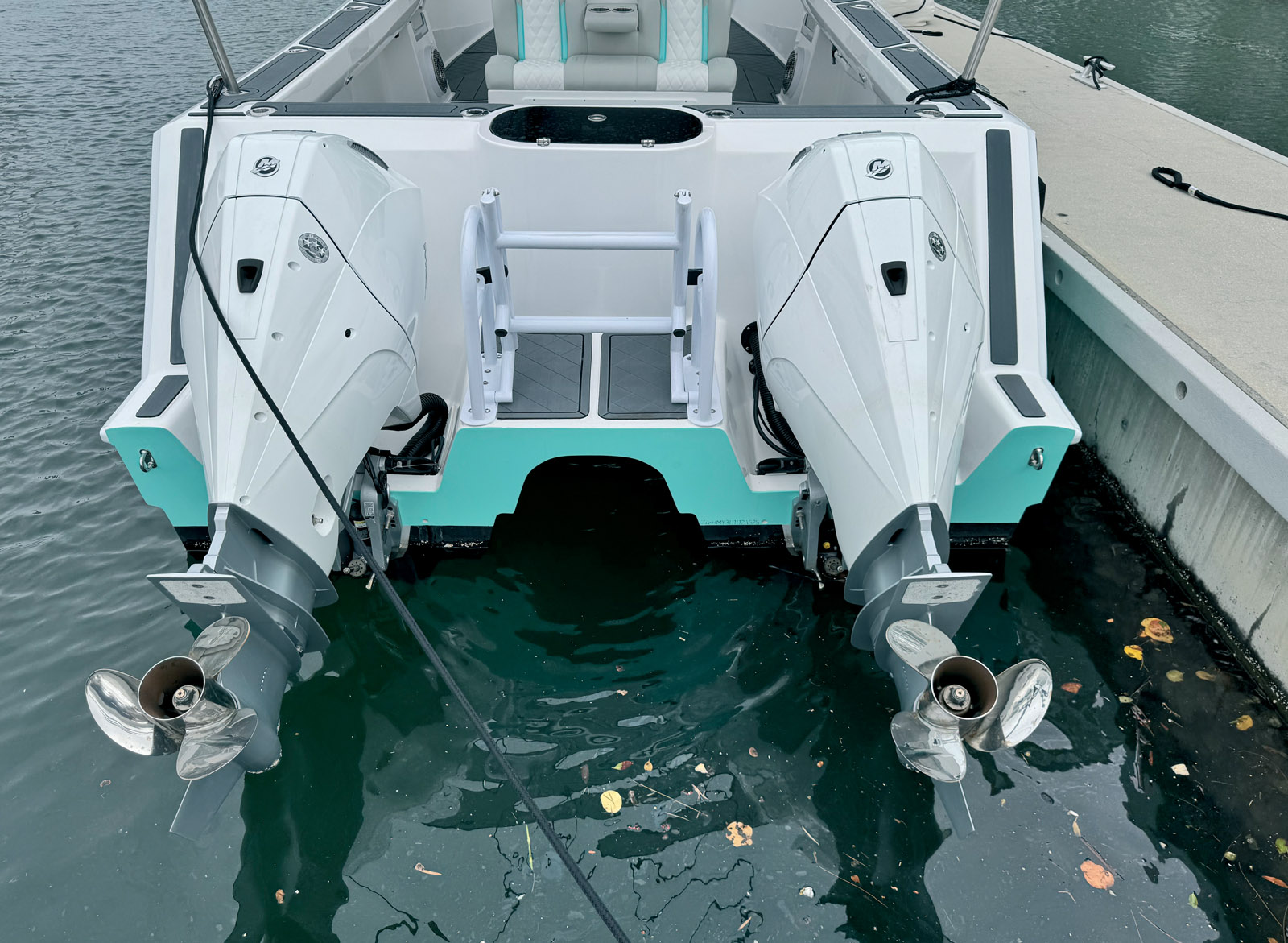
Another concession to comfort is a swim ladder located on a small aft platform between the two engines. It’s a good idea, but it’s a shame that accessing this ladder is a bit of an acrobatic feat. On the other hand, the HammerCat benefits from a high freeboard, which allows you to lean on it while fishing, unfortunately without cushions.
Another good point is the folding cleats, the fish measuring ruler integrated into the fish tank lid, and the solid mooring bollard on the bow.
Well-protected Helm and Modular Seats
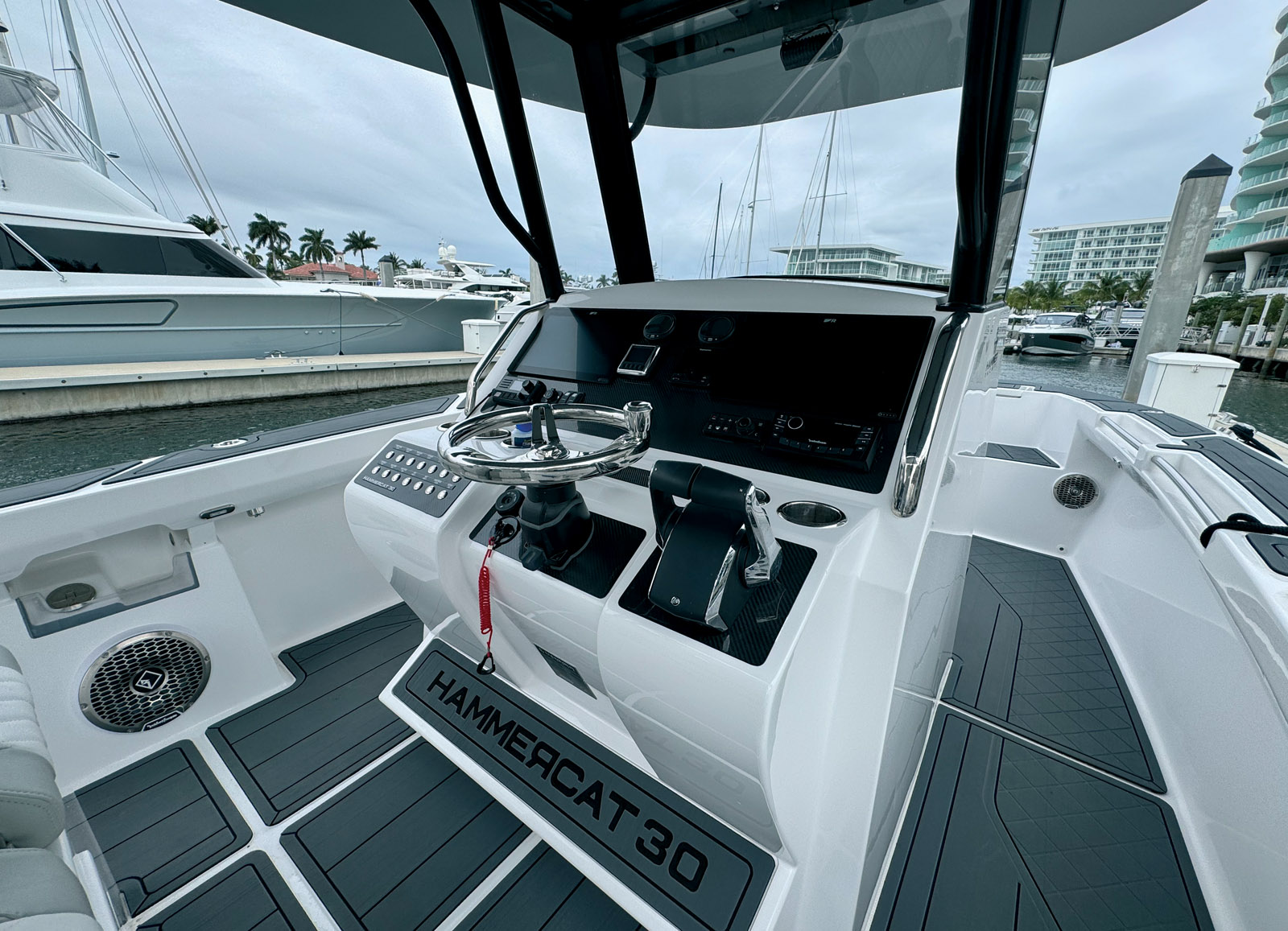
Then there is the console, which once again complies with all industry standards. Well protected by a high windshield and side windows, this helm is complete with two Raymarine Axiom 12” screens as standard, a slot for the VHF and another for the audio system, cup holders, a series of switches, and an adjustable stainless steel steering wheel.
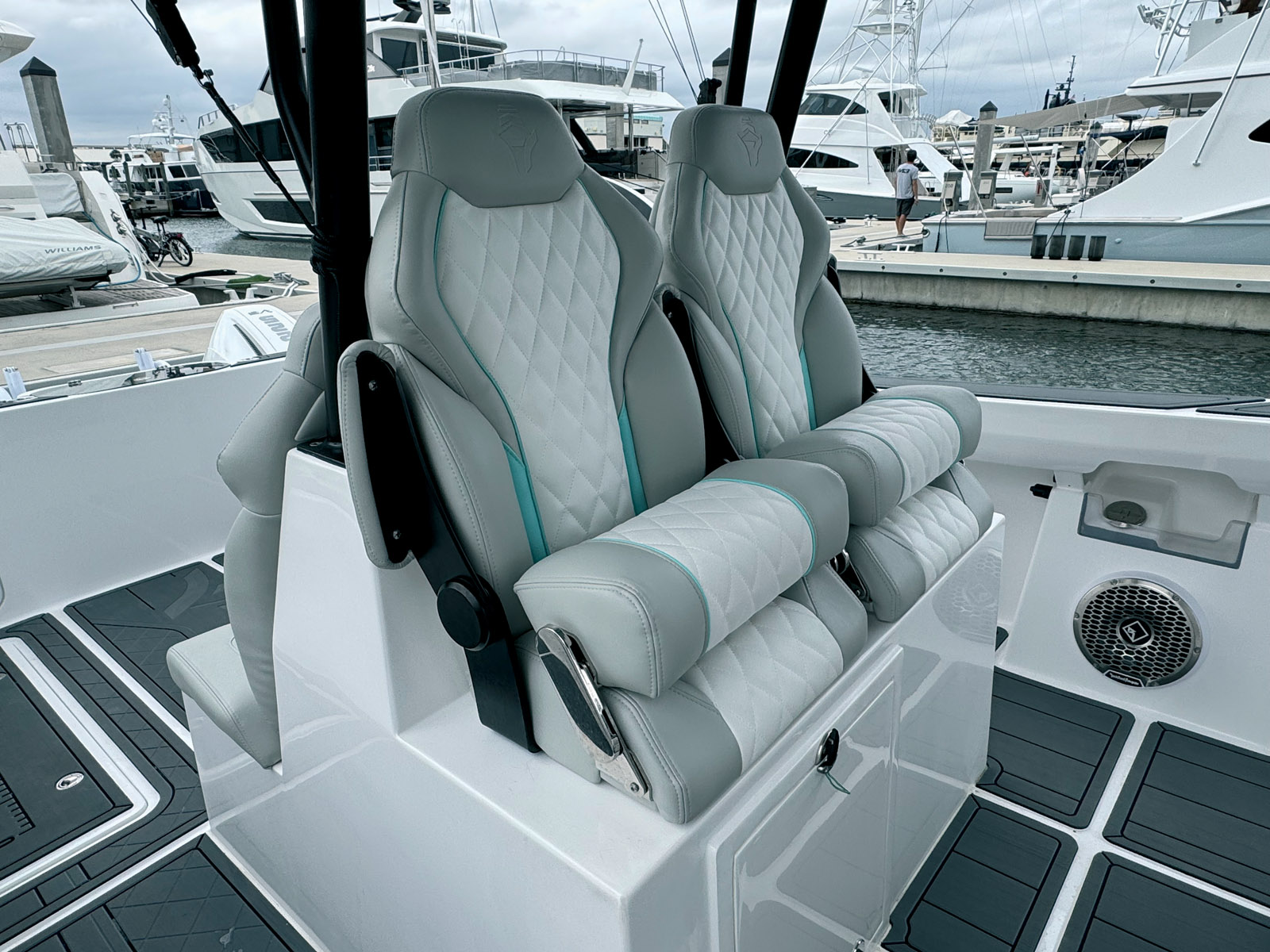
Once at the helm, you’ll appreciate the modular seats - classic or leaning post position - as well as the footrests and handrails. It is worth noting the number of handrails since they are everywhere on this fishing catamaran.
Finally, the HammerCat 30 comes with a fairly comprehensive range of standard equipment. In addition to the electronics, the powercat includes an audio system, radar, VHF radio, and high-quality stitched upholstery.
High Performance and Record Range
In terms of dynamics, in addition to the high tunnel, the HammerCat 30 benefits from double-stepped hulls, a feature that improves planing time, reduces the wetted surface area, and therefore increases speed while reducing fuel consumption. These hulls also feature a chine from bow to transom - a plus for stability - and two strakes, one below the waterline for guidance and grip and the other above the waterline, which limits water spray and stiffens the hull.
To put the HammerCat to the test, we fitted the maximum power output to the transom, i.e., 2 x 225 HP Mercury outboards. These provide a very good power-to-weight ratio, which we quickly verified. As soon as we left the channel, a slight push on the throttle was enough to lift the catamaran out of the water, and it was soon moving along on the lower part of its hulls. The tunnel works perfectly, and the air cushion effectively dampens movement. However, with 3 ft waves, it was a bit of a challenge for the powercat and its pilot (yours truly), who were eager to rev up the engines, while the importer began to pray to the heavens that I would go easy on the throttle. We take a few good waves, a few turns follow one after the other without the catamaran flinching, instilling a real sense of safety.
Nevertheless, the sea state on the day limited our ambitions somewhat and we had to stop at around 30 knots. In good conditions, the manufacturer claims a top speed of over 45 knots, which is not hard to believe. What’s more, Hammer Yachts places great emphasis on low fuel consumption, with a cruising speed of around 25 knots and a range of over 300 nautical miles. This means that fishing trips far from the coast are a real possibility.
Conclusion
In this increasingly popular category of fishing catamarans, the HammerCat 30 has no reason to be ashamed when compared to American models. Rather pleasing to the eye, the 30 also benefits from solid construction, a neat finish, and comprehensive equipment. Finally, it offers good seakeeping, reassuring and comfortable, which should appeal to fishermen and families alike. In short, it is a serious alternative to monohull fishing boats, with the added bonus of more space on board.
Very well built
Comprehensive equipment
No side cushions for the thighs
No windlass
Technical Specifications
Length overall: 28’8” (8.74 m)
Beam: 9’5” (2.86 m)
Draft: 16” (0.4 m)
Light displacement: 6,500 lbs (2.95 t)
Standard powertrain: 2 x 150 HP
Max powertrain: 2 x 225 HP
Fuel: 2 x 300 l / 2 x 80 US gal
Water (optional): 12 US gal (45 l)
Base price: $ 299,000 ex-tax