
The PC60 is an intermediate model in the Horizon Power Catamarans range. It also features comfort and luxury amenities, and directly attacks the monohull yacht market. A clever positioning for this catamaran with imposing dimensions, especially since it offers solid arguments to seduce a future owner.
Test location: Fort Lauderdale, FL (USA)
Conditions: Wind 8 to 9 knots, easterly swell of 3 to 5 feet (1 to 1.5 m)






Infos pratiques
- Le chantier : Horizon PC60
- La fiche technique
-
 Découvrez notre vidéo exclusive
- Financez votre Horizon PC60
- Assuez votre Horizon PC60
- Articles autour du Horizon PC60
Horizon Power Catamarans is a brand that is mainly known in the United States and Asia for the moment. Created in 2009 by Richard Ford and Stuart Hegerstrom, the company is aiming to conquer other markets, particularly in Europe. Manufacturing is handled by the Horizon Yachts shipyard, founded in 1986 and located in Kaohsiung, on the island of Taiwan. They are specialized in the construction of yachts from 52 to 150 feet and have earned a good reputation in the market thanks to their luxurious services and semi-custom concept. The Horizon Power Catamarans range is based on four models from 52 to 74 feet, a range that should evolve in the coming years. As a matter of fact, since its launch, Horizon has been increasingly successful, with already more than 50 units sold. This performance is all the more remarkable given that the manufacturer only offers semi- custom models, or even totally custom for the PC74.
 |
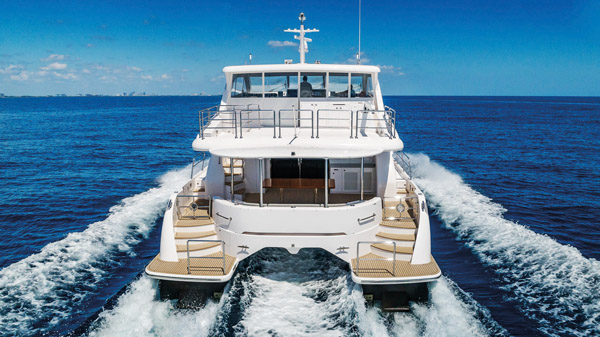 |
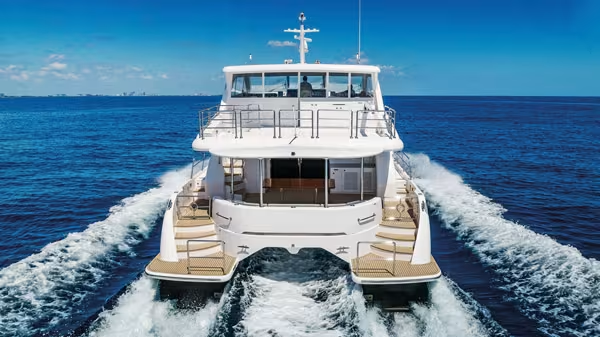
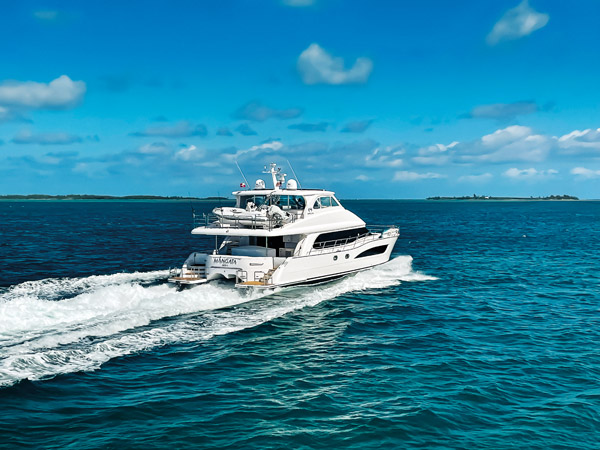
The Horizon PC60 is very imposing, both in terms of its dimensions and its structure - which gives confidence.
The large transoms end in two huge swimming platforms. As an option, a platform can connect the two rear decks.
An “À la carte” powercat
At Horizon, the idea is to take a base and build a project with each customer according to his desires or needs. The result is a certain diversity, since no two powercats are alike. The customization is not limited to the equipment but includes the interior design and even the layout of certain bulkheads. The shipyard also intends to demonstrate that a catamaran can offer the same level of comfort as a single-hulled yacht, with the addition of more space. In fact, once aboard this powercat, you will quickly forget that you are onboard a catamaran.
The other characteristic of the shipyard is the construction method used, directly inspired by the world of aeronautics and which borrows in particular very innovative quality control techniques using sound waves, laser or optical technology to ensure the final quality of each multihull, as much for the hull as for the internal structures. The PC60 is also available in a forward owner’s cabin version or with an open concept main deck. It is the second version that we tested off Fort Lauderdale, Florida.
As for the design, the PC60 is the result of an international collaboration between the New Zealand studio Lavranos Marine Design for the hulls, Winchester Design Group for the interior layout and JC Espinoza for the coordination. It is therefore normal that she has a very international dimension, even if her main market remains the United States.
 |
 |
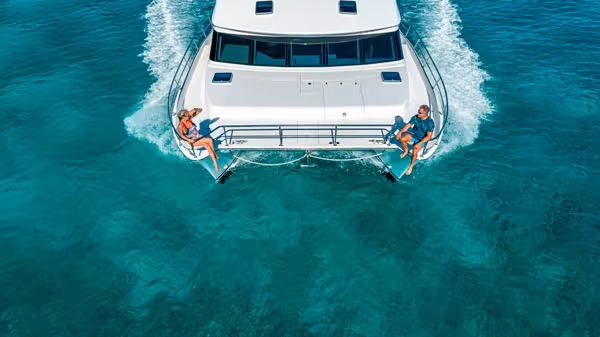
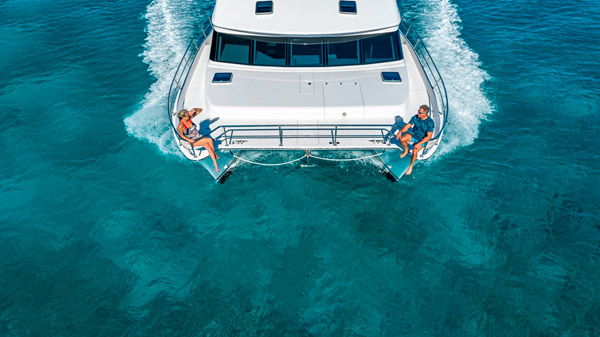
From the front, the thickness of the nacelle is truly impressive, this suggests good habitability.
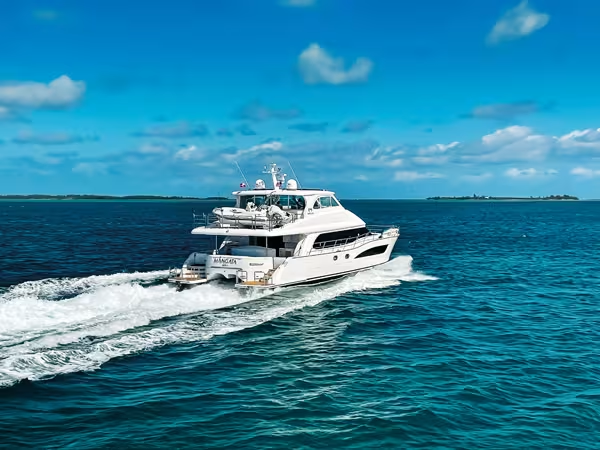
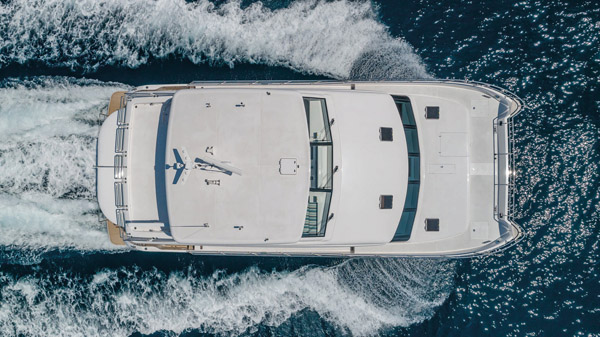
Seen from above, the PC60 goes along untroubled by the chop.
Robust and meticulous construction
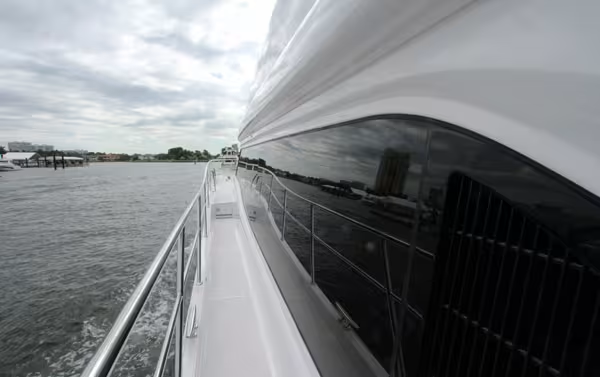
For those who are not familiar with the brand’s models, the first impression given by the PC60 is imposing, to say the least. With a length of nearly 62 ft (19 m), a width of 24.5 ft (7.47 m) and a T-Top that culminates at 18.8 ft (5.73 m) above the water, the catamaran has a rather massive appearance. The nacelle is also very thick and joins the hulls low down - a good omen for habitability. As for the main deck, it has a large, glazed area, but also very robust structures, a sign of seriousness. Finally, the Horizon benefits from an almost completely enclosed flybridge, in the manner of sky lounges, which are very popular in the world of sport fishing boats. However, you can remove the flexible side and rear windows to enjoy the fresh air. Despite the design not being necessarily light, we were quickly reassured about the solidity of the whole. In addition, the hull lines, which are quite elongated, offer a bit of dynamism, and the higher bow seems well suited for offshore work.
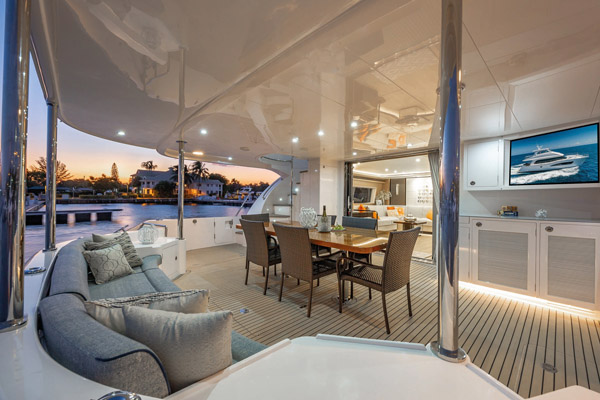
Designed to be very livable, the PC60 has a fairly high deck line. In fact, once on one of the two aft swimming platforms, you have to climb three steps to reach the cockpit. In passing, we noted the solid fixed shower located on top of the rear hatch, a real luxury when returning from swimming. The space between the two aft swimming platforms can accommodate a generously The large sized dinghy, but you can also opt for a central platform, giving the PC 60 one of the largest platforms in its class. It should be noted that you can also access the boat through one of the two lateral doors. Relatively traditional, the cockpit is completely covered by the back of the flybridge and offers enough space for a table for eight people and a large aft bench seat integrated into the transom. On closer inspection, things get interesting. The PC 60 has been designed to maximize space. As a result, there is a real outdoor galley with refrigerator, sink and icemaker, as well as a few storage lockers in the cockpit. On the port side, the designers have taken advantage of the space under the stairs to the flybridge to integrate a large closet with a system to organize everything: it’s simply remarkable. To understand the thoroughness and organization of the shipyard, you just have to take a look at the huge folder given to the owner - it lists all the systems of the catamaran down to the last detail - the maintenance, whether daily or annual, the reference numbers of consumables, and all the information that the owner or a professional working on the boat may need.
 |
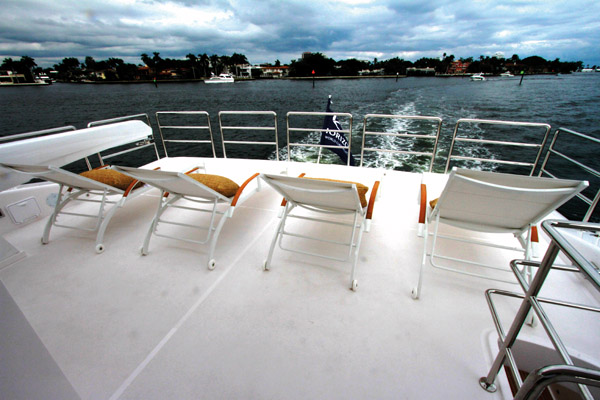 |
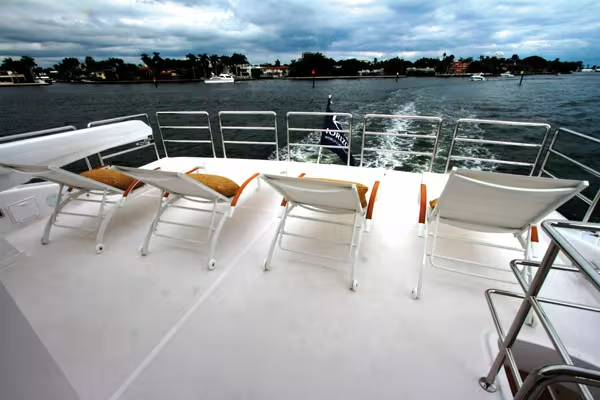
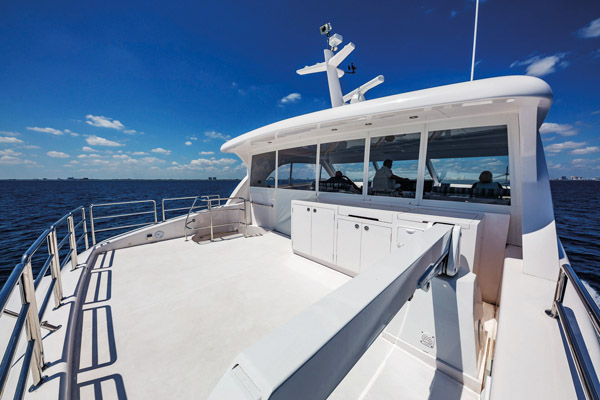
The rear of the flybridge has a crane capable of lifting a tender or water toys. This area can also be used as a deck, to accommodate a deck saloon or just about anything else the owner wants.
Not a lot of uses for the foredeck
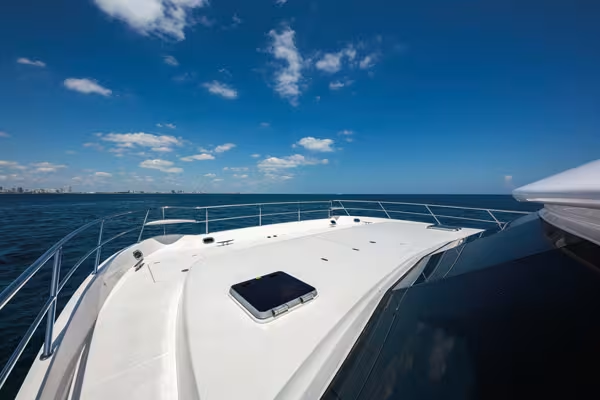
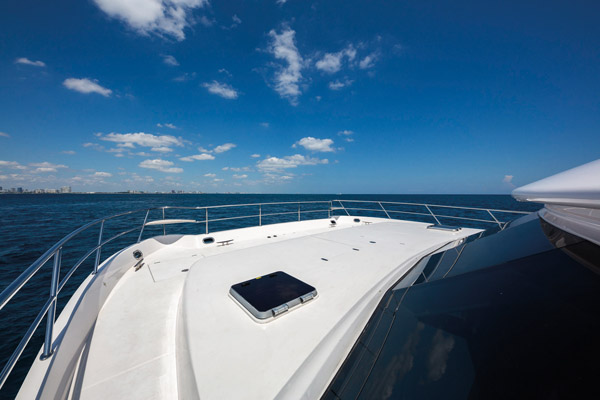
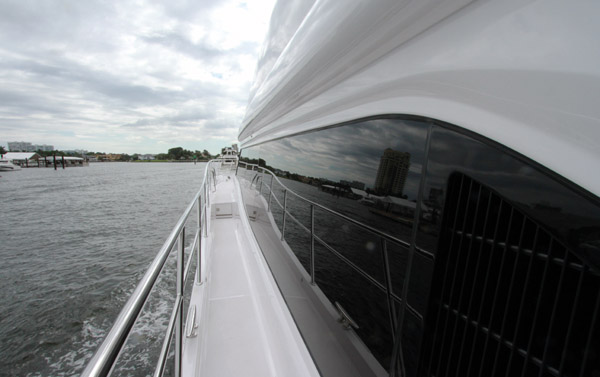
From the cockpit, it is easy to get to the bow thanks to the wide side-decks and a guardrail high enough to stay safe. Very large, this front deck is however not used much. It can accommodate a large sunbathing area, or you can just enjoy the small benches on each bow or take advantage of the space for maneuvers. It’s a pity, however, that there is no bench seat, or even a table for a drink in the open air.
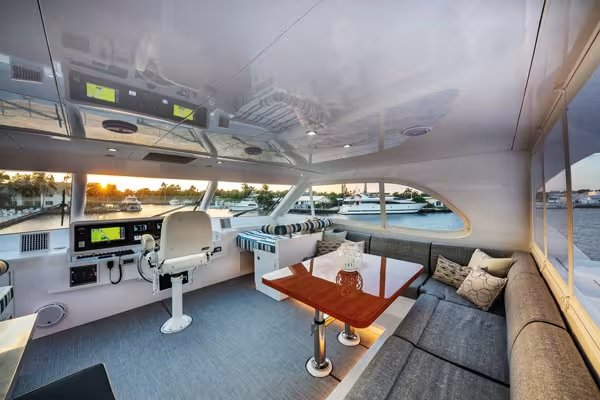
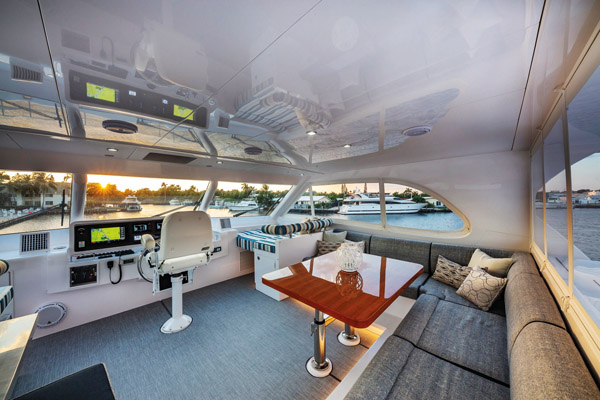
Last but not least, the flybridge is simply gigantic. In fact, it’s the same as the 65: you don’t feel cramped. In addition to the helm worthy of an Airbus, the flybridge offers a bar with refrigerator and stools, a large L-shaped bench to sit around the table, which can, if necessary, be transformed into a sunbed. The aft part of the flybridge has a large terrace with sun loungers, another sunbed, or a small summer lounge. This is also where the imposing crane is located to launch the «toys» of the boat. Thanks to a system of canvas, this flybridge can be totally closed, or largely open.
 |
 |
The foredeck is large, but not very well utilized.
The wide side-decks and guardrail make getting to the foredeck easy.
Impressive living space
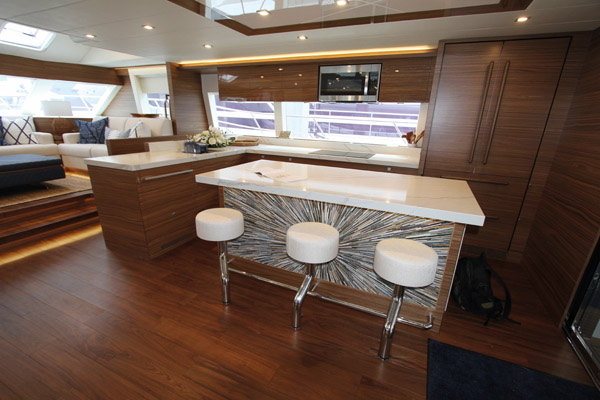
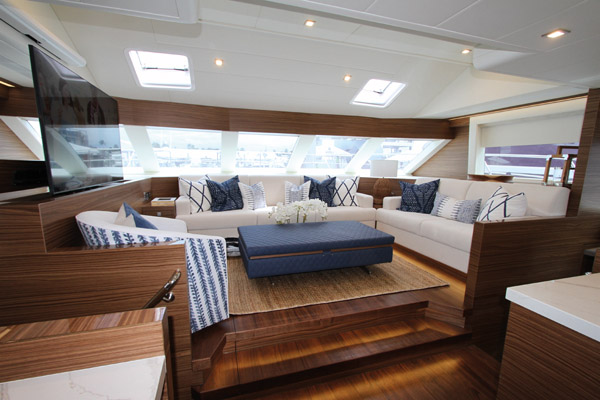
The Horizon PC60’s exterior dimensions are impressive, as is its interior. As soon as you step through the large sliding door, you discover a huge open space where a sofa faces a large, fully-equipped galley with a central island. The front part is occupied by a second saloon that can accommodate six or seven people while enjoying an unobstructed view of almost 360°. In fact, the PC60 is available in two versions: open, as on the model in our test, or in Deck Master configuration with the owner’s cabin located forward, instead of the saloon. This layout was previously reserved for monohulls of 90 feet or more. Apart from the volume, this main deck features a large number of storage compartments and all the appliances you can dream of. The decor is entirely made to the customer’s request, so that no two models are identical.
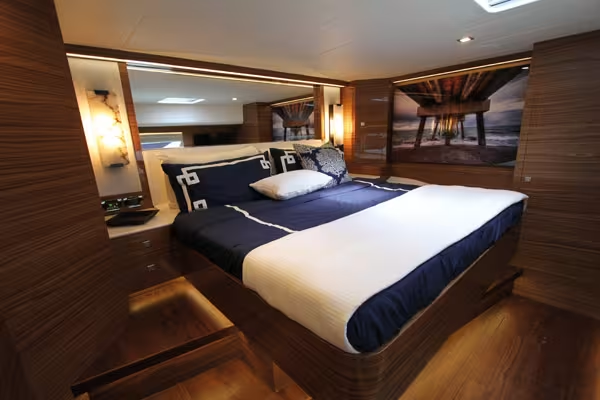
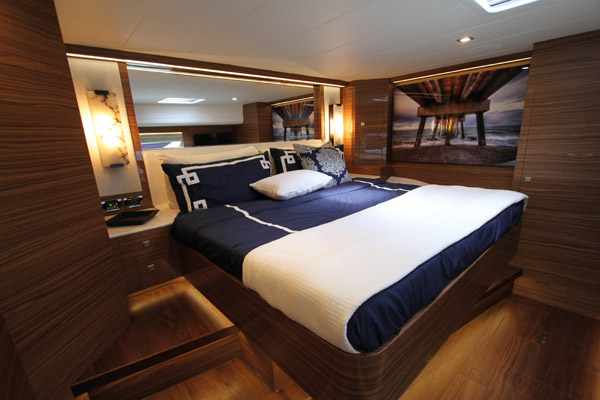
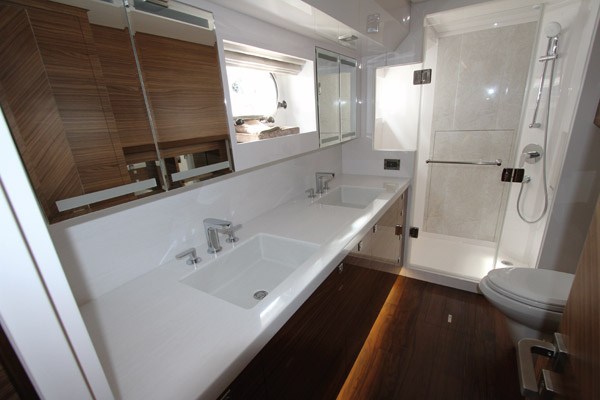
The hulls are of course reserved for the cabins, with the possibility of opting for a two, three or four cabin version. On the three-cabin model, the starboard hull has a king-size berth on the bow in a perpendicular position, which leaves enough room to move around the bed. The rear of the float is dedicated to a huge bathroom in the bow with an XXL-sized shower. The port hull is home to a double bed in the bow and two separate beds in the stern, each cabin having its own bathroom.
Contrary to a strong trend in the market, the portholes are a little smaller (which is not necessarily stupid in terms of safety), but this does not prevent these living spaces from benefiting from good lighting. While the decor is at the discretion of each owner, the quality of realization and the completion are quite simply remarkable. Finally, the designers have hidden storage compartments everywhere, a real plus for cruising.
Because we are on a semi-custom boat, the equipment is defined by the customer, but Horizon is really very open with regard to that, as well as the lighting as the audio system or the front fridge, we can integrate almost everything on board, the rest is only a question of cost. Announcing a range of several hundred miles, the catamaran of our test is also designed to be almost autonomous on the energy level. It has solar panels and a 21.5 kW Onan generator, which allows the crew to use electricity, (almost) without concern.
 |
 |
 |
Outre la table, le grand cockpit arrière offre une vaste banquette, une petite cuisine extérieure et un accès facile au flybridge.
Le flybridge est hérité du 65. Dès lors, l’espace ne manque pas, et on y trouve un coin repas, un bar et bien sûr un poste de pilotage complet.
Production semi-custom oblige, chaque modèle est unique, notamment au niveau de sa décoration, comme ici avec le panneau de l’îlot central de la cuisine.
Good marine abilities
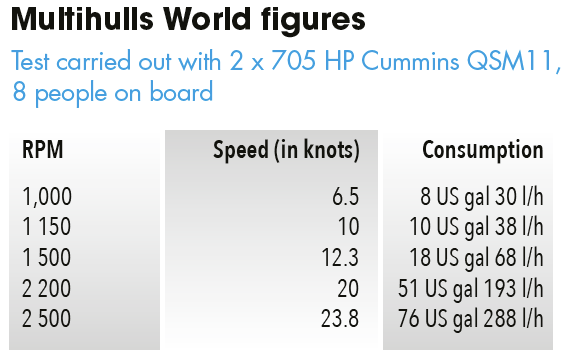
With an empty weight of 40 tons, the PC60 naturally requires some power to move. As standard, the shipyard equips the powercat with 2 x 705 HP Cummins QSM11. A generous and torquey engine that is rather well suited. Moreover, the design of the hulls has been thought for a maximum efficiency combining a correct speed and a controlled consumption. To achieve this, the semi-displacement hulls are equipped with a flat part at the rear that allows the boat to be raised a little out of the water. A tunnel has also been created to optimize the water flow to the propeller and thus improve the efficiency of the drivetrain. Finally, a small keel forward of each propeller ensures good steering. Particular care has also been taken with the weight distribution to give the PC60 an optimal trim. In the end, the shipyard is announcing a fuel saving of about 18% compared to a more traditional hull design.
Once at sea, it must be admitted that the result is quite convincing. Relatively fast, the catamaran accelerates quickly, to reach a cruising speed of about 20 knots at 2,200 rpm. For quiet coastal cruising, we would rather settle for 1,200 rpm, which propels the boat at about 10 knots. If necessary, the Horizon is even capable of flirting with 24 knots even though this is not its program at all. The other promise of the manufacturer was to keep a reasonable fuel consumption. Here again, the bet is partly won, since at 10 knots, the total consumption (both engines) is 11 gallons per hour (41.6 l/h), which gives the powercat a range of about 760 nautical miles, which is not bad. At 20 knots, the consumption climbs to 51 gallons per hour (193 l/h), for a range of a little more than 300 nautical miles, which is still pretty good.
 |
 |
 |
The PC60 is available in two versions, with a large forward lounge or with an owner’s cabin there instead.
The catamaran is available with 2, 3 or 4 cabins, all of which have a volume close to that of an 80-foot monohull yacht.
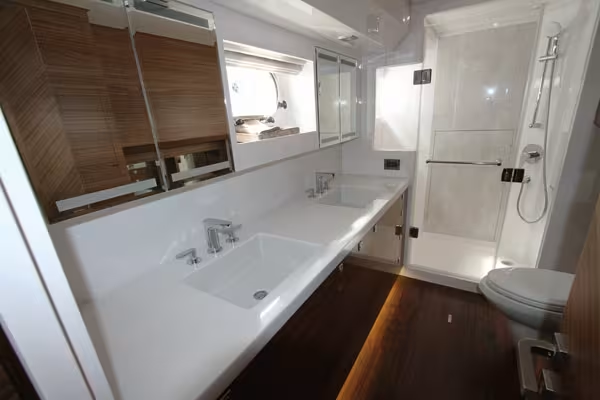
The owner’s cabin head has a totally unconventional size, worthy of a luxury hotel.
Conclusion
Stepping on the toes of monohull yachts, the PC60 offers similar features to an 80- or 90-foot cruiser, but with better comfort at sea. It also offers a high degree of customization, and a rather attractive starting price for such a large living area. This will appeal to those who prefer full comfort cruising or those who wish to live aboard without sacrificing the cozy aspect of their previous accommodation.
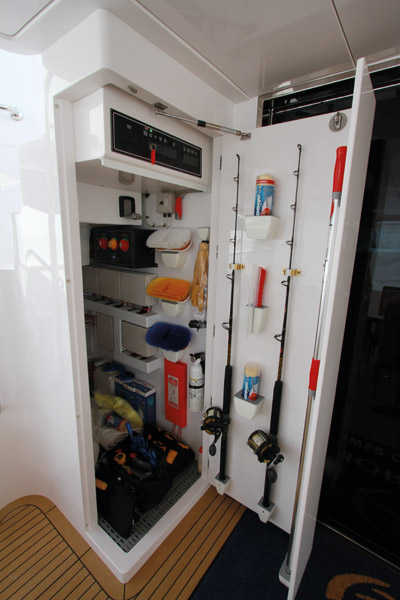
The builder’s penchant for organization has resulted in a large storage closet in the cockpit, where everything is in its place.
THE PLUSES:
+ Interior volume
+ Robustness
+ Semi-custom
THE MINUSES:
- Heavy displacement
- Front deck not much used
- Hull windows a little small
TECHNICAL SPECIFICATIONS
Builder: Horizon Yachts (Taiwan)
Design: Lavranos Marine Design (hull), Winchester Design Group (interior)
Overall length: 60’9’’ (18.78 m)
Beam: 24’6’’ (7.47 m)
Draft: 4’9’’ (1.46 m)
Air draft: 18’8’’ (5.73 m)
Light displacement: 83,467 lbs (40.09 t)
Berths: 6 (3 cabins) to 8 (4 cabins)
Fuel: 1,000 US Gal (3,785 l)
Water: 250 US Gal (945 l)
Engines: 2 x 705 HP Cummins QSM11
Certification category: A
Price: $3,850,000 basic version ex-tax
Options: on request

