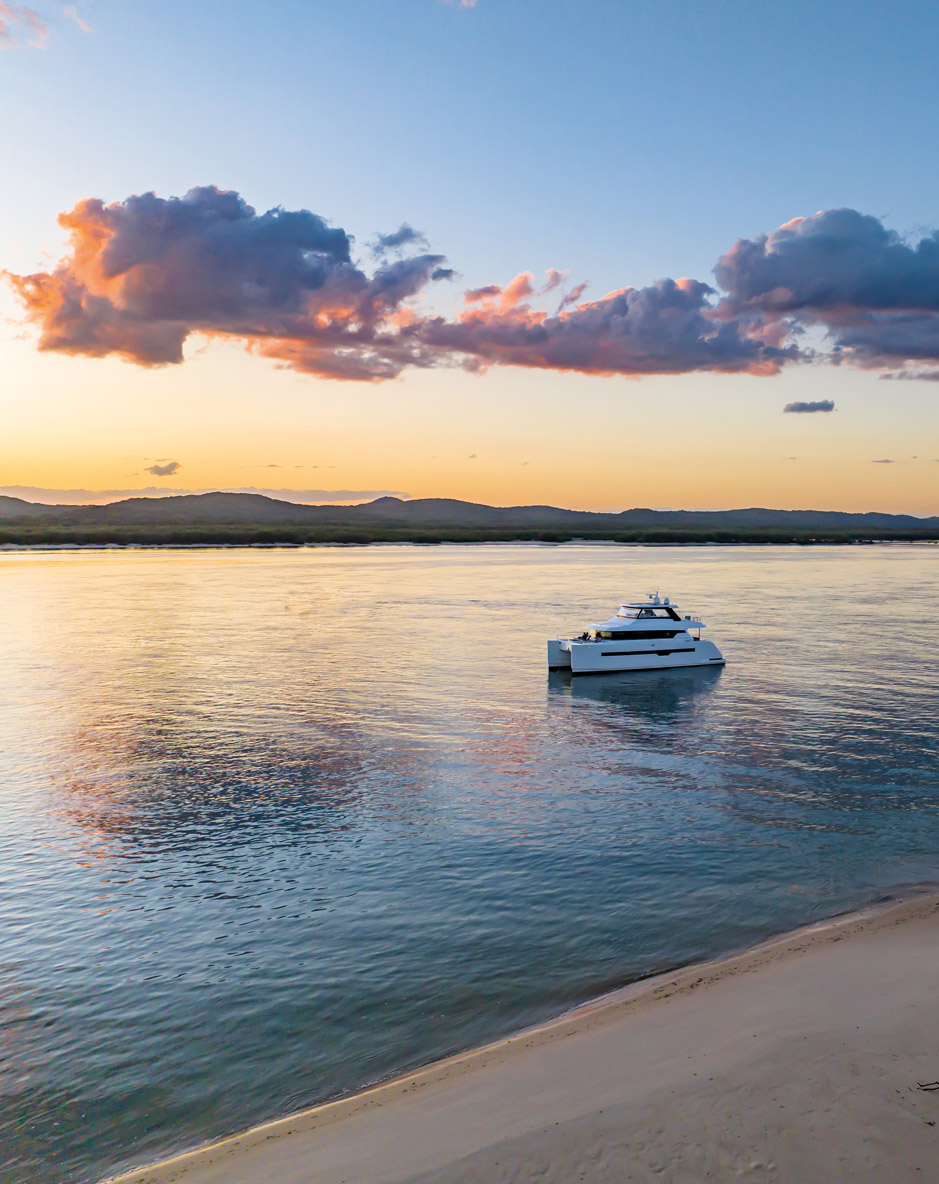
Escaping the madding crowd requires self-sufficiency and an efficient vessel, which is something Australian-owned Iliad Catamarans knew from the very beginning of the conception of this range of powered catamarans. These vessels and their inherent features, such as frugality and shallow draft, mean they are also ideal explorer boats.


Infos pratiques
- Le chantier : Iliad 62
- La fiche technique
-
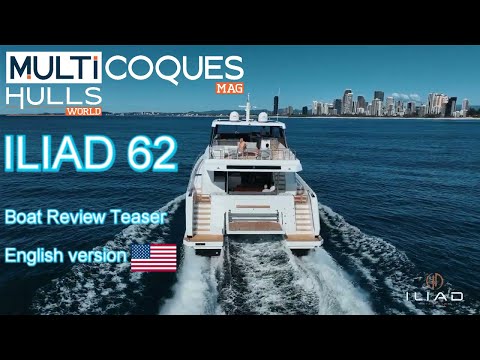 Découvrez notre vidéo exclusive
- Financez votre Iliad 62
- Assuez votre Iliad 62
- Articles autour du Iliad 62
Conditions: no wind and calm sea
The first Iliad to arrive in Australia was a 50, in 2019, and was joined in 2020 by a 70 model in a line-up that includes 53, 62 and 74 models. For 2022, the major milestones are the upcoming 53 S, which is the sedan model and now, the arrival of hull number one of the 62 that made its debut at the 2022 Sydney Boat Show.
These semi-displacement yachts can achieve double-digit cruising speeds and long ranges. The key to these capabilities is a wide array of engine choices, all shaft-driven, tailored to a customer’s needs. The popularity of explorer-style yachts continues to grow as people seek to escape the crowds and embrace technologies that liberate them from onshore services. For motor yachts, fuel efficiency is a key feature, and this is where catamarans with their low-drag hulls are very attractive.
Commanding Flybridge
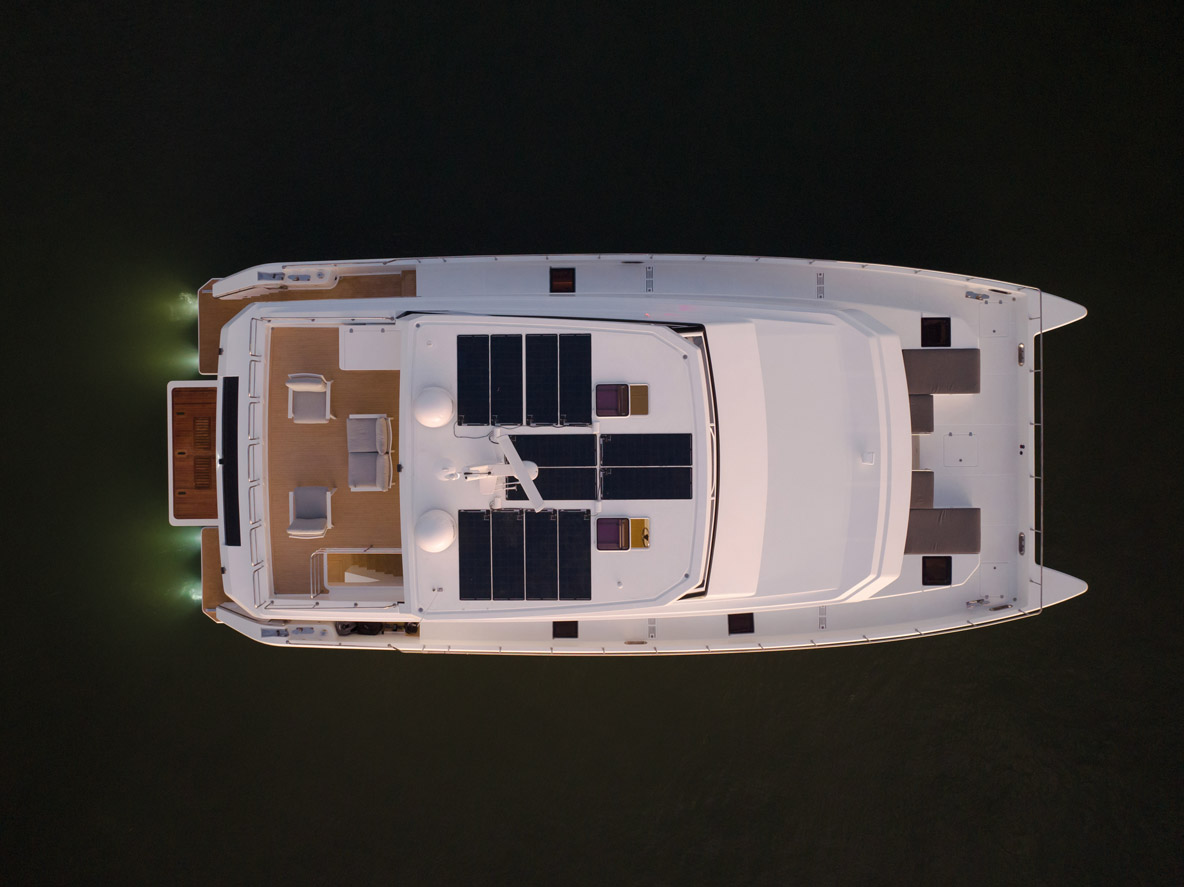
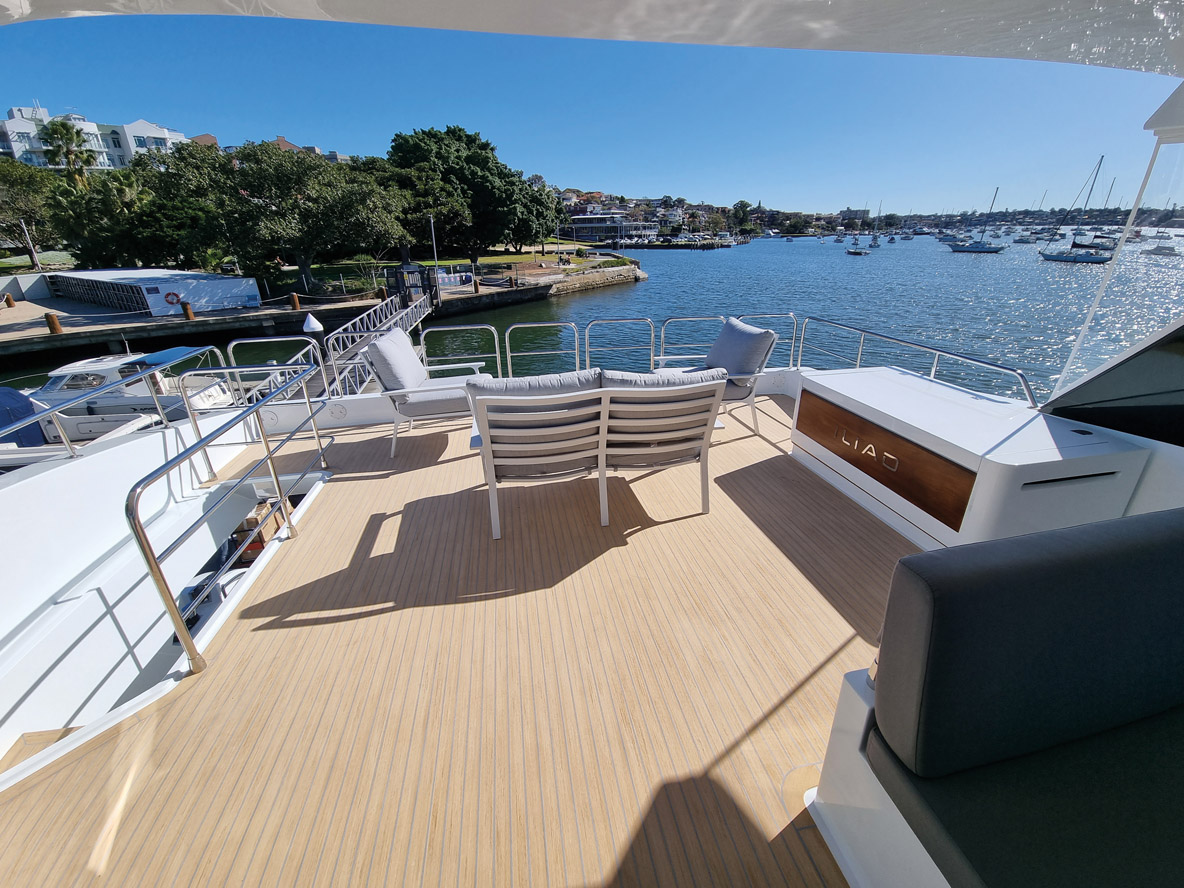
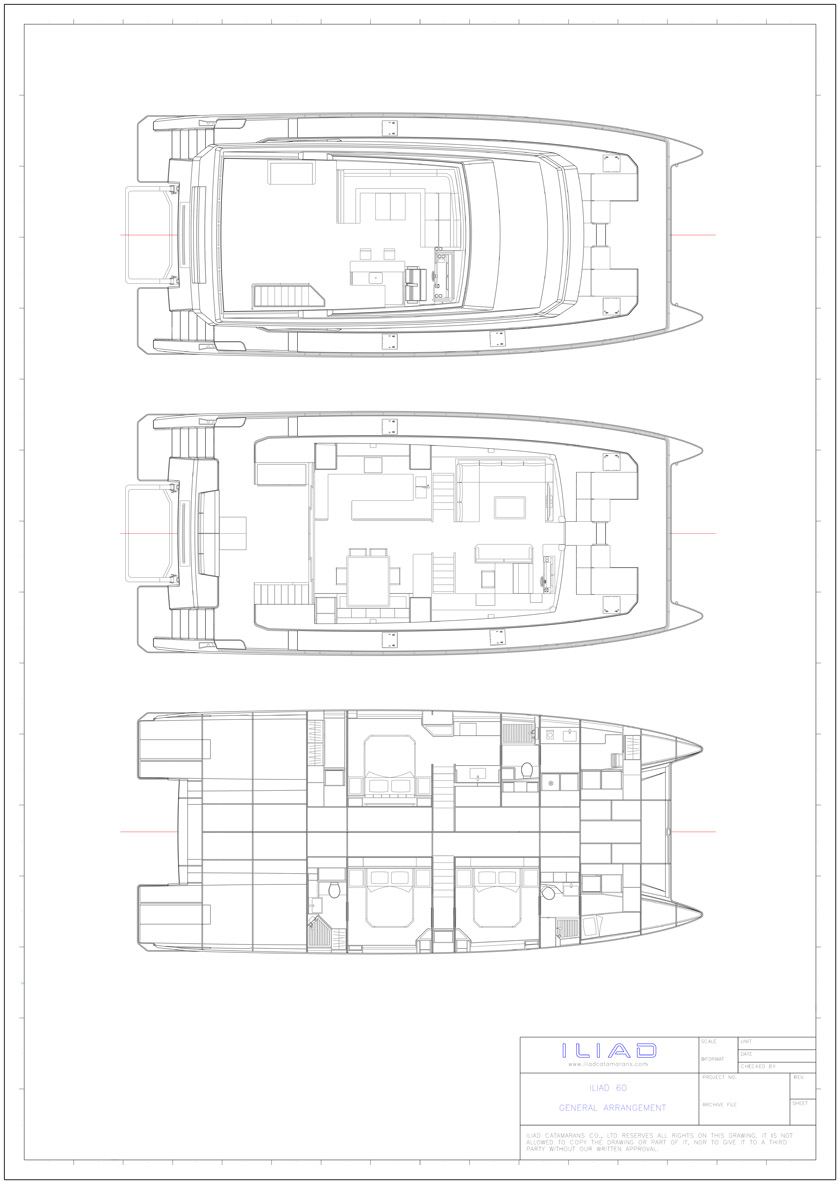
Three levels of living starts at the top with a huge flybridge that extends right to the aft of the Iliad 62. Climbing up here via the inboard steps from the cockpit reveals a semi-covered area with U-shaped lounge midships that seats 10; opposite this is a bar with stools that includes an electric plate and bar fridge. Offset to port at the front is the steering console that complements another (optional) one in the saloon. This elevated position is ideal for steering in shoal waters and good for tight marina maneuvers as well, because of the views all round. Looking aft on the flybridge, across the swath of thick Flexiteek flooring, is an open area for lounging or housing a dinghy, with a reinforced base in place for a davit. However, being a custom boat, this area could have sunbeds or even a jacuzzi perhaps. “Just let us know what you want,” advised Elkington. Overhead, the fiberglass roof supports communications equipment and clear plastics were fitted on the review boat to weatherproof the forward sections. “Alternatively, you could have fully enclosed wheelhouse with internal staircase leading up here,” said Elkington.
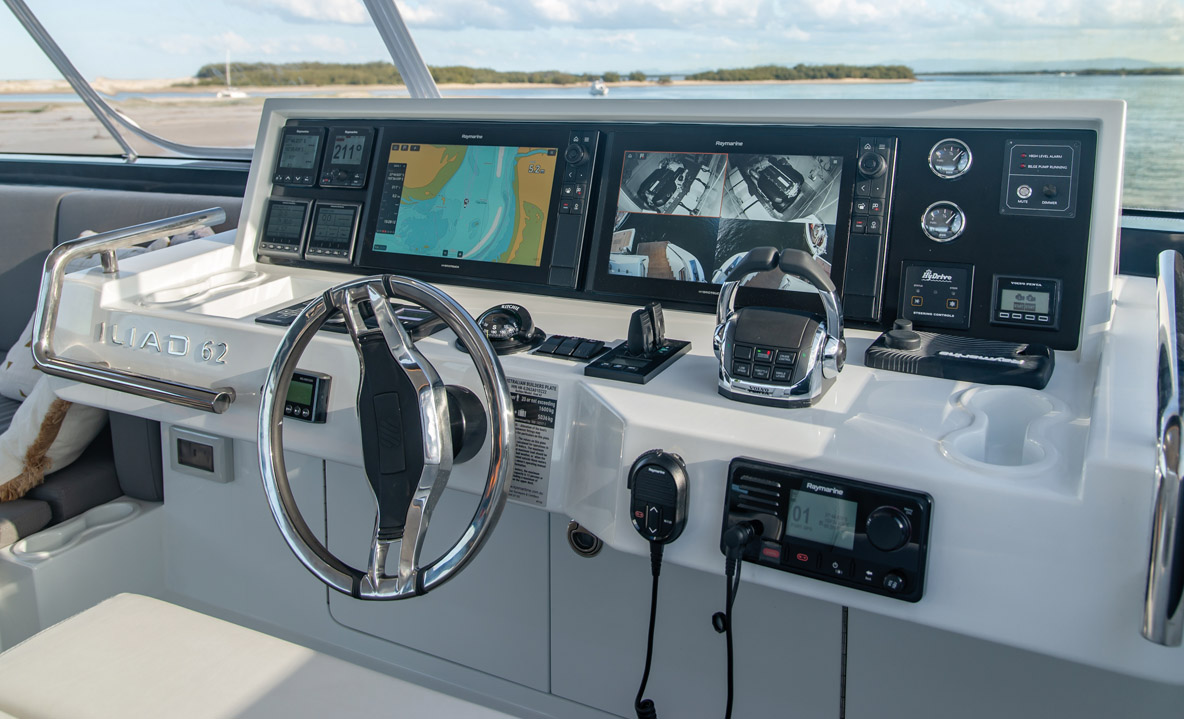
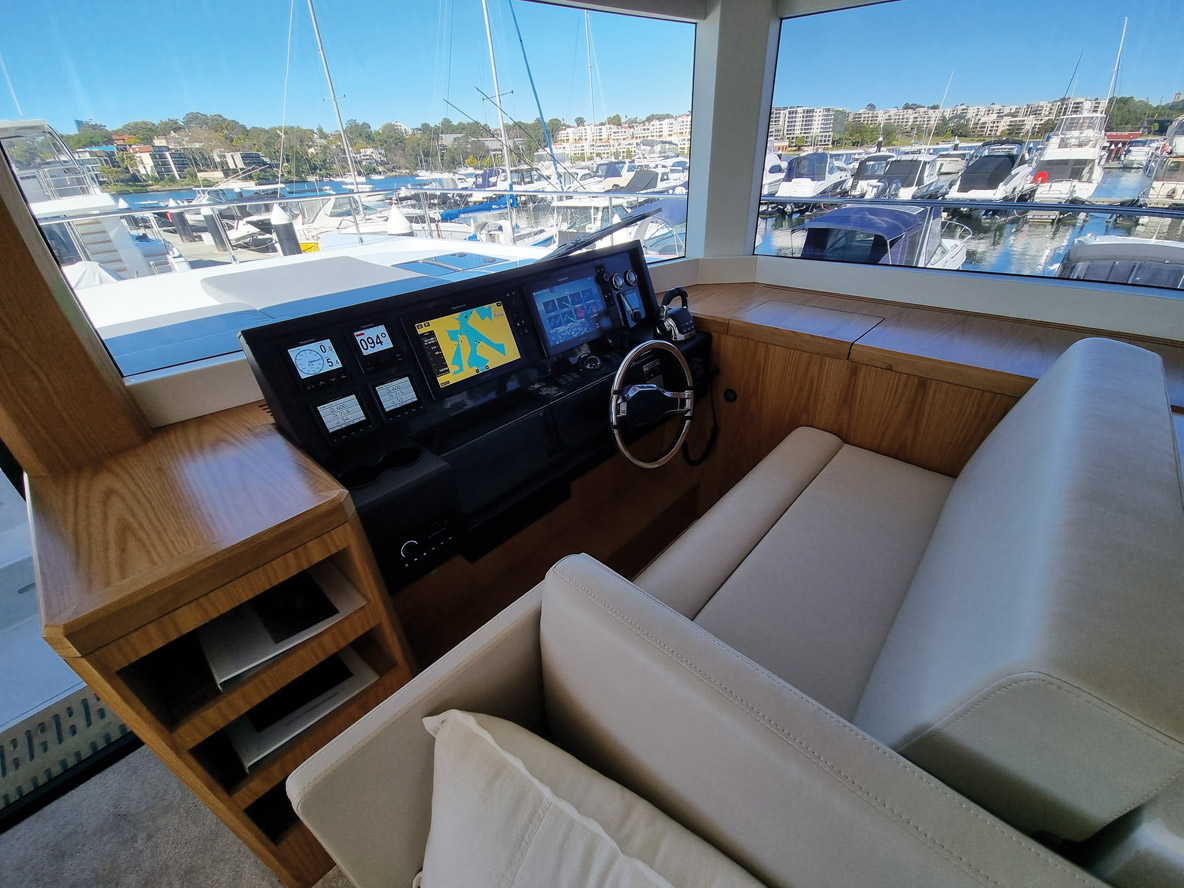
The steering console was dominated by Raymarine Hybrid Touch chart screen, autopilot and electronic throttles for the upgraded Volvo D6-600HP motors. Among the features of catamarans are their two engines located far apart (unlike a monohull) so this gives them incredible maneuverability, allowing the hulls to be pivoted, which generally offsets the need for a bow thruster; however, thrusters were fitted. Their vast bulk does create windage (and increased fuel consumption) so powerful engines like these 600HPs are ideal for a multipower of this size, especially if semi-displacement performance is desired.
Bow door
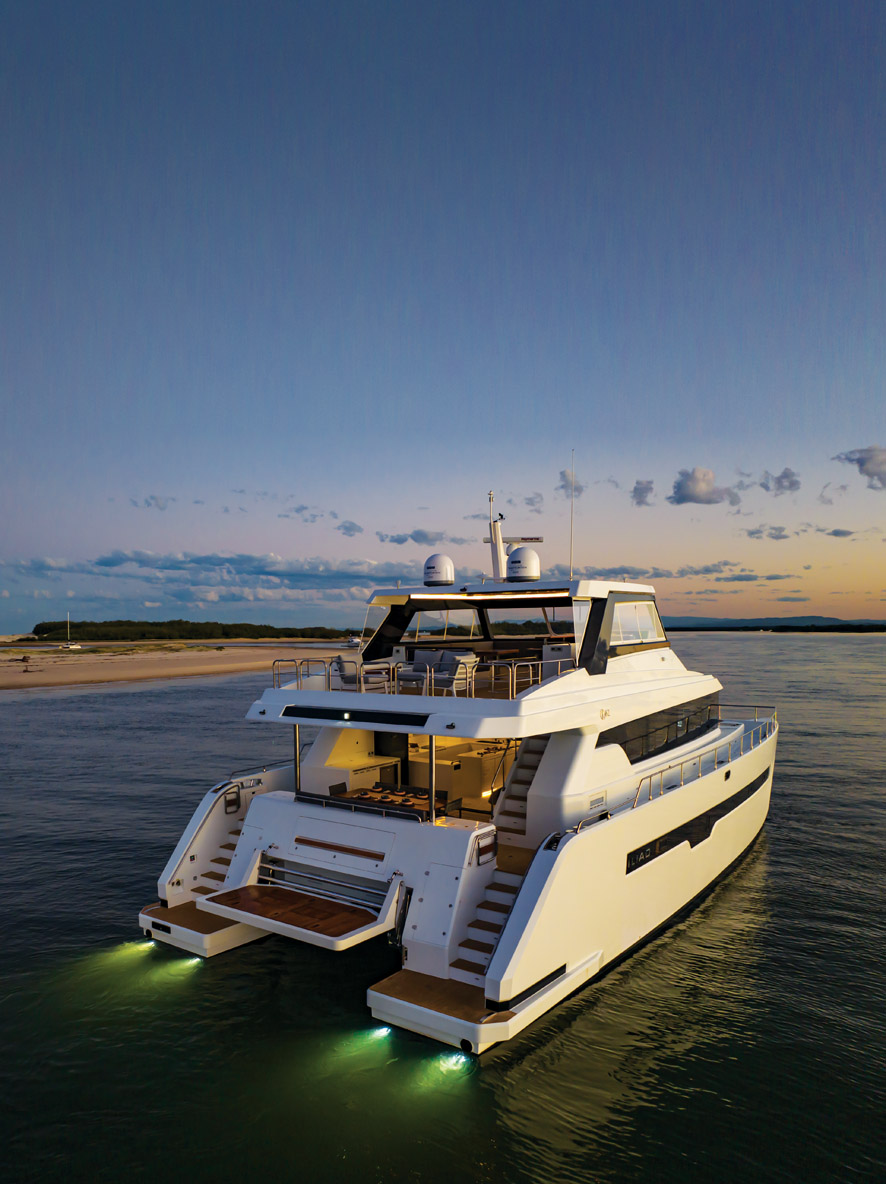
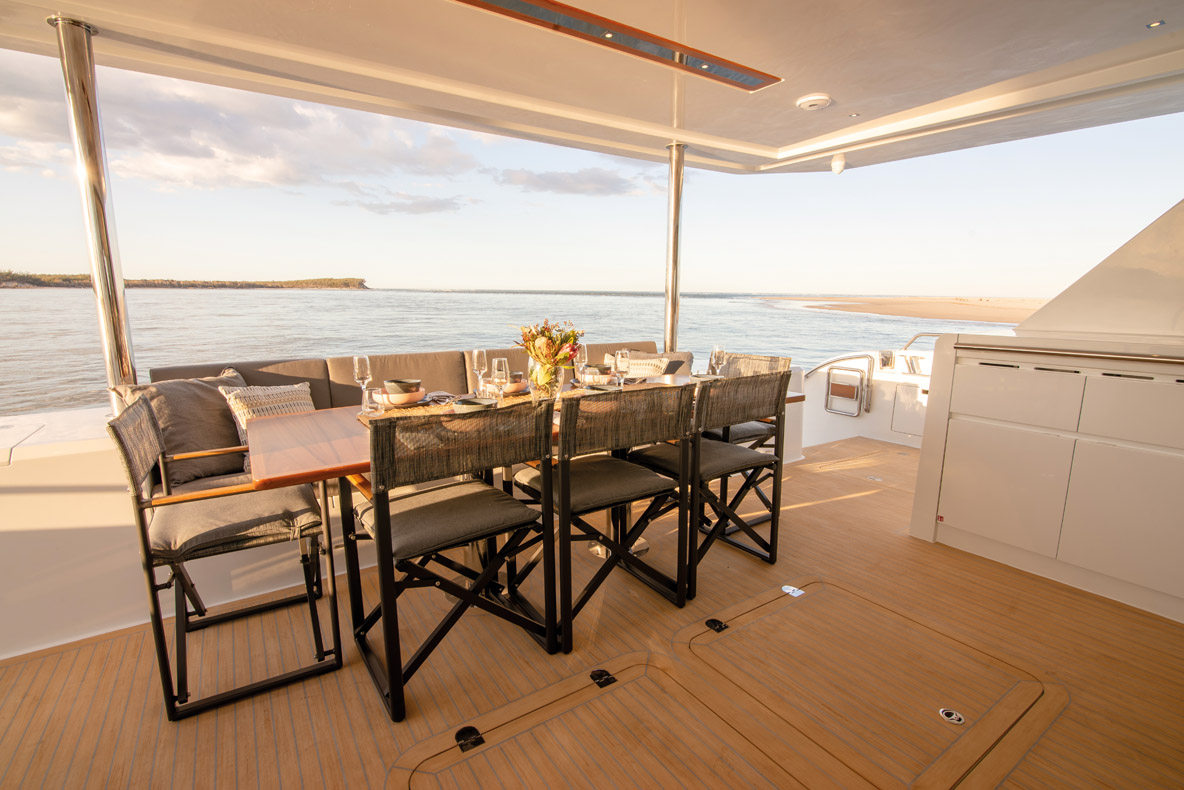
On the main deck, the aft part will be a strong selling point for prospective buyers, especially for those coming from the narrower beam of a monohull because the Iliad 62 has a vast area of unimpeded relaxing space that only a motor catamaran can offer. A wet bar and table for eight means the aft deck is an alfresco extension of the saloon, especially as the galley is just inside. The entire area is shaded by the flybridge extension which is strongly supported by large diameter stainless struts and seamlessly flows into the saloon while being protected by sturdy sliding doors.
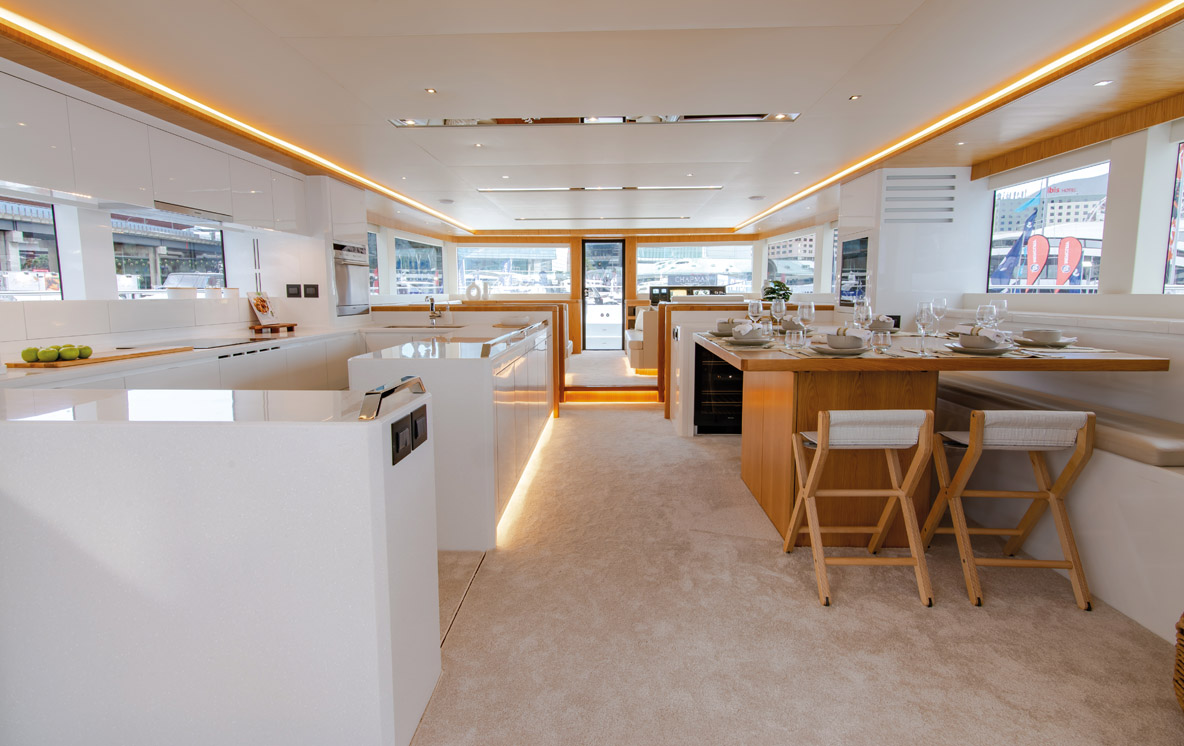
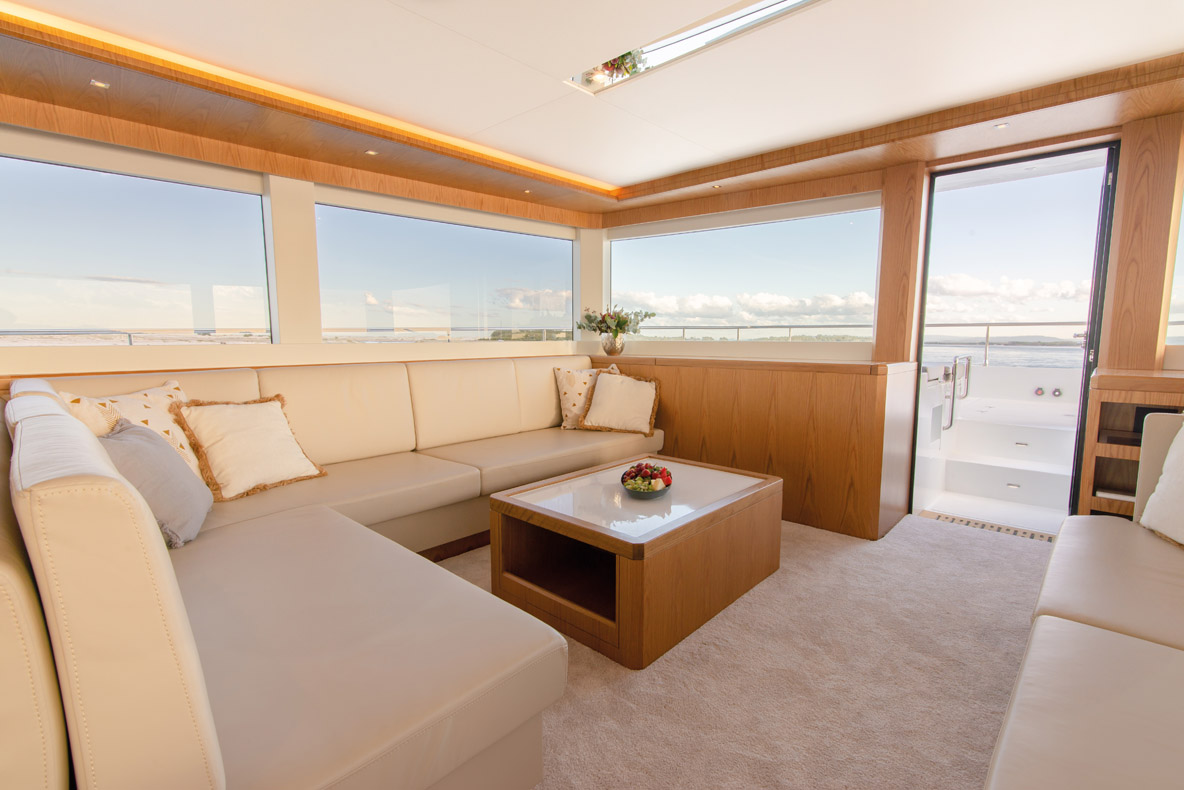
Inside, the open plan saloon the galley is to port, dinette conveniently placed opposite and lounge on the forward port quarter. New to the Iliad brand is the bow access from the front of the saloon, which allows guests to enjoy the forward cockpit or crew to quickly check on the rode when anchoring. Inside is the second steering console (which is optional) and double electronically controlled Besenzoni helm. It has a full array of Raymarine screens including autopilot and twin large navigation screens plus engine ones and anchor controls. The other key control is the main powerboard which is near the galley. It had neatly laid out 12v and 24v switches and all essential controls including the anti-fire system for the engine room.
As the forepart of the saloon is elevated by a step, this creates clear views from the steering console aided by the low-slung styling of the American Oak joinery – a medium colored wood that nicely matches the immaculate two-pack cream painted bulkheads and cupboards. Underfoot is carpet over laid wood. Views for the skipper are superb in all directions, greatly aided by the generous use of toughened glass throughout - all made in New Zealand by Glass Shape. Just behind the steering console is the navigation table, so ideally placed for the skipper to place pilot books and charts. This area also has a wet bar so is multi- purpose. Vertical side bulkheads throughout give lots of volume and natural light, while a sensibly large front window allows airflow at anchor.
In the galley, a U-shaped arrangement supports the cook when rolling in a seaway but if more access is required, an island bench can be specified instead. Appliances installed are comprehensive and include a four-burner electric hob with separate oven and a dish- washer, while an incredible array of six drawer refrigerator-freezers ensure the perishables remain cool or frozen. Other white goods include a washing machine installed in the owner’s hull. There’s also spacious Himacs composite worktops and two deep stainless sinks. Large cupboards overhead and under the worktops are ideal for victualling long-term, plus there’s watertight storage in the nacelle – ideal for maintaining the temperature of your wine. An improvement on previous models is clever use of fiddles that double as handholds on the workbench, illustrating my earlier comments about the improved level of refinement. The joinery is hand-finished in most places and includes rounded ends, curved cocktail table tops and immaculate stitching in the Ultraleather couches.
Private suite in the port hull
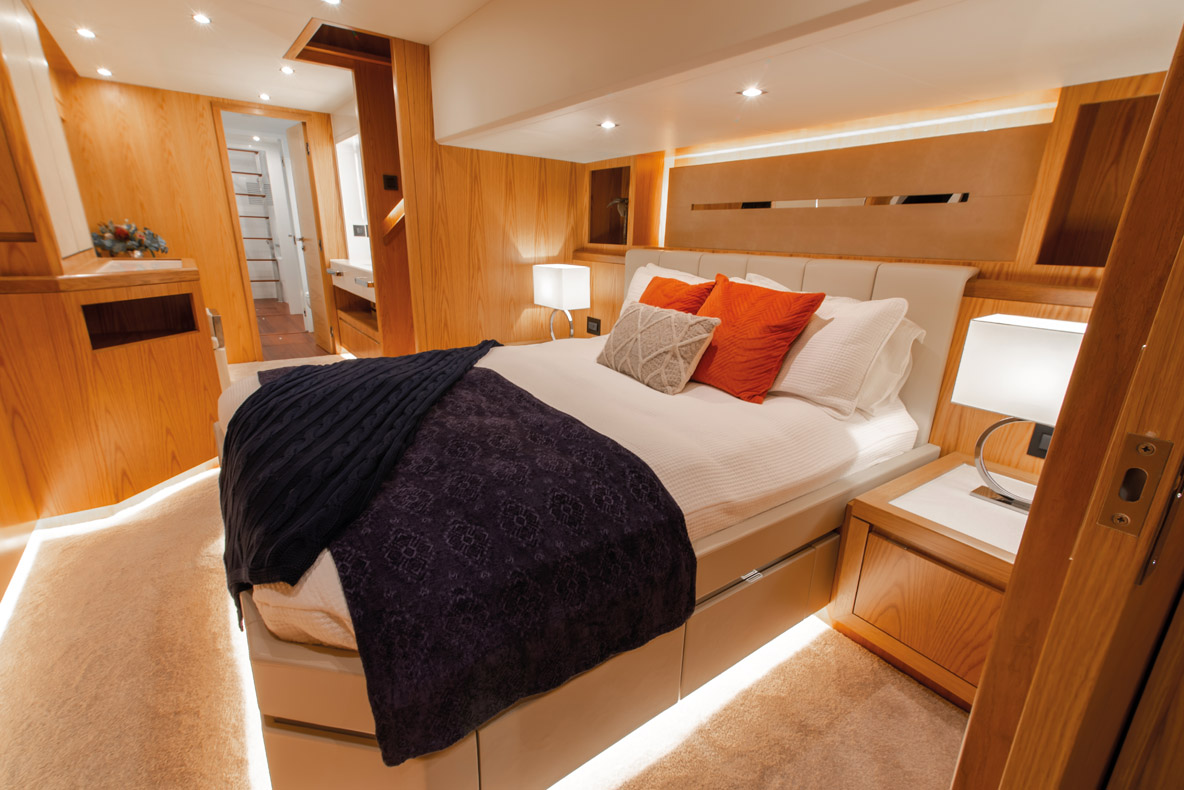
Moving down into the port hull, from steps just in front of the dinette-galley area, brings me to the owner’s suite. Closed-off by a sliding door, the entire hull is dedicated to the owner, with large island bed in the stern where the motion is kindest at sea, and ablutions in the bow with vanity/desk midships. Cleverly, a walk-in closet aft (which could be ablutions), acts as sound buffer from the adjoining engine room. The athwartships queen bed, faces the small rectangular portlights (that will be increased in size in the next hull) and sumptuous American Oak paneling gives a cozy feel throughout. The attention to detail again is subtle with quality metal door/cupboard fittings, petite chairs and a sumptuously padded couch along with strategically placed handrails. In the bathroom, the tall topsides ensure volume is good and opening portlights give that essential airflow for the tropics to reduce the reliance on the fitted air conditioning unit. Comfortable Flexiteek underfoot and a quality electric fresh water head finish off the area nicely. Forward of this is the washroom with washer/dryer, sink, fridge, cupboards and a good safety feature – a ladder leading to large escape hatch onto the deck.
Over in the starboard hull the two double berths with ensuite bathrooms are equally well appointed, including memory foam mattresses and surrounding bookshelves with tasteful mood-lights. The forward berth leads to another cabin with bunks. The ablutions include spacious shower units. The large expanses of white bulkheads maybe glaring but are easily wiped clean. Also good throughout is natural aeration from skylights and portlights.
Beachable hull
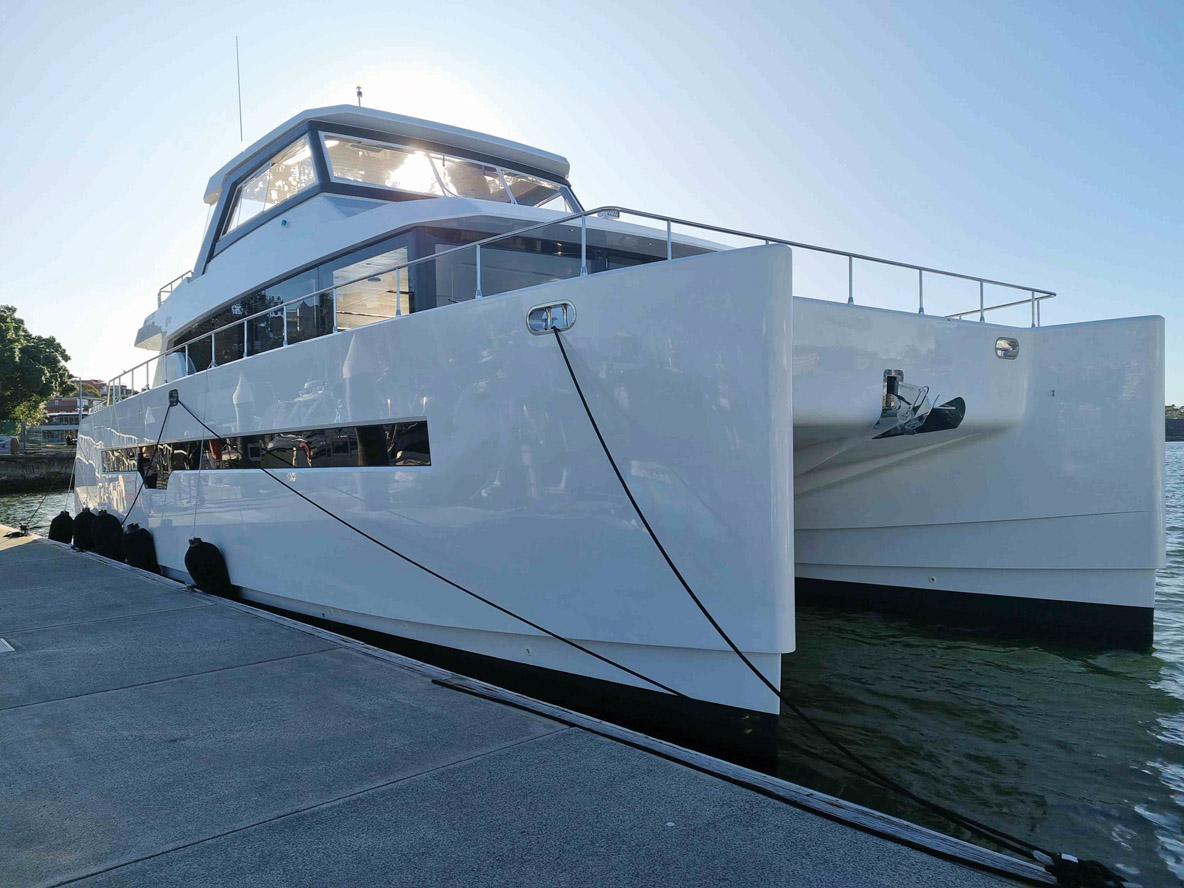
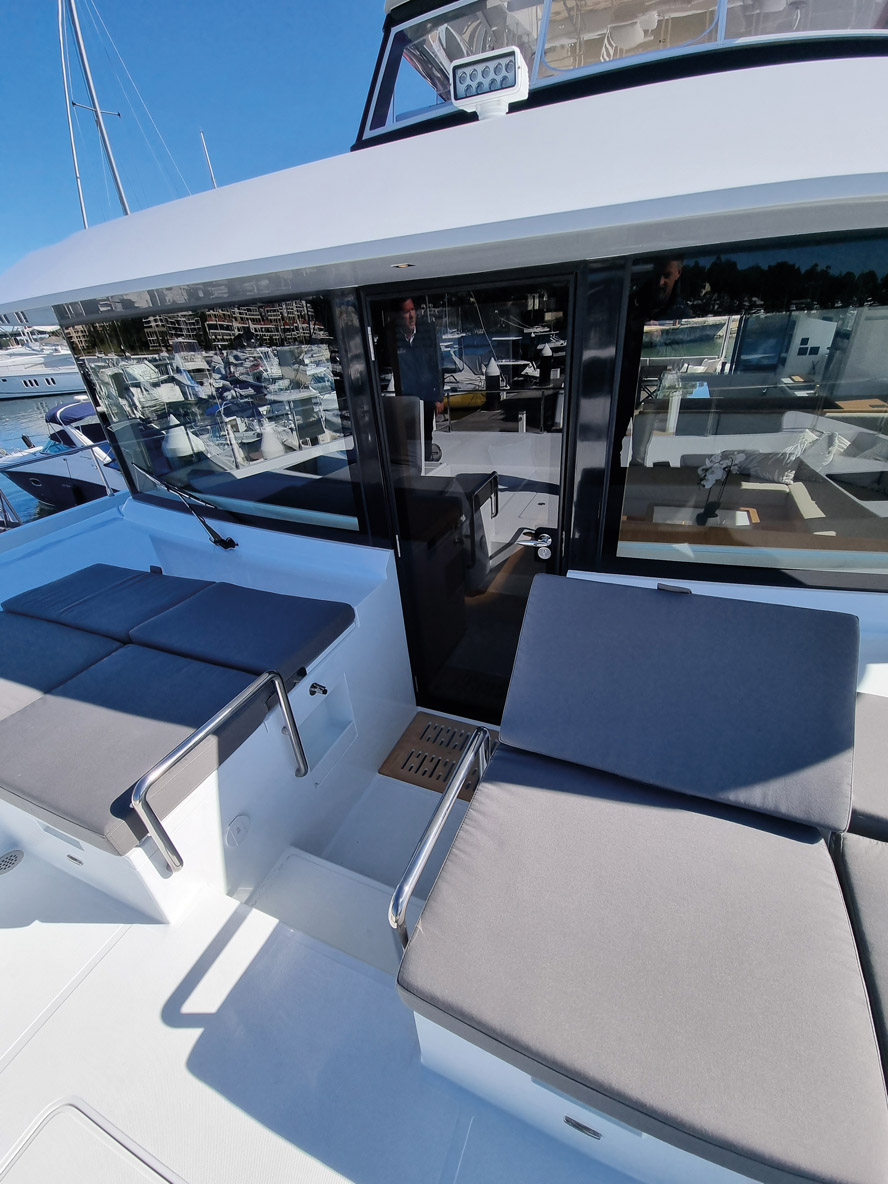
Usable deck space is important for tropical voyaging, and is generous on the Iliad 62, thanks to large fore and aft cockpits. The aft cockpit houses a large wetbar and electric grill, toilet cubicle and generous dining space under the flybridge wing. Wide side-decks with deep bulwarks and tall safety rails guide you to the bows. Here, twin sunbeds (in quality Sunbrella fabric) are to be found, and the lockers between them house the essential anchor setup. The rode (80kg Ultra anchor) runs under the nacelle, safely away from bare feet and is controlled by a Quick 3000W vertical windlass, which I’d prefer to be larger given the 50-ton loaded hull. Ideally, a second roller should be fitted (and is available on new builds) but good points included double sets of oversize cleats and large fairleads that also allow water displacement. The review boat had the optional capstans fitted on the transom. Moving back aft, each hull has molded steps into the water and the hydraulic swim platform can house a tender (or the on flybridge). Here, also are the hatches to each engine. The standard fitting is for 440 HP Volvo shaft-drives, but several engine brand choices are available. For example, emission levels can vary and certain jurisdictions (like the USA are more stringent) so owners should plan accordingly.
Given that they must all be shaft drive engines, in keeping with the explorer ethos, power choices range up to 725 HP. It’s a full vinylester hull, not just below the waterline but above as well with monolithic or solid glass around the keel line and key parts. Elsewhere PVC closed-cell infusion has been used.
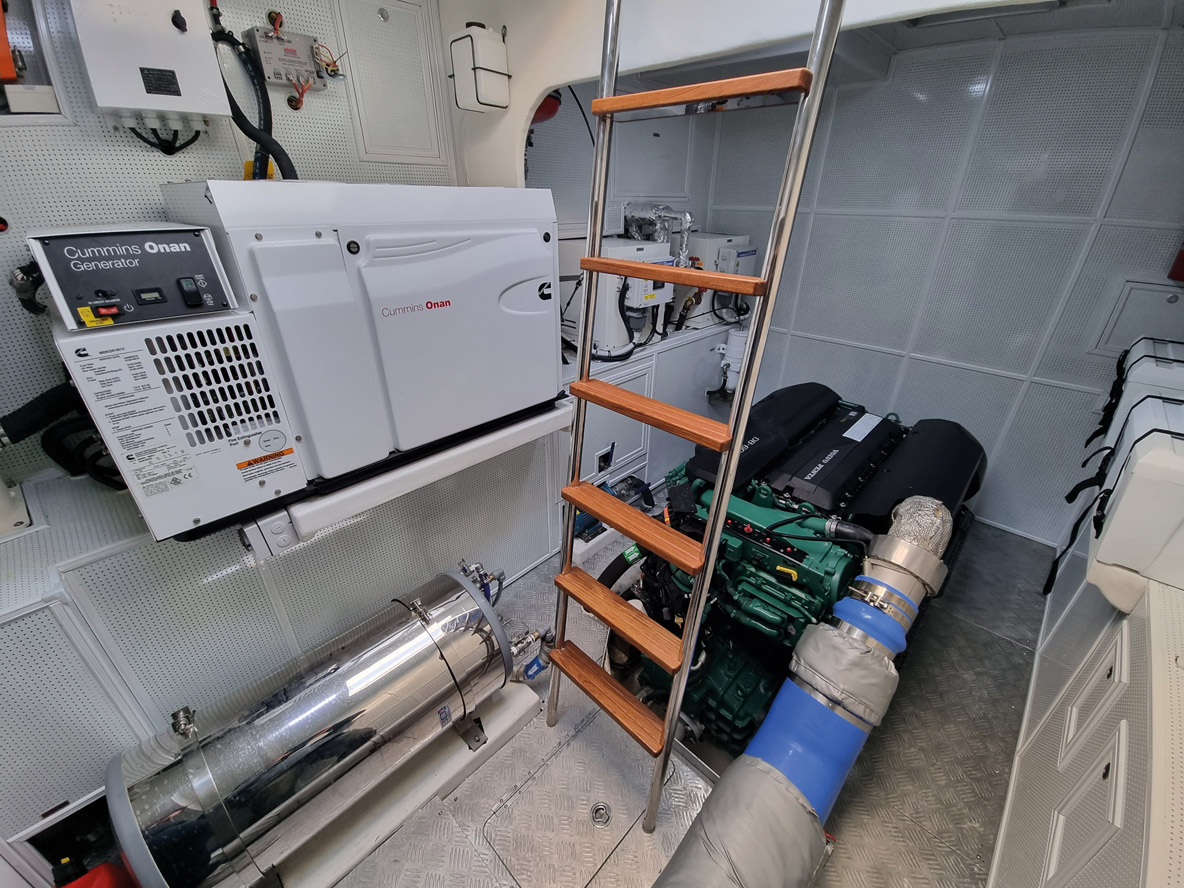
Watertight bulkheads are used throughout – in the engine room, the central hull and in case of collision on the bows. The hull has a solid fiberglass base and mini keels to allow a grounding (or hull scrub on a tidal beach). The shafts pass through the molded skegs and are so always remain protected. Looking inside the engine room revealed a spacious and well-organized area with electrics and AGM batteries elevated above the Volvo D6-600HPs. Interestingly, their exhausts now run through the transom to reduce fumes (as opposed to the side on earlier models). Only leading industry standard components are used such as Racor filters, Victron inverters and a Seafire automatic fire suppression system. Service access to the oilways and belts is also adequate, as is the quadrant and steering linkage access. Other key systems here include the 17KW Cummins Onan generator and hot water system. Another feature aboard this catamaran is the key figure of 3’9” (1.15 m) bridgedeck clearance; an impressive height that minimizes wave impact on the nacelle.
Sydney sea trial
Nudging our way from the marina in Sydney required little effort from skipper Michael ‘Nod’ Crook. Just a gentle shove from the bow thruster to clear the pontoon before he eased the electronic throttles to power us away. Most catamarans respond to judicious use of the throttles – in a fore and aft movement to spin the hulls but given the windage from the flybridge a thruster on each hull is welcome for the amateur skipper. At sea and safely away from the ferry traffic I took control of the Iliad 62. Leaning against the bolster seat on the flybridge with steering wheel at waist height the views were superb. Steering was instantaneous because of the electric/hydraulic steering system and twin rudders, wide apart. Pushing down the electronic throttles brought a faint roar from the twin 600HPs, and a tweak of the Interceptor tabs aided our planing.
Before that we’d been in trawler mode at 10 knots which is the long-range speed that showed 10 knots, giving a superb range of 2,000 miles but slowing a knot increases this to an incredible 3,294 nm. Increasing speed – to outrun a tropical storm for example - reduces this range significantly but the speed (maximum 21 knots reached on test) is there if you need it. Offshore beyond Sydney Heads, the rolling swell didn’t upset the Iliad 62, with no groans from any parts as we broached a few rollers. Below in the saloon console the steering experience was equally comfortable but less thrilling. The open plan layout allowed clear views aft, always essential. And the comfortable double seat supported me well as we glided back home to end an enjoyable outing on what is undoubtedly a superb power catamaran; that will take you to those distant horizons without worrying about your next fuel stop.
Conclusion
The latest Iliad 62 was a big hit at the Sydney Boat Show, as evidenced by the impressive number of visitors who flocked to see its accommodation spread out over three levels. Bob and Delores flew in from the United States on purpose and bought it on the very first day of the show... The American couple had originally been planning to order a custom powercat, but the quality of the fittings and the general good seamanship of this 62 seem to have won them over them very quickly!
Good seakeeping behavior
A la carte comfort
Primary windlass a bit light on power
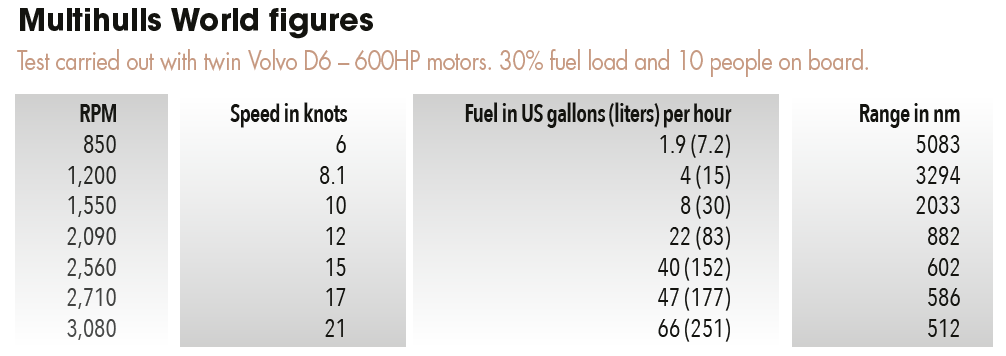
Technical specifications
Naval architect: Riccardo Bulgarelli
Length: 62’2” (18.95 m)
Beam: 26’10” (8.19 m)
Draft: 4’11” (1.50 m)
Displacement (lightship): 88,000 lbs (40 t)
Standard drivetrain: 2 x 440 HP
Options: 2 x Volvo D6-600HP shaft drives or Volvo D11 670hp or Volvo D11 725hp or Cummins QSM11 600hp/670hp
Fuel: 1,610 US gal (6,100 l) plus an optional 264 US gal (1000 l), depending on spec.
Water: 317 US gal (1,200 l)
Gray water: 132 US gal (500 l)
Black water: 132 US gal (500 l)
CE Certification: A12/B12/C20/D30
Price of the standard boat: US $2,500,000 ex-factory
Price of the boat we tested: AUD $5,100,000 (subject to exchange rates) or US$2,860,743 ex-factory