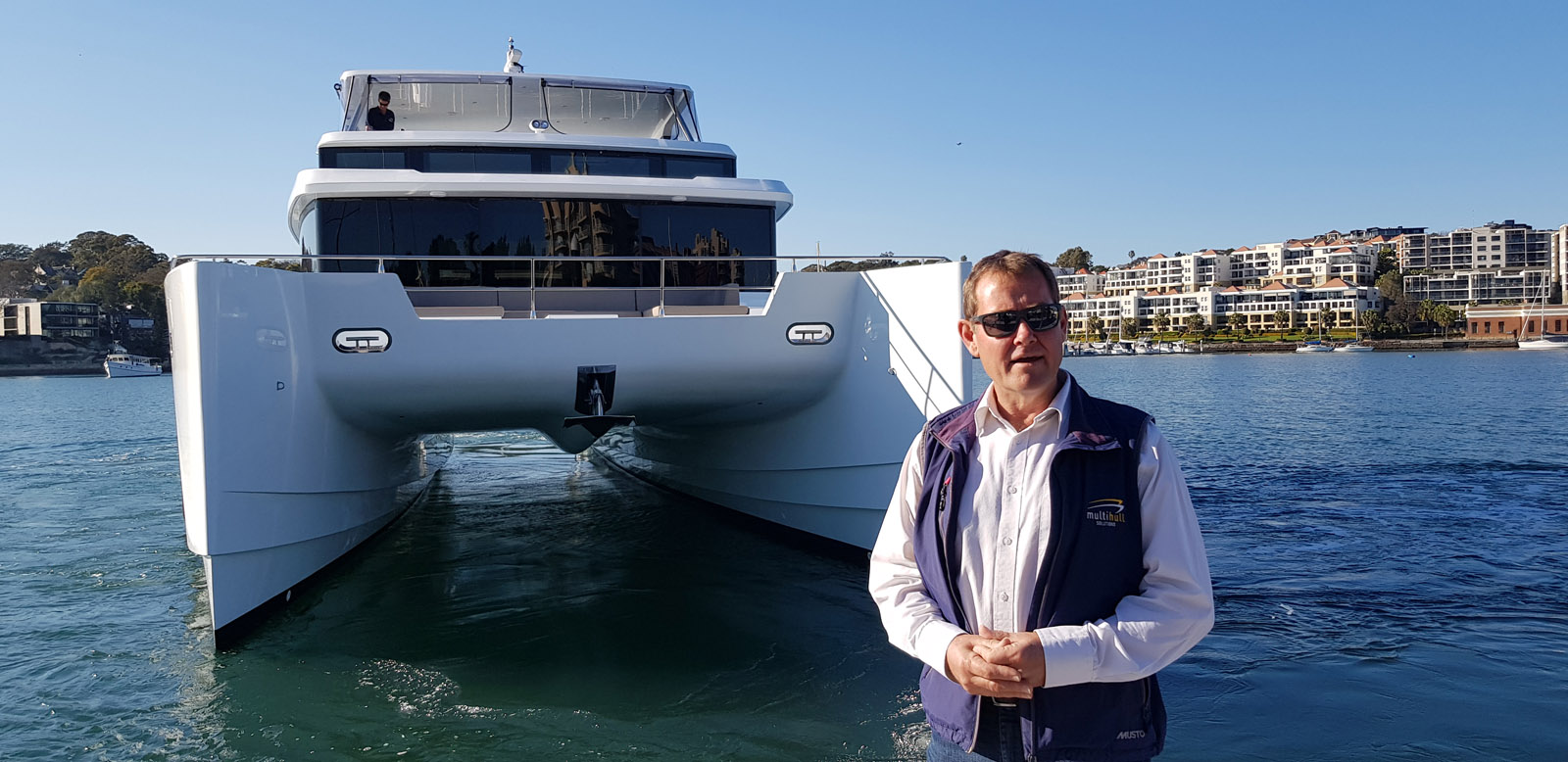
Powered catamarans have many attractions for both the cruising boater and day sailor alike. This Iliad 70 built in China quickly demonstrates that it will be difficult to offer more space, a more stable platform and, more surprisingly, a more economical motor cruiser in this size…
Infos pratiques
- Le chantier : Iliad 70
- La fiche technique
- Découvrez notre vidéo exclusive
- Financez votre Iliad 70
- Assuez votre Iliad 70
- Articles autour du Iliad 70
Test location: Sydney, Australia
Conditions: calm sea
Iliad: a new range launched in 2019
Australian company Multihulls Solutions has brought to market a remarkable new line of powered catamarans with the debut of the Iliad marque in 2019. The first model, the Iliad 50 (see our test in MW169) was unveiled at the Sanctuary Cove show. Her big sister, the Iliad 70 made her debut at the Sydney boat show. These will be joined by a 90 later, according to company boss Mark Elkington who was heavily involved in the conception and design. He explained to us about the Iliad philosophy: “I explored yards all around the world for an offshore passage maker style of vessel, that was tough enough to be beached if necessary, but most were using IPS engines, which are too vulnerable so our choice was either forget about this market opportunity or put a team together and build something ourselves.” The popularity of explorer-style yachts has never been higher as people seek to escape busy waterways while embracing the latest technologies that liberates them from onshore services. For motor yachts, fuel efficiency is a key feature, and this is where catamarans with their low-drag hulls become attractive. “Our designer had to ensure these boats could do 20 knots fully loaded with cruising gear and a passage-making speed of 8-10 knots to achieve that 2,000-mile minimum range,” explained Mark. The key to this is a wide array of engine choices, suited to customers’ needs, all shaft-driven. If the Iliad range starts with a 50-footer, that’s because Mark considers this to be the minimum size for carrying all the equipment that a true passage-making expedition boat requires.
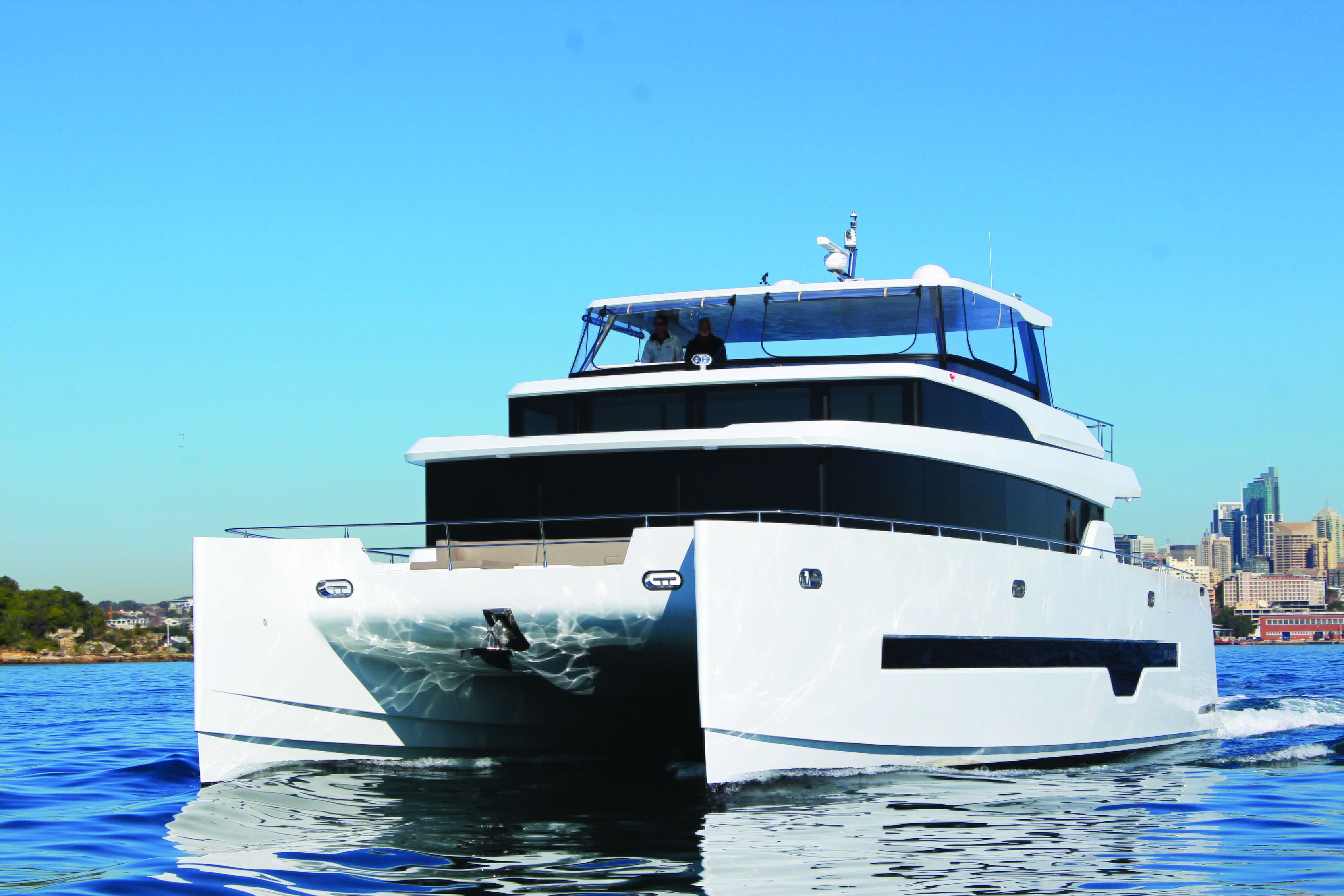
Three levels
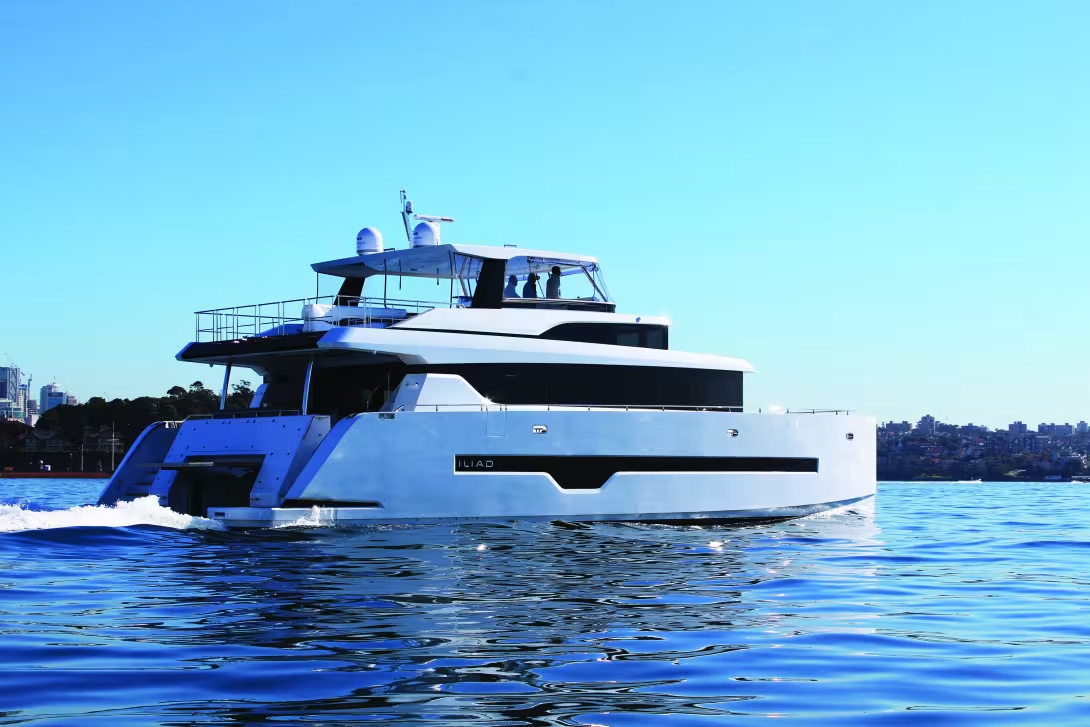
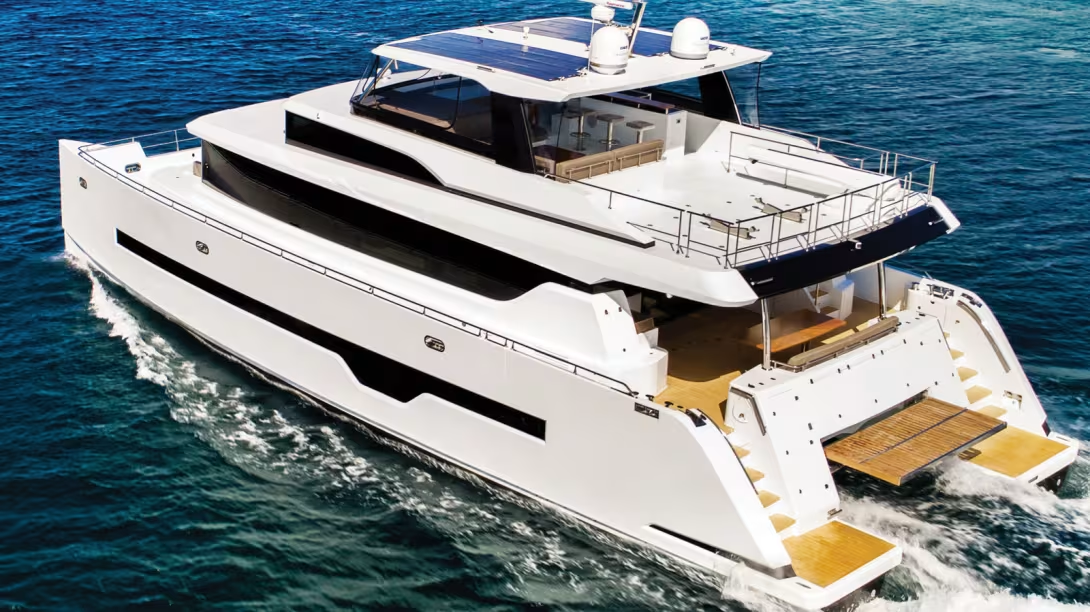
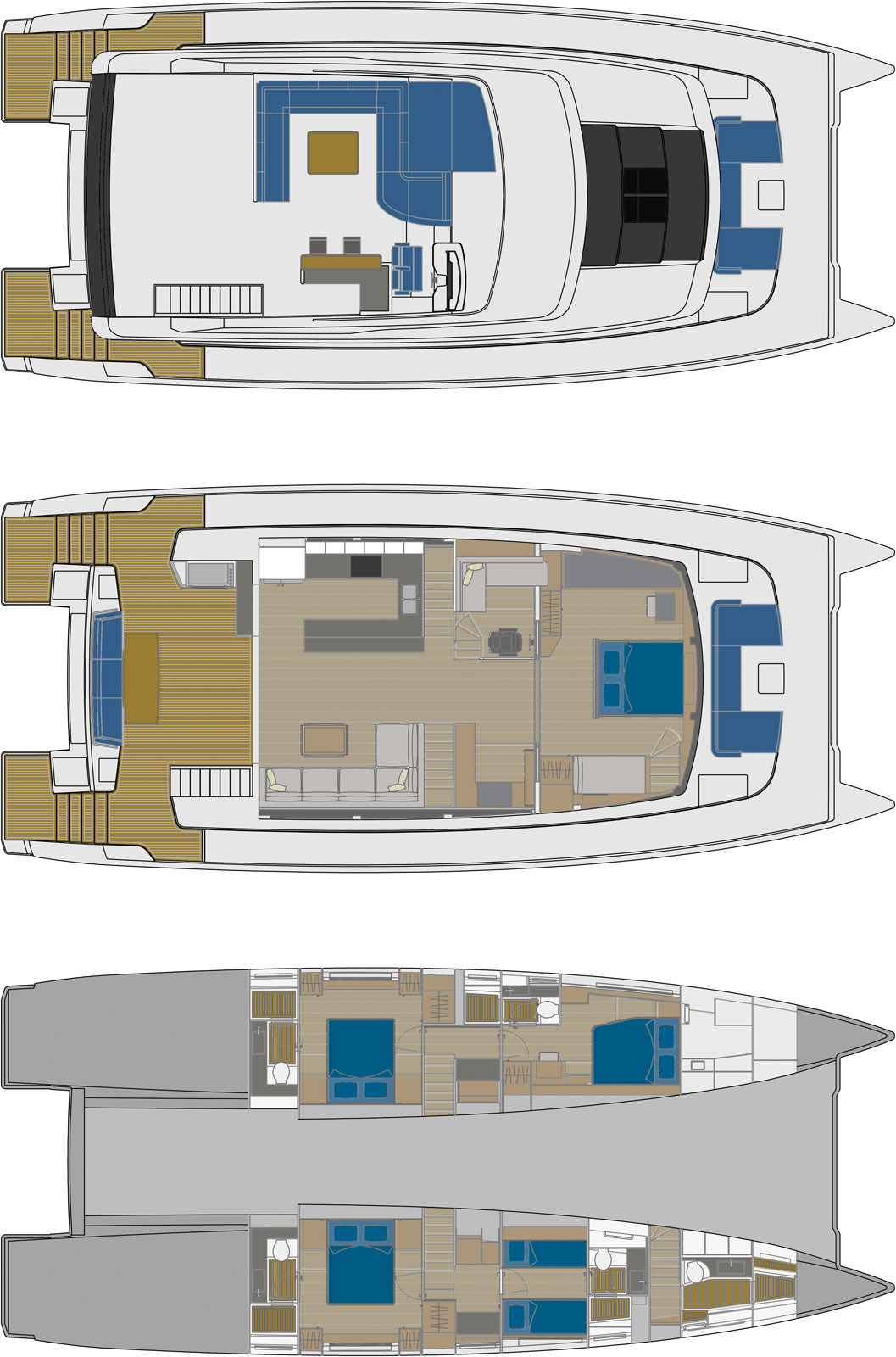
The squared-off hull and superstructure creates vast space throughout the three levels of the Iliad 70, including the enormous flybridge. Compared to the Iliad 50 that I’d tested previously, the 70 felt huge to me which indeed it is according to the stats which show it to be 60 tons fully loaded compared to about 30 tons for the 50. But what you get with the 70-footer is a superyacht catamaran with a ballroom sized saloon and accommodation for 10 people in five cabins plus ensuite crew quarters in the port forepeak. The accommodation highlight is the owner’s deck-level suite that has panoramic views forward and uses most of the 30-foot (9.15m) beam. This layout requires the inside console to be perched high above it, with a second steering position on the flybridge. Throughout the topsides, vertical bulkheads with tall windows ensure plenty of natural light and views when seated at the lounge or working in the galley.
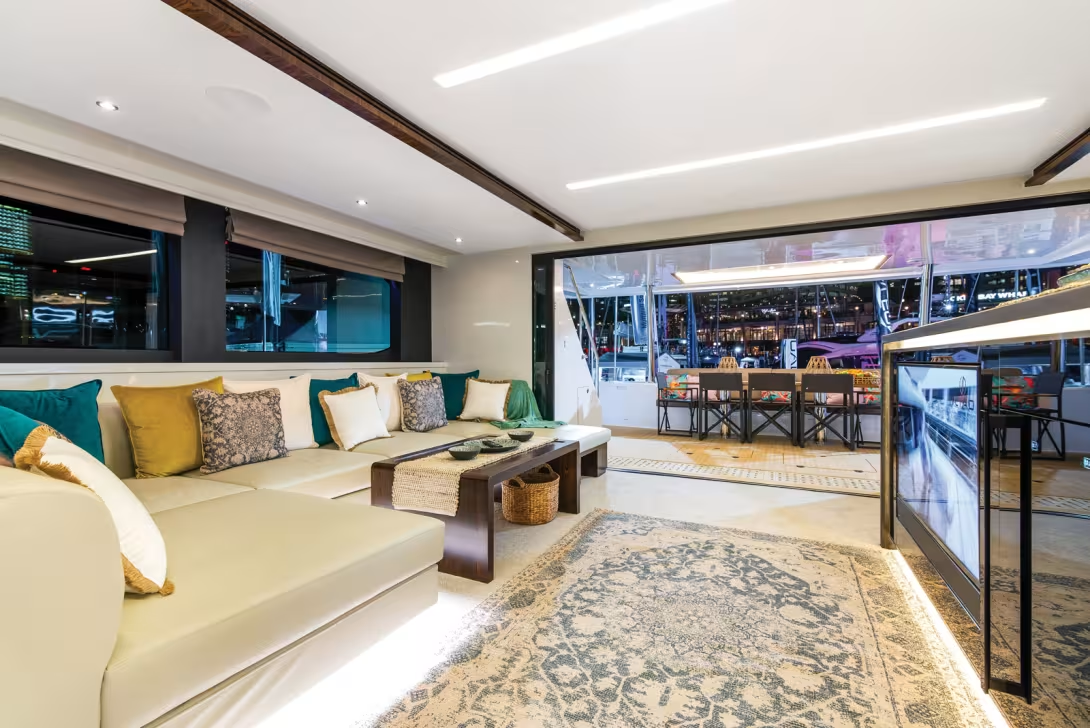
The saloon layout has the galley aft to port with lounge opposite and flows seamlessly out to the deck where diners sit at a 12-person teak table under the flybridge extension. A cockpit wet bar and grill complements the inside galley as well. The sizeable galley befits the superyacht proportions of the Iliad 70 with space for several chefs behind the bench which also supports them when rolling in a seaway. Cooking is done on a five-burner gas stove with electric oven underneath and microwave overhead. Stylish finishes included lacquered doors and precise joinery with various cubbyholes to maximize storage. There’s also spacious Corian worktops and two deep stainless sinks nearby the small dishwasher. Large cupboards overhead and under the worktops are ideal for victualling long-term and also a washing machine, while a tall double door refrigerator will hold a lot of perishables; plus, a second set of drawer fridges are in the hull. Other white goods include a washing machine installed in the starboard hull. My only complaint was the lack of fiddles to prevent crockery rolling onto the parquet flooring.
Elsewhere, the lounge couches are sumptuously upholstered in cream Ultraleather including a chaise lounge and face the galley bench; which also supports a large flatscreen television. Adjoining the lounge on starboard is a separate cubby with desk and custom chair. Walking around this loft style saloon revealed some interesting details not usually found on production boats, illustrating the level of customization available - such as mirrored finishes, customized chairs and unusual materials which gave a definite ‘bling’ factor to this first hull. “The owner asked for this level of finish that even included us cutting raw stone for sinks and a very high amount of customization but this is what we can offer owners,” said Mark.
At the business end of the Iliad 70, a climb to the portside console gives me clear views over the foredeck and beside the helm there’s even a small lounge for guests to accompany the skipper, who has a single bucket seat. Two Raymarine screens dominate the console with electronic throttles and thrusters (on each bow). Other essentials fitted include the autopilot and Quick windlass controls. Vision is enhanced with Flir cameras that give the steerer views of both inside and out as well. Underneath this elevated area is the main electrical board, so all controls nicely centralized.
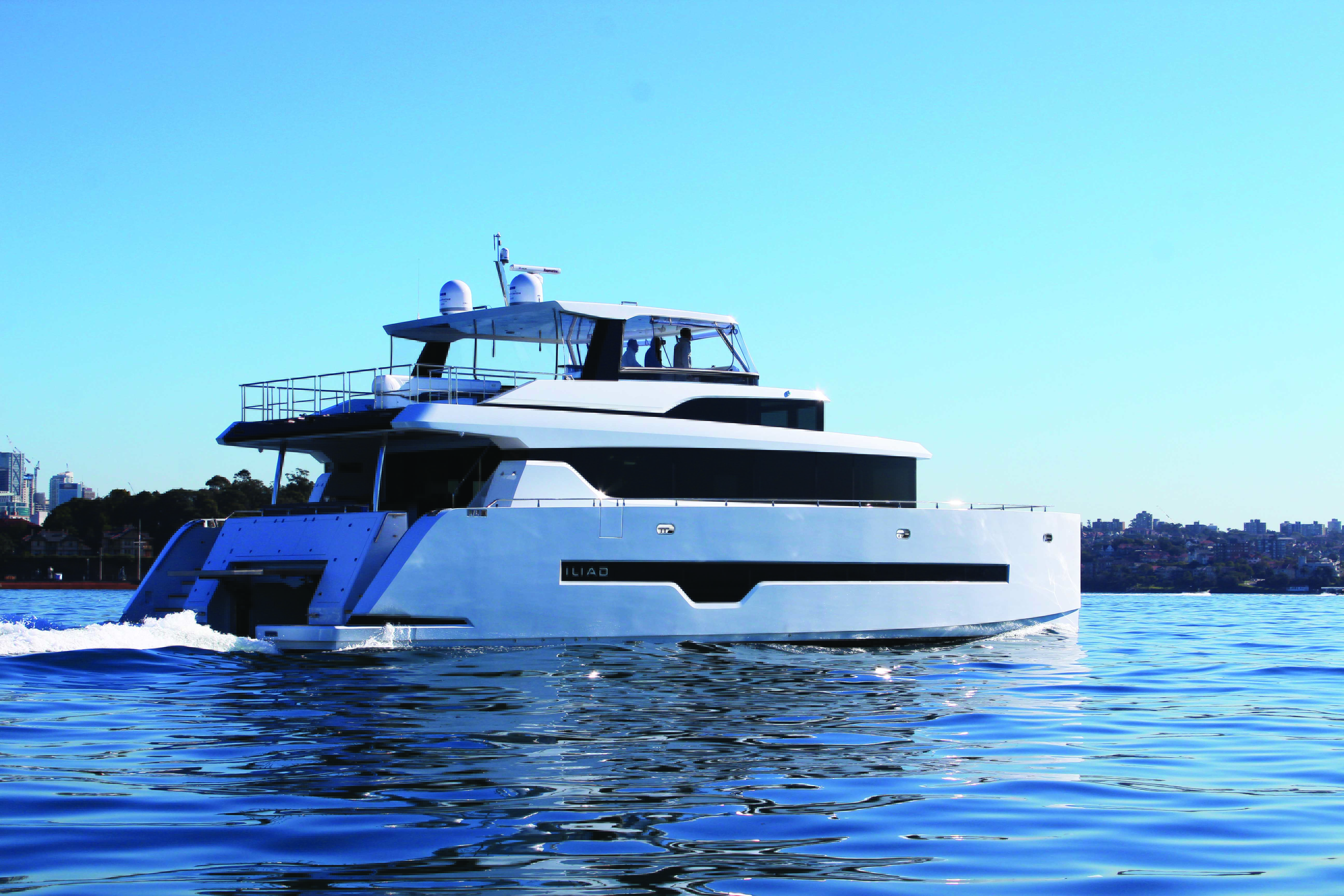
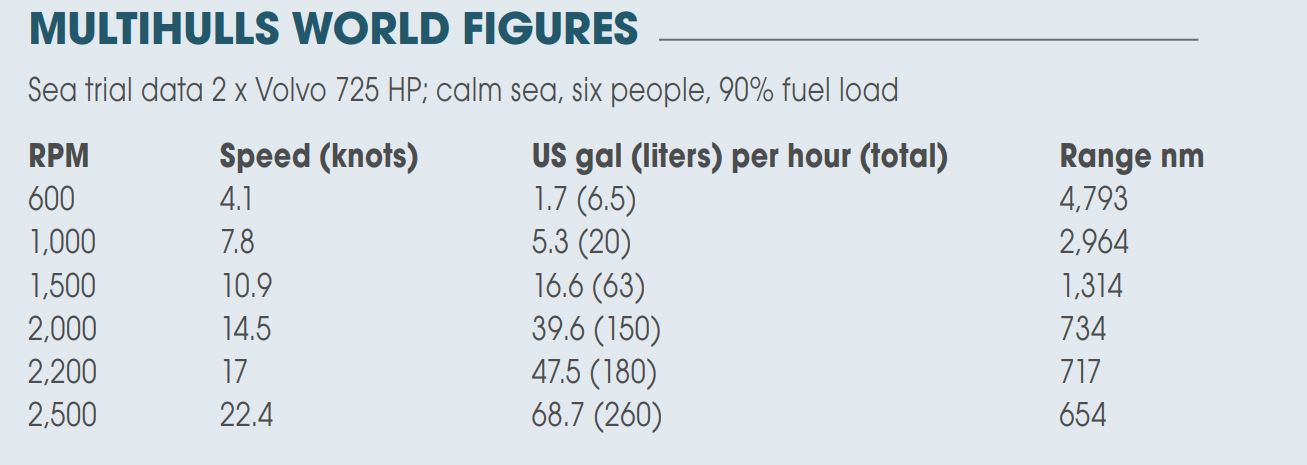
The Iliad 70 power catamaran can cruise in trawler mode at 8 knots, or at semi-displacement speeds, reaching a maximum of 22.4 knots during our Sydney sea trial.
Room with a view
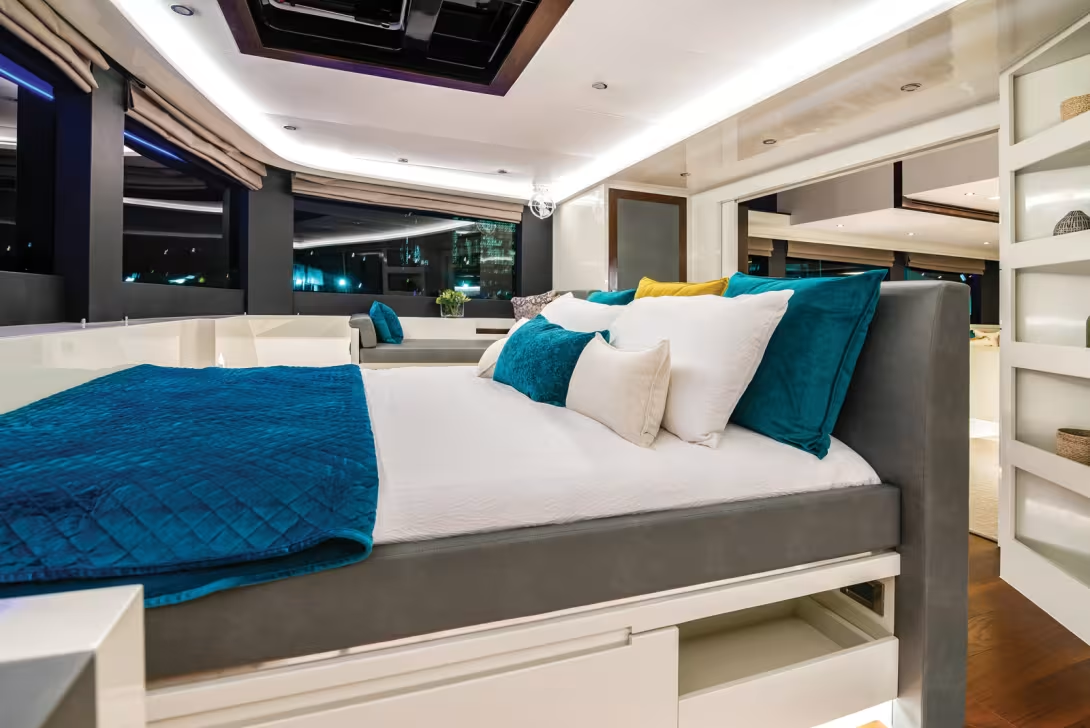
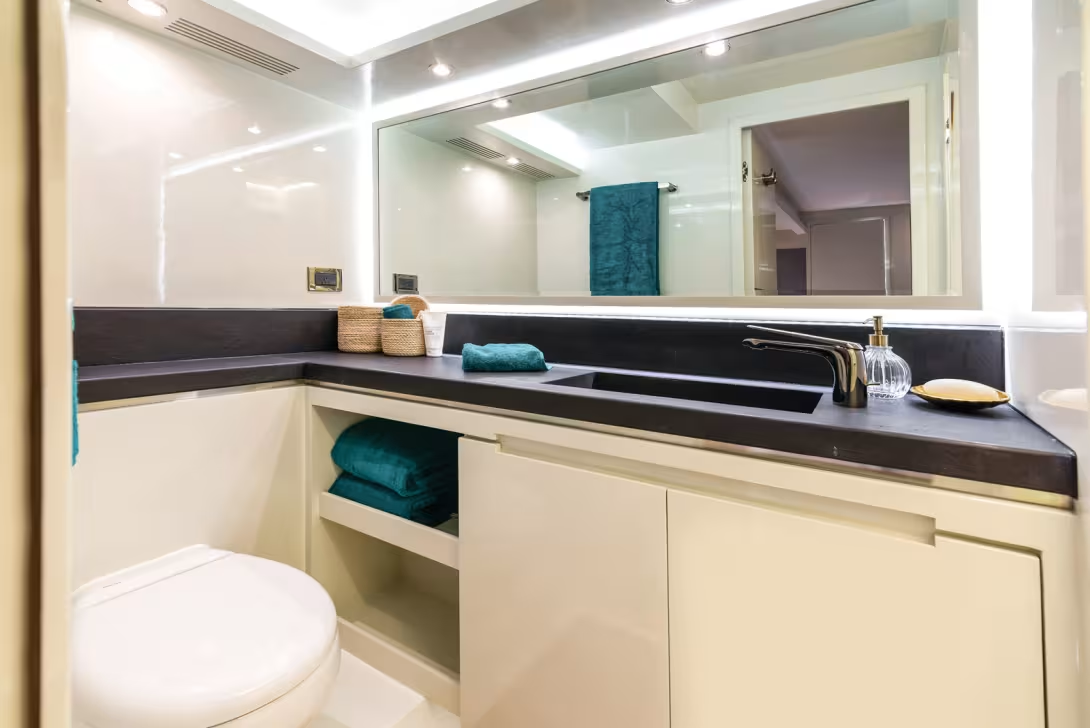
Generous living space is the essence of large catamarans but using the full beam by creating a deck-level owner’s suite gives the Iliad 70 an outstanding feature. It has a forward-facing queen bed for panoramic views through the tall windows which have curtains to ensure privacy and shade. Storage is included in the back bulkhead which has two sliding doors to seal the area off but when open it gives vision through the boat and that essential airflow required for tropical waters. There’s also under-bed storage for the owner and more down in the starboard hull which has a steep staircase to the ensuite bathroom. The long staircase reminds me how large the Iliad 70 is when I go down to check the bathroom. Ablutions include a separate shower cubicle, electric head and needless to say space is plentiful…
The hulls have four double cabins plus a crew berth. Accessed from the middle of the saloon on both sides, the main hull accommodation comprises two aft cabins which are symmetrical with athwartships queen beds and bathrooms behind them. Again, there’s spacious ablutions with large shower cubicles and good natural light but no opening hatch. The starboard hull’s forward berth on our review boat came with two single bunks and a walkway between, to the bow located bathroom. Its corridor contained bench space and a washing machine in a lazarette. Climbing over to the portside forward cabin reveals a small double bed with ensuite alongside and even desk space. Yet more good use of space is in the adjoining corridor which has double Vitrifrigo fridge drawers and storage. Throughout the cabins, tall wardrobes are ideal for long-term packing but were marred by only having rather weak magnetic closing. Only a small blemish on what is otherwise exemplary accommodation with an outstanding finish.
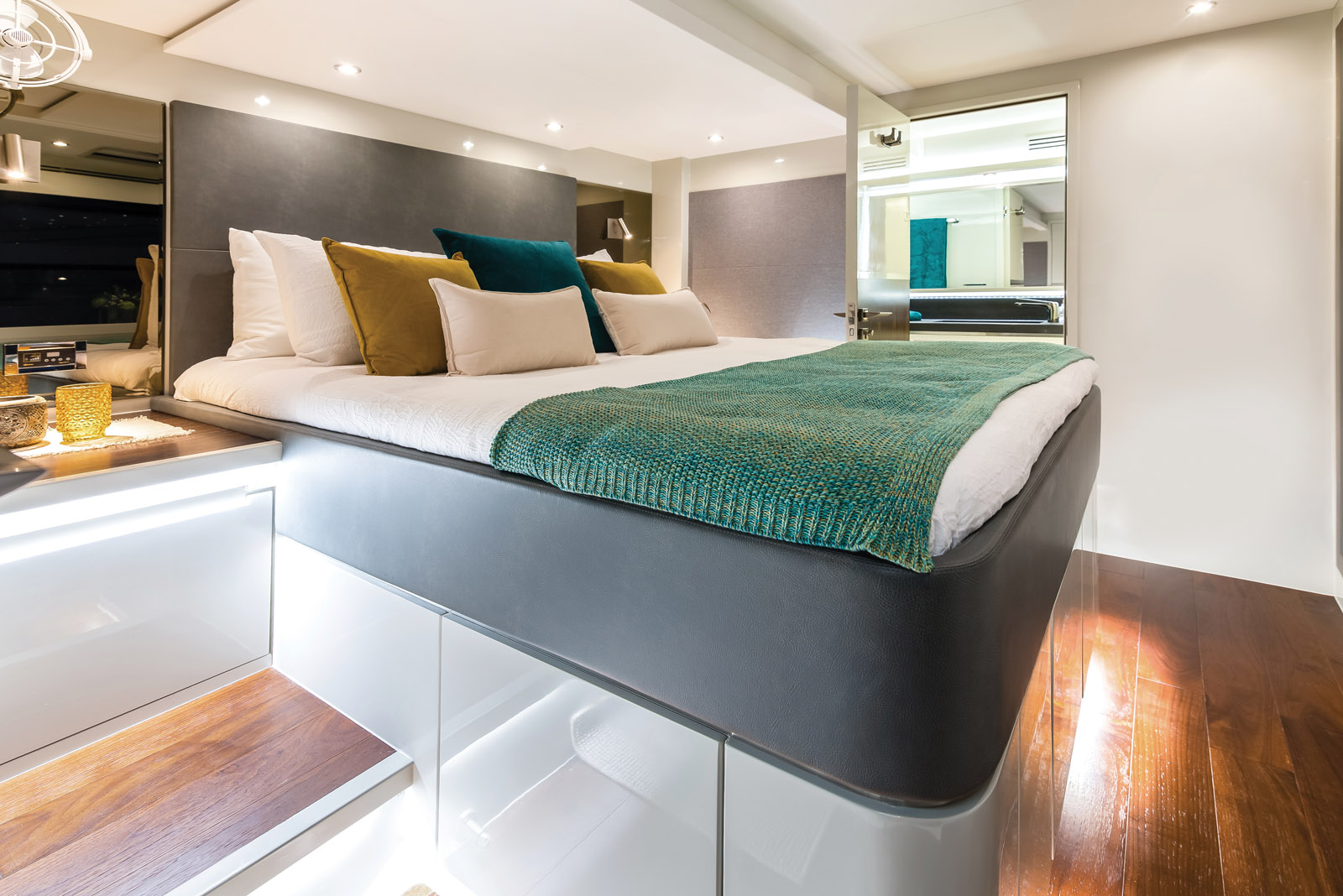
The owner’s suite is surrounded with natural light – from the tall windows and skylights, so well ventilated.
Vast flybridge
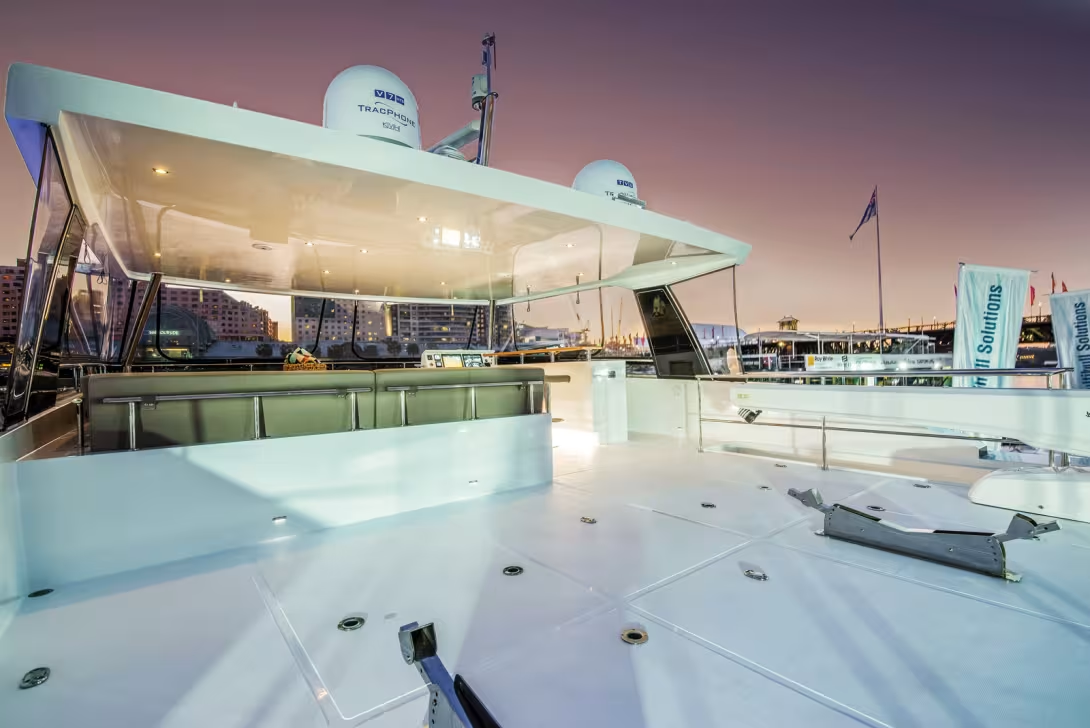
The flybridge covers nearly half the hull so is spacious for both people and the tender. Bluewater cruisers require tenders to be clear of the water and only deployed for longer periods, so the Iliad 70’s sits on the back of the flybridge in chocks to be lowered by crane. Alternatively, for regular use it could be kept on the hydraulic swim platform. Some dayboating owners may prefer a jacuzzi up here or a cocktail bar, “Just ask us” says Mark Elkington. The flybridge is dominated by the central lounge with sunbeds and the galley wet bar with barbecue, which even has its own drinks bar with stools. Impressive. Seating 12 people in style while also catering for them with the barbecue, makes this a convivial area, protected by the hardtop bimini. The skipper can also enjoy this area as well, seated at the starboard side console. Controls are a replica of the main console but handily on the opposite side, so ideal for docking whichever side-to you require.
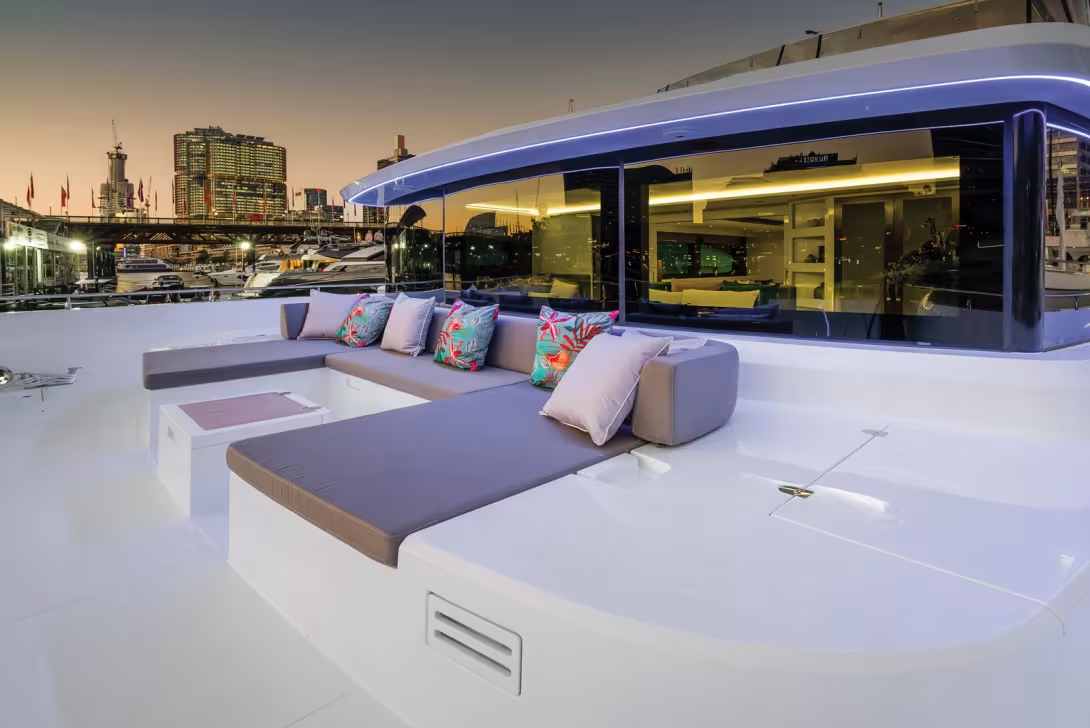
A single set of wide stairs guides me down to the Flexiteek clad deck where I walk along wide side decks with deep bulwarks to the bows. The effort is worthwhile, as I stretch out on the foredeck lounge sunbed then sit upright on the sunken flooring to write my notes. Around me are storage lockers for fenders and ancillary gear plus the essential anchor arrangement; but a rather small Quick windlass. However, with good rode that included a sizeable Ultra anchor. Ideally a larger windlass with capstan and a second roller should be added for those coral atoll adventures. Other key deck gear included aft capstans and sizeable cleating all round this powercat.
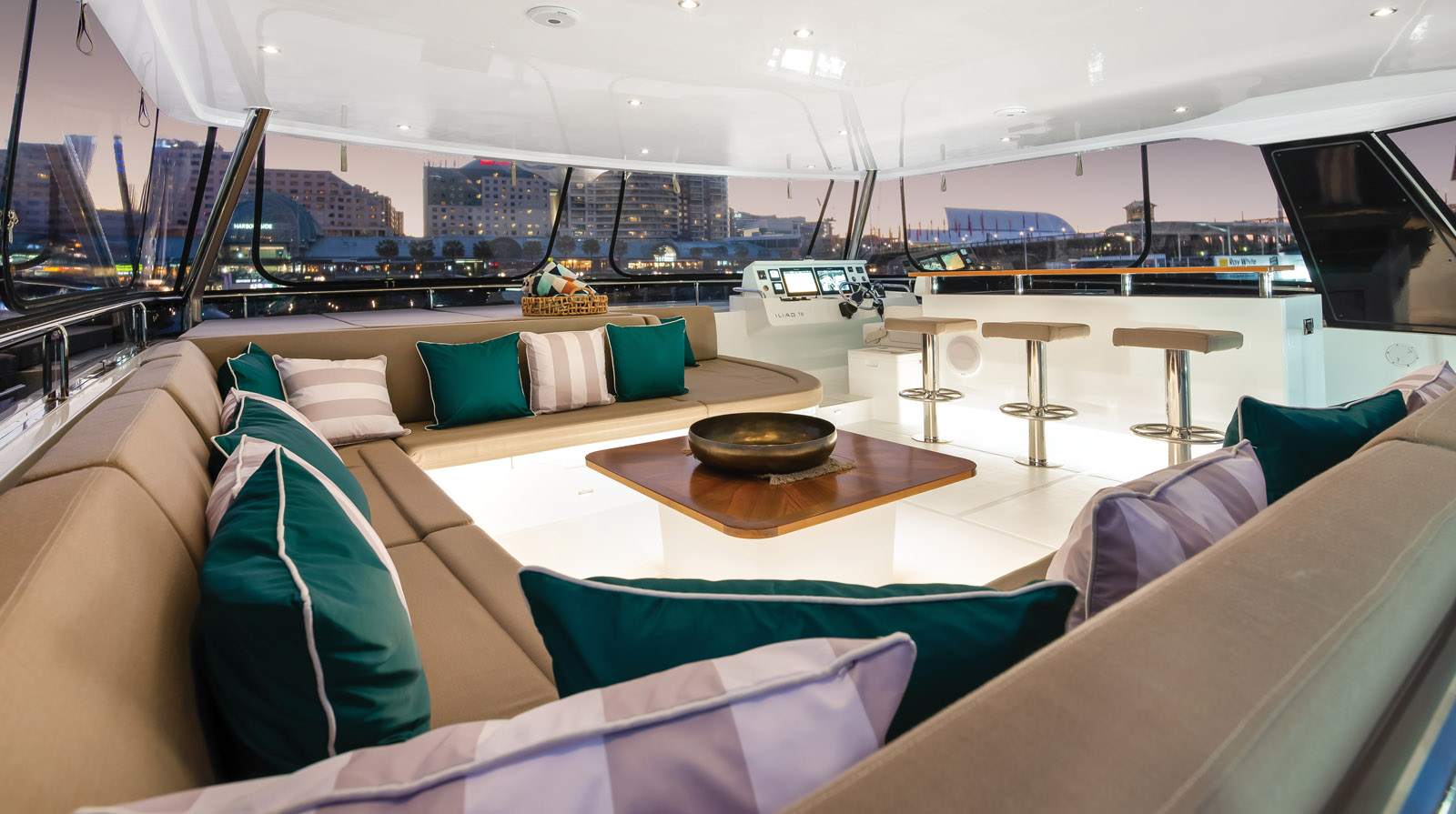
The big flybridge and large aft deck create a vast living space aboard the Iliad 70; and for the most part, the layout is customizable.
Well-designed engine compartments
The infused hull is built in China to CE category A standard and has a solid fiberglass base and mini keels to allow for taking the ground (or hull scrub on a tidal beach). Watertight bulkheads are used throughout – in the engine room, the central hull and in case of collision, at the bows. “It’s a full vinylester hull, not just below the waterline but above as well with monolithic or solid glass around the keel line and key parts”, said Mark. Elsewhere, PVC closed-cell infusion has been used by the experienced Xinlong Yachts yard, who were subject to visits by independent European CE inspectors at key stages of the build. Engine room access is via two large hatches on the aft decks where a tall ladder takes me down to the Volvo Penta D11-725. These are in-line 6-cylinder units, 10.8-liter capacity fed by diesel injectors with twin-entry turbos that vent via a water-cooled exhaust manifold – that proved quiet during our time at sea. Diesel storage is in separate alloy tanks. Again, space is at a premium so room for the technician to access the service points, including Racor fuel filters and in the starboard hull, the 22kVA generator which runs the owner’s dive compressor plus watermaker. Other quality electrics included Victron charger/converters and a bank of eight AGM gel house batteries (200Ah). The electrical panel is positioned high up on the bulkheads, and a fire suppression system (supported by Flir camera monitoring) finishes off these well-thoughtout engine rooms.
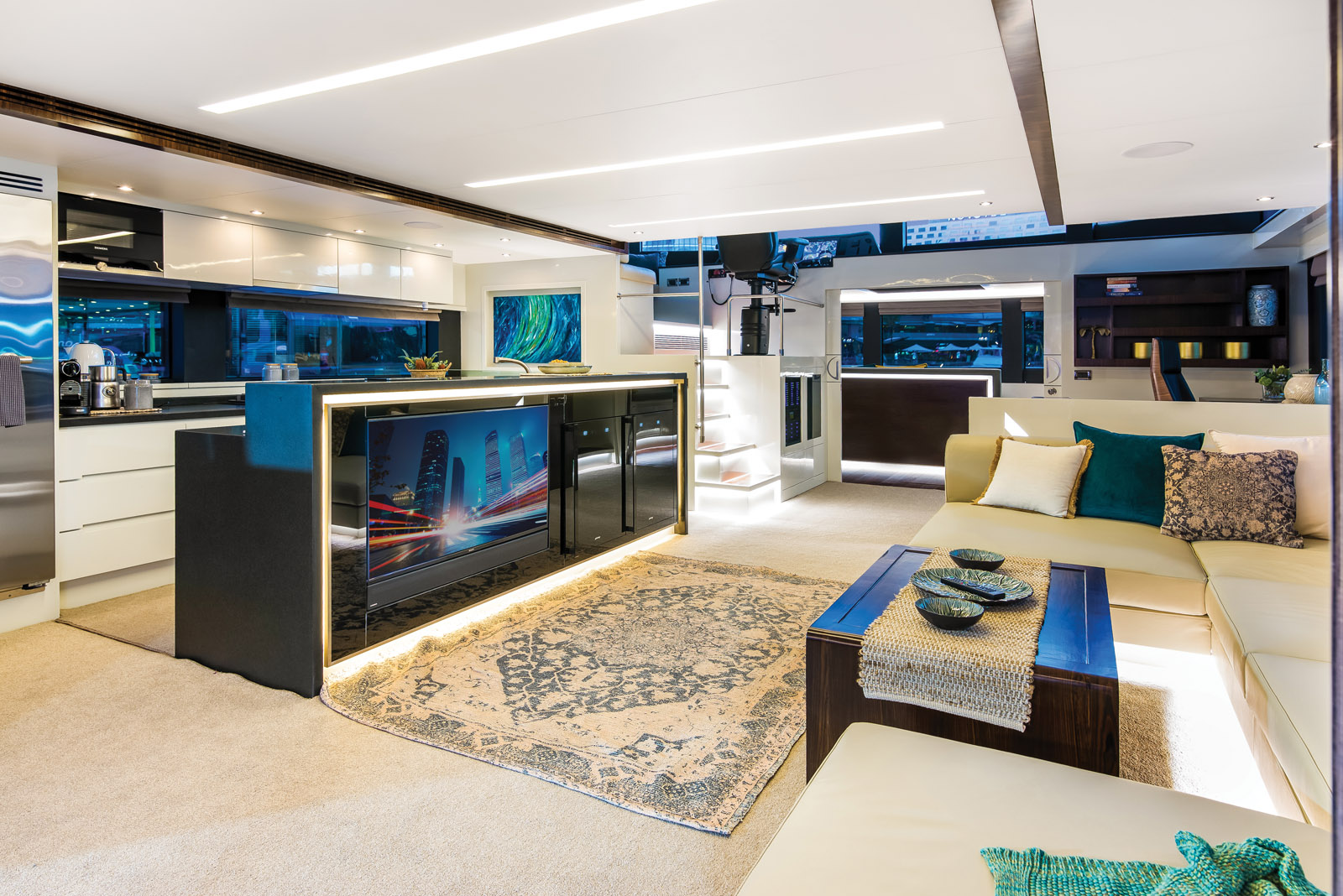
The Iliad 70 saloon has vast volume from the vertical bulkheads and lots of floor space around the aft galley that flows seamlessly into the aft cockpit dining area.
Iliad Voyage
The Iliad voyage of classical Greece sadly had to wait as our time only allowed a sojourn on Sydney Harbour before new owners were to have their maiden voyage. So, without further ado skipper Leon Bowles and I cast-off from Burkenhead Point. Having sailed the Iliad 50 with Leon, I asked him his thoughts on handling this larger sibling: “Yes she’s a much bigger boat but her weight keeps things under control, so she handles just fine.” Pushing us off the quay required the bow thruster and one engine, all smoothly done; aided by the Seastar hydraulic steering wheel on the flybridge. Accelerating clear of the no-wash zone we sedately motored under the Sydney Harbour bridge with only a faint murmur from the Volvos as we cruised at eight knots (giving an impressive 2,000 plus mile range). Snug behind the tall console and aided by clear plastic spray screens the alfresco steering was enjoyable, with enough vision to give me confidence to accelerate. A roar from the Volvos and distinct rise of the bows was felt as the Iliad 70 sped to its fast cruising speed of 17 knots which greatly increased the apparent wind. I used this as an excuse to try the inside console as we approached Sydney heads. Inside, and perched high up on the single helm seat, again vision was good, including being able to duck down to see aft or simply view the Flir camera on the Raymarine screen. A tendency to oversteer was my short experience at the helm but of course many owners simply click the autopilot on when going in a straight line. For the record I pushed the throttles fully down to watch the numbers rise to an impressive 22.4 knots while noting that the vases on the galley bench didn’t budge an inch. Of course, there was only small chop at the Sydney Heads but the tall bridgedeck clearance 4’1” (1.25m) should also ensure comfort even in a bumpy seaway.
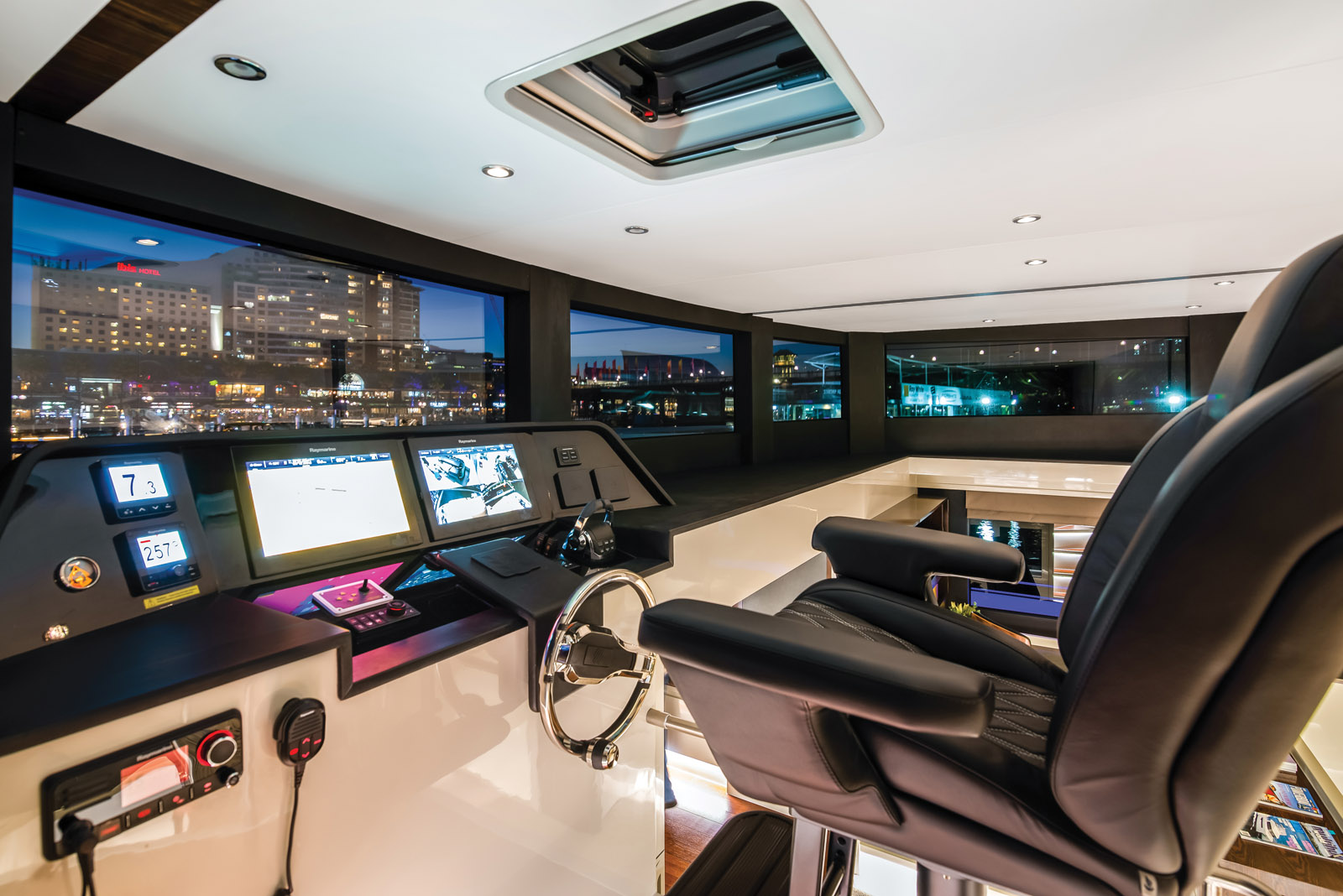
The saloon steering console is required to be above the deck cabin and the main electrical panel is conveniently beneath.
Conclusion
The Iliad 70 is undoubtedly an accomplished cruising catamaran, designed down to the finest details. This powercat is equally a credit to Australian ingenuity and Chinese construction. I can’t wait to see the 90 though!
TECHNICAL SPECIFICATIONS
The Iliad 70 can accommodate 10 people and has the owner’s suite on the main deck.
Builder: Xinlong Yachts, Zhanjiang, Guandong Province, China
Design: Riccardo Bulgarelli
Length overall: 69’2” (21.08m)
Beam: 30’ (9.15m)
Draft: 4’3” (1.29m)
Air draft: 21’4” (6.49m)
Displacement (lightship): 45 tons (46,000 kg)
Laden displacement: 59 tons (60,000kg)
Engines: Volvo Penta D11-725 is an in-line 6-cylinder, 10.8-litre diesel
Fuel tanks capacity: 2,000 US gal (7,600 L)
Water tanks capacity: 340 US gal (1,300 L)
Bridge Deck Clearance: 4’1” (1.25m)
CE Certification: A-12, B-12, C-20, D-30
Price: US$ 3,300,000 ex-tax
www.xinlongyachts.com
International Dealership: www.multihullsolutions.com.au
The Pluses
+ Exceptional comfort
+ Customizable
+ Additional helm stations
The Minuses
- Ground tackle undersized
- Insufficient ventilation in aft bathrooms
- A few finishing details need attention
“An offshore passage maker style of vessel needs to be tough enough to be beached if necessary. So we put a team together and build something ourselves.”
Mark Elkington, CEO of Multihulls Solutions