The multihull concept is now conquering all market sectors and all countries. The new K-30, designed and produced in Spain, is presented as a compact powercat - a concept that is very popular in the USA and the Caribbean, though much less so in Europe. Initially, the small Kattums (a 38 is due to be launched shortly) are positioned as an alternative to European monohull dayboats.
Infos pratiques
- Le chantier : Kattum K30
- La fiche technique
-
 Découvrez notre vidéo exclusive
- Financez votre Kattum K-30
- Assuez votre Kattum K-30
- Articles autour du Kattum K-30
Test conditions: 3-4 knot westerly wind, calm sea
Kattum Yachts is a young Spanish brand founded in 2022 by two naval engineers, Daniel Hernández and Félix López. Their dream was to create a motorboat brand that was different from the rest. To achieve this, they chose the catamaran concept, as it offers both good seakeeping and plenty of space on board. There are currently two boats in the range, the K-28 and the K-30.
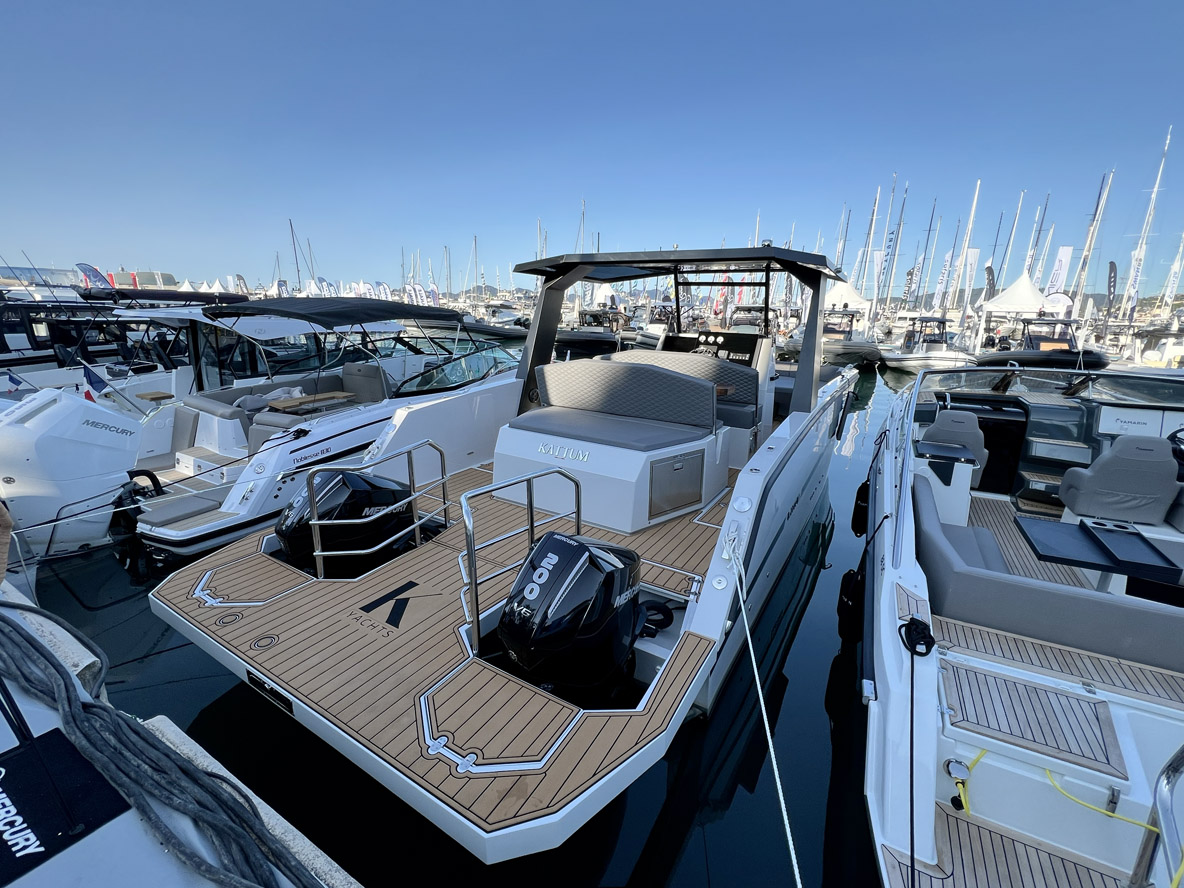
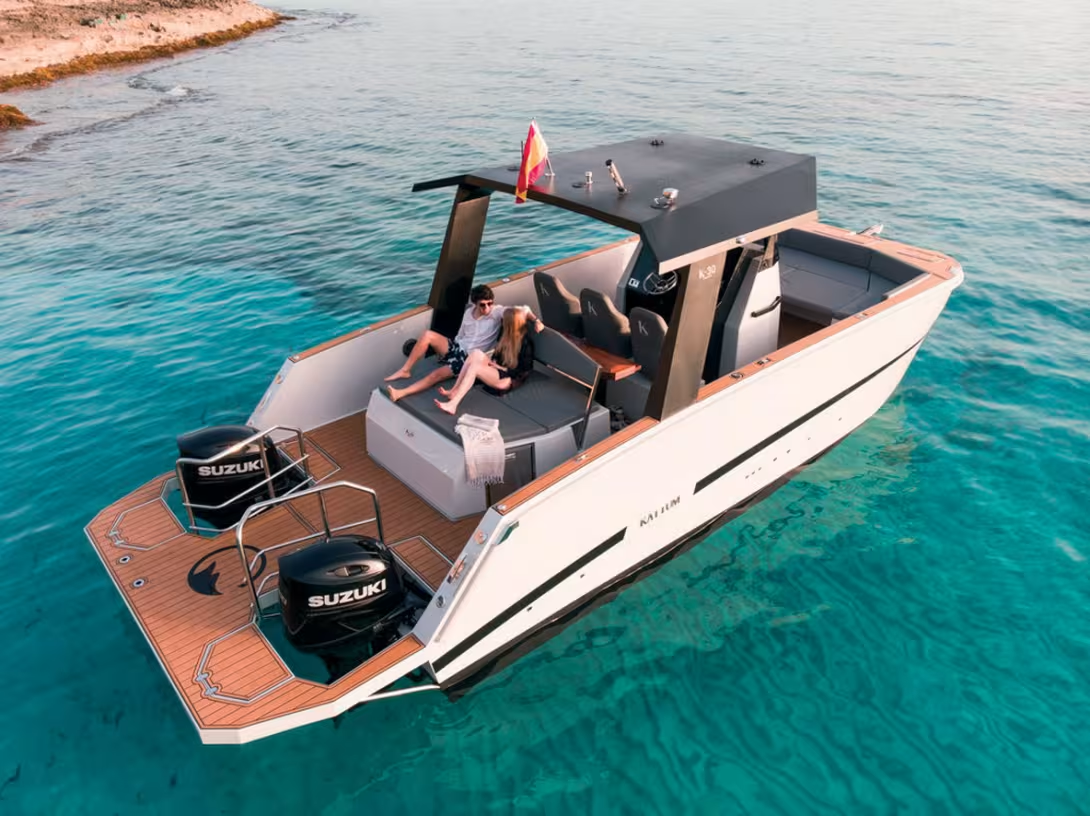
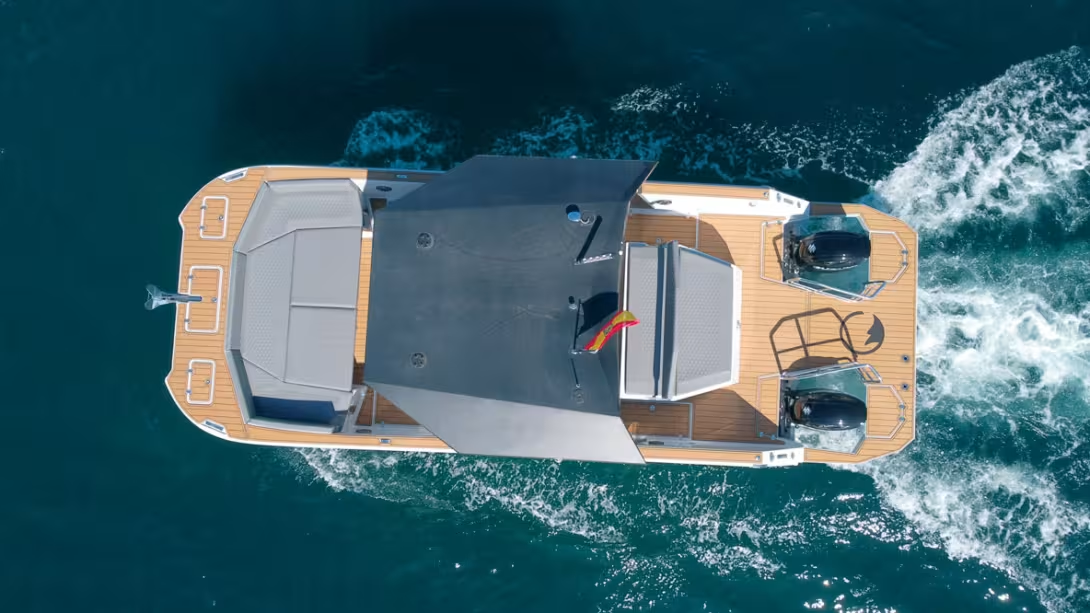
The K-30 we’re interested in today is in fact a lengthened version of the 28, a modification that is evident on the aft platform, which on the K-30 completely surrounds the engines. It’s an interesting option that really lets you enjoy swimming or boarding easily from the dock or aboard a jet ski. What’s more, hatches can be opened to easily raise the engines.
Clean, Modern Lines
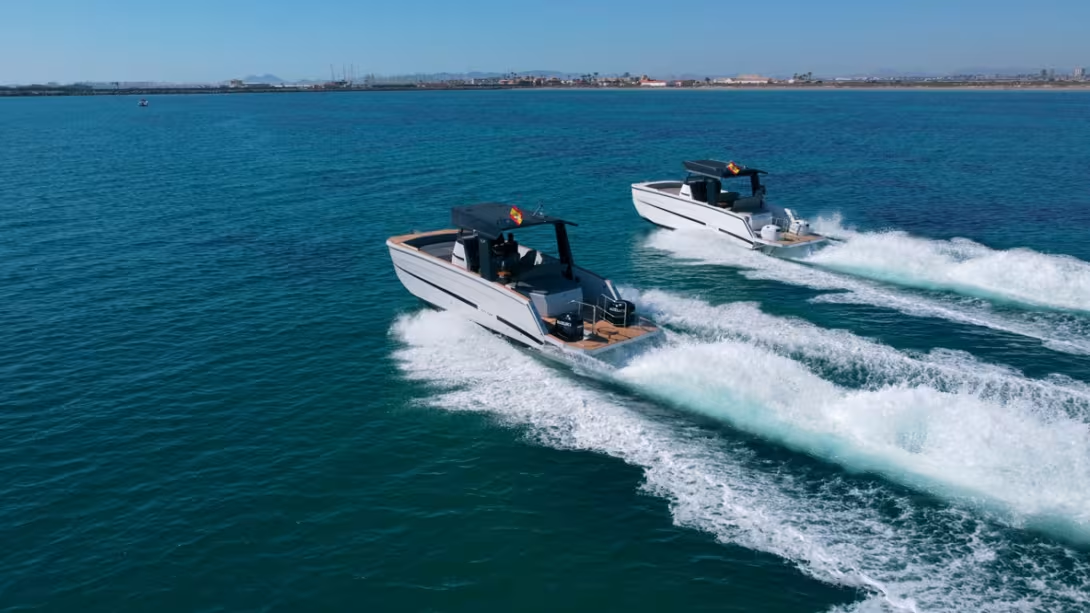
Aesthetically, the K-30’s design is uncluttered, with rather rectilinear lines, particularly on the deck edge, which curves aft to meet the swimming platform. The bow, meanwhile, remains fairly high, a plus for crew protection. An attractive T-top gives this powercat a modern, almost minimalist look.
Although it’s a catamaran, its beam remains contained at 3.4 m (11’2”). This means that while the K-30 cannot be transported by road, it can occupy a marina slip reserved for a 10-12 m (30-35 ft) monohull.
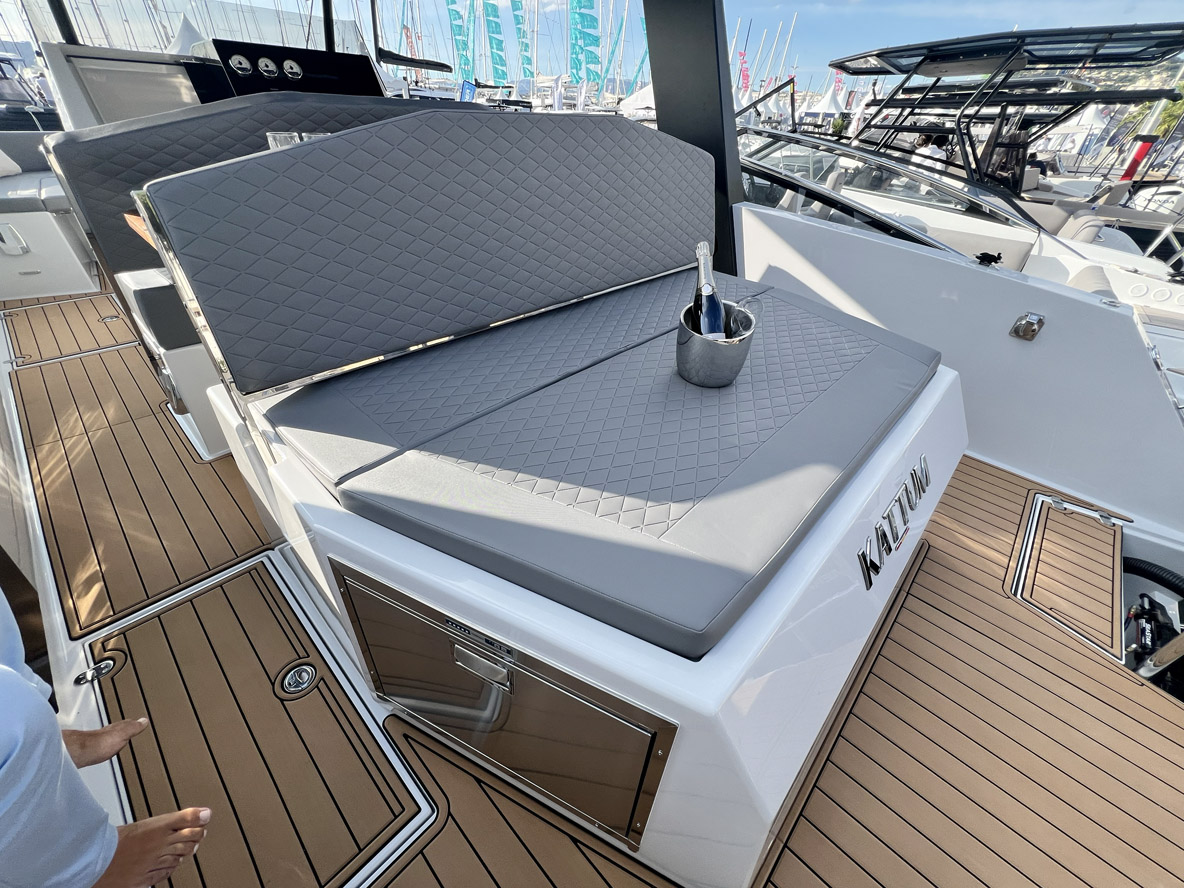
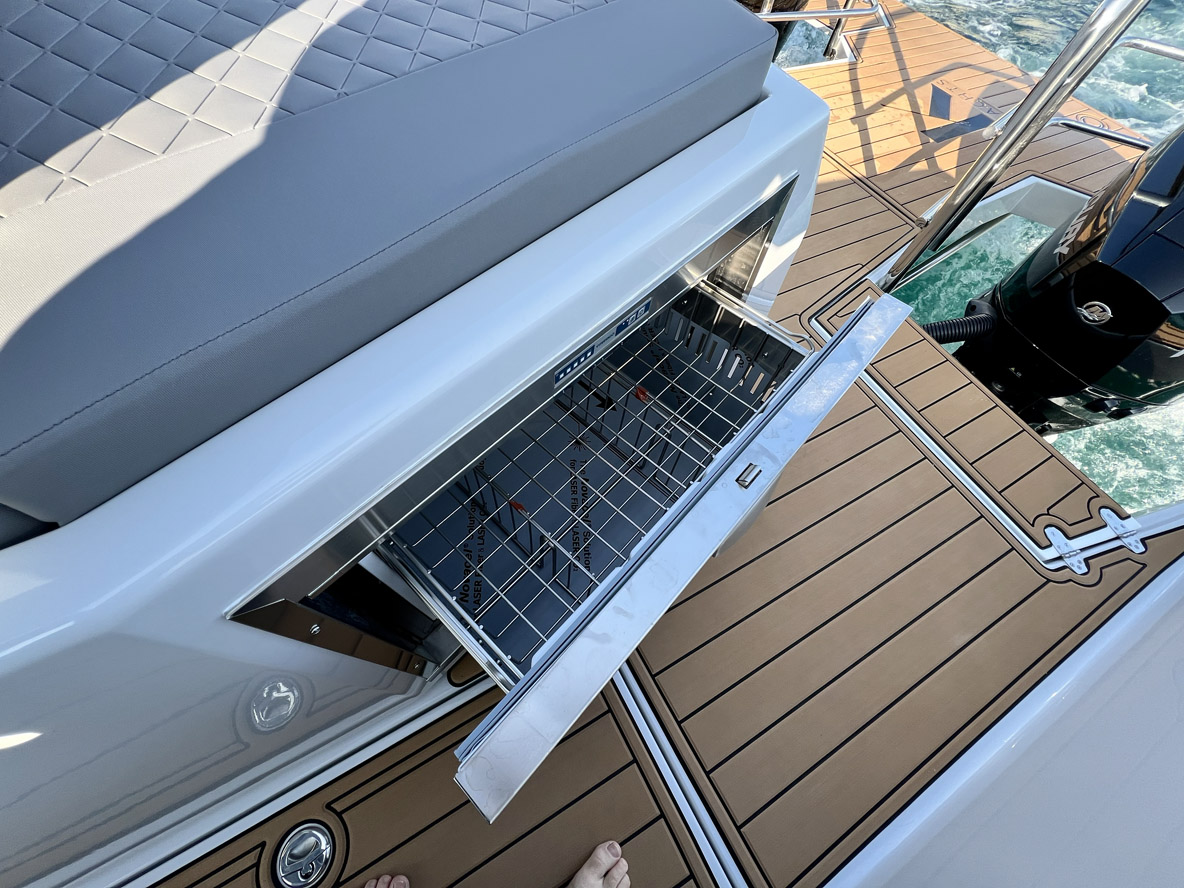
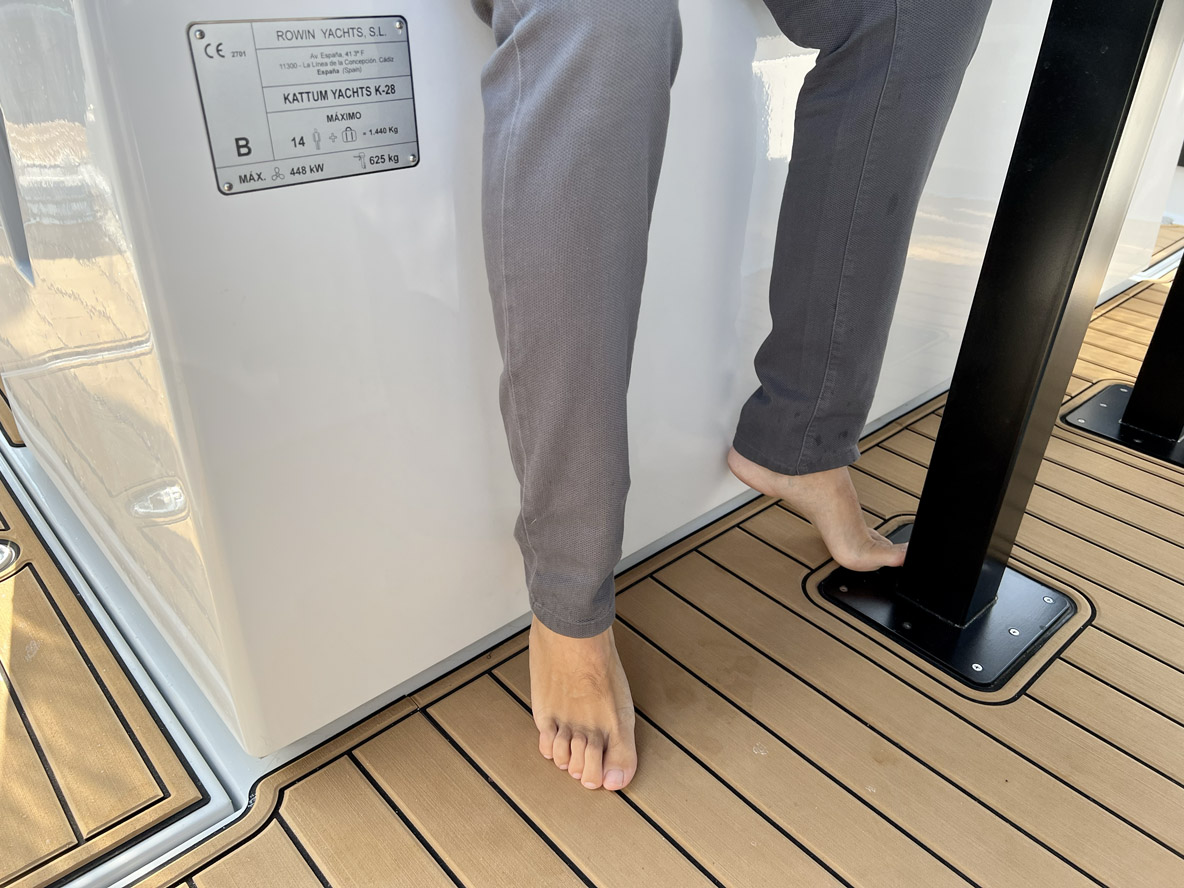
Thanks to its very long platform, it’s easy to get on board, and can even accommodate a person with reduced mobility. On the other hand, the stern is completely open, with no gate, which represents a danger for young children. Once on board, you’re greeted by a large sun lounger: the bench seat is equipped with a tilting backrest allowing you to adopt a lounge position. Curiously, the sun lounger doesn’t conceal a large storage area, as you might expect, but two refrigerators. From my point of view, that’s a bit of wasted space. To make up for this, there are several large storage compartments in the floor.
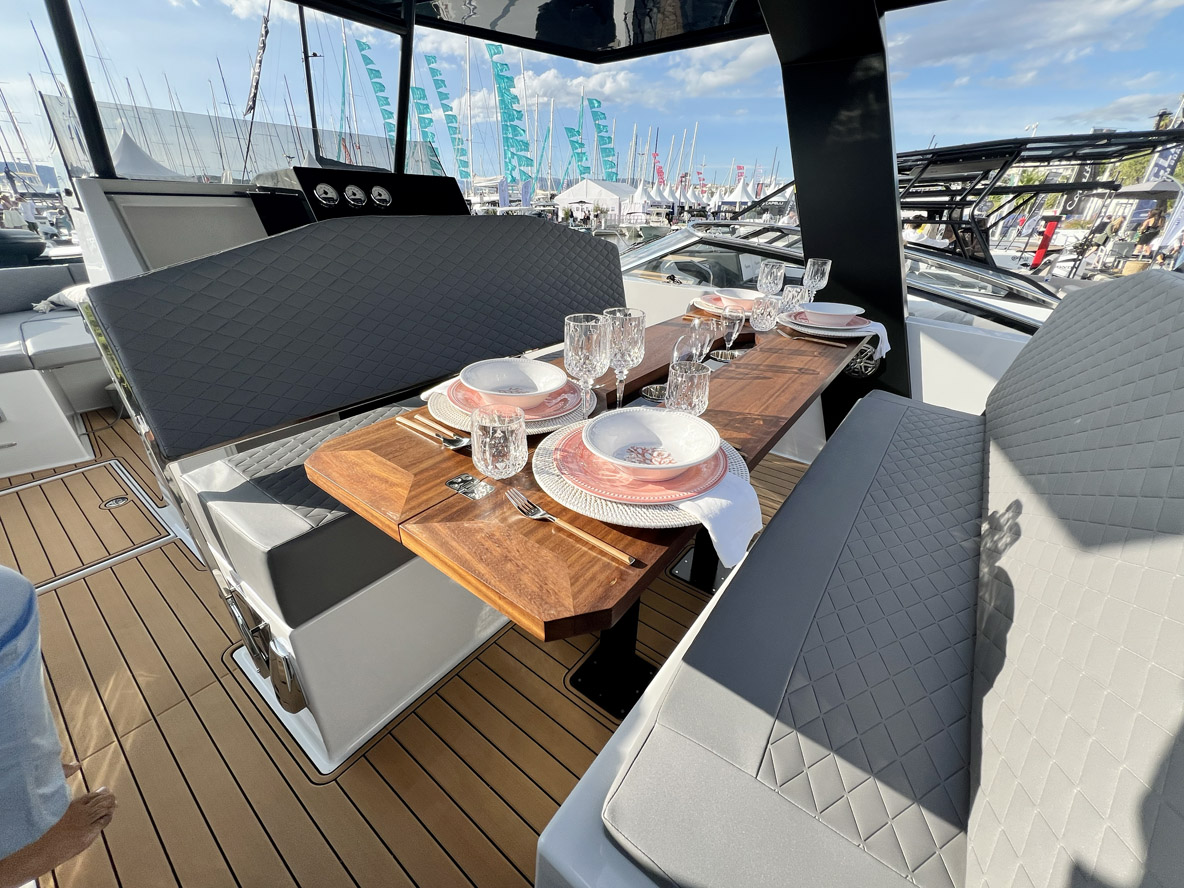
The pilot seat also has a tilting backrest, allowing you to create a dining area. Between the two benches, a large table can seat five or six people, with a dedicated space for bottles in the center. It’s a good idea, but it’s a pity that the seats are so high and therefore uncomfortable in the long run. What’s more, the backrests are also very high, making them a little more pleasant to sit in, but not an aesthetic success. The T-Top, on the other hand, offers every satisfaction - starting with welcome shade.
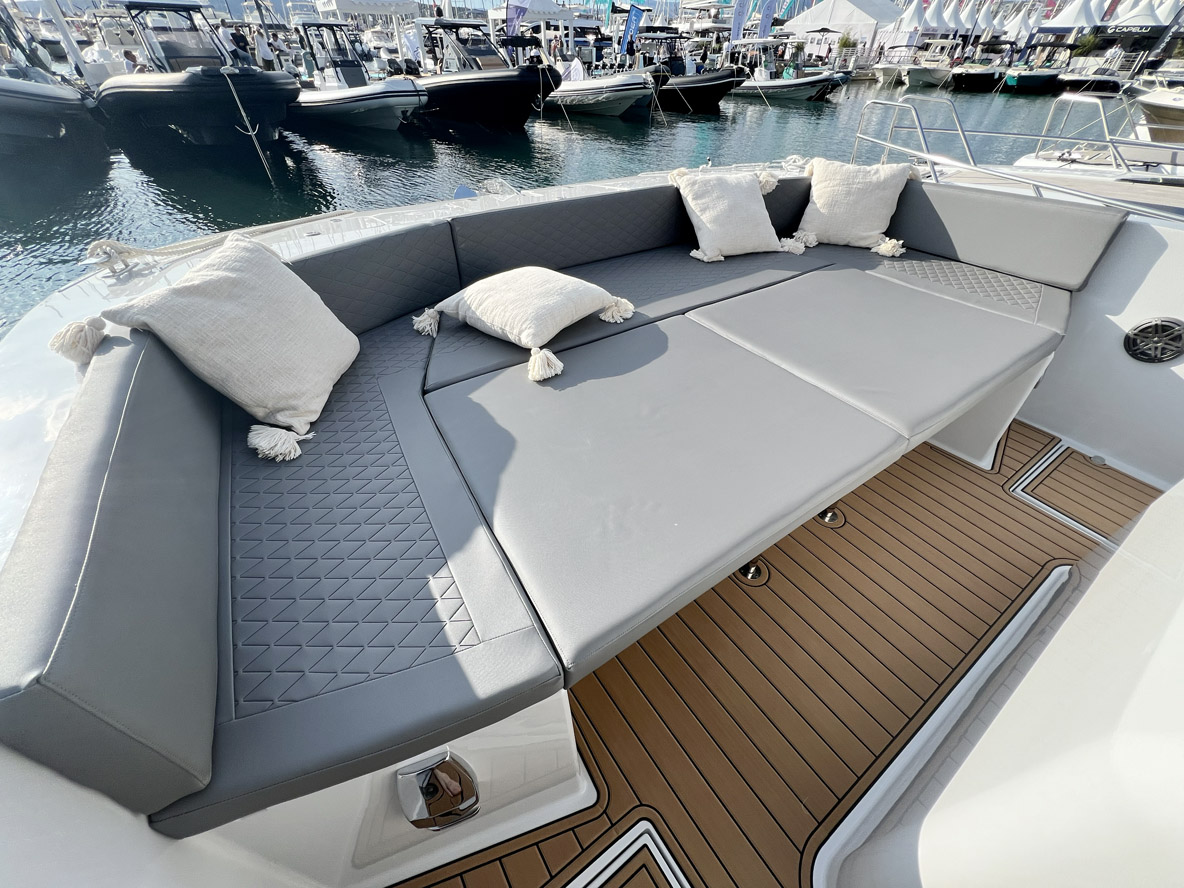
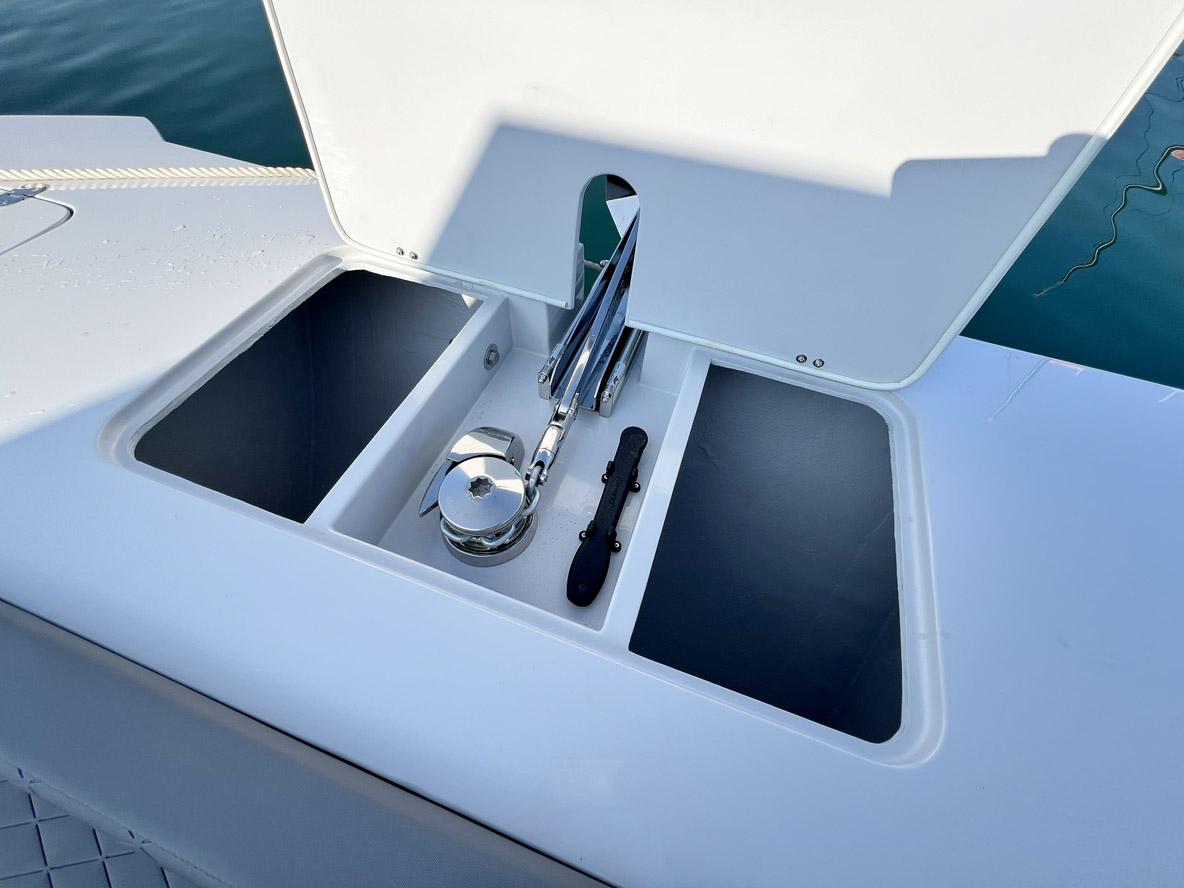
Sun worshippers will be happy to lie down on the foredeck, taking advantage of the catamaran’s width, this area features a large sun lounger with backrests high enough to keep out prying eyes or simply shelter from the wind. This area can be easily transformed into a dining area with an optional table in the middle. Storage compartments are also concealed under the seats, and this is also the access point to the anchor locker with windlass, anchor and two small lockers for storing fenders. Last but not least, the high freeboard all around the boat is a real plus for safety and protection from the spray..
A Console That’s Too High, Reducing Visibility
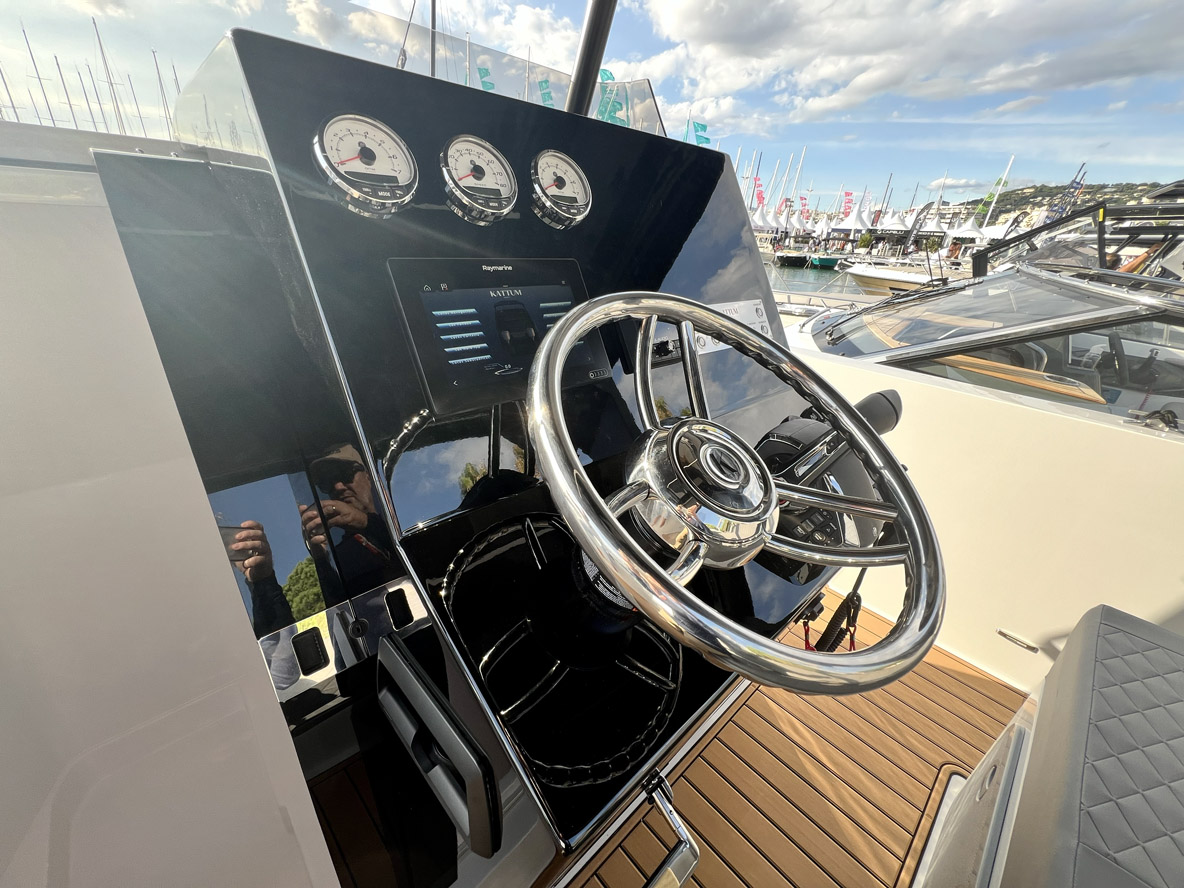
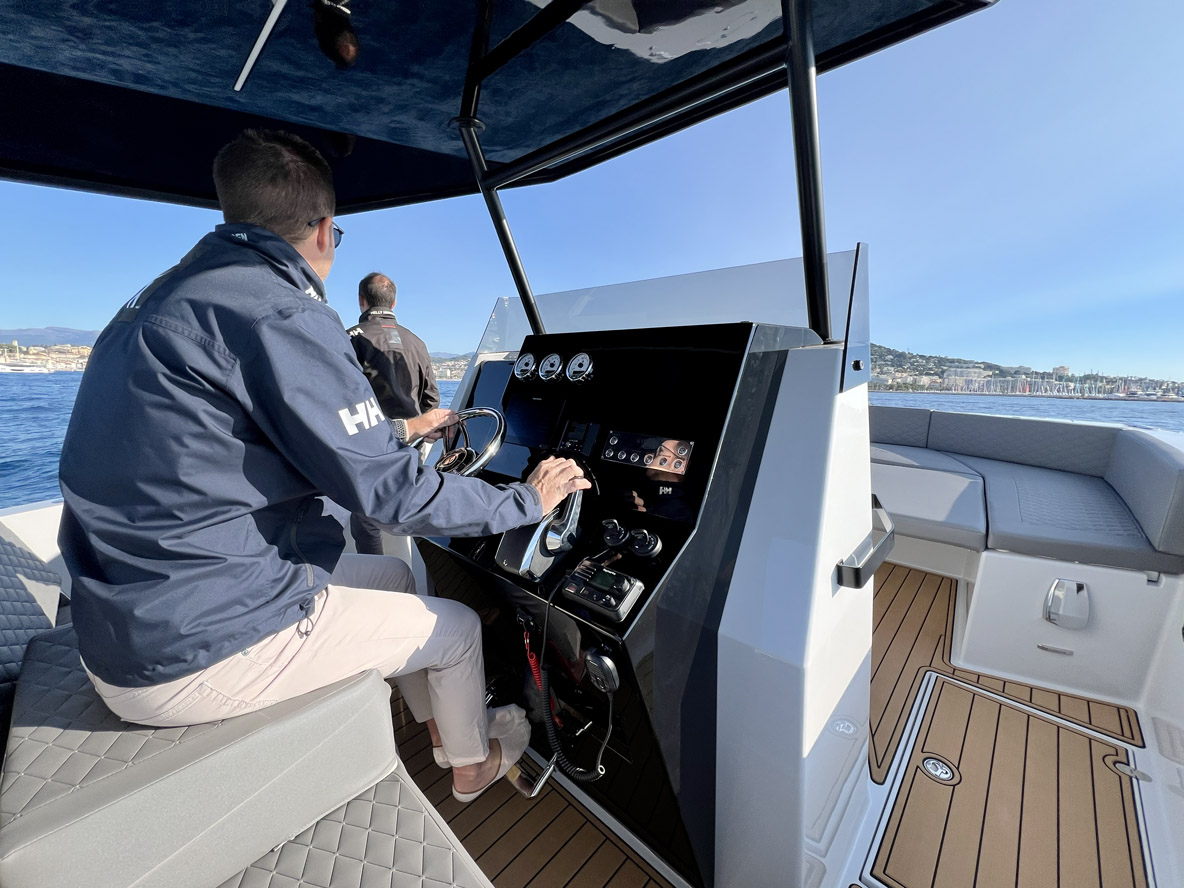
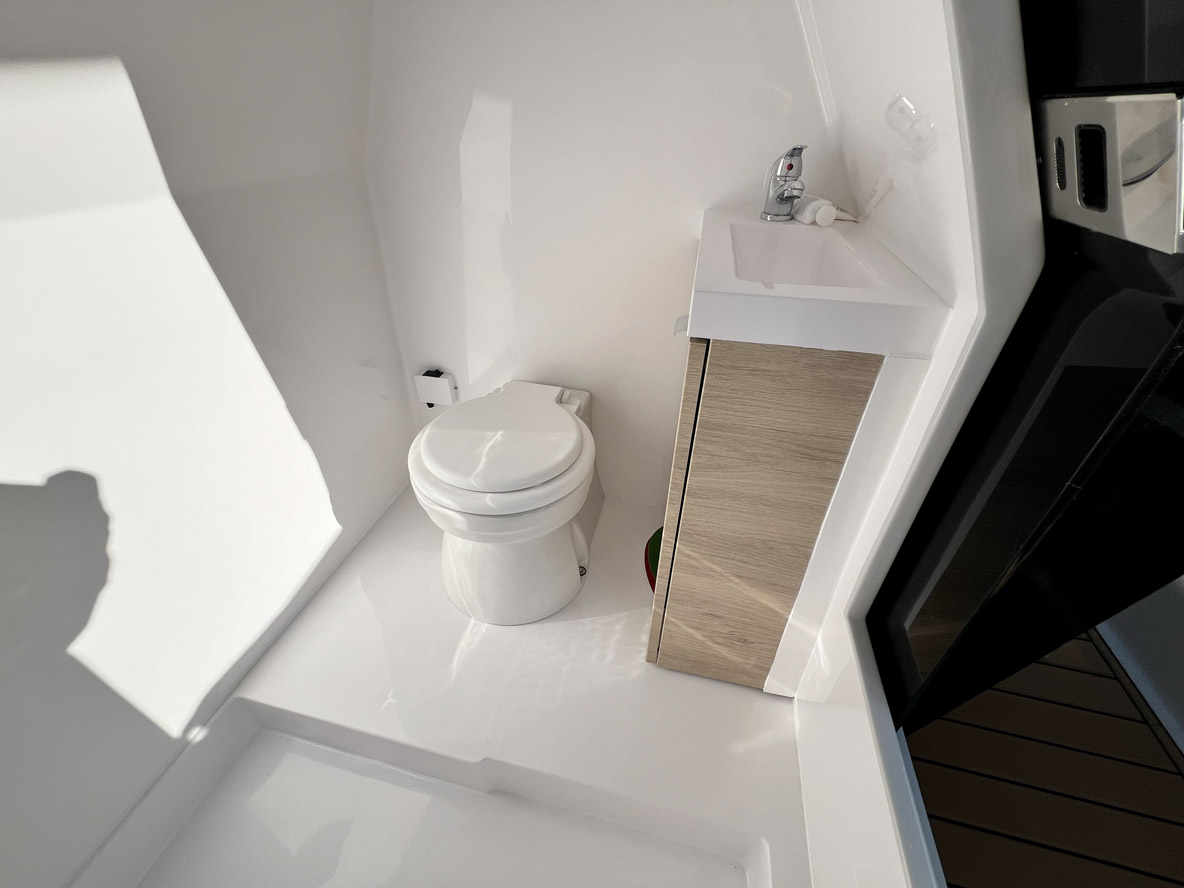
And then there’s the center console, which, due to the catamaran formula, doesn’t offer much headroom. However, the designers really wanted to install a real head with W.C. and sink, so the whole unit is much bulkier than it should be. In fact, while it’s nice to have a head on board (even without a porthole), the dashboard is far too high, and visibility is almost nil if you’re less than 1.90 m (6’2”) tall or want to drive in a seated position. To compensate for this, the manufacturer has added a large cushion to the driver’s seat... fortunately, there’s also a footrest.
As for the rest, the dashboard is rather attractive, with enough space to install a nice screen and a VHF - too bad there are no wood rubrail or pockets for personal items such as a phone or keys. On the other hand, there is an induction phone charger on the side of the console which is really convenient.
Generally speaking, build quality appears to be quite good, and finishes are very decent, with neat gelcoats and attractive upholstery. The equipment is within the norm, but not excessive, and we would have liked to see more handrails, especially at the bow and stern, where they are absent - a detail easy to fix.
Rated up to 600 HP
Quite high up on the water, the Kattum features pronounced bows and rests on two hulls, each with a deep V and sharp chines for stability. The tunnel is a good size, providing an effective air cushion at speed. The design is definitely attractive, all the more so as the powercat is officially rated up to 2 x 300 HP for just 2.8 t (6,175 lbs) light displacement. So it was with a smile on my face that we headed out from the marina early in the morning to enjoy the Bay of Cannes all to ourselves, or almost all to ourselves. For the occasion, two Mercury V6 engines, each delivering 200 HP, were mounted on the transoms. Once the motors were up to temperature, we pushed the throttle a little and, not surprisingly, the K-30 very quickly (5.2 seconds) extricated itself from the liquid element to get into its lines. So far, I felt very satisfied. We reached cruising speed, around 28 knots, but the trim setting was giving me a hard time.
No matter how hard we tried, the Kattum just churns and struggles to maintain stable on the water. Probably a weight distribution problem, or even a propeller problem, but we’ll have to check. Things get even worse in curves, as a mounting problem makes it extremely difficult to handle the steering. We returned to a straight line and tried a few spikes to reach 35 knots at 5,500 rpm, but we couldn’t go any further as the K-30 becomes unstable at this speed. Suffice to say, I was finally satisfied not to have the extra 200 HP available - a feeling I haven’t felt very often, I admit.
It’s a pity that this model didn’t benefit from a longer fine-tuning period and more careful assembly, as I’m convinced from the design of the hull that the K-30 can offer satisfactory performance and handle the sea in a better way.
Conclusion
Honestly, I’d set out with great motivation for this test, but in the end, I was left wanting more. While the overall design of the K-30 is a success, the on-board ergonomics needs to be rethought, and it’s perhaps not necessary to want to have everything on a 30-foot open catamaran, at the risk of making poor choices like this console, which is decidedly too imposing. As for seaworthiness, it would be interesting to repeat this test on a well-mounted and tested unit (trim settings, weight distribution, steering), as the K-30 is certainly worth more than what we saw on the day of our test.
Flattering finish
Large aft platform
Driving position to be revised
Seakindliness to be optimized
Technical Specifications
Length overall (with platform): 30’9” (9.38 m)
Beam: 11’2” (3.4 m)
Light displacement: 6,175 lbs (2.8 t)
Recommended power: 2 x 200 hp Mercury
Maximum power: 2 x 300 hp Mercury
Fuel: 2 x 50 US gal (2 x 190 l)
Fresh water: 2 x 20 US gal (2 x 75 l)
Heads: 1
CE Certification: Category B
Max. number of passengers: 14
Price: from €218,000 ex-tax, ex-works (Spain)