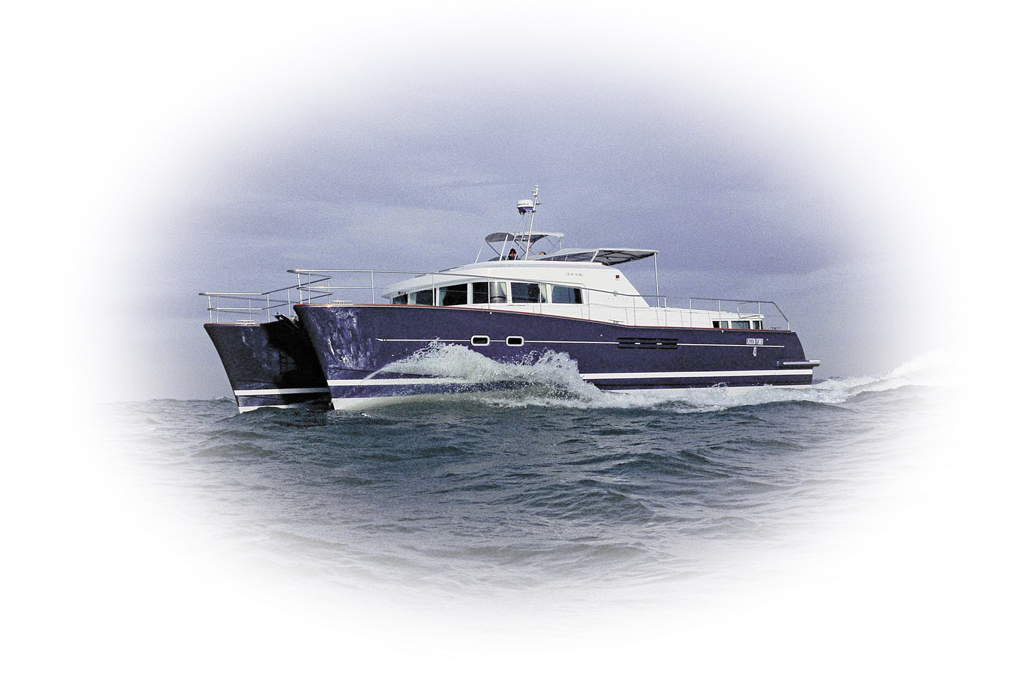
Paris Boat Show 2000: the Lagoon shipyard present their Trawler project, the Power 43. One year later, the shipyard’s motor catamaran is presented to the public. A few days after the end of the Show, we test the capacities of this much awaited boat…
Infos pratiques
- Le chantier : Lagoon Power 43
- La fiche technique
- Découvrez notre vidéo exclusive
- Financez votre Lagoon Power 43
- Assuez votre Lagoon Power 43
- Articles autour du Lagoon Power 43
I can imagine the thoughts of the Editor-in-chief before suggesting I test a motor catamaran! “Philippe Échelle is a madman, a multihuller intent on eliminating the least extra pounds; worse yet, an disciple of Richard Newick whose philosophy of comfort at sea lies in the handling of a good boat… without the least equipment. As for his doctrine in the area of motors, it can be summed up in a nutshell: up to 15 meters 2 outboards on articulated shoes… Can you reasonably send such a Spartan individual to test a 43-foot motor trawler?” When accused of professing anorexia when it comes to the construction of multihulls, I can only plead guilty. My only excuse is that I enjoy going fast on a sailboat, but is this valid? More seriously, it is with great enthusiasm that I undertook this deliver from Les Sables d’Olonne to Le Conquet. Yet, 200 nautical miles across the Bay of Biscay in mid-January should cool most ardor! Especially since most of our test was to take place at night with a strong south wind at 5 to 6 on a typical westerly swell! Many motor-driven units of this critical size, under 15 meters tend to accumulate certain defects that make them unpleasant in the view of multihullers: noisy, smelly, seaworthy but tending to roll, or fast, uncomfortable and gluttonous. The Trawler catamaran opens another possibility; it sails flat, offers truly areas for living, serious autonomy and moreover, fun behavior on a choppy sea, with surfing thrills comparable to those of a sailboat…
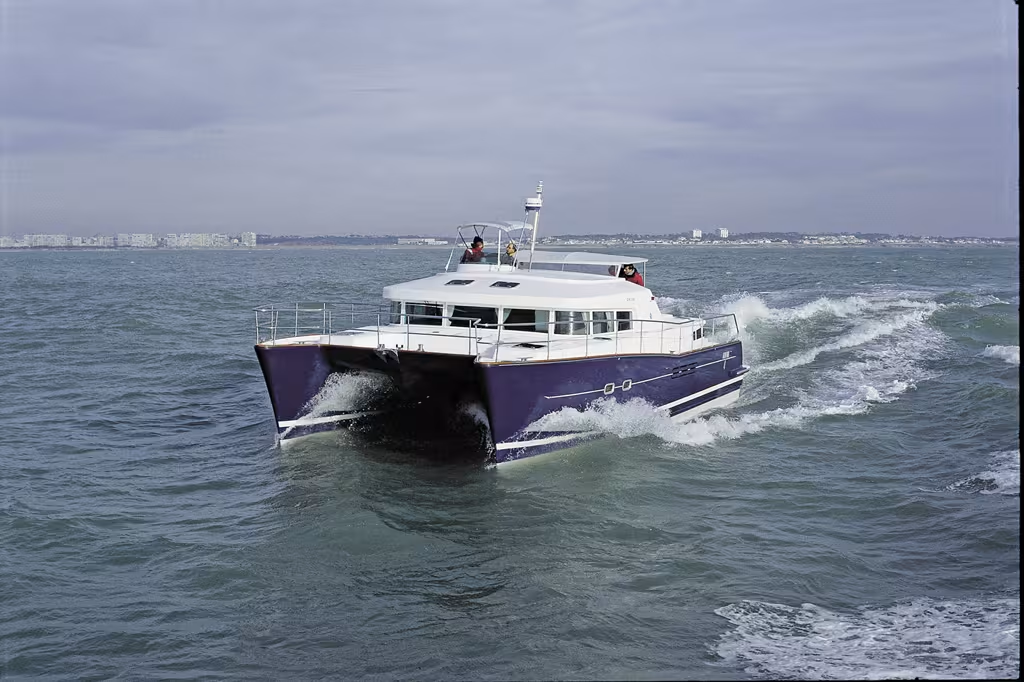
At 15 knots and 2,800 rpm, the Power 43 is very pleasant.
Le Trawler according to LAGOON
In truth, I like the Trawler. Its origin as a fishing boat is made to please me. The “Grands Banks” silhouette has taken over the water because these craft have a strong personality: sturdy, well built, convivial and seaworthy, these big boats sail at 9 knots, but with elegance. With their considerable roll, monohull Trawlers were not models of silent operation and, if the reliability of the two industrial motors placed under the saloon was legendary, there was less comment on the vibrations and noise their generated. The love their owners had for them was total and its would have been a sacrilege to evoke as a defect what was in fact merely a trait in her character. Even though Porsches began to hold the road only recently, the legend is still there… With the risk of overturning some deeply rooted ideas, it seems to me that the catamaran bring the Trawler concept what it had been missing. First, by eliminating roll, but also by separating each motor by a distance of several meters, which has the twofold advantage of making it easier to soundproof the compartments and deflect on either side of the 6.50m of platform the sound source. It seems like nothing, but it completely changes the conviviality of the saloon and cockpit. Four years of work have prepared the launch of this model and the general appearance is a success. The spirit of the Trawler is there, but transfigured by the room offered by this platform measuring 13m by 6.5m. The Lagoon roof is easily integrated in the concept and opens onto a protected comfortable central cockpit. From there, you have access to the raised wheelhouse. A companionway opens into the impressive aft roof for “sunbathing” and gives access in the owner’s version to the Pasha’s “private den”.
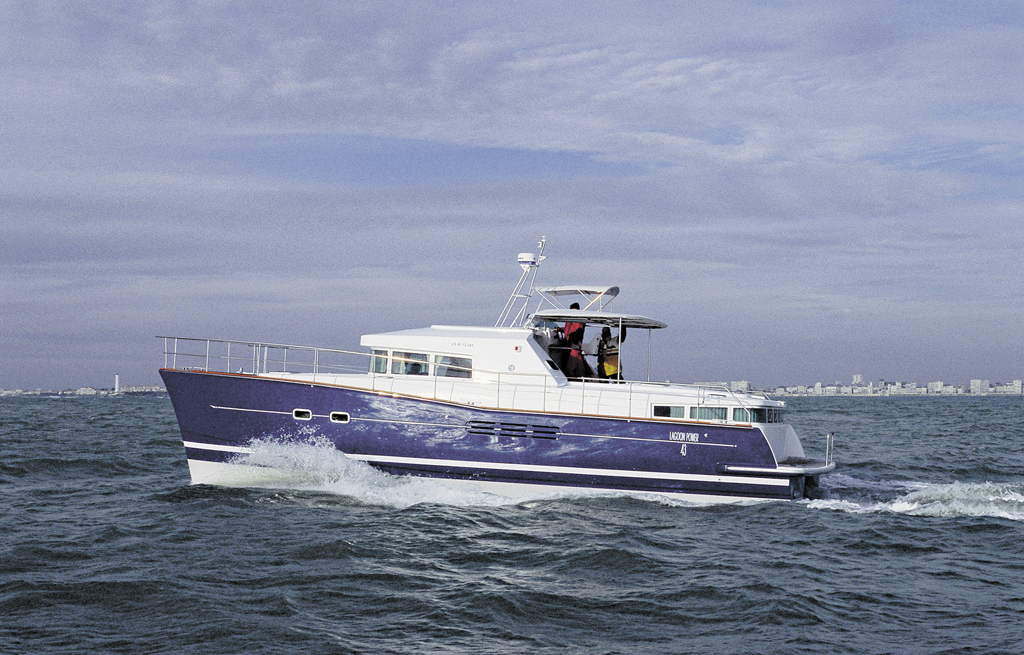
The circulation all around the deck is perfectly organized: the broad flying bridges are safe, with their stanchions and a handrail of stainless-steel tubing. The scantling and fittings inspire trust. The front transom is a choice item, well protected by tall powerful stems, surrounded in front by its railing, it offers a cockpit bench with irresistible charm in fine weather. Sunbathing on top of the aft roof is also very appealing, particularly since there a broad transom across the entire boat. Accessible by three steps in each hull, access is protected during sailing by a railing that opens. The first general glance confirms this catamaran’s vocation, it’s a boat for the sea, sturdy and well protected to withstand heavy weather without danger to the crew. Few yachtspersons know that the CNB-LAGOON factory in Bordeaux has a “fishing and transportation” branch. Yet its reputation has been recognized for many years; fast inter-island launches, fishing boats and other working vessels are designed and built there! Despite this experience, LAGOON took several years to prepare this project and Philippe Subrero was selected to design the POWER 43 and Xavier Fay took care of the interior decoration. A traditional elegant silhouette with volumes almost unknown in yachting, innovative interior design associating light and top-quality materials, motorization that can vary the power from 2x150CV to 2x260 CV. These are the main characteristics of the Trawler Cat according to LAGOON.
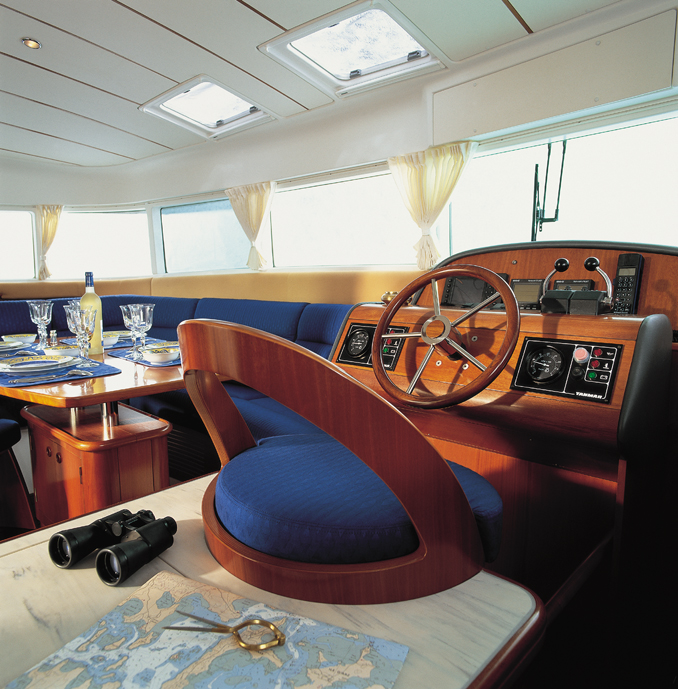
The optional steering station inside is very pleasant…
Life onboard
Naming the chapter on the features “life onboard” reveals my viewpoint and expresses the fantasies of a journalist and essayist… Indeed, while visiting the POWER 43, my imagination took hold of a dream: if I could borrow this Trawler for a sufficient length of time I swear I would weave around the Croatian archipelago so many tacks that any witness would guarantee I was repeating the hydrographics! Galicia is also awaiting me and no gust of northeasterly winds, no pugg of the low pressure sou’wester would keep me from completing my cruise on this boat! Our test unit being intended for a base in North America, it includes heating and air-conditioning as options. Thus, her owner can scour the Caribbean waters as well as the intra-coastal waterway or Chesapeake Bay, without suffering from either the heat or cold. I personally know a crew whose three members have never stopped singing the praises of this installation on a certain January night off the island of Belle-Île! Let’s be clear: the LAGOON POWER 43 is comfortable… You can undertake onboard tough sailing or outing in the tradewinds without hindering her polyvalence. The central zone is for the saloon, the two galleries and the interior piloting station, an option included in our Trawler and that I strongly recommend. The starboard gallery is devoted to passage toward the aft and fore cabins while the port gallery leads fore to the third cabin and offer, just under the companionway a true galley with full comfort as standard equipment: large refrigerator, separate icebox, excellent cooking range, large sinks, counter and ventilation above the oven. This equipment with its perfect ergonomics will enable you to make pesto or curry regardless of the weather, unlike the “playthings” such moderate size motorboats usually have, because it is supposed you’ll have dinner in the port.
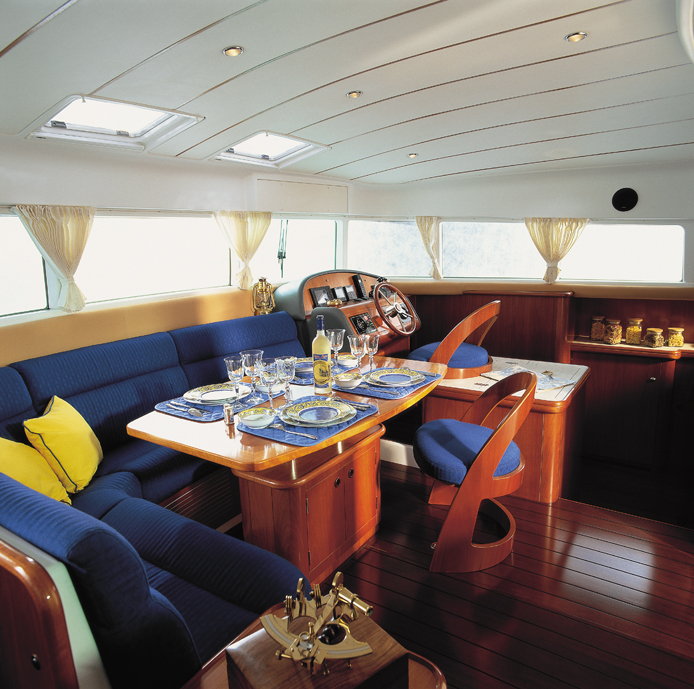
The saloon is comfortable for six people with abundant light and perfect visibility.
The saloon easily accommodates six people, with abundant light and perfect visibility. This central module, which contributed to the success of catamarans is always as pleasant for living, particularly since a large sliding glass panel modulates the space and completely open the passage to the “outdoor saloon” covered by the bimini top or the flybridge, according to the option. This convivial place is my favorite spot onboard, well centered, protected from bad weather or the sun. It is ideal for taking full advantage of the joy of being on the water. The fore cabins are vast and private, each with a head. Light and ventilation are ample (four opening hatches including the escape hatches) and the headroom varies from 1.94m to 2.10m. This mini studio apartments are perfectly separate. The aft cabin: the highlight of the tour, this private apartment occupies the boat’s entire beam, approximately 6x3m. Brimming with clever gadgets, storage areas, vast and well lit, open on the outside and very private, this yacht cabin is a success unsuspected on a 13m boat, it is sure to please the hearts of many Ulysses and Penelopes.
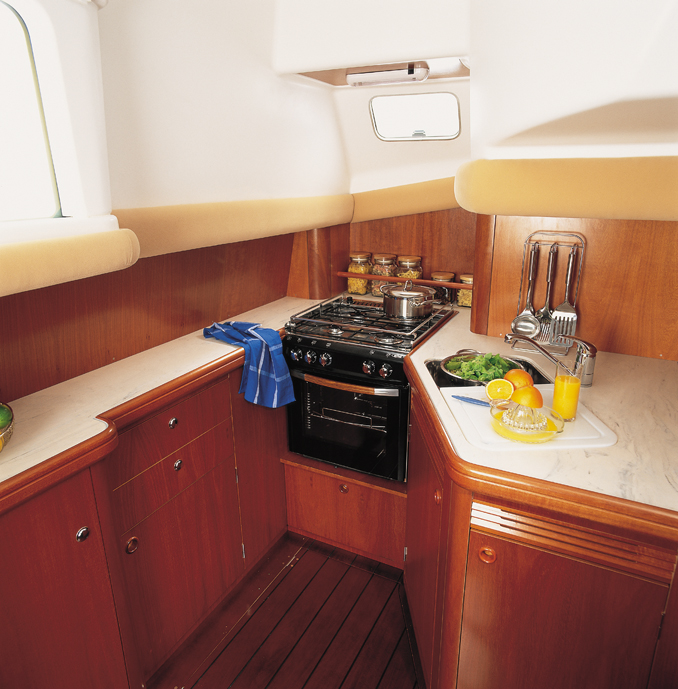
You can cook up a storm at sea in the perfectly ergonomic galley.
Waterlines and design
The stems are thin in their submerged part, but quickly gain in volume, their height over the water is reassuring. The front of the net is a critical place for multihulls and should be seriously scantled. Here, a false stem breaks the energy of the waves and orients them more gently in the tunnel. The waterlines flatten to the rear of the first third of the hulls giving this boat the ability to surf easily, while fins provide effective protection of the propellers and rudders. The central positioning of the 2x190 CV on the test version strikes me as judicious particularly since the fuel tanks and generator are also in the middle. Associated with balsa sandwich construction these arrangements have a very positive effect on the POWER 43’s behavior. Mechanical accessibility is good and carefully designed; despite the length of the shafts, there are no vibrations and the ventilation deserve very good marks. After three hours of operation, we opened the bottom hatches without feeling any heat!
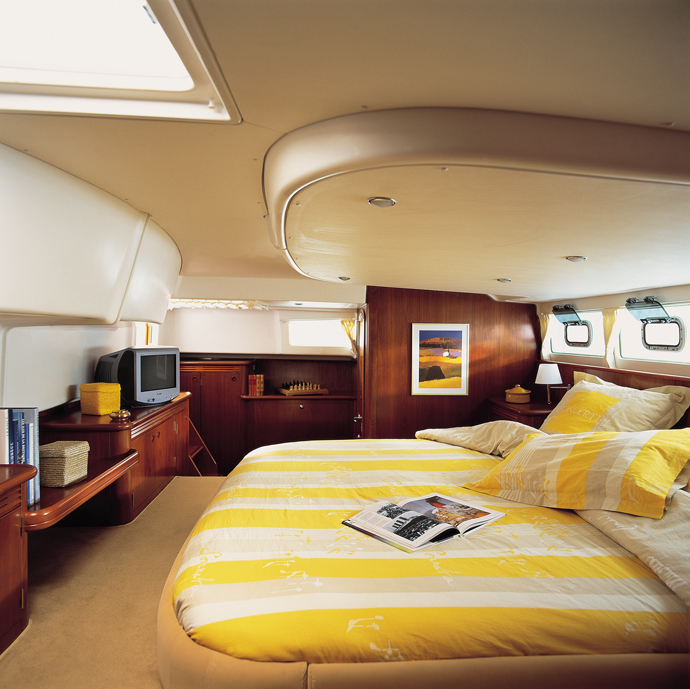
The aft cabin is simply fabulous… Brimming with clever devices, storage, vast and well-lit, open onto the outside and with a great deal of privacy, this yacht cabin is a success, you would never imagine on a 13-m boat…
Behavior at sea
4:30 pm, on a mid-January day, we left Les Sables d’Olonne towards Ouessant and Southampton; nasty westerly chop caught us in the channel and the weather announced a SE force 5-6 wind. As soon as we had negotiated the pass we bore down and full wind aft headed for Belle-Île in the open sea. The sea soon became rough, night fell and the temperature, which was already low enough, dropped further. In general it was the circumstances that invited us to think of the opportunity of setting sail, but not with our LAGOON POWER 43. With the heating and mooring lights turned on, we bore down our 15 knots at 2,800 rpm. After having dined, I settled for a while in the cockpit, enjoying watching our wake. This is a perfectly quiet place when the sea is agitated. A few minutes at the upper piloting station, however, reminded me that we were sailing in winter. And the visibility announced and verified at 2 nautical miles was reduced to practically nothing, facing the apparent wind on this darkest of nights. The contrast with the calm and comfort of the indoor piloting station is unbelievable, and we conversed without raising our voiced with Alain, entrusted by LAGOON with receiving sailing or motor catamarans afloat. The sea was now definitely rough and a splendid swell of 2-2.50 meters pursued the Trawler. With the automatic pilot our speed rose at times to more than 17 knots as the waves fell, while we had cut down the speed of the motors. I was delighted with these conditions that really allowed us to put the POWER 43 to the test. Trotting along at 11-12 knots on the crests, perfectly flat on this turbulent cauldron, the Trawler accelerated frankly and surfed on the waves with agility. The impact below felt safe, carried away by her momentum, our cat raised spray up to the top of the roof, but at no time did green water reach the deck. Despite this hairy surf, our estimation of the consumption on the 200 nautical miles of the course from Les Sables to Le Conquet was 15 liters per hour per motor! We enjoyed this little game for several hours, until an estimation of our arrival time indicated that landing at night counter-current in Le Conquet was not really advisable. We cut the Yanmar motors to 2,100 rpm and continued our route at 10 knots, a speed that struck us as ideal for comfort, discretion and economy for those who wish to travel far…
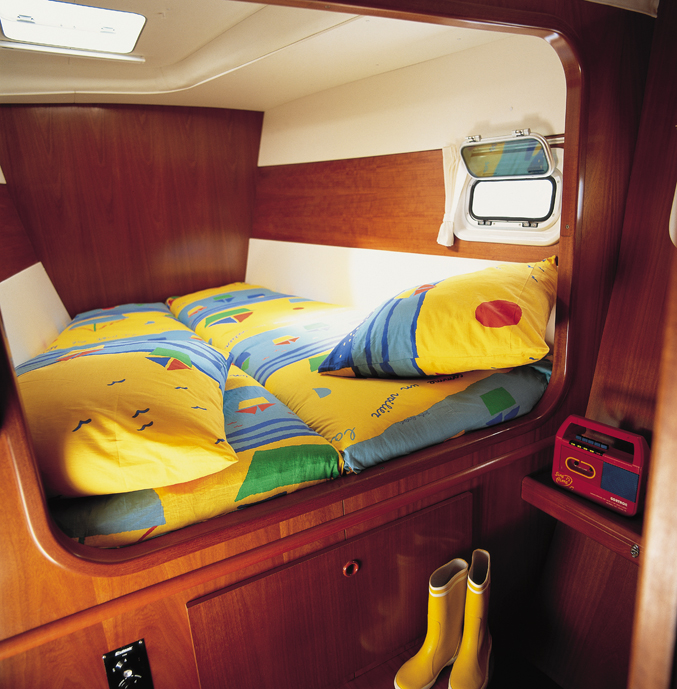
The cabins are spacious and very well ventilated.
CONCLUSION
As you can see, I had lots of fun with this boat and, believe me, dear readers of Multihulls World, you would have shared my pleasure during this journey! I had a yen to cast off for several months onboard a POWER 43 equipped for fishing and diving to scour the Caribbean, Baltic or Mediterranean Seas; the fact this boat is the source of such dreams is not the least of its charms. The Trawler 43 is a catamaran and, if she provides thrills far out of reach of her monohull sisters, it is necessary to recognize her limits and remember when to slow down in rough seas, despite her apparently irreproachable seaworthiness. Off the wind, the boat is sound, fun and economical. In very rough seas, it is like that, as for all multihulls, you should bear away somewhat to seek the most favorable angle of penetration. The motor power of 2x190 CV seemed to me quite sufficient, and the 2x150 CV version will also be very well adapted to travel or cruising. The 2x260 CV motors should make it possible to surfer continuously and should be reserved for particularly demanding uses, our test boat having already reached top speeds of 21 knots. Although the supply in this segment remains quite restricted, it is beginning to be more diversified. META has offered some “one offs” for the open sea, Fountaine Pajot has two models less than 40 feet long and we are impatient to test the 14.27m CHEYENNE from the Soubise shipyard. The LAGOON POWER CAT 43 should be very successful. Well built and of moderate displacement, she is fast and relatively economical. Her seaworthiness is that of a true travel boat, her silhouette is a success and the conviviality of her features is far superior to that of any monohull of the same size.
Pros
Silhouette Quality of construction Interior features Deck layout Seaworthiness
Cons
No wheelhouse as standard equipment Option flybridge a little too expensive
GENERAL CHARACTERISTICS
Designer: Philippe Subrero Architect-designer: Xavier Faÿ Maker: Lagoon Materials: Vinylester and polyester resin; hulls of balsa sandwich, like the net and deck. Monolithic matched mold. CP structural partitions Hull length: 13.13 m Waterline length: 11.90 m Beam: 6.51 m Draft: 1.20 m Light displacement: 10.5 t Max. load displacement: 13.5 t Berths (3 versions): 2, 3 or 4 double cabins Water tank: 2 x 430 l Fuel tank: 2 x 400 l Motors/speed: Standard: 2 x 150 CV 13-17 knots 2 x 120 CV / 12-15 knots 2 x 190 CV / 16-20 knots 2 x 260 CV / more than 20 knots 900 nautical miles of autonomy Certification: Underway - category A SELLING PRICE (plus VAT) Version tested - Owner 3 cabins - Yanmar 4 LHA DTE 2x190 CV: FF 1,983,492 (Euros 302,381.41) Other versions - For charter 4 cabins - Yanmar 4 LHA HTE 2x150 CV: FF 1,966,764 (Euros 299,831.24) - Owner 2 cabins + study - Volvo KAMD 44 2x260 CV: FF2,009,368 (Euros 306,326.18)
Some figures (in cm):
Fore cabin berths: 1.60 x 2 m Headroom: 2.10 m After cabin berth (owner): 2 m x 2 m Seats at table: 8 Cockpit: bench for 6 people Headroom in saloon: 2.40 m
COMPARISONS
LAGOON POWER 43 MARYLAND 37 TRAWLER CAT 42 TRAWLER CHEYENNE TRANSCAT 42 Shipyard CNB-Lagoon Fountaine Pajot Prometa Soubise Plaisance Alliaura Marine Overall length 13.10 m 11.15 m 12.90 m 14.27 m 12.85 m Beam 6.42 m 5.10 m 5.90 m 7.27 m 5.34 m Draft 1.20 m 1.05 m NC 1.3 m 1.10 m Displacement 9.5 t 11 t NC NC 14.7 t Motors (CV) 2x150/2x190/2x260 2x75/2x88/2x140 2x90/2x115 2x135/2x215 2 x 190 Fuel tank 2x400 l 1350 l 2x2500l 1000 l 1500 l Water tank 2x430 l 470 l 2x500l 600 l 500 l