With its trimarans topped by large pods, NEEL has broken the monopoly of catamarans on the multihull sailing market. In just 12 years, the manufacturer has managed to make an enviable place for itself in the nautical landscape. Following on from the LEEN 56, the first “Powertri” of its kind, and ahead of the forthcoming 50, this is the second model in a motor range that could play an even more decisive role in a less mature market. Especially since the LEEN 72 offers a cocktail of features that could make it the new trawler yacht – modern, for the third millennium.

Infos pratiques
- Le chantier : Leen 72
- La fiche technique
-
 Découvrez notre vidéo exclusive
- Financez votre LEEN 72
- Assuez votre LEEN 72
- Articles autour du LEEN 72
Test location: La Rochelle, France
Conditions: 10 knots of wind, slight sea
In the port of Les Minimes in La Rochelle on France’s Atlantic coast, not far from a shipyard that continues to expand to meet its growing success, the LEEN 72 has just splashed. The remaining week before the arrival of its owner promises to be a busy one for the teams. But Eric Bruneel, founder and owner of NEEL (and LEEN) is confident and above all proud of his new model. In his eyes, and in particular thanks to its length, it offers the best that a motor multihull can offer. Its architect, Bernard Nivelt, interviewed a few months before our test, was no less enthusiastic about the announced performance. A sign of modernity - we are not talking about speed here - but about records in terms of fuel consumption per mile, a subject that is more topical now than ever before.
The DNA of a trawler yacht
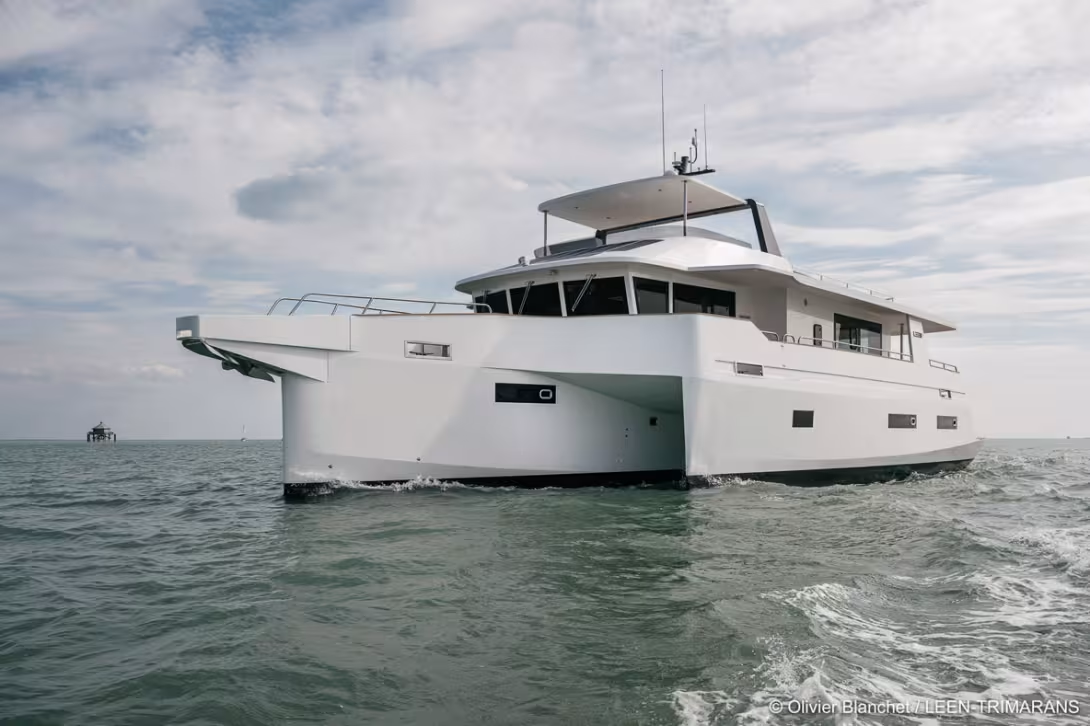
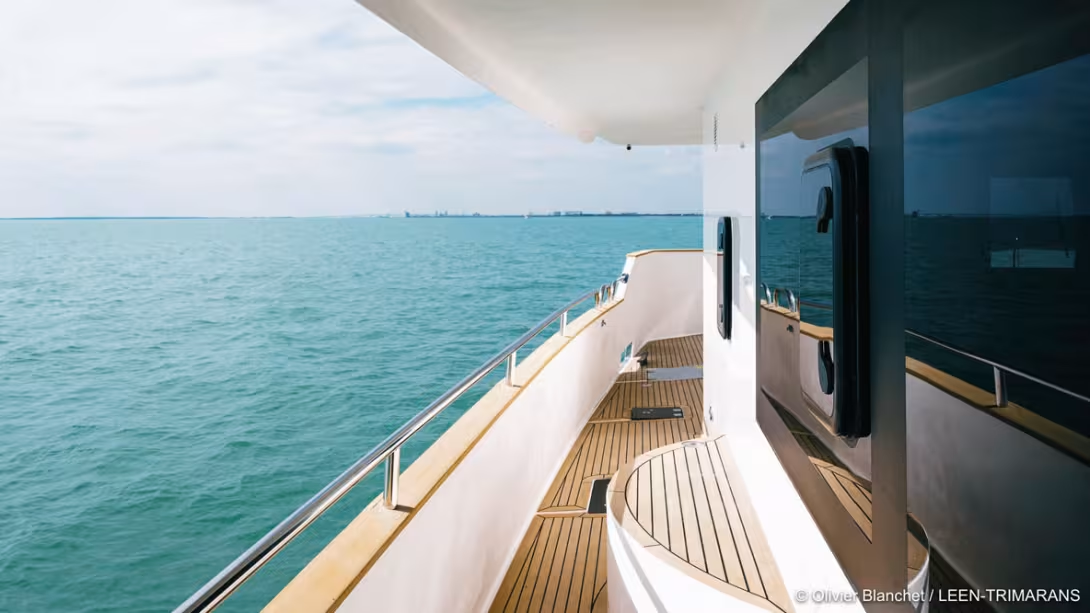
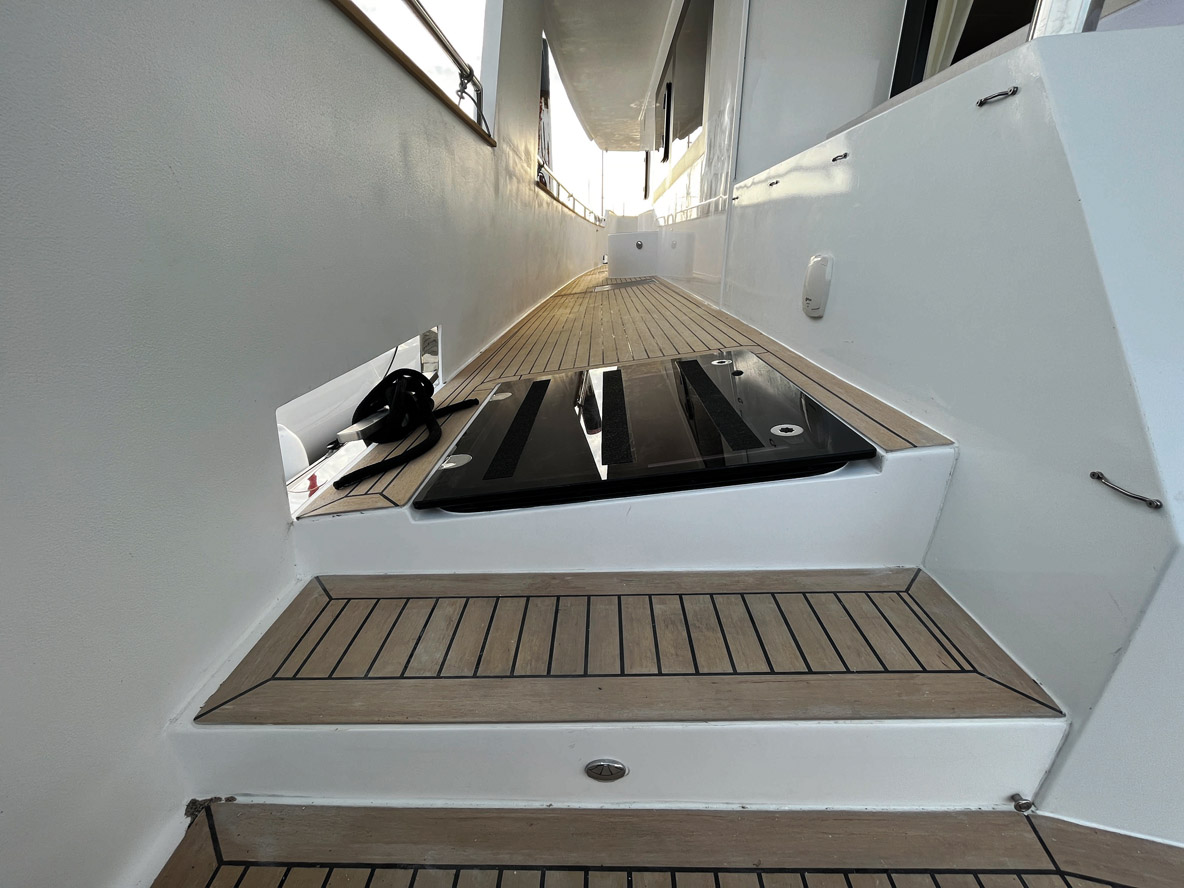
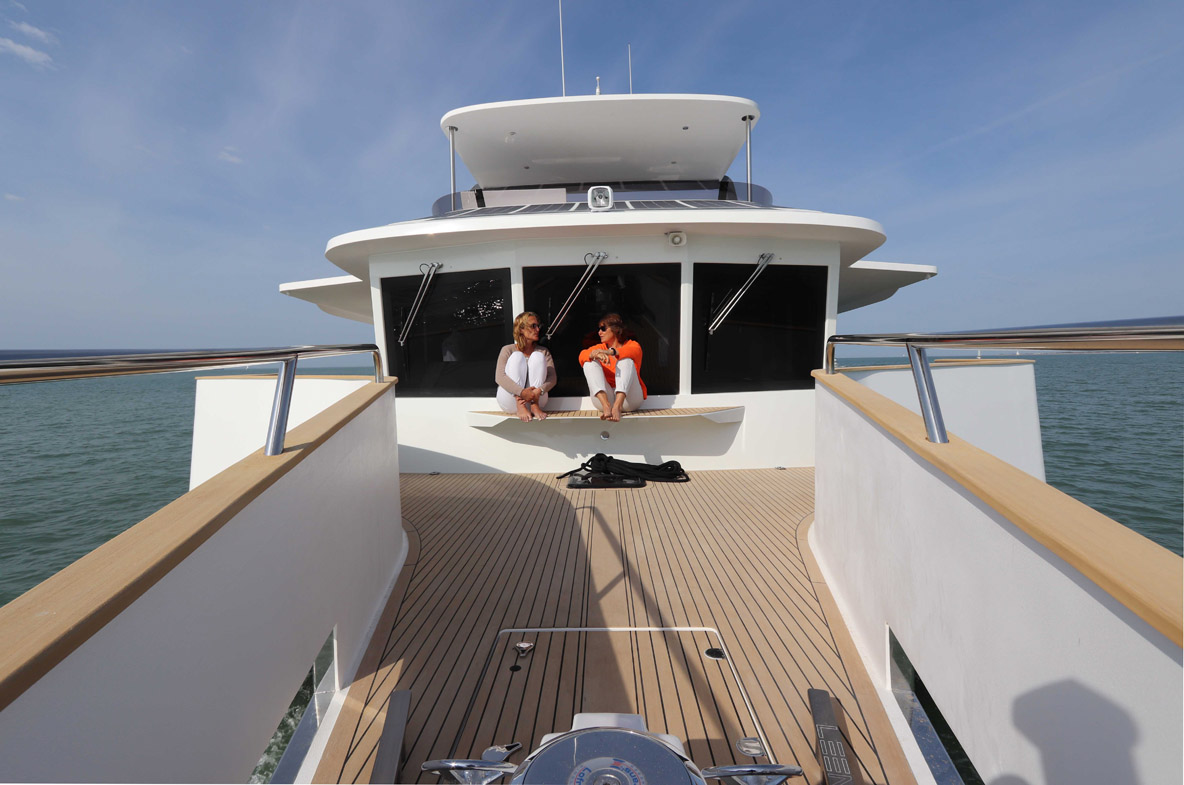
But before firing up the engines - yes, there are several, you’ll see – we made our first contact with the new flagship of the LEEN fleet. Of course, the freeboard is impressive, measuring no less than 9’2” (2.8 m) from the waterline to the guardrail. But compared to the LEEN 56 that inaugurated the range, the 72-foot (21.8 m) length brings more fluidity to the lines of this imposing trawler. The trimaran nevertheless picks up on many of the codes of this family of powerboats initiated across the Atlantic, intended for cruising and living aboard. Of course, we think of Grand Banks as the brand that popularized them, even though, for the LEEN, references are more likely to be made to serious offshore examples, even expedition models, such as Nordhavn, Selene or Kadey Krogen, and perhaps even the atypical FPBs of Steve and Linda Dashew. As on the former on our list above, you find the well-defended foredeck, covered side decks (they’re also inclined, by 5 degrees, to quickly evacuate any water that managed to invade in very heavy seas), safe guardrails because they are solid and high (3’/90 cm at least), or even the reverse glazing of the helm station to avoid glare and offer perfect visibility in all conditions. But these historical-style features are not associated with a displacement monohull that pushes a lot of water and just wants to roll like a pendulum on the swell or at anchor. No, they are associated with the hulls of a modern multihull, whose central hull literally splits the water and whose floats ensure incomparable stability, both under way or when moored. There is no need for a complex, costly and heavy fin or gyroscopic stabilization system: the multihull proves once again the relevance of its multi-millennial architecture.
Three motors and one thruster
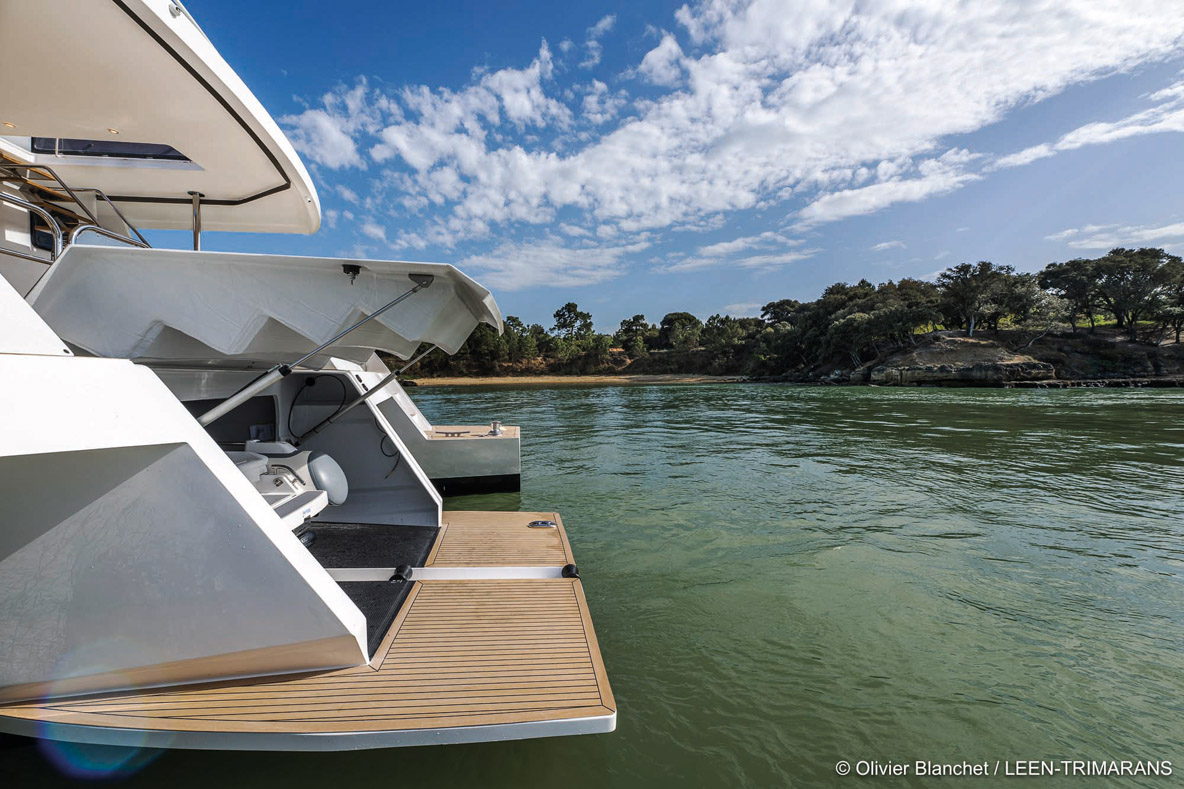
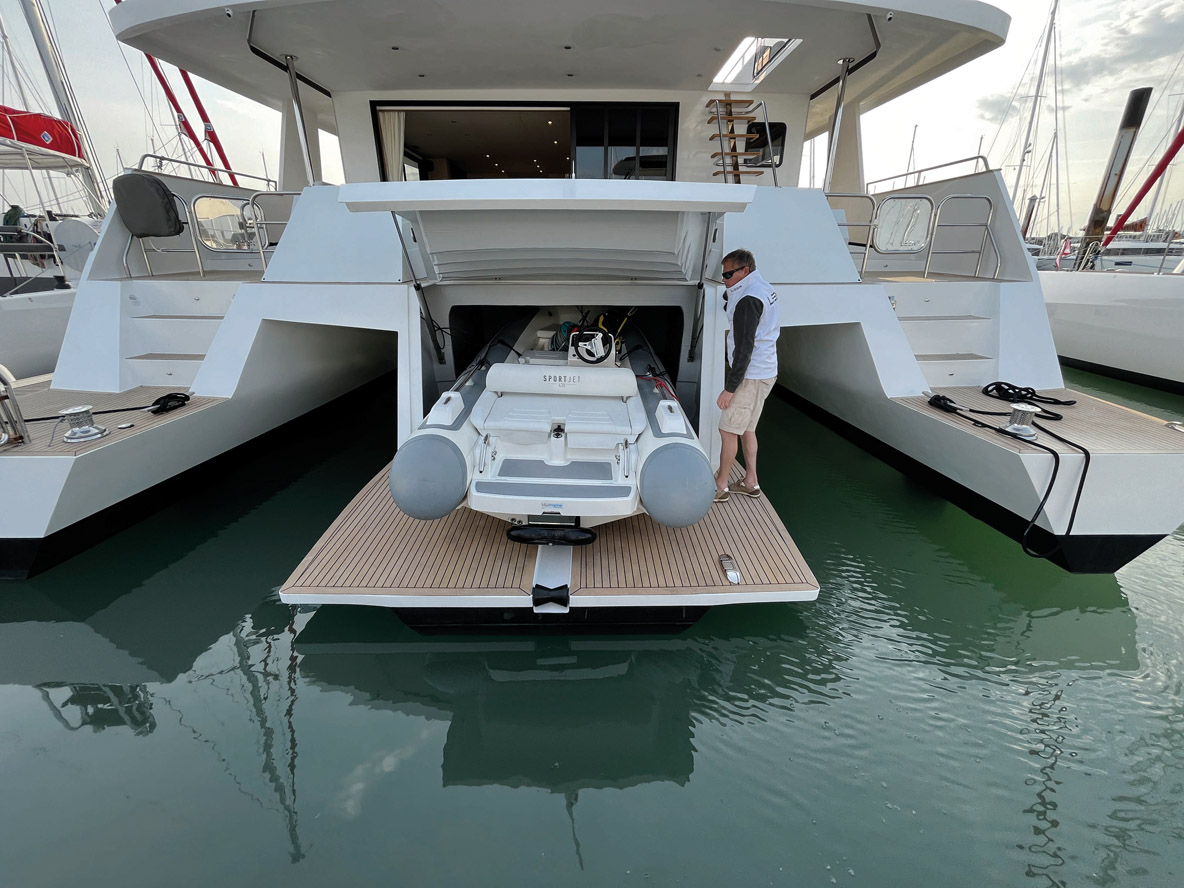
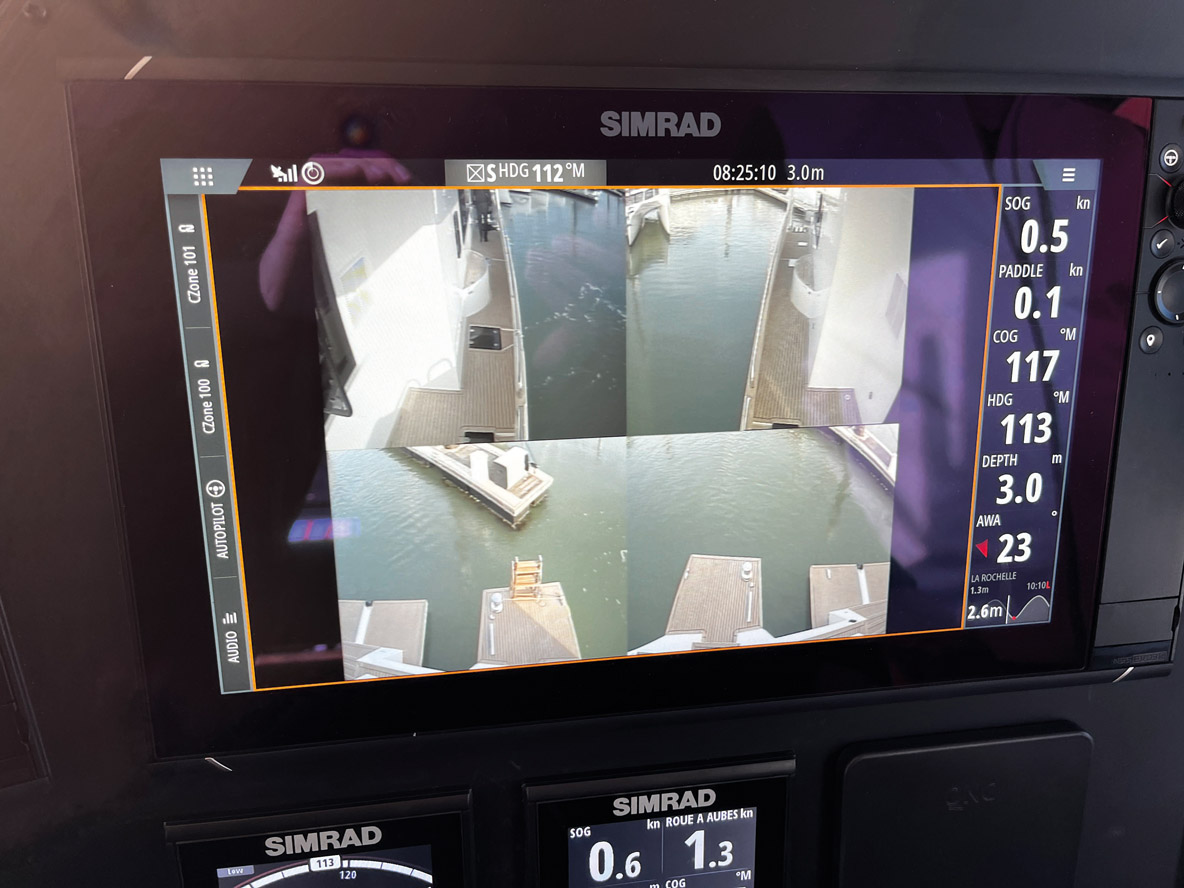
Following the demonstration of launching and recovery of the 13½-foot (4.1m) RIB which disappears completely - and without effort moreover, thanks to the electric winch - in its garage at the back of the central hull, we stepped aboard. The operation is relatively easy from the dock thanks to the relatively high sugarscoops on the floats. The one on the central hull is almost flush with the water, and will form a vast bathing platform, that looks like it will be great at anchor. Considering the narrowness of the passage between the docks, the density of boat traffic on a beautiful Saturday in May in the port of Les Minimes, and the dredging work in progress, it could have been complicated to get out of our slip. But that was not the case. This trip was one of the very first for the powertri, and yet Eric Bruneel appeared more Zen than ever at the controls. Note that he had four of them at his disposal to position this imposing vessel to within an inch of where he wanted it – a vessel whose dimensions 72 feet by 29 (21.80 m x 8.85 m) are close to those of a tennis court. In addition to the main Cummins engine producing 400 HP, which we’ll come back to in detail once at sea, each float is equipped with a 15-kW electric motor with immediate reactivity. These two motors can turn the boat around its axis, with one ahead and the other astern, just like a catamaran. And finally, to cater for all eventualities, and in particular that of a strong crosswind on the not insignificant superstructure, a bow thruster (15 kW at 24 V) is also installed. So we extracted ourselves from the finger pontoon with complete tranquility, reassured in the most critical phases by the images sent back by the four cameras (topsides and sugarscoops on the floats). The display at the navigation station screen could still do with a little development from the electronics supplier in order to offer a more intuitive “Bird’s eye view” type image, as in a car. In fact, while starboard and port are in the right place on the screen, the bow and stern seem to be reversed and the two floats are facing each other - where I would rather imagine seeing the central hull! Of course, the captain would quickly get used to this type of maneuvering, even if getting in and out of port in a multihull of this size is always a delicate moment, and even when the weather is as nice as it was during our test. Either way, it would be nice to optimize the available technology to avoid any doubt.
More than 3,000-mile range
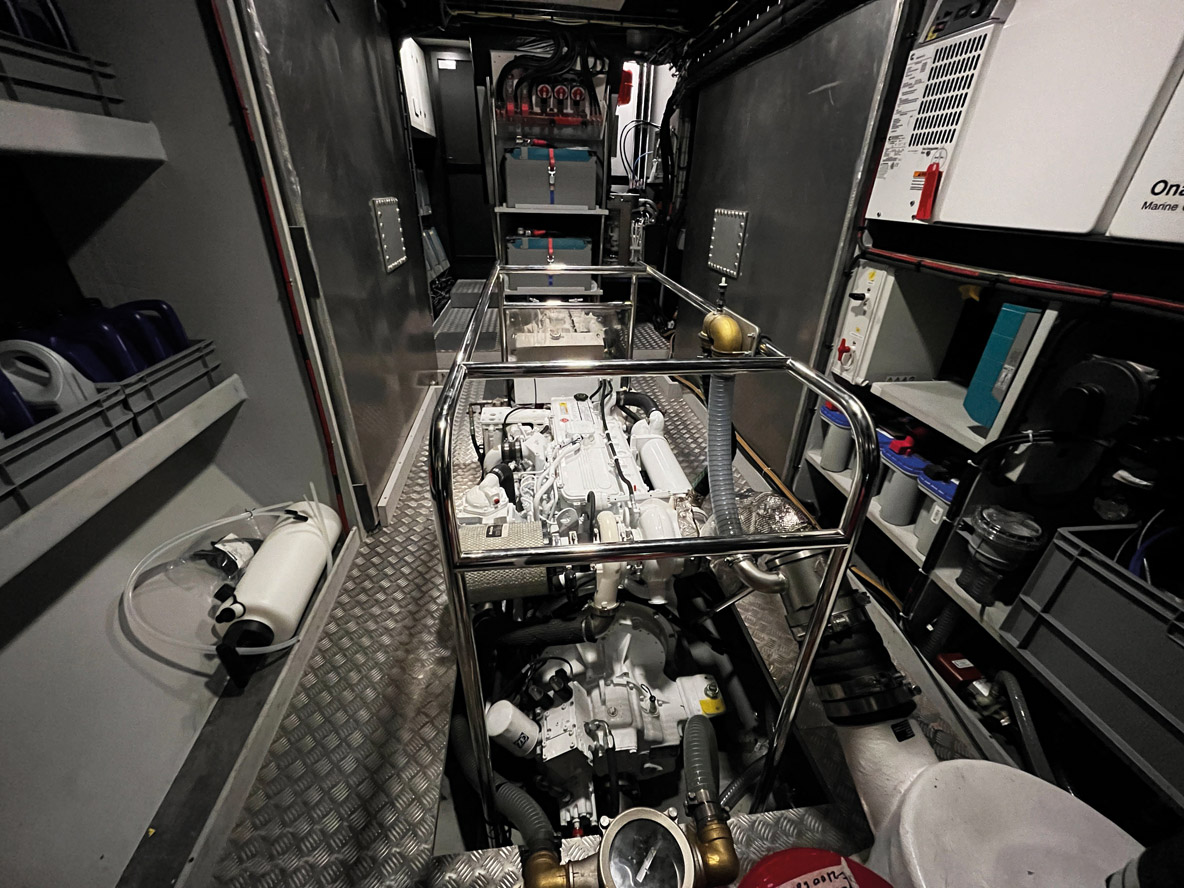
Next, it was time for the open sea! With half a day ahead of us, we had to be satisfied with the waters off La Rochelle... However, with its 1,320-US gallon (5,000-liter) fuel tank, the LEEN 72 could have taken us a long way, a very long way. No crazy speed on the program -that has never been part of the DNA of trawlers. On the contrary, this great voyage would be quiet and lulled by an unruffled rhythm, between 8 and 10 knots. It is indeed at such speeds that the hull/engine combination offers its best performance. While a monohull trawler of equivalent size is consuming somewhere between 9 and 11 gallons (35 to 40 liters) every hour at 9 knots, the LEEN 72 is quite satisfied with 3½ gallons (13 liters). Three hulls to give a consumption figure divided by three, with only 30% of the engine power used, it offers a range of over 3,000 nautical miles. Even better, if you’re not in a hurry, at between 6 and 7 knots, transpacific range is available - even if we are then under the target speed. What is inherent to the trawler concept, however, is reliability. The low-speed engine - 1,200 rpm at 9 knots - is not overtaxing, and the beautiful white Cummins block that sits in an engine room that any mechanic would dream of is not about to run out of fuel. However, the electric motors that helped us out with our port maneuvers also offer welcome redundancy in case of an unlikely failure or more likely, intermediate maintenance. First off, these motors offer 90 minutes of autonomy at 5 knots running on the on-board battery bank (36 kWh of 48 V Lithium batteries). This will be very useful in areas - present or future - where the use of internal combustion engines is prohibited. We are thinking of inland waterways, Dutch canals, or even some Norwegian fjords. Finally, in case of real unavailability of the main engine, you can also power these motors thanks to the generator (22 kW) and navigate at between 5 and 6 knots the time to get back to shore. What should be noted in all cases is the very great discretion of the internal combustion propulsion. As we have seen, you don’t need to push the revs up, and what’s more, insulation has been particularly well taken care of, right up to the floors which are insulated.
A layout not lacking in style
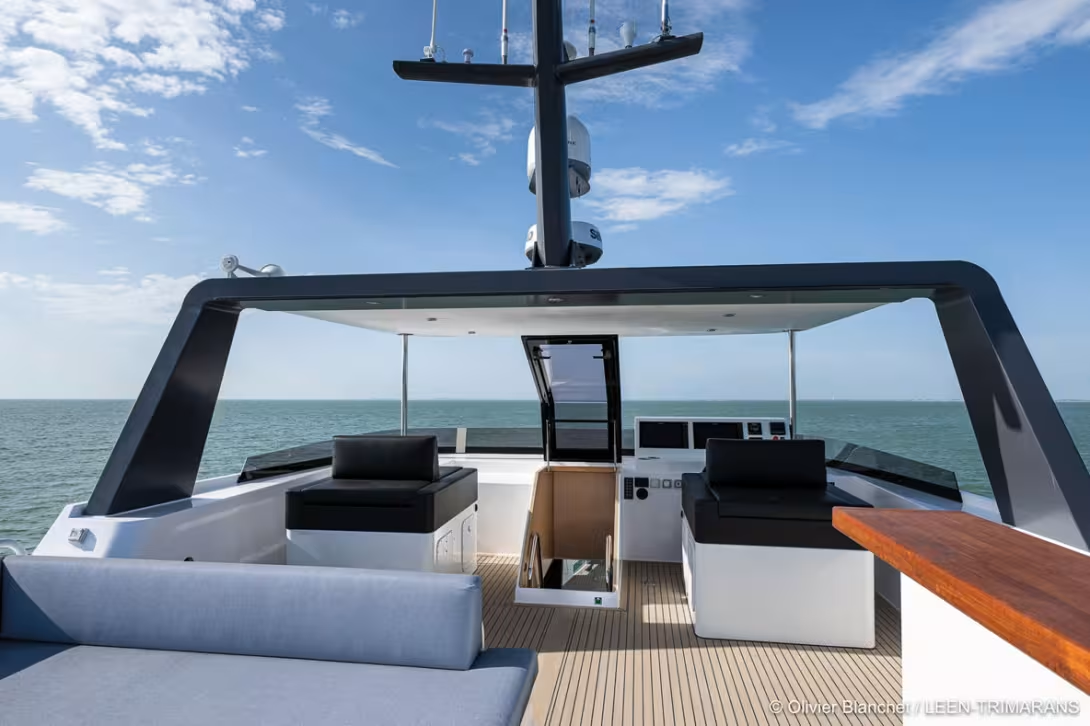
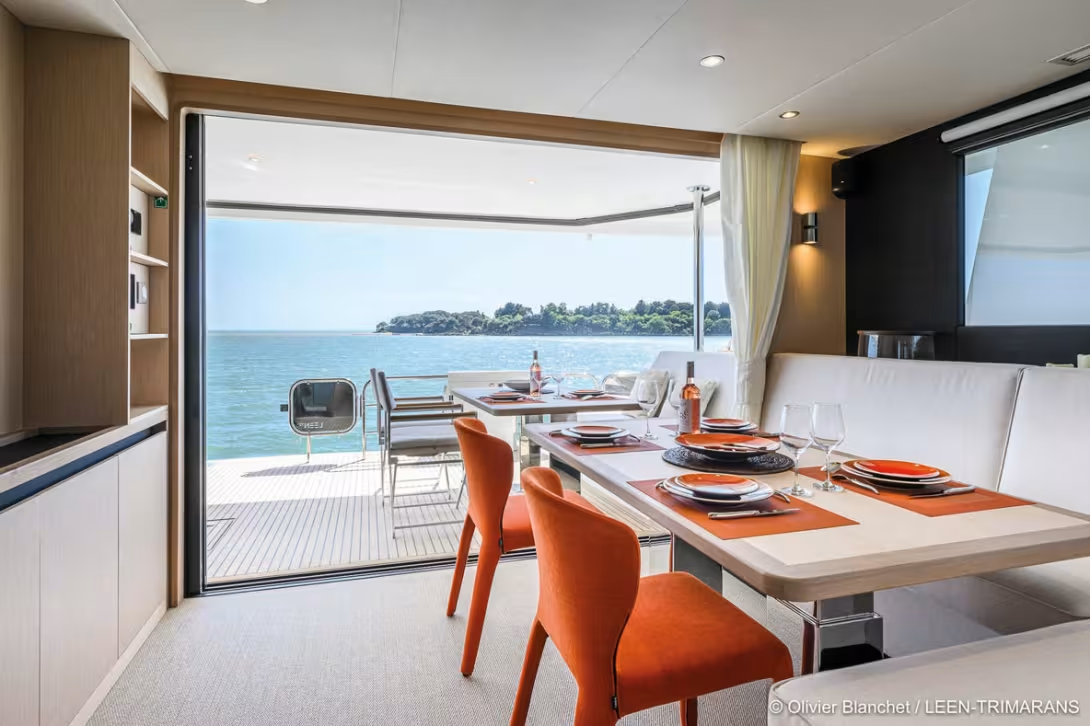
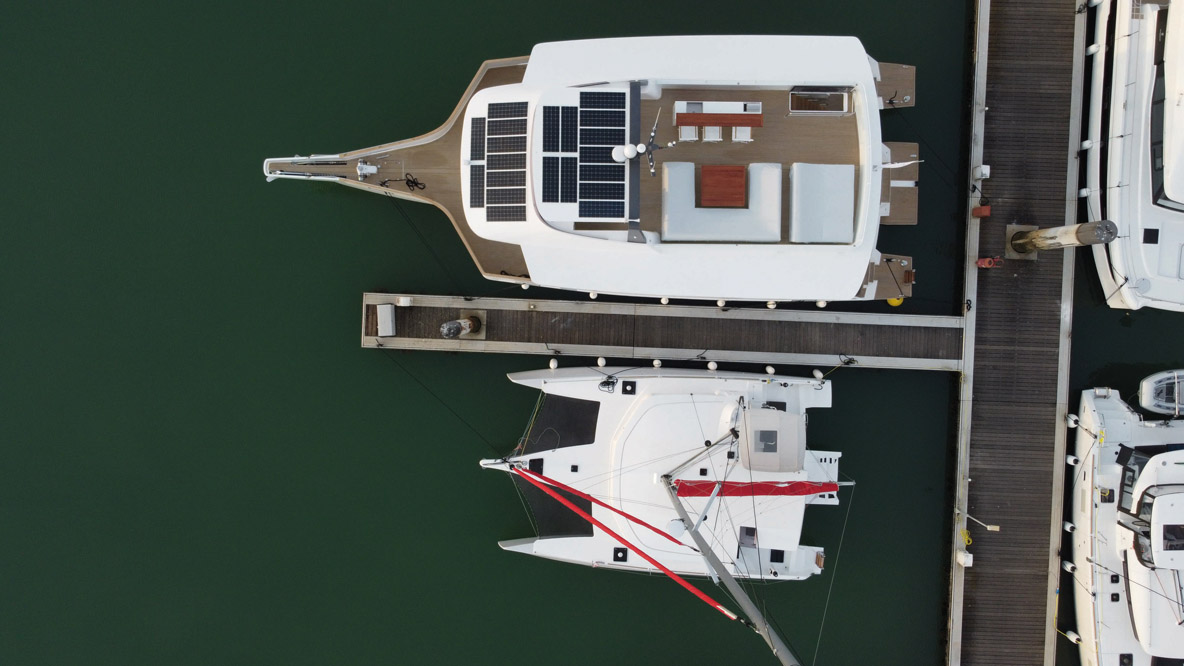
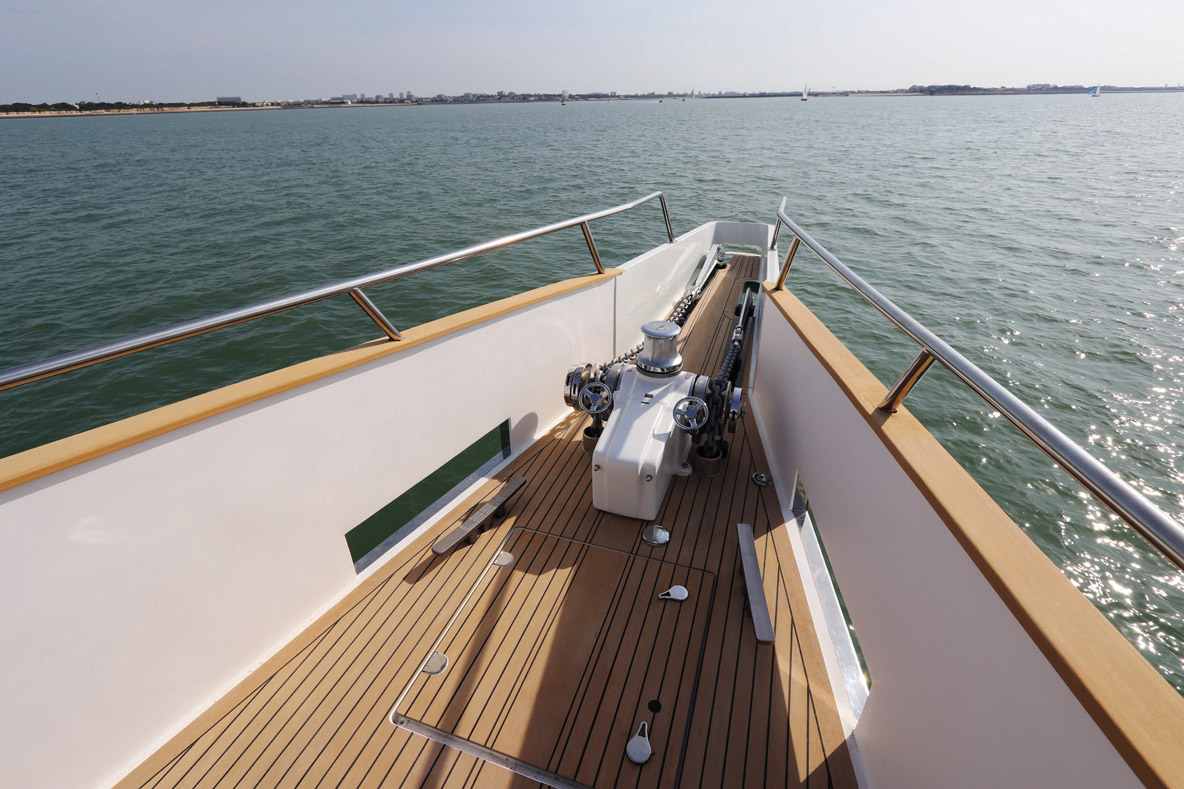
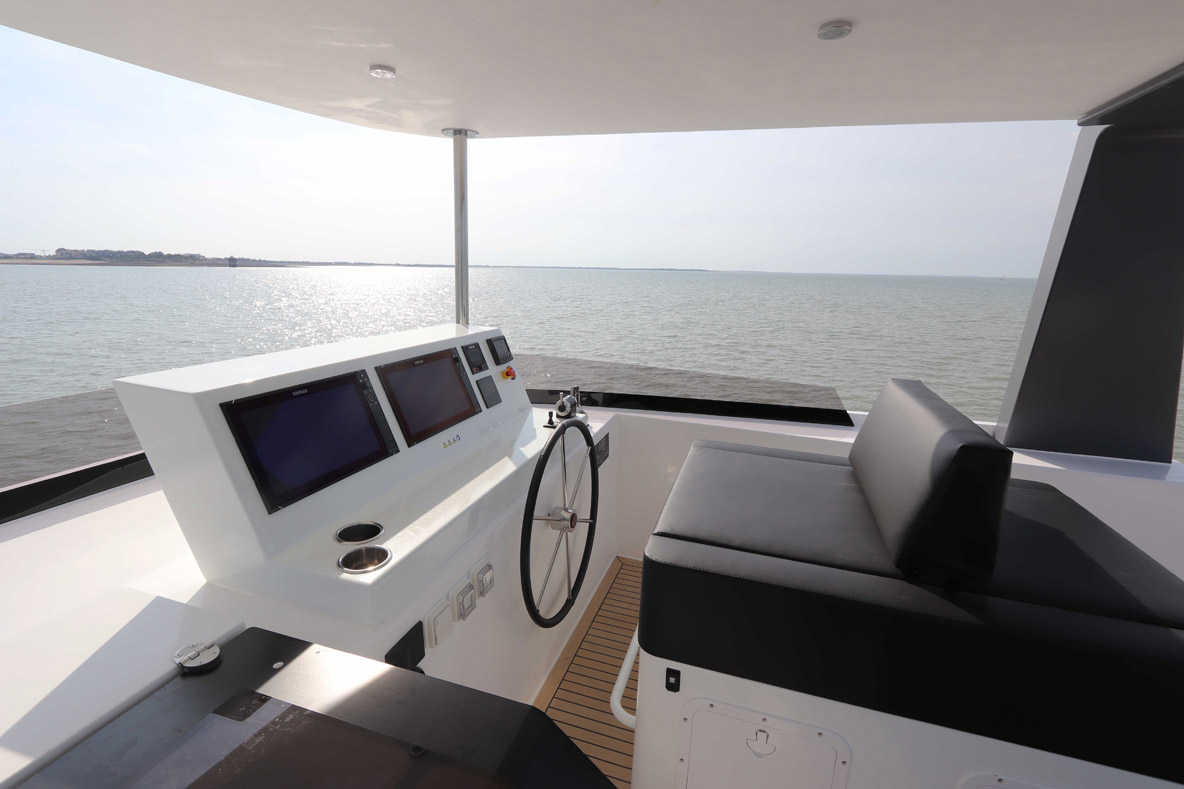
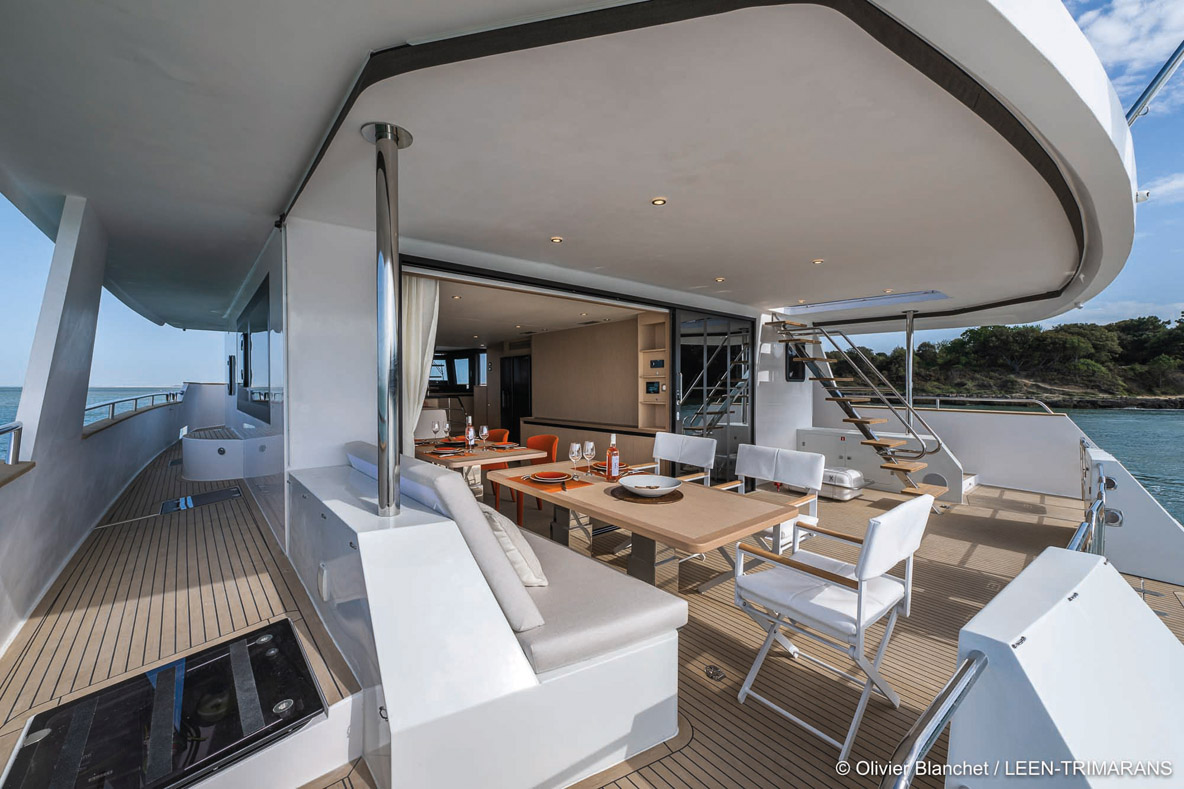
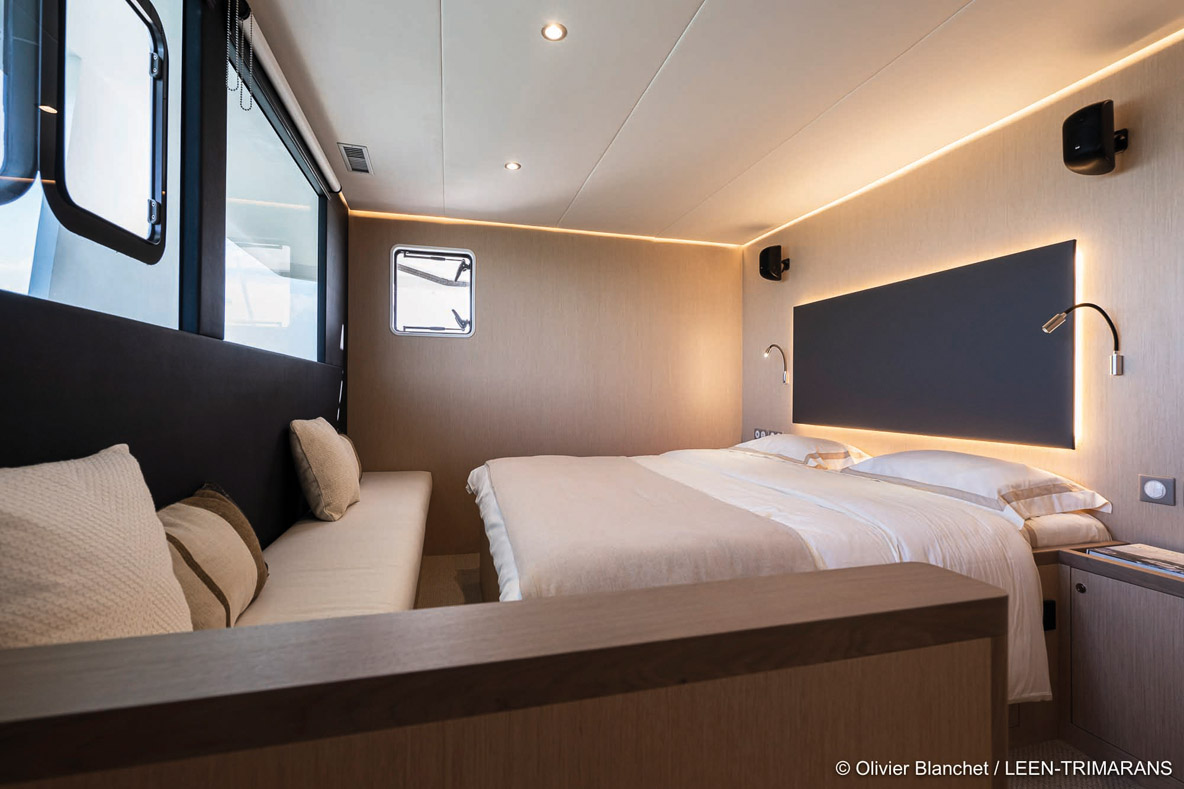
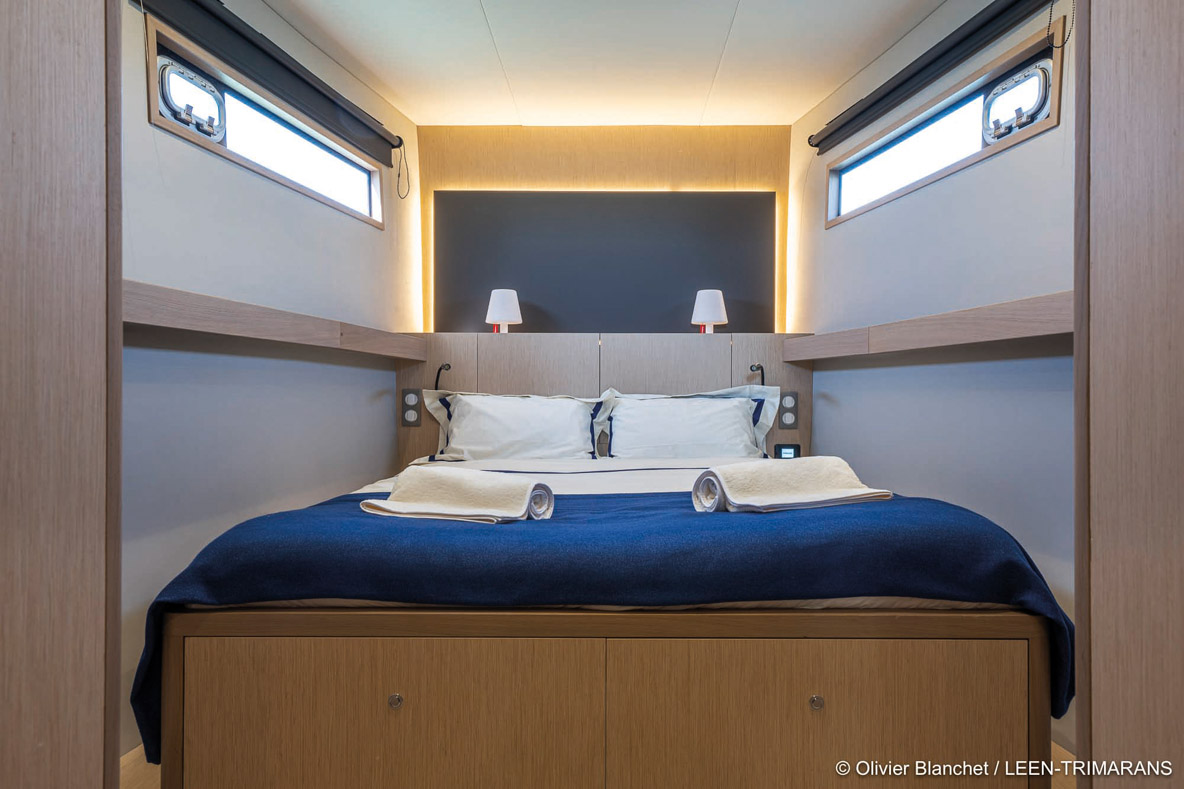
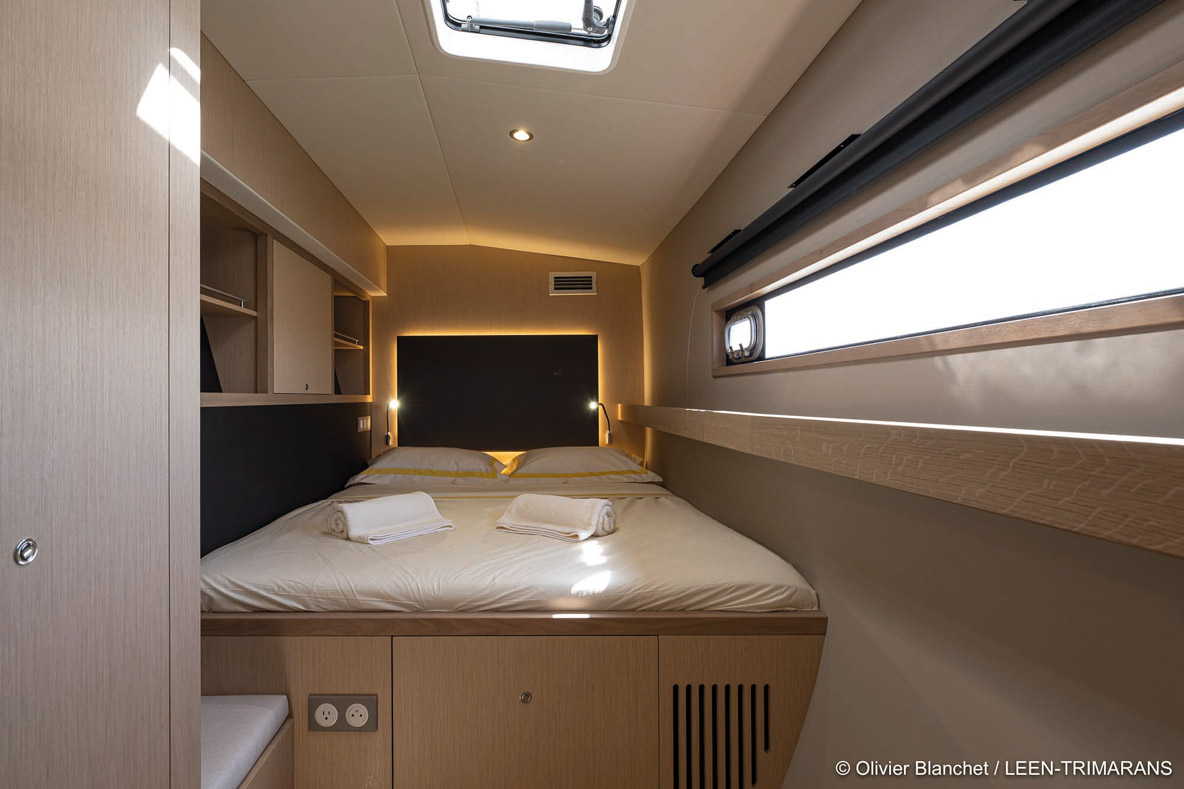
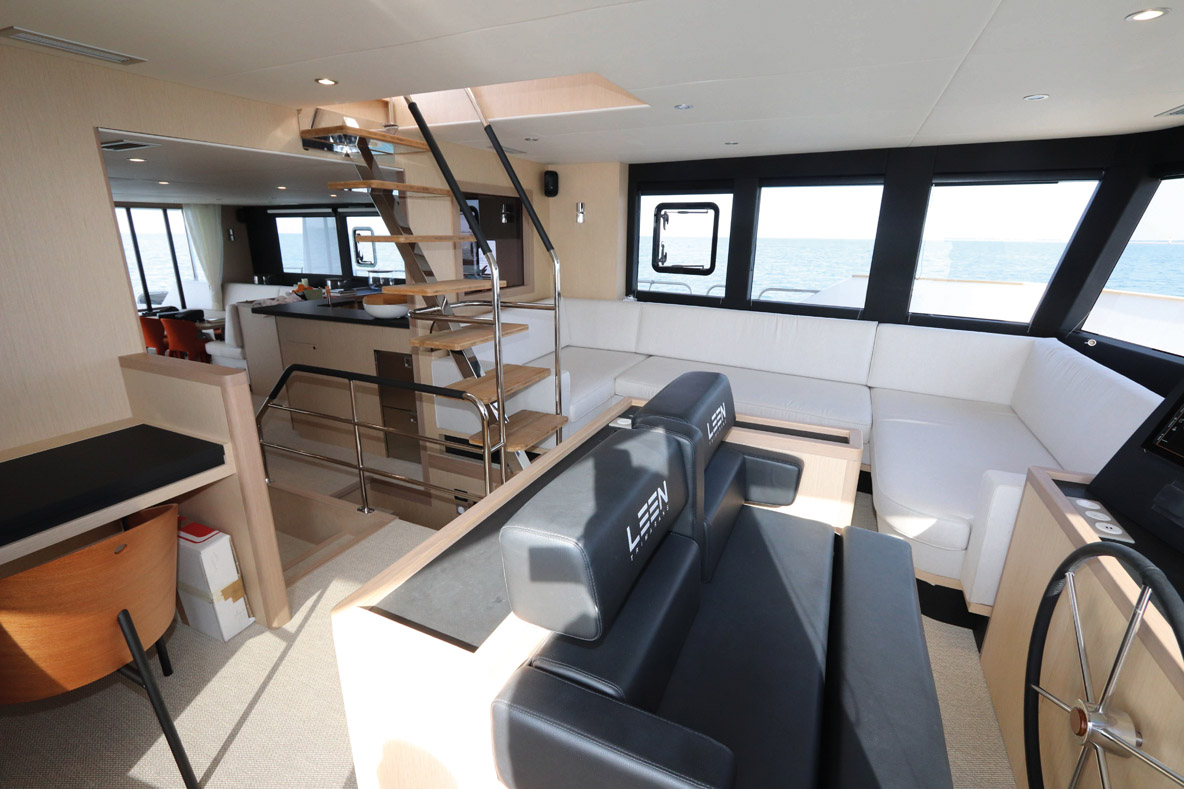
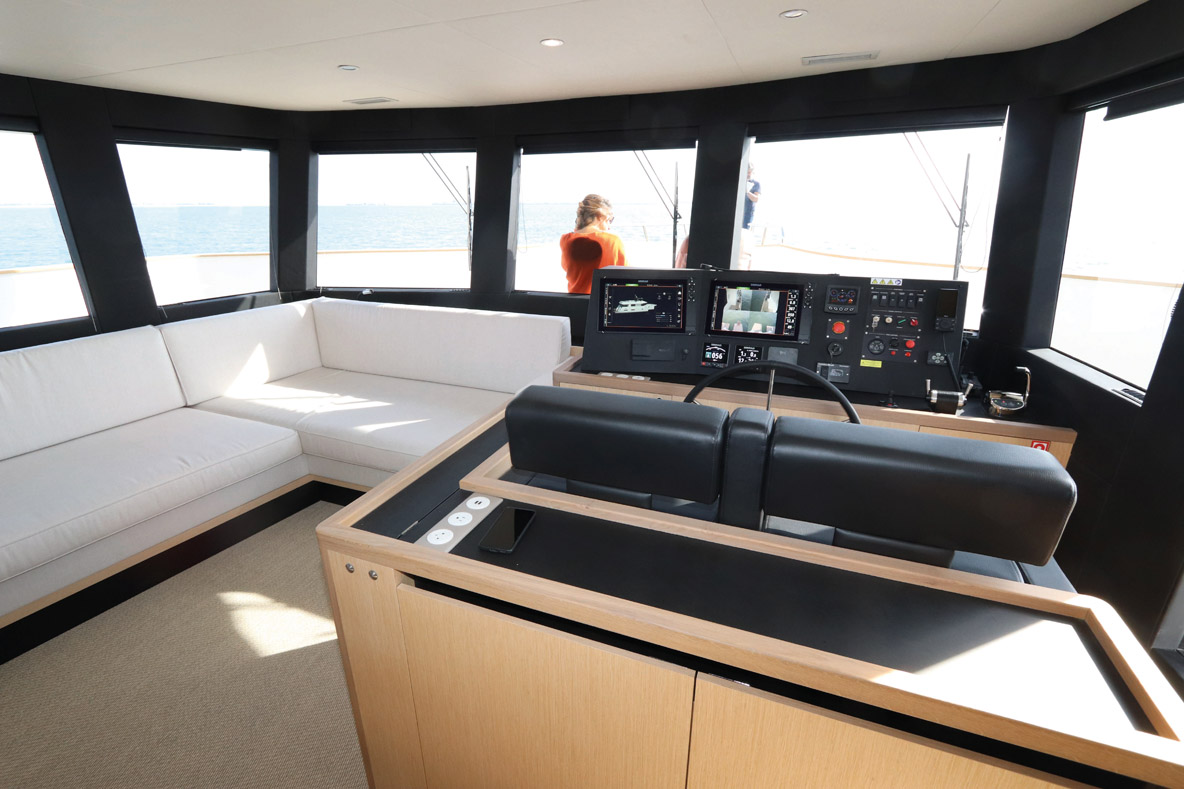
The very cozy-yachting atmosphere on board will delight those who love their boating in northern latitudes, or anywhere cool. The owner of this inaugural model is one of those aficionados of high latitudes cruising: at sea as well as in the mountains, he likes to open the way to uncharted areas. The low noise level also contributes to the comfort on board, which contrasts with the more rustic appearance of the exterior. The rendering of the interior is partly due to the manufacturing method of flat panels, without molds. This level of finish is very well suited to routes that might be considered the off-the-beaten-track. But if your program is more Mediterranean than Patagonian, a lacquered finish is still possible - but the interior won’t need upgrading. It has designed by Pierre Frutschi and remain in the spirit of the company - bright, contemporary, and seaworthy. When the large bay window (9 feet/2.75 m) is open, the saloon table for 8 people can be extended by the cockpit table, doubling its capacity. But for day-to-day use, the LEEN 72 is offered in a 3 or 4-cabin version - in the latter case, no dinghy garage is possible. As for eating, meal will be taken either outside or inside. Note in passing that a crew cabin can be integrated into one of the floats. Moving forward, you discover a very nice U-shaped galley with neat, marbled Corian countertops. Numerous storage spaces are provided, as well as large cold storage to starboard, well-suited to long-term cruising. To maintain both the view and the light, the galley is cleverly separated by a large window from the forward area of the nacelle. On the port side of the staircase that leads to the flybridge, there is a large lounge. A comfortable bench seat on the starboard side - facing the helm, of course - is available for conversation with the pilot, who has all the instruments at their disposal and a 180-degree view. The Securit glass windshield with windshield washer and defrosting system confirms, if it were still necessary, the all-seas vocation of this little ship. The direct side access to the starboard side deck is very comfortable and safe. The usefulness of the aft-facing, small desk, whose attractive seat design can be noted in passing, is however less obvious. Wouldn’t this space have been more useful in the owner’s cabin to which it is attached? This vast suite on the same level as the nacelle is precisely one of the strong points of this LEEN 72. From the bed (which measures 5’11” x 6’7” / 1.8 x 2 m), the view outside via an XXL-sized window some 8 feet (2.5 meters) long and 31½” (0.8 m) high, gives you a cinemascope view of the sea. While the large dressing area is on the same level, you have to go down into the float to access the shower room, which, on the other hand, is spread out over a long length, between a toilet on one side and a double basin and walk-in shower on the other. As for the two guest cabins, one occupies the forward end of the central hull, the other the port side float. They each have their own bathroom, but in the first one, the toilet is separate and accessible without passing through the cabin - which makes it a very practical for daytime use. Outside, the space of the large foredeck all the way back to the coachroof is a rather unique place that’s very popular with guests in good weather. A double 2,300 W / 24 V windlass occupies the robust bow platform. At anchor, you can use the huge flybridge accessible either from the cockpit or directly from the interior helm station area. It is of course possible to helm from under the shelter of the rigid bimini. The helmsman pilot will remain in contact with his crew who will be enjoying the long outdoor galley, the lounge with a 360-degree view or the sunbathing areas on the port side, aft.
Conclusion
Autonomous, reassuring, and perfectly equipped with air conditioning, heating, a 265-gallon (1,000-liter) water tank, a watermaker that can supply up to 42 gal/ 160 liters per hour, solar panels on the coachroof ensuring self-sufficiency at anchor, and storage space everywhere, the LEEN 72 ticks all the boxes of the ideal ocean-going motor multihull. It will be on display for the first time in the world at the Annapolis Boat Show, in October. There is no better way to test this new formula for a long-distance powertri than to present it at the very place where the trawler concept was born. We wouldn’t be surprised if the LEEN 72, although shaking up the rules, meets with great success there. In any case, we would love to be in the shoes of the happy owner of this first unit who, for the summer season 2023, plans to come back and cruise the waters of Ireland and Scotland…
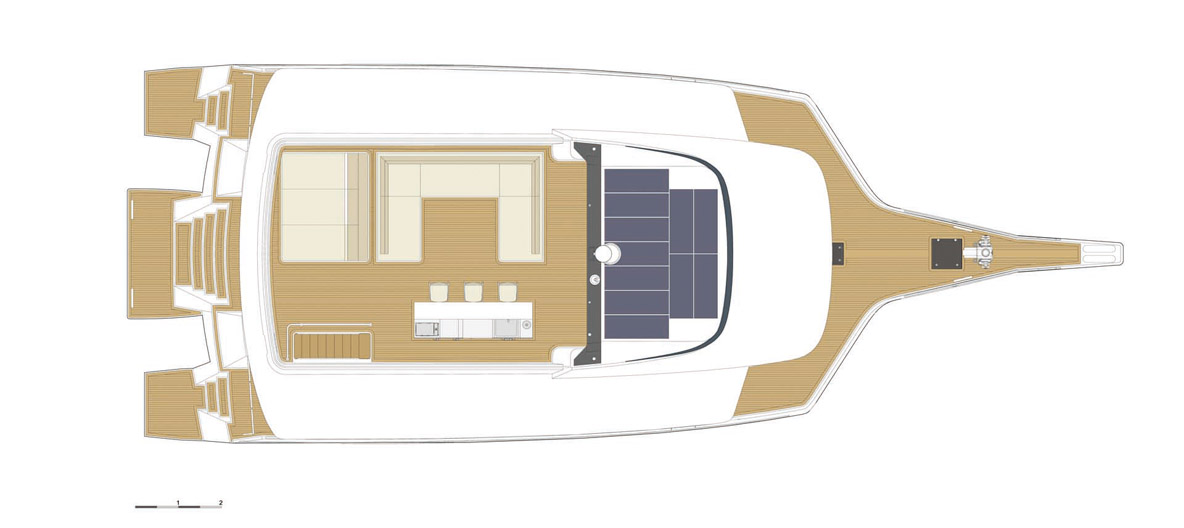
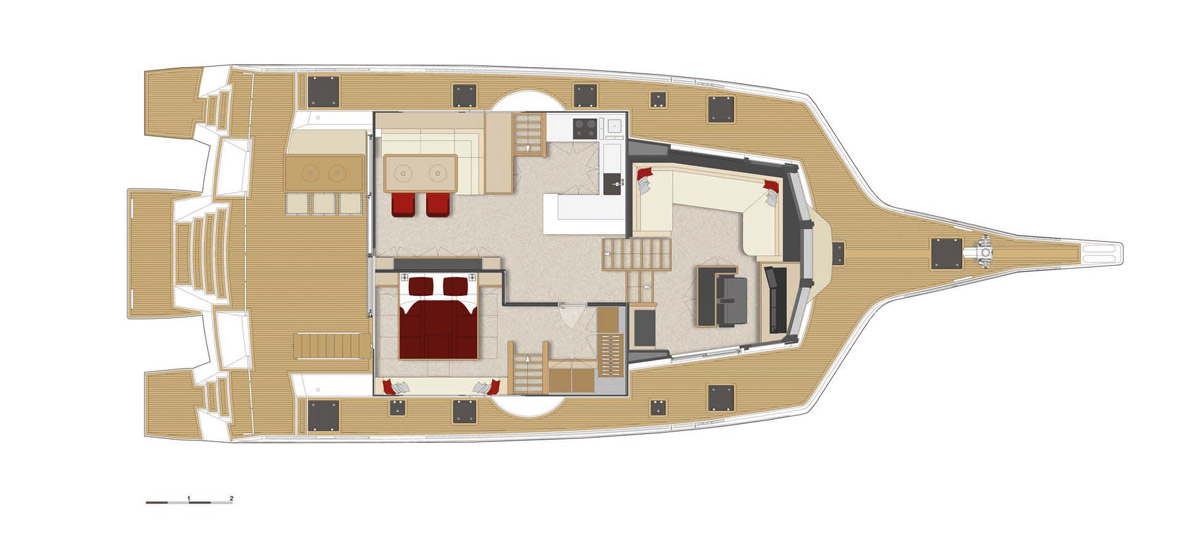
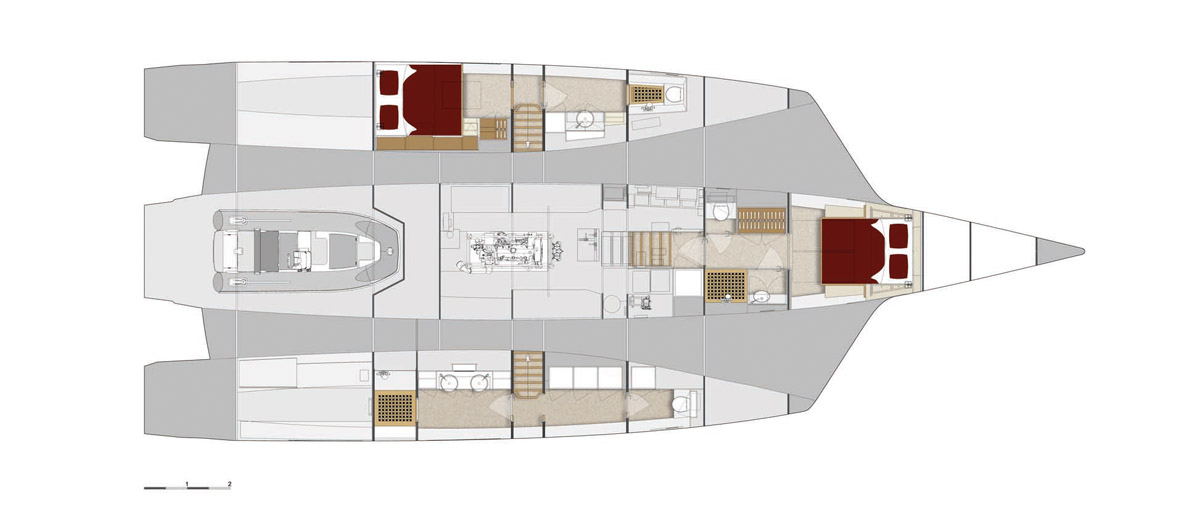
Technical specifications
- Builder: NEEL Trimarans
- Naval architect: Bernard Nivelt
- Interior design: Pierre Frutschi
- Overall length: 71’6” (21.8 m)
- Beam: 29’ (8.85 m)
- Draft: 4’5” (1.34 m)
- Light displacement: 70,550 lbs (32 t)
- Max laden displacement: 91,500 lbs (41.5 t)
- Fuel: 1,320 US gal (5,000 l)
- Water: 264 US gal (1,000 l)
- Main engine: 400 HP Cummins
- Electric motors: 2 x 15 kW
- Standard prices:
- Classic Version (1 single Cummins 400 HP motor): € € 1,911,000 ex-tax
- Hybrid version (the version we tested): € 1,999,000 ex-tax
- Main options in € ex-tax:
- Dinghy garage: 30,000
- Teak deck (sugarscoops, cockpit, foredeck, side decks, flybridge): 81,800
- Flybridge rigid bimini: 24,800
- Flybridge galley: 5,800
- Reversible A/C: 67,000
- Webasto heater: 16,000
- 42-US gal (160 l)/hour 220 V watermaker: 15,900
- Complete Simrad electronics pack: 45,000
- Hydraulic crane on the flybridge: 39,000
- Preparation, launching, delivery and 265 US gallons (1,000 liters) of fuel: 7,200
- Range
- Safety
- Space on board
- Consistency of the concept
- Access to owner’s cabin bathroom
- Image layout from external cameras
- Height of the bows of the floats
Multihulls World figures
| RPM | Speed (SOG) in knots | Consumption in US gal/h (l/h) | |||
| 700 | 4.5 | 0.66 (2.5) | |||
| 1,000 | 7.4 | 2.1 (8) | |||
| 1,200 | 9.1 | 3.45 (13) | |||
| 1,380 | 10.3 | 5.0 (19) | |||
| 1,700 | 11.4 | 9.25 (35) | |||
| 2,000 | 12.2 | 16.75 (63.5) | |||
| 2,130 | 12.6 | 22.2 (84) |