After the 53 PC and the 46 PC, the Leopard shipyard is expanding its range revealing the 40 PC. A smaller powercat, but one that uses the same recipes as her predecessors to attract first-time buyers or to expand the product range of charter companies.
Infos pratiques
- Le chantier : Leopard 40 PC
- La fiche technique
-
 Découvrez notre vidéo exclusive
- Financez votre Leopard 40 PC
- Assuez votre Leopard 40 PC
- Articles autour du Leopard 40 PC
Conditions: Wind 3 to 4 knots, flat sea
Leopard Catamarans, with its partners The Moorings and Sunsail, have been very well established in the catamaran charter business for years. This success continues in the sailing sector and is increasingly being extended to the powercat sector. To meet this demand - but also that of private owners - Leopard launched the 53 PC, then last year the 46 PC and now the 40 PC, which replaces the 43 PC. The first characteristic of this new model is of course its size, a little smaller. This is not a trivial element, since with this 40-footer, the brand intends to attract first-time buyers, but it also offers a more economical and easier-to-maneuver alternative for charter.
The idea of the 40-footer is also to propose the same level of comfort as on a larger unit, and so we naturally find many elements already present on her two big siblings. To carry out this mission, the brand called on well-known naval architect Alexander Simonis.
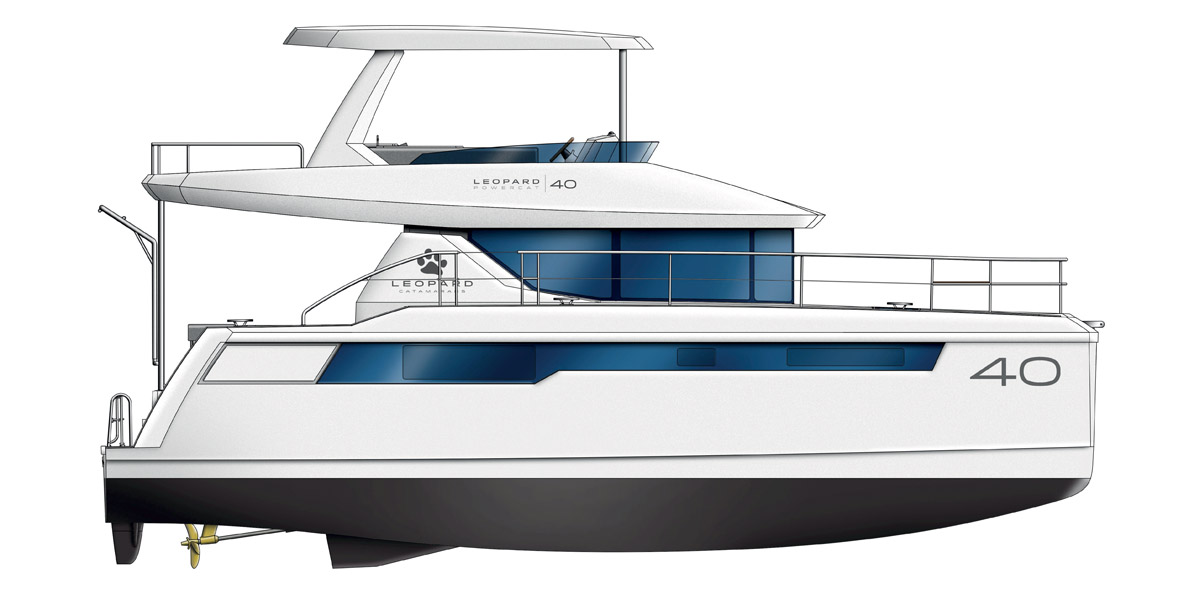
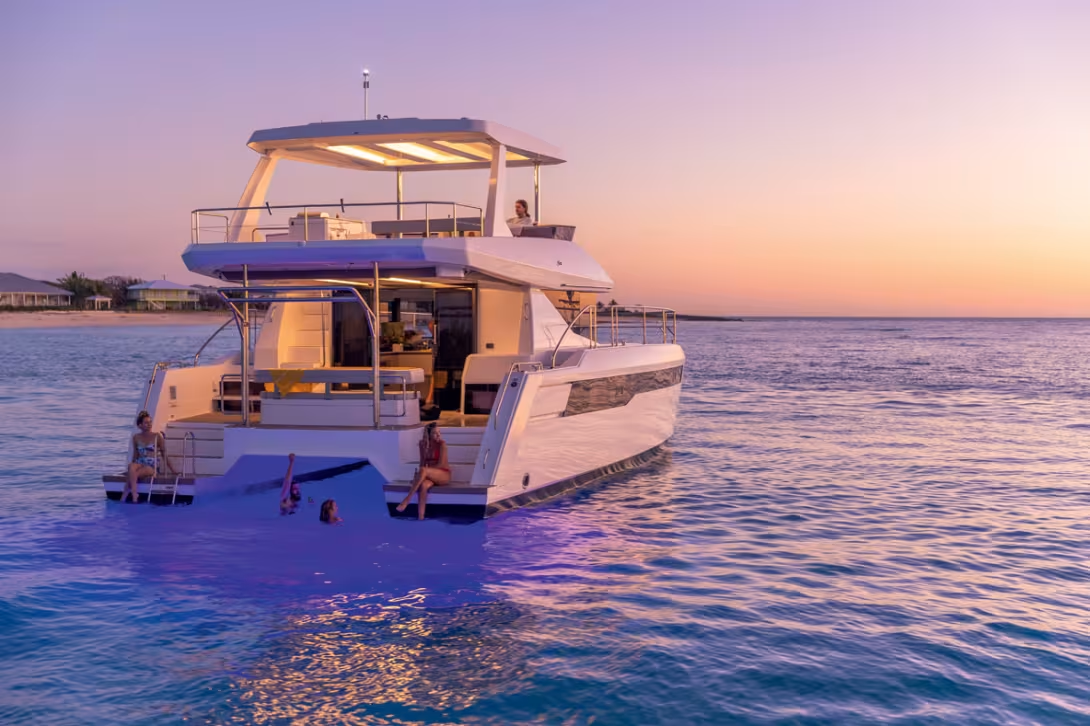
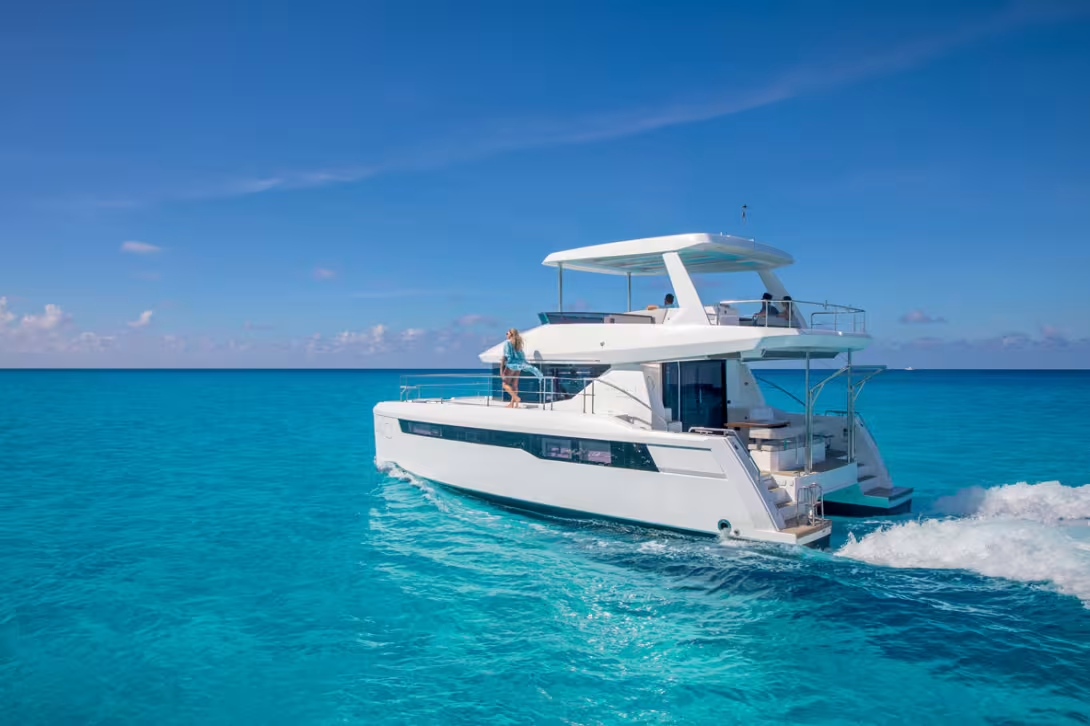
At first glance, the family resemblance is obvious. There is a stocky - but not so massive - silhouette, a large coachroof set back a bit and a prominent flybridge with a T-top. Added to this are the long hull portholes and the wide-open aft cockpit, elements that are unmistakably reminiscent of the 46 PC. Quite high, the nacelle is also voluminous because it houses a number of storage compartments.
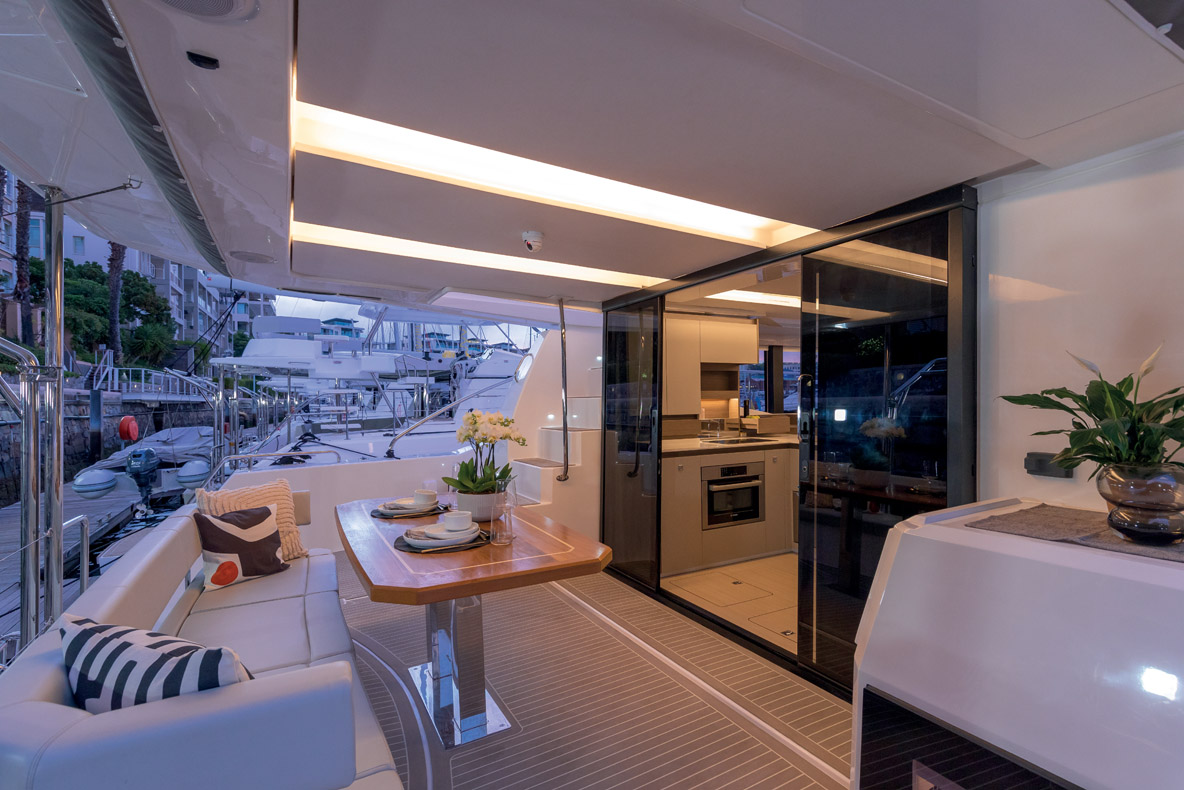
The best way to get on board is by the sugarscoops. These are quite wide with, on the port one, a solid swim ladder with handrail to facilitate your ascent. The space between the sugarscoops is dedicated to the dinghy, which can be hoisted using the davits. On the other hand, there is no central platform, either as standard or as an option. The cockpit itself is of a decent size with a bench seat for three people and a table that can easily accommodate six or eight people. The whole is well protected by the flybridge and access to the sugarscoop, side-decks, flybridge or saloon is very easy. There is also a passageway behind the bench seat for maneuvering or nautical activities.
A well-thought-out layout
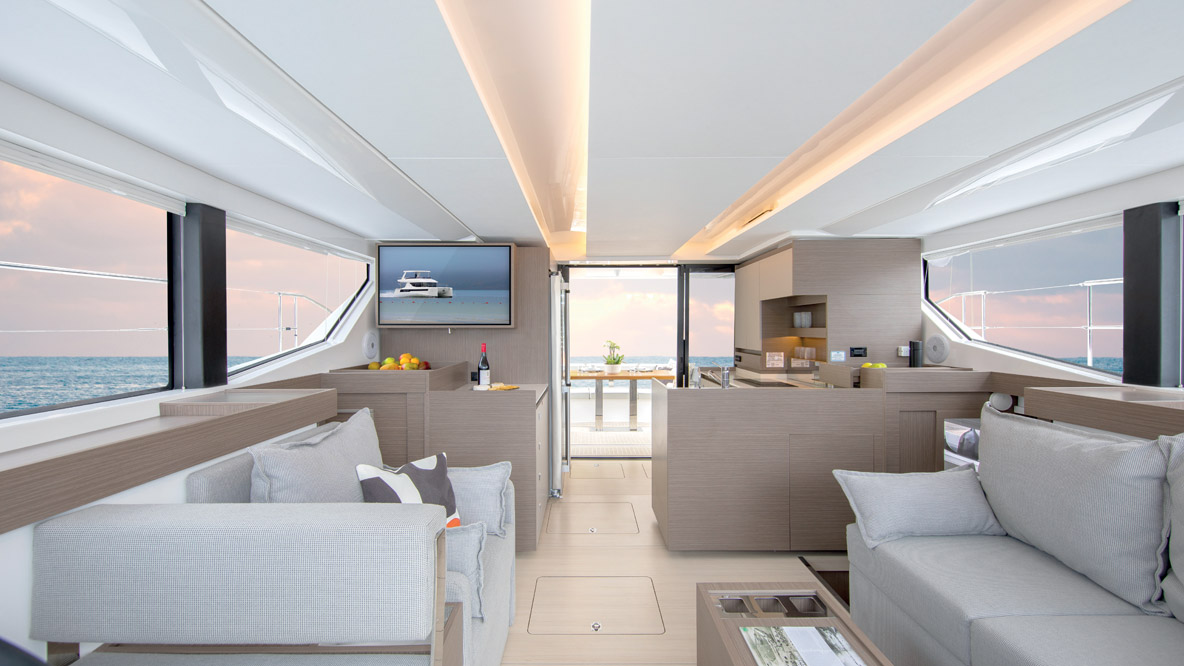
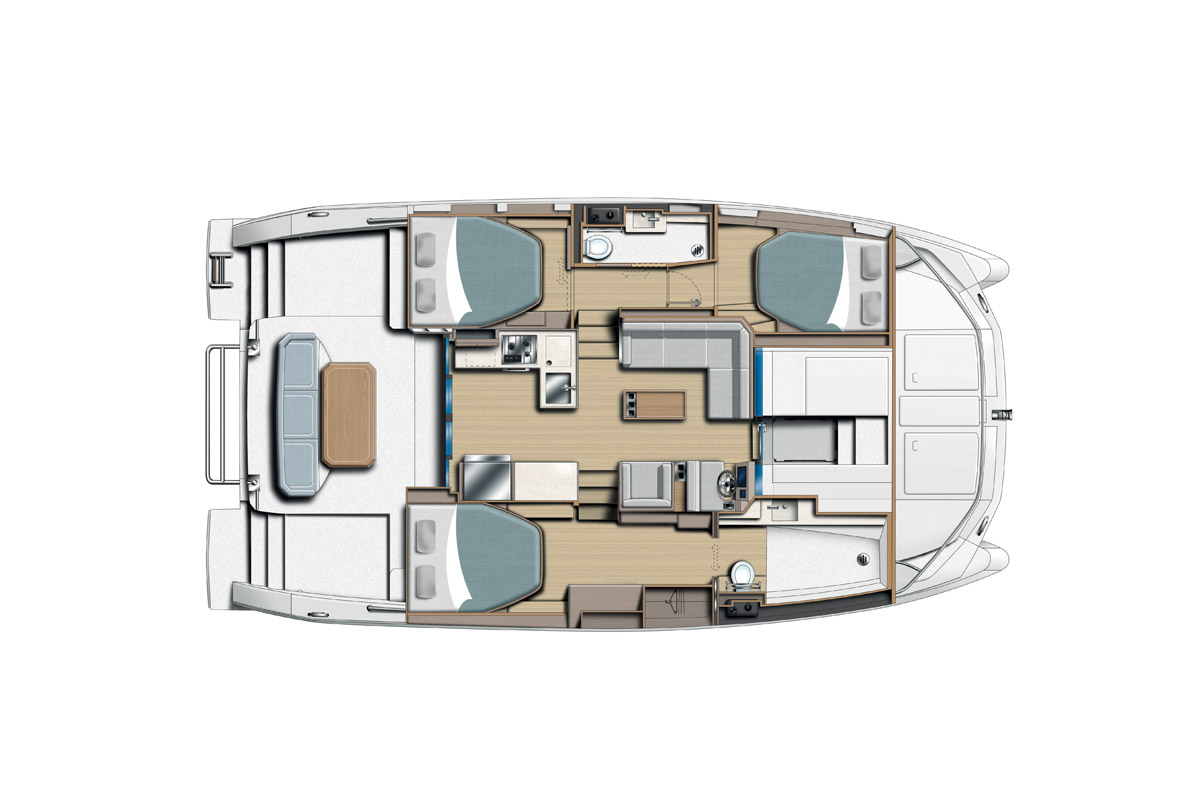
From the cockpit, the sliding doors open wide for easy access to the main deck. Organized in much the same way as the 46 PC, this level features an L-shaped galley on the port side, just by the entrance, perfect for service in the cockpit. In addition to its easy access, this galley includes plenty of storage and high-end appliances.
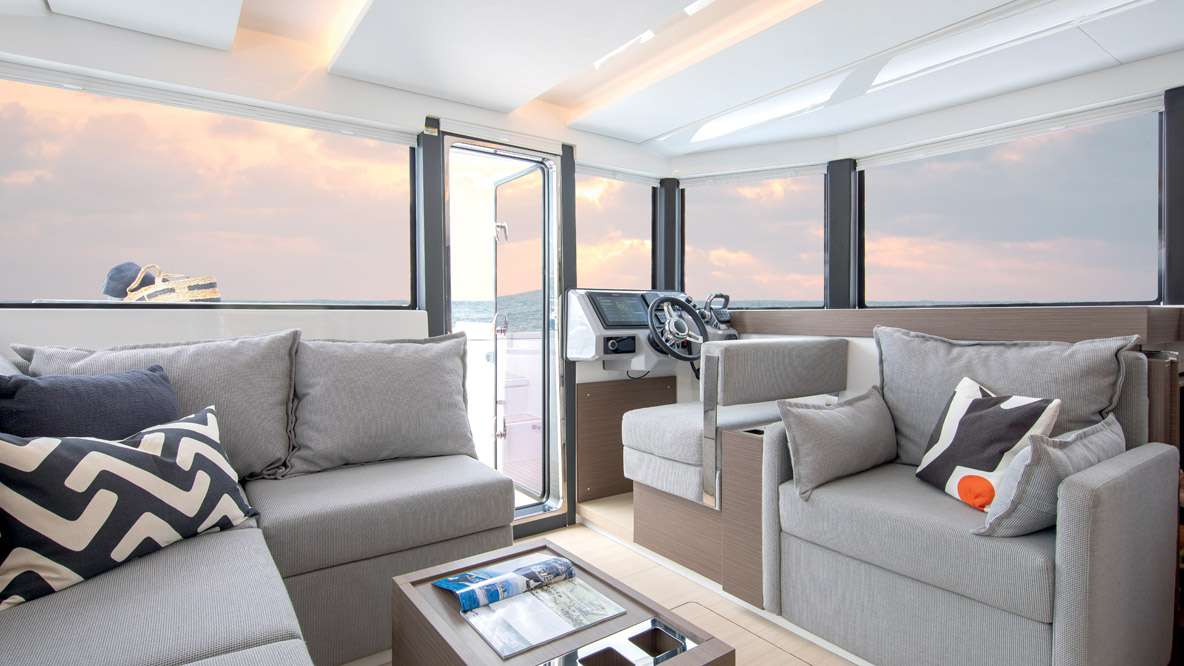
A little further forward, there is a small L-shaped saloon with a coffee table, all of which can turn to an additional sleeping space, just in case. This layout, mainly made for the boat show is in fact replaced by a classic high table. This arrangement has the merit of being able to be used as an office - too bad the builder didn’t think of installing power outlets on the port side. On the starboard side, the Leopard benefits from a real helm, well equipped, a good idea when under way in cool or rainy weather.
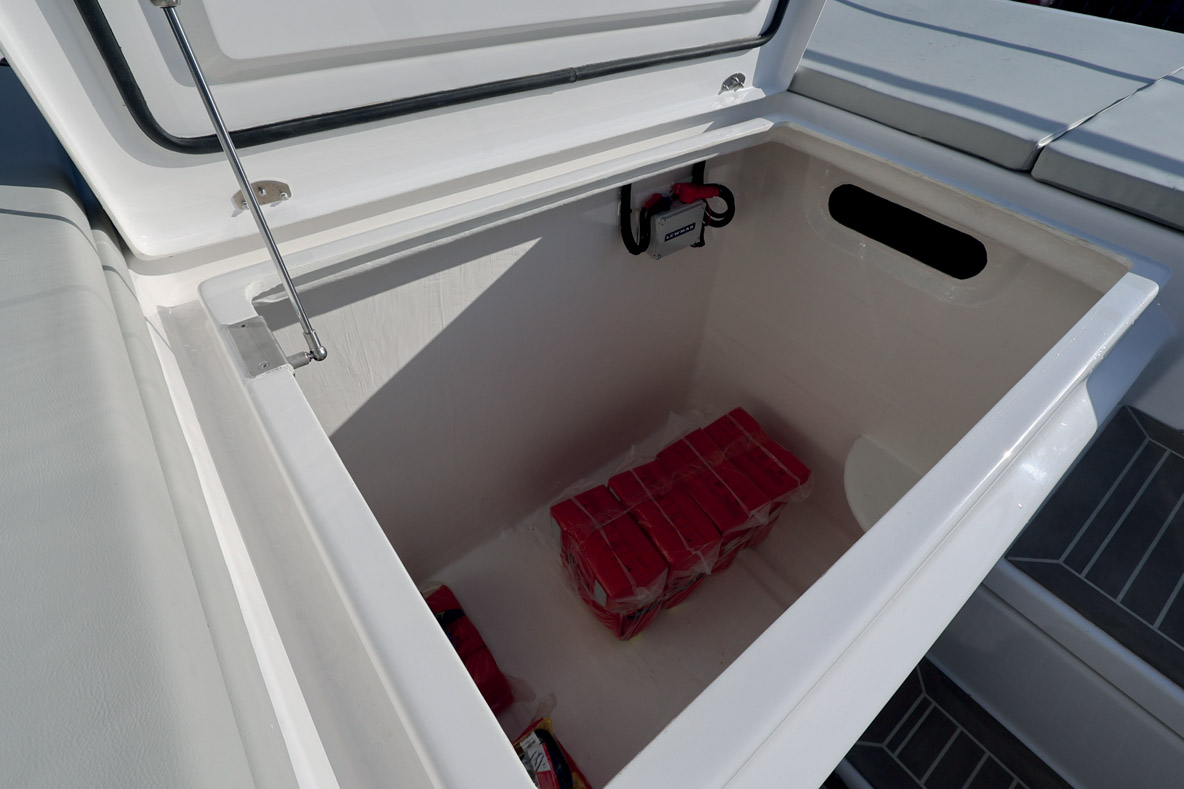
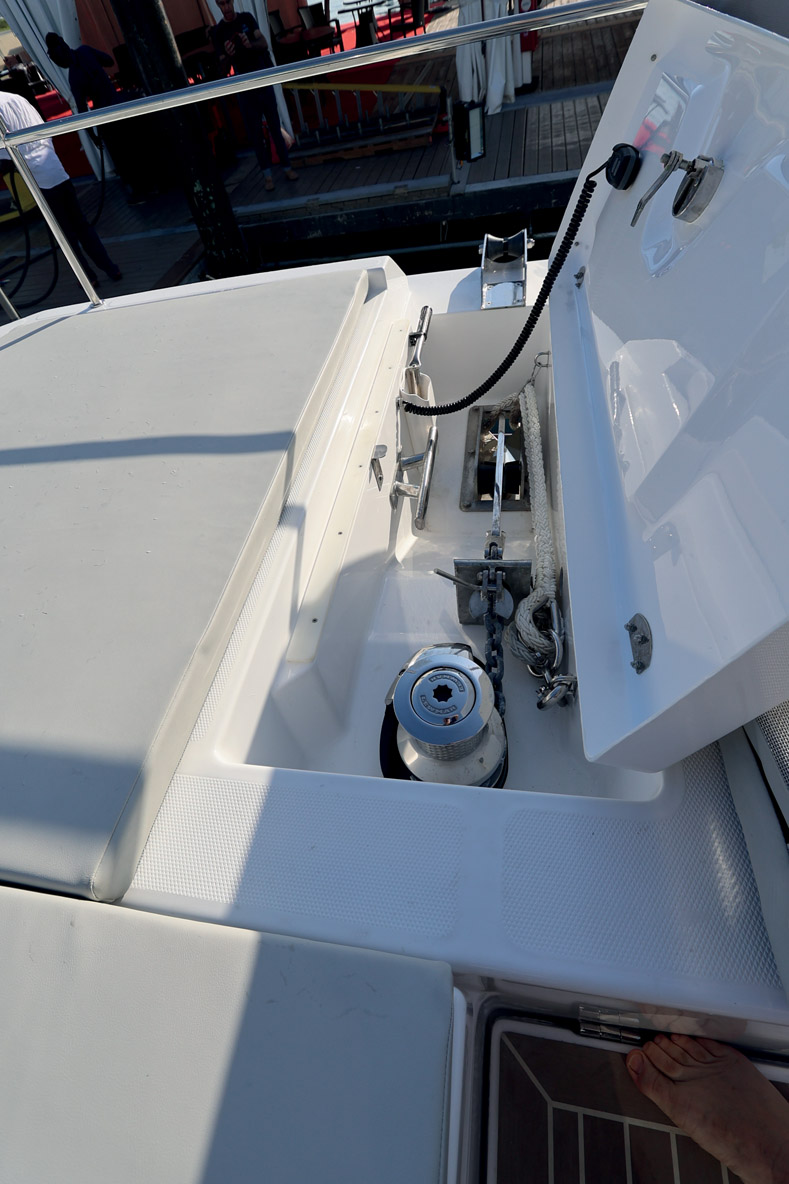
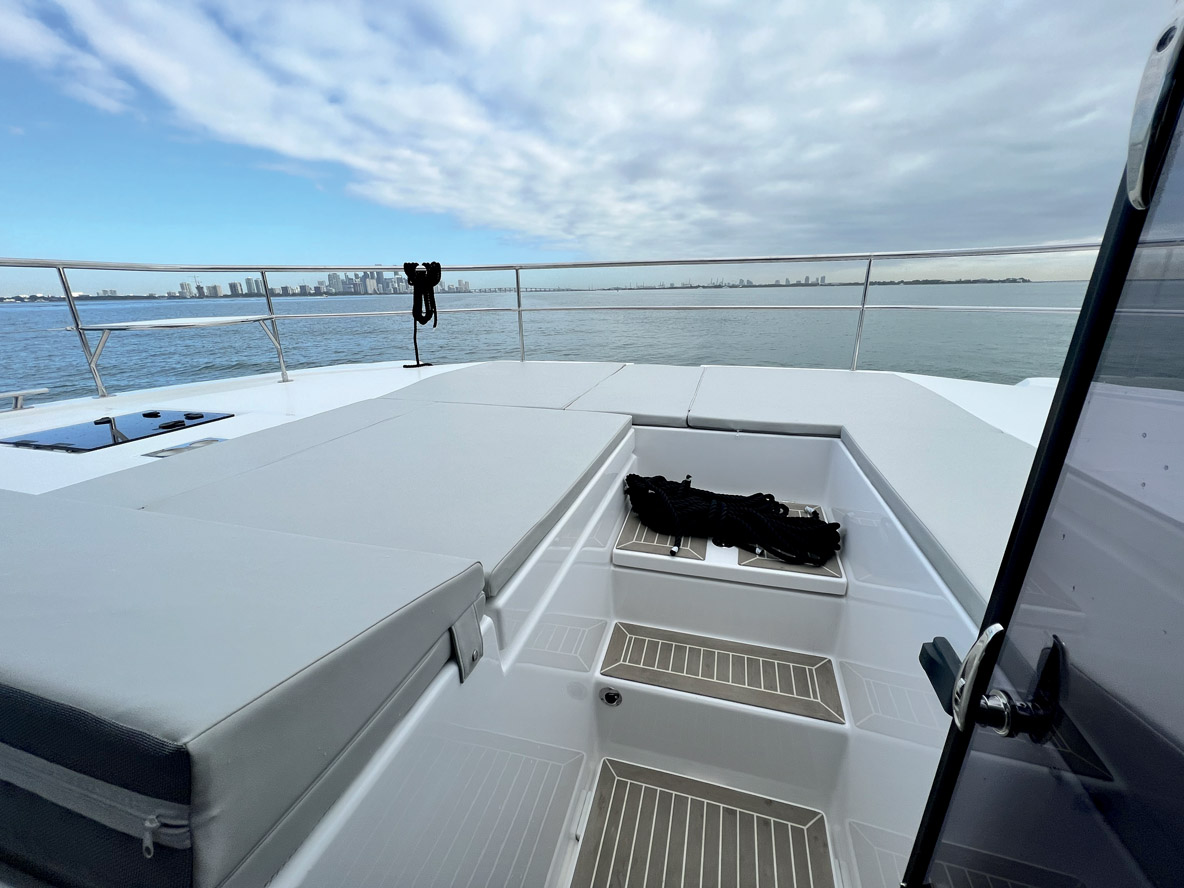
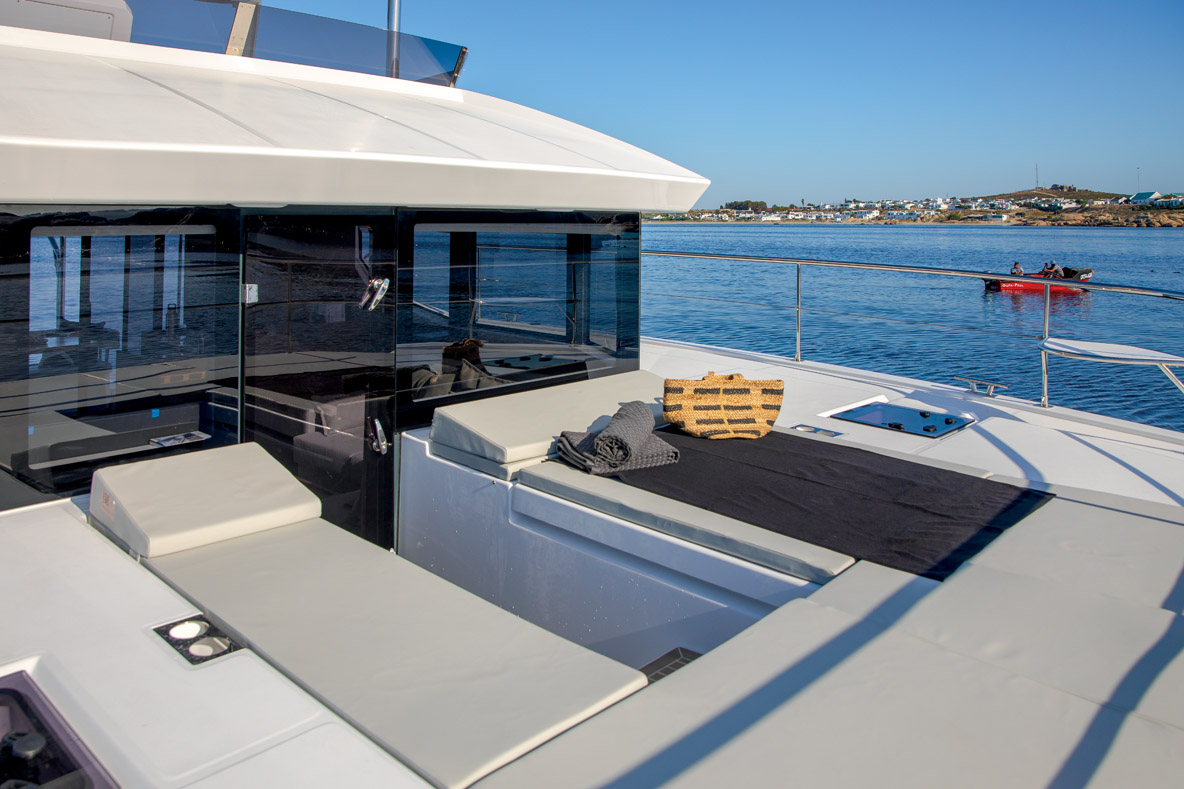
Finally, a glass door gives direct access to the foredeck. Using a Leopard design, this foredeck includes two seats on the front of the hulls and a few sun loungers with head cushions under which we can find several storage compartments, thus a huge locker, ideal for stowing the fenders. Access to the electric windlass is also very easy, a good point in case of problems. Note that if you have to access the foredeck from outside, the side-decks are wide and comfortable and you can easily find something to hold on to.
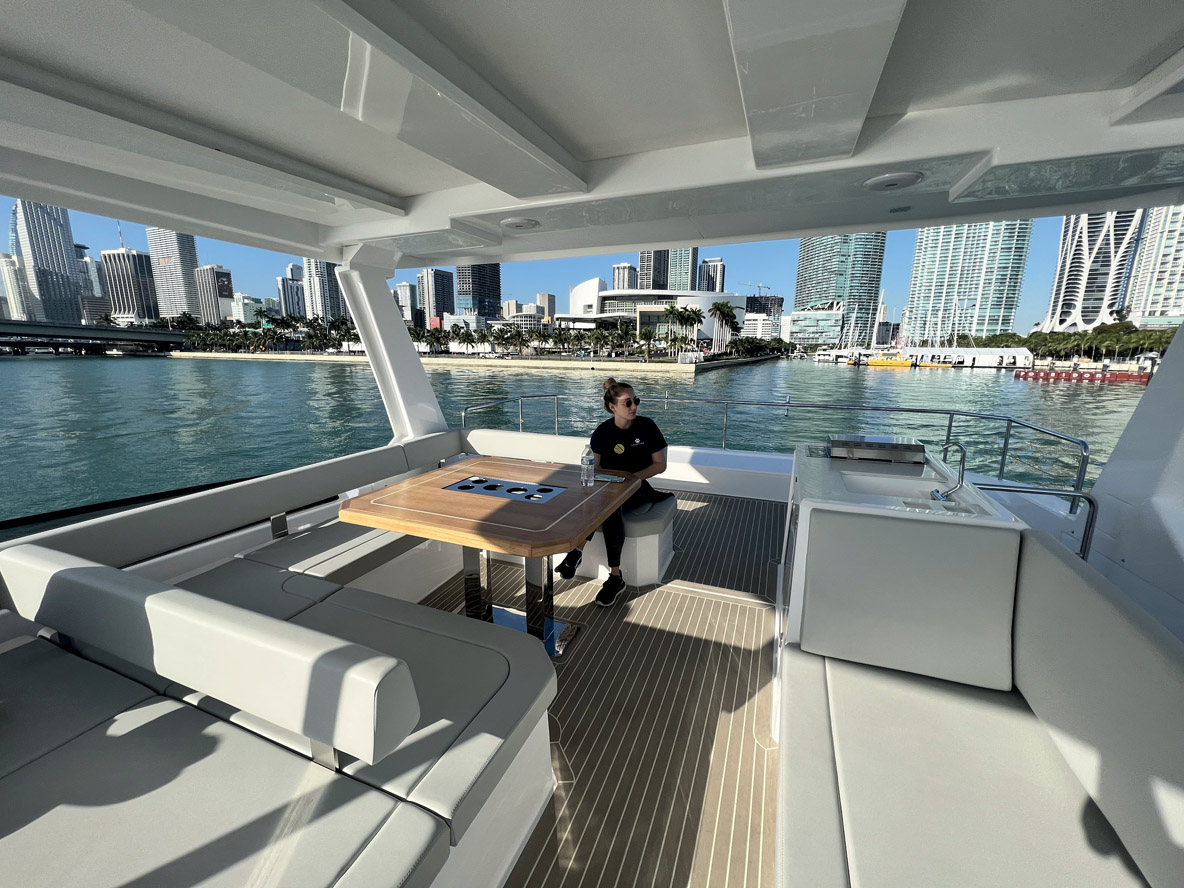
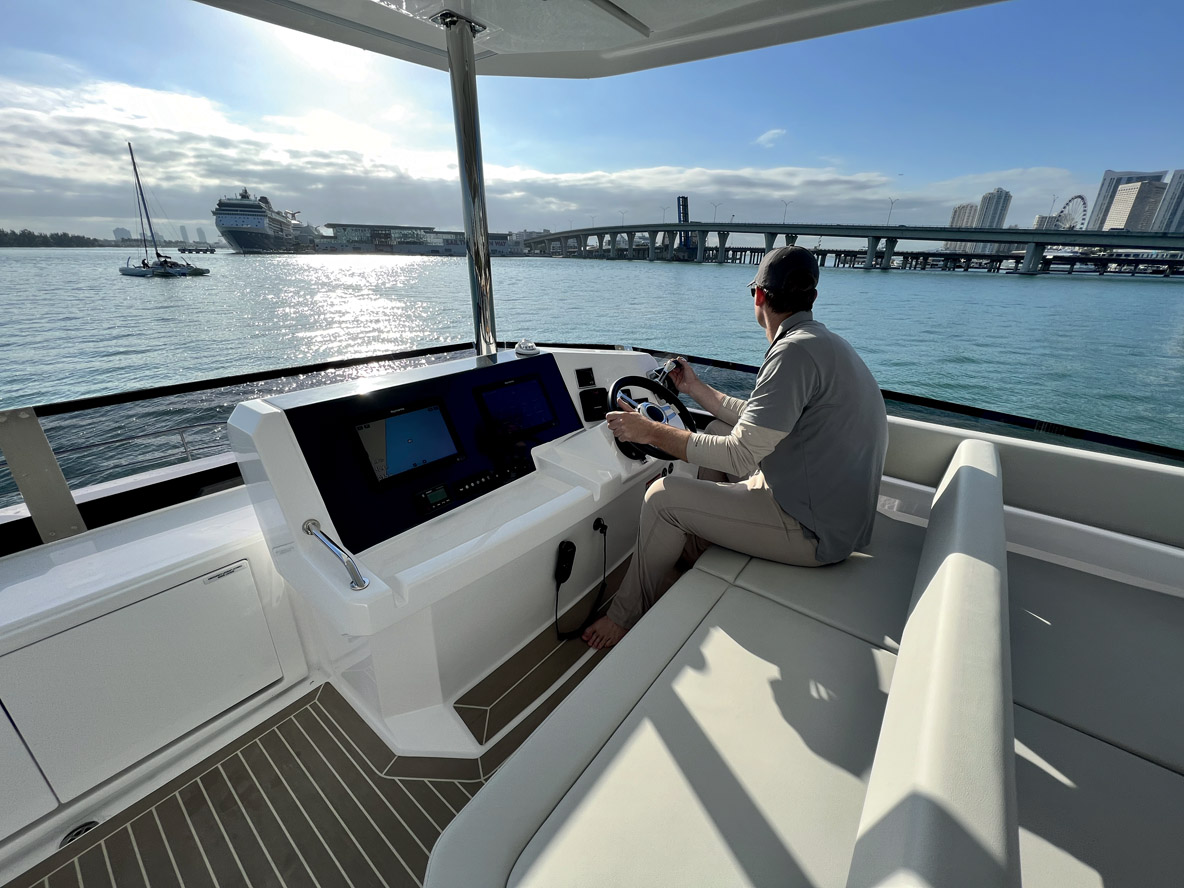
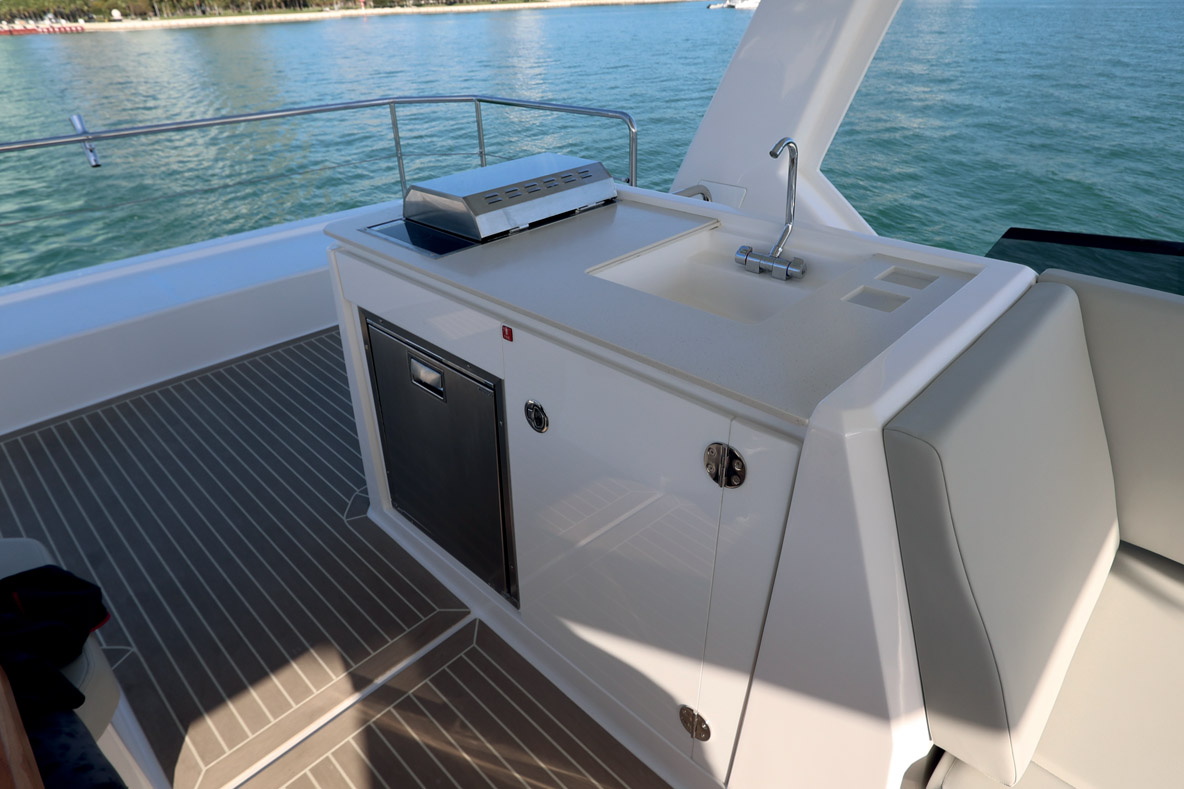
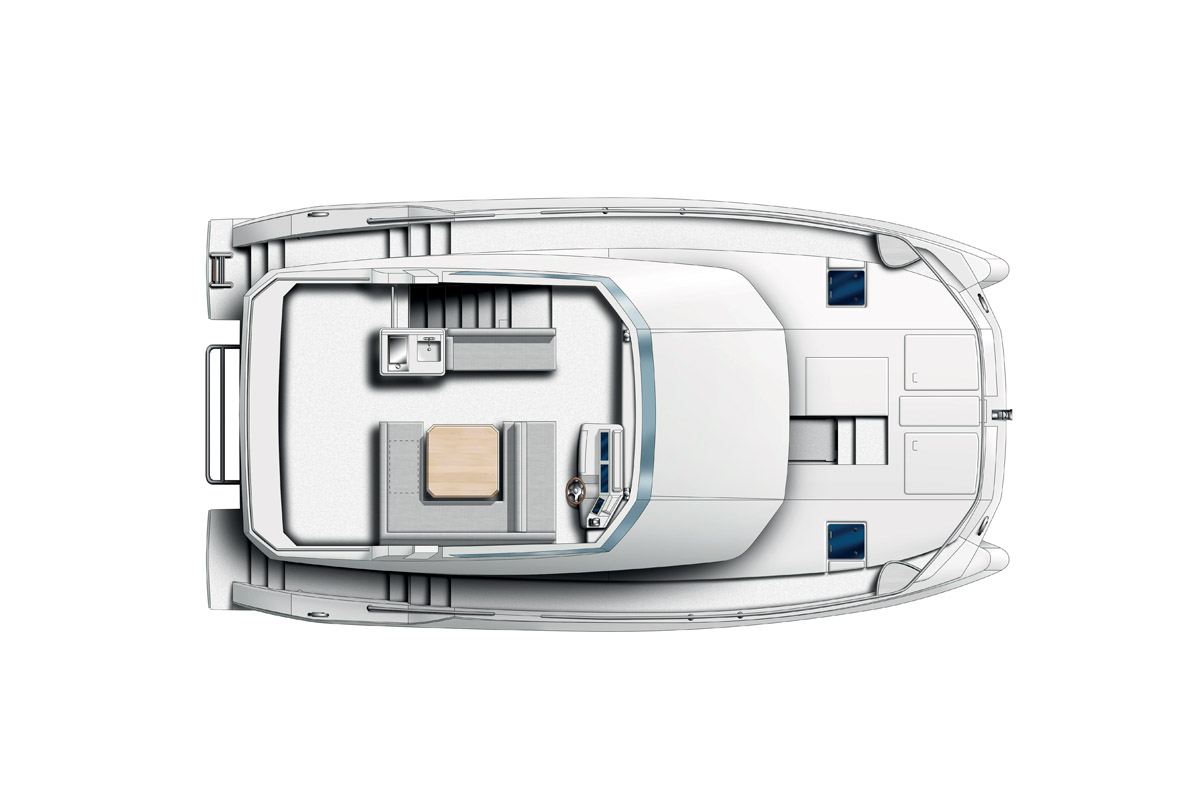
The flybridge is probably one of the largest in its class. It extends over the entire main deck and to the rear of the cockpit. Another good point, the access staircase from the cockpit is really comfortable which makes things easy. Taking advantage of its generous surface, this flybridge features a large U-shaped bench in the middle of which a table is placed. This saloon can also be transformed into a large sun lounging area. On the port side, a cabinet integrating a grill, a sink and a refrigerator allows you to cook while enjoying the view. A lounger, also on the port side, is the place of choice to talk with the captain or to tan. The last element of this flybridge is of course the helm. It is complete, relatively ergonomic and benefits from an entirely clear view. The seat is big enough for two people, ideal for longer trips. One small detail that changes everything is the windshield – it’s a wind deflector, allowing you to stay protected from the wind. There are also a few storage spaces here and there and the whole area is protected by a hardtop in which indirect LED lighting is integrated. If necessary, the flybridge can be completely closed with a transparent enclosure, which can be useful.
Three cabins… for now
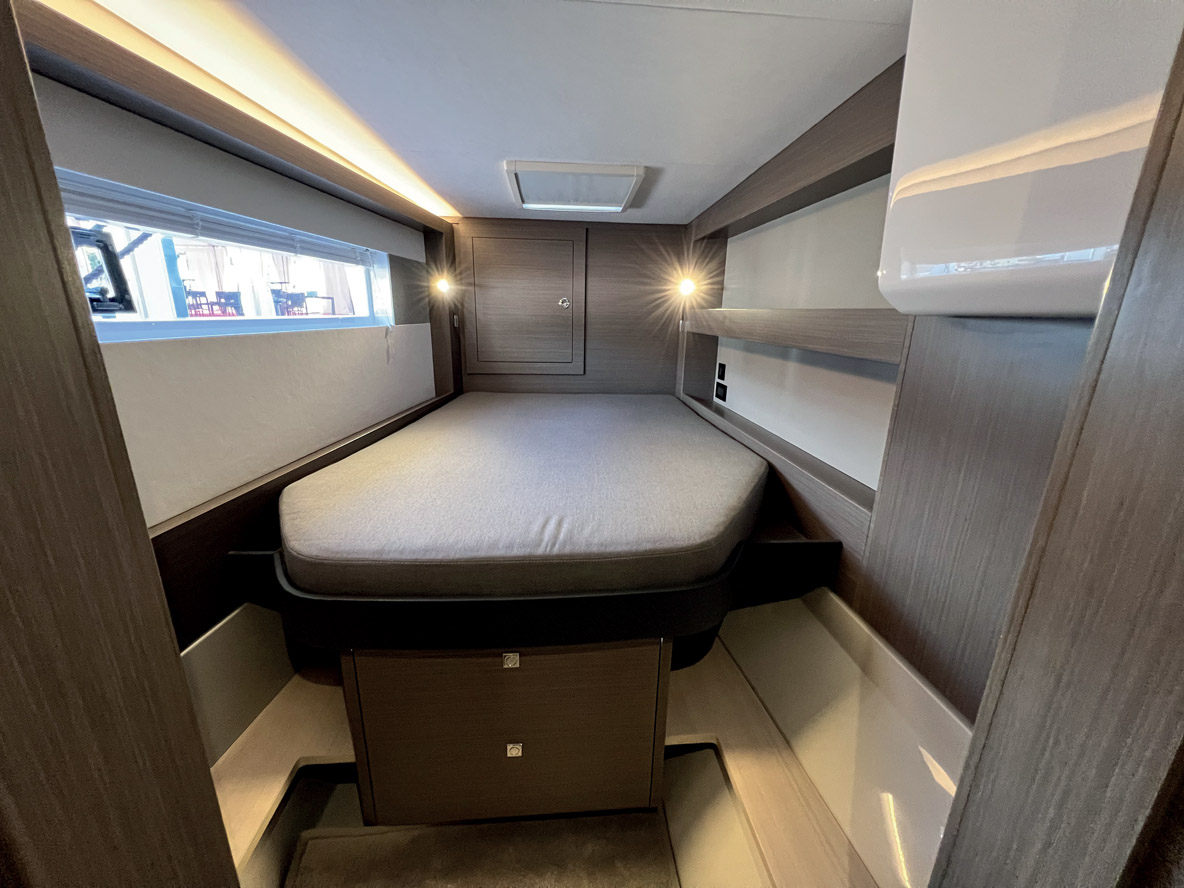
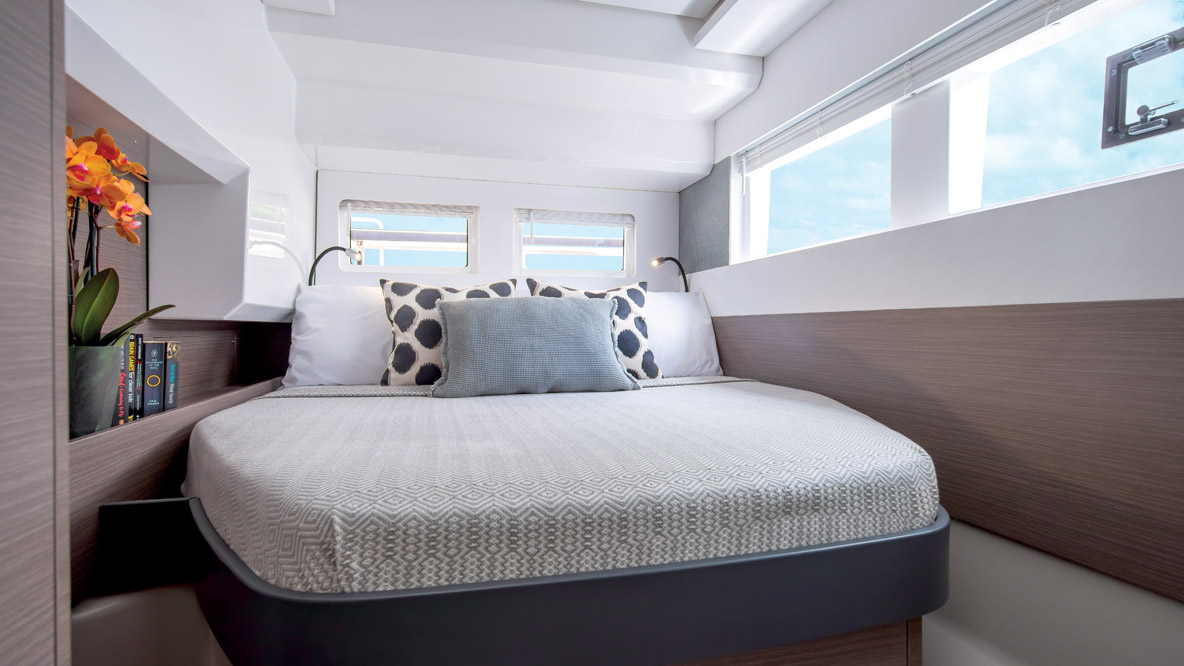
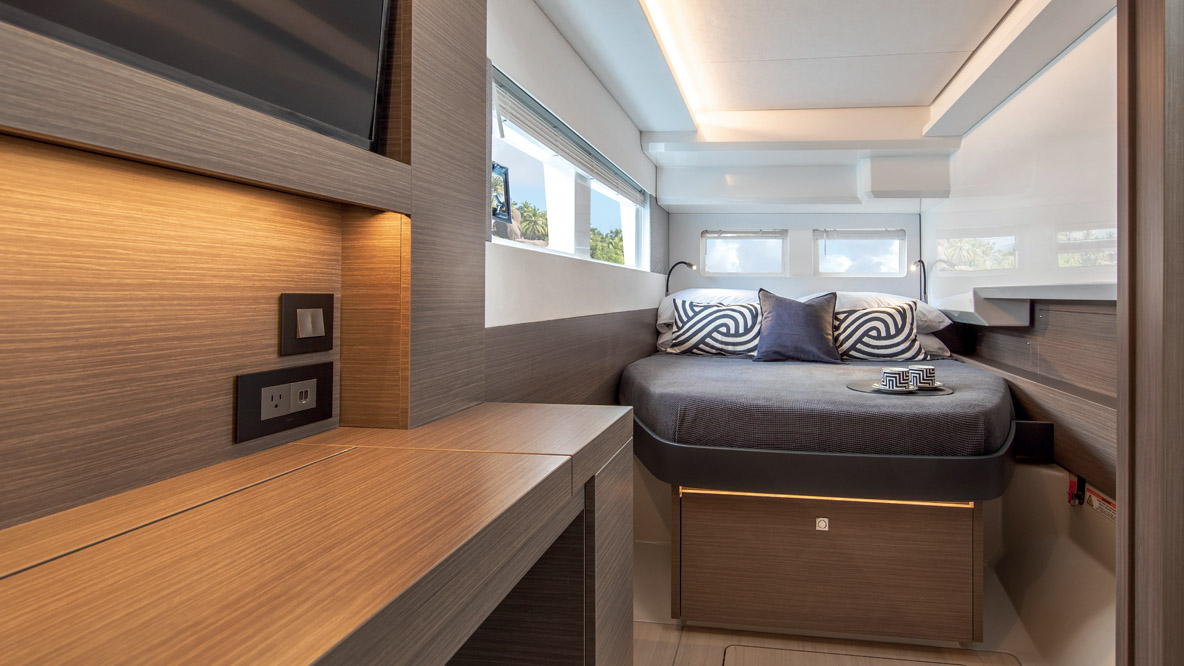
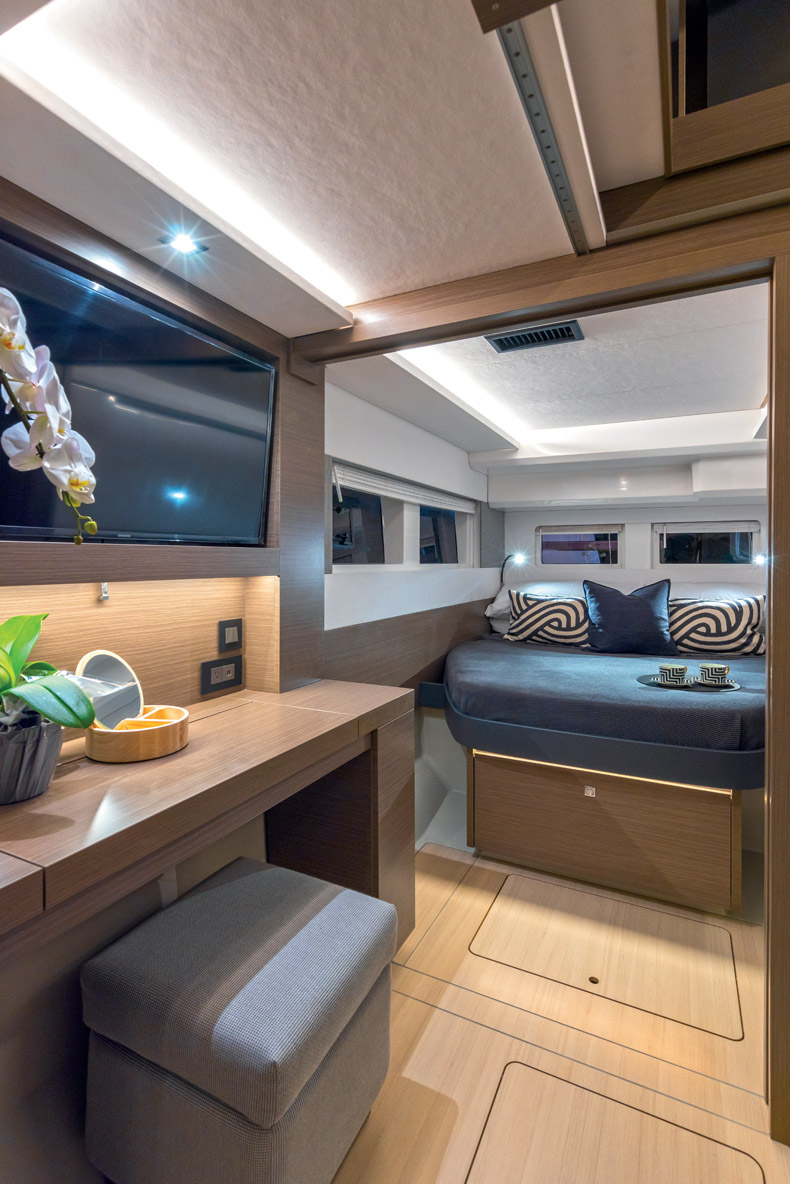
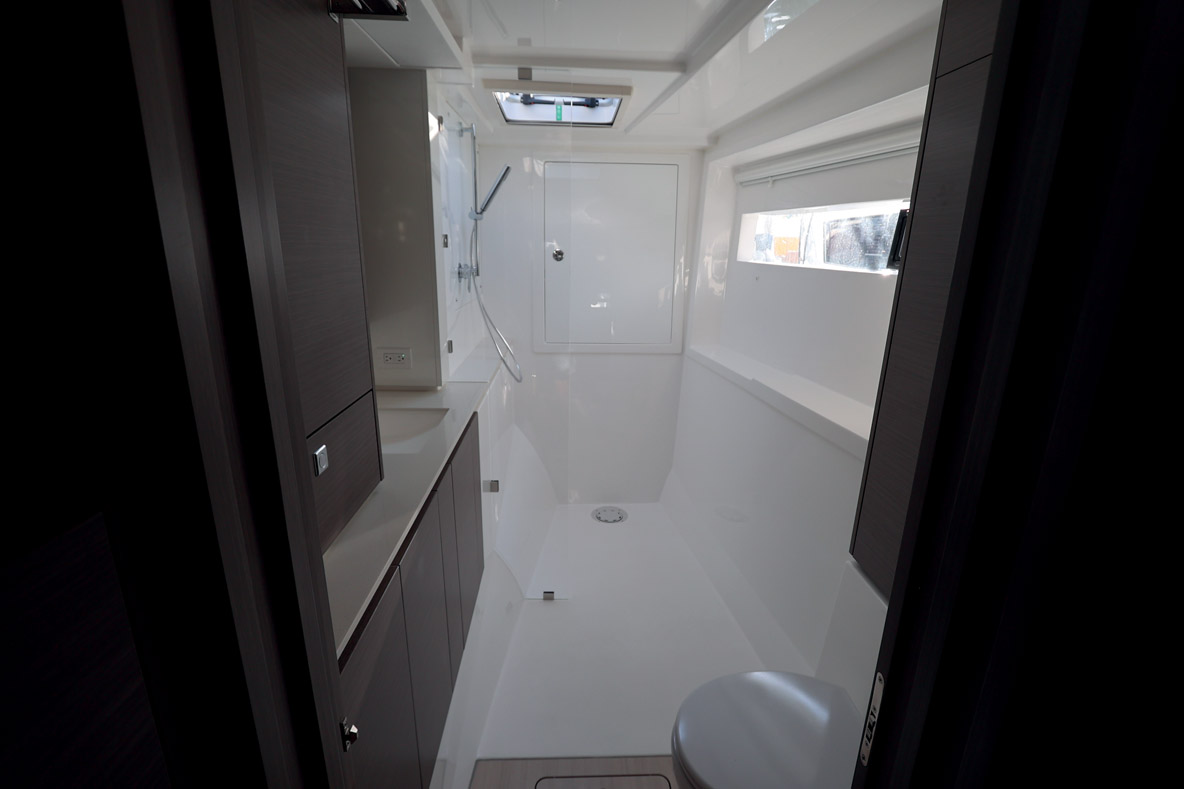
There remains the cabins and there, again, the shipyard used the same recipe as on the 46 by developing hulls wide enough to increase the available interior space. The result is clear: on a 40-footer, you can enjoy a queen-size bed with even a little space available on the sides. As for the distribution of space, the catamaran is currently available in a 3-cabin version. The owner’s suite occupies the starboard hull with a large double bed, a small desk, a large television and a bathroom with a toilet, sink and large shower. Everything is well lit thanks to the long hull windows and there is also storage spaces everywhere, starting with the drawers under the bed and the closets in the hallway. For greater privacy, simply slide the door across to isolate this cabin from the rest of the boat.
On the port side, the living space is divided into two cabins, each with a double bed and a shared bathroom. At this stage, the shipyard hasn’t formally specified whether or not the Powercat will be available in a four-cabin version, which would make sense for the charter market.
Overall, the finish of this catamaran is very good. The woodwork has a modern look, and the execution is in line with what we expect from such a powercat. The same is true for the fabrics, which are well made and for all the decorative elements. On the practical side, there are a sufficient number of electrical outlets (except for the sofa area) and small, well-placed ambient lights. As for the equipment, it is in the good average range and can be discussed at the time of ordering, with many options available.
A catamaran designed since the beginning as a powerboat
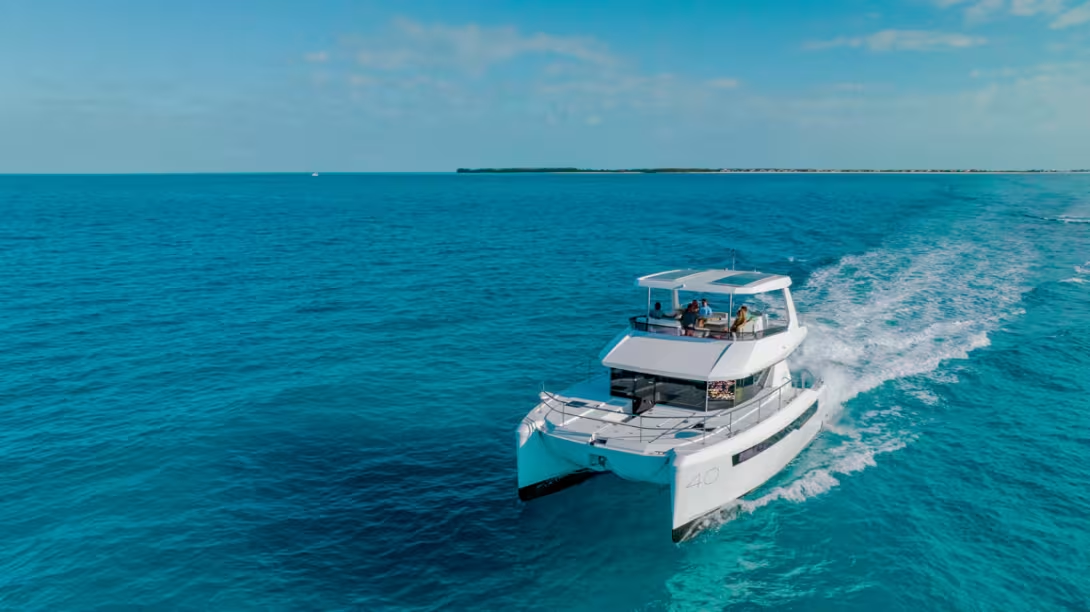
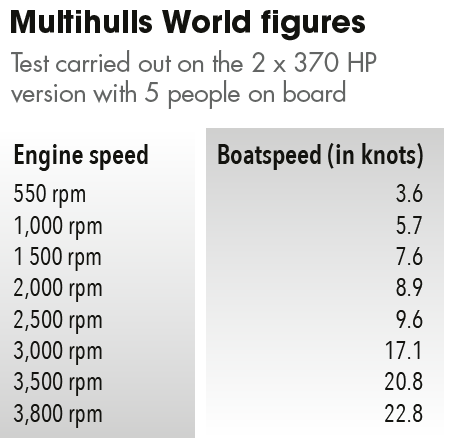
Like the other powercats of the brand, the 40 PC was designed from the start as a motor boat, i.e. her hulls are specific and the weight distribution corresponds to that of a motor boat. In addition, with a displacement of nearly 14 tons, the Leopard 40 PC necessarily requires some power. In the standard version, she is therefore equipped with twin 250 HP Yanmars, a power that can be increased to 2 x 320 or 2 x 370 HP. Hull number 1, the one we tested, was equipped with the most generous mechanics, namely twin 370’s. This may seem a bit modest for a 40-footer, especially considering the open 40-footers with 2,500 HP only a few feet away from our boat - and yes, in Miami, it’s a power explosion on almost every pontoon! But thanks to the magic of the multihull design, the 40 PC has really good hull efficiency and therefore doesn’t need to carry so much power. As proof, the powercat planes in only 8.3 seconds and reaches a cruising speed of about 18 knots and she is even able to reach a top speed of almost 23 knots, a more than correct speed. These are quite satisfactory results, especially since with such speed, you can already go pretty far. At this cruising speed, fuel consumption works out at 90 liters/hour (23.77 gal/h). Since the catamaran has a 1,400-liter (370 US gal) fuel tank, this allows a range of nearly 280 miles. If we want to play the distance card, at 8 knots, the 40 PC can cover nearly 600 miles, which is pretty good.
Apart from the performance aspect, the Leopard 40 PC evolves above all in great comfort. Smooth in waves, stable and well balanced, she is easy to control. Once in the marina, the optional bow thrusters make maneuvering much easier, even for a helmsman who is not an expert. In short, this power catamaran is really easy to handle.
Conclusion
Ultimately, we have to admit that this powercat ticks almost all the boxes. In addition to the fact that she is very easy to handle thanks to her compact size, she offers very good living space with the possibility of sleeping 8 people. Her on-board comfort makes it possible to consider doing some beautiful cruising and her range is more than correct. All of that for a budget that is obviously lower than the larger models that don’t necessarily offer much more.
Performance
Size of the flybridge
Lots of features are options only
Not available in a four-cabin version
TECHNICAL SPECIFICATIONS
Overall length: 40’ (12.19 m)
Overall beam: 21’8” (6.61 m)
Draft: 3’7” (1.1 m)
Air draft: 18’5” (5.61 m)
Light displacement: 30,488 Lbs (13.83 t)
Berths: 8
Fuel: 370 US gal (1,400 l)
Water: 170 US gal (640 l)
Standard engines: 2 x 250 HP Yanmar
CE Category: A
Price: $799,000 in base version ex-tax
Main options in US dollars (ex-tax)
2 x 320 HP version: $9,341
2 x 370 HP version: $31,329
Bow thruster: $15,873
Yanmar joystick: $24,256
Audio system: $5,461
Raymarine package: $14,428
220 V pack: $12,052
Icemaker: $3,772
Washer/dryer: $4,432
Watermaker: $24,530
Solar panels (4 x 400 W): $14,012