
This model is the best-selling powercat from South African builder Robertson & Caine - 139 units built as opposed to 137 for the 51 PC. From 2015 through 2020, a good half of these were delivered to The Moorings in charter management, the other half going into private hands. In these times of high demand on the new-boat market, the availability of Leopard 43 PCs is in turn reduced: the few models that come up for sale are snapped up very quickly!

Infos pratiques
- Le chantier : Leopard 43 PC
- La fiche technique
-
 Découvrez notre vidéo exclusive
- Financez votre Leopard 43 PC
- Assuez votre Leopard 43 PC
- Articles autour du Leopard 43 PC
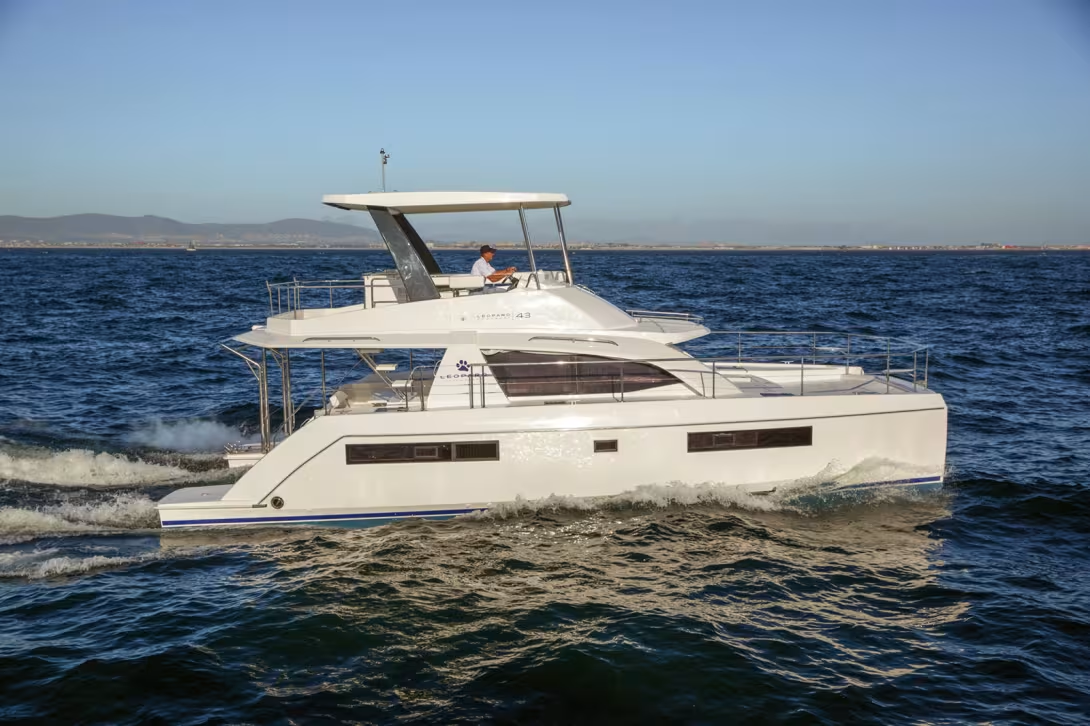
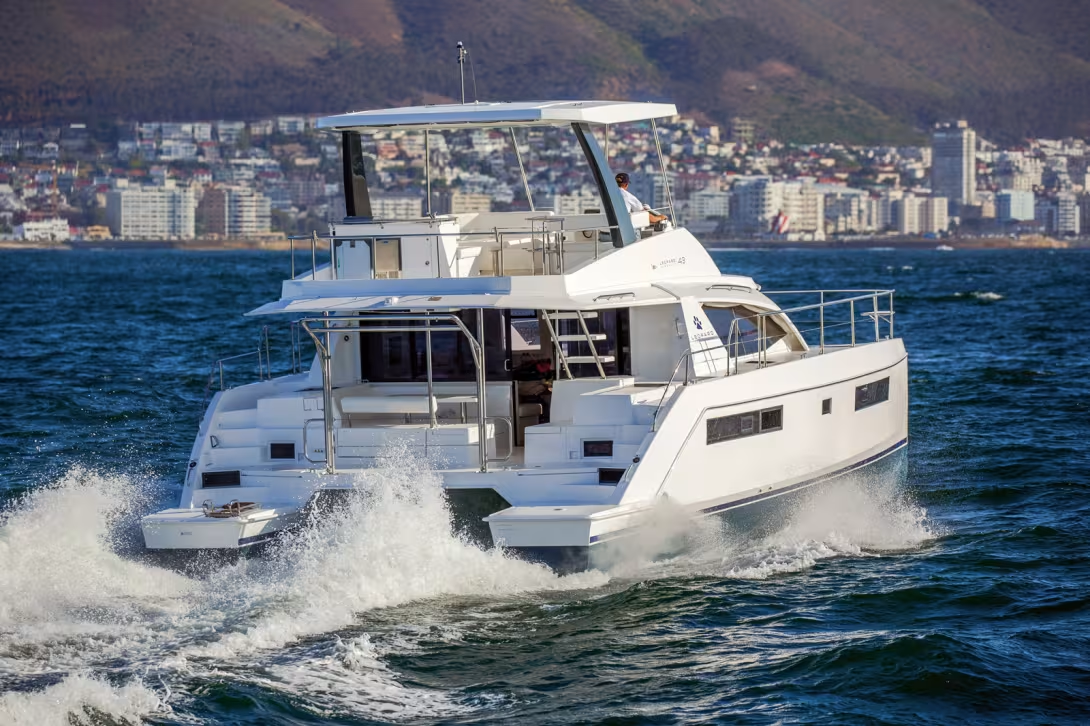
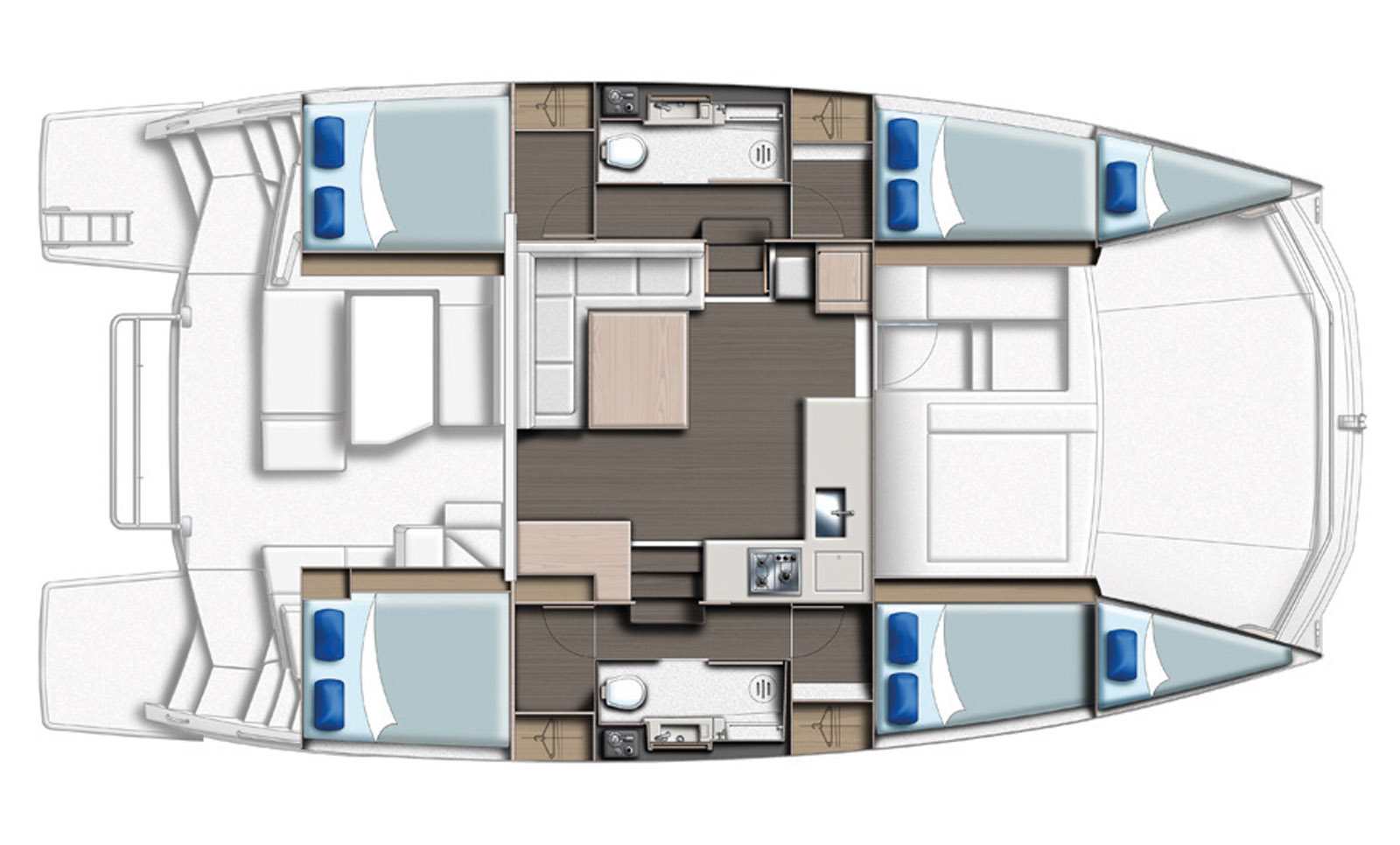
The Leopard 43 PC is the generic term for two distinct models. First of all, there was the version intended for private individuals, most often in a three-cabin version, and then the powercats destined for the charter company The Moorings. Most of these latter models are named Moorings 434 PC with four cabins. The 433 PC version has only three cabins and is seen mostly in the Caribbean. The Leopard 43 PC is no longer in build (it is shortly to be replaced by the Leopard 46 PC) and the first few are now coming off charter after 5 years of use. This powercat is a distant cousin of the Leopard 40 sailboat: the interiors are identical - minus the mast support strut - and were available in 3 or 4-cabin versions. On deck, the lines are similar, but the powerboat features a rigid foredeck and notably, a flybridge with a decent surface area and the helm station to starboard. First of all, let’s specify that this is the only helm station... The 43 PC is thus a boat rather suited to use in areas with a tropical climate or in the Mediterranean during the summer season, especially if night passages is envisaged. But despite the family resemblance with the Leopard 40 above the surface of the water, the PC featured completely redesigned hulls below, with deeper chines, U-shaped sections that widen very gradually, shorter keels (beaching is possible thanks to the skegs that protect propellers and rudders) and hollowed sterns that extend to create a tunnel effect above the propellers. The idea according to naval architects Simonis- Voogd is to keep the trim almost constant whatever the engine speed, in order to limit fuel consumption.
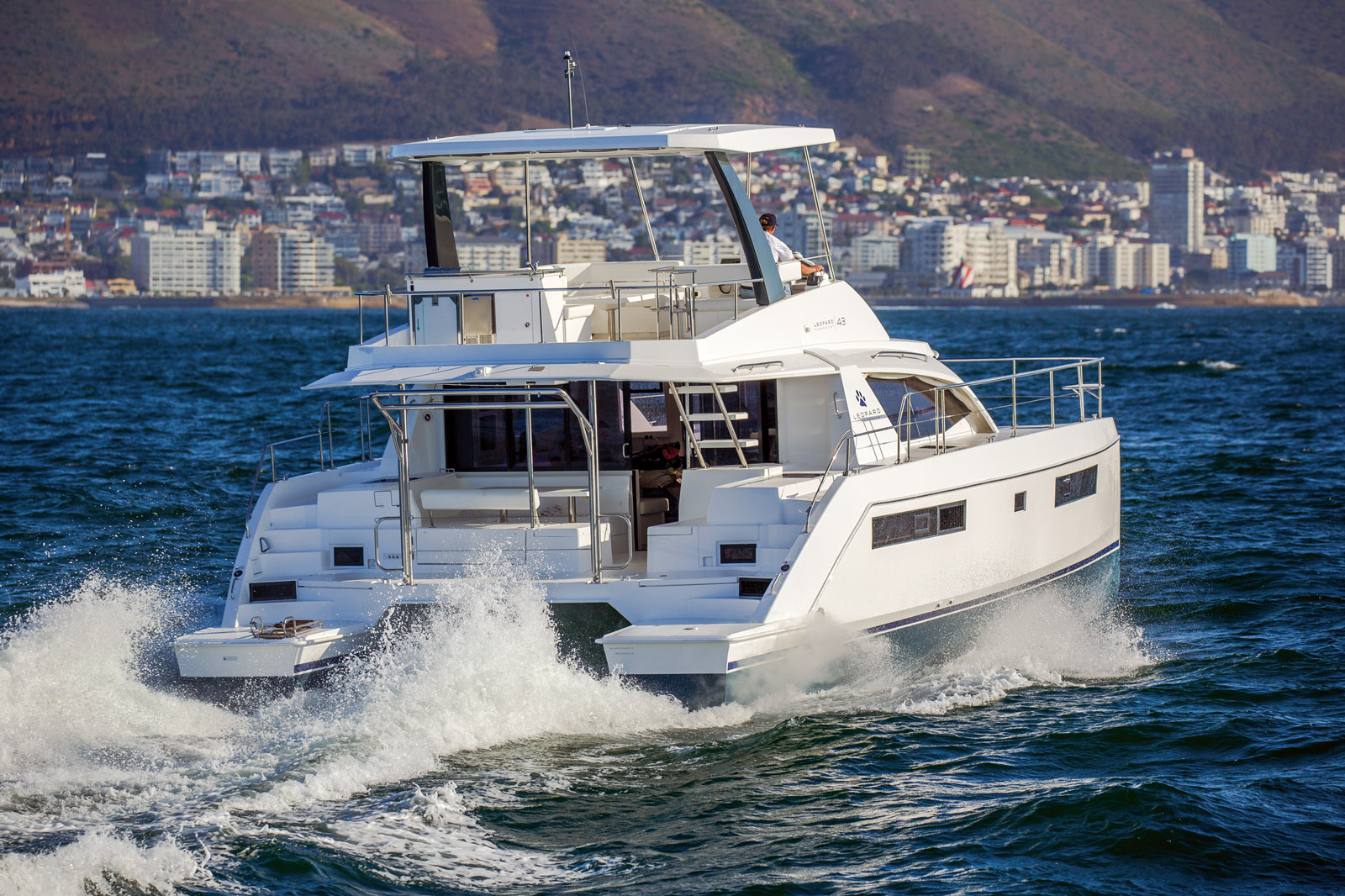
The hulls have been designed to optimize propeller efficiency and limit pitching.
2 x 260 then 2 x 320 HP
Early models - like the one we tested back in 2016 - were equipped with twin 260 HP Yanmar diesels. From 2017, the manufacturer opted for a higher power of 2 x 320 HP. The performance of the two versions remains close: top speed was upped from 19/20 knots to 23/24 and consumption is almost identical when the powercat is loaded, ie. in normal use. The economic cruising speed is 2,000 rpm, and this ensures a comfortable speed of 9 knots with a fuel consumption of about 6.35 US gallons (24 liters) per hour, that is to say, around three-quarters of a gallon (a little less than three liters) per mile. From the helm station, you enjoy a beautiful view of the water. It’s obviously pretty exposed to the wind - not much to the sea spray. A set of “glazed” fabric enclosures allow you to close in all or part of the flybridge, but this is neither elegant, nor transparent for long. The steering is smooth and precise: you quickly get the hang of the 43 PC. The throttle levers are particularly pleasant - they allow you to manage the power in an intuitive way, without any effort. The flexibility of these controls allows for “forward/ backward” movements that let you spin the powercat within its own length. On the other hand, it’s not so easy to manage this multihull single-handed, especially when docking. Under way, the 43 PC behaves very well. It goes well through the sea, and surfs willingly downwind. At full speed, the hulls seem to glide across the water with incredible lightness. Up on the flybridge, any roll is obviously amplified and sometimes a little abrupt but pitching remains limited. The shoal draft – 37” / 94 cm - makes it possible to maneuver in the shallowest waters.
 |
 |
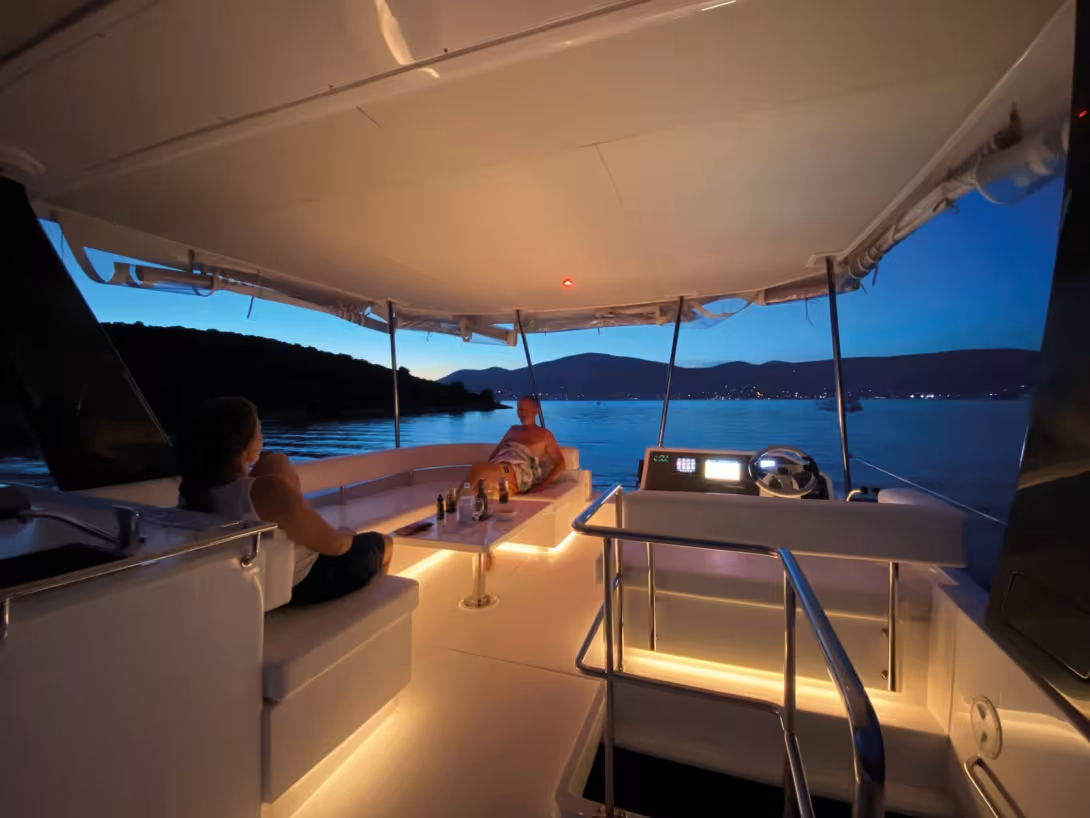
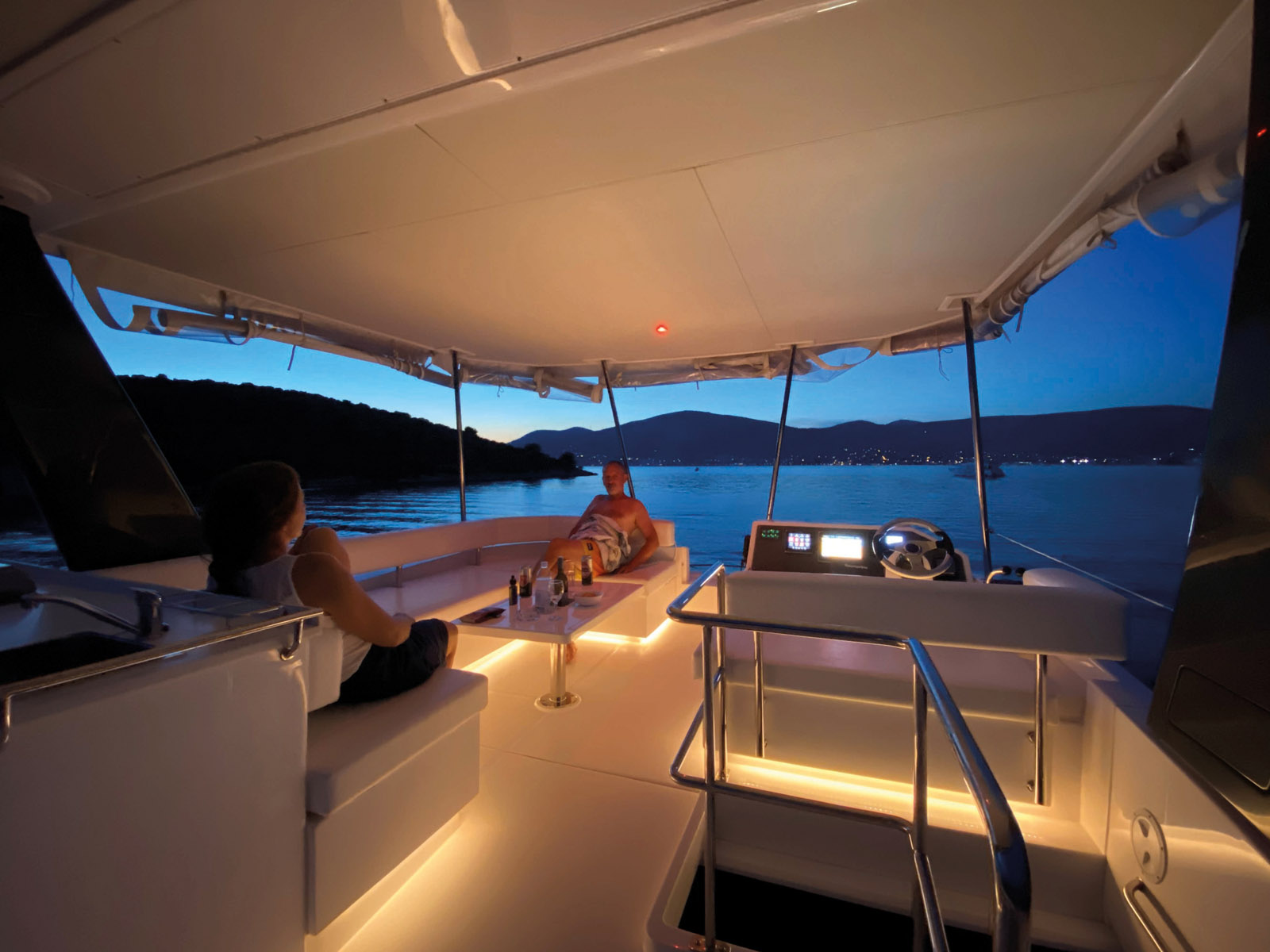
The flybridge will be appreciated by the whole crew both under way and at anchor.
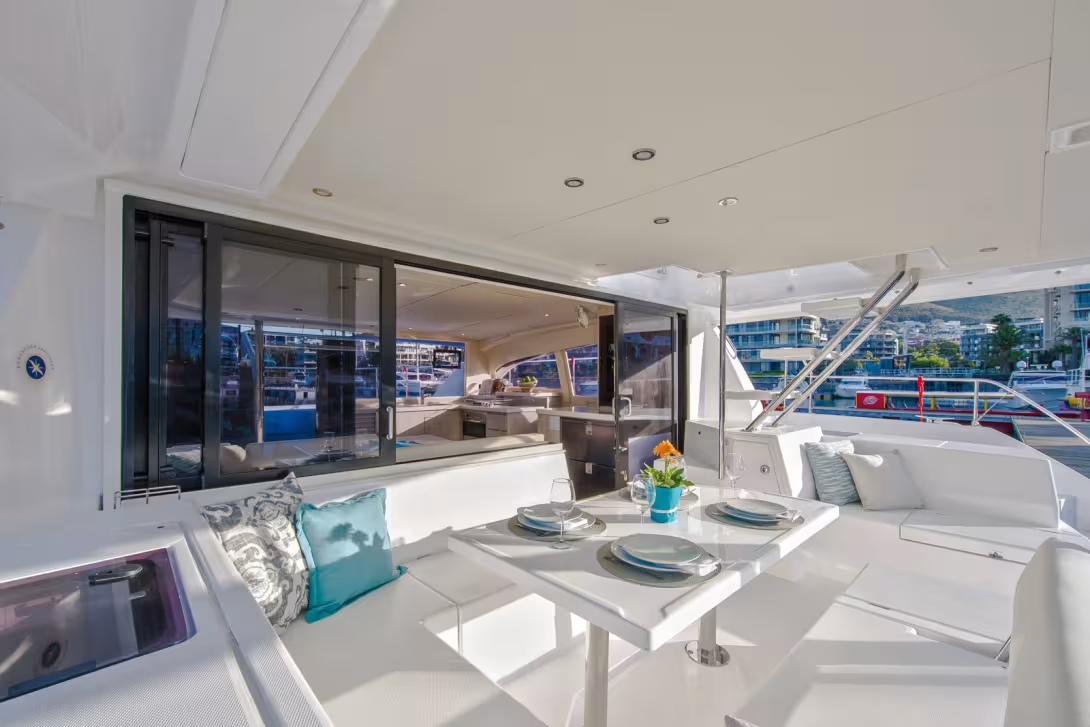
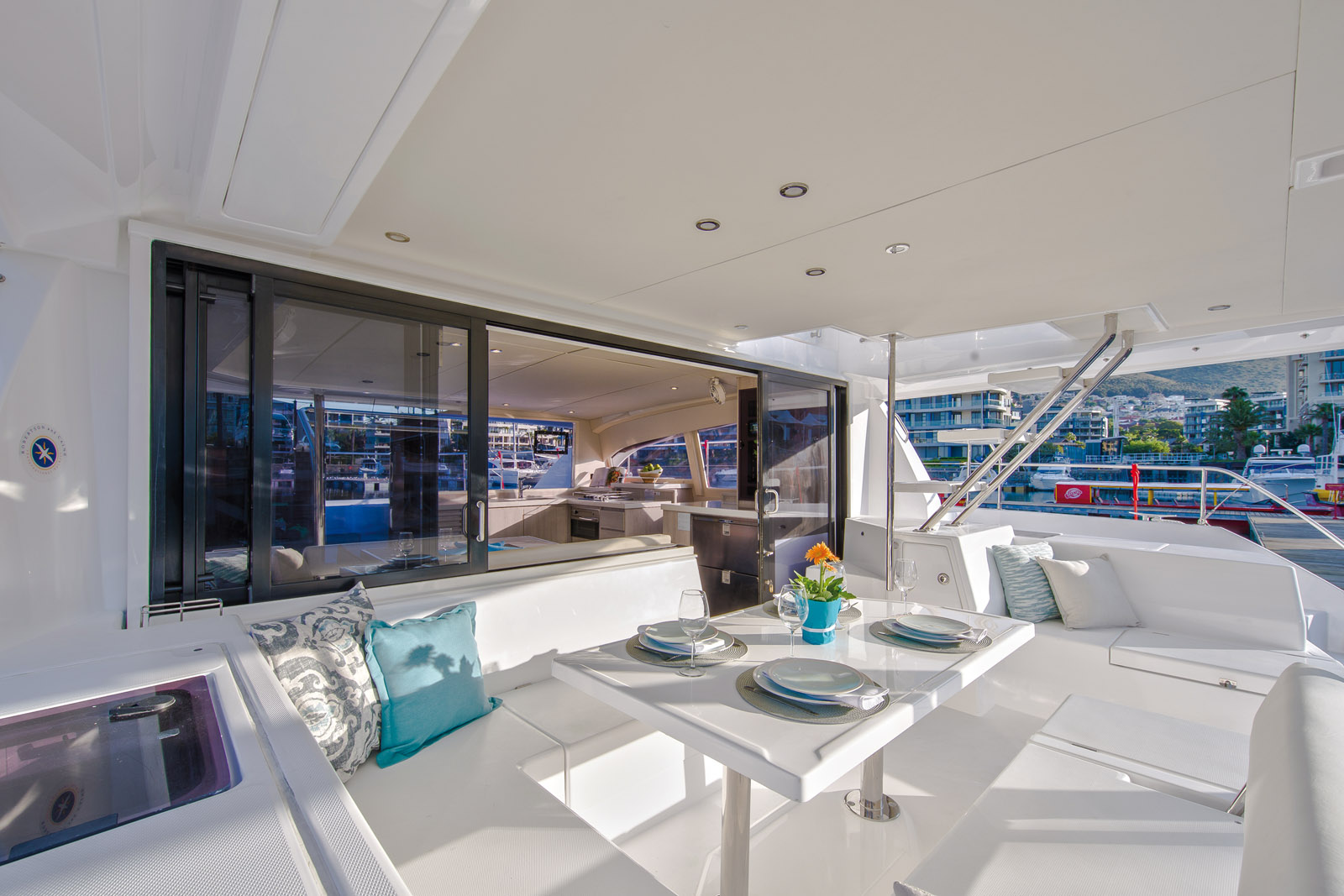
The imposing bimini perfectly protects the cockpit.
A great flybridge and a large nacelle
The enormous flybridge is definitely the highlight of this powercat. Of course, the cockpit with its sugarscoops, the stainlesssteel handrails and the large rigid foredeck are excellent as well, but the vast panoramic terrace easily wins out on the hedonism scale, especially at anchor. We really enjoyed sharing a meal up there. That said, the large aft table is well protected from the sun and any bad weather. There are electrically operated davits for easy launching/recovery of the dinghy.
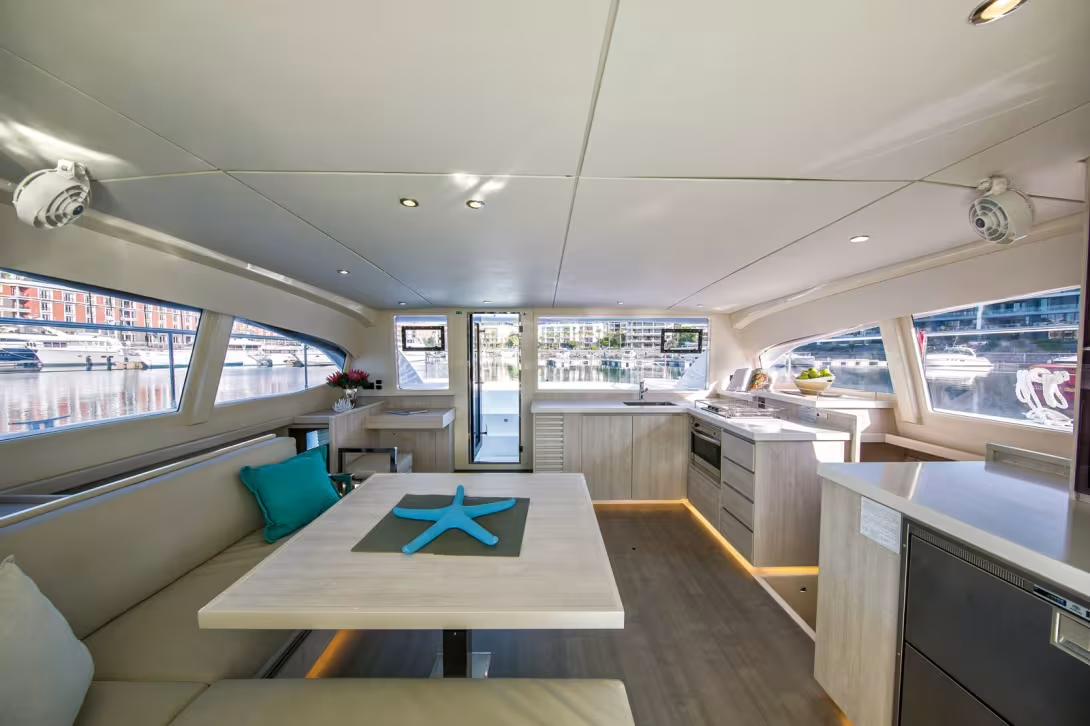
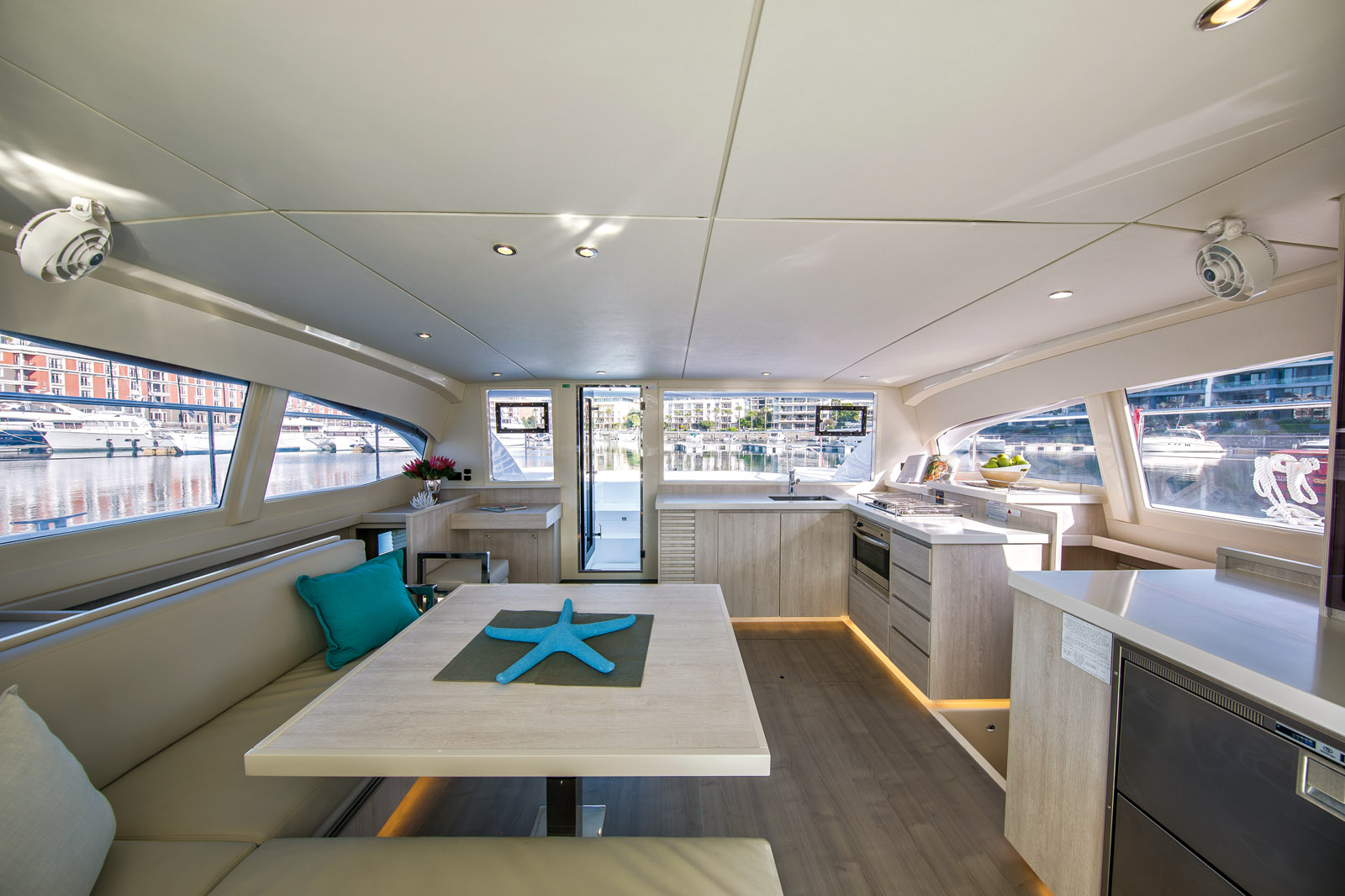
The nacelle is perfectly laid out. It has the advantage of opening onto the foredeck and offering very practical diagonal circulation. The galley is located forward, to starboard. On the opposite side of the door, a proper chart table. The L-shaped saloon adjoins the cockpit on the port side. Everywhere, there is plenty of storage space and efficient ventilation. The cabins are large and equipped with comfortable bathrooms.
 |
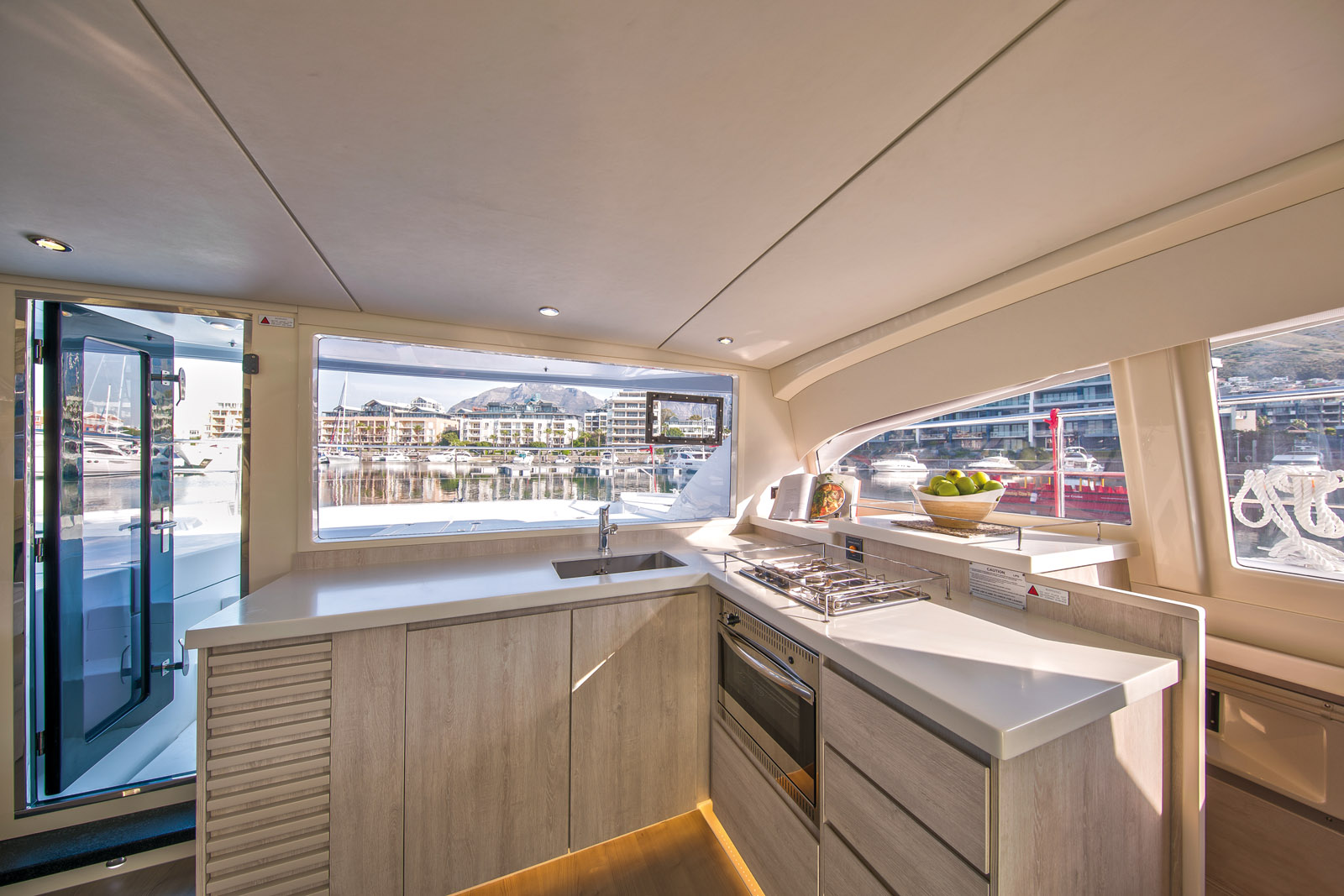 |
The nacelle is equipped with a forward door; the L-shaped galley, forward to starboard, doesn’t obstruct the circulation in the saloon and enjoys good ventilation.
Conclusion
The Leopard 43 PC is not only its manufacturer’s best-selling powercat, but it may still hold the title for all models combined. First place on the podium is contested by the Aquila 36 and the 44: both have well over a hundred units built and are still in production. Most 43 PCs are to be found in the Mediterranean, the Caribbean, the United States or the Seychelles and there’s even some in Thailand. While this model was relatively often seen on the second-hand market until 2020, Covid has changed that situation, lengthening the order books for new vessels. As a result, 43 PCs have become significantly more expensive and are selling very quickly with very low negotiation margins... at the time of writing, only two examples were currently looking for buyers. If you’re interested in this particularly convincing model for coastal and semi-offshore cruising, you should know that most of the models offered for sale are listed by the Leopard Brokerage.
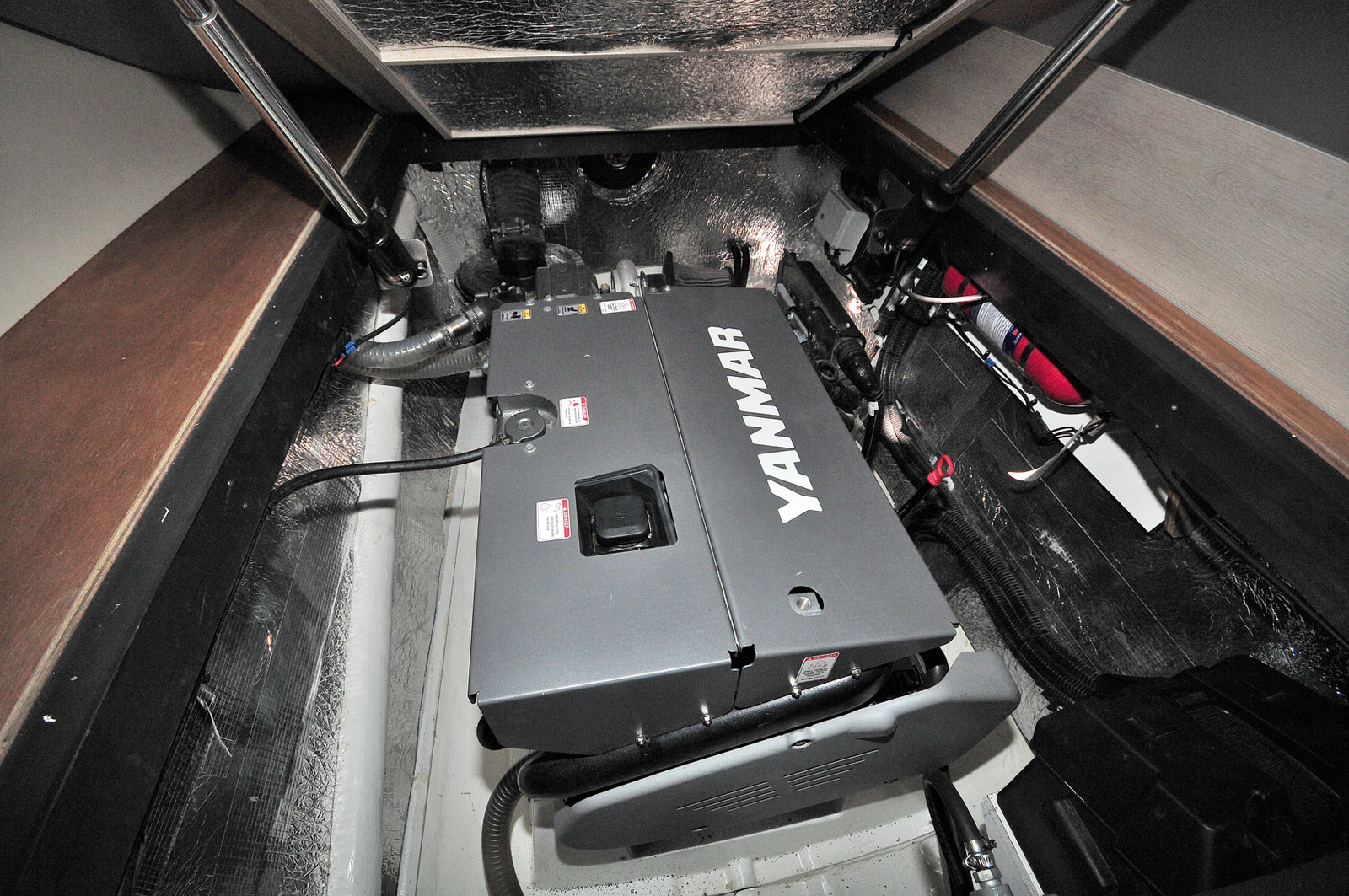
Early units were equipped with twin 260 HP motors, though the power was later increased to 2 x 320 HP.
Points to check
The Leopard 43 PC is still a recent powercat and its overall robustness is undeniable - two qualities that should avoid finding any big unpleasant surprises. Obviously, the units coming out of charter are a bit more tired than a privately owned catamaran. It is mainly the engines and all the peripherals (electrics, electronics, plumbing) that tend to suffer first from intensive use. A glance at the meters will speak volumes when you consider that the average life of a diesel engine is about 10,000 hours. Many fittings that might have been a bit lightweight are likely to have been replaced or are at risk of needing to be replaced, such as the clips that hold the headlinings in place or the drawer and door latches.
The Pluses:
+ Pleasing silhouette
+ Seakeeping qualities
+ Overall comfort
+ Enormous, convivial flybridge
The Minuses:
- No interior helm station
- Some fragile fittings
- Engines noisy above 2,000 rpm
TECHNICAL SPECIFICATIONS
Builder: Robertson & Caine
Length: 42’8” (13.00 m)
Beam: 22’ (6.72 m)
Displacement: 30,625 lbs (13.89 t)
Motors: 2 x 320 HP
Max speed: 24 knots
Fuel: 264 US gal (1,000 l)
Water: 206 US gal (780 l)
Cabins: 3 or 4
Production: 139 units built from 2015 to 2020
Price: from € 325,000 ex-tax
